33.9 C
Bangkok
Friday, June 26, 2026
Home Blog Page 2812

Scammed Official Turns Bottles Into Legal Action Against Scammer

Box of water bottles deputy mayor Narawuth Kunakham said he received, instead of the guitar he ordered online.

PHETCHABUN — When Narawuth Kunakham ordered a Yamaha guitar from an online shopping forum, he probably didn’t expect to get six bottles of water instead.

Now after finding himself the victim of a common scam that has long plagued the budding e-commerce industry in Thailand, Narawuth, deputy mayor of Petchabun city, said they scammed the wrong guy. He’s taking legal action.

“I want this case to be an example. This kind of thing happens everyday,” Narawuth said over the telephone today. “Many people get fooled, many people get scammed. But many of them did nothing. They thought it wasn’t worth their time, which only encouraged scammers to continue doing the scam. That’s why I want to set an example.” 

Earlier this month, Narawuth ordered a second-hand guitar from a seller on Kaidee.com, a portal for buying and selling between private parties.  Instead of the guitar for which he paid 1,800 baht, Narawuth said he received Monday a box containing six bottles of water.

Narawuth said he filed a fraud charge against the scammer – Kaidee.com user Ppsweetpork  – with Phetchabun City Police Station yesterday. 

Lt. Cpt. Warut Chuelinfa, an officer at the police station, confirmed the charge has been lodged, but declined to provide more information. 

According to Narawuth, he found out the seller’s name, phone number and home address because he ran the name of her bank account in the ID card database at his office. He said he has handed over all the information to the police.

“I’m confident the police will be able to make an arrest, because they have everything,” Narawuth said. “If only I had an arrest warrant in my hand, I’d make the arrest myself.” 

Narawuth said the scammer actually phoned him to apologize after news he had filed charges spread and wired the money back to him. But Narawuth vowed to press charges anyway.

“She returned the money to me, but I told her she has to return money to everyone she has scammed. And I won’t settle this matter out of court,” Narawuth said. “Returning the money [to everyone] merely makes her eligible for some reduction in her jail term.” 

Online shopping scams of this nature are common in Thailand, where e-commerce has recently exploded. In July 2014, police arrested a man for allegedly sending rocks to his clients who thought they were buying iPhones from him. 

Four months later, in November, a 16-year-old student filed a charge with police after she received a box of soap instead of the iPhone 4S she ordered from an online vendor. 


Teeranai Charuvastra can be reached at [email protected] and @Teeranai_C.


\

Advertisement

Torture in Deep South Systematic and Spreading Elsewhere, Rights Groups Allege

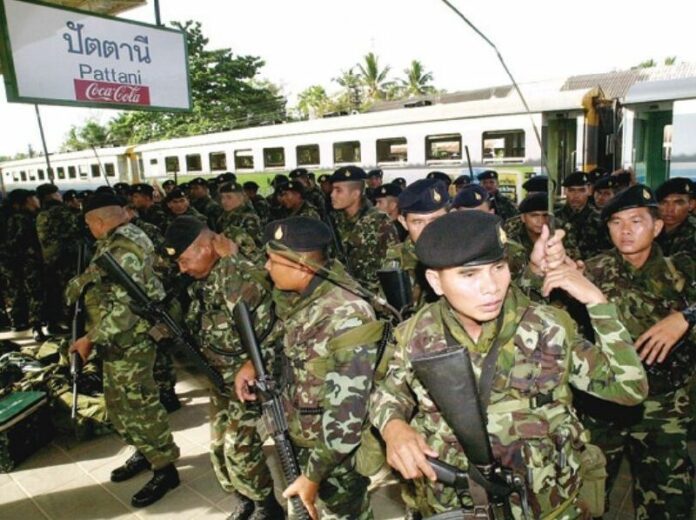
Embarking on a campaign of pacification under the government of former Prime Minister Thaksin Shinawatra, the first wave of soldiers arrive in Pattani in this May 2004 file photo.

BANGKOK — Torture ranging from waterboarding and strangling to threats of violence and sexual assault are used systematically by the army and police to force confessions from suspected insurgents in the Deep South, a new report alleges.

The second such report to be issued this month based on interviews with former detainees, the report to be released Wednesday by the Cross Cultural Foundation, Network of Human Rights Organizations in Pattani and Dua Jai Group warns that the alleged abuse undermines not just the justice system but support for the Thai state among Thai-Malay Muslims in the southernmost provinces.

“Torture in the [southern] border provinces is done systematically,” states the 120-page report. “It is destroying confidence in the structure of the state, both in acceptance of governance and confidence in the legal and justice systems. In the end, [suspects] may be lured into joining the violent struggle [for independence].”

Read: Army Denounces Deep South Torture Report as Product of ‘Imagination’

Col. Pramote Promin, spokesman for the Internal Security Operation Command, or ISOC, said they had not seen the report but dismissed it as yet another figment of its authors’ imaginations. He also accused one of its principal authors, foundation Director Pornpen Khongkachonkiet, of wanting to discredit the army and state.

Pornpen told Khaosod English the authorities should look into the findings of the “Report on Torture Situation and Inhumane, Cruel and Degrading Treatments in Southern Bordering Provinces 2014-2015,” before rejecting it outright. She stood by her findings, saying psychological evaluations of its sources, who are unidentified, were conducted to ensure the reliability of their accounts. The report includes testimony between 2014 to 2015 from 54 people, who recounted allegations of incidents both recent and old.

The tally by human rights groups counts more than 6,200 people killed between 2004 and 2014 in the Deep South, the report notes.

“My understanding is that ISOC doesn’t know its duty. The state has the responsibility to examine what’s happening. But they don’t read the reports, don’t examine their shortcomings and their policies,” Pornpen said, saying that ISOC’s stance is to ignore such torture allegations.

The report follows another released Feb. 2 by the Pattani-based Muslim Attorney Center Foundation. It contained similar allegations, saying the military used a wide range of physical and psychological abuse in 2015 to secure confessions from suspected insurgents.

Prominent human rights lawyer Somchai Hom-laor, another figure behind the report, said some torture techniques are now being adopted against ordinary Thais elsewhere in the kingdom who are believed to be threats to national security.

“We don’t want to condemn them or create hatred but want them to rectify the situation because it is undermining the state itself,” Somchai said.

The report noted that no single security officer has even gone to jail during the past decade over cases involving torture. The closest came in the 2007 case of Ashari Sama-ae, 25, who died while under detention without charge. The Supreme Administrative Court on Aug. 21 ordered the Prime Minister’s Office to pay his mother, Baedoh Sama-ae, compensation of 534,301 baht plus interest, which amounted to 1,014,000 baht, after the court found that Ashari died of head injuries while in the custody of ISOC, which operates under the prime minister’s office. No soldier was ever brought to justice in the case, however.

The report said that detention without charge under martial law, which is allowed for up to 37 days under the Emergency Decree, has created more opportunity for abuse, torture and degrading treatment of separatist suspects.

“The rights of these people have in fact been limited more so than criminal suspects who have been charged,” the report stated, adding that detainees are not allowed to see their relatives or attorneys, have no right to seek bail or temporary release, and in some cases are transferred to different detention facilities without the knowledge of family members.

The report claimed that both physical and psychological torture often starts when suspects are first arrested. Former detainees said mistreatment included having M16 rifle barrels stuck in their mouths, beatings, threats to kill them or their family members, threats of rape against their wives and more.

In one dramatic case, the report tells of a 27-year-old suspect who said he was arrested without charge in March 2014. He accused police officers of telling him to run from their vehicle for his life, which he refused to do out of fear of it being used as a pretext to kill him.

“The police officers said they would let me run, and if I succeeded [in fleeing], I would survive. I didn’t, and a police officer said, ‘That’s too bad, otherwise I would have sent you to join your dad [in the afterlife],’” he was quoted on page 21 of the report.

During interrogations, the report alleged a wide range of torture methods have been employed, such as waterboarding, stripping suspects naked, squeezing male suspects’ genitalia, strangulation, sleep deprivation, sensory deprivation by blindfolding and hooding, flagellation, foot roasting, electric shock, Chinese water torture and more.

Medical personnel have been complicit in the abuse, according to the findings.

Page 23 of the report notes an unnamed 29-year-old suspect’s account of being beaten in February 2014 only to be taken to see a medical doctor the next day.

“I was taken for a medical examination in the morning inside the [military] camp. The doctor didn’t examine me but issued a medical certificate stating that I wasn’t tortured,” he said.

The man alleged he eventually caved after three days of severe beatings and ominous threats.

“In the end I signed the document because the officers assaulted me all over my body and threatened to harm my wife, burn down my home, harm my parents and threatened that if I didn’t confess, they can send me to prison.”

The researchers said their subjects and alleged victims are suffering from anxiety, depression, Post-Traumatic Stress Disorder, anger and a desire for revenge.

“When I drive and see officers I feel scared, vengeful and as much as possible try to avoid seeing them,” one alleged victim was quoted saying.

Another described anguish over being subjected to unjust treatment.

“[I am ] stressed and worried. Why did they repeatedly arrest me when I didn’t do anything?” he is quoted saying. “I feel pain and anger in my heart that I am not getting justice.”

The report is in Thai with an English-language version forthcoming.

Advertisement

Tell’em ‘I’m Okay’ at Trasher’s Anti-Valentine Party

Joanna Lumley in ‘Absolutely Fabulous’ / BBC

BANGKOK — Whether you’re consciously single or a romance-hater tired of questions about your plans this Saturday, the party people of Trasher have a reason not to stay home with your cat.

Revisit or get schooled on all the bittersweet, brokenhearted Thai songs from the ‘90s onward at “Hey, I Told You I’m Okay,” where singles can dance until they feel better than just “okay,” and any tears on the dancefloor must be *sniff* tears of joy.

“We host this party especially for the heartbroken,” Trasher organizer Tichakorn “Jojo” Phukhaotong said. “We hope to gather them here to hug each other, weep, scream and scold asshole men for Valentine’s Day.”

Tickets are 300 baht and include one drink. The party runs from 9pm to 2am on Saturday at Ztudio Live Hall RCA at Royal City Avenue.


Chayanit Itthipongmaetee can be reached at[email protected] and @chayaniti92.

Follow Khaosod English on Facebook and Twitter for news, politics and more from Thailand. To reach Khaosod English about this article or another matter, please contact us by e-mail at [email protected].


\


Advertisement

Survivor Tells of Living Through Collapse of Taiwan Building

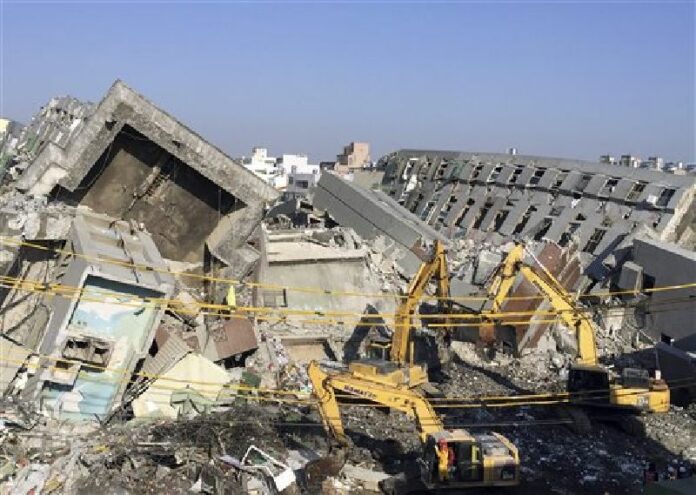
Rescue workers using excavators continue to search the rubble of a collapsed building complex in Tainan, Taiwan, Tuesday, Feb. 9, 2016. Photo: Annie Ho / AP

TAINAN, Taiwan — A survivor is telling of how he propped himself up against a wall for 20 hours to survive the collapse of a southern Taiwan building complex in Saturday's earthquake.

Ko Ching-chung said he was with his girlfriend in their apartment at the Weiguan Golden Dragon complex in the city of Taiwan when the 6.4 magnitude quake hit just before 4 a.m. on Saturday.

Seeking to avoid falling and potentially smothering her, Ko said he wedged himself into the space but began to lose strength as the hours went by. Finally, he could no longer hold himself in place and, begging her forgiveness, collapsed onto his girlfriend.

The young couple had been trapped in Saturday's pre-dawn collapse of the Weiguan Golden Dragon apartment complex in the southern Taiwanese city of Tainan following a strong earthquake. Outside, rescuers were frantically searching for survivors amid the smashed concrete and twisted iron.

"Toward the end, to tell you the truth, I had already given up," Ko told Taiwanese broadcaster FTV from his hospital bed on Monday, a day after he and his girlfriend were rescued.

"I had no strength left to hold myself up anymore. My body fell on top of her. She would have soon not been able to breathe. I said to her I had to lay on top of her, and she said to me it's OK."

Soon after, rescuers heard her voice and pulled the pair from the rubble, placing them among the more than 300 people who survived the tragedy that had claimed at least 40 lives by Tuesday. More than 100 people remain unaccounted for more than three days after the collapse.

Ko said his main desire following his rescue was to reunite with his loved ones, especially his mother, who had waited anxiously at the scene.

His mother, whose name wasn't given, said she shuddered when rescuers told her they could make out only a female voice.

"It was very difficult and horrible. But they continued digging, then they heard his voice," she said. "At that moment, I felt thankful to the gods in heaven and earth and all the blessings that people gave to us."

Also among the survivors was 8-year-old Lin Su-chin, who was rescued on Monday along with her 28-year-old aunt, Chen Mei-jih. On Tuesday, Lin had recovered enough after her 61-hour ordeal to speak a few words to her father and grandparents, mainly to express her wish for her favorite snacks.

"I want to eat gelatin, ice cream — I want to eat so many things," Lin said

Story: Associated Press


Advertisement

Very Sarcastic Temple Banner Prompts Drug Busts

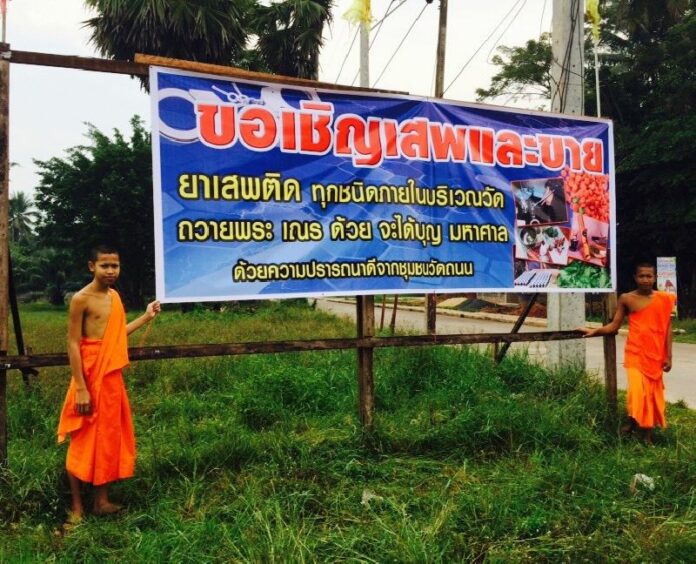
Novices pose with a sarcastic banner at Wat Thanon Suwan Pradit on Friday in Surat Thani province.

SURAT THANI — Police in Surat Thani province were goaded into raiding the community for drugs after a local abbot erected a banner complaining about rampant drug abuse in his temple.

Between Monday and Tuesday, the operation netted a dozen suspects and came in response to a scathing banner which sarcastically invited addicts to share drugs with the monks at Wat Thanon Suwan Pradit, a police commander said. 

“The operation started after he put that sign up,” said Col. Chamnote Kaewkhao, commander of Kanchanadith Police Station.

The banner was hung in front of the temple on Thursday, attracting much attention from residents and the media. 

“You are welcome to consume and buy drugs freely within the temple compound. You will also get a lot of blessings if you offer some to the monks and novices,” it read, along with photos of drug paraphernalia the abbot said he has found within the temple. 

Abbot Phra Kru Dharma Saraphorn said it’s not his monks getting high, but rather local addicts entering temple grounds.

“We are just several kilometers away from the district office, yet they still often sneak in and do drugs in the temple,” the abbot said to reporters on Friday. “Even though we have CCTVs, and police patrol the area every hour, the drug addicts aren’t deterred at all.” 

Four days after the abbot’s banner went up, police Monday raided local communities for two consecutive days and searched for evidence of drug use. The operation ended this morning, said police commander Chamnote. 

\

Police search for evidence of drug use Tuesday near Wat Thanon Suwan Pradit in Surat Thani province.


He said 12 suspects have been arrested in the two-day raid: nine for drug use and three on firearms charges. He also said the temple and its vicinity have long been known to police as a hotspot for narcotics. 

“The raid took place after the banner was erected, but in fact we have been strict in arresting these young gangsters,” Chamnote told Khaosod English. “Just last year, we arrested more than 20 of them.” 

Chamnote also said police are planning to conduct random urine tests on monks and novices at Thanon Suwan Pradit Temple. “The temple itself is also our target. Sometimes, monks and novices themselves do drugs. There’s been a lot of news about that,” the officer said. 


Teeranai Charuvastra can be reached at [email protected] and @Teeranai_C.


\

Advertisement

Very Sarcastic Temple Banner Prompts Drug Busts

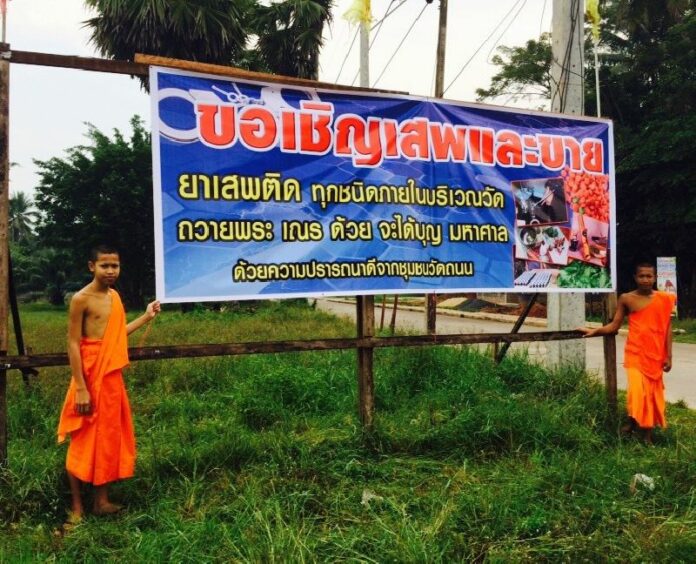
Novices pose with a sarcastic banner at Wat Thanon Suwan Pradit on Friday in Surat Thani province.

SURAT THANI — Police in Surat Thani province were goaded into raiding the community for drugs after a local abbot erected a banner complaining about rampant drug abuse in his temple.

Between Monday and Tuesday, the operation netted a dozen suspects and came in response to a scathing banner which sarcastically invited addicts to share drugs with the monks at Wat Thanon Suwan Pradit, a police commander said. 

“The operation started after he put that sign up,” said Col. Chamnote Kaewkhao, commander of Kanchanadith Police Station.

The banner was hung in front of the temple on Thursday, attracting much attention from residents and the media. 

“You are welcome to consume and buy drugs freely within the temple compound. You will also get a lot of blessings if you offer some to the monks and novices,” it read, along with photos of drug paraphernalia the abbot said he has found within the temple. 

Abbot Phra Kru Dharma Saraphorn said it’s not his monks getting high, but rather local addicts entering temple grounds.

“We are just several kilometers away from the district office, yet they still often sneak in and do drugs in the temple,” the abbot said to reporters on Friday. “Even though we have CCTVs, and police patrol the area every hour, the drug addicts aren’t deterred at all.” 

Four days after the abbot’s banner went up, police Monday raided local communities for two consecutive days and searched for evidence of drug use. The operation ended this morning, said police commander Chamnote. 

\

Police search for evidence of drug use Tuesday near Wat Thanon Suwan Pradit in Surat Thani province.


He said 12 suspects have been arrested in the two-day raid: nine for drug use and three on firearms charges. He also said the temple and its vicinity have long been known to police as a hotspot for narcotics. 

“The raid took place after the banner was erected, but in fact we have been strict in arresting these young gangsters,” Chamnote told Khaosod English. “Just last year, we arrested more than 20 of them.” 

Chamnote also said police are planning to conduct random urine tests on monks and novices at Thanon Suwan Pradit Temple. “The temple itself is also our target. Sometimes, monks and novices themselves do drugs. There’s been a lot of news about that,” the officer said. 


Teeranai Charuvastra can be reached at [email protected] and @Teeranai_C.


\

Advertisement

Fall Through Mall Roof Leaves Teen in Coma

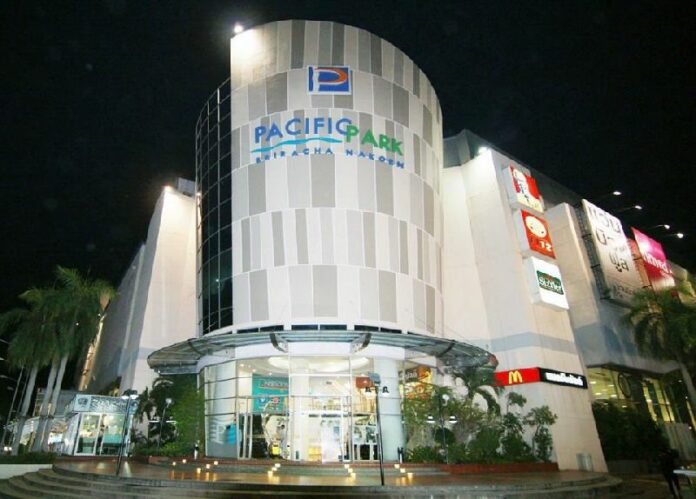
The five-story Pacific Park mall is located in the heart of Chonburi’s Si Racha district. Photo: Pacific Park / Facebook

CHONBURI — A 17-year-old student is in a coma after falling through the roof a mall last night after climbing up to take photos with his friends.

A female friend of the unidentified boy told police they were at the Pacific Park Sriracha and talked about going up to the deck to take photos because they’d heard the view was amazing. Consequently, they sneaked through an emergency exit and climbed up to a deck on the roof of the building.

The group of four friends reportedly took a set of photos before the boy asked to take a picture of them. He moved off of the deck and stood on unsupported roofing tile, at which point he fell through insulation material to the fourth floor.

The height of the fall was about 15 meters, police Lt. Col. Sirakran Tonsanguan said.
 

559000001460903.JPEG
 

The boy was seriously injured and sent to a hospital immediately. He’s presently in a coma, Sirakran said.


Chayanit Itthipongmaetee can be reached at [email protected] and @chayaniti92.

Follow Khaosod English on Facebook and Twitter for news, politics and more from Thailand. To reach Khaosod English about this article or another matter, please contact us by e-mail at [email protected].


Follow @KhaosodEnglish

\

Advertisement

Thai Teachers Pose as Foreigners to Teach English

Middle-school students at the Parliament Museum in a 2010 file photo. Photo: Office of the Prime Minister

BANGKOK — Seeing him from a distance, young children call out their Singaporean teacher’s name before sprinting toward him, excited to practice speaking English.

For their teacher, it’s a rewarding moment he says he could never experience if they knew the truth about him: He’s actually a Thai national who pretends he cannot understand every single word they say.

“They will value us less if they know we are a Thai teacher,” said Natthawut, who teaches at a school in the southern city of Hat Yai and asked Khaosod English not to publish his real name out of concern for his employer. “They will no longer be eager to speak English with us.”

Natthawut said he is among more than 200 English teachers, most of whom are recent graduates from Thai universities, working for the same company. For more than four years, the firm he works for has provided English teachers for both public and private schools across the country, especially those with special English programs.

Natthawut was one of three teachers working for the company, Make a Wit, to describe the same arrangement in which they teach children by posing as foreign English teachers. Their names have been changed for this story. After agreeing to be interviewed without reservation, two of the teachers said they did not want to be identified.

There’s nothing illegal about the practice, and all three teachers and a representative of the company described what they do as a valuable teaching technique that forces students to speak because they believe their teachers are foreigners who cannot understand Thai.

Reached for comment by a reporter, one of the company’s founders told Khaosod English they make it clear to schools and parents the teachers they provide are fully qualified Thai nationals.

He said their policy only calls for teachers to use English names and never speak Thai on school grounds, but said Make a Wit never advises them to lie to students about where they are from.

After answering several questions from a reporter, the company representative ended the interview and declined to give his name.


Ethical Deception?

Taya, another teacher at a school in Ratchaburi province said she told her students she was a Thai-American living in Canada before moving to Thailand six years ago.

When pressing her thumb on the fingerprint scanner at the school, what appears on the screen is the English name she invented for herself.

“The kids are always watching what the screen will say since they are skeptical of me,” said the 23-year-old teacher. “But on formal documents, I use my Thai name.”

Despite some initial reservations, all three teachers said they saw nothing unethical about the arrangement. The purpose of assuming a false identity, to them, is nothing more than a means of teaching that they believe works, and an effective method they were encouraged to use by the company which employed them.

“They told us it’s not a disguise,” said another woman, who goes by “Nicole” in the classroom. “But in practice, it is. They didn’t tell us to do it directly but they implied it.”

According to the teachers, the other school teachers and the students’ parents are all aware of the arrangement. Inquiries made to several schools supported that, as teachers answering the phone confirmed their Intensive English programs were taught by Thai nationals.

The only ones being fooled, they said, are the children.

“We are not deceiving anyone. The company agreed with the school to hire teachers who have an accent similar to foreigners, and parents know that,” Natthawut said. “We just don’t tell children.”

Taya said the company only hires Thai nationals because it believes they can better understand the children since they share the same culture and background and are familiar with the Thai education system, unlike foreigners.

“It is better to use a Thai teacher who has studied English directly than a European teacher who might carry the wrong accent,” she said.


Suspicious Minds

Lying to the Internet Generation is, of course, not easy. Natthawut himself once got in trouble because one of the his student discovered his Instagram account on which he wrote in Thai.

“They tracked me from who is followed by my colleague’s account,” he said. “Back then I wasn’t careful enough to set my Instagram to private.”

Deeply wired Bangkok children are even craftier. Teacher Nicole, or Supaporn in Thai, said after a lot of tricks, some students finally found out she was Thai and not the Filipina she claimed to be.

“In the beginning I felt weird with a repressed feeling of, ‘Why do I have to be another person, am I deceiving the kids?’” Supaporn said. “Now I let it go and think what I’m doing is more like training them.”

But not everyone agrees that teachers misrepresenting themselves in the classroom is a good way to teach English. One well-known teacher who has stood before classes of students for 32 years said it should not even be an option.

“It’s a totally wrong concept. Moreover, what kind of ethics are you teaching to the children?” said Somphot Panawas, an expert on English language instruction at Suan Dusit University.

For Somphot, the psychological reasoning behind the technique – that students are more engaged and forced to speak – is an excuse.

“The excitement comes from the activities and the teaching methods, not the nationality of the teacher,” he said.

Teaching English to beginners without the support of their mother language is not always the best means, Somphot said was the opinion of experts, and can make the instruction useless for weak learners.


Lower-Cost Alternative

According to government regulations, teachers in English programs are not required to be native speakers, however they must achieve a required score on tests of English ability.

The quality of English language instruction in Thailand has long been lamented, and stories of poor student performance are news media staples.

Some parents prefer their children learn English from foreigners, but qualified teachers tend to be in short supply, especially due to the relatively low pay at public primary and secondary schools.

In a cost-saving measure, the Ministry of Education announced in November it would seek to cut the number of foreign teachers and invest in intensive training of Thai teachers.

Authorities at the Ministry of Education said schools face other obstacles in hiring qualified foreign teachers, such as a contentious Thai language and culture course they are required to complete.

But the most important reason cited by a high-level education official is the fact that schools receive no subsidy to employ foreigners, so they often have to go with the most affordable choice.

“Native speakers’ wages are usually expensive,” said Deputy Permanent Secretary Chaiyot Imsuwan. “But if you only want someone who can speak English, the wages are less.”

While people debate over whether the nationality of teachers influences attitudes of English-language learners, Chaiyot said one matter is already settled: The quality of their teachers depends on how much their parents can afford.


\

Advertisement

Thai Teachers Pose as Foreigners to Teach English

Middle-school students at the Parliament Museum in a 2010 file photo. Photo: Office of the Prime Minister

BANGKOK — Seeing him from a distance, young children call out their Singaporean teacher’s name before sprinting toward him, excited to practice speaking English.

For their teacher, it’s a rewarding moment he says he could never experience if they knew the truth about him: He’s actually a Thai national who pretends he cannot understand every single word they say.

“They will value us less if they know we are a Thai teacher,” said Natthawut, who teaches at a school in the southern city of Hat Yai and asked Khaosod English not to publish his real name out of concern for his employer. “They will no longer be eager to speak English with us.”

Natthawut said he is among more than 200 English teachers, most of whom are recent graduates from Thai universities, working for the same company. For more than four years, the firm he works for has provided English teachers for both public and private schools across the country, especially those with special English programs.

Natthawut was one of three teachers working for the company, Make a Wit, to describe the same arrangement in which they teach children by posing as foreign English teachers. Their names have been changed for this story. After agreeing to be interviewed without reservation, two of the teachers said they did not want to be identified.

There’s nothing illegal about the practice, and all three teachers and a representative of the company described what they do as a valuable teaching technique that forces students to speak because they believe their teachers are foreigners who cannot understand Thai.

Reached for comment by a reporter, one of the company’s founders told Khaosod English they make it clear to schools and parents the teachers they provide are fully qualified Thai nationals.

He said their policy only calls for teachers to use English names and never speak Thai on school grounds, but said Make a Wit never advises them to lie to students about where they are from.

After answering several questions from a reporter, the company representative ended the interview and declined to give his name.


Ethical Deception?

Taya, another teacher at a school in Ratchaburi province said she told her students she was a Thai-American living in Canada before moving to Thailand six years ago.

When pressing her thumb on the fingerprint scanner at the school, what appears on the screen is the English name she invented for herself.

“The kids are always watching what the screen will say since they are skeptical of me,” said the 23-year-old teacher. “But on formal documents, I use my Thai name.”

Despite some initial reservations, all three teachers said they saw nothing unethical about the arrangement. The purpose of assuming a false identity, to them, is nothing more than a means of teaching that they believe works, and an effective method they were encouraged to use by the company which employed them.

“They told us it’s not a disguise,” said another woman, who goes by “Nicole” in the classroom. “But in practice, it is. They didn’t tell us to do it directly but they implied it.”

According to the teachers, the other school teachers and the students’ parents are all aware of the arrangement. Inquiries made to several schools supported that, as teachers answering the phone confirmed their Intensive English programs were taught by Thai nationals.

The only ones being fooled, they said, are the children.

“We are not deceiving anyone. The company agreed with the school to hire teachers who have an accent similar to foreigners, and parents know that,” Natthawut said. “We just don’t tell children.”

Taya said the company only hires Thai nationals because it believes they can better understand the children since they share the same culture and background and are familiar with the Thai education system, unlike foreigners.

“It is better to use a Thai teacher who has studied English directly than a European teacher who might carry the wrong accent,” she said.


Suspicious Minds

Lying to the Internet Generation is, of course, not easy. Natthawut himself once got in trouble because one of the his student discovered his Instagram account on which he wrote in Thai.

“They tracked me from who is followed by my colleague’s account,” he said. “Back then I wasn’t careful enough to set my Instagram to private.”

Deeply wired Bangkok children are even craftier. Teacher Nicole, or Supaporn in Thai, said after a lot of tricks, some students finally found out she was Thai and not the Filipina she claimed to be.

“In the beginning I felt weird with a repressed feeling of, ‘Why do I have to be another person, am I deceiving the kids?’” Supaporn said. “Now I let it go and think what I’m doing is more like training them.”

But not everyone agrees that teachers misrepresenting themselves in the classroom is a good way to teach English. One well-known teacher who has stood before classes of students for 32 years said it should not even be an option.

“It’s a totally wrong concept. Moreover, what kind of ethics are you teaching to the children?” said Somphot Panawas, an expert on English language instruction at Suan Dusit University.

For Somphot, the psychological reasoning behind the technique – that students are more engaged and forced to speak – is an excuse.

“The excitement comes from the activities and the teaching methods, not the nationality of the teacher,” he said.

Teaching English to beginners without the support of their mother language is not always the best means, Somphot said was the opinion of experts, and can make the instruction useless for weak learners.


Lower-Cost Alternative

According to government regulations, teachers in English programs are not required to be native speakers, however they must achieve a required score on tests of English ability.

The quality of English language instruction in Thailand has long been lamented, and stories of poor student performance are news media staples.

Some parents prefer their children learn English from foreigners, but qualified teachers tend to be in short supply, especially due to the relatively low pay at public primary and secondary schools.

In a cost-saving measure, the Ministry of Education announced in November it would seek to cut the number of foreign teachers and invest in intensive training of Thai teachers.

Authorities at the Ministry of Education said schools face other obstacles in hiring qualified foreign teachers, such as a contentious Thai language and culture course they are required to complete.

But the most important reason cited by a high-level education official is the fact that schools receive no subsidy to employ foreigners, so they often have to go with the most affordable choice.

“Native speakers’ wages are usually expensive,” said Deputy Permanent Secretary Chaiyot Imsuwan. “But if you only want someone who can speak English, the wages are less.”

While people debate over whether the nationality of teachers influences attitudes of English-language learners, Chaiyot said one matter is already settled: The quality of their teachers depends on how much their parents can afford.

 

Advertisement

48 Hurt, 24 Arrested in Hong Kong Fish Ball Riot

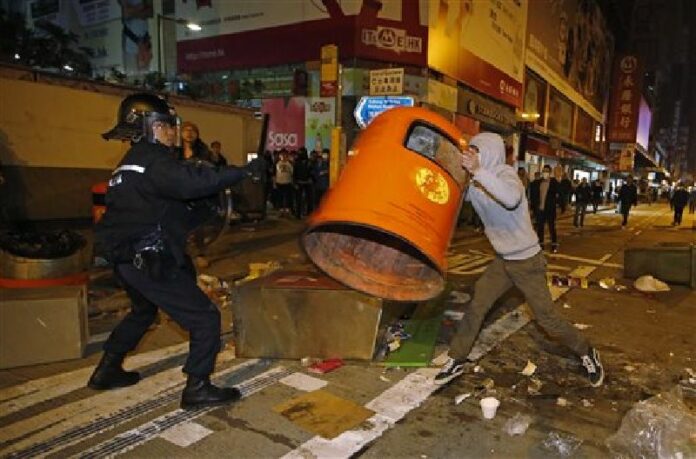
A rioter tries to throw a litter bin at police on a street in Mong Kok district of Hong Kong, Tuesday, Feb. 9, 2016. Photo: Kin Cheung / AP

HONG KONG — Hong Kong's Lunar New Year celebration descended into chaotic scenes as protesters and police, who fired warning shots into the air, clashed over a street market selling fish balls and other local holiday delicacies, leaving dozens injured and arrested.

The violence is the worst in Hong Kong since pro-democracy protests rocked the city in 2014, leaving a growing trust gap between the public and authorities.
Activists angered over authorities' attempts to crack down on the food hawkers in a crowded Kowloon neighborhood held running battles with police into the early morning hours of Tuesday.

Protesters pelted officers with bottles and pieces of trash. Some threw garbage cans, plastic safety barriers and wood from shipping pallets at them. They also set fires on the street.

At one point, a protester tried to tackle a traffic police officer from behind before both sides rush in to the melee in the middle of a busy street, according to footage shown by local news channel Cable TV. Moments later, another officer appeared to fire two warning shots into the air.

Hong Kong police said in a statement that the protesters had ignored their warnings to get off the street and shoved officers, who responded with batons and pepper spray.

\

Riot police try to block the bricks thrown by the protesters on a street in Mongkok district of Hong Kong, Tuesday, Feb. 9, 2016. Photo: Kin Cheung / AP


Acting District Commander Yau Siu-kei said 23 men and one woman were arrested on suspicion of assaulting and obstructing officers, resisting arrest and public disorder. The arrested were as young as 17 and as old as 70. Police said 48 officers were hurt by glass and flying objects.

Yau said two warning shots were fired.

The unrest started when authorities tried to prevent unlicensed street food sellers from operating on Monday night in Mong Kok, a working-class district of the city. The hawkers have become a local tradition during the Lunar New Year holiday but this year authorities tried to remove them.

\

 A protester kicks a riot police in Mong Kok district of Hong Kong, Tuesday, Feb. 9, 2016. Photo: Kin Cheung / AP


The hawkers were backed by activists who objected to the crackdown over concerns that Hong Kong's local culture is disappearing as Beijing tightens its hold on the semiautonomous city.

The latest scuffles underscore how tensions remain unresolved more than a year after the end of pro-democracy protests that gripped the city. Mong Kok, a popular and densely populated shopping and entertainment district, was one of the neighborhoods where activists occupied streets for about 11 weeks in late 2014, capturing world headlines with their demands for greater electoral freedom.

Story: Kelvin Chan / Associated Press

Advertisement

Hot News

LATEST NEWS

Bangkok
broken clouds
33.9 ° C
36.6 °
33.8 °
65 %
4.7kmh
52 %
Fri
36 °
Sat
36 °
Sun
37 °
Mon
37 °
Tue
36 °