25.5 C
Bangkok
Saturday, June 20, 2026
Home Blog Page 2860

Briton Among 5 Terrorism Suspects Arrested in Malaysia

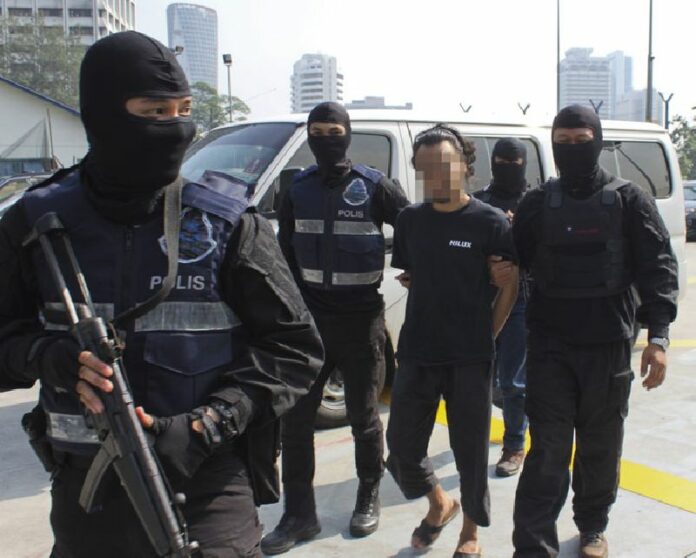
Malaysia's Special Branch Counter Terrorism Division officers arrest suspected Islamic militants in Kuala Lumpur, Malaysia, in a July 9 file photo. Photo: EPA / Royal Malaysian Police

KUALA LUMPUR — A British citizen was among five suspects arrested in Malaysia on suspicion of being involved with terrorist groups, the national police chief said Sunday.

Inspector General Khalid Abu Bakar said the British suspect was arrested in central Kuala Lumpur last month, and has already been deported.

"He has links with al-Qaeda," Khalid said." He fought in Afghanistan and Bosnia."

The police chief said the suspect was a part-time teacher in the northern state of Penang. He did not say when the man first arrived in Malaysia.

The four other suspects arrested in the sweep over the past two weeks were a Nigerian national, a Bangladeshi man, an Indonesia national and a Malaysian man. The four were believed to have ties with Islamic State militants.

The Home Affairs ministry said nearly 100 Malaysians have gone to Syria and Iraq to fight with IS.

Advertisement

Do or Not Do There is No Try: Bangkok Events to Awaken Your Force

Original photo: Jakob Montrasio / Flickr

In just two weeks, a rising wave of multi-generational pop culture will peak and crash in just 2 hours and 16 minutes inside a darkened theater.

To make the most of that for those who consider Star Wars a lifestyle or religious creed, Jedi boosters and Sith capitalists have conspired to put on a number of thematic events in Bangkok – before during and after the Dec. 17 release of “Star Wars: The Force Awakens.”

Those on the light side can condition their inner geek at a race, while an RCA nightclub seeks to tempt you to the dark side. For all the lovable rogue-types out there, some pop art will be auctioned off for charity.


May the Beats be With You

\

Two nights after the movie’s release, Live RCA Bangkok invites all the dancing Ewoks of Endor to a special themed night.

Sith Lords will spin dark and tech house In the “Enter the Death Star” zone, while the “outer rim’s scum and villains” get it on to afrobeats in the “Mos Eisley Cantina.” Disco and fancy foreign beer will be on tap in “The Jedi Garden.”

The event starts at 8pm on Dec. 19 at Live RCA Bangkok. The first 100 guests get a Darth Vader or Stormtrooper mask.


Helmet Art Project  by The 501st Legion

\

Organized by official Star Wars fan club 501st Legion, the Helmet Art Project will showcase stormtrooper helmets decorated by 18 local celebs and amateur artists.

The amateur artists personalizing the iconic clone headgear include U.S.-based ubercollector Steven Sansweet, director Yutthana “Pa Ted” Boon-aom, DJ Plakung, DJ Chao Chao, Khemanit “Pancake” Jamikorn, Saharat “Kong” Sangkapreecha and more.

All helmets will be auctioned off with the money going to the Children’s Hospital Foundation.

The exhibition runs for seven days starting Dec. 12 at CentralWorld.


Star Wars Run

\

Bring a lightsaber and prepare to stay on target for seven kilometers of running battles at the upcoming Star Wars Run.

Runners will fight stormtroopers and clear three levels: Laser Station at MBK Center, Snow Station at Suanluang Square and Space Tunnel Station at Chamchuri Square.

Participants are welcome to arrive at Siam Square early at 8pm to join the opening ceremony and concert.

Tickets are 900 baht and includes a licensed Star Wars water bottle, T-shirt, tote bag and “prestige coin.” Pray the Force Runs Through You starting at 10:30pm on Dec. 26 at Siam Square.

Advertisement

An Open Letter to Ultra-Royalists

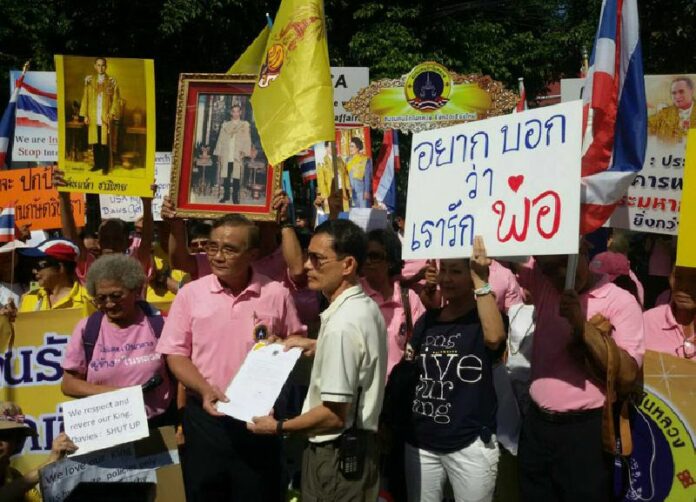
Ultra-royalists denounce U.S. Ambassador Glyn Davies in Chaing Mai at one of more than a dozen nearly identical, coordinated protests staged Nov. 30 in provinces throughout the nation. Photo: Welovethaiking.com

By Pravit Rojanaphruk
Senior Staff Writer

\

Dear Ultra-Royalists,  
  
How surprisingly delighted I was to read that hundreds of you
gathered at the U.S. Embassy and throughout the provinces during the past week to oppose the criticism of the lese majeste law by new U.S. Ambassador Glyn Davies and call for his ouster. It’s good and yet ironically surreal to see all you folks exercising your freedom of political assembly – despite the supposed junta ban on any political gathering of five or more people – to exercise your freedom of expression to further curb others’ freedom of expression.

\While I respect your ideological and political views with regards to the monarchy, I was disappointed that the venerable monk Buddha Issara, who led protesters Nov. 27 to the U.S. Embassy, claimed to be speaking on behalf of all Thais.

I have no qualm with him saying “we are not slaves of the U.S.,” and if I may add, we should be slaves to no one. Yet his venerableness was also quoted in the media as speaking on behalf of all Thais. “The monarchy is a sacred symbol that all Thais are ready to defend with their lives,” were his words Nov. 28 in Bangkok Post.

“All Thais” is quite broad and leaves no space for diversity of thought among Thai citizens.

Did your leader not know or had conveniently forgotten that just back in 2012, at least 39,185 signatures were collected in a bid to petition the parliament to amend the lese majeste law?

As much as I would never claim to speak for ultra-royalists, other people should try not to speak for me, for I know that there are Thais who find the lese majeste law not just an embarrassment, but an anachronistic, draconian and even barbaric law under which people are sentenced to prison for up to 15 years for simply stating something negative or critical about the monarchy.

Like any complex society, there’s no single way to be Thai, no single Thai view but a multiplicity of Thai ways. Your nationalism may be focused on a few key institutions, but my patriotism is for the greater liberty and equality of all.

Where there arises important disagreement, we should discuss, debate, deliberate, seek common ground and hopefully strike compromise instead of pretending it doesn’t exist.

Unfortunately, there are some Thais who think there exists no debate about the appropriateness of the lese majeste law in the 21st century and assume that all endorse it.

The debate about the merit of the lese majeste law will continue, no matter what one side claims or whether a foreign envoy mentions it or not, until there is an acceptable compromise that’s acceptable to most, if not all.

Foreigners like Ambassador Davies who spoke at the Foreign Correspondents Club of Thailand on Nov. 25 are just stating the obvious from a different point of view that no one should be jailed for peacefully expressing an opinion. It’s easy to blame the “ugly Americans” poking their noses into internal affairs and forget the existence of the internal debate on the issue which is far from settled.

Such critical views against the lese majeste law is not exclusively held by Western liberals but by a good number of Thais, who aspire to see a more free and open Thailand where people can publicly articulate about this important institution without fear or having to resort to gossip, and where people like myself can write without having to censor myself to the extent that only positive things about the monarchy are fit to be published. Alas, some Thais are now seeking to even make criticism of the law itself a taboo. They now want not just the monarchy to be above criticism but the law to be above criticism too. They have mistaken criticism of the law as ill-intended and malicious toward the monarchy. This is like saying those who oppose capital punishment must support heinous crimes, while the fact is that they are for a right to life and chance for criminals to redeem themselves.

Let us not see things in black and white. Let us not fool ourselves and others any longer and make a mockery of Thailand in front of the world and pretend that we all have a consensus on the issue.

The truth is so embarrassingly clear when foreign journalists interview prisoners of conscience or those who are against the law. We owe it to our posterity to sort out our differences in a calm, civilized, rational and amicable way.

And just because we think differently on the issue does not means we have to regard each other as mortal enemies or fill up social media with hate speech.

Let the light of reason prevail.

With my best wishes to all of you and to all Thai people,

Pravit Rojanaphruk


P.S. By the way, I wouldn’t be too worried about the call for the removal of the American Ambassador. Davies used to handle North Korea, and I don’t believe anything in Thailand will put him off balance. But all of you have the right to continue calling for his ouster. Incidentally, as I recently told two curious U.S. diplomats, although there are not many of you, there are enough to overrun their embassy.


Pravit Rojanaphruk can be followed on Twitter at @PravitR

Advertisement

Get ‘Trapped’ at Jam Cine Club this Month

'Woman in the Dunes' 1964

By Lisnaree Vichitsorasatra
Staff Reporter

BANGKOK — Ever feel trapped and unable to get out? If you ever felt like you can’t escape, the theme of weekly, free films showing this month at Jam is Cleithrophobia, the fear of being trapped in an enclosed space.

Organizer Camille Lacadee, an architect and Bangkok filmmaker, said the idea came from her recurring dreams about being entrapped in endless multiplying corridors and spaces. She is also a cinephile who likes to discuss films.

Next up on Dec. 9 is Al Pacino as a bank robber in Sidney Lumet’s 1975 “Dog Day Afternoon.” The film is loosely based on the true story of John Wojtowicz, who robbed New York City banks to finance a sex-reassignment surgery. Lacadee said she chose the film she everyone can relate to the feeling of being trapped in their own body.

On the Dec. 16, a man collecting insects finds himself trapped in the sand dunes, unable to return home, Japanese director Hiroshi Teshigahara’s 1964 film  “Woman in the Dunes.” It’s based on a book by novelist Kobo Abe.

"[Women in the Dunes] is a sort of allegory of our existence, between the struggle for an illusion of freedom and the everyday routine of work and relationship, about finding oneself- where one is and renouncing the urge to escape,” Lacadee said.

Another fear – androphobia – will feature Dec. 23 in “Repulsion,” a 1961 psychological horror film by Roman Polanski starring eternal French bombshell Catherine Deneuve. In it, Deneuve’s character copes with her fear of men.

Each screening is followed by casual discussion and analyses. Of course booze and food are available throughout at the art bar located off lower Sathon Road a short walk from BTS Surasak.

Read more about Jam Cine Club or find the venue.


Advertisement

Activists to Visit Rajabhakti Park Despite Likely Detention of Student Leader

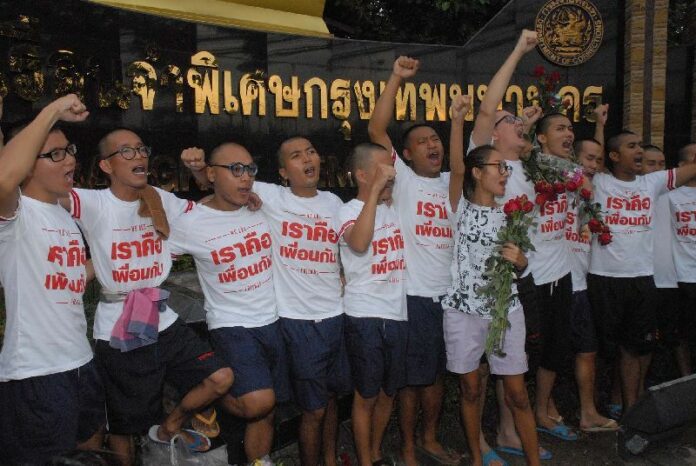
Fourteen activists of the New Democracy Movement celebrate their release July 8 from a Bangkok prison.

By Pravit Rojanaphruk
Senior Staff Writer

BANGKOK — A leader of a pro-democracy group said their plans to visit a scandal-plagued “history park” built by the army are unchanged after one of his fellow student activists was believed to have been detained by the military.

Siriwith Seritiwat, a Thammasat University student and member of the New Democracy Movement, was not heard from for some time after telling friends an army officer had summoned him to a meeting Saturday afternoon, according to Rangsiman Rome, another leader of the group.

Rangsiman and others worried he'd been taken into custody, but Siriwith posted to Facebook on Saturday evening that he was still free.

His order to appear from the military came after members of the group said they would travel to the controversial Rajabhakti Park, which was built by the military and is now embroiled in allegations of corruption, as a symbolic reminder that the military is not above corruption.

On Facebook, Siriwith wrote that visit would go ahead whether he was arrested or killed.

On Monday, two Redshirt leaders were on their way to the park, which was built to glorify the monarchy but has become a source of embarrassing revelations for the military, when they were detained by soldiers for several hours before being released.

Rangsiman said the military has always insisted it’s not corrupt and positions itself as aggressively anti-corruption, so the trip was to be a reminder to the public this is not always the case.

The trip is to include about 30 people including members of the group, some of which have were previously arrested, charged, held and ultimately released in June for protesting against the junta, and members of the public.

Rome said they would board a train bound for the Hua Hin district of Prachuap Khiri Khan province, where the park is located. The group planned to depart Bangkok’s Bangkok Noi train station at 7am on Monday.

Asked whether the group thinks it will be allowed to proceed or stopped like the Redshirts, Rangsiman said he hopes they’ll be allowed to travel unimpeded.

“I try to think nothing will happen,” said Rangsiman, who himself will not join the trip due to an upcoming examination at Thammasat University, where he’s a postgraduate student.

Rome added someone should take responsibility for the park, especially since former army chief Gen. Udomdej Sitabutr, who oversaw the approximately 1 billion-baht project, admitted to some financial irregularities. Among allegations Udomdej confirmed were “commissions” collected by a middleman from foundries approved to cast the giant king statues that are the park’s main feature.

Rangsiman denied the move is merely a stunt to provoke the junta to react – or overreact.

He said the public, including his fellow activists, are talking about the alleged corruption, making it imperative they be able to see the site, where giant statues of seven past kings have been erected, with their own eyes.

“I don’t see this as an act of provocation to the National Council for Peace and Order,” he said, referring to the formal name of the military junta which staged the coup in May 2014. “Many have never been there themselves."

Update: This story has been updated to reflect Siriwith's confirmation Saturday night he was not in military custody.

Pravit Rojanaphruk can be followed on Twitter at @PravitR


Related stories:

Rajabhakti Scandal: Redshirt Leaders Released

Former Army Chief Explains Royal Park Project Graft

Junta Weighs Charges Against Coup Anniversary Marchers

Student Activists Arrested for Anti-Coup March in Bangkok

3 Students Charged For 2006 Coup Commemoration

Advertisement

What's Going on Inside Junta's 'Black Site?'

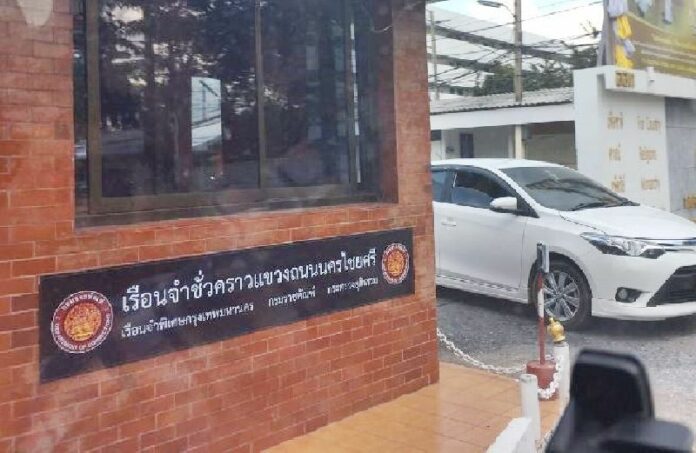
The sign outside the prison located inside the 11th Army Circle base in Bangkok in a Dec. 3, 2015, photo.

By Pravit Rojanaphruk
Senior Staff Writer

BANGKOK — Abuse, illegal interrogation methods, forced confession, torture or worse have been speculated by human rights activists and experts as possibilities inside a temporary prison at a Bangkok military base.

Despite giving reporters a limited tour Thursday of the 11th Military Circle facility, the junta’s refusal to close down the facility, reserved for suspects deemed threats to national security, has led critics and rights activists to suspect it’s used for heavy-handed interrogation of civilians and the possible use of torture and more, which is effectively undermining the public’s already dwindling faith in the justice system.

“They want to control the process starting from the arrest and incarceration [of suspects] inside military compound in order to force confessions,” said Jon Ungpakorn, a former elected senator and executive director of iLaw, a human rights documentation and legal advocacy group. Jon pointed out that this includes solitary confinement, considered a form of torture according to international norms, as it leads to confession even before the suspect is brought to court.

“This results in the destruction of the judicial process,” Jon said. “Actually the whole process is being undermined from the very day they started summoning people for attitude adjustment [and detain them without charge].”


Reporters Tour Controversial Military Prison Where 2 Died


New York-based Human Rights Watch is one of the organizations calling for shutting down the facility. Sunai Phasuk, senior Thai researcher at Human Rights Watch, said the practise is unprecedented and constitutes a blatant disregard for proper judicial process.

He said the United Nations has also made similar demand but to no avail.

“Nothing like this has ever occurred,” Sunai noted. “I guess they don’t care. The junta doesn’t care about complying with Thailand’s international obligations. They think that the excuse of ‘domestic security [concerns]’ justify it. Human rights commitments for the junta are non-binding. They can use sedition charges, employ arbitrary arrest and create a reign of fear with the purpose of sending the message that this is the ultimate consequence of defying the military regime.”

Sunai said his organization thinks the National Council for Peace and Order, the formal name of the junta, is trying to introduce new and unprecedented levels of human rights violations. Human Rights Watch concluded in one of its latest statements that Thailand is moving toward becoming a pariah state.
 

 \
Police Maj. Prakrom 
Warunprapha was first revealed as one of the accused of defaming the monarchy by exploiting their ties for personal gain when he was taken to a military court on Oct. 21. Two days later officials said he hanged himself inside his cell at the 11th Army Circle.

Fear of Rendition, Torture or Worse

What may be happening inside the base, located in the Nakhon Chaisri subdivision of Bangkok’s Dusit district, where at least eight suspects are currently held is a subject of widespread speculation.

This is the same military which, if you believe a five-year report on torture from Washington, facilitated the CIA in setting up a “black site” in Thailand for torturing terror suspects in 2002 during the first term of Prime Minister Thaksin Shinawatra. (Not true, junta said one year ago.) And the Americans are known to have tortured at least 10 people to death during the next couple years after that.

On Thursday members of the media, including Khaosod English, were shown the cells, where inmates were instructed to sit facing away from them. Reporters were not allowed to speak to any of them. That has not dispelled concerns about what might be happening inside the “temporary” facility, which the corrections department said will be more than doubled in size from five to 11 cells.

“It may be a place for illegal interrogation techniques,” said Somchai Preechasilpakul, a law lecturer and former dean of law at Chiang Mai University. “But my view is that the place is maintained so those taken in won’t dare dispute the charges against them, particularly lese majeste charges. There must be some ‘special measures’ being applied.”

Asked what these measures might be, Somchai said: “Well, like limiting access to suspects by outsiders and quickly building up cases against the suspects.”

Arnon Nampa, a member of Thai Lawyers for Human Rights noted that not all suspects accused of violating security laws or the lese majeste law have been detained inside the camp, however.

“The fact that only some are being detained inside suggest that this is a special detention facility serving a particular mission – possibly illegal interrogation methods, forced confession, forced implication of others, but don’t write torture down yet. And two people have died while in custody,” said Arnon, referring to lese majeste suspects police Maj. Prakrom Warunprapha and former palace aide Suriyan “Mor Yong” Sujaritpalawong, both accused of citing the monarchy for monetary gain. The public were told that Pakrom hung himself while Suriyan contracted a blood infection. No independent fact-finding committee was convened and both bodies were quickly cremated.

Although it’s technically said to operate under the purview of the Department of Corrections, Arnon doesn’t buy that as anything more than for the sake of appearance.

“In practise, it’s like having detainees under the direct authority of the army,” he said.

One human rights activist who asked to remain anonymous due to her sense of insecurity said any form of harsh interrogations, torture or worse could have taken place inside. She said at the very least, the suspects could be “visited” and “interrogated” at any time, possibly by those not legally assigned to interrogate them.

Junta spokesman Winthai Suvari was contacted by phone three times to discuss why the junta feels it is necessary to keep the temporary remand facility open, but did not return calls. On Thursday, Department of Corrections chief Witthaya Suriyawong described it as a comfortable facility, where nearly every detainee had their own cell and toilet.

It currently holds seven inmates: five lese majeste suspects and two Uighur men – Mohammad Bilal and Yusufu Mieraili – accused of bombing Bangkok’s Erawan Shrine on Aug. 17.

The five accused of defaming the monarchy are: Jirawong Watanathewasilp, Prathin Chanket, Nattapol Nawanle, Wallop Boonchan, Pahiran Kongkham. The latter four are alleged members of a Khon Kaen-based Redshirt faction accused of lese majeste and conspiring to overthrow the government.


 \
Suriyan Sujaritpalawong, a celebrity psychic with national fame, was taken to a military court on Oct. 21 where the former palace aide was accused of being one of the ringleaders of a gang of "royal impostors." On Nov. 9 officials announced he'd died two days earlier due to a "blood infection."


Don’t Stop Demanding Change

Jon insisted that citizens and various concerned groups must keep on applying pressure and demanding the immediate end to the facility’s use, as well as the use of military tribunals to try civilians.

“It’s our duty,” he explained.

Request for access to examine the prison’s conditions by the Cross Cultural Foundation, a human rights group mostly focused on the Deep South, has been denied by the Department of Corrections which is legally overseeing the prison inside military camp.

Witthaya, the top corrections official, wrote in a Nov. 30 reply that the prison’s operations were not “related to the Foundation, and that they are not relatives of the suspects.”

“The integrity of the judicial process is being lost,” said Pornpen Khongkachonkiet, director of the foundation. She pointed out that neither proper autopsies nor court inquests were made into the deaths of Prakrom and Suriyan, the two lese majeste suspects, procedures that can now even be relied on as standard procedure in cases in the Deep South, where deaths in military custody were once a regular occurrence.

As for Somchai, he warned the junta’s continued military detention of more and more suspects could eventually backfire.

“Once it reaches a certain point, they may have no space left to stand. If they are clever, they should adjust themselves,” he said. “But I don’t think they’re aware yet."

Pravit Rojanaphruk can be followed on Twitter at @PravitR

Correction: An earlier version of this story misstated the number of cells the prison's operators would like to see it expanded to. That would be 11, not six.


Related stories:

Third ‘Royal Impostors’ Suspect Still Alive, Official Says

Deaths of Lese Majeste Suspects Prompt Calls for Greater Transparency

Famous Astrologer 'Mor Yong' Dies in Custody

Further Autopsy of Lese Majeste Inmate Unnecessary, Minister Says

‘Royal Imposters’ Suspect Found Hanging in Prison, Officials Say


Advertisement

Opinion: Blinded By ISIS

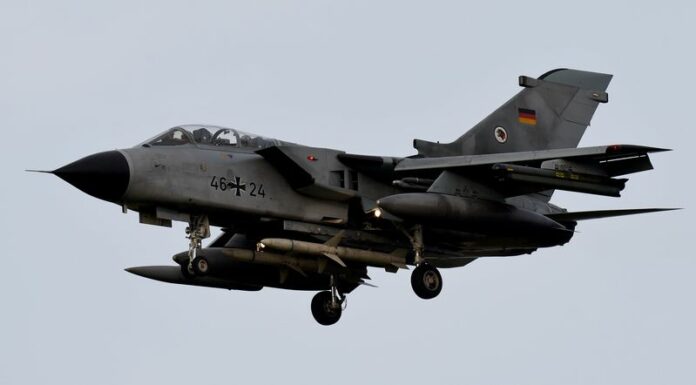
A Tornado with the German Luftwaffe's recon squadron 51 touches down at an air base in the north of Germany in an undated file photo. Photo: Carsten rehder / DPA

Shlomo Ben-Ami
Project Syndicate

MADRID – The general consensus emerging since last month’s carnage in Paris seems to be that the Islamic State, or ISIS, can be defeated only by a ground invasion of its “state.” This is a delusion.

Even if the West and its local allies (the Kurds, the Syrian opposition, Jordan, and other Sunni Arab countries) could agree about who would provide the bulk of ground troops, ISIS has already reshaped its strategy. It is now a global organization with local franchised groups capable of wreaking havoc in Western capitals.

In fact, ISIS has always been a symptom of a deeper problem. Disintegration in the Arab Middle East reflects the region’s failure to find a path between the bankrupt, secular nationalism that has dominated its state system since independence and a radical brand of Islam at war with modernity. The fundamental problem consists in an existential struggle between utterly dysfunctional states and an obscenely savage brand of theocratic fanaticism.

With that struggle, in which most of the region’s regimes have exhausted their already-limited stores of legitimacy, a century-old regional order is collapsing. Indeed, Israel, Iran, and Turkey – all non-Arab-majority countries – are probably the region’s only genuinely cohesive nation-states.

For years, key states in the region – some of them, like Saudi Arabia and Qatar, darlings of the West – have essentially paid protection money to jihadists. Yes, America’s wars in the region – as destructive as they were stupid – bear a substantial part of the blame for the mayhem now engulfing the Fertile Crescent. But that does not exculpate the Arab fundamentalist monarchies for their role in reviving the seventh-century vision that ISIS (and others) seek to realize.

ISIS’s army of psychopaths and adventurers was launched as a “startup” by Sunni magnates in the Gulf who envied Iran’s success with its Lebanese Shia proxy, Hezbollah. It was the combination of an idea and the money to propagate it that created this monster and nurtured its ambition to forge a totalitarian caliphate.

For years, the Wahhabis of Arabia have been the fountainhead of Islamist radicalism and the primary backer and facilitator of extremist groups throughout the region. As former U.S. Senator Bob Graham, the lead author of the classified Senate report on the terror attacks of Sept. 11, 2001, put it earlier this year, “ISIS is a product of Saudi ideals” and “Saudi money.” Indeed, Wikileaks quotes former U.S. Secretary of State Hillary Clinton accusing Qatar and Saudi Arabia of collusion “with Al Qaeda, the Taliban, and other terrorist groups.”

That raises an obvious question: When regimes in the region collaborate with terrorist groups, how can intelligence cooperation with them, let alone a coalition to fight Islamic extremism, be credible? The so-called pro-Western regimes in the Arab Middle East simply do not see eye to eye with the West about the meaning and implications of the war on terror, or even about what violent radicalism is.

That is just one reason why an invasion of the caliphate, with local armies supported by Western airstrikes, could have devastating unintended consequences – think of George W. Bush’s invasion of Iraq. Indeed, even if such a division of labor could be agreed, a ground invasion that denies ISIS its territorial base in Iraq and Syria would merely push it to redeploy in a region that is collapsing into various no man’s lands.

At that point, “Caliph” Abu Bakr al-Baghdadi, or some future would-be caliph, would invariably fuse the region’s mounting governance chaos with a global jihadi campaign – a process that, as we have seen in Paris and elsewhere, has already started. The ideological and strategic rift between ISIS and Al Qaeda notwithstanding, an alliance against the common enemy – the incumbent Arab regimes and the West – cannot be entirely discounted. Osama Bin Laden himself never ruled out the idea of establishing a caliphate. Indeed, his terrorism was perceived as a prelude to it.

At the same time, Syria and Iran might exploit the inevitable chaos to expand their presence in Iraq, and all parties, including Turkey, would oppose a central role for the Kurds. The latter have proven themselves as tremendously reliable and capable fighters, as the battles to liberate the cities of Kobani and Sinjar from ISIS control have shown. But no one should think that they can be the West’s tool for subduing the Sunni heartland of Iraq and Syria.

Nor is it clear that the West is capable of compensating the Kurds with full-fledged statehood. The geostrategic constraints that have prevented Kurdish independence for centuries are even more acute today.

Some of the consequences of a Western-backed Arab invasion of the caliphate are no less predictable for being “unintended.” It would eventually stir up mass sympathy for the Caliphate throughout the region, thus providing ISIS with a propaganda victory and further inspiration for alienated young Muslims in Europe and elsewhere to fight the Crusaders and the Muslim traitors aligned with them.

The only realistic alternative is more – much more – of the same. That means a constant and resolute effort to stop the caliphate’s expansion, cut off its sources of finance, deepen and expand intelligence cooperation among credible allies, end the oil-rich monarchies’ collusion with terrorist groups, and encourage reform (without engaging in grand state-building projects).

The Arab Middle East is not susceptible to quick fixes. It requires profound indigenous change that might take the better part of this century to produce. For now, turning the caliphate into yet another failed state in the region seems to be the best that can be expected.

Shlomo Ben-Ami, a former Israeli foreign minister, is Vice President of the Toledo International Center for Peace. He is the author of Scars of War, Wounds of Peace: The Israeli-Arab Tragedy.

Copyright 2015, Project Syndicate

Advertisement

Poetic Justice: Myanmar Writers to Pen New Era as Lawmakers

Tint Lwin, who writes under the name Maung Lwin Mon (Kathar), outside the NLD office in Pazuntaung Township, Yangon on Dec. 3. Photo: Phyo Thiha Cho / Myanmar Now

YANGON — Since colonial days, Myanmar’s poets have put pen to paper to express the mood of the people, describing their trials and tribulations through verse as the country endured one political upheaval after another.

From Thakhin Ko Daw Hmaing, whose prose inspired pro-independence leaders when the country was under British rule, to Min Ko Naing, a prominent activist who emerged from the 1988 student protests, poets have long been central to dissident causes, whether opposing colonial overlords or military dictators.

Now, the time has come for poets to go from writing verse to drafting laws.

The opposition National League for Democracy, or NLD, won a landslide victory in Myanmar’s historic elections Nov. 8 and among its 800-odd lawmakers in the new national and state and regional parliaments are 11 well-known bards.

Instead of working with words and feelings, and turning out heart-rending prose, they will be faced with more mundane tasks such as familiarizing themselves with tax legislation and state and regional budgets.

It remains to be seen how these poets, who honed their craft vividly describing the struggles of ordinary people under the junta, will acclimatise to their new role as politicians when they take their seats in parliament on Jan. 31.


Accidental Parliamentarians

Than Aung, whose pen name is Ani Htet, has reservations about his new job.

He won a Lower House seat to represent Ngaputaw Township in Ayeyarwaddy Region, but told Myanmar Now he enjoys being a village schoolteacher and a writer. But the state of the country and the needs of the people drove him into politics, he said.

“I never dreamt of becoming a member of parliament. I had always thought I was going to spend my life as a simple teacher and poet,” he said in a telephone interview.

Analysts and losing candidates from the ruling Union Solidarity and Development Party, or USDP, have raised questions over the ability of poets to become good parliamentarians.

USDP lawmaker Hla Swe, who lost his Upper House seat to an NLD candidate in Sagaing Region, believes it would take time for poets, with their artistic temperaments, to get used to parliamentary processes such as time limits in tabling motions, he said.

“They would have to try hard. Their mother has threatened to punish them if they don’t. It’s their mother’s responsibility if they don’t try,” he said, referring to party leader Aung San Suu Kyi, often called Amay (Mother) Suu by party members.
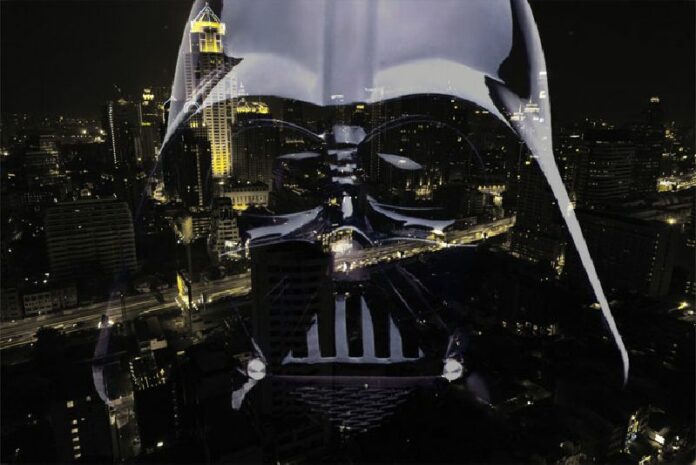
Perhaps the most famous example of a dissident writer and poet turned politician was Václav Havel, who was president of the Czech Republic for a decade after the Velvet Revolution toppled Communism in 1989.

Ani Htet said he has already started preparing for life in parliament, studying laws and planning on tabling motions to amend some and enact new ones. First, he said, he wants to tackle laws on education and media.

“It’s not easy to be a representative in parliament. I’m trying my best to study and prepare myself so what I do there will benefit the country,” he said.   


A Multi-Hyphenated Poet

The NLD’s Kyaw Zin Lin beat Thar Aye, incumbent chief minister of Sagaing Region, for a regional parliamentary seat in Butalin Township. Better known by his nom de plume Zay Linn Mg, the 33-year-old lyricist is also a medical doctor.

“I would actually prefer being a political activist rather than a formal parliamentarian because you have the freedom to say what you want. Now I’ll have to be faithful to the party’s policies,” he said of his new job.

Although slightly chafing at the thought of having to give up his freedoms, he also said he’s ready to take on the new role and already has his eyes on reforming the complex bureaucratic mechanism within the regional parliament so that it becomes more democratic.

One of his political dreams, he said, was to get the officials of the powerful General Administrative Department democratically elected, since they play a key role in the country’s wider administrative mechanism down to the township level.

Currently, the department is under the Ministry of Home Affairs which, according to the 2008 Constitution, is headed by a military general and controlled by the army chief.  

“Only the village and ward-level officials are directly elected by the people, but the regional and township level administrative officials are directly appointed by the Ministry of Home Affairs. So we need to change that for better governance,” he said.


Great Expectations

Myanmar’s poets have long portrayed the destitute and downtrodden through their art, and have a good sense of the needs of the people, said female writer Thwe Sagaing, voicing support for her fellow artists.

http://ssl.gstatic.com/ui/v1/icons/mail/images/cleardot.gif“The poets have always stood with the oppressed. So we are confident that they will be able to work for the public,” she said.
Mi Chan Wai, another writer, said the poets-turned-MPs are creative thinkers who will be able to bring new ideas and concepts to otherwise dull parliamentary procedures.

“I believe that we will be able to fulfil these expectations as we poets have always fought for the truth,” said Tint Lwin, elected as a lawmaker for the Yangon Region parliament for the NLD.

The writer, who writes under the name Maung Lwin Mon (Kathar), used to make a living working for a state-owned bank, but lost his job for joining demonstrators in the 1988 uprising against military rule.

He continued to be involved in politics and was later jailed for his dissident activities.

In a poem celebrating Aung San Suu Kyi’s 66th birthday, which fell a few months after the November 2010 elections and her release from house arrest, he called her “mother” and compared her to a rose.

“Because of your teachings, us, your sons and daughters, who are easily afraid and bereft of reasoning, are now full of strength and bravery,” he wrote.

“We have chosen to be poets and MPs at the same time, we hope we can find the right balance between these two modes of life,” he told Myanmar Now.

Story: Phyo Thiha Cho and Kay Zon Nway

Advertisement

FBI Investigating California Mass Murder as Terrorism

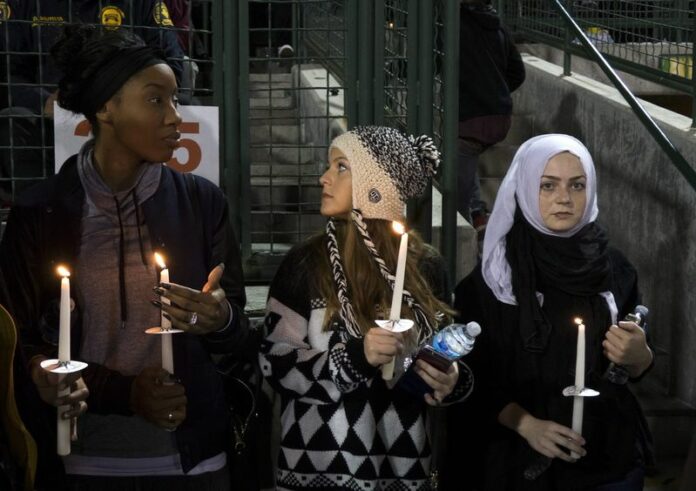
Mourners hold candles at a candlelight vigil Thursday for the victims of the gun attack in San Bernardino, California. Photo: Eugene Garcia / EPA

WASHINGTON — The FBI is investigating a shooting that left 14 people dead and 21 wounded in San Bernardino, California, as an act of terrorism, it said Friday.

"As of today, based on information and the facts as we know them, we are now investigating these horrific acts as an act of terrorism," FBI Assistant Director David Bowdich said.

A "number of pieces of evidence" prompted the FBI to shift the focus of its investigation, he said, but that it remained unclear whether the suspects in the attack were directed or inspired by a terrorist group like Islamic State or al-Qaeda.

He pointed to the planning of the attack and attempts to destroy digital evidence, including the destruction of two mobile phones, but would not provide further details about what evidence pointed to terrorism.

FBI Director James Comey said however that there was no evidence that the alleged attackers, Tashfeen Malik, 29, and Syed Rizwan Farook, 28, were part of an organized terrorist group or cell.

"The investigation so far has developed evidence of radicalism by the killers and the potential for inspiration from a foreign terrorist organization," Comey said.

There was also no evidence the attackers had had meaningful contact with any individuals already being investigated by the FBI, he said.

Malik, the wife in the husband-wife pair suspected in the mass killing, had pledged allegiance to Islamic State in a Facebook post shortly before or during the attack, the FBI confirmed.

US broadcasters earlier reported that Malik posted the pledge under an alias and later deleted it.

Lawyers for the Farook family said the FBI had not found "any clear smoking gun" that the suspects were involved in terrorism and questioned allegations based on Facebook posts.

None of the family members had any idea that the attack was going to happen, lawyer David Chesley said.

Pakistani intelligence sources told dpa that Malik had had contact in the past with radical Islamic cleric, Maulana Abdul Aziz, at Islamabad's Red Mosque. A mosque spokesman said he could not confirm whether they had met.

Malik, and her husband, Farook, are accused of carrying out the attack on his colleagues in the county health department.

The couple were killed in a shootout with police hours after the massacre at a conference centre in the city east of Los Angeles.

The FBI is investigating the couple's digital and telephone communications and whether they may have been planning additional attacks with the large arsenal found in their apartment and car.

Farook, a US citizen, had spent time in Pakistan and Saudi Arabia, and his international contacts are now under investigation, Bowdich said earlier.

Farook returned to the United States from Saudi Arabia in July 2014 with Malik, who entered the country with a Pakistani passport on a K1 visa, available to fiancees of US citizens. The two later married.

The couple left their 6-month-old daughter with relatives prior to the attack under the pretense of going to a medical appointment, according to media reports.

Javier Lesaca, a terrorism expert at George Washington University, told dpa the attack would fit with Islamic State efforts to use social media and the internet to inspire so-called lone wolf terrorists to commit attacks abroad.

"They don't need a big structure just need to convince a few people around the world to be able to create a problem of global security," he said.

Officials had earlier said the motive in the attack was unclear, and US President Barack Obama said it could have been terrorism or workplace violence.

White House spokesman Josh Earnest earlier Friday wouldn't comment on details of the ongoing investigation and said it was too soon to draw conclusions about the attackers' motive.

Wearing black tactical gear but no body armour, the two assailants fired 65 to 75 rounds from "assault-style" rifles and left a bag containing three pipe bombs rigged to a remote-controlled toy car, which did not detonate, police said.

The search of the suspects' house, about 5 kilometres from the site of the shooting, uncovered about 5,000 rounds of ammunition and 12 pipe bombs, plus additional bomb-making material and tools, police said.

The San Bernardino massacre is the second major US mass shooting in less than a week. On November 27, a gunman killed three people and injured nine at a family planning clinic in Colorado.

Story: DPA / Anne K. Walters

Advertisement

Epic Events to Awaken Your Force

BANGKOK — In just two weeks, a rising wave of multi-generational pop culture will peak and crash in just 2 hours and 16 minutes inside a darkened theater.

To make the most of that for those who consider Star Wars a lifestyle or religious creed, Jedi boosters and Sith capitalists have conspired to put on a number of thematic events in Bangkok before during and after the Dec. 17 release of “Star Wars: The Force Awakens.”

Those on the light side can condition their inner geek at a race, while an RCA nightclub seeks to tempt you to the dark side. For all the lovable rogue-types out there, some pop art will be auctioned off for charity.


Helmet Art Project  by The 501st Legion

\

Organized by official Star Wars fan club 501st Legion, the Helmet Art Project will showcase stormtrooper helmets decorated by 18 local celebs and amateur artists.

The amateur artists personalizing the iconic clone headgear include U.S.-based ubercollector Steven Sansweet, director Yutthana “Pa Ted” Boon-aom, DJ Plakung, DJ Chao Chao, Khemanit “Pancake” Jamikorn, Saharat “Kong” Sangkapreecha and more.

All helmets will be auctioned off with the money going to the Children’s Hospital Foundation.

The exhibition runs for a week starting Dec. 12 at CentralWorld.


May the Beats be With You

\

Two nights after the movie’s release, Live RCA Bangkok invites all the dancing Ewoks of Endor to a special themed night.

Sith Lords will spin dark and tech house In the “Enter the Death Star” zone, while the “outer rim’s scum and villains” get it on to afrobeats in the “Mos Eisley Cantina.” Disco and fancy foreign beer will be on tap in “The Jedi Garden.”

The event starts at 8pm on Dec. 19 at Live RCA Bangkok. The first 100 guests get a Darth Vader or Stormtrooper mask.


Star Wars Run

\

Bring a lightsaber and prepare to stay on target for seven kilometers of running battles at the upcoming Star Wars Run.

Runners will fight stormtroopers and clear three levels: Laser Station at MBK Center, Snow Station at Suanluang Square and Space Tunnel Station at Chamchuri Square.

Participants are welcome to arrive at Siam Square early at 8pm to join the opening ceremony and concert.

Entry is 900 baht and includes a licensed Star Wars water bottle, T-shirt, tote bag and “prestige coin.” Pray the Force Runs Through You starting at 10:30pm on Dec. 26 at Siam Square.


To reach us about this article or another matter, please contact us by e-mail at: [email protected].

Follow Khaosod English on Facebook and Twitter for news, politics and more from Thailand.

Follow @KhaosodEnglish

\

Advertisement

Hot News

LATEST NEWS

Bangkok
overcast clouds
25.5 ° C
25.5 °
25.5 °
93 %
3.2kmh
100 %
Fri
25 °
Sat
32 °
Sun
35 °
Mon
37 °
Tue
37 °