36.1 C
Bangkok
Saturday, June 27, 2026
Home Blog Page 3028

Indian Tourist Beaten, Robbed on Pattaya Beach

CHONBURI — An Indian tourist was reportedly beaten unconscious and robbed by a group of Thai teenagers in the resort town of Pattaya early this morning.

Police say the 50-year-old Indian tourist was walking on the beach when at least five Thai young men punched and kicked him until he lost consciousness. The group then stole his wallet, mobile phone, and cash from his bag, police say.

The tourist lost an estimated 75,000 baht, and suffered head injuries and a broken nose. 

A witness told police the five men appeared to be members of a local teenage gang who regularly extort money from people on Pattaya beach. 

"These teenagers like to pose as masters of the beach and drink alcohol together. When they are drunk, they extort money from residents in the area," said Pol.Lt. Siraphudet Chamnankit, an officer at Mueang Pattaya Police Station. "They assault victims who refuse to give up the money."

He said police are searching for the perpetrators. 

Pattaya, a coastal resort town east of Bangkok, is known for its seedy nightlife industry and high crime rate.


For comments, or corrections to this article please contact: [email protected]

You can also find Khaosod English on Twitter and Facebook
http://twitter.com/KhaosodEnglish
http://www.facebook.com/KhaosodEnglish


Advertisement

Thailand Building Ties Closer to Home to Counter Western Criticism

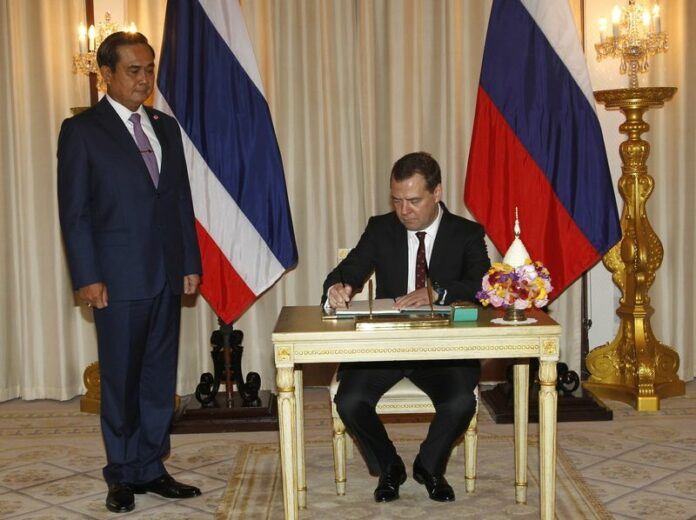
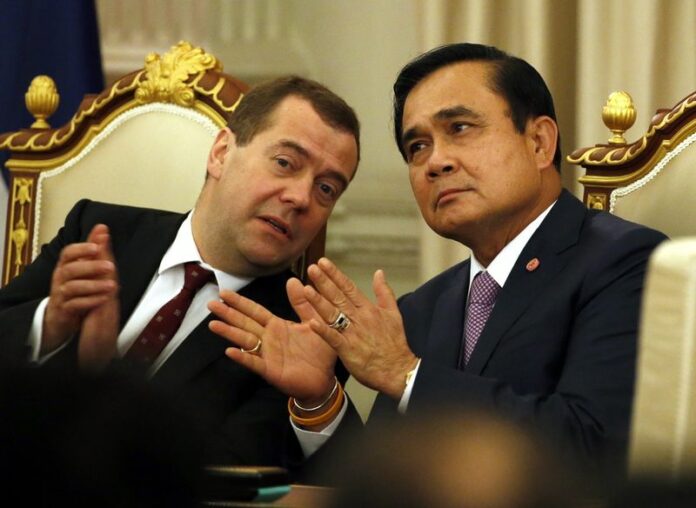
Russia's Prime Minister Dmitry Medvedev (R) signs a guest book as Thai Prime Minister Prayut Chan-o-cha (L) looks on prior to their meeting at Government House in Bangkok, Thailand, 08 April 2015. Medvedev is on a two-day visit to Thailand for economic and trade talks. EPA/SAKCHAI LALIT / POOL

BANGKOK (DPA) — Diplomatically spurned by the US and Western European countries over its military coup in May, Thailand's ruling junta is looking elsewhere for friends.

Russian Prime Minister Dmitry Medvedev's visit to Thailand on Wednesday marked the first time a leader from outside Asia has visited the country since the military took power.

\
Thailand's Prime Minister Prayut Chan-o-cha (R) shakes hands with Russian Prime Minister Dmitry Medvedev (L) at the end of their joint news conference at Government House in Bangkok, Thailand, 08 April 2015. EPA/RUNGROJ YONGRIT

Medvedev is an "old friend," Thai Prime Minister Prayuth Chan-ocha said, and characterized their meeting as "very important."

"Warming up to Moscow lends the Prayuth government significant short-term leverage against the West," said Thitinan Pongsudhirak, the head of the Institute for Securities and International Studies think tank in Bangkok.

"For Thailand under the military regime, Russia represents another geostrategic hedge [against] Western criticisms."

At the same time that Prayuth was hosting Medvedev in Thailand, Defence Minister and Deputy Prime Minister Prawit Wongsuwan was in Beijing to boost defence ties.

China was the first major power to acknowledge Thailand's military regime.

They were to discuss the purchase of submarines for the Thai navy as well as joint military exercises between the two nations.

Closer defence ties with China are seen by analysts as a response to cooler relations with the US. Washington scaled down its involvement in the annual Cobra Gold exercises that is hosted by Thailand each February.

Prayuth remarked before his meeting with Medvedev that Thailand was interested in purchasing Russian arms.

"The coup represented a unique opportunity for both China and Russia," said Pavich Supapipat, a government policy analyst at advisory firm Vriens & Partners.

"For years, Thailand was the only US ally on mainland South-East Asia but the friction brought about by the coup has let Russia and China move in to fill the void."

But the military government is due to be in place for another year before it returns Thailand to civilian rule, and Pavich argues that any foreign policy shifts are only temporary.

"The Thai government's recent embrace of China and warm welcome of Russia are likely to be short-term, expedient moves to counter Western posturing," agrees Thitinan.

Both analysts warn that short-term measures could have long-term effects for one of the United States' oldest allies in the region.

"The military has to balance its need to be recognized with the long-terms needs of the country," Pavich argues. "Otherwise we risk damaging a very good friendship."

"Thailand is playing a costly game in cosying up to these authoritarian powers," Thitinan said.

(Reporting by Cod Satrusayang, dpa) 


For comments, or corrections to this article please contact: [email protected]

You can also find Khaosod English on Twitter and Facebook
http://twitter.com/KhaosodEnglish
http://www.facebook.com/KhaosodEnglish

Advertisement

Thai Junta Expands Military Power in New Order, Citing Article 44

Prayuth at the Royal Thai Army's Command and General Staff College in Bangkok, 3 April 2015

BANGKOK — Thailand’s military junta issued an order on Wednesday evening granting Gen. Prayuth Chan-ocha and his Cabinet members the power to request military assistance with law enforcement.

According to the order, which was published in a Royal Gazette and broadcast on national television, the measure is intended to “increase the efficiency in enforcement of laws that protect the interest of the public and the people.”

The order states that Cabinet ministers, all of whom were chosen by junta chairman and Prime Minister Gen. Prayuth, can ask the Minister of Defense, who is also a junta member, to assign military officers to assist with law enforcement duties.

Those officers will be granted the same powers as law enforcement officials, and must act in accordance with existing laws. However, civilian officials will be required to “cooperate with the military officers.” Refusing to cooperate will be considered a violation of disciplinary regulations, the order states.

The order marks the second time Gen. Prayuth has invoked Article 44 of the interim constitution, which grants him essentially unlimited power to intervene in national affairs.

Gen. Prayuth, who came to power in a coup last May, did not directly use his powers under Article 44 until last week, when he invoked the clause to to retain key components of martial law after repealing it on 1 April. He cited the Article to issue a 14-part order maintaining the military's authority to detain individuals without charge, ban political gatherings, and try civilians in martial court, among other powers.

Gen. Prayuth also said he would use the Article 44 to "swiftly" solve national problems, such as land encroachment and human trafficking.

The order released tonight listed “encroachment on public land and national parks, and the usage of public space that blocks traffic and leads to nuisance among the people in their daily lives,” as examples of issues that military officers will be assigned to help combat.

Article 44 has been strongly condemned by international human rights agencies and democratic governments, who say the law grants Gen. Prayuth a dangerous amount of unchecked power. 

"Normally I would warmly welcome the lifting of martial law," the UN High Commissioner for Human Rights Zeid Ra'ad Al Hussein said last week. "But I am alarmed at the decision to replace martial law with something even more draconian, which bestows unlimited powers on the current Prime Minister without any judicial oversight at all. This clearly leaves the door wide open to serious violations of fundamental human rights."

In response to the criticism, the junta has promised not to abuse the law or violate human rights. Gen. Prayuth and other junta leaders have repeatedly said that "good people" have nothing to fear. 


For comments, or corrections to this article please contact: [email protected]

You can also find Khaosod English on Twitter and Facebook
http://twitter.com/KhaosodEnglish
http://www.facebook.com/KhaosodEnglish

Advertisement

Thai Junta Issues New Order Under Article 44

BANGKOK — Thailand’s military junta issued an order on Wednesday evening granting Gen. Prayuth Chan-ocha and his Cabinet members the power to request military assistance with law enforcement.

According to order, which was announced on national television, the measure is intended to “increase the efficiency in enforcement of laws that protect the interest of the public and the people.”

The order states that Cabinet ministers, all of whom were chosen by junta chairman and Prime Minister Gen. Prayuth, can request the Minister of Defense, who is also a junta member, assign military officers to assist with law enforcement duties.

Those officers will be granted the same powers as law enforcement officials, and must act in accordance with existing laws. However, civilian officials will be required to “cooperate with the military officers.” Refusing to cooperate will be considered a violation of disciplinary regulations, the order states.

The order was the fourth time Gen. Prayuth has invoked Article 44 of the interim constitution, which grants him essentially unlimited power to intervene in national affairs.

Gen. Prayuth cited the Article to issue three other orders after he repealed martial law on 1 April. The three orders retain key components of martial law, which had been in place since the May 2014 coup, including the power to detain individuals without charge, ban political gatherings, and try civilians in military court.

Gen. Prayuth also said he would use the Article 44 to swiftly solve national problems, such as land encroachment and human trafficking.

The order released tonight listed “encroachment on public land and national parks, and the usage of public space that blocks traffic and leads to nuisance among the people in their daily lives,” as examples of issues that military officers will be assigned to help combat.

Article 44 has been strongly condemned by international human rights agencies and democratic governments, who say the law grants Gen. Prayuth "draconian" powers. 

"Normally I would warmly welcome the lifting of martial law," the UN High Commissioner for Human Rights Zeid Ra'ad Al Hussein said last week. "But I am alarmed at the decision to replace martial law with something even more draconian, which bestows unlimited powers on the current Prime Minister without any judicial oversight at all. This clearly leaves the door wide open to serious violations of fundamental human rights."


For comments, or corrections to this article please contact: [email protected]

You can also find Khaosod English on Twitter and Facebook
http://twitter.com/KhaosodEnglish
http://www.facebook.com/KhaosodEnglish


Advertisement

Thai Junta Expands Military Power in New Order, Citing Article 44

Gen. Prayuth Chan-ocha at the Royal Thai Army's Command and General Staff College in Bangkok, 3 April 2015

BANGKOK — Thailand’s military junta issued an order on Wednesday evening granting Gen. Prayuth Chan-ocha and his Cabinet members the power to request military assistance with law enforcement duties.

According to the order, which was published in a Royal Gazette broadcast on national television, the measure is intended to "increase the efficiency in the enforcement of laws that protect the public interest."

The order states that Cabinet ministers, all of whom were chosen by junta chairman Gen. Prayuth, can request the assistance of military officers  from the Minister of Defense, who is also a junta member.

Those officers will be granted the same powers as police, and must act in accordance with existing laws. However, civilian officials will be required to "cooperate with the military officers." Refusing to cooperate will be considered a violation of disciplinary regulations, the order states.

The order marks the second time Gen. Prayuth has invoked Article 44 of the interim constitution, which grants him essentially unlimited power to intervene in national affairs.

Gen. Prayuth, who came to power in a coup last May, did not directly use his powers under Article 44 until last week, when he invoked the clause to to retain key components of martial law after repealing it on 1 April. He cited the Article to issue a 14-part order maintaining the military's authority to detain individuals without charge, ban political gatherings, and try civilians in martial court, among other powers.

Gen. Prayuth also said he would use the Article 44 to "swiftly" solve national problems, such as land encroachment and human trafficking.

The order released tonight listed "encroachment on public land and national parks, and the usage of public space that blocks traffic and creates a nuisance among the people," as examples of issues that military officers will be assigned to help quell.

Article 44 has been strongly condemned by international human rights agencies and democratic governments, who say the law grants Gen. Prayuth a dangerous amount of unchecked power. 

"Normally I would warmly welcome the lifting of martial law," the UN High Commissioner for Human Rights Zeid Ra'ad Al Hussein said last week. "But I am alarmed at the decision to replace martial law with something even more draconian, which bestows unlimited powers on the current Prime Minister without any judicial oversight at all. This clearly leaves the door wide open to serious violations of fundamental human rights."

In response to the criticism, the junta has promised not to abuse the law or violate human rights. Gen. Prayuth and other junta leaders have repeatedly said that "good people" have nothing to fear. 

(Reporting by Sally Mairs)

For comments, or corrections to this article please contact: [email protected]

You can also find Khaosod English on Twitter and Facebook
http://twitter.com/KhaosodEnglish
http://www.facebook.com/KhaosodEnglish


Advertisement

Redshirts Downsize Crackdown Anniversary Event, Heeding Junta's Order

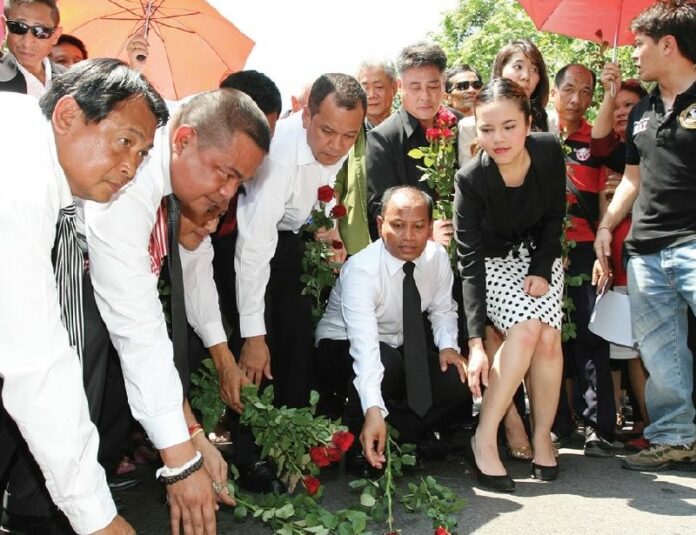
Redshirt leaders lay down roses near Democracy Monument in memory of the 10 April 2010 crackdown in Bangkok, 11 April 2012

BANGKOK — A top Redshirt leader says he will comply with the junta's orders to scale back an event planned for Friday to commemorate the Redshirt protesters who were killed in the 2010 military crackdown.

Jatuporn Prompan, chairman of the United Front of Democracy Against Dictatorship (UDD), said the UDD will move the merit-making ceremony from Plub Pla Chai Temple in the historic quarter of Bangkok to Kerd Kan Udom Temple in Pathum Thani province. In addition, no UDD leaders will attend the ceremony, which will only feature 10 monks, instead of the original 53.
 
"The ceremony will be simple. No speeches. No politics," the UDD chairman said. "There will only be chanting in memory of those who died. After the ceremony is over, everyone will disperse and go home."
 
Earlier today, the deputy chairman of the military junta, Gen. Prawit Wongsuwan, asked the group to cancel the ceremony in compliance with the junta’s ban on political gatherings.
 
“I am asking for cooperation: don't organize any event during this time, because I don't want it to become a conflict,” said Gen. Prawit, “I am asking them to stage personal activities instead of a gathering.”
 
The junta, known formally as the National Council for Peace and Order (NCPO), banned all political activities after toppling a Redshirt-backed government last May. 
 
NCPO spokesperson Col. Winthai Suwaree explained today that the ceremony is "very likely" to be seen as political activity if UDD leaders attend. 
 
"Therefore, to prevent individuals with ill intention from misusing the event, they should adjust the activity to be solely about the relatives [of the crackdown victims], while those with good intention can support the event by donating money," Col. Winthai said.
 
Complying with Col. Winthai's request, Jatuporn asked Redshirt supporters not to attend the ceremony, but donate money to the temple instead.
 
"We want to let the families make merit for those who have passed away without any obstacles," Jatuporn said. "Therefore, I am asking the NCPO to be open-minded and mature about this; not to obstruct the merit-making ceremony or be any more paranoid than they already are. They should spend time working on the road map [to democracy], that would be better." 
 
The ceremony is scheduled for this Friday, the fifth anniversary of the day that then-Prime Minister Abhisit Vejjajiva ordered the military to disperse tens of thousands of Redshirts who were rallying in Bangkok to demand a new election.
 
At least twenty civilians and five soldiers died during clashes between soldiers and shadowy “Blackshirt” militants who were allied to the protesters.
 
The military later mounted another assault on the Redshirts in late May 2010, forcing the movement’s leaders to surrender and call off the protests on 19 May 2010. In total, more than 90 people, mostly civilians, were killed in the violence. 
 
Since 2010, Redshirt activists have gathered in Bangkok every 10 April to honor the victims.  

For comments, or corrections to this article please contact: [email protected]

You can also find Khaosod English on Twitter and Facebook
http://twitter.com/KhaosodEnglish
http://www.facebook.com/KhaosodEnglish

Advertisement

Lese Majeste Filed Against Bua Yai Province Campaigners

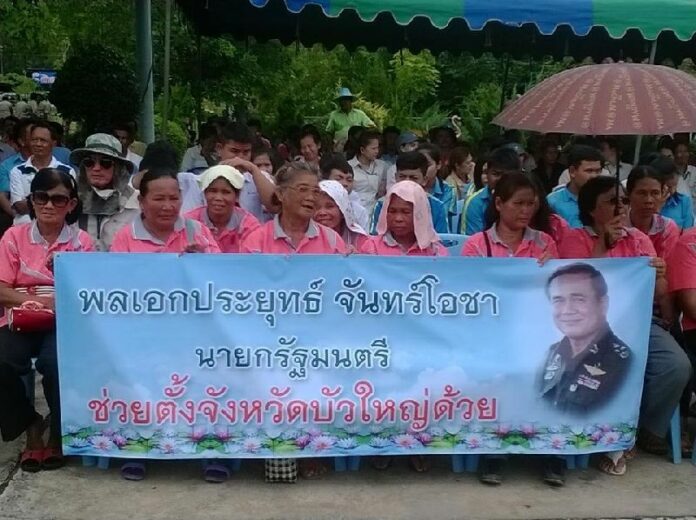
A pro-separation rally with a banner asking Gen. Prayuth to help support the cause, 16 Sept 2014.

(Prachatai English)

BANGKOK – The leaders of a campaign to divide Nakhon Ratchasima into two provinces have been accused of defaming the Thai monarchy, a crime punishable by up to 15 years in prison. 

Kampan Boonyued, a former civil servant and the leader of the movement to separate Bua Yai and seven other districts from the northeastern province, met with police on Tuesday to respond to a lese majeste accusation. The complaint was filed by the leaders of the group opposing the establishment of Bua Yai Province.

The complaint also accused Sarawut Nuanponkrang and Arun Akarapridi, two other leaders of Bua Yai District, of defaming the monarchy.

Read more here


Note: Khaosod English is not responsible for content on other websites.
Advertisement

Indonesian Stowaway Survives One-Hour Flight

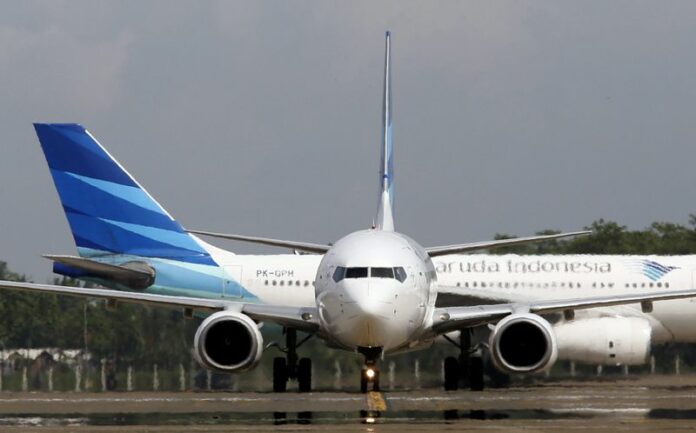
Garuda Indonesia aircrafts at Soekarno Hatta airport, Jakarata, Indonesia, 12 December 2014. An Indonesian man survived a one-hour flight from Sumatra island to Jakarta by hiding in the passenger jet's landing gear bay, media reports said Wednesday. EPA/MAST IRHAM
JAKARTA (DPA) — An Indonesian man survived a one-hour flight from Sumatra island to Jakarta while hiding in the passenger jet's landing gear bay, police said Wednesday.

The man, identified as 21-year-old Mario Steven Ambarita, crawled out of the wheel well of a Garuda Indonesia plane on Tuesday after it landed at the Soekarno-Hatta airport, dazed and staggering, said airport police spokesman E Sutrisna.

"He said he wanted to meet President Joko Widodo, but he didn't say for what purpose," Sutrisna said, adding that the airport authority has taken over the investigation. 

Garuda spokesman Pujobroto said the man appeared to have breached the fence at Sultan Syarif Kasim II airport in Riau province on Sumatra island and climbed into the aircraft's wheel well as it was preparing for take off.

"He knew that the plane would stop for a moment before taking off," Pujobroto, who goes by one name, was quoted as saying by the Kompas.com news website.  

Ambarita was treated at the airport's clinic. 

Kompas said Ambarita was the third stowaway since 1981 known to have survived hiding in an Indonesian plane's landing gear bay. 

Temperatures can drop to well below zero degrees Celsius outside a plane at above 16,000 feet (4,875 metres), and wheel bays are not equipped with heating or oxygen.

Extreme cold and lack of oxygen has killed other stowaways on longer flights.


For comments, or corrections to this article please contact: [email protected]

You can also find Khaosod English on Twitter and Facebook
http://twitter.com/KhaosodEnglish
http://www.facebook.com/KhaosodEnglish

Advertisement

British Tourist Assaulted by 3 Thais in Pattaya

CHONBURI — Three Thai men are under arrest for beating a British tourist who they say sexually harassed a woman in the resort town of Pattaya last week.

In a press conference today, police said the three men confessed to assaulting the 36-year-old British man on 5 April.

One of the suspects, Patipan, told police he attacked the British tourist because the man sexually harassed his sister while she was walking with her Finnish boyfriend. The woman phoned Patipan for help, and Patipan arrived at the scene with two of his friends, Pattana and Piyarat, police say. 

According to police, the British tourist was arguing with the Finnish man when the three Thais arrived at the scene. Pattana reportedly tried to tell the British man to leave, and then punched him when he refused. 

The British man eventually started to leave, but then turned around to shout insults at the three men, prompting the group to beat him up, police say. The three men reportedly fled the scene after the incident. 

Patipan, Pattana, and Piyarat have been charged with assault. 

"The suspects confessed that the reason they did it is because they were angry at [the British man] for scolding them," said Pol.Col. Sukthat Pumphanmuang, superintendent of Mueang Pattaya Police Station "They did not have any intention to destroy the tourism atmosphere or damage Pattaya's reputation. They also apologized for what they have done."

Pol.Col. Sukthat added that the Thai woman has also pressed sexual assault charge against the British tourist.


For comments, or corrections to this article please contact: [email protected]

You can also find Khaosod English on Twitter and Facebook
http://twitter.com/KhaosodEnglish
http://www.facebook.com/KhaosodEnglish

Advertisement

Thailand, Russia Sign Agreements on Drug Trafficking, Energy

Russian Prime Minister Dmitry Medvedev (L) chats with Thailand's Prime Minister Prayut Chan-o-cha (R) during a signing ceremony prior to their joint news conference at Government House in Bangkok, Thailand, 08 April 2015. Medvedev is the first Russian Prime Minister to visit Thailand in 25 years. EPA/RUNGROJ YONGRIT

BANGKOK (DPA) — Thailand and Russia signed bilateral agreements to combat drug trafficking, boost investment and develop the Thai energy sector Wednesday.

Russian Prime Minister Dmitry Medvedev met his Thai counterpart Prayuth Chan-ocha in Bangkok to strengthen ties.

\
Thailand's Prime Minister Prayut Chan-o-cha (R) shakes hands with Russian Prime Minister Dmitry Medvedev (L) at the end of their joint news conference at Government House in Bangkok, Thailand, 08 April 2015. EPA/RUNGROJ YONGRIT

Russia will lend expertise in the military and civil aviation industries.

"Thailand is a close friend in the Asia Pacific region and we have long diplomatic relations. In two years we will mark our 120 years of relations," Medvedev said.

He said he had extended an invitation to Prayuth to visit Russia in the coming months.

"Friends prove their worth when one is in trouble. Friends will help and understand," said Prayuth, who has courted Beijing and Moscow after being spurned by Western countries for seizing power in a coup.

"I thank you Russia for understanding."


For comments, or corrections to this article please contact: [email protected]

You can also find Khaosod English on Twitter and Facebook
http://twitter.com/KhaosodEnglish
http://www.facebook.com/KhaosodEnglish

Advertisement

Hot News

LATEST NEWS

Bangkok
overcast clouds
36.1 ° C
36.6 °
35 °
61 %
3.6kmh
100 %
Sat
37 °
Sun
36 °
Mon
35 °
Tue
33 °
Wed
32 °