
























27 C
Bangkok
Friday, July 24, 2026
Home Blog Page 3029

Educating for Sustainable Development

By Irina Bokova and Christiana Figueres

PARIS – This year marks a turning point for the world, with the international community adopting a new global development strategy in September and negotiating a universal deal to combat climate change in December. To succeed, policymakers must recognize that today’s global imperatives – to eradicate poverty and improve wellbeing, while restoring the Earth’s balance – form a single agenda, and that the most effective means of achieving it is education.

The good news is that the proposed set of Sustainable Development Goals, which will underpin global efforts for the next 15 years, reflect this recognition. Likewise, Article 6 of the United Nations Framework Convention on Climate Change (UNFCCC) stipulates that education, training, and public awareness on climate change must be pursued.

But, with negotiations on these global agreements far from complete, it is vital that policymakers’ emphasis on education continues to be reinforced. To this end, the world’s education ministers must take the opportunity offered by this month’s World Education Forum in Incheon, South Korea, to highlight the role that education can and should play in advancing sustainable development.

A strong education system broadens access to opportunities, improves health, and bolsters the resilience of communities – all while fueling economic growth in a way that can reinforce and accelerate these processes. Moreover, education provides the skills people need to thrive in the new sustainable economy, working in areas such as renewable energy, smart agriculture, forest rehabilitation, the design of resource-efficient cities, and sound management of healthy ecosystems.

Perhaps most important, education can bring about a fundamental shift in how we think, act, and discharge our responsibilities toward one another and the planet. After all, while financial incentives, targeted policies, and technological innovation are needed to catalyze new ways of producing and consuming, they cannot reshape people’s value systems so that they willingly uphold and advance the principles of sustainable development. Schools, however, can nurture a new generation of environmentally savvy citizens to support the transition to a prosperous and sustainable future.

Some schools are already becoming learning labs for sustainable development, where young students are being prepared to adapt to and help mitigate the consequences of climate change. Guided by the UNFCCC – as well as related initiatives like the UN Alliance on Climate Change Education, Training, and Public Awareness – governments are increasingly integrating education strategies, tools, and targets into national development policies. The UNESCO-led UN Decade of Education for Sustainable Development, which began in 2005, was explicitly intended to instill in every human being “the knowledge, skills, attitudes, and values necessary to shape a sustainable future.”

Together, UNESCO and the UNFCCC are not only promoting climate-change education in schools; they are also giving teachers the tools and knowledge they need to provide that education through online courses. Already, more than 14 million students and 1.2 million teachers in 58 countries have been engaged in such learning, and 550 business schools have signed on to the Principles for Responsible Management Education, developed by the UN Global Compact.

This progress, though important, is just the beginning. What is needed now is a global movement, with every student in every country learning about sustainable development from well-trained teachers, equipped with the appropriate curricula and resources. An ambitious sustainable development agenda, together with a legally binding global climate deal, could go a long way toward catalyzing such a movement.

Of course, we cannot secure a sustainable future in a matter of months. But, with a well-designed set of commitments and targets, we can move onto the right path. And, with effective educational programs that instill in future generations the importance of restoring Earth’s balance and delivering a prosperous future for the many, rather than the few, we can stay on that path.

That is the message that education ministers must emphasize at their upcoming forum, and that policymakers should heed as they negotiate this year’s two critical global agreements.

Irina Bokova is Director-General of UNESCO. Christiana Figueres is Executive Secretary of the UN Framework Convention on Climate Change.


Copyright: Project Syndicate, 2015.
www.project-syndicate.org


For comments, or corrections to this article please contact: [email protected]

You can also find Khaosod English on Twitter and Facebook
http://twitter.com/KhaosodEnglish
http://www.facebook.com/KhaosodEnglish

Advertisement

Last Edition of La Fête Festival

DISCLAIMER: This is a press release. Its contents are not produced by Khaosod English.

From June, 3th to June, 20th 2015, for its last edition as a festival, La Fête will celebrate the arts and the richness of the cultural cooperation between France and Thailand. 

On June 3rd, 2015, in the Main Auditorium of Chulalongkorn University, the opening of the festival, chaired by Her Royal Highness Princess Maha Chakri Sirindhorn, will celebrate the 500th anniversary of the coronation of French Renaissance King Francis I, with the show “Royal festivities at the French court “, that incorporates music, singing, dancing, acrobatics and sumptuous costumes.


More than any previous edition, La Fête 2015 will be a showcase of the Franco-Thai cultural cooperation with the new productions of choreographer Jitti Chompee and photographer Lek Kiatsirikajorn, who both benefited, in 2014, from a three-months residence at the Cité Internationale des Arts de Paris, with the support of the French Embassy; with the exhibition of two students selected, this year, for the exchange program between the Ecole Nationale Supérieure des Beaux-arts de Paris and Silpakorn University: Alexandre Poisson and Kanjana Chonsiri ; or with the plastic and photographic dialogue, that artists Rush Pleansuk and Philippe Moisan will present at the Alliance Française Bangkok. 


In addition, La Fête 2015 will offer the best of contemporary French creations with surprising pieces like Notte (the night), a new magic performance that combines dance, magic, juggling and video effects, or like Standards, the newest piece by choreographer Pierre Rigal, in which eight hip hop dancers seize, gracefully but energetically, the French flag. 


Finally, the much-awaited Hip-hop Battle will conclude this last edition of La Fête, and will be followed by a festive night animated by Go Grrrls’ two DJs (DJ Dookie and DJ Maehappyair): a youthful and musical event. 
The last edition of La Fete will keep its promises by offering an eclectic and high quality programming opened to the world. 

The full programming will be available, starting May 14th, on La Fête’s website: www.lafete-bangkok.com

Advertisement

Thai Man Stabbed Dead Over Constitution Debate

NAKHON PATHOM — A 41-year-old man in Nakhon Pathom province has been arrested for allegedly stabbing another man dead during a heated argument about Thailand’s new constitution.

According to police, Thepnarong Prachart confessed to grabbing a kitchen knife and stabbing 44-year-old Prasit Wimal in an outburst of rage because the two disagreed about the new charter, which was drafted under the oversight of the ruling military junta.

Thepnaron fled the scene but was later arrested after witnesses identified him to police, said Pol.Lt. Am Ketkaew, an officer at Pho Kaew Police Station. He has been charged with premediated murder. 

Thailand’s previous charter was dissolved by the junta that seized power from an elected government in May 2014. Thailand's 20th constitution, which was drafted by a junta-appointed committee is expected to be completed in September. The military junta, known formally as the National Council for Peace and Order (NCPO), approved a referendum for the charter earlier this month, though details about the vote have not been disclosed. 

In 2012, a Redshirt was reportedly stabbed dead by a Yellowshirt in Nong Khaem district of Bangkok after they engaged in a heated political debate. A witness at the scene told police the pair was arguing about the reconciliation process undertaken by the government at the time.


For comments, or corrections to this article please contact: [email protected]

You can also find Khaosod English on Twitter and Facebook
http://twitter.com/KhaosodEnglish
http://www.facebook.com/KhaosodEnglish
Advertisement

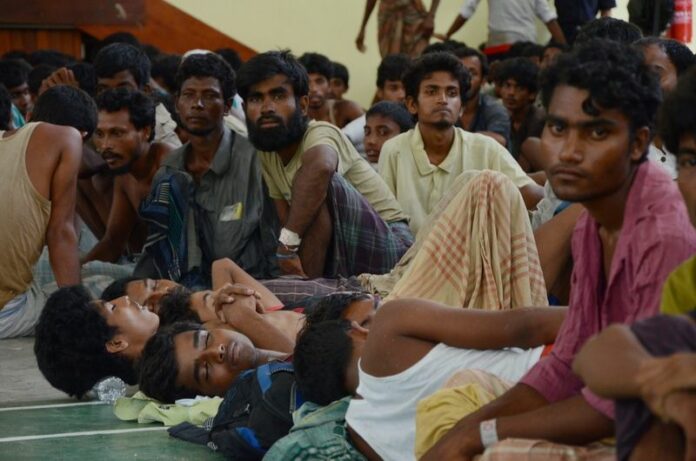
Malaysia Finds 139 Graves of Suspected Trafficking Victims

Migrants from Myanmar and Bangladesh sit at a police station in Kuah, Langkawi. Malaysian security forces discovered a total of 139 graves, most containing several sets of remains, at 28 human trafficking camps near the Thai border. EPA/STR

KUALA LUMPUR (DPA) — Malaysian security forces discovered a total of 139 graves, most containing several sets of remains, at 28 human trafficking camps near the Thai border, the police chief said Monday.

"We don't know yet how many bodies are there," Inspector General Khalid Abu Bakar told reporters in the village of Wang Kalian near Padang Besar town in the state of Perlis, 420 kilometres north of Kuala Lumpur, where the grave sites were discovered a week ago.

"Exhumation works start today," he added. "We do not know yet the identifies of the victims, whether they are Rohingyas or Bangladeshis."

Home Minister Ahmad Zahid Hamidi said the bodies were piled two or three to a grave and that he believed the camps had been in existence for at least five years.

Prime Minister Najib Razak on Monday vowed to bring to justice to those responsible, thought to be human traffickers.

"I am deeply concerned with graves found on Malaysian soil purportedly connected to people smuggling," tweeted Najib, who is in Japan for a three-day visit. "We will find those responsible."

In Thailand this month authorities discovered several mass graves containing dozens of bodies thought to be of Rohingya and Bangladeshi migrants just over the border from Malaysia in the state of Songkhla.

The discovery of the mass graves comes amid international outcry over the thousands of Rohingya refugees thought to be adrift in South-East Asian waters.n South-East Asian waters.

(Reporting by John Grafilo)


For comments, or corrections to this article please contact: [email protected]

You can also find Khaosod English on Twitter and Facebook
http://twitter.com/KhaosodEnglish
http://www.facebook.com/KhaosodEnglish
Advertisement

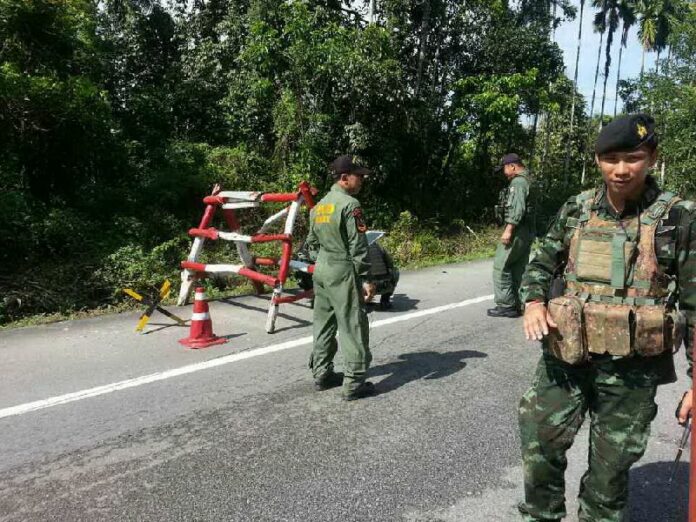
Suspected Insurgents Attack Soldiers at Narathiwat Checkpoint

Soldiers inspect the checkpoint in Narathiwat where suspected insurgents and soldiers exchanged gunfire on 24 May 2015.

NARATHIWAT — A group of gunmen attacked a military checkpoint in the southern border-province of Narathiwat last night, Thai police say.

According to police, the militants began shooting at soldiers who were manning the checkpoint during a heavy rainstorm in Sugai Kolok district at around 10 pm. 

\
Security officers collect evidence from the checkpoint where soldiers and suspected insurgents exchanged gunfire on 24 May 2015.

The soldiers reportedly shot back at the suspected insurgents, who eventually retreated. No injuries have been reported.

The militants also left behind one homemade explosive, which soldiers disposed of this morning, said Pol.Col. Kong-at Suwannakham, superintendent of Sugai Kolok Police Station.

Police suspect the gunmen were members of an Islamic separatist movement that has claimed more than 6,000 lives in the southern provinces of Narathiwat, Yala, and Pattani – a region known as the Deep South. The insurgents are believced to be seeking to revive the Islamic state of Patani, which was annexed by Thailand in the early 20th century. 

More than 60,000 security officers are stationed in the region to combat the secessionist violence, which broke out in January 2004. 

Experts say the insurgency is mostly fueled by ethnic and religious differences. While the vast majority of Thailand is Buddhist, the southern provinces of Yala, Narathiwat, and Pattani are mostly populated by Muslims who speak a Malay dialect.  

Yesterday, representatives of the Organization of Islamic Cooperation (OIC) visited a Muslim community in Pattani's Thung Yang Daeng district and gave a lecture on morality, peace, and religious teachings. The group was given a welcome ceremony by Lt.Gen. Prakarn Chollayuth, commander of the Fourth Region Army, which oversees security operation in the Deep South. 

 
For comments, or corrections to this article please contact: [email protected]

You can also find Khaosod English on Twitter and Facebook
http://twitter.com/KhaosodEnglish
http://www.facebook.com/KhaosodEnglish

Advertisement

Gunfire at Home of Former Yellowshirt Activist

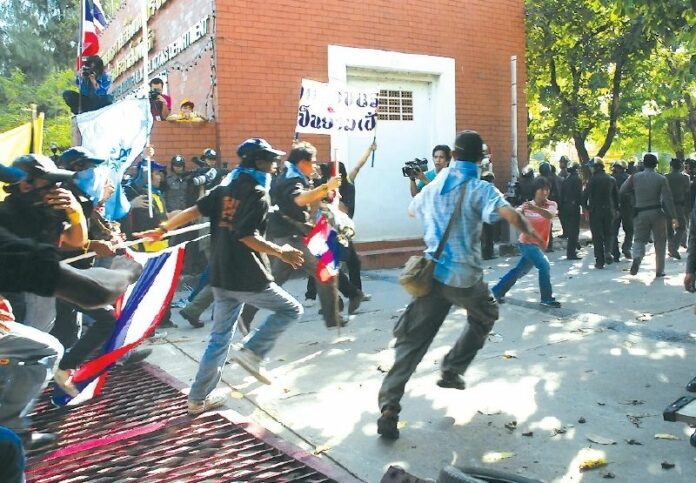
Yellowshirt protesters rush into the state-owned Channel 11 in Bangkok after tearing down the gate, 26 August 2008.

SA KAEO — A dozen rounds were fired at the house of a former Yellowshirt activist in Sa Kaeo province yesterday morning.

Ammarin Yeeheng, 30, said the unidentified gunman shot as his home, which also doubles as an eatery, at around 7 am on 24 May. Police told reporters at least twelve bullet holes were found at the house, but no injuries have been reported. 

\
Police inspect Ammarin's home in Sa Kaeo province, where 12 bullets were fired  on 24 May 2015.

Ammarin is one of 85 people currently on trial for breaking into the headquarters of the state-owned Channel 11 at 5am in August 2008 in an attempt to shut down the station's broadcasts. The siege was part of the Yellowshirt movement's campaign to oust the Redshirt-backed government at the time. 

The group of 85 was charged with intrusion of a state agency, damaging state property, and illegal possession of firearms. The case is currently before the Supreme Court, which accepted an appeal from the activists after they were found guilty by lower courts.

Ammarin said a mysterious gunman also shot inside his home in December 2008, injuring his wife. Police never tracked down the perpetrator, he said, adding that he has ceased all political activities since the military coup in May 2014, but remains active on Facebook. 

"I believe both attacks on my house were motivated by politics," Ammarin told reporters. 

\
Yellowshirt protesters occupy headquarters of state-owned Channel 11 in Bangkok after the group of 85 was arrested on 26 August 2008.

Pol.Cpt. Nikom Srithong, an officer at Aranya Prathet Police Station, said witnesses who live close to Ammarin did not notice or hear anything suspicious that morning, leading police to believe the perpetrator may have used a sound suppressor for the firearm, or shot from inside a car.

"We are investigating the details of the incident, including collecting witnesses' testimonies and forensic evidence, in order to find and prosecute the perpetrator," Pol.Cpt. Nikom said.

 
For comments, or corrections to this article please contact: [email protected]

You can also find Khaosod English on Twitter and Facebook
http://twitter.com/KhaosodEnglish
http://www.facebook.com/KhaosodEnglish
Advertisement

Prayuth on Anti-Monarchy Plot, the 'Two Types of Thai People,' and Student Activists

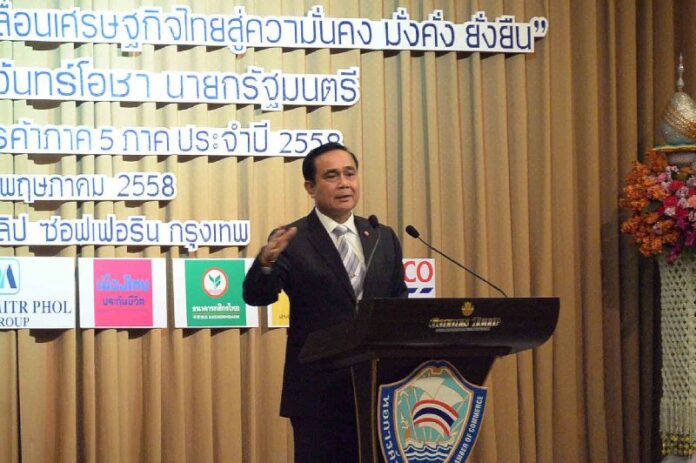
Gen. Prayuth speaking at the Golden Tulip Hotel in Bangkok on 23 May 2015.

BANGKOK – Thai junta chairman Gen. Prayuth Chan-ocha delivered a lengthy speech to a group of investors over the weekend, offering his views on an alleged plot to overthrow the monarchy, the student protests that marked the one-year anniversary of the coup on Friday, and a range of other political topics.

Below are notable excerpts from the two-hour speech, which he gave at an event organized by the Thai Chamber of Commerce at the Golden Tulip Hotel in Bangkok on Saturday.

On the monarchy: 

"Thai people must love each other, but still some evil people like to distort information about the monarchy. And everyone believes it … People who don't know and don't understand fall for these lies. People who insult the monarchy right now may not be great in number, but they belong to a movement of people who want power and seek personal gain. There are only two things that they want to control, but they cannot do so: the military and the monarchy. If they can destroy these two things, they will definitely be able take over Thailand. It will be done by someone that all of you know, but I don't want to say out loud who this person is. Because if I say it, that person may counter me, and I will get angry, and I will be forced to exercise my power. I don't want to exercise my power."

[Read related article: Thaksin: 2014 Coup Makers Helped by Traditional Elites]

On intelligence of Thai people:

"These days, there are two groups of Thai people: [those who use] facts, and [those who use] feelings. A majority of [Thai people] use feelings. They use their hearts when they love someone or hate someone, and use very little of their brains. Very few people think thoroughly about right and wrong. I am not insulting you. The first thing we have to fix today is to encourage knowledge, be conscience in living our lives. If Thai people still use feelings to guide their lives like this, no matter what, we won't be able to move on together. Even I have to try to be conscious to refrain from getting angry, which sometimes I am able to do, and sometimes I am not. But if anyone else was standing here in my position, they would understand that it takes a lot of patience." 

On the anti-coup student protests on 22 May 2015:

"When I order things, I do not only use power and power and power, because if you use power too much, it will be gone quickly. On some days, I cannot use my power. For example, the students came out [to protest] the other day. I could not use my power. Because they [the students] are our future. I try to understand that they have a fiery spirit. They have a good ideology. But it's not their time yet. I have forgiven them so many times. Their parents are also worried for them. If they want their children to graduate, they have to teach them why we [the junta] are here, what we are doing."

[Read related article: Thai Police Forcefully Break Up Student Anti-Coup Protest]

On democracy:

"Can the international community accept us? We are being pressured to turn our country into a democracy. I have explained to them that today we are even more democratic than they are. I never interfere with other countries. I only explain reasons for them to listen to. I can't talk about the bad things of my own country to them, I'm embarrassed. Many countries have started to understand. Some countries ask me, why isn't there an election yet? So I said, if an election came with shootings and bomb attacks, would you have that kind of election? They look at me, so confused, and they ask me, that kind of thing still happens in your country?"

On the military coup he staged on 22 May 2014:

"If I were not there on that day, there may not be a Thailand today, because wars were breaking out all over the country." 


For comments, or corrections to this article please contact: [email protected]

You can also find Khaosod English on Twitter and Facebook
http://twitter.com/KhaosodEnglish
http://www.facebook.com/KhaosodEnglish

Advertisement

Prayuth on Anti-Monarchy Plot, the 'Two Types of Thai People,' Student Activists

BANGKOK – Thai junta chairman Gen. Prayuth Chan-ocha delivered a lengthy speech to a group of investors over the weekend, offering his views on an alleged plot to overthrow the monarchy, the student protests that marked the one-year anniversary of the coup on Friday, and a range of other political topics.

\

Gen. Prayuth speaking at the Golden Tulip Hotel in Bangkok on 23 May 2015.

Below are notable excerpts from the two-hour speech, which he gave at an event organized by the Thai Chamber of Commerce at the Golden Tulip Hotel in Bangkok on Saturday.

On the monarchy: 

"Thai people must love each other, but still some evil people like to distort information about the monarchy. And everyone believes it … People who don't know and don't understand fall for these lies. People who insult the monarchy right now may not be great in number, but they belong to a movement of people who want power and seek personal gain. There are only two things that they want to control, but they cannot do so: the military and the monarchy. If they can destroy these two things, they will definitely be able take over Thailand. It will be done by someone that all of you know, but I don't want to say out loud who this person is. Because if I say it, that person may counter me, and I will get angry, and I will be forced to exercise my power. I don't want to exercise my power."

[Read related article: Thaksin: 2014 Coup Makers Helped by Traditional Elites]

On intelligence of Thai people:

"These days, there are two groups of Thai people: [those who use] facts, and [those who use] feelings. A majority of [Thai people] use feelings. They use their hearts when they love someone or hate someone, and use very little of their brains. Very few people think thoroughly about right and wrong. I am not insulting you. The first thing we have to fix today is to encourage knowledge, be conscience in living our lives. If Thai people still use feelings to guide their lives like this, no matter what, we won't be able to move on together. Even I have to try to be conscious to refrain from getting angry, which sometimes I am able to do, and sometimes I am not. But if anyone else was standing here in my position, they would understand that it takes a lot of patience." 

On the anti-coup student protests on 22 May 2015:

"When I order things, I do not only use power and power and power, because if you use power too much, it will be gone quickly. On some days, I cannot use my power. For example, the students came out [to protest] the other day. I could not use my power. Because they [the students] are our future. I try to understand that they have a fiery spirit. They have a good ideology. But it's not their time yet. I have forgiven them so many times. Their parents are also worried for them. If they want their children to graduate, they have to teach them why we [the junta] are here, what we are doing."

[Read related article: Thai Police Forcefully Break Up Student Anti-Coup Protest]

On democracy:

"Can the international community accept us? We are being pressured to turn our country into a democracy. I have explained to them that today we are even more democratic than they are. I never interfere with other countries. I only explain reasons for them to listen to. I can't talk about the bad things of my own country to them, I'm embarrassed. Many countries have started to understand. Some countries ask me, why isn't there an election yet? So I said, if an election came with shootings and bomb attacks, would you have that kind of election? They look at me, so confused, and they ask me, that kind of thing still happens in your country?"

On the military coup he staged on 22 May 2014:

"If I were not there on that day, there may not be a Thailand today, because wars were breaking out all over the country." 


For comments, or corrections to this article please contact: [email protected]

You can also find Khaosod English on Twitter and Facebook
http://twitter.com/KhaosodEnglish
http://www.facebook.com/KhaosodEnglish

Advertisement

Prayuth on Anti-Monarchy Plot, the 'Two Types of Thai People,' and Student Activists

Gen. Prayuth Chan-ocha arriving at a Chamber of Commerce event in Bangkok on 23 May 2015.

BANGKOK – Thai junta chairman Gen. Prayuth Chan-ocha delivered a lengthy speech to a group of investors over the weekend, offering his views on an alleged plot to overthrow the monarchy, the student protests that marked the one-year anniversary of the coup on Friday, and a range of other political topics.

Below are notable excerpts from the two-hour speech, which he gave at an event organized by the Thai Chamber of Commerce at the Golden Tulip Hotel in Bangkok on Saturday.

On the monarchy: 

"Thai people must love each other, but still some evil people like to distort information about the monarchy. And everyone believes it … People who don't know and don't understand fall for these lies. People who insult the monarchy right now may not be great in number, but they belong to a movement of people who want power and seek personal gain. There are only two things that they want to control, but they cannot do so: the military and the monarchy. If they can destroy these two things, they will definitely be able take over Thailand. It will be done by someone that all of you know, but I don't want to say out loud who this person is. Because if I say it, that person may counter me, and I will get angry, and I will be forced to exercise my power. I don't want to exercise my power."

[Read related article: Thaksin: 2014 Coup Makers Helped by Traditional Elites]

On intelligence of Thai people:

"These days, there are two groups of Thai people: [those who use] facts, and [those who use] feelings. A majority of [Thai people] use feelings. They use their hearts when they love someone or hate someone, and use very little of their brains. Very few people think thoroughly about right and wrong. I am not insulting you. The first thing we have to fix today is to encourage knowledge, be conscience in living our lives. If Thai people still use feelings to guide their lives like this, no matter what, we won't be able to move on together. Even I have to try to be conscious to refrain from getting angry, which sometimes I am able to do, and sometimes I am not. But if anyone else was standing here in my position, they would understand that it takes a lot of patience." 

On the anti-coup student protests on 22 May 2015:

"When I order things, I do not only use power and power and power, because if you use power too much, it will be gone quickly. On some days, I cannot use my power. For example, the students came out [to protest] the other day. I could not use my power. Because they [the students] are our future. I try to understand that they have a fiery spirit. They have a good ideology. But it's not their time yet. I have forgiven them so many times. Their parents are also worried for them. If they want their children to graduate, they have to teach them why we [the junta] are here, what we are doing."

[Read related article: Thai Police Forcefully Break Up Student Anti-Coup Protest]

On democracy:

"Can the international community accept us? We are being pressured to turn our country into a democracy. I have explained to them that today we are even more democratic than they are. I never interfere with other countries. I only explain reasons for them to listen to. I can't talk about the bad things of my own country to them, I'm embarrassed. Many countries have started to understand. Some countries ask me, why isn't there an election yet? So I said, if an election came with shootings and bomb attacks, would you have that kind of election? They look at me, so confused, and they ask me, that kind of thing still happens in your country?"

On the military coup he staged on 22 May 2014:

"If I were not there on that day, there may not be a Thailand today, because wars were breaking out all over the country." 


For comments, or corrections to this article please contact: [email protected]

You can also find Khaosod English on Twitter and Facebook
http://twitter.com/KhaosodEnglish
http://www.facebook.com/KhaosodEnglish
Advertisement

Malaysian Premier 'Concerned' Over Mass Migrant Graves

KUALA LUMPUR (DPA) — Prime Minister Najib Razak on Monday vowed to bring to justice those responsible for mass graves thought to be of Myanmar Rohingya and Bangladeshi migrants found last week.

"I am deeply concerned with graves found on Malaysian soil purportedly connected to people smuggling," tweeted Najib, who is in Japan for a three-day visit. "We will find those responsible."

Around 100 bodies were found according to first reports, the Star newspaper reported Sunday, indicating that the investigation was still ongoing.

Home Minister Ahmad Zahid Hamidi confirmed that the bodies piled two or three to a grave were discovered last week by special forces near Padang Besar town, 420 kilometres north of Kuala Lumpur, near 17 abandoned detention camps for trafficked people.

Local officials in the area believed the camps had been in existence for at least five years, Ahmad Zahid said.

In Thailand this month authorities discovered several mass graves containing dozens of bodies thought to be of Rohingya and Bangladeshi migrants just over the border from Malaysia in the state of Songkhla.

The discovery of the mass graves comes amid international outcry over the thousands of Rohingya refugees thought to be adrift in South-East Asian waters.

(Reporting by John Grafilo)


For comments, or corrections to this article please contact: [email protected]

You can also find Khaosod English on Twitter and Facebook
http://twitter.com/KhaosodEnglish
http://www.facebook.com/KhaosodEnglish

Advertisement

Hot News

LATEST NEWS

Bangkok
overcast clouds
27 ° C
27.7 °
25 °
68 %
3.1kmh
100 %
Fri
29 °
Sat
36 °
Sun
34 °
Mon
32 °
Tue
31 °