



























30 C
Bangkok
Sunday, June 28, 2026
Home Blog Page 3035

Trust Prayuth with Article 44, Thai Govt Says

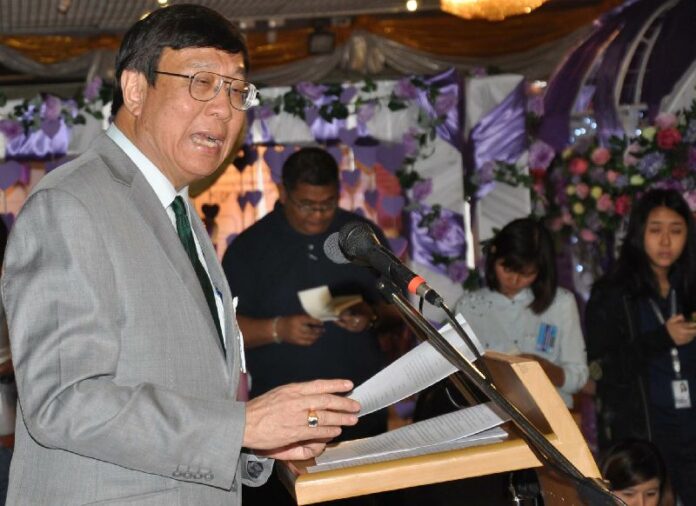
Pornpetch Wichitcholchai, NLA chairman, speaking on 30 March 2015.

BANGKOK — Although the plan to replace martial law with Article 44 of the interim constitution has been widely condemned by legal experts and rights advocates in Thailand, members of the military government publicly defended the proposal today, urging the public to trust that Gen. Prayuth Chan-ocha will judiciously exercise the Article’s broad powers.

"In the past, Gen. Prayuth has never used power in a wrong or excessive way," said Pornpetch Wichitcholchai, the chairman of the junta-appointed National Legislative Assembly. "I think the exercise of power under Article 44 will be done in a creative way."

\
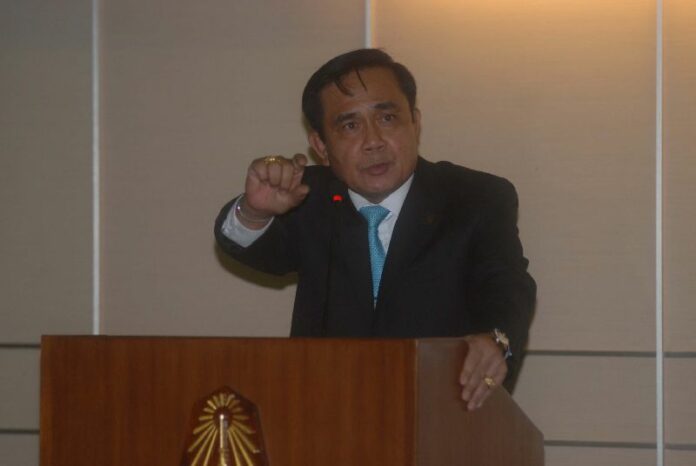
Gen. Prayuth Chan-ocha speaking at the Ministry of Transport, 30 March 2015.

Gen. Prayuth announced last Friday that he may lift martial law, which has been in place since the coup last May, and replace it with Article 44 of the interim constitution, effectively a carte blanche to unilaterally intervene as he sees fit. 

Under Article 44, the junta chairman may issue any order to "disrupt or suppress" an act that threatens to undermine national security, the monarchy, the economy, or the "administration of state affairs." These orders will be immediately deemed "legal, constitutional and conclusive," the article states.

"If [Gen. Prayuth] does good things and uses the law within proper boundaries, I believe Section 44 will be beneficial," Pornpetch said today. "From my own personal experience, the junta chairman has never used his powers harshly."

Gen. Prayuth, who is also Prime Minister, has refused to say when the transition will take place. Yesterday he told reporters, "It will happen when it does."

Human rights groups, legal experts, and politicians on both sides of the aisle have spoken out against the plan, arguing that Article 44 will only augment Gen. Prayuth’s ability to trample on civil liberties.

"At least martial law has the format of detaining individuals and trials, but Section 44 gives unlimited power to the Prime Minister," said Niran Pitakwatchara, chairman of the National Human Rights Commission (NHRC). "The government already has full control over the armed forces and the police. I want them to think whether it is appropriate to use Section 44 when there are reforms of many issues in the country, including problems about inequality."

Gen. Prawit Wongsuwan, deputy chairman of the junta, dismissed Niran’s concerns over the use of Section 44, which he said would be used to mimic the powers granted to the military by martial law.

"Martial law may look harsh in the eyes of foreigners, so we are considering to use Section 44 instead, in order to maintain peace and order," said Gen. Prawit, who also serves Minister of Defense. "The power will rest on the Prime Minister, who will know well what to do. Section 44 and martial law will have the same values, because they can be used to control situations. Section 44 will be focused on detention and searches, like martial law."

The general also urged the media to stop asking about the issue, because Gen. Prayuth has already "answered many times."

"I don't think I need to lecture anyone about this, because the law will be used for guarding against people who have ill will towards country. Therefore, good people need not to be worried. There will not be any violation of human rights."

Since seizing power in a military coup last May, the Thai junta has come under steady criticism from international human rights groups for using martial law to suppress civil liberties. The army has cited the 100-year-old law to arrest and detain individuals without charges, search properties without warrants, try civilians in martial courts, and ban public protests and political seminars. 

Related coverage:

For comments, or corrections to this article please contact: [email protected]

You can also find Khaosod English on Twitter and Facebook
http://twitter.com/KhaosodEnglish
http://www.facebook.com/KhaosodEnglish

Advertisement

Thailand Scrambles to Ward Off Aviation Safety Downgrade

Thai Airways aircraft at Suvarnabhumi Airport, Thailand's largest airport, in Bangkok, Thailand, 02 November 2014. Thailand's Transport Ministry is calling an emergency meeting later this week as the country faces an imminent aviation safety downgrade, officials said Monday. EPA/BARBARA WALTON

BANGKOK (DPA) — Thailand's Transport Ministry is calling an emergency meeting later this week as the country faces an imminent aviation safety downgrade, officials said Monday.

The meeting will discuss the International Civil Aviation Organization's (ICAO) rejection last week of a safety plan put forward by Thailand's Department of Civil Aviation, which was submitted to avoid a downgrade.

The ICAO carried out an audit in January and found serious gaps in safety standards at some Thai budget airlines.

"The audit found that the Department of Civil Aviation had overlooked many regulations for the low-cost airlines," a source within the Transportation Committee of the Legislative Assembly told dpa.

"Simple things like having airline manuals at ground offices, making sure you have two planes ready to relieve mechanical errors were all lacking."

If safety is downgraded, all airlines registered in Thailand, including major carriers like Thai Airways International would face possible bans on new routes. Existing routes would continue as normal.

Japan and South Korea have already responded to the possible downgrade by banning requests for future flight plans and banning all charter flights from Thailand-registered companies.

Coming during high season, the bans have already affected tour groups which sell their tickets in advance.

A source within Thai Airways criticized the Department of Civil Aviation. "Their lack of attention to detail is costing us all," the source said.

 
For comments, or corrections to this article please contact: [email protected]

You can also find Khaosod English on Twitter and Facebook
http://twitter.com/KhaosodEnglish
http://www.facebook.com/KhaosodEnglish

Advertisement

No Royal Name for Southern Island, Official Says

Ta Chai island on 9 March 2015.

BANGKOK — The director of Thailand's National Parks department says the name of Ta Chai island has not been changed, reversing another official's announcement over the weekend that the daughter of the Crown Prince had renamed the island after herself.

On 27 March, Jirasak Chookwamdee, director of Fifth Conservation Area Administration Office, told the media that Ta Chai island had been renamed as Sirivannavari island, in honor of Her Royal Highness Sirivannavari Nariratana, who visited the southern island recently. Princess Sirivannavari is the second daughter of Crown Prince Vajiralongkorn. 

According to Jirasak, Princess Sirivannavari was impressed by the beauty of the island, which is located Similan Islands National Park, and expressed her wish to have the island named after herself as a result. 

"She also provided moral support for officials at the National Park for working to take care of the natural resources, even though there have been problems," said Jirasak, in reference to recent overcrowding and littering on the islands by visitors. 

However, Nipon Chotibal, director of the central Department of National Parks, said on 29 March that the name has not been changed. 

"It is not true," Nipon told reporters, "Her royal visit to the island was to study nature. She is interested in marine and coastline resources, and she gave moral support for the officials in the National Parks of Similan and Surin."

 "There has been no action to give a new name to Ta Chai island," he said.

Many places, roads, and buildings in Thailand are named after members of the Royal Family as tokens of loyalty. 


For comments, or corrections to this article please contact: [email protected]

You can also find Khaosod English on Twitter and Facebook
http://twitter.com/KhaosodEnglish
http://www.facebook.com/KhaosodEnglish
Advertisement

Thailand Scrambles to Ward Off Aviation Safety Downgrade

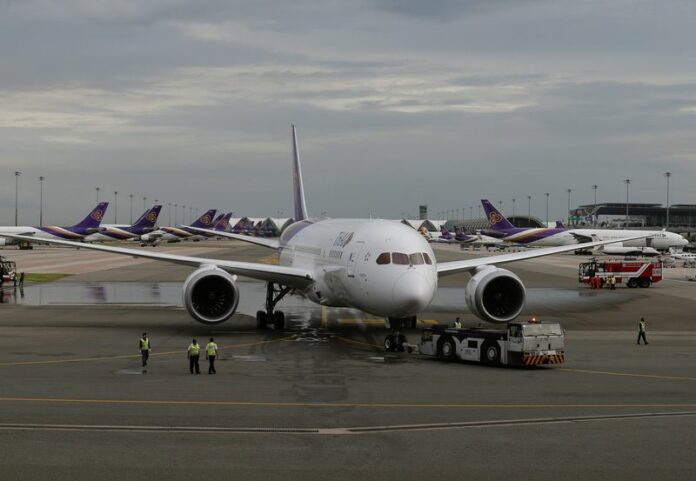
A Thai Airways 787-8 Dreamliner aircraft at Suvarnabhumi Airport, Bangkok, Thailand, 18 July 2014. Thailand's Transport Ministry is calling an emergency meeting later this week as the country faces an imminent aviation safety downgrade, officials said Monday. EPA/NARONG SANGNAK

BANGKOK (DPA) — Thailand's Transport Ministry is calling an emergency meeting later this week as the country faces an imminent aviation safety downgrade, officials said Monday.

The meeting will discuss the International Civil Aviation Organization's (ICAO) rejection last week of a safety plan put forward by Thailand's Department of Civil Aviation, which was submitted to avoid a downgrade.

The ICAO carried out an audit in January and found serious gaps in safety standards at some Thai budget airlines.

"The audit found that the Department of Civil Aviation had overlooked many regulations for the low-cost airlines," a source within the Transportation Committee of the Legislative Assembly told dpa.

"Simple things like having airline manuals at ground offices, making sure you have two planes ready to relieve mechanical errors were all lacking."

If safety is downgraded, all airlines registered in Thailand, including major carriers like Thai Airways International would face possible bans on new routes. Existing routes would continue as normal.

Japan and South Korea have already responded to the possible downgrade by banning requests for future flight plans and banning all charter flights from Thailand-registered companies.

Coming during high season, the bans have already affected tour groups which sell their tickets in advance.

A source within Thai Airways criticized the Department of Civil Aviation. "Their lack of attention to detail is costing us all," the source said.

 
For comments, or corrections to this article please contact: [email protected]

You can also find Khaosod English on Twitter and Facebook
http://twitter.com/KhaosodEnglish
http://www.facebook.com/KhaosodEnglish

Advertisement

Prayuth Answers Questions About Article 44 [Transcript]

BANGKOK — Thai junta chairman Gen. Prayuth Chan-ocha says he is considering replacing martial law with Article 44 of the interim constitution, but has refused to provide any details about if and when this transition will occur.

The proposal, announced on Friday, has already come under fierce criticism from politicians, legal scholars, and human rights groups who warn that the clause will grant the junta chairman even broader powers than those prescribed under martial law.

Under Article 44 of the interim constitution, which Gen. Prayuth has yet to invoke, the junta chairman is authorized to issue any order to “disrupt or suppress” an act that threatens to undermine national security, the monarchy, the economy, or the “administration of state affairs.” These orders will be considered “legal, constitutional and conclusive,” the article states.

Below is a transcript of Gen. Prayuth’s conversation with reporters about invoking Article 44 on 29 March after he returned from the state funeral of Lee Kuan Yew in Singapore.

Reporter: When will you impose Section 44?

Prayuth: It will happen when it does.

Reporter: The NHRC [National Human Rights Commission] suggested the government reconsider the use of Section 44.

Prayuth: Go tell NHRC to take care of the country and make it peaceful. They can't even do that. In the past, both Internal Security Act and Emergency Decree have been used, but could they do it? That's why we have [this situation] today.

Reporter: Will Section 44 draw more pressure from international community?

Prayuth: The main focus should be the people inside the country. Today, the people in the country have suffered long enough. Don't make us fight anyone again. Have some responsibility. Focus on things that are more essential. 

Reporter: Can martial law be repealed before Songkran?

Prayuth: I'm not answering that. You keep asking. There is martial law, but does it trouble you? Has anyone put you in jail? You keep criticizing me, but has anyone done anything to you?

Reporter: Not only the people will pressure you on this, but also the international community.

Prayuth: What international? Today, I met the former President of the United States, the former Prime Minister of Japan. They expressed their congratulations that Thailand is peaceful. None of them criticized me. But some of our people, they make them say that we have to do this, do that. I ask you, why are we letting them force us to do things they order?

Reporter: If the government has not been pressured about the martial law, then what drove you to think about the swapping?

Prayuth: I have not swapped anything. But since you keep asking me everyday whether I will swap it, I will swap it for you, that's all. And has there been any swapping so far? No, it has not. I am not afraid of anyone. Why do I have to be afraid? I do for Thai people. If you are not a Thai person, don't bother me. Who's Thai here? Raise your hand.

Reporter: After the new constitution has been released, will you take any position in the new organizations?

Prayuth: I want to solve problems first, then we’ll talk about it. Don't worry. If you want the country to improve, be safe, and develop to match other countries, we cannot live like this. It depends on the people of the nation, what they want. When the time comes, I may ask the people what they want. 

Reporter: Regarding the economy…

Prayuth: We are working on everything. We work more than the previous government that the reporters liked. Problems come in steps. But I will not blame anyone, and I will do my best. In the past, we let them grow rubber in the national parks. Therefore, the rubber price will never be better. We need zoning, and let me tell you, I will do it in my time. How much time I have, that's it. I want Ms. Somjit [the reporter] to listen to me, too. I am not angry at you today, because I want to calm my spirit after the funeral of Mr. Lee Kuan Yew. 

As Prayuth left the interview for his car, he loudly said to officials, "Which reporters asked about the martial law? There's one man and one woman. I will order the NCPO to see whether they have been troubled by martial law." 


Advertisement

Chinese Tourist Jumps Off Pattaya 'Baht Bus'

The songthaew or "baht bus" that a Chinese tourist jumped off of in Pattaya on 30 March 2015.

CHONBURI — An inebriated Chinese tourist reportedly jumped off a moving bus in the resort town of Pattaya early this morning.

Police say the 25-year-old Chinese tourist was severely injured after he jumped off what is colloquially known as a "songthaew" or "baht bus" at around 1:00 am in central Pattaya, a popular resort town east of Bangkok.

"There was a severe impact on the brain," said Pol.Lt.Col. Possawat Siripornnopkul, an officer at Muang Pattaya Police Station. "The chance of him being dead or alive is equal. Doctors are closely monitoring his condition." 

Witnesses told police the man had a heated argument with his girlfriend that night while he was drinking alcohol with a group of other Chinese tourists at a bar in Pattaya.

The group reportedly boarded a baht bus at the end of the night to take them to their hotel in South Pattaya, but the Chinese man suddenly jumped off the vehicle despite his friends’ attempts to stop him, police said.

 
For comments, or corrections to this article please contact: [email protected]

You can also find Khaosod English on Twitter and Facebook
http://twitter.com/KhaosodEnglish
http://www.facebook.com/KhaosodEnglish
Advertisement

Mounting Criticism as Prayuth Mulls Invoking 'Dictatorial' Power

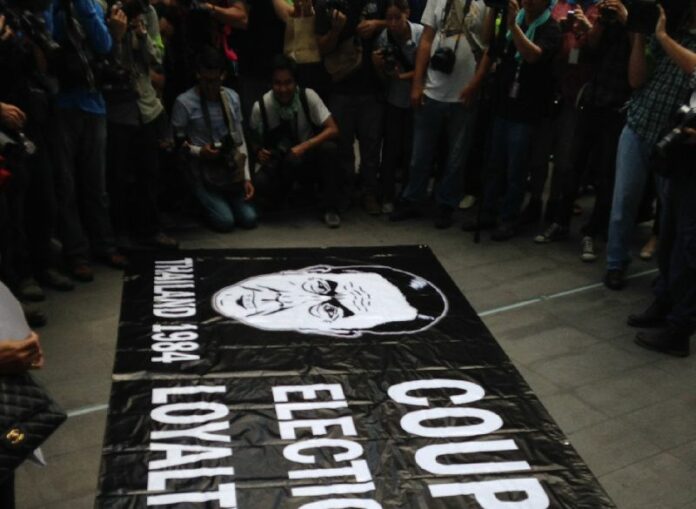
Anti-coup protesters unfurled a banner denouncing Gen. Prayuth as a dictator at a flash protest  on 1 June 2014.

BANGKOK – Gen. Prayuth Chan-ocha’s proposal to replace martial law with Article 44 of the interim constitution, which grants him unrestrained power to intervene in national affairs, has been met with a tide of criticism from voices across the political spectrum.

The junta chairman told reporters on Friday he was considering the swap, presumably to assuage international criticism about martial law, which he imposed shortly before leading a military coup as army chief last May.

\
Anti-coup protesters unfurled a banner denouncing Gen. Prayuth as a dictator at a flash protest  on 1 June 2014.

Over the past ten months, Gen. Prayuth has come under consistent criticism from international human rights groups and Western democracies for using the 100-year-old law to detain individuals without charges, search houses without warrants, ban political protests, and try dissidents in martial courts among other human rights violations.

Yet politicians and legal experts in Thailand appear united in their view that the new plan – replacing martial law with Article 44 – will only expand the junta’s ability to suppress dissent and curb civil liberties.

Under Article 44 of the interim charter penned by the junta after the coup, the junta chairman “shall have the powers to make any order to disrupt or suppress” any act that “undermines public peace and order or national security, the Monarchy, national economics or administration of State affairs, whether that act emerges inside or outside the Kingdom.”

Furthermore, “In this case, that order, act or any performance in accordance with that order is deemed to be legal, constitutional and conclusive.”

The constitutional clause does not require the junta chairman to inform the government in advance of issuing the order, but simply t0 notify the National Legislative Assembly "without delay." 

"The government probably wants to fix its image and reduce pressure from the international community, but the fact is, it won't be like that," said Yodpol Thepsithar, a law lecturer at Naresuan University. "Section 44 will be even worse, because it gives full power solely to the Prime Minister. He can order anything, from seizing assets and execution, without any need for proof [of guilt]."

Many commentators have compared Article 44 to a clause in Thailand’s 1959 charter that granted the leader of the 1957 coup, Field Marshal Sarit Thanarat, similarly sweeping powers to impose decrees that would be considered lawful by virtue of their issuance. Sarit ruled over Thailand for seven years, and invoked the clause to publicly execute political activists and suspected communists and criminals.

“[Article 44] can be extended indefinitely, giving the junta chairman absolute power, like Section 17 under the era of Field Marshal Sarit Thanarat,” said Anusorn Iamsa-ard, a spokesperson for the Pheu Thai Party, which controlled the government toppled in the May 2014 coup.

Using a common Thai idiom, he warned that replacing martial law with Article 44 “may be like running away from a tiger into a crocodile.”

The deputy chairman of the rival Democrat Party, Sathit Pitutecha, also expressed concern about the proposal, which he said “will destroy the confidence of both domestic and foreign communities, especially the international communities, who will only see Thailand as more of a dictator.”

Yet Sathit was careful to draw a distinction between his party’s stance and what he percieved to be the motivation of the Pheu Thai politicians speaking against the plan.

“I speak with good will, unlike those who invoked the idiom of 'running away from tiger into crocodile,' but may have been speaking based on political motivations,” said Sathit. “Gen. Prayuth has to fix the problem at the right place. He has to deal with the chaos inciters, the people who threw a grenade at the Criminal Court, and the Redshirt network. If the investigation reveals that the inciters have some existing cases while they requested bail from the court, just tell the court to cancel the bail, and throw them into prison. That's all.”

Sathit was referring to a grenade attack on a courthouse in Bangkok earlier this month that authorities say was organized by supporters of the Redshirt movement, who backed the Pheu Thai government toppled in the coup.

Gen. Prayuth refused to comment yesterday on when martial law will be revoked. Responding to a reporter who asked when Article 44 will be imposed, the junta chairman said “it will happen when it does.” 

The general has previously threatened to invoke Article 44 to suppress anti-coup activities and shut down media agencies who did not "cooperate with the government," though he has never officially used the law to date.
 
 
For comments, or corrections to this article please contact: [email protected]

You can also find Khaosod English on Twitter and Facebook
http://twitter.com/KhaosodEnglish
http://www.facebook.com/KhaosodEnglish

Advertisement

Mounting Criticism as Prayuth Mulls Invoking 'Dictatorial' Power

Junta chairman Gen. Prayuth Chan-ocha speaking on 29 March 2015.

BANGKOK – Gen. Prayuth Chan-ocha’s proposal to replace martial law with Article 44 of the interim constitution, which grants him unrestrained power to intervene in national affairs, has been met with a tide of criticism from voices across the political spectrum.

The junta chairman told reporters on Friday he was considering the swap, presumably to assuage international criticism about martial law, which he imposed shortly before leading a military coup as army chief last May.

\
Anti-coup protesters unfurled a banner denouncing Gen. Prayuth as a dictator at a flash protest  on 1 June 2014.

Over the past ten months, Gen. Prayuth has come under consistent criticism from international human rights groups and Western democracies for using the 100-year-old law to detain individuals without charges, search houses without warrants, ban political protests, and try dissidents in martial courts among other human rights violations.

Yet politicians and legal experts in Thailand appear united in their view that the new plan – replacing martial law with Article 44 – will only expand the junta’s ability to suppress dissent and curb civil liberties.

Under Article 44 of the interim charter penned by the junta after the coup, the junta chairman “shall have the powers to make any order to disrupt or suppress” any act that “undermines public peace and order or national security, the Monarchy, national economics or administration of State affairs, whether that act emerges inside or outside the Kingdom.”

Furthermore, “In this case, that order, act or any performance in accordance with that order is deemed to be legal, constitutional and conclusive.”

The constitutional clause does not require the junta chairman to inform the government in advance of issuing the order, but simply to notify the National Legislative Assembly "without delay." 

"The government probably wants to fix its image and reduce pressure from the international community, but the fact is, it won't be like that," said Yodpol Thepsithar, a law lecturer at Naresuan University. "Section 44 will be even worse, because it gives full power solely to the Prime Minister. He can order anything, from seizing assets and execution, without any need for proof [of guilt]."

Many commentators have compared Article 44 to a clause in Thailand’s 1959 charter that granted the leader of the 1957 coup, Field Marshal Sarit Thanarat, similarly sweeping powers to impose decrees that would be considered lawful by virtue of their issuance. Sarit ruled over Thailand for seven years, and invoked the clause to publicly execute political activists and suspected communists and criminals.

“[Article 44] can be extended indefinitely, giving the junta chairman absolute power, like Section 17 under the era of Field Marshal Sarit Thanarat,” said Anusorn Iamsa-ard, a spokesperson for the Pheu Thai Party, which controlled the government toppled in the May 2014 coup.

Using a common Thai idiom, he warned that replacing martial law with Article 44 “may be like running away from a tiger into a crocodile.”

The deputy chairman of the rival Democrat Party, Sathit Pitutecha, also expressed concern about the proposal, which he said “will destroy the confidence of both domestic and foreign communities, especially the international communities, who will only see Thailand as more of a dictatorship.”

Yet Sathit was careful to draw a distinction between his party’s stance and what he percieved to be the motivation of the Pheu Thai politicians speaking against the plan.

“I speak with good will, unlike those who invoked the idiom of 'running away from tiger into crocodile,' but may have been speaking based on political motivations,” said Sathit. “Gen. Prayuth has to fix the problem at the right place. He has to deal with the chaos inciters, the people who threw a grenade at the Criminal Court, and the Redshirt network. If the investigation reveals that the inciters have some existing cases while they requested bail from the court, just tell the court to cancel the bail, and throw them into prison. That's all.”

Sathit was referring to a grenade attack on a courthouse in Bangkok earlier this month that authorities say was organized by supporters of the Redshirt movement that backed the Pheu Thai government toppled in the coup. At least twelve people have been arrested in connection with the bombing, which did not cause any injuries. 

Gen. Prayuth refused to comment yesterday on when martial law will be revoked. Responding to a reporter who asked when Article 44 will be imposed, the junta chairman said “it will happen when it does.” 

The general has previously threatened to invoke Article 44 to suppress anti-coup activities and shut down media agencies who did not "cooperate with the government," though he has never officially used the law to date.
 
 
For comments, or corrections to this article please contact: [email protected]

You can also find Khaosod English on Twitter and Facebook
http://twitter.com/KhaosodEnglish
http://www.facebook.com/KhaosodEnglish

Advertisement

No Royal Name for Southern Island, Official Says

Ta Chai island on 9 March 2015.

BANGKOK — The director of Thailand's National Parks department says the name of Ta Chai island has not been changed, reversing another official's announcement over the weekend that the daughter of the Crown Prince had renamed the island after herself.

On 27 March, Jirasak Chookwamdee, director of Fifth Conservation Area Administration Office, told the media that Ta Chai island had been renamed as Sirivannavari island, in honor of Her Royal Highness Sirivannavari Nariratana, who visited the southern island recently. Princess Sirivannavari is the second daughter of Crown Prince Vajiralongkorn. 

According to Jirasak, Princess Sirivannavari was impressed by the beauty of the island, which is located Similan Islands National Park, and expressed her wish to have the island named after herself as a result. 

"She also provided moral support for officials at the National Park for working to take care of the natural resources, even though there have been problems," said Jirasak, in reference to recent overcrowding and littering on the islands by visitors. 

However, Nipon Chotibal, director of the central Department of National Parks, said on 29 March that the name has not been changed. 

"It is not true," Nipon told reporters, "Her royal visit to the island was to study nature. She is interested in marine and coastline resources, and she gave moral support for the officials in the National Parks of Similan and Surin."

 "There has been no action to give a new name to Ta Chai island," he said.

Many places, roads, and buildings in Thailand are named after members of the Royal Family as tokens of loyalty. 


For comments, or corrections to this article please contact: [email protected]

You can also find Khaosod English on Twitter and Facebook
http://twitter.com/KhaosodEnglish
http://www.facebook.com/KhaosodEnglish

Advertisement

Prayuth Answers Questions About Article 44 [Transcript]

Channel 7 reporter Somjit Nawakruasunthorn speaking at an anti-government rally in Bangkok on 9 November 2014.

BANGKOK — Thai junta chairman Gen. Prayuth Chan-ocha says he is considering replacing martial law with Article 44 of the interim constitution, but has refused to provide any details about if and when this transition will occur.

The proposal, announced on Friday, has already come under fierce criticism from politicians, legal scholars, and human rights groups who warn that the clause will grant the junta chairman even broader powers than those prescribed under martial law.

Under Article 44 of the interim constitution, Gen. Prayuth will be able to issue any order to “disrupt or suppress” an act that threatens to undermine national security, the monarchy, the economy, or the “administration of state affairs.” These orders will by definition be considered “legal, constitutional and conclusive,” the article states.

Below is a transcript from Gen. Prayuth’s press conference on 29 March after he returned from the state funeral of Lee Kuan Yew in Singapore. The questions were asked by Somjit Nawakruasunthorn, a Channel 7 reporter who particpated in the anti-government protests that preceded last year's coup. 

Somjit: When will you impose Section 44?

Prayuth: It will happen when it does.

Somjit: The NHRC [National Human Rights Commission] suggested the government reconsider the use of Section 44.

Prayuth: Go tell the NHRC to take care of the country and make it peaceful. They can't even do that. In the past, both the Internal Security Act and Emergency Decree have been used, but could they do it? That's why we have [this situation] today.

Somjit: Do you think Section 44 will help the situation become more orderly?

Prayuth: I will do anything that helps the country be peaceful and orderly. 

Somjit: Will Section 44 draw more pressure from the international community?

Prayuth: The main focus should be on the people inside the country. Today, people in the country have suffered long enough. Don't make us fight anyone again. Take some responsibility. Ask me about things that are more essential. 

Somjit: Many people are concerned about the economy. What do you want to say to the people?

Prayuth: We are working on everything. We are working more than the previous government that you liked. Problems occur in different levels. But I will not blame anyone, and I will do my best.  In the past, we let them grow rubber in national parks. Therefore, the rubber price will never be better than now. We need zoning. I will do it in my time … Why are people like Lee Kuan Yew heroes? It doesn't mean I want to be one, but I want to use his wisdom. Why is he a legend? During his lifetime, the country started as poor and had a lot of suffering. It wasn't developed like it is now. The people were forbidden to do this and that. But today, 30 and 50 years later, that country has so much … 

[Gen. Prayuth cuts off Somjit as she prepares to ask another question.]

Prayuth: Listen to me Somjit, listen. Learn to listen. Don't act like representative [of some groups] with me. I am not angry at you today, because I want to calm my spirit after the funeral of Mr. Lee Kuan Yew. You should think if you plan to have children and grandchildren in the future, Somjit. I will do it for them. I am not doing it for you. 

Somjit: So, in your opinion, is the Singaporean regime is suitable for Thailand?

Prayuth: I didn't say that! I only said, [let’s] only bring their good examples to use in our country. Don't do this to me again. I have warned you many times. Enough. I will not answer any more of your questions. Anyone else? No one here has anything on their mind? 

Somjit: I would like to ask a final question. After the new constitution is released, will you take any positions in the new organizations? 

Prayuth:  I want to solve problems first, then we’ll talk about it. Never mind, you can ask me, I am not angry. I am not angry. Do you want the country to develop and be safe? Or do you want us to live like this? It's up to you. When the time comes, I may ask the people what they want. Ask them. Go help me ask them, Somjit. Use your newspaper [sic] to ask them what they want. Do they want democracy, elections, and unlimited freedom? Go ask them. And I will see what I can do. Anyone else?

Somjit: Isn't it better if the government just does referendum on that?

Prayuth: A referendum is for the constitution. Hey, you keep pestering me. Go ask them. This is not my business. Okay? Why? There is martial law, but does it trouble you? Answer me, reporters. Are you troubled by it? Has anyone put you in jail? You keep criticizing me, but has anyone done anything to you?

Somjit: It's not only about people being troubled, but also the international community is pressuring–

Prayuth: What international? Listen to me. Today I met all the leaders. Former president Clinton, [the Prime Minister of] Japan, South Korea. Everyone. They expressed congratulations that Thailand is peaceful. None of them criticized me. But some of our people, they make them say that we have to do this, do that. I ask you, why are we letting them force us to do things they order? If you let them force us, can you follow their rules? Have you ever done that? The UN, IUU, Somjit has to ask them first, then I will answer you. 

Somjit: If the government has not been pressured about martial law, then what drove you to think about swapping [martial law with Article 44]?

Prayuth: I have not changed anything. But since you keep asking me every day whether I will change it, I will change it for you. That's all. And have there been any changes so far? No, there have not. I am not afraid of anyone. Why do I have to be afraid? I do things for the Thai people. You are not a Thai person, so don't bother me. Who's Thai here? Raise your hand. [Some reporters raise their hands] Thank you. 

As Prayuth left the scene, he loudly asked officials, "Which reporters asked about the martial law? There was one man and one woman. I will order the NCPO to see whether they have been troubled by martial law." 

NCPO is an acronym for the junta's formal name, the National Council for Peace and Order. 

 
For comments, or corrections to this article please contact: [email protected]

You can also find Khaosod English on Twitter and Facebook
http://twitter.com/KhaosodEnglish
http://www.facebook.com/KhaosodEnglish

Advertisement

Hot News

LATEST NEWS

Bangkok
overcast clouds
30 ° C
31.6 °
30 °
75 %
3.5kmh
98 %
Sat
30 °
Sun
34 °
Mon
34 °
Tue
33 °
Wed
32 °