


























28.3 C
Bangkok
Sunday, June 28, 2026
Home Blog Page 3039

1992 Uprising Activists Protest Unelected PM Charter Clause

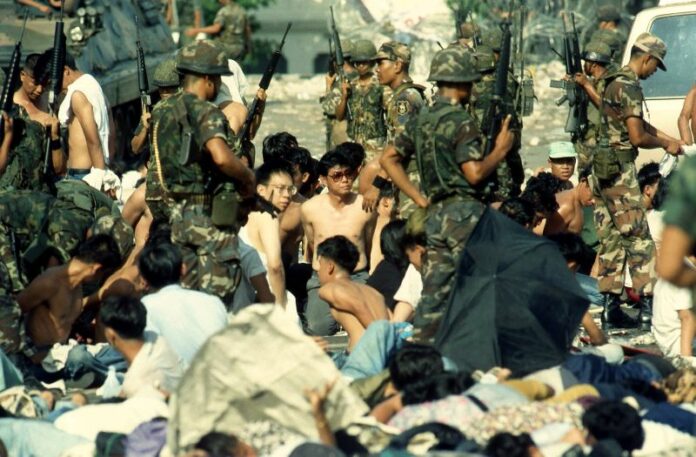
Soldiers detain protesters on Ratchadamnern Avenue in Bangkok, 18 May 1992

BANGKOK — Former activists who participated in the uprising against an unelected Prime Minister in 1992 have voiced their opposition to a clause in the junta's new charter that will allow for an unelected PM to take control in the event of a political crisis.

The Group, which included some relatives of those killed in the 1992 crackdown, submitted a letter of protest to the chairman of the junta-appointed Constitution Drafting Committee (CDC) at the Parliament House today.

Adul Kiewboriboon, who heads the May 1992 Committee and organized today's protest, said the group is concerned that the draft of the new charter will not require Prime Ministers to be elected MPs.

According to the CDC, the removal of the requirement is intended to allow for an “outsider” Prime Minister, chosen by MPs, to take charge and break a deadlock in the event of a political crisis. The drafters have not specified what would constitute a political crisis. 

This move marks a departure from Thailand's recent constitutions, such as the 2007 charter dissolved by the junta last May, which have explicitly required Prime Ministers to be elected MPs.

Adul expressed concern that this opening will allow members of the current junta to "perpetuate their power" by convincing the parliament choose them as Prime Ministers in the post-coup government. The junta, known officially as the National Council for Peace and Order (NCPO), has promised to hold an election next year.   

"It raises suspicion among some parts of the society that it will open up a channel for the perpetuation of power," said Adul, "The May 1992 Committee disagrees with such direction, because it contradicts with the legacies of the martyrs of May 1992." 

The 1992 uprising, known as the Black May, came a year after Gen. Suchinda Kraprayoon staged a coup in 1991 and ordered the drafting of a new constitution that allowed non-MPs to serve as Prime Ministers.

After a Prime Minister elected by the people in 1992 was disqualified because of a legal complication, a coalition of parties in parliament appointed Gen. Suchinda to lead the government, despite his earlier insistence that he would not engage in politics. 

A month later, tens of thousands of demonstrators took to the streets of Bangkok to protest Gen. Suchinda’s return and demand an elected Prime Minister. Gen. Suchinda responded by launching a military crackdown that lasted for two days and left more than 50 people dead. His Majesty the King eventually intervened and ordered both sides to cease the confrontation. Gen. Suchinda resigned from his position on 24 May. 

During his meeting with CDC chairman Bowornsak Uwanno today, Adul said he was not convinced by the CDC's insistence that the unelected PM clause would only be used as an "emergency exit" for a crisis.

"It conflicts with democratic governance, and it may end up starting a new round of conflict," Adul told Bowornsak. 

Responding to the complaint, Bowornsak said the clause may be amended in the future, as the CDC is still gathering opinions from the people.

"The drafting of the new charter is still in its first stage. It's not finalized," the CDC chairman said.

Related coverage:
CDC's Poll Shows Lack of Support for Unelected PM
Bipartisan Alarm Over Junta's 'Anti-Politician' Charter


For comments, or corrections to this article please contact[email protected]

You can also find Khaosod English on Twitter and Facebook
http://twitter.com/KhaosodEnglish
http://www.facebook.com/KhaosodEnglish


For comments, or corrections to this article please contact[email protected]

You can also find Khaosod English on Twitter and Facebook
http://twitter.com/KhaosodEnglish
http://www.facebook.com/KhaosodEnglish
Advertisement

Developing Asia to Keep Strong Economic Growth in 2015-16, ADB Says

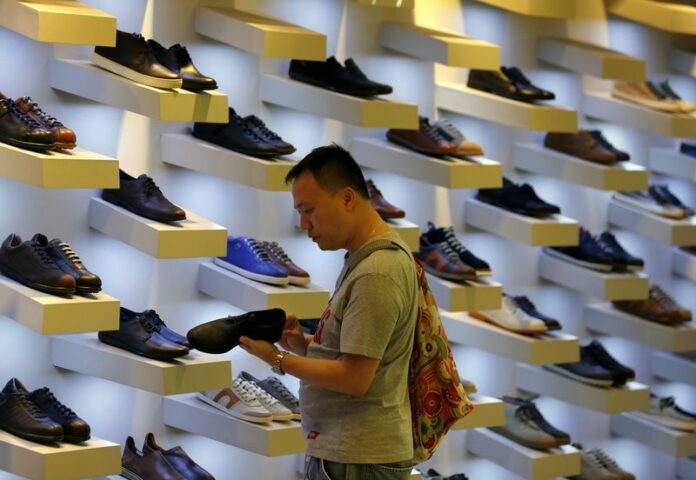
A Chinese tourist looks for shoes at a shopping mall in Bangkok, Thailand, 02 July 2013. Developing Asia will show strong economic growth this year and in 2016, but an impending rise in US interest rates may require monetary responses to maintain stability, an Asian Development Bank report said Tuesday. EPA/RUNGROJ YONGRIT

MANILA (DPA) — Developing Asia will show strong economic growth this year and 2016, but an impending rise in US interest rates may require monetary responses to maintain stability, an Asian Development Bank report said Tuesday.

The region's gross domestic product is expected to grow 6.3 per cent in both 2015 and 2016, the same as last year, the Manila-based bank said in its annual Asian Development Outlook report.

"Developing Asia is making a strong contribution to global economic growth," the bank's chief economist Shang Jin Wei said.

"Falling commodity prices are creating space for policymakers across the region to cut costly fuel subsidies or initiate other structural reforms," he said. "This is a key opportunity to build frameworks that will support more inclusive and sustainable growth in the longer term."

But the report warned that reversals in "otherwise supportive environment" could dampen growth in the region.

"If China falters as it adjusts to its new normal, or if India reforms less decisively than anticipated, their slower growth could spill over to others in developing Asia," it said.

Outside the region, the Greek debt crisis and the deepening recession in Russia may also have consequences to the region, the report said.

"The impending rise in US interest rates may reverse capital flows to the region, requiring monetary responses to maintain stability," it added. "Finally, the benefits flowing from the low price of crude oil could evaporate if geopolitical tensions push it sharply higher."

Growth in China was expected to moderate to 7.2 per cent in 2015 and 7 per cent in 2016 as the government continues to implement structural reforms, which would further slow investment down, the report said.

The growth rates are lower than the average 8.5 per cent expansion for the Chinese economy in the period since the global financial crisis, it added.

Amid the cooling of China's economy, India is expected to overtake it in terms of growth "as the initial phase of government efforts to remove structural bottlenecks is lifting investor confidence," the report said.

India's economy is projected to expand 7.8 per cent in the fiscal year 2015, up from 7.4 per cent in 2014. The growth rate is expected to further pick up in the fiscal year 2016 when it is forecast to rise to 8.2 per cent.

Across the sub-regions, economic growth in East Asia will slow to 6.5 per cent in 2015 and 6.3 per cent in 2016, down from 6.6 per cent in 2014, amid the moderation in China.

South Asia's economy is predicted to grow faster at 7.2 per cent in 2015 and 7.6 per cent in 2016, reflecting the strong performance anticipated in India, the report added.

South-East Asia is poised for a growth rebound after the sub-region's growth fell to 4.4 per cent in 2014. The area's economy is expected to expand 4.9 per cent in 2015 and 5.3 per cent in 2016.

The report stressed the need for developing Asia to deepen reforms in banking and capital markets as well as to ensure greater access to financing for growth and equity in the region.

"Improving the efficiency of the banking sector and capital market can boost investment productivity and innovation," Wei said.

"Reducing the dominance of state-owned financial institutions and developing local currency bond markets are some of the important steps needed in promoting financial development," he said.


For comments, or corrections to this article please contact[email protected]

You can also find Khaosod English on Twitter and Facebook
http://twitter.com/KhaosodEnglish
http://www.facebook.com/KhaosodEnglish

Advertisement

Disabled Lotto Sellers Rally Against Proposed Ticket Machines

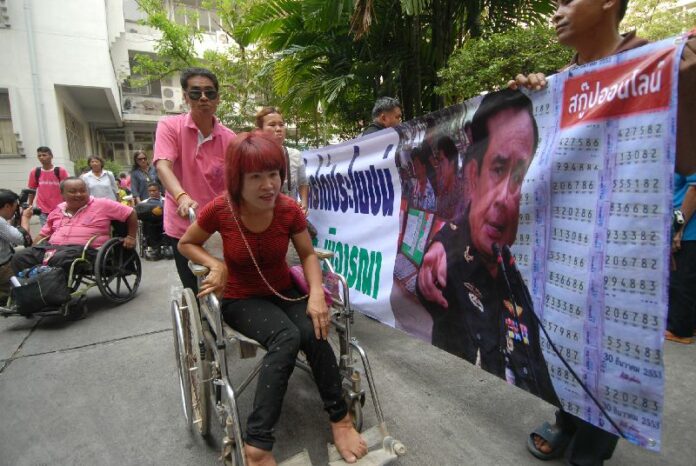
Disabled lottery vendors submitted a letter to protest the government's plan to install ticket vending machines, 24 March 2014.

BANGKOK — More than 100 lottery vendors rallied in Bangkok today to protest a government plan to introduce lottery ticket vending machines, which they say will decrease job opportunities for disabled people who commonly sell lottery tickets in Thailand.

The vendors, who are members of the Disabled Vendors Association, convened at the government’s complaint center this morning to submit a letter of protest to Prime Minister and junta chairman Prayuth Chan-ocha.

\
Lottery vendors march to the government complaint center in Bangkok, 24 March 2015.

Earlier this month, Gen. Prayuth and the Cabinet agreed to consider installing lottery vending machines in convenience stores across Thailand for the first time. Government officials say the machines will reduce the cost of production for the state, and reduce the number of "middlemen," which increase the ticket prices.

Under the current system, the Government Lottery Office sells tickets to five distributing companies – known as the "Five Tigers" – who in turn sell the tickets to street vendors. As a result, the market price of a lottery ticket usually hovers around 120 baht, an approximately 40 percent increase from the original price set by the government. 

However, the leader of today's protesters, Santisuk Polsawing, argued that printing more tickets is a better way to lower prices.

"The production of lottery tickets doesn't match the demand of customers," said Santisuk, who is the leader of the Disabled Vendors Association. "The correct way to solve the problem is to increase the production, and allow more vendors who are disabled, because it is a way to create jobs for those without many opportunities." 

Santisuk also warned that selling lottery tickets through vending machines at shopping malls and convenience stores could make it easier for children to start buying tickets, and may feed gambling addictions among serial lottery players. 

"Selling lottery tickets is a good profession for people with disabilities,” Santisuk said. "I'd like to call on the Prime Minister not to restrict rights of disabled people, because the state welfare payment of 800 baht per month for disabled people is not enough to live on. I insist that disabled people support the government. If the Prime Minister wants to return happiness to the people, he has to return happiness to disabled people, too." 

The plan to legalize lottery vending machines is currently being studied by the Council of State. 

 
For comments, or corrections to this article please contact[email protected]

You can also find Khaosod English on Twitter and Facebook
http://twitter.com/KhaosodEnglish
http://www.facebook.com/KhaosodEnglish

Advertisement

Alleged Coral Smuggler Arrested on Koh Pha Ngan

Coral intercepted by police on Koh Pha Ngan island, 24 March 2015.

SURAT THANI — Police have detained a man who allegedly attempted to smuggle nearly two tons of coral from reefs around Koh Pha Ngan island in southern Thailand.

Local residents alerted volunteer police officers late last night after they saw three men transporting bags from a boat to a pick-up truck.

\
The pick-up truck of coral found by police on Koh Pha Ngan, 24 March 2015.

When a group of police officers arrived at the site, the three men immediately fled the scene, police say.

The officers then inspected the pick-up truck and found at least 1,800 kilograms of corals stuffed into 60 sacks.

Satit Khunwatcharakit, 55, later met with police and identified himself as the owner of the vehicle, but insisted that he had no knowledge of the smuggling. According to Satit, a man named "Kerd" was borrowing the pick-up truck at the time.

However, police detained Satit and charged him with possessing corals without permission. Corals are considered a protected animal under Thai laws and illegal possession is punishable by up one year in prison and a 20,000 baht fine.


For comments, or corrections to this article please contact[email protected]

You can also find Khaosod English on Twitter and Facebook
http://twitter.com/KhaosodEnglish
http://www.facebook.com/KhaosodEnglish

Advertisement

2010 Crackdown Trial: Abhisit to Blame Violence on Blackshirts

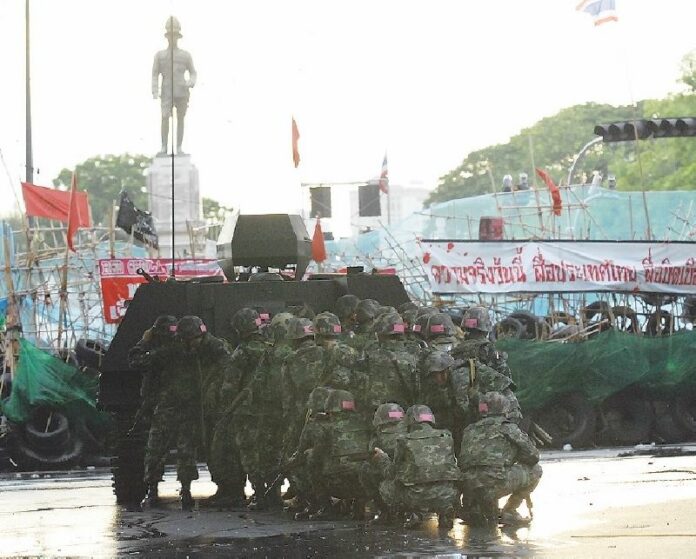
Soldiers take cover behind an armored vehicle as they advance on the Redshirt camp in Bangkok, 19 May 2010.

BANGKOK — Former Prime Minister Abhisit Vejjajiva will defend himself against charges related to his authorization of the 2010 crackdown by contesting a previous court ruling that found soldiers responsible for the deaths of civilians, his lawyer said.

Abhisit and his former deputy, Suthep Thaugsuban, have beencharged with abuse of power by the National Anti-Corruption Commission (NACC) for launching the military operation onRedshirt protesters in 2010, which left over 90 people dead, mostly civilians. If proven guilty, the Democrat Party leaders could be retrospectively impeached and banned from politics for five years.

\
Redshirt protesters burn tires during clashes with soldiers in Bon Kai district of Bangkok, 17 May 2010.

Abhisit’s lawyer, Bundit Sitthipan, submitted the former PM’s testimony to the NACC today, which consisted of six boxes of documents, photographs, and CDs. 

Bundit told reporters the testimony explains the rationality behind each order Abhisit issued as head of the Center for Resolution of Emergency Situation (CRES) at the time. The documents also reveal that Abhisit’s orders clearly instructed military commandersnot to use violence against the protesters, his lawyer said.

According to Abhisit’s account, the violence that ensued was spurred by Redshirt-allied militants that soldiers were forced to confront.

Bunddi said that Abhisit specifically plans to dispute the 2013 court inquest that found soldiers responsible for the deaths of six unarmed civilians inside Wat Pathumwanararm Temple on the last day of the crackdown. 

Abhisit will argue that the shooting started because members of the Redshirt organization the United Front of Democracy Against Dictatorship (UDD) opened fire on soldiers first, his lawyer said.

"We have evidence that the UDD seized firearms from state officials to fire at security officers," Bundit said. "The soldiers were shot by the same bullets that are used by the military."

The claim counters the findings of the court inquest, which determined that no armed militants were in the vicinity of the temple at the time. The court also noted that the soldiers seen shooting into the temple on video footage captured by police do not appear to be taking cover or reacting to alleged attacks from the Redshirt-allied militants. 

\
 Soldiers take cover behind an armored vehicle as they advance on the Redshirt camp in Bangkok, 19 May 2010

The 2010 crackdown was an effort to disperse the thousands of Redshirt protesters who descended on Bangkok in March 2010 to demand a fresh election from Abhisit. In early April, the Redshirts escalated their protest by seizing the capital city's financial district, and the government declared an emergency situation in response. 

On 10 April 2010, Abhisit ordered the military to disperse the protesters from Ratchadamnern Avenue, but the crackdown was called off after security officers ran into resistance from armed militants who became known as “Blackshirts.”

Another military operation was mounted in mid-May, culminating in the final assault on the protesters' camp in downtown Bangkok on 19 May 2010. More than 90 people were killed in clashes, including protesters, soldiers, medical workers, bystanders, and two foreign journalists. 

Abhisit has formally named two members of his government as witnesses in the NACC inquiry: Gen. Anupong Paochinda and Thawil Pliensri, who were serving as army chief and head of national intelligence agency at the time.

"They are people who were directly involved in the operation," Bundit said. "The reason why we did not include Gen. Prayuth Chan-ocha, the [current] Prime Minister, as a witness is because he was serving as deputy army chief at the time. It will overlap with Gen. Anupong." 

Gen. Prayuth seized power from the Redshirt-backed government on 22 May 2014 and was later appointed as a Prime Minister by a rubber stamp parliament.

The lawyer added that Suthep, who led the mass anti-government protests that preceded the 22 May coup and is nowliving as a monk in southern Thailand, will file his own testimony to the NACC "in the next few days." 

The NACC has also been tasked with pursuing a separate legal case against Abhisit and Suthep in the Supreme Court's Division for Holders of Political Office. The pair was initially charged with murder for their role the crackdown, but the Criminal Courtdropped the case in 2014 and gave the NACC authority to prosecute the pair for "abuse of power" in Supreme Court instead. 


For comments, or corrections to this article please contact[email protected]

You can also find Khaosod English on Twitter and Facebook
http://twitter.com/KhaosodEnglish
http://www.facebook.com/KhaosodEnglish
Advertisement

2010 Crackdown Trial: Abhisit to Blame Violence on Blackshirts

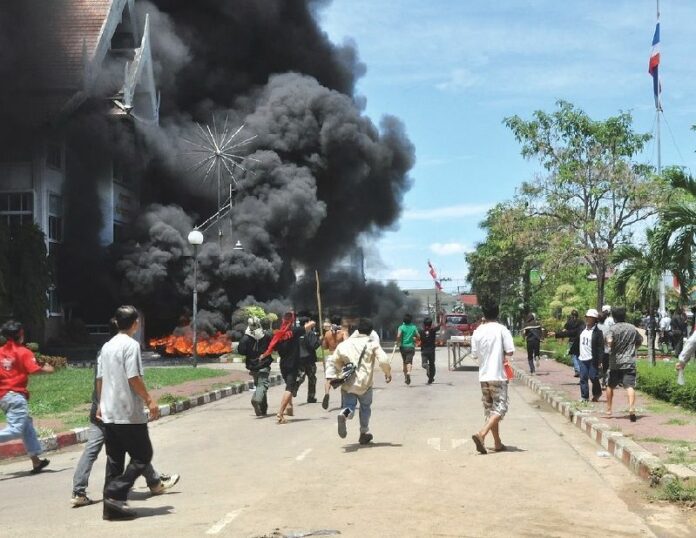
Redshirts torch the City Hall in Mukdahan province in response to the crackdown in the capital city, 19 May 2010

BANGKOK — Former Prime Minister Abhisit Vejjajiva will defend himself against charges related to his authorization of the 2010 crackdown by contesting a previous court ruling that found soldiers responsible for the deaths of civilians, his lawyer said.

Abhisit and his former deputy, Suthep Thaugsuban, have been charged with abuse of power by the National Anti-Corruption Commission (NACC) for launching the military operation on Redshirt protesters in 2010, which left over 90 people dead, mostly civilians. If proven guilty, the Democrat Party leaders could be retrospectively impeached and banned from politics for five years.

\
 Soldiers take cover behind an armored vehicle as they advance on the Redshirt camp in Bangkok, 19 May 2010

Abhisit’s lawyer, Bundit Sitthipan, submitted the former PM’s testimony to the NACC today, which consisted of six boxes of documents, photographs, and CDs. 

Bundit told reporters the testimony explains the rationality behind each order Abhisit issued as head of the Center for Resolution of Emergency Situation (CRES) at the time. The documents also reveal that Abhisit’s orders clearly instructed military commanders not to use violence against the protesters, his lawyer said.

According to Abhisit’s account, the violence that ensued was spurred by Redshirt-allied militants that soldiers were forced to confront.

Bunddi said that Abhisit specifically plans to dispute the 2013 court inquest that found soldiers responsible for the deaths of six unarmed civilians inside Wat Pathumwanararm Temple on the last day of the crackdown. 

Abhisit will argue that the shooting started because members of the Redshirt organization the United Front of Democracy Against Dictatorship (UDD) opened fire on soldiers first, his lawyer said.

"We have evidence that the UDD seized firearms from state officials to fire at security officers," Bundit said. "The soldiers were shot by the same bullets that are used by the military."

The claim counters the findings of the court inquest, which determined that no armed militants were in the vicinity of the temple at the time. The court also noted that the soldiers seen shooting into the temple on video footage captured by police do not appear to be taking cover or reacting to alleged attacks from the Redshirt-allied militants. 

\
Redshirt protesters burn tires during clashes with soldiers in Bon Kai district of Bangkok, 17 May 2010.

The 2010 crackdown was an effort to disperse the thousands of Redshirt protesters who descended on Bangkok in March 2010 to demand a fresh election from Abhisit. In early April, the Redshirts escalated their protest by seizing the capital city's financial district, and the government declared an emergency situation in response. 

On 10 April 2010, Abhisit ordered the military to disperse the protesters from Ratchadamnern Avenue, but the crackdown was called off after security officers ran into resistance from armed militants who became known as “Blackshirts.”

Another military operation was mounted in mid-May, culminating in the final assault on the protesters' camp in downtown Bangkok on 19 May 2010. More than 90 people were killed in clashes, including protesters, soldiers, medical workers, bystanders, and two foreign journalists. 

Abhisit has formally named two members of his government as witnesses in the NACC inquiry: Gen. Anupong Paochinda and Thawil Pliensri, who were serving as army chief and head of national intelligence agency at the time.

"They are people who were directly involved in the operation," Bundit said. "The reason why we did not include Gen. Prayuth Chan-ocha, the [current] Prime Minister, as a witness is because he was serving as deputy army chief at the time. It will overlap with Gen. Anupong." 

Gen. Prayuth seized power from the Redshirt-backed government on 22 May 2014 and was later appointed as a Prime Minister by a rubber stamp parliament.

The lawyer added that Suthep, who led the mass anti-government protests that preceded the 22 May coup and is now living as a monk in southern Thailand, will file his own testimony to the NACC "in the next few days." 

The NACC has also been tasked with pursuing a separate legal case against Abhisit and Suthep in the Supreme Court's Division for Holders of Political Office. The pair was initially charged with murder for their role the crackdown, but the Criminal Court dropped the case in 2014 and gave the NACC authority to prosecute the pair for "abuse of power" in Supreme Court instead. 


For comments, or corrections to this article please contact[email protected]

You can also find Khaosod English on Twitter and Facebook
http://twitter.com/KhaosodEnglish
http://www.facebook.com/KhaosodEnglish

Advertisement

Russians Arrested in Pattaya for Marijuana Export Business

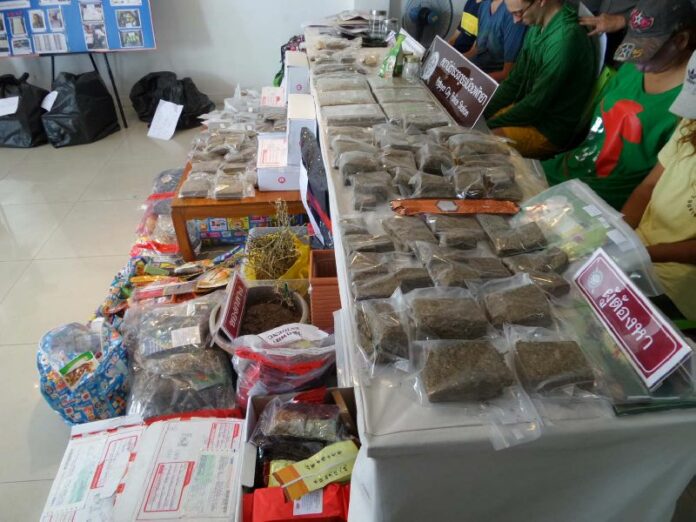
Marijuana allegedly found by police in a raid of the suspect's residence, 23 March 2015.

CHONBURI — Three Russians and two Thais have been arrested for allegedly growing marijuana plants in the resort town of Pattaya and mailing packages of cannabis to Russia.

Georgy Nyushkov, 28, Aleksei Druzhinin, 30, and Aleksei Samokhin, 26, were arrested at their home in Pattaya while the Thai suspects, Kaewchai Thumaporn, 43, and Kanokprom Wongsin, 28, were apprehended in Banglamung district, police say.

The Russian suspects reportedly told police they entered Thailand as tourists and bought marijuana from Kaewchai, paying 20,000 baht per kilogram. The suspects then hid the marijuana in packages of incense and mailed them to customers in Russia, said Pol.Maj.Gen. Nitipong Niamnoi, commander of Chonburi police.

"They saw that they were making good money, so they ordered marijuana seeds from a foreign country and planted them in their home," Pol.Maj.Gen. Nitipong said, adding that Kaewchai bought the marijuana from another Thai dealer, Kanokprom. 

Chonburi police tracked down the suspects after customs officers at Bangkok’s Suvarnabhumi Airport reported intercepting a Russia-bound package from Pattaya that contained 10 kilograms of marijuana.

A raid of the Russian suspects' residence turned up  17 kilograms marijuana, one marijuana plant, 21 flower pots that had been prepared for marijuana planting, 20 postal packages, incense products, and a bong.

"We will prosecute all of the suspects in accordance with the law," said Pol.Maj.Gen. Nitipong. "We will also contact the Russian authorities to expand the arrest of marijuana buyers in that country."

 
For comments, or corrections to this article please contact[email protected]

You can also find Khaosod English on Twitter and Facebook
http://twitter.com/KhaosodEnglish
http://www.facebook.com/KhaosodEnglish

Advertisement

Developing Asia to Keep Strong Economic Growth in 2015-16, ADB Says

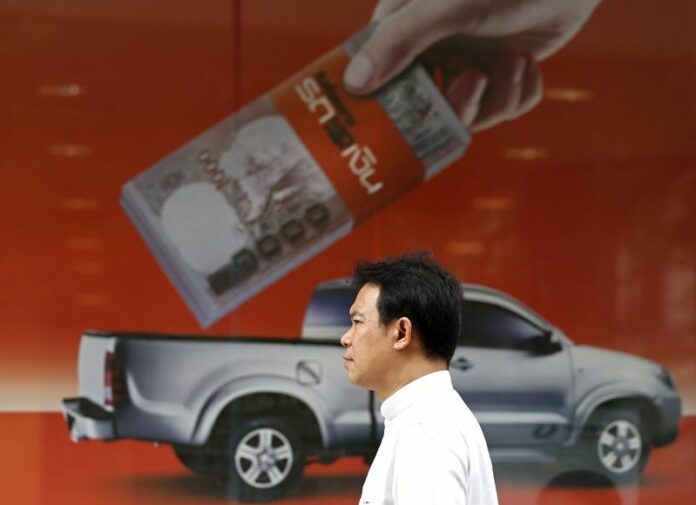
A Thai office worker walks past an ad for bank loans in Bangkok, Thailand, 08 July 2013. Developing Asia will show strong economic growth this year and in 2016, but an impending rise in US interest rates may require monetary responses to maintain stability, an Asian Development Bank report said Tuesday. EPA/RUNGROJ YONGRIT

MANILA (DPA) — Developing Asia will show strong economic growth this year and 2016, but an impending rise in US interest rates may require monetary responses to maintain stability, an Asian Development Bank report said Tuesday.

The region's gross domestic product is expected to grow 6.3 per cent in both 2015 and 2016, the same as last year, the Manila-based bank said in its annual Asian Development Outlook report.

"Developing Asia is making a strong contribution to global economic growth," the bank's chief economist Shang Jin Wei said.

"Falling commodity prices are creating space for policymakers across the region to cut costly fuel subsidies or initiate other structural reforms," he said. "This is a key opportunity to build frameworks that will support more inclusive and sustainable growth in the longer term."

But the report warned that reversals in "otherwise supportive environment" could dampen growth in the region.

"If China falters as it adjusts to its new normal, or if India reforms less decisively than anticipated, their slower growth could spill over to others in developing Asia," it said.

Outside the region, the Greek debt crisis and the deepening recession in Russia may also have consequences to the region, the report said.

"The impending rise in US interest rates may reverse capital flows to the region, requiring monetary responses to maintain stability," it added. "Finally, the benefits flowing from the low price of crude oil could evaporate if geopolitical tensions push it sharply higher."

Growth in China was expected to moderate to 7.2 per cent in 2015 and 7 per cent in 2016 as the government continues to implement structural reforms, which would further slow investment down, the report said.

The growth rates are lower than the average 8.5 per cent expansion for the Chinese economy in the period since the global financial crisis, it added.

Amid the cooling of China's economy, India is expected to overtake it in terms of growth "as the initial phase of government efforts to remove structural bottlenecks is lifting investor confidence," the report said.

India's economy is projected to expand 7.8 per cent in the fiscal year 2015, up from 7.4 per cent in 2014. The growth rate is expected to further pick up in the fiscal year 2016 when it is forecast to rise to 8.2 per cent.

Across the sub-regions, economic growth in East Asia will slow to 6.5 per cent in 2015 and 6.3 per cent in 2016, down from 6.6 per cent in 2014, amid the moderation in China.

South Asia's economy is predicted to grow faster at 7.2 per cent in 2015 and 7.6 per cent in 2016, reflecting the strong performance anticipated in India, the report added.

South-East Asia is poised for a growth rebound after the sub-region's growth fell to 4.4 per cent in 2014. The area's economy is expected to expand 4.9 per cent in 2015 and 5.3 per cent in 2016.

The report stressed the need for developing Asia to deepen reforms in banking and capital markets as well as to ensure greater access to financing for growth and equity in the region.

"Improving the efficiency of the banking sector and capital market can boost investment productivity and innovation," Wei said.

"Reducing the dominance of state-owned financial institutions and developing local currency bond markets are some of the important steps needed in promoting financial development," he said.


For comments, or corrections to this article please contact[email protected]

You can also find Khaosod English on Twitter and Facebook
http://twitter.com/KhaosodEnglish
http://www.facebook.com/KhaosodEnglish
Advertisement

Chiang Mai Monks Offer 'Merit Coffee' to Temple-Goers

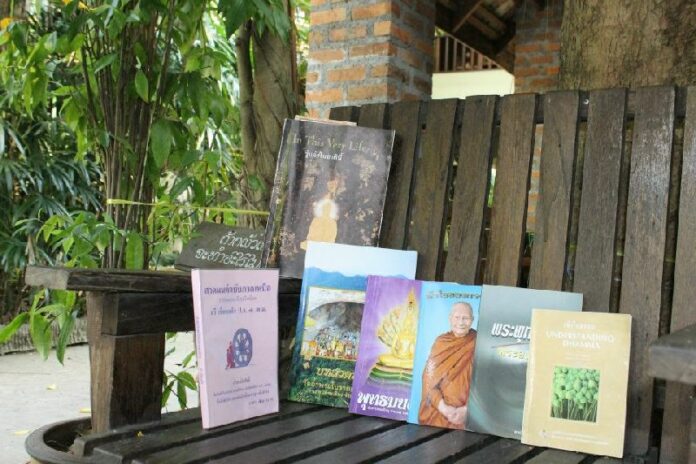
Books from the "Dharma book corner" inside the cafe.

CHIANG MAI — Visitors to Sankangpla Temple in Chiang Mai province looking for a boost of energy — physically or spiritually — are encouraged to order a special cup of "merit coffee" made by monks in a cafe on the temple grounds.

According to the temple's abbot, the cafe, named Kafae Boon (Merit Coffee), started as a small booth in 2012, after one of the monks suggested providing beverage to temple-goers. 

\
A monk making coffee at Kafae Boon in Chiang Mai province.

"But we couldn't get the formula for our beverage right. We had to improvise," Phra Kru Sitthipanyaporn explained. He said a monk at the temple later came up with a unique formula for the coffee, took over the booth, and expanded it into a permanent shop in 2014. 

Nowadays, the cafe offers modern and traditional Thai coffee, tea, and water. Sitthipanyaporn said the shop does not directly charge clients. Instead, the shop has a sign suggesting donation prices and advises visitors to donate the money to the temple. The cafe also features a "Dharma book corner" for temple-goers who are interested in learning more about Buddhist teachings. 

Sitthipanyaporn said the cafe is intended to be a place where young people can chat about Buddhist philosophy.

"It's like a reception room for the temple that welcomes everyone," said the abbot, "If you don't have the money, you can still come to drink the coffee and talk about Dharma. We applied modern culture, such as coffee shop, that people like in our temple. All of the materials were donated by temple-goers."

Phra Tawatchai Kattirat said he works as a barista whenever he is free from his daily religious routines at the temple.

"We are well-trained for the job," Phra Tawatchai said, "We developed our beverage formula to rival leading coffee shops."

 
For comments, or corrections to this article please contact[email protected]

You can also find Khaosod English on Twitter and Facebook
http://twitter.com/KhaosodEnglish
http://www.facebook.com/KhaosodEnglish
Advertisement

Martial Court Denies Alleged Torture Victim Bail

Soldiers at the Criminal Court in Bangkok on 16 March 2015.

BANGKOK — A Thai military court has denied bail to a terror suspect who said he was tortured in military custody earlier this month.

Sansern Sri-unruen, a 54-year-old taxi driver by profession, has been held in prison since 16 March to await a trial in military court for his alleged connection to a "terrorist network" that planned to stage bomb attacks in Bangkok.

Today, a judge denied the 800,000 baht bail posted by a member of the Thai Lawyers for Human Rights group, citing the possibility that Sansern might try to flee the country.

The lawyers group says that Sansern and three other men were beaten by soldiers while they were held incommunicado at an army camp for six days of interrogation. Under martial law, which was imposed by the military junta that seized power in the May 2014 coup, security officers can detain individuals without charges for up to seven days. 

Sansern also said soldiers electrocuted him "30-40" times on his legs in an effort to extract a confession.

The four men have been accused of participating in a plot to "create chaos" and draw an intervention from the United Nations by planting bomb attacks around the capital city. Police say the network was responsible for the grenade attack at the Criminal Court on the night 7 March. 

At least 12 arrests have been made in connection with the case so far.

The military has sternly denied the torture allegation and threatened to take legal action against those who spread it.

"Everyone, including the chief of police and even the Prime Minister, answered in the same way that there was never any torture or beating of suspects," Maj.Gen. Sansern Kaewkamnerd said on 21 March, "The officers have clear evidence. There is no need to do such a thing. Soldiers and police don’t think it would help anything to do that. However, we are willing to investigate the issue."

Speaking to Khaosod yesterday, Pawinee Chumsri, the lawyer who represented Sansern, said her group has received 13 complaints about torture under military custody since the junta seized power on 22 May 2014. The complaints, she said, include three suspects who were arrested and accused of launching an attack on a Yellowshirt rally in Trat province on 22 February 2014. 

"We try to collect evidence after we receive complaints, but I have to admit that it's very difficult, because security officers claim it's a matter of national security," Pawinee saide. "Martial law doesn't make it easy for independent agencies or human rights workers to prove the evidence after they receive complaints.”

She also warned security officers are more likely to resort to torture under martial law, which allows them to detain suspects in army camps without access to lawyers or the outside world.

Pawinee cited the case of Yapa Kaseng, an imaam from the restive province of Narathiwat who was detained by military officers under martial law and fatally tortured in their custody in 2008. Yapa was accused of aiding a local insurgent group that sought to secede Narathiwat and neighboring provinces from Thailand.

A court later confirmed in 2011 that Yapa was beaten to death by a group of soldiers when he was held at an army camp for interrogation. The Ministry of Defense also stated that there was no evidence that linked Yapa to the insurgents, and agreed to pay compensation to the cleric's family. 

Last May, the junta held a Redshirt activist incommunicado for three weeks – violating the seven-day limit under martial law – before admitting to the public that she was in military custody. The activist, Kritsuda Khunasen, fled Thailand shortly after she was released and accused soldiers of torturing her while she was in their custody.
 
For comments, or corrections to this article please contact[email protected]

You can also find Khaosod English on Twitter and Facebook
http://twitter.com/KhaosodEnglish
http://www.facebook.com/KhaosodEnglish
Advertisement

Hot News

LATEST NEWS

Bangkok
overcast clouds
28.3 ° C
28.3 °
28.3 °
77 %
3.5kmh
100 %
Sun
34 °
Mon
33 °
Tue
33 °
Wed
33 °
Thu
33 °