






















32.3 C
Bangkok
Friday, July 3, 2026
Home Blog Page 3070

Chinese Dominate Forbes' List of Powerful Asian Female Executives

The logo of the Chinese company Alibaba.

MANILA (DPA) — Businesswomen from China and Hong Kong dominated a list of Asia's most powerful female executives, Forbes said Thursday.

A total of 50 women from 16 countries in the region were included in its fourth annual Asia's Power Businesswomen, and 14 of them were from China and Hong Kong.

They included two executives of Chinese online commerce giant Alibaba – chief financial offer Maggie Wu and co-founder Lucy Peng – a first time for any company, Forbes said.

Wu, a newcomer to the list, was recognized for being behind Alibaba's "blockbuster IPO," while Peng was hailed for being "the energy behind its financial services affiliate, Ant Financial."

Australian mining mogul Gina Rinehart and retailer Katie Page topped the list of women who are "active in the upper echelons of the business world in Asia, wield significant power and have access to robust financial resources."

The list had 27 newcomers, including Noni Purnormo of Blue Bird Group Holding, who heads the largest taxi company in Indonesia, and Chinese Cheng Xue, vice chairwoman of Foshan Haitian Flavoring & Food.

"Women on the list are also advancing their leadership in the traditionally male-dominated manufacturing sector," Forbes said.

Among those knocking down walls in manufacturing were Taiwan's Enid Huey-Chin Tsai of Hiwin Technology and Japan's Mayumi Kotani of Yushin Precision Equipment. Both companies are involved in making industrial robots.

Women from Mongolia and Myanmar appeared for the first time on the list.

"Myanmar's Win Win Tint took the family grocery and built a retail conglomerate that spans supermarkets, convenience stores, drugstores, bookstores and more," it said.

Garamjav Tseden founded and heads Mongolia's mining company Monpolymet, which began with a focus on gold mining but has since expanded into construction, mineral exploration and land rehabilitation.

Forbes also identified 12 "savvy, ambitious women" in their late 20s and early 40s as "Women to Watch."

They include Jean Liu of Didi Dache, a taxi-hailing app in China, and Petrea Vela, the scion of a New Zealand family "that has built a fishing, racing and bloodstock realm."


For comments, or corrections to this article please contact: [email protected]

You can also find Khaosod English on Twitter and Facebook
http://twitter.com/KhaosodEnglish
http://www.facebook.com/KhaosodEnglish
 

Advertisement

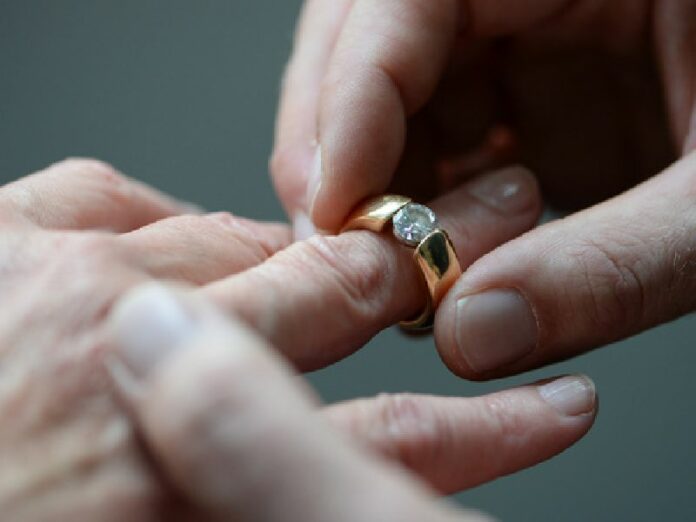
Adultery No Longer Illegal in South Korea

SEOUL (DPA) — South Korea's Constitutional Court Thursday repealed a law punishing adultery, after four previous attempts to throw out the law had failed, a news report said.

"The article violates individuals' freedom to choose their sexual partners and their right to privacy," said an opinion presented by five of the justices who voted down the law in a 7-2 decision, Yonhap News Agency reported.

The anti-adultery law "no longer reflects our people's way of thinking," the opinion said.

Two of the judges had argued that the law was necessary to protect sexual ethics and the institution of marriage, according to Yonhap.

Between 1990 and 2008, four petitions to strike down the law failed, the last by only one vote.

Only a few of South Korea's regional neighbours still criminalise adultery, including North Korea, Taiwan and the Philippines.

Nearly 53,000 South Koreans have been indicted for adultery since 1985, Yonhap said, although in the last seven years only a tiny minority had ever been arrested.

 
For comments, or corrections to this article please contact: [email protected]

You can also find Khaosod English on Twitter and Facebook
http://twitter.com/KhaosodEnglish
http://www.facebook.com/KhaosodEnglish
Advertisement

ART EXHIBITION BY MICHAEL DELOFFRE AT GOLDEN TORTOISE BANGKOK

DISCLAIMER: This is a press release. Its contents are not produced by Khaosod English.

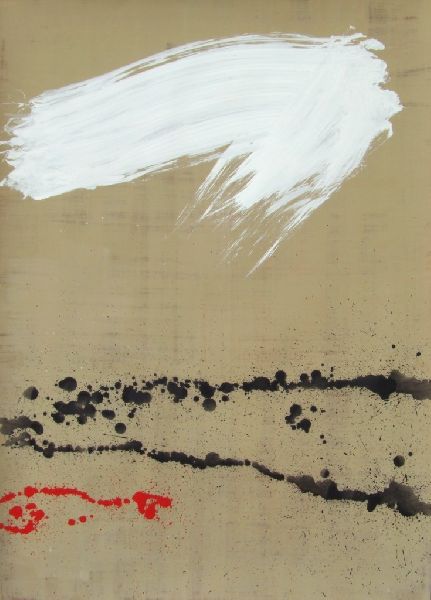
GOLDEN TORTOISE is proud to present a showcase of art pieces of Michaël Deloffre, French artist with all 20 paintings exhibiting for a month from 6th February to 8th March  at GOLDEN TORTOISE 100 Sukhumvit soi 49, Bangkok 10110. Tel: 02 662 5600. Open daily 10am – 6pm. This exhibition is open to public, allowing guests to explore into the world of his art .

Originally, the vision of Michaël Deloffre is revealed by the creation of monumental and unique pieces of paintings and sculptures. Becoming a pioneer in enhancing raw beauty, he paves the way for a “Natural & Contemporary” aesthetic movement.. Today, more than 150 exhibitions of his works have been exposed to over 40 countries.

He is now an internationally renowned artist and his works can be found in many private and public collections around the world such as the National Foundation for Contemporary Art (FNAC) in Paris, the Hamburger Bahnhof Museum in Berlin, the Museum of Contemporary Art (MCA) in Chicago, the Institute of Contemporary Art (ICA) in Philadelphia, and the Museum of Contemporary Art (CMAM) in Montreal.

For this very exhibition, Michaël Deloffre exhibits paintings never shown before, where the concept of his creation works on blacks, revealing the space between light and shade. Wide and straight movements divulge the colors and material, and express his observation of the evolution of our social relationships in today’s world with the advent of new technologies.


The result of his work contains a strong emotion that brings us strength and weakness at the same time. His works of art transcend towards the essentials of beauty, revealing a pure and simple aestheticism; a primal beauty, a kind of universal art language.


DISCLAIMER: This is a press release. Its contents are not produced by Khaosod English.

Advertisement

Thammasat Students Protest Dismissal of Exiled Professor

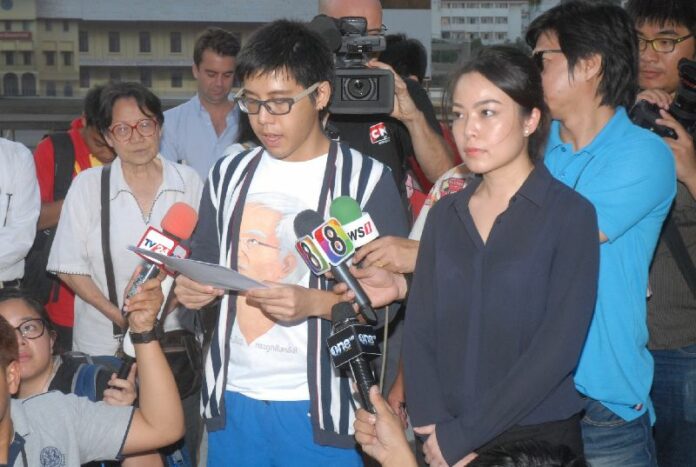
Several dozen students and lecturers staged protests denouncing Thammasat University's recent decision to fire history professor Somsak Jeamteerasakul, 26 Feb 2015.

BANGKOK — Several dozen students and lecturers staged protests on Thursday denouncing Thammasat University's recent decision to fire history professor Somsak Jeamteerasakul, a prominent critic of the Thai monarchy who is currently living in exile.

According to an order released by the university this week, Somsak, 56, was fired for failing to show up for work for more than 15 days. The dismissal effectively disqualified Somsak from receiving a pension and other benefits, despite the fact he has taught at the university for over 20 years.

\
Students and professors 
denounce Thammasat University's decision to fire history professor Somsak Jeamteerasakul, 25 Feb 2015.

Today's protests were organized by a group calling itself "Thammasat Community" at Thammasat's Tha Prachan and Rangsit campuses.

The demonstrators at Tha Prachan campus read a statement to the press expressing disappointment over the university’s decision to fire Somsak rather than accept his letter of resignation, which he said he submitted to the university in December 2014. 

"It is disappointing that the administrators of Thammasat University have abandoned their chance to show moral courage in defense of liberty and academic independence," the statement read. "Instead, they display fear toward the dictatorial power that has interfered in the university, to the point of refusing to protect their own personnel."

\

In a symbolic gesture of solidarity with Somsak, one of the demonstrators put white powder in his hair in reference to the historian’s nickname as "the white-haired professor." 

Several plain-clothed police officers monitored the event, Prachatai English reported, but no arrests were made. Public protests and political activities are currently banned by the junta, which declared martial law and seized power in a coup in May 2014.

A historian by trade, Somsak is a rare outspoken critic of the monarchy in Thailand, where insulting the Royal Family is punishable by up to 15 years under the country’s lese majeste law

Somsak, who was charged with lese majeste in 2011, is believed to have fled Thailand shortly after the May 2014 coup.

The junta, known officially as the National Council for Peace and Order (NCPO), summoned Somsak and hundreds of other academics, activists, and politicians for "attitude adjustment" after the military takeover. When Somsak did not comply, authorities issued an arrest warrant for him and eventually revoked his passport.

After six months of silence, Somsak posted on his Facebook that he was living in exile in Europe. Although he has never specified which country he is living in, many people have confirmed that he is residing in France. Over the past few months, Somsak has published dozens of historical documents and criticism of the monarchy on social media. 

The rector of Thammasat University, Somkid Lertpaitoontold TNN news agency yesterday that the order to expel Somsak was in accordance with university regulations, which prohibit employees from missing work for more than 15 days "without due cause." He added that the university summoned Somsak to testify before a university committee in person, but that the historian did not comply, leaving the university administrators no choice but to fire him. 

"The punishment of Mr. Somsak is not related to his expression of political opinions, because we regard it as academic freedom," Somkid was quoted as saying. "And it's not related to lese majeste, either. Mr. Somsak is being prosecuted under the criminal codes, which is the duty of police officers to proceed under the laws." 

However, Somsak posted on his Facebook that university regulations allow for a wide range of punishments for employees who miss work, ranging from temporary suspensions to requested resignations.

"I suspect that the rector has been so busy working for the NCPO that he forgot the regulations of his own workplace," Somsak wrote, referring to Somkid's membership in the interim legislature appointed by the ruling junta. 

 
For comments, or corrections to this article please contact: [email protected]

You can also find Khaosod English on Twitter and Facebook
http://twitter.com/KhaosodEnglish
http://www.facebook.com/KhaosodEnglish
Advertisement

Junta's Lawmakers Approve Bill to Restrict Rallies

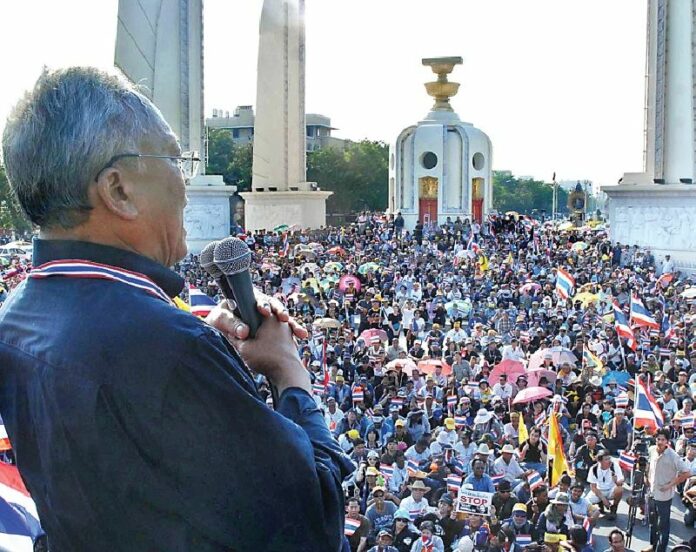
Anti-government protesters rally in Bangkok in November 2013.

BANGKOK – The Thai junta’s rubber-stamp parliament has unanimously approved the first draft of a bill that would restrict political demonstrations in Thailand.

The bill, named the Public Rallies Act, was approved today in a 182-0 vote by the National Legislative Assembly (NLA), whose members were hand-picked by the ruling junta. 

\
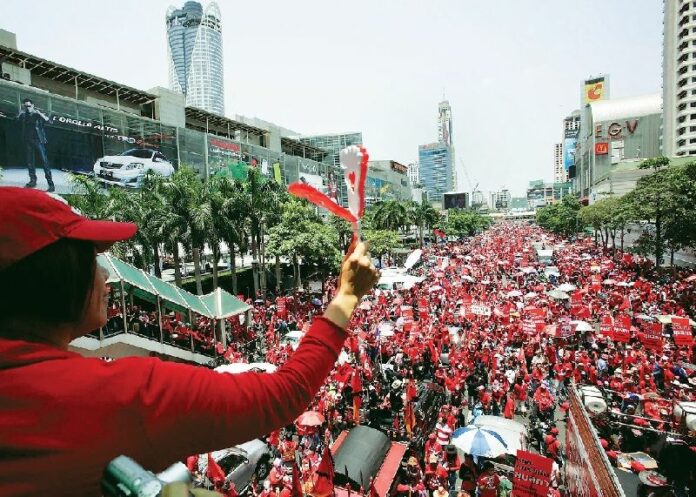
A Redshirt rally in Bangkok in April 2010.

The bill will now go to a 22-member subcommittee before it returns to the assembly for a second vote one month from now.

According to a draft of the bill, public rallies will required to be peaceful and respect the "boundary of rights and liberties ascribed by the Constitution." 

If approved and enforced, the act will also place the following restrictions on protests:

  • The area within a 150-meter radius of any royal palace and residences of guests who are formally invited by the Royal Thai Family will be declared off-limits to any protest.
  • No protest can take place in the premises of the Government House, Parliament, and courts, except with approval from relevant state agencies. 
  • The Commander of the Royal Thai Police has the power to declare the area within 50-meter radius of the Government House, Parliament, and courts off-limits to any protest. 
  • Organizers of potential rallies are required to alert authorities at least 24 hours before the demonstrations take place. They are required to state the purpose, date, time, and place of the rallies. 
  • Security officers can obtain orders from courts to disperse rallies in which "demonstrators commit any act of violence that may cause danger to the lives and property of others, and lead to chaos in the country." 
  • In the event of an order to declare any area off-limit to protests, violators face a maximum jail term of 10 years. 

Speaking to the assembly before the vote this morning, NLA member and Thammasat University rector Somkid Lertpaitoon said he supported the bill, but had some reservations.

"It's good that the government is trying to pass this bill, after the troubles about political rallies in the past 10 years," he said. "[But] this law does give a large opening to the judgment of security officers. Therefore, security officers have to uphold the principle of peaceful and unarmed assembly, because it is the right of the people."

He also pointed to a Constitutional Court verdict in 2006 that ruled against requiring citizens to ask permission to protest in public . The court ruled that such a law would violate the constitutional provision on freedom of assembly.

"I am not sure how much the verdict of the Constitutional Court will affect this law," Somkid said.

Deputry Prime Minister Visanu Krue-ngam assured the NLA that details of the law can be amended by the sub-committee. He also assured the lawmakers that security officers will be trained in crowd control and required to enforce the law fairly. 

"This law isn't a perfect tool," Visanu said. "Some people were asking, will there be still be rallies under this law? Let me answer that rallies will still take place. But the rallies will be more orderly." 

The NLA then unanimously voted to pass the bill. 

For much of the last decade, Thailand has been rocked by mass protests organized by rival political factions known as the Redshirts, mostly composed of rural poor who support former Prime Minister Thaksin Shinawatra, and the Yellowshirts, a loose coalition of royalists and traditional elites who revile Thaksin his political camp.

The protests have occasionally turned deadly during clashes between the two groups and encounters with security forces. The bloodiest episode occurred in 2010, when more than 90 people were killed during a military crackdown on Redshirt protests from March to May of that year. 

More recently, nearly 30 people lost their lives during the six months of anti-government protests staged by Yellowshirts that culminated in a military coup on 22 May 2014. 

Public protests are currently outlawed under martial law by the ruling military junta, though in practice the ban is only strictly applied to anti-coup and pro-democracy activities. 

 
For comments, or corrections to this article please contact: [email protected]

You can also find Khaosod English on Twitter and Facebook
http://twitter.com/KhaosodEnglish
http://www.facebook.com/KhaosodEnglish


Advertisement

Junta's Lawmakers Approve Bill to Restrict Rallies

A Redshirt rally in Bangkok on 3 April 2010.

BANGKOK – The Thai junta’s rubber-stamp parliament has unanimously approved the first draft of a bill that would restrict political demonstrations in Thailand.

The bill, named the Public Rallies Act, was approved today in a 182-0 vote by the National Legislative Assembly (NLA), whose members were hand-picked by the ruling junta. 

The bill will now go to a 22-member subcommittee before it returns to the assembly for a second vote one month from now.

According to a draft of the bill, public rallies will required to be peaceful and respect the "boundary of rights and liberties ascribed by the Constitution." 

If approved and enforced, the act will also place the following restrictions on protests:

  • The area within a 150-meter radius of any royal palace and residences of guests who are formally invited by the Royal Thai Family will be declared off-limits to any protest.
  • No protest can take place in the premises of the Government House, Parliament, and courts, except with approval from relevant state agencies. 
  • The Commander of the Royal Thai Police has the power to declare the area within 50-meter radius of the Government House, Parliament, and courts off-limits to any protest. 
  • Organizers of potential rallies are required to alert authorities at least 24 hours before the demonstrations take place. They are required to state the purpose, date, time, and place of the rallies. 
  • Security officers can obtain orders from courts to disperse rallies in which "demonstrators commit any act of violence that may cause danger to the lives and property of others, and lead to chaos in the country." 
  • In the event of an order to declare any area off-limit to protests, violators face a maximum jail term of 10 years. 

Speaking to the assembly before the vote this morning, NLA member and Thammasat University rector Somkid Lertpaitoon said he supported the bill, but had some reservations.

"It's good that the government is trying to pass this bill, after the troubles about political rallies in the past 10 years," he said. "[But] this law does give a large opening to the judgment of security officers. Therefore, security officers have to uphold the principle of peaceful and unarmed assembly, because it is the right of the people."

He also pointed to a Constitutional Court verdict in 2006 that ruled against requiring citizens to ask permission to protest in public . The court ruled that such a law would violate the constitutional provision on freedom of assembly.

"I am not sure how much the verdict of the Constitutional Court will affect this law," Somkid said.

\
Anti-government protesters rally in Bangkok in November 2013.

Deputry Prime Minister Visanu Krue-ngam assured the NLA that details of the law can be amended by the sub-committee. He also assured the lawmakers that security officers will be trained in crowd control and required to enforce the law fairly. 

"This law isn't a perfect tool," Visanu said. "Some people were asking, will there be still be rallies under this law? Let me answer that rallies will still take place. But the rallies will be more orderly." 

The NLA then unanimously voted to pass the bill. 

For much of the last decade, Thailand has been rocked by mass protests organized by rival political factions known as the Redshirts, mostly composed of rural poor who support former Prime Minister Thaksin Shinawatra, and the Yellowshirts, a loose coalition of royalists and traditional elites who revile Thaksin his political camp.

The protests have occasionally turned deadly during clashes between the two groups and encounters with security forces. The bloodiest episode occurred in 2010, when more than 90 people were killed during a military crackdown on Redshirt protests from March to May of that year. 

More recently, nearly 30 people lost their lives during the six months of anti-government protests staged by Yellowshirts that culminated in a military coup on 22 May 2014. 

Public protests are currently outlawed under martial law by the ruling military junta, though in practice the ban is only strictly applied to anti-coup and pro-democracy activities. 

 
For comments, or corrections to this article please contact: [email protected]

You can also find Khaosod English on Twitter and Facebook
http://twitter.com/KhaosodEnglish
http://www.facebook.com/KhaosodEnglish


Advertisement

Prayuth Willing to Testify on 2010 Crackdown

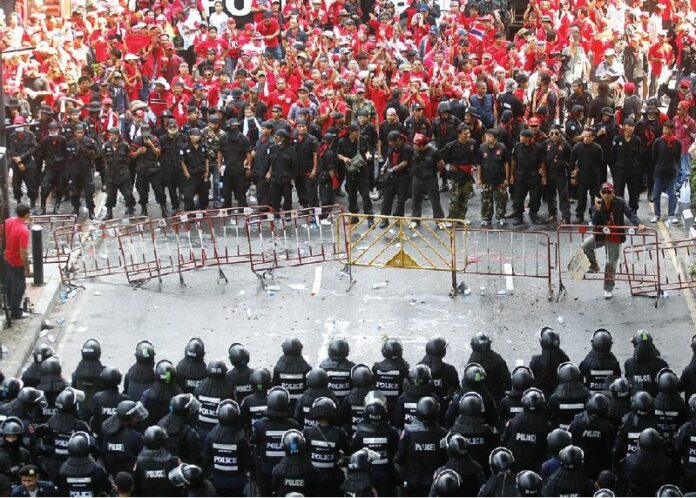
Redshirt demonstrators face off with riot police near Ratchaprasong Intersection in Bangkok, 6 April 2010​.

BANGKOK — Junta chairman and Prime Minister Prayuth Chan-ocha said he is willing to provide testimony to Thailand’s anti-graft agency about his role as a top army commander in the 2010 military crackdown on Redshirt protesters.

On 24 February, the the National Anti-Corruption Commission (NACC) moved forward with “abuse of power” charges against former Prime Minister Abhisit Vejjajiva and his deputy Suthep Thaugsuban for authorizing the crackdown, which left over 90 people dead.

\
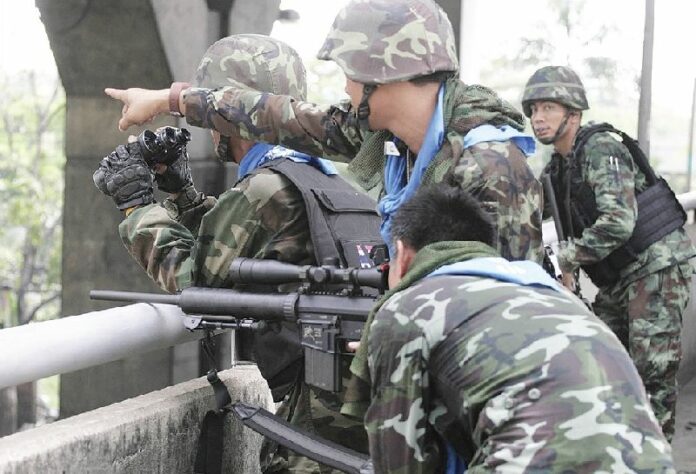
A military sniper aims at Redshirt protesters during clashes on Viphavadee Road in Bangkok, 28 April 2010.


If found guilty, the pair could be retroactively impeached and banned from political office for five years.

Yesterday, Abhisit suggested that the NACC question military commanders such as Gen. Prayuth, who will be able to provide more details about the operation.

Speaking to reporters today, Gen. Prayuth said he has not received any requests to appear before the commission, but is ready to testify if he is summoned.

"I am ready to give information, but I may not need to be there personally. I can submit the information through documents," said Gen. Prayuth, who served as commander of the First Region Army during the crackdown. 

Asked whether the investigation will affect the reputation of the military, Gen. Prayuth shot back, "How will that affect the military? The officers were performing their work."

He then raised his voice and told the reporters, "I want to ask you about this fact: were there armed people among the civilians? Were there? Answer me loudly. Were there Blackshirts among the Redshirts? Did they shoot at the soldiers? If so, then it's over."

Gen. Prayuth was referring to militants, known as the Blackshirts, who were allegedly allied to the Redshirts and exchanged fire with soldiers during the crackdown.

Abhisit, Suthep, Prayuth, and other military commanders insist that the Blackshirts, and not security officers, were responsible for much of the bloodshed. Suthep famously suggested in May 2010 that soldiers who were filmed firing into a temple on the last day of the crackdown were in fact "bandits" disguised as military officers. 

However, the NACC noted in its briefing this week that court inquests have determined security officers to be responsible for many of the civilian deaths.

The effort to hold Abhisit and Suthep accountable for the 2010 crackdown was initially taken up by the Division of Special Investigation, which filed murder charges against the two politicians in 2011. The Criminal Court eventually dropped the case last August, and granted the NACC authority to try Abhisit and Suthep in the Supreme Court's Division for Holders of Political Office. 

Military commanders who oversaw the operation, such as Gen. Prayuth, Gen. Anupong Paochinda, and Gen. Prawit Wongsuwan, have never been formally included in the investigation. 

Human rights groups have repeatedly faulted Thai authorities for failing to hold state officials accountable for the 2010 crackdown. 


For comments, or corrections to this article please contact: [email protected]

You can also find Khaosod English on Twitter and Facebook
http://twitter.com/KhaosodEnglish
http://www.facebook.com/KhaosodEnglish
Advertisement

Thai Authorities Detain Karen Activist for Protesting Junta's Forest Policy

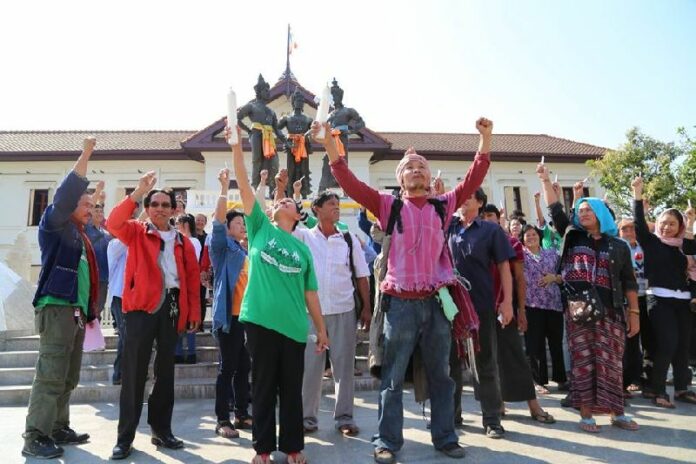
Pruet Odochao, centre, lights a candle on Saturday afternoon in front of the Three Kings Monument in central Chiang Mai together with about 30 other activists [Prachatai English]

(Prachatai English)

BANGKOK – The Thai military detained a northern activist for holding a symbolic political event to condemn the junta’s forest policy in the northern province of Chiang Mai.

At around 5 pm on Saturday the military detained Pruet Odochao, a Karen activist from a group called People’s Group for Northern Reform, for two hours after he participated in a symbolic political activity of lighting candles in front of the Three Kings Monument in central Chiang Mai.

The military officers reportedly searched his belongings and checked his cell phone before releasing him after two hours’ detention.

Read more here

Note: Khaosod English is not responsible for content on other websites.


Advertisement

Prayuth Willing to Testify on 2010 Crackdown

BANGKOK — Junta chairman and Prime Minister Prayuth Chan-ocha said he is willing to provide testimony to Thailand’s national anti-graft agency about his role as a top army commander in the 2010 military crackdown on Redshirt protesters.

The inquiry over the crackdown, which left more than 90 people dead, is being conducted by the National Anti-Corruption Commission (NACC).

On 24 February, the NACC moved forward with “abuse of power” charges against former Prime Minister Abhisit Vejjajiva and his deputy Suthep Thaugsuban for authorizing the crackdown. If found guilty, the pair could be retroactively impeached and banned from political office for five years.

Yesterday, Abhisit suggested that the NACC turn to military commanders such as Gen. Prayuth for additional testimony, as they will be able to provide more details about the military operation.

Speaking to reporters today, Gen. Prayuth said he has not received any requests to appear before the commission, but is ready to testify if he is summoned.

"I am ready to give information, but I may not need to be there personally. I can submit the information through documents. Don't make it such a big news," said Gen. Prayuth, who served as commander of the First Region Army during the crackdown.

Asked whether the NACC inquiry will affect the reputation of the military, Gen. Prayuth shot back, "How will that affect the military? The officers were performing their work."

He then raised his voice and told the reporters, "I want to ask you about this fact: were there armed people among the civilians? Were there? Answer me loudly. Were there Blackshirts among the Redshirts? Did they shoot at the soldiers? If so, then it's over."

Gen. Prayuth was referring to the Redshirt-allied militants, known as the Blackshirts, who allegedly shot and threw grenades at soldiers during clashes between protesters and security forces in 2010.

Abhisit, Suthep, Prayuth, and other military commanders insist that the Blackshirts, and not security officers, were responsible for much of the bloodshed. Suthep famously suggested in May 2010 that soldiers who were filmed firing into a temple on the last day of the crackdown were in fact "bandits" disguised as military officers. 

However, the NACC noted in its briefing this week that court inquests have determined security officers to be responsible many of the civilian deaths.

The effort to hold Abhisit and Suthep accountable for the 2010 crackdown was initially taken up by the Division of Special Investigation, which filed murder charges against the two politicians in 2011. The Criminal Court eventually dropped the case last August, and granted the NACC authority to try Abhisit and Suthep in the Supreme Court's Division for Holders of Political Office. 

Military commanders who oversaw the operation, such as Gen. Prayuth, Gen. Anupong Paochinda, and Gen. Prawit Wongsuwan, have never been formally included in the investigation. 

Human rights groups have repeatedly faulted Thai authorities for failing to hold state officials accountable for the 2010 crackdown. 


For comments, or corrections to this article please contact: [email protected]

You can also find Khaosod English on Twitter and Facebook
http://twitter.com/KhaosodEnglish
http://www.facebook.com/KhaosodEnglish

Advertisement

Prayuth Willing to Testify on 2010 Crackdown

A military sniper aims at Redshirt protesters during a clash on Viphavadee Road in Bangkok, 28 April 2010.

BANGKOK — Junta chairman and Prime Minister Prayuth Chan-ocha said he is willing to provide testimony to Thailand’s anti-graft agency about his role as a top army commander in the 2010 military crackdown on Redshirt protesters.

On 24 February, the the National Anti-Corruption Commission (NACC) moved forward with “abuse of power” charges against former Prime Minister Abhisit Vejjajiva and his deputy Suthep Thaugsuban for authorizing the crackdown, which left over 90 people dead.

\
 Redshirt demonstrators face off with riot police near Ratchaprasong Intersection in Bangkok, 6 April 2010​.

If found guilty, the pair could be retroactively impeached and banned from political office for five years.

Yesterday, Abhisit suggested that the NACC question military commanders such as Gen. Prayuth, who will be able to provide more details about the operation.

Speaking to reporters today, Gen. Prayuth said he has not received any requests to appear before the commission, but is ready to testify if he is summoned.

"I am ready to give information, but I may not need to be there personally. I can submit the information through documents," said Gen. Prayuth, who served as commander of the First Region Army during the crackdown. 

Asked whether the investigation will affect the reputation of the military, Gen. Prayuth shot back, "How will that affect the military? The officers were performing their work."

He then raised his voice and told the reporters, "I want to ask you about this fact: were there armed people among the civilians? Were there? Answer me loudly. Were there Blackshirts among the Redshirts? Did they shoot at the soldiers? If so, then it's over."

Gen. Prayuth was referring to militants, known as the Blackshirts, who were allegedly allied to the Redshirts and exchanged fire with soldiers during the crackdown.

Abhisit, Suthep, Prayuth, and other military commanders insist that the Blackshirts, and not security officers, were responsible for much of the bloodshed. Suthep famously suggested in May 2010 that soldiers who were filmed firing into a temple on the last day of the crackdown were in fact "bandits" disguised as military officers. 

However, the NACC noted in its briefing this week that court inquests have determined security officers to be responsible for many of the civilian deaths.

The effort to hold Abhisit and Suthep accountable for the 2010 crackdown was initially taken up by the Division of Special Investigation, which filed murder charges against the two politicians in 2011. The Criminal Court eventually dropped the case last August, and granted the NACC authority to try Abhisit and Suthep in the Supreme Court's Division for Holders of Political Office. 

Military commanders who oversaw the operation, such as Gen. Prayuth, Gen. Anupong Paochinda, and Gen. Prawit Wongsuwan, have never been formally included in the investigation. 

Human rights groups have repeatedly faulted Thai authorities for failing to hold state officials accountable for the 2010 crackdown. 


For comments, or corrections to this article please contact: [email protected]

You can also find Khaosod English on Twitter and Facebook
http://twitter.com/KhaosodEnglish
http://www.facebook.com/KhaosodEnglish
Advertisement

Hot News

LATEST NEWS

Bangkok
overcast clouds
32.3 ° C
34.4 °
30.5 °
74 %
4.5kmh
100 %
Fri
32 °
Sat
31 °
Sun
30 °
Mon
28 °
Tue
32 °