





























28.3 C
Bangkok
Thursday, July 2, 2026
Home Blog Page 3075

Northern Myanmar Clashes Reveal Fault Lines in Troubled Region

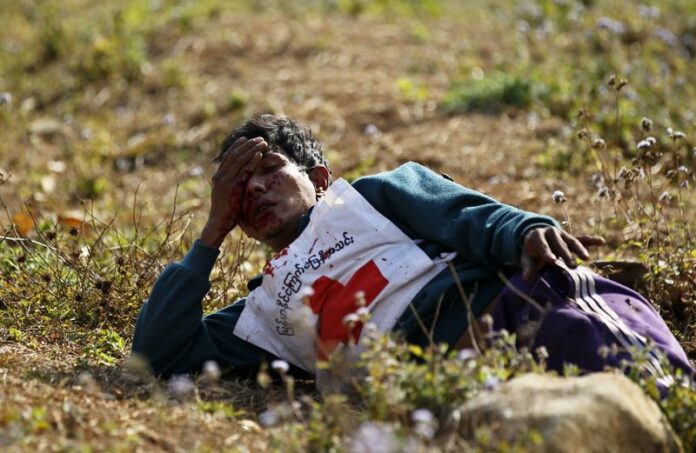
A wounded Red Cross volunteer lies on the ground after vehicles of a rescue convoy were attacked by Kokang rebels near self-administered Kokang capital Laukkai, northern Shan State, Myanmar, 17 February 2015. EPA/LYNN BO BO

By Kyaw Lynn

LASHIO, MYANMAR (DPA) — Sheltering at Man Su Buddhist monastery in north-eastern Myanmar, Mu Mu San and eight other women as well as two children are waiting for relatives they left behind.

The monastery in Lashio town in Shan state is serving as a temporary shelter for people fleeing violence near the Myanmar-China border, some 130 kilometres away.

\
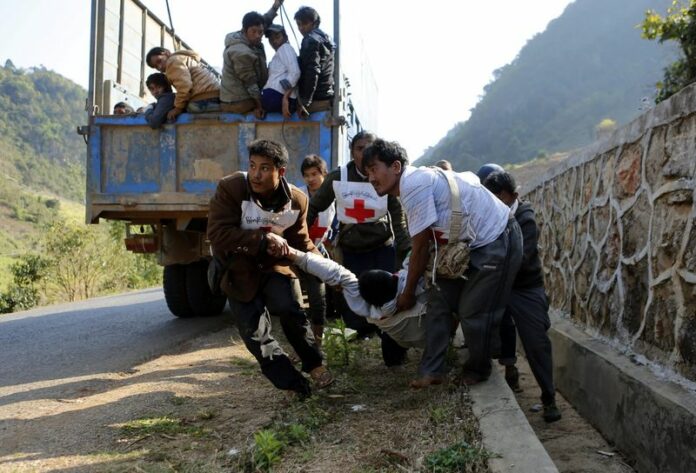
Volunteers of Myanmar's Red Cross organisation carry a wounded volunteer Moe Kyaw, 45, near self-administered Kokang capital Laukkai, northern Shan State, Myanmar, 17 February 2015. EPA/LYNN BO BO

"My husband and three relatives are still on the way and we haven't get any news of them," said Mu Mu San, 32, who fled from Laukkai, the capital of the self-administered Kokang region, which has been the focus of heavy fighting between government troops and rebels.

"Rescue trucks are full of war victims. So they prioritize children and women, so I left my husband and relatives there," said Mu Mu San.

The convoy carrying war victims, including Mu Mu San, was shot at by Kokang rebels during the drive away from the border. Two Myanmar Red Cross volunteers were wounded.

Mu Mu San's group are among thousands who fled Laukkai after fighting erupted 10 days ago.

President Thein Sein Tuesday declared a state of emergency and imposed martial law in Kokang, with dozens of soldiers and rebels killed in the past fortnight.

At least one civilian died in an ambush by the rebels Tuesday as residents fled to Lashio town further away from the Chinese border to avoid the violence.

\
A wounded Red Cross volunteer lies on the ground after vehicles of a rescue convoy were attacked by Kokang rebels near self-administered Kokang capital Laukkai, northern Shan State, Myanmar, 17 February 2015. EPA/LYNN BO BO

The rebels, formally known as the Myanmar National Democratic Alliance Army (MNDAA), are led by Pheung Kya-shin, an 84-year-old fighter of Chinese descent.

"We will keep fighting the Myanmar government until Kokang is recovered," Pheung – who speaks Mandarin with a Yunnan accent – told Chinese media in December, his first interview in 5 years.

The MNDAA controlled the Kokang region between 1989 and 2009.

Myanmar's army seized the area in 2009 in the wake of a failed peace deal, according to which the rebels were to reform into a border guard force under the control of the military.

Pheung Kya-shin refused to bargain, and he and other leaders fled to Thailand.

His rekindled fight against the government has been taken up by at least two other ethnic rebel groups.

"We are in alliance. So we must join them in fighting against the government. Otherwise, the next time it will be us," said Tar Parn La, a spokesman for the Ta'ang National Liberation Army.

\
Myanmar citizens are seen awaiting rescue teams to flee from self-administered Kokang capital Laukkai, northern Shan State, Myanmar, 17 February 2015. Thousands of people living around Laukkai have fled as clashes continue in the area. EPA/LYNN BO BO

Not all rebel groups in Shan state are joining the Kokang fighting, however. The powerful United Wa State Army (UWSA), which has been in talks with the government over its nationwide peace deal, has said they have no reason to help the Kokang rebels because they want peace and stability in the region.

Authorities say the fighting has been prolonged by the involvement of the TNLA and Arakan Army, both of which are fighting government forces in other areas of Shan and in northern Kachin state.

Army chief Min Aung Hlaing on Monday warned the rebel groups that joining the Kokang rebels would be a declaration of war, state media reported. "They have to take responsibility for it," he was quoted as saying.

The country's giant neighbour China adds another dimension to the violence.

More than 30,000 residents have fled to China's north-western province of Yunnan since February 9, according to Yunnan's Lincang City authorities.

Myanmar authorities meanwhile say Kokang rebels entered Myanmar from China.

Beyond the Chinese ancestral link to the MNDAA leadership, Beijing denies any ties to the rebels. It says it respects Myanmar's "territorial integrity" and would not allow organizations or individuals to undermine stability in the border areas.

\
A Buddhist monk and war victims fleeing from Laukkai takes cover after vehicles of the Red Cross rescue convoy were attacked by Kokang rebels near self-administered Kokang capital Laukkai, northern Shan State, Myanmar, 17 February 2015. EPA/LYNN BO BO​

Myanmar state-run media has offered an alternative explanation for the fighting, reporting that the army launched its operation last week after MNDAA rebels seized weapons from a local militia.

Whatever sparked the violence, the timing is such that a long-sought peace deal between the government and the country's myriad ethnic groups could be under threat.

One of the signatories says the Kokang rebels were not invited to take part, leading them to gain power in other ways.

"We are worrying it may impact on the ongoing peace process," said Padoh Mahn Nyein Maung, a central committee member of powerful Karen National Union, representing another ethnic group.

"They demanded that the government accept them as a group in signing the Nationwide Ceasefire Accord, but government didn't accept it. So, the fighting starts," he said.

"What else can we do other than fight them to retake our region?" said Kokang rebel spokesman Htun Myat Linn. 


For comments, or corrections to this article please contact: [email protected]

You can also find Khaosod English on Twitter and Facebook
http://twitter.com/KhaosodEnglish
http://www.facebook.com/KhaosodEnglish
Advertisement

Northern Myanmar Clashes Reveal Fault Lines in Troubled Region

Volunteers of Myanmar's Red Cross organisation carry a wounded volunteer Moe Kyaw, 45, near self-administered Kokang capital Laukkai, northern Shan State, Myanmar, 17 February 2015. EPA/LYNN BO BO

By Kyaw Lynn

LASHIO, MYANMAR (DPA) — Sheltering at Man Su Buddhist monastery in north-eastern Myanmar, Mu Mu San and eight other women as well as two children are waiting for relatives they left behind.

The monastery in Lashio town in Shan state is serving as a temporary shelter for people fleeing violence near the Myanmar-China border, some 130 kilometres away.

\
A wounded Red Cross volunteer lies on the ground after vehicles of a rescue convoy were attacked by Kokang rebels near self-administered Kokang capital Laukkai, northern Shan State, Myanmar, 17 February 2015. EPA/LYNN BO BO

"My husband and three relatives are still on the way and we haven't get any news of them," said Mu Mu San, 32, who fled from Laukkai, the capital of the self-administered Kokang region, which has been the focus of heavy fighting between government troops and rebels.

"Rescue trucks are full of war victims. So they prioritize children and women, so I left my husband and relatives there," said Mu Mu San.

The convoy carrying war victims, including Mu Mu San, was shot at by Kokang rebels during the drive away from the border. Two Myanmar Red Cross volunteers were wounded.

Mu Mu San's group are among thousands who fled Laukkai after fighting erupted 10 days ago.

President Thein Sein Tuesday declared a state of emergency and imposed martial law in Kokang, with dozens of soldiers and rebels killed in the past fortnight.

At least one civilian died in an ambush by the rebels Tuesday as residents fled to Lashio town further away from the Chinese border to avoid the violence.

\
Volunteers of Myanmar's Red Cross organisation carry a wounded volunteer Moe Kyaw, 45, near self-administered Kokang capital Laukkai, northern Shan State, Myanmar, 17 February 2015. EPA/LYNN BO BO

The rebels, formally known as the Myanmar National Democratic Alliance Army (MNDAA), are led by Pheung Kya-shin, an 84-year-old fighter of Chinese descent.

"We will keep fighting the Myanmar government until Kokang is recovered," Pheung – who speaks Mandarin with a Yunnan accent – told Chinese media in December, his first interview in 5 years.

The MNDAA controlled the Kokang region between 1989 and 2009.

Myanmar's army seized the area in 2009 in the wake of a failed peace deal, according to which the rebels were to reform into a border guard force under the control of the military.

Pheung Kya-shin refused to bargain, and he and other leaders fled to Thailand.

His rekindled fight against the government has been taken up by at least two other ethnic rebel groups.

"We are in alliance. So we must join them in fighting against the government. Otherwise, the next time it will be us," said Tar Parn La, a spokesman for the Ta'ang National Liberation Army.

\
Myanmar citizens are seen awaiting rescue teams to flee from self-administered Kokang capital Laukkai, northern Shan State, Myanmar, 17 February 2015. Thousands of people living around Laukkai have fled as clashes continue in the area. EPA/LYNN BO BO

Not all rebel groups in Shan state are joining the Kokang fighting, however. The powerful United Wa State Army (UWSA), which has been in talks with the government over its nationwide peace deal, has said they have no reason to help the Kokang rebels because they want peace and stability in the region.

Authorities say the fighting has been prolonged by the involvement of the TNLA and Arakan Army, both of which are fighting government forces in other areas of Shan and in northern Kachin state.

Army chief Min Aung Hlaing on Monday warned the rebel groups that joining the Kokang rebels would be a declaration of war, state media reported. "They have to take responsibility for it," he was quoted as saying.

The country's giant neighbour China adds another dimension to the violence.

More than 30,000 residents have fled to China's north-western province of Yunnan since February 9, according to Yunnan's Lincang City authorities.

Myanmar authorities meanwhile say Kokang rebels entered Myanmar from China.

Beyond the Chinese ancestral link to the MNDAA leadership, Beijing denies any ties to the rebels. It says it respects Myanmar's "territorial integrity" and would not allow organizations or individuals to undermine stability in the border areas.

\
A Buddhist monk and war victims fleeing from Laukkai takes cover after vehicles of the Red Cross rescue convoy were attacked by Kokang rebels near self-administered Kokang capital Laukkai, northern Shan State, Myanmar, 17 February 2015. EPA/LYNN BO BO​

Myanmar state-run media has offered an alternative explanation for the fighting, reporting that the army launched its operation last week after MNDAA rebels seized weapons from a local militia.

Whatever sparked the violence, the timing is such that a long-sought peace deal between the government and the country's myriad ethnic groups could be under threat.

One of the signatories says the Kokang rebels were not invited to take part, leading them to gain power in other ways.

"We are worrying it may impact on the ongoing peace process," said Padoh Mahn Nyein Maung, a central committee member of powerful Karen National Union, representing another ethnic group.

"They demanded that the government accept them as a group in signing the Nationwide Ceasefire Accord, but government didn't accept it. So, the fighting starts," he said.

"What else can we do other than fight them to retake our region?" said Kokang rebel spokesman Htun Myat Linn. 


For comments, or corrections to this article please contact: [email protected]

You can also find Khaosod English on Twitter and Facebook
http://twitter.com/KhaosodEnglish
http://www.facebook.com/KhaosodEnglish
Advertisement

Thai Former Premier Yingluck to be Indicted on Criminal Charges

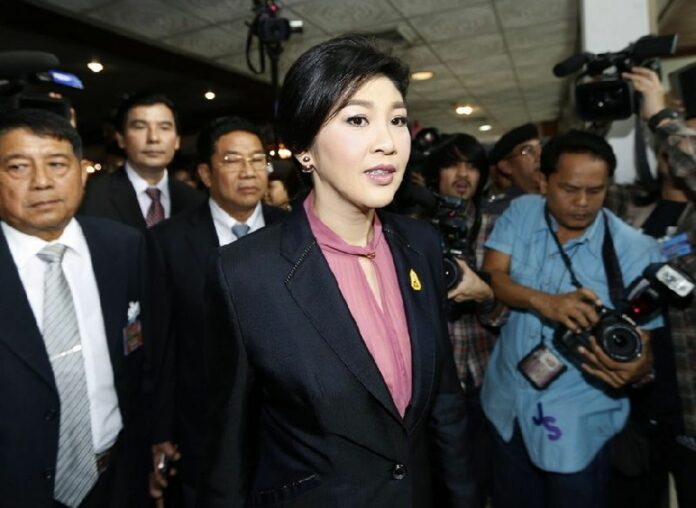
Former Thai prime minister Yingluck Shinawatra arrives to give her statement during impeachment proceedings against her, at the Parliament House in Bangkok, Thailand, 09 January 2015. Shinawatra was due to appear before the country's legislative body to face charges over a failed rice subsidy scheme. EPA/NARONG SANGNAK

By Cod Satrusayang

BANGKOK (DPA) — Former Thai prime minister Yingluck Shinawatra was to be indicted Thursday on criminal charges stemming from her government's rice subsidy scheme, the Office of the Attorney General (OAG) said.

Yingluck faces charges of dereliction of duty over corruption within the scheme, OAG spokesman Kosolwat Inthujanyong told reporters.

If found guilty, she could face up to 10 years in prison.

Sources inside her former party suggested Yingluck would not attend the hearing.

The former premier has already been impeached by the military-appointed legislature over the same charges and banned from politics for five years.

Yingluck has denied all charges against her.

"I've never cheated anybody," she said during the impeachment proceedings.

She argued that the hearings were politically motivated and that she cannot be impeached as she was no longer in office.

Yingluck was removed from office in May 2014 by the Constitutional Court after months of street demonstrations, including by farmers who had not been paid under the rice scheme.

The rest of her government was ousted later that month by a military coup that installed the current legislature and cabinet.

 
For comments, or corrections to this article please contact: [email protected]

You can also find Khaosod English on Twitter and Facebook
http://twitter.com/KhaosodEnglish
http://www.facebook.com/KhaosodEnglish
Advertisement

Thai Former Premier Yingluck to be Indicted on Criminal Charges

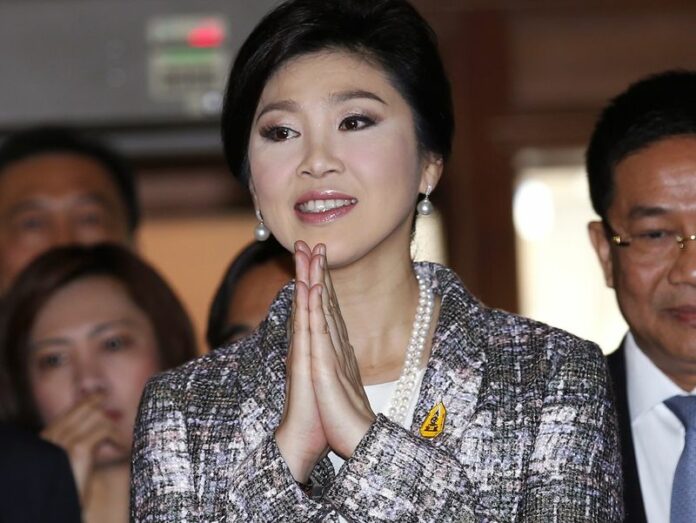
A file photo of former Thai prime minister Yingluck Shinawatra arriving at the National Legislative Assembly (NLA) during impeachment proceedings against her, at Parliament House in Bangkok, Thailand, 22 January 2015. Shinawatra was to be indicted on criminal charges stemming from her government's rice subsidy scheme. EPA/NARONG SANGNAK

By Cod Satrusayang

BANGKOK (DPA) — Former Thai prime minister Yingluck Shinawatra was to be indicted Thursday on criminal charges stemming from her government's rice subsidy scheme, the Office of the Attorney General (OAG) said.

Yingluck faces charges of dereliction of duty over corruption within the scheme, OAG spokesman Kosolwat Inthujanyong told reporters.

If found guilty, she could face up to 10 years in prison.

Sources inside her former party suggested Yingluck would not attend the hearing.

The former premier has already been impeached by the military-appointed legislature over the same charges and banned from politics for five years.

Yingluck has denied all charges against her.

"I've never cheated anybody," she said during the impeachment proceedings.

She argued that the hearings were politically motivated and that she cannot be impeached as she was no longer in office.

Yingluck was removed from office in May 2014 by the Constitutional Court after months of street demonstrations, including by farmers who had not been paid under the rice scheme.

The rest of her government was ousted later that month by a military coup that installed the current legislature and cabinet.

 
For comments, or corrections to this article please contact: [email protected]

You can also find Khaosod English on Twitter and Facebook
http://twitter.com/KhaosodEnglish
http://www.facebook.com/KhaosodEnglish
Advertisement

Thai Duo Arrested for Drugging, Robbing Elderly Foreign Men

PATTAYA — Police have arrested two Thai women who allegedly drugged and robbed a series of elderly foreign men in Pattaya.

Police say the two 40-year-old women posed as sex workers, and then laced the drinks of their “clients” with sleeping medicine. While the men slept, the women stole their money and other valuables.

The pair, two sisters named Netsai Panyakham and Manee Panyakham, were identified by three men at the police station who claimed to be victims.

According to police, the two women have stolen more than 140,000 baht in at least four incidents in Pattaya over the past two months. 

The sisters, who are originally from Mae Sot in Tak province, have been charged with theft and are being held at the station in Pattaya, police say. Police have urged any other victims to come forward. 

 
For comments, or corrections to this article please contact: [email protected]

You can also find Khaosod English on Twitter and Facebook
http://twitter.com/KhaosodEnglish
http://www.facebook.com/KhaosodEnglish

Advertisement

Foreign Tourists Are Rude Too, Chinese Newspaper Says

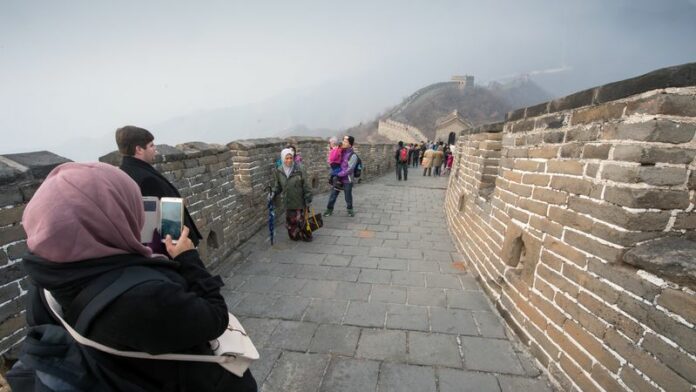
A file photo shows tourists enjoying the view from the Great Wall of China in Mutianyu near Beijing, China, 23 November 2014. Chinese state media highlighted the bad behaviour of foreign tourists as hundreds of millions of locals began travelling home or on holiday for the Chinese New Year holiday. Photo: Peter Kneffel/dpa

BEIJING (DPA) — Chinese state media Wednesday highlighted the bad behaviour of foreign tourists as hundreds of millions of locals began travelling home or on holiday for the Chinese New Year holiday.

Chinese tourists have increasingly come under fire in recent years for their behaviour abroad.

"It's been said that Chinese people can be uncivilised. In fact, it also applies to many foreigners," said People's Daily Online, the website for the government's official newspaper. "Our website has combed through a number of examples of uncivilised behaviour by foreign tourists. Let's not learn from them. Ha!"

The article showed photos and examples of foreigners misbehaving, such as those who have posed nude outside tourist sites, stepped on monuments, camped on China's Great Wall – which is prohibited – and taken up too much space on public benches. 

An accompanying graphic provided Chinese readers with guidelines on civilized travel. These included avoiding writing "I have visited here" on landmarks, cutting queues and snapping their fingers to get people's attention. 

The rude antics of some Chinese tourists have embarrassed many in the country, and sparked debate about how the government could discourage bad behaviour. 

In the worst incident in recent months, a flight attendant on an AirAsia flight was scalded in December after noodles in hot water were flung at her by a Chinese tourist, who was angry about not getting a receipt for her purchase.

The tourist was accompanied by three others, one of whom later threatened to blow up the aircraft because the group of four could not be seated together.

China will establish a public record of Chinese tourists who behave badly in foreign countries, state media reported last month.

The Civil Aviation Administration of China is also considering blacklisting and punishing unruly airline passengers, according to the China News Service. 

According to the Chinese lunar calendar, the new goat year begins on February 19, the longest and most important celebration in the Chinese calendar.  

 
For comments, or corrections to this article please contact: [email protected]

You can also find Khaosod English on Twitter and Facebook
http://twitter.com/KhaosodEnglish
http://www.facebook.com/KhaosodEnglish
Advertisement

Koh Tao Murders: Victim’s Family Raises Money To Attend Trial

An online fund is raising money for Hannah Witheridge's family to attend the trial of her alleged murders in July.

BANGKOK — The family of a 23-year-old British tourist who was hacked to death on the southern island of Koh Tao last year is raising money to attend the trial of her alleged murderers in July.

The battered bodies of Hannah Witheridge and another British tourist, 24-year-old David Miller, were found on one of the island's idyllic beaches last September. A bloodied garden hoe, believed to be the murder weapon, was found nearby.

Two 21-year-old Burmese migrant workers on the island were arrested in October and charged with raping and murdering Witheridge, and murdering Miller.

Zaw Lin and Wai Phyo, whose trial is set to begin in July, initially confessed to the crimes but later recanted, saying they were tortured by police into confessing.

Last week, Witheridge’s sister set up an online fund to help her family travel to Thailand for the trial.

“We are extremely keen to travel out to Thailand to represent Hannah and to, hopefully, see justice done,” Witheridge’s sister Laura wrote on the fundraising page.

In less than a week, at least £3,784 out of a £10,o00 goal has been raised. According to Witheridge’s sister, the money will be used to fund two flights to Thailand, one to see the beginning of the trial and one to attend the verdict.

“We are a family of 5 so the cost of flights and accommodation alone are going to be steep,” Laura Witheridge wrote, adding that the family also plans to hire an interpreter to cover the entire trial.

“An interpreter is the only way we can stay connected to the process and know what is going on, rather than having to hear about it in the World's media,” she wrote.

The investigation into the murder of Witheridge and Miller became a subject of media attention for weeks, with numerous rights groups expressing concern that Thai police turned to Zaw and Wai as scapegoats after their investigation appeared to reach a dead-end.

Doubts about Thai police’s handling of the case eventually prompted the United Kingdom to send its own delegation of police to Thailand to oversee the investigation.

After being briefed by the UK team, Witheridge’s family expressed confidence in the investigation.

“We are confident in the work that has been carried out into these atrocious crimes and want to remind both press and public that they do not have the full facts to report and make comment on at this stage,” Witheridge’s family said in a statement.

 
For comments, or corrections to this article please contact: [email protected]

You can also find Khaosod English on Twitter and Facebook
http://twitter.com/KhaosodEnglish
http://www.facebook.com/KhaosodEnglish


Advertisement

Artists Spark Outrage By Felling 143-Year-Old Tree in Krabi

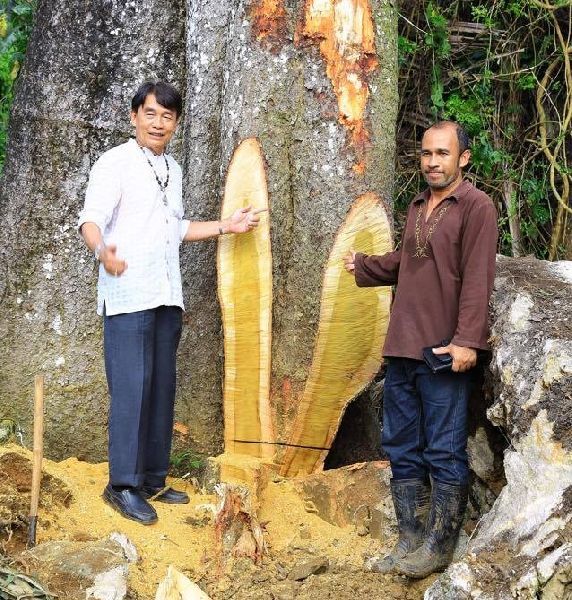
Katsumi Mukai (L) and Kamol Thassanachalee cutting down a tree in Krabi province. [Photo:Akradej Chakjinda]

KRABI — Two artists have come under fire for cutting down a 143-old tree in Krabi province for an art installation.

Katsumi Mukai, a Japanese wood sculptor, and Kamol Thassanachalee, a well-known Thai artist, drew heavy criticism after photos of the felled tree in Krabi began circulating on social media.

\
Katsumi Mukai (L) cutting down a tree in Krabi province. [Photo:Akradej Chakjinda]

“I’m really feeling down hearing that trees were cut for an artist to create artwork,” Suchart Sawatsri, another famous Thai artist and writer, said in response to the photos. “I am really disgusted by what he’s done. 

According to the Mayor of Krabi province, the owner of the land where the tree stood gave the artists permission to cut it down for their sculpture exhibition at Krabi's Andaman Art Gallery.

\
Trees carved for Mukai's sculpture show in Krabi
[Photo:Akradej Chakjinda].

Mukai has visited Thailand on many times and was an “Artist-In-Residence” at Khon Kaen University for two months. In 2005 he carved a giant rain tree in Malaysia into a popular outdoor sculpture in George Town called the “Winds of Penang.” 


For comments, or corrections to this article please contact: [email protected]

You can also find Khaosod English on Twitter and Facebook
http://twitter.com/KhaosodEnglish
http://www.facebook.com/KhaosodEnglish


Advertisement

Foreign Tourists Are Rude Too, Chinese Newspaper Says

A picture made available 18 September 2014 shows tourists visiting The Great Wall at Mutianyu, one of China's UNESCO Heritage sites on the outskirts of Beijing, China, 16 September 2014. Chinese state media highlighted the bad behaviour of foreign tourists as hundreds of millions of locals began travelling home or on holiday for the Chinese New Year holiday. EPA/DIEGO AZUBEL

BEIJING (DPA) — Chinese state media Wednesday highlighted the bad behaviour of foreign tourists as hundreds of millions of locals began travelling home or on holiday for the Chinese New Year holiday.

Chinese tourists have increasingly come under fire in recent years for their behaviour abroad.

"It's been said that Chinese people can be uncivilised. In fact, it also applies to many foreigners," said People's Daily Online, the website for the government's official newspaper. "Our website has combed through a number of examples of uncivilised behaviour by foreign tourists. Let's not learn from them. Ha!"

The article showed photos and examples of foreigners misbehaving, such as those who have posed nude outside tourist sites, stepped on monuments, camped on China's Great Wall – which is prohibited – and taken up too much space on public benches. 

An accompanying graphic provided Chinese readers with guidelines on civilized travel. These included avoiding writing "I have visited here" on landmarks, cutting queues and snapping their fingers to get people's attention. 

The rude antics of some Chinese tourists have embarrassed many in the country, and sparked debate about how the government could discourage bad behaviour. 

In the worst incident in recent months, a flight attendant on an AirAsia flight was scalded in December after noodles in hot water were flung at her by a Chinese tourist, who was angry about not getting a receipt for her purchase.

The tourist was accompanied by three others, one of whom later threatened to blow up the aircraft because the group of four could not be seated together.

China will establish a public record of Chinese tourists who behave badly in foreign countries, state media reported last month.

The Civil Aviation Administration of China is also considering blacklisting and punishing unruly airline passengers, according to the China News Service. 

According to the Chinese lunar calendar, the new goat year begins on February 19, the longest and most important celebration in the Chinese calendar.  

 
For comments, or corrections to this article please contact: [email protected]

You can also find Khaosod English on Twitter and Facebook
http://twitter.com/KhaosodEnglish
http://www.facebook.com/KhaosodEnglish

 

Advertisement

Phuket Governor Stands Strong Against Beach Chairs

Governor Nisit Jansomwong speaking at press conference in Phuket on Feb 17, 2015.

(The Phuket Gazette)

PHUKET —  Governor Nisit Jansomwong stood strong in his anti-beach chair campaign today, amid some tourists denouncing Phuket and its beaches following the recent “no beach chair” rule.

“Today, I would like to make it clear. We will continue to strictly enforce the rules prohibiting beach chairs on Phuket sands,” Governor Nisit said.

The governor’s statement flies in the face of Patong Mayor Chalermluck Kebsup’s call yesterday for a compromise following several incidents on Patong Beach this week during which tourists became outraged after police asked them to remove their sun loungers from the sands in compliance with the no-chair policy.

Read more here.

Note: Khaosod English is not responsible for content on other websites.

Advertisement

Hot News

LATEST NEWS

Bangkok
overcast clouds
28.3 ° C
31.6 °
28.3 °
77 %
4.2kmh
100 %
Wed
28 °
Thu
37 °
Fri
37 °
Sat
29 °
Sun
30 °