



























27.7 C
Bangkok
Thursday, July 2, 2026
Home Blog Page 3074

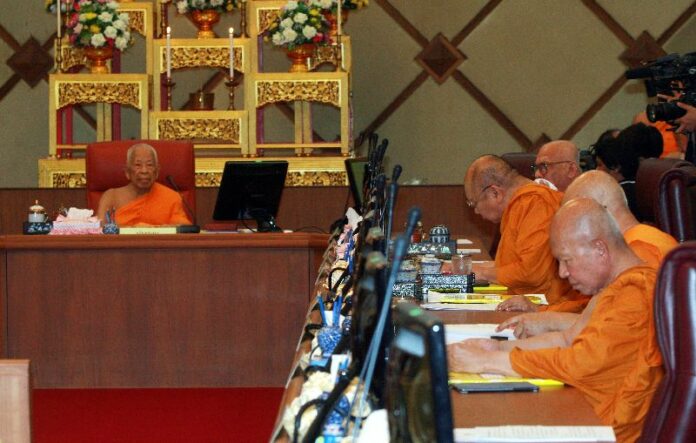
Dhammakaya Abbot Allowed to Continue Monkhood

An undated photo of the Supreme Sangha Council, a governing body for the order of Buddhist monks in Thailand.

BANGKOK — The leader of a controversial Buddhist movement has been permitted to continue serving as an abbot, a spokesperson for Thailand's Supreme Sangha Council said today.

Phra Dhammachayo, the abbot of Wat Phra Dhammakaya, was thrust into the spotlight this week after a member of the junta’s reform body revived concerns over his behavior, citing a letter written by the head of Thailand’s order of Buddhist monks in 1999. 

\The letter, written by the late supreme patriarch Somdet Phra Nyanasamvara, urged the Supreme Sangha Council (SSC) to defrock Phra Dhammachayo for distorting Buddhist doctrines and failing to transfer 1,500 rai of donated land to the temple.

Instead of defrocking the monk, the SSC ordered him to transfer the assets, which he eventually agreed to.

This week, members of the junta’s National Reform Council (NRC) demanded answers about Phra Dhammachayo, who they said should have been defrocked more than a decade ago.

A spokesperson for the Supreme Sangha Council announced today that Phra Dhammachayo has been cleared of any wrongdoing, as he already returned the disputed land to the temple years ago. The spokesperson did not comment on the other charge against the abbot – that he had distorted Buddhist doctrine. 

"Please stop discussing old stories or reviving what's been over for a long time," said Phra Phrommethee. "Our society is starting to reconcile."

Wat Phra Dhammakaya has not commented on the controversy other than releasing a short letter saying that all accusations against the abbot had “ended.”  A Khaosod correspondent who tried to go to the temple's PR department for further comment was turned away by security officers who said the media is strictly banned from entering the temple.

The Dhammakaya movement, which was founded in the 1970s and boasts millions of followers across Thailand, has been criticized by mainstream Buddhists for its heavy focus on soliciting donations, extravagant buildings and processions, and secretive organizational structure.

The movement, whose members include powerful politicians and businessmen, has overseas branches in at least eighteen countries and 24-hour satellite TV stations broadcast in several languages. 

 
For comments, or corrections to this article please contact: [email protected]

You can also find Khaosod English on Twitter and Facebook
http://twitter.com/KhaosodEnglish
http://www.facebook.com/KhaosodEnglish

Advertisement

33 Chinese Tourists Stranded in Pattaya

Police say a group of 33 Chinese tourists were stranded by their tour guide on a beach in the resort town of Pattaya, Feb 20, 2015.

PATTAYA — Police say a group of 33 Chinese tourists were stranded by their tour guide on a beach in the resort town of Pattaya.

The tourists, from Zhejiang province, told police through an interpreter that they arrived in Thailand on Feb 18 after paying a tour company around 12,000 baht each.

According to the group, after arriving in Pattaya their 20-year-old Chinese tour guide demanded they each pay around 7,000 baht more for the trip. Around two thirds of the group paid the fee, but the others refused because they had already purchased the tour package.

The guide then reportedly disappeared with the money, nearly 150,000 baht in total, without informing any of the tourists.

A representative from the “New Gen” tour company in Chiang Mai has taken responsibility for the group and met with police on Friday. She said her company was not involved with the guide’s dereliction of duty, but offered to refund the tourists who had paid the additional fees.

Police are looking for the original guide and are investigating whether she was licensed. 


For comments, or corrections to this article please contact: [email protected]

You can also find Khaosod English on Twitter and Facebook
http://twitter.com/KhaosodEnglish
http://www.facebook.com/KhaosodEnglish

Advertisement

Thai Government Bans Commercial Surrogacy

Mitsutoki Shigeta, 24, at Suvarnabhumi Airport in Bangkok in 2013.  Mr. Shigeta, 24, is under investigation by Thai police for having fathered a dozen babies in Thailand through a surrogate clinic in Bangkok.

BANGKOK — Thailand’s junta-appointed legislature has passed a bill outlawing commercial surrogacy in the Kingdom following a string of surrogacy scandals last year.

The new law, passed by the National Legislative Assembly on Thursday, stipulates that only married couples with at least one Thai partner can access surrogacy services in Thailand.

The surrogate mother, who must be Thai and over 25, cannot receive any direct fees for the service.

The law was proposed last year after Thailand’s reputation as a go-to destination for affordable “fertility tourism” came into the spotlight following a series of international scandals.

The first incident involved an Australian couple who took home a baby girl but abandoned her twin brother with his Thai surrogate mother after discovering he had Down Syndrome.

In a separate scandal that emerged several months later, a 24-year-old Japanese man was discovered to have fathered at least 12 babies with surrogate mothers in Thailand. In January, Mitsutoki Shigeta succesfully sued the Thai government for custody over three of the babies. 

"This law aims to stop Thai women's wombs from becoming the world's womb,” NLA member Wanlop Tankananurak told Reuters.

Under the new law, hiring women to commercially carry fetuses is punishable by up to 10 years in prison. 

Surrogacy advocates say outlawing the practice risks driving the industry underground, or forcing couples to seek services in countries with less reliable medical services. Commercial surrogacy is currently legal in some US states, and countries like Russia, India, and Israel.


For comments, or corrections to this article please contact: [email protected]

You can also find Khaosod English on Twitter and Facebook
http://twitter.com/KhaosodEnglish
http://www.facebook.com/KhaosodEnglish

Advertisement

Thai Government Bans Commercial Surrogacy

A file photo shows a surrogate baby with Down's Syndrome at a hospital in Chonburi province, Thailand, 04 August 2014. Thailand outlawed commercial surrogacy, after a scandal last year highlighted a blind spot in the country's legislation. EPA/RUNGROJ YONGRIT

BANGKOK — Thailand’s junta-appointed legislature has passed a bill outlawing commercial surrogacy in the Kingdom following a string of surrogacy scandals last year.

The new law, passed by the National Legislative Assembly on Thursday, stipulates that only married couples with at least one Thai partner can access surrogacy services in Thailand.

The surrogate mother, who must be Thai and over 25, cannot receive any direct fees for the service.

The law was proposed last year after Thailand’s reputation as a go-to destination for affordable “fertility tourism” came into the spotlight following a series of international scandals.

The first incident involved an Australian couple who took home a baby girl but abandoned her twin brother with his Thai surrogate mother after discovering he had Down Syndrome.

In a separate scandal that emerged several months later, a 24-year-old Japanese man was discovered to have fathered at least 12 babies with surrogate mothers in Thailand. In January, he succesfully sued the Thai government for custody over three of the babies. 

"This law aims to stop Thai women's wombs from becoming the world's womb,” NLA member Wanlop Tankananurak told Reuters.

Under the new law, hiring women to commercially carry fetuses is punishable by up to 10 years in prison. 

Surrogacy advocates say outlawing the practice risks driving the industry underground, or forcing couples to seek services in countries with less reliable medical services. Commercial surrogacy is currently legal in some US states, and countries like Russia, India, and Israel.

 
For comments, or corrections to this article please contact: [email protected]

You can also find Khaosod English on Twitter and Facebook
http://twitter.com/KhaosodEnglish
http://www.facebook.com/KhaosodEnglish

Advertisement

Cabinet Approves Mandatory SIM Card Registration

Thai junta chairman and PM Gen. Prayuth Chan-ocha, 22 Jan 2015.

BANGKOK — Thailand’s military government has approved a measure requiring all mobile phone users to register pre-paid SIM cards in the interest of protecting "national security."

Mobile phone users have until July 31, 2015 to register with their network provider, which involves providing personal details such as their full name, ID, phone number, etc.

Those who use their phones to access free Wi-Fi services will also be required to register, officials said. Anyone who misses the deadline will be unable to use their phones, except for emergency calls to police and hospitals.

It is estimated that there are currently 90 million active and unregistered prepaid SIM cards in Thailand.

The measure, first proposed by the National Broadcasting and Telecommunication Commission (NBTC) last month, was approved by Gen. Prayuth Chan-ocha's Cabinet on Wednesday. 

Thakorn Tanthasit, NBTC sec-gen, said the order is part of an effort to crack down on those who use mobile phones to facilitate criminal activities, threaten individuals, or spread libel.

“From now on the NBTC will be working closely with all public bodies, including Ministry of Labor, Interior Ministry, the Royal Thai Police, and the government’s Public Relations Department, to speed up the implementation and have all numbers have to be completely registered by July 31,” Thakorn said.

However, some mobile phone users have expressed concern that the order infringes on their privacy. The Southeast Asia Press Alliance (SEAPA) tweeted yesterday that measure is pushing Thailand even closer to a “surveillance state.”

According to ThaiTech, Australia, Japan, South Africa, and a number of European countries already have similar laws in place.

Since seizing power in a coup in May 2014, Thailand’s military junta has enacted a series of measures to strengthen the government’s surveillance capabilities. In January, the Cabinet approved a bill that would grant state authorities sweeping power to monitor the internet in the name of safeguarding "national cyber security."

According to a draft of the Cyber Security Act, available on the Thai Cabinet’s website, officials will be able to "access any channel of information and communication, including mails, telegrams, telephones, fax, computer, or any other type of electronic and telecommunication equipment" deemed necessary by authorities.

Human rights organizations say that freedom of expression has dropped sharply since the Thai military seized power on 22 May 2014. Gen. Prayuth, who was appointed Prime Minister by a legislature whose members he handpicked, has banned protests and public criticism of his regime, intimidated the media, and ordered hundreds of activists to be briefly detained in military camps for "attitude readjustment."

 
For comments, or corrections to this article please contact: [email protected]

You can also find Khaosod English on Twitter and Facebook
http://twitter.com/KhaosodEnglish
http://www.facebook.com/KhaosodEnglish

Advertisement

The Festival of India Returns to Bangkok

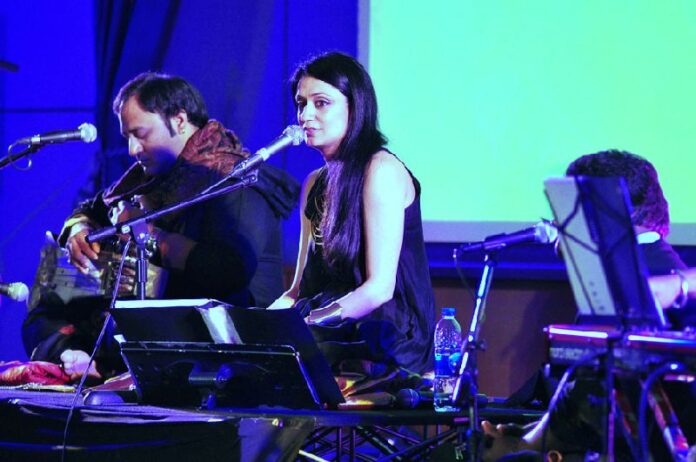
The Festival of India in Bangkok, 2015.

Following the splendid success of last year's inaugural event, The Festival of India, featuring dance, art exhibitions, literature, and music, is back again to satisfy Bollywood fans and promote Indian culture in Thailand. 

Organized by The Embassy of India in Bangkok in corporation with Teamwork Arts, the India-based entertainment company, and Indian Studies Center of Chulalongkorn University, the event is also aimed at commemorating the 60th birthday anniversary of Her Royal Highness Princess Maha Chakri Sirindhorn. 

The Indian extravaganza will take place from now until May 25, 2015 in various locations in Bangkok, including Grand Millennium Hotel, CentralWorld, Aksra Theatre, Thammasat University, Chulalongkorn University.

This year's event will showcase of the common heritage between India and Thailand, contemporary Indian art, fashion shows by well-recognized designers, and dance and musical performances by renown Indian troupes.

"It's a great honor that Her Royal Highness Princess Maha Chakri Sirindhorn will preside over the closing ceremony on the last day of the event when "Words on Water" will be performed at the Main Auditorium, Chulalongkorn University," said H.E. Mr. Harsh Vardhan Shringla, the Ambassador of India to the Kingdom of Thailand.

"This year's festival will focus on the contemporary aspect, economic, and culture, and the relationship between India and Thailand and I think it's also important for Thai people, particularly the young generations, to understand the concept and nature of India through culture," he said.

"The most important thing to note," he added, "is that all events will be available free of charge for public, except the reception day on Friday, March 6 at the Grand Millennium Hotel, Sukhumvit."


Advertisement

Bangkok Students Defy Junta With Anti-Coup Banners

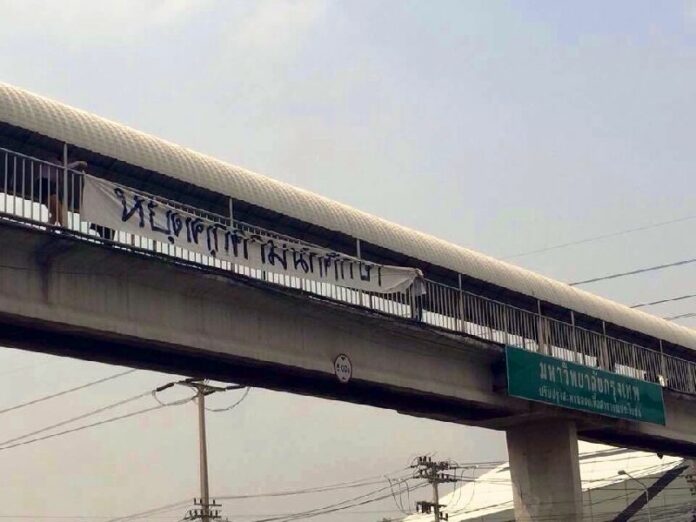
A banner hung near Bangkok University on Feb 17, 2015 that reads: "Stop Abusing Students."

BANGKOK — In an effort to evade the Thai junta’s ban on political protests, student activists in Bangkok have taken to expressing their dissent through anonymous banners hung around the city.

BANGKOK — In an effort to evade the Thai junta's ban on political protests, student activists in Bangkok have taken to expressing dissent through anonymous banners hung around the city.

At least two banners have been strung across pedestrian bridges in Bangkok over the past three days, bearing stern words for the Thai junta.

The first banner, hung near Bangkok University on Tuesday, said “Stop Abusing Students,” following the arrest of a student activist and several others who organized a rare pro-democracy demonstration in downtown Bangkok on Saturday.

\

The second banner (above), hung early this morning near King Mongkut’s University of Technology, said "Down With Dictatorship – Long Live Democracy."  Text at the bottom of the banner warned: "This banner cannot self destruct, unless it is removed by a lackey of a dictator."

Both banners were removed by security officers several hours after they were erected. A student activist, who wished to remain anonymous, confirmed to Khaosod English that the banners were hung by student groups.

Since the May 2014 coup, several dozen student activists have posed the most consistent public challenge to the Thai junta, which has banned all political demonstrations and criticism of its regime. 

Although the military takeover was initially met with sizeable protests in Bangkok, the budding anti-coup movement was quickly squashed after soldiers began arresting demonstrators and sending them to face trial in military courts.

Only a small network of student activists, mostly in Bangkok, have continued to stage regular demonstrations against the military government, which are nearly always broken up by soldiers and often end in arrest.

While the students are normally briefly detained in army camps before being released without charges, Siriwit Serithiwat, the student arrested on Saturday for organizing a mock election, has been charged with defying the junta’s ban on protests and is expected to face trial in military court.

Siriwit has also been charged with violating an agreement he was forced to sign during his last detention in which he promised not to participate in any political activities. 

Hanging anonymous banners is not the first time student activists have sought to circumvent the junta's strict ban on public dissent. They have also organized "picnics" (which later led authorities to ban "eating sandwiches with anti-coup intent"), public read-ins of George Orwell’s 1984, and mass viewings of the Hunger Games movie, which became associated with the anti-coup movement after demonstrators adopted the film’s three-finger salute last May.

Earlier this month, students at Thammasat University used elaborate disguises to sneak parade floats that were critical of the junta past security officers who were monitoring their annual pre-football match parade. 

(Reporting by Sally Mairs)

For comments, or corrections to this article please contact:[email protected]

You can also find Khaosod English on Twitter and Facebook
http://twitter.com/KhaosodEnglish
http://www.facebook.com/KhaosodEnglish

Advertisement

Bangkok Students Defy Junta With Anti-Coup Banners

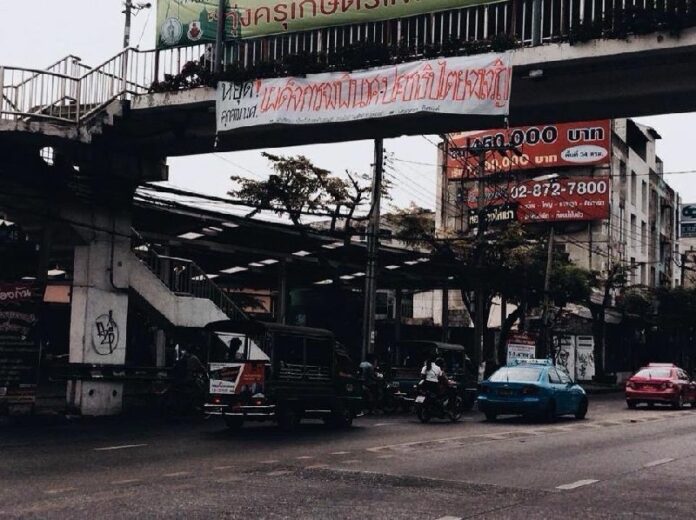
A banner hung near King Mongkut’s University of Technology that reads: Down With Dictatorship – Long Live Democracy.” Feb 19, 2015.

BANGKOK — In an effort to evade the Thai junta's ban on political protests, student activists in Bangkok have taken to expressing dissent through anonymous banners hung around the city.

At least two banners have been strung across pedestrian bridges in Bangkok over the past three days, bearing stern words for the Thai junta that seized power in a coup last May.

The first banner, hung near Bangkok University on Tuesday, said "Stop Abusing Students," following the arrest of a student activist and several others who organized a rare pro-democracy demonstration in downtown Bangkok on Saturday.

\

The second banner (above), hung early this morning near King Mongkut’s University of Technology, said "Down With Dictatorship – Long Live Democracy."  Text at the bottom of the banner warned: "This banner cannot self destruct, unless it is removed by a lackey of a dictator."

Both banners were removed by security officers several hours after they were erected. A student activist, who wished to remain anonymous, confirmed to Khaosod English that the banners were hung by student groups.

Since the May 2014 coup, several dozen student activists have posed the most consistent public challenge to the Thai junta, which has banned all political demonstrations and criticism of its regime. 

Although the military takeover was initially met with sizeable protests in Bangkok, the budding anti-coup movement was quickly squashed after soldiers began arresting demonstrators and sending them to face trial in military courts.

Only a small network of student activists, mostly in Bangkok, have continued to stage regular demonstrations, which are nearly always broken up by soldiers and often end in arrest.

While the students are normally briefly detained in army camps before being released without charges, Siriwit Serithiwat, the student arrested on Saturday for organizing a mock election, has been charged with defying the junta’s ban on protests and is expected to face trial in military court.

Hanging anonymous banners is not the first time student activists have sought to circumvent the junta's strict ban on public dissent. They have also organized "picnics" (which later led authorities to ban "eating sandwiches with anti-coup intent"), public read-ins of George Orwell’s 1984, and mass viewings of the Hunger Games movie, which became associated with the anti-coup movement after demonstrators adopted the film’s three-finger salute last May.

Earlier this month, students at Thammasat University used elaborate disguises to sneak parade floats that were critical of the junta past security officers who were monitoring their annual pre-football match parade. 


For comments, or corrections to this article please contact:[email protected]

You can also find Khaosod English on Twitter and Facebook
http://twitter.com/KhaosodEnglish
http://www.facebook.com/KhaosodEnglish

 

Advertisement

Pattaya Woman Arrested For Exploiting Slow Loris

Narumol Insa-art, 23, was arrested in downtown Pattaya with a slow loris, a small primate with large eyes that is native to Southeast Asia and listed as a protected species. 19 Feb 2015.

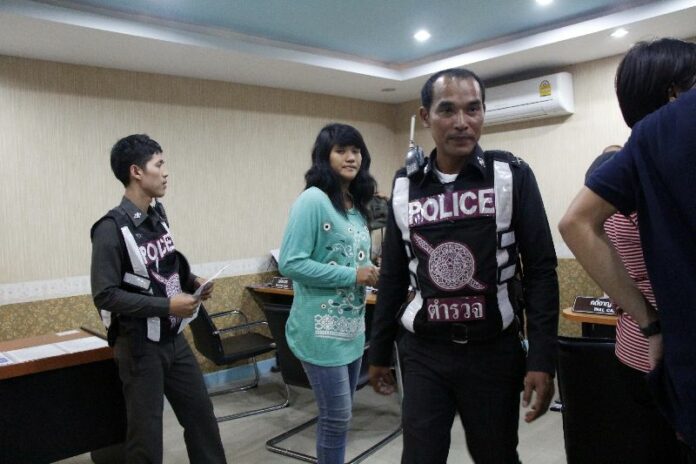
PATTAYA – Police say they have arrested a 23-year-old woman who was charging tourists in Pattaya to pose for photos with an endangered primate.

Narumol Insa-art was arrested in downtown Pattaya with a slow loris, a small primate with large eyes that is native to Southeast Asia and listed as a protected species.

She has been charged with illegal possession of a protected species under Thailand's new Animal Welfare Act, passed by the junta's lawmaking body last November.

\
The slow loris confiscated by police from a woman in Pattaya, 19 Feb 2015.

Police say Narumol charged tourists 100 baht each to take a photo with the animal, which authorities have brought to a local wildlife center.

The slow loris, whose population has declined nearly 80% in recent decades, is a popular item on the black market in Thailand, where it is sold as an exotic pet.

The American pop star Rihanna made headlines last year when she published a photo of herself holding a loris during a trip to Phuket. The photo, published on Instagram, was captioned "Look who was talking dirty to me!" and reportedly led Phuket police to arrest the animal’s owners. 

Thailand is known as a hub for animal tourism, with abundant opportunities for tourists to pay to interact with exotic animals like tigers, elephants, and gibbons. Animal welfare groups say many of these captive animals are physically mistreated and some of them have been taken by poachers from the wild.

The Animal Welfare Act, passed in November 2014, is the first piece of legislation in Thailand to criminalize animal cruelty. 


For comments, or corrections to this article please contact: [email protected]

You can also find Khaosod English on Twitter and Facebook
http://twitter.com/KhaosodEnglish
http://www.facebook.com/KhaosodEnglish
Advertisement

Thai Beaches Dominate Top 10 List in Asia

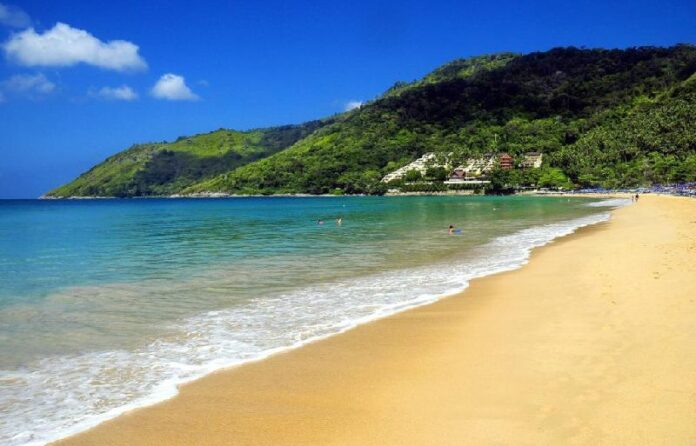
A photo of Phuket’s Nai Harn Beach taken by a traveler on TripAdvisor's website.

BANGKOK — Travellers around the world have voted four Thai beaches onto TripAdvisor’s top ten list of the best beaches in Asia.

The rankings were determined by the quantity and quality of traveler reviews on TripAdvisor over a twelve-month period.

Phuket’s Nai Harn Beach was ranked third, with Krabi’s Railay Beach, Phuket’s Kata Noi Beach, and Krabi’s Phra Nang Beach taking 7th, 8th, and 9th place respectively.

“We are very proud to hear that our beaches have been recognized as some of the best beaches in Asia according to TripAdvisor,” said Pichaya Saisaengchan, a PR director for the Tourism Authority of Thailand (TAT). “Hopefully travelers will still continue to visit Thailand to explore the enduring charm of Thai beaches.”

Thailand's tourism industry struggled in 2014 after street protests broke out against former Prime Minister Yingluck Shinawatra. The protests continued for six months, with occasional outbursts of violence that killed nearly 30 people, before the military staged a coup and declared nation-wide martial law on 22 May 2014, further crippling the tourism sector. 

The industry was also hampered by the brutal murder of two British backpackers on the island of Koh Tao in September 2014. The murder was widely reported in Thai and international media, and tarnished the island’s reputation as an idyllic getaway. 

For comments, or corrections to this article please contact:[email protected]

You can also find Khaosod English on Twitter and Facebook
http://twitter.com/KhaosodEnglish
http://www.facebook.com/KhaosodEnglish
Advertisement

Hot News

LATEST NEWS

Bangkok
overcast clouds
27.7 ° C
27.7 °
27.7 °
83 %
3.5kmh
100 %
Wed
27 °
Thu
36 °
Fri
34 °
Sat
31 °
Sun
30 °