




























31.6 C
Bangkok
Monday, June 29, 2026
Home Blog Page 3082

Editorial: BKK Bombing No Justification for Martial Law

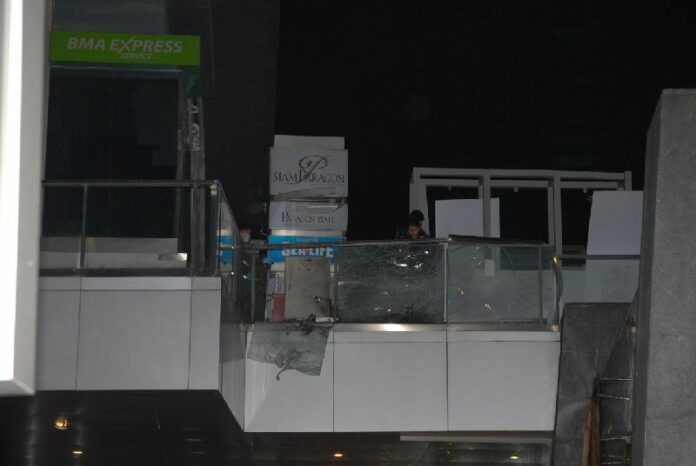
Damage caused by two IEDs in front of Siam Paragon on 1 Feb 2015.

Regardless of who is responsible for the Siam Paragon bombings, the incident should not be used as an excuse by the Thai junta to maintain martial law and its broad restriction on human rights.

On 1 February, two homemade pipe bombs exploded on the walkway connecting Siam Paragon, one of the largest shopping malls in Thailand, and Siam skytrain station, the city's busiest thoroughfare. The bombs did not cause any fatalities, but they alarmed many by striking the heart of Bangkok's financial district.

Police have yet to make an arrest, but that has not stopped Thais across the political spectrum from pointing fingers. However, what is most concerning is the military junta’s attempts to use the incident to justify its prolonged imposition of martial law. 

"There is necessity for martial law to prevent ill-intentioned individuals from committing any further wrongdoing," junta chairman and Prime Minister Prayuth Chan-ocha said in response to the bombings on 2 February.

This is logic is flawed on a number of accounts. To begin, the fact that the bombs were successfully detonated suggests that martial law is not as effective at safeguarding the public as the junta claims. Further evidence of this can be found in the three southern border provinces, known as the Deep South, where insurgents stage near-daily attacks despite living under the Internal Security Act – which is modeled on martial law – for the past eleven years. 

In addition, contrary to what the junta claims, continuing martial law and a ban on all political activities is unlikely to lead to peaceful reconciliation of Thailand’s political foes. Rather, prolonged suppression is more likely to drive politics underground, where it may come back to haunt the country in a more militant form. The surest way to avoid violence is to let people air their grievances through public assemblies and other peaceful forms of expression.

Written in 1914 – before Thailand became a constitutional monarchy –Thailand’s martial law is an archaic piece of legislation that is inappropriate for the modern age. The 100-year-old law grants the military a number of outmoded powers, such as the authority to "Burn any house or thing which may be useful to the enemy" and "alter the nature of the country or village … for the purpose of fight or preparation for the defense at the discretion of the military authority." Most glaringly, the law may be invoked by army chiefs without any approval from a parliament or civilian government; no modern democracy should grant the military such unilateral power.

The law itself specifies that it can only be invoked in time of war and insurrection – neither of which is happening in Thailand right now. The junta’s claims that martial law is needed to fight terror attacks is also baseless; there are many Western nations that live under fear of terror attacks, yet none have gone to the extreme of imposing martial law.

The junta’s response to the 1 Feb bombings suggests that Thailand is in for a vicious cycle, in which the junta’s suppression of civil rights leaves dissidents little choice but to take up arms, which is then seized upon by the junta to further justify its iron grip.

There is no justification for martial law without the approval of an elected parliament. The law should be repealed immediately and then re-written by elected lawmakers to prevent the current status quo from ever happening again. 
 
Advertisement

Red Activist 'Only Forwarded' Fake Royal Document

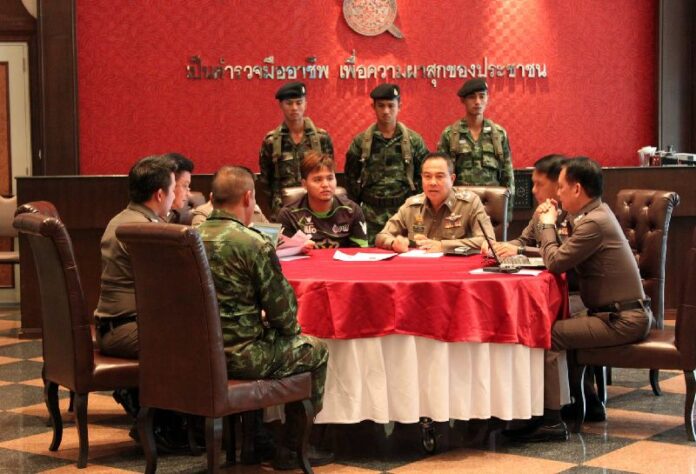
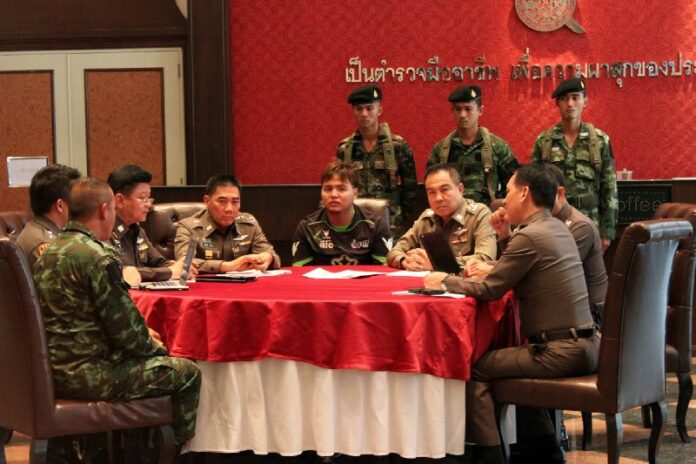
Police and military officers interrogate Krit Butradeecheen about a forged royal statement, 4 Feb 2015.

BANGKOK — The 25-year-old arrested in connection with a forged royal statement was one of the first people to forward the document on social media, police say.

The suspect, Krit Bootdeecheen, was arrested at his home in Phetchabun province yesterday. Police say he was "among the first" to share a fake royal statement that purported to be issued by His Majesty the King. The document, which began circulating on social media on the night of 2 February, claimed that King Bhumibol had appointed a Regent to act on his behalf. Within an hour, the Thai government announced that the document was forged. 

Pol.Lt.Gen. Prawut Thawornsiri, spokesperson of the Royal Thai Police, said yesterday that he could not comment on how the authorities tracked Krit down, but insisted that the 25-year-old was one of the first people to post the fake statement on social media. 

"The text first appeared at 9:33 pm on 2 February. It was posted by Krit a very short time later," Pol.Lt.Gen. Prawut told reporters."We believe Krit is the second or third person who published the text, after the producer of the document. We are tracking down that person. I believe that individual is still Thailand."

He added, "Based on our current information, the person [who produced the document] is part of the UDD movement."

Krit, 25, is currently facing charges of lese majeste (insulting the monarchy) and violating Computer Crimes Act, which criminalizes using a computer to spread false information. 

Jatupon Prompan, a top UDD leader, confirmed that Krit is a member of the organization and said he has already dispatched a lawyer to assist Krit, who is currently being held at a military camp in northern Bangkok. 

Jatupon also stressed that Krit did not fabricate the document, but merely forwarded it to his friends after he saw it on social media. 

"Krit is no different than the website of ASTV Manager," said Jatuporn, referring to the ultra-royalist newspaper that briefly published the forged statement on its website. "But they were treated so differently. Because Krit is a Redshirt, he is detained like a major criminal."

ASTV Manager eventually removed the document and published an apology on its wesbite. Police summoned the newspaper’s online editor for questioning but no charges have been filed.

Falsifying a statement that purports to be issued by the Royal Palace is a criminal act in Thailand, where defaming the monarchy is punishable by up to 15 years in jail. Quoting offensive remarks made by others is also outlawed under Thailand’s lese majeste law, the strictest of its kind in the world. 

His Majesty the King, who turned 87 in December 2014, is currently residing at Sirirraj Hospital in Bangkok for treatment of several illnesses. His frail health has been a cause of anxiety for many Thais.

The Redshirt movement is regularly accused of harboring anti-monarchy elements in its ranks. Redshirt leaders have repeatedly denied the allegations, though a number of radical Redshirt activists are known for their criticism of the monarchy. 

For comments, or corrections to this article please contact: [email protected]

You can also find Khaosod English on Twitter and Facebook
http://twitter.com/KhaosodEnglish
http://www.facebook.com/KhaosodEnglish

Advertisement

Families of 2010 Crackdown Victims Demand Progress From NACC

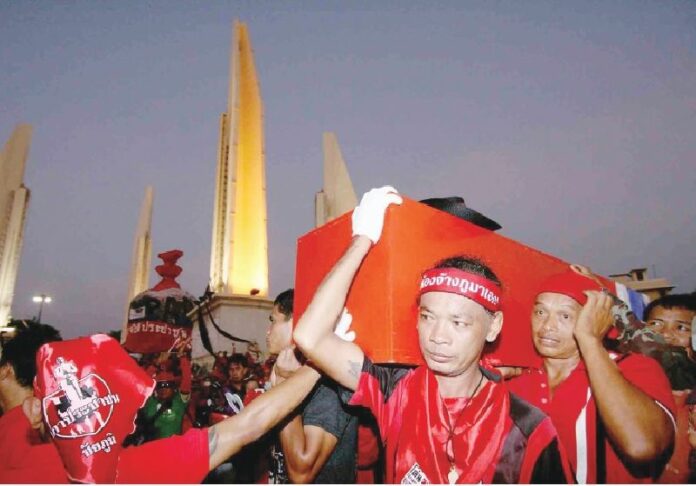
Redshirt demonstrators carry coffins of protesters killed in the crackdown by the military in Bangkok, 11 April 2010.

BANGKOK — Family members of victims killed in the 2010 crackdown on Redshirt demonstrators have submitted a letter of protest to Thailand’s anti-graft agency for failing to take legal action against those responsible for the military operation.

In August 2014, the National Anti-Corruption Commission (NACC) was granted jurisdiction over legal charges filed against former Prime Minister Abhisit Vejjajiva and his deputy Suthep Thaugsuban for authorizing the crackdown, which led to more than 90 fatalities, mostly civilians.

However, the NACC has yet to formally take up the case in the court. Abhisit and Suthep were originally charged with murder by the Division of Special Investigation (DSI) in 2010, but the Criminal Court threw out the case  in August on the grounds that the former leaders should be charged with "abuse of power" by the NACC instead.

Nattapat Akhart, the younger brother of a volunteer medic shot dead by soldiers in the crackdown, submitted a letter of protest to the NACC today on behalf of families of other victims.  

\
Redshirt demonstrators carry coffins of protesters killed in the crackdown by the military in Bangkok, 11 April 2010.

Speaking to reporters, he said that it's been almost five years since the crackdown, yet there has been no progress on the case. He added that he has never been contacted by the NACC to provide any evidence.

He also compared the NACC’s sluggish pace concerning the 2010 crackdown case to its swift prosecution of former Prime Minister Yingluck Shinawatra for alleged dereliction of duty that led to corruption in her administration’s rice-pledging scheme.

The NACC brought the case before the junta-appointed interim parliament in January, which voted to retroactively impeach Yingluck and ban her from politics for five years.

"The NACC worked so fast. In one and half years the NACC punished her with both disciplinary and legal actions," Nattapat said. "I am not here today because of Ms. Yingluck. I am here today for my own business. If the NACC wants to be quick and serious, there has to be some progress already."

The 2010 crackdown was an effort to disperse the tens of thousands of Redshirt demonstrators that had descended on the capital city and occupied Bangkok’s financial districts to demand a fresh election. 

\

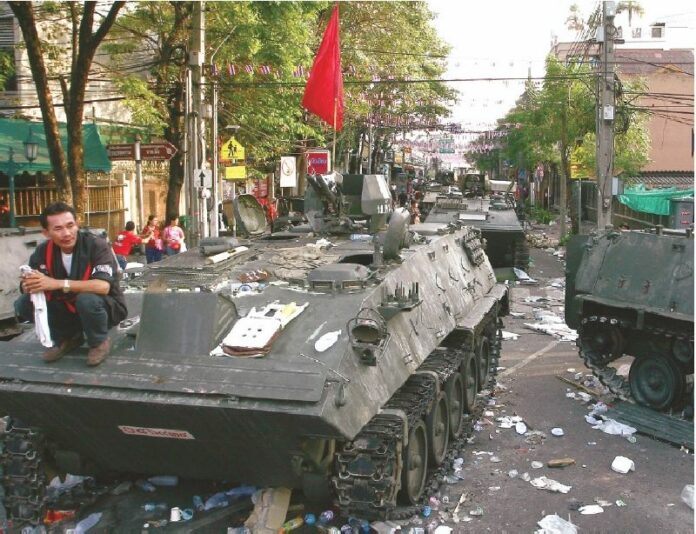
A Redshirt demonstrator sits atop one of armored vehicles left behind by the military after a failed crackdown on the protesters on Ratchadamnoen Avenue in Bangkok, 11 April 2010

Troops were first sent to break up the protests on Ratchadamnoen Avenue on 10 April 2010, but were unsuccessful. Skirmishes between the military and armed militants allied to the protesters erupted in May, turning parts of Bangkok into a warzone. The military launched a final push that ended the protests on 19 May 2010.

The violence claimed the lives of more than 90 people, including demonstrators, soldiers, rescue workers, bystanders, and two foreign journalists. More than 1,000 people were also injured in the crackdown. 

Court inquests in recent years have identified military forces as responsible for many of the deaths, such as an incident in which soldiers shot and killed six people, including Nattapat's sister, at a Buddhist temple in central Bangkok on 19 May 2010.

"I want to know where my case is. It's still in a black hole,” Nattapat said. “Why isn't the NACC moving quickly like other cases?"

Last month, NACC spokesperson Vicha Mahakhun told reporters that the Commission is struggling with the 2010 crackdown case because it is difficult to identify the exact individuals whose orders led to deaths.

"The autopsy shows so many twists to the story. We have to summon more witnesses in the cases related to the court inquests," he said. 

Vicha also confirmed in January that despite a lack of progress in the 2010 inquiry, a case has been formally filed against leading members of a former Redshirt-backed government for cracking down on Yellowshirt demonstrators in 2008 with tear gas and alleged police beatings.

According to the NACC, former Prime Minister Somchai Wongsawasdi and his deputy at the time abused their power by ordering riot police to clear Yellowshirt protesters from the streets around the Parliament building. Two people were killed and many injured in the operation. 

"We have already filed the case with the Supreme Court's Division for Holders of Political Office," Vicha said.  


For comments, or corrections to this article please contact: [email protected]

You can also find Khaosod English on Twitter and Facebook
http://twitter.com/KhaosodEnglish
http://www.facebook.com/KhaosodEnglish

Advertisement

Families of 2010 Crackdown Victims Demand Progress From NACC

A Redshirt demonstrator sits atop one of armored vehicles left behind by the military after a failed crackdown on the protesters on Ratchadamnern Avenue in Bangkok, 11 April 2010

BANGKOK — Family members of victims killed in the 2010 crackdown on Redshirt demonstrators have submitted a letter of protest to Thailand’s anti-graft agency for failing to take legal action against those responsible for the military operation.

In August 2014, the National Anti-Corruption Commission (NACC) was granted jurisdiction over legal charges filed against former Prime Minister Abhisit Vejjajiva and his deputy Suthep Thaugsuban for authorizing the crackdown, which led to more than 90 fatalities, mostly civilians.

However, the NACC has yet to formally take up the case in the court. Abhisit and Suthep were originally charged with murder by the Division of Special Investigation (DSI) in 2010, but the Criminal Court threw out the case  in August on the grounds that the former leaders should be charged with "abuse of power" by the NACC instead.

Nattapat Akhart, the younger brother of a volunteer medic shot dead by soldiers in the crackdown, submitted a letter of protest to the NACC today on behalf of families of other victims.  

\
Redshirt demonstrators carry coffins of protesters killed in the crackdown by the military in Bangkok, 11 April 2010.

Speaking to reporters, he said that it's been almost five years since the crackdown, yet there has been no progress on the case. He added that he has never been contacted by the NACC to provide any evidence.

He also compared the NACC’s sluggish pace concerning the 2010 crackdown case to its swift prosecution of former Prime Minister Yingluck Shinawatra for alleged dereliction of duty that led to corruption in her administration’s rice-pledging scheme.

The NACC brought the case before the junta-appointed interim parliament in January, which voted to retroactively impeach Yingluck and ban her from politics for five years.

"The NACC worked so fast. In one and half years the NACC punished her with both disciplinary and legal actions," Nattapat said. "I am not here today because of Ms. Yingluck. I am here today for my own business. If the NACC wants to be quick and serious, there has to be some progress already."

The 2010 crackdown was an effort to disperse the tens of thousands of Redshirt demonstrators that had descended on the capital city and occupied Bangkok’s financial districts to demand a fresh election. 

\

A Redshirt demonstrator sits atop one of armored vehicles left behind by the military after a failed crackdown on the protesters on Ratchadamnoen Avenue in Bangkok, 11 April 2010

Troops were first sent to break up the protests on Ratchadamnoen Avenue on 10 April 2010, but were unsuccessful. Skirmishes between the military and armed militants allied to the protesters erupted in May, turning parts of Bangkok into a warzone. The military launched a final push that ended the protests on 19 May 2010.

The violence claimed the lives of more than 90 people, including demonstrators, soldiers, rescue workers, bystanders, and two foreign journalists. More than 1,000 people were also injured in the crackdown. 

Court inquests in recent years have identified military forces as responsible for many of the deaths, such as an incident in which soldiers shot and killed six people, including Nattapat's sister, at a Buddhist temple in central Bangkok on 19 May 2010.

"I want to know where my case is. It's still in a black hole,” Nattapat said. “Why isn't the NACC moving quickly like other cases?"

Last month, NACC spokesperson Vicha Mahakhun told reporters that the Commission is struggling with the 2010 crackdown case because it is difficult to identify the exact individuals whose orders led to deaths.

"The autopsy shows so many twists to the story. We have to summon more witnesses in the cases related to the court inquests," he said. 

Vicha also confirmed in January that despite a lack of progress in the 2010 inquiry, a case has been formally filed against leading members of a former Redshirt-backed government for cracking down on Yellowshirt demonstrators in 2008 with tear gas and alleged police beatings.

According to the NACC, former Prime Minister Somchai Wongsawasdi and his deputy at the time abused their power by ordering riot police to clear Yellowshirt protesters from the streets around the Parliament building. Two people were killed and many injured in the operation. 

"We have already filed the case with the Supreme Court's Division for Holders of Political Office," Vicha said.  


For comments, or corrections to this article please contact: [email protected]

You can also find Khaosod English on Twitter and Facebook
http://twitter.com/KhaosodEnglish
http://www.facebook.com/KhaosodEnglish

Advertisement

Vietnam Shifts Tack on Land Rights, but Results Yet to be Seen

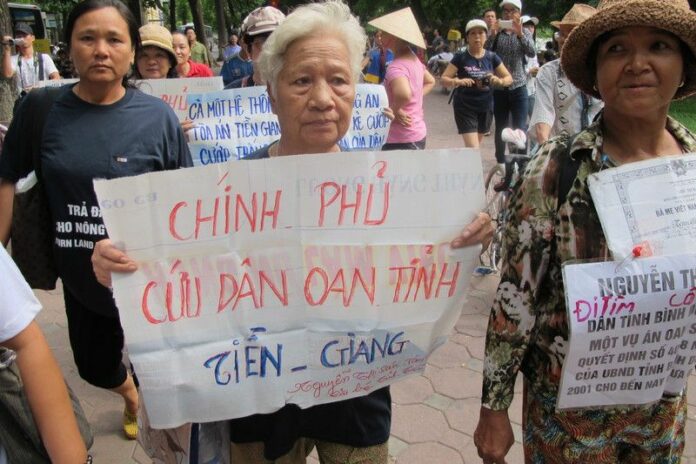
A woman holds a banner reading "Government, help us victims of land grabs in Tien Giang" province, at a demonstration in central Hanoi, June 2013. Vietnam has changed some laws regulating evictions for land developments after growing complaints. [DPA]

By Marianne Brown

HANOI (DPA) —  Sitting at a small cafe, Trinh Ba Phuong, 31, reaches across the table to light his uncle's cigarette, before he explains how his parents ended up in prison over a land protest.

He has brought family members and friends to the interview for support in case he is tailed by security officials.

Phuong's father is serving a 20-month prison sentence and his mother 15 months for disturbing public order after they helped rally protesters against evictions for a residential project in their village, Duong Noi, on the outskirts of Hanoi, last year.

Around 350 of the village's families refused the 13 dollars per square metre they were offered in early 2014, saying it was too low.

"There was no discussion. Now they have taken the land. We're farmers, what job can we do?" Phuong says.

The story of Phuong's family is a common one in Vietnam, where land requisitions are frequently implemented for residential, commercial, industrial and infrastructural developments.

The forced evictions are becoming a source of politically dangerous discontent, prompting the government to introduce some changes.

Revisions to the Land Law in force since July upped the standard lease period for land – still owned by the communist state – from 20 to 50 years.

The changes also improved the calculation for compensation, a leading gripe behind 70 per cent of the 700,000 official complaints filed by evictees between 2008 and 2011, according to National Assembly officials cited by newspaper Thanh Nien.

Under the previous system, "They just did a rough survey on the price and published it every year," says Tito Nicolas, a specialist at the Asian Development Bank.

\
Than Thi Giang, 63, holds a banner asking Vietnam's Communist Party for help in preserving her parents' burial place at a demonstration in central Hanoi, June 2013 [DPA].

In a 2013 official index, only 18.8 per cent of respondents reported being offered prices close to the market value.

The new methodology in place since July addresses this "at least on paper," Nicolas says, and is based on a more thorough market comparison.

The improved law also states that land requisition can now only happen once there is somewhere for residents to move to, he says.

"In the past, even when the resettlement site was not ready they just gave them rental allowance and waited until the resettlement was ready. But now it is very clear."

Vietnam may be hoping to avoid some of the disruption and negative press faced by other countries in the region over similar problems.

In nearby Myanmar, tens of thousands of complaints have been brought before authorities as the economy booms following the political opening that started in 2011, and only 1,000 or so have been resolved, according to a parliamentary committee.

One case made global headlines when farmers ejected from a 9,000-hectare site to build an airport around 80 kilometres from Yangon complained they received nothing near the land's market value.

In Cambodia, the forced redevelopment of shantytowns around Boeng Kak lake in Phnom Penh also prompted an international scandal.

The World Bank froze lending to the country after 3,000 families were evicted to make way for the commercial development headed by a company owned by a senator from the ruling Cambodian People's Party.

Construction has stalled amid the scrutiny, with two Chinese partner firms cancelling their contracts.

The number of people helped by the Vietnamese reforms is limited, because they do not apply retroactively to hundreds of cases pending before the courts.

And resolving the compensation issue will not cover all residents' objections, according to a 2014 report by the Asia Foundation.

Those evicted are often more concerned about the future of their livelihoods and cultural practices, including places of worship and cemeteries, says the study titled Public Land Disputes in Vietnam.

Keeping parties happy often requires conflict management and communication rather than just payment, says John Gillespie, report co-author and professor at Monash University in Australia.

"You can't resolve the conflict if you need to widen the road and the person doesn't want to give up their house."

Mediation can help, Gillespie says, a bit like therapy. "When you tell someone your story you get a sense of release."

The report advocates rethinking the balance of power between land users and state officials. Policy makers may or may not yet take heed, but is small comfort to Phuong and his family. 

The Duong Noi evictions took place before the new law came in, and he and his siblings have little hope for a mediated, peaceful resolution.

"Just look at the trial," he says. "We won't trust the government again."


Advertisement

Thai Military Threatens Landless Southern Villagers

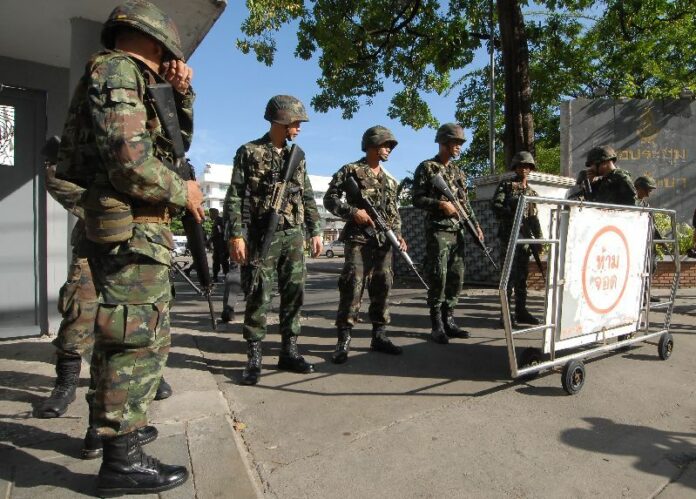
Soldiers guard the Army Club in Bangkok, 23 May 2014, a day of the military coup.

(Prachatai English)

BANGKOK —  The military surrounded a village in southern Thailand and told the landless villagers to leave a disputed area while threatening a villager not to take picture of the event.

According to Protection International (PI), at about 5:30pm on Tuesday Five military men came to Pruemsub Community of Chai Buri District in the southern province of Surat Thani and ordered the landless villagers to leave the area.

The military also reportedly threatened a villager who attempted to take picture of the military operation that he would be arrested and brought to military camp for interrogation if he took  pictures of the scene. 

Read more here.

Note: Khaosod English is not responsible for content on other websites.

Advertisement

Thailand Fast-Tracks Immigration for Honeymooning Couples


A file photo shows foreign tourists waiting at the departure hall of Suvarnabhumi Airport in Bangkok Thailand, 03 December 2013. Honeymooning couples will be fast-tracked through immigration for the month of February. EPA/HOW HWEE YOUNG

BANGKOK (DPA) — Honeymooning couples will be fast-tracked through immigration for the month of February, the Tourism Authority of Thailand (TAT) said Wednesday.

The initiative is to promote Thailand as a honeymoon destination and celebrate the spirit of Valentine's Day, a TAT spokeswoman said.

Couples arriving at Bangkok's Suvarnabhumi Airport or the international airport on the resort island of Phuket will be able to get a commemorative ticket and cut the immigration queue.

The capital's Don Muang airport that serves low-cost and domestic airlines will not be part of the promotion.

 
Advertisement

Thai Musician Arrested For Allegedly Forging Royal Statement

Police and military officers interrogate a 25-year-old man who was arrested for allegedly forging a statement that purported to be issued by His Majesty the King, 4 Feb 2015.

BANGKOK — Police say they have arrested a 25-year-old Thai musician who allegedly forged a statement that purported to be issued by His Majesty the King on Monday night.

According to Pol.Lt.Gen. Prawut Thawornsiri, spokesperson of the Royal Thai Police, the man has been charged with lese majeste (insulting the monarchy) and violating the Computer Crime Act, which criminalizes spreading false information using a computer system.

Pol.Lt.Gen. Prawut did not explain how police tracked down the suspect, who was reportedly living in Phetchabun province. Yesterday, Pol.Lt.Gen. Prawut said he suspected that whoever was behind  the fake document was residing in a foreign country. 

The suspect has been sent to an army camp in Bangkok for interrogation. 

The forged palace statement began circulating on the internet at 9 pm on 2 February. The notice said that King Bhumibol, 87, had decided to appoint a Regent to act on his behalf. Due to strict laws that criminalize any remarks deemed critical of the monarchy, Khaosod English is withholding other details of the document’ contents.  

The document was widely shared on social media, and reproduced on the website of a royalist newspaper, ASTV Manager. An hour after the document began circulating online, a spokesperson for Thailand’s military government announced that the order was forged. ASTV Manager then pulled the statement and published an apology. 

Falsifying a statement that purports to be issued by the Royal Palace is a radical and unprecedented act in Thailand, where the king is widely revered as a demi-god. Under Thailand's lese majeste law, insulting the monarchy is punishable by up to 15 years in prison. Quoting offensive remarks made by others is outlawed as well. 

His Majesty the King is currently residing at Sirirraj Hospital in Bangkok for treatment of several illnesses. His frail health has been a cause of anxiety for many Thais.

CORRECTION: The original article mistakenly said the suspect was from Phetchaburi province. Police say he is from Phetchabun. 

Read more:
Police Summon News Editor For Publishing Fake Royal Statement
Thai Govt Condemns Fake HM King Statement

 
Advertisement

Arrest Warrants Issued For Siam Paragon Bombers

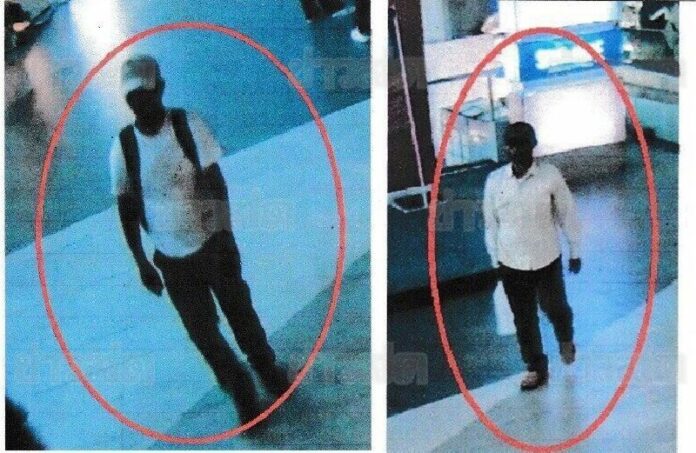
A screenshot of the suspects from CCTV footage provided by police.

BANGKOK — Police have obtained arrest warrants for two suspects in connection with the double bombing of a high-end shopping mall in downtown Bangkok on Sunday.

The bombs went off at around 8.10 pm on the walkway that connects Siam Paragon, one of the largest shopping malls in Thailand, and Siam skytrain station, the largest and busiest BTS station in the city. One person was reported injured by the blast. 

\
A screenshot of the suspects from CCTV footage provided by police.

Police say CCTV footage shows two suspects planting the bombs and walking away from the scene prior to the blast. 

However, police say they have scant information about the suspects, whose faces were concealed by baseball caps. The arrest warrants described them as "unidentified Thai men."

The two suspects are charged with premeditated murder, causing an explosion that could harm other individuals and property, and carrying weapons into a residential area without due cause.

Police have yet to determine a motive for the attack, which they say was launched as an act of harassment, and not designed to injure or kill. 

There has been widespread speculation on social media about whether a political group was behind bombing, which occured in the heart of Bangkok's financial center and while the country remains under martial law. 

Since seizing power on 22 May 2014, the ruling military junta has touted martial law as a necessary means to restore peace and order following the sporadic violence that characterized the six months of anti-government protests prior to the coup.

Underground militants believed to be affiliated with both Thailand's Redshirt and Yellowshirt factions launched numerous grenade and shooting attacks on rival groups during the protests. Most of the 28 fatalities were protesters killed by shadowy assailants who attacked rally sites. 

 
Advertisement

Plane Crashes in Taiwanese Capital, at Least 13 Dead

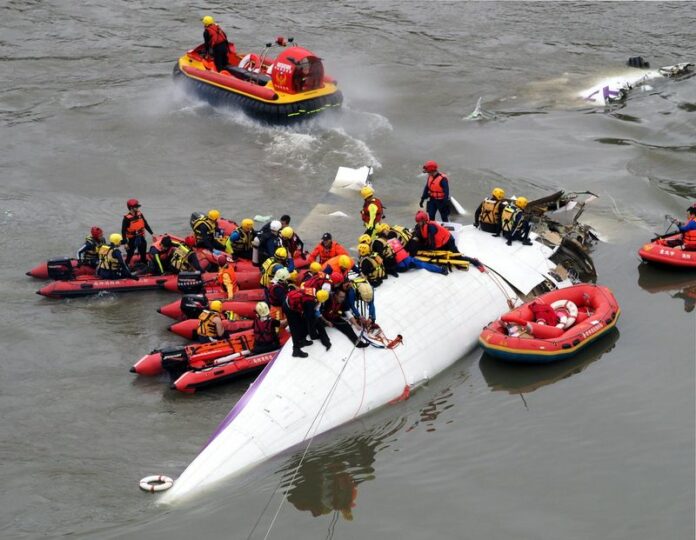
Search and rescue team members operate on a TransAsia Airways passenger plane which crashed into the Keelung River in Taipei, Taiwan, 04 February 2015. Of the 58 people on board the ATR 72 plane, at least 8 were killed, 16 injured and the rest rapped inside the plane. EPA/DAVID CHANG

By Yu-Tzu Chiu

TAIPEI (DPA) – At least 13 people were killed when a passenger plane with 58 people on board crashed into a river after hitting a bridge in the Taiwanese capital Wednesday.

Surviving passengers of TransAsia Airways flight GE235 were taken to hospital, the Taipei municipal government said, quoting the fire department.

The twin-engine ATR 72 turboprop crashed shortly after takeoff from Taipei's Songshan Airport, en route to Kinmen Island, with 53 passengers and five crew, state-run Central News Agency reported.

The plane avoided tall buildings of Taipei's Nangang district but its wing hit a bridge and it crashed into the river, an online video showed.

TransAsia Airways officials offered a public apology, and confirmed 13 deaths, 28 injured survivors and 17 people still missing.

"On the site, we are still doing our best to rescue people," chief executive officer Peter Chen said.

Chen said the flight manifest listed 31 Chinese tourists and 22 Taiwanese passengers.

Rescuers were trying to lift the front part of the wreckage with cranes Wednesday afternoon.

The cause of the crash was still unknown. Local media reported that some analysts suspected that one of engines lost power, as the plane failed to gain altitude after takeoff.

TransAsia Airways said the plane was the latest type of ATR-72-600 and the engines were new. Its latest safety check was conducted January 26.

The plane lost radio contact shortly after it took off at 10:52 am (0252 GMT), according to the Civil Aeronautics Administration.

Aviation authority director Lin Chih-ming said the plane was the same type as TransAsia Airways flight GE222 that crashed in Penghu in July 2014, killing 48 of the 59 people on board.

For comments, or corrections to this article please contact: [email protected]

You can also find Khaosod English on Twitter and Facebook
http://twitter.com/KhaosodEnglish
http://www.facebook.com/KhaosodEnglish

Advertisement

Hot News

LATEST NEWS

Bangkok
overcast clouds
31.6 ° C
32.2 °
31.6 °
63 %
4.7kmh
100 %
Mon
33 °
Tue
32 °
Wed
30 °
Thu
34 °
Fri
33 °