































28.8 C
Bangkok
Monday, July 6, 2026
Home Blog Page 3101

Pheu Thai Bets on Junta's Amnesty For Yingluck

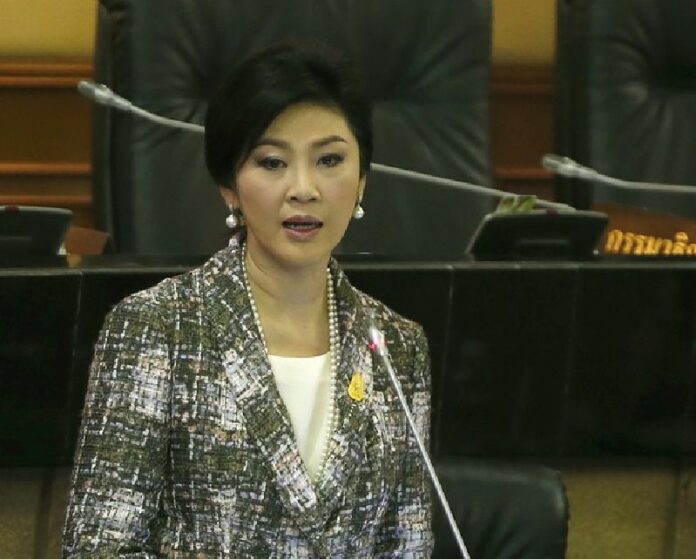
Yingluck Shinawatra answers to the questions of the National Legislative Assembly (NLA) during impeachment proceedings against her, at Parliament House in Bangkok, Thailand, 22 January 2015.  EPA/NARONG SANGNAK

BANGKOK — A top legal adviser to the Pheu Thai Party says he hopes the military junta will grant amnesty to former Prime Minister Yingluck Shinawatra and dissolve the impeachment verdict handed down to her yesterday.

Singthong Buachum, head of Pheu Thai Party's legal team and a former MP, told reporters that he believes amnesty for Yingluck is a prerequisite for achieving national "reconciliation" and "reform"  –  two tasks the military junta insists it is attempting to achieve. 

"If there is no amnesty, the reconciliation will fail," said Singthong. "Things will be like in the past. Reforms won't succeed."

Former PM Yingluck was retrospectively impeached yesterday by the National Legislative Assembly (NLA), a body whose members were handpicked by the military junta. One hundred and ninety members of the NLA voted in favor of impeaching Yingluck for allegedly failing to stop corruption in her administration’s rice-pledging scheme. Eighteen NLA members voted against the impeachment, 8 abstained, and 3 ballots were spoilt. 

As a result of the impeachment, Yingluck now faces a five year ban from politics, effectively disqualifying her from running in the next general election, which the junta says will take place as early as 2016. 

Yingluck was accused of dereliction of duty in carrying out her government's rice-pledging scheme, which Thailand’s national anti-graft agency said cost the country 500 billion baht in damages due to mismanagement and corruption.

Under the scheme, a key police of Yingluck’s administration, the Thai government bought rice from farmers at above-market prices, but then struggled to sell the paddies on the international market, accumulating stockpiles and resulting in huge financial loses.

Yesterday, the Office of Attorney-General also announced plans to prosecute Yingluck in the Supreme Court's Division for Holders of Political Office. If found guilty of the criminal charges, Yingluck could face up to 10 years in prison.

Singthong, Yingluck's legal adviser, said his legal team is more "concerned" by the pending prosecution before the Supreme Court, as "criminal charges carry a far more severe punishment."

Singthong also insisted that Pheu Thai Party would not mobilize its supporters to protest the impeachment or any other verdict against Yingluck.

"We want the NCPO and the government to help Thailand move forward," Singthong said, referring to the junta's formal name, the National Council for Peace and Order. 

Yingluck denounced the impeachment in a Facebook post yesterday. 

"Today Thai democracy is dead, along with the rule of law," the statement read. "Reconciliation cannot take place by hunting down certain individuals. It has to come with impartiality that provides justice to all sides."

Hours after the impeachment, Panthongtae Shinawatra, son of former Prime Minister Thaksin Shinawatra and a nephew Yingluck’s, published a post on his official Instagram site with the text, "Are you ready, Thai people?" – an excerpt from a Redshirt mobilizing song.

However, the streets of Bangkok remained calm on Friday, with the public adhering to the junta's ban on all political activities and protests. 

Military junta spokesperson Col. Winthai Suvaree warned all sides against participating in any political activities yesterday. He also denied the reports that the military instructed Yingluck to cancel her press conference yesterday and forced her to turn to Facebook instead.

"We didn't force anyone. We merely asked for her cooperation," Col. Winthai said, "Because we have determined that it is not appropriate for anyone to participate in any political activities at the moment. It may lead to chaos in the country."

Read more:
Full English Text of Yingluck's Post-Impeachment Statement 
Junta's Legislature Votes Overwhelmingly to Impeach Former PM Yingluck 
Thai Ex-Premier Faces Criminal Charges Ahead of Impeachment Decision


For comments, or corrections to this article please contact: [email protected]

You can also find Khaosod English on Twitter and Facebook
http://twitter.com/KhaosodEnglish
http://www.facebook.com/KhaosodEnglish

 

Advertisement

Korean Tourist Bus Crash Leaves One Dead in Chiang Rai

A bus carrying tourists from South Korea crashed into an oncoming pick-up truck in Chiang Rai province on 24 Jan 2015, killing one person and injuring 16.

CHIANG RAI – A bus carrying tourists from South Korea crashed into an oncoming pick-up truck in Chiang Rai province this morning, killing one person and injuring 16.

The driver of the pick-up truck was killed in the collision, while at least 16 South Korean tourists on the bus were injured by the impact, Pol.Lt. Patcharawat Taweewuttirat said. 

Police say the incident took place on Chiang Rai – Chiang Mai Road in Mae Saruai district shortly after midnight. 

Luen Traipat, the 58-year-old driver of the chartered bus, said he was driving the tourists from Chiang Rai to Chiang Mai province. According to Luen, he "suddenly" lost control of the bus and slammed into the pick-up truck on the opposite lane at a high speed. 

Police have arrested and charged Luen with reckless action leading to death of others. 


For comments, or corrections to this article please contact: [email protected]

You can also find Khaosod English on Twitter and Facebook
http://twitter.com/KhaosodEnglish
http://www.facebook.com/KhaosodEnglish
Advertisement

Thai Royalists Stage Protest at New Zealand Embassy

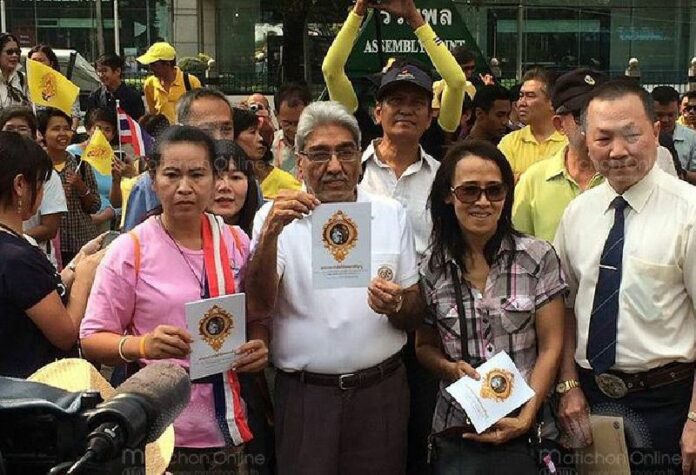
Dozens of Thai royalists defied the junta's ban on protests to stage a rally in front of the New Zealand Embassy in Bangkok on 23 Jan 2015, demanding NZ authorities extradite an alleged anti-monarchist back to Thailand.

BANGKOK — Dozens of Thai royalists defied the junta's ban on protests to stage a rally in front of the New Zealand Embassy in Bangkok yesterday, demanding NZ authorities extradite an alleged anti-monarchist back to Thailand.

The protesters, numbering around 60, were led by Maj.Gen. Rienthong Naenna, a retired military commander, director of a hospital, and founder of a Facebook page called "Garbage Collection Organization," which advocates tougher measures for those who criticize the Thai monarchy. 

Maj.Gen. Rienthong was accompanied by Satit Segal, an India-born businessman and core leader of the ultra-conservative protest group that campaigned against the government toppled in the 22 May 2014 coup.

Satit told reporters that the protesters were angered by New Zealand authorities' decision to allow a 23-year-old charged with lese majeste (insult of the monarchy) to stay in New Zealand and use his residency for "political activism."

The suspect, student activist Ekapop Luara, is wanted for allegedly insulting the Thai monarchy, a crime punishable by up to 15 years in prison under Section 112 of Thailand's Criminal Codes. He posted on his Facebook in December that he is now living in New Zealand, claiming to have been granted asylum by NZ authorities. 

After announcing his alleged asylum status in New Zealand, Ekapop, aka Tang Acheewa, began criticizing Thailand's military junta and mocking the effort to extradite him and other lese majeste suspects. His Facebook account has since been deactivated. 

He is believed to have fled Thailand shortly after the military staged the coup on 22 May 2014.

"We want them to send Ekapop Luara back to Thailand to face legal prosecution," Satit said. "What the New Zealand government is doing is not right. Ekapop is charged in a criminal case, not a political one. If the Embassy refuses to do anything, I and my group will escalate our protests."

Shannon Austin, the New Zealand Charge d'Affaires, accepted the group's letter of protest on behalf of the Embassy. The protesters dispersed soon afterward.

Over 70 security officers, including police officers and soldiers, quietly observed the protests until the demonstrators – who were violating the martial law ban on public protests – dispersed on their own. 

On 6 January, the Thai Ministry of Foreign Affairs summoned a diplomat from the New Zealand Embassy in Bangkok to express its concern over reports that Ekapop is residing in New Zealand.

"Mr. Ekapop is using his status granted by the New Zealand government to engage in political matters that affect the national security of Thailand, at a time when Thailand is moving forward and seeking a national reconciliation," said Sek Wannamethee, spokesperson of the Thai Ministry of Foreign Affairs (MFA).

The MFA also asked the New Zealand authorities not to allow anyone who violates Thai laws to use its country as a base for political activities, Sek told reporters.

The New Zealand Embassy in Bangkok has not responded to Khaosod English’s requests for comment.

Since staging a coup on 22 May 2014, junta leader and Prime Minister Prayuth Chan-ocha has stepped up prosecution of lese majeste suspects. Gen. Prayuth, considered a hardline royalist, has also granted military courts – which do not permit appeals – jurisdiction over lese majeste cases.

Among those currently facing prosecution are two theatre activists accused by the military of insulting the Royal Family by staging a play about a fictional monarch in October 2013. The two activists have been held in prison since they were arrested last August, with the court repeatedly denying their requests for release on bail. 

The growing persecution has forced a number of activists and academics to flee Thailand and seek asylum in foreign countries. Apart from Ekapop, other notable exiles include transgender activist Saran Chuichai and historian Somsak Jeamteerasakul, who say they are living in France, as well as Pavin Chachavalpongpun, a political science scholar who lives in Japan. 


For comments, or corrections to this article please contact: [email protected]

You can also find Khaosod English on Twitter and Facebook
http://twitter.com/KhaosodEnglish
http://www.facebook.com/KhaosodEnglish
Advertisement

Prayuth Asks Media To Stop Asking Kids About '12 Values'

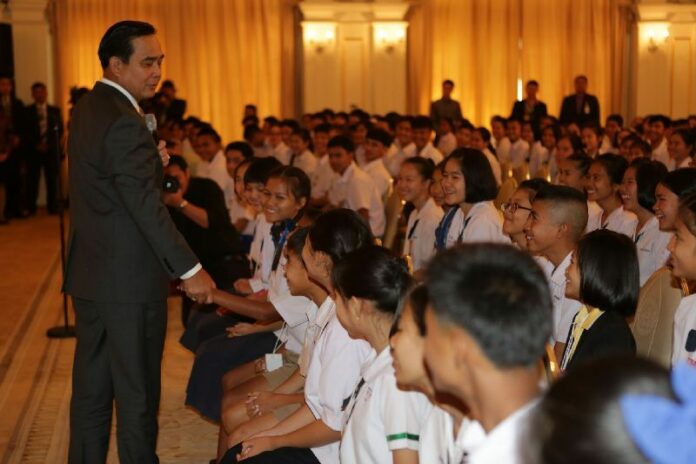
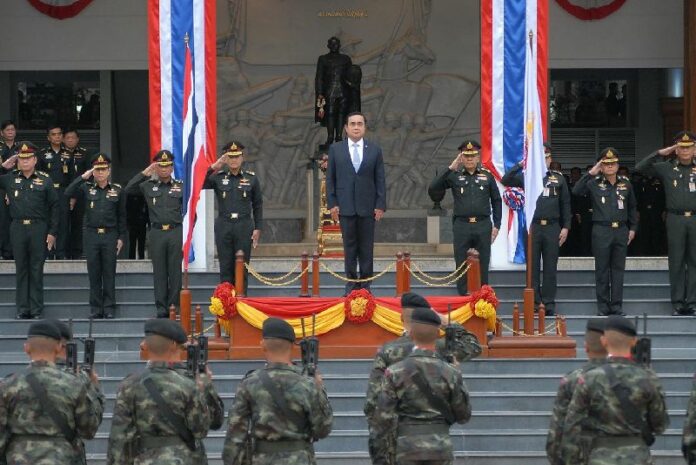
Gen. Prayuth Chan-ocha chats with schoolchildren at the Government House on 7 Jan 2015.

BANGKOK — Thai junta leader and Prime Minister Prayuth Chan-ocha has instructed the media to stop asking children about whether they are familiar with his moral teachings, known as the "Twelve Values."

Gen. Prayuth told the nation in his weekly televised speech last night that reporters from some media agencies have been excessively testing children on whether they’ve memorized the "Twelve Values" that Gen. Prayuth says he wants all Thais to practice.

"They ask each kid, can you remember them? Can you recite them? It's a turnoff for the kids," Gen. Prayuth said. "That's not right. I have never forced anyone to do anything."

He did not specify any TV channel by name, but simply went on to urge "all TV channels and all media agencies" against spoiling the Twelve Values by repetitively asking children to recite them.

"It's useless. It doesn't cause any benefit. It's a waste of your energy,” Gen. Prayuth said. “This is something that I want all show producers, talk show hosts, especially the state-owned channels or channels that use state budgets, to think about. I don't want to force or direct anything for you."

His statement last night appeared to be a change of tack, as the general has repeatedly urged state agencies, including the media and education establishments, to promote the "Twelve Values" publicly. 

However, he did add last night that he wanted to see more dramas and films incorporate moral lessons into their storylines.

"Education, TV, films, dramas, they should put in some good things, too," Gen. Prayuth suggested. 

The Twelve Values, which Gen. Prayuth bestowed to the nation in a televised broadcast in July, are the following: 

1. Loyalty to the Nation, the Religion, and the Monarchy
2. Honesty, sacrifice, endurance, and noble ideology for the greater good
3. Gratitude for parents, guardians, and teachers
4. Diligence in acquiring knowledge, via school studies and other methods
5. Preserving the Thai customs and tradition
6. Morality and good will for others
7. Correct understanding of democracy with the King as Head of State
8. Discipline, respect for law, and obedience to the older citizens
9. Constant consciousness to practice good deeds all the time, as taught by His Majesty the King
10. Practice of Self-Sufficient Economy in accordance with the teaching of His Majesty the King
11. Physical and mental strength. Refusal to surrender to religious sins.
12. Uphold the interest of the nation over oneself.

Authorities have already instructed public schools and state agencies to hang a banner listing Gen. Prayuth’s teachings on their premises. State agencies have also produced a poem, song, and 12-part film based on the teachings.

Last month, the Ministry of Information, Communication, and Telecommunication released a set of "stickers" depicting each of the Twelve Values for users of the chat application LINE. 


For comments, or corrections to this article please contact: [email protected]

You can also find Khaosod English on Twitter and Facebook
http://twitter.com/KhaosodEnglish
http://www.facebook.com/KhaosodEnglish
Advertisement

Prayuth Asks Media To Stop Asking Kids About '12 Values'

BANGKOK — Thai junta leader and Prime Minister Prayuth Chan-ocha has instructed the media to stop asking children about whether they are familiar with his moral teachings, known as the "Twelve Values."

Gen. Prayuth told the nation in his weekly televised speech last night that reporters from some media agencies have been excessively testing children on whether they’ve memorized the "Twelve Values” that Gen. Prayuth says he wants all Thais to practice.

"They ask each kid, can you remember them? Can you recite them? It's a turnoff for the kids," Gen. Prayuth said. "That's not right. I have never forced anyone to do anything."

He did not specify any TV channel by name, but simply went on to advise "all TV channels and all media agencies" against spoiling the Twelve Values by repetitively asking children about the them.

"It's useless. It doesn't cause any benefit. It's a waste of your energy,” Gen. Prayuth said. “This is something that I want all show producers, talk show hosts, especially the state-owned channels or channels that use state budgets, to think about. I don't want to force or direct anything for you," the general said.

His statement last night appeared to be a change of tack, as the general has repeatedly urged state agencies, including the media and education establishments, to promote the "Twelve Values" publicly. 

However, he did say last night that he wanted to see dramas and films incorporate more moral lessons into their storylines.

"Education, TV, films, dramas, they should put in some good things, too," Gen. Prayuth suggested. 

The Twelve Values, which Gen. Prayuth bestowed to the nation in a televised broadcast in July, are the following: 

1. Loyalty to the Nation, the Religion, and the Monarchy
2. Honesty, sacrifice, endurance, and noble ideology for the greater good
3. Gratitude for parents, guardians, and teachers
4. Diligence in acquiring knowledge, via school studies and other methods
5. Preserving the Thai customs and tradition
6. Morality and good will for others
7. Correct understanding of democracy with the King as Head of State
8. Discipline, respect for law, and obedience to the older citizens
9. Constant consciousness to practice good deeds all the time, as taught by His Majesty the King
10. Practice of Self-Sufficient Economy in accordance with the teaching of His Majesty the King
11. Physical and mental strength. Refusal to surrender to religious sins.
12. Uphold the interest of the nation over oneself.

Authorities have already instructed public schools and state agencies to hang a banner listing Gen. Prayuth’s teachings on their premises. State agencies have also produced a poem, song, and 12-part film based on the teachings.

The Ministry of Information, Communication, and Telecommunication also created a set of "stickers" depicting each of the Twelve Values for users of the chat application LINE. 


For comments, or corrections to this article please contact: [email protected]

You can also find Khaosod English on Twitter and Facebook
http://twitter.com/KhaosodEnglish
http://www.facebook.com/KhaosodEnglish
Advertisement

Editorial: New Laws Darken Future of Free Speech in Thailand

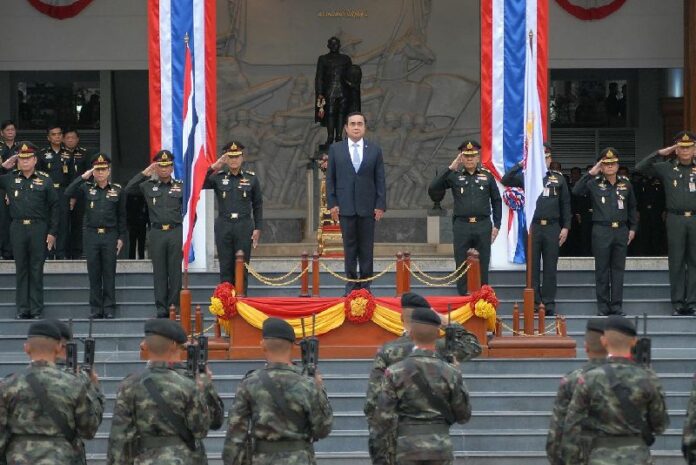
Junta chairman, Prime Minister, and former Army Chief Prayuth Chan-ocha presiding over the 105th anniversary of the 1st Region Army in Bangkok on 13 Jan 2015.

The future of freedom of expression in Thailand is bleak.

While several existing laws already grant Thai authorities sweeping power to prosecute dissident thinkers, the junta's interim government is considering two more pieces of legislation that will vastly strengthen the state's censorship capabilities.

The first piece comes in the form of a constitutional clause that places broad restrictions on freedom of expression.

According to the so-called “hate speech” clause, the state will be authorized to curb free speech in order to:

"maintain the stability of the state; to protect the rights, liberty, dignity, reputation, private information, rights in family, or individual privacy; to maintain peace and order or the good morality of the people; to prevent or cease mental or health degradation of the people; to prevent any hatred between the people in the nation or religions; or to prevent any act of violence against one another."

The term "stability of the state" should raise a red flag. Under the notorious Computer Crimes Act, which outlaws disseminating any information through a computer system that may damage national security, the very same phrase is frequently used to silence critics of the state. For example, two journalists in Phuket are currently facing jail terms for allegedly violating the Computer Crimes Act by publishing an excerpt of a Reuters article that accused some members of the Thai Navy of profiting from human trafficking. 

Authorities have regularly capitalized on the conveniently broad language of the Computer Crimes Act, which was passed by the last post-coup government in 2007, to prosecute political enemies. There is no reason to think that the lengthy and yet vague definition of what constitutes unlawful speech in this new constitutional clause won’t be wielded in the same way. 

In a second worrisome development, the Cabinet has already given the green light to a bill that would empower authorities to access any form of private communication in the name of "safeguarding national cyber security," without securing a court warrant. 

According to Section 35 of the draft of the Cyber Security Act, officials will be authorized to "access any channel of information and communication, including mails, telegrams, telephones, fax, computer, or any other type of electronic and telecommunication equipment" deemed necessary to protect the state.

As stands now, the bill does not require officials to seek court warrants to access private information, or outline any other checks on these far-reaching powers. Section 35 also grants authorities the power to "request" any state or private agency "to act for the benefit of the [officials'] performance of duty."

In Thailand, where insulting the Thai Royal Family is illegal and considered a threat to national security, there is little doubt this law will be used to identify and prosecute perceived critics of the monarchy. 

In recent years, the rise of Internet availability and social media has opened up new spaces for discussion of taboo topics in Thailand. The Cyber Security Act will surely spell the end of this safe haven for honest discussion.

With laws like the Computer Crimes Act and lese majeste, Thailand is already far from cultivating a society that values freedom of expression. These two pieces of legislation will only steer the country further from that path. 

 
Advertisement

Editorial: New Laws Darken Future of Free Speech in Thailand

Junta chairman, Prime Minister, and former Army Chief Prayuth Chan-ocha presiding over the 105th anniversary of the 1st Region Army in Bangkok on 13 Jan 2015.

The future of freedom of expression in Thailand is bleak.

While several existing laws already grant Thai authorities sweeping power to prosecute dissident thinkers, the junta's interim government is considering two more pieces of legislation that will vastly strengthen the state's censorship capabilities.

The first piece comes in the form of a constitutional clause that places broad restrictions on freedom of expression.

According to the so-called “hate speech” clause, the state will be authorized to curb free speech in order to:

"maintain the stability of the state; to protect the rights, liberty, dignity, reputation, private information, rights in family, or individual privacy; to maintain peace and order or the good morality of the people; to prevent or cease mental or health degradation of the people; to prevent any hatred between the people in the nation or religions; or to prevent any act of violence against one another."

The term "stability of the state" should raise a red flag. Under the notorious Computer Crimes Act, which outlaws disseminating any information through a computer system that may damage national security, the very same phrase is frequently used to silence critics of the state. For example, two journalists in Phuket are currently facing jail terms for allegedly violating the Computer Crimes Act by publishing an excerpt of a Reuters article that accused some members of the Thai Navy of profiting from human trafficking. 

Authorities have regularly capitalized on the conveniently broad language of the Computer Crimes Act, which was passed by the last post-coup government in 2007, to prosecute political enemies. There is no reason to think that the lengthy and yet vague definition of what constitutes unlawful speech in this new constitutional clause won’t be wielded in the same way. 

In a second worrisome development, the Cabinet has already given the green light to a bill that would empower authorities to access any form of private communication in the name of "safeguarding national cyber security," without securing a court warrant. 

According to Section 35 of the draft of the Cyber Security Act, officials will be authorized to "access any channel of information and communication, including mails, telegrams, telephones, fax, computer, or any other type of electronic and telecommunication equipment" deemed necessary to protect the state.

As stands now, the bill does not require officials to seek court warrants to access private information, or outline any other checks on these far-reaching powers. Section 35 also grants authorities the power to "request" any state or private agency "to act for the benefit of the [officials'] performance of duty."

In Thailand, where insulting the Thai Royal Family is illegal and considered a threat to national security, there is little doubt this law will be used to identify and prosecute perceived critics of the monarchy. 

In recent years, the rise of Internet availability and social media has opened up new spaces for discussion of taboo topics in Thailand. The Cyber Security Act will surely spell the end of this safe haven for honest discussion.

With laws like the Computer Crimes Act and lese majeste, Thailand is already far from cultivating a society that values freedom of expression. These two pieces of legislation will only steer the country further from that path. 

 
For comments, or corrections to this article please contact: [email protected]

You can also find Khaosod English on Twitter and Facebook
http://twitter.com/KhaosodEnglish
http://www.facebook.com/KhaosodEnglish
Advertisement

Fate of Japanese Hostages Unknown as Islamic State's Deadline Passes

By Takehiko Kambayashi and Weedah Hamzah

TOKYO/BEIRUT (DPA) — The fate of two Japanese hostages being held by the Islamic State was unknown on Friday as a deadline set by the jihadist group expired.

"So far the captors are silent, but we expect something from them soon," said an activist, who is based in the north-eastern Syrian province of Raqqa, an Islamic State stronghold.

He said the 72-hour deadline for payment of a ransom had passed early on Friday.

The activist, who asked not to be named for fear of reprisal from the extremists, said Islamic State had established contact with the Japanese government.

"The situation remains extremely severe, and we just continue to do what we have to do for them to be released as early as possible," Chief Cabinet Secretary Yoshihide Suga told a news conference in Tokyo.

Japanese authorities believed the ransom deadline was 2:50 pm (0550 GMT) on Friday.

The militant group threatened in a video posted on the internet Tuesday to kill Kenji Goto, a freelance journalist, and Haruna Yukawa, who works for a private security firm, unless a 200-million-dollar (178-million-euro) ransom payment was made within 72 hours.

Asked if there has been any contact from the group, Suga said, "Nothing in particular."

The top government spokesman declined to give details of the ongoing diplomatic efforts.

Earlier in the day, Goto's mother Junko Ishido implored the captors at a news conference, "Please allow him to be released."

"Kenji is not an enemy of Islamic State. He went only to rescue his acquaintance," Ishido said, referring to Yukawa.

In Tuesday's footage, the two hostages appeared in orange jumpsuits similar to those worn by hostages previously beheaded by Islamic State.

In Syria meanwhile, the death toll from a Syrian regime raid on an area near the capital Damascus has risen to more than 42 killed among them six children, a monitoring group said.

The Syrian Observatory for Human Rights said the bombardment targeted a rebel-held district in the region of Eastern Ghouta on the outskirts of Damascus. There was no official comment.

More than 200,000 people, mostly civilians, have been killed in Syria's nearly four-year conflict, according to activists.

In neighboring Lebanon, Lebanese army soldiers clashed throughout the day Friday with members of the jihadist movement Islamic State near the Lebanese-Syrian border.

The Lebanese army said late Friday that five of its soldiers were killed and others wounded in ongoing clashes with terrorists in the Tallat al-Hamra region on the outskirts of Ras Baalbek in the eastern Bekaa.

The army said that members of the terrorist group attacked an army surveillance post in Tallat al-Hamra near the Lebanese-Syrian border earlier Friday.

It added that a number of gunmen were killed and wounded in the fighting.

Members of the al-Qaeda-linked Nusra Front and the Islamic State group have launched several such attacks in recent months on Lebanon's eastern border with Syria.


For comments, or corrections to this article please contact: [email protected]

You can also find Khaosod English on Twitter and Facebook
http://twitter.com/KhaosodEnglish
http://www.facebook.com/KhaosodEnglish

Advertisement

Fate of Japanese Hostages Unknown as Islamic State's Deadline Passes


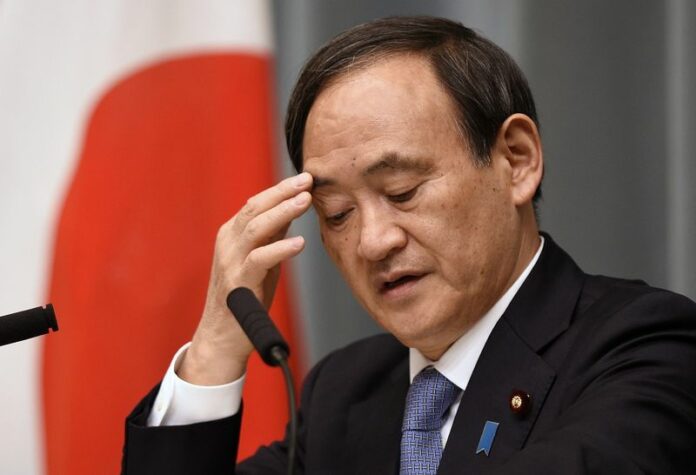
Japanese Chief Cabinet Secretary Yoshihide Suga during a press conference at the prime minister's official residence in Tokyo, Japan, 23 January 2015. The mother of one of the Japanese men held by the Islamic State militant group implored the captors to release her son as a 72-hour deadline for paying a ransom approached. EPA/FRANCK ROBICHON

By Takehiko Kambayashi and Weedah Hamzah

TOKYO/BEIRUT (DPA) — The fate of two Japanese hostages being held by the Islamic State was unknown on Friday as a deadline set by the jihadist group expired.

"So far the captors are silent, but we expect something from them soon," said an activist, who is based in the north-eastern Syrian province of Raqqa, an Islamic State stronghold.

He said the 72-hour deadline for payment of a ransom had passed early on Friday.

The activist, who asked not to be named for fear of reprisal from the extremists, said Islamic State had established contact with the Japanese government.

"The situation remains extremely severe, and we just continue to do what we have to do for them to be released as early as possible," Chief Cabinet Secretary Yoshihide Suga told a news conference in Tokyo.

Japanese authorities believed the ransom deadline was 2:50 pm (0550 GMT) on Friday.

The militant group threatened in a video posted on the internet Tuesday to kill Kenji Goto, a freelance journalist, and Haruna Yukawa, who works for a private security firm, unless a 200-million-dollar (178-million-euro) ransom payment was made within 72 hours.

Asked if there has been any contact from the group, Suga said, "Nothing in particular."

The top government spokesman declined to give details of the ongoing diplomatic efforts.

Earlier in the day, Goto's mother Junko Ishido implored the captors at a news conference, "Please allow him to be released."

"Kenji is not an enemy of Islamic State. He went only to rescue his acquaintance," Ishido said, referring to Yukawa.

In Tuesday's footage, the two hostages appeared in orange jumpsuits similar to those worn by hostages previously beheaded by Islamic State.

In Syria meanwhile, the death toll from a Syrian regime raid on an area near the capital Damascus has risen to more than 42 killed among them six children, a monitoring group said.

The Syrian Observatory for Human Rights said the bombardment targeted a rebel-held district in the region of Eastern Ghouta on the outskirts of Damascus. There was no official comment.

More than 200,000 people, mostly civilians, have been killed in Syria's nearly four-year conflict, according to activists.

In neighboring Lebanon, Lebanese army soldiers clashed throughout the day Friday with members of the jihadist movement Islamic State near the Lebanese-Syrian border.

The Lebanese army said late Friday that five of its soldiers were killed and others wounded in ongoing clashes with terrorists in the Tallat al-Hamra region on the outskirts of Ras Baalbek in the eastern Bekaa.

The army said that members of the terrorist group attacked an army surveillance post in Tallat al-Hamra near the Lebanese-Syrian border earlier Friday.

It added that a number of gunmen were killed and wounded in the fighting.

Members of the al-Qaeda-linked Nusra Front and the Islamic State group have launched several such attacks in recent months on Lebanon's eastern border with Syria.


For comments, or corrections to this article please contact: [email protected]

You can also find Khaosod English on Twitter and Facebook
http://twitter.com/KhaosodEnglish
http://www.facebook.com/KhaosodEnglish

Advertisement

'Heartbroken' Tourist Attempts Suicide in Pattaya Bar

CHONBURI — A foreign tourist attempted suicide in a bar in Pattaya this morning after he saw his ex-girlfriend with another man, police say.

Police have identified the man as a 44-year-old Canadian national. Rescue workers were called to assist him at around 3 am today in front of a bar on Soi Pattaya 16.

The tourist reportedly had large knife wounds on his right arm, and is now being treated at Pattaya Memorial Hospital.

A witness, Wassana Yoosuparb, told police that the Canadian man was drinking at the bar when he saw a woman he used to date with another man.

He then reportedly tried to convince her "come back" to him, according to Wassana.

"His [ex] girlfriend refused, so he became sad and acted madly. He used his knife to slash at his own arm," Wassana said. She added that people in the area promptly called police for help.  


For comments, or corrections to this article please contact: [email protected]

You can also find Khaosod English on Twitter and Facebook
http://twitter.com/KhaosodEnglish
http://www.facebook.com/KhaosodEnglish

Advertisement

Hot News

LATEST NEWS

Bangkok
overcast clouds
28.8 ° C
28.8 °
25.5 °
82 %
3.7kmh
100 %
Sun
30 °
Mon
32 °
Tue
34 °
Wed
33 °
Thu
33 °