

























30 C
Bangkok
Saturday, June 20, 2026
Home Blog Page 3136

Thai Police Ban Controversial Book On Royal Succession

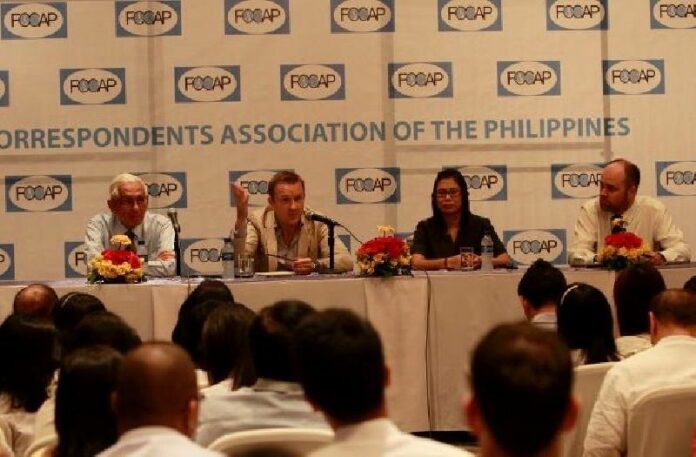
Author of " A Kingdom Crisis" Andrew M. Marshall (second from the left) speaking at a panel in the Philippines in 2011.

BANGKOK — Thai police have banned on a new book on Thailand’s monarchy written by a British author, citing lese majeste and the book’s “threat” to public morality.

Although Andrew MacGregor Marshall’s A Kingdom Crisis: Thailand’s Struggle for Democracy in the Twenty-First Century is not yet on sale in Thailand, Thai police announced yesterday that two reviews of the book provide sufficient evidence that the content is inappropriate for Thai audiences.

Two journalists from The Independent and South China Morning Post newspapers, which are based in the United Kingdom and Hong Kong respectively, published reviews of the book last month.

“The reviewers discussed the attitude of the author of A Kingdom in Crisis and referenced the main content published in the book,” the police announcement reads. “Therefore, there is sufficient evidence that the book A Kingdom in Crisis is a publication that insults, defames, and displays vengeful expression towards His Majesty the King.”

The book also threatens “peace and order, and the good morality of the people,” the announcement says.

The order was signed by Thai police chief Somyot Phumpanmuang, who has vowed to bolster a crackdown on criticism of the Thai monarchy.

Invoking the 2007 Publishing Act, the announcement set a maximum punishment of three years in prison and a fine of 60,000 baht for importing or distributing the book. The order also instructs officials to “confiscate and destroy the aforementioned publication” if they encounter it.

The order did not mention any penalties for acquiring A Kingdom in Crisis through electronic means, but Thailand’s infamous 2007 Computer Crime Act outlaws any dissemination of information deemed insulting toward the monarchy through a computer system.

The author of the book, Andrew M. Marshall, says he resigned from Reuters in 2011 in order to tell the “Thai Story,” which involves intrigues about the royal family and their alleged role in the country’s recent political crises.

Last night, Marshall publicly thanked Thai police on Twitter for banning his book. “Many thanks to the Royal Thai Police for banning my new @ZedBooks publication ‘A Kingdom in Crisis,'” he wrote. “Great for publicity!”

Marshall argues in his book that the power struggle between Thailand’s opposing political camps is in large part driven by a conflict regarding the royal succession to the Thai throne.

Like all other aspects of the monarchy, discussing the royal succession is taboo in Thailand. Under Section 112 of the Thai Criminal Codes, a law known as lese majeste, criticisng the royal family is punishable by up to 15 years in prison.

Thai authorities have previously banned websites and books that are perceived to violate the draconian law.

In 2006, Thai police issued ban on The King Never Smiles, a biography of Thailand’s King Bhumibol that was written by American academic Paul Handley.

A Thai-American was later sentenced in 2011 for two and a half years for allegedly translating the book into Thai language. The defendant, Joe Gordon, was eventually pardoned and released from prison after one year.

For comments, or corrections to this article please contact: [email protected]

You can also find Khaosod English on Twitter and Facebook
http://twitter.com/KhaosodEnglish
http://www.facebook.com/KhaosodEnglish
 

Advertisement

Editorial: The Folly of the Amnesty Bill, One Year Later

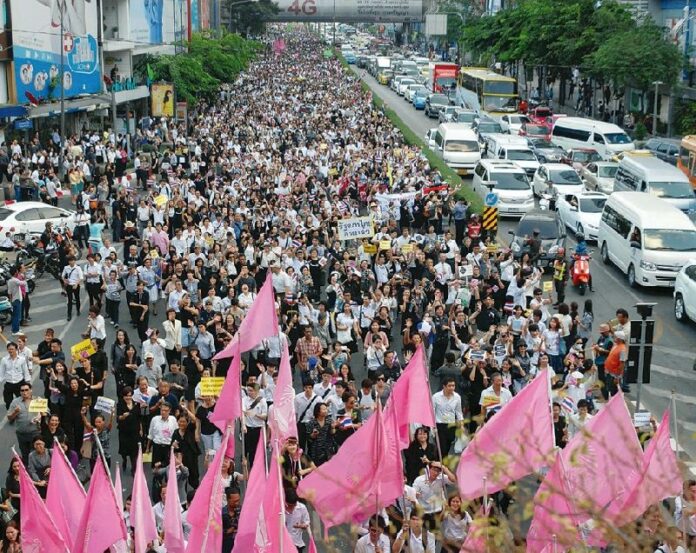
Chulalongkorn University students demonstrate against the amnesty bill in Bangkok on 5 November 2014.

We should not forget the political fumbling of the Pheu Thai party that ultimately led to the suspension of democracy in Thailand today.

This month marks the first anniversary of the mass street demonstrations against former Prime Minsiter Yingluck Shinawatra’s administration that paved the way for the military coup on 22 May 2014.

One year later, it's critical not to let the six months of chaotic and sporadically violent protests that broke out on 29 November overshadow the events that sparked the turmoil in the first place: the then-ruling Pheu Thai Party’s attempt to pass the highly controversial "blanket amnesty bill" in early November of 2013. 

The bill, which was overwhelmingly approved by Pheu Thai MPs in the early morning of 1 November without the presence of opposition lawmakers, would have dissolved all political charges and convictions in Thailand from 2004 to 2013. 

The sweeping scope of the bill alienated Thais across the political spectrum, as it would have pardoned polarizing figures like former Prime Minister Thaksin Shinwatra, who was found guilty of corruption in 2008, and former Democrat Party PM Abhisit Vejjajiva, who was charged with murder for authorising a deadly crackdown on Redshirt protesters in 2010. 

It was clear to most that the bill’s all-encompassing nature was motivated by a desire to allow Thaksin, the de facto leader of the Pheu Thai party, to return to Thailand after years of living in exile.

Yet not only was the content of the blanket amnesty bill dubious; the Pheu Thai party's handling of the legislative process surrounding the bill was an affront to the principles of parliamentary democracy.

The original draft of the bill was intended to pardon only protesters, not the leaders of Thailand’s political movements. But Pheu Thai MPs violated parliamentary regulations by broadening the purview of the bill to the point that it no longer resembled the initial draft at all.

Earning accusations of being a "tyrannical majority," the Pheu Thai party did not allow any debate during the session when the bill was passed in the early hours of 1 November. The party also explicitly instructed lawmakers not to challenge the bill, and demanded that four dissenting Pheu Thai MPs – including a daughter of a military officer who lost his life during 2010 crackdown – merely abstain, instead of vote against the motion.  

Despite the government’s insistence that extending blanket amnesty was a gesture of "national reconciliation," the bill infuriated nearly all parties and political camps across the Kingdom.

Yellowshirt leaders who were being prosecuted for their role in the 2008 protests said they were willing to contest their charges in court. So did Abhisit and his deputy, Suthep Thaugsuban. Meanwhile, many Redshirt activists demanded that those responsible for the 2010 crackdown be brought to justice rather than pardoned by the bill.

Anger over the bill quickly spiraled into massive protests in Bangkok that pushed Yingluck to dissolve the House in December and call a snap election. Though sparked by fury over the amnesty bill, the protests later developed into a full-scale repudiation of Yingluck's government and even democracy itself, culminating in the military coup on 22 May.

Thailand’s coup-makers dismantled what was left of Yingluck’s government, tore up the 2007 constitution, and appointed several conservative and military-stacked councils to oversee a year of national reforms before the next election is held.

It's not clear when democracy will return to Thailand, but when it does, those running for office must remember the painful lessons from the folly of the blanket amnesty bill. 

Future politicians must bear in mind that participating in a parliamentary democracy comes with a responsibility to respect the rule of law and place the interest of the public above political machinations. 

 
For comments, or corrections to this article please contact: [email protected]

You can also find Khaosod English on Twitter and Facebook
http://twitter.com/KhaosodEnglish
http://www.facebook.com/KhaosodEnglish
Advertisement

US, China Announce New Targets On Greenhouse Gas Emissions

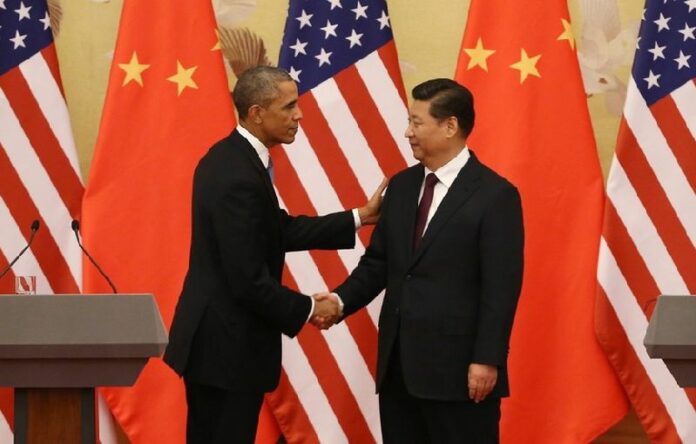
US President Barack Obama (L) and Chinese President Xi Jinping shake hands during a press conference at the Great Hall of the People in Beijing, China, 12 November 2014. On Wednesday, the leaders announced new climate change targets following the end of their two-day talks in Beijing. EPA/HOW HWEE YOUNG

By Joanna Chiu

BEIJING (DPA) — US President Barack Obama and Chinese President Xi Jinping Wednesday announced new climate change targets at the end of their two-day talks in Beijing.

Xi said China's CO2 emissions would peak around 2030, with non-fossil fuel sources making up 20 per cent of energy sources by then.

He did not put a target on emissions levels or reduction, but it was the first time China, which relies heavily on coal-powered electricity generation, has put a date on a CO2 peak.

US has in past argued that it could not commit to reductions in greenhouse gas emissions until fast-growing China did the same. 

"I am proud to announce we have made a historic agreement," Obama said in a joint press conference with Xi following the talks.

Obama announced a new target for the United States to cut its net greenhouse gas emissions to 26-28 per cent below 2005 levels by 2025, compared with the previous target of a 17-per-cent cut by 2020.

"It puts us on path to making the deep [reductions] that climate change scientists say is necessary," Obama said.

Xi told the conference that both sides would also push for progress at ongoing international climate change negotiations. 

"Academics… think China might reach the peak value [of CO2 emissions] between 2025-2040. To set the target in 2030 is not an easy task," said Pan Jiahua, director of the Institute of Urban and Environmental Studies at the Chinese Academy of Social Sciences. 

"I think China will try its best since the government has announced it," Pan told dpa.

Obama may face greater difficulties in getting lawmakers to support the targets. 

Obama has so far failed to convince both opposition Republicans and his own Democrats that global warming is a security threat and that Congress needs to put a price on carbon. 

Instead, he has used executive orders to restrict emissions and funneled money to the clean energy industry.

The joint declaration by the US and China comes ahead of a UN Climate Change Conference in Paris in 2015, and some advocates for action on climate change are hoping it may motivate other countries to announce similar targets. 

"The US and China should make it a race to the top, catalyzing other countries to announce their targets and build momentum leading up to Paris. Today's announcement is a big step in that direction," said Jennifer Morgan, Director of the Climate Program of the US-based World Resources Institute.  

Environmental campaigners said however that the deal lacked ambition. 

"Both sides have yet to reach the goal of a truly game-changing climate relationship," said Li Shuo, senior climate and energy campaigner for Greenpeace East Asia.

The next round of climate negotiations starts next month in Lima and ends in December 2015 in Paris.

Obama was in the Chinese capital to attend the Asia-Pacific Economic Cooperation (APEC) summit Monday and Tuesday and to pay a state visit to China at Xi's invitation.

On Tuesday evening the pair spoke for five hours over a private dinner at Zhongnanhai and on Wednesday morning they met again at the Great Hall of the People in central Beijing.

The US and China also struck deals on agriculture and food security, agreed to boost trade in information technology and to expand visas for business people and students.

Later Wednesday, Obama was to meet with Chinese Premier Li Keqiang and then fly to Myanmar for the East Asia Summit.


Advertisement

Ayutthaya Sweatshop Busted For Employing Laotian Child Labour

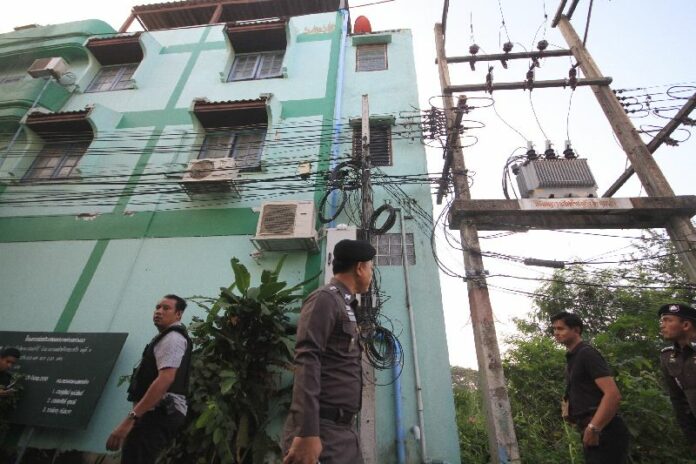
The electric pole that 3 children reportedly climbed down to escape a gold shop in Ayutthaya where they were forced to work for little pay.

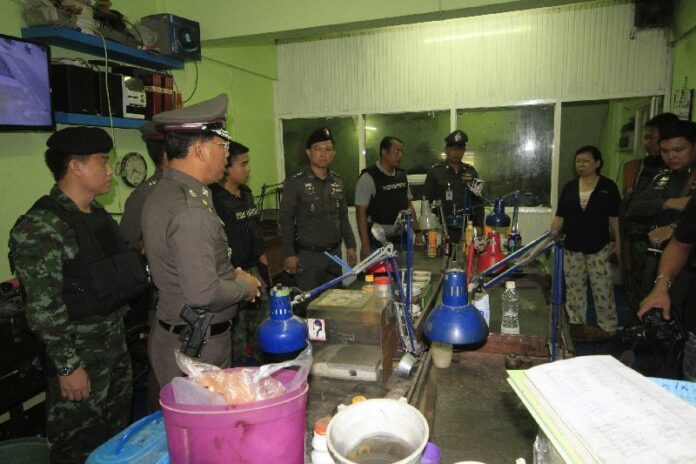
AYUTTHAYA — Police raided a gold jewelry shop in Ayutthaya province this morning where three Laotian children were reportedly forced to work for less than 20 baht a day.

The jewelry shop is located on the upper floor of a building in Sena district, police say. The owner, Sumonthanee Opassuwan, 35, was arrested on suspicion of human trafficking during the raid, which was organised by local police, soldiers, and officials from the Ministry of Social Development and Human Security. 

Pol.Maj.Gen. Sermkid Sitthichaikan said police received information about the gold shop from three Laotian children who used to work there but escaped.

The children, two boys and one girl, are between 14-15 years old, he said.

According to Pol.Maj.Gen. Sermkid, the children said they were forced to wake up early in the morning, clean the shop, and work on gold necklaces until the afternoon when they were given their first meal. The children were sometimes forced to work till 1 am and were also prevented from leaving the building or contacting their parents, the officer said.

Pol.Maj.Gen. Sermkid added that the children were paid between 500-1,000 baht for three months of work. 

"Eventually they could not stand the conditions anymore, so they climbed out of the window and down the electric pole," Pol.Maj.Gen. Sermkid said. "They were trying to go home, but they ran into police first."

He said police are still trying to establish where the children are from, and how they ended up at Sumonthanee's gold shop. All three children have been placed in a shelter home run by the Ministry of Social Development and Human Security. 

Thailand's labour laws bar children under the age of 15 from working, and require all employees under the age of 18 be granted an hour break every four hours. Minors are also not permitted to work between 10pm-6am. 

The shop owner insisted that she paid the children 300 baht per day for their labour, but did not provide any proof of payment. She also told police that the working conditions were fair, with eight-hour shifts and three meals a day. 

"I didn't force them to do it at all. I didn't let them go out anywhere because I saw them as children, I was afraid they may be lured into doing bad things if they go out," Sumonthanee said. "I did scold them sometimes because they were naughty."

Thailand is a major source, transit, and destination for human trafficking. Many of the victims are from neighboring countries and under the age of 18.

Last week, police said they rescued almost two dozen underage Thai and Laotian women who were allegedly being held captive in a karaoke shop in central Nakhon Pathom and forced into prostitution.

 
For comments, or corrections to this article please contact: [email protected]

You can also find Khaosod English on Twitter and Facebook
http://twitter.com/KhaosodEnglish
http://www.facebook.com/KhaosodEnglish
 

Advertisement

50-Year-Old Northern Cook Accused of Collecting Firearms

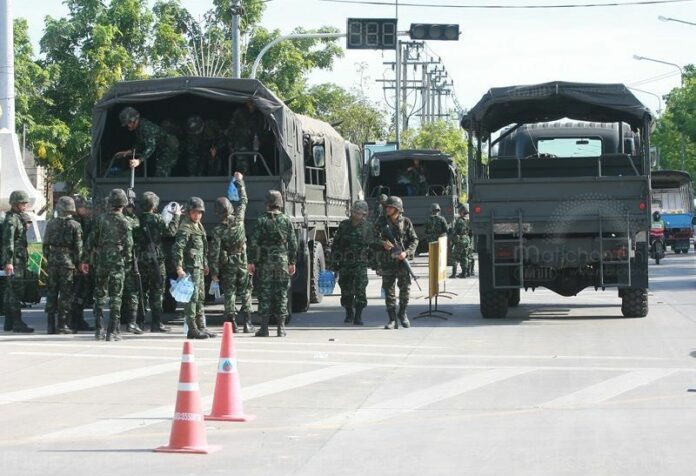
Soldiers near Aksa Avenue on 20 May 2014. Saowani Intalo reportedly cooked meals for Redshirt protesters who were staging a rally there.

(Prachatai English)

BANGKOK – The military court has refused to grant bail to a 50-year-old woman from northern Lamphun Province, accused of possessing illegal weapons, despite the suspect’s poor health. The defence lawyer, meanwhile, has challenged the military court’s jurisdiction over the case.
 
Saowani Intalo, a 50-year-old restaurant owner, was arrested along with Phairat Singkham, 38 years old, during a 26 May raid by military and police forces on a longan farm in the northern province of Lamphun. 

Read more here.

Note: Khaosod English is not responsible for content on other websites.

Advertisement

Ayutthaya Sweatshop Busted For Employing Laotian Child Labour

Police raided a gold jewelry shop in Ayutthaya province  where three Laotian children were reportedly forced to work for less than 20 baht a day, 12 Nov 2014.

AYUTTHAYA — Police raided a gold jewelry shop in Ayutthaya province this morning where three Laotian children were reportedly forced to work for less than 20 baht a day.

The jewelry shop is located on the upper floor of a building in Sena district, police say. The owner, Sumonthanee Opassuwan, 35, was arrested on suspicion of human trafficking during the raid, which was organised by local police, soldiers, and officials from the Ministry of Social Development and Human Security. 

Pol.Maj.Gen. Sermkid Sitthichaikan said police received information about the gold shop from three Laotian children who used to work there but escaped.

The children, two boys and one girl, are between 14-15 years old, he said.

According to Pol.Maj.Gen. Sermkid, the children said they were forced to wake up early in the morning, clean the shop, and work on gold necklaces until the afternoon when they were given their first meal. The children were sometimes forced to work till 1 am and were also prevented from leaving the building or contacting their parents, the officer said.

Pol.Maj.Gen. Sermkid added that the children were paid between 500-1,000 baht for three months of work. 

"Eventually they could not stand the conditions anymore, so they climbed out of the window and down the electric pole," Pol.Maj.Gen. Sermkid said. "They were trying to go home, but they ran into police first."

He said police are still trying to establish where the children are from, and how they ended up at Sumonthanee's gold shop. All three children have been placed in a shelter home run by the Ministry of Social Development and Human Security. 

Thailand's labour laws bar children under the age of 15 from working, and require all employees under the age of 18 be granted an hour break every four hours. Minors are also not permitted to work between 10pm-6am. 

The shop owner insisted that she paid the children 300 baht per day for their labour, but did not provide any proof of payment. She also told police that the working conditions were fair, with eight-hour shifts and three meals a day. 

"I didn't force them to do it at all. I didn't let them go out anywhere because I saw them as children, I was afraid they may be lured into doing bad things if they go out," Sumonthanee said. "I did scold them sometimes because they were naughty."

Thailand is a major source, transit, and destination for human trafficking. Many of the victims are from neighboring countries and under the age of 18.

Last week, police said they rescued almost two dozen underage Thai and Laotian women who were allegedly being held captive in a karaoke shop in central Nakhon Pathom and forced into prostitution.

 
For comments, or corrections to this article please contact: [email protected]

You can also find Khaosod English on Twitter and Facebook
http://twitter.com/KhaosodEnglish

Advertisement

Anti-Coup Activists Crash London 'Hunger Games' Premiere

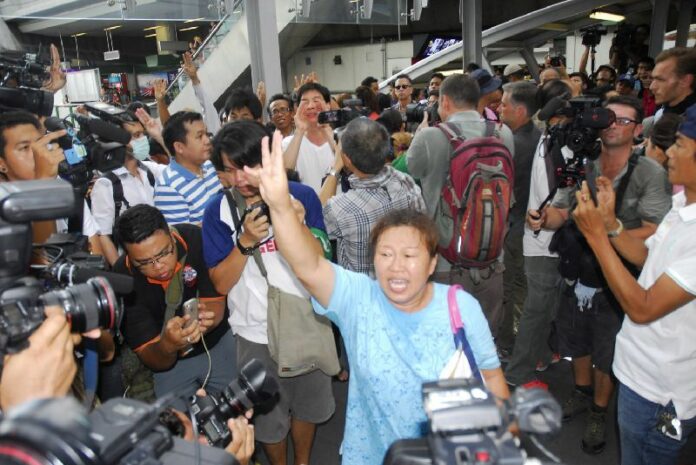
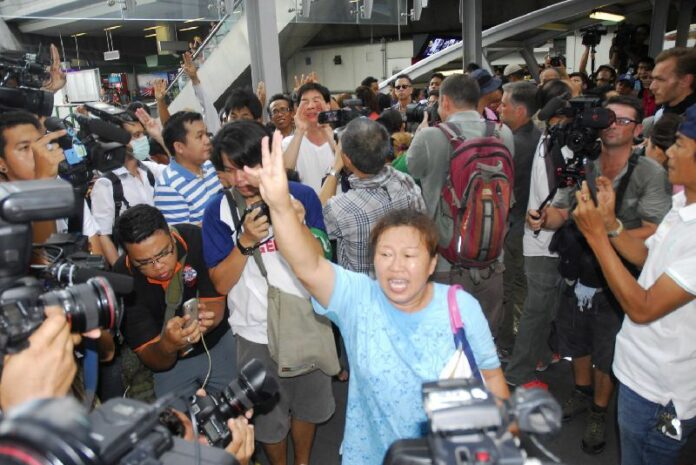
An anti-coup activist in Thailand flashes the three-finger salute in Bangkok on 1 June 2014.

BANGKOK — Anti-coup activists staged a demonstration during the premiere of the latest installment of "The Hunger Games" series in London to draw attention to their "non-fiction" struggle against Thailand’s military junta.

Dozens of activists held up banners criticizing junta chairman and Prime Minister Gen. Prayuth Chan-ocha as they stood among a crowd waiting to see "The Hunger Games: Mockingjay – Part 1" in front of London’s Odeon Theatre on 10 November.

They also held signs that read "#DistrictThai," comparing junta-ruled Thailand to one of the fictional "districts" ruled by an autocratic regime in the dystopian films.  

"The Hunger Games" movies, which are based on a novel series by the same name, became an unlikely source of inspiration for the anti-coup movement that emerged shortly after Gen. Prayuth toppled Thailand’s elected government on 22 May 2014. 

In the wake of the coup, activists adopted the three-finger salute from the movie to express opposition to the military takeover. In “The Hunger Games,” the hand gesture symoblises defiance against an authoritarian government.

Thailand’s military junta quickly banned the gesture, along with other anti-coup symbols, such as "eating sandwiches" and reading George Orwell's Nineteen-Eightyfour.

Some activists who violated the bans were dragged away from their peaceful rallies by security forces and tried in military court on charges of instigating dissent against the regime. 

The protest at the London premiere of "Mockingjay" on 10 November appears to have been organised by a Facebook group called "District Thai."

In a statement posted on 7 November, the group called on "the global community, the international press, and all those who cherish humanity" to join their campaign against Thailand’s military government.

"Streets and beaches of Thailand may seem normal and quiet. But that is just the surface," the statement reads. "In reality, citizens are being brainwashed, activists detained, intellectuals arrested and journalists censored. Expression of dissent became forbidden."

Another Facebook post by the group explains that the three finger salute was inspired by the "Hunger Games," but unlike the series, "our struggle is non-fiction."

"The Hunger Games: Mockingjay – Part 1" will open in Thai cinemas on 20 November. 


For comments, or corrections to this article please contact: [email protected]

You can also find Khaosod English on Twitter and Facebook
http://twitter.com/KhaosodEnglish
http://www.facebook.com/KhaosodEnglish
Advertisement

Anti-Coup Activists Crash London 'Hunger Games' Premiere

Anti-coup activist in Thailand flashes the three-finger salute in Bangkok on 1 June 2014.

BANGKOK — Anti-coup activists staged a demonstration during the premiere of the latest installment of "The Hunger Games" series in London to draw attention to their "non-fiction" struggle against Thailand’s military junta.

Dozens of activists held up banners criticizing junta chairman and Prime Minister Gen. Prayuth Chan-ocha as they stood among a crowd waiting to see "The Hunger Games: Mockingjay – Part 1" in front of London’s Odeon Theatre on 10 November.

They also held signs that read "#DistrictThai," comparing junta-ruled Thailand to one of the fictional "districts" ruled by an autocratic regime in the dystopian films.  

"The Hunger Games" movies, which are based on a novel series by the same name, became an unlikely source of inspiration for the anti-coup movement that emerged shortly after Gen. Prayuth toppled Thailand’s elected government on 22 May 2014. 

In the wake of the coup, activists adopted the three-finger salute from the movie to express opposition to the military takeover. In “The Hunger Games,” the hand gesture symoblises defiance against an authoritarian government.

Thailand’s military junta quickly banned the gesture, along with other anti-coup symbols, such as "eating sandwiches" and reading George Orwell's Nineteen-Eightyfour.

Some activists who violated the bans were dragged away from their peaceful rallies by security forces and tried in military court on charges of instigating dissent against the regime. 

The protest at the London premiere of "Mockingjay" on 10 November appears to have been organised by a Facebook group called "District Thai."

In a statement posted on 7 November, the group called on "the global community, the international press, and all those who cherish humanity" to join their campaign against Thailand’s military government.

"Streets and beaches of Thailand may seem normal and quiet. But that is just the surface," the statement reads. "In reality, citizens are being brainwashed, activists detained, intellectuals arrested and journalists censored. Expression of dissent became forbidden."

Another Facebook post by the group explains that the three finger salute was inspired by the "Hunger Games," but unlike the series, "our struggle is non-fiction."

"The Hunger Games: Mockingjay – Part 1" will open in Thai cinemas on 20 November. 


For comments, or corrections to this article please contact: [email protected]

You can also find Khaosod English on Twitter and Facebook
http://twitter.com/KhaosodEnglish
http://www.facebook.com/KhaosodEnglish
 

Advertisement

'Crazed Foreigner' Attacks Pattaya McDonald's Store

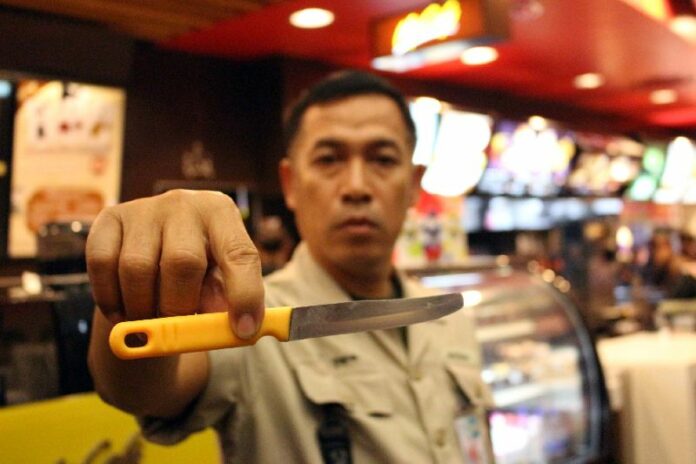
An emergency responder holding the knife used by a foreign man who attempted to attack customers in  a McDonald's store in Pattaya, 12 Nov 2014.

CHONBURI — A foreign man has been arrested for attempting to attack customers with a knife at a McDonald's store in Pattaya early this morning.

The incident took place at around 3.30 am at a McDonald's in Central Pattaya, police say. 

Kandapon Pongsapakkaranatat, 34, said he was ordering food at the counter when a man charged into the store, wielding a knife and shouting incoherently at other customers.

Kandapon said he tried to talk the man into putting down his knife, but to no avail.

"He grabbed my neck and tried to hurt me," Kandapon said. "So I struggled and ran away, then I called the police."

Police officers had to wrestle the man down to disarm him. When they attempted to question the foreigner, whose nationality has not been confirmed, he initially pretended to be mute before mumbling unintelligibly.

A police officer at Mueang Pattaya Police Station said he believes the foreigner may be suffering from a mental breakdown. Police say they are investigating the incident. 

For comments, or corrections to this article please contact: [email protected]

You can also find Khaosod English on Twitter and Facebook
http://twitter.com/KhaosodEnglish
http://www.facebook.com/KhaosodEnglish
Advertisement

Thai Police Kill Five Drug Smugglers

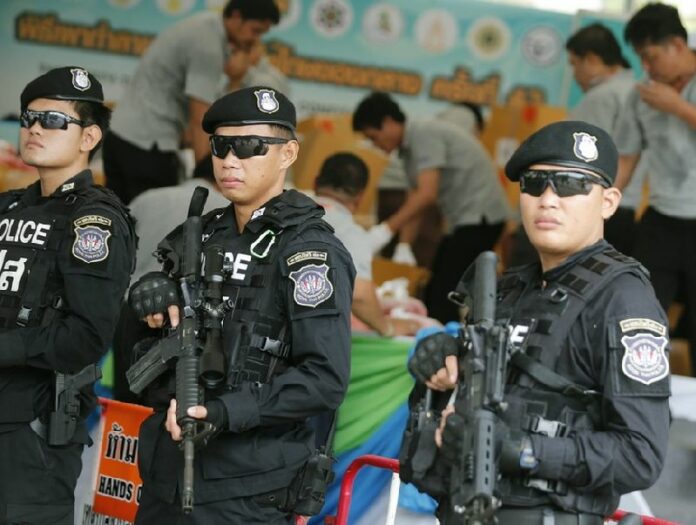
Officers stand guard as narcotics officials prepare to burn drugs in a high-powered oven in Ayutthaya province in a in a June 26, 2014 file photo. Photo: Narong Sangnak / EPA

BANGKOK (DPA) — ​Thai border police killed five drug traffickers during a shootout near the Myanmar border, an officer said Wednesday.

The incident occurred in the northern province of Chiang Mai. None of the police were injured, the sub-inspector of Chiang Dao border police said.

"All of them were armed," Lieutenant Narin Boochuay said. "Five of them were killed during the clash but the other five escaped."

The group was smuggling bags containing more than 400,000 pills of methamphetamine into Thailand from Myanmar, he said.

The borders between Thailand, Myanmar and Laos are popular routes for the international drug trade in the region.

Advertisement

Hot News

LATEST NEWS

Bangkok
overcast clouds
30 ° C
31.1 °
27.7 °
78 %
3.4kmh
100 %
Sat
32 °
Sun
35 °
Mon
37 °
Tue
36 °
Wed
36 °