

























33.8 C
Bangkok
Saturday, June 20, 2026
Home Blog Page 3135

Obama Says Myanmar Reforms Not "Irreversible"

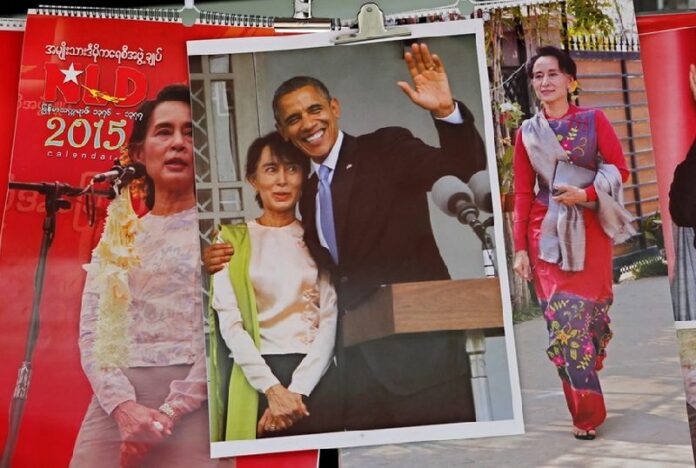
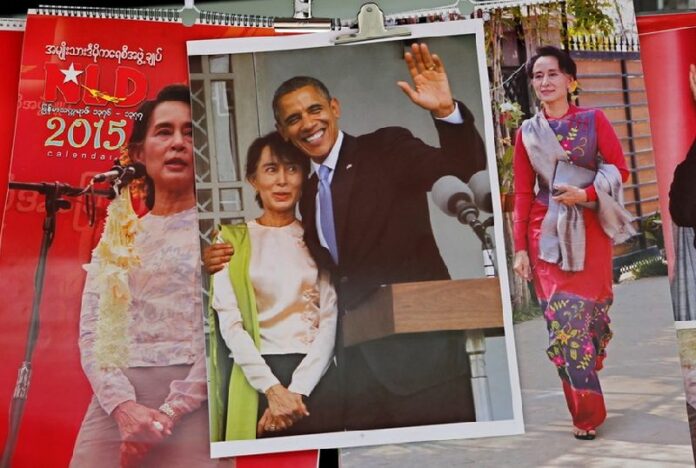
A poster of US President Barack Obama and Aung San Suu Kyi (C) in Yangon, Myanmar, 10 November 2014.

YANGON (DPA) — Visiting US President Barack Obama warned Friday that political reforms in Myanmar were "by no means complete or irreversible," after talks with opposition leader Aung San Suu Kyi.

However, "over the past two years, important changes have been made," Obama said in a joint press conference in Yangon.

The pace of reforms in Myanmar was the main theme of his talks with Suu Kyi, and with President Thein Sein in the capital Naypyidaw on Thursday, Obama said.

\
A poster of US President Barack Obama and Aung San Suu Kyi (C) in Yangon, Myanmar, 10 November 2014. 

Over the past two days, senior officials in the Myanmar government have defended the speed of the changes, arguing that for some parts of society it was too fast, and that the process required patience.

Obama called for general elections next year to be held on time, and for them to be "free, fair and inclusive."

Suu Kyi referred to a provision of the Myanmar constitution that bars her from running for president as "unfair, unjust and undemocratic," in the joint news conference.

"If we want democracy, we have to dare to live by the principles of democracy," said Suu Kyi, who leads the opposition National League for Democracy party.

The 2008 charter contains a clause barring those related to foreign nationals from the highest post in the government. Suu Kyi's late husband was British and her two sons are British citizens.

Suu Kyi is seeking support for a campaign to amend the constitution before the elections, but the still-powerful military retains a veto on changes to the text.

Obama said the relevant provisions of the constitution "didn't make much sense to me," after talks at Suu Kyi's lakeside villa, where until just four years ago she was kept under house arrest.

Referring to ethnic violence in Myanmar's western Rakhine state, Obama said the US opposed discrimination against Rohingya, using a term for the Muslim group that has been criticized by the Myanmar government.

The US sought "durable and effective solutions for the terrible violence in Rakhine state," he said.

The attempt by the government to settle disputes with the many ethnic insurgencies in the country was also a key to progress, the two Nobel prize laureates said.

"It is the duty of the government to make all our people feel secure," Suu Kyi said. "We cannot achieve harmony without security."

Turning to Suu Kyi, Obama said "we continue to look to you for inspiration." The two politicians shared a slightly awkward embrace during the joint presser, and walked off the stage arm-in-arm.

Obama met Suu Kyi on a landmark visit to Yangon two years ago, when he become the first sitting US president to visit Myanmar.

Myanmar was under military rule between 1962 and 2010, earning it pariah status among Western democracies, but many sanctions on the country were dropped in 2012 after Thein Sein began implementing a series of political and economic reforms.
 

Advertisement

Obama Says Myanmar Reforms Not "Irreversible"

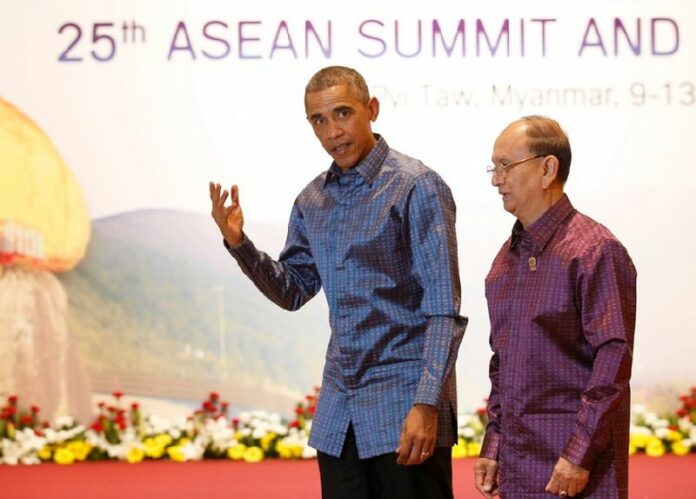
Myanmar President Thein Sein (2- L) walks with US President Barack Obama during the official greeting at the 25th Association of South East Asian Nations (ASEAN) summit in Naypyitaw, Myanmar, 12 November 2014. Myanmar defended its progress on political reforms and its treatment of minorities ahead of summit talks between President Thein Sein and his US counterpart Barack Obama. EPA/BARBARA WALTON

YANGON (DPA) — Visiting US President Barack Obama warned Friday that political reforms in Myanmar were "by no means complete or irreversible," after talks with opposition leader Aung San Suu Kyi.

However, "over the past two years, important changes have been made," Obama said in a joint press conference in Yangon.

The pace of reforms in Myanmar was the main theme of his talks with Suu Kyi, and with President Thein Sein in the capital Naypyidaw on Thursday, Obama said.

\
A poster of US President Barack Obama and Aung San Suu Kyi (C) in Yangon, Myanmar, 10 November 2014. 

Over the past two days, senior officials in the Myanmar government have defended the speed of the changes, arguing that for some parts of society it was too fast, and that the process required patience.

Obama called for general elections next year to be held on time, and for them to be "free, fair and inclusive."

Suu Kyi referred to a provision of the Myanmar constitution that bars her from running for president as "unfair, unjust and undemocratic," in the joint news conference.

"If we want democracy, we have to dare to live by the principles of democracy," said Suu Kyi, who leads the opposition National League for Democracy party.

The 2008 charter contains a clause barring those related to foreign nationals from the highest post in the government. Suu Kyi's late husband was British and her two sons are British citizens.

Suu Kyi is seeking support for a campaign to amend the constitution before the elections, but the still-powerful military retains a veto on changes to the text.

Obama said the relevant provisions of the constitution "didn't make much sense to me," after talks at Suu Kyi's lakeside villa, where until just four years ago she was kept under house arrest.

Referring to ethnic violence in Myanmar's western Rakhine state, Obama said the US opposed discrimination against Rohingya, using a term for the Muslim group that has been criticized by the Myanmar government.

The US sought "durable and effective solutions for the terrible violence in Rakhine state," he said.

The attempt by the government to settle disputes with the many ethnic insurgencies in the country was also a key to progress, the two Nobel prize laureates said.

"It is the duty of the government to make all our people feel secure," Suu Kyi said. "We cannot achieve harmony without security."

Turning to Suu Kyi, Obama said "we continue to look to you for inspiration." The two politicians shared a slightly awkward embrace during the joint presser, and walked off the stage arm-in-arm.

Obama met Suu Kyi on a landmark visit to Yangon two years ago, when he become the first sitting US president to visit Myanmar.

Myanmar was under military rule between 1962 and 2010, earning it pariah status among Western democracies, but many sanctions on the country were dropped in 2012 after Thein Sein began implementing a series of political and economic reforms.


Advertisement

Thai Buddhism Agency Protests Over 'Blasphemous' Japanese Rock Band

BANGKOK — Thailand's National Office of Buddhism has written a formal letter of protest to the Japanese Embassy concerning a rock band whose lead singer recently wore a Buddhist monk robe onstage at a concert in Japan.

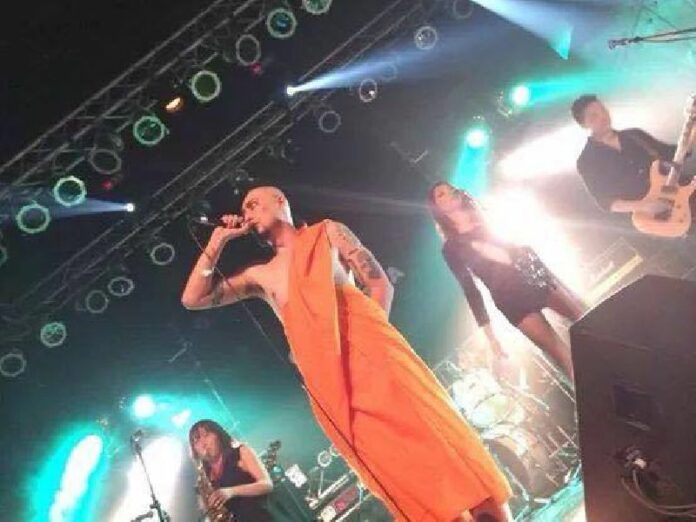
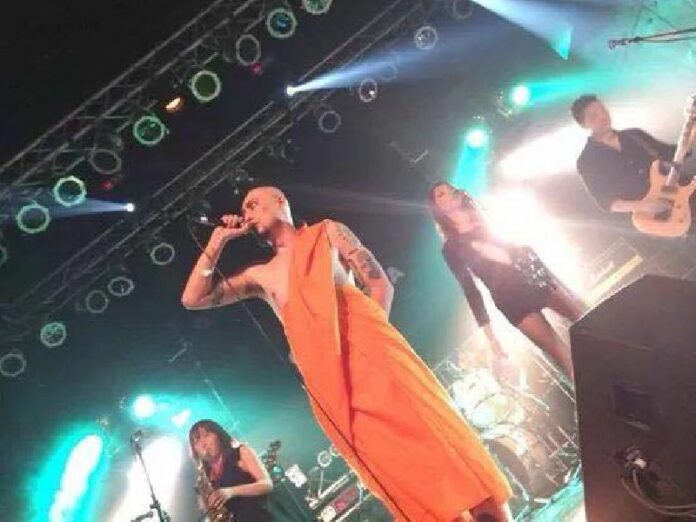
The punk-rock band Wat Wayhem Orchestra stirred a controversy among Thais earlier this week after one of its lead singers was seen posing as a Buddhist monk in saffron robes during a live performance in Japan.

\

A vast majority of Thais practice the Theravada branch of Buddhism in which saffron robes are reserved for monks, who are considered holy agents of Lord Buddha. 

Somchai Surachatri, a spokesperson of the National Office of Buddhism (ONAB), said yesterday that the agency sent a letter of protest to the Embassy of Japan in Bangkok regarding the incident. 

"We want them to be careful about the performance of celebrities, singers, and actors, so that they will not hurt the feelings of Thai Buddhists," Somchai told Prachachat. "If they perform in Thailand in such manner, they may face criminal charges for their blasphemous action against Buddhism."

Under Section 206 of Thailand’s Criminal Code, any act of "blasphemy" against the "the religion of any people" is punishable by up to seven years in prison. 

Somchai's remark came shortly after the singer of Wat Wayhem Orchestra, Yamauchi Takaya, apologised for his wardrobe choice on Twitter. 

"I did not have any intention to insult Buddhism," Takaya wrote in Thai on his Twitter account on 13 November. "I admit that I don't know Thai customs so well. I ask all Thai people to forgive me."

The appropriation of Buddhist objects and decorations are a frequent source of controversy among Thai Buddhists.

In July 2013, a group of Buddhist activists protested in front of the German Embassy in Bangkok to voice their opposition to an art installation in Munich, Germany that involved laying a large Buddhist statue on the ground.

The effort to stop foreigners’ "blasphemous" treatment of Buddhist statues is coordinated through a group called “Knowing Buddha.” The group has sponsored several large billboards over Bangkok's main thoroughfares advising foreign visitors to be respectful of the religion. 

According to an announcement on the group’s Facebook page, titled “Do and Don’t on Buddha,” the group recently succeeded in pressuring Thai authorities to halt all sales of Buddhist art and furniture pieces at Bangkok’s Chatuchak Weekend Market. 


For comments, or corrections to this article please contact: [email protected]

You can also find Khaosod English on Twitter and Facebook
http://twitter.com/KhaosodEnglish
http://www.facebook.com/KhaosodEnglish

Advertisement

Thai Buddhism Agency Protests Over 'Blasphemous' Japanese Rock Band

Photos of the lead singer of Japanese punk-rock band  wearing a monk's robe on stage sparked a controversy among Thai Buddhists, Nov 2014.

BANGKOK — Thailand's National Office of Buddhism has written a formal letter of protest to the Japanese Embassy concerning a rock band whose lead singer recently wore a Buddhist monk robe onstage at a concert in Japan.

The punk-rock band Wat Wayhem Orchestra stirred a controversy among Thais earlier this week after one of its lead singers was seen posing as a Buddhist monk in saffron robes during a live performance in Japan.

\

A vast majority of Thais practice the Theravada branch of Buddhism in which saffron robes are reserved for monks, who are considered holy agents of Lord Buddha. 

Somchai Surachatri, a spokesperson of the National Office of Buddhism (ONAB), said yesterday that the agency sent a letter of protest to the Embassy of Japan in Bangkok regarding the incident. 

"We want them to be careful about the performance of celebrities, singers, and actors, so that they will not hurt the feelings of Thai Buddhists," Somchai told Prachachat. "If they perform in Thailand in such manner, they may face criminal charges for their blasphemous action against Buddhism."

Under Section 206 of Thailand’s Criminal Code, any act of "blasphemy" against the "the religion of any people" is punishable by up to seven years in prison. 

Somchai's remark came shortly after the singer of Wat Wayhem Orchestra, Yamauchi Takaya, apologised for his wardrobe choice on Twitter. 

"I did not have any intention to insult Buddhism," Takaya wrote in Thai on his Twitter account on 13 November. "I admit that I don't know Thai customs so well. I ask all Thai people to forgive me."

The appropriation of Buddhist objects and decorations are a frequent source of controversy among Thai Buddhists.

In July 2013, a group of Buddhist activists protested in front of the German Embassy in Bangkok to voice their opposition to an art installation in Munich, Germany that involved laying a large Buddhist statue on the ground.

The effort to stop foreigners’ "blasphemous" treatment of Buddhist statues is coordinated through a group called “Knowing Buddha.” The group has sponsored several large billboards over Bangkok's main thoroughfares advising foreign visitors to be respectful of the religion. 

According to an announcement on the group’s Facebook page, titled “Do and Don’t on Buddha,” the group recently succeeded in pressuring Thai authorities to halt all sales of Buddhist art and furniture pieces at Bangkok’s Chatuchak Weekend Market


For comments, or corrections to this article please contact: [email protected]

You can also find Khaosod English on Twitter and Facebook
http://twitter.com/KhaosodEnglish
http://www.facebook.com/KhaosodEnglish

Advertisement

Obama To Meet Suu Kyi For Talks On Myanmar Reforms, Elections

A poster with the image of US President Barack Obama and Myanmar opposition leader Aung San Suu Kyi (C) is seen in front of a souvenir shop of National League for Democracy (NLD) party headquarters in Yangon, Myanmar, 10 November 2014. Obama is to meet Suu Kyi in Yangon, amid a renewed debate over the pace of the country?s political reforms. EPA/LYNN BO BO

By Simon Lewis

YANGON (DPA) — Barack Obama is to meet Myanmar opposition leader Aung San Suu Kyi in Yangon on Friday, amid a renewed debate over the pace of the country's political reforms.

Obama met Myanmar's President Thein Sein in the capital Naypyidaw on Thursday, calling for elections next year to be free, fair and inclusive.

The polls will likely also be discussed when Obama visits Suu Kyi at her lakeside villa, where until just four years ago she was kept under house arrest.

At present, Suu Kyi, who leads the popular opposition National League for Democracy, is not eligible to contest the presidency under the country's constitution.

The 2008 charter contains a clause barring those related to foreign nationals from the highest post in the government. Suu Kyi's late husband was British and her two sons are British citizens.

Suu Kyi is seeking support for a campaign to amend the constitution before the elections, but the still-powerful military retains a veto on changes.

During his visit, Obama has also raised concerns that Myanmar's transition from military dictatorship to democracy appears to have slowed, but government officials have defended the pace of change. 

Obama met Suu Kyi on a landmark visit to Yangon two years ago, when he become the first sitting US president to visit Myanmar.


Advertisement

HM King's Intestine Inflammation Escalates

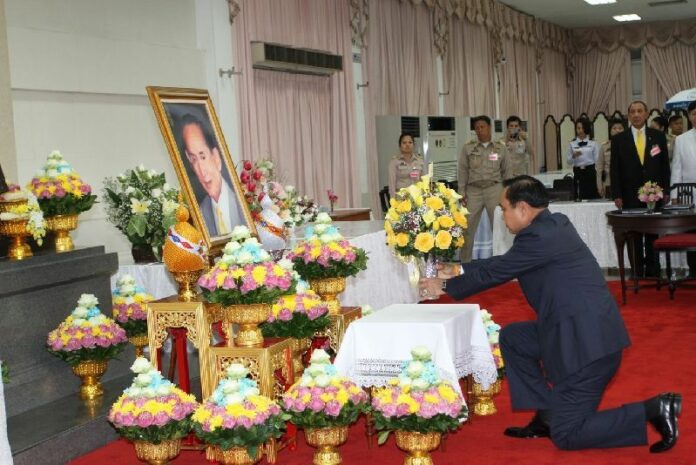
Junta leader and PM Prayuth Chan-ocha wishing HM the King a speedy recovery on 6 October 2014.

BANGKOK — The King of Thailand is still being treated for an infection in his intestine more than a month after he was admitted to the hospital with a high fever, the Royal Household Bureau said in a statement today.

According to the palace, medical workers at Bangkok’s Siriraj Hospital recently detected an increase in King Bhumibol’s intestinal infection that caused the 86-year-old monarch to have a fever, stomach pain, diarrhea, and faster heart rate.

Doctors are now administering a new dose of antibiotic medicine, which appears to have reduced His Majesty the King’s fever. The king's overall condition is improving, the statement says.

King Bhumibol was driven to Siriraj Hospital from his summer palace in Prachuap Kiri Khan province on 3 October with a high fever and rapid heartbeat. His Majesty later underwent surgery to remove an infected gallbladder, the palace said. 

His Majesty the King's frail health is a cause of anxiety for many Thais. The monarch has been on the throne for more than 60 years and is widely credited with bringing stability to the kingdom. 


For comments, or corrections to this article please contact: [email protected]

You can also find Khaosod English on Twitter and Facebook
http://twitter.com/KhaosodEnglish
http://www.facebook.com/KhaosodEnglish

Advertisement

Junta Leader Explains Thai Coup To UN Sec-Gen

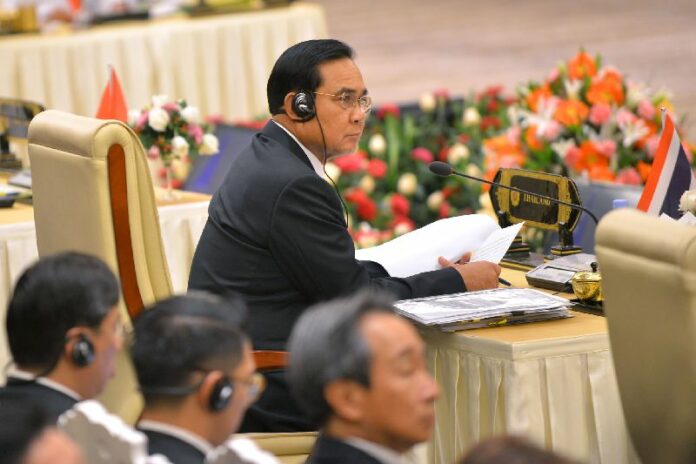
Gen. Prayuth Chan-ocha, chairman of the Thai military junta and Prime Minister, attending the ASEAN summit in Myanmar, 13 November 2014

BANGKOK – Thailand's military leader has asked the secretary general of United Nations to "understand" that dire circumstances drove him to stage a coup against the elected government six months ago.

Gen. Prayuth Chan-ocha, chairman of Thailand's military junta and Prime Minister, told UN sec-gen Ban Ki Moon at an international summit in Naypyidaw, Myanmar, today that the coup was necessary to ensure the safety of Thai people, state media reported.

Gen. Prayuth has been in the Burmese capital city since yesterday to attend a summit of the Association of Southeast Asian Nations (ASEAN).

According to state media, Gen. Prayuth told Ban that he was forced to step in and topple the former government when it became clear that the violent political protests, which had been paralysing Thailand for six months, were about to spiral out of control. 

"There was a domestic dispute that involved the use of military-grade weapons, and there was a real likelihood that the violence would escalate," Gen. Prayuth was quoted as saying. "So it was necessary to step in and take control of the situation."

Gen. Prayuth unilaterally declared martial law over the entire nation on 20 May, and staged the coup against the government two days later. 

He also reportedly told the UN secretary general that the next year of national reforms is needed to develop "sustainable democracy" in Thailand. Gen. Prayuth added that Thailand is still upholding all of the international treaties it has signed.

Gen. Prayuth has offered a similar explanation for the 22 May coup in various public speeches given over the past six months. Portraying himself as a selfless general forced to save the nation from imminent crisis, Gen. Prayuth once went as far as complaining that he got in a fight with his wife because of his new unrewarding role. 

However, critics of the coup accuse Gen. Prayuth of collaborating with the anti-government protesters and only stepping in when they failed to topple the former administration through their street campaign.


For comments, or corrections to this article please contact: [email protected]

You can also find Khaosod English on Twitter and Facebook
http://twitter.com/KhaosodEnglish
http://www.facebook.com/KhaosodEnglish

Advertisement

Armed Soldiers Arrest Gamblers in Rice Field

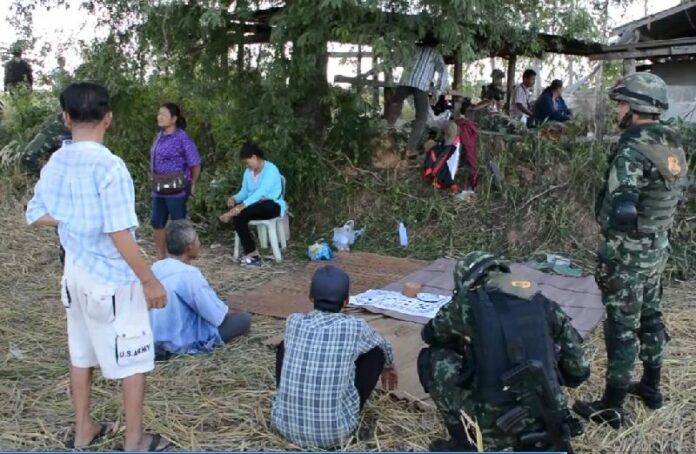
Heavily armed soldiers broke up a group of women and men who were caught gambling in the middle of a rice field in the northeastern Amnart Charoen province, 13 Nov 2014.

AMNAT CHAROEN — At least five heavily armed soldiers broke up a group of women and men who were caught gambling in the middle of a rice field in the northeastern province of Amnart Charoen today.

A total of 11 suspects were arrested after the soldiers, armed with automatic rifles and body armour, surrounded them with military vehicles at around 9 am this morning. Some of the players attempted to run away and hide in the rice field, but were swiftly apprehended by soldiers. 

\

The soldiers also confiscated the group’s board game set and betting money. 

The raid was conducted by a local military unit stationed in the province by Thailand’s military junta, which seized power in May. 

Cpt. Komwacharin Korthong, the officer in charge of the raid, said a number of farmers in the area had complained to soldiers that the gamblers were disrupting their harvests by playing “high low,” a popular Thai gambling game, in the rice fields.

"The spot was far from the eyes of anyone, so the gamblers didn’t have any fear of the law," Cpt. Komwacharin told reporters. 

Gambling of all kinds is illegal in Thailand, except for the state-run lottery and horse racing, though many Thais routinely gamble in private. 

Since the military junta seized power on 22 May, soldiers have been deployed across Thailand to take up a variety of law enforcement duties. They have arrested suspected drug dealers, extortionist beach vendors, and other criminals as part of the junta’s effort to promote a "tough-on-crime" image. 


For comments, or corrections to this article please contact: [email protected]

You can also find Khaosod English on Twitter and Facebook
http://twitter.com/KhaosodEnglish
http://www.facebook.com/KhaosodEnglish
Advertisement

Myanmar Defends Reforms Ahead of Obama Talks

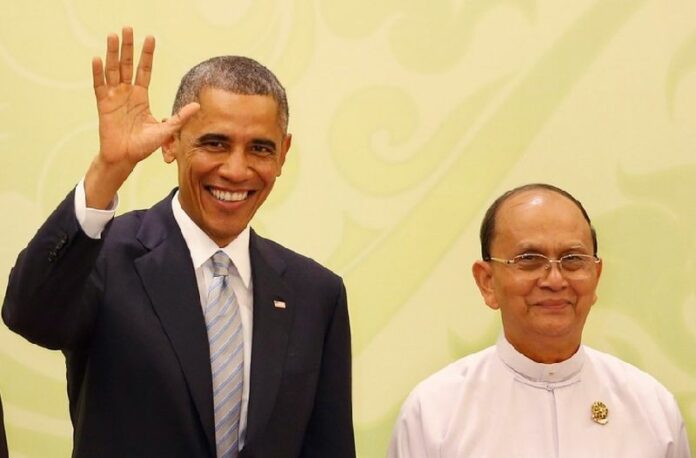
US President Barack Obama waves next to Myanmar President Thein Sein during the 2nd ASEAN-United States Summit, part of the 25th Association of South East Asian Nations (ASEAN) and Related Summits in Naypyitaw, Myanmar, 13 November 2014. Myanmar defended its progress on political reforms and its treatment of minorities ahead of summit talks between Sein and Obama. EPA/BARBARA WALTON

By Cod Satrusayang

NAYPYIDAW (DPA) – Myanmar defended its progress on political reforms and its treatment of minorities Thursday ahead of summit talks between President Thein Sein and his US counterpart Barack Obama.

Speaking ahead of the bilateral meeting, Myanmar's Deputy Foreign Minister U Thant Kyaw said many countries "support our reform process."

"If reforms are slowing down, why would people come to attend our summit? To some groups our reforms are happening too fast," he said.

Myanmar was under military rule between 1962 and 2010, earning it pariah status among Western democracies, but many sanctions on the country were dropped in 2012, after Thein Sein began implementing a series of political and economic reforms.
Obama told Myanmar media earlier that political progress "has not come as fast as many had hoped."

While acknowledging "difficult reforms" undertaken by Myanmar, Obama criticized restrictions on the media and said he was "deeply concerned" about the treatment of the Rohingya ethnic minority.

"We are aware of concerns over minority issues and we are investigating the situation," U Thant Kyaw told reporters.

His comments came as the East Asian Summit concluded in the Myanmar capital Naypyidaw.

The Association of South East Asian Nations and other world leaders – including from China, Japan, South Korea, Australia, India, Russia and New Zealand – concluded the conference with calls for greater economic cooperation and combined efforts in disaster preparations and the combating of disease. 

Chinese Premier Li Keqiang called East Asia "one of the promising regions of the world."

"Strong relations are necessary to realize our shared vision of the Asia-Pacific region," Obama said.

Li noted improvements in relations between the nations involved in the South China Sea territorial disputes adding that all parties had conducted "close and effective dialogue and communications" over the past year.

Progress had been made on the South China Sea issue over the last year, said Philippines presidential spokesman Herminio Coloma, adding that all must "realize that there is an opportunity to move forward."

On the first day of meetings, the 10 member nations of ASEAN called for further economic integration after the implementation of the ASEAN Economic Community at the end of next year.

ASEAN comprises Brunei, Indonesia, Malaysia, the Philippines, Singapore, Thailand, Vietnam, Cambodia, Laos and Myanmar.

Advertisement

Lawmakers Welcome Activist Monk Buddha Issara's Reform Proposal

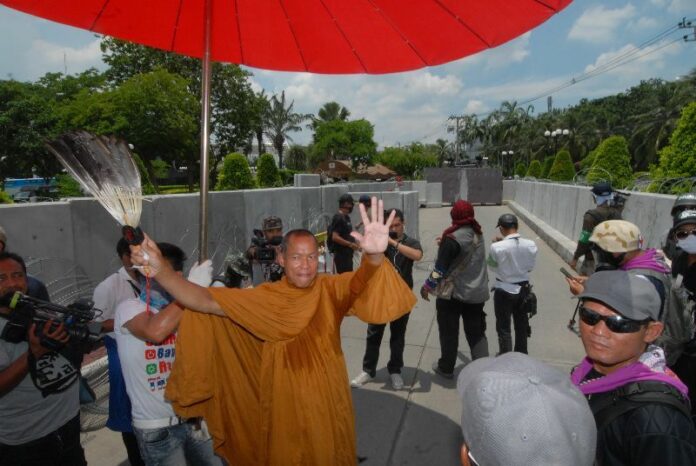
Buddha Issara leads anti-government protesters to storm a police government in Bangkok on 9 May 2014.

BANGKOK – Buddha Issara, the Buddhist monk who helped lead the six-month protest campaign that paved way for the military coup in May, was given a VIP welcome by the presidents of Thailand’s legislative and reform councils today.

The 58-year-old firebrand monk arrived at Parliament this morning to submit a proposal to the National Legislative Assembly (NLA) and National Reform Council (NRC), the two bodies appointed by the military junta to pass laws and implement national reforms over the next year.

Buddha Issara was personally welcomed by NLA President Pornpetch Wichitcholchai and NRC Chairman Thianchay Kiranandana, despite the fact that he faces multiple charges related to his role in the sporadically violent protests against the former government earlier this year.

After handing his petition to Pornpetch, Buddha Issara said he would like lawmakers to establish an agency to "monitor and curb the behavior and ethics of all politicians," and amend criminal laws to remove statutes of limitations for corruption charges.

"Every ordinary citizen should be able to file a corruption charge. It shouldn't only be the duty of state agencies," Buddha Issara told reporters. "If there are [corruption] complaints against any politicians, they must be suspended from their duties until there is clarity on the matter."

The monk said the petition also proposes legislation that "prevents rich people from stealing the jobs of poor people," and over 90 other suggestions concerning the country's energy industry. 

After receiving the petition, Pornpetch assured Buddha Issara that the NLA and Constitution Drafting Committee (CDC) will carefully consider his proposals.

"As far as I have listened to Luang Phu [elder monk], I think his proposal is very beneficial to the administration and economy of our nation," Pornpetch said. 

Speaking to reporters, Buddha Issara urged all political parties to contribute to the drafting of the new constitution.

"All sides should cooperate in drafting of the new charter, so they won't talk about how the new constitution will be a poisonous fruit from a poisonous tree," the monk said. "If anyone doesn't cooperate or refuses to join the process, it means they intend to prolong problems in the country. They want to cause unrest in the country. They are disgusting."

Buddha Issara was one of the most visible leaders of the protest group, named the People's Committee for Absolute Democracy With the King As Head of State (PCAD), which sought to topple the former government between December 2013 and May 2014. 

Considered the leader of the PCAD’s "hardcore" faction, Buddha Issara oversaw the storming of government buildings, blocking of major roads, and armed clashes between PCAD militants and pro-government protesters. The monk also led his supporters to besiege various voting stations during the 2 February election in an attempt to block the poll, which the ruling party was expected to win.

Police charged the monk with insurrection and disruption of national election for his role in the protests, but no arrest was ever made. 

The PCAD campaign came to an end in May 2014 when the military unilaterally declared martial law and staged a coup against the former government. Although the coup-makers insist they are not allied to any of Thailand's political factions, the junta has carried out the PCAD's key demand of postponing elections to implement national reforms.

Buddha Issara has praised the military for their intervention, and today defended the retention of martial law seven months after the coup.

"Some political parties want the military to repeal martial law because they see it as obstacle to expressing opinions," Buddha Issara said. "But in my opinion, you can express your opinion under martial law anyway. There's no problem at all."


For comments, or corrections to this article please contact: [email protected]

You can also find Khaosod English on Twitter and Facebook
http://twitter.com/KhaosodEnglish
http://www.facebook.com/KhaosodEnglish

Advertisement

Hot News

LATEST NEWS

Bangkok
overcast clouds
33.8 ° C
34.4 °
32.2 °
65 %
3.4kmh
100 %
Sat
34 °
Sun
36 °
Mon
37 °
Tue
36 °
Wed
36 °