26.1 C
Bangkok
Saturday, June 20, 2026
Home Blog Page 3139

Destiny of New Constitution Written In The Stars, Drafter Says

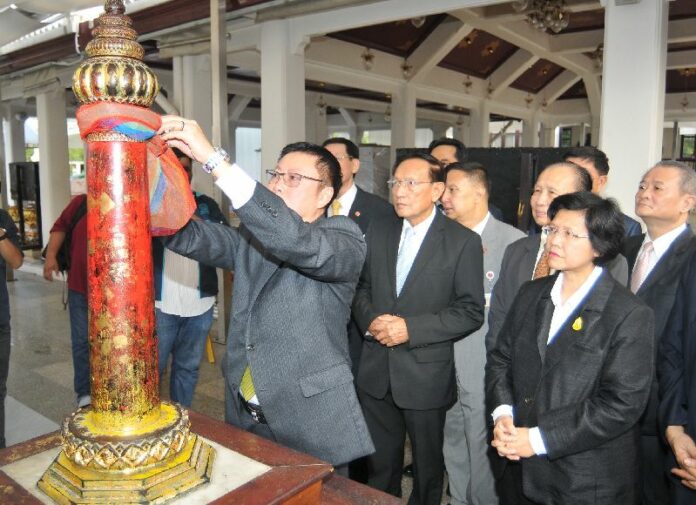
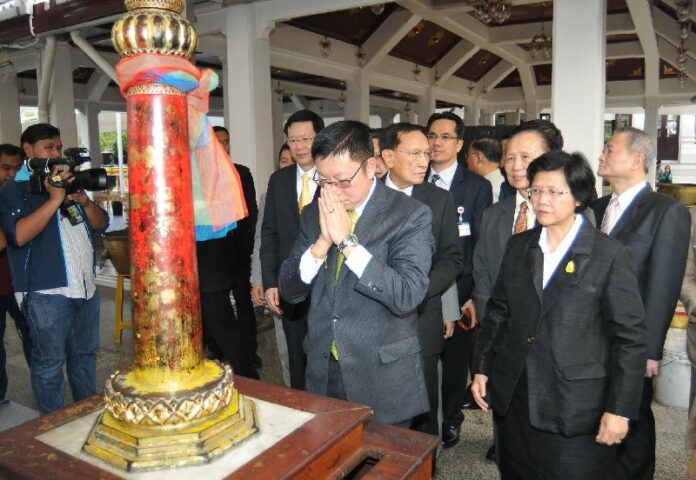
Bowornsak Uwanno at Bangkok's city pillar on the day he was chosen as chairman of the Constitution Drafting Committee, 5 November 2014.

BANGKOK — According to the chairman of Thailand's Constitution Drafting Committee (CDC), the success of the country's new charter has been portended in the stars.

Bowornsak Uwanno, the Chulalongkorn academic who now heads the CDC, said the good fortunes of the charter committee and the National Reform Council (NRC) have been secured by the auspicious dates of the two groups’ formations: 21 October and 4 November. 

"Both dates are extremely auspicious," Bowornsak said during a talk with fellow NRC members on 8 November. "They are Days of Great Luck … on those days, Jupiter, who represents justice, wisdom, and purity, resides in the Cancer zodiac. It portends a great fortune."

Under the 2014 interim constitution, which was drafted by the military junta that seized power on 22 May 2014, the CDC will work closely with the NRC to produce a new "permanent" charter for Thailand – the country's 19th – before a new national election can take place. 

The final draft will need to be approved by the military junta, but Bowornsak said astrological evidence suggests the process will run smoothly.

"The new constitution will be of fairness and wisdom, because Rahu, the astrological entity that represents avarice, will refrain from its violent mood," Bowornsak explained. "Mars is also moving to reside in the Sagittarius. The signs say that all NRC and CDC members will work hard and have courage. It also means that the military will back this constitution."

The CDC chairman added that there will be no major resistance to the new charter because "Saturn, the lord of suffering and protests, is in Scorpio, which dulls its power. It will not have any negative impact on the constitution."

"I believe this new Constitution will be a great success," he said.

The interim government has not yet decided whether the new charter will be subject to a referendum vote. 

Many high-ranking officials in Thailand are deeply superstitious. Most recent Prime Ministers, including current PM and chairman of the military junta Gen. Prayuth Chan-ocha, are believed to consult personal astrologers on matters related to politics. 


For comments, or corrections to this article please contact: [email protected]

You can also find Khaosod English on Twitter and Facebook
http://twitter.com/KhaosodEnglish
http://www.facebook.com/KhaosodEnglish

Advertisement

Destiny of New Constitution Written In The Stars, Drafter Says

Bowornsak Uwanno praying to Bangkok's city pillar on the day he was chosen as chairman of the Constitution Drafting Committee, 5 November 2014.

BANGKOK — According to the chairman of Thailand's Constitution Drafting Committee (CDC), the success of the country's new charter has been portended in the stars.

Bowornsak Uwanno, the Chulalongkorn academic who now heads the CDC, said the good fortunes of the charter committee and the National Reform Council (NRC) have been secured by the auspicious dates of the two groups’ formations: 21 October and 4 November. 

"Both dates are extremely auspicious," Bowornsak said during a talk with fellow NRC members on 8 November. "They are Days of Great Luck … on those days, Jupiter, who represents justice, wisdom, and purity, resides in the Cancer zodiac. It portends a great fortune."

Under the 2014 interim constitution, which was drafted by the military junta that seized power on 22 May 2014, the CDC will work closely with the NRC to produce a new "permanent" charter for Thailand – the country's 19th – before a new national election can take place. 

The final draft will need to be approved by the military junta, but Bowornsak said astrological evidence suggests the process will run smoothly.

"The new constitution will be of fairness and wisdom, because Rahu, the astrological entity that represents avarice, will refrain from its violent mood," Bowornsak explained. "Mars is also moving to reside in the Sagittarius. The signs say that all NRC and CDC members will work hard and have courage. It also means that the military will back this constitution."

The CDC chairman added that there will be no major resistance to the new charter because "Saturn, the lord of suffering and protests, is in Scorpio, which dulls its power. It will not have any negative impact on the constitution."

"I believe this new Constitution will be a great success," he said.

The interim government has not yet decided whether the new charter will be subject to a referendum vote. 

Many high-ranking officials in Thailand are deeply superstitious. Most recent Prime Ministers, including current PM and chairman of the military junta Gen. Prayuth Chan-ocha, are believed to consult personal astrologers on matters related to politics. 

 
For comments, or corrections to this article please contact: [email protected]

You can also find Khaosod English on Twitter and Facebook
http://twitter.com/KhaosodEnglish
http://www.facebook.com/KhaosodEnglish


Advertisement

Academics Suggest Reviving Absolute Monarchy's Supreme Council

Panitan Wattanayagorn speaking at a panel co-hosted by the conservative think-tank King Prajadhipok Institute and the National Reform Council (NRC) on 8 Nov 2014 [Photo: Voice TV]

BANGKOK — Several prominent academics have proposed reviving the Supreme Council of the State, a decision-making body that superseded all three branches of government during Thailand’s last days as an absolute monarchy.

Chulalongkorn University political scientist Panitan Wattanayagorn suggested at a panel discussion on Saturday that including a Supreme Council in the new Constitution could help secure a “balance of power” between different branches of government. 

"We’ve proposed the formation of the Supreme Council of the State to serve as another balance of power, apart from the administrative, legislative, and judicial branches," said Panitarn, who served as an adviser to the administration of Abhisit Vejjajiva during the crackdown on Redshirt protesters in 2010.

"It will be the fourth balance of power," he said. "Under this system, the Supreme Council will wield the biggest power as a sovereign governing body.” 

The panel was co-hosted by the conservative think-tank King Prajadhipok Institute and the National Reform Council (NRC), which was appointed by the junta to propose a reforms across a wide range of sectors in Thailand over the next year. 

However, the sec-gen of the Prajadhipok Institute and chairman of the Constitution Drafting Committee (CDC), Bowornsak Uwanno, quickly clarified that no groups involved with the junta's reform process have formally endorsed the idea of a Supreme Council.

"Some media may say in their headlines that the Prajadhipok Institute proposed the establishment of a Supreme Council to control the Cabinet, the Parliament, and the court," said Bowornsak. "That is not true. It's only a suggestion by Surapol.”

He was referring to Surapol Sriwitthaya, a lecturer at Rangsit University who is credited for spearheading the proposal at the Prajadhipok Institute.

'Legacy' of Absolute Monarchy

In an interview with Matichon on Saturday, Surapol cited "Chinese" political philosophy as the inspiration for his proposal. 

"If you look at the Chinese Constitution that [Chinese republican revolutionary] Sun Yat-Sen helped lay foundation to, you will see that it does not separate the sovereign powers into three branches in the way Montesquieu describes," Surapol said.

According to Surapol, Thailand should emulate the Chinese tradition of establishing a strong central authority with technocrats wielding significant power in the administration of the country. He also noted that the Supreme Council was once put into practice in Thailand by King Prajadhipok in late 1920s. 

"A supreme governing council is an old legacy of King Rama VII. We should apply the idea as the central authority of all independent agencies," Surapol said.

King Prajadhipok, more commonly known as King Rama VII, formed the Supreme Council in 1925 in an effort to solve various crises besetting the royal government at the time, including a global recession and growing calls for democratic governance.

The council was stacked with top palace princes and accused by critics of failing to impose any real reforms. A group of military officers and civilians later seized power on 24 June 1932 and paved the way for parliamentary democracy in Thailand, abolishing the Supreme Council in the process.

Despite its historical shortcomings, Surapol said the council could be an effective answer to recent attempts to install a truly "independent agency" in Thailand that counters the influence of elected politicians. 

"The 1997 and 2007 Constitutions had already established some independent agencies to serve as checks and balances," Surapol told Matichon. "But if we do not have a political institute that only answers to such independent agencies, we won't have a strong system of checks and balances."

Supreme authority

According to Surapol, the Supreme Council would consist of 23 members selected from the legislative, administrative, and judicial branches, such as Prime Minister, an opposition leader, speakers from the lower and upper houses, judges, and 22 "local representatives" from across the country.

The Supreme Council would be responsible for overseeing the recruitment and transfer of bureaucrats "to prevent interference from political factions," Surapol said. 

He added that the council would also assume a "semi-judicial" role, especially in cases of impeaching political office holders.

According to Surapol's vision, the National Anti-Corruption Commission (NACC) and Parliament would be able to petition the Supreme Council to impeach politicians, and the Council, not the courts, would retain the final say.

Although political activists across the spectrum in Thailand agree that checks and balances are a healthy facet of a democracy, supporters of the Redshirt movement have accused the country’s "independent agencies," like the NACC and Constitutional Court, of harbouring a bias against the elected governments they support.

Their suspicion has been reinforced by the NACC and judiciary's prolific record of ruling against politicians allied to former Prime Minister Thaksin Shinawatra, the de facto leader of the Redshirts. 

However, Alongkorn Ponlaboot, former Democrat MP and a member of the National Reform Council, stressed yesterday that the idea of the Supreme Council is merely one of many ideas submitted to the body. 

"The NRC has not formally considered the proposal by Prajadhipok Institute," Alongkorn told reporters. "But it's a good sign that every side is proposing their opinion about reforms of our nation."


 
For comments, or corrections to this article please contact: [email protected]

You can also find Khaosod English on Twitter and Facebook
http://twitter.com/KhaosodEnglish
http://www.facebook.com/KhaosodEnglish


Advertisement

Military Detains Academic, Land Rights Activists in Chiang Mai After Attempted Rally

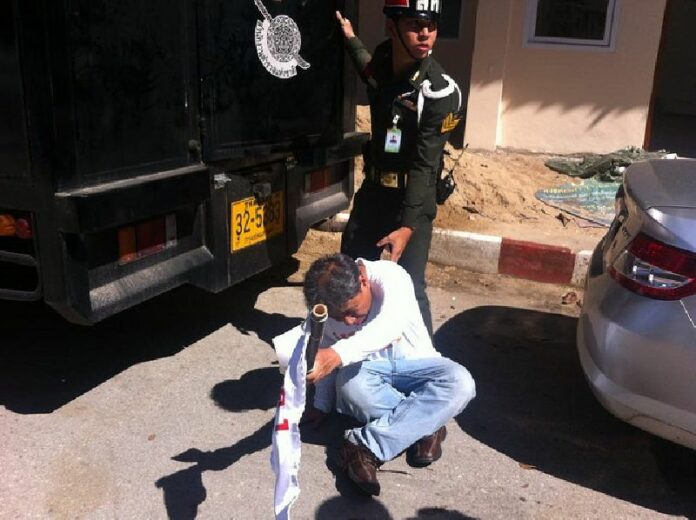
Military police detain Prapart Pintobtang and put him in a prison vehicle [Prachatai English]

(Prachatai English)

BANGKOK – The military on Sunday detained four people, including Prapart Pintobtang, a political scientist from Chulalongkorn University, Bangkok, who organized a walking rally against the junta’s policy to reclaim protected areas, which has heavily affected the poor.
 
After they started the rally by walking about 50 metres from Suan Dok temple in central Chiang Mai, the military detained the four in a military prison vehicle. The military decided to release the four about 30 minutes later and promised that the Minister of Natural Resources and Environment will meet with them to discuss the problem. 

Read more here.

Note: Khaosod English is not responsible for content on other websites.

Advertisement

Myanmar Rejects Bangladesh Request to Restart Rohingya Repatriation

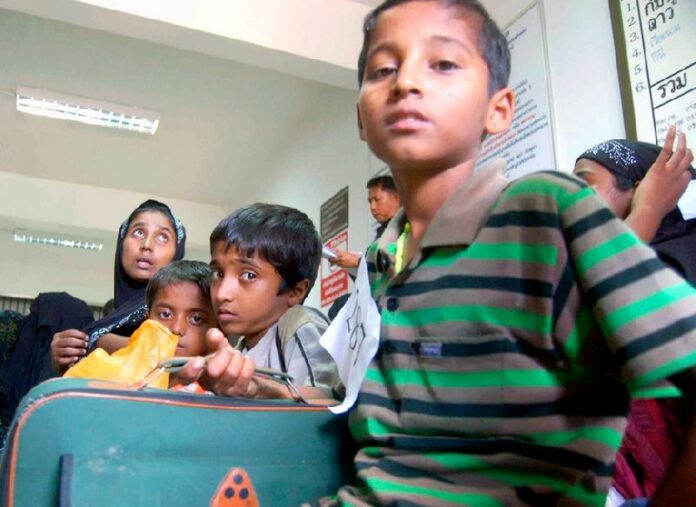
Ethnic Rohingya refugees from Myanmar, including children, wait for registration after being rescued in southern Thailand, 11 January 2013. Myanmar has rejected a request from Bangladesh to immediately begin accepting back Muslim refugees living in camps across the border. EPA/THORANIT PIRUNLA-ONG

YANGON (DPA) – Myanmar has rejected a request from Bangladesh to immediately begin accepting back Muslim refugees living in camps across the border, an official said Monday.

"President Thein Sein said that Myanmar stands ready to receive the refugees from Bangladesh by our four rules," presidential spokesman Ye Htut said on Facebook, referring to rules for citizenship that include proof that both parents were Myanmar citizens.

Bangladesh is trying to restart a repatriation process that stalled in 2005 to return Rohingya Muslims who have fled Myanmar during the past two decades.

But the Myanmar government and the mostly Buddhist ethnic community of the western frontier state of Rakhine reject the Muslim group's claim to citizenship, and refer to them as "Bengalis."

Thein Sein and Bangladesh President Abdul Hamid met in Beijing on Sunday ahead of an Asia-Pacific Economic Cooperation meeting.

"He [Thein Sein] said that it's impossible to receive them back urgently," Ye Htut said.

Rohingya do not qualify for full Myanmar citizenship by birth as their ethnic identity is not recognized under the country's 1982 citizenship law.

Myanmar has agreed to receive more than 2,000 refugees from Bangladesh whose claims have been verified, although the government has disputed Bangladeshi announcements calling the refugees Rohingya.

There are more than 200,000 Rohingya refugees in Bangladesh, including about 30,000 who are documented and staying in two official camps in Cox's Bazar, according to the UN Refugee Agency and the Refugee Relief and Rehabilitation Commission in Bangladesh.


Advertisement

Myanmar Rejects Bangladesh Request to Restart Rohingya Repatriation

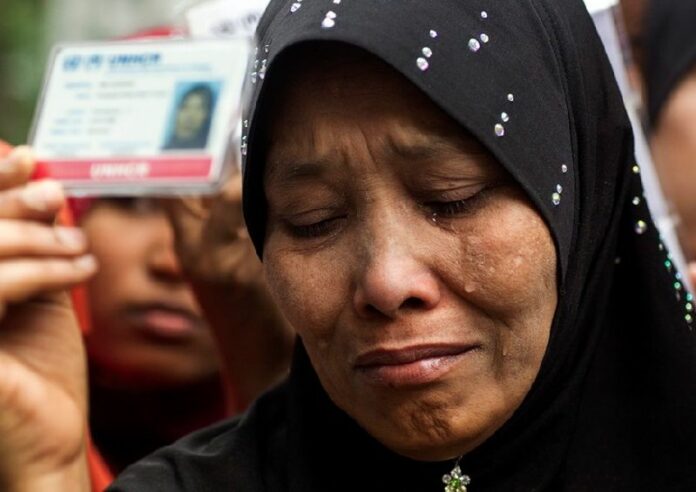
An ethnic Myanmar Rohingya refugee in Malaysia reacts while showing her UNHCR refugee ID card during a demonstration in front of the United Nations office in Kuala Lumpur, Malaysia, 16 July 2014. Myanmar has rejected a request from Bangladesh to immediately begin accepting back Muslim refugees living in camps across the border. [DPA]

YANGON (DPA) – Myanmar has rejected a request from Bangladesh to immediately begin accepting back Muslim refugees living in camps across the border, an official said Monday.

"President Thein Sein said that Myanmar stands ready to receive the refugees from Bangladesh by our four rules," presidential spokesman Ye Htut said on Facebook, referring to rules for citizenship that include proof that both parents were Myanmar citizens.

Bangladesh is trying to restart a repatriation process that stalled in 2005 to return Rohingya Muslims who have fled Myanmar during the past two decades.

But the Myanmar government and the mostly Buddhist ethnic community of the western frontier state of Rakhine reject the Muslim group's claim to citizenship, and refer to them as "Bengalis."

Thein Sein and Bangladesh President Abdul Hamid met in Beijing on Sunday ahead of an Asia-Pacific Economic Cooperation meeting.

"He [Thein Sein] said that it's impossible to receive them back urgently," Ye Htut said.

Rohingya do not qualify for full Myanmar citizenship by birth as their ethnic identity is not recognized under the country's 1982 citizenship law.

Myanmar has agreed to receive more than 2,000 refugees from Bangladesh whose claims have been verified, although the government has disputed Bangladeshi announcements calling the refugees Rohingya.

There are more than 200,000 Rohingya refugees in Bangladesh, including about 30,000 who are documented and staying in two official camps in Cox's Bazar, according to the UN Refugee Agency and the Refugee Relief and Rehabilitation Commission in Bangladesh.


Advertisement

World Leaders in Beijing As APEC Regional Summit Set to Begin

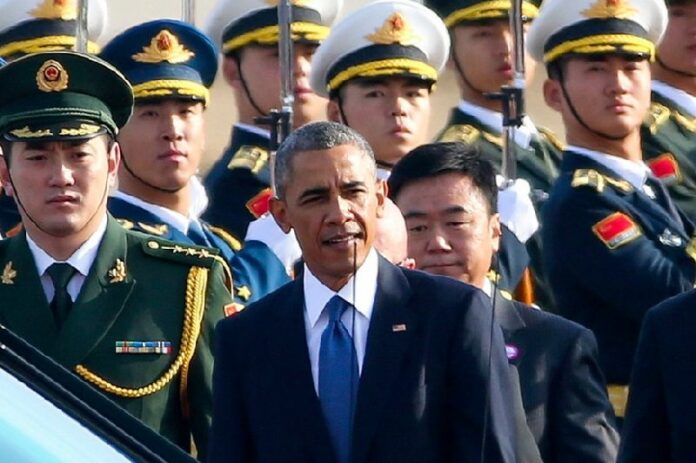
US President Barack Obama arrives at Beijing Capital Airport in Beijing, China, 10 November 2014. Obama is in China to attend the Asia-Pacific Economic Cooperation (APEC) 2014 Summit and related meetings running from 05 to 11 November. EPA/DIEGO AZUBEL

By Marco Mierke and Joanna Chiu

BEIJING (DPA) – US President Barack Obama landed in Beijing early Monday ahead of a summit of Asian-Pacific regional leaders in the Chinese capital.

He joins Russian President Vladimir Putin, Japanese Prime Minister Shinzo Abe and Australian Premier Tony Abbott – who arrived over the weekend – and other political leaders at the Asia-Pacific Economic Cooperation (APEC) summit meeting on Monday and Tuesday.

Obama was due to hold talks with Abbott and new Indonesian President Joko Widodo on the sidelines of the summit. He is also expected to hold bilateral meetings with Chinese President Xi Jinpin on Wednesday.

One of the key topics during the regional forum will be trade, where the United States and China are expected to push for progress on competing agreements.

During minister-level meetings on Saturday, members of APEC agreed to move forward on the Beijing-backed Free Trade Area of the Asia Pacific (FTAAP) deal for Pacific countries. 

For their part, US negotiators have reportedly agreed to tone down their plan for discussions on the Trans-Pacific Partnership (TPP) at the APEC summit, and say any such talks will now be kept low-key, the South China Morning Post said.

On Monday, China and South Korea announced that they had "virtually" reached a free trade deal during a meeting between their leaders, a South Korean official said, according to Yonhap News Agency.

APEC is an inter-governmental forum with 21 member countries and regions, that seeks to promote sustainable growth and economic integration, and reduce trade barriers across the Asia-Pacific region.

A welcome dinner for the APEC leaders was to be held on Monday evening.


Advertisement

Venezuelan Crowned At Pattaya's Transgender Beauty Pageant

Venezuelan national Isabella Santiago (centre) was chosen out of 21 contestants from 18 countries, including Thailand, to be Miss International Queen 2014.

CHONBURI — A Venezuelan national was crowned winner of Pattaya's annual Miss International Queen, the largest beauty contest for transgender women in the world.

Isabella Santiago, 22, was chosen out of 21 contestants from 18 countries, including Thailand, to be Miss International Queen 2014. Organisers say the beauty contest, held for the tenth time this year, is meant to promote acceptance of transgender people around the world. 

Apart from the pageant crown, Ms. Santiago also won a prize in the "Best Dress" category. Her prizes come with cash rewards totaling 440,000 baht. 

Thai national Nitsa Ketrahong, a student from Bangkok's Rajamangala University of Technology, was the first runner-up, while Piyada Inthavong, from Laos, came in third. 

The pageant was held at the Tiffany Show theatre in Pattaya, which regularly hosts shows featuring transgender performers. The contest is known for launching Treechada "Poy" Petcharat, one of Thailand's most well-known transgender women, into fame after she was crowned a winner in 2004.

Thailand is known for its relatively relaxed attitude toward LGBTs compared to more conservative nations in the region like Malaysia and Myanmar, though gay marriage remains unrecognised by law. Human rights activists also note that many LGBTs still suffer from routine discrimination in Thailand.

Among the panel of judges who sat at the Miss International Queen pageant this year was Seri Wongmontha, a conservative transgender writer and TV host who campaigned against former Prime Minister Yingluck Shinawatra during the anti-government protests that started in December 2013 to and lasted until the coup on 22 May of this year. 

Earlier this week, Seri lashed out at a lesbian couple who was filmed kissing on Bangkok's public skytrain, calling their behavior incompatible with Thai tradition. The video went viral and spurred a heated debate about discrimination and whether public displays of affection should be tolerated in public.

"It is highly inappropriate. We are Thais, we have noble customs and traditions," Seri said in an interview with Daily News on 4 November. "A man and woman doing it is already inappropriate. When lesbians do it, it's even worse, in my opinion." 

Seri added, "I would like to warn all Thai youth in the present time to think about what is appropriate and suitable before they do anything. They cannot claim that it's about individual rights."


For comments, or corrections to this article please contact: [email protected]

You can also find Khaosod English on Twitter and Facebook
http://twitter.com/KhaosodEnglish
http://www.facebook.com/KhaosodEnglish

Advertisement

Venezuelan Crowned At Pattaya's Transgender Beauty Pageant

Venezuelan national Isabella Santiago (centre) was chosen out of 21 contestants from 18 countries, including Thailand, to be Miss International Queen 2014.

CHONBURI — A Venezuelan national was crowned winner of Pattaya's annual Miss International Queen, the largest beauty contest for transgender women in the world.

Isabella Santiago, 22, was chosen out of 21 contestants from 18 countries, including Thailand, to be Miss International Queen 2014. Organisers say the beauty contest, held for the tenth time this year, is meant to promote acceptance of transgender people around the world. 

Apart from the pageant crown, Ms. Santiago also won a prize in the "Best Dress" category. Her prizes come with cash rewards totaling 440,000 baht. 

Thai national Nitsa Ketrahong, a student from Bangkok's Rajamangala University of Technology, was the first runner-up, while Piyada Inthavong, from Laos, came in third. 

The pageant was held at the Tiffany Show theatre in Pattaya, which regularly hosts shows featuring transgender performers. The contest is known for launching Treechada "Poy" Petcharat, one of Thailand's most well-known transgender women, into fame after she was crowned a winner in 2004.

Thailand is known for its relatively relaxed attitude toward LGBTs compared to more conservative nations in the region like Malaysia and Myanmar, though gay marriage remains unrecognised by law. Human rights activists also note that many LGBTs still suffer from routine discrimination in Thailand.

Among the panel of judges who sat at the Miss International Queen pageant this year was Seri Wongmontha, a conservative transgender writer and TV host who campaigned against former Prime Minister Yingluck Shinawatra during the anti-government protests that started in December 2013 to and lasted until the coup on 22 May of this year. 

Earlier this week, Seri lashed out at a lesbian couple who was filmed kissing on Bangkok's public skytrain, calling their behavior incompatible with Thai tradition. The video went viral and spurred a heated debate about discrimination and whether public displays of affection should be tolerated in public.

"It is highly inappropriate. We are Thais, we have noble customs and traditions," Seri said in an interview with Daily News on 4 November. "A man and woman doing it is already inappropriate. When lesbians do it, it's even worse, in my opinion." 

Seri added, "I would like to warn all Thai youth in the present time to think about what is appropriate and suitable before they do anything. They cannot claim that it's about individual rights."


For comments, or corrections to this article please contact: [email protected]

You can also find Khaosod English on Twitter and Facebook
http://twitter.com/KhaosodEnglish
http://www.facebook.com/KhaosodEnglish

Advertisement

Junta 'Will Not Tolerate' Impeachment Protests

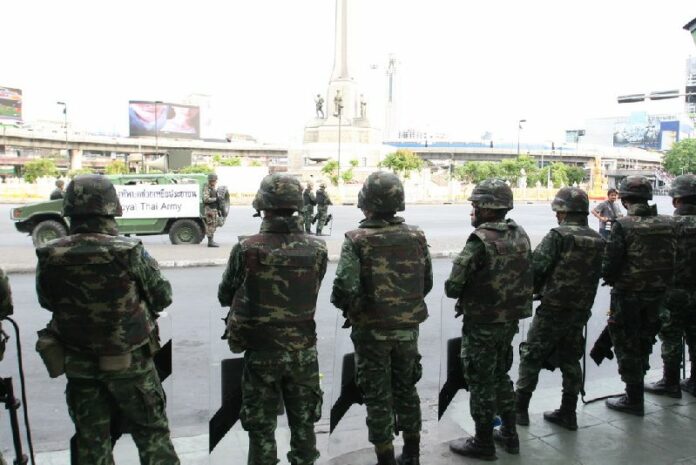
Soldiers block an anti-coup protest at Victory Monument in Bangkok on 30 May 2014.

BANGKOK – Thailand’s military junta has stressed that it will not allow any political protests over the possible impeachment of former politicians allied to the deposed government.

Thaworn Senniam, a leader of the Yellowshirt movement that staged street protests against the previous government, previously hinted of organising new round of protests if the National Legislative Assembly (NLA) fails to impeach Somsak Kiatsuranond and Nikom Waiyaratchapanich, who served Parliament and Senate Speakers in 2013, respectively.

Responding to Thaworn's threat, former Pheu Thai MP Worachai Hema also vowed to mobilise supporters of his party, known as the Redshirts, if the NLA does impeach Somsak and Nikom for their effort last year to amend the 2007 constitution to make it more democratic.

But Gen. Anupong Paochinda, Minister of Interior Affairs and a member of the military junta, said yesterday that all political camps must refrain from staging protests for the sake of the peace and order. 

According to Gen. Anupong, Prime Minister and junta leader Prayuth Chan-ocha "will not tolerate" any street protests.
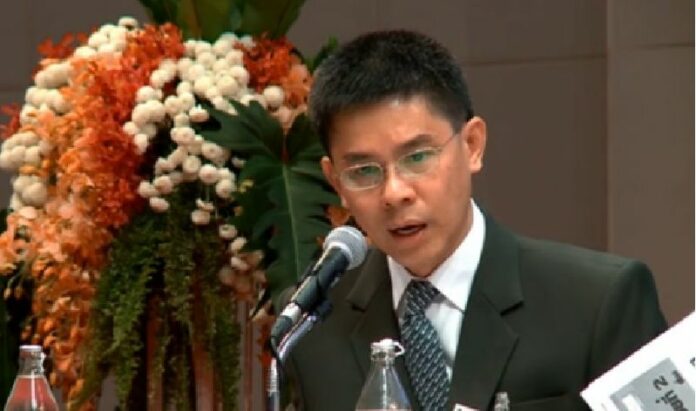
"You can have different opinions. The government will not interfere with that," Gen. Anupong told reporters. "But if you bring people onto the streets and cause a dispute, we won't have any of that."

Gen. Prayuth, who in addition to PM is the chairman of junta's National Council for Peace and Order (NCPO), previously warned that in the event of street protests, the NCPO may invoke Section 44 of the 2014 Interim Constitution, which permits it to intervene in matters related to "national security.”

However, Gen. Udomdet Sitabutr, commander-in-chief of the Royal Thai Army, insisted that Gen. Prayuth would prefer to solve the conflict by "creating understanding.”

"The Prime Minister is not considering to use Section 44 to control the situation," Gen. Udomdet explained. "The Prime Minister merely brought it up to remind everyone that the NCPO still has the power to proceed with it. But he will not use it immediately. He has stressed that we have to create understanding with dissenters."

The army chief added that security officers have already contacted Worachai and Thaworn to "try to reach understanding with them."

"Political discussion should not lead to disputes or instigate the people to do inappropriate things," Gen. Udomdet said. "I want all of the political groups to express their opinions to the National Reform Council [instead of protesting]."

Somsak and Nikom are facing impeachment for facilitating the Pheu Thai party’s  attempt to amend the 2007 Constitution in April 2013 to make the Senate fully-elected, as opposed to half-appointed and half-elected.

The Constitutional Court blocked the amendment in November and declared it unconstitutional. Thailand’s National Anti-Corruption Commission (NACC) then urged the Senate to impeach Somsak and Nikom and bar them from politics for their roles in the amendment attempt. 

The impeachment case has been passed along to the NLA, which was formed after the coup and whose members were handpicked by the junta. On 6 November a majority of the NLA members voted to deliberate on the impeachment. Talks are set to officially begin on 27 November. 

If found guilty of abuse of power as charged by the NACC, Somsak and Nikom could be banned from holding political office for the next five years.


For comments, or corrections to this article please contact: [email protected]

You can also find Khaosod English on Twitter and Facebook
http://twitter.com/KhaosodEnglish
http://www.facebook.com/KhaosodEnglish

Advertisement

Hot News

LATEST NEWS

Bangkok
overcast clouds
26.1 ° C
26.1 °
26.1 °
93 %
1.8kmh
100 %
Sat
33 °
Sun
35 °
Mon
37 °
Tue
37 °
Wed
36 °