


























31.6 C
Bangkok
Tuesday, June 9, 2026
Home Blog Page 3153

UK to Tackle Deforestation in Developing Countries

Picture: Abbie Trayler-Smith/DFID/Panos

Note: This is a press release. Its contents are not produced by Khaosod English.

Britain will promote new links with businesses to manage scarce natural resources and stop deforestation in the developing world, International Development Secretary Justine Greening announced today

The Department for International Development will establish new partnerships between businesses and farmers in developing countries to create multinational supply chains free from unsustainable deforestation.

The UK will also support a major new drive across Europe to stamp out the demand for wood sourced from illegal logging.

Speaking at the Forest and Climate Challenge conference at the United Nations General Assembly in New York, Ms Greening will warn that climate change is one of the most urgent and pressing challenges to global poverty reduction.


Announcing the new UK support, Justine Greening said:

Climate change has the potential to halt or undo the progress we have made in the last two decades. Without action the world will get hungrier, poorer and more dangerous in the years to come. There is no point in building a health clinic for poor people in Bangladesh if it will get washed away by the next floods.

Investing in the better management of natural resources and putting a stop to deforestation is the smart thing to do. British businesses are already leading the way in setting up long-term sustainable supply chains.

Our assistance will help companies, communities, smallholders and governments work together to reduce deforestation and increase crop yields.

Deforestation is the second largest source of greenhouse gas emissions and affects the lives of more than one billion people who depend on forests for food, fuel and a living. It also makes these communities more vulnerable to natural disasters.


The new British support announced today consists of:

  • £60 million for a new programme to encourage businesses to join the fight against deforestation. The Investments in Forests and Sustainable Land Use initiative will form a number of innovative public-private partnerships with communities, local farmers and local and international businesses including UK companies, to manage forests sustainably and support and encourage agriculture that does not cause further deforestation.
  • an additional £84 million available for the successful Forest Governance, Markets and Climate programme, as a contribution to a global partnership to end illegal logging. The new money will support efforts to close the EU market to illegally-harvested timber, and provide support to developing countries to tackle weak governance that allows illegal practice to flourish.

The new Investments in Forests and Sustainable Land Use initiative will support 10-15 major public-private partnerships and will work with companies that are committed to taking deforestation out of their supply chains, including smallholder farmers, to help them produce palm oil, timber and other agricultural commodities in ways that do not cause deforestation.

Smallholder oil palm farmers, for example, currently receive around half of the yield that they should when compared to professionally run plantations. By supporting investments to improve the productivity of their existing plantations, UK support can help these farmers increase their yields without clearing more forest.

Justine Greening also emphasised the need for the post-2015 development goals agreed in the year ahead to be climate smart and called on the international community to agree ambitious targets for protecting forests and other natural resources.
Advertisement

Britons' Murder: Police Chief Dismisses Koh Tao 'Mafia' Allegation

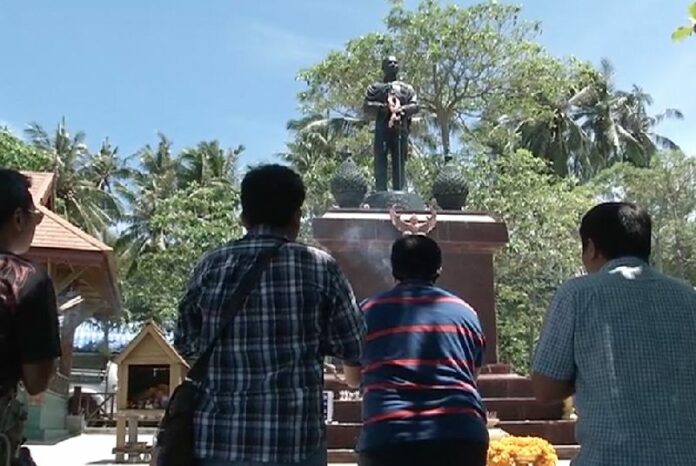
Locals on Koh Tao pray to a statue of Rama V for police to find the culprit behind the gruesome murder of two British Tourists. 21 Sept, 2014.

BANGKOK — Thailand’s new police chief has brushed off media reports that there is "mafia" network on the resort island in Southern Thailand where two British tourists were murdered last week.

David Miller, 24, and Hannah Witheridge, 23, were found beaten to death on Koh Tao on the early morning of 15 September. 

Police have yet to arrest any suspects as none of the DNA samples taken from more than 30 people in the past week have matched the DNA traces found on Witheridge’s body.

According to a number of journalists on the island, locals say they are wary about speaking openly about the case for fear of reprisal from powerful island families that “run the show.”  

But  Pol.Gen. Somyot Pumphanmuang  dismissed the allegations of a mafia network on the island today.

"If there really is a mafia, locals and police detectives would have informed me already," Pol.Gen. Somyot said.

Pol.Gen. Somyot insisted that residents on the island have helpfully cooperated with police in their effort to identify and arrest the culprit. He said the police investigation has seen a lot "progress," though he did not elaborate on the details.

Though Koh Tao is widely considered a peaceful and idyllic island getaway, reports from the UK-based The Telegraph and The Daily Mirror, and Thailand-based Bangkok Post have painted a grimmer picture of the island: a popular tourist destination that is under the grip of “dangerous” families with powerful connections. The reports claim that many residents have chosen to remain silent in the aftermath of the murder, raising speculations that shady mafia may be involved in the killing of Witheridge and Miller. 

Last night, 25-year-old Scottish tourist Sean McAnna, who was a friend of Miller, fled Koh Tao after telling the British Embassy and press that his life was threatened by two Thai "mafia" on the island.

The Scotsman claimed the pair of gangsters cornered him and threatened to hang him to death because of his knowledge about the murder. 

Police say McAnna is currently under police protective custody and assisting with the ongoing investigation. 


For comments, or corrections to this article please contact: [email protected]

You can also find Khaosod English on Twitter and Facebook
http://twitter.com/KhaosodEnglish
http://www.facebook.com/KhaosodEnglish

Advertisement

Professors Hit Back At NCPO's Ban On Academic Freedom

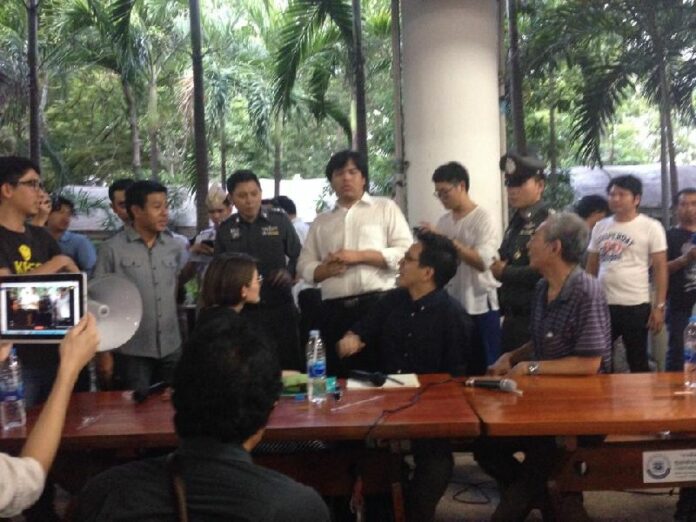
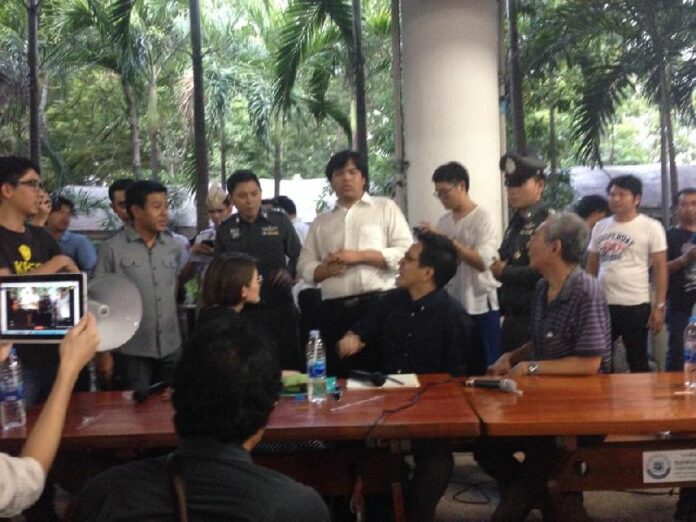
Police break up a talk at Thammasat University on the "Demise of Foreign Dictators" on 18 September [Photo provided by student who attended the event].

BANGKOK — The military junta's insistence that all academic seminars must be approved by authorities has angered a number of Thai lecturers who are denouncing the measure as an encroachment on free speech.

Gen. Prawit Wongsuwan, a member of the junta's National Council for Peace and Order (NCPO) and the Minister of Defense, said yesterday that Thai academics should not "cross the line" by organizing political discussions.

He was responding to a letter signed by 60 academics from 16 universities across Thailand that condemned the arrest of three student activists and four professors at Thammasat University for organising a panel on the "Demise of Foreign Dictators" on 18 September.

Gen. Prawit defended the military's action as "legal" and said academics who wish to hold panel discussions must seek approval from the NCPO first. 

"The NCPO wants to see peace, happiness, and reconciliation," Gen. Prawit said. "Anything related to politics cannot be allowed."

Prach Panchakunathorn, a Chulalongkorn University philosophy lecturer who signed the open letter, lashed out at Gen. Prawit's statement in an interview yesterday.

"Academics never crossed any line. It's the military who crossed the line by arresting lecturers and students inside the premises of the university," Mr. Prach said. "We cannot accept that."

He also insisted that the military has no right to require academics seek permission before organising a public discussion.

"We [wrote the letter] to express our stance, to let the public know that there are academics who don't agree with intimidation by the military and police," Mr. Prach said. "The scale of [the letter's] impact depends on how much importance society and the media will give to this matter."

Hara Shintaro, another signatory of the letter who teaches social science at Prince of Songkhla University, expressed similar disappointment at what he called an "irrational" response by the NCPO.

"In the long term, the NCPO's ban on academic panels will become a disadvantage to the regime," Mr. Shintaro said. "The foreign community will lose their confidence in Thailand even more, because Thai people are not guaranteed the protection of their rights and liberty.

"I have not seen any academic discussion that caused riots, contrary to the fears of the authorities," the lecturer said.

'Shameful' discussion

The NCPO  banned all forms of political activity and public protest after seizing power in late May. Violators have been sent to face trials in military court and five anti-coup protesters have been given suspended jail sentences. 

In addition to scuttling the panel at Thammasat University last week, the military has forced academics at Chiang Mai University to cancel a discussion scheduled for Thursday, titled "Happiness and Reconciliation Under 2014 Interim Charter.”

However, Somchai Preechasilpakul, a law lecturer at Chiang Mai University, told Khaosod yesterday that he is organising another panel to stress that "academic freedom is an important issue."

The upcoming panel will focus on peep, the metal boxes that several lecturers have donned in recent weeks to embody a Thai idiom for feeling shameful. Lecturers at Thammasat and Mahidol University wore the boxes in public to express their “shame” over their university rectors' decisions to join the military junta's national administration.  

"Peep is a good way to remind university academics joining the coupmakers in their effort to run the country that they have no legitimacy," Mr. Somchai said. "They should use the time spent on their dual roles to take responsibility for their educational duties instead."

Just today, activist Waranchai Chokechana arrived at Government House wearing a woven basket – a variation of peep – to submit a letter to NCPO leader and Prime Minister Prayuth Chan-ocha protesting the junta's crackdown on academic freedom. 

"It's a loss of freedom of thought," Mr. Waranchai said.

Related articles:
NCPO Defends Ban On Political Academic Discussions
Military Blocks Academic Panel On Foreign Dictatorships


For comments, or corrections to this article please contact: [email protected]

You can also find Khaosod English on Twitter and Facebook
http://twitter.com/KhaosodEnglish
http://www.facebook.com/KhaosodEnglish

Advertisement

Professors Hit Back At NCPO's Ban On Academic Freedom

Police break up a talk at Thammasat University on the "Demise of Foreign Dictators" on 18 September [Photo provided by student who attended the event].

BANGKOK — The military junta's insistence that all academic seminars must be approved by authorities has angered a number of Thai lecturers who are denouncing the measure as an encroachment on free speech.

Gen. Prawit Wongsuwan, a member of the junta's National Council for Peace and Order (NCPO) and the Minister of Defense, said yesterday that Thai academics should not "cross the line" by organizing political discussions.

He was responding to a letter signed by 60 academics from 16 universities across Thailand that condemned the arrest of three student activists and four professors at Thammasat University for organising a panel on the "Demise of Foreign Dictators" on 18 September.

Gen. Prawit defended the military's action as "legal" and said academics who wish to hold panel discussions must seek approval from the NCPO first. 

"The NCPO wants to see peace, happiness, and reconciliation," Gen. Prawit said. "Anything related to politics cannot be allowed."

Prach Panchakunathorn, a Chulalongkorn University philosophy lecturer who signed the open letter, lashed out at Gen. Prawit's statement in an interview yesterday.

"Academics never crossed any line. It's the military who crossed the line by arresting lecturers and students inside the premises of the university," Mr. Prach said. "We cannot accept that."

He also insisted that the military has no right to require academics seek permission before organising a public discussion.

"We [wrote the letter] to express our stance, to let the public know that there are academics who don't agree with intimidation by the military and police," Mr. Prach said. "The scale of [the letter's] impact depends on how much importance society and the media will give to this matter."

Hara Shintaro, another signatory of the letter who teaches social science at Prince of Songkhla University, expressed similar disappointment at what he called an "irrational" response by the NCPO.

"In the long term, the NCPO's ban on academic panels will become a disadvantage to the regime," Mr. Shintaro said. "The foreign community will lose their confidence in Thailand even more, because Thai people are not guaranteed the protection of their rights and liberty.

"I have not seen any academic discussion that caused riots, contrary to the fears of the authorities," the lecturer said.

'Shameful' discussion

The NCPO  banned all forms of political activity and public protest after seizing power in late May. Violators have been sent to face trials in military court and five anti-coup protesters have been given suspended jail sentences. 

In addition to scuttling the panel at Thammasat University last week, the military has forced academics at Chiang Mai University to cancel a discussion scheduled for Thursday, titled "Happiness and Reconciliation Under 2014 Interim Charter.”

However, Somchai Preechasilpakul, a law lecturer at Chiang Mai University, told Khaosod yesterday that he is organising another panel to stress that "academic freedom is an important issue."

The upcoming panel will focus on peep, the metal boxes that several lecturers have donned in recent weeks to embody a Thai idiom for feeling shameful. Lecturers at Thammasat and Mahidol University wore the boxes in public to express their “shame” over their university rectors' decisions to join the military junta's national administration.  

"Peep is a good way to remind university academics joining the coupmakers in their effort to run the country that they have no legitimacy," Mr. Somchai said. "They should use the time spent on their dual roles to take responsibility for their educational duties instead."

Just today, activist Waranchai Chokechana arrived at Government House wearing a woven basket – a variation of peep – to submit a letter to NCPO leader and Prime Minister Prayuth Chan-ocha protesting the junta's crackdown on academic freedom. 

"It's a loss of freedom of thought," Mr. Waranchai said.

Related articles:
NCPO Defends Ban On Political Academic Discussions
Military Blocks Academic Panel On Foreign Dictatorships


For comments, or corrections to this article please contact: [email protected]

You can also find Khaosod English on Twitter and Facebook
http://twitter.com/KhaosodEnglish
http://www.facebook.com/KhaosodEnglish

Advertisement

Customers Awed By Dog-Waiter

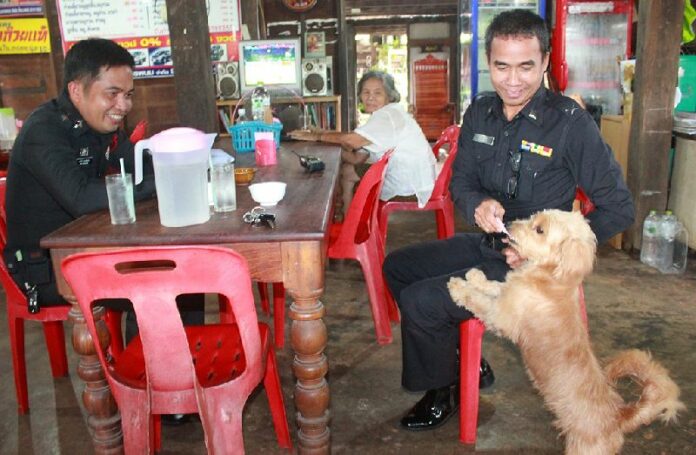
While Kallaya Kaewkwan, 49, cooks meals for customers at Mae Boon restaurant, Barry the dog impresses customers with his ability to dutifully ferry money back and forth between the tables and his owner, 23 Sept 2014.

NAKHON PANOM — A restaurant in Nakhon Panom province has achieved local fame for employing a dog to fetch bills and deliver change to customers, carrying the banknotes in his mouth.

While Kallaya Kaewkwan, 49, cooks meals for customers at Mae Boon restaurant, Barry the dog impresses customers with his ability to dutifully ferry money back and forth between the tables and his owner.

"The customers are really impressed by the cuteness and intelligence of this dog," Ms. Kallaya said. "They say they keep returning to the restaurant because they miss him."

Ms. Kallaya said Barry was given to her by relatives when he was only ten days old.

"His mother died, so I fed him with baby milk powder," Ms. Kallaya said.

According to Ms. Kallaya, Barry's intelligence first became evident when he was three years old. While she went out to the street to pay dessert and ice vendors who visited her house, Barry began imitating her by grabbing leaves or plastic bags to “pay” the vendors with, Ms. Kallaya said.

Barry also likes to fetch letters from the mailman for her, said Ms. Kallaya.


For comments, or corrections to this article please contact: [email protected]

You can also find Khaosod English on Twitter and Facebook
http://twitter.com/KhaosodEnglish
http://www.facebook.com/KhaosodEnglish


Advertisement

Military Lectures Monks To Love 'Nation, Religion, Monarchy'

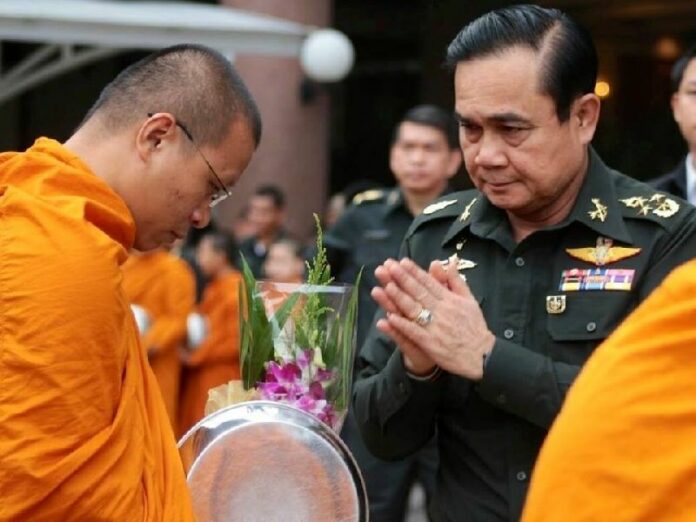
Gen. Prayuth Chan-ocha on 29 August 2014.

BANGKOK — Members of the armed forces lectured over 300 monks in Nakhon Ratchasima province today about instilling a love for Thailand's 'Three Pillars': Nation, Religion, and Monarchy.

The lecture was organised by local branch of the Internal Security Operations Command (ISOC) at Wat Sa Kae temple this morning. 379 monks attended the talk, including top prelates and abbots in the province. 

The event was chaired by Maj.Gen. Chotiwat Bhumipattarasawat, deputy commander of the ISOC for Nakhon Ratchasima province.

According to officials, the lecture was a part of the military junta's effort to promote "national reconciliation." The talk reportedly focused on the need to uphold the 'Three Pillars,' as well as maintain "pride in Thainess" and "loyalty to His Majesty the King." 

Since staging the coup against the elected government on 22 May, the junta's National Council for Peace and Order (NCPO) has launched an intense PR blitz aimed at promoting pro-establishment and conservative values.

Related articles:
Education Ministry Releases Prayuth's Wisdom Poem 


For comments, or corrections to this article please contact: [email protected]

You can also find Khaosod English on Twitter and Facebook
http://twitter.com/KhaosodEnglish
http://www.facebook.com/KhaosodEnglish

Advertisement

Scotland Trip For Work, Not Sightseeing, EC Insists

Anti-election protesters force a polling station in Bang Kapi district to close down, 26 January 2014.

BANGKOK — The secretary-general of Thailand's Election Commission has defended the group's ten-day trip to Scotland, calling it an opportunity for officials to learn how to "improve the election procedure" in Thailand.

EC officials traveled to Scotland from 10 to 21 September to "observe" the independence referendum, in which Scottish residents voted on whether Scotland should remain a part of the United Kingdom. The voting was carried out peacefully in a single day.

Critics of the ten-day trip called it a waste of taxpayer money, as democracy has been suspended in Thailand and the country's interim constitution does not permit separatism or a referendum on secessions. In addition, many observers found the EC's apparent gusto for elections puzzling given the group's notorious reluctance to organise elections in Thailand earlier this year.

But Puchong Nutrawong, sec-gen of the EC, said today that the trip was an important educational experience.

"Officials went on the trip to record all the information [they saw]," Mr. Puchong told reporters. "They did not go for sightseeing. They were there to perform their duties per their assignment."

Asked whether he thought the Scottish referendum was truly relevant to the political situation Thailand, Mr. Puchong said, "Elections are an important principle of democracy. I believe [what we learned on] this educational trip will be very applicable to Thailand."

Earlier this year, EC officials in many voting districts closed down their posts during the 2 February snap poll called by former Prime Minister Yingluck Shinawatra, citing pressure from anti-government protesters who sought to obstruct the election. 

The Constitutional Court ultimately nullified the election because voting did not take place everywhere in the country on the same day.

The EC then repeatedly resisted the government's attempts to organise a fresh poll, claiming that it was not possible because of the anti-government protesters who vowed to block any election held before unspecified national reforms were implemented. 

In April, the EC allowed anti-government protesters to enter the hall where election talks were being held and hang banners bearing anti-election slogans. 

The second attempt at a snap poll, which was initially scheduled to take place on 20 July, never happened as the military seized power and dissolved the government on 22 May.

Thailand's military rulers now say elections will be not be held until October 2015, and only if "national reconciliation" has been achieved and the political climate is deemed stable. 

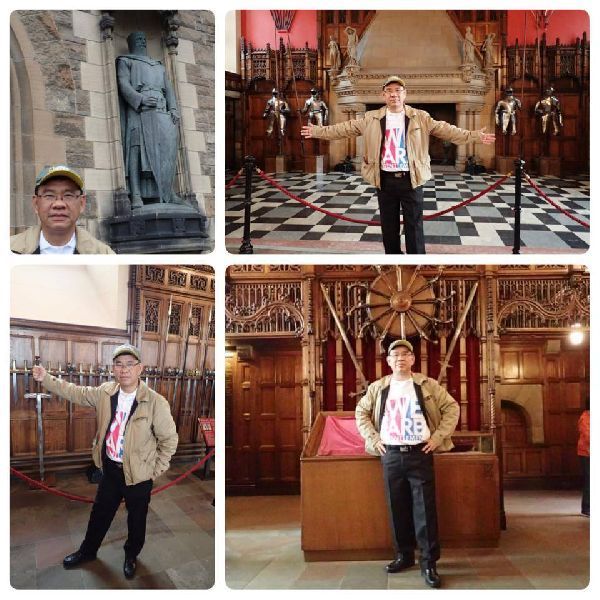
Meanwhile, photos of Election Commissioner Somchai Srisuthiyakorn visiting museums in Scotland have been widely circulated on social media, with critics of the EC calling the photos proof that Mr. Somchai was wasting the state budget on personal leisure. 

When a reporter asked Mr. Puchong whether the trip to Scotland was approved by the junta's National Council for Peace and Order (NCPO), the sec-gen said the trip was authorised under the budget for the 2014 fiscal year, which was approved before the 22 May coup. 

"There will be no foreign trip for the EC in the 2015 fiscal year budget," Mr. Puchong said.


For comments, or corrections to this article please contact: [email protected]

You can also find Khaosod English on Twitter and Facebook
http://twitter.com/KhaosodEnglish
http://www.facebook.com/KhaosodEnglish

Advertisement

Scotland Trip For Work, Not Sightseeing, EC Insists

Photos of Election Commissioner Somchai Srisuthiyakorn visiting museums in Scotland have been widely circulated on social media, drawing outrage from critics of the EC who say the photos are proof that Mr. Somchai was blatantly wasting the state budget on personal leisure.

BANGKOK — The secretary-general of Thailand's Election Commission has defended the group's ten-day trip to Scotland, calling it an opportunity for officials to learn how to "improve the election procedure" in Thailand.

EC officials traveled to Scotland from 10 to 21 September to "observe" the independence referendum, in which Scottish residents voted on whether Scotland should remain a part of the United Kingdom. The voting was carried out peacefully in a single day.

Critics of the ten-day trip called it a waste of taxpayer money, as democracy has been suspended in Thailand and the country's interim constitution does not permit separatism or a referendum on secessions. In addition, many observers found the EC's apparent gusto for elections puzzling given the group's notorious reluctance to organise elections in Thailand earlier this year.

But Puchong Nutrawong, sec-gen of the EC, said today that the trip was an important educational experience.

"Officials went on the trip to record all the information [they saw]," Mr. Puchong told reporters. "They did not go for sightseeing. They were there to perform their duties per their assignment."

Asked whether he thought the Scottish referendum was truly relevant to the political situation Thailand, Mr. Puchong said, "Elections are an important principle of democracy. I believe [what we learned on] this educational trip will be very applicable to Thailand."

Earlier this year, EC officials in many voting districts closed down their posts during the 2 February snap poll called by former Prime Minister Yingluck Shinawatra, citing pressure from anti-government protesters who sought to obstruct the election. 

The Constitutional Court ultimately nullified the election because voting did not take place everywhere in the country on the same day.

The EC then repeatedly resisted the government's attempts to organise a fresh poll, claiming that it was not possible because of the anti-government protesters who vowed to block any election held before unspecified national reforms were implemented. 

In April, the EC allowed anti-government protesters to enter the hall where election talks were being held and hang banners bearing anti-election slogans. 

The second attempt at a snap poll, which was initially scheduled to take place on 20 July, never happened as the military seized power and dissolved the government on 22 May.

Thailand's military rulers now say elections will be not be held until October 2015, and only if "national reconciliation" has been achieved and the political climate is deemed stable. 

Meanwhile, photos of Election Commissioner Somchai Srisuthiyakorn visiting museums in Scotland have been widely circulated on social media, with critics of the EC calling the photos proof that Mr. Somchai was wasting the state budget on personal leisure. 

When a reporter asked Mr. Puchong whether the trip to Scotland was approved by the junta's National Council for Peace and Order (NCPO), the sec-gen said the trip was authorised under the budget for the 2014 fiscal year, which was approved before the 22 May coup. 

"There will be no foreign trip for the EC in the 2015 fiscal year budget," Mr. Puchong said.


For comments, or corrections to this article please contact: [email protected]

You can also find Khaosod English on Twitter and Facebook
http://twitter.com/KhaosodEnglish
http://www.facebook.com/KhaosodEnglish


Advertisement

Democrats Deny Supporting Pre-Coup Protests

Democrat Party chairman Abhisit Vejjajiva visits PCAD leader Suthep Thaugsuban at the PCAD rally in Bangkok's Lumpini Park, 22 March 2014. Despite their close coordination, Democrat Party disavows any link to the protest movement.

BANGKOK — Leading members of the Democrat Party have denied the allegation that their party supported the six month anti-government protest campaign launched at the end of last year.

The comments came in response to a complaint filed by Redshirt activist Sa-ngiam Samranrat asking the Constitutional Court to dissolve the Democrat Party on the grounds that it engaged in politics through non-parliamentary means. 

Mr. Sa-ngiam's complaint was based on the involvement of prominent Democrat party leaders in the six months of street protests staged against then-Prime Minister Yingluck Shinawatra starting last November. The former secretary-general of the Democrat Party, Suthep Thaugsuban, became the leader of the protest movement. 

"The party did not organise the protests," Wirat Kalyasiri, director of Democrat Party's legal department, said on Thursday, explaining that Mr. Suthep and other Democrat leaders had already resigned from the party when they joined and organised the protests. 

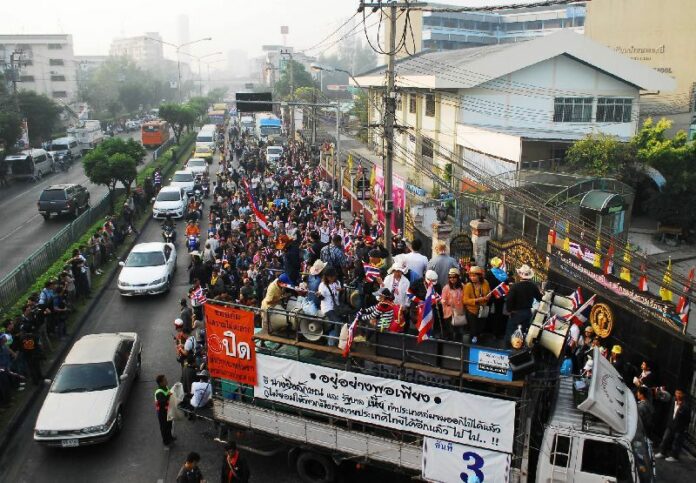
The People's Committee for Absolute Democracy With the King As Head of State (PCAD) started its campaign against Ms. Yingluck in December 2013, demanding that she be replaced by a royally-appointed Prime Minister and an unelected "People's Council." The protests came to an end on 22 May 2014 when the military seized power in a coup d’etat.

Mr. Suthep and seven other Democrats resigned from their party in November last year to the lead the escalating protests, which were sparked by the government's attempt to pass a bill that would have given amnesty to Ms. Yingluck's brother, former PM Thaksin Shinawatra, who currently lives in self-imposed exile to avoid corruption convictions.

"They resigned to demonstrate and struggle for the right cause in a democratic way," Mr. Wirat said. "Society has always been aware about our party's stance on this issue." 

The Democrat Party’s legal adviser also insisted that previous court rulingsdeemed the PCAD protests legal, peaceful assembly. 

Nipit Intarasombat, deputy chairman of Democrat Party, said the public should understand that his party never agreed to endorse the PCAD protests. He stressed that all illegal actions committed by former Democrat members during the campaign should not be used to prosecute the party as a whole. 

In 2007, Democrat Party was spared from a party dissolution verdict by the Constitutional Court in a lawsuit related to its boycott of the April 2006 national election. However, the court dissolved the former ruling Thai Rak Thai Party on the grounds that it allegedly bribed a number of smaller parties to participate in the boycotted election. 


For comments, or corrections to this article please contact: [email protected]

You can also find Khaosod English on Twitter and Facebook
http://twitter.com/KhaosodEnglish
http://www.facebook.com/KhaosodEnglish

Advertisement

NCPO Defends Ban On Political Academic Discussions

Police interrupt and cancel a discussion on the status of human rights in Thailand held at the Foreign Correspondents' Club of Thailand, 2 Sept 2014.

BANGKOK — Thailand’s military junta has reiterated its ban on all political activities, including academic discussions, and moved to block another forum organised by academics at Chiang Mai University.

"All activities related to politics must be held off for now," Col. Winthai Suvaree, spokesperson of the junta's National Council for Peace and Order (NCPO), said at a press conference yesterday.

Last week the military interrupted a panel on the "Demise of Foreign Dictators" at Thammasat University and briefly detained four professors and three students, including the prominent historian Nidhi Eoseewong.

Col. Winthai said the military has also canceled an academic discussion titled "Happiness and Reconciliation Under 2014 Interim Constitution” that was scheduled to take place at Chiang Mai University this Thursday.

"Because of the nation's atmosphere at the moment, we don't want to see any gatherings or activities that may be related to politics," Col. Winthai said. "If any agency wants to propose or complain about any issue to the government, they should submit a letter to Gen. Prayuth Chan-ocha, Prime Minister and NCPO chairman."

He added, "We don't want to see the use of any other channels that could cause divisions in society."

After staging a coup four months ago, the NCPO banned all forms of political expression and public protests. Many of the those who violated the prohibition are now facing trials in military court.

Yesterday, 60 academics from 16 universities across Thailand signed an open letter condemning the cancellation of the panel discussion at Thammasat University, which they called "a severe infringement of academic freedom."

"We urge the ruling military junta, the National Council of Peace and Order (NCPO), to stop intimidating academics and students, and respect academic freedom," the letter said. "If such a basic freedom as the freedom to engage in intellectual discussions within an academic institution is not respected, there is no hope that the Thailand that will come out of the NCPO's reform will respect citizens' basic rights and freedom."

On 2 September, the military forced a group of lawyers and activists to cancel their panel discussion on the status of human rights in junta-ruled Thailand. A spokesperson of the NCPO claimed it was necessary to block the talk, aptly titled "Access to Justice in Thailand: Currently Unavailable," to prevent the dissemination of false information and "prejudice."


For comments, or corrections to this article please contact: [email protected]

You can also find Khaosod English on Twitter and Facebook
http://twitter.com/KhaosodEnglish
http://www.facebook.com/KhaosodEnglish

Advertisement

Hot News

LATEST NEWS

Bangkok
overcast clouds
31.6 ° C
31.6 °
29.4 °
68 %
3.1kmh
100 %
Tue
35 °
Wed
34 °
Thu
34 °
Fri
28 °
Sat
31 °