

























25.5 C
Bangkok
Sunday, July 5, 2026
Home Blog Page 3286

What Can the Army Do Under Martial Law?

BANGKOK — In a political development that came as a surprise to many on Tuesday, the Thai army announced at 3:00 in the morning that the entire country is now under martial law.

Thailand’s martial law was written in 1914, before the country was a constitutional monarchy.  It grants the military extensive powers—including “superior power over the civil authority” in regards to maintaining public order—and also curbs a number of human rights.

Under the century-old martial law, the military now has the power to:  

  1. Search any “body vehicle, dwelling place, building or any place and at any time.” [Section 9:1].
  2. Inspect any letter, package, printed matter “or other things transmitting within the area under the Martial Law” [Section 9:2].
  3. “Force labor for supporting military service in all respects” and demand from any person “any conveyance, beast of burden, provisions, arm, instrument and tool for use in military service” [Section 10].
  4. Impose a curfew, prohibit any meeting or assembly, and control transportation in any public area [Section 11].
  5. Prohibit dissemination of any printed material and television or radio broadcast [Section 11].
  6. “Burn any house or thing which may be useful to the enemy” and “alter the nature of the country or village … for the purpose of fight or preparation for the defense at the discretion of the military authority” [Section 14].
  7. Detain for inquiry any person that the military has “reasonable ground to suspect” is the “enemy or violates the provisions of this Act” [Section 15].

In addition, no person is allowed to claim any compensation for any damages that may result from the exercise of these powers [Section 16].

The sweeping powers granted to the military under martial law are significantly more far-reaching than the authority enjoyed by the government under the Internal Security Act that was previously in place.

As a result, the army’s move has already come under harsh criticism from groups like Human Rights Watch.

"Thailand is using a century old law with draconian provisions that permit the military to exercise essentially unlimited authority to violate human rights if they are so inclined,” said Brad Adams, Director of Human Rights Watch’s Asia Division.

“It's a law that pre-dates the creation of all international human rights standards, and it shows," Mr. Adams said.

The military has already made moves to apply some of these powers.

This morning, the army’s newly-formed peace-keeping operation, the Peace and Order Maintaining Command (POMC), shut down ten politically-affiliated TV stations in order to prevent the dissemination of "misleading" information that could cause public confusion and unrest.

The POMC also ordered that all unlicensed community radio stations, which are often operated by hardcore Redshirt activists, be taken off the air.

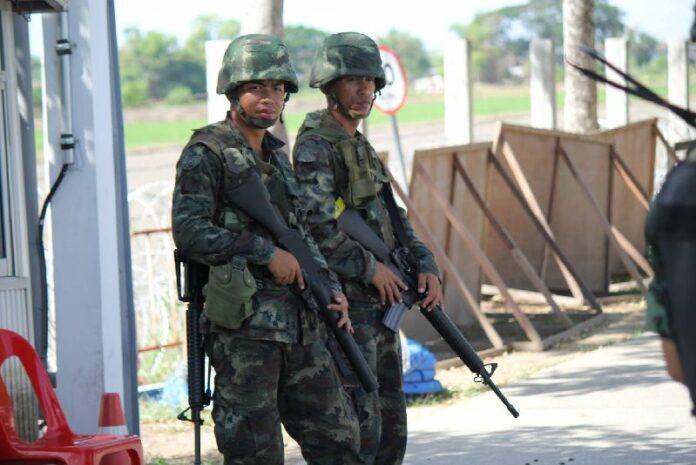
In addition, troops have been deployed to oversee both anti-government and Redshirt rally sites, with orders to prohibit activists from marching anywhere.  

Government officials say they were not informed of the army’s plan to announce martial law until it was declared on television at 3:00 a.m. this morning.

The army has insisted that they have not staged a coup.

If that proves to be true, this would be the first time in Thailand’s history that a nationwide declaration of martial law has not been followed by a military coup d’état. 


For comments, or corrections to this article please contact:[email protected]

You can also find Khaosod English on Twitter and Facebook
http://twitter.com/KhaosodEnglish
http://www.facebook.com/KhaosodEnglish

Advertisement

What Can the Army Do Under Martial Law?

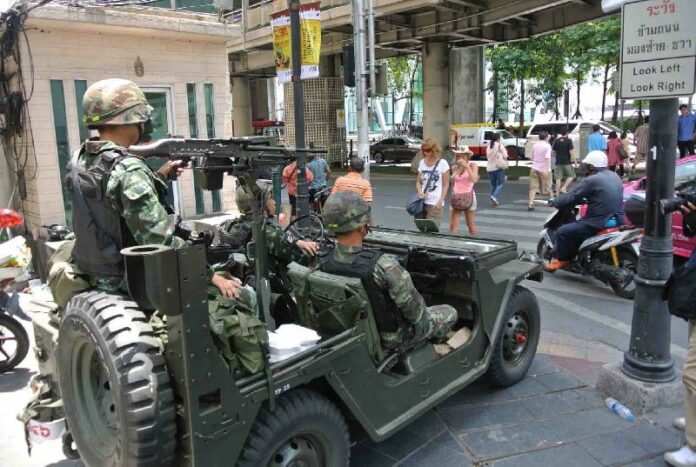
Armed soldiers on duty in Bangkok after the military declared martial law on Tuesday, 20 May 2014.

BANGKOK — In a political development that came as a surprise to many on Tuesday, the Thai army announced at 3am that the country is now under martial law.

Thailand’s martial law was written in 1914, before the country was a constitutional monarchy.  It grants the military extensive powers — including “superior power over the civil authority”  in order to maintain public order — and also curbs a number of human rights.

Under the century-old piece of legislation, the military is now authorized to:  

  1. Search any “body vehicle, dwelling place, building or any place and at any time.” [Section 9:1].
  2. Inspect any letter, package, printed matter “or other things transmitting within the area under the Martial Law” [Section 9:2].
  3. “Force labor for supporting military service in all respects” and demand from any person “any conveyance, beast of burden, provisions, arm, instrument and tool for use in military service” [Section 10].
  4. Impose a curfew, prohibit any meeting or assembly, control transportation in any public area, and “prohibit any person from conducting any act or having any prohibited undertaking or thing as determined by the Minister of Defense during the period of the Martial Law” [Section 11].
  5. Prohibit dissemination of any printed material and television or radio broadcast [Section 11].
  6. “Burn any house or thing which may be useful to the enemy” and “alter the nature of the country or village … for the purpose of fight or preparation for the defense at the discretion of the military authority” [Section 14].
  7. Detain for inquiry any person that the military has “reasonable ground to suspect” is the “enemy or violates the provisions of this Act” [Section 15].

In addition, the law bars people from claiming any compensation for any damages that result from the exercise of these powers [Section 16].

The sweeping powers granted to the military under martial law are significantly more far-reaching than the authority enjoyed by the government under the Internal Security Act, which was previously in place.

As a result, the army’s move has already come under harsh criticism from groups like Human Rights Watch.

"Thailand is using a century old law with draconian provisions that permit the military to exercise essentially unlimited authority to violate human rights if they are so inclined,” said Brad Adams, the Director of HRW's Asia Division.

"It's a law that pre-dates the creation of all international human rights standards, and it shows," Mr. Adams said.

The military has already begun excerising some of its new powers. This morning, the army’s newly-formed peace-keeping operation, the Peace and Order Maintaining Command (POMC), shut down ten politically-affiliated TV stations in order to prevent the dissemination of "misleading" information that could cause "confusion" and unrest.

The POMC also ordered that all unlicensed community radio stations, which are often operated by hardline Redshirt activists, be taken off the air.

In addition, troops have been deployed to oversee both anti-government and Redshirt rally sites, with orders to prohibit activists from marching anywhere.  

Government officials say they were not informed of the army’s plan to announce martial law until it was declared on television at 3:00 a.m. this morning.

The army has insisted that they have not staged a coup. If that proves to be true, this would be the first time in Thailand’s history that a nationwide declaration of martial law has not been followed by a military coup d’état. 

UPDATE: The military launched a coup on 22 May. 


For comments, or corrections to this article please contact:[email protected]

You can also find Khaosod English on Twitter and Facebook
http://twitter.com/KhaosodEnglish
http://www.facebook.com/KhaosodEnglish

Advertisement

Citing Martial Laws, Military Censors Media

Soldiers stand guard at Thai Com satellite HQ in Pathumthani province, 20 May 2014

BANGKOK – The Thai military shutdown ten TV stations allied with both pro- and anti-government factions after declaring martial law early this morning.

Citing the power to censor the media in section 11 of the country's 100-year-old martial laws, the army’s newly-formed Peace and Order Maintaining Command (POMC) suspended 10 satellite TV channels in order to prevent the dissemination of "misleading" information that could cause public confusion and unrest.

The suspended TV stations include Asia Update and Blue Sky TV, which have served as the mouthpieces of the pro-government United Front of Democracy Against Dictatorship (UDD) and the anti-government People's Committee for Absolute Democracy With the King As Head of State (PCAD), respectively.

Both stations have regularly broadcasted live footage from their supporters' protest sites across the country.

So far, all politically-affiliated TV stations appear to have complied with POMC's demands, except for the anti-government T News station, which has announced its intention to appeal the order. 

In statement posted on its website, T News says it’s a for-profit TV station "without affiliation to any political faction,” and cannot afford to cease its operation because of an outstanding debt of 125 million baht. 

"We are appealing the POMC to allow T News to continue our commercial operations, otherwise the company will suffer massive financial losses," the statement reads.

According to the POMC's statement, all unlicensed "community radios" will be taken off the air as well. Many local Redshirt groups operate unregistered  "community radio stations," such as the UDD hardline faction allied to Redshirt activist Wuttipong "Ko Tee" Kochthammakul, who is thought to be currently living in exile.

Although most mainstream news outlets are being permitted to operate normally, the POMC stressed that all media must refrain from "inciting chaos" or reporting anything that "affects the peace and order maintaining operations of the security force."

Martial law, which grants the military “superior power over the civil authority” in matters of maintaining public order, was declared at 3:00 a.m. this morning by Gen. Prayuth Chan-ocha, commander-in-chief of the Royal Thai Army and chairman of the recently-installed POMC.

The military has ordered representatives from all state agencies to attend a 2:00 p.m. meeting this afternoon to discuss the declaration of martial law at military bases across the country. 


For comments, or corrections to this article please contact:[email protected]

You can also find Khaosod English on Twitter and Facebook
http://twitter.com/KhaosodEnglish
http://www.facebook.com/KhaosodEnglish

Advertisement

US to Thai Army: Don't Undermine Democratic Institutions

The US Embassy in Bangkok released a statement on its website in response to the Thai army's declaration of martial law on Tuesday morning.

US State Department Spokesperson Jen Psaki: 

We are aware of reports that Thailand’s army has declared martial law and are monitoring developments closely. We remain very concerned about the deepening political crisis in Thailand and urge all parties to respect democratic principles, including respect for freedom of speech. We understand the Royal Thai Army announced that this martial law declaration is not a coup. We expect the Army to honor its commitment to make this a temporary action to prevent violence, and to not undermine democratic institutions. The United States firmly believes all parties must work together to resolve differences through dialogue and find a way forward. This development underscores the need for elections to determine the will of the Thai people.

Advertisement

Govt Calls Emergency Meeting To Respond To Martial Law

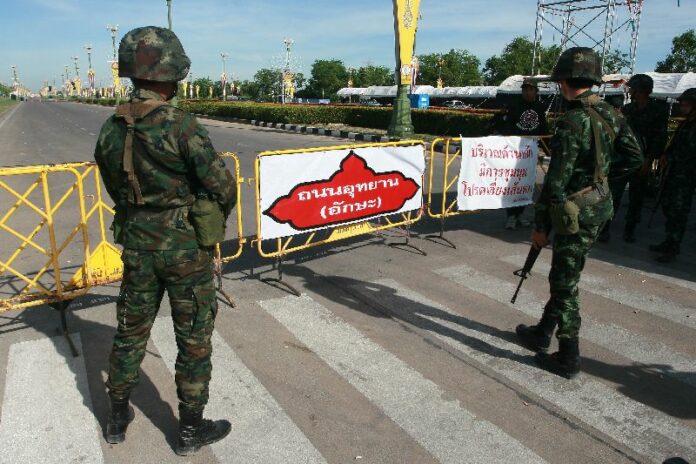
Soldiers surround Redshirt rally on Aksa Avenue after martial law was declared this morning, 20 May 2014.

BANGKOK — The government is urgently convening a meeting to draft a formal response to the Royal Thai Army’s unexpected pre-dawn declaration of martial law on Tuesday, a top official said.

Suranand Vejjajiva, secretary to the caretaker Prime Minister Niwatthamrong Boonsongphaisarn, said the Cabinet is currently meeting to discuss the developing situation and will announce a formal response later in the day. He did not say where the meeting is being held.

Martial law, which grants the military “superior power over the civil authority” in matters of maintaining public order, was declared at 3:00 a.m. this morning by Gen. Prayuth Chan-ocha, commander-in-chief of the Royal Thai Army and chairman of the recently-installed Peace and Order Maintaing Command (POMC).

The military has ordered representatives from all state agencies to attend a 2:00 p.m. meeting this afternoon at military bases across the country. 

This morning, security forces were seen clearing anti-government protesters out of the Government House, taking control of major intersections, surrounding the Redshirt rally on Aksa avenue, and entering the residences of a number of Cabinet members, including Labour Minister Chalerm Yoobamrung. 

The army has also shut down a number of politicized TV stations, including Asia Update and Blue Sky TV.

However, daily life for most Thais proceeded normally this morning, and so far the military presence in Bangkok is considered “light.”

Almost 30 people have died since the most recent bout of political unrest erupted in Thailand last November.


For comments, or corrections to this article please contact: [email protected]

You can also find Khaosod English on Twitter and Facebook
http://twitter.com/KhaosodEnglish
http://www.facebook.com/KhaosodEnglish
Advertisement

DPA: Army Declares Martial Law in Thailand

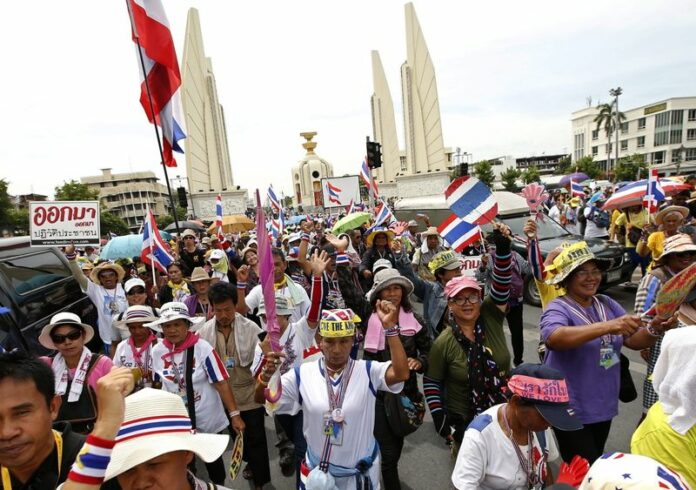
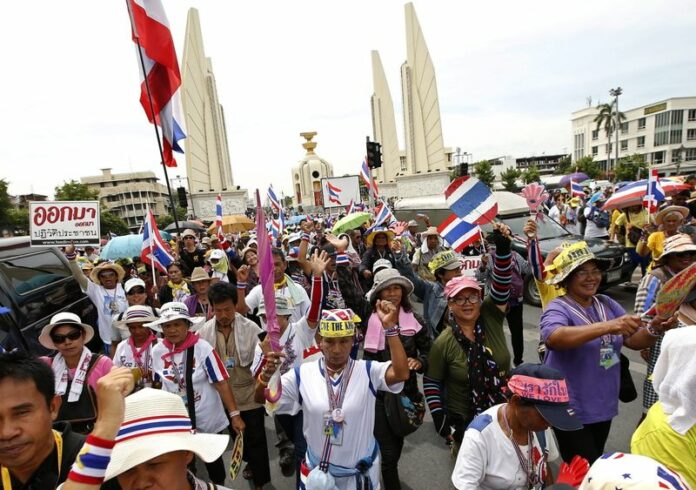
Thai anti-government protesters march during a rally at the Democracy Monument in Bangkok, Thailand, 19 May 2014 (DPA).

By Somchai Kwankijswet and Peter Janssen (DPA)

BANGKOK — Thai army Chief Prayuth Chan-ocha early Tuesday declared martial law, giving the military full control over peace-keeping in the country that has seen six months of anti-government protests.

The statement was issued about 3 am Tuesday (2000 GMT), according to local media reports.

In a brief statement Prayuth dissolved the government's Centre for Maintaining Peace and Order (CAPO) and set up an army-controlled peace keeping centre.

Prayuth has the authority to declare martial law without the consent of the government, which has had caretaker status since December 9.

"It looks like he may have decided to do this without consulting the government, since his first order was to dissolve the CAPO which was jointly run by the government and police," said Panitan Wattanayagorn, a political scientist and military affairs analyst at Chulalongkorn University.  

Thailand has been wracked by six months of non-stop protests seeking to topple the government.

At least 25 people have died in political-related violence and more than 700 injured.

On Thursday, Prayuth warned the army would use "full force" to maintain law and order in the country during the on-going political crisis, after three protesters were killed.

The declaration of martial law follows the launch over the weekend of a "final battle" against the government by Suthep Thaugsuban, leader of the People's Democratic Reform Committee (PDRC), the main anti-government protest group.

Suthep on Saturday said he would pressure the remaining 25 members of the caretaker cabinet to resign and launch a mass protest on Friday to Monday to topple the administration.  

He vowed to turn himself in to authorities to face insurrection charges on May 27 should his final battle fail.

"I think Prayuth is trying to neutralize the confrontation between the PDRC and elements of the pro-government groups who have threatened to fight back if Suthep's group capture some of the ministers," Panitan said.

Martial law gives the army control over security, but leaves the government in command of other tasks, unlike a coup.

Thailand has witnessed 18 coups in the past eight decades, the last of which ousted former prime minister Thaksin Shinawatra in 2006.

The army has stationed troops in the capital to help police keep the peace during the past six months of protests, which have brought Thai politics to a stalemate.

Advertisement

DPA: Army Declares Martial Law in Thailand

Thai anti-government protesters march during a rally at the Democracy Monument in Bangkok, Thailand, 19 May 2014 (DPA).

By Somchai Kwankijswet and Peter Janssen (DPA)

BANGKOK — Thai army Chief Prayuth Chan-ocha early Tuesday declared martial law, giving the military full control over peace-keeping in the country that has seen six months of anti-government protests.

The statement was issued about 3 am Tuesday (2000 GMT), according to local media reports.

In a brief statement Prayuth dissolved the government's Centre for Maintaining Peace and Order (CAPO) and set up an army-controlled peace keeping centre.

Prayuth has the authority to declare martial law without the consent of the government, which has had caretaker status since December 9.

"It looks like he may have decided to do this without consulting the government, since his first order was to dissolve the CAPO which was jointly run by the government and police," said Panitan Wattanayagorn, a political scientist and military affairs analyst at Chulalongkorn University.  

Thailand has been wracked by six months of non-stop protests seeking to topple the government.

At least 25 people have died in political-related violence and more than 700 injured.

On Thursday, Prayuth warned the army would use "full force" to maintain law and order in the country during the on-going political crisis, after three protesters were killed.

The declaration of martial law follows the launch over the weekend of a "final battle" against the government by Suthep Thaugsuban, leader of the People's Democratic Reform Committee (PDRC), the main anti-government protest group.

Suthep on Saturday said he would pressure the remaining 25 members of the caretaker cabinet to resign and launch a mass protest on Friday to Monday to topple the administration.  

He vowed to turn himself in to authorities to face insurrection charges on May 27 should his final battle fail.

"I think Prayuth is trying to neutralize the confrontation between the PDRC and elements of the pro-government groups who have threatened to fight back if Suthep's group capture some of the ministers," Panitan said.

Martial law gives the army control over security, but leaves the government in command of other tasks, unlike a coup.

Thailand has witnessed 18 coups in the past eight decades, the last of which ousted former prime minister Thaksin Shinawatra in 2006.

The army has stationed troops in the capital to help police keep the peace during the past six months of protests, which have brought Thai politics to a stalemate.

*********

Bangkok (CNN) — The Thai army declared martial law throughout the country Tuesday in a surprise move that an aide to the country's embattled Prime Minister said the government didn't know about beforehand.
"They took this action unilaterally. The government is having a special meeting regarding this. We have to watch and see if the army chief honors his declaration of impartiality," the aide said, describing the situation as "half a coup d'etat."
Lt. Gen. Nipat Thonglek told CNN the move was not a coup.
"The Army aims to maintain peace, order and public safety for all groups and all parties," a ticker running on the army's television channel said. "People are urged not to panic, and can carry on their business as usual. Declaring martial law is not a coup d'etat."
Martial law went into effect at 3 a.m. on Tuesday, the ticker said.
All Thai TV stations are being guarded by the military, Thai public television announced, showing pictures of soldiers and armored vehicles taking positions outside broadcast facilities in the country's capital.
The dramatic announcements come days after the head of the army issued a stern warning after political violence had surged in the country's capital.
Political tensions have been running high in Thailand. Supporters and opponents of the country's government have staged mass protests in recent days, and caretaker Prime Minister Yingluck Shinawatra was removed from office, along with nine cabinet ministers, by a top court earlier this month.

Advertisement

Thai Airways Threatens Strike If Govt Refuses To Quit

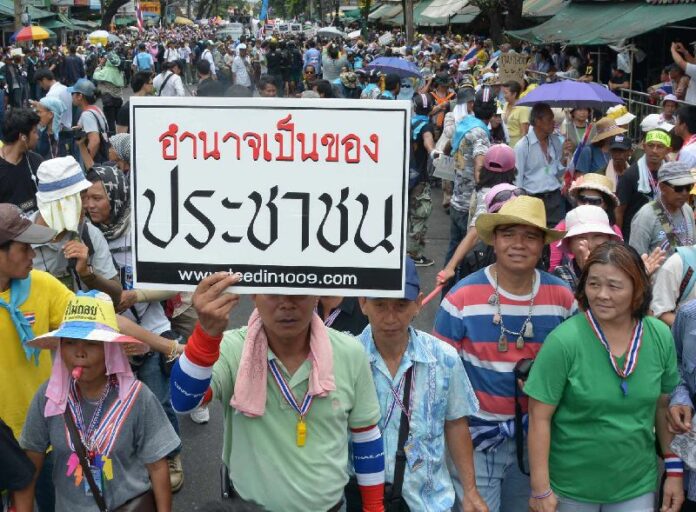
Anti-government protester with a sign that reads, "Power Belongs to the People," 19 May 2014.

BANGKOK — The leader of the Thai Airways union has threatened to call a strike and shutdown the company if the government refuses to resign by 21 May.

Somsak Manop, deputy chairperson of the Thai Airways union, said all union members of the state-owned airline should follow the plan put forth by the anti-government People's Committee for the Absolute Democracy With the King As Head of State (PCAD), which calls for a nationwide strike to "seize back the Sovereign Power" for  the people. 

The PCAD is in the midst of their "one last fight" to topple the government of caretaker Prime Minister Niwatthamrong Boonsongphaisarn, and replace it with an unelected "People's Council" to implement series of unspecified "national reforms.” PCAD leader Suthep Thaugsuban has claimed that the "Great Mass of the People" will achieve victory by 27 May. 

According to Mr. Somsak, if the government does not respond to PCAD's demand by 21 May, more than 15,000 employees of the airline will unanimously go on strike from 22-26 May, as a part of the PCAD’s final struggle against the government.

"If all employees join the strike, the company will automatically be shut down," Mr. Somsak said. 

The threat to strike comes at a time when the debt-ridden, state-owned Thai Airways is already facing massive financial losses, caused by the significant drop in tourism since turmoil broke out in Thailand last year, an inability to compete with privately-run airlines, and rampant nepotism.

Mr. Somsak admitted that some Thai Airways employees disagree with the strike plan because they fear it will only worsen the company's financial troubles. However, he claimed that 70-80% of the workers do agree with the strike, and said that Thai Airways will be in financial trouble regardless of whether the workers strike or not.

Mr Somsak added that "three to four" executive members of the Thai Airways union will join the PCAD's effort to hunt down Cabinet members and force them to resign from their caretaker positions. 

Caretaker director of Thai Airways Chokechai Panyayong said the administration is aware of the union's strike threat, and insisted that the company's operation will be not disrupted. 

"I am confident that Thai Airways staff has the spirit and responsibility for their duty," Mr. Chokechai said.

He explained that the administration has not forbidden its staff from joining any political demonstrations because it is their constitutional right to do so, but he stressed that staff are only permitted to join protests outside of working hours.

"I am sure there will be no disruption to our service," Mr. Chokechai added.


For comments, or corrections to this article please contact: [email protected]

You can also find Khaosod English on Twitter and Facebook
http://twitter.com/KhaosodEnglish
http://www.facebook.com/KhaosodEnglish
Advertisement

High Expectations For Modi as Daunting Challenges Loom

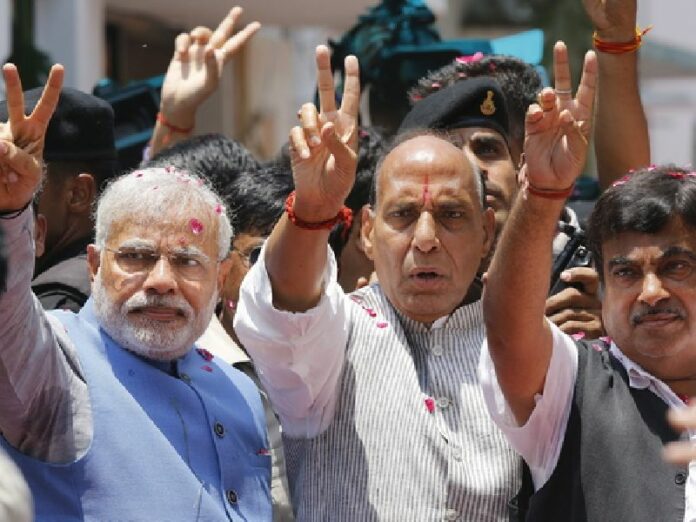
Narendra Modi (left) flashes victory signs ahead of a BJP party meeting in New Delhi. Modi is expected to become India's next prime minister (DPA).

By Siddhartha Kumar (DPA)

NEW DELHI — "Good Days are Coming!" was among the catchy slogans that Hindu nationalist leader Narendra Modi campaigned on to strike a chord with Indians angry over high inflation and mismanagement of the economy.

After his Bharatiya Janata Party (BJP) routed the ruling Indian National Congress party, the 63-year-old Modi repeated the slogan at victory rallies before thousands of ecstatic supporters.

Asia's third-largest economy is battling its worst slowdown in 10 years, with growth dropping to below 5 per cent annually.

The decade-long tenure of prime minister Manmohan Singh has left his successor with challenges including inflation averaging around 10 per cent over the last two years, rising unemployment and declining investments.

Many economists believe that Modi, who stormed into power on public resentment against the Gandhi-led Congress, will be under pressure to deliver from the outset.

BJP spokesman Prakash Javadekar said the new government would urgently focus on containing inflation and generating jobs for youths. It is also expected to give a big push to infrastructure projects.

Among the obstacles Modi will face is a new law that restricts land acquisition enacted by the previous government with much fanfare.

"This would clearly interfere with investments and remains a key problem for the new government," D H Pai Panandikar, president of Delhi-based RPG Foundation think tank.

Modi will also be tested to contain the deficits in the budget and the current account.

Tackling government corruption, improving ease of doing business and clarifying tax regulations for foreign investors would be key to restoring confidence in the economy.

One immediate test is how the new government will deal with the effects of a forecasted weak monsoon season, Panandikar said.

About two-thirds of the country's 1.2 billion population depend on agriculture and allied activities, and a poor monsoon would lead to higher inflation and hurt economic growth even further. Rural consumption has been a key driver of the economy in recent years.

Modi will also have to quickly address bureaucratic inertia to implement stalled government projects.

"If the projects get off the ground, it will kickstart the Indian industry which is absolutely stagnant," Panandikar said.

A key reason behind the slowdown is the dismal performance of the industrial sector, with nearly flat growth in the financial year ending March.

Reviving the stagnant economy and taming inflation would take years rather than months. Public patience could soon wear thin.

"India faces a turning point when a crisis for stagnation generates support for change, setting the stage for a new leader to push reform," economist Ruchir Sharma wrote in the Times of India.

"The warm welcome tends to last only 12 to 18 months in global markets and local voters will lose patience too if the new leader does not generate results. To make India relevant again, Modi needs to move fast," Sharma said.

Javadekar was more optimistic, saying, "We have a roadmap to deal with these challenges."

Modi starts with positive sentiment from domestic and international business circles, and a record of efficiency as a pro-business chief minister of the western state of Gujarat.

"Actually, we think Modi can do a lot and chances are that he will," Mumbai-based economist Akshay Mathur said.

With BJP getting an absolute majority in parliament – the first Indian party to do so in three decades – it should be a stable government free from coalition troubles. Modi would be able to push through his legislative reforms, said.


Advertisement

Crackdown Victims' Families Urge Govt To Ratify ICC Jurisdiction

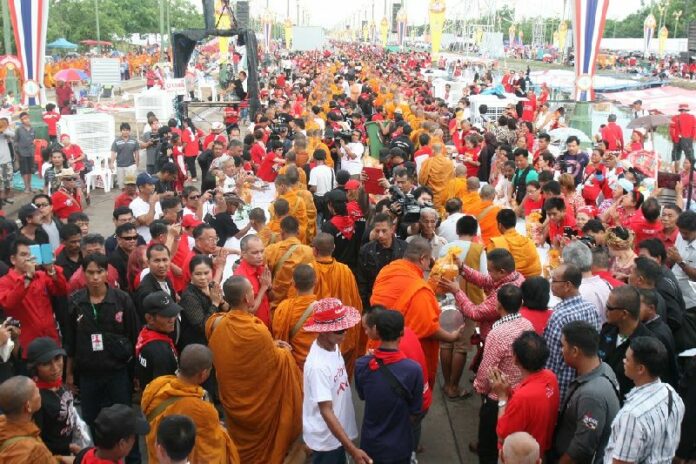
Redshirts on Aksa Avenue summoned 2,000 monks to participate in a ceremony commemorating the May 2010 military crackdown, 19 May 2014.

BANGKOK — Family members of victims of the 2010 military crackdown have renewed their calls for justice, demanding the government allow the International Criminal Court to pursue the pending court cases against those responsible for the crackdown.

"It's been four years since I lost my son, but the case is not going anywhere," said Somchai Chiamphol, whose son, Thipnet Chiamphol, was shot dead near Soi Rang Nam during clashes between the military and Redshirt protesters on 14 May 2010. 

Today marks the fourth anniversary of the military crackdown on Redshirt protesters that left over 90 people dead, yet the Thai authorities have still failed to make any headway on the lawsuits against the government and military officials who authorised the crackdown.

As a result, families of the victims and human rights activists have been calling on the government to formally cede jurisdiction over the cases to the ICC.

"I want the DSI [Division of Special Investigation] to press ahead with the cases of the martyrs, and I want the government to accept the jurisdiction of the ICC, so that the world will know [about the crackdown] and help us find the wrongdoers," said Mr. Somchai, whose son died in the crackdown. "That way, the country can move forward."

In April of 2010, former Prime Minister Abhisit Vejjajiva and his deputy Suthep Thaugsuban ordered the brutal military crackdown on the tens of thousands of Redshirt protesters who were rallying on Bangkok’s streets to demand a fresh election. 

The 10 April crackdown was followed by weeks of clashes between the protesters and security forces, culminating in a final military assault on the Redshirts' encampment on 19 May. 

Mr. Abhisit and Mr. Suthep have been charged by the DSI for murder due to their role in 2010, but both have denied the charges, blaming the deaths on shadowy "Blackshirt" militants thought to be allied with the Redshirts. 

Pan Kamkong, whose brother Phan Kamkong was shot dead by the military near Ratchapralop Airport Link Station on 15 May, said he wanted authorities to hasten the legal procedures against Mr. Abhisit and Mr. Suthep. 

"Especially Mr. Suthep. He is now charged with insurrections and murder, yet he is allowed to walk free and hurt our feelings," Mr. Pan complained. "If it's possible, I want the government to finally accept the jurisdiction of the ICC, because this is a big case. A lot of people died."

Despite their alliance with the Redshirts, the current government has been reluctant to pass jurisdiction onto the ICC.

In November 2013, the ruling Pheu Thai Party also attempted to pursue a "blank amnesty bill" that would pardon all politicians accused of corruption and political violence since 2005, including the authorities responsible for the 2010 military crackdown.

"I have to admit that I am still deeply disappointed by the government's attempt to pass the 'all in the basket' amnesty bill," Mr. Pan told Khaosod. "Eventually, it led to what is happening right now. If the government had not done it, the PCAD wouldn't be here," Mr Pan said, referring to the anti-government People's Committee for Absolute Democracy With the King As Head of State, who began their protests in response to the introduction of the amnesty bill last November.   

To commemorate the anniversary of the crackdown, Redshirts invited 2,000 monks to their rally site on Aksa Avenue in western Bangkok to perform a religious ceremony this morning.

Yesterday, a group of families, under the name "Families of April-May 2010 Martyrs,” arranged their own ceremony to honor their loved ones at Plab Pla Chai Temple in Bangkok.  

"It's been four years since the loss, but as a relative of the victim, I am still upholding their democratic ideal. I have not forgotten those who died," said Ubonwan Chantorn, the sister of a taxi driver who was shot dead while rallying with the Redshirts near Lumpini Park on 14 May 2010.

"I want the legal process to move forward, because so far progress has been abysmal," Ms. Ubonwan said, "Personally, I understand bureaucracy, and I see that some cases that have clear evidence are being processed, but many cases have not seen any progress at all.”

She added, "I want to use this occasion of the fourth anniversary to remind officials, to ask them whether they are ready to perform their duties, find the truth, and bring us justice."

According to Ms. Ubonwan, the "Families of April-May 2010 Martyrs" will renew their campaign for justice once the current political crisis calms down. 

Phayao Akhard, thhe mother of "Nurse Kate" who was shot dead by the military inside a temple on the last day of the 2010 crackdown, said she plans to meet with DSI chief Tharit Pengdith herself and urge him to make genuine progress on the more than 70 still unresolved cases. 


For comments, or corrections to this article please contact: [email protected]

You can also find Khaosod English on Twitter and Facebook
http://twitter.com/KhaosodEnglish
http://www.facebook.com/KhaosodEnglish
Advertisement

Hot News

LATEST NEWS

Bangkok
overcast clouds
25.5 ° C
26.1 °
25.5 °
46 %
2.4kmh
100 %
Sun
30 °
Mon
31 °
Tue
36 °
Wed
31 °
Thu
33 °