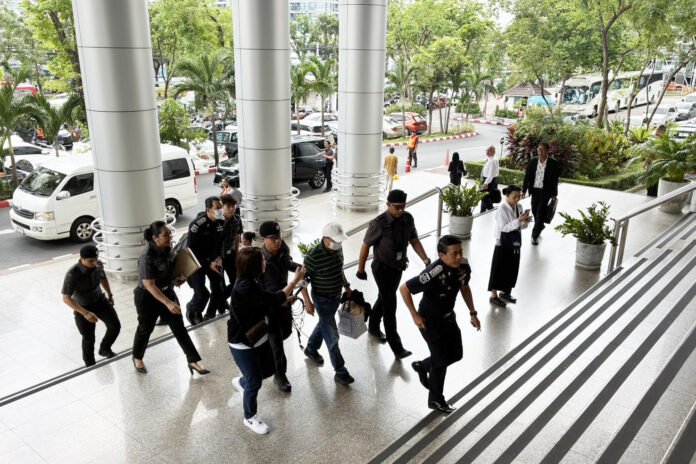
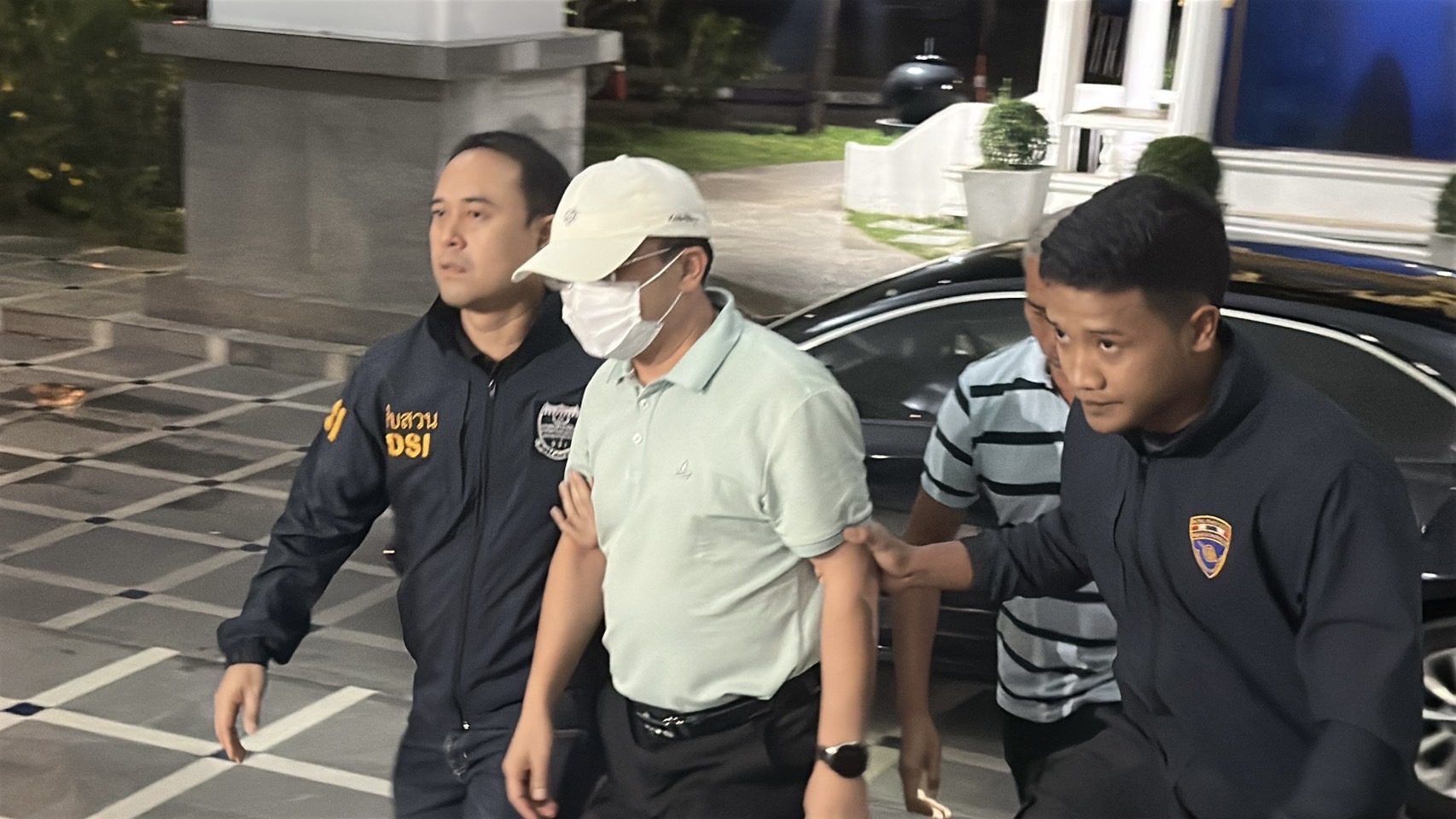
DSI investigators bring 42-year-old Chinese national Mr. Zhang Chuanling to the Criminal Court on Ratchadaphisek Road in Bangkok on April 21, 2025.
BANGKOK — A Chinese executive from China Railway (Thailand) has been released on 500,000 baht bail with travel restrictions after being charged by the Department of Special Investigation (DSI) in a nominee case.
The case involves the collapse of the State Audit Office building in Bangkok, which was the only building to collapse during the March 28 earthquake that originated in Myanmar. The disaster resulted in 103 casualties, with only 9 survivors.
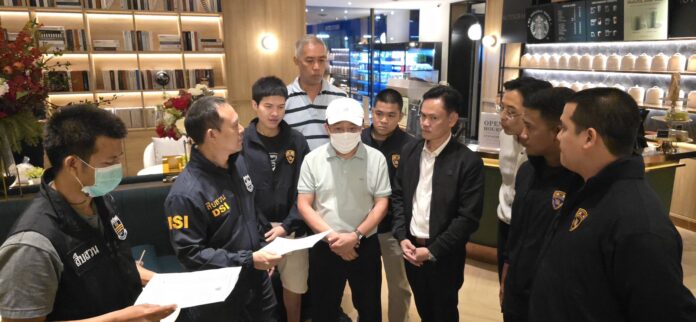
On April 21, DSI investigators brought 42-year-old Chinese national Mr. Zhang Chuanling to the Criminal Court on Ratchadaphisek Road in Bangkok for the first detention request. He was arrested at a hotel in the Ratchada area on April 19 and informed of the charges.
An Investor from China
Zhang denied the charges, stating he hadn’t appointed anyone as a nominee shareholder. He explained that he represents a Chinese state enterprise and is an investor from China making investments in Thailand on behalf of the Chinese government. He claimed to be merely an executive sent to manage the company’s operations in Thailand.
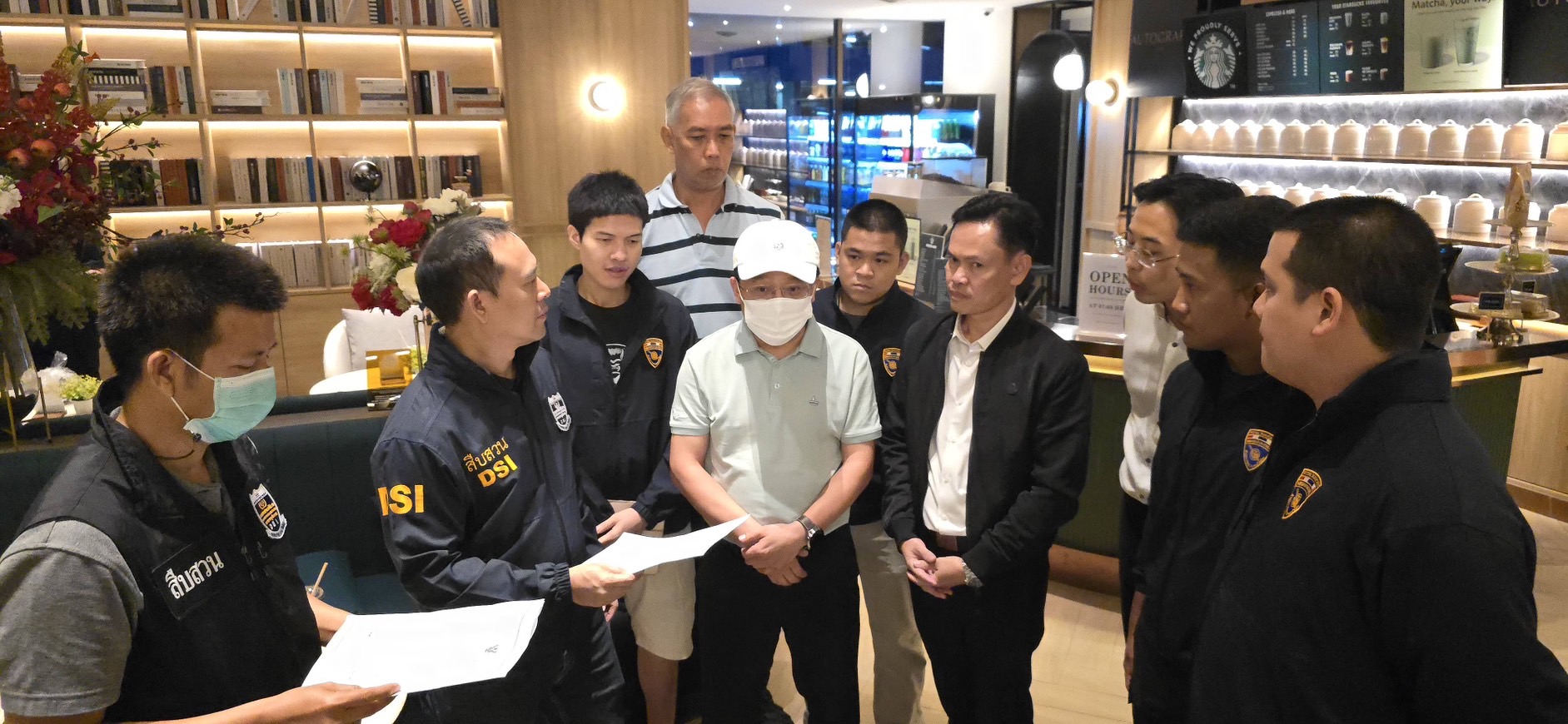
Special Investigation Department (DSI) officers apprehend Mr. Zhang Chuanling, a board member of China Railway No. 10 (Thailand) Company Limited at a luxury hotel in the Ratchadaphisek area of Bangkok on April 19, 2025.
He affirmed that the Chinese state enterprise has approved approximately 120 million baht ($3.6 million) in compensation for victims and those affected by the State Audit Office building collapse, and is currently coordinating with the Ministry of Justice to deliver these funds.
The suspect posted 500,000 baht ($15,000) bail, which the court granted with the condition that he cannot leave the country without court permission and must report as scheduled.
Details of the Petition
The petition stated that the DSI received a case regarding a joint venture that bid on the State Audit Office building construction project, potentially violating the Foreign Business Act and possibly being involved in government procurement fraud.
Investigations revealed that the company responsible for constructing the building was a joint venture between Italian-Thai Development Public Company Limited (ITD) and China Railway No. 10 (Thailand) Co., Ltd., operating as ITD-CREC. China Railway was registered on August 10, 2018, with a registered capital of 100 million baht (1 million shares at 100 baht each), with Thai shareholders holding 51% and Chinese nationals 49%. ITD-CREC has 4 shareholders:
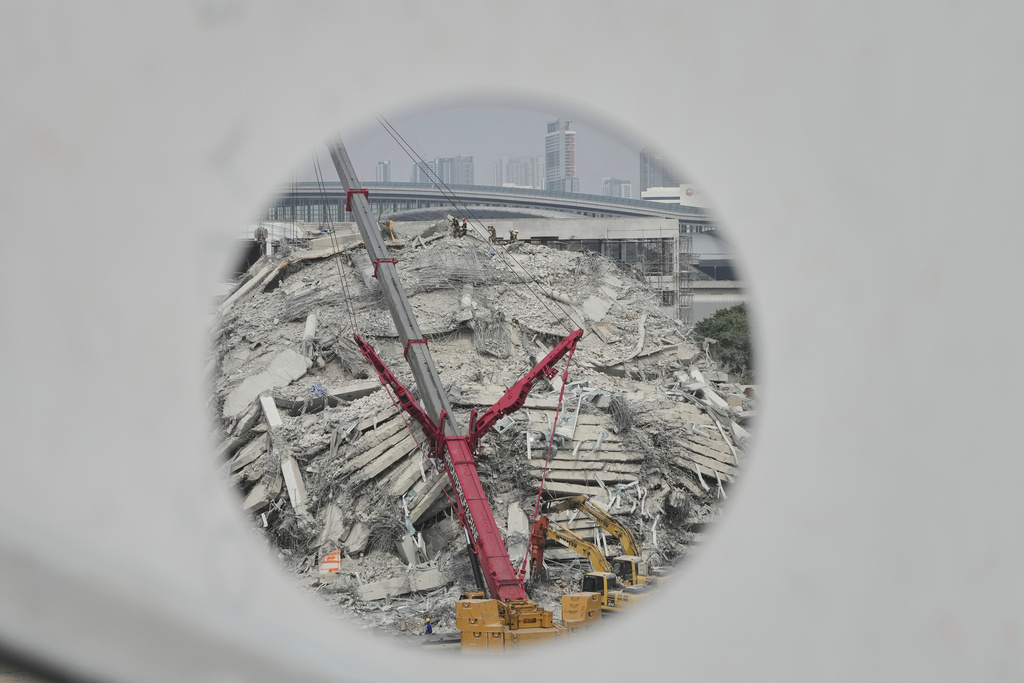
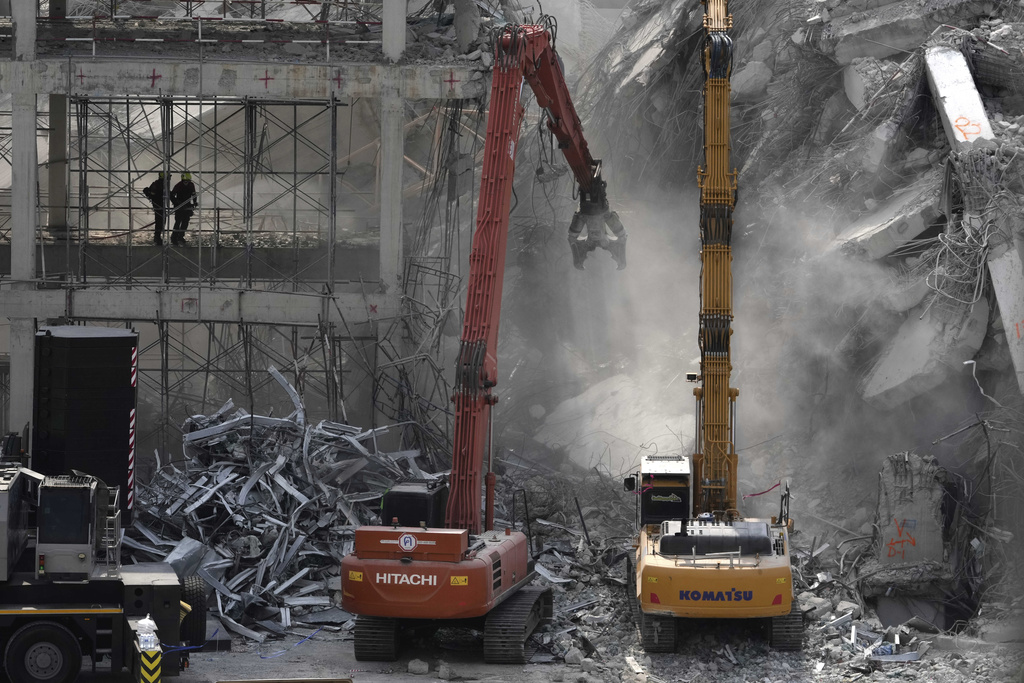
Heavy machinery are employed to clear the huge pile of concrete at the site of an under-construction high-rise building that collapsed after an earthquake in Bangkok, Thailand, Tuesday, April 1, 2025. (AP Photo/Sakchai Lalit)
China Railway No. 10 Engineering Company (Chinese nationality): 490,000 shares (49%), valued at 49 million baht, with Zhang (Chinese) and Mr. Sophon Meechai (Thai) as authorized directors
Mr. Sophon Meechai (66, Thai): 407,997 shares (40.7997%), valued at 40,799,700 baht, also holding shares in 4 other companies
Mr. Prajuab Sirikhet (53, Thai): 102,000 shares (10.20%), valued at 10,200,000 baht, also holding shares in 7 other companies
Mr. Manat Sri-anan (62, Thai): 3 shares (0.003%), valued at 300 baht, also holding shares in 10 other companies
Suspicious Thai Partners
Further investigation into the three Thai directors revealed that Mr. Sophon previously worked at Thai Glass Industries Co., Ltd., resigning on September 9, 2014, with no subsequent employment records. Mr. Prajuab and Mr. Manat worked at Santiphap Import-Export Co., Ltd., with Mr. Prajuab resigning on September 1, 2010, and Mr. Manat on March 31, 2015.
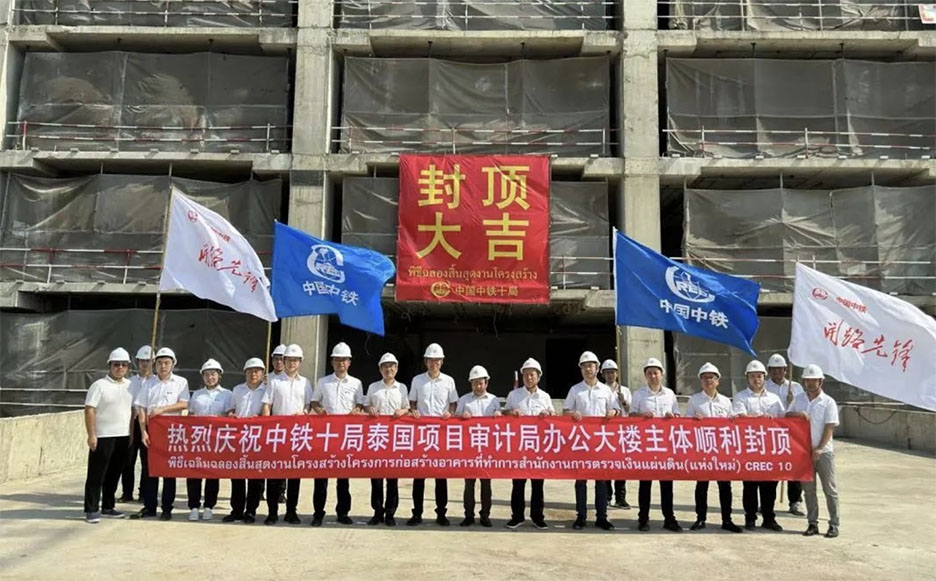
Construction supervisors of the State Audit Office building holding a sign written in Thai and Chinese that reads: ‘Celebration ceremony for the completion of structural work, Construction Project of the (New) Office of the Auditor General,’ CREC, April 3, 2024.
Santiphap Import-Export is located at 493 Soi Phutthabucha 44, Lane 11, Bang Mot, Thung Khru, Bangkok – the same address as China Railway and eight other companies. All three Thai directors of China Railway also serve as directors of these companies.
Investigations found that Sophon, Prajuab, and Manat were employees of Chinese-owned companies, working as manual laborers and drivers. It is not credible that these three individuals are shareholders in any business, given their employment as hired workers with low incomes.
They are suspected of being registered as nominal shareholders holding 51% to make China Railway appear to be a Thai company, allowing it to engage in businesses restricted by law, including bidding for the construction of the new State Audit Office building through e-bidding. Construction began in 2020 and continued until the building collapsed on March 28, 2025.
Thai Shareholders Surrender
On the same day, the three Thai directors and shareholders – Sophon, Prajuab, and Manat – surrendered at the DSI Deputy Director-General’s Office on Chaengwattana Road, Bangkok. Manat’s lawyer submitted clarification documents to investigators, briefly confirming that all three were genuine shareholders and denying the allegations against them.
SKY Is a Social Scapegoat?
Meanwhile, the Thai legal team for Xin Ke Yuan Steel Co., Ltd. (SKY) held a press conference at Rama Gardens Hotel, claiming the company has become a social scapegoat. They stated that the collection of steel samples from the collapsed building by Thai authorities and the subsequent announcement that the steel was substandard was unjustified, as the steel had already been used and was outside the scope of laboratory testing, making it impossible to measure against industry standards.
SKY insists their steel products meet ISO 9001 standards as required by law and the Board of Investment (BOI). They objected to implications that SKY is a Chinese “grey” company, noting that over the past five years (2019-2023), the company has paid 856 million baht in taxes with proper accounting.
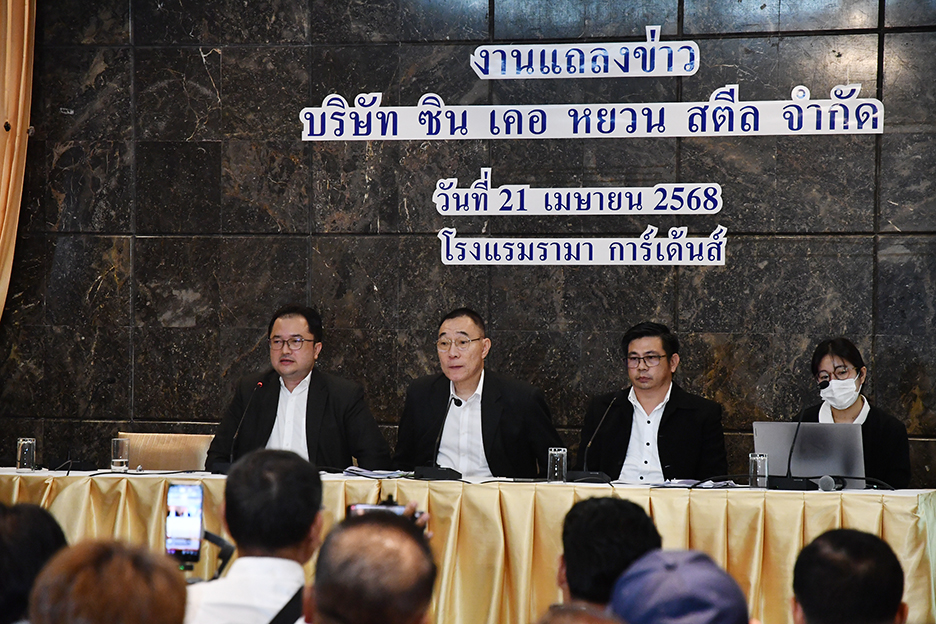
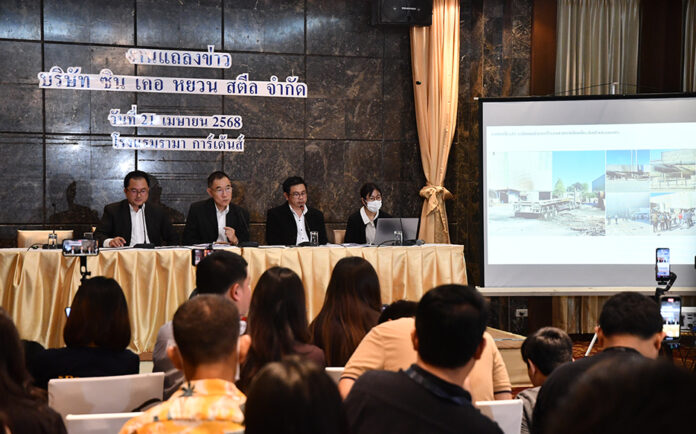
Lawyers from Xin Ke Yuan Steel Company Limited held a press conference regarding the company’s steel product standards for the media at Leelawadee Room, Rama Gardens Hotel, Vibhavadi Rangsit Road, on April 21, 2025.
Foreign Investment Impact
“While the Thai government invites foreign investment, the order to close the factory and revoke the investment license affects the investment climate. Whether SKY will withdraw all investments from Thailand is up to the company’s decision and cannot be answered by the legal team,” said lawyer Surasak Weerakul.
As of April 20 at 6:00 PM, according to the search and rescue team at the State Audit Office building site, there were 103 casualties, with 47 deaths, 9 injuries, and 47 people still trapped under the rubble.
Lawyers from Xin Ke Yuan Steel Company Limited held a press conference regarding the company's steel product standards for the media at Leelawadee Room, Rama Gardens Hotel, Vibhavadi Rangsit Road, on April 21, 2025.
BANGKOK (AP) — A Thai-Chinese company denied Monday allegations its steel rods did not pass safety standard tests after nationwide criticism prompted an investigation into the collapse of a high-rise building under construction after an earthquake last month in Bangkok.
Authorities are probing Xin Ke Yuan Steel and another Chinese contractor involved in the construction to find out why the building crumbled following a quake centered in Myanmar, more than 800 miles (1,200 kilometers) away. It was the only building that completely collapsed that day.
The 7.7 magnitude quake on March 28 killed more than 3,700 in Myanmar, while in Thailand, 47 were killed, mostly at the collapse site, and 47 others went missing.
The collapse sparked questions about the enforcement of construction safety and the state-run Chinese contractor, China Railway No. 10 Engineering Group, leading to the arrest Saturday of its Chinese executive in Thailand, identified as Zhang, on suspicion of operating the business through the use of nominees.
FILE – Soldiers from fire services spray water to settle the dust as heavy machineries are deployed to clear the rubble from an under construction high-rise building that collapsed after Friday’s earthquake in Bangkok, Thailand, on April 2, 2025. (AP Photo/Manish Swarup, File)
Foreigners can operate a business in Thailand, but it must be a joint venture with a Thai partner, and they cannot own more than 49% to protect local competitiveness.
Three Thai shareholders of the company are also wanted on suspicion of being the nominees, said officials of the Department of Special Investigation, Thailand’s equivalent of the FBI. They also said they were looking into the quality of the construction material and whether the company illegally fixed its bidding.
The company posted a video online last year advertising the building, meant to be a new office of the State Audit Office, with plenty of drone footage and boasting about the quality of the design, construction and management of the project.
Last week, a Thai engineer filed a police complaint saying that his name and signature were forged as a project controller in one of the construction plans. He denied any involvement in the project.
Xin Ke Yuan Steel, also partly owned by Chinese nationals, came under scrutiny over the quality of the steel rods they provided for the buildings. Its operating license is currently suspended following a fatal fire accident in December at its factory in Rayong province.
Lawyers from Sinceryuan Steel Company Limited held a press conference regarding the company’s steel product standards for the media at Leelawadee Room, Rama Gardens Hotel, Vibhavadi Rangsit Road, on April 21, 2025.
Industry Minister Akanat Promphan said two types of steel rods found at the collapse site did not pass safety standards and that Xin Ke Yuan supplied both. He raided the company’s factory on April 11 for evidence, saying that samples of the steel products confiscated by authorities following its December suspension have already failed two tests.
The company’s legal team disputed Monday the test results in a press conference, stressing that all of their products had passed safety tests and that they were being treated unfairly by authorities. They, however, declined to comment when asked specifically about the test results of the company’s steel rods found at the collapse site.
Earlier this month, the Revenue Department filed a complaint accusing Xin Ke Yuan of issuing over 7,000 false tax invoices. The company’s lawyers on Monday denied any wrongdoing.
The search for the missing workers is still ongoing, Thai authorities say.
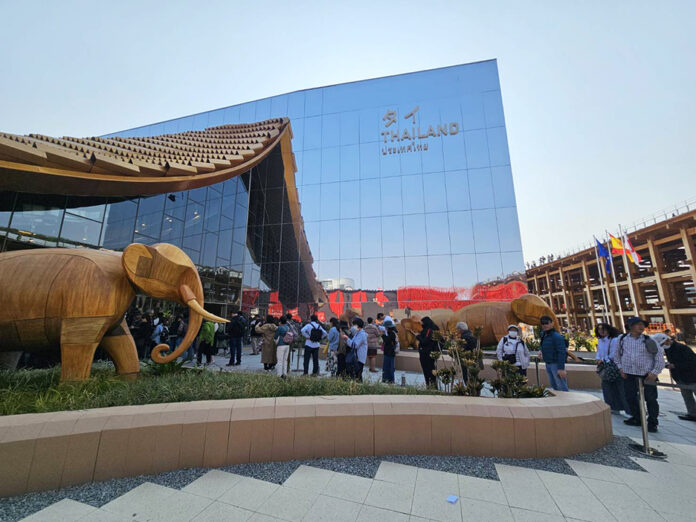
Visitors to the World Expo in Osaka, Japan queue to enter the Thai Pavilion on April 15. The building was designed by A49 Architects, featuring a traditional Thai roof design with large glass walls. (KHAOSOD Photo/Chumchan Chamniprasart)
BANGKOK — The organizers of the Thailand Pavilion at World Expo 2025 Osaka, Kansai, Japan have addressed public criticism regarding $27 million budget, which some netizens considered excessive relative to the content presented.
Critics characterized it as having “private sector design with government content.”
The Ministry of Public Health, the host agency for this event, held a press conference on April 21 to clarify the situation. Dr. Opas Karnkawinpong, Permanent Secretary for Public Health, explained that the $27 million (900-million-baht) budget is actually lower than the $36 million (1.2 billion baht) spent at the previous World Expo in Dubai five years ago, despite Japan’s high costs.
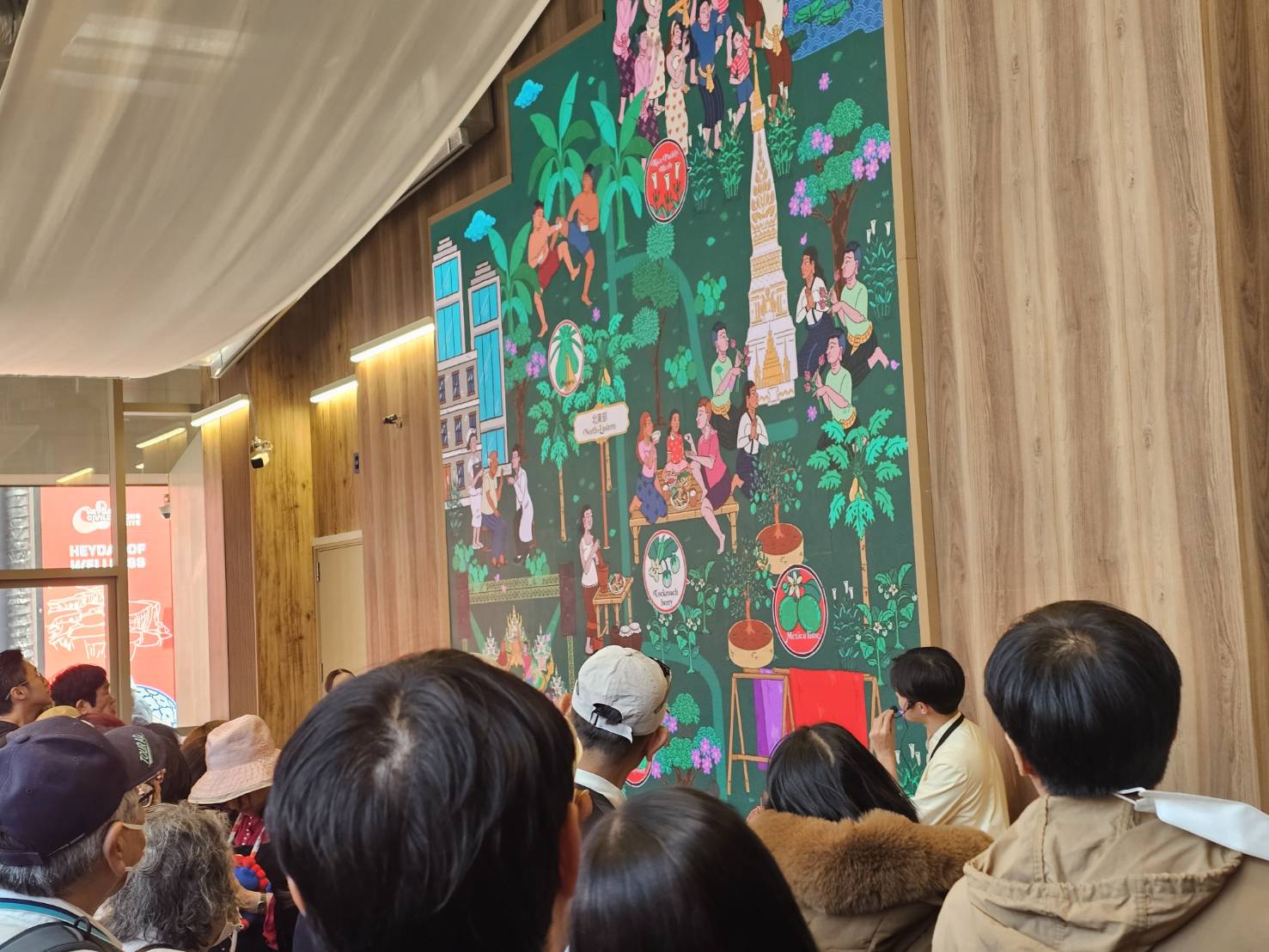
Visitors to the World Expo in Osaka, Japan queue to watch an introductory video about Thailand in the Thai Pavilion on April 15, 2025. (KHAOSOD Photo/Chumchan Chamniprasart)
Dr. Opas acknowledged that preparation was complicated by the COVID-19 pandemic that began in 2020, but emphasized that all processes followed Thai government regulations while also complying with Japan’s strict labor laws.
Regarding criticism about the content, Dr. Opas stated that the pavilion aims to showcase Thailand’s healthcare capabilities while also supporting economic growth through business matching opportunities, particularly promoting Thai massage as a potential revenue generator.
The pavilion, designed by A49 Architects, features a traditional Thai roof design with large glass walls. Its theme “Immunity” focuses on nature, lifestyle, culture, food, and health. Some visitors have suggested that the pavilion should emphasize modern health innovations and technology rather than historical elements, which they feel would better align with the expo’s future-oriented theme.
Since opening on April 13, the pavilion has welcomed approximately 10,000 visitors daily. Dr. Opas noted that while there has been criticism, there has also been substantial praise, especially from international visitors.
Officials expect to attract over 3 million visitors throughout the six-month expo, representing 10% of total attendance, which they believe will enhance Thailand’s reputation as an international health center.
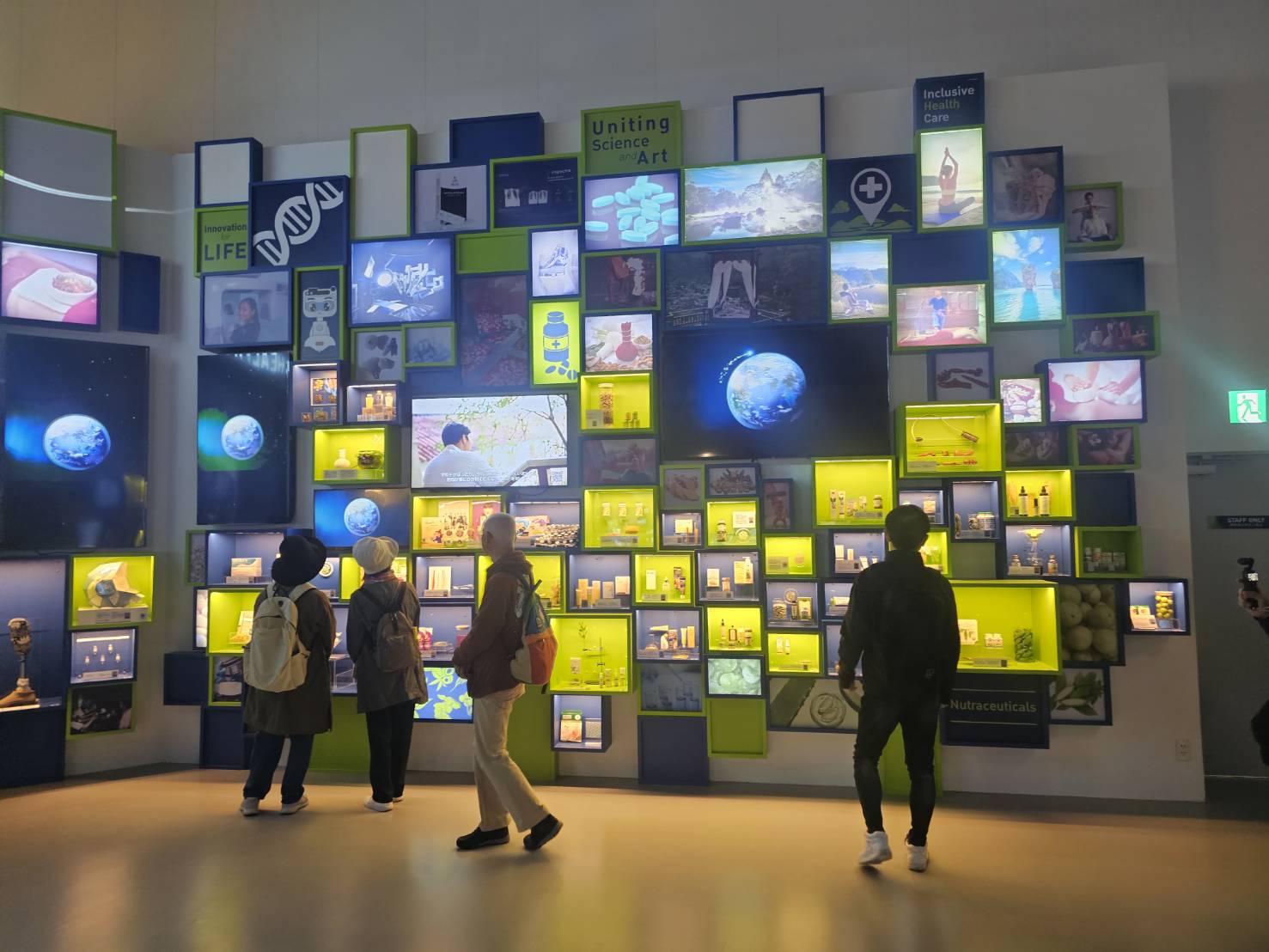
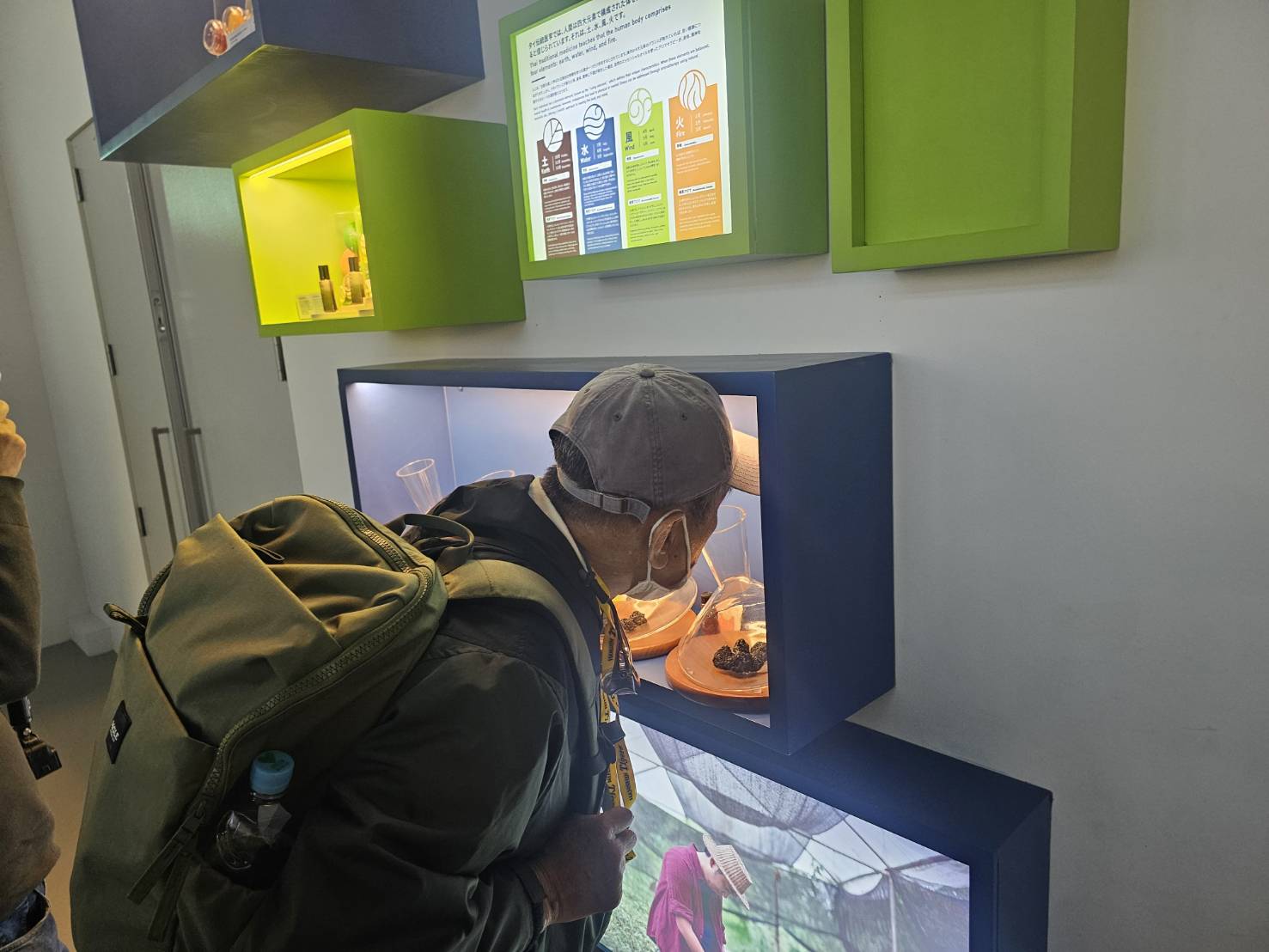
Thai herbal exhibition inside the Thai Pavilion, with some varieties available for visitors to smell. (KHAOSOD Photo/Chumchan Chamniprasart)Thai herbal exhibition inside the Thai Pavilion, with some varieties available for visitors to smell. (KHAOSOD Photo/Chumchan Chamniprasart)
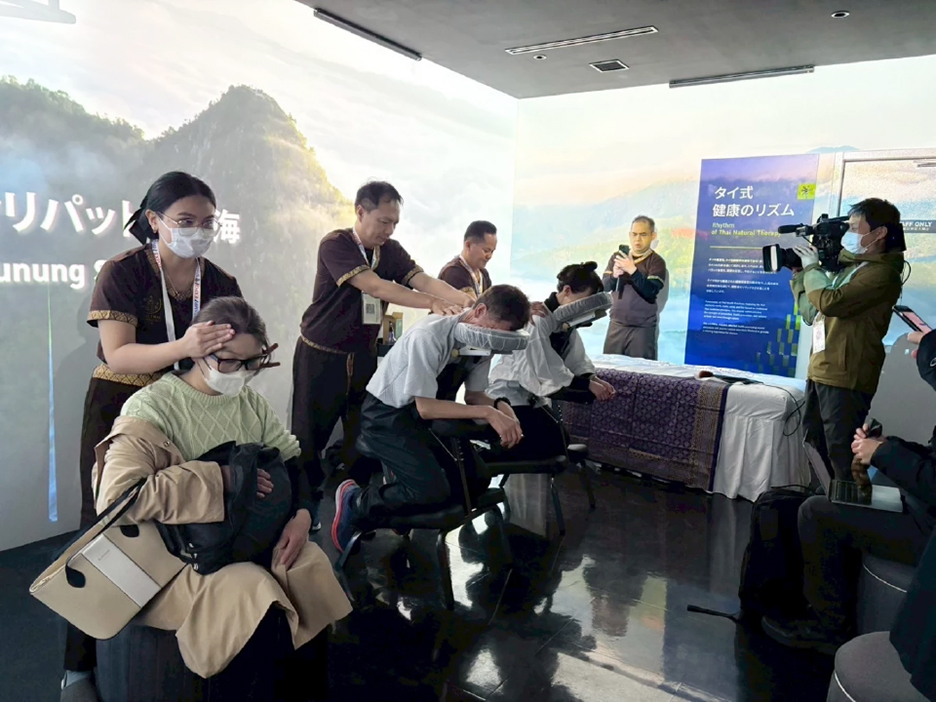
Dr. Korkrit Limphasammut, Deputy Director-General of the Department of Health Service Support, added that besides exhibitions, the pavilion offers daily demonstrations of Thai massage targeting office syndrome relief, showcasing this UNESCO-recognized practice.
He explained that this year’s Thailand Pavilion aligns with the World Expo’s theme of “Designing Future Society for Our Lives.” The pavilion showcases Thailand’s approach to creating fulfilling lives, happiness, and positioning the country as a global health center by connecting Thai cultural soft power with medical innovation, health, and wellness initiatives.
“Our content must address these challenges,” said Dr. Korkrit, noting that all exhibitions have been approved by the organizing team and will rotate monthly to maintain visitor interest. The official opening ceremony will be held on Thursday, April 24.
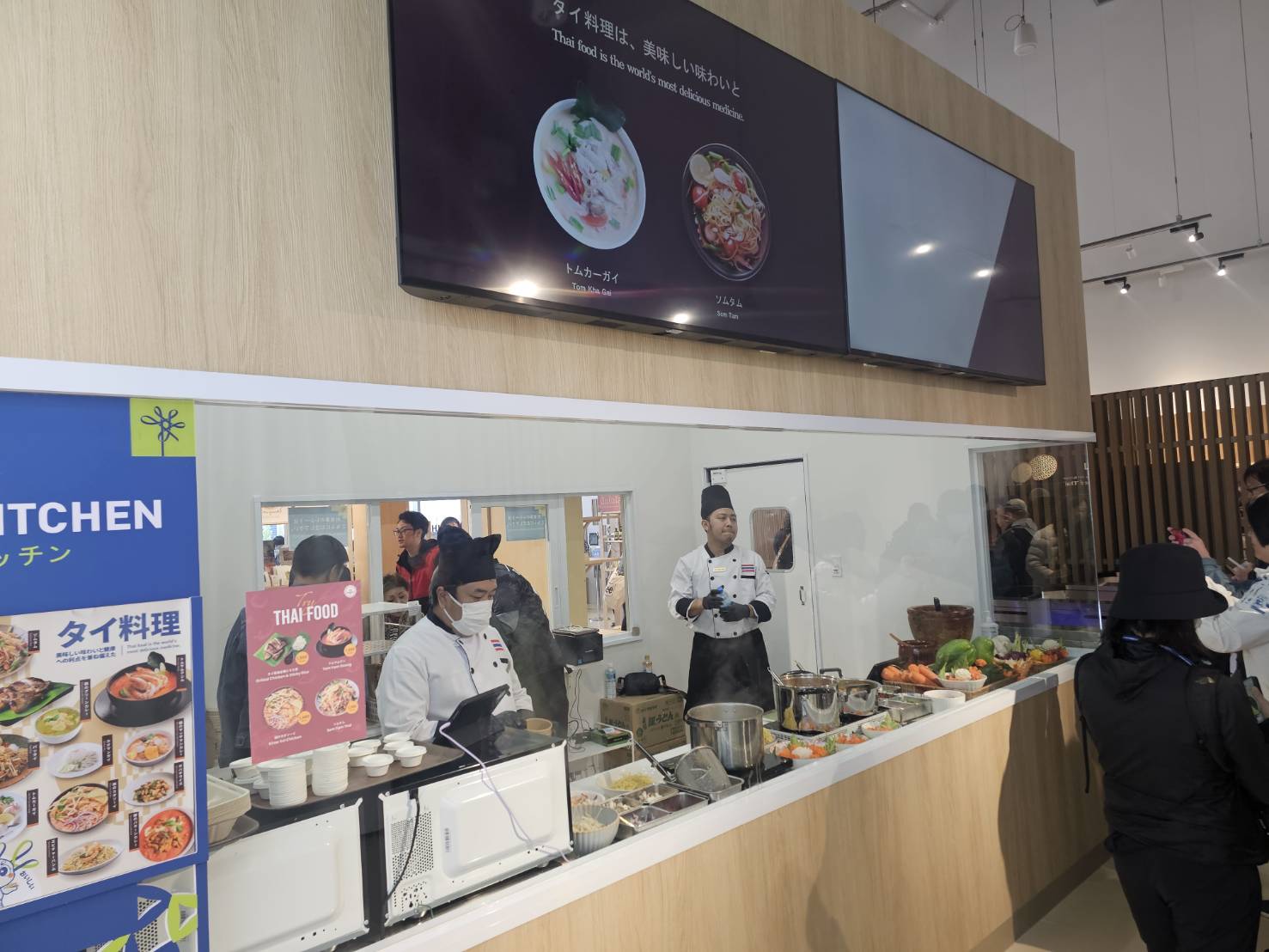
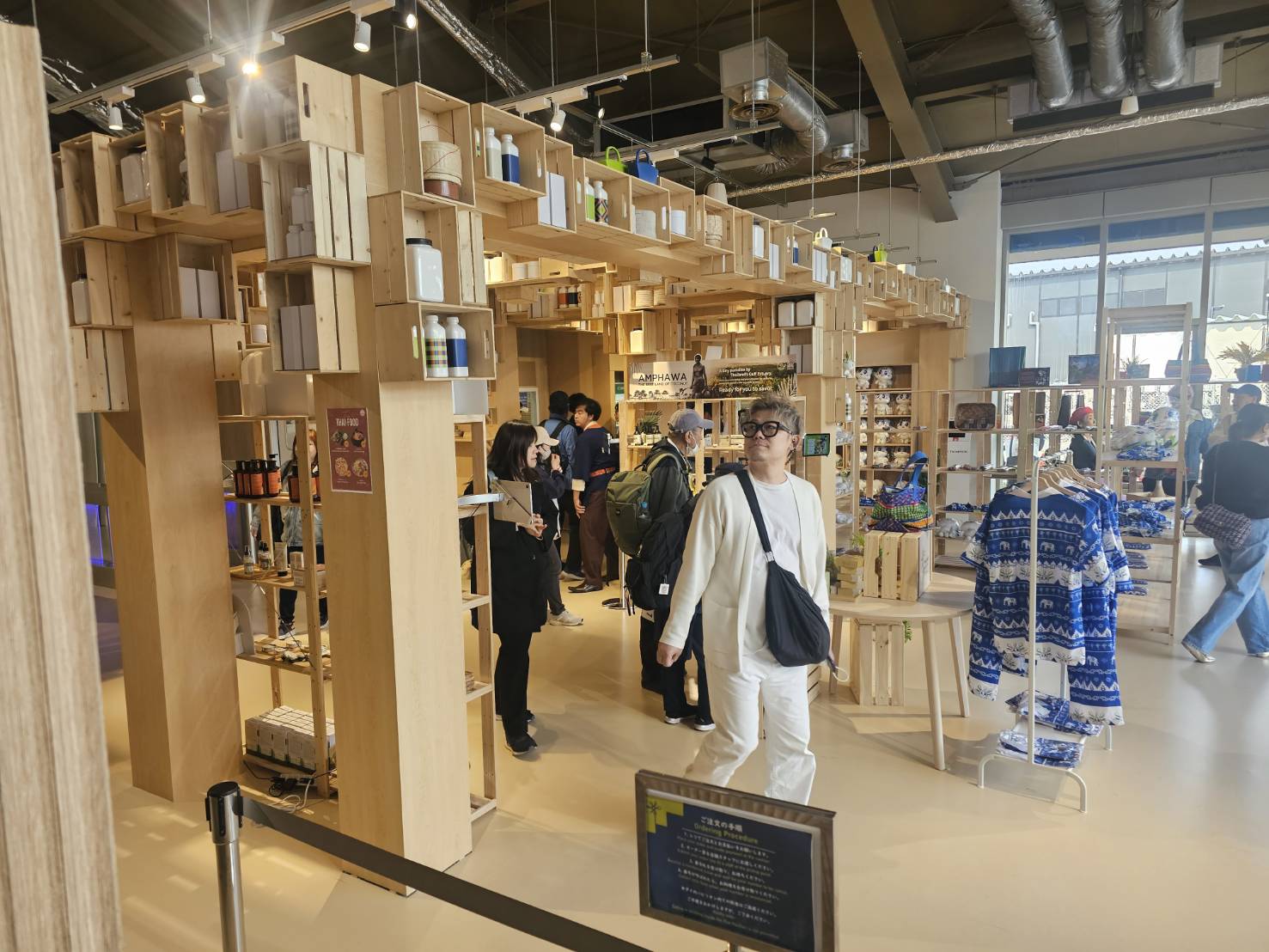
A highlighted activity within the Thai Pavilion is Thai massage service, which is highly popular among visitors. (Photo courtesy of the Department of Thai Traditional and Alternative Medicine)Thai food introduction corner, offering not only descriptions of health benefits but also tasting opportunities for visitors.Shopping corner for various products containing Thai herbs, displayed in a section built with natural materials. (KHAOSOD Photo/Chumchan Chamniprasart)
Addressing procurement concerns, Dr. Korkrit outlined the project timeline: On December 20, 2022, the Cabinet approved the budget and implementation plan, followed by the March 14, 2023 approval of $26 million (867.88 million baht), with the Department of Health Service Support (DHSS) designated as the implementing agency.
The bidding process required three announcements due to various inquiries and inspections. RMA110 Company ultimately won with a bid of $25.8 million (862 million baht), slightly under budget. Rightman Company, which previously organized Thailand’s exhibition in Italy in 2015, was involved as part of a joint bid.
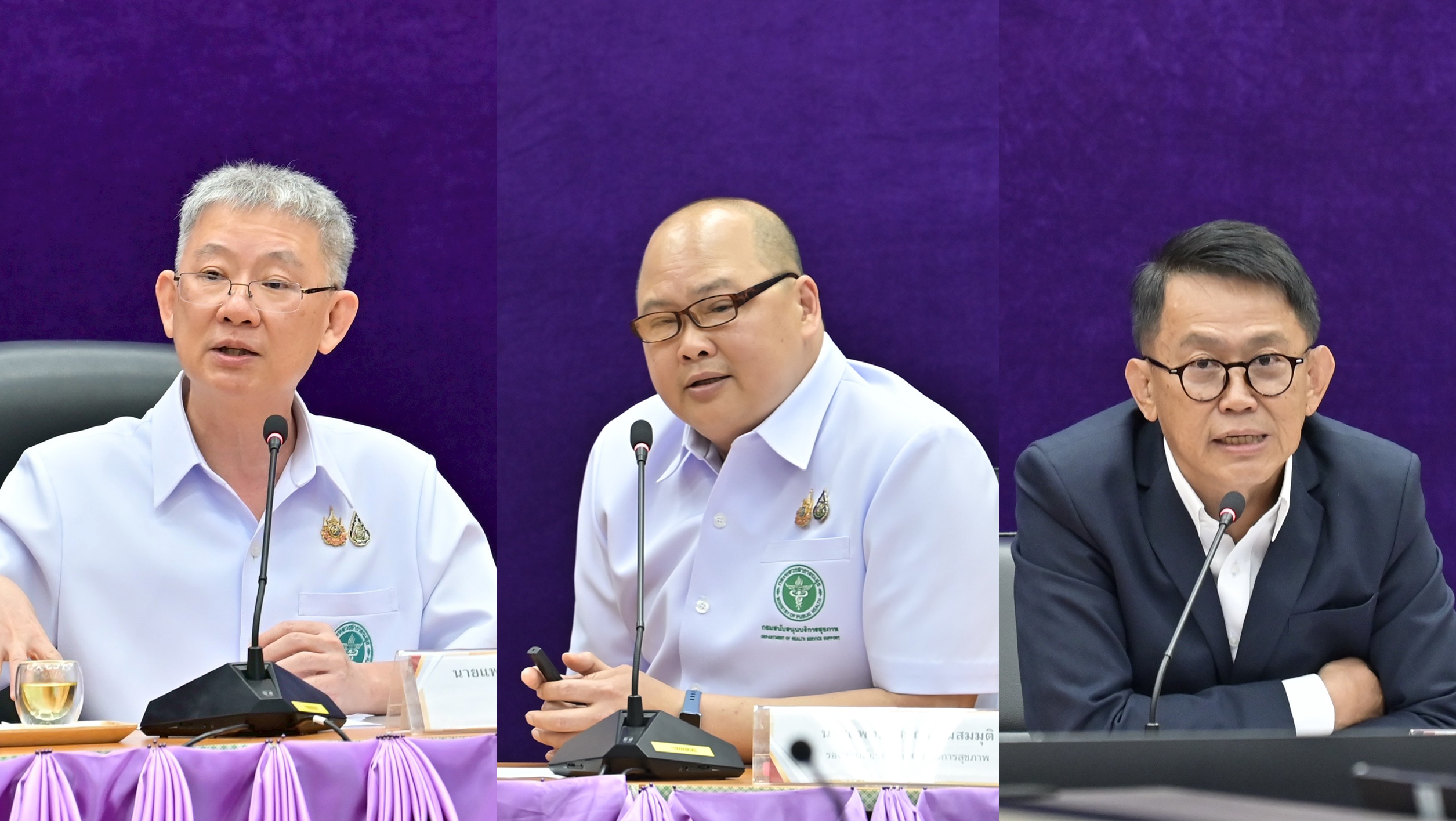
Dr. Opas Karnkawinpong, Permanent Secretary of the Ministry of Public Health (left), Dr. Korkrit Limphasammut, Deputy Director-General of the Department of Health Service Support (center), and Mr. Uppatham Nisitsukcharoen, Executive Director of Rightman Company Ltd. and the RMA110 joint venture, at a press conference at the Ministry of Public Health, Bangkok, regarding the Thai Pavilion at World Expo 2025 in Osaka, Japan, on April 21, 2025.
Dr. Korkrit clarified that due to documentation complexities, DHSS decided to work with only one of the companies rather than maintaining a formal joint venture structure, contradicting media reports that suggested impropriety in the process.
At the press conference, Mr. Uppatham Nisitsukcharoen, executive director representing both Rightman Company and the RMA110 joint venture, presented the exhibition procurement contract to the media. The contract, complete with tax identification information, confirms that all exhibition construction falls under the operational framework agreed upon with the Department of Health Service Support.
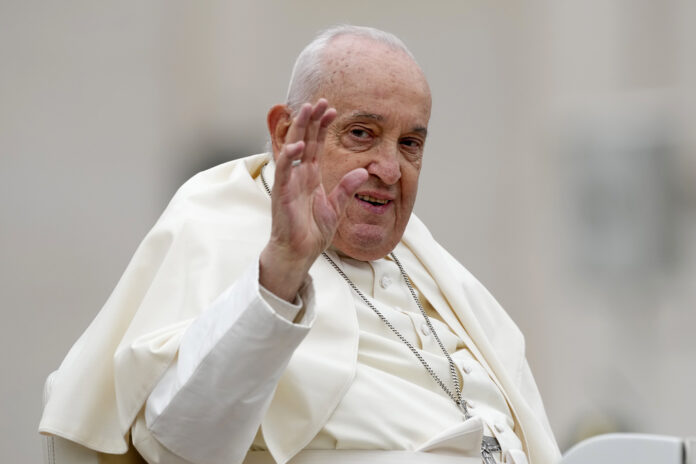
file - Pope Francis smiles after celebrating Easter mass in St. Peter's Square at the Vatican, Sunday, March 31, 2024. (AP Photo/Andrew Medichini, file)
VATICAN CITY (AP) — Pope Francis, history’s first Latin American pontiff who charmed the world with his humble style and concern for the poor but alienated conservatives with critiques of capitalism and climate change, has died Monday. He was 88.
“At 7:35 this morning, the Bishop of Rome, Francis, returned to the home of the Father. His entire life was dedicated to the service of the Lord and of his Church,″ Farrell said in the announcement.
“He taught us to live the values of the Gospel with faithfulness, courage, and universal love, especially for the poorest and most marginalized.
“With immense gratitude for his example as a true disciple of the Lord Jesus, we commend the soul of Pope Francis to the infinite, merciful love of God, One and Tribune.″
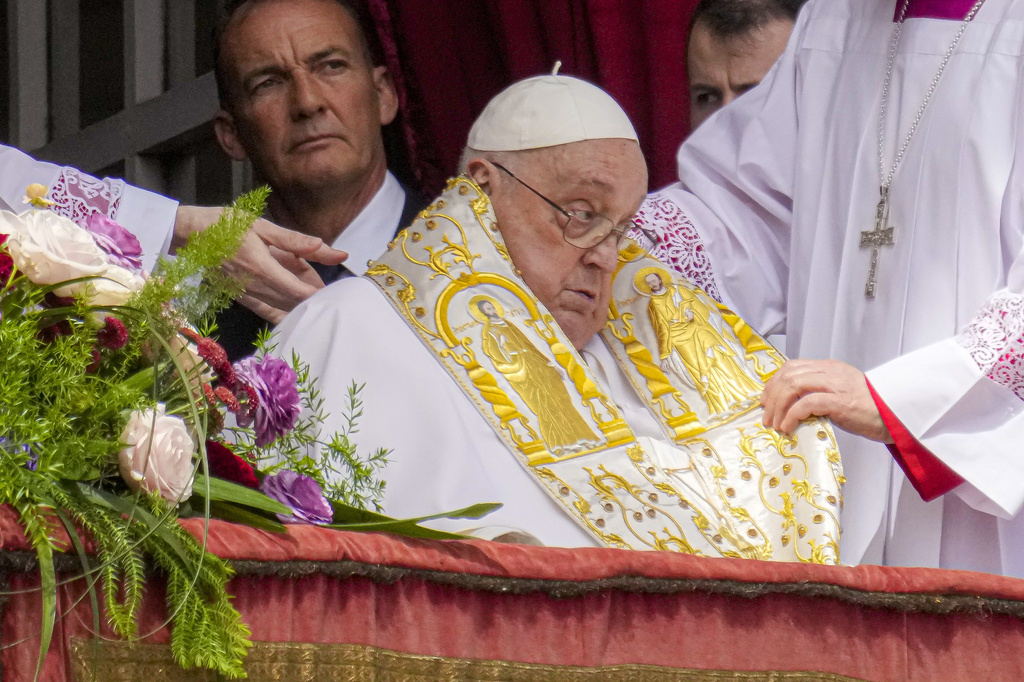
Pope Francis appears on the central lodge of St. Peter’s Basilica to bestow the Urbi et Orbi (Latin for to the city and to the world) blessing at the end of the Easter mass presided over by Cardinal Angelo Comastri in St. Peter’s Square at the Vatican Sunday, April 20, 2025.(AP Photo/Gregorio Borgia)
On Easter Sunday, Pope Francis emerged from his convalescence to bless thousands of people in St. Peter’s Square and treat them to a surprise popemobile romp through the piazza, drawing wild cheers and applause as he continues his recovery from a near-fatal bout of double pneumonia.
“Viva il Papa!” (Long live the pope), “Bravo!” the crowd shouted as Francis looped through the square in his open-topped popemobile and then up and down the main avenue leading to it. He stopped occasionally to bless babies brought up to him, a scene that was common in the past but unthinkable just a few weeks ago as the 88-year-old pope fought for his life.
“Brothers and sisters, Happy Easter!” Francis said, his voice sounding stronger than it has since he was released from the hospital March 23 after a five-week stay.
His 12-year papacy
Francis, who suffered from chronic lung disease and had part of one lung removed as a young man, was admitted to Gemelli hospital on Feb. 14, 2025, for a respiratory crisis that developed into double pneumonia. He spent 38 days there, the longest hospitalization of his 12-year papacy.
From his first greeting as pope — a remarkably normal “Buonasera” (“Good evening”) — to his embrace of refugees and the downtrodden, Francis signaled a very different tone for the papacy, stressing humility over hubris for a Catholic Church beset by scandal and accusations of indifference.
After that rainy night on March 13, 2013, the Argentine-born Jorge Mario Bergoglio brought a breath of fresh air into a 2,000-year-old institution that had seen its influence wane during the troubled tenure of Pope Benedict XVI, whose surprise resignation led to Francis’ election.
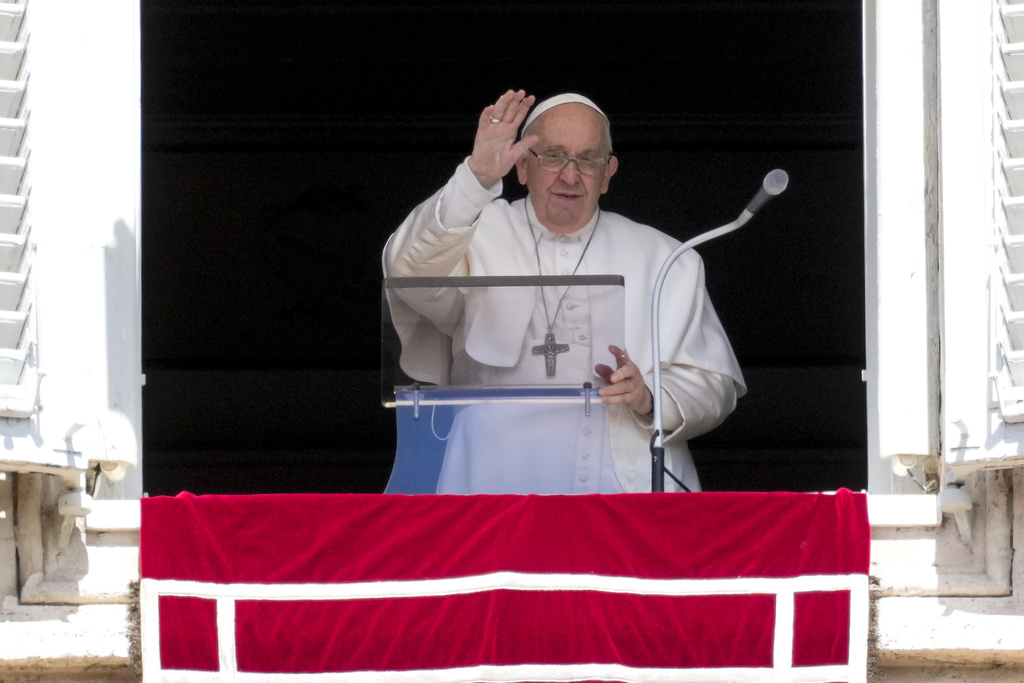
Pope Francis delivers his blessing as he recites the Regina Coeli noon prayer from the window of his studio overlooking St.Peter’s Square, at the Vatican, Sunday, April 16, 2023. (AP Photo/Andrew Medichini)
But Francis soon invited troubles of his own, and conservatives grew increasingly upset with his progressive bent, outreach to LGBTQ+ Catholics and crackdown on traditionalists. His greatest test came in 2018 when he botched a notorious case of clergy sexual abuse in Chile, and the scandal that festered under his predecessors erupted anew on his watch.
And then Francis, the crowd-loving, globe-trotting pope of the peripheries, navigated the unprecedented reality of leading a universal religion through the coronavirus pandemic from a locked-down Vatican City.
He implored the world to use COVID-19 as an opportunity to rethink the economic and political framework that he said had turned rich against poor.
“We have realized that we are on the same boat, all of us fragile and disoriented,” Francis told an empty St. Peter’s Square in March 2020. But he also stressed the pandemic showed the need for “all of us to row together, each of us in need of comforting the other.”
Reforming the Vatican
Francis was elected on a mandate to reform the Vatican bureaucracy and finances but went further in shaking up the church without changing its core doctrine. “Who am I to judge?” he replied when asked about a purportedly gay priest.
The comment sent a message of welcome to the LGBTQ+ community and those who felt shunned by a church that had stressed sexual propriety over unconditional love. “Being homosexual is not a crime,” he told The Associated Press in 2023, urging an end to civil laws that criminalize it.
A file photo of Pope Francis by the Associated Press.
Stressing mercy, Francis changed the church’s position on the death penalty, calling it inadmissible in all circumstances. He also declared the possession of nuclear weapons, not just their use, was “immoral.”
In other firsts, he approved an agreement with China over bishop nominations that had vexed the Vatican for decades, met the Russian patriarch and charted new relations with the Muslim world by visiting the Arabian Peninsula and Iraq.
He reaffirmed the all-male, celibate priesthood and upheld the church’s opposition to abortion, equating it to “hiring a hitman to solve a problem.”
Roles for women
But he added women to important decision-making roles and allowed them to serve as lectors and acolytes in parishes. He let women vote alongside bishops in periodic Vatican meetings, following longstanding complaints that women do much of the church’s work but are barred from power.
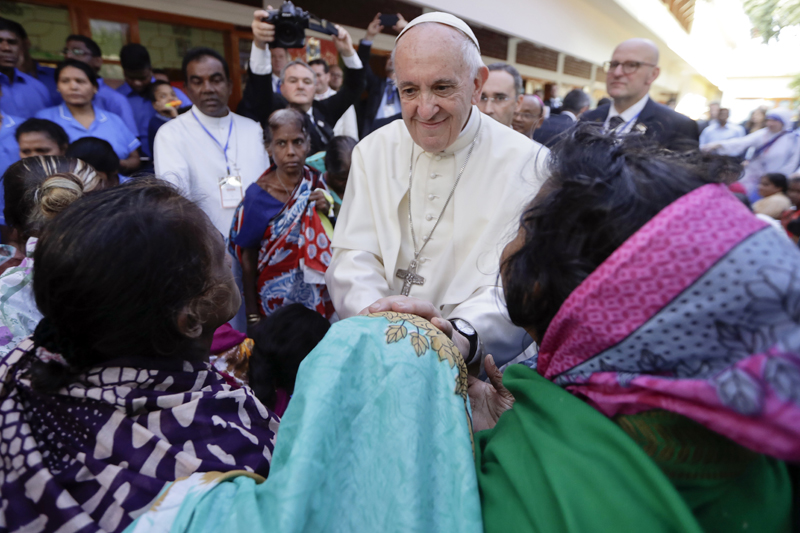
In this Saturday, Dec. 2, 2017, file photo, Pope Francis visits the Mother Teresa House in Dhaka’s Tejgaon neighborhood, Bangladesh. Pope Francis is wrapping up his Asian trip with a visit to an orphanage and home for the disabled run by Mother Teresa’s order and a meeting with Bangladeshi priests and nuns. Photo: Andrew Medichini / AP
Sister Nathalie Becquart, whom Francis named to one of the highest Vatican jobs, said his legacy was a vision of a church where men and women existed in a relationship of reciprocity and respect.
“It was about shifting a pattern of domination — from human being to the creation, from men to women — to a pattern of cooperation,” said Becquart, the first woman to hold a voting position in a Vatican synod.
The church as refuge
While Francis did not allow women to be ordained, the voting reform was part of a revolutionary change in emphasizing what the church should be: a refuge for everyone — “todos, todos, todos” (“everyone, everyone, everyone”) — not for the privileged few. Migrants, the poor, prisoners and outcasts were invited to his table far more than presidents or powerful CEOs.
“For Pope Francis, it was always to extend the arms of the church to embrace all people, not to exclude anyone,” said Cardinal Kevin Farrell, whom Francis named as camerlengo, taking charge after a pontiff’s death or retirement.
Francis demanded his bishops apply mercy and charity to their flocks, pressed the world to protect God’s creation from climate disaster, and challenged countries to welcome those fleeing war, poverty and oppression.
An Amazon indigenous girl gives Pope Francis a plant during the offertory of a Mass for the closing of Amazon synod in St. Peter’s Basilica at the Vatican, Sunday, Oct. 27, 2019. (AP Photo/Alessandra Tarantino)
After visiting Mexico in 2016, Francis said of then-U.S. presidential candidate Donald Trump that anyone building a wall to keep migrants out “is not Christian.”
While progressives were thrilled with Francis’ radical focus on Jesus’ message of mercy and inclusion, it troubled conservatives who feared he watered down Catholic teaching and threatened the very Christian identity of the West. Some even called him a heretic.
A few cardinals openly challenged him. Francis usually responded with his typical answer to conflict: silence.
He made it easier for married Catholics to get an annulment, allowed priests to absolve women who had had abortions and decreed that priests could bless same-sex couples. He opened debate on issues like homosexuality and divorce, giving pastors wiggle room to discern how to accompany their flocks, rather than handing them strict rules to apply.
St. Francis of Assisi as a model
Francis lived in the Vatican hotel instead of the Apostolic Palace, wore his old orthotic shoes and not the red loafers of the papacy, and rode in compact cars. It wasn’t a gimmick.
“I see clearly that the thing the church needs most today is the ability to heal wounds and to warm the hearts of the faithful,” he told a Jesuit journal in 2013. “I see the church as a field hospital after battle.”
If becoming the first Latin American and first Jesuit pope wasn’t enough, Francis was also the first to name himself after St. Francis of Assisi, the 13th century friar known for personal simplicity, a message of peace, and care for nature and society’s outcasts.
Francis sought out the unemployed, the sick, the disabled and the homeless. He formally apologized to Indigenous peoples for the crimes of the church from colonial times onward.
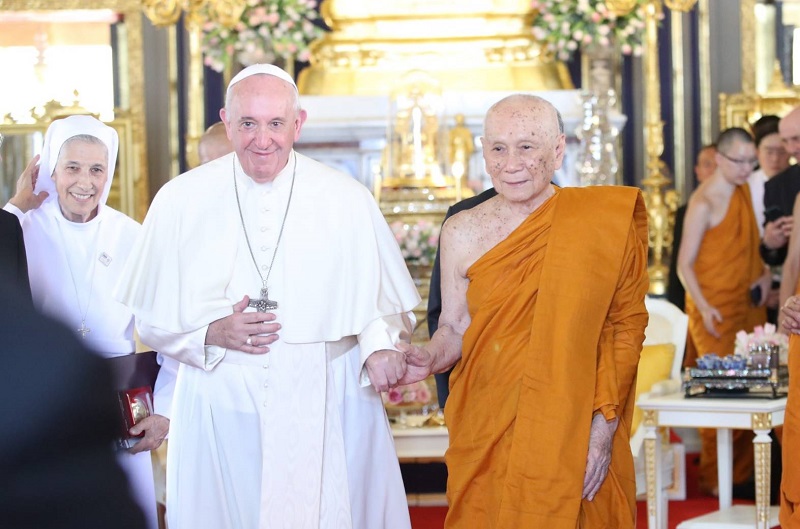
Pope Francis and Supreme Patriarch Ariyavongsagatanana together at Ratchabophit Temple in Bangkok on November 21, 2019
And he himself suffered: He had part of his colon removed in 2021, then needed more surgery in 2023 to repair a painful hernia and remove intestinal scar tissue. Starting in 2022 he regularly used a wheelchair or cane because of bad knees, and endured bouts of bronchitis.
He went to society’s fringes to minister with mercy: caressing the grossly deformed head of a man in St. Peter’s Square, kissing the tattoo of a Holocaust survivor, or inviting Argentina’s garbage scavengers to join him onstage in Rio de Janeiro.
“We have always been marginalized, but Pope Francis always helped us,” said Coqui Vargas, a transgender woman whose Roman community forged a unique relationship with Francis during the pandemic.
His first trip as pope was to the island of Lampedusa, then the epicenter of Europe’s migration crisis. He consistently chose to visit poor countries where Christians were often persecuted minorities, rather than the centers of global Catholicism.
Friend and fellow Argentine, Bishop Marcelo Sánchez Sorondo, said his concern for the poor and disenfranchised was based on the Beatitudes — the eight blessings Jesus delivered in the Sermon on the Mount for the meek, the merciful, the poor in spirit and others.
“Why are the Beatitudes the program of this pontificate? Because they were the basis of Jesus Christ’s own program,” Sánchez said.
Missteps on sexual abuse scandal
But more than a year passed before Francis met with survivors of priestly sexual abuse, and victims’ groups initially questioned whether he really understood the scope of the problem.
Francis did create a sex abuse commission to advise the church on best practices, but it lost its influence after a few years and its recommendation of a tribunal to judge bishops who covered up for predator priests went nowhere.
And then came the greatest crisis of his papacy, when he discredited Chilean abuse victims in 2018 and stood by a controversial bishop linked to their abuser. Realizing his error, Francis invited the victims to the Vatican for a personal mea culpa and summoned the leadership of the Chilean church to resign en masse.
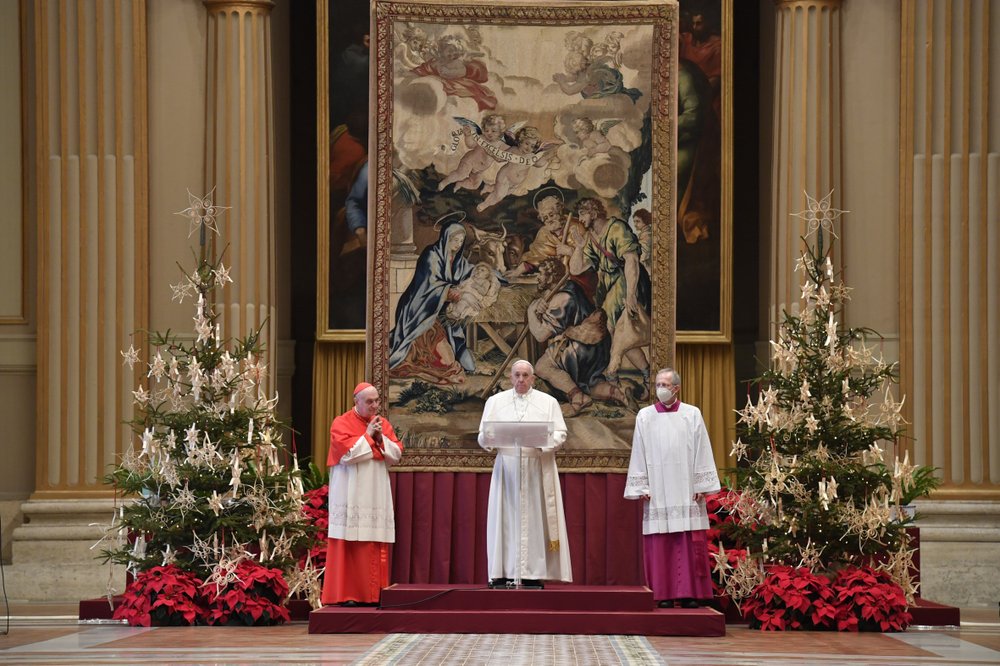
Pope Francis, center, delivers the Urbi et Orbi (Latin for ‘to the city and to the world’ ) Christmas’ day blessing inside the blessing hall of St. Peter’s Basilica, at the Vatican, Friday, Dec. 25, 2020. (Vatican Media via AP)
As that crisis concluded, a new one erupted over ex-Cardinal Theodore McCarrick, the retired archbishop of Washington and a counselor to three popes.
Francis had actually moved swiftly to sideline McCarrick amid an accusation he had molested a teenage altar boy in the 1970s. But Francis nevertheless was accused by the Vatican’s one-time U.S. ambassador of having rehabilitated McCarrick early in his papacy.
Francis eventually defrocked McCarrick after a Vatican investigation determined he sexually abused adults as well as minors. He changed church law to remove the pontifical secret surrounding abuse cases and enacted procedures to investigate bishops who abused or covered for their pedophile priests, seeking to end impunity for the hierarchy.
“He sincerely wanted to do something and he transmitted that,” said Juan Carlos Cruz, a Chilean abuse survivor Francis discredited who later developed a close friendship with the pontiff.
A change from Benedict
The road to Francis’ 2013 election was paved by Pope Benedict XVI’s decision to resign and retire — the first in 600 years — and it created the unprecedented reality of two popes living in the Vatican.
Francis didn’t shy from Benedict’s potentially uncomfortable shadow. He embraced him as an elder statesman and adviser, coaxing him out of his cloistered retirement to participate in the public life of the church.
“It’s like having your grandfather in the house, a wise grandfather,” Francis said.
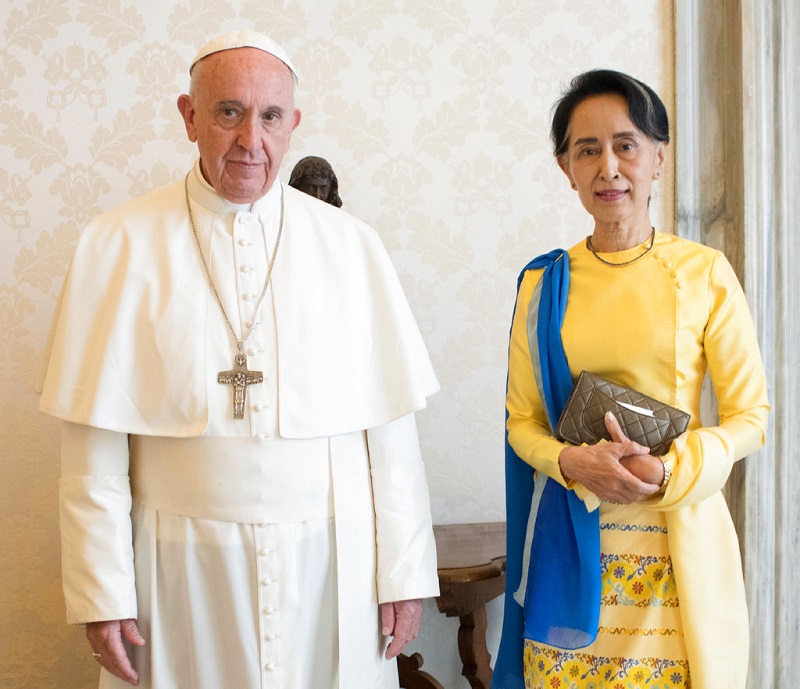
State Counsellor and Union Minister for Foreign Affairs of the Republic of the Union of Myanmar Aung San Suu Kyi, right, poses with Pope Francis on the occasion of their private audience at the Vatican on May 4, 2017. Photo: Associated Press
Francis praised Benedict by saying he “opened the door” to others following suit, fueling speculation that Francis also might retire. But after Benedict’s death on Dec. 31, 2022, he asserted that in principle the papacy is a job for life.
Francis’ looser liturgical style and pastoral priorities made clear he and the German-born theologian came from very different religious traditions, and Francis directly overturned several decisions of his predecessor.
He made sure Salvadoran Archbishop Óscar Romero, a hero to the liberation theology movement in Latin America, was canonized after his case languished under Benedict over concerns about the credo’s Marxist bent.
Francis reimposed restrictions on celebrating the old Latin Mass that Benedict had relaxed, arguing the spread of the Tridentine Rite was divisive. The move riled Francis’ traditionalist critics and opened sustained conflict between right-wing Catholics, particularly in the U.S., and the Argentine pope.
Conservatives oppose Francis
By then, conservatives had already turned away from Francis, betrayed after he opened debate on allowing remarried Catholics to receive the sacraments if they didn’t get an annulment — a church ruling that their first marriage was invalid.
“We don’t like this pope,” headlined Italy’s conservative daily Il Foglio a few months into the papacy, reflecting the unease of the small but vocal traditionalist Catholic movement that was coddled under Benedict.
Those same critics amplified their complaints after Francis’ approved church blessings for same-sex couples, and a controversial accord with China over nominating bishops.
Its details were never released, but conservative critics bashed it as a sellout to communist China, while the Vatican defended it as the best deal it could get with Beijing.
U.S. Cardinal Raymond Burke, a figurehead in the anti-Francis opposition, said the church had become “like a ship without a rudder.”
Burke waged his opposition campaign for years, starting when Francis fired him as the Vatican’s supreme court justice and culminating with his vocal opposition to Francis’ 2023 synod on the church’s future.
Twice, he joined other conservative cardinals in formally asking Francis to explain himself on doctrine issues reflecting a more progressive bent, including on the possibility of same-sex blessings and his outreach to divorced and civilly remarried Catholics.
Francis eventually sanctioned Burke financially, accusing him of sowing “disunity.” It was one of several personnel moves he made in both the Vatican and around the world to shift the balance of power from doctrinaire leaders to more pastoral ones.
Francis insisted his bishops and cardinals imbue themselves with the “odor of their flock” and minister to the faithful, voicing displeasure when they didn’t.
His 2014 Christmas address to the Vatican Curia was one of the greatest public papal reprimands ever: Standing in the marbled Apostolic Palace, Francis ticked off 15 ailments that he said can afflict his closest collaborators, including “spiritual Alzheimer’s,” lusting for power and the “terrorism of gossip.”
Trying to eliminate corruption, Francis oversaw the reform of the scandal-marred Vatican bank and sought to wrestle Vatican bureaucrats into financial line, limiting their compensation and ability to receive gifts or award public contracts.
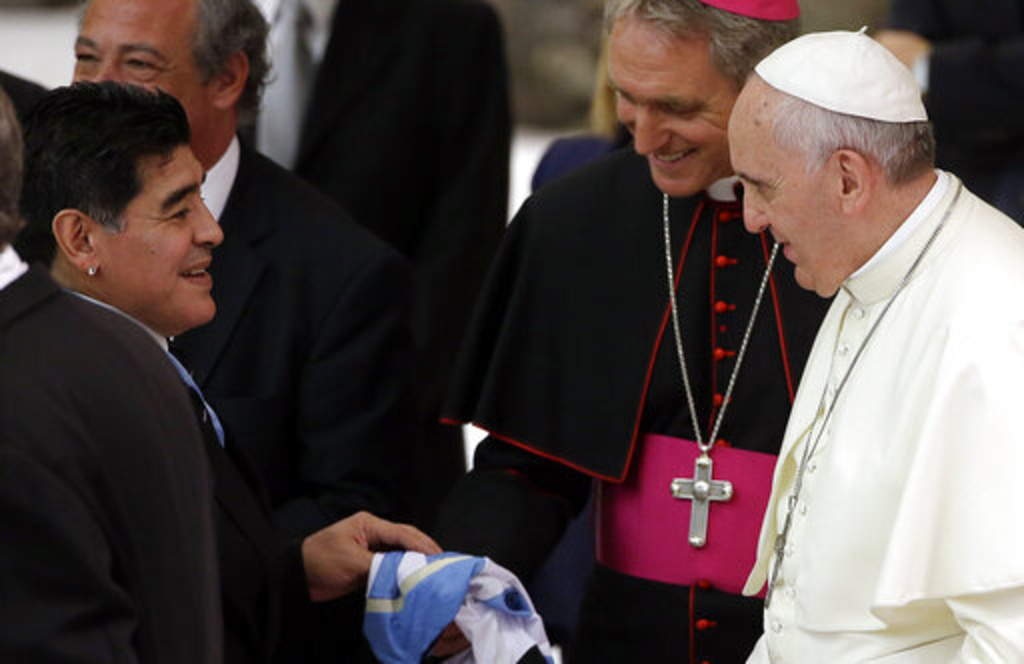
FILE – Argentine soccer legend Diego Armando Maradona, left, greets Pope Francis in the Paul VI hall at the Vatican, Monday, Sept. 1, 2014. (AP Photo/Gregorio Borgia, File)
He authorized Vatican police to raid his own secretariat of state and the Vatican’s financial watchdog agency amid suspicions about a 350 million euro investment in a London real estate venture. After a 2 1/2-year trial, the Vatican tribunal convicted a once-powerful cardinal, Angelo Becciu, of embezzlement and returned mixed verdicts to nine others, acquitting one.
The trial, though, proved to be a reputational boomerang for the Holy See, showing deficiencies in the Vatican’s legal system, unseemly turf battles among monsignors, and how the pope had intervened on behalf of prosecutors.
While earning praise for trying to turn the Vatican’s finances around, Francis angered U.S. conservatives for his frequent excoriation of the global financial market that favors the rich over the poor.
Economic justice was an important themes of his papacy, and he didn’t hide it in his first meeting with journalists when he said he wanted a “poor church that is for the poor.”
In his first major teaching document, “The Joy of the Gospel,” Francis denounced trickle-down economic theories as unproven and naive, based on a mentality “where the powerful feed upon the powerless” with no regard for ethics, the environment or even God.
“Money must serve, not rule!” he said in urging political reforms.
He elaborated on that in his major eco-encyclical “Praised Be,” denouncing the “structurally perverse” global economic system that he said exploited the poor and risked turning Earth into “an immense pile of filth.”
Some U.S. conservatives branded Francis a Marxist. He jabbed back by saying he had many friends who were Marxists.
Soccer, opera and prayer
Born Dec. 17, 1936, in Buenos Aires, Jorge Mario Bergoglio was the eldest of five children of Italian immigrants.
He credited his devout grandmother Rosa with teaching him how to pray. Weekends were spent listening to opera on the radio, going to Mass and attending matches of the family’s beloved San Lorenzo soccer club. As pope, his love of soccer brought him a huge collection of jerseys from visitors.
He said he received his religious calling at 17 while going to confession, recounting in a 2010 biography that, “I don’t know what it was, but it changed my life. … I realized that they were waiting for me.”
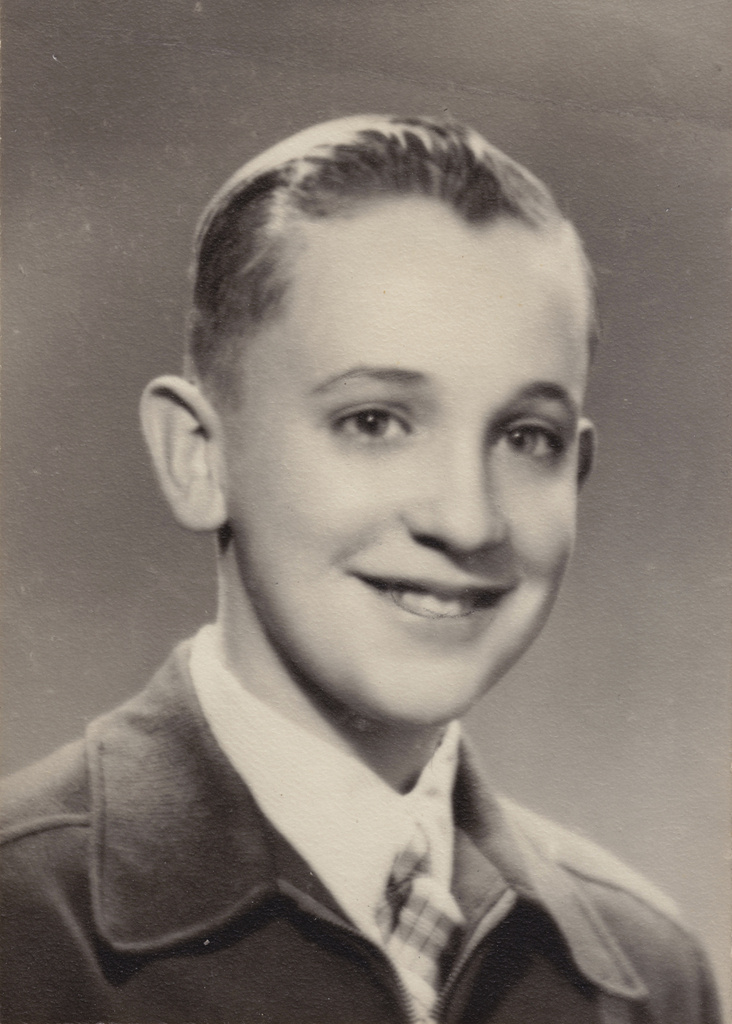
FILE – This undated file photo made available by Maria Helena Bergoglio shows Jorge Mario Bergoglio as a teenager in Buenos Aires, Argentina. (Bergoglio family photo via AP, File)
He entered the diocesan seminary but switched to the Jesuit order in 1958, attracted to its missionary tradition and militancy.
Around this time, he suffered from pneumonia, which led to the removal of the upper part of his right lung. His frail health prevented him from becoming a missionary, and his less-than-robust lung capacity was perhaps responsible for his whisper of a voice and reluctance to sing at Mass.
On Dec. 13, 1969, he was ordained a priest, and immediately began teaching. In 1973, he was named head of the Jesuits in Argentina, an appointment he later acknowledged was “crazy” given he was only 36. “My authoritarian and quick manner of making decisions led me to have serious problems and to be accused of being ultraconservative,” he admitted in his Civilta Cattolica interview.
Life under Argentina’s dictatorship
His six-year tenure as provincial coincided with Argentina’s murderous 1976-83 dictatorship, when the military launched a campaign against left-wing guerrillas and other regime opponents.
Bergoglio didn’t publicly confront the junta and was accused of effectively allowing two slum priests to be kidnapped and tortured by not publicly endorsing their work.
He refused for decades to counter that version of events. Only in a 2010 authorized biography did he finally recount the behind-the-scenes lengths he used to save them, persuading the family priest of feared dictator Jorge Videla to call in sick so he could say Mass instead. Once in the junta leader’s home, Bergoglio privately appealed for mercy. Both priests were eventually released, among the few to have survived prison.
As pope, accounts began to emerge of the many people — priests, seminarians and political dissidents — whom Bergoglio actually saved during the “dirty war,” letting them stay incognito at the seminary or helping them escape the country.
Bergoglio went to Germany in 1986 to research a never-finished thesis. Returning to Argentina, he was stationed in Cordoba during a period he described as a time of “great interior crisis.” Out of favor with more progressive Jesuit leaders, he was eventually rescued from obscurity in 1992 by St. John Paul II, who named him an auxiliary bishop of Buenos Aires. He became archbishop six years later, and was made a cardinal in 2001.
He came close to becoming pope in 2005 when Benedict was elected, gaining the second-most votes in several rounds of balloting before bowing out.
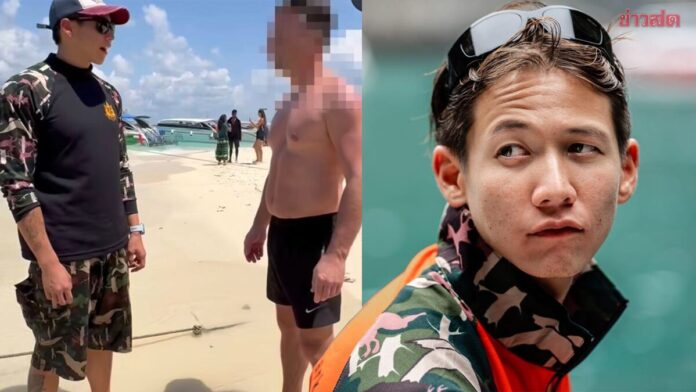
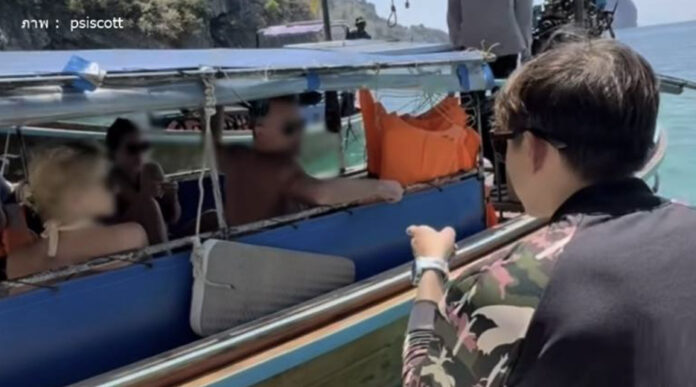
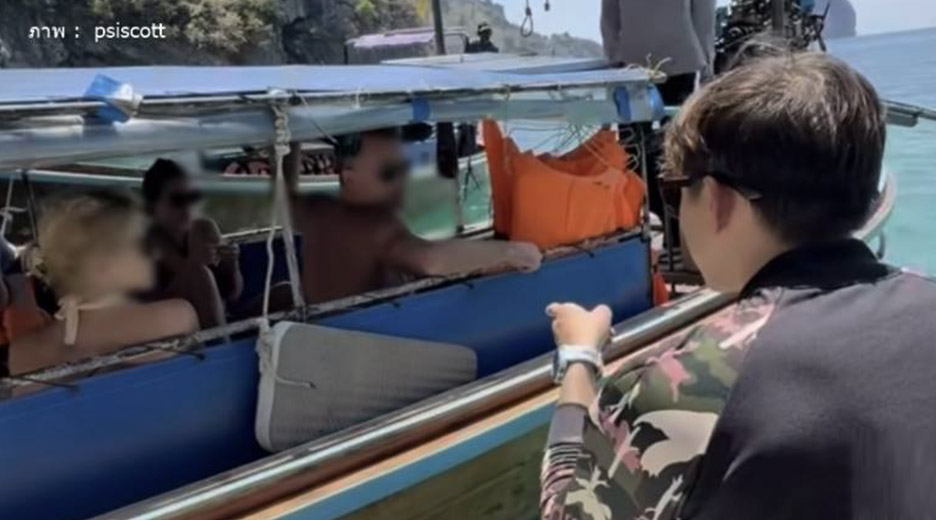
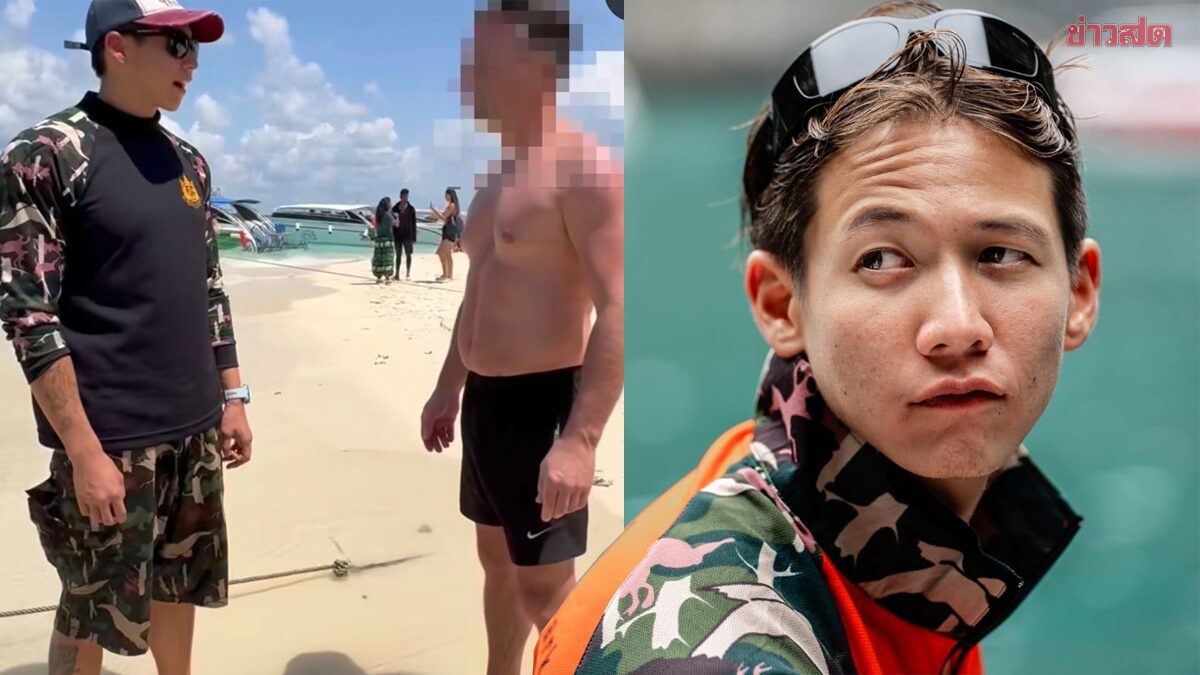
Footage from controversial video shows Siranath Bhiromphakdee, known publicly as Psi Scott, arguing with a foreign man on a beach in Krabi province.
BANGKOK — The Director-General of Thailand’s Department of National Parks, Wildlife and Plant Conservation announced plans to dismiss advisor Psi Scott within the week due to inappropriate behavior involving the viral of “Ni Hao” controversy, and wasn’t willing to improve himself.
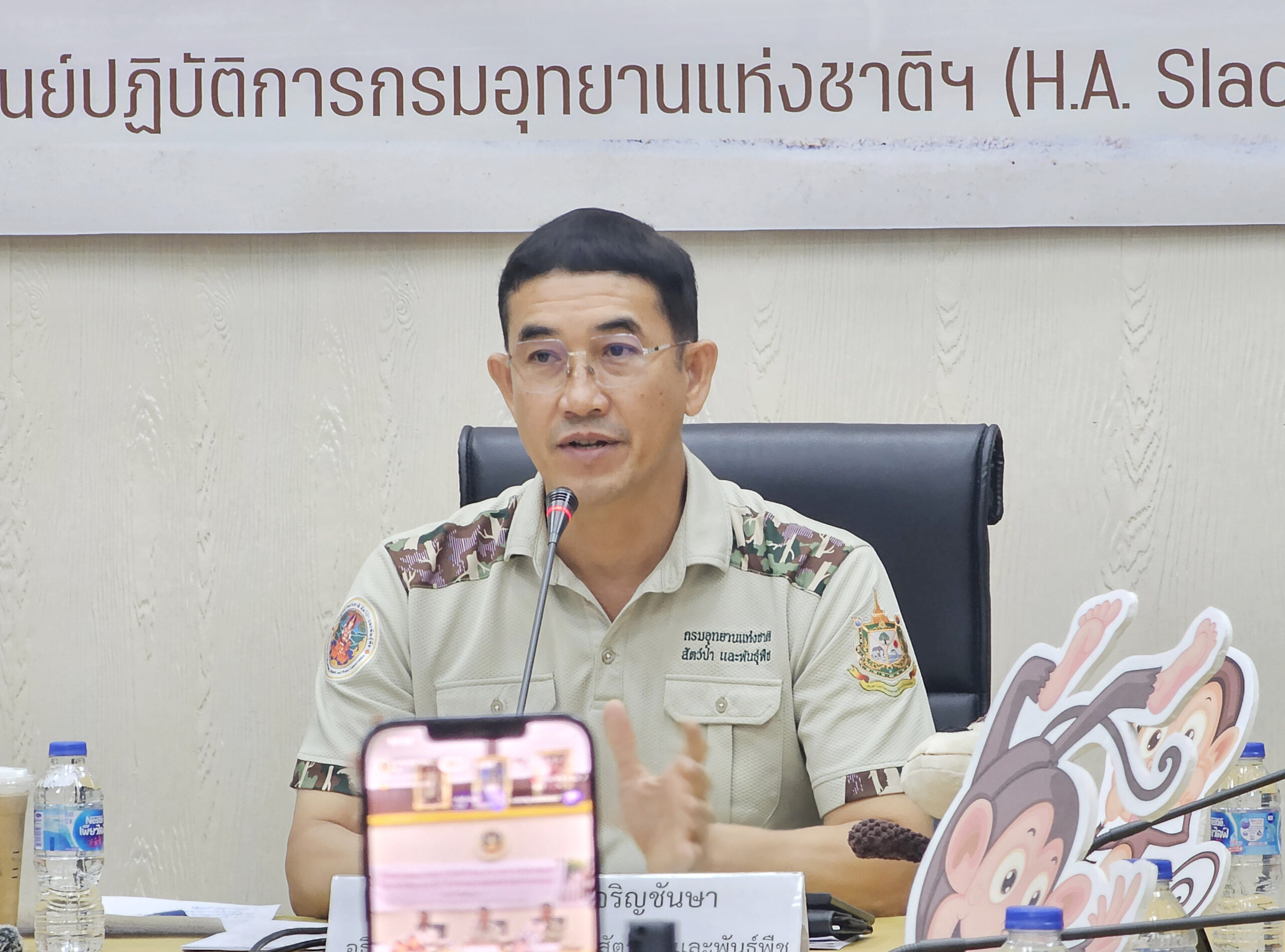
Mr. Athapol Charoenchansa, Director-General of the Department of National Parks, Wildlife and Plant Conservation, stated on April 21 regarding the case of Siranath Bhiromphakdee, known publicly as Psi Scott, his advisor, who published a video criticizing foreign tourists because he was displeased at being greeted in Chinese with “Ni Hao,” which he perceived as racial discrimination.
Athapol said that initially he did not intend to dismiss Psi Scott from his advisory position because he saw him as a new generation person with work dedication, and had recommended that he improve his work approach. However, Psi Scott went on to elaborate and gave challenging interviews.
Athapol Charoenshunsa
“He received credit because the Department of National Parks gave him the opportunity to work, but with this kind of behavior, within this week, I will have the National Parks Office consider reviewing and canceling his advisory appointment due to inappropriate behavior and refusal to accept correction after being warned,” Mr. Attapol said.
Psi Scott’s action has sparked widespread debate on Thai social media about whether such a greeting constitutes racial discrimination.
The controversial video clip captures Siranath Bhiromphakdee, known publicly as Psi Scott, arguing with a foreign man on a beach in Krabi province.
According to Scott, he took offense when the man greeted him in Chinese and then appeared to laugh mockingly after he informed him of the reason that they could not hire a guide to take a boat to an island. Scott subsequently confronted the Russian tourist again and demanded he board a boat to leave the area.
The incident has divided public opinion. Some Thais consider the greeting racially insensitive and have shared similar experiences, while others believe Scott overreacted. Some foreigners have posted response videos suggesting Thais should similarly stop referring to all Westerners as “farang” (foreigner).
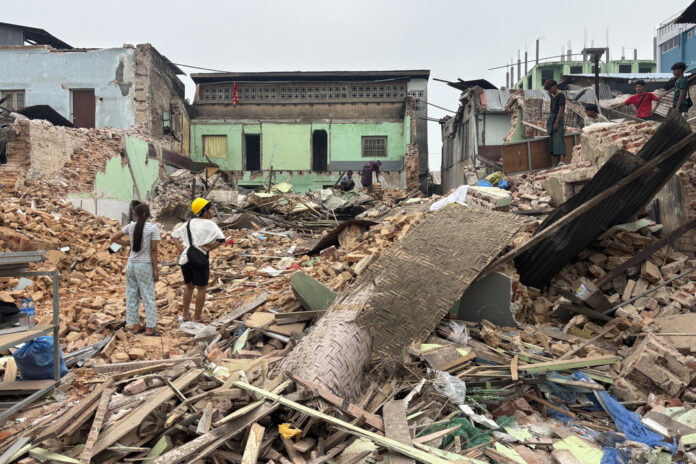
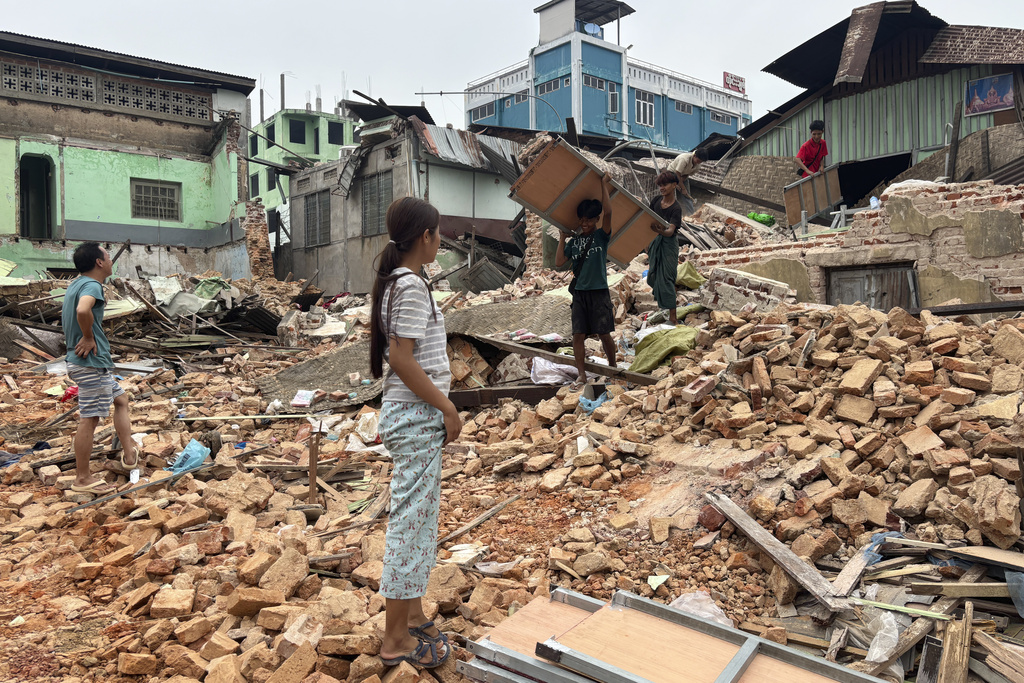
People clean debris from damaged buildings in the aftermath of an earthquake on March 28, in Naypyitaw, Myanmar, Monday, April 7, 2025. (AP Photo)
BANGKOK (AP) — Basic services have yet to be restored to the areas of Myanmar worst hit by a huge earthquake three weeks ago, and emergency workers recovering bodies and clearing debris are contending with regular aftershocks and lack of resources, humanitarian services say.
A situation report issued late Friday by the U.N. Office for the Coordination of Humanitarian Affairs, or OCHA, said frequent strong aftershocks continue to shake central Myanmar almost daily, increasing fear and uncertainty among affected residents, disrupting response effort s and exacerbating the pressure on already limited resources and services.
“Three weeks after catastrophic twin earthquakes hit Myanmar on 28 March, the worst-affected communities are still without safe shelter, clean water and sanitation, stable electricity, health care and essential services,” the report said.
Rescuers clean debris from damaged roads in the aftermath of the March 28 earthquake in Naypyitaw, Myanmar, Thursday, April 10, 2025. (AP Photo)
The epicenter of the 7.7 magnitude quake was near Mandalay, Myanmar’s second-largest city, but it hit a wide swath of the country, causing significant damage to six regions and states including the capital, Naypyitaw.
It also worsened an already dire humanitarian crisis triggered by the country’s civil war that had internally displaced more than 3 million people and left nearly 20 million in need, according to the United Nations.
A report in the state-run Myanma Alinn newspaper published on Saturday said the quake’s death toll had reached 3,726, with 5,105 people injured and 129 still missing. It said 1,975 international rescuers and medical workers from 25 countries had collaborated with local rescuers in saving 653 people and recovering 753 bodies from under rubble.
Myanma Alinn said 65,096 houses and buildings, 2,514 schools, 4,317 Buddhist monasterial living quarters, 6,027 pagodas and temples, 350 hospitals and clinics, 170 bridges, 586 dams and 203 sections of the country’s main highway were damaged by the earthquake.
People clean debris from damaged buildings in the aftermath of an earthquake on March 28, in Naypyitaw, Myanmar, Monday, April 7, 2025. (AP Photo)
Myanmar Fire Services Department, an official emergency services agency operating in many areas of the country, said in statements posted Friday on its Facebook page that rescue workers were carrying out relief, search and cleaning debris from the big buildings, and had returned valuable jewelry, cash, and documents found among the rubble to their owners.
It also said that rescuers recovered two bodies from collapsed buildings in Mandalay.
An official from Myanmar Rescue Federation (Mandalay), which has been operating along with the firefighters, told The Associated Press on Friday that the priority three weeks on from the earthquake was to clear bodies and debris from under bigger buildings, while also providing assistance to the survivors affected by the earthquake.
The official, who spoke on the condition of anonymity because he fears arrest for speaking without authorization, said the number of bodies recovered daily has decreased to only one or two.
Another emergency services worker in Mandalay, similarly speaking on condition of anonymity, said the number of rescue teams operating in Mandalay has been steadily decreasing as most of the international rescue teams had returned to their countries after their work to find survivors was considered completed. He said local rescue workers were mainly participating in clearing debris and providing assistance.
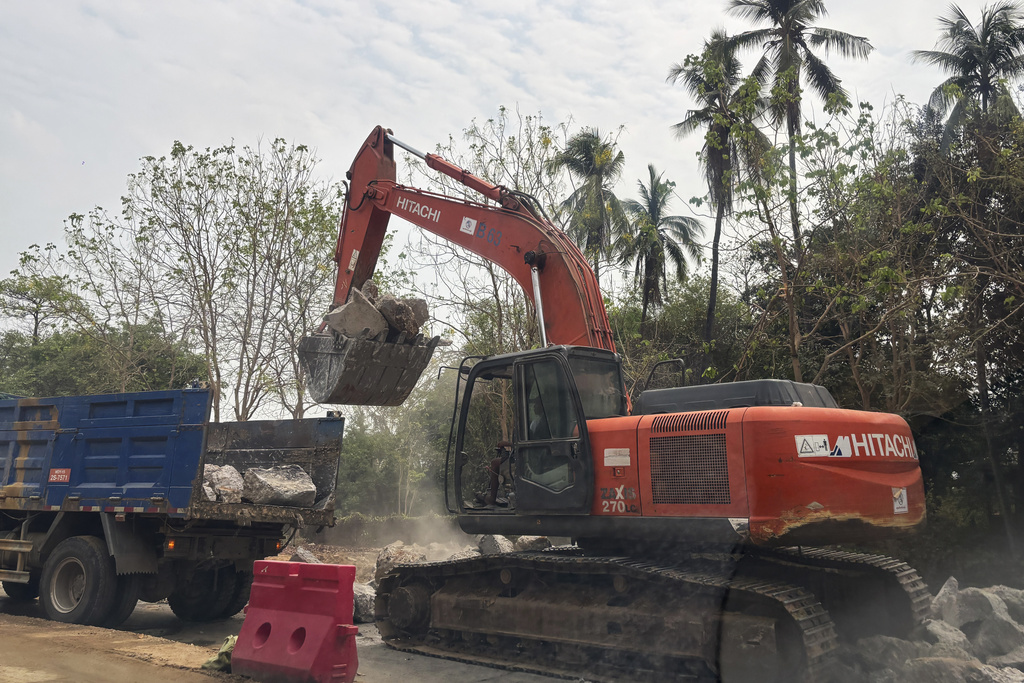
The United Nations Development Program earlier this month estimated that at least 2.5 million tons, or roughly 125,000 truckloads, of debris from the quake needs to be removed. It based its estimate on remote sensing analysis of images obtained by satellites.
UN-Habitat, the U.N. agency for human settlements, said in a statement on Friday that its staff and the Myanmar Engineering Society were collaborating in assessing widespread building damage in earthquake-affected regions.
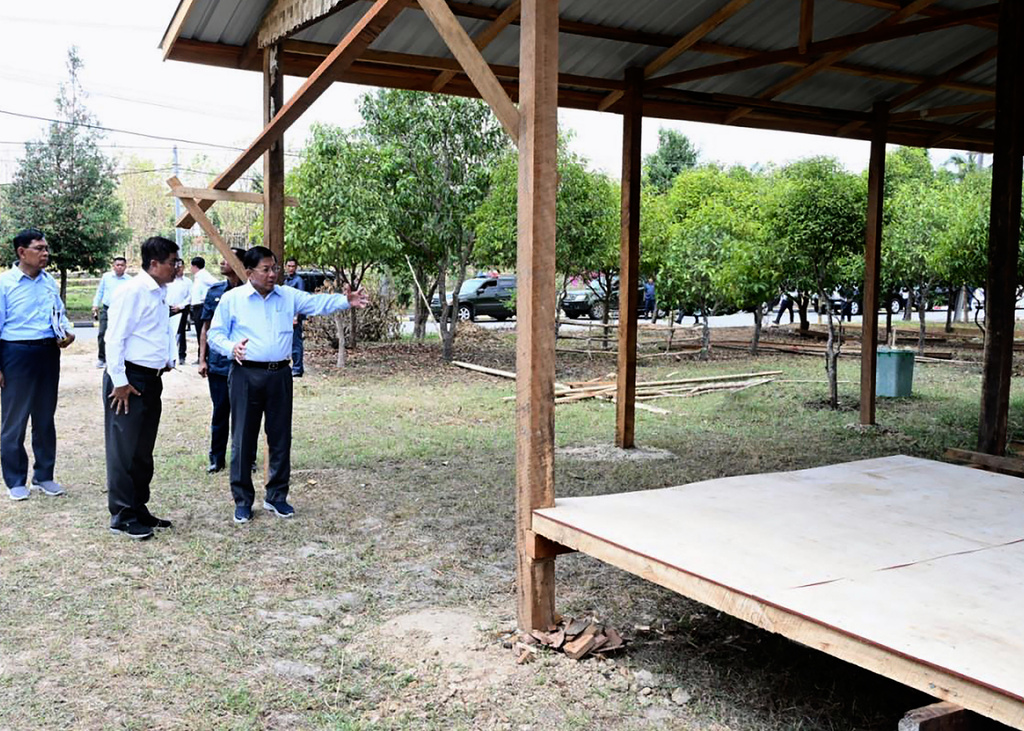
In this photo provided by Myanmar Military True News Information Team on April 18, 2025, Myanmar military chief Senior Gen. Min Aung Hlaing, third from left, inspects construction site for temporary government office in Naypyitaw, Myanmar, the country’s capital. (Myanmar Military True News Information Team via AP)
In Naypyitaw, almost all rescuers have ceased their relief efforts, while government buildings that were damaged by the earthquake have not yet been repaired and remain in their post-earthquake condition, said a resident who asked not to be named for security reasons. In residential areas, people have almost completed clearing the debris on their own.
Saturday’s report in Myanma Alinn said Senior Gen. Min Aung Hlaing, head of the military government, told his Cabinet members during a meeting on Friday that the urban layout of Naypyitaw will be redesigned.
Naypyitaw became Myanmar’s capital in 2006 after being built at great expense almost from scratch next to what had once been a logging center inhabited by largely by farmers. It is notable for its grandiose government buildings and under-utilized multi-lane roads.
Footage from controversial video shows Siranath Bhiromphakdee, known publicly as Psi Scott, arguing with a foreign man on a beach in Krabi province.
Is using Chinese greeting “ni hao” (你好 or hello) on Thais by Westerners considered a racist move?
The question was fiercely debated since yesterday when a viral video showing a national park advisor in Krabi province telling a Russian couple that their vacation on an island is over after were found enjoying themselves on the island during off-limits period by hiring a guide to take the boat there, and when informed about why it’s not permissible, the Russian man replied to Mr Siranath Bhiromphakdee, AKA Sai Scott, the park advisor, with the word “ni hao”.
Siranath then went ballistic and told the two their vacation on the island is over for the day and if the man repeated the Chinese greeting again, he would be “deported”.
Siranath, a self-avowed marine environmentalist who refuses to eat seafood because he doesn’t want to harm marine life, is a scion of one of the richest Thai families, (Singha Beer wealth, if you need to know). He posted the video clip of the confrontation on his FB page, which has 213K followers and explained the incident in English. The video on Saturday was posted as news by a British tabloid news outlet.
“To come to Thailand, and not even have the respect to know the difference between Thailand and China is extremely racist. You cannot plan a vacation here to enjoy our natural resources and ignore the Thai people who live in the country. Something as small as saying “Ni Hao” to a Thai person, it’s not only disrespectful to Thais, but to Asians as Asia is not one nationality. It would be like me going to England and thinking it was the same as Russia,” Siranath wrote five days ago.
To be fair to the Russian tourist, we do not know what his exact intention was but all we have was the video where the sound quality wasn’t the best.
This writer will not dwell on whether who is right or wrong in this particular encounter but to try to explain why some Thais get offended when greeted by the words “ni hao”.
First, whether it is offensive or “racist” or not, depends on the context. If a Westerner greets a Thai like this abroad, particularly in the West, and then laughs, or follows it up with gibberish Chinese like “ching chong ching chong, etc” or mimick Bruce Lee’s movement, or makes slanted eyes, then yes, it definitely is. It’s a racist generalization of Chinese identity, which ends up lumping Thais in as Chinese – disregard of whether the offender is aware of the difference between the two nations and cultures.
Furthermore, it must be understood that China has a population of 1.4 billion, so Westerners are often more familiar with China than Thailand. It’s similar to how Thais unfamiliar with the West might expect all Westerners they encounter in Thailand to be first-and-foremost American, and to be able to speak fluent English.
If a Westerner greets a Thai in Thailand with “ni hao,” it might mean they are either completely unaware that Thai language is different from Chinese, conflated Thailand with Taiwan, or they think the particularly Thai person they encountered are Chinese because the person look Chinese (due to the Thai person’s Chinese ancestry).
Or perhaps they are too lazy to bother to learn Thai or the word “sawasdee,” or they think China is the big brother of Asia and Chinese language can be used anywhere in Asia, something akin to the use of English elsewhere. Depending on the context, Thais who know a bit about foreign countries should understand that it’s just a greeting.
Nevertheless, some Thais, like Siranath, feel that it’s a rejection of Thailand’s distinct identity from China, and triggered on their fears that Thailand is becoming an economic and cultural colony of China.
This is especially the case if Thais hear this kind of greeting in an already negative context (as happened in the controversial video), coupled with the recipient’s past negative experiences in the West of being mocked with racist caricatures like mimicking slanty eyes, or called “chinaman”. In this case, some Thais could get triggered and might suddenly explode, like this well-known case.
in conclusion: The Thai government, especially the Ministry of Culture, the Ministry of Foreign Affairs, the Tourism Authority of Thailand (and even Thai restaurants abroad), should promote the word “sawasdee” more and promote soft power more effectively.
BTW, and don’t forget that some Westerners also feel that the Thai word “farang” (foreigner) is problematic. Caution should be exercised when using it.
For example, one Westerner said that some Thais laughed when a Westerner (farang) eats guava, which is also called “farang” in Thai, and laugh. Whether the word farang, which probably originated from the Persian word “farangi” which originally referred to the Franks, or a Germanic tribe in Europe, is derogatory, and a neutral description of caucasians of various nationalities by Thais, should be the topic for another column, however, and Westerners familiar with Thailand are also divided on the matter, just like some Thais who don’t mind being greeted with the words “ni hao” while others get triggered.
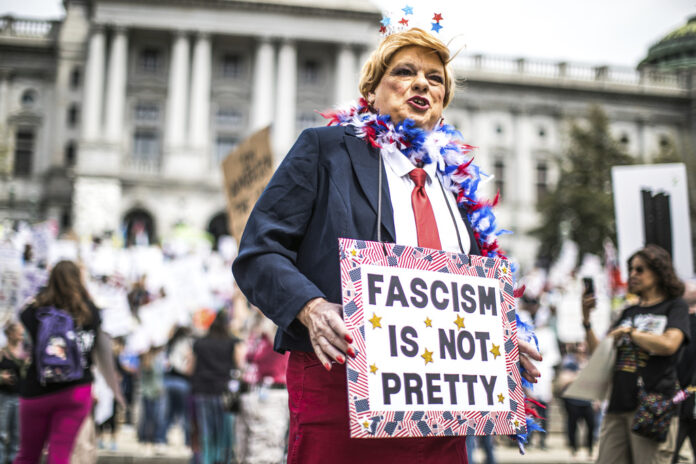
Protesters rally at the state capitol in Harrisburg, Pa., during the Day of Action protest against the Trump Administration. Saturday, April 19, 2025. (Zach Gleiter/The Patriot-News via AP)
NEW YORK (AP) — Opponents of President Donald Trump’s administration took to the streets of communities large and small across the U.S. on Saturday, decrying what they see as threats to the nation’s democratic ideals.
The disparate events ranged from a march through midtown Manhattan and a rally in front of the White House to a demonstration at a Massachusetts commemoration of “the shot heard ’round the world” on April 19, 1775, marking the start of the Revolutionary War 250 years ago.
Thomas Bassford was among the demonstrators at the reenactment of the Battles of Lexington and Concord outside Boston. The 80-year-old retired mason from Maine said he believes Americans are under attack from their own government and need to stand up against it.
“This is a very perilous time in America for liberty,” said Bassford, who was with his partner, daughter and two grandsons. “I wanted the boys to learn about the origins of this country and that sometimes we have to fight for freedom.”
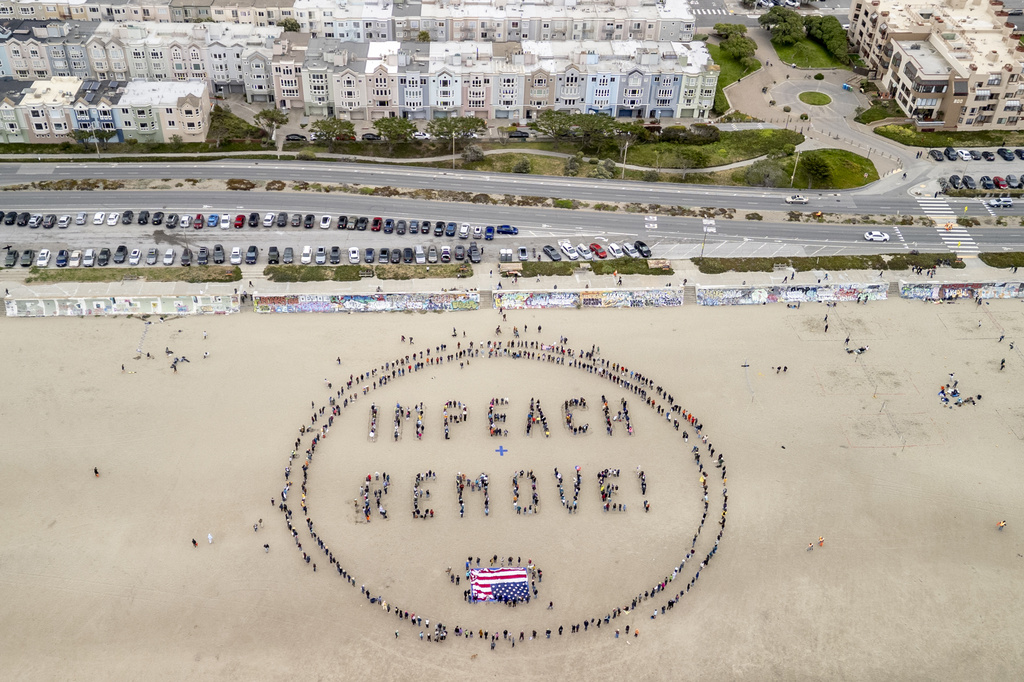
Protesters form a “Impeach & Remove” human banner on Ocean Beach during a protest against U.S. President Donald Trump, in San Francisco, Saturday, April 19, 2025. (Stephen Lam/San Francisco Chronicle via AP)
In Denver, hundreds of protesters gathered at the Colorado State Capitol with banners expressing solidarity with immigrants and telling the Trump administration: “Hands Off!” People waved U.S. flags, some of them held upside down to signal distress.
Thousands of people also marched through downtown Portland, Oregon, while in San Francisco, hundreds spelled out the words “Impeach & Remove” on a sandy beach along the Pacific Ocean, also with an inverted U.S. flag. People walked through downtown Anchorage, Alaska, with handmade signs listing reasons why they were demonstrating, including one that one that read: “No sign is BIG enough to list ALL of the reasons I’m here!”
Elsewhere protests were planned outside Tesla car dealerships against billionaire Trump adviser Elon Musk and his role in downsizing the federal government. Others organized more community service-oriented events such as food drives, teach-ins and volunteering at local shelters.
Some of the events drew on the spirit of the Revolutionary War, calling for “no kings” and resistance to tyranny.
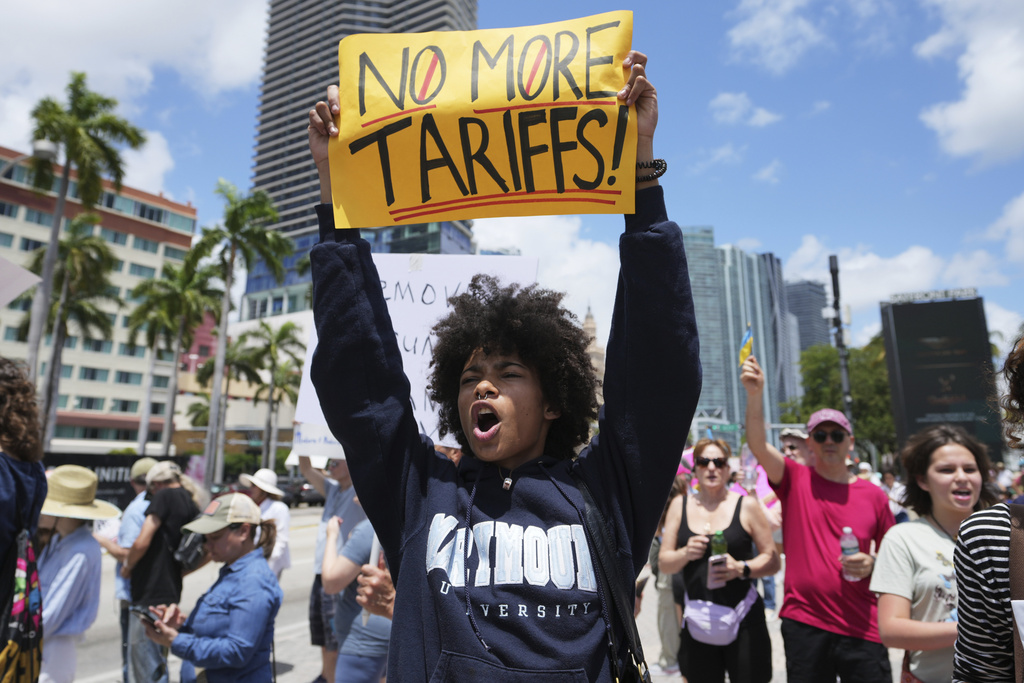
Paul Ivanov chants slogans during a protest against the Trump administration, Saturday, April 19, 2025, in Miami. (AP Photo/Lynne Sladky)
In Anchorage, a colonial reenactor in colonial garb held up a “No Kings” sign while the person next to him hoisted cardboard that read in part: “The Feudal Age is OVER.”
Boston resident George Bryant, who was among those at the Concord protest, said he is concerned that the president is creating a “police state.” He held a sign saying, “Trump fascist regime must go now!”
“He’s defying the courts. He’s kidnapping students. He’s eviscerating the checks and balances,” Bryant said. “This is fascism.”
In Washington, Bob Fasick, a 76-year-old retired federal employee from Springfield, Virginia, said he came out to the rally near the White House out of concern over threats to constitutionally protected due process rights, Social Security and other federal safety-net programs.
“I cannot sit still knowing that if I don’t do anything and everybody doesn’t do something to change this, that the world that we collectively are leaving for the little children, for our neighbors is simply not one that I would want to live,” Fasick said.
In Columbia, South Carolina, several hundred people protested at the statehouse holding signs with slogans such as “Fight Fiercely, Harvard, Fight.”
And in Manhattan, protesters rallied against continued deportations of immigrants as they marched from the New York Public Library north toward Central Park and past Trump Tower.
“No fear, no hate, no ICE in our state,” they chanted to a steady drumbeat, referring to the U.S. Immigration and Customs Enforcement.
Marshall Green said he is most concerned that Trump invoked the wartime Alien Enemies Act of 1798 by claiming the country is at war with Venezuelan gangs linked to the South American nation’s government, even though a recent U.S. intelligence assessment found no coordination between them.
“Congress should be stepping up and saying no, we are not at war. You cannot use that,” said the 61-year-old from Morristown, New Jersey. “You cannot deport people without due process, and everyone in this country has the right to due process no matter what.”
Meanwhile Melinda Charles, of Connecticut, said she worries about “executive overreach,” citing clashes with the federal courts, Harvard University and other elite colleges.
“We’re supposed to have three equal branches of government,” she said, “and to have the executive branch become so strong, I mean it’s just unbelievable.”
__
Associated Press writers Claire Rush in Oregon, Joseph Frederick in New York, Rodrique Ngowi in Massachusetts, Nathan Ellgren in Washington and Meg Kinnard in Columbia, South Carolina, contributed.
Footage from controversial video shows Siranath Bhiromphakdee, known publicly as Psi Scott, arguing with a foreign man on a beach in Krabi province.
BANGKOK — A viral video showing a tourism advisor to Thailand’s National Park Department confronting a tourist for greeting him with the Chinese phrase “Ni Hao” (Hello) has sparked widespread debate on Thai social media about whether such a greeting constitutes racial discrimination.
The controversial clip captures Siranath Bhiromphakdee, known publicly as Psi Scott, arguing with a foreign man on a beach in Krabi province. According to Scott, he took offense when the man greeted him in Chinese and then appeared to laugh mockingly after he informed him of the reason that they could not hire a guide to take a boat to an island. Scott subsequently confronted the Russian tourist again and demanded he board a boat to leave the area.
The incident has divided public opinion. Some Thais consider the greeting racially insensitive and have shared similar experiences, while others believe Scott overreacted. Some foreigners have posted response videos suggesting Thais should similarly stop referring to all Westerners as “farang” (foreigner).
Footage from controversial video shows Siranath Bhiromphakdee, known publicly as Psi Scott, arguing with a foreign man on a beach in Krabi province.
In a television interview, Psi Scott claimed he was dismissed from his advisory position at the National Park Department despite doing nothing wrong, saying he was merely teaching the foreigner not to display racist behavior.
However, on April 19, Attapol Charoenchansa, Director-General of the National Park, Wildlife and Plant Conservation Department, denied issuing any dismissal order. He explained that advisory positions operate on annual contracts, and formal termination requires official documentation. Attapol stated he had only messaged Scott via Line app suggesting he adjust his working approach and understand the boundaries of his advisory role.
“Scott’s media interviews have negatively impacted the Department and created misunderstandings. I need to clarify our perspective and emphasize that I don’t want this issue to escalate further, as it damages our agency’s reputation,” Attapol said.
The Director-General added that Scott’s role was limited to providing counsel, not serving as a forest protection officer. He revealed he had previously reprimanded Scott and made allowances for him multiple times, as marine park chiefs had reported discomfort with Scott’s social media content creation activities.
Footage from controversial video shows Siranath Bhiromphakdee, known publicly as Psi Scott, arguing with a foreign man on a beach in Krabi province.
“Personal content creation in protected areas requires permission. I’d like Scott to remain calm and return to our collaborative work. My criticism was intended to keep our operations moving forward. When he performs well, I offer praise and encouragement,” Attapol explained.
The dispute shows no signs of resolution, as on the same day, 68 tour guides and tourism operators from Krabi province submitted a formal complaint to both the National Park Department Director-General and the Krabi Governor. They requested an investigation into Scott’s behavior, accusing him of falsely claiming to be a government official and using social media to attack local individuals and businesses.
The complaint alleges that Scott frequently publishes images and videos of local tourism businesses and individuals on his personal social media without fact-checking, damaging their reputations with unfair accusations. This has created conflict between businesses, park officials, and local communities, undermining conservation and sustainable tourism cooperation.
“While local operators are willing to work with the National Park Department to preserve natural resources, Scott’s behavior obstructs this collaboration. Working together should be based on transparency, respect for local communities, and fair practices—not the abuse of power,” the complaint stated.
The tourism operators also requested that the Department establish clear standards and criteria for appointing advisors to ensure transparency and appropriateness for the Department’s mission.
Special Investigation Department (DSI) officers apprehend Mr. Zhang Chuanling, a board member of China Railway No. 10 (Thailand) Company Limited at a luxury hotel in the Ratchadaphisek area of Bangkok on April 19, 2025.
BANGKOK — Thai authorities have made their first arrest following the collapse of the 33-story State Audit Office building in Bangkok. Mr. Zhang Chuanling, a board member of China Railway No. 10 (Thailand) Company Limited, was taken into custody on April 19.
Special Investigation Department (DSI) officers apprehended Zhang at a luxury hotel in the Ratchadaphisek area of Bangkok. During questioning at DSI headquarters, Zhang requested an interpreter and legal representation.
The DSI investigation, led by Police Lieutenant Colonel Yutthana Phraedam, has been ongoing since April 4, following the March 28 building collapse. The State Audit Office building was the only structure in Bangkok to collapse following the earthquake in Myanmar.
Special Investigation Department (DSI) officers apprehend Mr. Zhang Chuanling, a board member of China Railway No. 10 (Thailand) Company Limited at a luxury hotel in the Ratchadaphisek area of Bangkok on April 19, 2025.
Investigators are focusing on allegations that China Railway was operating in Thailand using nominees and had formed a joint venture with Italian-Thai Development Public Company Limited to secure the construction contract for the State Audit Office building.
DSI officials, working with other agencies, have collected evidence, interviewed witnesses, and searched four key locations: Car Hub Company Limited, PKW Joint Venture, W. and Colleagues Consultants Company Limited, and PN Synchronize Company Limited.
Authorities have also seized 24 containers stored beneath the parking structure of the collapsed building. These containers reportedly held important documents related to the construction site operations of the ITD-CREC Joint Venture and PKW Joint Venture.
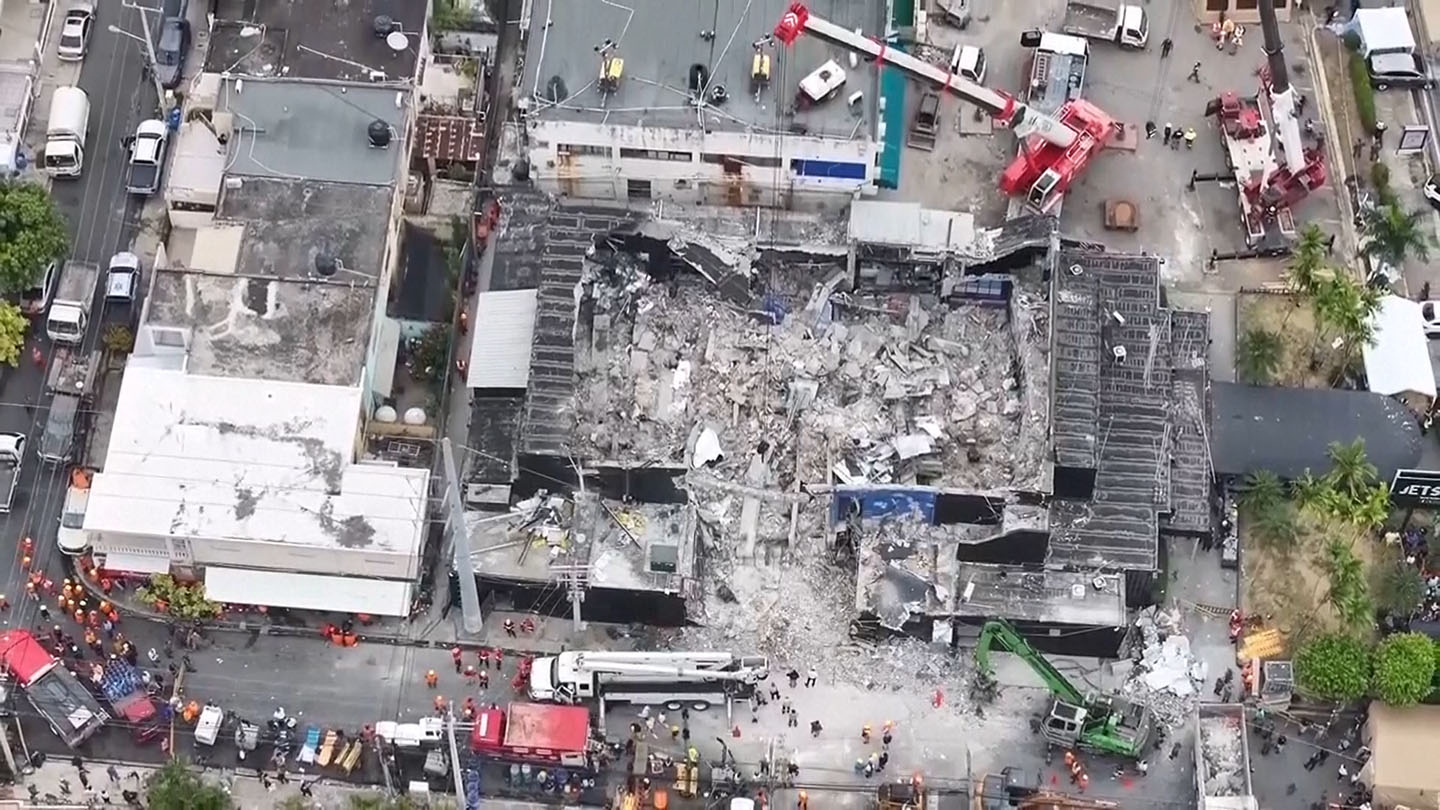
Construction supervisors of the State Audit Office building holding a sign written in Thai and Chinese that reads: ‘Celebration ceremony for the completion of structural work, Construction Project of the (New) Office of the Auditor General,’ CREC, April 3, 2024.Rescue workers search for bodies at the Jet Set nightclub after its roof collapsed during a merengue concert in Santo Domingo, Dominican Republic, Thursday, April 10, 2025. (AP Photo/Matias Delacroix)
Based on evidence gathered, the Criminal Court has approved arrest warrants for Zhang and three Thai shareholders: Mr. Manas Sri-anan, Mr. Prachuab Sirikhet, and Mr. Sophon Meechai.
According to investigation reports, Zhang is listed as a director of China Railway No. 10. The company is registered at 493 Soi Phuttha Bucha, Branch 11, Bang Mot Subdistrict, Thung Khru District, Bangkok.
The company’s ownership structure shows 51% Thai ownership: Sophon holds 40.7997%, Prachuab holds 10.2%, and Manas holds 0.0003%. The remaining 49% is owned by a single Chinese national, Mr. Zhang.
Authorities are continuing their efforts to apprehend the remaining suspects for questioning.