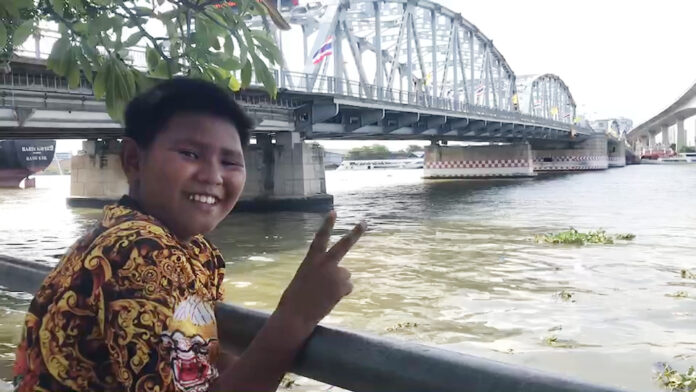
Klao, a 12-year-old boy, poses in front of Bangkok Bridge in the Bang Kho Laem district where he rescued a 17-year-old girl from the Chao Phraya river. He shares his story during an interview on Nov. 24, 2024.
BANGKOK — In a remarkable display of courage, a 12-year-old boy saved the life of a 17-year-old girl who attempted to jump from Bangkok Bridge in the Bang Kho Laem district. The incident, which went viral on social media, occurred at 7:13 PM on November 22.
According to report, the young hero, identified only as “Klao,” was fishing on the bridge when his line got tangled. After climbing down to retrieve it, he heard a splash and desperate cries for help. Despite being the only swimmer among his group of five friends, Klao immediately jumped into action when he heard the girl shouting, “Help me! I don’t want to die!”
Klao offers aromatic inhalants to comfort a 17-year-old girl after rescuing her from the Chao Phraya river on Nov. 22, 2024.
“I was scared of drowning too, but I had to help,” Klao told reporters during an interview at his family’s rice porridge shop in Soi Charoen Krung 107. He managed to grab the girl’s arm and pull her to safety, during which she confessed, “I wanted to die, but now I’ve changed my mind.”
After the rescue, the girl requested help to contact her friends. While waiting for help to arrive, Klao and his friends provided her with inhalants as she appeared exhausted. Police officers and rescue workers from the Poh Teck Tung Foundation arrived at the scene shortly after.
Supawan Thai-tanadrop, Klao’s 31-year-old mother, initially couldn’t believe her son had performed such a daring rescue in the Chao Phraya River. “I’m proud of his bravery and willingness to help others,” she said.
Supawan also shared a message for the young woman: “Please think carefully before taking such actions. Life’s problems can always be solved, and we can keep moving forward.”
The incident ended safely with the girl’s father arriving to take her home, while her friends expressed their gratitude to the young hero. Klao’s final message to the girl was simple but powerful: “Please don’t do this again. If I hadn’t been there, there might not have been anyone to help.”
A foreign tourist jumps in the water in Blue lagoon, in Vang Vieng, Laos, Saturday, Nov. 23, 2024. (AP Photo/Anupam Nath)
VANG VIENG, Laos (AP) — A little town known as a backpacker paradise in northern Laos has come under spotlight for a mass poisoning case that has killed at least six tourists and potentially injured scores of others.
News broke earlier this week that two Australian teens became critically ill after a night out drinking in the town of Vang Vieng. They died in Thai hospitals, with one confirmed case of methanol poisoning. A British woman was also confirmed dead. An American and two Danes also died, though their exact causes of death have not been released. A New Zealander has been sickened.
Since then, many tourists have become worried as it’s unclear how many have been affected, said Neil Farmiloe, a New Zealander who owns a restaurant in the town.
Foreign tourists ride on a hot air balloon in the sky in Vang Vieng, Laos, Saturday, Nov. 23, 2024. (AP Photo/Anupam Nath)
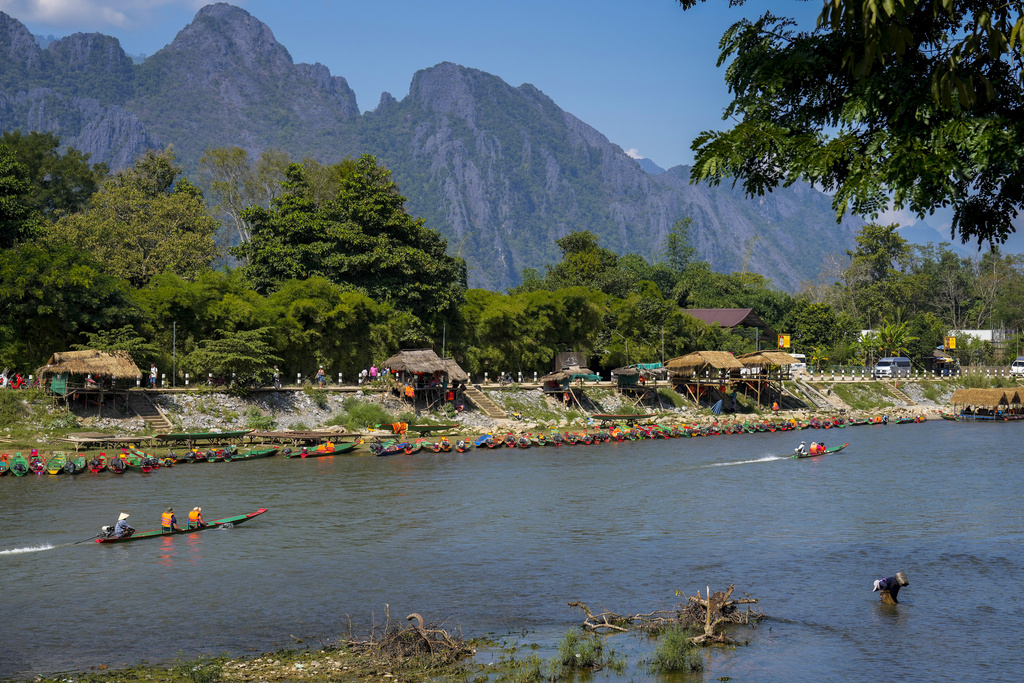
The incident has stirred up dark memories of the town once known for reckless partying involving young backpackers. But despite the tragedy, the town, especially at night, was packed by visitors in its main neighborhood bustling with bars, restaurants and food stalls. During the daytime, many kayaks floated along the river, with tourists shouting and splashing water at each other.
Frida Svedberg left Sweden five weeks ago for her big Southeast Asia trip with no firm return plan. She said she had heard about the news just before she arrived in Laos and has been bombarded with messages from concerned family members and friends. She still went ahead with her original plan to spend three nights in the town. She found it as beautiful as expected.
“Obviously it’s like a famous backpacker place. You go from Thailand Luang Prabang and then to Vang Vieng and then you keep going. I’ve just heard good things about it and it’s where most people go,” the 24-year-old said.
Vang Vieng used to be more dangerous
Landlocked Laos, a one-party communist state, is one of Southeast Asia’s poorest nations and a popular tourist destination, particularly Vang Vieng.
Soutjai Xayphankhaun, who has run his Sout Jai Guesthouse in Vang Vieng for 17 years, said the town back in 2005-2006 started to become popular among European backpackers, who were attracted by serene nature and activities like river tubing, where tourists sit on a tube and float along the Nam Song River, stopping to party at many different bars on the banks.
Foreign tourists relax with beer and food in Blue lagoon, in Vang Vieng, Laos, Saturday, Nov. 23, 2024. (AP Photo/Anupam Nath)
It could get rowdy with cheap booze, illegal drugs and river sports sometimes turning deadly. People drowned or took a fatal blow after jumping into the river on a rope swing. In 2011, the town recorded 27 deaths related to river activities, forcing the government to step in with regulations.
After that, Farmiloe said Vang Vieng has been receiving much more eclectic groups of tourists who enjoy a wider range of activities aside from nightlife. There are still a lot of young Western backpackers, but the town is also visited by many Chinese and South Koreans.
Tour agencies scattered along the main streets advertised a range of packages offering the clear turquoise water of the Blue Lagoon, serene mountaintop views and many different caves. Those more adventurous try kayaking, zip line, paragliding or hot air balloons. Tubing is still there, but with far fewer riverbank bars to visit than in the past.
Locals worry the incident could hit tourism
Vang Vieng received more than 600,000 tourists in 2023, and expected to see even more this year, the state-owned Laos News Agency quoted the district governor as saying earlier this year.
But with the latest tourist deaths, guesthouse owner Soutjai is a little worried.
“It’s about tourists and the confidence of tourists. The news was all around the world. There will definitely be an impact,” he said.
Foreign tourists ride on boat in a river in Vang Vieng, Laos, Friday, Nov. 22, 2024. (AP Photo/Anupam Nath)
Swedish tourist Anton Honkanen said what happened did affect his experience.
“I think it destroys the value of backpacking a little bit. Because everyone just enjoys this time. Maybe meeting some new people at the hostels, taking some drinks with all kinds of people from all around the world. And now I won’t do it today because of the poisoning,” he said.
Svedberg, however, said what happened was unfortunate and shouldn’t stop people from coming. “Things can happen anywhere, everywhere. So I think it doesn’t have to affect tourism. Just be cautious.”
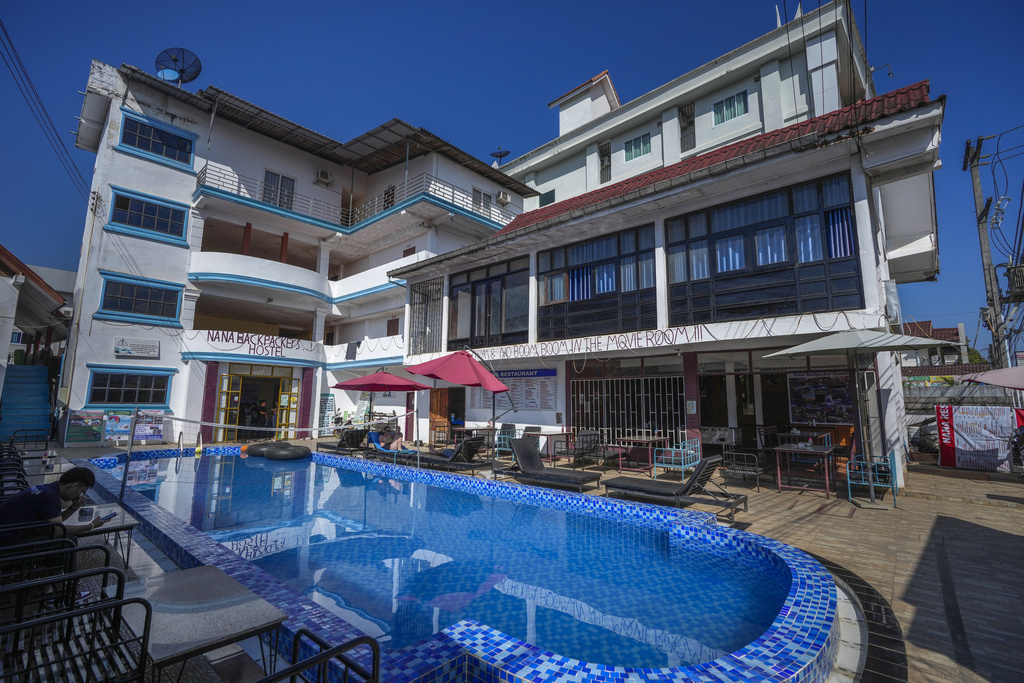
The Nana Backpacker Hostel, where the two Australian teens stayed, shut its gate on Saturday. It had not been allowed to take new guests since early this week and was accommodating the remaining visitors until Friday. Its manager and owner, who are Vietnamese, have been detained for questioning by the Lao police.
Methanol is sometimes added to mixed drinks at disreputable bars as a cheaper alternative to ethanol, but can cause severe poisoning or death. It is also a byproduct of poorly distilled homebrew liquor, and could have found its way into bar drinks inadvertently.
The Laotian government on Saturday officially acknowledged the case and promised to bring the perpetrators to justice.
Thai authorities are searching for a French tourist who went missing in a boat capsizing incident at Ratchaprapha Dam, Surat Thani Province, on Nov. 24, 2024.
SURAT THANI — An extensive search operation is underway for an elderly French tourist who went missing after a tourist boat capsized in Ratchaprapha Dam, Surat Thani Province.
The incident occurred Saturday noon, November 23, when two groups of foreign tourists departed from Ban Chiao Lan Municipal Pier in two long-tail boats, heading to their accommodations on houseboats in the reservoir.
The vessel that capsized was heading toward Ran Nang Prai raft house, opposite the scenic Three Brothers Mountain, locally known as “Thailand’s Guilin” in the Ratchaprapha Reservoir or Cheow Lan Dam in Khao Phang Subdistrict, Ban Ta Khun District, Surat Thani Province.
Local authorities establish a search center at Ban Chiao Lan pier, Ban Ta Khun District, Surat Thani Province, on Nov. 24, 2024.
The capsized boat was carrying 12 people in total: ten French tourists (four men and six women), one tour guide, and the boat driver identified as Mr. Somchart. While the group was viewing the Three Brothers Mountain, the boat encountered strong winds and thunderstorms, causing it to capsize.
The boat driver and guide managed to rescue nine passengers. One tourist, identified as Mr. Jean, was rushed to Surat Thani Hospital after inhaling water into his lungs, while Mr. Rene remains missing.
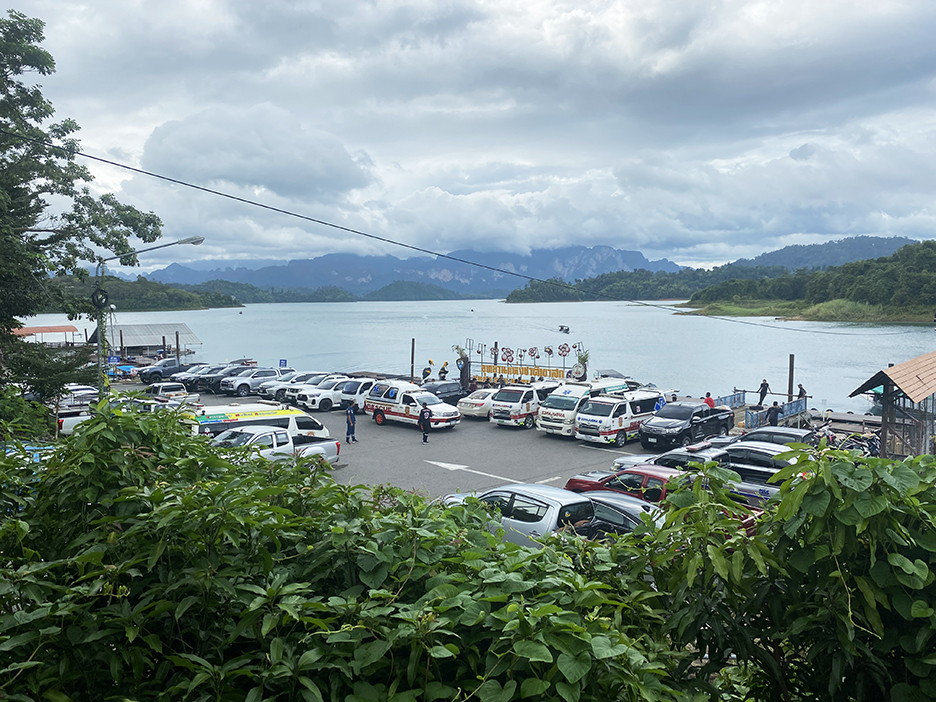
Emergency vehicles line up at Ban Chiao Lan pier, Ban Ta Khun District, Surat Thani Province, after a boat capsized at Ratchaprapha Dam on Nov. 23, 2024.
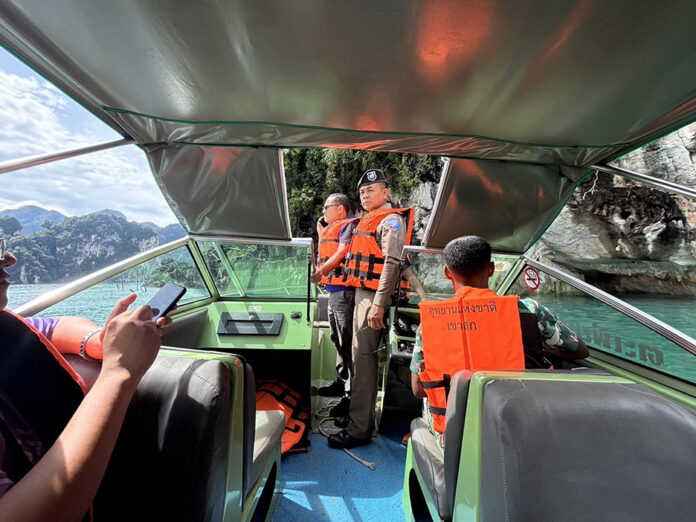
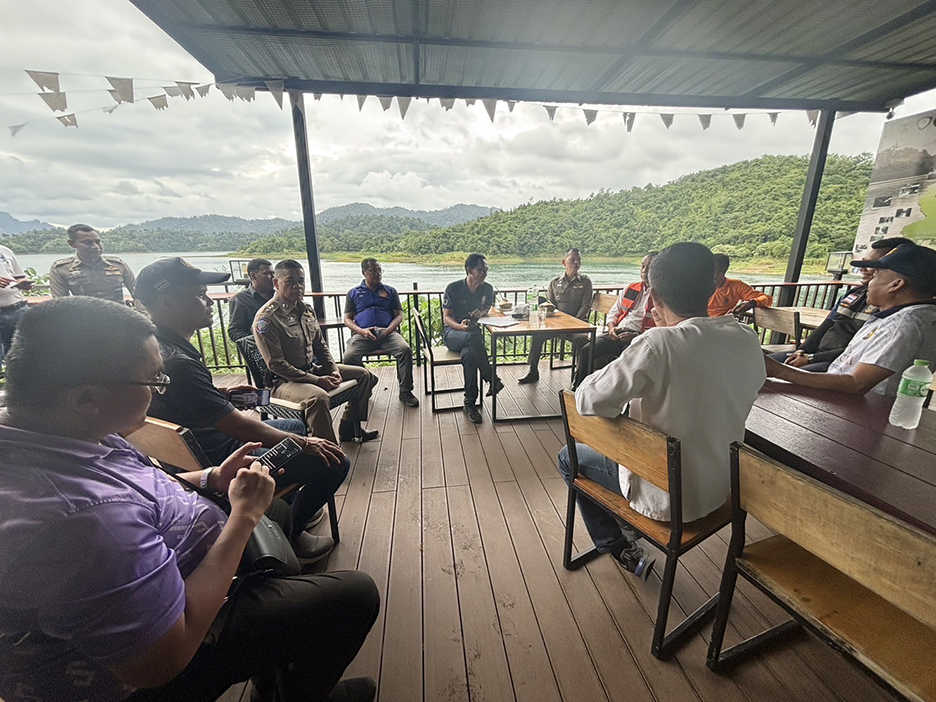
On Sunday, November 24, local authorities established a dedicated search center at Ban Chiao Lan pier. The operation is being jointly coordinated by Ban Ta Khun District Chief, Ban Chiao Lan Municipal Mayor Chaowalit Chuaysong, and the Head of Khao Sok National Park. Search teams, including park officials, municipal rescue workers, and members of the Kusolsattha Foundation, are utilizing underwater drones to scan the area where the boat sank.
This is the second serious incident at Ratchaprapha Dam this year. In February, a 24-year-old British tourist died after falling from a kayak in the same waters. In that case, the search team included Ivan Karadzic, a Danish diving instructor who had previously participated in the famous 2018 Wild Boars football team cave rescue. The British tourist’s body was recovered three days after he went missing.
The current search operation continues as teams work against time to locate the missing French tourist.
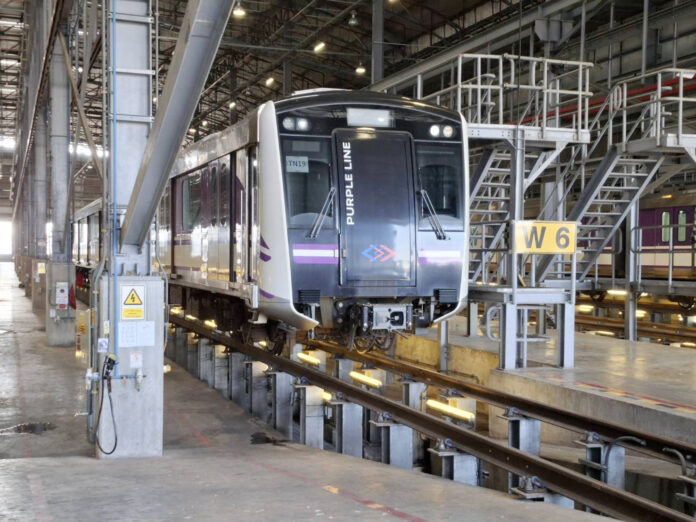
The MRT Purple Line expands the mass transit network, connecting Tao Poon MRT station to Bang Yai station. (Photo by Pravit Rojanaphruk)
L ooking at the past seven decades of Japan’s Official Development Assistance (ODA) to Thailand was like looking at how Thailand modernised herself.
Japan has dispatched 12,000 technical experts and 1,100 volunteers to Thailand over the decades, while Thailand sent 33,000 technical trainees to Japan.
The past two decades or so, in particular, saw key infrastructures developed, partly thanks to Japan’s Yen Loan (or low-interest loan) and made possible the completion of Suvarnabhumi International Airport (2006) and the MRT Blue Line (2004). (On top of 14 out of 20 bridges across the Chao Phraya River in Bangkok and nearby provinces.)
These two projects in particular, significantly improved Thailand’s and Bangkok’s infrastructures in a way one cannot fathom how things would have been without these pioneering projects.
Today, Thailand is a major global tourist destination and Bangkok’s mass transport system keeps expanding, creating new satellite towns, reducing traffic congestion, expanding the economy, and making life much more bearable.
On Wednesday, Nov 20, 2024, the Embassy of Japan in Bangkok took the opportunity to show a group of Thai press how Japan assisted Thailand on the occasion of 70 years of Japan’s ODA in Thailand.
The embassy chose two more current projects and by showing us the two projects, we can see the challenges facing Thai society today.
We were first taken to see the MRT Purple Line, which was completed through Japan’s Yen Loan and technical assistance in 2016. It expanded the mass transit network, connecting Tao Poon MRT station to that of Bang Yai station. The day trip was shepherded by Ms Kaamura Maki, the embassy’s counsellor and director of the embassy’s information centre who speaks decent Thai after two years of language lessons at Chulalongkorn University.
(Repayment period for the Purple Line is 25 years, with grace period of 7 years and interest rate of 1.4 percent. The investment cost was 63.7 billion baht). The 16 stations connected Bangkok to nearby Nonthaburi province’s Bang Yai district (about 33 kilometres from Bangkok) and enabled many to live there while conveniently commuting to Bangkok to work.
The Deputy Head of the Mission of the Embassy, Mr Nishioka Tatsushi, dropped by and delivered a short message and said Thailand is a “model case” when it comes to Japan’s ODA to a foreign country but added that as Thailand has become a middle income country, the nature of assistance and cooperation has changed.
A Thai executive at MRT Purple Line spoke to me on the condition that he is not named that going forward, Thailand will face more challenges as to how to keep the fare reasonable enough so more people will use MRT to travel from the satellite towns around Bangkok to the capital to work. (As of September 2024, 72,823 commuters use the line on average daily. )
The fare right now is a flat 20 baht per trip due to the current government’s intervention while normally and prior to that it’s 42 baht for the full length of the line, which is considerably pricey as the minimum daily wage is around 350 baht, making a round trip fare costing roughly a quarter of one’s minimum wage. I told the executive that since we don’t know how long the government can subsidise the fares, such mass transport system is in fact more of a middle-class transport system as poorer people could hardly afford to use them daily.
The executive told me more challenges lie ahead as the government has to bring the private sector to invest in new mass transit lines and that means Thailand’s mass transit fares will be one of the highest in the world. (On what Japan gets in return, the Purple Line uses Toshiba made trains and the stations were adapted from Japanese models.)
Japan’s ODA contribution to Thailand’s education system is showcased at King Mongkut’s University of Technology Thonburi. (Photo by Pravit Rojanaphruk)
Moving to the afternoon, it was a showcase of Japan’s ODA assistance in education.We were taken to meet with administrators and students of KOSEN KMUTT at King Mongkut’s University of Technology Thonburi, in the outskirts of Bangkok. Here is a new five-year engineering and biology programme for particularly bright students.
The programme was made possible through the yen loan. Japan International Cooperation Agency (JICA) also provided technical assistance via a number of Japanese lecturers teaching bright young Thais who had to pass two difficult examinations when they were in their middle school to be chosen for the five years education which was fully funded by the Thai government.
Again, these students will be ideal graduates for Japanese firms and factories in Thailand as well as other companies working in areas related to biology, engineering and beyond. (Students in the programme have the opportunity to do the last three years of their five-year course programme at counterpart universities and colleges in Japan.) Thailand will gain too, without doubt.
Unfortunately, while discussing the programme with the Thai administrators, I asked if most of these fully-funded students were basically from the upper middle class background and that most able students from poor families were left out of this programme. The answer was yes. This is another major challenge facing Thailand.
Back to Japan. We are thankful to Japan and they are still assisting Thailand through other ways such as training physically handicapped Thais to make pastry and run bakeries, help Thailand adapt to an aging society, researching on PM 2.5 problems, and more. For all these we are grateful and I am happy to say that unlike back in the 1970s when Japan was seen by some Thais as a threat that would turn Thailand into its economic colony, such fears have been proven false. Japan is no longer the Number One economic powerhouse in Asia (thus much less threatening) and the fears among Thais are now focused on China, rightly or wrongly. But that’s a topic of another column.
BANGKOK — The MICHELIN Guide Thailand has expanded its prestigious Bib Gourmand list to 156 venues, adding 20 new entries for 2025. The announcement comes ahead of the official MICHELIN Guide Ceremony scheduled for November 28, 2024.
Among the newcomers are five establishments from Chon Buri, a region making its debut in the guide. The selections range from upscale restaurants to modest street food vendors, representing approximately 15 different cuisine types including Southern Thai, Isan, and Thai Contemporary.
“Our inspectors discovered numerous simple restaurants and small eateries that are local favorites,” said Gwendal Poullennec, International Director of The MICHELIN Guides. “These establishments preserve their culinary heritage across generations, offering remarkable cuisine at pocket-friendly prices.”
Khao Lam Mae Khai Toon KlaoJanhom, a southern Thai restaurant
The Bib Gourmand distinction, symbolized by the “Michelin Man,” recognizes restaurants offering high-quality food at reasonable prices. The 2025 selection spans multiple regions, including 52 venues in Bangkok and surrounding provinces, 20 in Chiang Mai, and various establishments across Thailand’s northeastern Isan region, southern provinces, and popular tourist destinations like Phuket and Ko Samui.
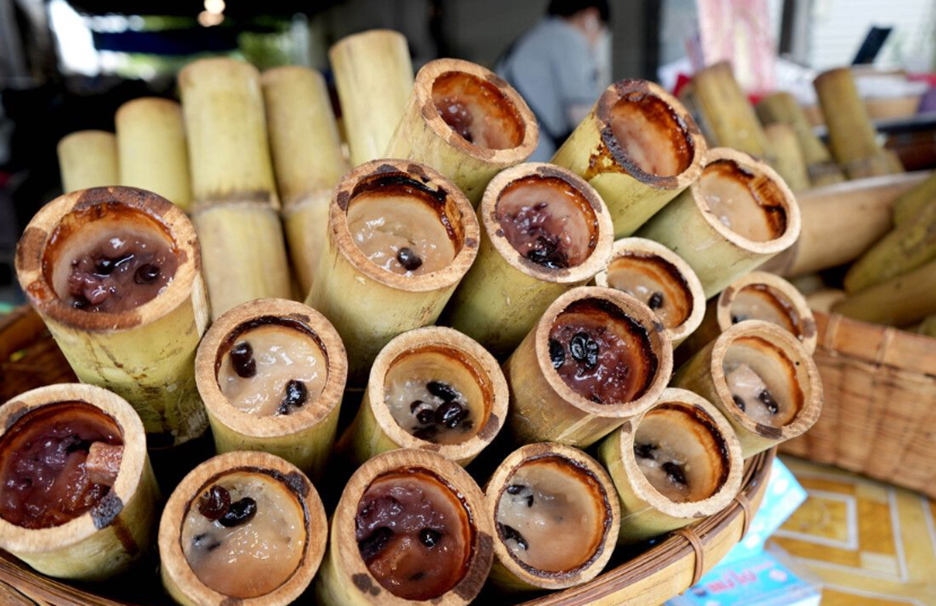
Notable new entries include Khao Mun Gai Nha Jone, a perpetually busy eatery serving delicious, tender and juicy chicken with sauces that add a real kick; Janhom, a southern Thai restaurant known for its intense flavors and house-made curry paste; Morakot Kitchen, a 120-year-old establishment famous for its authentic fish cakes; and Khao Lam Mae Khai Toon Klao, a 60-year-old dessert stall specializing in traditional sweetened sticky rice cooked in bamboo.
Natural Resources and Environmental Crime Division officers seize three complete tiger carcasses in a raid conducted in Bang Bua Thong district, Nonthaburi Province on Nov. 23, 2024.
NONTHABURI — In a collaborative effort between Thai law enforcement and US wildlife authorities, the Natural Resources and Environmental Crime Division (NRECD) has arrested a 60-year-old man in connection with illegal wildlife trafficking, seizing three complete tiger carcasses in a raid conducted in Bang Bua Thong district, Nonthaburi province.
Chalee Meepra was apprehended at his residence in Bang Rak Pattana subdistrict, where authorities discovered the tiger remains. He faces charges of “possession and trading of protected wildlife specimens without proper authorization.”
Natural Resources and Environmental Crime Division officers arrest a 60-year-old man in connection with illegal wildlife trafficking at his residence in Bang Bua Thong district, Nonthaburi province on Nov. 23, 2024.
The arrest comes as part of a broader international cooperation initiative between the United States Fish and Wildlife Service (USFWS), Thailand’s Central Investigation Bureau, the Wildlife Justice Commission (WJC), and the Department of National Parks, Wildlife and Plant Conservation.
This joint operation targets transnational wildlife trafficking networks in Southeast Asia under the US Fish and Wildlife Service Southeast Asia project.
During interrogation, Meepra confessed that the specimens were Sumatran tigers obtained from Indonesia approximately 40 years ago. He admitted to attempting to sell the carcasses, initially asking for 900,000 baht ($25,000) before negotiating down to 200,000 baht ($5,700) due to financial difficulties.
Natural Resources and Environmental Crime Division officers seize three complete tiger carcasses and brought them to Bang Bua Thong Police Station in Nonthaburi province on Nov. 23, 2024.
This case follows a recent significant arrest where authorities apprehended a 35-year-old suspect in Nakhon Sawan Province on November 19, seizing various wildlife products including tiger skins, handbags, wallets, and bear claw keychains. That suspect had been operating an online business selling products made from illegally sourced wildlife parts, primarily from Cambodia, for several years.
The case has been transferred to Bang Bua Thong Police Station for further legal proceedings as authorities continue their crackdown on wildlife trafficking in the region.
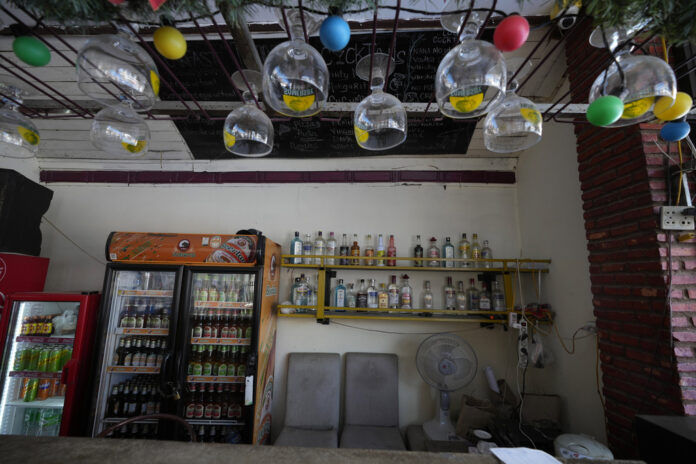
The empty bar of Nana Backpackers hostel in Vang Vieng, Laos, Friday, Nov. 22, 2024. (AP Photo/Anupam Nath)
VANG VIENG, Laos (AP) — The Laotian government on Saturday officially acknowledged the mass poisoning that has killed at least six tourists, promising it would bring perpetrators to justice.
Two Australian teenagers and a British woman died from suspected methanol poisoning after drinking tainted alcohol in Laos. An American man and two Danes also died, though their exact causes of death have not been released. A New Zealander also has been sickened.
In a short statement released to the media, the Lao government said it was “profoundly saddened over the loss of lives of foreign tourists” in the town Vang Vieng and offered its condolences to the families of the victims.
“The Government of the Lao PDR has been conducting investigations to find causes of the incident and to bring the perpetrators to justice in accordance with the law,” it said.
A foreign tourist couple rest near a swimming pool at Nana Backpackers hostel in Vang Vieng, Laos, Friday, Nov. 22, 2024. (AP Photo/Anupam Nath)
Laos is a one-party communist state with no organized opposition and the government keeps a tight lid on information. In this case, officials have released almost no details. The police have said they detained a number of people but refused to provide further information.
Details have been murky over the number of tourists affected and the possible source of the methanol-laced drinks.
Methanol is sometimes added to mixed drinks at disreputable bars as a cheaper alternative to ethanol, but can cause severe poisoning or death. It is also a byproduct of poorly distilled homebrew liquor, and could have found its way into bar drinks inadvertently.
The U.S. State Department on Friday issued a health alert for citizens traveling in Laos, warning of “suspected methanol poisoning in Vang Vieng, possibly through the consumption of methanol-laced alcoholic drinks,” following similar alerts from other countries whose citizens were involved.
Foreign tourists ride on boat in a river in Vang Vieng, Laos, Friday, Nov. 22, 2024. (AP Photo/Anupam Nath)
Nineteen-year-old Australians Bianca Jones and Holly Bowles died in Thai hospitals on Thursday and Friday respectively after being evacuated from Laos for emergency treatment. Thai authorities confirmed that Jones had died by “brain swelling due to high levels of methanol found in her system.”
Both were found sick in their room at the Nana Backpacker Hostel on Nov. 13 after they failed to check out as planned.
The U.K. Foreign Office named 28-year-old British woman Simone White as another of the victims.
Landlocked Laos is one of Southeast Asia’s poorest nations and a popular tourist destination. Vang Vieng is particularly popular among backpackers seeking partying and adventure sports.
A Singaporean man, seated in a wheelchair, is questioned by Don Mueang Police investigators after his arrest on November 22, 2024 for making a false bomb threat call at Don Mueang Airport.
BANGKOK — A Singaporean man has been arrested and faces deportation after making a false bomb threat at Bangkok’s Don Mueang International Airport, citing family-related stress as the motivation for his actions.
The incident, which occurred on Thursday, caused significant disruption when the suspect called in a bomb threat targeting an Air Asia aircraft that was taxiing for takeoff at 2:47 p.m. Police Lieutenant General Choengron RimPadee, Commander of Immigration Division 2 and spokesman for the Immigration Bureau, confirmed that the suspect, identified only as Mr. Ho, was apprehended at the airport’s passenger terminal around 7:00 p.m. on November 22.
The Singaporean suspect shows his phone while confessing to making the disruptive call to Don Mueang Airport at 14:41 on November 21, 2024.
According to immigration officials, Mr. Ho, who had overstayed his visa by 28 days, was tracked down through his phone signal within the airport premises. Upon arrest, he confessed to making the false threat, attributing his actions to stress from family problems.
The incident on November 21 caused significant disruption to Flight FD 3114, bound for Hat Yai, affecting 162 passengers and six crew members. Airport security implemented emergency protocols, requiring all passengers to disembark for screening while the aircraft underwent a thorough security check. The emergency protocols were finally lifted at 7:30 p.m.
Mr. Ho entered Thailand using an APEC Business Travel Card and had previously made several trips to the country without any criminal record. However, he now faces severe legal consequences under Thailand’s Air Navigation Act of 2015. The law stipulates that making false statements causing panic at airports or during flights carries penalties of 5-15 years imprisonment and fines ranging from 200,000 to 600,000 baht (approximately $5,700-$17,100).
A Singaporean man, seated in a wheelchair, is questioned by Don Mueang Police investigators after his arrest on November 22, 2024 for making a false bomb threat call at Don Mueang Airport.
“Following his prosecution and completion of any sentence, Mr. Ho will be deported and permanently blacklisted from entering Thailand,” stated Police Lieutenant General Choengron. He added that the suspect might face additional civil lawsuits from Don Mueang Airport, the airline, and affected passengers for damages incurred.
The Immigration Bureau issued a stern warning to both Thai nationals and foreigners, emphasizing that such pranks carry severe consequences, including criminal charges, imprisonment, and substantial civil liabilities.
“The cost of such irresponsible actions extends far beyond any momentary amusement,” concluded the Immigration spokesman. “Perpetrators face not only criminal penalties and imprisonment but also responsibility for extensive civil damages.
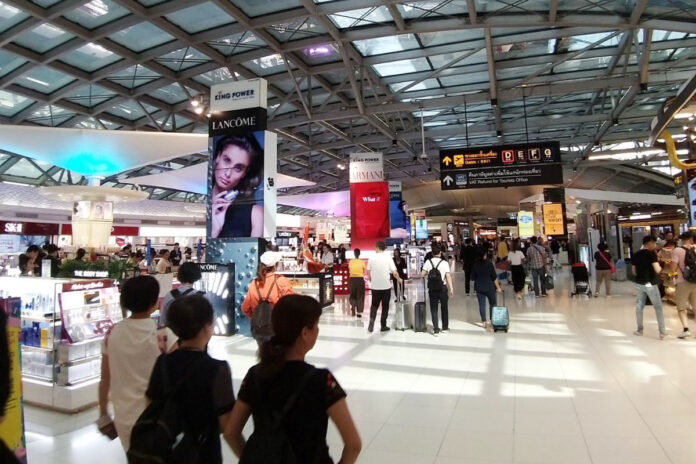
BANGKOK — Airports of Thailand (AOT) has approved a refund of $5.6 million or 193 million baht to King Power Suvarnabhumi after King Power Suvarnabhumi gave up commercial land to facilitate the expansion of Suvarnabhumi Airport’s passenger terminal planned for 2021. King Power has agreed not to seek compensation, interest or additional costs.
On November 21, 2024, Airports of Thailand Public Company Limited (AOT) announced to the Stock Exchange of Thailand its decision to proceed with the construction of the eastern expansion of Suvarnabhumi Airport’s passenger terminal.
As part of this project, part of the area outside the east side of the terminal will be reclaimed, on the second floor, where the former “City Garden” (later Food Stop) was located. This area was previously occupied by King Power Suvarnabhumi Co, Ltd (KPS) under a concession agreement for the operation of retail and service activities.
The concession agreement, which runs from September 28, 2020 to March 31, 2033, was partially affected by AOT having to reclaim the land. After King Power received formal notice from AOT, the company relinquished the specified acreage on July 30, 2021.
Duty-Free shops
King Power then applied for a replacement space of the same size in the domestic terminal to continue its catering operations for passengers and visitors. However, AOT was unable to allocate a sufficiently large replacement space due to the current capacity restrictions.
At AOT’s board meeting on November 21, 2024, the board approved the reclamation of approximately 1,257,560 square meters from King Power’s operations at Suvarnabhumi Airport, representing 4.97 percent of King Power’s total concession area at the airport (25,307,260 square meters). The reclaimed space would be used for the construction of the eastern expansion, which would take effect retroactively from July 30, 2021.
As part of the agreement, AOT will reimburse King Power 193.08 million baht. This is the minimum compensation for the second year of the agreement (April 1, 2023 – March 31, 2024) based on the reduced operating area. King Power has confirmed that it will not claim any further damages, interest or costs in connection with the reimbursement.
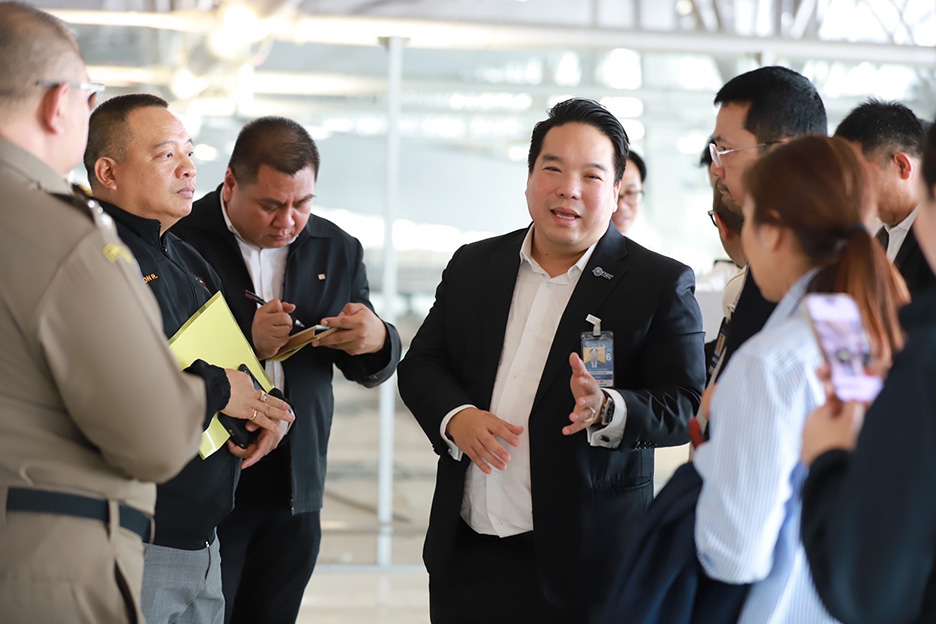
Keerati Kitmanawat, President of Airports of Thailand Public Company Limited (AoT), together with Pol. Maj. Gen. Cherngron Rimpadee, Commander of Immigration 2, inspect the services of Suvarnabhumi Airport on February 25, 2024.
AOT Net Profit Surges 118%
Meanwhile, Dr. Kirati Kitmanawat, CEO of AOT, summarized the company’s financial performance for the financial year ending September 2024. AOT reported a net profit of 19.18 billion baht ($556 million), an increase of 118.21 percent, or 10.39 billion baht ($301 million) from the previous year.
Total revenue rose to 67.83 billion baht ($1.96 billion), an increase of 40.01 percent due to a 39.43 percent increase in revenue from sales and services. This included aviation-related revenue of 31.00 billion baht, up 8.73 billion baht (39.23 percent), and non-aviation-related revenue of 36.12 billion baht, up 10.25 billion baht (39.60 percent) from the previous year.
Total expenditure reached 40.52 billion baht ($1.17 billion), an increase of 18.33 percent (6.28 billion baht). However, the growth rate of expenditure was lower than the increase in revenue, so the ratio of expenditure to revenue decreased from 70.08 percent in the previous year to 59.71 percent, reflecting improved operational efficiency.
TOKYO — Around 1,000 employees of Nissan Motor Co. in Thailand are expected to be let go or relocated by fall 2025, with the Japanese automaker grappling with a downturn in profits, an industrial source said Friday.
The move is in line with a pledge that Japan’s third-largest car company has made to cut its global workforce by about 7 percent, or 9,000 employees, by fiscal 2026 ending in March 2027, the source said.
Although Japanese carmakers have long dominated the market in Thailand, they have been facing a decline in sales as electric vehicles made by Chinese manufacturers gain a stronger foothold.
Nissan, previously led by Carlos Ghosn who was sent by France’s car producer Renault, has experienced a steep slide in sales in Thailand in recent years, reporting a 29.7 percent drop from a year earlier to 14,224 vehicles in fiscal 2023.
In Thailand, Nissan’s factories have produced four models for the domestic market and for export, such as its Kicks compact sports utility vehicle. The Japanese carmaker has been reviewing its operations in recent years.
On Thursday, Nissan said it projects some 6 percent, or around 1,000, of its employees in the United States will retire early by the end of the year.