






























27.7 C
Bangkok
Friday, June 26, 2026
Home Blog Page 978

Cambodian Court Convicts Lawyer, Dozens of Others of Treason

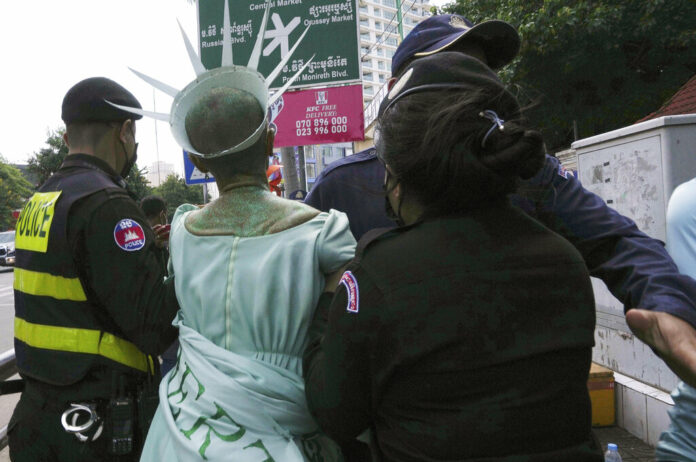
Cambodian-American lawyer Theary Seng, center, dressed in the Lady Liberty, is escorted by local police officers outside Phnom Penh Municipal Court in Phnom Penh, Cambodia, Tuesday, June 14, 2022. Photo: Heng Sinith / AP

PHNOM PENH, Cambodia (AP) — A Cambodian American lawyer and dozens of members of a now-dissolved opposition party were convicted of treason Tuesday in a trial that was the latest move to tame all opposition to the long-running rule of Prime Minister Hun Sen.

Lawyer Theary Seng and most of the other defendants had been charged over a failed attempt by the leader of the defunct Cambodia National Rescue Party to return from exile in 2019. Cambodian authorities blocked Sam Rainsy’s return and alleged the 60 defendants were involved in organizing his trip, which Theary Seng and the others have denied.

Cambodian courts are widely believed to be under the influence of Hun Sen, whose authoritarian style of rule has kept him in power for 37 years. The Cambodia National Rescue Party was his party’s biggest rival before it was disbanded by a court ruling just ahead of national elections in 2018 that resulted in a clean sweep by Hun Sen’s Cambodia People’s Party.

The Phnom Penh Municipal Court found Theary Seng and most of the others guilty of conspiracy to commit treason, defense lawyer Choung Chou Ngy said. Theary Seng was sentenced to six years in jail, and the others received sentences of five to eight years.

Many of the 60 defendants earlier fled into exile or went into hiding, and it wasn’t immediately clear how many appeared in court for the verdict Tuesday.

Theary Seng stood outside the court as the verdict was announced, saying she wanted her arrest to be public and “not in the shadow.” Media saw at least three police officers approach Theary Seng, hold her hand and body, and push her into a waiting police truck shortly after the verdict came.

She was garbed as Lady Liberty, in a light green gown and a crown with “Freedom” written on it, and from time to time, she raised up her imitation torch and shouted “free the political prisoners.“ She has worn thematic costumes to her court sessions to publicize her belief that Cambodia is not a democratic nation and the trial is unfair.

She told reporters she was ready for a “sham” guilty verdict.

“I am ready and prepared to go to the notorious Cambodian prison for my political opinions, for my beliefs, for my belief in democracy, for my belief in freedom,” she said. ” I am ready to pay the price of prison in order that I live out my conscience and my belief in freedom and justice.”

Choung Chou Ngy, who represents Theary Seng but not the other defendants, said he plans to file an appeal. He said the defendants who got five-year terms had their sentences suspended. But those with sentences of six to eight years were ordered jailed, and the judge ordered police to find those who were sentenced in absentia so they could face justice.

The disbanding of the Cambodia National Rescue Party, its removal from the ballot, and a government crackdown on media and independence voices paved the way for Hun Sen’s party to sweep the 2018 elections and claim every seat in the National Assembly. He has repeatedly stated his intention to stay in office until 2028 and has endorsed one of his sons to succeed him.

Sam Rainsy, Hun Sen’s main political nemesis, has been in exile since 2016 to avoid serving prison sentences on defamation and other charges he says are politically motivated.

The trial of Theary Seng and her co-defendants began in 2020 but was suspended until December 2021 due to coronavirus restrictions. Initially, nearly 130 defendants were named and the proceeding were split into three trials for manageability.

In a related case in March, the court convicted 21 people of treason and related charges for their nonviolent political opposition to Cambodia’s government. Seven exiled leaders of the Cambodia National Rescue Party, including Sam Rainsy, received 10-year prison terms in absentia. Another 13 defendants were ordinary party supporters whom the court ordered to serve more than three years.

___

Story: Sopheng Cheang.
Advertisement

Jan. 6 Panel Hears: Trump ‘Detached From Reality’ in Defeat

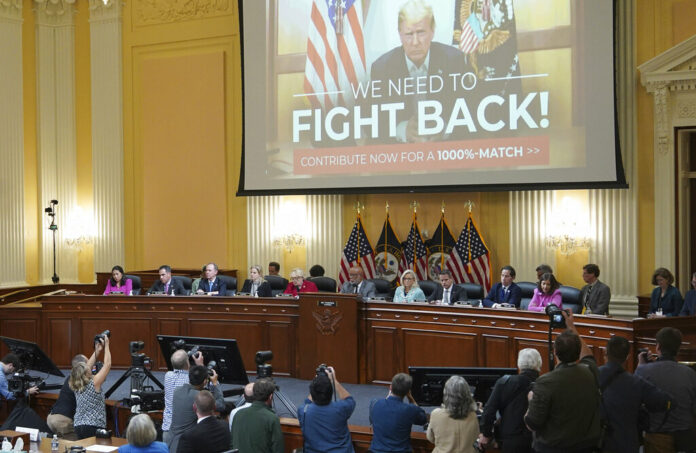
A video of former President Donald Trump speaking is displayed as the House select committee investigating the Jan. 6 attack on the U.S. Capitol continues to reveal its findings of a year-long investigation, at the Capitol in Washington, Monday, June 13, 2022. Photo: Mandel Ngan / Pool via AP

WASHINGTON (AP) — Donald Trump’s closest campaign advisers, top government officials and even his family were dismantling his false claims of 2020 election fraud ahead of Jan. 6, but the defeated president seemed “detached from reality” and kept clinging to outlandish theories to stay in power, the committee investigating the Capitol attack was told Monday.

With gripping testimony, the panel is laying out in step-by-step fashion how Trump ignored his own campaign team’s data as one state after another flipped to Joe Biden, and instead latched on to conspiracy theories, court cases and his own declarations of victory rather than having to admit defeat.

Trump’s “big lie” of election fraud escalated and transformed into marching orders that summoned supporters to Washington and then sent them to the Capitol on Jan. 6 to block Biden’s victory.

“He’s become detached from reality if he really believes this stuff,” former Attorney General William Barr testified in his interview with the committee.

Barr called the voting fraud claims “bull——,” “bogus” and “idiotic,” and resigned in the aftermath. “I didn’t want to be a part of it.”

The House 1/6 committee spent the morning hearing delving into Trump’s claims of election fraud and the countless ways those around him tried to convince the defeated Republican president they were not true, and he had simply lost the election.

The witnesses Monday, mostly Republicans and many testifying in prerecorded videos, described in blunt terms and sometimes exasperated detail how Trump refused to take the advice of those closest to him, including his family members. As the people around him splintered into a “team normal” headed by former campaign manager Bill Stepien and others led by Trump confidant Rudy Giuliani, the president chose his side.

On election night, Stepien said, Trump was “growing increasingly unhappy” and refusing to accept the grim outlook for his presidency.

Son-in-law Jared Kushner tried to steer Trump away from Giuliani and his far-flung theories of voter fraud. The president would have none of it.

The back-and-forth intensified in the run-up to Jan. 6. Former Justice Department official Richard Donoghue recalled breaking down one claim after another — from a truckload of ballots in Pennsylvania to a missing suitcase of ballots in Georgia —- and telling Trump “much of the info you’re getting is false.”

Still, he pressed on with his false claims even after dozens of court cases collapsed.

On Monday an unrepentant Trump blasted the hearings in his familiar language as “ridiculous and treasonous” and repeated his claims.

The former president, mulling another run for the White House, defended the Capitol attack as merely Americans seeking “to hold their elected officials accountable.”

Nine people died in the riot and its aftermath, including a Trump supporter shot and killed by Capitol police. More than 800 people have been arrested, and members of two extremist groups have been indicted on rare sedition charges over their roles leading the charge into the Capitol.

During the hearing, the panel also provided new information about how Trump’s fundraising machine collected some $250 million with his campaigns to “Stop the Steal” and others in the aftermath of the November election, mostly from small-dollar donations from Americans. One plea for cash went out 30 minutes before the Jan. 6, 2021, insurrection.

“Not only was there the big lie, there was the big ripoff,” said Rep. Zoe Lofgren, D-Calif.

Chairman Rep. Bennie Thompson, D-Miss., opened Monday’s hearing saying Trump “betrayed the trust of the American people” and “tried to remain in office when people had voted him out.”

As the hearings play out for the public, they are also being watched by one of the most important viewers, Attorney General Merrick Garland, who must decide whether his department can and should prosecute Trump. No sitting or former president has ever faced such an indictment.

“I am watching,” Garland said Monday at a press briefing at the Justice Department, even if he may not watch all the hearings live. “And I can assure you the Jan. 6 prosecutors are watching all of the hearings as well.”

Biden was getting updates but not watching “blow by blow,” said White House press secretary Karine Jean-Pierre.

Stepien was to be a key in-person witness Monday but abruptly backed out of appearing live because his wife went into labor. Stepien, who is still close to Trump, had been subpoenaed to appear. He is now a top campaign adviser to Trump-endorsed House candidate Harriet Hageman, who is challenging committee vice chair Rep. Liz Cheney in the Wyoming Republican primary.

The panel marched ahead after a morning scramble and delay, with witness after witness saying Trump embraced and repeated his claims about the election although those closest told him the theories of stolen ballots or rigged voting machines were simply not true.

Stepien and senior adviser Jason Miller described how the festive mood at the White House on Election Night turned grim as Fox News announced Trump had lost the state of Arizona to Joe Biden, and aides worked to counsel Trump on what to do next.

But he ignored their advice, choosing to listen instead to Giuliani, who was described as inebriated by several witnesses. Giuliani issued a general denial Monday, rejecting “all falsehoods” he said were being said about him.

Stepien said, “My belief, my recommendation was to say that votes were still being counted, it’s too early to tell, too early to call the race.”

But Trump “thought I was wrong. He told me so.”

Barr, who had also testified in last week’s blockbuster opening hearing, said Trump was “as mad as I’d ever seen him” when the attorney general later explained that the Justice Department would not take sides in the election.

Barr said when he would tell Trump “how crazy some of these allegations were, there was never, there was never an indication of interest in what the actual facts were.”

For the past year, the committee has been investigating the most violent attack on the Capitol since the War of 1812, which some believe posed a grave threat to democracy.

Monday’s hearing also featured live witnesses, including Chris Stirewalt, a former Fox News Channel political editor who was part of a team that declared on Election Night that Arizona was being won by Biden. Also appearing was the former U.S. attorney in Atlanta, BJay Pak, who abruptly resigned after Trump pressured Georgia Secretary of State Brad Raffensperger to find enough votes to overturn his defeat.

The panel also heard from elections lawyer Benjamin Ginsberg, who discussed the norms of election campaign challenges, and former Philadelphia City Commissioner Al Schmidt, the only Republican on the city’s election board, who told the panel that regardless of how “fantastical” some of the claims that Trump and his team were making, the city officials investigated. He discussed facing threats after Trump criticized him in a tweet.

___

Story: Lisa Mascaro and Mary Clare Jalonick. Associated Press writers Kevin Freking and Michael Balsamo in Washington and Farnoush Amiri and Jill Colvin in New York contributed to this report.

Advertisement

Opinion: Thailand’s Marijuana Challenge: Let’s Not Get Too High Prematurely

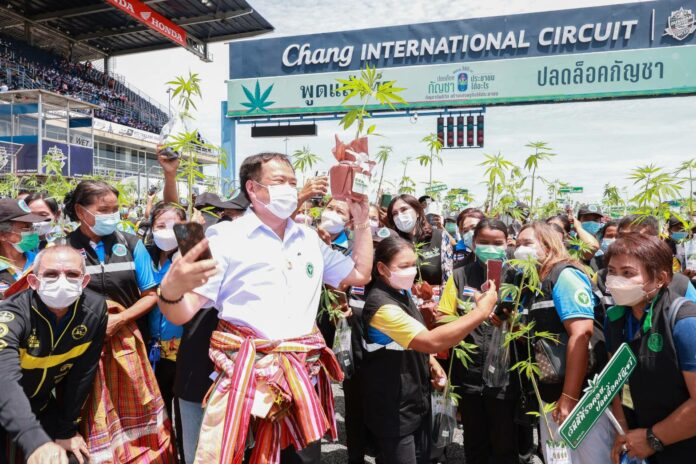
Health Minister Anutin Charnvirakul poses with people holding their marijuana plants during the distribution of 1 million free marijuana seedlings in Buriram province on June 10, 2022. Photo: Bhumjaithai Party.

The decriminalization of marijuana which took effect on Thursday, the first in Asia, poses both opportunities and challenges to Thai society.

The positive impact is plain for everyone to see: income generated by growing, selling, and exporting marijuana and its related-products for medical and gastronomic purposes. Without doubt, large companies are well-prepared to exploit the new reality and it is a challenge to make sure that it would not just benefit the billionaires and that ordinary farmers and household growers get a fair dividend as well.

It is also good that some three thousand inmates are being released for their needless crimes of possessing or selling cannabis. This has a slight effect to lessen the already overcrowded prison system in Thailand. Also, many sick people who are in pain will have access to alternative herbal painkillers and sleep pills.

The other major challenge is how to ensure that the decriminalization of the growing and selling of marijuana for medical purposes does not lead to widespread substance abuse and addiction, particularly among the youth. Only someone high or naïve would believe that when the government says it is only for “medical purposes,” it will stay that way.

I saw the lack of any regulation and blatant mockery of the notion of cannabis for “medical purposes” on Khao San Road Saturday night, where many locals and foreign tourists queue up to buy cannabis in a free for all atmospheres. None looked sick to me.

Well, it is not exactly free at 700 baht per gram, twice the price of weed in Amsterdam. A 20-year-old Briton from Bristol, Tycjan Gapski, was the first customer of the day, and that evening there were over a hundred buying the stuff which was illegal just half a week ago. Gapski told me Bangkok is becoming the New Amsterdam. (But then I quietly thought that was the old name of New York.)

“Everyone get the f*ck down here because this is gonna be madness,” Gapski told me after he bought a gram.

The price of legal marijuana flowers peddled by the weed truck on Khao San Road may be twice that of Amsterdam at 700 baht per gram but  the huge potential for a new type of de facto “recreational tourism” is plain for all to see and smell. The price will likely drop as more are planting. The challenge is how to properly regulate them to mitigate unwanted repercussions.

With more than 6 million marijuana plants to be cultivated, according to Public Health Minister Anutin Charnveerakul, the man who successfully pushed for the policy, there should be little doubt of the trickle-down effect that would lead to the use of marijuana for recreational purposes.

The Ministry of Agriculture has also announced it will give away a million marijuana saplings, while over 580,000 people have registered with the government to grow cannabis and over thirty million Thais accessed the government cannabis app as of Saturday.

I am not alone cooking this up or fearing alone. On Friday, the dean of Chulalongkorn University’s Faculty of Medicine, Chanchai Sittipunt, expressed concerns that some will simply claim that they have headache or severe pain, in fact they just wanna have a Thai stick to get high.

Anutin also admitted on Friday that some will probably get high all day and “kept smiling” and urged public health volunteers throughout the kingdom to be vigilant. Some even accused the government of trying to ‘drugged’ its own people so they can rule the country however they like. (Back in the 1970s and 80s, booze and cigarettes were so cheap in the Philippines under Marcos dictatorship one wonders if it is a way to keep people content and blurry, a form of state-induced escapism.)

Well, nothing really wrong with people enjoying a stick or two once in a while I would say – even if that is the grey area of the law. The concern is how to prevent it from not becoming so widespread and excessive to the point where a significant percentage of the Thai population, particularly young Thais become dependent on cannabis and addicted. If not handled properly, many Thais will simply vacate to the alternative high universe.

We have seen alcohol abuse, addiction to cigarettes, and now welcome to the world of pot. Moderation and responsible consumption are crucial and the months ahead will be a litmus test of Thailand’s ability to handle cannabis responsibly.

Already, the Royal College of Pediatricians also warned on Friday in a letter that recreational use of marijuana, as well as consuming food with cannabis leaves, among those under the age of 20 will have a lasting impact on user’s brain development. They too are not buying into the belief that given the new reality, people will only use it for medical purposes only. In another development, a joint letter penned by 21 experts expressed concerns about de facto policy vacuum.

If you are not worried about the health effects on those younger than 20 or that the teenager or adult next door will be high all day, you should be concerned about the possible repercussions of traffic accidents. Drunk, sleepy, or reckless drivers are deadly enough, now we will most likely have to deal with ‘high’ drivers.

It is all about responsible use and management and we will see in the weeks ahead how Thai society is fairing. I do not want to be pessimistic, and generally support decriminalization, but I am not high and see things in pink either. We need contingency plans to deal with the possible adverse effects of this brave new world.

Advertisement

NASA Launches Study of UFOs Despite ‘Reputational Risk’

FILE - Workers on scaffolding repaint the NASA logo near the top of the Vehicle Assembly Building at the Kennedy Space Center in Cape Canaveral, Fla., Wednesday, May 20, 2020. Photo: John Raoux / AP File

CAPE CANAVERAL, Fla. (AP) — NASA is launching a study of UFOs as part of a new push toward high-risk, high-impact science.

The space agency announced Thursday that it’s setting up an independent team to see how much information is publicly available on the matter and how much more is needed to understand the unexplained sightings. The experts will also consider how best to use all this information in the future.

NASA’s science mission chief, Thomas Zurbuchen acknowledged the traditional scientific community may see NASA as “kind of selling out” by venturing into the controversial topic, but he strongly disagrees.

“We are not shying away from reputational risk,” Zurbuchen said during a National Academy of Sciences webcast. “Our strong belief is that the biggest challenge of these phenomena is that it’s a data-poor field.”

NASA considers this a first step in trying to explain mysterious sightings in the sky known as UAPs, or unidentified aerial phenomena.

The study will begin this fall and last nine months, costing no more than $100,000. It will be entirely open, with no classified military data used.

NASA said the team will be led by astrophysicist David Spergel, president of the Simons Foundation for advancing scientific research. In a news conference, Spergel said the only preconceived notion going into the study is that the UAPs will likely have multiple explanations.

“We have to approach all these questions with a sense of humility,” Spergel said. “I spent most of my career as a cosmologist. I can tell you we don’t know what makes up 95% of the universe. So there are things we don’t understand.”

___

Story: Marcia Dunn.

Advertisement

Capitol Riot Panel Blames Trump for 1/6 ‘Attempted Coup’

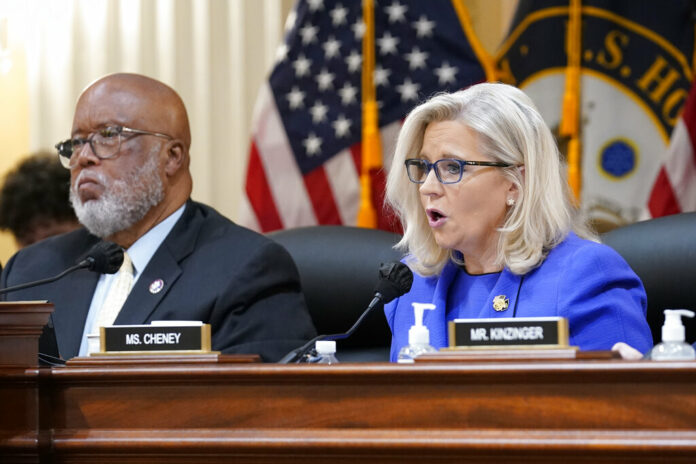
Vice Chair Liz Cheney, R-Wyo., gives her opening remarks as Committee Chairman Rep. Bennie Thompson, D-Miss., left, looks on, as the House select committee investigating the Jan. 6 attack on the U.S. Capitol holds its first public hearing to reveal the findings of a year-long investigation, at the Capitol in Washington, Thursday, June 9, 2022. Photo: J. Scott Applewhite / AP

WASHINGTON (AP) — The House panel investigating the Jan. 6 insurrection at the U.S. Capitol laid the blame firmly on Donald Trump Thursday night, saying the assault was hardly spontaneous but an “attempted coup” and a direct result of the defeated president’s effort to overturn the 2020 election.

With a never-before-seen 12-minute video of extremist groups leading the deadly siege and startling testimony from Trump’s most inner circle, the 1/6 committee provided gripping detail in contending that Trump’s repeated lies about election fraud and his public effort to stop Joe Biden’s victory led to the attack and imperiled American democracy

“Democracy remains in danger,” said Rep. Bennie Thompson, D-Miss., chairman of the panel, during the hearing, timed for prime time to reach as many Americans as possible.

“Jan. 6 was the culmination of an attempted coup, a brazen attempt, as one rioter put it shortly after Jan. 6, to overthrow the government,” Thompson said. “The violence was no accident.”

The hearings may not change Americans’ views on the Capitol attack, but the panel’s investigation is intended to stand as its public record. Ahead of this fall’s midterm elections, and with Trump considering another White House run, the committee’s final report aims to account for the most violent attack on the Capitol since 1814, and to ensure such an attack never happens again.

Testimony showed Thursday how Trump desperately clung to his own false claims of election fraud, beckoning supporters to the Capitol on Jan. 6 when Congress would certify the results, despite those around him insisting Biden had won the election.

In a previously unseen video clip, the panel played a quip from former Attorney General Bill Barr who testified that he told Trump the claims of a rigged election were “bull——.”

In another, the former president’s daughter, Ivanka Trump, testified to the committee that she respected Barr’s view that there was no election fraud. “I accepted what he said.”

Others showed leaders of the extremist Oath Keepers and Proud Boys preparing to storm the Capitol to stand up for Trump. One rioter after another told the committee they came to the Capitol because Trump asked them to.

“President Trump summoned a violent mob,” said Rep. Liz Cheney, R-Wyo., the panel’s vice chair who took the lead for much of the hearing. “When a president fails to take the steps necessary to preserve our union — or worse, causes a constitutional crisis — we’re in a moment of maximum danger for our republic.”

There was an audible gasp in the hearing room when Cheney read an account that said when Trump was told the Capitol mob was chanting for Vice President Mike Pence to be hanged for refusing to block the election results. Trump responded that maybe they were right, that he “deserves it.”

At another point it was disclosed that Rep. Scott Perry, R-Pa., a leader of efforts to object to the election results, had sought a pardon from Trump, which would protect him from prosecution.

When asked about the White House lawyers threatening to resign over what was happening in the administration, Trump’s son-in-law Jared Kushner scoffed they were “whining.”

Police officers who had fought off the mob consoled one another as they sat in the committee room reliving the violence they faced on Jan. 6. Officer Harry Dunn teared up as bodycam footage showed rioters bludgeoning his colleagues with flagpoles and baseball bats.

In wrenching testimony U.S. Capitol Police officer Caroline Edwards told the panel that she slipped in other people’s blood as rioters pushed past her into the Capitol. She suffered brain injuries in the melee.

“It was carnage. It was chaos,” she said.

The riot left more than 100 police officers injured, many beaten and bloodied, as the crowd of pro-Trump rioters, some armed with pipes, bats and bear spray, charged into the Capitol. At least nine people who were there died during and after the rioting, including a woman who was shot and killed by police.

Biden, in Los Angeles for the Summit of the Americas, said many viewers were “going to be seeing for the first time a lot of the detail that occurred.”

Trump, unapologetic, dismissed the investigation anew — and even declared on social media that Jan. 6 “represented the greatest movement in the history of our country.”

Republicans on the House Judiciary Committee tweeted: “All. Old. News.”

Emotions are still raw at the Capitol, and security was tight. Law enforcement officials are reporting a spike in violent threats against members of Congress.

Against this backdrop, the committee was speaking to a divided America. Most TV networks carried the hearing live, but Fox News Channel did not.

The committee chairman, civil rights leader Thompson, opened the hearing with the sweep of American history. saying he heard in those denying the stark reality of Jan. 6 his own experience growing up in a time and place “where people justified the action of slavery, the Ku Klux Klan and lynching.”

Republican Rep. Cheney, the daughter of former Vice President Dick Cheney, outlined what the committee has learned about the events leading up to that brisk January day when Trump sent his supporters to Congress to “fight like hell” for his presidency.

Among those testifying was documentary maker Nick Quested, who filmed the Proud Boys storming the Capitol — along with a pivotal meeting between the group’s then-chairman Henry “Enrique” Tarrio and another extremist group, the Oath Keepers, the night before in nearby parking garage. Quested said the Proud Boys later went to get tacos.

Court documents show that members of the Proud Boys and Oath Keepers were discussing as early as November a need to fight to keep Trump in office. Leaders both groups and some members have since been indicted on rare sedition charges over the military-style attack.

In the weeks ahead, the panel is expected to detail Trump’s public campaign to “Stop the Steal” and the private pressure he put on the Justice Department to reverse his election loss — despite dozens of failed court cases attesting there was no fraud on a scale that could have tipped the results in his favor.

The panel faced obstacles from its start. Republicans blocked the formation of an independent body that could have investigated the Jan. 6 assault the way the 9/11 Commission probed the 2001 terror attack.

Instead, House Speaker Nancy Pelosi ushered the creation of the 1/6 panel through Congress and rejected Republican-appointed lawmakers who had voted on Jan. 6 against certifying the election results, eventually naming seven Democrats and two Republicans.

House GOP Leader Kevin McCarthy, who has been caught up in the probe and has defied the committee’s subpoena for an interview, called the panel a “scam.”

In the audience were several lawmakers who were trapped together in the House gallery during the attack.

“We want to remind people, we were there, we saw what happened,” said Rep. Dean Phillips, D-Minn. ”We know how close we came to the first non-peaceful transition of power in this country.”

The Justice Department has arrested and charged more than 800 people for the violence that day, the biggest dragnet in its history.

___

Story: Lisa Mascaro, Mary Clare Jalonick, and Farnoush Amiri. Associated Press writers Kevin Freking and Michael Balsamo and Alanna Durkin Richer in Boston contributed to this report.

Advertisement

Healthcare, technology, and sustainability – How the pandemic has changed us, and the way forward

By Jim Falteisek, Senior Vice President, 3M Asia Corporate Affairs and Managing Director of 3M Korea

There is no doubt that the COVID-19 pandemic has ushered in a new paradigm. While countries come out of lock downs, and jobs, schools, and universities return to physical formats, our lives – the way we interact, live, and work – have been forever changed. 

Naturally, 3M was curious about how the pandemic has and will continue to fundamentally transform life as we know it. Thus, we commissioned an independent study amongst 22,000 adults across 11 different countries, including France, Brazil, China, Mexico, Canada, Japan, Germany, UK, USA, India, and South Korea.

This is what we uncovered.

  • The rise of hyper-health-consciousness 

We are now more health-conscious than ever. Unsurprisingly, living through a pandemic has changed the way people view health. According to 3M Futures, 76% of people globally agreed that the pandemic made them more conscious of their personal health. 

This is the same closer to home.

A survey of 1,025 Thai respondents found that nearly 90% of them wanted to become healthier, with 64% eating healthier diets, and 58% enhancing their fitness routines. 

The pandemic has even affected how we think about public spaces, with 77% agreeing that public spaces need to be re-designed to be more health conscious. 

This includes offices. The pandemic has overturned our idea of workplace interiors, and companies are facing the dual-pronged challenge of creating spaces that invoke a sense of “community” and still protect the health and well-being of their employees. 

Furniture was a great, inexpensive, quick way to create short-term and long-term flexible space solutions at 3M offices, especially as we push for more sustainable solutions. Our next step, ultimately, is the integration of upcoming technologies to “future-proof” and best serve our employees.

  • A perpetually digital existence – working, interacting, and playing online

When countries entered lockdowns, virtual substitutes quickly took over. 

This has brought about divided opinions. Although more than 64% preferred to work from home, with a similar portion (58%) of respondents willing to try new technological advancements such as sustainable homes and all-electric vehicles, others would rather minimize the role of devices in their lives. 

As many as 77% noted that they had better interactions with friends and family in-person than when using technology and online platforms. 7 in 10 people also favored hobbies that allows them to unplug from their devices. Another 75% highlighted that too much screen time is a health issue that should be addressed.

  • Approaching an AI future with equal parts optimism and fear

An AI-infused future is already dawning upon us. Globally, 63% believe that cutting-edge AI advancements like driverless vehicles will be a part of our lives in the next 10 years. 55% are also willing to accept a ride from a self-driving car. 

Despite this excitement, we continue to question its ethics and implications, and want more transparency on how technology is being used in society. To truly harness the power of AI and data while not compromising privacy, governments need to design ways that allow for safe sharing of quality data. 

According to a Thailand Board of Investment report, Artificial intelligence (AI) or robotics and digital industries are priority sectors in the government’s national strategy, Thailand 4.0. The government has implemented various measures to promote utilization of industrial robots in the country to raise the country’s level of development and competitiveness by focusing on advanced technologies as well as green and sustainable growth. 

Companies will also need to evolve to handle the complexity and speed of the ethical parameters of using data and AI in a principled and ethical way. Governing bodies will have to understand data, breadth and depth, potential uses, now and in the future, tradeoffs between possible very high benefit at a cost of using data without governance. 

Likewise, 3M’s integrity and value model guides everything we do, including how we are utilizing AI throughout our business, from analyzing records for the most effective and economical healthcare treatments, to using road, building and environmental data to optimize the safety of workers and equipment in real time. On a global scale, we are using advanced algorithms to improve our supply chains, the quality of production, and sourcing to better meet the needs of our customers. 

  1. Sustainability – not just a demand, but an expectation

When it comes to sustainability, we are also demanding businesses to walk the talk. Three-quarters of respondents worldwide demand transparency from brands that claim sustainable commitments. We also believe businesses should be green and sustainable, instead of using it as a marketing point.

Thailand has increased efforts in tackling climate change and environmental protection,

but will it be fast enough? Around the world, most people (73%) are willing to live in sustainable homes, but most do not think society will prioritize sustainable living in the near term. In fact, 40% feel that renewable energy will not become a major part of their cities within the next decade. 

Governments will therefore need to find faster ways to implement green policies and practices. 

The Thai government has introduced the Bio-Circular-Green (BCG) economy model to drive economic and social development that will help achieve its Environmental, Social and Governance sustainability targets. The model aims to encourage sustainable development that benefits communities at every level in Thailand and uses natural assets more effectively, working in partnership with the public and private sectors.

We are stepping up to the plate. Having committed to ensuring that every new product being commercialized from 2019 onwards demonstrates how it drives impact for the greater good, 3M works every day to design solutions that do more with less materials and advance our manufacturing processes. On the consumer front, we are developing ways to reduce user touch points, which often leads to waste, and finding digital avenues where possible to reduce environmental costs. 

Advertisement

Siam Piwat joins forces with Takashimaya Group, expanding own brands into Japan for the first time

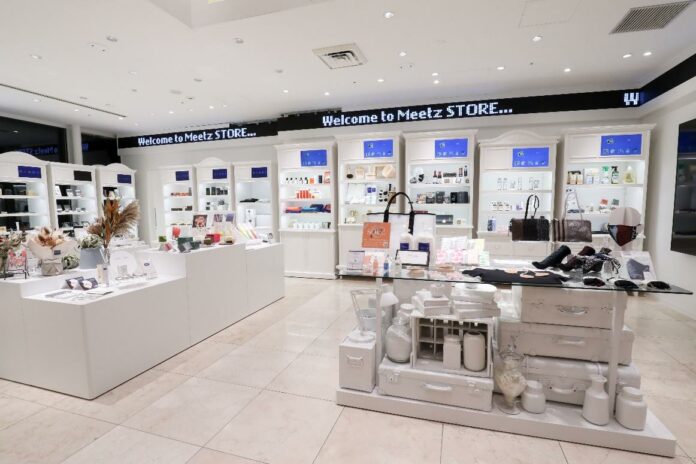
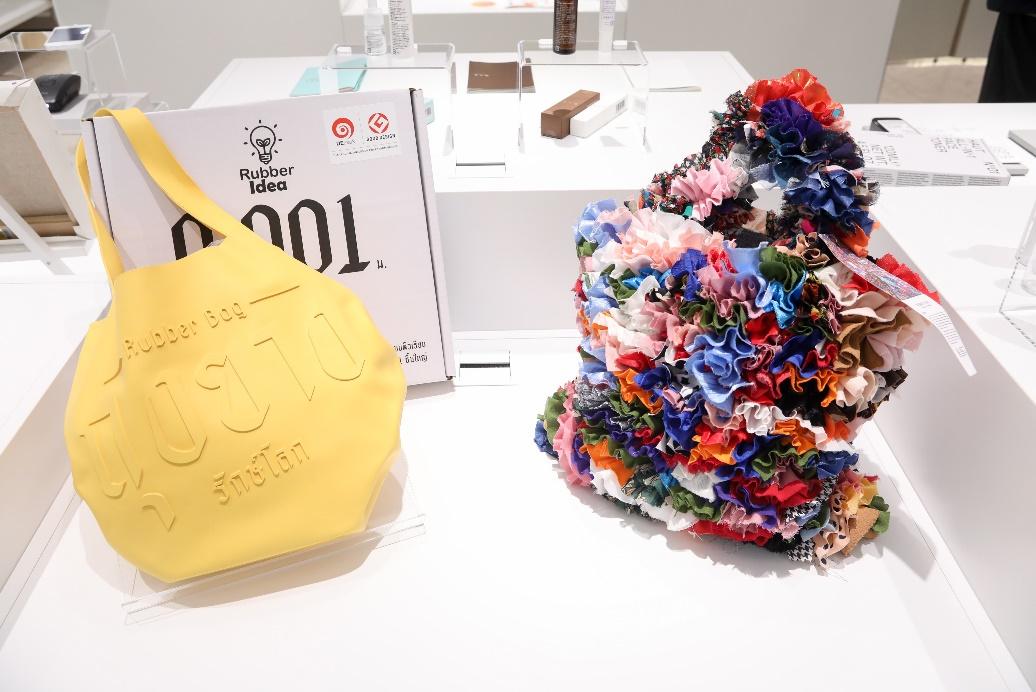
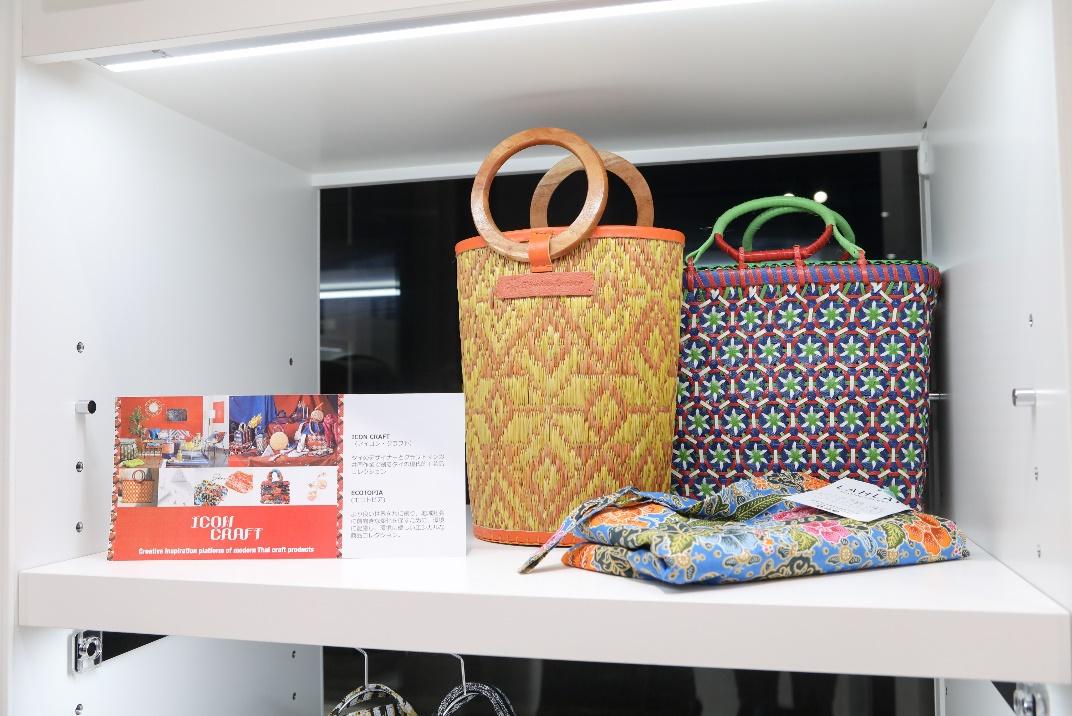
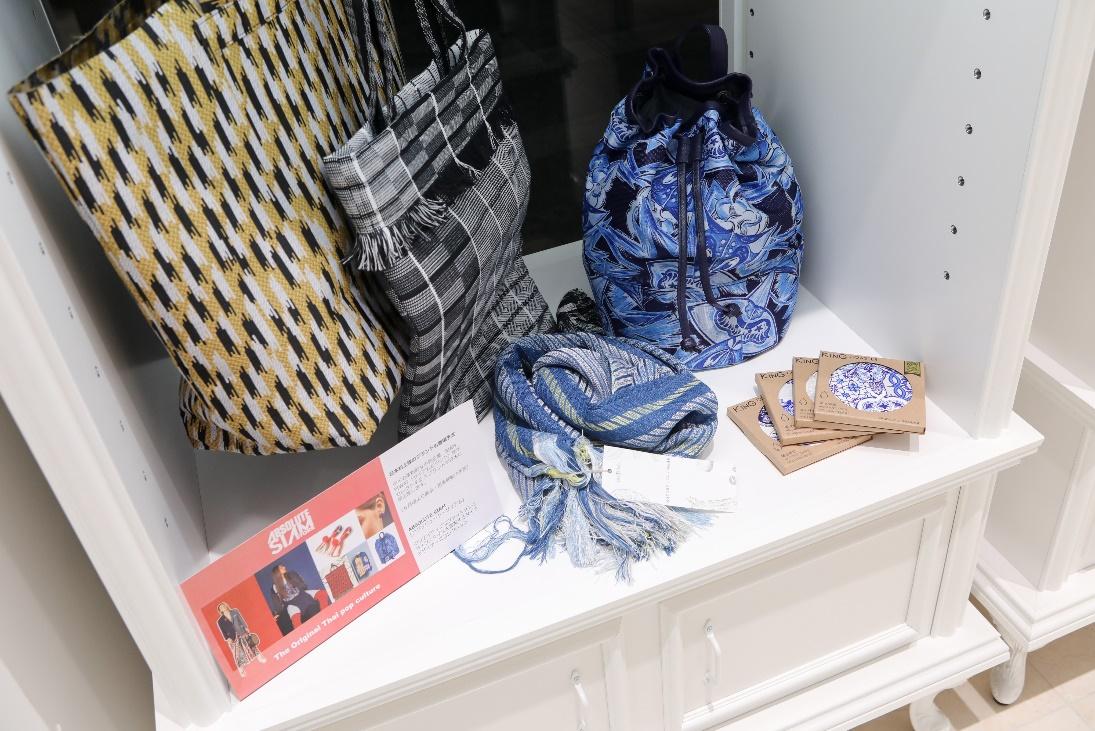
Siam Piwat Retail Holding Company Limited, the leader of retail innovation under Siam Piwat Group, forges ahead with its international expansion plan by collaborating with Takashimaya Transcosmos IC Japan Company Limited (TTICJ), a unit of Takashimaya Group, Japan’s most successful and recognized major premium department store chain, to feature three owned curated brands, namely Absolute Siam, Ecotopia and ICONCRAFT at the Meetz STORE, a new concept offline showroom and online e-commerce platform to be    set up in Takashimaya Times Square  in Tokyo, and Asian Fair in JT Takashimaya Department Store at Nagoya, thus furthering the foray into the Japanese market for the very first time. This collaboration strengthens Siam Piwat Retail’s key strategies in commercializing own brands abroad to increase customer bases overseas while supporting Thai SMEs, helping to advance the growth of the Thai economy

image4 3

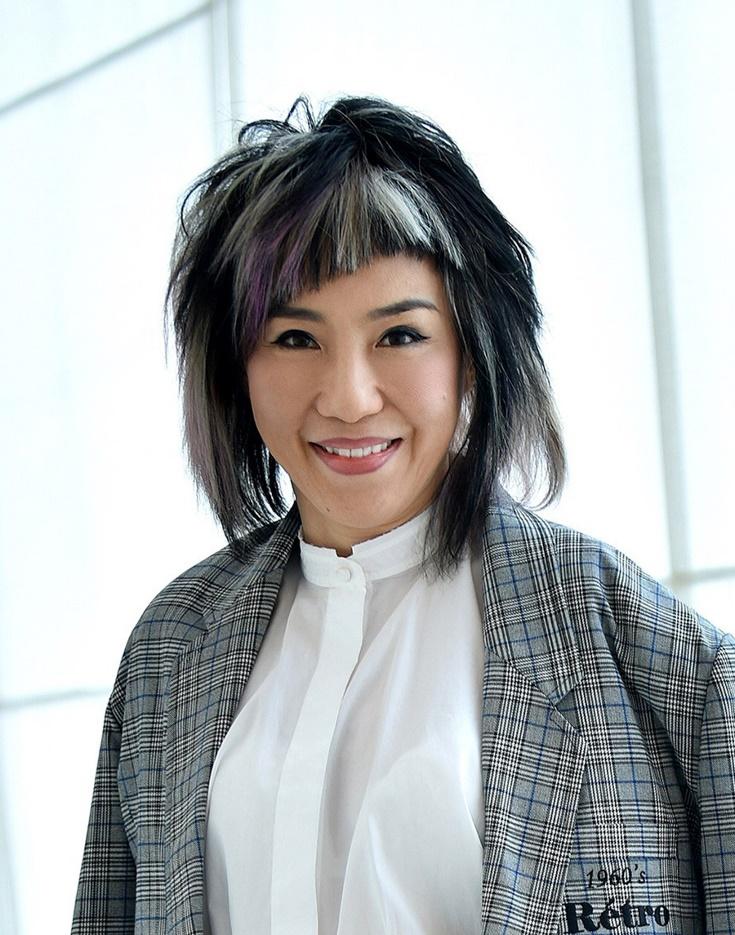
Ms. Usara Yongpiyakul, Chief Executive Officer – Retail Business Group, Siam Piwat Co., Ltd., said, “Siam Piwat has long been conducting business with large companies in Japan, and Takashimaya is one of the key partners, having opened the first branch in Thailand at ICONSIAM. This collaboration is thus an extension of our close business relationship. For this initiative, TTICJ (Takashimaya Transcosmos I.C. Japan) will bridge knowledge gap and share experience responsible for its long-standing success in Japan, while we bring our expertise in presenting a diverse range of distinctly Thai products and creating a unique and extraordinary experiences in the Japanese market. Japan marks the third country in Asia in our international expansion following Malaysia and Taiwan in a period of only five months since the beginning of 2022. Under Meetz Store, a new O2O e-commerce platform that connects customers from offline to online channels, this will enhance the opportunities to increase the international presence of Thai brands to the target groups and promote their ability to better cater to the needs and the shopping behavior of Japanese customers.”

The three Thai brands are Absolute Siam, Ecotopia, and ICONCRAFT, each with distinctive outstanding features but united in their unique Thai craftsmanship and creativity. The products include innovative art and contemporary craftworks by skilled artisans, designers, young eco-conscious creators, and SME entrepreneurs from across Thailand.

Meetz STORE held at Takashimaya Times Square in Shinjuku, Tokyo, from 29th April 2022 onwards and Siam Piwat Retail will commerce its operation in Meetz STORE at the end of June 2022. With its close proximity to Shinjuku Train Station, there are 3.6 million passengers a day as the potential walk-in customers to Meetz STORE. More importantly, Meetz STORE aims to tap into nationwide 5.7 million cardholders of Takashimaya Group. Meetz STORE is the evolution of merging offline showroom store with e-commerce platform to spur offline-to-online (O2O) shopping experience and stimulate spending everywhere across Japan. Meetz STORE features a variety of carefully selected product categories, endorsed and promoted by Japanese well-known curators by their expertise fields. The presentation of Siam Piwat’s brands aims to be curated and endorsed by Mr. Mao Sakaguchi, a creator well-known for his ethical consumption concepts and curation of eco-friendly and socially responsible products, which have been growing in popularity among Japanese consumers. 

image3 3

image6

image5 2

The Asian Fair, an international fair that has enjoyed phenomenal success through the years, will be held in Takashimaya Department Store in Nagoya, Japan’s third largest city, from June 23 to 28, 2022. At this fair, visitors will be dazzled by an eye-popping array of products from private brand collection, which is much awaited by Japanese shoppers as they previously could not travel especially during the height of COVID-19 outbreaks. 

This collaboration does not only drive Siam Piwat’s retail arm forward and further strengthen the business partnership between Siam Piwat and Takashimaya Group, but more importantly commercializing SPW own curated concept brands to different countries with new business models that will enhance SPW and partners to achieve mutual benefits and growth sustainably in the long run.

Advertisement

THE STANDARD, HUA HIN GETS COLORFUL AND CREATIVE FOR PRIDE MONTH

Chic beachfront resort unveils a month-long series of celebrations, including rainbow illuminations, “Loud & Proud” music events and a special package

HUA HIN, THAILAND, JUNE  2022: The Standard, Hua Hin, the stylish Thai resort where chic beach vibes meet mid-century style, will fly the flag for diversity and equality this June with a series of fabulous activities to mark Pride Month!

Running from 1-30 June 2022, Pride Month is important and symbolic occasion for the LGBTQ+ community. Marked with parades, parties, concerts and workshops all around the world, this annual event celebrates inclusivity in all its forms, highlights the ongoing struggle for equal rights and honors the impact of gay, lesbian, bisexual and transgender people throughout history.

To mark Pride Month in Thailand, The Standard, Hua Hin will be illuminated in the colors of the rainbow with light shows, interior decorations and installations that reflect the resort’s deep commitment to freedom of expression. Guests will also be invited to unwind and enjoy two days of “Loud & Proud” DJ parties, featuring special guest stars. 

From 8-11pm on 17th June, Amita Tata Young, the Thai pop sensation turned DJ, will play an exclusive session at the Beach Bar! Then on 18th June, a full day of fun activities awaits at The Lido Bar. DJ Gramaphone Children will get the party started at 2pm, followed by DJ Rhunrun on the decks from 4.30pm. Then, when the sun sets, a performance by the ever-glamorous Pat Chanudom. Revelers can then get their groove on late into the night with a live set of upbeat tunes from DJ Tob until 11pm. Gene Kasidit will be there to make your night more memorable. 

To help everybody experience the joy of Pride Month, The Standard, Hua Hin has crafted its “Pride in Paradise” package. Enjoy an amazing stay with your loved one, including breakfast for two, a sweet turndown surprise, two Pride cocktails, a Mud Lounge session for two, and a 15% discount at the resort’s restaurant and spa. And that’s not all; couples who book a Superior Suite or Villa will be treated to a blissful bubble bath! Pride in Paradise is valid for stays taken throughout Pride Month, between 1st and 30th June 2022. To book, please visit www.standardhotels.com/hua-hin/specials/pride-in-paradise

“Pride Month is such an important occasion, when the world’s LGBTQ+ community stands up and celebrates its rich diversity, culture and heritage. At The Standard, we strive to promote equality and inclusivity every single day, so we are delighted to be able to mark this major event with a series of vibrant activities. Proudly wearing the colors of the rainbow flag, The Standard, Hua Hin will look fabulous throughout June! We look forward to welcoming all our guests to Thailand’s glittering gulf coast during Pride Month,” said Mai Vejjajiva Timblick, Chief Creative & Culture Officer for Standard Asia.

The Standard, Hua Hin brings a cool Miami vibe to Thailand’s tropical shores. With 199 rooms, suites and villas, the mid-century design Lido pool and bar, a beachfront Thai izakaya restaurant and juice café, this chic seafront retreat is a haven for curious global explorers. It was recently named on Condé Nast Traveler’s “Hot List” for 2022, a highly exclusive selection of the world’s most exciting new hotels. 

The Standard hotels are present in the most desirable of destinations, from Miami Beach to the Maldives, London to New York, Hua Hin, Ibiza and very soon, Bangkok.

Connect with the hotel via:
Facebook: The Standard Hua Hin
Instagram/Line: @thestandardhuahin
Web: www.standardhotels.com/hua-hin

Advertisement

China and Russia Defend North Korea Vetoes in First at UN

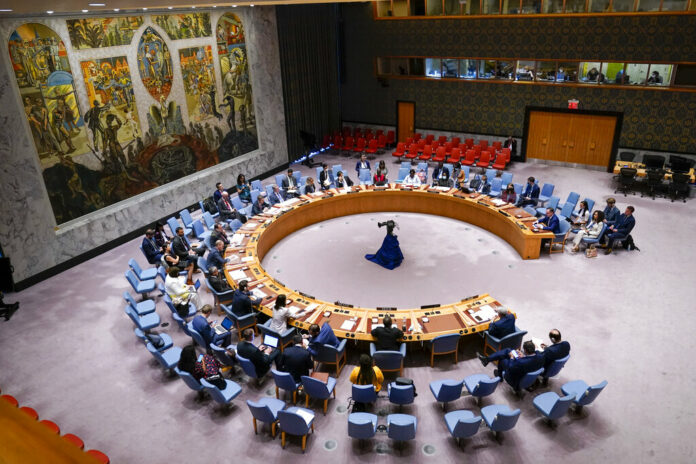
The United Nations Security Council meets on threats to international peace and security, Wednesday, June 8, 2022 at United Nations headquarters. Photo: Mary Altaffer / AP

UNITED NATIONS (AP) — China and Russia defended their vetoes of a strongly backed U.S. resolution that would have imposed tough new sanctions on North Korea, speaking at a first of its kind General Assembly meeting Wednesday.

The debate was held under new rules requiring the General Assembly to examine any veto wielded in the Security Council by one of its five permanent members.

Close allies China and Russia reiterated their opposition to more sanctions, blaming the United States for rising tensions on the Korean peninsula and insisting that what’s needed now is dialogue between North Korea and the Biden administration.

Nearly 70 countries signed up to speak at the open meeting which General Assembly President Abdalla Shahid hailed as making the U.N. more efficient and accountable. “It is with good reason that it has been coined as `revolutionary’ by several world leaders I have recently met,” he said.

Denmark’s U.N. Ambassador Martin Bille Hermann told the 193-member world body as he started his address on behalf of the Nordic countries: “History is being made today.”

The Security Council is entrusted with ensuring international peace and security, he said, and the use of a veto to prevent the council from discharging its duties “is a matter of great concern.”

The General Assembly’s adoption of a resolution on April 26 requiring a debate on the issue not only gives the country or countries casting a veto to explain their reason but it gives all U.N. member nations “a welcome opportunity to share our views on the matter at hand,” Hermann said.

A united Security Council imposed sanctions after North Korea’s first nuclear test explosion in 2006 and tightened them over the years in a total of 10 resolutions seeking — so far unsuccessfully — to rein in its nuclear and ballistic missile programs and cut off funding.

The 13-2 Security Council vote on May 26 marked a first serious division among its five veto-wielding permanent members — China, Russia, United States, Britain and France — on a North Korea sanctions resolution.

On Sunday, North Korea fired eight short-range missiles in what appeared to be a single-day record for the country’s ballistic launches. It was the reclusive north Asian country’s 18th round of missile tests in 2022 that included its first launches of intercontinental ballistic missiles in nearly five years.

U.S. deputy ambassador Jeffrey DeLaurentis told the assembly the record number of launches have taken place as North Korea “is finalizing preparations for a potential seventh nuclear test.”

He called the actions by the Democratic People’s Republic of Korea or DPRK — the country’s official name — “unprovoked.”

De Laurentis stressed that U.S. President Joe Biden and Secretary of State Antony Blinken “have repeatedly and publicly said that we seek a dialogue with Pyongyang, without preconditions,” and that message has been passed through private channels, including China.

“The United States is more than prepared to discuss easing sanctions to achieve the complete denuclearization of the Korean peninsula,” he said.

Unfortunately, DeLaurentis said, the DPRK has only responded with “destabilizing launches that threaten not only the region but the world.”

Under the General Assembly resolution that required Wednesday’s meeting, the permanent member or members casting a veto are given precedence on the speakers list.

China’s U.N. Ambassador Zhang Jun addressed diplomats first, accusing the United States of ignoring positive steps taken by the DPRK and returning to its “old path” of “chanting empty slogans for dialogue and increasing sanctions against the DPRK.”

This has intensified “the DPRK distrust of the U.S.” and brought talks “to a complete deadlock,” he said.

Zhang blamed “the flip-flop of U.S. policies,” its failure to implement results of the DPRK-U.S. dialogue during the Trump administration, and its disregard for the North’s “reasonable concerns” for tensions on the peninsula today.

“Where the situation goes from here will depend to a large extent on the actions of the U.S.,” he said, “and the key lies in whether the U.S. can face up to the crux of the problem, demonstrate a reasonable attitude, and take meaningful concrete actions.”

Russia’s deputy U.N. ambassador Anna Evstigneeva said new sanctions against the DPRK “would be a dead end,” stressing that current U.N. sanctions have failed to guarantee security in the region “nor moved us any further toward settling the nuclear missile non-proliferation issues.”

“Anyone who is seriously addressing the North Korean problem has long understood that it’s futile to expect Pyongyang to unconditionally disarm under the threat of a spiral of sanctions,” she said. “The creation of new military blocs in the regions such as the formation of the U.S.-Great Britain and Australia casts serious doubt on the good intentions of these countries,” including in Pyongyang.

North Korea’s U.N. Ambassador Kim Song denounced all U.N. sanctions and the proposed U.S. resolution as “illegal,” saying they violate the U.N. Charter and his country’s right to self-defense to prepare for any potential security crisis on the Korean peninsula and in the region.

Modernizing the DPRK’s armaments is essential, he said, to safeguard North Korea’s interests “from direct threat of the United States,” which he insisted has made no move “to abandon its hostile policy.”

___

Story: Edith M. Lederer.

Advertisement

Thailand Decriminalizes Marijuana, but Not the Strong Stuff

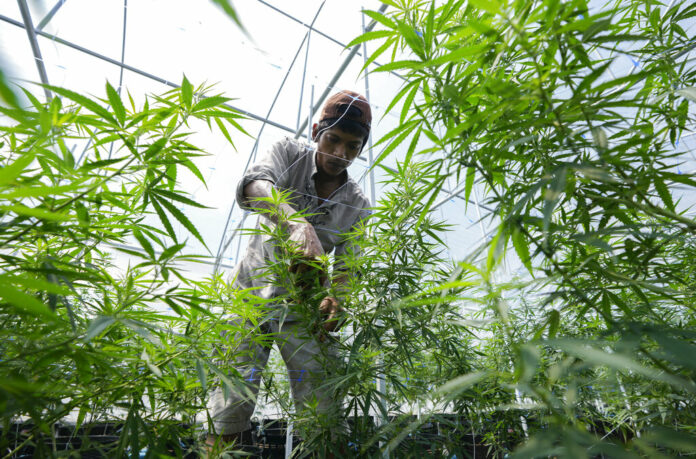
A worker tends to cannabis plants at a farm in Chonburi province, eastern Thailand on June 5, 2022. Photo: Sakchai Lalit / AP

BANGKOK (AP) — Thailand made it legal to cultivate and possess marijuana as of Thursday, like a dream come true for an aging generation of pot smokers who recall the kick the legendary Thai Stick variety delivered.

The stated intention of the country’s public health minister to distribute 1 million marijuana seedlings, beginning Friday, has added to the impression that Thailand is turning into a weed wonderland.

But for the time being, would-be marijuana tourists will be disappointed. Thailand has become the first nation in Asia to decriminalize marijuana — also known as cannabis, or ganja in the local lingo — but it is not following the examples of Uruguay and Canada, the only two countries so far that have legalized recreational marijuana on a national basis.

The government has said it is promoting cannabis for medical use only, warning those eager to light up for fun that smoking in public could still considered to be a nuisance subject to a potential 3-month sentence and 25,000 Thai baht ($780) fine. And extracted content remains illegal if it contains more than 0.2% of tetrahydrocannabinol, or THC, the chemical that makes people high.

That’s roughly the same amount that might be found in hemp, a cannabis variety mostly grown for fibers that are used for industrial purposes.

So far, it appears there would be no effort to police what people can grow and smoke at home, aside from registering to do so, and decanting it for medical purposes. But commercial cannabis products cannot breach the limit.

Thailand wants to make a splash in the market for medical marijuana. It already has a well developed medical tourism industry and its tropical climate is ideal for growing cannabis.

“We should know how to use cannabis,” Public Health Minister Anutin Charnvirakul, the country’s biggest marijuana booster, said recently. “If we have the right awareness, cannabis is like gold, something valuable, and should be promoted.”

But he added, “We will have additional Ministry of Health Notifications, by the Department of Health. If it causes nuisances, we can use that law (to stop people from smoking).”

He said the government prefers to “build an awareness” that would be better than patrolling to check on people and using the law to punish them.

“Everything should be on the middle path,” Anutin said during a news conference ahead of the decriminalization Thursday.

Economic benefits are at the heart of the marijuana reforms, projected to boost everything from national income to small farmers’ livelihoods. But there is concern over whether the benefits will be distributed equitably.

One fear is that giant corporations could be unfairly served by proposed regulations involving complicated licensing processes and expensive fees for commercial use that would handicap small producers.

“We have seen what happened with the alcohol business in Thailand. Only large-scale producers are allowed to monopolize the market,” said Taopiphop Limjittrakorn, a lawmaker from the opposition Move Forward party. “We are worried the similar thing will happen to the cannabis industry if the rules are in favor of big business,” His party wants laws now being drafted to tackle the problem.

Small operators are keen to move into the marijuana sector anyway.

On a hot Sunday afternoon in eastern Thailand’s Sri Racha district, Ittisug Hanjichan, owner of Goldenleaf Hemp, a cannabis farm, held his fifth training course for 40 entrepreneurs, farmers, and retirees. They each paid about $150 to learn tips on nicking seed coats and tending the plants to get quality yields.

“I believe that this new cash crop will be a path for Thailand to revive its COVID-hit economy,” said Ittisug, whose nickname is Boy.

One of his students was 18-year-old Chanadech, who said his parents used to scold him for trying to secretly grow marijuana plants.

He said his father has changed his mind and now sees marijuana as a medication rather than something to be abused. The family runs a small homestay and café and hopes to one day provide cannabis to their guests.

Gloria Lai, Asia regional director of the International Drug Policy Consortium, a network of over 190 civil society organizations worldwide advocating drug policies “grounded in principles of human rights, health and development,” sees liberalizing marijuana laws as a good step that might provide economic opportunities for rural communities.

“From our perspective, a major positive outcome of the legal changes is that at least 4,000 people imprisoned for offences relating to cannabis will be released, people facing cannabis-related charges will see them dropped, and money and cannabis seized from people charged with cannabis-related offences will be returned to their owners,” Lai said in an email interview.

___

Story: Tassanee Vejpongsa and Grant Peck.

Advertisement

Hot News

LATEST NEWS

Bangkok
broken clouds
27.7 ° C
30.5 °
27.7 °
82 %
2.1kmh
65 %
Thu
28 °
Fri
36 °
Sat
36 °
Sun
37 °
Mon
37 °