































Public urged to beware of scammers seeking money and personal information through fraudulent documents falsely claiming to be issued by PEA.
The Ministry of Digital Economy and Society (DE), through the Anti-Fake News Center Thailand (AFNC), has released the latest results of its fake news monitoring and reporting efforts. The initiative is in line with the policy of Mr.Chaichanok Chidchob, Minister of Digital Economy and Society, to strengthen public awareness of technology-related crimes, fake news, and misinformation.
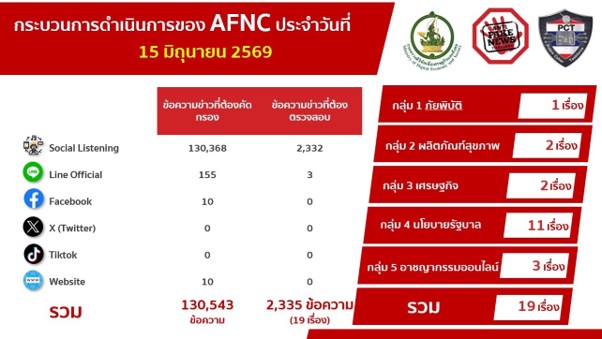
On 15 June 2026, AFNC monitored a total of 130,543 messages and identified 2,335 messages requiring verification. The largest number of reports came from Social Listening channels, accounting for 2,332 messages, followed by three reports received through the AFNC Line Official account. A total of 19 issues were investigated, with verification results received from relevant agencies for 15 cases.
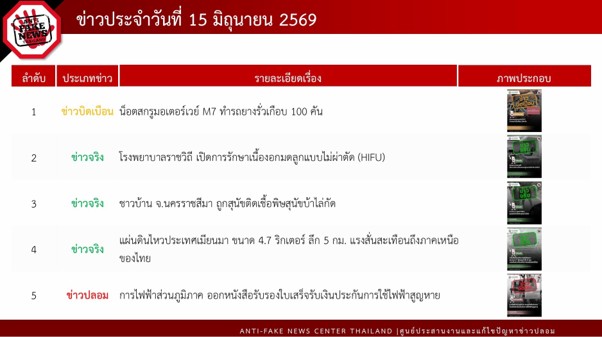
Among the seven stories that attracted the greatest public attention, three were confirmed as true, two were identified as fake news, and two were classified as misleading information. These included:
- Misleading Information: Screws on Motorway M7 caused tire punctures to nearly 100 vehicles.
- True News: Rajavithi Hospital introduces non-surgical treatment for uterine fibroids (HIFU).
- True News: Residents in Nakhon Ratchasima were attacked by a dog infected with rabies.
- True News: A 4.7-magnitude earthquake in Myanmar at a depth of 5 kilometers caused tremors felt in northern Thailand.
- Fake News: PEA issues replacement certificates for lost electricity deposit receipts.
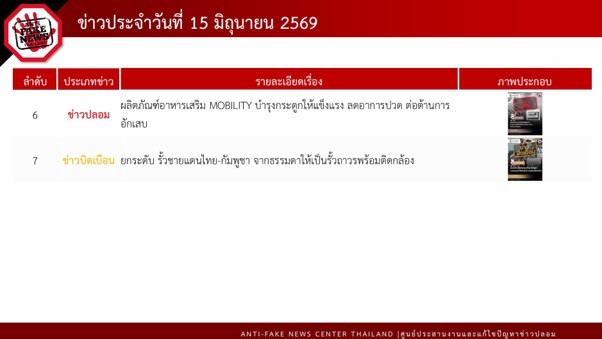
- Fake News: MOBILITY dietary supplement strengthens bones, relieves pain, and reduces inflammation.
- Misleading Information: Thailand plans to upgrade the Thai-Cambodian border fence into a permanent fence equipped with surveillance cameras.
One of the most notable fake stories claimed that the Provincial Electricity Authority (PEA) had issued certificates to replace lost electricity deposit receipts. The DE Ministry coordinated with PEA under the Ministry of Interior and confirmed that the claim is false.
According to PEA, documents circulating through the LINE application that appear to be official certificates for lost electricity deposit receipts are fraudulent documents created by scammers. Electricity users are advised not to trust individuals who attempt to collect or misuse personal information under this pretext and should not provide personal information to anyone making such claims.
PEA stated that registration for electricity deposit refunds is available only through its official website at [www.pea.co.th](http://www.pea.co.th). Customers with questions can contact the 1129 PEA Contact Center or their local PEA office.
The DE Ministry remains concerned about the spread of fake news and misinformation across online and social media platforms. Sharing unverified information may lead to misunderstanding, financial losses, misuse of personal information, and broader impacts on society.
The public is encouraged to trust and share information only from official sources and to carefully verify facts and website links before believing or forwarding any information.
People who encounter suspicious information or possible fake news can report it or verify information through the Anti-Fake News Center Thailand via Hotline 1111 ext. 87, available 24 hours a day.