


































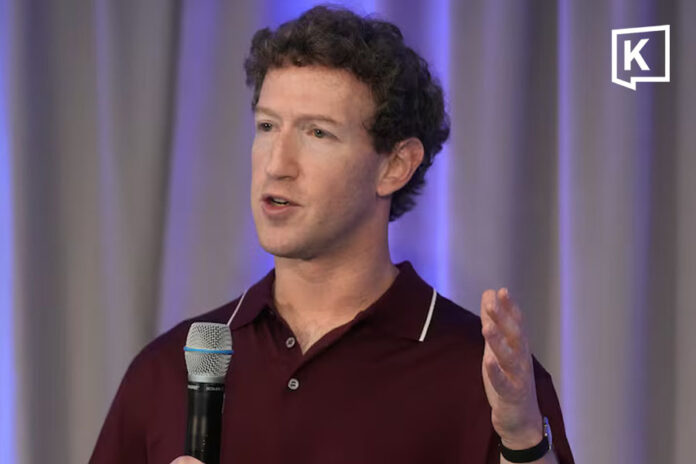
Mark Zuckerberg has published a roughly 6,500-word manifesto on the future of artificial intelligence, laying out a vision in which everyone gets access to a personal “superintelligence” that can help with work, health, education, business and everyday life.
It is an ambitious pitch. It is also a convenient one for Meta.
Zuckerberg’s central argument is that the biggest question surrounding advanced AI is not simply how powerful it becomes, but who gets to control it. He warns against concentrating superintelligence in the hands of governments, large institutions or a small group of experts, and argues that the safest future is one where billions of ordinary people have access to powerful AI themselves.
That leaves an obvious tension hanging over the manifesto: Zuckerberg is making the case against concentrated technological power while running one of the largest technology companies on the planet.
Still, beneath the grand language, his argument can be boiled down to a few main ideas.
1. Everyone gets their own superintelligent assistant
Zuckerberg predicts that people will eventually have personal AI agents that know their goals and preferences and work for them around the clock.
These agents could manage finances, careers and health, tutor children, teach adults new skills, help start businesses and assist scientists with research.
He says his own AI already helps monitor his sleep and training, prototype ideas and plan baking activities with his daughter.
The promise is simple: instead of mainly replacing people, AI will make individuals far more capable.
But that vision also assumes people will be willing to hand vast amounts of personal information to AI systems. Meta says it intends to build a private mode where even the company cannot access users’ information.
2. Zuckerberg thinks AI could create more jobs, not fewer
One of the biggest fears surrounding AI is that increasingly capable systems will replace large numbers of workers.
Zuckerberg acknowledges jobs will change, but argues AI could be used more for “invention” than automation, creating new products, businesses and professions.
He predicts smaller companies, more entrepreneurs and entirely new occupations, much as previous technological shifts created app developers, social media creators and electric vehicle technicians.
It is one of the more optimistic assumptions in the manifesto.
3. His solution to dangerous AI is more AI in more hands
Many AI safety arguments focus on tightly controlling advanced systems and ensuring they follow human values.
Zuckerberg thinks that approach has a fundamental flaw: humans do not share one set of values, so there can never really be one perfectly “benevolent” superintelligence acting for everyone.
Instead, he argues safety should come from a balance of power.
His example is a courtroom. If one person had a superintelligent lawyer, they would have an enormous advantage. If everyone had one, the advantage disappears.
He applies the same logic to cybersecurity, business and politics, arguing that competing AI systems should check one another.
“There is no such thing as a singular benevolent superintelligence,” he writes.
But distributing an extremely powerful technology does not automatically prevent misuse. It may simply distribute the ability to misuse it as well.
Zuckerberg acknowledges risks including cyberattacks, biological threats, surveillance and AI systems eventually improving themselves beyond human capabilities.
4. America needs to win the AI race
For all the language about empowering individuals, the manifesto is also explicitly about national power.
Zuckerberg argues the United States and other democratic countries must remain ahead in AI development.
He backs cooperation between frontier AI companies and the US government, restrictions on advanced chips reaching rivals, and faster construction of data centres, energy infrastructure and semiconductor capacity.
At the same time, he warns against regulation that could slow American AI companies down, arguing excessive restrictions could hand the advantage to authoritarian countries.
It is a familiar Silicon Valley position: moving too slowly may be more dangerous than moving quickly.
5. Meta wants to be the company that gives AI to everyone
The manifesto is philosophical, but it is also unmistakably a statement of corporate strategy.
Zuckerberg says Meta will focus on “personal superintelligence” for billions of people and small businesses, including free or affordable access.
The company also plans to resume releasing some open-source AI models and says an independent board will approve safety criteria for powerful model releases.
Zuckerberg argues decisions about superintelligence should not rest with him alone, despite Meta remaining a founder-controlled company.
That may be one of the more revealing parts of the piece: the man warning against concentrated AI power is also acknowledging how much power people in his position could soon possess.
So what is Zuckerberg really saying?
Strip away the language about civilisation and human potential, and the message is fairly straightforward.
Zuckerberg believes superintelligent AI is coming soon. He thinks trying to contain it within a handful of institutions would be dangerous and unfair.
Instead, he wants powerful AI distributed widely, while Meta builds the products and infrastructure that deliver it.
He believes that could mean more businesses, faster scientific discovery, better education and greater prosperity.
What the manifesto spends less time confronting is what happens if those assumptions prove wrong: if businesses automate faster than workers can adapt, if personal AI demands levels of surveillance people reject, or if putting extremely powerful tools into everyone’s hands creates more dangers than it prevents.
Then, after thousands of words that most people will probably never read without the help of an AI, he signs off simply:
“– Mark”