



































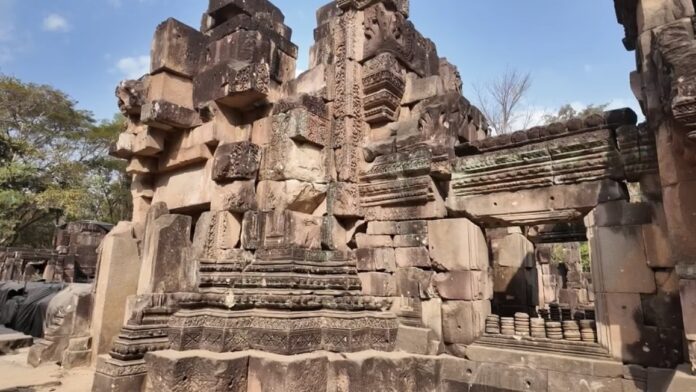
PHNOM PENH — Cambodia has rejected Thailand’s claim over the Ta Muen Complex, saying it violates international law, as border tensions persist.
In a statement on Tuesday, the Cambodia PR Team dismissed assertions by Thailand’s Joint Information Center that the complex is legally registered as Thai property, saying such registration has no legal standing.
Cambodia said the claim contradicts the Franco–Siamese Treaty of 1907 and related boundary records from 1908–1909 and 1919–1920, which it said place the Ta Muen temples within Cambodian territory.
“The claimed registration is superseded by treaty-based boundaries and therefore has no legal effect under international law,” the statement said.
Phnom Penh cited the 1907 treaty-based 1:200,000 boundary map, historical demarcation records and Cambodia’s listing of the site in its National Inventory of Cultural Heritage as evidence that the complex is in Oddar Meanchey province. It rejected Thailand’s reliance on unilateral 1:50,000 maps, saying they lack legal authority.
Cambodia reaffirmed that the complex falls under its sovereignty, declared unilateral Thai claims “legally null and void”, and called for a peaceful resolution through the International Court of Justice.
Earlier, Thailand’s Anti-Fake News Center said on 18 January that Ta Muen Thom is a nationally registered ancient monument of Thailand. Citing the Fine Arts Department, it said the site was registered on 8 March 1935, as published in the Royal Gazette, predating Cambodia’s independence in 1953.
Thailand says Ta Muen Thom is located at Ta Muen Pass in Surin province, northeastern Thailand.
Thai authorities on Wednesday also released images of Ta Muen Thom following a nearly month-long ceasefire along the Thai–Cambodian border, showing the Thai national flag prominently raised at the site, which Thai officials say indicates the temple is under Thai control.