






























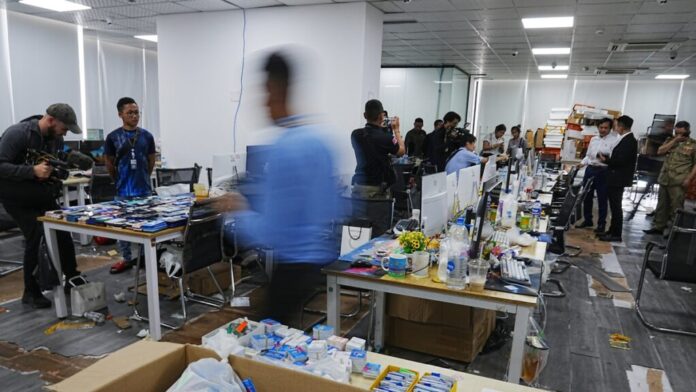
Thailand has joined the United States and 11 other countries in adopting a joint statement outlining measures to dismantle transnational online scam networks, including targeted economic sanctions, criminal prosecutions and closer cooperation against corrupt officials involved in scam operations.
The US State Department announced that members of the Contact Group on Countering Criminal Online Scams and Scam Centers in Southeast Asia, East Asia, and the Pacific had released a Statement of Principles to guide coordinated action against criminal organisations operating across the region.
The 13 participating countries are the United States, Australia, Canada, Indonesia, Japan, Malaysia, New Zealand, the Philippines, South Korea, Singapore, Thailand, the United Kingdom and Vietnam.
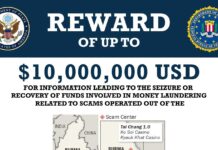
According to the State Department, scam groups based in Southeast Asia, mostly operated by Chinese criminal organisations, stole an estimated US$18.2 billion from American victims across all 50 US states in 2025 alone.
The department said these criminal networks exploit trafficked workers and use fraudulent investment schemes and other scams to steal victims’ life savings.
The United States established the Contact Group in April 2026 to coordinate international efforts against online scam operations, in line with President Donald Trump’s Executive Order 14390 on combating cybercrime, fraud and predatory schemes targeting American citizens.
Under the newly released principles, participating countries will consider targeted economic sanctions and entry bans against individuals involved in scam operations, including those who facilitate fraud through money laundering and corruption.
The countries also pledged to prioritise investigations, prosecutions and lawful arrests of criminal leaders, while identifying and dismantling their financial, operational and logistical networks.
Crackdown on corrupt officials
One of the key commitments focuses on public officials who cooperate with transnational criminal organisations.
The participating governments agreed to intensify cooperation against corruption and pursue investigations, prosecutions and sanctions, where appropriate, against officials who collude with foreign criminal networks operating online scams.
They also intend to strengthen intelligence-sharing and exchange digital evidence obtained from suspects, victims and seized electronic devices.
Where operationally feasible, members will notify and seek prior consent from relevant partner countries before conducting law enforcement operations against scam networks suspected of targeting their nationals.
The agreement also calls for coordination with international law enforcement mechanisms, including INTERPOL’s Global Fraud Taskforce, known as Operation Shadowstorm.
Participating countries will seek to facilitate the return of recovered funds and assets to victims, where appropriate and in accordance with domestic laws.
Protection for trafficking victims
The statement also addresses people forced to work in scam centres.
Member countries are encouraged to identify, protect and assist individuals who have been trafficked, coerced or compelled to participate in online fraud.
The principles emphasise that trafficking victims should not be inappropriately punished for unlawful acts committed as a direct consequence of their exploitation.
The governments also pledged to strengthen cooperation with banks, cryptocurrency platforms, telecommunications companies and digital service providers to identify suspicious financial transactions and disrupt online scam infrastructure.
This includes efforts to block or remove websites, applications and accounts used for fraudulent activities.
The joint statement emphasises that all enforcement measures must respect national sovereignty, territorial integrity and domestic legal frameworks.
The US State Department said Washington and its partners would use available tools to bring criminal organisations targeting American citizens to justice.