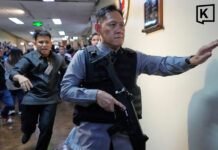
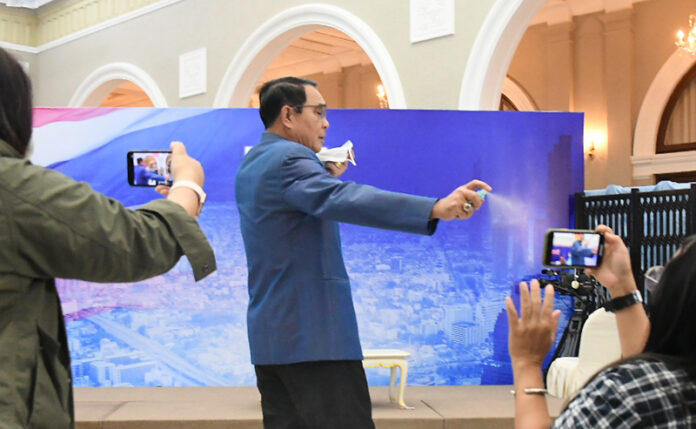
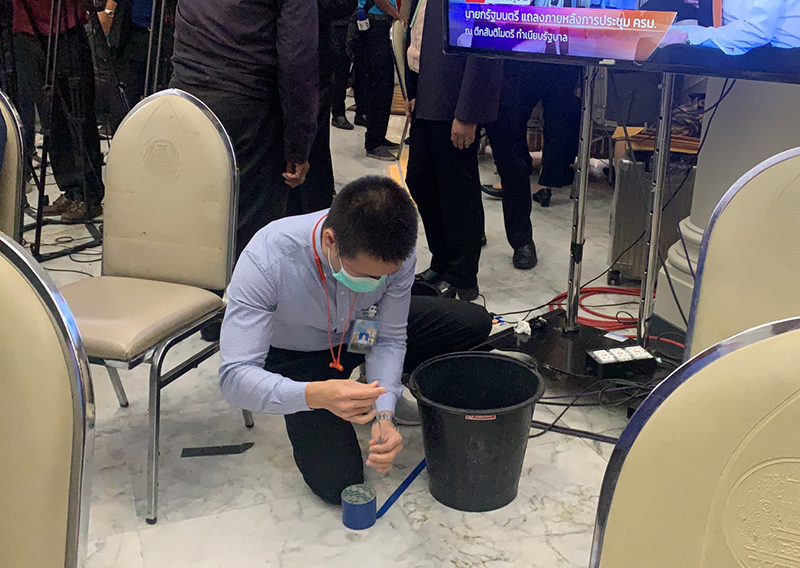
Gen. Prayut Chan-o-cha sprays reporters with sanitizer at Government House March 9, 2021.
BANGKOK — Gen. Prayut Chan-o-cha apologized Friday for spraying reporters with alcohol while being questioned by the press earlier in the week.
At the Royal Thai Police Headquarters Friday, Prayut apologized for spraying reporters with sanitizing alcohol after the Tuesday cabinet meeting.
“Usually I joke around with reporters like this. I won’t do it again and will follow the rules. Sorry, I guess,” he said.
When pressed on the fact that international news outlets picked up on the story, the general changed his tone to a ngonone – a mix of pouty disappointment.
“Well, who was the one who distributed that footage? I was just teasing you. I’ve resolved never to joke around with you again. End of story,” he said angrily.
If you get alcohol into your eyes, you should flush your eyes as soon as possible after contact.
Popular Facebook parenting page “Take Kids With Us” wrote on Friday that Prayut’s behavior is an example of how pooyai in Thai society bully people in less senior positions under the guise of a joke.
“Pooyai” means adults, but it can also refer to influential people or individuals that demand respect from those inferior to their standing.
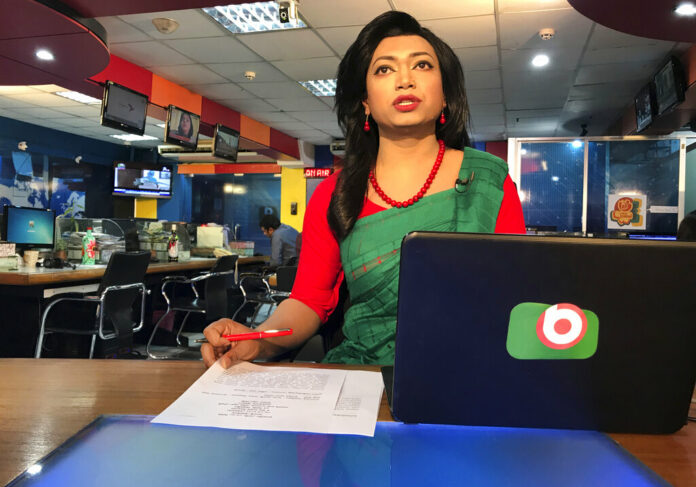
Bangladesh's first transgender news anchor Tashnuva Anan Shishir reads news bulletin , in Dhaka, Bangladesh, Tuesday, March 9, 2021. Photo: Al-emrun Garjon / AP
DHAKA, Bangladesh (AP) — A Bangladeshi satellite television station has hired the country’s first transgender news anchor, saying it hopes the appointment will help change society.
Tashnuva Anan Shishir, who previously worked as a rights activist and actress, debuted on Dhaka-based Boishakhi TV on Monday, International Women’s Day. She read a three-minute news bulletin, and after finishing cried as her colleagues applauded and cheered.
“I was very nervous, I was feeling so much emotional, but I had in my mind that I must overcome this ordeal, this final test,” Shishir, 29, said in an interview Tuesday.
In her early teens, she began to live publicly her female identity. She said family members, relatives and neighbors started teasing her and she was bullied and sexually exploited.
She started feeling that it was impossible to continue living and attempted suicide, she said.
The worst thing that happened was that her father stopped talking to her, saying she was the reason that her family was losing face, Shishir said.
“I left home,” she said.
She moved from her family’s house in a southern coastal district to live a solitary life in the capital, where she underwent hormone therapy, worked for charities and acted with a local theater group. In January, she began studying public health at a Dhaka university, which she is continuing alongside her job at the TV station.
Bangladesh officially has more than 10,000 transgender people, but activists say the actual number is much higher in the nation of more than 160 million people. The LGBT community faces social isolation, sexual abuse and other forms of harassment. Finding employment is very difficult, and many live by begging or selling sex.
Since 2013, the government of Prime Minister Sheikh Hasina has allowed transgender people to identify themselves as a separate gender. They were given voting rights in 2018.
Some changes are already visible.
In November, a charity group opened Bangladesh’s first Islamic school for the transgender community.
Boishakhi TV said it wanted to be part of the changes and has hired a second transgender person in its drama department.
“Our prime minister has taken many steps for the transgender people. Encouraged by such steps, we have appointed two transgender people, We want the attitude of society to change through these appointments,” said Tipu Alam Milon, the station’s deputy managing director.
___
Story: By Julhas Alam. This story was first published on March 10, 2021. It was updated on March 12, 2021, to correct by removing the anchor’s former name and conforming to AP style.
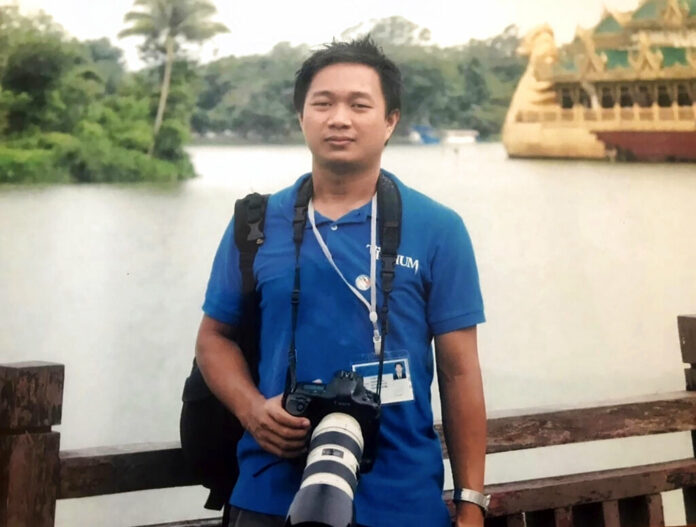
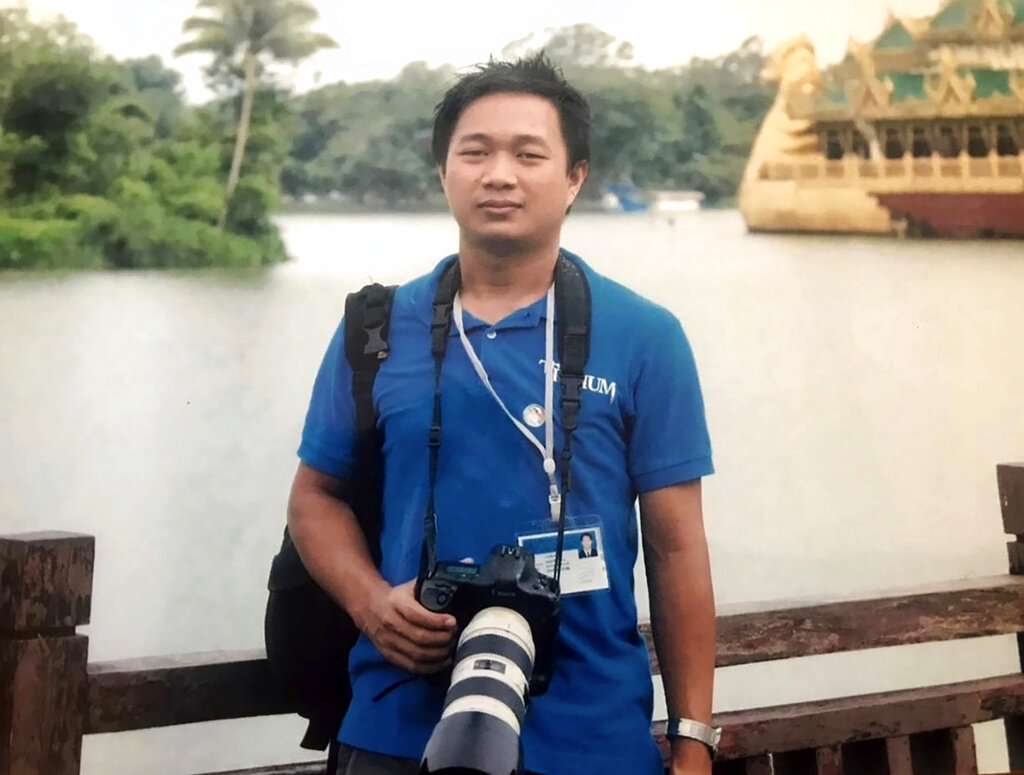
This undated family file photo provided on Wednesday, March 3, 2021 shows Associated Press journalist Thein Zaw in Yangon, Myanmar. Photo: Thein Zaw family via AP
YANGON, Myanmar (AP) — A court in Myanmar is scheduled to hold a hearing on Friday for an Associated Press journalist detained while covering demonstrations against the military’s seizure of power last month. He is facing a charge that could send him to prison for three years.
Thein Zaw, 32, was one of nine media workers taken into custody during a street protest on Feb. 27 in Yangon, the country’s largest city, and has been held without bail.
His hearing Friday comes at the end of his initial remand period, and his lawyer, Tin Zar Oo, said ahead of it that she expected the court to schedule another hearing. She plans to submit her power of attorney as Zaw’s lawyer and perhaps try to apply for bail.
Thein Zaw has not been seen by his lawyer or any of his family members since his arrest. Tin Zar Oo said visits at Insein Prison, where he is being held, are not allowed because of coronavirus concerns, so his family has been dropping off food and supplies for him at the gate.
According to the independent Assistance Association for Political Prisoners, 38 journalists have been detained since the military took over Feb. 1, ousting the elected government of Aung San Suu Kyi. Nineteen are still incarcerated.
The group says it has verified the detentions of more than 2,000 people as well as 69 deaths.
The military regime has attacked the press in other ways as well. This week it canceled the licenses of five local media outlets that had extensively covered the protests. Mizzima, Democratic Voice of Burma, Khit Thit Media, Myanmar Now and 7Day News have continued operating after they were barred from broadcasting or publishing on any media platform.
Thein Zaw was arrested as he was photographing police, some of them armed, charging down a street at anti-coup protesters. A video shows that although he stepped to the side of the street to get out of their way, several police rushed over and surrounded him. One put him in a chokehold as he was handcuffed and then taken away.
Insein Prison in northern Yangon is notorious for housing political prisoners under previous military regimes. Hundreds of protesters detained in the past week, many of them students, are also being held there.
Thein Zaw and at least six other members of the media have been charged with violating a public order law that could see them imprisoned for up to three years, according to his lawyer and the Assistance Association for Political Prisoners.
The Associated Press has called for his immediate release.
“Independent journalists must be allowed to freely and safely report the news without fear of retribution,” Ian Phillips, AP vice president for international news, said after the arrest. “AP decries in the strongest terms the arbitrary detention of Thein Zaw.”
Many press freedom organizations have joined the call for the release of the detained journalists.
“These charges are a obvious effort to intimidate Myanmar’s journalists into silence and prevent them from reporting on the junta’s increasingly violent crackdown on the protests against its illegitimate rule,” said Scott Griffen, deputy director of the International Press Institute, headquartered in Vienna. “We call on the authorities to immediately drop these groundless charges, and release Thein Zaw and all other detained journalists.“
The U.S. government, in addition to criticizing the coup and the violence of Myanmar’s security forces, has shown support for the cause of press freedom in the Southeast Asian nation.
“We condemn the attempted media blackout and efforts to silence the voices of the people by revoking the licenses of several local media organizations,” U.S. State Department spokesperson Ned Price told reporters in Washington on Thursday. “We are deeply concerned about the increasing attacks on the freedom of expression, including for members of the press. We call for the release of journalists and for all others who have been unjustly detained.”
Even during Suu Kyi’s time in office, journalists were often sued for their reporting.
In the highest-profile case, two journalists working for the Reuters news agency were arrested in 2017 while working on a story about the military violence directed at Myanmar’s Rohingya minority, more than 700,000 of whom fled to Bangladesh for safety. They were accused of illegally possessing official documents, although they argued that they were framed because of official opposition to their reporting.
They were convicted and sentenced to seven years behind bars before being freed in 2019 in a mass presidential pardon.
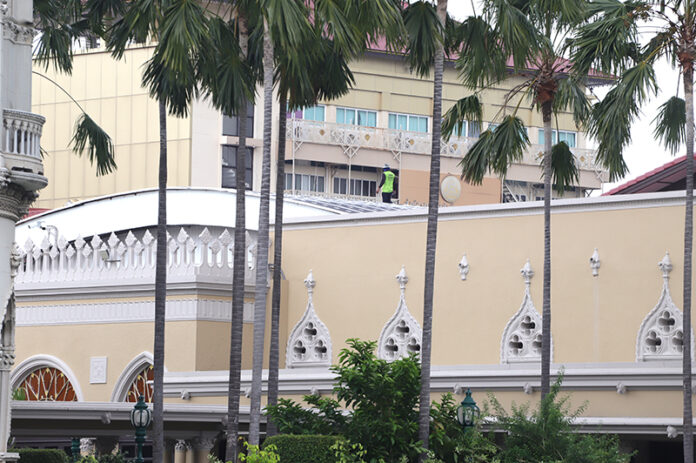
A repairman on the roof of Government House for repairs on March 11, 2021.
BANGKOK — Thursday was the first day of repairs of a leaky roof at Government House – which will cost taxpayers a whopping 6 million baht.
Soldiers from the Post Engineer Department laid down tarps at Santi Maitri Building inside the Government House complex as the first step to fix the leaky ceiling.
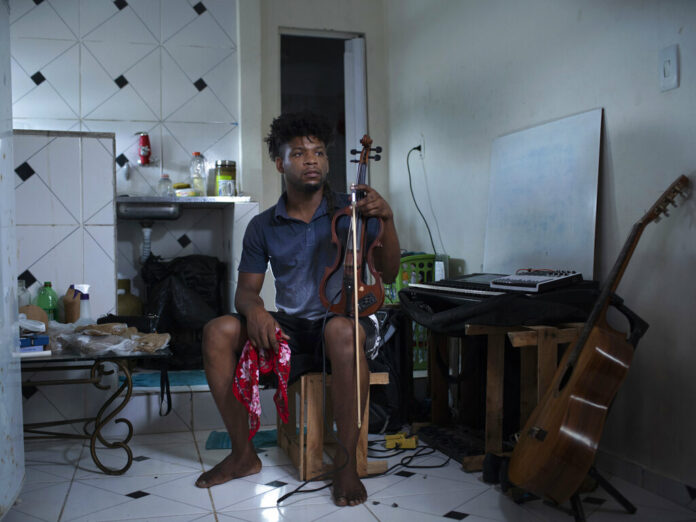
Mauricio Vivet poses for a photo with his violin at home, Dona Marta slum, Rio de Janeiro, Brazil, Saturday, March 6, 2021. Photo: Silvia Izquierdo / AP
One year into the COVID-19 pandemic, the world has seen death, economic hardship and anxiety on an unprecedented scale. But it has also witnessed self-sacrifice, courage and perseverance.
In India, Brazil, South Africa and other places around the globe, people are helping others and reinventing themselves.
“I’ve been adaptable, like water,” said a woman whose dream of becoming a U.S. boxing champion was dealt a blow by the crisis, though not necessarily a knockout punch.
Their voices and images can inspire, even though the future is as uncertain for them as it is for everyone else.
THE VIOLINIST
Mauricio Vivet’s talent as a violinist had earned him a route out of a slum in Rio de Janeiro. As a teen, he played classical music in the streets for money. He got noticed and received a scholarship to a prestigious music school.
After graduation, Vivet earned a living by playing at events and giving lessons. He moved out of the neighborhood and planned to open a music studio.
COVID-19 put a stop to all that. Concerts, weddings and other events were canceled. Vivet, 27, now struggles just to pay for food. He left his apartment and moved back to his mother’s house in the favela.
Vivet’s biggest fear is not having money to provide for his 4-year-old son, Angelo.
Vivet has gone back to square one.
On a recent day, he carefully wrapped his violin in a red cloth, placed it inside a battered black suitcase and made his way to Ipanema Beach. There, he sat on a stone bench and played his violin, the sweet notes amplified by a speaker. Passersby stopped to listen. Some dropped money into the red cloth.
“It is the only stage that I have, the only thing that they have not prohibited,” Vivet said. “It’s the only way I can make money.”
THE BOXER
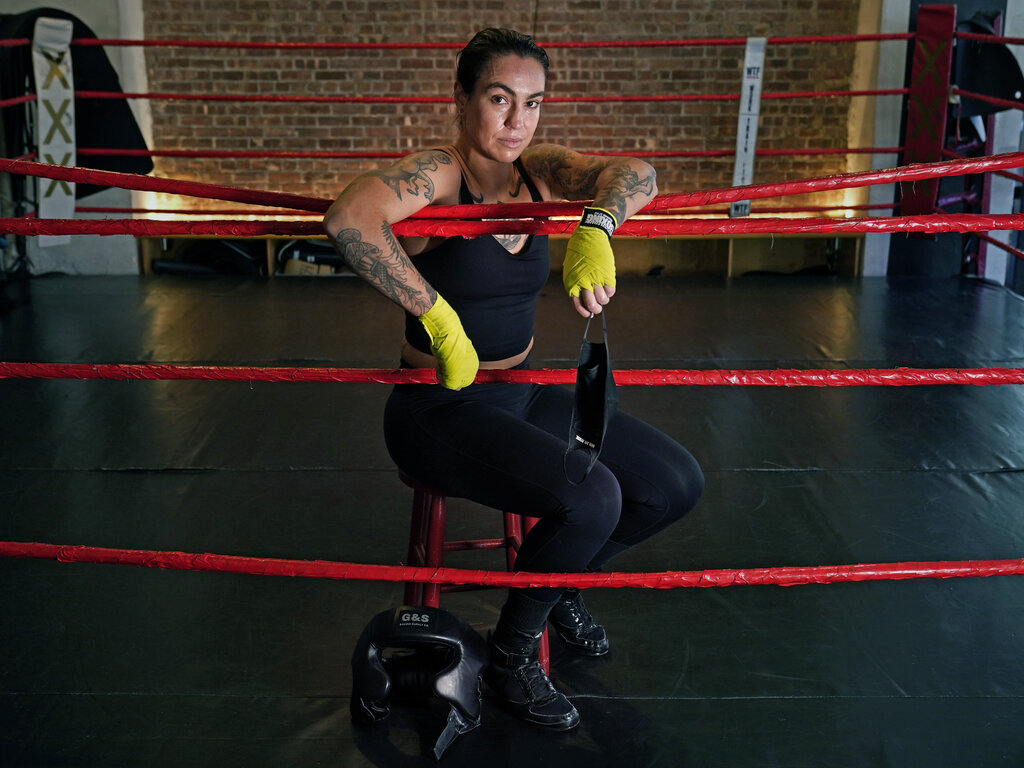
Melody “Mel” Popravak, a boxer, poses for a portrait at Work Train Fight boxing gym, Friday, March 5, 2021, in New York. Photo: Kathy Willens / AP
On a recent day, Melody “Mel” Popravak was in a boxing gym in New York City, her arms tattooed, her hands wrapped in yellow tape. Three years ago, she started boxing and was a finalist in two national tournaments.
After the shutdown, she trained in a friend’s garage.
“I’m determined not to give up and to continue to move on to be a professional boxer,” the 35-year-old said.
She has also started an online personal training company where she gives tips on staying in shape.
“I’m checking in with people all over the country who are going through various situations related to COVID,” she said. “I think I’ve been staying strong. I’ve been adaptable, like water, melding into the situation.”
THE BURIAL WORKER
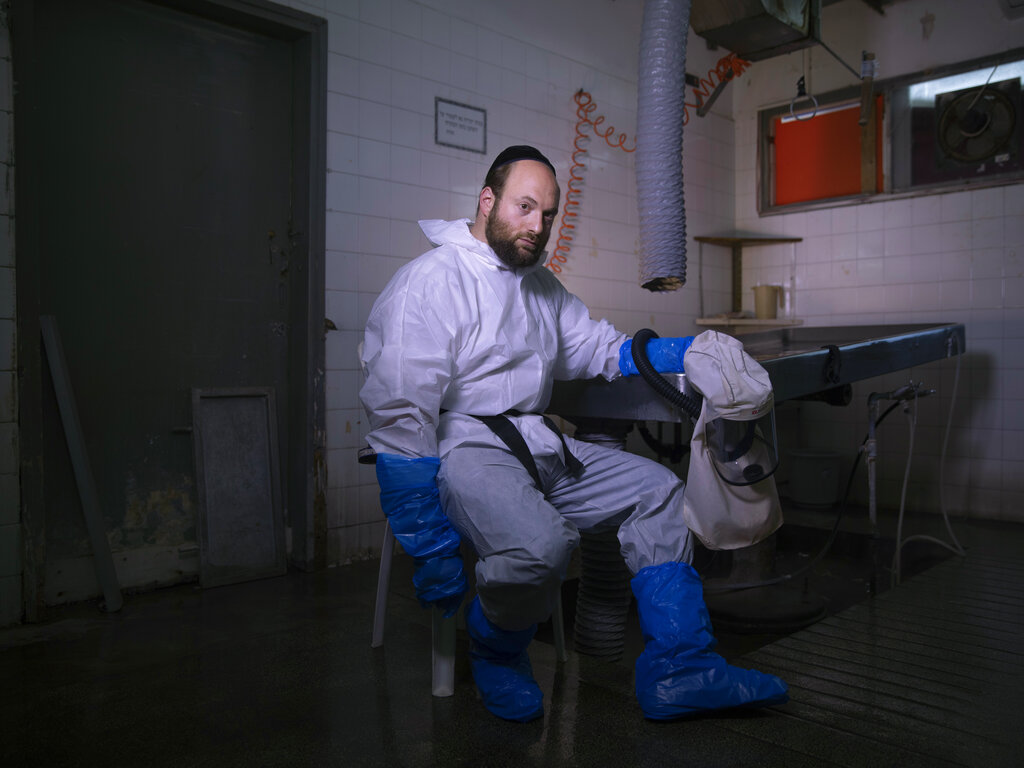
Yehuda Erlich, a worker with Israel’s official Jewish burial society, poses for a photo at a morgue in the central Israeli city of Holon, near Tel Aviv, Tuesday, March 2, 2021. Photo: Oded Balilty / AP
Yehuda Erlich, a worker with Israel’s official Jewish burial society, remembers the first signs that coronavirus had arrived: empty streets and deathly silence. Then a surge of deaths overwhelmed his morgue, with bodies placed in the corridor.
“I really hope we are nearing the end,” Erlich said of the pandemic.
THE STRICKEN DOCTOR
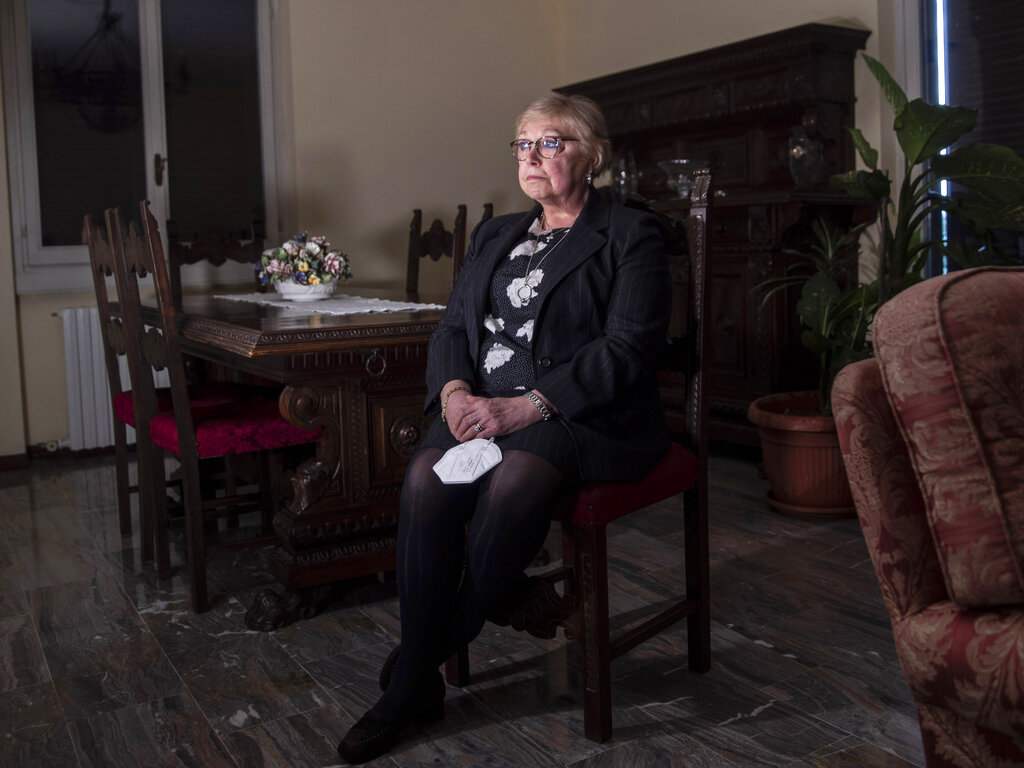
Gabriella Formenti, a doctor from the village of Tavernola Bergamasca in northern Italy, poses at her home Monday, March 8, 2021. Photo: Luca Bruno / AP
Near the beginning of the pandemic, Gabriella Formenti, a doctor from the village of Tavernola Bergamasca in northern Italy, started feeling exhausted and had a high fever. Hit by the virus, she wound up intubated in an intensive care unit.
Eventually she woke up but could move only her head, having lost muscle mass. Today, Formenti undergoes rehabilitation and is often out of breath and weak. Forced by her condition to retire, she greatly misses her patients.
“This disease emphasized, even more, how close they are to me emotionally and personally,” she said. “They even celebrated when I came back home. They all came to see me and helped me. ”
THE ACTRESS
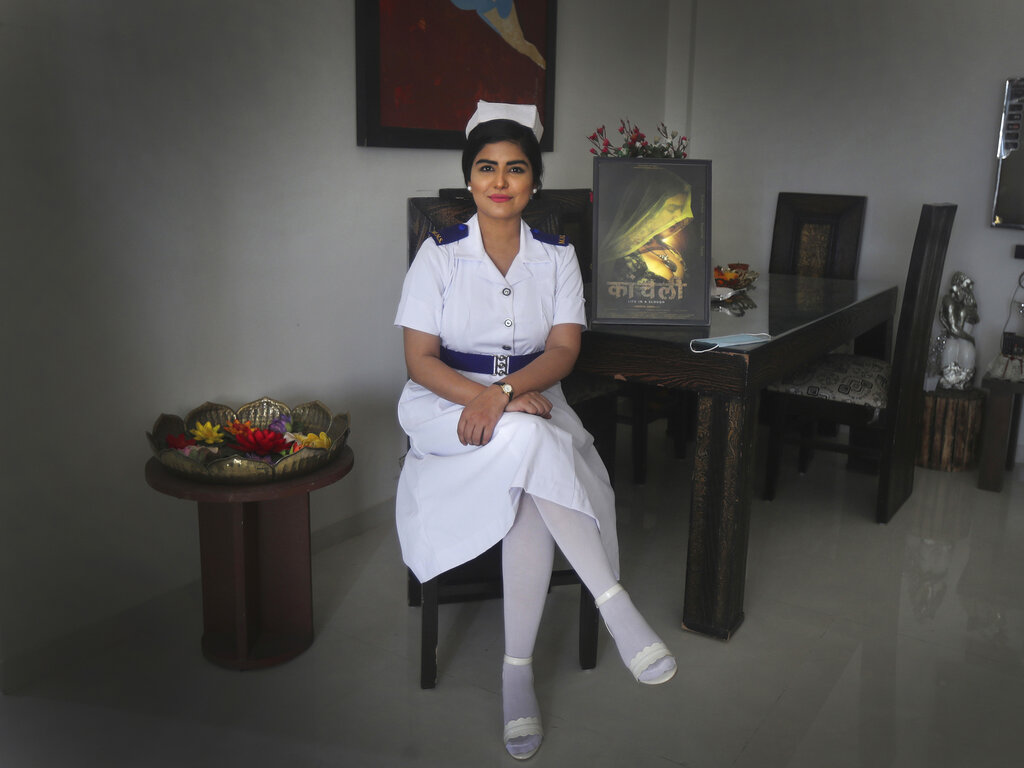
Shikha Malhotra, a Bollywood actress and nurse, poses for a photo sitting next to a poster of her in a Bollywood film at her apartment in Mumbai, India, Wednesday, March. 3, 2021. Photo: Rafiq Maqbool / AP
Shikha Malhotra is a Bollywood actress whose Instagram feed highlights her film and TV projects. During the pandemic, they have also featured her as a nurse.
It is a real-life role that Malhotra, who has a nursing degree, has taken on while volunteering at a crowded Mumbai hospital. Mumbai was one of the worst-hit cities in India, the country with the second-highest caseload of COVID-19 in the world.
“I am first a nursing officer, then an actress,” Malhotra said at her home, wearing a white nurse’s uniform, a white cap over her luxuriant black hair. Next to her was a poster of a movie she starred in.
After working in a COVID-19 ward for months, she became infected, spent a month alone in the hospital recovering, then suffered a stroke that paralyzed the right side of her body.
“It was a big setback for me,” the 25-year-old said, tears streaming down her face as she recalled believing that she would never walk again. She recovered and plans to continue her acting career while also staying ready to serve as a nurse whenever she is needed.
“Seeing life and death in the hospital changed me,” Malhotra said. “I became a more mature person, more grounded. Seeing the people in pain, every single second now I thank God for all that I have.”
THE CENTENARIAN
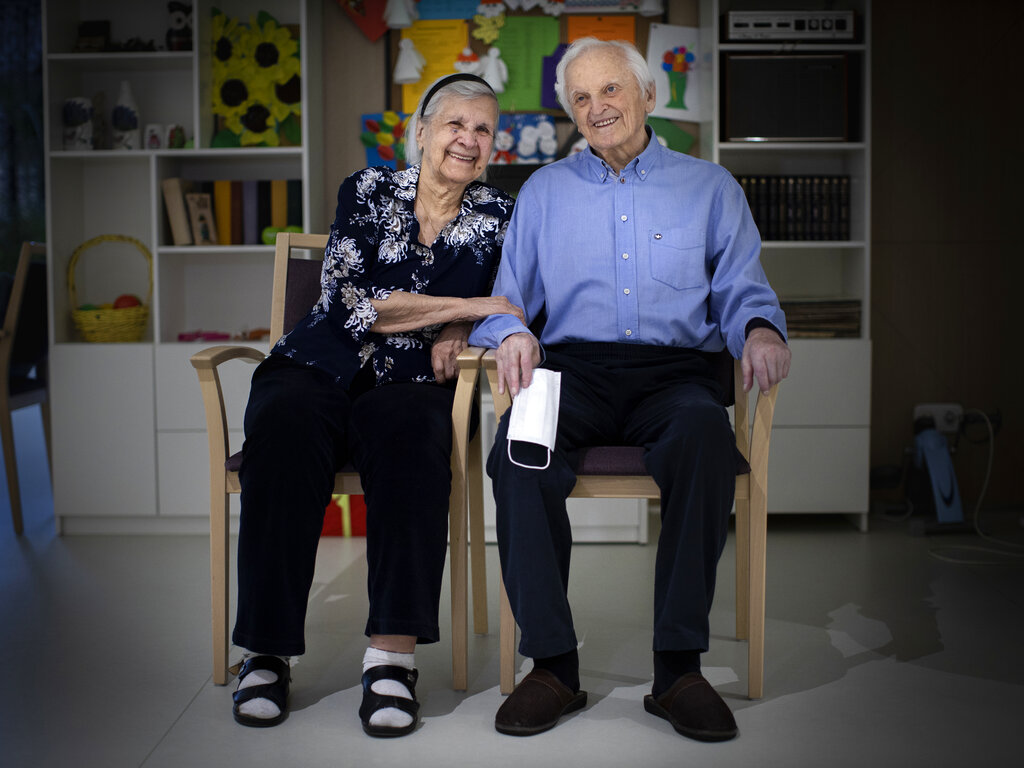
Boris Novikov poses for a photo with his wife, Yelena, at a senior care center just outside Moscow, Russia, Friday, March 5, 2021. Photo: Alexander Zemlianichenko / AP
At 101, Boris Novikov is one of the oldest survivors of COVID-19 in Russia.
A decorated World War II veteran, Novikov was hospitalized with oxygen support. Now recovered, he celebrated his birthday last week at a senior care center near Moscow, where he lives with his wife, Yelena, 93. They have been together 70 years.
Novikov told a visitor he feels “excellent.”
“We can’t complain about anything, for now at least,” his wife added. “We’re living it day by day.”
THE VACCINATOR
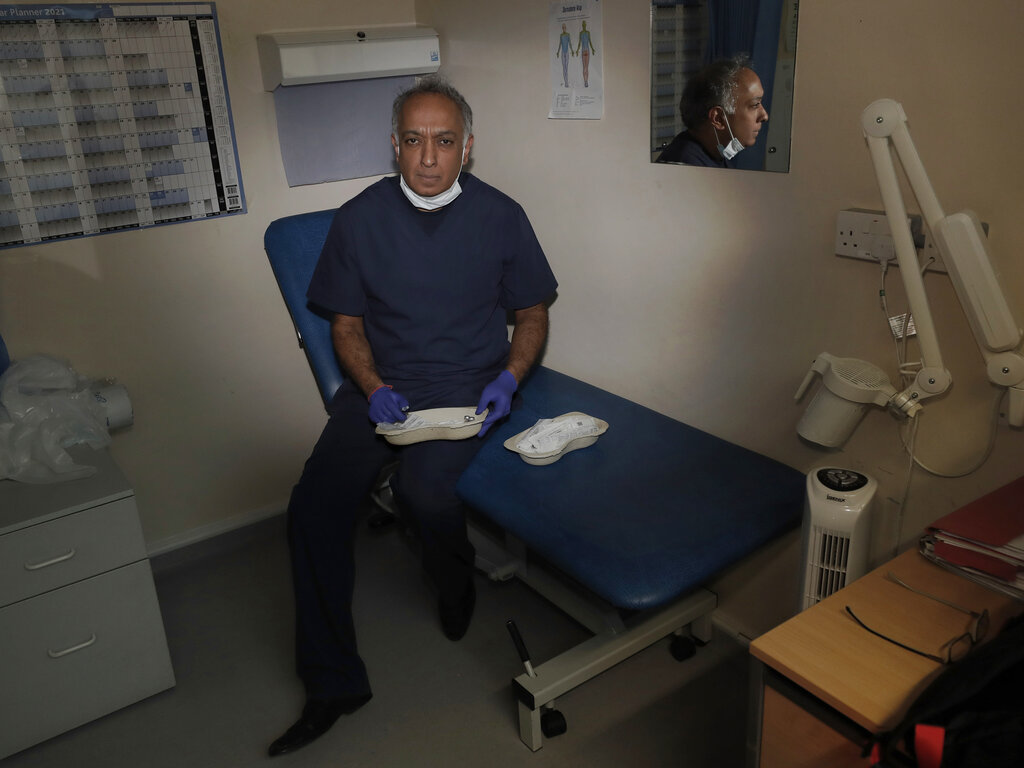
Dr. Anil Mehta poses for a photograph as he prepares syringes at his practice in Northeast London, Wednesday, March 3, 2021. Photo: Frank Augstein / AP
Dr. Anil Mehta has been going with his small team of physicians and nurses to homeless centers in London to offer free COVID-19 vaccinations. The team has vaccinated hundreds of people.
“It makes sense to focus energy on groups that are underrepresented and those most reluctant to go to their doctors,” he said.
Mehta is driven by a desire to help everyone get back to normal as quickly as possible.
“Our lives have been turned upside down in the past year,” he said. “This is the most important thing any of us doctors have done in our lives.”
THE TOUR GUIDE
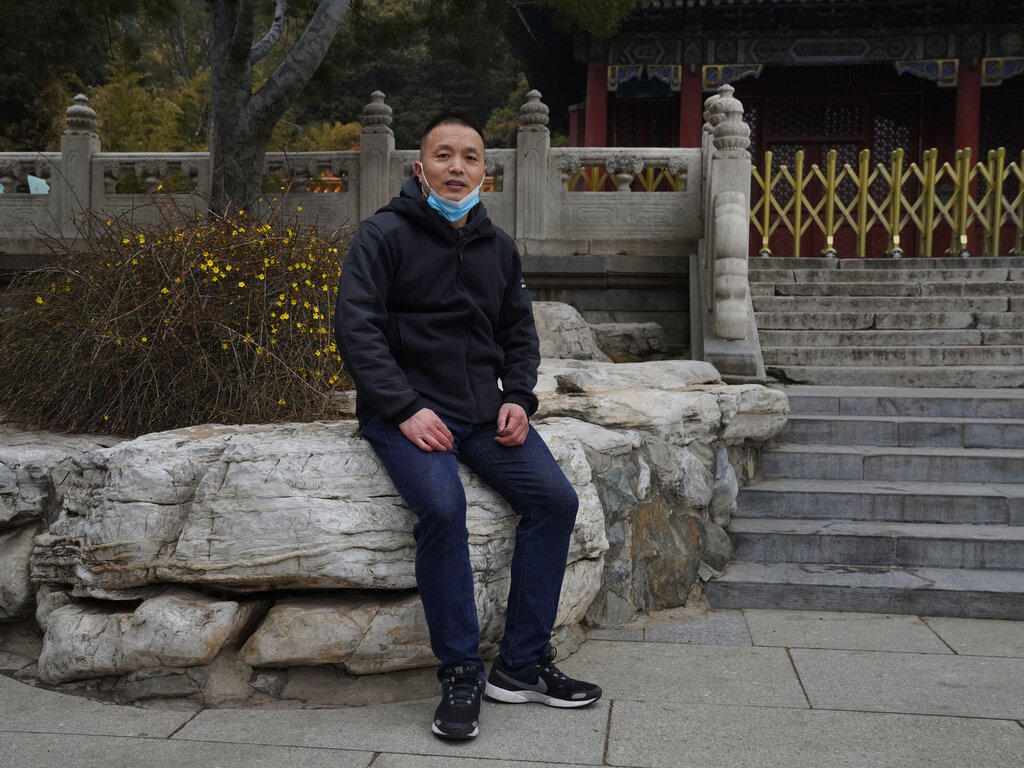
Shi Jinjie, a tour guide in Beijing, poses for a photo at the Jingshan park in Beijing on Friday, March 5, 2021. Photo: Ng Han Guan / AP
Shi Jinjie, a tour guide in Beijing, saw a 90% drop in business last year because of the pandemic. But he is confident domestic tourism will make a comeback very soon.
Already, a few customers are trickling in. He showed them around a park featuring centuries-old pavilions.
“Is Jingshan beautiful?” he asked them. As he took their photo, they responded: “Beautiful!”
THE RESEARCHER
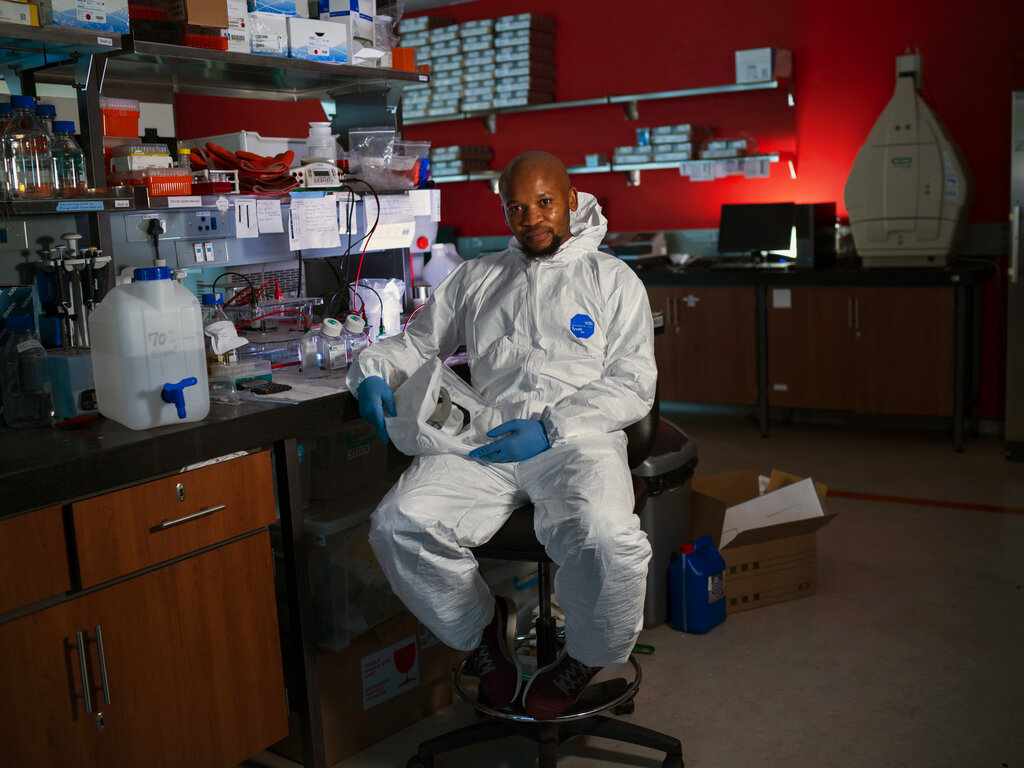
Sandile Cele, a doctoral candidate at the University of Kwazulu-Natal, poses in a lab Thursday, March 4, 2021, Durban, South Africa. Photo: Jerome Delay / AP
Sandile Cele was pursuing a doctorate at the University of Kwazulu-Natal in South Africa when the pandemic hit, creating an obvious research topic.
He made a splash when he figured out how to grow the South African variant of the coronavirus in the laboratory. That enabled the lab to test it and discover that people previously infected with COVID-19 don’t produce antibodies against the mutant version, which has spread to numerous countries.
Cele, 33, said it is every graduate student’s dream “to have a project for your Ph.D. that’s going to have so much impact in the world.”
THE BLAST VICTIM
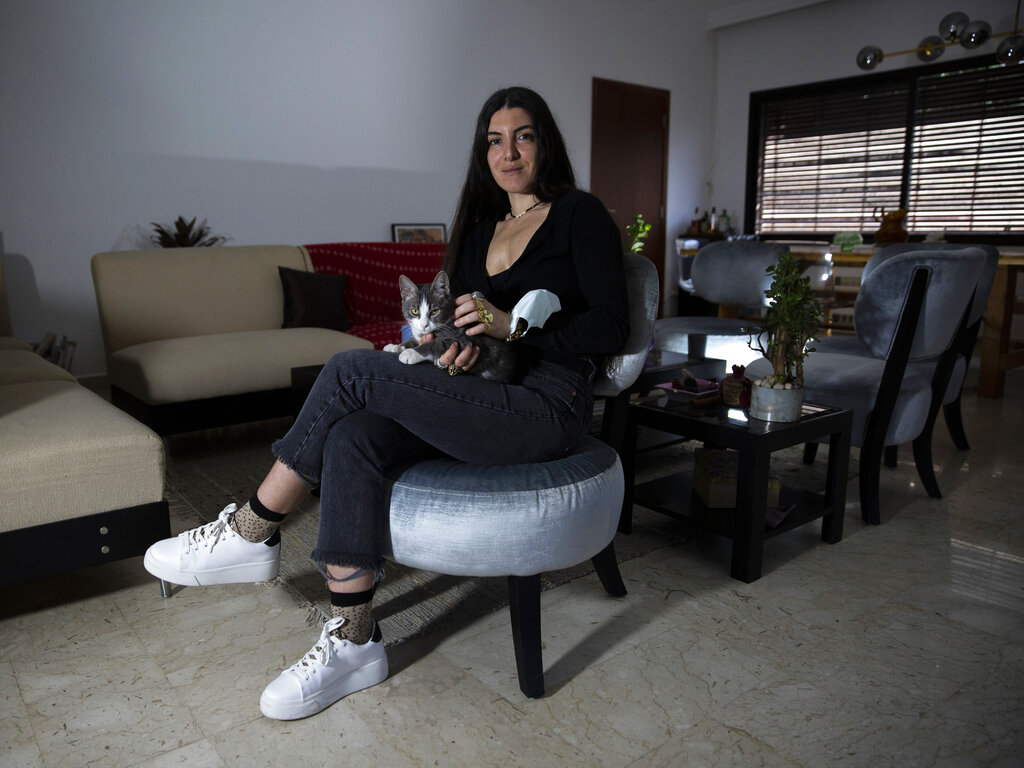
Angelique Sabounjian, 40, poses for a photograph at her home in the town of Antelias, north of Beirut, Lebanon, Monday, March 8, 2021. Photo: Hassan Ammar / AP
On Aug. 4, Angelique Sabounjian was at a coffee shop in Beirut when a thunderous explosion at a warehouse containing a chemical commonly used as fertilizer rocked the city, blowing out windows and cutting Sabounjian’s face. She bled profusely.
On that day, she also became infected with the coronavirus.
“Catching corona and being in that isolation really helped me realize I was crying all day, every day, and I think I needed that,” she said. “I needed to have that release in some way.”
THE SURVIVOR
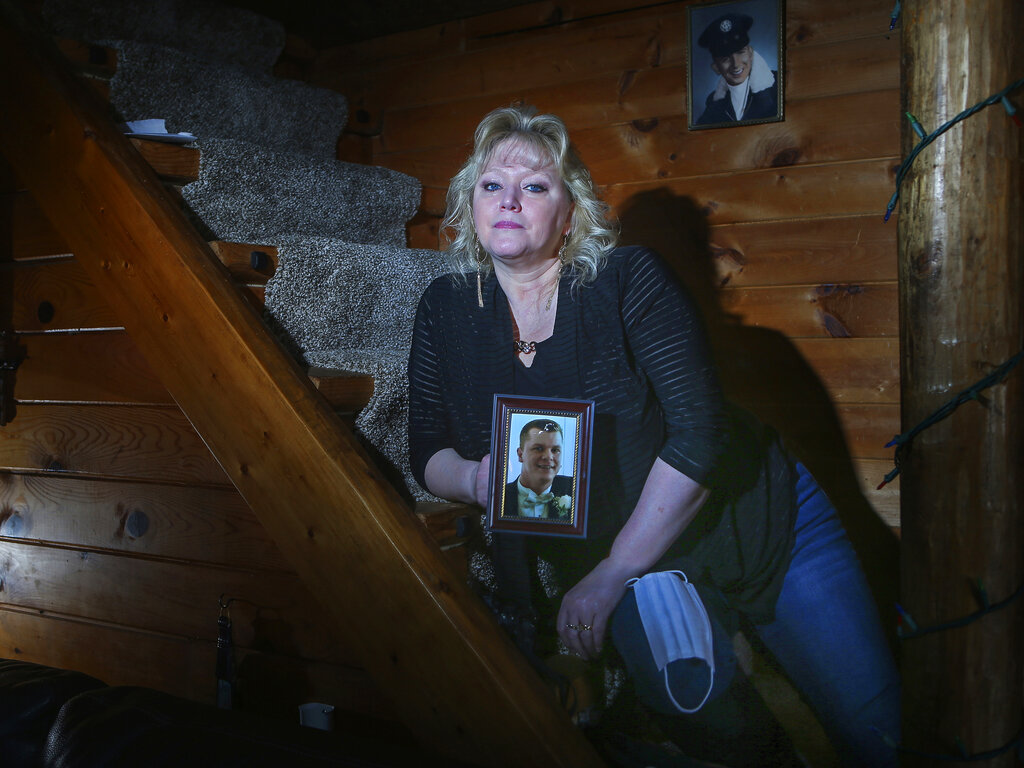
Cynthia Archambault poses with photos of her late brother Daniel Remillard, in hand, and father Ronald Remillard in Woonsocket, R.I., Friday, March 5, 2021. Photo: Stew Milne / AP
Cynthia Archambault, of Woonsocket, Rhode Island, lost her brother Daniel Remillard and her father, Ronald Remillard, to COVID-19 within an hour of each other.
“It’s left a really big gaping hole in all of our hearts,” she said.
THE SOLDIER
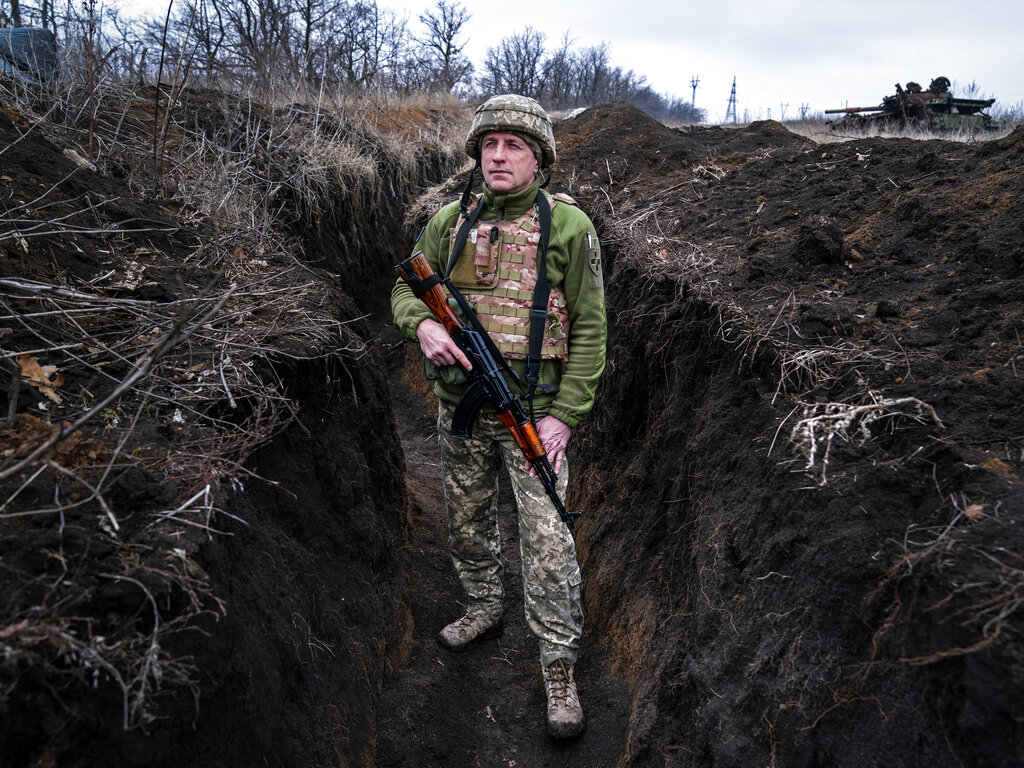
A Ukrainian serviceman, who asked to be identified only by his call sign, Kram, stands at his post in the town of Krasnohorlivka east of Kyiv, eastern Ukraine, Friday, March 5, 2021. Photo: Evgeniy Maloletka / AP
In a front-line trench, the soldier in eastern Ukraine faces two enemies: the Russian-backed separatist rebels and the coronavirus that threatens to infiltrate the ranks.
“We are used to living with dangers,” said the soldier, who asked to be identified only by his call sign, Kram. “The pandemic has become another stress for me.”
___
Story: Andrew Selsky. Associated Press journalists Rafiq Maqbool in Mumbai, India; Lucas Dumphries in Rio de Janeiro; Kathy Willens in New York; Bram Janssen in Durban, South Africa; Sylvia Hui in London; Alexander Zemlianichenko in Moscow; Evgeniy Maloletka in Krasnohorlivka, Ukraine; Fay Abuelgasim in Beirut; Maria Grazia Murru in Tavernola Bergamasca, Italy; Borg Wong and Caroline Chen in Beijing; Laurie Kellman in Holon, Israel; and Stew Milne in Woonsocket, Rhode Island, contributed to this report.
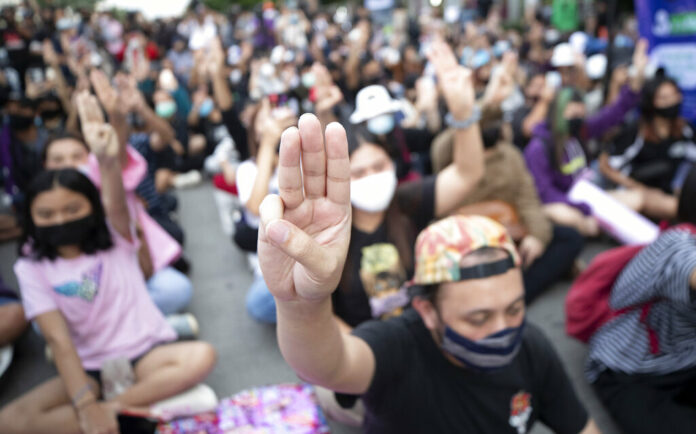
In this Oct. 23, 2020 file photo, pro-democracy activists flash three-fingered salutes outside Bangkok Remand Prison, in which some of the activists are kept, in Bangkok, Thailand. Photo: Sakchai Lalit / AP
BANGKOK (AP) — Thailand is considering an expansion of prison space as it arrests more political prisoners, the justice minister said Wednesday.
Somsak Thepsuthin said Bangkok Remand Prison and Klong Prem Central Prison, where most recently detained political prisoners are held, become congested when families and supporters come to visit.
“Therefore, we are discussing finding a larger area that can accommodate more people for everyone’s convenience,” he told reporters. He denied speculation that a separate new prison would be built for political prisoners.
“Everyone should be treated equally,” Somsak said.
The legal aid group Thai Lawyers for Human Rights recently said at least 382 people, including 13 minors, are facing charges related to political demonstrations and expressing political views from July 2020 through the end of last month.
A student-led pro-democracy movement took hold last year that is calling for Prime Minister Prayuth Chan-ocha and his government to step down, the constitution to be amended to make it more democratic and the monarchy to be reformed to make it more accountable.
In this Oct. 23, 2020 file photo, pro-democracy activists flash three-fingered salutes outside Bangkok Remand Prison, in which some of the activists are kept, in Bangkok, Thailand. Photo: Sakchai Lalit / AP
When the protests became more critical of the monarchy, the authorities stepped up their prosecutions of activists. More than 60 of the people cited by the Thai Lawyers for Human Rights have been charged under the lese majeste law, which makes defaming the monarchy punishable by up to 15 years in prison per incident.
On Wednesday, the Criminal Court sentenced a 22-year-old man to 4 1/2 years in prison for violating the Computer Crime Act by creating several accounts on Facebook on which he allegedly made nine posts criticizing the monarch in April 2020.
The man, a waiter, had his sentence halved from the original nine years because he pleaded guilty, a standard practice in Thai courts.
The Department of Corrections website says Bangkok Remand Prison holds 3,195 prisoners, while Klong Prem Central Prison accommodates 7,009.
On March 9, 2021, Samitivej Hospital launched a campaign to target and solve pain points for patients who wish to avoid hospital visits, are worried about illnesses, or have concerns about high medical expenses. In addressing these issues, we offer patients the option of online doctor consultations, and we provide people with excellent healthcare via preventive health check-up programs, artificial intelligence technology for the detection of diseases before they occur, cost reduction management through our expense management dashboard system and smart equipment pooling system, and added value through vouchers for cash with values of up to 25%, in line with Samitivej’s ongoing goal of keeping people healthy and preventing illness.
Chairat Panthuraamphorn, M.D., Managing Director and CEO of Samitivej and BNH Hospitals, stated: “At present, many people throughout the country are experiencing a wide variety of economic, physical health, and mental health problems. At Samitivej, we aim to be a segment of society that is part of the solution for people. There are many pain points that need to be targeted and resolved—there are those who avoid hospital visits due to fear of contracting disease; there are those who are worried about illnesses in general, knowing that if they get sick they will suffer not only physically, but mentally as well; and there is the issue of healthcare expenses, where maintaining one’s health becomes a significant cost of living. Samitivej, therefore, continues to hold true to its vision of ‘we want people to stay healthy, and not fall ill’ by launching a campaign to meet these needs and to create value in every dimension of healthcare.
“We started our online doctor visitation services as an alternative for patients even before COVID-19. During the COVID-19 pandemic we saw a huge increase in the number of users of the service. In addition, self-care has become increasingly important to people, and Samitivej met this need with Engage Care, a technology designed to help patients suffering from diabetes and high blood pressure to better care for themselves while at home. From the time they awake in the morning, patients can easily measure their own sugar levels. If these levels are outside the target range, the system will send an alert to the hospital so that a doctor can immediately follow-up and provide treatment. We also provide services that connect the hospital’s healthcare to patients’ homes, such as through TytoCare devices that can be used to measure temperature and heart rate, listen to lung functions, etc., allowing doctors to provide accurate diagnoses and consultation online with greater confidence. We offer at-home vaccination and drug delivery services as well.”
The campaign creates value in all areas of healthcare, as detailed below:
For patients who wish to avoid hospital visits because they are afraid of contracting disease, we offer technology designed to save lives as follows:
Samitivej Virtual Hospital: Online doctor consultation 24/7, alongside TytoCare, an examination kit that can be used for lung examination, capture images inside the ear, examine the back of the throat, capture images of the skin, measure body temperature, and listen to and record heart rate.
Engage Care: An application to monitor and track health indicators for patients with diabetes or high blood pressure and connect them with a team of medical professionals providing services 24 hours a day.
Samitivej PACE: Technology enabling families to monitor the status of each stage of a patient’s surgery via smartphone.
Samitivej Prompt: A system providing access to inpatient treatment plans and for monitoring status during treatment.
For those who wish to prevent illness, Samitivej emphasizes its Early Detection Technology to save lives, as follows:
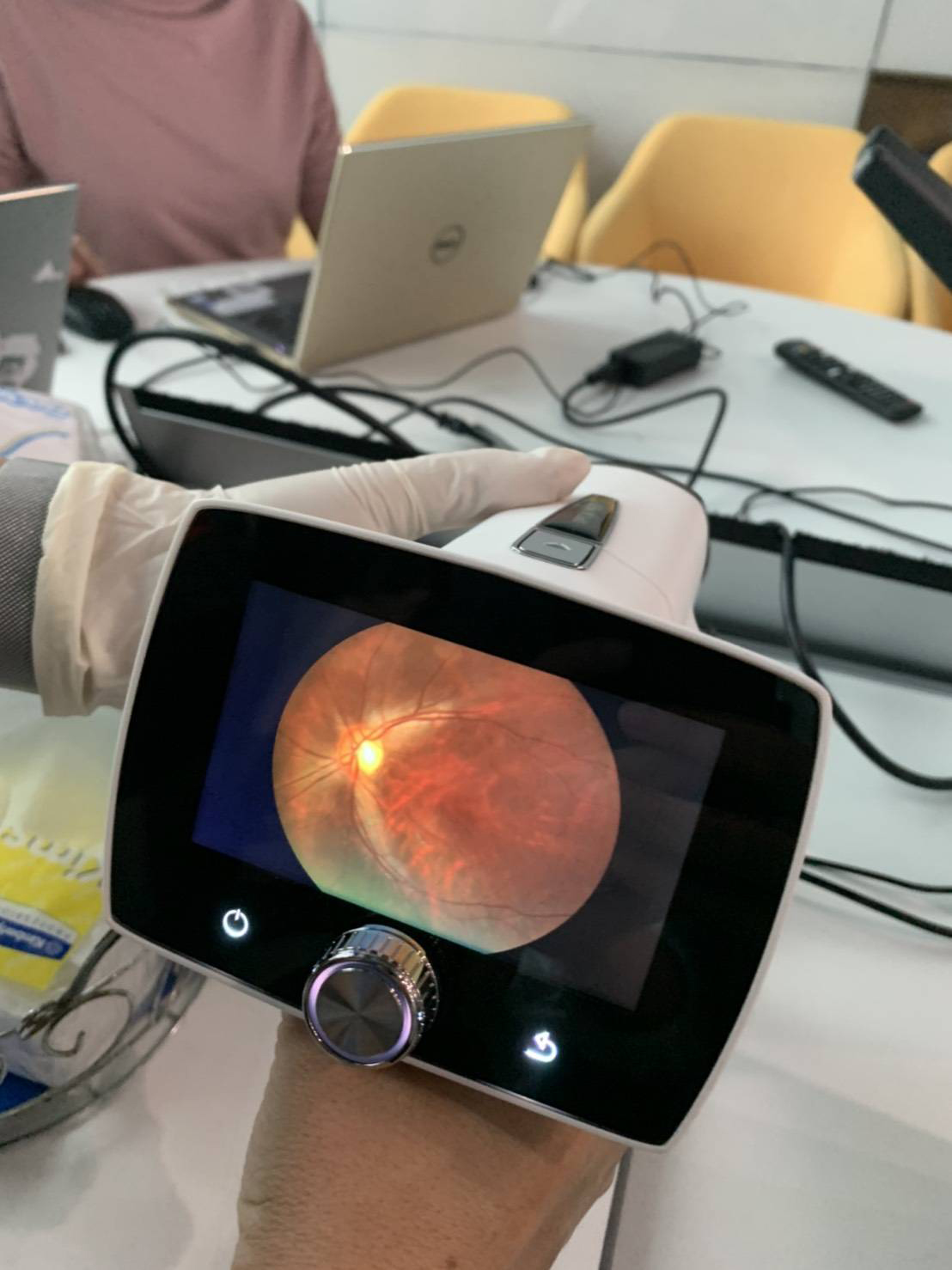
TrueEye® artificial intelligence technology which uses retinal images to predict risk factors for cardiovascular diseases and diabetes. This deep tech project is supported by the Chulalongkorn University Technology Center (UTC).
Total Health Solutions, with a focus on preventive screening to prevent the occurrence of disease in specific age groups.
Gene Testing with deep sequencing, in order to identify future disease risks.
Vaccine Club, a vaccination care program for all age
Innovation to facilitate greater convenience, create value and save costs, as follows:
Payment Dashboard, a system to track and manage expenses within insurance limits.
Smart Equipment Pooling System for better management of medical equipment and the reduction of patient costs.
Vouchers for cash with values of up to 25% to apply toward hospital services.
– Pay 5,000 THB and receive privileges valued up to 5,750 THB
– Pay 10,000 THB and receive privileges valued up to 12,000 THB
– Pay 30,000 THB and receive privileges valued up to 37,500 THB
Participating Hospitals: Samitivej Sukhumvit Hospital, Samitivej Srinakarin Hospital, Samitivej Children’s Hospital, Japanese Hospital by Samitivej, Samitivej Thonburi Hospital, Samitivej Chinatown Hospital, Samitivej Sriracha Hospital, and Samitivej Chonburi Hospital.
Available through June 30, 2021. Call 02-022-2222 or email [email protected]for more information.
About Samitivej Hospitals
Samitivej Hospitals started operation on June 4, 1979. Our hospitals are among the 43 members of Bangkok Dusit Medical Services Public Company Limited, which operates leading hospitals in Thailand and South East Asia. We offer healthcare services certified to meet both local standards and standards set forth by Joint Commission International (JCI) from America. There are currently eight member hospitals—Samitivej Sukhumvit Hospital, Samitivej Japanese Hospital, Samitivej Srinakarin Hospital, Samitivej Children’s Hospital, Samitivej Chinatown Hospital, Samitivej Thonburi Hospital, Samitivej Sriracha Hospital, and Samitivej Chonburi Hospital.
For more information, please contact Sasikan Lertsittichai, Brand Communication Manager at [email protected]or Tel 020-222-443.
Kazumi Endo stands on the beach in Soma, Fukushima Prefecture on Dec. 9, 2020. (Kyodo)
VIENNA — Michiyo Suzuki remains undecided on whether to return to her hometown of Futaba in Fukushima Prefecture, where the crippled Fukushima Daiichi nuclear plant is located.
When a massive earthquake and tsunami struck on March 11, 2011, her family was unable to find a space in an evacuation center and was forced instead to spend the night in their car. The next morning, they were simply instructed to “flee to the west.”
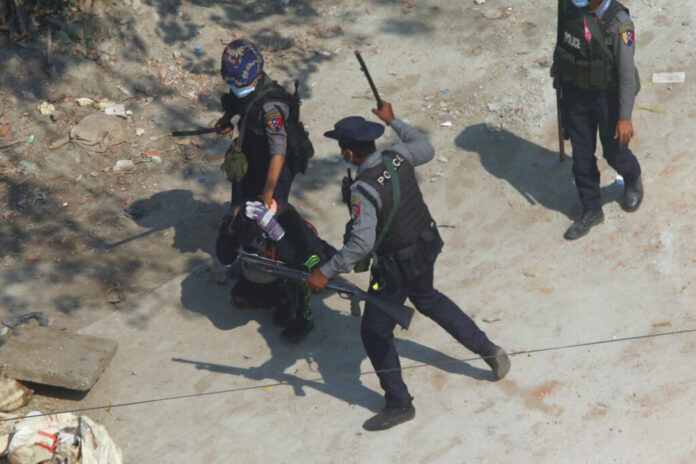
In this March 6, 2021, file photo, riot police officers hold down a protester as they disperse protesters in Tharkata Township on the outskirts of Yangon, Myanmar. Myanmar’s military-controlled government is seeking to suppressing media coverage of protests against their seizure of power as journalists and ordinary citizens strive to keep people inside and outside of the country informed about what is happening. Photo: AP
BANGKOK (AP) — Myanmar’s military-controlled government is cracking down on coverage of mass protests, raiding media companies and detaining dozens of journalists since its Feb. 1 coup,including Thein Zaw of The Associated Press.
The crackdown comes as the military has escalated violence against mass protests and as independent media continue to cover the arrests and shootings by troops in cities across Myanmar. In some instances, journalists are using social media to get the information out.
How has the media landscape in Myanmar changed since the coup? Here’s a look:
HOW IS THE GOVERNMENT SUPPRESSING NEWS?
Authorities raided the offices of Kamayut Media on Monday, detaining its co-founder, Han Thar Nyein, and editor-in-chief, Nathan Maung. Witnesses said seven military trucks were involved in the raid, according to a member of Han Thar Nyein’s family. The military also raided the offices of Mizzima News.
A day earlier, five local outlets — Mizzima, DVB, Khit Thit Media, Myanmar Now and 7Day News — were banned from broadcasting or providing any information on any media platform or using any technology after their licenses were canceled, state broadcaster MRTV reported. All had covered the protests extensively and often livestreamed video.
Myanmar Now, an independent news service, reported that police broke down the door of its office Monday and seized computers, printers and parts of the newsroom’s data server. It cited unnamed witnesses and showed a photo of CCTV footage. But it said the office had been evacuated in late January.
Human rights groups an journalism organizations have condemned the attacks on freedom of the press.
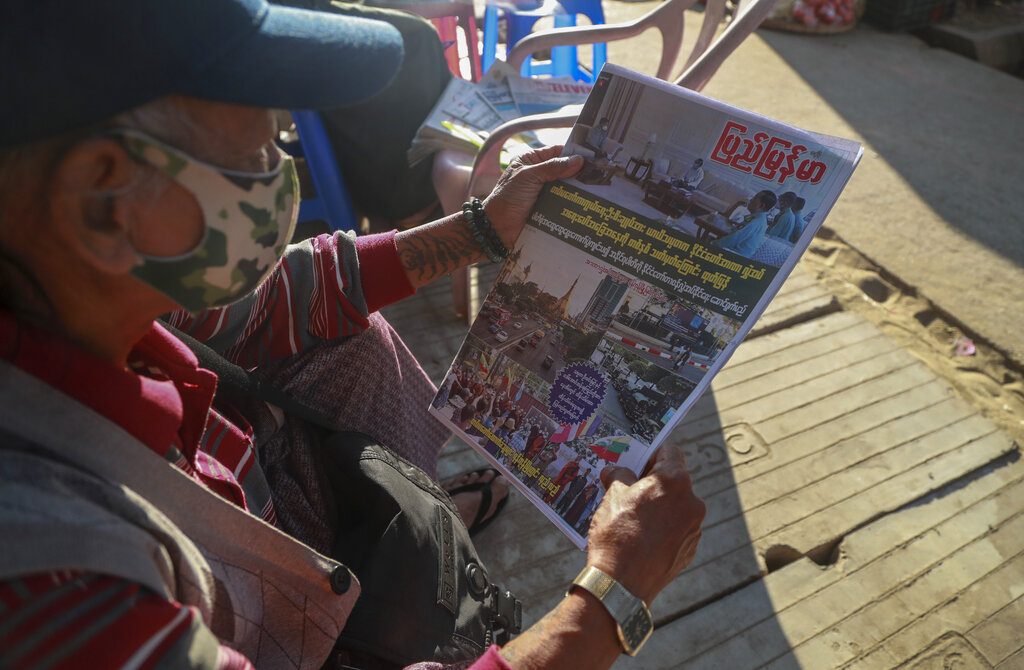
In this Feb. 2, 2021, file photo, a man looks at a newspaper, which reports “1 year of State of Emergency and Acting President transferred Power to Military Chief” on the front page, in Yangon, Myanmar. Photo: AP
HOW ARE INDEPENDENT MEDIA OUTLETS RESPONDING?
For now, they are vowing to press on despite the risks.
“What is certain is that we will not stop covering the enormous crimes the regime has been committing throughout the country,” said Swe Win, Myanmar Now’s editor-in-chief.
Mizzima, another privately owned, independent local news outlet, put out a statement on its website saying it “continues to fight against the military coup and for the restoration of democracy and human rights” using various online and multimedia platforms. Other outlets also still reported on protests Tuesday. Some media organizations are trying to operate from abroad.
WHAT KIND OF MEDIA ARE STILL LEGALLY OPERATING IN MYANMAR?
Myanmar seems to be reverting to its old system where officially sanctioned media are entirely state-controlled, as they were before August 2012. Even before the coup, under the military-dominated, quasi-civilian government led by Aung San Suu Kyi, journalists faced arrest and harassment for reporting on sensitive topics such as abuses against its Rohingya Muslim ethnic minority.
Reuters journalists Wa Lone and Kyaw Soe Oo were given seven-year prison sentences, but later pardoned, for trying to investigate a massacre of Rohingya civilians. Myanmar ranked 139th of 180 countries in Reporters Without Borders’ 2020 World Press Freedom index. Journalists often have faced criminal prosecution for online defamation.
The English-language Myanmar Times announced it had suspended all publications for three months beginning Feb. 21. That move came after many of its staff quit to protest the paper’s agreement to follow a junta order not to use the word “coup” to describe the military takeover.
Another state-controlled newspaper, the Global New Light of Myanmar, is still publishing. Other state media include the Myanmar News Agency and army-controlled Myawaddy TV.
This undated family file photo provided on Wednesday, March 3, 2021 shows Associated Press journalist Thein Zaw in Yangon, Myanmar. Photo: Thein Zaw family via AP, File
WHAT ARE THE LONGER-TERM RAMIFICATIONS?
Suppressing all reporting would require a complete blackout of all internet and satellite communications. Apart from the legal and human rights implications, that would be a huge setback for the country’s economy. Myanmar’s businesses are highly reliant on the internet and on digital platforms like Facebook, having developed quickly in the past few years after decades of relative isolation under previous military governments.
So far, the junta has chosen to shut down internet links at night, hindering but not completely stopping such communications. Because modern businesses rely heavily on the internet and the free-flow of communication and information, the military’s actions are further damaging a business environment already devastated by the coup and its aftermath.
In this March 5, 2018, file photo, a Vietnamese passenger boat sails past U.S. aircraft carrier USS Carl Vinson as it docks in Danang bay, Vietnam. Photo: Hau Dinh / AP
SAN DIEGO (AP) — A former executive for a Malaysian defense contractor linked to a sweeping corruption scandal that cost the Navy some $35 million appeared Tuesday in a California courtroom to face federal charges.
Pornpun “Yin” Settaphakorn appeared before a judge in San Diego and was ordered detained pending another hearing next month.
Settephakorn, of Thailand, was extradited from that country last week, according to a statement from the U.S. attorney’s office.
Settphakorn oversaw the Thailand office of Glenn Defense Marine Asia, which provided fuel, food and other services to Navy ships in Pacific ports.
Prosecutors said the firm and its owner, known by his nickname of “Fat” Leonard Francis, bribed Navy officers with fancy gifts, trips and prostitutes to provide classified information in order to beat competitors and overcharge for services.
The scheme cost the Navy some $35 million.
Settaphakorn was charged in 2014 with involvement in a conspiracy to submit fraudulent price quotes, claims and invoices to the Navy.
It wasn’t clear whether she had an attorney in California to speak on her behalf.
More than a dozen Navy and company officials, including Leonard and an admiral, have pleaded guilty in the case.