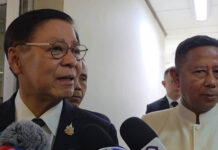
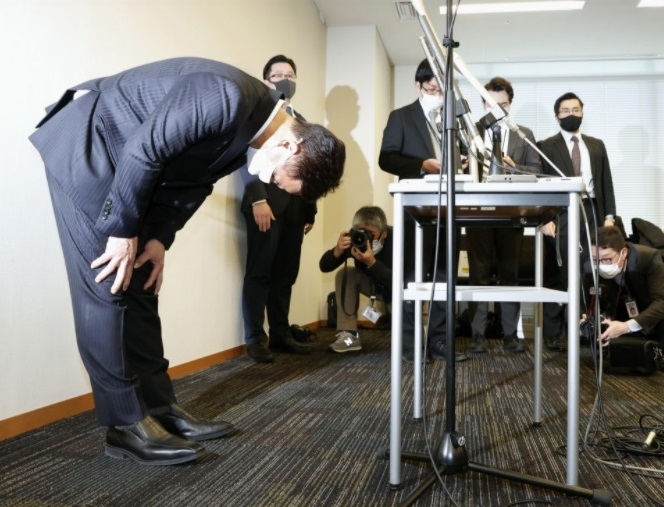
Komeito member Kiyohiko Toyama, who offered to resign as a lawmaker for visiting a hostess bar during a coronavirus emergency, apologizes in the parliament building in Tokyo on Feb. 1, 2021. (Kyodo)
TOKYO (Kyodo) — A senior member of Japan’s ruling coalition offered to quit parliament Monday after angering the public by visiting a Tokyo hostess bar despite government calls to avoid unnecessary outings under a state of emergency to rein in the spread of the coronavirus.
Kiyohiko Toyama, former acting secretary general of Komeito, the junior coalition partner of the Liberal Democratic Party, has admitted to visiting a hostess bar in Tokyo’s posh Ginza district late at night on Jan. 22.
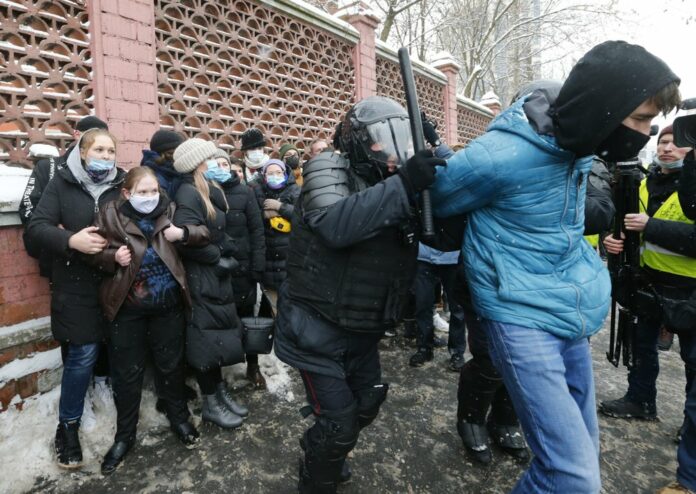
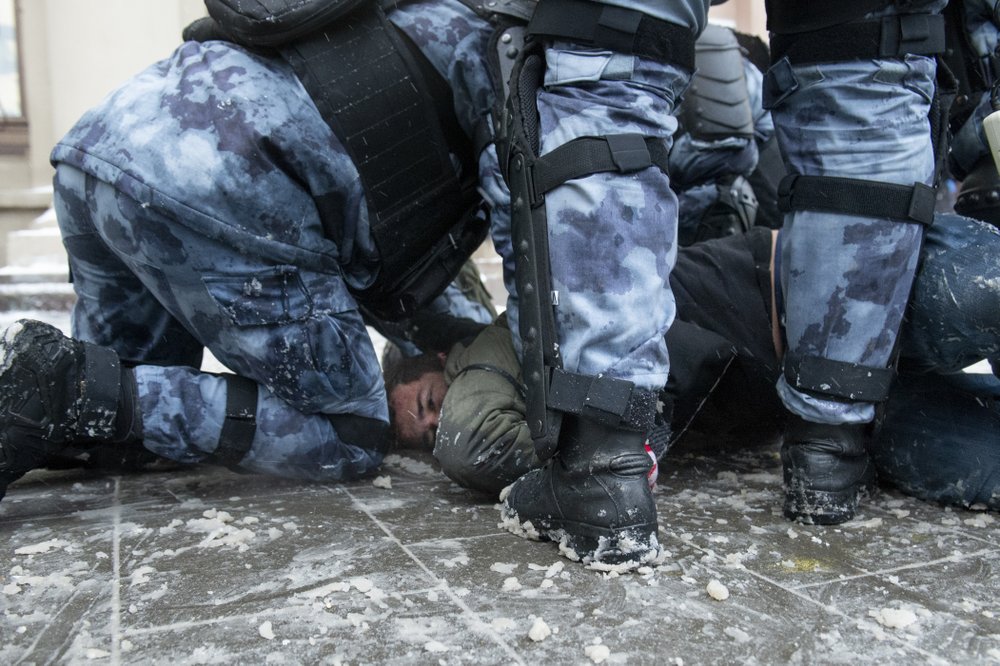
Police officers detain a man during a protest near the Matrosskaya Tishina prison where Alexei Navalny is being held, in Moscow, Russia, on Sunday, Jan. 31, 2021. (AP Photo/Alexander Zemlianichenko)
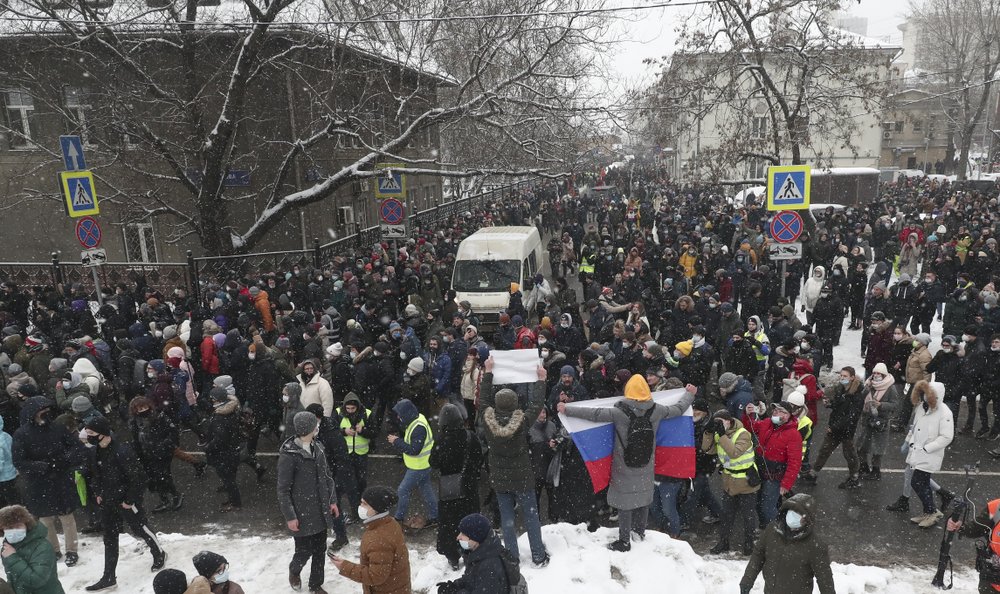
MOSCOW (AP) — Chanting slogans against President Vladimir Putin, tens of thousands took to the streets Sunday across Russia to demand the release of jailed opposition leader Alexei Navalny, keeping up nationwide protests that have rattled the Kremlin.
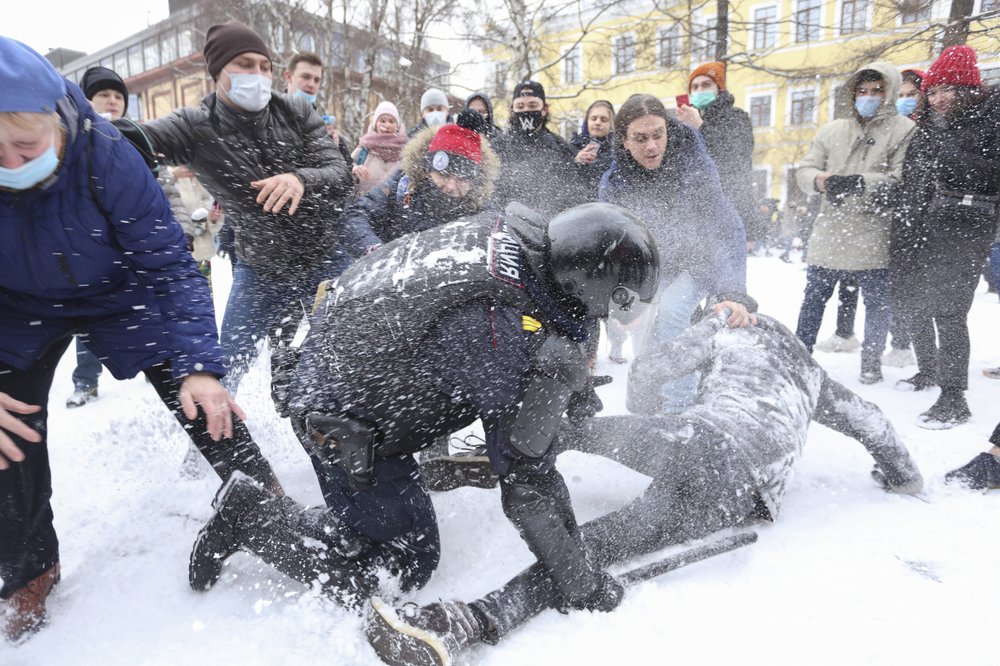
More than 5,100 people were detained by police, according to a monitoring group, and some were beaten.
The massive protests came despite efforts by Russian authorities to stem the tide of demonstrations after tens of thousands rallied across the country last weekend in the largest, most widespread show of discontent that Russia had seen in years. Despite threats of jail terms, warnings to social media groups and tight police cordons, the protests again engulfed cities across Russia’s 11 time zones on Sunday.
Navalny’s team quickly called another protest in Moscow for Tuesday, when he is set to face a court hearing that could send him to prison for years.
A policeman detains a man while protesters try to help him, during a protest against the jailing of opposition leader Alexei Navalny in St. Petersburg, Russia, Sunday, Jan. 31, 2021. (AP Photo/Valentin Egorshin)
The 44-year-old Navalny, an anti-corruption investigator who is Putin’s best-known critic, was arrested on Jan. 17 upon returning from Germany, where he spent five months recovering from nerve-agent poisoning that he blames on the Kremlin. Russian authorities have rejected the accusations. He was arrested for allegedly violating his parole conditions by not reporting for meetings with law enforcement when he was recuperating in Germany.
The United States urged Russia to release Navalny and criticized the crackdown on protests.
“The U.S. condemns the persistent use of harsh tactics against peaceful protesters and journalists by Russian authorities for a second week straight,” U.S. Secretary of State Antony Blinken said on Twitter.
The Russian Foreign Ministry rejected Blinken’s call as “crude interference in Russia’s internal affairs” and accused Washington of trying to destabilize the situation in the country by backing the protests.
On Sunday, police detained more than 5,100 people in cities nationwide, according to OVD-Info, a group that monitors political arrests, surpassing some 4,000 detentions at the demonstrations across Russia on Jan. 23.
Navalny’s team initially called for Sunday’s protest to be held on Moscow’s Lubyanka Square, home to the main headquarters of the Federal Security Service, which Navalny contends was responsible for his poisoning. Facing police cordons around the square, the protest shifted to other central squares and streets.
Police were randomly picking up people and putting them into police buses, but thousands of protesters marched across the city center for hours, chanting “Putin, resign!” and “Putin, thief!” — a reference to an opulent Black Sea estate reportedly built for the Russian leader that was featured in a widely popular video released by Navalny’s team.
“I’m not afraid, because we are the majority,” said protester Leonid Martynov. “We mustn’t be scared by clubs because the truth is on our side.”
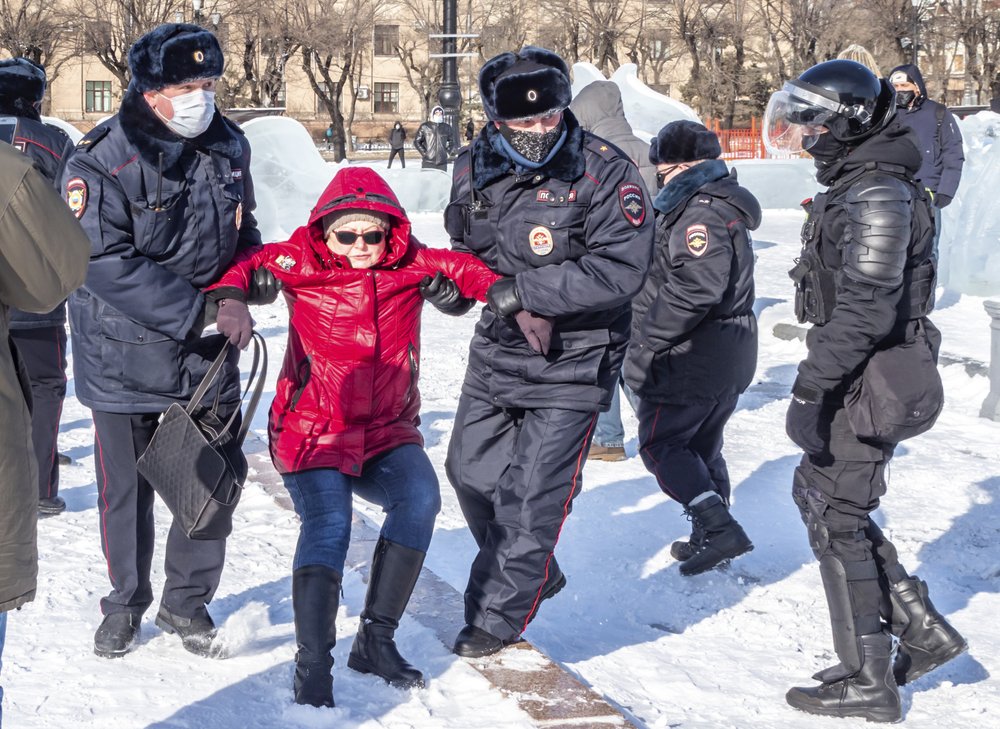
Police officers detain a woman during a protest against the jailing of opposition leader Alexei Navalny in Khabarovsk, 6,100 kilometers east of Moscow, Russia, on Sunday, Jan. 31, 2021. (AP Photo/Igor Volkov)
At one point, crowds of demonstrators walked toward the Matrosskaya Tishina prison where Navalny is being held. They were met by phalanxes of riot police who pushed the march back and chased protesters through courtyards.
Demonstrators continued to march around the Russian capital, zigzagging around police cordons. Officers broke them into smaller groups and detained scores, beating some with clubs and occasionally using tasers.
Over 1,600 people were detained in Moscow, including Navalny’s wife, Yulia, who was released after several hours pending a court hearing Monday on charges of taking part in an unsanctioned protest. “If we keep silent, they will come after any of us tomorrow,” she said on Instagram before turning out to protest.
Amnesty International said that authorities in Moscow have arrested so many people that the city’s detention facilities have run out of space. “The Kremlin is waging a war on the human rights of people in Russia, stifling protesters’ calls for freedom and change,” Natalia Zviagina, the group’s Moscow office head, said in a statement.
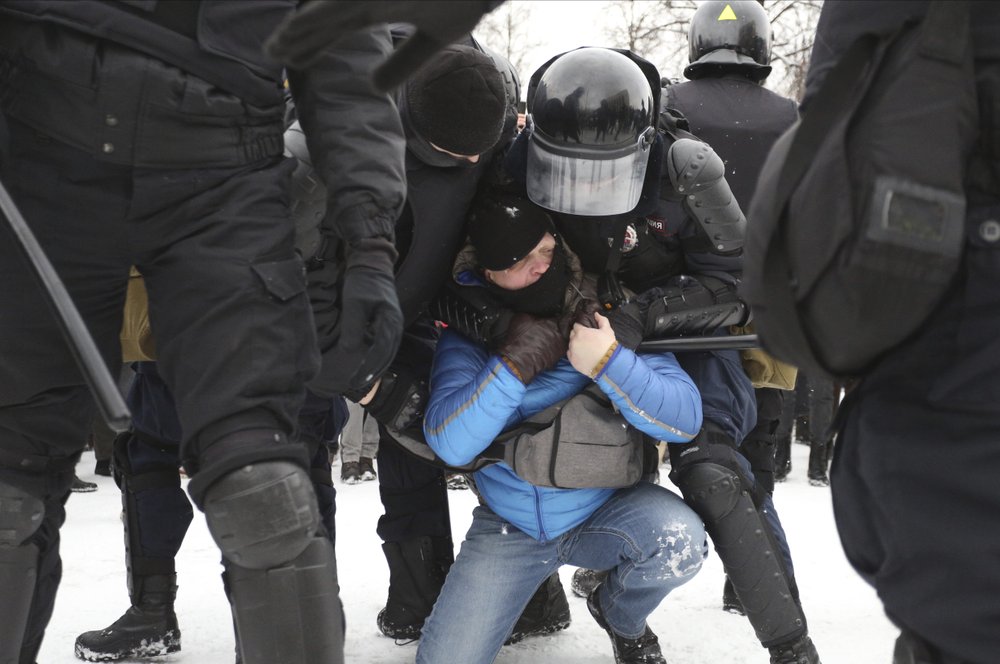
Police detain protesters during a protest against the jailing of opposition leader Alexei Navalny in St. Petersburg, Russia, Sunday, Jan. 31, 2021. (AP Photo/Valentin Egorshin)
Several thousand people marched across Russia’s second-largest city of St. Petersburg, chanting “Down with the czar!” and occasional scuffles erupted as some demonstrators pushed back police who tried to make detentions. Over 1,100 were arrested.
Some of the biggest rallies were held in Novosibirsk and Krasnoyarsk in eastern Siberia and Yekaterinburg in the Urals.
“I do not want my grandchildren to live in such a country,” said 55-year-old Vyacheslav Vorobyov, who turned out for a rally in Yekaterinburg. “I want them to live in a free country.”
Swedish Foreign Minister Ann Linde, who currently chairs the Organization for Security and Cooperation in Europe, condemned “the excessive use of force by authorities and mass detention of peaceful protesters and journalists” and urged Russia “to release all those unjustly detained, including Navalny.”
As part of a multipronged effort by authorities to block the protests, courts have jailed Navalny’s associates and activists across the country over the past week. His brother Oleg, top aide Lyubov Sobol and three other people were put under a two-month house arrest Friday on charges of allegedly violating coronavirus restrictions during last weekend’s protests.
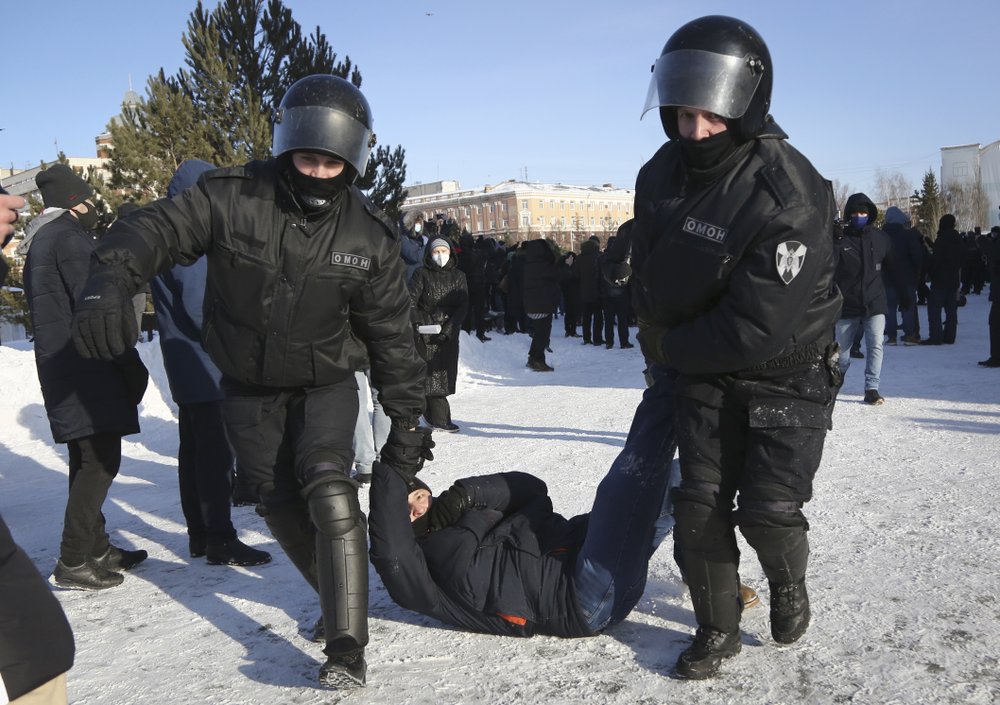
Police detain a man during a protest against the jailing of opposition leader Alexei Navalny in the Siberian city of Omsk, Russia, on Sunday, Jan. 31, 2021. (AP Photo)
Prosecutors also demanded that social media platforms block calls to join the protests.
The Interior Ministry issued stern warnings to the public, saying protesters could be charged with taking part in mass riots, which carries a prison sentence of up to eight years.
Protests were fueled by a two-hour YouTube video released by Navalny’s team after his arrest about the Black Sea residence purportedly built for Putin. The video has been viewed over 100 million times, inspiring a stream of sarcastic jokes on the internet amid an economic downturn.
Russia has seen extensive corruption during Putin’s time in office while poverty has remained widespread.
“All of us feel pinched financially, so people who take to the streets today feel angry,” said Vladimir Perminov who protested in Moscow. “The government’s rotation is necessary.”
People attend a protest against the jailing of opposition leader Alexei Navalny in Moscow, Russia, Sunday, Jan. 31, 2021. (AP Photo/Andrew Lubimov)
Demonstrators in Moscow chanted “Aqua discotheque!” — a reference to one of the fancy amenities at the residence that also features a casino and a hookah lounge equipped for watching pole dances.
Putin says neither he nor any of his close relatives own the property. On Saturday, construction magnate Arkady Rotenberg, a longtime Putin confidant and his occasional judo sparring partner, claimed that he himself owned the property.
Navalny fell into a coma on Aug. 20 while on a flight from Siberia to Moscow and the pilot diverted the plane so he could be treated in the city of Omsk.
Police officers detain a man during a protest against the jailing of opposition leader Alexei Navalny in Moscow, Russia, on Sunday, Jan. 31, 2021. (AP Photo/Denis Kaminev)
He was transferred to a Berlin hospital two days later. Labs in Germany, France and Sweden, and tests by the Organization for the Prohibition of Chemical Weapons, established that he was exposed to the Novichok nerve agent.
Russian authorities have refused to open a full-fledged criminal inquiry, claiming lack of evidence that he was poisoned.
Navalny was arrested immediately upon his return to Russia earlier this month and jailed for 30 days on the request of Russia’s prison service, which alleged he had violated the probation of his suspended sentence from a 2014 money-laundering conviction that he has rejected as political revenge.
On Thursday, a Moscow court rejected Navalny’s appeal to be released, and the hearing Tuesday could turn his 3 1/2-year suspended sentence into one he must serve in prison.
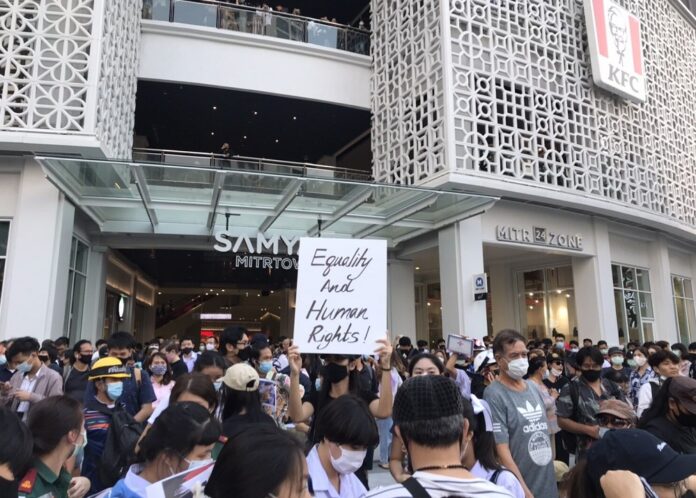
A pro-democracy protest in front of Samyan Mitrtown shopping mall in Bangkok on Oct. 26, 2020.
Shopping malls in Bangkok are more than just a place to shop. To the many mall rats, it’s a place to escape the heat, meet friends, dine, date, drink, watch films and more.
Of late, political protests took place inside the malls itself – the malls have become politicized.
The most high-profile recent example was the protest staged by Benja Apan, a key member of the United Front of Thammasat and Demonstration at IconSiam luxury shopping mall on Jan 20. She staged a one-woman protest against the alleged monopolization of the Thai government’s COVID-19 vaccine monopoly. She held a placard with the message “Vaccine Monopoly is PR for the Royals”.
It became news chiefly because a security guard slapped the 21-year-old Benja on the face and ended up at a local police station paying 1,000 baht fine for minor assault. Everything was captured on Facebook Live, courtesy of Benja’s colleague who was manning her smart phone’s FB Live episode as the two end up being surrounded by security guards who tried to prevent the use of the mall as a political space.
Hours after, the company expressed regrets and the next day saw the guard resigning.
Whether you take side with Benja or the guard, the truth is, Bangkok’s upscale shopping malls, and not just IconSiam, has become the choice venues for political protests of many young Thais who are against the government and calling for monarchy reforms. Shopping malls in Bangkok are the place for protests, a de facto semi-public venue for political activities. This includes Siam Paragon, Samyan Mitrtown and more.
It is partly due to the fact that over the years, particularly since the 2014 military coup, public space for political activities have been reduced and restricted. Think of Democracy Monument, an icon for not just the struggle for democracy but the venue of choice for numerous political protests since the 1970s.
Late last year, when the protesters wanted to use the venue, they literally had to remove potted plants installed by City Hall and metal traffic barricades. It’s a “green” and indirect way to deter protesters from occupying the symbolic site. Last week, the monument was cordoned off again for another “renovation”.
Then there’s the mysterious disappearance of the Constitution Defense Monument in the northeastern part of Bangkok which marks the defeat of the royalist counter-revolt in 1933. The monument, where redshirts once gathered for political protest, was mysteriously hauled away from the site where it stood for decades in the middle of the night on Dec 27, 2018.
Then there’s also the Public Assembly Act passed by the then junta’s rubber-stamp parliament in 2015 which stated that demonstrators need to inform police no less than 24 hours in advance or face up to 10,000 baht fine. Not to mention the COVID-19 ban on public gathering as a result of the emergency decree.
On the other hand, protesters can walk into any major shopping mall and carry out political protests while the mall’s guards are expected to treat the valued customers, and the not-so-valued protesters, as kings.
It’s a Catch-22 situation for these shopping malls because on one hand, they have to please the government, the royals, while at the same time not be seen as brutal against the anti-government and monarchy-reform protesters. After all, they’re supposed to be in the business of hospitality, running a luxury shopping mall and not a junta boot camp.
Siam Paragon took a different, and more subtle route in handling political protesters by merely trailing them. Protest leaders Parit “Penguin” Chiwarak, Panusaya “Rung” Sithijirawattanakul and Benja herself wore crop tops and staged symbolic political protests for over an hour last month inside the mall on Dec 20.
Siam Paragon allowed the three to roam around and in the end, someone else later filed a lese-majeste complaint to police instead, accusing them of mocking the king in how they dressed and bebave inside the mall.
As for Samyan Mitrtown, on Jan 16. two dozen demonstrators fled inside the mall in the late afternoon of that day when police began arresting a few in front of the mall. Many shops shut themselves immediately in order to keep demonstrators out.
Back to IconSiam, hours after the Benja’s incident, I inspected the privately-owned and spacious promenade where Benja was attacked after being surrounded by the guards and tried to flee. A sign in Thai and English have been posted stating that the place is a private property.
“PRIVATE PROPERTY: IconSiam reserves the right to limit the use of their premises only to activities with advance written permission. In case of violations, the company reserves the right to pursue legal action, including but not limited to claim for damages.”
Two days later, I saw a young activist posted on Facebook a photo of another two young activists holding placards against the lese majeste law at IconSiam’s riverside lawn.
This time, I heard of no physical assault. Apparently, some protesters continue to claim shopping mall space as a de facto political space with varying degrees of success. And despite such an announcement by IconSiam, others continue to insist that it’s in fact a privately owned public space or a de facto public space for political protests.
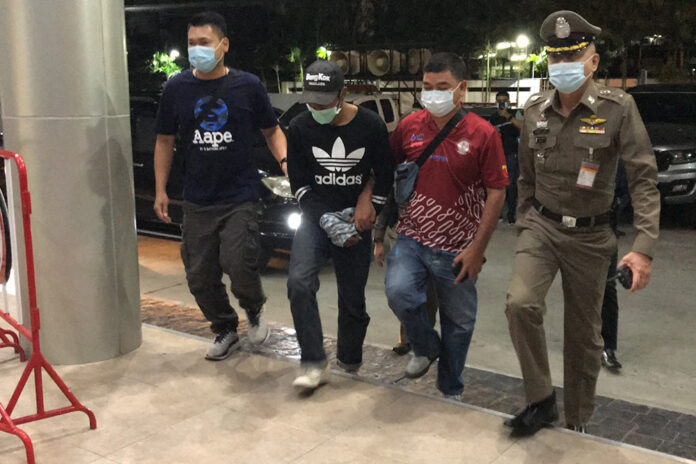
Police escort one of the suspects to Pathum Wan Police Station on Jan. 28, 2021.
BANGKOK — Three men were arrested in connection with a bomb attack that injured five people close to a pro-democracy rally earlier this month, police said Friday.
Weerayut Sumritruangsri, 30, Pornchai Prakapuang, 23, and Nuttasut Siriaut, 19, were accused of throwing a ping pong bomb at police officers in front of Chamchuri Square building on Jan. 16. Police said the three are members of the protesters’ security network “Gear of Democracy,” which consists mainly of current and former polytechnic students.
“The suspects confessed that they’re members of the Gear of Democracy group,” metropolitan police commander Pakkapong Pongpetra said. “They said they built the device themselves and intended to disrupt police operations.”
The trio were apprehended on Thursday after a court issued an arrest warrant for them.
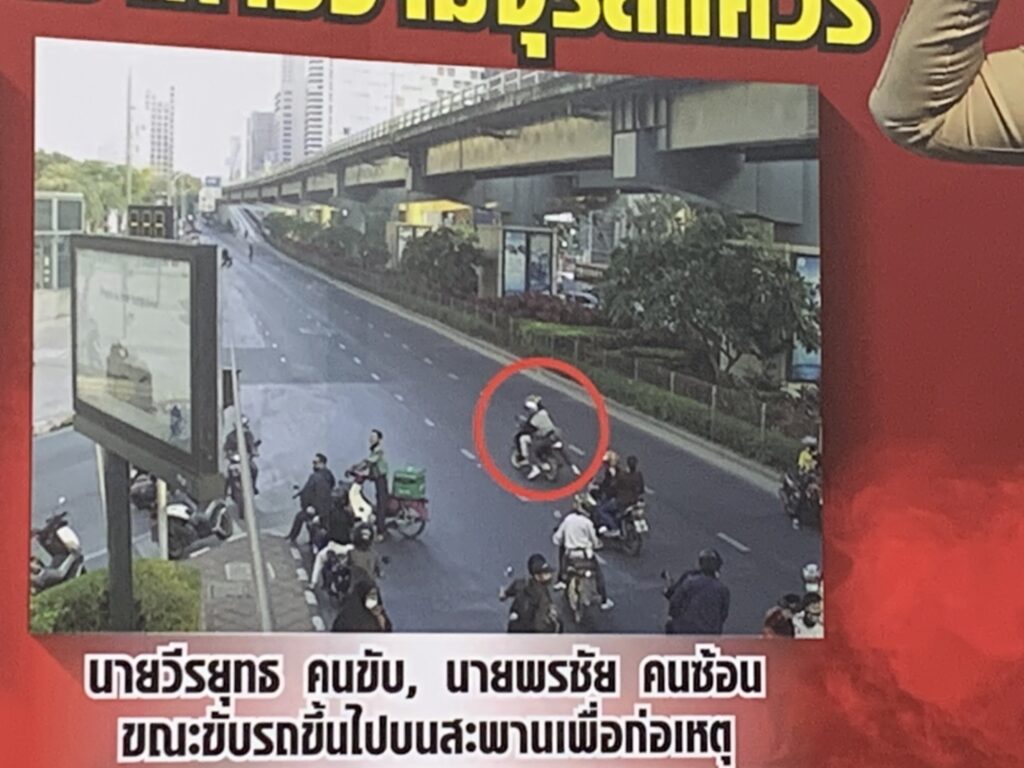
Police said the suspects went up the overpass over Samyan Intersection on a motorbike and threw the bomb into a group of police officers. The blast wounded three policemen, a reporter for The Standard online news site, and another civilian, Lt. Gen. Pakkapong said.
Investigators said evidence implicating the three includes CCTV footage.
At the time of the explosion, demonstrators were gathering across the street in front of Samyan Mitrtown mall. The protesters were calling for the release of activists who were arrested earlier on that day for campaigning against the royal defamation law.
Some of them retreated to Chamchuri Square after riot police moved in to disperse the crowd.
A screenshot of a CCTV footage released by police reportedly shows the suspects on a motorbike prior to the explosion.
A similar incident was also reported on Nov. 25, when a device believed to be firecrackers went off while protesters were leaving their rally in front of the Siam Commercial Bank’s headquarters.
No one was arrested, even though the assailants were captured live on camera by The Standard news site while they carried out the attack.
Pakkapong said investigators are gathering evidence to see whether the suspects arrested for the Samyan explosion are connected to the previous attacks. “The suspects only confessed to this case,” Pakkapong said.
The three men were charged with assault, causing an explosion, carrying weapons into residential areas without reasonable causes, and illegal possession of explosives.
The “Guard Coalition for the People,” an umbrella group consisting of 10 different guard units, said in an online statement that the group is not involved in the attack.
“We will let the people decide about the results of investigation,” the group tweeted. “We are not involved in the bombing, but we must ensure that [the suspects] are safe.”
The Gear of Democracy group has yet to comment on the matter.
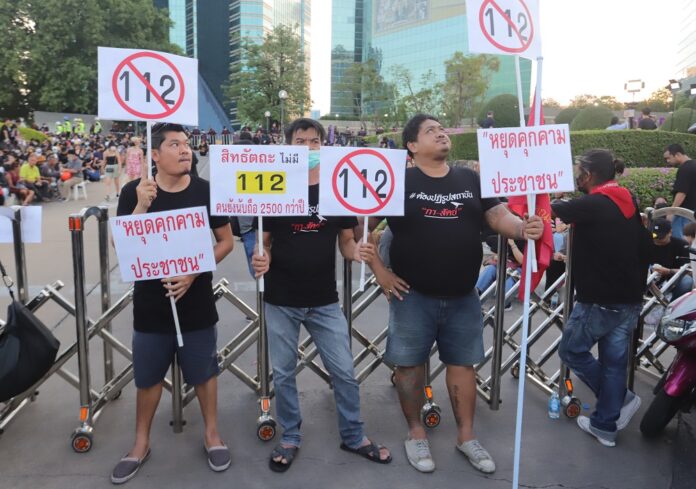
Protesters hold up signs denouncing lese majeste law during a rally outside Siam Commercial Bank HQ in Bangkok on Nov. 25, 2020.
BANGKOK — An opposition party’s bid to amend the harsh royal defamation law already hit a snag when one of its MPs publicly said he would not support the move.
Move Forward party-list MP Karom Polpornklang said he felt the campaign to reform the offense, known as lese majeste, is doomed to fail and may even draw unwanted attention to his faction. The party has said it will launch the amendment bid after the censure debate concludes next month.
“I have to live in this country,” Karom said by phone Thursday. “I don’t have money to buy airline tickets and move overseas.”
“You can’t say I’m a coward. I simply believe that there will be a time for every institution to change its way, but I will not try to use my knee to break a knife. It hurts,” he said, using a Thai proverb.
Karom, who was a lawyer before entering politics, also said he knew of two other MPs in the party who will not lend their support to the amendment, though he declined to identify them by names.
“I won’t sign on it. At least there are already three people who won’t sign on it, including myself,” the lawmaker said. “A lot of people aren’t comfortable giving the answer like I did. This is a sensitive matter. We can’t act hastily. I’ve never broken ranks with the party, but this will be the first time I do.”
Move Forward MP who spearheads the amendment campaign, Wiroj Lakkhanaadisorn, said he respects Karom’s decision. Wiroj maintains that a majority of MPs in the party will go ahead and push for reforms of not just the lese majeste law, but other libel laws as well.
“We already had an internal meeting at the party about this matter. We talked about the rationale and reasons for it,” Wiroj spoke by phone. “But some MPs didn’t attend the meeting. They might not have understood the matter clearly.”
He added that the party will try to negotiate with Karom, because the lese majeste charge has often been abused and politicized.
“There have been many prosecutions under this law,” Wiroj said. “Article 112 doesn’t lead to peace. It might even lead to unrest.”
Lese majeste, or insulting the monarchy, is punishable by up to 15 years in prison per offense under Article 112 of the Criminal Codes. At least 50 people have been charged with the crime since November, a civil rights lawyer group said.
Move Forward MP Rangsiman Rome, who organized numerous pro-democracy rallies prior to his election, said he respects Karom’s differing view about the law.
“I understand that people can have different opinions about each topic, and we can exchange the views on this,” Rangsiman said by phone. “People have the rights to have different opinions about Article 112 as well.”
Party sec-gen Chaithawat Tulathon admits that not everyone in Move Forward is behind the campaign to reform the lese majeste law.
“There are still details that not all of us agree on,” Chaithawat said. “Right now we have different drafts of the [amendment] bill. There are options that we can discuss.”
The ruling Phalang Pracharath Party has said it will oppose any bid to touch on the lese majeste charge, which it views as a necessary tool to protect the monarchy from slanders.
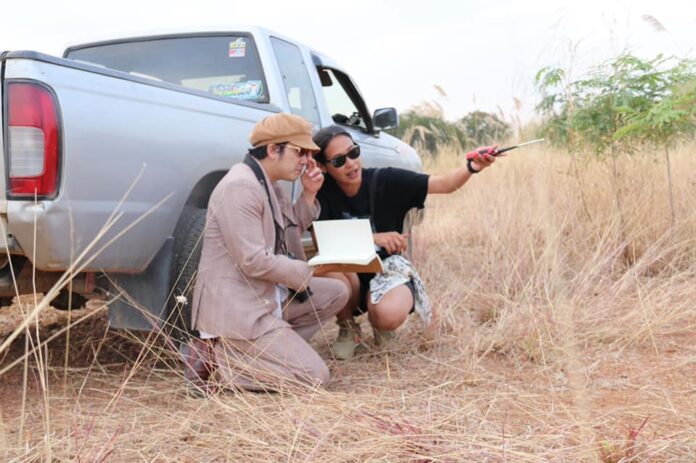
Netizens found something new to argue about on Friday when celebrities turned activists Inthira “Sai” Charoenpura and Chaiamorn “Ammy” Kaewwiboonpan posted photos of themselves visiting an undisclosed location – though their posture seems to imitate King Rama IX’s upcountry visits.
The photo was first posted by Inthira, who said it was a trip to a mine.
— ITRC 😼กล้ามากกกกกกที่จะไม่กลับไปรักเธอ! (@charoenpura) January 28, 2021
Chaiamorn, who’s also a lead singer with the pop band Bottom Blues, later posted more photos of the same trip. “An album here. I’m scared the salims won’t screenshot this fast enough,” Ammy wrote, using a derogatory term for the pro-establishment supporters.
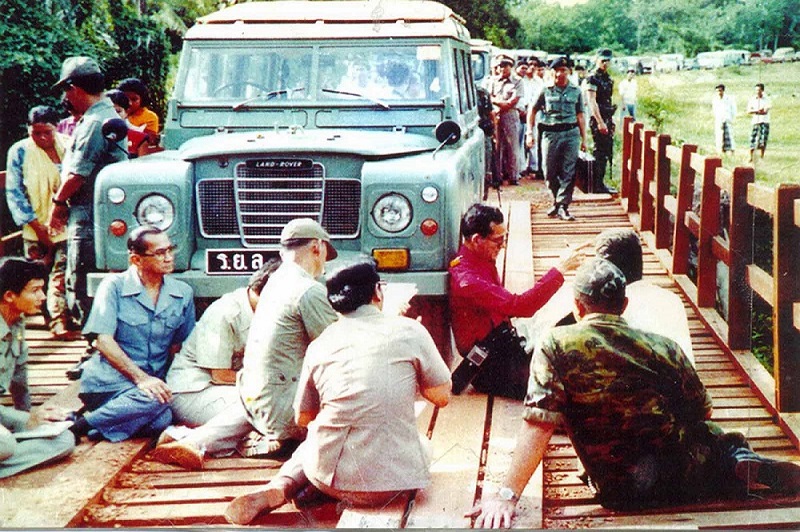
Many in both pro- and anti-government camps quickly deduced that the photos were a parody of the late King Bhumibol, who was often photographed in a similar manner.
“All that these people can do is to mock and trample on the hearts of people loyal to the monarchy. They will never be happy on this land,” pro-establishment Facebook page Jun Everything wrote.
“They are evil beyond measure,” user Wanthanee Kleeklaew also wrote in the pro-establishment PDRC Hot News Update group.
King Bhumibol and his entourage visit a rural community in Narathiwat province on Sept. 7, 1981.
MGR Online, a news site known for its ultraroyalist streak, reported the incident with a strongly worded headline, “The bastards keep up their antics.”
Naturally, supporters of the two activists see it as harmless fun. Some went further and photoshopped the photos, adding sepia filters to give it a vintage, aged look.
“You almost got it. You just need a drop of sweat on your nose,” Facebook user Tonglang Duangladna commented. Someone also turned the photo into a calendar.
Inthira and Chaiamorn have not spoken out on the controversy. Neither of them mentioned King Bhumibol in their posts.
But several people have been charged with royal defamation, a crime punishable by up to 15 years in jail per count, for allegedly mocking members of the Royal Family, even without any explicit mention. One person was charged for wearing a crop-top, another for donning a traditional Thai costume.
Hardline pro-royalists have also pledged to ramp up royal insult complaints against the activists. In just a spate of three months, 56 people and counting have been charged under Article 112 of the Criminal Codes, a law also known as lese-majeste.
Inthira is known for donating to and fundraising for the anti-government protests that broke out in 2020. She has been charged with violating the lese-majeste law for an online post.
Chaiamorn has been arrested multiple times for his role in leading the pro-democracy protests. He also features heavily in a viral rap song that criticizes the monarchy which has been geo-blocked in Thailand on YouTube.
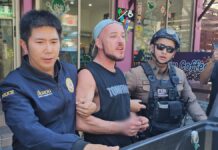
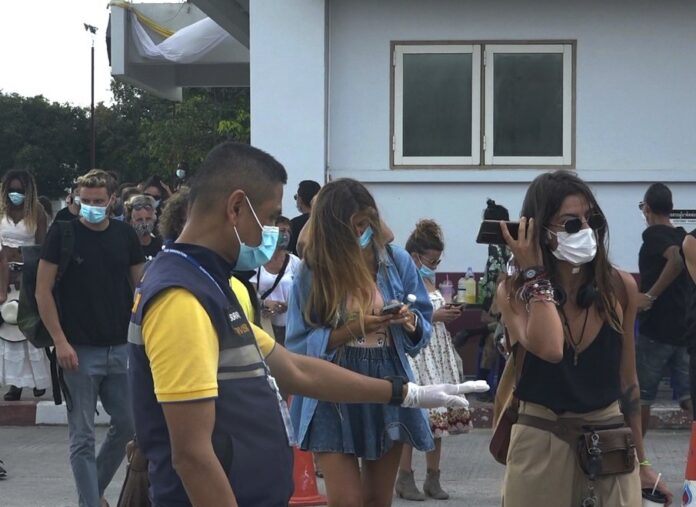
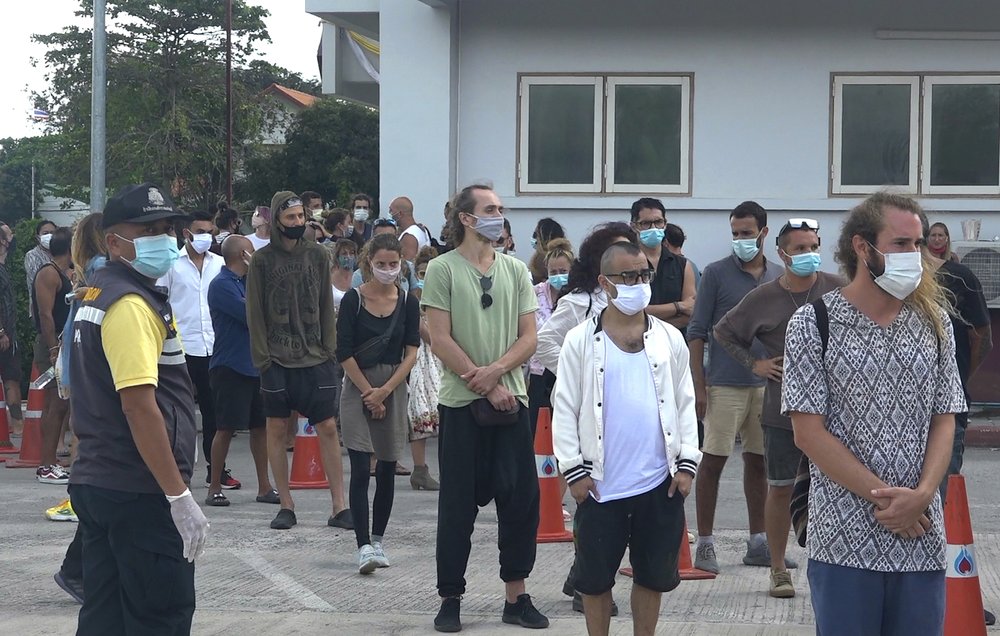
An immigration officer stand beside a group of foreigners in front of police station to attend a court hearing through video conferencing on Koh Phangan island, Surat Thani province, southern Thailand, Thursday, Jan. 28, 2021. (AP Photo)
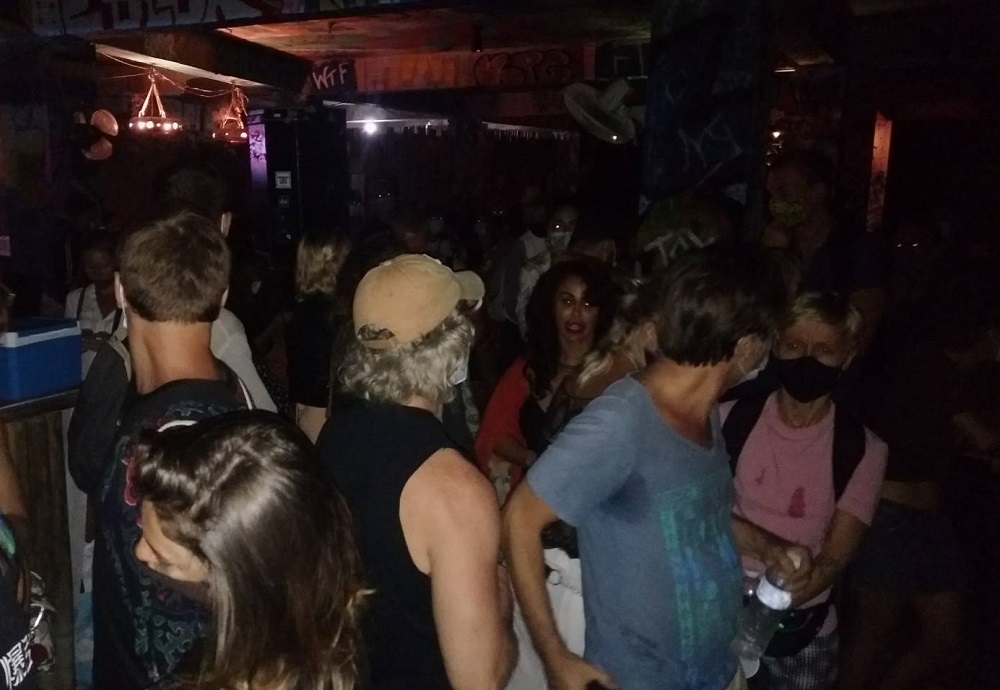
BANGKOK, Thailand (AP) — More than a hundred participants in a party in a bar on a popular Thai island, including 89 foreigners, received suspended jail terms and fines Thursday for breaking national coronavirus restrictions.
Police arrested the 109 partygoers in a raid Tuesday night on the Three Sixty Bar on Koh Phangan in southern Thailand. The foreigners are from more than 10 countries, including the U.S., the U.K., Russia, Switzerland and Denmark.
The island in Surat Thani province is a popular destination for young backpacking travelers and is known for its all-night, full-moon beach parties. However, Thailand barred virtually all tourists from entering the country in April 2020 because of the coronavirus.
An immigration officer stand beside a group of foreigners in front of police station to attend a court hearing through video conferencing on Koh Phangan island, Surat Thani province, southern Thailand, Thursday, Jan. 28, 2021. (AP Photo)
Police said they tracked plans for the party on social media, where the bar promoted the event to celebrate its fifth anniversary.
The court conducted the trial over a video link. The judge sentenced each defendant to one month in jail, which was suspended if they have good behavior for a year. He also fined them 4,000 baht ($130) each.
The Thai organizer and two Thai bartenders were given fines of 10,000 baht ($330) and two years in jail, also suspended for a year.
One of the partygoers, Russian Dmitry Kopylov, apologized Thursday for his actions.
“I wanted to say sorry,” he said. “Nobody wants to make any kind of problem or do something wrong.”
In this Tuesday, Jan. 26, 2021 photo, a Thai immigration officer talks to people at a bar on Koh Phangan island, Surat Thani province, southern Thailand. (Police Investigation Team of Surat Thani Immigration)
The party organizer said he had made an honest mistake.
“I thought Surat Thani province was in the COVID-19 green zone. We didn’t have any new cases for 14 days. So I thought we were allowed to organize an activity,” Pongdaran Limochakul said.
Until recently, Thailand appeared to have the disease under control, with very few cases of local transmission. But a new outbreak has led to cases in many provinces, forcing a reimposition of some restrictions.
On Thursday, authorities reported 756 new cases, pushing Thailand’s total to 16,221.
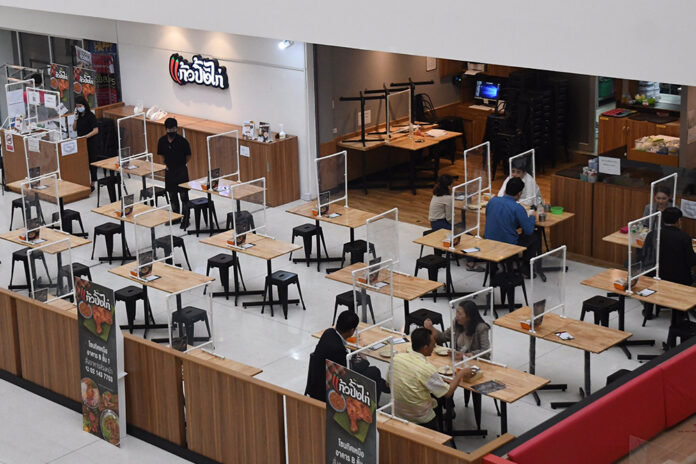
Diners at a restaurant in Bangkok eat within plastic partitions set up to maintain social distancing on Jan. 28, 2021.
BANGKOK — Starting next week, restaurants in the capital may serve diners until 11pm, though consumption of alcoholic beverages in the premises is still banned, the government’s pandemic response center announced Friday.
Nightlife venues such as bars and nightclubs will also remain closed in Bangkok and the neighboring provinces including Samut Prakan, Pathum Thani, and Nonthaburi, spokesman Taweesin Visanuyothin said. The new measures will come into effect on Monday, Feb. 1.
Taweesin justified the booze ban as a necessary measure to prevent coronavirus infections from large gatherings.
“These venues will remain closed as we have seen a cluster of infections stemming from a party,” Taweesin said.
Dine-in hours are currently restricted to 6am to 9pm for restaurants in Bangkok metropolis – designated by health authorities as the “Red Zone” due to their high risk of infection. Serving alcohol in restaurants inside this zone remains prohibited, though drinks may be sold for takeaway, Taweesin said.
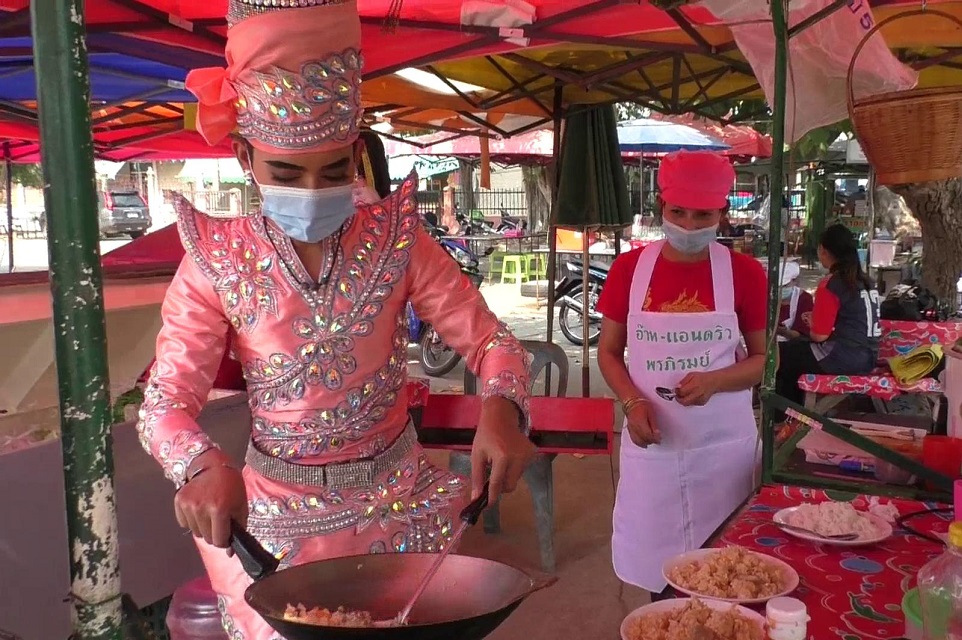
Members of a traditional drama troupe, or likay, turn to opening an eatery in Chainat province on Jan. 17, 2021, to earn a living during the coronavirus pandemic.
Restaurants in the provinces outside the “Red Zone” can open without any dine-in restrictions and alcohol can be served to diners under certain conditions.
Alcohol may be served until 11pm for establishments in 20 “Orange Zone” provinces such as Chonburi, Rayong, Chanthaburi, amd Kanchanaburi; and until 12am in 17 “Yellow Zone” provinces like Prachuap Khiri Khan, Surat Thani, Phang Nga, and Nakhon Ratchasima.
Education institutions may resume classes, with a mix of online and offline studying since the number of students is limited to 25 per physical classroom, Taweesin said.
Pattaya’s Shutdown Continues
Meanwhile, all hotels and tourist attractions in Chonburi, where the resort town of Pattaya is located, have been ordered closed until further notice – a blow to the local tourism and hospitality industry.
The order was issued by Gov. Pakarathorn Thianchai on Thursday, citing an unspecified “urgent need” despite seeing no new infection there for the past week. Hotels that are still occupied by guests may file an appeal to remain open within seven days, the order state.
There is a small silver lining. Phisut Sae-khu, president of the eastern chapter of the Thai Hotels Association, said the order was issued at the industry’s request so that employees could be eligible for compensation from the social security funds.
“We have been demanding the closure order for months already,” Phisut said. “It doesn’t mean that all hotels are now closed. Hotels can still open if they wish to do so.”
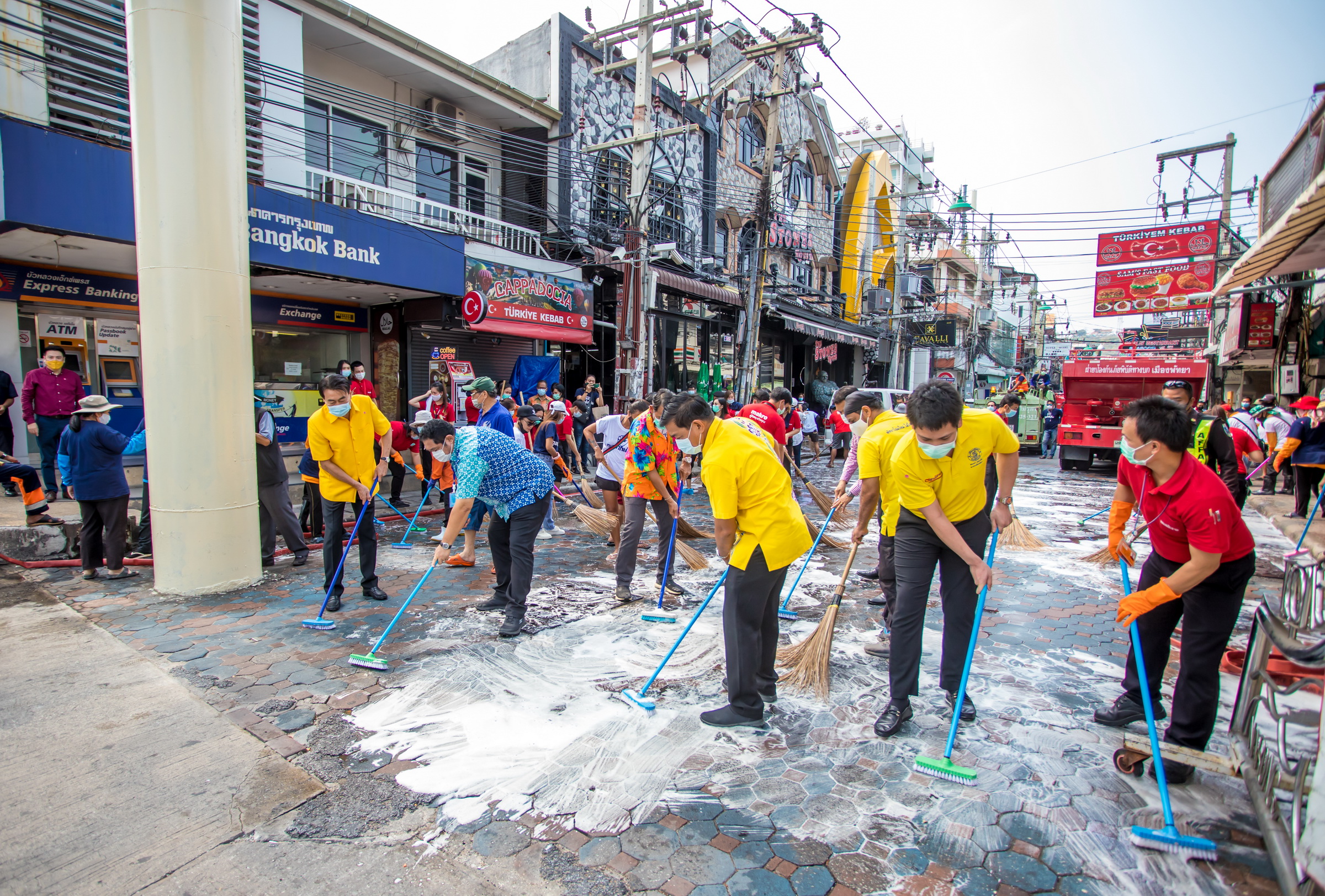
Officials participate in a “Big Cleaning Day” event at Pattaya’s Walking Street on Jan. 28, 2021.
Insured workers affected by the pandemic are entitled to receive compensation at a rate of 50 percent of their daily wage during the closure period, but for no more than 90 days at a time.
Thailand continues to see a three-digit increase in the number of new patients on a daily basis with 802 new cases reported on Friday.
Taweesin said 89 were local transmissions, 692 from active case-finding operations among risk groups, and 21 were imported from abroad.
The country’s latest tally of cases now stands at 17,023. At least 76 deaths associated with the virus have been recorded.
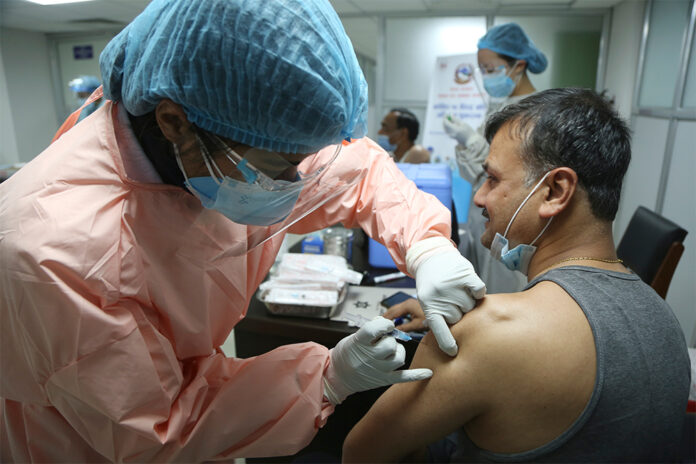
A Nepalese doctor receives AstraZeneca/Oxford University vaccines, manufactured under license by Serum Institute of India at Teaching Hospital in Kathmandu, Nepal on Jan. 27, 2021. Photo: Niranjan Shrestha / AP
BANGKOK — The coronavirus vaccination program will not begin this Valentine’s Day as slated earlier, health minister Anutin Charnvirakul announced Friday.
Minister Anutin cited the vaccine supply dispute between AstraZeneca and the European Union as the reason for the new pushback. But the minister insisted that the first shipment of vaccines will still arrive within February, even as some of Thailand’s neighbors in Asia are already going forward with their inoculation.
“The delay is not from us,” Anutin said. “We will reach out to every source of production and ask them to send some of their stock to us before March. We’re trying to negotiate and doing everything we can. If there’s a problem, it’s beyond our control.”
Health officials previously told Khaosod English that the vaccination would officially begin on Feb. 14, but Anutin now said the first shot will not be administered until March, at the earliest.
The government is set to import 200,000 doses of vaccines jointly developed by British-Swedish pharmaceutical AstraZeneca and Oxford University from abroad to fill the gap before the locally made version of AstraZeneca vaccines will be available. It is unclear when that will happen; officials have mentioned either May or June.
Many uncertainties lie ahead in the country’s ambitious plan to inoculate at least more than half of its population within this year as government officials keep pushing back the target date for the vaccine rollout.
AstraZeneca vaccine was approved for emergency use by the Food and Drug Administration last week. But the FDA will still have to inspect each batch of the incoming vaccines before they can be used in Thailand, potentially a cause for yet another delay.
“The vaccines are set to be available in March,” Anutin said. “When the vaccines arrive in Thailand, it must go through an inspection process.”
The first group of people to be inoculated will be frontline healthcare workers and vulnerable populations such as those living with diabetes, obesity, and chronic obstructive pulmonary disease in the provinces hardest hit by the virus, officials said.
Some other nations in the Asian region, most notably Indonesia and India, have already started their bid to vaccinate their populations against COVID-19, prompting many government critics to question why Thailand is lagging behind.
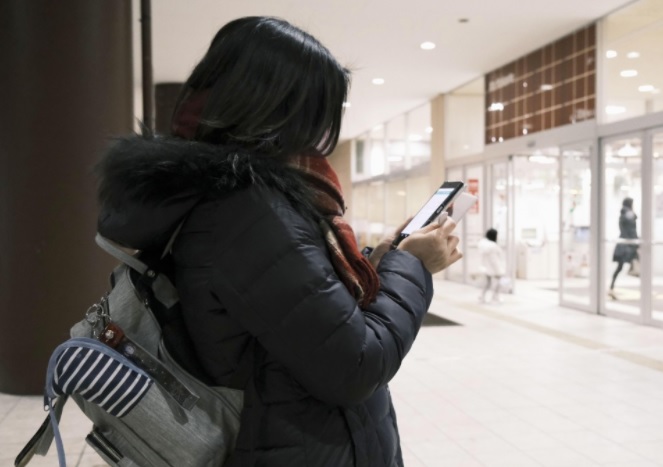
Photo taken Jan. 28, 2021, shows a woman from Sapporo, Hokkaido, who became infected with the novel coronavirus along with her daughter and mother. (Kyodo)
TOKYO (Kyodo) — As Japan struggles to contain a recent surge of coronavirus infections, preventing the virus from spreading within households has become a major challenge.
An increasing number of COVID-19 patients have been told to recover at home as many parts of the nation see a shortage of hospital beds. However, medical experts have highlighted the dangers of home isolation and the difficulty of stopping others in the infected person’s household from being exposed even when preventative steps are taken.