30.2 C
Bangkok
Tuesday, June 9, 2026
Home Blog Page 1509

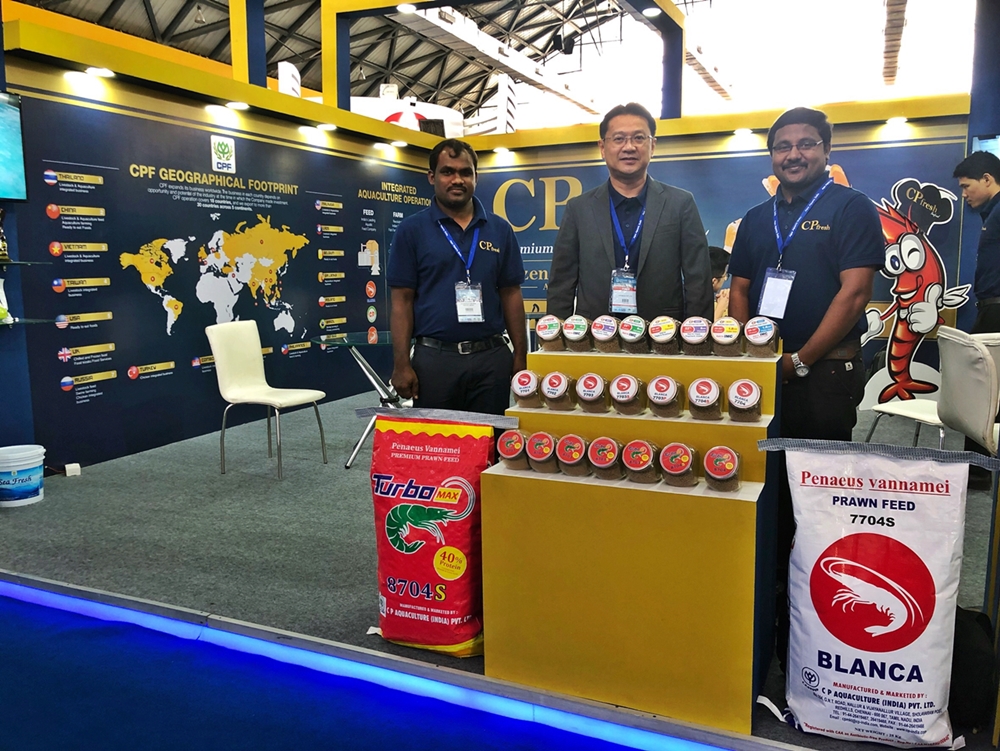
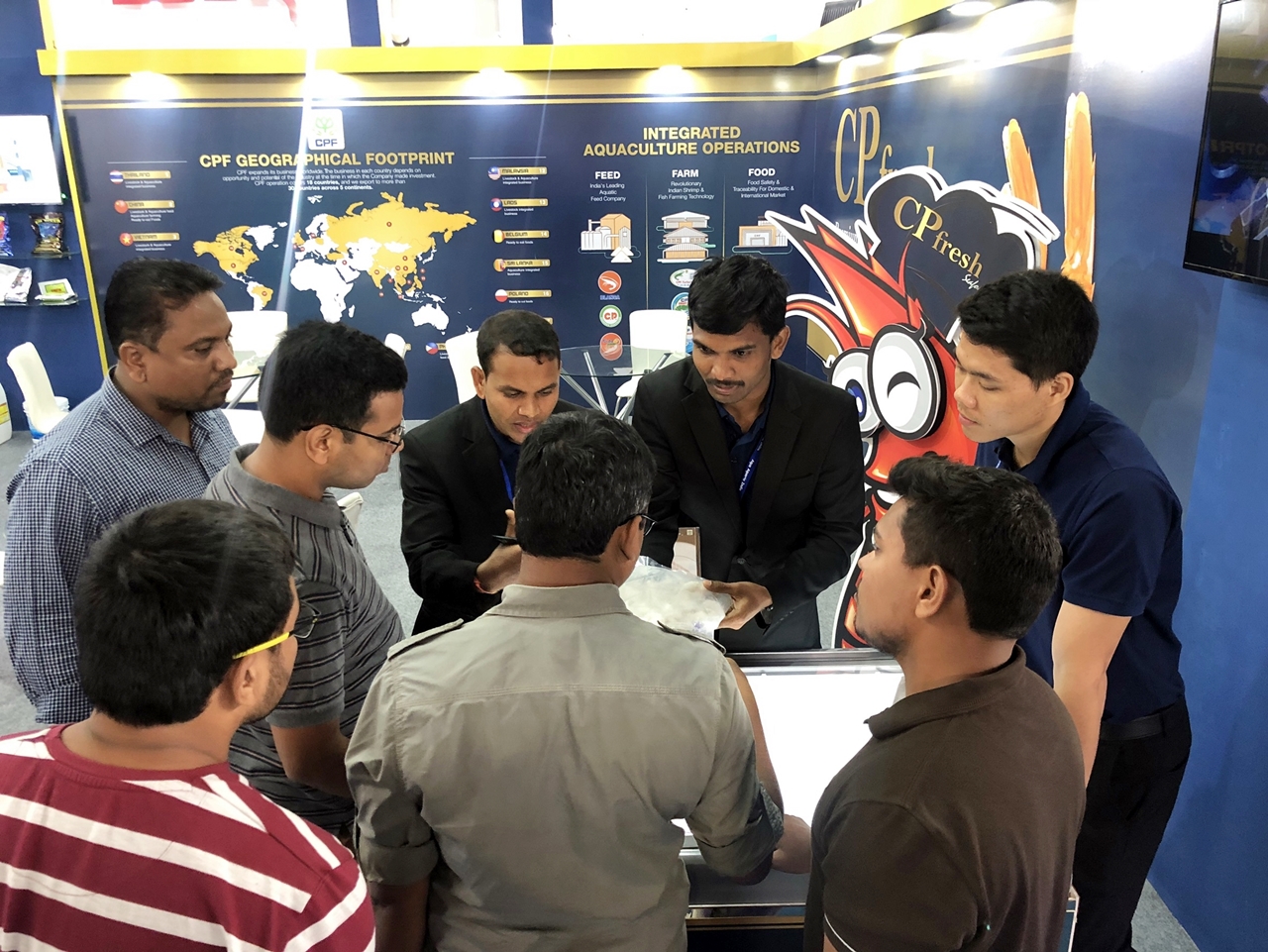
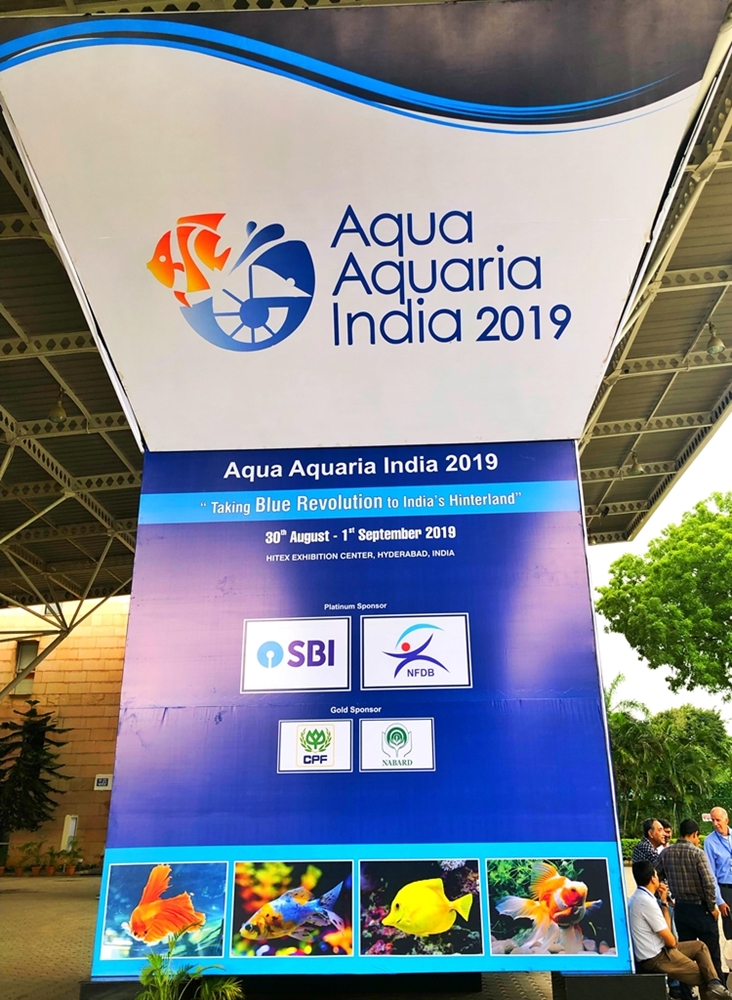
CPF India Showcases Innovative Frozen Shrimp ‘CP Fresh’ in Aqua Aquaria India 2019

CPF India led by Mr. Chakgrit Veeranakin, Senior Vice President and Mr. Ganesh Arekere, Senior Vice President for aquaculture business of CPF India, showcased the premium frozen shrimp under “CP Fresh” brand at Aqua Aquaria India 2019 hosted by Marine Products Export Development Authority under India’s Ministry of Commerce.

“CP Fresh” shrimps were cultured from CPF Smart Farm system adhering food safety standards and traceability.

CPF India also presented shrimp farm focusing create sustainability to society and environment at HITEX Exhibition Center in Hyderabad in India.

01

02

03

06

07

Advertisement

Dump Your Phone E-Waste at AIS Shops in Bangkok

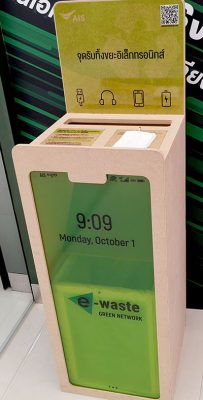
Old smartphones and headphones overlaid on top of a e-waste donation box taken on Sept. 5, 2019 at at Siam Paragon.

BANGKOK — One of Thailand’s mobile providers now offers convenient drop-off spots for phone-related e-waste.

Instead of throwing away that cracked Samsung phone to be buried in landfill, consider dropping it off at one of the 37 AIS branches around Bangkok.

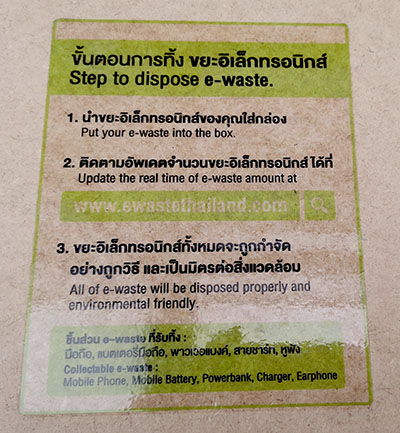
The “Throw Away E-waste with AIS” program accepts donations of old mobile phones, mobile phone batteries, power banks, earphones, charging cables, chargers, and other phone accessories (but not regular batteries, and larger electronics like computers).

Small plastic bags are available at the boxes for mobile phone batteries that may leak.

There are also drop-off boxes at seven Central Department stores: in front of the Superdry store in Central Lardprao, in front of Jaspal at Central Bangna, in front of McDonald’s at Central Rama II, in front of the Body Shop at Central Rama III, in front of Lacoste at Central Pinklao, in front of F Fashion shop at Central Rama IX, and by the information center next to Jaspal at Central Festival Eastville.

Here’s a map of all the dropoff sites:

Although local district offices do accept e-waste, they are lumped into a broader category of toxic waste. This campaign is one of the first to provide a wide range of convenient dropoff sites. Previous channels to donate your e-waste in Thailand were sporadic, and included mailing your items to short-term government campaigns or temples.

Supatchaya “Ann” Techachoochart, the co-owner of Thailand’s first refillable bulk supply store, Refill Station, welcomes the campaign and hopes it will increase awareness among Thais to properly get rid of their e-waste.

IMG 20190905 133436 e1567677853953“If the private sector is doing this, then it helps push the issue, and maybe the public sector will do so as well,” Ann said.

According to the campaign’s page, the donated e-waste will be sorted, dismantled, and reduced into metals, gold, silver, plastic, lithium, and so on. Ann says that all the waste will be shipped to Singapore to be processed, since e-waste recycling is not legally covered by Thai law yet.

Read: How to Donate, Recycle, Get Rid of Stuff in Bangkok

Ann warned against keeping e-waste around the home due to the presence of harmful substances such as lead and mercury. Environmentally, not only will these leak into nature, the process of gaining such materials in the first place can be unethical. For example, the mining of coltan – used in most smartphones and computers – in Sub-Saharan Africa has resulted in conflicts over obtaining the mineral, as well as destroyed wildlife habitats.

“It’s a blood mineral in the Congo. If you can’t imagine what it’s like, think of Avatar and the conflict to get resources,” Ann said. “So by recycling, we can reuse those ores, instead of mining for them in nature again.”

Instructions on disposing e-waste.
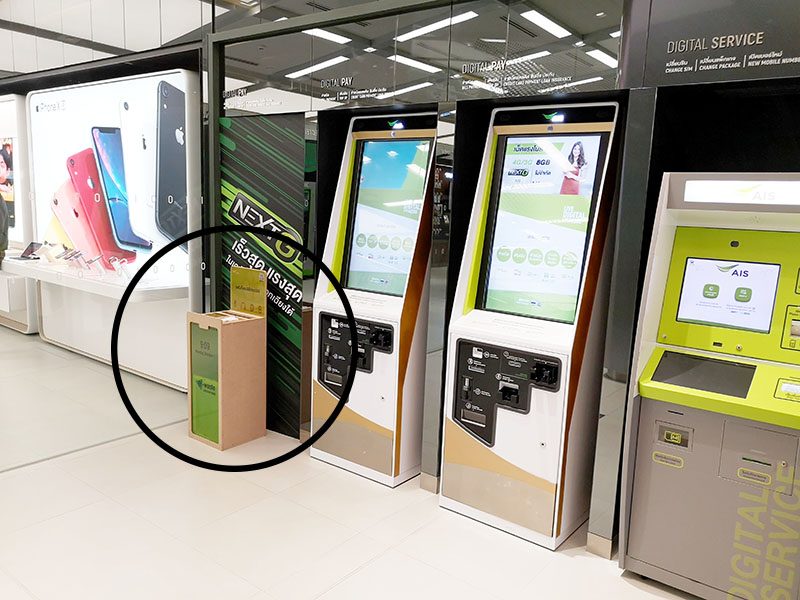
The e-waste donation box in front of AIS Siam Paragon.
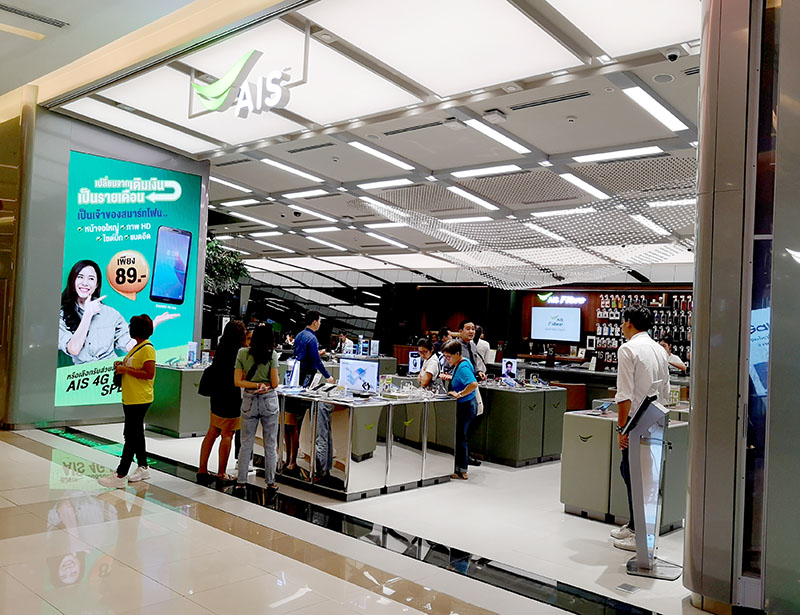
The AIS shop at Siam Paragon.

Related stories:

How to Donate, Recycle, Get Rid of Stuff in Bangkok

How to Start Using Less Plastic in Bangkok Right Now

The ‘Sabai Sabai’ Way to Go Zero Waste in Thailand

Advertisement

Opinion: Thailand’s Burnt Drum Killings, Then and Now

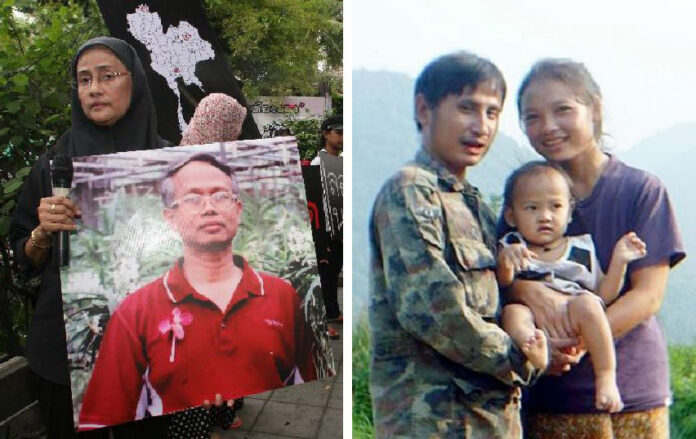
Left: Activists, including Angkhana Neelapaijit, mark the 11th anniversary of the abduction of human rights lawyer Somchai Neelapaijit in 2015 in Bangkok. Right: Porlajee “Billy” Rakchongcharoen poses with his wife and child. Photo: Courtesy of his family

retention.column

Not being well-versed in murder techniques, I asked one question twice to the chief of the Department of Special Investigation on Tuesday during the press conference announcing the discovery of skull fragments belonging to the missing activist Porlajee “Billy” Rakchongcharoen.

What is the significance of the two metal rods found inside the charred 200-liter oil drum where Billy’s burnt bones were found?

Both times, the chief neglected to respond.

Just hours later, former National Human Rights Commissioner and this year’s Ramon Magsaysay awardee Angkhana Neelapaijit posted on her Facebook suggesting that the two metal rods must have been used to keep the lid of the drum in place while the body of the 30-year-old Karen activist was being burned.

It’s unclear whether Billy was killed before being burned or burned alive. He was last seen being detained by the then Kaeng Krachan National Park chief Chaiwat Limlikhit-aksorn for allegedly harvesting wild honey.

Angkhana said some high-ranking officials have told her that her husband, human rights lawyer Somchai Neelapaijit, was killed and burned inside a similar oil drum by authorities. Somchai championed the rights of Thai-Malay Muslims in the deep south but was abducted and killed in 2004 during the Thaksin Shinawatra administration. His body was never found and no one has been punished.

Four-and-a-half decades ago during the Cold War, burning enemies of the state inside red oil drums, whether alive or dead, was in vogue among some Thai officers. There is even a monument marking the widespread “red drum” (thang daeng) killings in Phatthalung province. Estimates of the number of red drum killings committed during the Cold War range from hundreds to as many as three thousand. People accused of being enemies of the Thai state simply disappeared, or their remains were discovered in such oil drums.Re•tention: Pravit Rojanaphruk

Fast forward to 2019, the United Nations says there have been 86 outstanding cases of enforced disappearance in Thailand since 1980. You would think there is a law criminalizing enforced disappearance in Thailand. Wrong. No domestic law criminalizes abduction to kill.

Why is the Thai state so reluctant to enact a law which recognizes the heinous crime for what it is? According to Angkhana, the junta-appointed parliament under the last junta mulled such a bill for three years, and eventually failed to enact it before elections in March this year – despite its record of quickly giving a rubber stamp to other laws.

Is it because it’s the state itself who is the biggest perpetrators of abductions and torture? Is it because every now and then the state needs to silence, kill and even burn some of its critics and opponents?

Billy was fighting for the rights of the Karen people to live in disputed parts of the national park before he disappeared. Rights lawyer Somchai was fighting for the rights of Thai-Malay Muslims to have a political say prior to his disappearance.

While the Department of Special Investigation should be commended for discovering Billy’s burnt bone fragments, justice has yet to be served. Distrust runs deep and not all were convinced.

Yaowalak Anuphan, head of Thai Lawyers for Human Rights, posted on her Facebook soon after the DSI press conference speculating that the emergence of Billy’s remains may have more to do with Thailand’s on-going attempt to register Kaeng Krachan National Park as a UNESCO World Heritage site. UNESCO rejected the bid earlier this year, listing the concerns of the Karen community inside the park as an issue that has to be addressed for the body to reconsider the listing again.

I truly hope that was not the real drive to solve Billy’s enforced disappearance.

Advertisement

Wife of Dead Insurgent Suspect Alleges Torture, Shows Photos

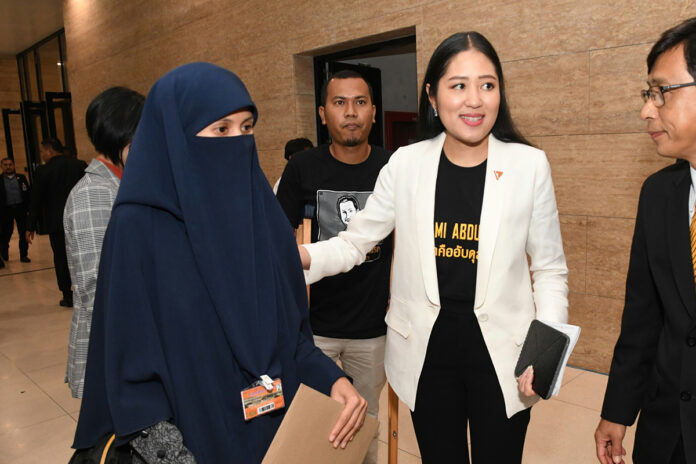
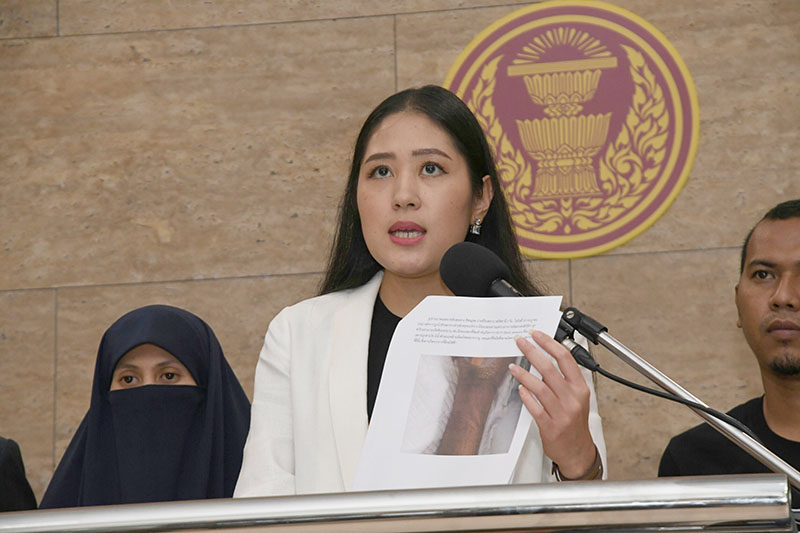
Sumaiya Minka, left, with Future Forward Party MP Pannika Wanich on Sept. 4, 2019 at Parliament.

BANGKOK – The wife of a suspected insurgent who died after falling unconscious while in military custody has revealed photos suggesting he might have been tortured.

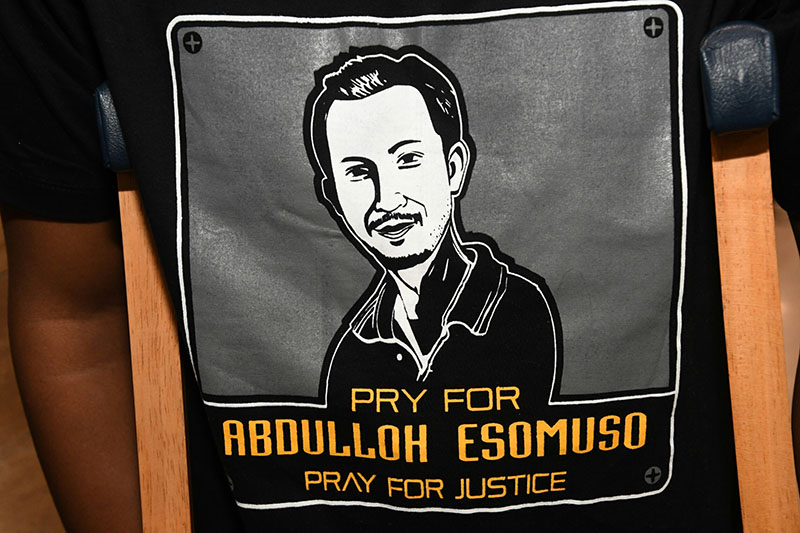
Sumaiya Minka on Wednesday claimed her late husband, Abdulloh Esormusor, was tortured while detained for 12 hours in a military camp in Pattani province. She backed the allegations with photos allegedly taken in the ICU unit of a hospital soon after her late husband, Abdulloh Esormuso, arrived unconscious on July 22.

The photos show red marks on Abdulloh’s wrists, which may have been left from being tied by a rope. Also visible are marks on his fingers that could have been the result of an electric shock. One photo shows liquid oozing out of his ear.

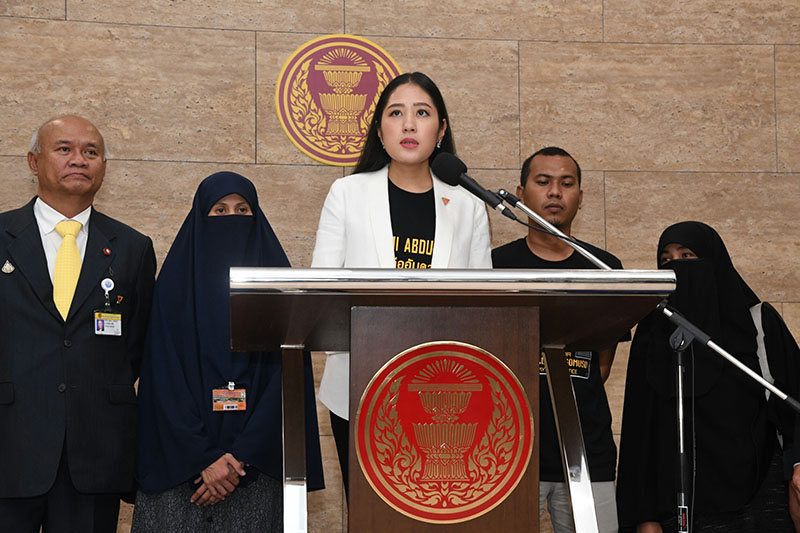
Sumaiya presented the photos both to the Future Forward Party at Parliament, and to the local branch of the Office of the United Nations High Commissioner for Human Rights.

Future Forward Party spokesperson Pannika Wanich told reporters at a press conference today that there have been 54 mysterious deaths under military custody since 2014. Almost all the deceased have been Thai-Malay Muslims.

“Abdulloh wasn’t the first to emerge out of a military camp with severe injuries, crippled or dead,” Pannika said.

She said that documentation by the Pattani Human Rights Research Group found that 51 percent of the deceased were Thai-Malay Muslims aged between 29 and 38. 57 per cent were from Pattani province.

Future Forward Party then urged Prime Minister Gen. Prayuth Chan-ocha, the Defense Ministry, and the armed forces to clarify the circumstances that led to Abdulloh’s death.

ภรรยาอับดุลเลาะห์ยื่นหนังสือที่รัฐสภา ๑๙ 14 ภรรยาอับดุลเลาะห์ยื่นหนังสือที่รัฐสภา ๑๙ 11 ภรรยาอับดุลเลาะห์ยื่นหนังสือที่รัฐสภา ๑๙ 17

Related stories:

Family of Pattani Man Who Died in Army Custody Seeks Justice

Suspected Insurgent in Coma After Army Detention

Advertisement

Yellowshirt Leader Freed From Jail Early Under Royal Pardon

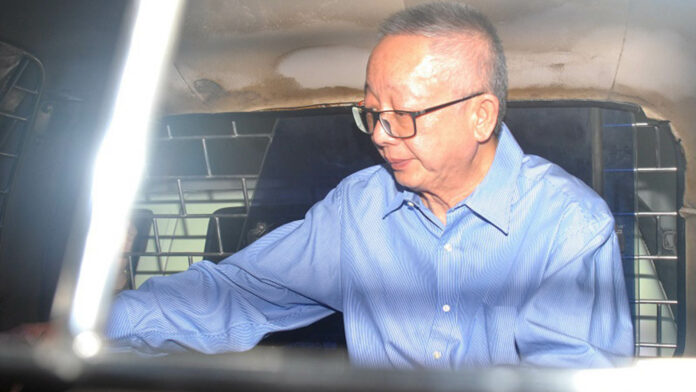
Sondhi Limthongkul being transported to prison on Sept. 6, 2016 after the Supreme Court upheld the verdict to imprison him 20 years.

BANGKOK — A leader of the Yellowshirt movement who spent three years in prison for fraud was released Wednesday afternoon.

Sondhi Limthongkul, 72, was greeted by supporters as he walked out from Bangkok Remand Prison at 3pm on Wednesday.

The ex-media mogul, who later became a leader of the protest movement against then-Prime Minister Thaksin Shinawatra, was convicted for falsifying loan guarantee documents for a 1.08 billion baht loan from Krungthai Bank.

Sondhi was released earlier than scheduled due to a royal pardon granted on the occasion of His Majesty the King’s wedding. He, along with three other executives, were originally sentenced to 20 years in prison in 2012, but were only jailed in 2016 after fighting through the appeals process.

Corrections Department chief Naras Savestanan said Sondhi was qualified for the pardon as he had demonstrated good behavior in prison and is more than 70 years old. However, his pardon was delayed due to a misinterpretation of a law which prevents violators of the Securities and Exchange Act from being released early.

Judges eventually granted the pardon, reasoning he was not an executive of a financial institution, who the law bars from early release.

Naras insisted the release had nothing to do with politics.

“His parole was granted after his legal situation was clarified,” Naras said. “There was no hidden agenda or order from anyone.”

Sondhi, the founder of the prominent media conglomerate Manager, fraudulently attempted to guarantee a loan in 2016 to The M Group, a company in which he held shares. The M Group later defaulted on the loan, forcing Manager Group to assume the massive debt.

Sondhi then embarked on a campaign against Thaksin Shinawatra and governments aligned with him by founding the People’s Alliance for Democracy (PAD) in 2005. The movement’s street demonstrations culminated in takeovers of key locations across Bangkok including Government House and Suvarnabhumi International Airport.

The protests eventually led to the military coup which ousted Thaksin on Sept. 19, 2006. He later announced the disbandment of the PAD in 2009. He has kept a low profile since being wounded in an ambush by unknown attackers with assault rifles. The case remains unsolved.

He was also charged for occupying the airport, but the trial against him and other Yellowshirt leaders has hardly progressed despite a decade passing.

Related stories:

Yellowshirt Leader Sondhi Jailed 20 Years for Fraud

Yellowshirt Leader Released on Bail After Two Weeks in Jail

Imprisoned Yellowshirt Founder ‘Not Enjoying Any Privileges’

Convicted Yellowshirt Leader to Share Prison With Redshirts

Anti-Graft Crusader and Yellowshirt Founder Convicted of Fraud

Advertisement

World’s Largest Dates Market in Saudi Arabia Bustles as Harvest Season in Full Swing

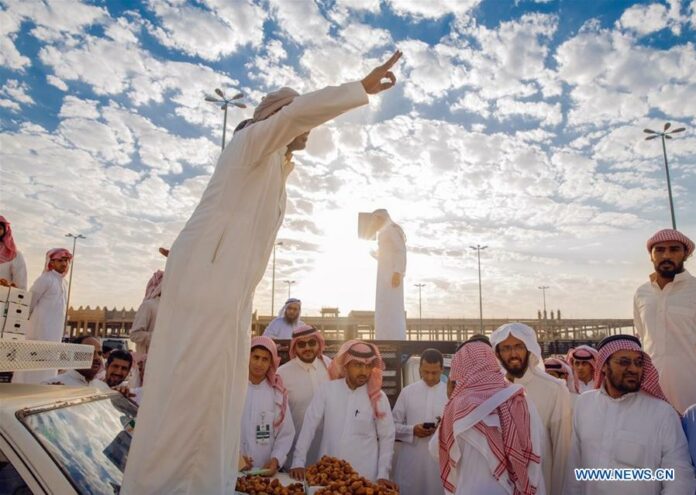
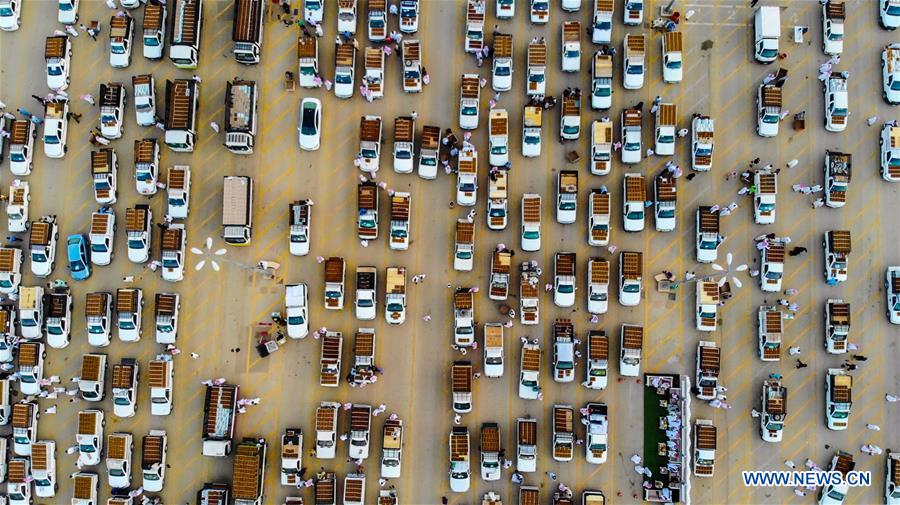
Merchants stand on trucks at a seasonal date market in the city of Buraydah, north of Riyadh, Saudi Arabia, on Aug. 29, 2019. With dates harvest season in full swing in Saudi Arabia, ample varieties of dates are filling wholesale and retail markets across the kingdom, which boasts the world's largest number of date palm trees and is the third biggest producer of fresh dates globally. Photo: Buraydah Dates Festival media section / Handout via Xinhua

BURAYDAH, Saudi Arabia (Xinhua) — With dates harvest season in full swing in Saudi Arabia, ample varieties of dates are filling wholesale and retail markets across the kingdom, which boasts the world’s largest number of date palm trees and is the third biggest producer of fresh dates globally.

Saudi Arabia’s largest date market is in Buraydah, capital of the north-central Al-Qassim region, 330 km northwest of Saudi capital Riyadh.

The region has more than 7 million date palm trees, the highest number among all regions in the kingdom.

Dating back to some 60 years ago, Buraydah Dates Festival usually fills with activities, and date farmers are expecting high sales during this year’s festival, which will close on Sept. 5.

According to the Saudi National Center for Palms and Dates, Saudi annual production of fresh dates amounts to about 15 percent of global output, reaching 1.3 million tons per year from 28 million palm trees.

More than 1,000 sq km of land are under date palm cultivation in Saudi Arabia, producing some 400 varieties of dates.

Every year, during the 35-day festival in high summer, farmers from Al-Qassim and other regions gather for the biggest event of its kind.

Vehicles loaded with dates gather at a seasonal date market in the city of Buraydah, north of Riyadh, Saudi Arabia, on Aug. 29, 2019. Photo: CIC/Handout via Xinhua

Buraydah’s location in the heart of the historic Najd region has made it a hub of diverse cultures and a variety of festivals, featuring markets selling food and handicrafts.

Shopping at the seasonal date market is a unique experience, especially during the harvest season that falls during August and September each year.

The festival is not simply an annual marketplace but also a lifeline for thousands of farmers and youths who depend on the income generated from date farming.

In addition to the grand display of the date farmers’ harvest, another noticeable part of the festival is the brokerage market where traders seek the services of distinguished auctioneers to obtain the optimum prices for the dates.

At the festival, hundreds of trucks laden with boxes and crates of various varieties of dates. Dressed in the traditional white robes with red-and-white checkered headdress for men, auctioneers are hawking their wares atop their trucks as customers inspect fistfuls of dates.

“Buraydah Dates Festival is the largest seasonal agricultural and economic activity in the kingdom,” said Khaled Abdullah Alrobay, head of the media team at the festival.

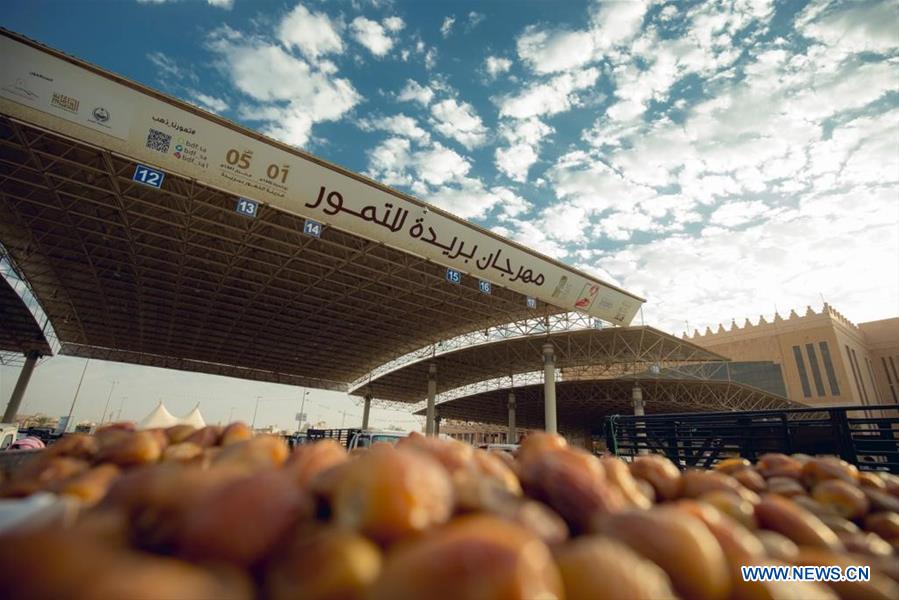
Dates are seen at a seasonal date market in the city of Buraydah, north of Riyadh, Saudi Arabia, on Aug. 29, 2019.  Photo: CIC/Handout via Xinhua
Dates are seen at a seasonal date market in the city of Buraydah, north of Riyadh, Saudi Arabia, on Aug. 29, 2019. Photo: CIC/Handout via Xinhua

The festival employs more than 4,000 young men and women for marketing, accounting and management, Alrobay added.

“The festival is the largest in the world in terms of sales transactions that take place inside the market’s yards, in addition to the line of more than 2,000 cars loaded with hundreds of tons of dates on a daily basis,” he said.

“In this economic carnival, farmers and date traders offer more than 45 varieties of Qassim dates,” Alrobay said.

The most popular variety by far is the golden yellow Sukkari. Other varieties include Barhi, Khlas, Shaqra, Medjool, Wannan, Rothan, Nabtat Ali, Heshaishy and Sekkaryah Hamra.

During dates harvest season, which runs for as long as three months starting in August, most regions in Saudi Arabia hold dates markets.

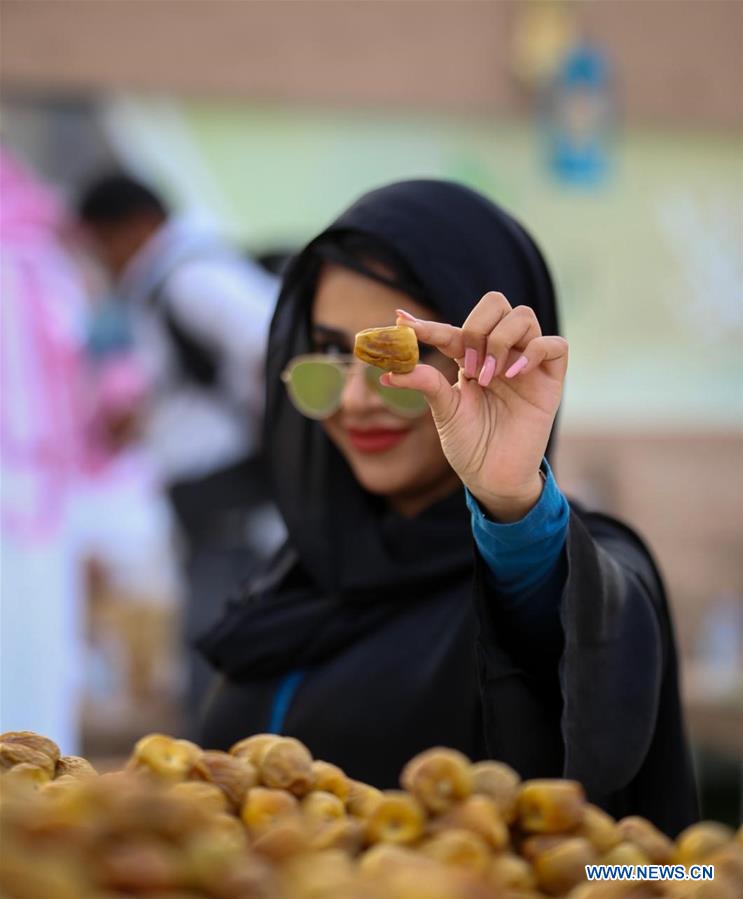
A woman shows a date at a seasonal date market in the city of Buraydah, north of Riyadh, Saudi Arabia, on Aug. 29, 2019. Photo: CIC/Handout via Xinhua

Through its pavilion at the Buraydah Dates Festival, the Saudi Export Development Authority seeks to increase the kingdom’s share in the global dates market by raising export awareness and developing the readiness of potential exporters.

It also aims to shed light on global market opportunities in the dates sector, based on its role in increasing the proportion of Saudi non-oil exports, encouraging openness to international markets, raising the competitive quality of local products, and fulfilling the kingdom’s Vision 2030.

The Buraydah Dates Festival attracts many consumers and traders from Gulf countries and the Arab world.

Saudi exports of dates reached 758 million Saudi riyals (202 million U.S. dollars) in 2018, including re-exports, an increase of 8 percent compared with 2017, according to the Saudi Export Development Authority.

The festival hosts the produce of 8 million palm trees transported with 53,000 vehicles. The quantity of dates sold during Buraydah Dates Festival, usually around 33,000 tons in 10 million containers, represents 10 percent of dates sold in Al-Qassim.

This year, the organizers introduced new functions and programs to attract broader participation of families, children and youths, Saudi Press Agency reported.

These programs include activities related to dates, as well as social and cultural programs. There are informative and recreational sessions accompanying the festival, including an awareness program to encourage youths to enter the market.

The annual date festival is an important event to turn primary products into dates derivatives including date syrup, date paste and date gift boxes for all occasions throughout the year.

According to festival organizers, integrated services supportive to farmers, traders and consumers have been set up in one of the biggest economic gatherings in the world.

Quality-control teams have been assigned to ensure that dates products are free from pesticides, fraud and other irregularities. Additionally, a guide office was deployed to lead customers to the finest types of dates, while a tent was set aside to allow youths to sell dates on a retail basis.

Advertisement

Lam Says Decision to End Bill Was Her Govt’s Own

A man watches the television message that Hong Kong Chief Executive Carrie Lam makes an announcement on the extradition bill, at a home electronics retailer in Hong Kong, on Wednesday, Sept. 4, 2019. Photo: Vincent Yu / AP

HONG KONG — The Latest on Hong Kong protests (all times local):

11 a.m.

Hong Kong Chief Executive Carrie Lam says the move to withdraw the extradition bill was her government’s own decision, and that it was backed by the Chinese central government.

Lam denies making a U-turn on the bill after three months of massive opposition. She says she suspended the bill in mid-June, days after massive protests begun, and had in July declared that the bill effectively dead.

She says she hopes the formal withdrawal of the bill will be an olive branch to open dialogue with aggrieved protesters and seek a way out of the impasse.

Opponents of the bill said its withdrawal was too little, too late, and the other demands made during the protests should be addressed.

___

10:45 a.m.

Hong Kong leader Carrie Lam says the extradition bill that sparked months of demonstrations will be formally withdrawn in the legislative council without the need for debate or vote.

Lam made her first live remarks on the withdrawal of the bill at a news conference Thursday. She said there will be no debate and no voting in the council, which resumes meeting next month and is packed with pro-Beijing lawmakers.

Withdrawal of the bill meets one of protesters’ demands, but the activists have vowed not to yield until the government accepts other demands including an independent investigation into alleged police brutality against protesters, the unconditional release of those detained and democracy.

The massive protests since June have disrupted transportation links around the city and at its international airport.

Advertisement

Protests in Hong Kong Hit Economy Hard, US Academic Says

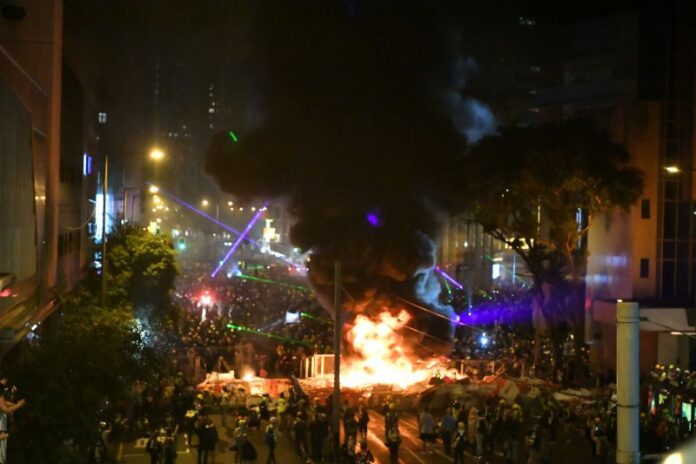
Protesters shine laser beams and set fires near the Hong Kong police headquarters in Wan Chai in the HKSAR, Aug. 31, 2019. Photo: Xinhua

HOUSTON, Texas (Xinhua) — The violent protests in Hong Kong are losing support and are battering the city’s economy, Jon Raymond Taylor, a U.S. academic has said.

“When you start doing things that are of a very violent nature, you’re going to lose the support of people. You’re going to scare people. You’re going to impact Hong Kong’s economy, which is by the way now happening,” the political science and geography professor at the University of Texas at San Antonio told Xinhua in an interview last week.

Focusing his research on China for more than 20 years, Taylor, also the department chair, has closely followed the recent development in Hong Kong.

Defending the actions of Hong Kong police, he said the Hong Kong police “are quite correct.”

“Any police officer would tell you if they’re seeing threat to lives of not just individuals on the sidelines, but actual protesters themselves, let alone police officers, they’re going to act. And anybody that doesn’t understand that doesn’t understand how police officers are supposed to operate to protect the public safety,” he commented.

Speaking of the “one country, two systems” practice in Hong Kong, Taylor said the policy has been successful to maintain prosperity in the region over the past 20 years.

“It’s been successful in encouraging and maintaining … investments and investment opportunities” in Hong Kong, he said.


Advertisement

Hurricane Death Toll Climbs to 20 in Devastated Bahamas

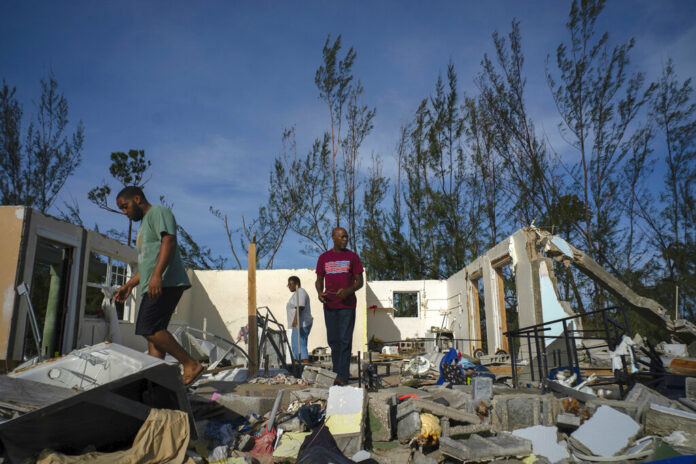
George Bolter, left, and his parents walk through the remains of his home destroyed by Hurricane Dorian in the Pine Bay neighborhood of Freeport, Bahamas, Wednesday, Sept. 4, 2019. Photo: Ramon Espinosa / AP

FREEPORT, Bahamas — The ground crunched under Greg Alem’s feet on Wednesday as he walked over the ruins of his home, laid waste by Hurricane Dorian. He touched a splintered beam of wood and pointed to the fallen trees, overcome by memories.

“We planted those trees ourselves. Everything has a memory, you know,” he said. “It’s so, so sad. … In the Bible there is a person called Job, and I feel like Job right now. He’s lost everything, but his faith kept him strong.”

The devastation wrought by Dorian — and the terror it inflicted during its day-and-a-half mauling of the Bahamas — came into focus Wednesday as the passing of the storm revealed a muddy, debris-strewn landscape of smashed and flooded-out homes on Abaco and Grand Bahama islands. The official death toll from the strongest hurricane on record ever to hit the country jumped to 20, and there was little doubt it would climb higher.

With a now-distant Dorian pushing its way up the Southeastern U.S. coast, menacing Georgia and the Carolinas, many people living in the Bahamas were in shock as they slowly came out of shelters and checked on their homes.

In one community, George Bolter stood in the bright sunshine and surveyed the ruins of what was once his home. He picked at the debris, trying to find something, anything, salvageable. A couple of walls were the only thing left.

“I have lost everything,” he said. “I have lost all my baby’s clothes, my son’s clothes. We have nowhere to stay, nowhere to live. Everything is gone.”

The Bahamian government sent hundreds of police officers and marines into the stricken islands, along with doctors, nurses and other health care workers, in an effort to reach drenched and stunned victims and take the full measure of the disaster.

“There are many in Grand Bahama who are suffering,” Prime Minister Hubert Minnis said at a news conference. “We know there are many Bahamians that are in need of help. I want to assure you that more help is on the way.”

He thanked the international community for its response, especially the U.S. government for what he called their “exceptional assistance.”

The U.S. Coast Guard, Britain’s Royal Navy and relief organizations including the United Nations and the Red Cross joined the burgeoning effort to rush food and medicine to survivors and lift the most desperate people to safety by helicopter. The U.S. government also dispatched urban search-and-rescue teams.

Londa Sawyer stepped off a helicopter in Nassau, the capital, with her two children and two dogs after being rescued from Marsh Harbor in the Abaco islands.

“I’m just thankful I’m alive,” she said. “The Lord saved me.”

Sawyer said that her home was completely flooded and that she and her family fled to a friend’s home, where the water came up to the second floor and carried them up to within a few feet of the roof. She said she and her children and the dogs were floating on a mattress for about half an hour until the water began receding.

Sandra Cooke, who lives in Nassau, said her sister-in-law was trapped under her roof for 17 hours in the Abaco islands and wrapped herself in a shower curtain as she waited.

“The dog laid on top of her to keep her warm until the neighbors could come to help,” she said. “All of my family lives in Marsh Harbor, and everybody lost everything. Not one of them have a home to live anymore.”

The storm pounded the Bahamas with Category 5 winds up to 185 mph (295 kph) and torrential rains, swamping neighborhoods in brown floodwaters and destroying or severely damaging, by one estimate, nearly half the homes in Abaco and Grand Bahama, which have 70,000 residents and are known for their marinas, golf courses and all-inclusive resorts.

Bahamian Health Minister Duane Sands said 17 of the dead were from the Abaco islands and three from Grand Bahama. He said he could not release further details because the government still had to contact family members.

Some people in the Abaco islands complained that they had not seen any aid except for medical supplies for the main hospital, where hundreds of people were temporarily living as they awaited help.

By late Wednesday, Dorian has crept back up to Category 3 force with 115 mph (185 kph) winds and was pushing toward a brush with the Carolinas — with a direct hit on the outer banks possible. An estimated 3 million people in Florida, Georgia and North and South Carolina had been warned to clear out, and highways leading inland were turned into one-way evacuation routes.

At 11 p.m. EDT, Dorian was centered about 105 miles (170 kilometers) south of Charleston, South Carolina, moving north at 7 mph (11 kph). Hurricane-force winds extended outward up to 60 miles (100 kilometers) from its center.

Forecasters said there was the danger of life-threatening floods as storm surge moves inland from the coastline, as well as the potential for over a foot of rain in some spots.

“Hurricane Dorian has its sights set on North Carolina,” Gov. Roy Cooper said. “We will be ready.”

As the threat to Florida eased and the danger shifted farther up the coast, Orlando’s airport reopened, along with Walt Disney World and Universal. To the north, ships at the big Norfolk, Virginia, naval base were ordered to head out to sea for safety, and warplanes at Langley Air Force Base in Virginia were sent inland.

The U.S. mainland recorded its first death in connection with the hurricane, that of an 85-year-old man in North Carolina who fell off a ladder while preparing his home for the storm. Dorian was also blamed for one death in Puerto Rico.

On Tybee Island, Georgia, Debbie and Tony Pagan stacked their beds and couches atop other furniture and covered their doors with plastic wrap and sandbags before evacuating. Their home flooded during both Hurricane Matthew in 2016 and Irma in 2017.

“It’s a terrible way to live,” Debbie Pagan said. “We have the whole month of September and October to go. How would you like to be living on pins and needles?”

Another Tybee islander, Sandy Cason, said: “The uncertainty and the unknown are the worst part. Just not knowing what’s going to be here when you get back.”

Along King Street in historic Charleston, South Carolina, dozens of shops and restaurants typically bustling with tourists were boarded up, plywood and corrugated metal over windows and doors, as the flood-prone downtown area braced for high water.

Mark Russell, an Army veteran who has lived in South Carolina much of his life, went to a hurricane shelter right away. As for those who hesitated to do so, he said: “If they go through it one time, maybe they’ll understand.”

___

Story: By Marko Alvarez, Dánica Coto and Michael Weissenstein. Coto reported from San Juan, Puerto Rico, and Weissenstein from Nassau, Bahamas. AP writers Tim Aylen in Freeport; Russ Bynum in Georgia; and Seth Borenstein in Washington contributed to this report.

Advertisement

Danish Hero During Nanjing Massacre Commemorated in China, Denmark

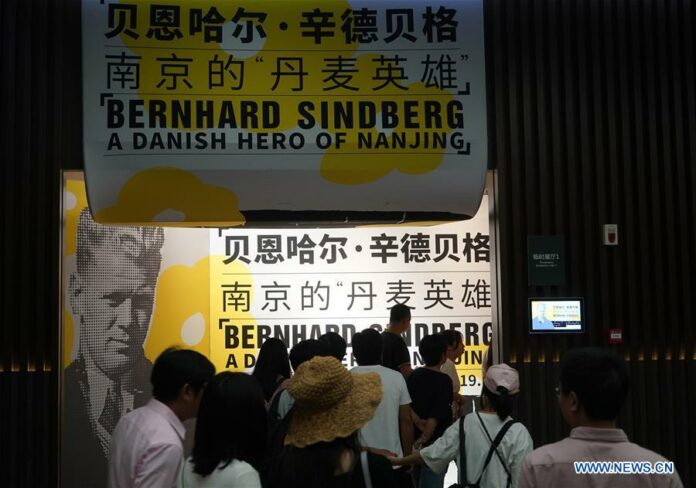
Visitors tour the photo exhibition
Visitors tour the photo exhibition "Bernhard Sindberg: A Danish Hero of Nanjing" in Nanjing, capital of east China's Jiangsu Province, Aug. 31, 2019. Photo: Xinhua

NANJING, China (Xinhua) — As China marked Victory Day of the Chinese People’s War of Resistance Against Japanese Aggression Tuesday, two photo shows in memory of Danish hero Bernhard Arp Sindberg went on simultaneously in the Chinese city of Nanjing and the Danish city of Aarhus.

The exhibition held in the Memorial Hall of the Victims in Nanjing Massacre by Japanese Invaders in Nanjing, capital of east China’s Jiangsu Province, has attracted more than 200,000 visitors since it opened Saturday.

Apart from the exhibition, a statue of the hero, jointly designed by two Chinese artists and a Danish artist, was unveiled by Denmark’s Queen Margrethe II in Marselisborg Memorial Park in Aarhus, the birthplace of Sindberg, Saturday.

Sindberg, along with German businessman John Rabe and U.S. priest John Magee, was among the foreigners who had protected Nanjing residents, despite the risks during the war.

Tuesday marked the 74th anniversary of the victory in the Chinese People’s War of Resistance Against Japanese Aggression and the World Anti-Fascist War.

Sindberg traveled to Nanjing in December 1937, at the age of 26. He worked in a cement factory, where he and a German engineer saved more than 20,000 Chinese during the Nanjing Massacre.

Outside the refugee shelter, Japanese invaders slaughtered about 300,000 Chinese civilians during a six-week rampage after they captured Nanjing, then China’s capital, on Dec. 13, 1937.

Sindberg provided food and medical treatment for the Chinese refugees in the factory. He also recorded the atrocities committed by the Japanese invaders in the city with photographs and letters, which became historical evidence to reveal the truth about the horrific massacre to the world.

The two exhibitions focus on Sindberg’s 106 days in Nanjing and the development of the city over the past 82 years.

Zhang Jianjun, the curator of the memorial hall, said the exhibitions can help more people know the Danish hero, as well as pass on and strengthen the friendship between China and Denmark.

Two Chinese artists Shang Rong and Fu Licheng, from Nanjing University, cooperated with Danish artist Lene Desmentik in designing and making the sculpture of Sindberg.

“He is a legendary figure. And in the process of creation, his image becomes clearer. We found his photos, in his youth and old age, archived in the memorial hall and a library in Nanjing,” Shang added.

The statue, measuring three meters in height, stands straight with his arms open.

“It’s a symbol of welcome, both for the refugees and the peace,” Shang said.

Desmentik later created the “gate of hope” — two-door frames encircling the statue, saying the structure represented the gate of Nanjing, safeguarding the city and people against wars, as well as a gateway to the future.

“We erect the statue in Sindberg’s hometown to remember his humanity, fearlessness, and to remind the world to learn from history and cherish peace,” said Peng Zhengang, deputy director of the department of publicity with Nanjing Municipal Committee of the Communist Party of China, at the unveiling ceremony in Aarhus.

Peng said special yellow roses named after Sindberg have been planted in both Nanjing and Aarhus, to commemorate the hero.

In April 2006, Sindberg’s sister, 80-year-old Bitten Andersen, and six relatives of the Sindberg family from the United States and Lebanon planted the Sindberg Roses in the Peace Square in Nanjing.

The following year, the seedlings were transplanted to the newly-built Memorial Hall of the Victims of the Nanjing Massacre of the Japanese Invaders, where the “Nanjing Sindberg Rose Garden” was specially erected.

Peter Harmsen, a Danish historian of World War II, wrote a biography of Sindberg.

Recently, two publishing houses from China and Denmark jointly signed an agreement to release the Chinese version of the book.

Harmsen said he visited Nanjing many times during the writing of the book. He traced Sindberg’s footsteps in the city, experiencing its past and its new look.

“The first stop of my trips was the Yanziji Middle School, which is next to the cement factory, where Sindberg opened the gate to let thousands of Chinese take refuge in Nanjing during the Japanese invasion,” he said.

Now, the middle school has forged a friendship tie with a Danish high school.

Harmsen said he was touched by the heritage and cooperation opportunities brought by Sindberg’s humanitarian deeds. Enditem

Advertisement

Hot News

LATEST NEWS

Bangkok
overcast clouds
30.2 ° C
31.6 °
28.8 °
76 %
4.5kmh
100 %
Tue
34 °
Wed
34 °
Thu
35 °
Fri
31 °
Sat
31 °