BANGKOK — Imagine you’re an expat in a country where you must report to the police within 48 hours each time you travel to another province for longer than 24 hours.
Amazingly restrictive and burdensome, isn’t it? Welcome to Thailand 2019!
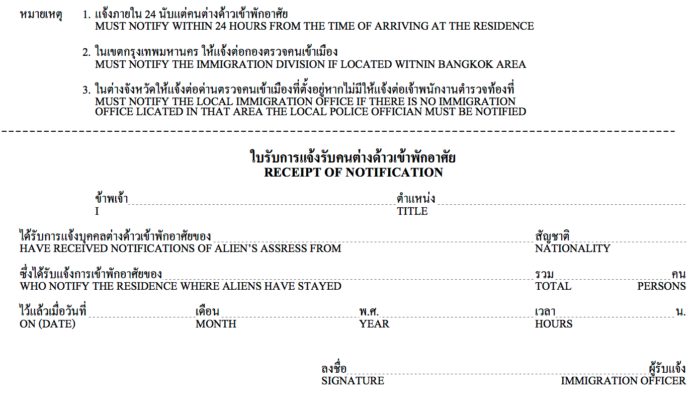
Whether it makes sense or not, Thai immigration police are requiring expats living in Thailand to do just that through an online “TM30” form.
The commander of Bangkok’s immigration police, Pol. Maj. Gen. Patipat Suban na Ayudhaya, insists it’s for the safety of both foreigners and Thais.
“We will try our best to distinguish between the good and bad guys. I promise all of you: we try,” Patipat told the jam-packed, mostly frustrated western audience at the Foreign Correspondents’ Club of Thailand on Thursday evening.
The law requiring foreigners to report themselves has been around since 1979, during the height of the Cold War. But immigration police have only just begun enforcing it (though tourists are largely spared when hotels fill out the form for travelers).
Expats have the option to fill out the form online, but many say the application is slow and that it takes as long as five weeks just to get a login password.
Patipat’s main immigration superintendent, Pol. Col. Thatchapong Sarawanangkul, insisted that is nothing wrong with the online app, however.
Nevertheless, even Thatchapong admitted he has to work until 10pm every night with no holidays, even though his wife will give birth to their baby by the end of this month, in order to clear the forms.
Patipat added that only 10 officers have been assigned to handle the online app, in further admittance that immigration police are ill-equipped to manage the controversial online form. Officers have to check reports one by one in the hopes of spotting potential ‘alien criminals’ bent on committing crimes in Thailand.
This may be a noble goal but let us pause for a second. Would a real alien criminal be foolish enough to submit genuine details of their latest whereabouts in order to wait for the Thai immigration police to arrest or deport them? The chances of catching bad guys from the TM30 immigration form are very slim.
It’s the majority of expats in Thailand – the so-called good aliens – who bear the brunt of the inconvenience and feel stifled. It’s as if Thailand is turning into a police state for largely law-abiding expats.
Instead of making them feel welcomed and at home so Thailand can boost its economy and enrich its culture and society, the pedantic TM30 immigration form has alienated hundreds of thousands of law-abiding expats. Mounting damage is growing on a daily basis in the form of increase numbers considering whether living in Thailand is worth the trouble.
When something makes no sense, it should be done away with. For decades the regulation wasn’t even imposed. It’s not too late to make the law defunct again before it ends up causing more problems than it solves.
TM30 is an unnecessary waste of time and resources in the name of national security. Such pedantic and restrictive rules don’t belong in a country wanting to attract more foreign expats and investments.
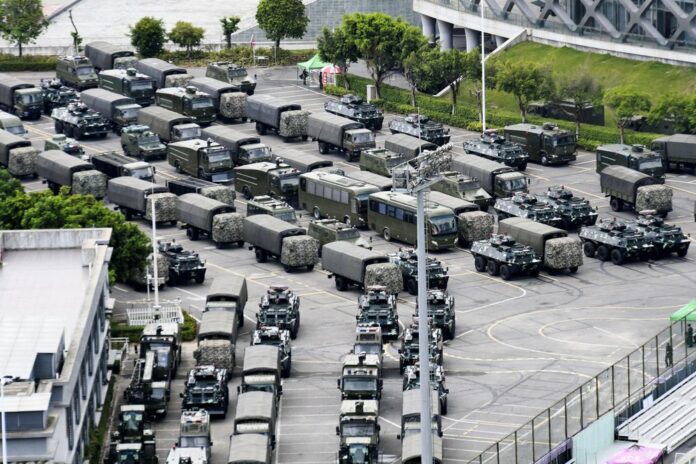
This Friday, Aug. 16, 2019, photo shows armored vehicles and troop trucks are parked outside Shenzhen Bay Stadium in Shenzhen, China.(Madoka Ikegami/Kyodo News via AP)
SHENZHEN, China — Members of China’s paramilitary People’s Armed Police marched and practiced crowd control tactics at a sports complex in Shenzhen across from Hong Kong in what some interpreted as a threat against pro-democracy protesters in the semi-autonomous territory.
The sound of marching boots and synchronized shouts echoed from the grounds on Friday. Officers in green camouflage stood guard at closed entrances. A stadium security guard said “it wasn’t clear” when the paramilitary police would leave the grounds.
Chinese state media have only said that the Shenzhen exercises were planned earlier and were not directly related to the unrest in Hong Kong, though they came shortly after the central government in Beijing said the protests were beginning to show the “sprouts of terrorism.”
From a distance, police could be seen conducting drills in military fatigues, using shields, poles and other riot-control gear. In one exercise, two groups marched in formation with those in front raising shields as if to protect themselves from projectiles. Others behind held red flags and banners. The words “the law” and “prosecuted” could be seen on one.
Outside, dozens of armored carriers and trucks sat in the parking lot of the Shenzhen Bay Stadium, close to a bridge linking mainland China to Hong Kong.
Chinese paramilitary police could be seen gathered at the Shenzhen Stadium which is located next to a bridge linking Mainland China to Hong Kong. (Aug. 16)
Asked if Hong Kong police could maintain order or if mainland Chinese intervention is becoming inevitable, Hong Kong police commander Yeung Man-pun said that while they face tremendous pressure, “I can tell you we’re confident the police have the capability to maintain law and order.”
Germany, meanwhile, said it considers China to be a responsible actor that will respect Hong Kong laws guaranteeing freedom of speech and rule of law.
Government spokesman Steffen Seibert said Friday that Hong Kong’s 1997 Basic Law, under which the city was promised a high degree of autonomy when the former British colony returned to China, “is a Chinese law, and as such we naturally expect that the People’s Republic of China, too, won’t call into question the peaceful exercise of these rights.”
Weeks of protests in Hong Kong have been marked by increasing violence and a shutdown of the Hong Kong airport earlier this week. The demonstrators are demanding expanded political rights and the scrapping of legislation that could have seen criminal suspects sent to mainland China.
A weekend of protests began Friday night with a university student-led “power to the people” rally in Chater Garden, a public square in the financial district.
A pro-democracy march is planned for Saturday along with a separate pro-government “Save Hong Kong” rally, ahead of a major pro-democracy rally called for Sunday. Police have denied permission for the march on Sunday, but protesters have ignored such denials in the past.
China has pressured foreign and Hong Kong companies to support the ruling Communist Party’s position against the protesters.
The CEO of Cathay Pacific Airways, one of Hong Kong’s most prominent companies, resigned Friday following pressure by Beijing on the carrier over participation by some of its employees in the anti-government protests.
Cathay Pacific said Rupert Hogg resigned “to take responsibility” following “recent events.”
The company chairman, John Slosar, said in a statement the airline needed new management because events had “called into question” its commitment to safety and security.
On Monday, Hogg threatened employees with “disciplinary consequences” if they took part in “illegal protests.′
Last week, China’s aviation regulator said Cathay Pacific employees who “support or take part in illegal protests, violent actions, or overly radical behavior” are banned from staffing flights to mainland China.
On Friday morning, Frenchman Alain Robert, who has been dubbed “spiderman” for his unauthorized climbs of skyscrapers, hung a banner appealing for peace as he scaled the 62-story Cheung Kong Center, a landmark Hong Kong building that is the base for property tycoon Li Ka-shing’s business empire.
The banner showed the Chinese and Hong Kong flags over a handshake and a small yellow sun with a smiley face.
“The banner is to give joy and smile to the people of Hong Kong,” he told the AP as he sat in a taxi about to leave for his climb. He added that he didn’t want to get “mixed up in the political situation.”
Robert, 57, was taken to a police station afterward. It wasn’t immediately clear if he would be charged. He was banned in 2017 from returning to Hong Kong for one year after climbing another building.
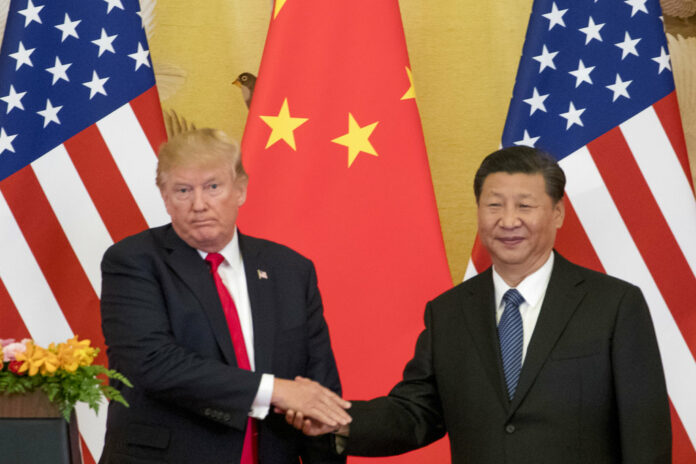
President Donald Trump and Chinese President Xi Jinping shake hands in 2017 during a joint statement to members of the media Great Hall of the People in Beijing, China. Photo: Andrew Harnik / Associated Press
WASHINGTON — The Kentucky Cabinet for Economic Development has recently said it will lead a business development trip to China later this month, the latest signal of U.S. state and local officials’ unwavering willingness to enhance cooperation despite simmering trade tensions between the world’s two largest economies.
“As we continue to build relationships with Chinese businesses and seek investment opportunities, we are executing our long-term strategy to tap into the enormous opportunities that exist in China,” Vivek Sarin, Kentucky Cabinet for Economic Development interim secretary, said in a statement earlier this week. “We are confident that this will lead to more jobs for Kentuckians.”
Sarin is certainly not alone. Many state and local officials, with a more pragmatic attitude, have expressed their continued interest in boosting cooperation with China in economy, culture, education and beyond, injecting positive momentum into the bilateral relations facing headwinds.
The “most important thing” for subnational leaders is about the business of moving their state forward around jobs, moving their state forward around prosperity and making sure that each citizen has an opportunity to participate in the economy, and that’s the “motivation” for their relentless efforts in seeking cooperation with China, said Reta Jo Lewis, senior fellow and director of congressional affairs at the German Marshall Fund of the United States.
The negative factors at the national level, however, have trickled down to subnational levels, raising concerns among officials, the business community and the general public.
Kate Brown, governor of the northwestern U.S. state of Oregon, recently said that what is happening nationally has had a “chilling effect” on commodity prices and the state’s ability to sell goods to China. “It’s been extremely detrimental particularly in the agricultural sector, which is a huge driver of the Oregon economy,” Brown said at a panel discussion held by the Brookings Institution in late July.
When asked whether Midwest farmers worry about losing the Chinese market permanently, former Missouri Governor Bob Holden said that he thinks they are very scared. “If that relationship with China and others disappears for the agriculture community, then you’ve really lost the foundation of this heartland reach all the way from the Great Lakes down to the Gulf,” he said.
For Los Angeles, the effects of the U.S. administration’s trade war are causing “considerable pain” at the local level, as trade with China accounts for 60 percent of the port’s total trade volumes, said Nina Hachigian, the city’s deputy mayor of international affairs, noting that the port’s exports to China are down 25 percent, with fruit, nuts and wine from California hit hard.
Nevertheless, the temporary setback in bilateral relations does not seem to have dampened subnational officials’ willingness to promote bilateral cooperation with a long term view.
“China will always represent a major market and I think it would be a mistake to overlook the potential that is there,” Don Pierson, secretary of Louisiana Economic Development, told Xinhua on the sidelines of the 2019 SelectUSA Investment Summit held in Washington in June.
In response to Chinese companies’ concerns stemming from the trade tensions, Pierson said the southeastern state has always been a very international state and “we would want to message that we remain open for business,” eyeing a strong economic and cultural partnership between China and Louisiana going forward.
Such remarks were echoed by many at the Fifth China-U.S. Governors Forum held in late May. Kentucky Governor Matt Bevin, whose state hosted the event, told Xinhua that he doesn’t think the rhetoric at the national level has undermined the enthusiasm of governors and investors, noting that the presence of nearly 400 people indicated unceasing interest in subnational dialogue.
“Our relationship with China is absolutely key, central to the success that we have had,” said Cyrus Habib, lieutenant governor of the U.S. state of Washington, noting that the northwestern state exports more to China than any other U.S. state, and China is also the state’s number one export destination.
Asides from economic cooperation, subnational leaders have attached high importance to cultural exchanges. “From my perspective as a governor, it’s all about the jobs and the economy, but if I can’t impact that I’m gonna focus on the relationship piece, the cultural piece, because that’s a longterm investment,” Brown said, adding that it will “pay off” for Oregonians in the decades to come.
Holden, who helped bring the first Confucius Institute to the state of Missouri, told Xinhua that “it’s my contention that how well you put together the cultural relationships, how well you build the education partnerships, will determine how successful you’re going to be in the business department.”
Last week, Chinese-owned manufacturer Phoenix Paper Wickliffe announced its plans to invest 200 million U.S. dollars in western Kentucky’s Ballard County to construct a new, 100,000-square-foot paper-and-pulp recycling facility. The new investment, on top of its original 150 million dollar investment, is on its way to creating 500 jobs in the rural community.
Bevin said “a lot has happened” since the establishment of U.S.-China diplomatic relations 40 years ago, and he saw great opportunities for both sides ahead. “We are just at the beginning. I think of a long journey together.”
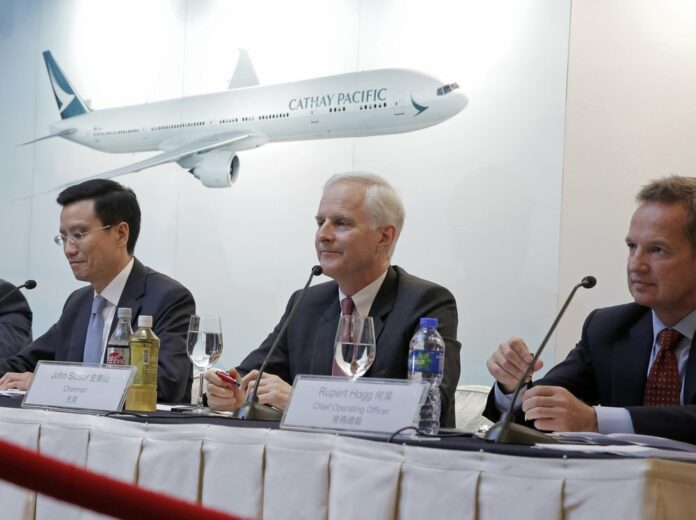
In this March 15, 2017, file photo, from right, Cathay Pacific Chief Operating Officer Rupert Hogg, Chairman John Slosar and Chief Executive Ivan Chu attend a news conference as they announce the company result in Hong Kong. Image: Associated Press.
HONG KONG — The CEO of Cathay Pacific Airways, one of Hong Kong’s most prominent companies, resigned Friday following pressure by Beijing on the carrier over participation by some of its employees in anti-government protests.
Rupert Hogg became the highest-profile corporate casualty of official Chinese pressure on foreign and Hong Kong companies to support the ruling Communist Party’s position against the protesters.
Beijing jolted companies last week when it warned Cathay Pacific employees who “support or take part in illegal protests” would be barred from flying to or over the mainland. Cathay Pacific said a pilot who was charged with rioting was removed from flying duties.
Hong Kong is in its third month of protests that started in opposition to a proposed extradition law but have expanded to include demands for a more democratic system.
Cathay Pacific needs new management to “reset confidence” because its commitment to safety and security were “called into question,” the company chairman, John Slosar, said in a statement.
Hogg resigned to “to take responsibility as a leader of the company in view of recent events,” the statement said.
Cathay Pacific serves more than 200 destinations in Asia, Europe and the Americas. It has 33,000 employees.
Its parent, Cathay Pacific Group, also owns Dragonair, Air Hong Kong and HK Express.
Slosar said last week that Cathay Pacific didn’t tell its employees what to think, but that position shifted following China’s warning.
On Monday, Hogg threatened employees with penalties including possible firing if they took part in “illegal protests.”
Hong Kong was promised a “high degree of autonomy” — a system dubbed “one country, two systems” by Beijing — when the former British colony returned to China in 1997.
Government critics say that is being eroded by Hong Kong leaders and the Communist Party.
“Cathay Pacific is fully committed to Hong Kong under the principle of ‘one country, two systems’ as enshrined in the Basic Law. We are confident that Hong Kong will have a great future,” Slosar said in the statement.
Other companies also have been caught up in nationalist passions.
Fashion brands Givenchy, Versace and Coach apologized after Chinese social media users criticized them for selling T-shirts that showed Hong Kong, as well as the Chinese territory of Macau and self-ruled Taiwan, as separate countries.
Taiwan split with the mainland in a civil war in 1949 but Beijing claims the island as its territory and is pressuring companies to say it is part of China.
Last year, 20 airlines including British Airways, Lufthansa and Air Canada changed their websites to call Taiwan part of China under orders from the Chinese regulator. The White House called the demand “Orwellian nonsense.”
A protester vandalizes the regional emblem of Hong Kong Special Administrative Region after breaking and entering the Legislative Council building in Hong Kong, south China, July 1, 2019. Image: Xinhua.
BEIJING — China on Friday responded to U.S. President Donald Trump’s remarks concerning the Hong Kong Special Administrative Region (SAR).
According to reports, the U.S. President tweeted Thursday that a meeting between Chinese leader and Hong Kong’s protesters could lead to a happy ending of the protests.
When asked for comments on this, Foreign Ministry spokesperson Hua Chunying said that China has noticed Trump used to say that “the riots” in Hong Kong had lasted for a long time.
“Violent criminal activities in Hong Kong have escalated continuously since June,” Hua said, noting such activities ruthlessly trampled on the rule of law and social order, seriously undermined Hong Kong’s stability and prosperity, and openly challenged the bottom line of the “one country, two systems” principle.
The spokesperson said the most urgent and overriding task at present is to stop the violence and restore order in accordance with the law.
“The central government firmly supports Chief Executive Carrie Lam in leading the SAR government to administer the SAR in accordance with the law, and the Hong Kong police in strictly enforcing the law,” she said, adding the central government also firmly supports the punishment of violent criminals in accordance with the law.
Marium, an orphaned dugong, eats sea grass in Trang in May 2019. Photo: Sirachai Arunrugstichai / Courtesy
TRANG — A baby dugong who had become a national darling due to cute clips has died from ingesting plastic.
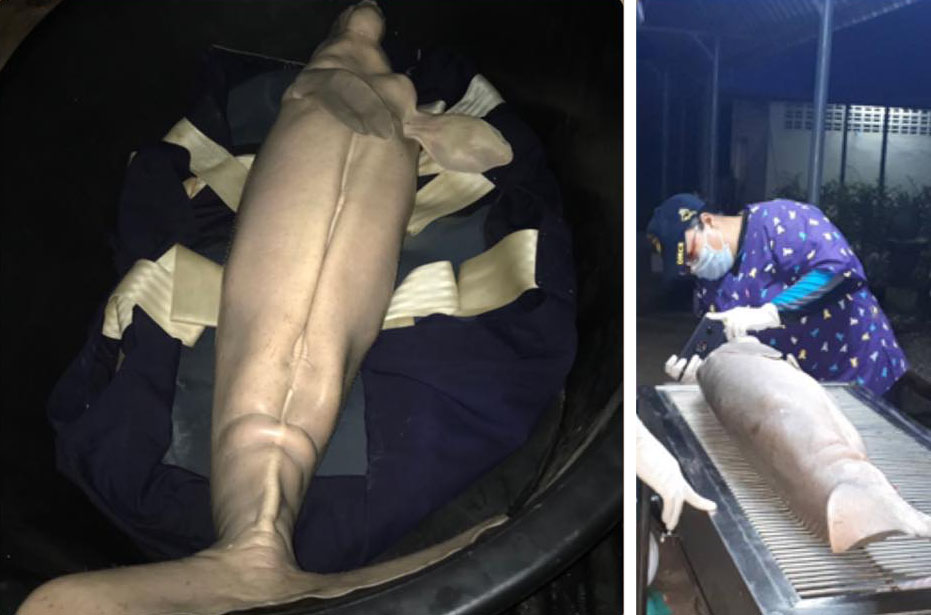
While vets initially thought six-month-old Marium, a dugong rescued and taken under the marine state department’s care in May, was suffering in recent weeks from a depressive state caused by an attack by a larger dugong, an autopsy found that Marium’s death Saturday was due to ingesting plastic.
Her time of death was 9 minutes past midnight on Saturday. At 5:52, a team of vets performed an autopsy to find that several pieces of plastic she had ingested were blocking her digestive system. The result was bloating, sepsis, and flooding lungs, according to the Department of Marine and Coastal Resources.
Affected was the conservation photographer who first made Marium famous internationally with photos of her cuddling caretakers and munching on seagrass. During an interview, he fondly recalled Marium swimming next to boat hulls resembling the underbellies of adult dugongs, and how she would snore when asleep in people’s arms.
Marium before her autopsy on Aug. 17, 2019. Photo: Department of Marine and Coastal Resources / Facebook
“The cause of death is plastic,” Sirachai “Shin” Arunrugstichai wrote in a message Saturday. “I hope that her story will draws our eyes closer to the issues at sea. I also hope that her death will not be in vain and instead be a call to action for all of us.”
Vets repeatedly tried to resuscitate her after she stopped breathing, but to no avail.
“We are all saddened by this loss. We want to emphasize the importance of everyone cooperating together if we want to conserve marine animals,” the marine department’s Facebook wrote in a Saturday morning post.
Marium was attacked by an adult dugong Aug. 7, after which her condition declined. Vets were initially able to treat her respiratory problems. Her autopsy also revealed internal bruising, which may be attributed to either the dugong attack or from swimming into rocks.
Marine and Coastal Resources Minister Warawuth Silpa-archa announced that his department will initiate an ocean cleanup program called the “Marium Project” at a press conference on Saturday.
Marium was airlifted Sunday to Bangkok’s National Museum to be stuffed, after which she will go on display at the Phuket Aquarium.
A pair of begpackers selling travel photos by the BTS Mo Chit stairs on Jan. 16, 2016. Photo: Pornthip Chaithanapat / Facebook
BANGKOK — Despite widespread online outrage against tourists busking on the streets of Asia, a survey has found that nearly half of Thais have a sabai sabai impression of begpackers.
UK-based market research agency YouGov found 46 percent of Thais have a positive perception of “begpackers”: travellers, usually Western, who beg for money from locals to fund a globe-trotting trip. Only 10 percent have a negative impression of them, while the remaining 44 percent are undecided.
“I have no particular feelings toward them,” said Kamonrat Nuna, a street vendor selling rice in front of MRT Chatuchak Park – once a popular spot for begpackers. “I just wonder why charming farang have to be on the streets asking for money.”
Opinions on begpackers seem determined in part by age. The survey found that only 41 percent of older Thais (aged 55 and above) have welcoming attitudes towards begpackers, compared to 53 percent of Gen Z respondents (aged 18 to 24).
However, begpackers – who often try to engage in novel forms of begging such as street performances, selling goods, or offering hugs – are not necessarily more successful at getting donations. The survey found people are only four percent more likely to give to begpackers (52 percent) than to ordinary beggars (48 percent)
But although many Thais appear sympathetic, more than half of respondents (53 percent) simultaneously support stronger law enforcement measures against begpackers.
An interviewed city law compliance officer (tessakit), whose duties cover arresting beggars, revealed that he has used his discretion to let begpackers off the hook.
“Actually, it’s against the law to beg on the streets. But I don’t want to catch them as I feel pity and want to give them a chance,” said a tessakit officer stationed in Mo Chit who asked not to be identified. “I don’t really know why they have to be on the streets because I’m not good at English, but I guess they must be spendthrifts who got carried away among the lights of Bangkok.”
The officer said he hasn’t seen a begpacker for a while. Two years ago, he spotted a couple of Westerners selling their travel photos by the BTS Mo Chit stairs. The pair claimed that they were finding money to fund their return tickets home.
I counted three foreigners selling stuff today in #Bangkok. A growing trend. This one was doing spray paint artwork & selling it for 300B pic.twitter.com/5tbKREPQrM
— Richard Barrow 🇹🇭 🇬🇧 (@RichardBarrow) June 11, 2017
Seeing a Thai begpacker abroad is highly unlikely, as only three percent of Thais have chosen to resort to begging in the event of running out of money while on a trip. Most people would simply go home (47 percent), ask from friends or family (40 percent), or find a temporary job (35 percent) instead.
“Even if I really broke, I will never beg. It’s better to find something legit to do,” Kamonrat said.
The survey was conducted online from July 9 to 25 using a pool of 2,052 Thais who signed up to participate in return for compensation.
It did not find a correlation between both support for begpackers and socio-economic status, and support for begpackers and gender. However, Thais who have been abroad tend to have a more positive impression toward begpackers.
Elsewhere in Asia, public perceptions towards begpackers are strikingly different. South China Morning Post reports that immigration officers in Bali are threatening to return begpackers to embassies. Meanwhile, a begpacker couple who played guitar on the metro received backlash from Singapore netizens, according to a report from France 24.
Begging is illegal under Thai law. Offenders can face up to a month in jail and fined up to 10,000 baht. In an effort to cope with begpackers, immigration requires some tourist and student visa holders to show proof they possess at least 20,000 baht upon entering the country.
In 2014, “infamous” begpacker Benjamin Holst was arrested in Pattaya and deported after he was found begging on Pattaya beach, which locals later found him using the money he begged for parties. He is now believed to be in Gambia, his wife’s homeland, according to his latest post on Facebook.
Police and Forestry officials at Khao Kala in Nakhon Sawan on Aug. 16, 2019.
NAKHON SAWAN — Police are investigating whether a meditation center known for UFO sightings is encroaching on protected forests, after dual raids on Thursday and Friday.
Dozens of policemen and rangers rushed Khao Kala mountain for a second time Friday to determine whether the Khao Kala Meditation Center, run by a group of UFO believers, is encroaching on forest area. Police have also issued summons for the landowners of the meditation center.
“If we find anyone guilty of wrongdoing, we will file a criminal case against them. If a UFO descends and parks here, that’s even better. We’ll capture them all,” Police Maj. Gen. Damrong Petpong said.
Police were drawn to raid the area after the UFO Kaokala group organized a UFO-watching event for Saturday, with locals reporting that some adherents believe they are mediums for aliens from Pluto.
UFO Kaokala is a group of UFO believers who maintain that aliens communicate with them via meditation. They say their communications with aliens enhance their Buddhist practices and even help them predict natural disasters (a group member predicted in 2017 that World War III will ignite by 2022).
The group was founded in 1998, when nurse Somjit Reapeth said she saw aliens at Nakhon Sawan mountain. Since then, the mountain has become Thailand’s go-to UFO sighting spot.
Saturday’s event is actually Somjit’s birthday. As of press time, an organizer named “Jack,” whose phone number is on the event page, said that the event will still go on, but at the foothills rather than the peak of the mountain. Admission is free and transportation via van from Bangkok will be provided. Contact Jack at the number listed on the event page if interested.
Officials armed with coordinate measuring machines canvassed the mountain from its foothills to its peak on Thursday and Friday.
“The Forestry Department will use satellite GPS to check whether, and how much, the center is on forest space. We will proceed according to the law,” Pinit Laoyuu from the local Forestry Department said.
Pinit said Friday that he estimated about 3 to 5 rai (0.48 to 0.8 hectares) of the meditation center encroaches on forest. He said that forest officials will be securing the area.
“For the time being, we will not allow people to pitch tents or hold activities here since a case is ongoing,” Pinit said.
Adherents camped at Khao Kala in Nakhon Sawan on Aug. 16, 2019.
Charoen Raepetch, the listed owner of the meditation center, was not on site Thursday. When contacted, he said that he would not be returning to the mountain any time soon and half-jokingly said that he was “afraid the Forestry people would capture him.”
Police have summoned Charoen as well as others suspected of being involved in the meditation center for questioning.
Despite the police presence, locals have flocked to the mountain to take photos, exchanging alleged UFO sightings. Some say that the lights at night can be explained away by shooting range practice at a nearly military case. Others are UFO Kaokala adherents with tents, set on seeing aliens via meditation, with or without forestry officials nearby. The mediums include a doctor and a captain in the military.
Chaliew Phoocharoen, the sub-district head of Khao Kala tambon, said that most people living in the area are not alien believers, and that most of the followers are from out-of-town.
Suspected sex workers waiting outside while the police raided a bar in Si Racha, Chonburi on Aug. 15.
BANGKOK — Thailand continues to be a major center of global sex trafficking rings that extend to countries as far flung as Japan, Morocco and Germany, a UN report released last month says.
“In 2017, trafficking for sexual exploitation accounted for 255 cases or 84 per cent of the total 302 [human trafficking] cases in Thailand,” according to the United Nations Office on Drugs and Crime report, titled “Transnational Organized Crime in Southeast Asia,” which was unveiled at a Thursday news conference.
Thailand prosecuted only 36 clients of sex trafficking involving children between 2015 and 2017, even though the report found that minors comprise a majority of victims of sex trafficking.
“Data from the Thai Office of the Attorney General indicates that of the 1,248 detected victims of trafficking for sexual exploitation in the 2014-2017 period, almost 70 per cent were underage girls,” the report stated.
In addition to women and children from Thailand and neighboring countries, the report notes that women from far flung regions such as Africa are also trafficked through Thailand. Similarly, trafficked Thais are ferried to destinations as far away as Japan and Europe.
“Men, women and children from Thailand and other Southeast Asian countries travel to Japan where some are subjected to conditions of forced labour or sexual exploitation, including fraudulent marriage,” the report said.
In 2017, the Department of Special Investigation disrupted two transnational trafficking rings.
One involved a network from Uganda operating in Bangkok and Pattaya. The DSI apprehended 70 Ugandan women who had been charged USD$7,000 for the journey to Thailand. Upon arriving, the traffickers seized the women’s travel documents and forced them into prostitution to pay off the bondage debt.
The other ring originated in Morocco. Two Moroccan women were rescued along with 30 Burmese, Vietnamese and Syrian women.
Some Thais are not victims but perpetrators of trafficking. Between 2014 and 2016, the Japanese government convicted 12 foreign nationals of human trafficking, of which five were Thais. During the same period, Japan identified 20 Thai trafficking victims.
A crackdown in Germany in 2018 similarly identified both Thai victims and perpetrators in sex trafficking rings.
“A total of 32 Thai victims [of sex trafficking] were identified,” the report said. “The investigation reportedly found that a Thai woman and her German partner brought victims from Thailand to Germany on tourist visas and then forced them to work in brothels across the country.”
Thai social media was abuzz Thursday when CNN ran an article about the environmental efforts of a half-British, half-Thai actor who has been a staple of Channel 3 soaps for decades.
Alexander Simon Rendell, known as Alex Rendell, is following in the tradition of actors-turned-environmentalists such as Leonardo di Caprio – if Leo held camps for kids to scuba dive in Krabi, that is.
The 29-year-old started working in the Thai entertainment industry when he was four, starring in commercials as the cute kid hawking toothpaste in 1994, and then as the cute, inquisitive kid in soaps. He continued appearing in soap operas and films until signing a contract with Channel 3 when he was 16, though he ended up typecast as the leading man’s best friend rather than the leading man. But no matter – Alex turned to co-founding the Environmental Education Center (EEC), an organization that raises environmental awareness among kids through camps.
The EEC is in its fifth year of operations and has hosted around 150 camps, with lengthy waiting lists of parents wanting their kids to go scuba-dividing with Alex in Krabi.
“I feel really fortunate that I get to both act and work in the EEC. Few people get to do two jobs that they love. I feel so lucky,” Alex said.
Khaosod sat down for a chat with Alex about his walk down the dual roads of fame and forest.
When Alex was 10, he met with environmentalist Alongkot “Kru Kot” Chukeaw to film a soon-scraped demo for a kid’s nature show. Though the show was canceled, Alex never forgot the memory of caring for an elephant named Tinglu with Kru Kot. As an adult, Alex reconnected with Kru Kot and found that he was working on a project getting blind children in contact with elephants.
“I thought it was a great activity. There’s just the teacher, elephants, and the blind kids. I wanted to be a part of something like that. I had participated in a lot of charities but I felt like this one was cooler because it didn’t need cameras, people clapping, or stuff like that. It was just people there, all heart,” he said.
So the pair founded EEC, alongside Kru Kot’s wife and actress Jarinporn “Toey” Joonkiat. Kru Kot, who has campaigned for environmental education in Thailand for more than two decades, took care of creating the camps’ programs and curriculum. Toey was in charge of media relations and marketing.
The master’s degree graduate in Environmental Social Sciences from Mahidol University says that he holds the camps to foster environmental consciousness in kids, to tackle the environmental crisis from the ground up.
“I want the new generation to be environmentalists without anyone telling them to,” Alex said. “They don’t need to be affected by problems before acting.”
EEC’s dozen-or-so camp offerings last from three to five days and take kids on various programs: from learning about elephant conservation in Khao Yai, diving in Koh Lanta, to even taking a wildlife veterinary course at Kasetsart University. Prices for a space in each camp aren’t disclosed – you have to request a booking in a notoriously long waiting list.
Alex says 85 percent of camp attendees are Thai kids who go to international schools, with the rest consisting of foreigners. Most are Bangkokians.
“You can already teach kids 3, 4, 5, 6 years old about the environment. They say they love turtles, fish, forests,” he said. “This generation should be more environmentally conscious than ours or the ones before.”
Running the EEC is an “emotional rollercoaster,” Alex says. The ups include seeing children develop green consciousness. He described one child whose parents brought him to a camp as a baby, then as a toddler, then as a four-year-old. Throughout those years, the child was always interested in drawing sea turtles.
“Even as a four-year-old, he wanted to tell the story of sea turtles. He will have the environment in his heart forever,” Alex said. “Think of him in 20, 30 years from now and how impactful he’ll be when he’s a manager…His daily decisions will benefit the Earth for sure.”
Alex says he’s seeing more and more people become conscious of the environment, and he hopes the numbers will only continue to snowball.
“When Thais care about the environment, then the big organizations will start to care too,” Alex said. Nowadays he’s lined up to give talks about going green to businesses too.
In Thailand, environmental concerns usually take a backseat to most other issues, with low awareness on how to properly dispose of waste or reduce plastic use. Government organizations limply suggest green guidelines which are often completely ignored. Sometimes the green schemes of big corporations appear as no more than lip service. For example, Tesco Lotus on Thursday announced a convoluted scheme where its smaller supermarket chains won’t provide plastic bags, but only if the customer is buying two items or less. Plastic bags will continue to be given for free if asked.
“I will do whatever it takes to make the environment a mainstream concern. It’s always been a secondary concern,” Alex said.
He gave Marium, an orphaned dugong in Trang who swam her way into the nation’s heart, as an example of how a cute face can get people interested in the environment.
As a showbiz veteran, Alex knows the value of a handsome face like his own. And he’s willing to use it for the environment.
“I’m an actor that people recognize. So people are ready to listen to me, even though I may not be an expert. I feel like one way I can be useful is to be a spokesperson for the actual experts,” Alex said.
Like many celebs, Alex is an avid Instagram user and has over 1.5 million followers. Compare that to Greenpeace’s 350,000 Facebook followers, for example.
“More people follow me than environment pages,” he said. “So instead of being stingy about using my fame, my name, or my image…I would rather be useful.”