Matichon Group deputy director Parnbua Boonpan and Xinhua Bangkok bureau chief Ming Dajun.
BANGKOK — Khaosod and two other publications under Matichon Group announced a groundbreaking partnership with China’s Xinhua News Agency on Thursday.
The cooperation grants Khaosod, Prachachat and Matichon unlimited access to the Thai edition of Xinhua’s news materials and rights to republish them. A memorandum of understanding between the two sides was signed at Khaosod’s main office in Bangkok today.
Matichon Group deputy director Parnbua Boonpan, Khaosod executive editor Chumchan Chamniprasart, and Khaosod English news chief Teeranai Charuvastra presided over the signing ceremony. Xinhua was represented by Bangkok bureau chief Ming Dajun. Sino-Thai Communication Group board members Hua Xie and Kobkij Praditpolpanich were also present.
Teeranai, who serves as a liaison between the two sides, said the cooperation is a significant and timely “first step” toward broader cooperation between Matichon Group and Xinhua at a time when China is playing an increasingly large role in the region.
From left to right: Khaosod English news chief Teeranai Charuvastra, Khaosod executive editor Chumchan Chamniprasart, Matichon Group deputy director Parnbua Boonpan, Xinhua Bangkok bureau chief Ming Dajun, and Sino-Thai Communication Group board members Hua Xie and Kobkij Praditpolpanich.
“Most Thai media have been relying on external sources to tell stories about China,” said Teeranai, who’s also a regular contributor to Khaosod’s “China Watch” section. “Now Matichon Group can let the Chinese people themselves tell their own stories with their own voices.”
It is hoped that the partnership will bring more news about China to Matichon’s massive Thai readership, be it about Thai-Chinese relations, politics, culture, entertainment, or the latest viral trends on Tik Tok.
Today marked the first time Matichon signed a partnership with a Chinese counterpart. The publishing group has similar agreements with Vietnam’s Thanh Nien newspaper and the Thai edition of the British Broadcasting Corporation (BBC).
Xinhua is the official state news agency of the People’s Republic of China and widely considered to be China’s most influential news organization. The agency operates over 170 foreign media bureaus worldwide, including one in Thailand.
Matichon Group owns multiple news platforms – both online and print – including Matichon, Matichon Weekly, Prachachat, Khaosod, Khaosod English and an online video production team.
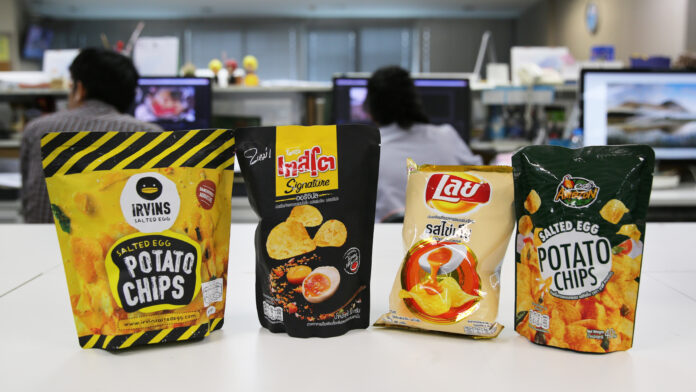
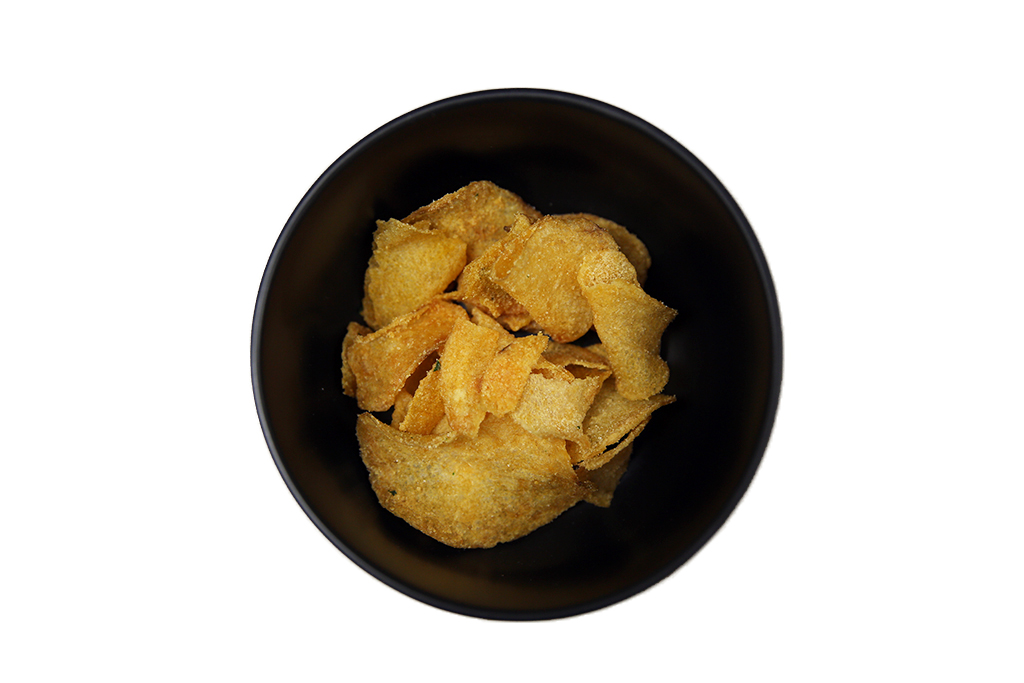
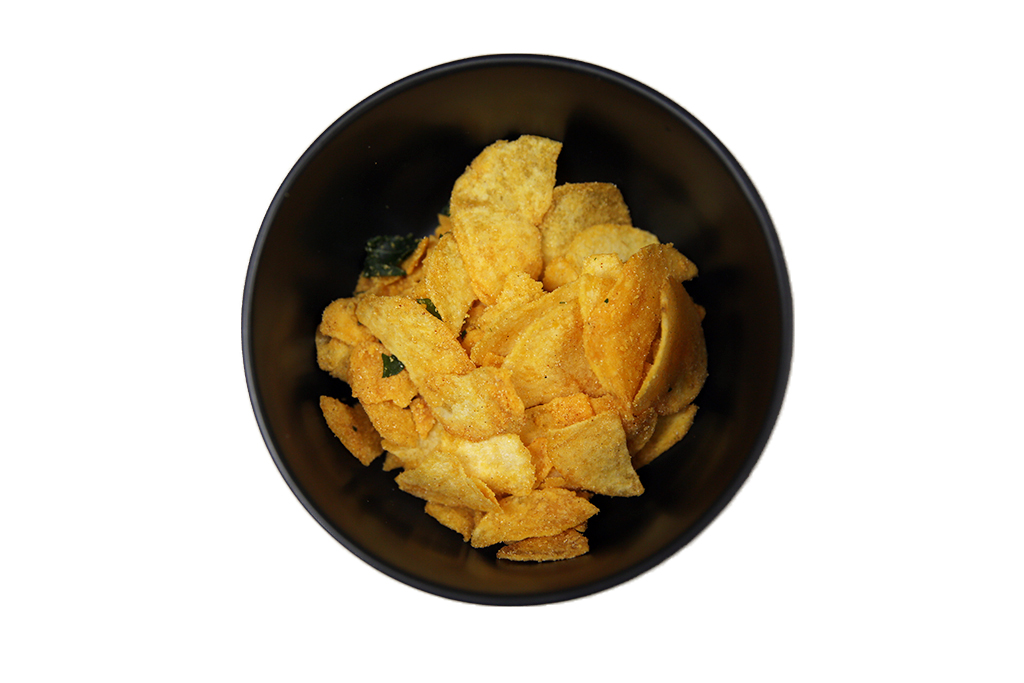
From the left: Irvins, Taste Signature, Lay’s, and Cafe Amazon salted egg potato chips
Salted egg, the porridge-enriching stable of our grandmothers’ kitchens for generations, has been revitalized over the past year into a variety of trendy snacks.
In Thailand, the earliest record of salted egg being eaten is kai kem chaiya, introduced by a Cantonese migrant who settled in Chaiya, Surat Thani in the 1920s. Now a new salted-egg wave has swept in from Singapore, with a snack of fish skin coated in salted egg igniting the craze before inspiring other sweet-and-salty dishes across the Southeast Asian peninsula.
Since mid-2018, Bangkok’s food scene has seen a fierce battle between kai kem and purple potatoes. Although bubble tea is the more common sight, the yolk has quietly infiltrated the city’s food scene in lattes, donuts, ice cream, sandwiches, instant noodles, and even McFries.
To help readers navigate the craze, Khaosod English tested four salted-egg potato chip brands and rated them across three criteria: salted-eggness, texture, and nutrition.
We chose potato chips instead of the more popular fish skin as a testbed for salted egg because of availability, and because the neutral taste of chips allows for a precise appreciation of the flavor and aroma of salted egg.
1 of 4
Irvins
Cafe Amazon
Lay's
Tasto Signature
Irvins stands out as the best but most expensive of the bunch. The first bite is punched with a slight sweetness, before an abrupt zing keeps the aftertaste interesting. Potato fans may not pleased with the dense texture, made from potatoes sourced from China, while those addicted to Irvins fish skin might turn their backs on the comparatively mild flavour of chips.
Still the balanced taste coupled with generous coating make Irvins a clear winner above the domestic brands we tested. The higher price is understandable given the brand is imported from Singapore: a small bag (105 grams) costs 210 baht, while a large bag (230 grams) costs 420 baht. They are available at Irvins outlets in Central World, Siam Paragon, and EmQuartier.
Cafe Amazon’s offering is flavorful, but is overwhelmed with a sweetness that completely buried any pungency – a key flavor boasted by many salted-egg brands. Like Irvins, the chips are nicely coated with seasoning and small bits of curry leaves.
Once again though, heavy coating is a consolation for the chip’s texture, which is even more dense and chewy than Irvins. Hungry snackers may appreciate the convenience of being able to buy salted-egg chips at Cafe Amazons nationwide, but salted-egg fanatics may find the chain’s rendition hard to swallow.
A 40 gram packet costs 55 baht, with a 10 baht discount if purchased with a drink.
Unfortunately Lay’s is a letdown, a rare misstep for the veteran chips brand. Airy and crispy-thin potato slices are sprinkled evenly with seasoning, though the orange tinge of salted egg is almost invisible. The taste is sweet and tangy, but comes from artificial flavour rather than the creamy texture of real salted egg powder. A 46 gram packet costs 20 baht, while a 70 gram bag costs 30 baht.
Tasto Signature, the “premium” spin-off of the Thai brand, is actually insipid. It teases with the grainy touch of real salted-egg coating (six percent according to the ingredients list), with none of the expected sweet-and-salty taste. A 50 gram packet costs 30 baht.
None of the four brands were overly salty, but we did wash the tasting down with water as monosodium glutamate was used in all four packets.
There was no striking difference in fat or sodium across the brands. However, “genuine” salted egg means more cholesterol. Irvins contains 140 milligrams of cholesterol per 25 gram serving, while Cafe Amazon contains 56.25 milligrams. Tasto Signature contains 20 milligrams of cholesterol, while Lay’s contains none at all. The daily recommended intake for cholesterol is less than 300 milligrams.
Indeed, there are more salted egg brands out there in the market, but the four have been chosen because they can be readily brought off the store shelves. Whether salted egg will stand firmly in the food trend, like big brothers green tea and charcoal, is to be proven in a matter of time. But one thing we can be sure of is that these chips are highly addictive.
This article is unsponsored and we paid for the chips ourselves.
BANGKOK — Palace officials on Thursday said a historic teakwood mansion will be fully rebuilt after repair works are completed, though no time-frame was given.
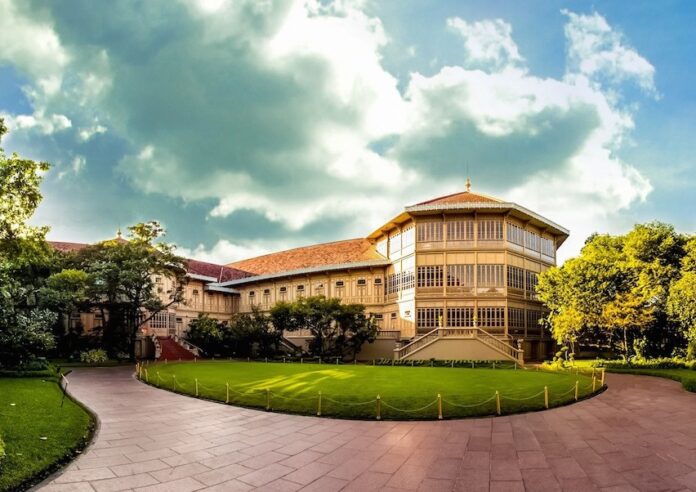
Vimanmek Mansion, which has been closed off to the public since mid-2016, appeared to be thoroughly dismantled in a recent visit by Khaosod English. City Hall documents say the subterranean foundation of the century-old villa needs repairs, while officials maintain the site will be restored in its former glory.
“Right now, they’re putting down ground columns,” a palace guard explained. “After that, the palace will be rebuilt exactly as it looked.”
Vimanmek will also receive a new landmark: a massive pond the size of a swimming pool located to the north of the mansion. The guard said it will be a large fishpond.
Publicly available documents put the renovation’s price tag at 81 million baht.
But here’s the bad news for anyone wishing to admire the mansion’s spectacular Thai-Western architecture once again – Vimanmek will not welcome visitors after the renovation efforts are over.
“It won’t be reopened to the public. It’ll be closed off permanently,” an official at the Office of His Majesty’s Principal Private Secretary, which manages the property, said by phone. “We don’t know when the renovation will be completed.”
Sorry, We’re Closed
Vimanmek is located inside the sprawling Amphorn Sathan complex, which is in turn part of a royal estate in Dusit district that spans multiple palaces and villas. It was relocated from its original site in Chonburi province a century ago.
The mansion was a popular tourist destination in Bangkok’s historic quarters until the Royal Household Bureau closed it off from the public in July 2016.
During a reporter’s unannounced visit on Thursday, the site where Vimanmek Mansion once stood is now a busy construction site. Heaps of earth, piles of construction materials, large cranes, and scores of workers dotted the land. Cement trucks were seen entering and leaving the palace’s northwestern gate.
Naturally, security was tight. Royal Guards armed with rifles stood at attention, facing the construction site while workers labored.
A reporter had to exchange his ID at a checkpoint opposite the King’s Guards 1st Division base before he was taken inside the palace complex to what was once Vimanmek Mansion. The reporter was also told not to take photographs of the works.
Documents published online by Bangkok’s Department of Public Works and Town Planning earmarked a one-million baht fund for daily “accommodation and transportation” for the laborers, since they are not allowed to live on the palace compound.
The same documents, dated Nov. 6, 2017, said Vimanmek Mansion’s metal and wooden foundations are in need of repair due to old age, especially the underground infrastructure.
The renovation includes replacing the foundation with new steel piles weighing 16 tons each, installing anti-vibration equipment, and raising the mansion structure by 30 centimeters. Workers will also rebuild air-conditioning systems, electric wires, ventilation, brickworks, and steel-reinforced concrete.
The documents named three engineers as overseers of the project, though no one was available for an interview during today’s visit. Three soldiers guarding the site questioned by a reporter said they weren’t told when the works will be completed.
Environmental blogger Maneechanate Sammanee holding a glass jar on July 19.
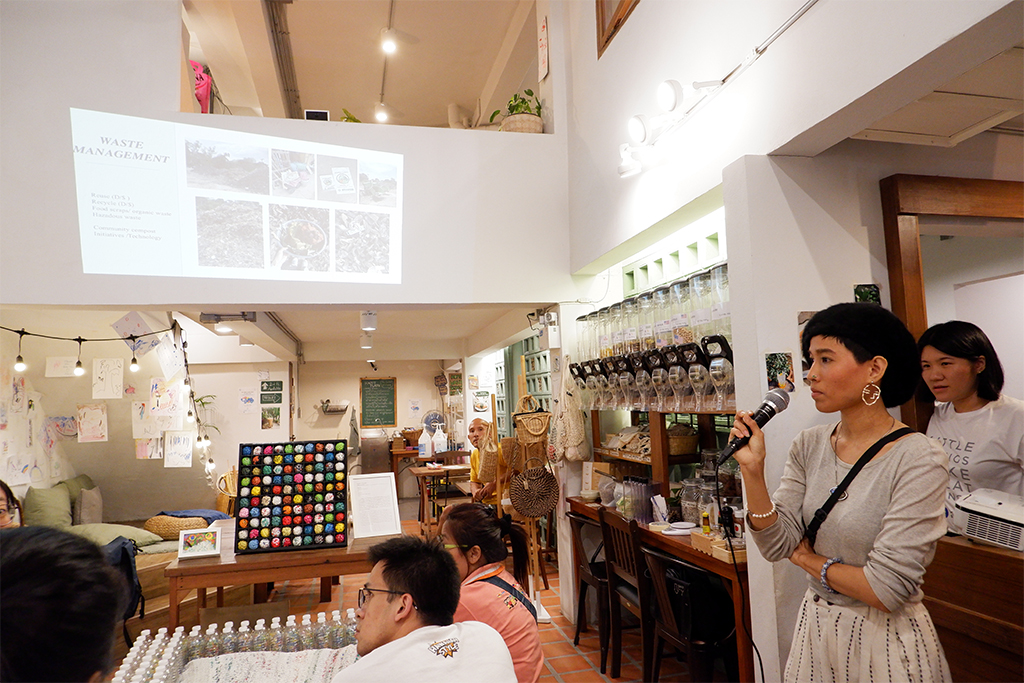
Top: Maneechanate Sammanee holds her jar of trash on July 19, 2019 at Refill Station.
Battling frowny kao gaeng vendors. Adamantly refusing durian cellophane-wrapped to a styrofoam dish and double-bagged. These are just some of the unique hurdles for Thais starting out on zero-waste lifestyles.
Unlike doomsday, “all-or-nothing” approaches to reducing waste often seen in the West – not just going vegan, but swearing off flying on planes, taking holidays, or even having children – Thai go-greeners who gathered at a recent zero-waste lifestyle event seemed to approach sustainability with a sense of “sabai sabai.”
Some of the main hurdles they face are street food shops and markets where vendors oppose their green efforts.
Frowny Vendors, Annoyed Fam
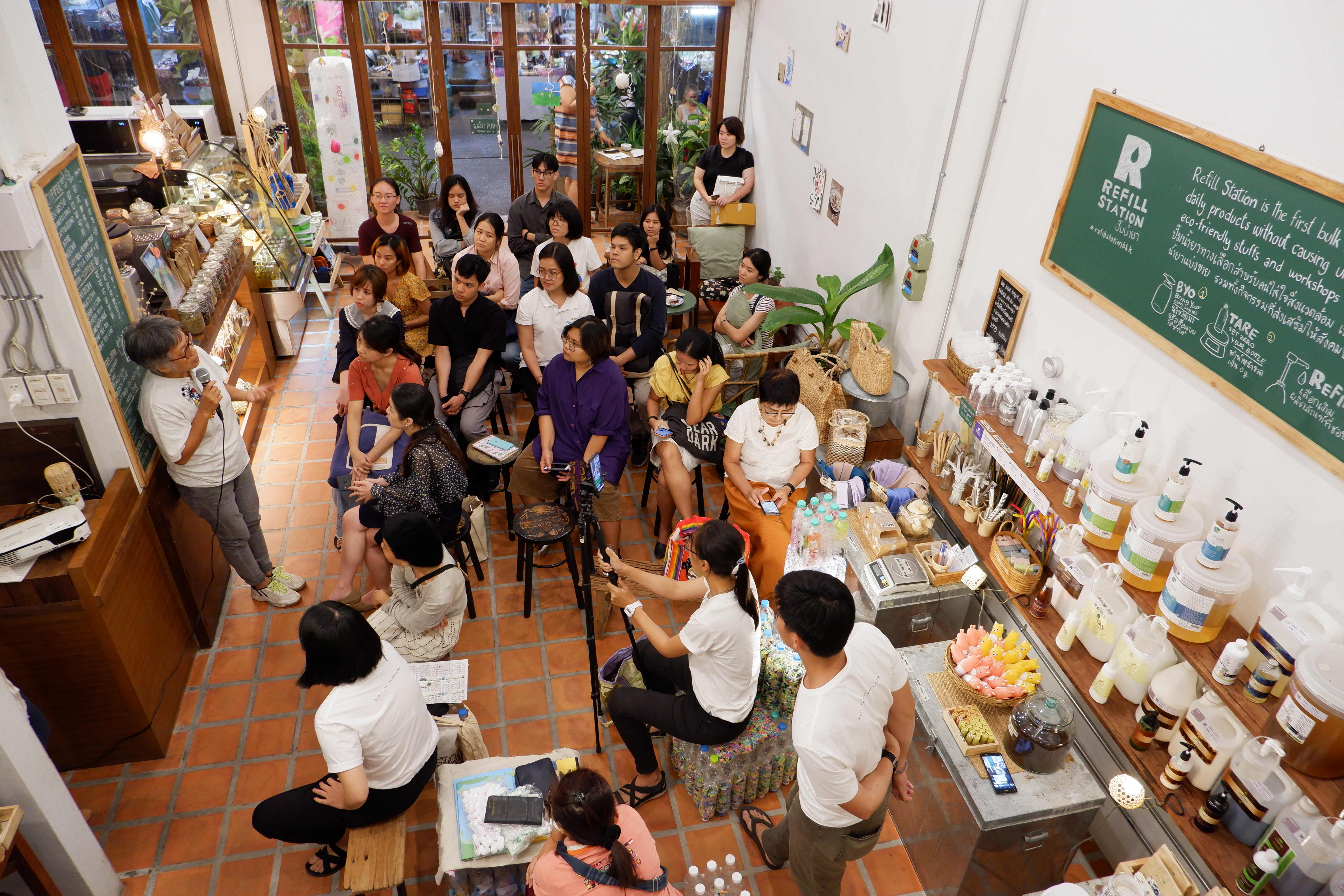
At a recent discussion eventon zero waste held at Refill Station, participants recalled vendors variously praising and scorning their requests for curry to be placed in tupperware rather than double-bagged. Many food vendors are reluctant to stray from plastic or styrofoam which are cheaper than bagasse or other biodegradable materials, while governmental awareness efforts are often just publicity stunts.
Guay tiew noodles in a tiffin carrier instead of plastic bags. Photo: Mommam Mam / Facebook
Attendants also spoke of aunties charging more for green curry if you bring your own container, and of drink vendors who prepare beverages in a plastic cup before pouring it into the customer’s reusable one (and then promptly tossing the plastic cup in the bin).
Although she says vendors at vegetarian eateries are generally friendly, Maneechanate Sammanee, 29, an environmental blogger at Less Waste for Whales, still remembers the consequences of asking an auntie selling kanom krok [grilled coconut rice pudding] at Siriraj Hospital to forgo the styrofoam tray and just put it in her hand.
“She got very mad and said, ‘That’s too troublesome. I’m not selling it to you anymore,’” Maneechanate said. “I know that zero waste is a middle class thing. When we buy food from working-class vendors, while asking for extra work to be put in, that moment – combined with the stress in their lives – can make them lash out.”
Pattama Homrod and Wipawanee Nakcharoen
Pattama Homrod, 20, still finds it perplexing that moo ping vendors line her tupperware with plastic bags. Nipapat Polsamak, 25, says her local joke congee shop tries to discourage her from bringing in a box.
“It’s hard to explain to the vendors sometimes. Education on this issue is sorely needed,” Nipapat said.
“Some vendors don’t seem too happy when we bring our own containers because they can’t as easily judge the portions they need to give us,” Wipawanee Nakcharoen, 23, said. “But others compliment me for bringing one. I asked her if a lot of people bring their own containers. She said out of the huge marketplace, I was only one of three people.”
“When I ask for no straw [lod or หลอด], the barista quickly tells me, ‘Don’t worry, we don’t use ice tubes, [naam kaeng lod or น้ำแข็งหลอด]’” Supatchaya “Ann” Techachoochart, co-owner of Refill Station shared. “A lot of them ask with grave concern, ‘How are you going to drink it without a straw?’ and give me one anyway.”
Family can also pose a barrier to using less waste. On the event posters, a prompt reads, “My family and everyone around me is saying that I’m yer” [too much, demanding].
Another event attendant spoke of her boyfriend who, despite previously saying she was “asking too much” for refusing a straw, finally stopped using single-use straws himself. Another success came in the form of her mother finally swapping to a tiffin carrier to transport food offerings for the dead, instead of dozens of individually-wrapped plastic food bags.
Papawee Pongthanavaron said she was once cyberbullied for pointing out that a foodie YouTuber wasted too much plastic – around 60 pieces for just one meal by her count – in buying 31 individually-wrapped sandwiches, using plastic cutlery and double-bagging.
“I was bombarded with comments saying I was too loke suay (naive). Others asked what the fuck was wrong with me,” Papawee said. “Another just wrote, ‘When you fuck, you don’t use bags?'” (Toong, or plastic bag, is also slang for a condom.)
Mai pen rai, we’ll get them next time na
In a 2018 Ted Talk, youth climate activist Greta Thunberg lamented, “No one is acting as if we are in a crisis. Most climate scientists and green politicians keep on flying around the world, eating meat and dairy.” However accurate this strain of environmentalism may be, its strictness risks alienating the vast majority of people who the green movement still needs to get on board.
“The trouble is, people think that you have to immediately stop producing all waste,” Maneechanate said. “And people can fall into the trap of judging others because they think they are greener, or do better.”
Meatballs can be put in reusable glass jar instead of plastic bags. Photo: Nuu BlueFern / Facebook
She’s part of a growing group of Thais trying to go zero waste without the extremism. In the open Facebook group Greenery Challenge, numbering more than 22,000 members, Thais are posting practical ways to cut back waste – asking Tops Supermarket’s salad bar to use lunchboxes, or putting their bua loi desserts in a steel cup, for example. Posts are lighthearted, with the feel of a fun, non-competitive game. It’s a good springboard for Thais looking to use less plastic.
So how does one start on this sabai sabai, zero waste path? Maneechanate recommends that a budding zero-waste lifestyler do a quick audit of all the trash they produce in a day or week, before trying out some easy switches. Instead of using several plastic bags to carry somtam from the cart to your house, a lunchbox or tiffin carrier (pinto) could do the trick. And don’t forget to pat yourself on the back for not using something that takes half a millennium to decompose, says Maneechanate. Soon, you’ll naturally cut back.
Even for people that don’t give a crap about the environment, a quick cost-benefit analysis shows that many zero-waste hacks save money. For example, buying a 14-baht bottle of water for 365 days a year could run you 5,110 baht, compared to paying 300 baht for a reusable bottle. In the long-run, a 1,000 baht menstrual cup will soon be cheaper than buying tampons or pads over and over.
“The only truly zero-waste thing is nature. What are you going to do, tell the doctor you don’t want to use a plastic syringe?” Maneechanate said. “It’s not a contest. Just do what you can. If you can’t stop eating meat, then cut out waste elsewhere in your life.”
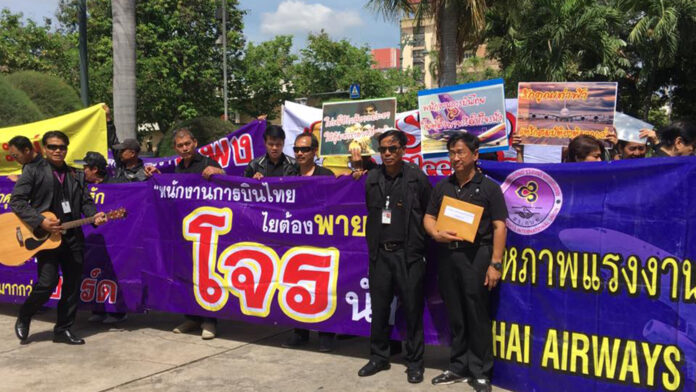
In this file photo dated April 18, 2017, Thai Airways International Union submitted a petition to Prime Minister Prayuth Chan-ocha at Government House demanding the use of Article 44 to remove the airway's board of directors due to the lack of transparency. Photo: Matichon.
BANGKOK — An international alliance of 217 trade unions has lambasted the judicial harassment of unionists employed in Thai state enterprises, calling on the Thai government to fully recognize the rights of workers to unionize and strike.
“Thailand demonstrated some of the worst cases of union busting in the region through persistent judicial harassments and astronomical claims of damages against trade union leaders in the case of the State Railway of Thailand (SRT) and Thai Airway (TG),” said the International Trade Union Confederation (ITUC) in a statement released on Wednesday at the Foreign Correspondents’ Club of Thailand.
Only 1.5 percent of Thailand’s 37.9 million strong labor force is unionized, while major state enterprise unions face legal harassment.
The Thai Airways case, which dates back to 2013 but is still being fought in the Supreme Court, began when union members staged a two-day protest to demand a pay rise after wages had been cut for years. Thai Airways sued union leaders for 326 million baht in damages to the airline’s reputation.
Chamsri Sukchoterat, an advisor to the union, said at the press conference that the demand for monetary compensation for reputational damage is baseless since the protest – which was not a strike – led to no flight cancellations.
“How did they calculate the damage to Thai Airways’ image?” asked Chamsri, adding that the national air carrier apparently used a formula based on the length of newspaper articles about the protest.
The ITUC statement came after the last military government, headed by then-junta leader and current Prime Minister Gen Prayuth Chan-ocha, approved draft amendments to the 1975 Labor Relations Act and the 2000 State Enterprise Labor Relations Act in February 2019 to allow authorities to forcibly end strikes if there would be an economic or public benefit.
Meanwhile in the State Railway case, the Supreme Labor Court ruled in March 2018 that seven railway workers must pay 15 million baht in damages to the State Railway of Thailand. The case began with a train derailment in Trang province in 2009 that killed seven passengers and injured 88.
The month following the crash, the train union launched a campaign arguing that the accident was not a result of drivers’ negligence but the understaffing of workers, after a 1998 cabinet resolution introduced a policy of hiring only five new employees for every 100 outgoing employees.
“Under Thai labor relations laws, 80 percent of the workforce is prohibited from organizing in trade unions and bargaining collectively. Large number of workers, including migrant workers, fishers, farmers, and informal sector workers, are vulnerable to abuses and exploitation,” continued the confederation’s statement.
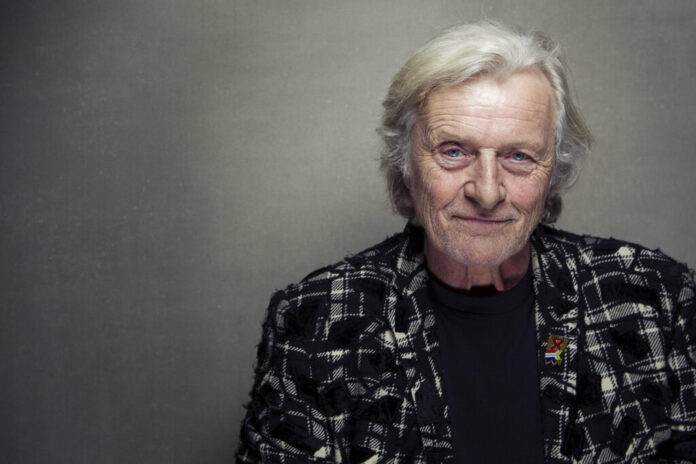
FILE - This Jan. 19, 2013 file photo shows actor Rutger Hauer at the Sundance Film Festival in Park City, Utah. Hauer, who specialized in menacing roles, including a memorable turn as a murderous android in "Blade Runner" opposite Harrison Ford, has died July 19 at his home in the Netherlands. He was 75. Photo: Victoria Will / Invision / AP File
NEW YORK — Dutch film actor Rutger Hauer, who specialized in menacing roles, including a memorable turn as a murderous android in “Blade Runner” opposite Harrison Ford, has died. He was 75.
Hauer’s agent, Steve Kenis, said Wednesday the actor died July 19 at his home in the Netherlands.
Hauer’s roles included a terrorist in “Nighthawks” with Sylvester Stallone, Cardinal Roark in “Sin City” and playing an evil corporate executive in “Batman Begins.” He was in the big-budget 1985 fantasy “Ladyhawke,” portrayed a menacing hitchhiker who’s picked up by a murderer in the Mojave Desert in “The Hitcher” and won a supporting-actor Golden Globe award in 1988 for “Escape from Sobibor.”
Filmmaker Guillermo del Toro in a tweet called Hauer “an intense, deep, genuine and magnetic actor that brought truth, power and beauty to his films.” Gene Simmons, the KISS bassist who starred opposite Hauer in “Wanted: Dead or Alive,” described his former co-star as “always a gentleman, kind and compassionate.”
In “Blade Runner,” Hauer played the murderous replicant Roy Batty on a desperate quest to prolong his artificially shortened life in post-apocalyptic, 21st-century Los Angeles.
In his dying, rain-soaked soliloquy, he looked back at his extraordinary existence. “All those moments will be lost in time. Like tears in rain. Time to die,” he said.
“It’s so much fun to playfully roam into the dark side of the soul and tease people,” the actor told The Associated Press in 1987. “If you try to work on human beings’ light side, that’s harder. What is good is hard. Most people try to be good all their lives. So you have to work harder to make those characters interesting.”
Hauer’s ruggedly handsome face, blue eyes and strong physique drew the attention of American producers in such international successes as “Turkish Delight,” ”Spetters” and “Soldier of Orange.” The offers from the United States came as a surprise to Hauer, who faced the same uncertain future experienced by other Dutch film actors.
“We make about 10 films a year, all in Dutch,” he recalled. “You act for your own community, basically, which is fine. But you can’t live on it. There is also the danger of overexposure; you can’t be too greedy.” After the world recognition for “Soldier of Orange,” a friend suggested Hauer might be able to find work in American films.
Hauer was born in the Netherlands village of Breukelen. His parents were actors but he had little concentration for school and at 15 ran away as a seaman on a freighter. That didn’t take, nor did a stint in the army, and his parents decided he was destined to follow the family profession. Rutger enrolled in acting school.
Hauer spent five years with a small troupe bringing theater to rural Holland. He made his film debut in the saucy “Turkish Delight,” nominated for an Oscar as best foreign language film of 1973.
Earlier in his career, a Hollywood agent suggested changing his name to something easier for the American public to learn. The actor declined. “If you’re good enough, people will remember your name,” he explained.
He is survived by his wife of 50 years, Ineke ten Cate, and a daughter, actress Aysha Hauer, from a previous marriage.
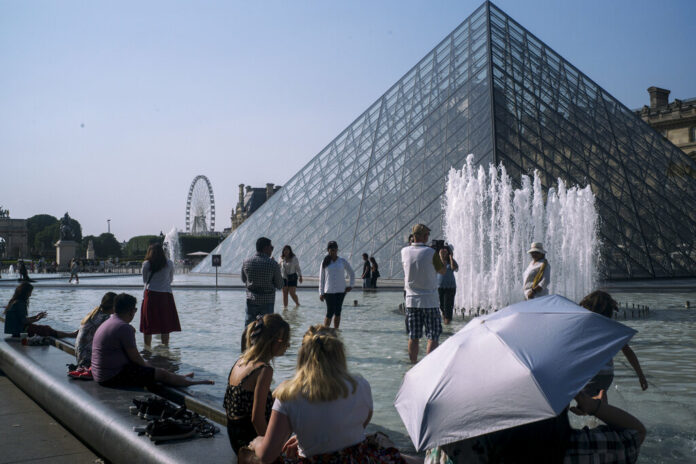
People cool off next to the fountains at Louvre Museum in Paris, France, Wednesday, July 24, 2019. Temperatures in Paris are forecast to reach 41 degrees C (86 F), on Thursday. Photo: Rafael Yaghobzadeh / AP
BERLIN — Europeans cooled off in public fountains Wednesday as a new heat wave spread across parts of the continent and was already breaking records.
Belgium and Germany registered their highest-ever temperatures, while the Netherlands saw its hottest day in 75 years.
And the mercury is expected to rise even further.
Paris and other parts of France could see temperatures exceeding 40 C (104 F) on Thursday along with Germany, Belgium, Netherlands, Luxembourg and Switzerland.
The heat is putting pressure on authorities to help protect the elderly and the sick. Air conditioning is not common at homes, offices, schools or hospitals in European cities.
The weather is also aggravating droughts since it hasn’t rained much in many parts of Europe this summer. The combination of heat, wind and possible lightning from thunderstorms also increases the risk of wildfires.
Why is it so hot?
The second likely-to-be-record-breaking heat wave in two months in Europe includes some of the same ingredients of the first — hot dry air coming from northern Africa. That hot air is trapped between cold stormy systems in the Atlantic and eastern Europe and forms “a little heat dome,” said Ryan Maue, a private meteorologist in the U.S.
This heat wave is a relatively short event where the heat comes with a southerly wind — and dust — from Africa’s Sahara Desert, in contrast to the big European heat waves of 2003 and 2010 which lasted much longer and were sustained by a stationary high pressure system with little wind, experts say.
At the end of June, several countries reported record temperatures, and France hit its all-time heat record: 46 C (114.8 F) in the small southern town of Verargues.
Is climate change causing this?
Heat waves are happening more frequently in large parts of Europe, Asia and Australia, experts say. As the world warms, scientists say there will be more and hotter heat waves, but attributing single events to climate change involves precise computer modeling and calculations.
A team of European climate scientists did a quick, non-peer reviewed analysis of Europe’s June heat wave and found man-made warming made it at least five times more likely.
“Either of the two European heat waves this summer would have been remarkable in isolation. But now we are seeing multiple episodes of record heat in a given summer. By mid-century, we will simply call these episodes ‘summer’ — if we continue on this trajectory,” said Pennsylvania State University climate scientist Michael Mann, who wasn’t part of the European group.
The heat waves aren’t just because the world is 1 degree Celsius warmer than before the industrial era, but also because climate change and the melting of Arctic sea ice has slowed down the jet stream, which is the river of air that moves weather along, Mann said. The slow jet stream is “a big part of the story when it comes to these very persistent heat extremes we have seen in recent summers,” Mann said in an email.
How hot could it get this week and where?
Temperatures in France especially are likely to be 15 C (27 F) higher than normal, with Paris likely to break its all-time hottest record mark of 40.4 degrees (104.7 Fahrenheit). Surrounding areas around Paris may hit 41 or 42 C (106 to 108 Fahrenheit), weather experts said.
The Dutch meteorological institute tweeted that Wednesday’s heat wave broke a record that stood for nearly 75 years of the hottest temperature ever recorded in the Netherlands. The Dutch weather service Weerplaza said that the southern city of Eindhoven reported a temperature of 39.3 (102.7 F) Wednesday afternoon.
Belgium measured its highest temperature since records were first kept in 1833. In sun-baked Kleine Brogel in northeastern Belgium, temperatures rose to 39.9 C (102.3 F), and the weather forecaster of the Royal Meteorological Institute said that it was “the highest ever Belgian temperature.”
Also, temperatures won’t cool down much at night, and maybe stay around 24 C (75 F) or higher.
The German Weather Service said a probable record high of 40.5 C (104.9 F) for the country was recorded in Geilenkirchen and put the entire country on heat alert. The previous record of 40.3 C (104.5 F) was set in 2015.
A young woman stands under an artificial waterfall in a public pool in Grossroehrsdorf, eastern Germany, Wednesday, July 24, 2019. A heatwave hit big parts of Europe. Photo: Robert Michael / dpa via AP
What are people and authorities doing to stay cool?
France in particular is haunted by the 2003 heat wave that killed an estimated 15,000 people there, most of them isolated elderly people whose families in many cases were on vacation. The country has since taken measures to try to ensure such a catastrophe isn’t repeated.
Those measures include a color-coded heat alert system to warn people when temperatures are expected to rise to dangerous levels in their area. The alert system went to its maximum level of red for the first time during last month’s heat wave, when France saw its highest-ever recorded temperature.
There are also public service announcements on television, radio and in public transportation systems about risks of high temperatures, telling people to drink water and watch out for isolated elderly people.
Millions of euros in extra funding for emergency services, including more staff members in hospitals and nursing homes overwhelmed in 2003. A government report at the time blamed the death toll on lack of coordination among government agencies, nursing homes that lacked air conditioning and overnight staff, lack of a public alert system, and other problems.
Still, few homes in France or Germany have air conditioning, and many public buildings also lack air conditioning, including hospitals and schools.
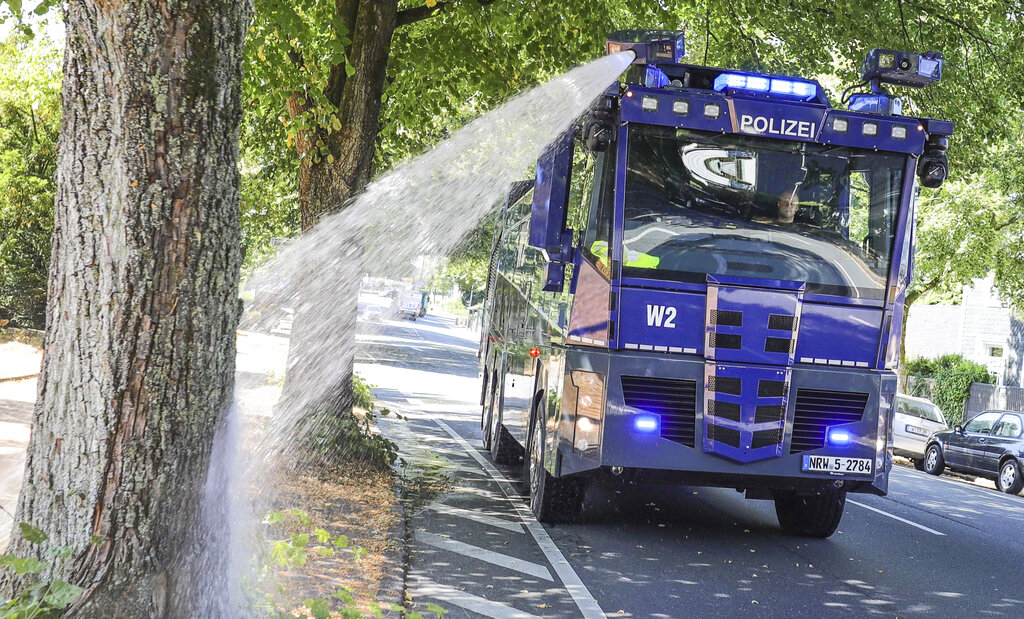
In the Netherlands, local authorities have taken an unusual precaution — with trucks scattering salt on the roads like they usually do in the winter.
The salt spreaders are usually used to prevent ice forming on Dutch roads in the cold, but Arnhem municipality started using them to cool off asphalt that is baking in the heat wave.
The city says in a statement that the salt “attracts moisture from the air and cools the asphalt.” It also prevents the asphalt from becoming sticky.
Across London, authorities started handing out water and sunscreen to homeless people and opened day centers for them to rest and shower. In the Lewisham district of the British capital, garbage collectors will start working as early as 5 a.m. in the morning to beat the heat.
London police warned people not to swim in the city’s River Thames after a young man died there Tuesday night.
“Whilst at times, the Thames may look appealing, especially in this hot weather, it remains very dangerous all year round,” police said in a statement. “On initial entry the water can seem warm on the surface, but further in it can be freezing cold and there are often very strong undercurrents.”
A water canon of the German police waters trees in Wuppertal, western Germany, Wednesday, July 24, 2019. Hot temperatures are expected all over Europe during the next days. Photo: Claudia Otte / dpa via AP
When is it over?
The heat wave will end in a few days. On the weekend, temperatures are expected to fall. However, quite often end of a heat wave brings storms, including lightning and heavy flooding.
Story: Kirsten Grieshaber and Seth Borenstein. Elaine Ganley and Angela Charlton in Paris, Natasha Livingstone in London, Mike Corder in The Hague, Netherlands, and Raf Casert in Brussels contributed to this report.
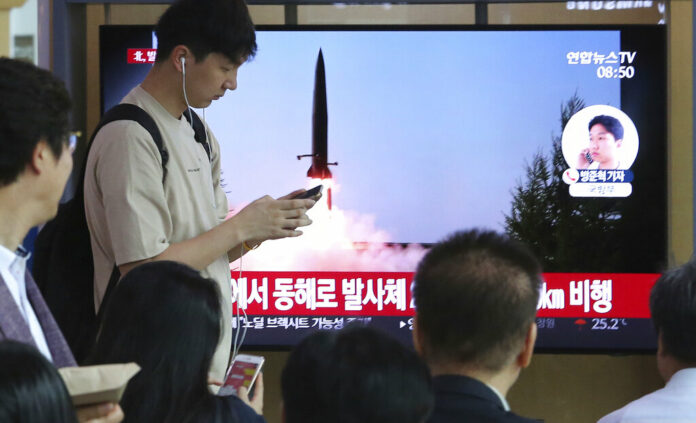
People watch a TV showing a file image of North Korea's missile launch during a news program at the Seoul Railway Station in Seoul, South Korea, Thursday, July 25, 2019. North Korea fired two unidentified projectiles into the sea on Thursday, South Korea's military said, the first launches in more than two months as North Korean and U.S. officials work to restart nuclear diplomacy. The signs read: "North Korea fired unidentified projectiles into the sea." Photo: Ahn Young-joon / AP
SEOUL — North Korea fired two short-range missiles into the sea Thursday, South Korea’s military said, the first weapons launches in more than two months and an apparent pressuring tactic aimed at Washington as North Korean and U.S. officials struggle to restart nuclear negotiations.
The South’s Joint Chiefs of Staff said the missiles that were fired from near the eastern coastal town of Wonsan flew about 430 kilometers (270 miles) before landing in the waters off the country’s east coast.
A South Korean defense official, requesting anonymity because of department rules, said that an initial South Korean analysis showed both missiles were fired from mobile launchers and flew at a maximum altitude of 50 kilometers (30 miles).
The North is unhappy with planned U.S.-South Korean military drills that it says are an invasion preparation, and the missile tests may be aimed at sending a message to Washington about what would happen if diplomacy fails.
The timing was also interesting, coming not long after many in the United States were focused on testimony before Congress by Robert Mueller, the former special counsel, about his two-year probe into Russian election interference. And just hours before, U.S. national security adviser John Bolton left Seoul after agreeing with South Korean officials to boost cooperation to achieve North Korea’s denuclearization.
But the missiles’ relatively short flight distance also suggests the launches were not a major provocation, such as a test of a long-range missile capable of reaching the U.S. mainland, and that North Korea doesn’t appear to be pulling away from U.S.-led diplomacy aimed at curbing its nuclear program.
In recent days, North Korea has been pressuring the U.S. and South Korea to scrap their summertime military drills. Last week, the North said it may lift its 20-month suspension of nuclear and long-range missile tests in response to the drills. Trump has considered the weapons moratorium a major achievement in his North Korea policy.
Some experts North Korea’s recent actions are an attempt to get an upper hand ahead of the possible resumption of talks. North Korea wants widespread sanctions relief so it can revive its dilapidated economy, but U.S. officials are pushing the country to take significant disarmament steps before they give up the leverage provided by the sanctions.
A senior U.S. official said the Trump administration was aware of the reports of a short-range projectile launched from North Korea. The official, who spoke on condition of anonymity to provide a response, said the administration had no further comment at this time.
South Korean Defense Ministry spokeswoman Choi Hyunsoo urged Pyongyang to stop acts that are “not helpful to efforts to ease military tensions on the Korean Peninsula.”
If North Korea fired ballistic missiles, it could have ramifications because U.N. Security Council resolutions ban the North from engaging in any launch using ballistic technology. Still, the U.N. Security Council has typically imposed fresh sanctions on North Korea only when it conducted long-range ballistic missile tests.
“If they were ballistic missiles, they violate the U.N. sanctions, and I find it extremely regrettable,” Japan’s Defense Minister Takeshi Iwaya told reporters in Tokyo.
It was the first such launch since Seoul said North Korea fired three short-range missiles off its east coast in early May. Many experts said at the time that those missiles bore a strong resemblance to the Russian-designed Iskander, a short-range, nuclear-capable ballistic missile that has been in the Russian arsenal for more than a decade.
Analyst Kim Dong-yub at Seoul’s Institute for Far Eastern Studies said the latest North Korean missiles could be Scud-C ballistic missiles or KN-23 surface-to-surface missiles, a North Korean version of the Iskander.
South Korea’s military said it and the U.S. military were analyzing details of Thursday’s launches. South Korea said it was monitoring possible additional launches by North Korea.
During a third summit at the Korean border late last month, Trump and North Korean leader Kim Jong Un agreed to resume nuclear negotiations, which had been deadlocked since their second summit in Vietnam in February ended without an agreement because of disputes over U.S.-led sanctions.
Both the launches in May and on Thursday won’t end that weapons test moratorium, which applies to firing intercontinental ballistic missiles.
On Tuesday, North Korean state media said Kim inspected a newly built submarine and ordered officials to further bolster the country’s military capabilities. The Korean Central News Agency said the submarine’s operational deployment “is near at hand.”
After analyzing North Korea-dispatched photos of the submarine, experts said the submarine likely has three launch tubes for missiles. South Korean government documents say North Korea has about 70 submarines, but analysts say they mostly have a single launch tube.
The construction of such a new submarine suggests North Korea has been increasing its military capability despite nuclear diplomacy that it began with the United States early last year.
The latest launches came amid a recent flare-up of tensions on the Korean Peninsula after South Korean fighter jets on Tuesday fired hundreds of warning shots to drive away a Russian reconnaissance plane that Seoul says violated its airspace. Before that alleged intrusion, Seoul said Russian and Chinese warplanes including the reconnaissance aircraft made an extremely unusual joint entrance into South Korea’s air defense identification zone, prompting South Korean military jets to scramble.
Russia and China have said they carried out their first joint patrol in the waters between the Korean Peninsula and Japan but said none of their planes violated South Korea’s airspace. Experts say the joint patrol may have been aimed at testing readiness of trilateral security cooperation among the United States, South Korea and Japan.
Story: Hyung-Jin Kim. Deb Riechmann in Washington and Mari Yamaguchi in Tokyo contributed to this report.
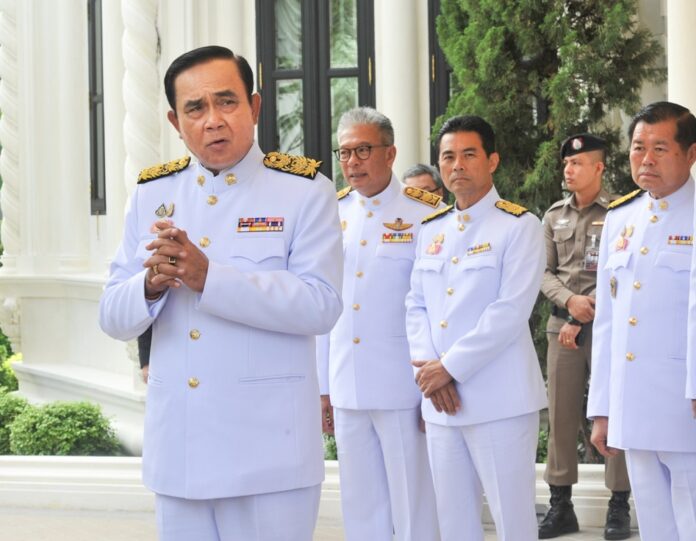
BANGKOK — Both government and opposition camps on Wednesday said they are prepped for what promised to be the first time PM Prayuth Chan-ocha faces his critics in a parliament since coming to power five years ago.
The rival coalitions said they have lined up the speakers for the government’s inaugural address to the parliament, in which Gen. Prayuth and his cabinet will detail their policies. Opposition leaders said they will use the session, which is expected to last at least two days, to grill Prayuth for his failures in governance and question his administration’s legitimacy.
Pheu Thai MP Suthin Klangsaeng said the party and its allies have named 55 politicians to scrutinize Prayuth and his cabinet, from issues like corruption allegations to economic performances. Suthin also teased that the opposition will drop a bombshell when the two sides clash tomorrow.
“Something that people all over the world is interested in were not included in the government’s [published] policies, and I believe it would definitely impact credibility and investment,” Suthin said. “But I would not disclose it here. I’d talk about it in the parliament.”
“I’d like to ask everyone to keep watching,” the MP added.
The government’s policy address is mandatory under the parliament regulations. Prayuth and his cabinet members are required to attend the session, while opposition politicians will be granted time slots to question the government leaders directly.
Abhisit Vejjajiva’s address to the parliament in 2009.
Unlike Prayuth’s previous appearances at the interim parliament stacked with the Yes-Men he handpicked, the general is expected to face relentless broadsides from the opposition bench when the parliament convenes tomorrow – his first taste at parliamentary politics since seizing power in a 2014 coup.
In brief comments to reporters today, Prayuth said he is “not worried” about tomorrow sessions, though he did imply nervousness when he spoke to Phalang Pracharath MPs at their conference on Saturday.
“Help me out. Don’t just abandon me!” Prayuth teased.
Both pro- and anti-government factions have been announcing their strategies for the two-day “battle,” littering the news with military lingo and threats directed at the other side in the process.
Pheu Thai said its vanguard will consist of veteran shock troops like Seripisut Temiyavet, Jirayu Huangsap, Mingkwan Sangsuwan, Sompong Amornwiwat and Wan Muhamad Noor Matha.
Yingluck Shinawatra’s inaugural session at the parliament in August 2011.
Meanwhile, Phalang Pracharath Party said the government coalition has designated 20 MPs for what it calls “a rapid deployment unit” – ready to counter any allegations the opposition plan to hurl at the cabinet members.
“If they address anything outside the scope, we will hit back immediately,” Phalang Pracharath official Wirakon Khamprakop told reporters.
Pro-government MPs to be deployed in the frontline include Parina Kraikup, Anucha Nakasai, Sira Jenjaka, and Pada Vorakanon.
House Speaker Chuan Leekpai said the opposition parties will be given a total time slot of 13 hours and 30 minutes for their addresses and challenges, while the cabinet and coalition MPs will receive five hours each. The junta-appointed senate will also be granted a total of five hours.
The time will be allotted in accordance with the proportion of MPs won in the March election; for instance, Pheu Thai will get seven hours compared to Phalang Pracharath’s two hours and Bhumjaithai’s 59 minutes.
Chuan also said he might be partial to extending the session for an extra day if the debates could not be completed by Friday midnight.
Prayuth Chan-ocha speaks to the interim parliament in 2014.
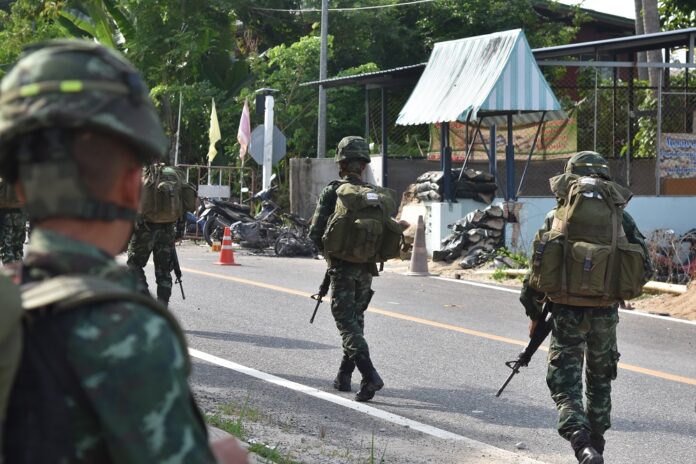
Soldiers on patrol in Pattani province on July 24, 2019 close to the checkpoint where four security officers were killed in a raid the previous day.
PATTANI — A coordinated gun attack on a military checkpoint in the restive province of Pattani left four security officers dead, the army said Wednesday.
The raid took place at about 9pm Tuesday at a roadblock manned by soldiers and armed volunteers in central Pattani. Security camera footage shows over a dozen masked men throwing grenades and shooting at the security officers. After about five minutes of gunfighting, they retreat with some firearms they collected.
Pattani taskforce commander Piyapong Wongchan said the assailants showed a high level of coordination during the raid. Four security officers were killed and two wounded in the attack.
“Some of our officers were shot, but they endured the injuries and kept fighting until their deaths,” the general said.
Gen. Piyapong also said at least two of the attackers appear to have been injured in the gunfight and left a trail of blood at the crime scene, which police have collected as evidence.
Although the general did not identify the perpetrators, similar assaults have been carried out in the past by insurgents seeking to secede the provinces of Pattani, Yala and Narathiwat.
Apart from inflicting deaths and injuries, the perpetrators made off with five assault rifles they seized from dead security officers, police said.
The raid comes at a time of renewed tension in the Muslim-majority southern border provinces. Earlier this week, a 32-year-old local man was left in a coma after the military detained him on suspicion of aiding the separatist movement.
Civil rights activists have called on the authorities to investigate the incident, fearing the man might have been a victim in the military’s long history of torturing detainees.
Over 40 residents in Yala province have said they were arrested by the military recently and only released after they agreed to give up DNA samples.
On Wednesday, a group of government and opposition MPs submitted a joint petition to Prime Minister Prayuth Chan-ocha, urging him to consider repealing special laws that allow soldiers to detain individuals and search properties at will.
The MPs, who hail from the southern border provinces, said the military should question whether these measures will indeed bring about peace in the region.