A welfare card holder shows a 500-baht note Wednesday in front of Krung Thai ATMs in Prachin Buri province.
BANGKOK — Defending the military government’s handing out of 500-baht cash stipends to welfare card recipients, one of its ministers – who also helps lead a pro-junta political party – said Thursday that Thailand’s poorest are in dire need of help.
Suvit Maesincee, minister of science and technology and deputy leader of the Palang Pracharat Party, said the poor are starving to death and should benefit from continued support for programs introduced by his government, such as its controversial welfare card program.
“This is not a handout to the poor as alleged because these people do not earn enough, so we need to fill up for the people. We want to create a pracharat society,” Suvit said, using the slogan his party is named after, which the government uses to promote its policies as a form of public-state cooperation. Palang Pracharat wants junta leader Gen. Prayuth Chan-ocha to become prime minister after the election.
“People are starving – near death. How can you not help them? We must help and expand on it. Right now there are 11.4 million holders and we must look into it to see if it’s comprehensive or not,” said Suvit, referring to the welfare program that provides eligible, registered Thais with monthly credits for things like groceries and transportation.
Last week, they also received a one-time 500 baht stipend described as a New Year’s gift by the regime. The rush to obtain the money, especially on a holiday from limited numbers of ATM machines, caused some pandemonium.
The program led to debate over whether it was sound policy or a thinly veiled attempt to buy votes while #500baht became a topic on social media. One commentator defended the scheme as no different from the 30 baht medicare program introduced over a decade ago by former PM Thaksin Shinawatra while others said it was different because medical care is a welfare right while the cash handout was a one-off disbursement.
“I thought they said they hated populism and vote-buying policies? Oh I forgot, the person doing it is not Thaksin or Yingluck,” @Shyguythailand tweeted Wednesday.
“What can help the poor is not 500 baht but easy and equal access to education,” @Kaekissed tweeted.
Suvit, who has yet to resign as minister despite his growing obligations as a political player, said salarymen will also benefit from a forthcoming policy proposal to pay pensions to those working in the private sector.
“There are changes facing all professions,” he said.
KRABI — After a raucous evening at a pub, an unlikely bar-goer spent the night at the police station before someone showed up to claim him.
But it wasn’t the usual Krabi troublemaker – it was a two-meter crocodile that crawled into Wang Thong Pub and Restaurant just after the last order, before being bagged by local police and kept in the slammer overnight at the Ao Luek Police Station
“We tied it next to the police station’s coffee shop,” Maj. Witthaya Tongkong of Ao Leuk Police Station said jovially. “It was pretty calm when people walked up to it, but when people walk away it whacked its tail really hard.”
Coffee in hand, a volunteer police officer grabbed the croc’s tail and wiggled it in footage Witthaya sent.
“It went bang, bang, bang against the wall,” Witthaya said.
Beyond that, he did not get to know the animal well.
“I can’t tell between male and female crocodiles,” he added, laughing. “We didn’t name it either.”
A volunteer police officer holds his coffee while wiggling the crocodile’s tail Thursday morning at the Ao Luek Police Station in Krabi. Photo: Police Maj. Witthaya Tongkong / Courtesy
Police saw a frayed rope around the croc’s neck, which suggested he had escaped captivity as as a pet, so they sent out a call for someone to claim the croc. As of Thursday afternoon, the Fisheries Department in Thung Yai, Nakhon Si Thammarat had done so.
The crocodile almost went home with the wrong human. Panjaporn Phasuk and her husband rushed to the pub Thursday morning and profusely apologized, saying that it was her crocodile – which she claimed to keep in a concrete basin in her backyard – that got loose.
But after taking the crocodile home, she brought it back to the police station, saying it was a case of mistaken reptile identity.
A mural depicting those who participated in the Luang Cave rescue operations.
BANGKOK — The year 2018 is winding down, so it’s time to briefly remember what we spent the year searching for. Digitally, that is.
Perhaps unsurprisingly, much of the Google’s top results in Thailand centered around the happy escapism of lakorn and pop music, plus the romantic difficulties of celebrity couples.
Channel 3’s massive hit drama “Love Destiny” easily topped not only the most-searched overall term and TV show categories, but also revived interest in Thai history, as seen in spikes searches relating to the proper way to wear 17th century trousers and cooking Ayutthaya-era dishes.
“ประเทศกูมี (My Country’s Got)” a rap song critical of the junta and social ills which became even more viral after a deputy police chief tried to suppress it.
“คุกกี้เสี่ยงทาย (Fortune Cookie)” an earworm hit by girl group BNK48
“วันหนึ่งฉันเดินเข้าป่า (Into the Woods)” a strangely philosophical song about walking into the woods. Widely shared after a construction mogul was arrested on poaching charges.
“ซ่อนกลิ่น” first song released by indie-pop musician Palmy in five years.
7Tourist Destinations
A file photo of Khao Kho.
Khao Kho
Khao Yai National Park
Ayutthaya
Nan
Bangkok
8How-To
Miss Universe 2018 contestants wear Chong Kraben at a winter-themed fair in Bangkok.
Poster for 1988's “Talad Prommajari” (“Virgin Market”). Kowit Wattanakul, who appeared in the film, is one of three veteran actors to announce they will seek seats in the Parliament.
BANGKOK — Three elderly actors, two famed for their roles as villains, will run for office in one of several offshoot parties of the Pheu Thai Party.
Party leader and Redshirt leader Jatuporn Promphan welcomed Suriya Chinphan, Dam Dasakorn and Kowit Wattanakul on Thursday, saying they would run as MP candidates in the Pheu Chart Party.
Suriya, 65, best known for 1977’s famous romantic film “Mon Rak Nam Moon” (“The Love Spell of Moon River”), will compete in Pathum Thani province’s fourth district. Suriya said he has been serving the public by entertaining them for decades as an actor, adding that it enables him to meet and understand people from all walks of life.
The veteran actor said the country is in trouble and that he wishes to serve the public in a different capacity as MP. Suriya said he used to be poor and thus understands the unprivileged well.
At least four parties are known proxies for Pheu Thai, a political powerhouse loyal to former leader Thaksin Shinawatra, who is living in self-imposed exile. They include Pheu Tham, Pheu Chart and Thai Raksa Chart.
Pheu Chart also welcomed 73-year-old Dam. Dam – known for his role as an archvillain in movies such as “Choom Paw” (1976) and “Muay Thai Nai Kanom Tom” (2003) – will compete as an MP candidate in Kanchanaburi province.
The famous veteran actor said a number of political parties had invited him to join, but he chose Pheu Chart.
Kowit, 64, who often plays the antagonist and won a “Best Villain Actor” award in 1988 for his role in “Talad Prommajari” (“Virgin Market”), is still active in the entertainment industry. He will run for a seat in Surin province’s fourth district. Kowit said Pheu Thai Party is an alternative for those wanting to fight for democracy, adding that Jatuporn is living proof of that.
Butterfly Pea Ice Cream with Thong Muan (95 baht) and Ayutthaya Charming Green tea (70 baht).
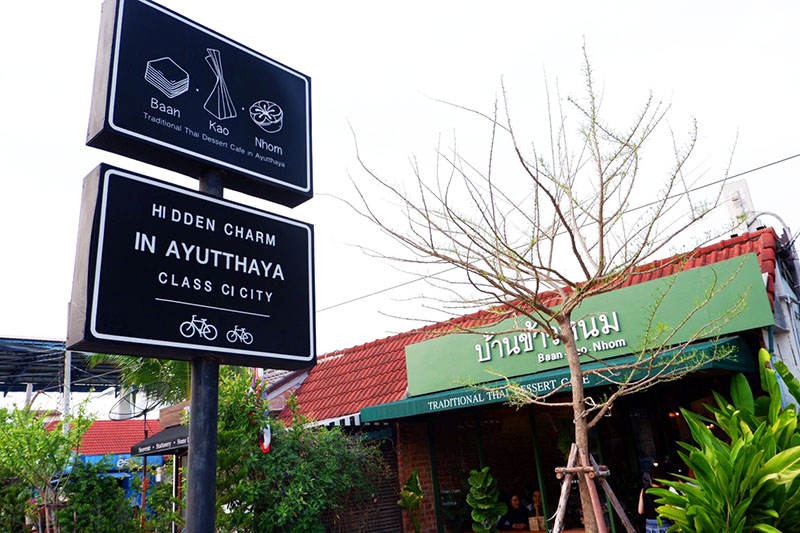
AYUTTHAYA — Somewhere between overly chic hangout and dowdy OTOP shack is Baan Khao Nhom, an unpretentious cafe – with a sensible price range – that also benefits local producers.
Baan Khao Nom, a rustic dessert cafe in the historic city north of Bangkok, will turn five this February – and although now there are several Thai dessert cafes popping up in the capital, its owner says hers was one of the first.
“My family and everyone told me that I would run out of business. ‘No one wants to eat kanom thai,’” said Thapakorn “Yui” Soonthornpruek, referring to Thai desserts. “But I was stubborn and confident in them.”
On a recent Sunday, both Thai and foreign customers were seated at every table, splitting butterfly pea affogatos (110 baht) and sipping on local house blend coffee (60 baht to 95 baht) or mugs of milky Ayutthaya Charming Green tea (70 baht to 80 baht).
The Butterfly Pea Ice Cream (95 baht) comes with a stick of thong muan, or crispy coconut milk crepe roll. It’s served on a bed of crushed thong muan in a glass, similar to how ice cream is sometimes served in granola. Mango, coconut and muskmelon ice cream dishes are also available.
Besides ordering ice cream desserts, customers can also pick up krajaad or shallow bamboo baskets lined with banana leaves stacked by the door and load them up with locally-made desserts on display – most are 50 baht or less.
Some of the desserts are made in-house, but Yui gets many others from “talented grandpas and grandmas who can’t sell all of their yummy sweets,” Thapakorn said. “I wanted to provide a channel for them to sell it.”
Don’t worry about sugar overload – the deserts aren’t as sweet as most Thai desserts found elsewhere. Thapakorn, 32, said she asked her suppliers to reduce the sugar.
“If it’s too sweet, then you can’t eat a lot of it,” she said.
Butterfly Pea Ice Cream with Thong Muan (95 baht) and Ayutthaya Charming Green tea (70 baht).
Thapakorn was working in Bangkok when she had to move back to Ayutthaya to be with her family. Remembering how she would purchase Thai desserts from grannies paddling along canals on her way to school, she started visiting local dessertmakers to find sweets for her shop.
Some are commonly found, such as piak poon rice pudding or chor muang steamed purple dumplings. Others were hard to find like khao nhom ob boran, a box of pastel colored, floral-smelling pressed flour pellets with dried fruit.
Boxes of khao nhom ob boran (50 baht).
There’s also cold desserts in the fridge, such as longans in butterfly pea juice, chao guay grass jelly and look choop, or sweet bean paste marzipan coated with jelly. Although normally shaped into miniature fruits, a box at Baan Khao Nhom had a set shaped like naam prik chili dip with a mackerel.
The desserts and pots of brown sugar are served in traditional white-and-blue porcelain dishes and the coziness is amplified by the decor of with pinto tiffin carriers and woven basketry.
Those who find themselves on a day trip to Ayutthaya should make a pitstop at the Thai dessert cafe – skip those honey toast and condensed milk-overloaded bingsu places.
Baan Khao Nhom is on Uthong Road in Ayutthaya city, approximately an hour and a half’s drive from Bangkok. The restaurant is open 8am to 6pm on weekdays, 9am to 6:30pm on weekends. This review is based on an unannounced visit.
BANGKOK — For its second year, Bangkok Block Party will throw a bigger event running two days in the heart of the city.
Siam Paragon, Siam Center and the skywalk connecting Siam Discovery and MBK Center will be packed with music fans and artists at three stages for hip-hop, electronic and heavy rock.
The international lineup highlights include Chicago indie trio Autograf, Dublin hip-hop act Rejjie Snow, poetic rapper Jesse James Solomon and many more. Local acts from the former block party such as underground punk rock group The Greed and hardcore act License to Kill will headline.
Not only music, expect food, drinks, workshops and pop-up tattoo parlors.
Bangkok Block Partyruns noon to midnight on Jan. 19 and Jan. 20 at Siam Paragon, Siam Center and the Siam Discovery-MBK Center skywalk.
Tickets for one day are 900 baht and 1,500 baht for both days. They are available online and at BTS Skytrain ticketing booths.
The block party, led by hip-hop crew Blaq Lyte, took place for the first time earlier this year at A Square on Soi Sukhumvit 26 with more than 50 music acts.
In this Oct. 21, 2018, photo, Sister Laurentina, left, stands next to the tombstone of Adelina Sau in Abi village in West Timor, Indonesia. Photoซ Tatan Syuflana / Associated Press
FATUKOKO, Indonesia — The stranger showed up at the girl’s door one night with a tantalizing job offer: Give up your world, and I will give you a future.
It was a chance for 16-year-old Marselina Neonbota to leave her isolated village in one of the poorest parts of Indonesia for neighboring Malaysia, where some migrant workers can earn more in a few years than in a lifetime at home. A way out for a girl so hungry for a life beyond subsistence farming that she walked 22 kilometers (14 miles) every day to the schoolhouse and back.
She grabbed the opportunity — and disappeared.
The cheerful child known to her family as Lina joined the army of Indonesians who migrate every year to wealthier countries in Asia and the Middle East for work. Thousands come home in coffins, or vanish. Among them, possibly hundreds of trafficked girls have quietly disappeared from the impoverished western half of Timor island and elsewhere in Indonesia’s East Nusa Tenggara province.
The National Agency for Placement and Protection of Indonesian Workers has counted more than 2,600 cases of dead or missing Indonesian migrants since 2014. And even those numbers mostly leave out people like Lina who are recruited illegally — an estimated 30 percent of Indonesia’s 6.2 million migrant workers.
On that night in 2010, Lina didn’t seem to sense the danger posed by the stranger named Sarah. But Lina’s great-aunt and great-uncle, who had raised her, were hesitant.
Sarah insisted they could trust her; she was related to the village chief. And Lina would only be gone two years.
Lina’s aunt, Teresia Tasoin, knew a Malaysian salary could support the whole family. Her husband — fighting both a teenager’s excitement and a crushing headache — doubted he could stop Lina from going.
Still, the couple wanted to hold a Catholic prayer service for Lina before she left. Sarah promised she would only take Lina to the provincial capital of Kupang for one night to organize her paperwork, then bring her back the next day. It was a lie.
Less than one hour after Sarah walked into their home, she walked back out with Lina. And just like that, their girl was gone.
Looking back on it now, Tasoin crumbles under the weight of what-ifs. “I regret it,” she says through tears.
“I regret letting her go.”
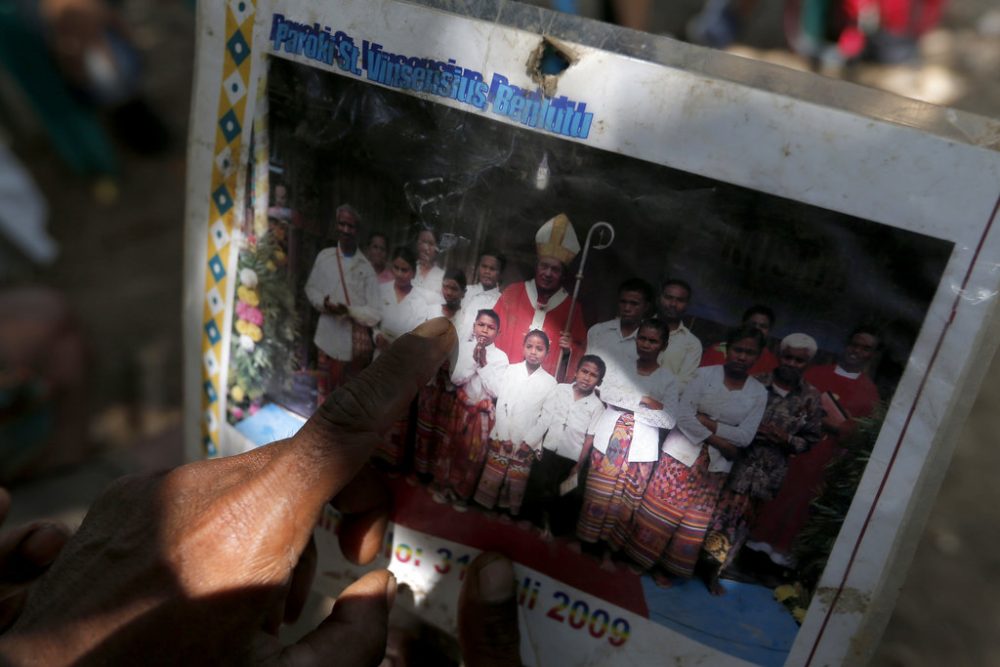
In this Oct. 23, 2018, photo, Laurencius Kollo holds up a photograph taken in July 2009, which shows Marselina Neonbota, (third from left) posing with the district Bishop. Photo: Tatan Syuflana / Associated Press
___
When it comes to tracking the fate of migrants, Asia is the blackest of black holes.
It has more migrants than any region on earth, with millions traveling within Asia and to the Mideast for work. Yet it has the least data on those who vanish. In an exclusive tally, The Associated Press found more than 8,000 cases of dead and missing migrants in Asia and the Mideast since 2014, in addition to the 2,700 listed by the U.N.’s International Organization for Migration. More than 2,000 unearthed by the AP were from the Philippines alone. And countless other cases are never reported.
These workers reflect part of the hidden toll of global migration. An AP investigation documented at least 61,135 migrants dead or missing worldwide over the same period, a tally that keeps rising. That’s more than double the number found by the IOM, the only group that has tried to count them.
While it’s not clear how many left for jobs, in general workers make up about two-thirds of international migrants, according to the International Labor Organization; the rest are fleeing everything from drug violence to war and famine. Migrants may die on perilous journeys through deserts or at sea, while many others like Lina disappear into networks that traffic in people.
In deeply Christian East Nusa Tenggara, the church has become one of the few advocates for the dead and disappeared. With the impoverished province home to the highest number of trafficking cases in the country, nuns and priests have transformed themselves into counter-trafficking crusaders.
Inside a little church across from Lina’s house, Sister Laurentina is praying before a riveted crowd. Slight and soft-spoken, the nun — who like many Indonesians goes by only one name — is nonetheless a giant presence before the parishioners. There is danger in trusting illegal recruiters, she warns. There is death.
Her words are not hyperbole. She waits at the airport for the arrival of nearly every migrant worker’s corpse that is flown back to Kupang, a ritual that has earned her the nickname “Sister Cargo.” One day after her warning to parishioners, she will be back at the airport, praying over the 89th coffin this year that has returned from Malaysia with the remains of a local migrant. Some die from accidents or illness, she says. Others from neglect and abuse.
Laurentina is one of the few people in West Timor even trying to track the missing. Since 2012, she has traveled across the island to educate villagers on the dangers of traffickers. She has held at least 20 meetings this year alone.
Laurentina asks each audience if anyone has lost contact with a relative who migrated for work. And at every meeting, for six years, at least one or two people have told her: Yes, my child is missing. Most are girls.
The remoteness of West Timor and a lack of education mean many people just don’t understand the danger. But even for those who do, a trip through the drought-punished region makes clear why they risk their lives to leave.
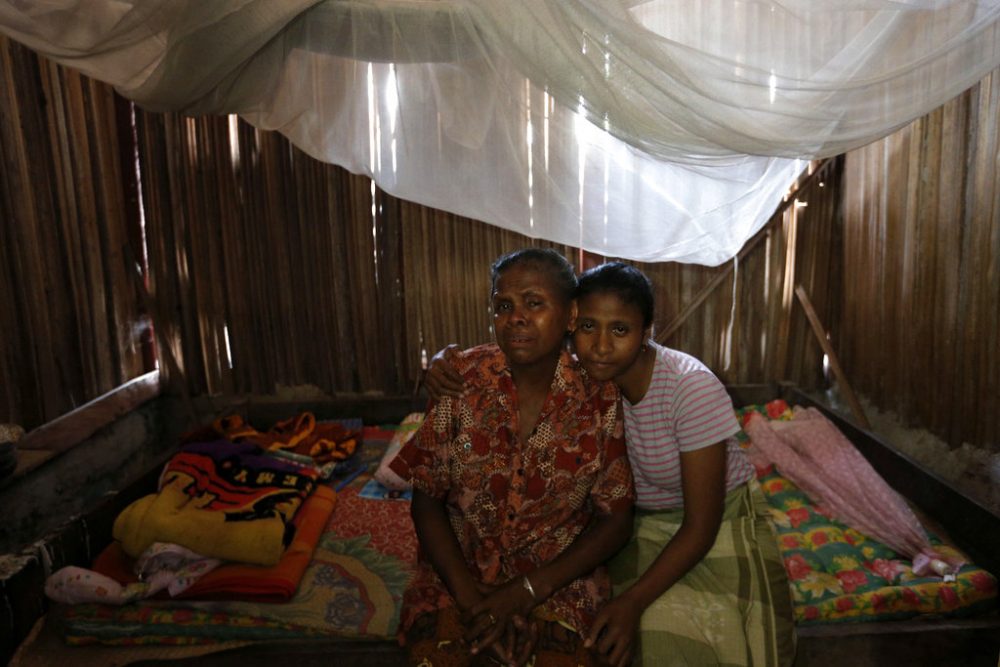
In this Oct. 21, 2018, photo, Yohanna Banunaek, left, is comforted by her daughter Yeti, in Abi village in West Timor, Indonesia, while they grieve the loss of Adelina Sau, Banunaek’s other daughter. Photo: Tatan Syuflana / Associated Press
Gnarled trees cling to barren hills. Many of the rivers have run dry. Emaciated dogs lick desperately at cracked-open coconuts lying on the dusty ground.
With no real industry here, generations of villagers have migrated to Malaysia to work as maids or on plantations. But in the past few years, migrant trafficking has picked up, as traffickers move to the most remote areas in search of fresh, unsuspecting prey. Many victims end up overworked and underpaid, and some are forced into prostitution.
In the village of Oe’Ekam, priest Maximus Amfotis watches as locals line up at a water tank, filling containers some will have to lug several kilometers home. He regularly hears of local teens migrating to Malaysia for work, never to return. There was a new case just two weeks ago, he says. The cycle seems endless.
“If we cannot stop this problem,” he says, “I fear that the current generation will be lost.”
___
Unlike Lina, Orance Faot was betrayed by her own flesh and blood.
The road to her house is so rocky that by the time you arrive, it feels like you’ve gone through an hours-long earthquake. The sunny, hardworking girl was just 14 when she traveled down that same rocky path four years ago on a motorbike bound for Kupang.
That morning, Orance told the grandmother she lived with, Margarita Oematan, that she was going with her older cousin Yeni to a priest’s house to study the Bible. When she failed to return, her uncle went looking for her. He walked as far as the river where she sometimes swam, but found no trace of his niece or Yeni. A driver later told the family that the girls had hired a bike.
When the family finally got hold of Yeni, she denied knowing what had happened to Orance. But the Faots suspected Yeni had turned Orance over to a recruiter. Eventually, they did something few here do — they went to the police.
In much of West Timor’s remote interior, electricity, phones and cars are a luxury. So absolute is the isolation that some islanders have never even seen the sea. So when a child goes missing, many families don’t know who can help.
Families also hesitate to contact officials because they often accept payment from the recruiters, who exploit a tradition known as okomama. The practice involves placing a small gift — a bit of money or betel nut — in a basket in exchange for a favor. The offering is a show of respect. It is also a contract.
The Faots, though, say they never received anything for Orance.
Yeni told police she had introduced Orance to a Chinese man, according to an investigator. The Chinese man told officials he had handed Orance over to a recruiter who often sends girls to work as maids in Malaysia. But the recruiter — who would later be convicted in a different trafficking case — denied knowing Orance, said the investigator, who spoke anonymously because he was not authorized to discuss the case.
Orance’s case is hardly an anomaly, the investigator says. In his visits to nearly 150 villages, most of the families he’s interviewed say they have lost contact with at least one relative who migrated for work. And most of the missing, he says, are girls.
The fact that Orance appears to have been lured by her own cousin is also typical. Field recruiters almost always have some connection to their victims, making them seem trustworthy. For each person they hand over, a field recruiter gets anywhere from a few hundred to more than a thousand dollars from agents up the chain, police and experts say.
Officials searched immigration records for Orance, without success. That’s not surprising, as traffickers often falsify names, birthdays and addresses on migration papers.
Finding these girls is virtually impossible, says Among Resi, head of the IOM’s counter-trafficking and labor migration unit in Indonesia. The families have almost no details on where their child has gone. They rarely even have a photo.
The assumption, Resi says, is that many of the girls are trapped in their employers’ homes. Domestic workers are highly vulnerable to abuse, because they toil behind closed doors for families who often take their passports to stop them from fleeing. Other girls, Resi says, may have run away and ended up in abusive relationships or encountered other dangers.
Some answers to the fate of the missing can be found by talking to those who returned. Yunita Besi, the daughter of a village chief, was 18 when she went with a recruiter promising work as a maid in Malaysia. For months, she says, she and a group of girls were bounced from one locked house to another, forbidden from going outside or using phones. Those who broke the rules, she says, were beaten.
She eventually ended up in the port town of Dumai, and knew she’d soon be shipped to Malaysia. One day, when the security guards were away, she managed to call her father. He ordered her to put the recruiter on the line, then threatened to call the police if his daughter was not released. Yunita was set free.
Orance’s family is still hoping for a call of their own. But after four years of silence, much of that hope has given way to dread.
In their home today, Orance exists only on paper. A report card cataloguing her cleverness. A school photo capturing her big brown eyes. A birth certificate memorializing the day she entered their world, and a police report memorializing the day she left.
“So many coffins are coming back with bodies,” Oematan says. “I’m always afraid that someday, it will be Orance inside one.”
___
Adelina Sau’s long journey home came in a shrink-wrapped coffin marked “Fragile.”
Her grave lies along the side of a lonely road. Staring out from the tombstone’s tiles is a blurry picture of her face, an image taken from a photo a cop snapped of her passport.
That grainy picture-of-a-picture is the only photo of Adelina that her family has. A copy hangs on the wall of their tin-roofed house, above a few sacks of rice that will feed the family half the year. The rest of the time, they will survive on their corn and cassava crops.
Tall and sturdy, Adelina was strong enough as a child to help her parents lug buckets of rice from the farm to their home. Though obedient, she grew tired of their poverty, and envied her friend’s new clothes.
So Adelina got excited when a recruiter visited her house in 2013, offering a babysitting job in Malaysia for $200 a month. At 15, Adelina was too young to legally migrate for work, but the recruiter promised he would take care of her documents. Which is how Adelina entered Malaysia on a passport listing her age as six years older, her family says.
The recruiter’s other promises fell apart. Adelina returned home after a year, having been paid just $200 total.
A few weeks later, another recruiter came knocking.
This time, her family says, it was a neighbor’s friend named Flora. She offered Adelina a job as a maid in Malaysia, an offer flatly rejected by Adelina’s mother, Yohanna Banunaek. Her daughter had just been cheated by the last recruiter, she told Flora.
But the next morning, while Banunaek was working on the farm, Flora returned to the house and left with Adelina.
When Banunaek came home, she was frantic. She ordered a relative of Flora’s to try and contact her. A week later, she says, a gift from Flora arrived: Around $30. The family never heard from her again. They didn’t report Adelina’s disappearance because they didn’t know how.
A year passed with no news. Still, in 2015, Adelina’s sister, Yeti, accepted a job as a babysitter in Malaysia. Two years later, Yeti returned home safely, having been paid what she was promised. For her, the deal had been a dream. For Adelina, a nightmare.
Word of Adelina’s fate finally arrived in February this year. So painful were the details that her mother couldn’t eat for a week.
Adelina had been working as a maid for a Malaysian family when a local lawmaker’s office received a tip from neighbors who suspected she was being abused. Officials found bruises on her head and face and infected wounds on her hand and legs, police said. She was hospitalized, but died the next day. An autopsy found septicemia and cited possible abuse and neglect.
A grim photo of Adelina on local news sites showed her sleeping outside the home on a ragged mat near the family’s dog. A 59-year-old woman was charged with murder. Her trial is pending.
Adelina’s parents kept their daughter’s coffin inside their home for two days before laying her to rest.
A few months later, Yeti gave birth to a baby girl. She named her Adelina. Banunaek believes the baby holds her daughter’s soul.
Banunaek clings to this belief, and to the sweet memories of her lost girl. Along with the blurry photo, there’s little else she has left.
___
Five years after Lina went missing, the military paid a chance visit to her village. Lina’s uncle, Laurencius Kollo, told them about the night his niece walked out the door with Sarah. The soldiers alerted the police, who took an official report.
Kollo and his wife waited for news. It never came.
The years dragged on. Kollo prayed every night for his niece’s return. He would walk and walk around the village to try and release his pain.
And then, one day in March this year, word arrived that a neighbor’s daughter was returning home from Malaysia. Maybe, Kollo thought, Lina was coming with her.
In a rush of hope and excitement, the frail 69-year-old climbed a tree to pick some betel leaves. As he clung to the branches, he watched the sun set and daydreamed about Lina. Maybe this would be the day he could finally hug her.
Lost in his memories, Kollo slipped. He crashed to the earth and blacked out.
When he awoke, his arm was broken. And so was his heart.
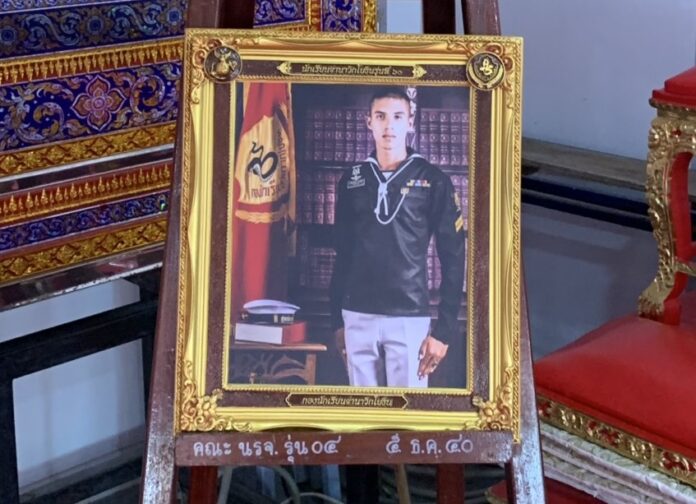
A portrait of Kriangsak Pengpanich is shown at his funeral Thursday.
BANGKOK — A naval Special Forces cadet died in a freak accident while training off the coast of Trat province, the navy said Thursday.
Kriangsak Pengpanich, 22, was swimming Wednesday in the open sea when a carnivorous, shallow-water fish struck him in the neck at high speed, the navy said in a statement. Kriangsak, who served in the marine corps, was pronounced dead at the hospital.
The cadet was undergoing a 60-hour training course to join the Recons, an elite amphibious unit operating under the Navy when he was struck by the needlefish.
A photo released by the navy shows a seaman posing with the needlefish. Image: Wassana Nanuam / Facebook
Although needlefish are not naturally aggressive toward humans, there have been rare cases of fatal encounters, usually involving children.
Marine ecologist Thon Thamrongnawasawat posted online that it’s the first time he had heard of an attack by needlefish in Thailand.
A funeral for Kriangsak will be held through Tuesday in the Sattahip district of Chonburi province.
Kantapong Huadsri was being taken to the Criminal Court Wednesday after police inquiry.
BANGKOK — A police officer who shot and killed a French national Wednesday has been charged and jailed after a court denied his release on bail.
Investigators said former Lumpini police Kantapong Huadsri would be held at the Criminal Court for 12 days pending the outcome into an investigation into charges of murder and weapons-related counts in the death of 41-year-old Djamel Malik Ait Kaki, who was killed inside an office building near BTS Nana yesterday morning.
The 49-year-old former station squad leader has confessed to the crime, police said. He was deemed a flight risk and denied bail. The court said he would not appeal the decision.
Ait Kaki got into a bar brawl over a woman yesterday with Kantapong, who was reportedly angry that he lost the fight. Kantapong followed and shot the victim dead in front of a Dunkin’ Donuts stall in the Trendy Office and Plaza in Soi Sukhumvit 13.
A Lion Air Boeing 737 Max 8 lands in January in Papua province, Indonesia. Image: Raja Video Id / YouTube
DALLAS — The CEO of United Airlines says his pilots don’t need any additional training on the new Boeing jet that is at the center of the investigation into a deadly crash in Indonesia.
Oscar Munoz says that’s because United’s pilots are prepared to respond to problems that might surface with automated systems on modern planes.
“When any trouble arises, our pilots are trained to fly the damn aircraft, period,” Munoz told reporters Wednesday.
He said pilots are taught to disconnect automated systems, fly the plane by hand, and gain altitude to buy time while they trouble-shoot problems. He said the Boeing 737 MAX is safe and reliable.
The remarks were Munoz’s first public comments about the plane since the Oct. 29 Lion Air accident, which killed 189 people when the Boeing 737 MAX plunged into the Java Sea.
Indonesian investigators are examining the role of faulty sensor readings from an anti-stall system that repeatedly pushed the nose of the Lion Air jet down. Information from a preliminary report indicates that the pilots tried to counter the downward pitch and deal with other cockpit warnings but lost control of the plane a few minutes after takeoff.
United, American Airlines and Southwest Airlines all use the new Boeing model, which was first delivered to airlines around the world last year.
Pilots at American and Southwest complained that they were not told about a new feature that could push the nose of the plane down automatically based on a sensor measurement. The pilots’ union at American has asked for additional training on the anti-stall system. American said it has added information about the system to its regular pilot-refresher training.
Munoz’s comments came during a wide-ranging call with reporters in which he announced new international flights from San Francisco, boasted about United’s performance on the stock market this year — its shares are up more than 30 percent while many other airlines stocks are down — and criticized an Italian carrier’s plan to launch more flights to the U.S.
Air Italy is 49 percent owned by Qatar Airways, which United, American and Delta have accused of unfair competition due to heavy subsidies from its government. In January, the Trump administration and Qatar reached an agreement under which Qatar Airways will eventually disclose more details about its finances.
In a side letter to the deal, Qatar Airways said it was not considering new flights to the U.S. from third countries. Munoz said Air Italy’s planned flights from Milan to Los Angeles and San Francisco would violate the agreement and amount to “kind of an in-your-face” to the Trump administration.