30 C
Bangkok
Sunday, June 28, 2026
Home Blog Page 1773

Smiling Buffalo Reunited With Farmer by Anonymous Donor

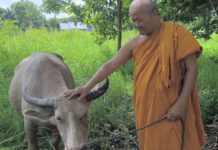
Surat Phaeoket and Tongkum are smiling together again Sunday after being reunited in Chai Nat province. Photo: Smiling Buffalo, A Little Thing Called Happiness. Surat Phaeoket & Tongkum / Facebook

CHAI NAT A buffalo who captured the nation’s heart was back loping around with his friends in sunny, grassy Chai Nat province after an anonymous donor paid a bond for his release from police lockup.

Tongkum, 4, was freed from a pen behind a Bangkok police station and returned to his owner, Surat Phaeoket, as of Sunday.

Tongkum’s ownership has been at the center of a scandal since Surat bought him using donations solicited online after photos of their interspecies friendship won hearts and minds. Boonlert Kanpakdee – Tongkum’s former owner and a small functionary in Chai Nat province, accused Surat of being a beggar and misrepresenting the situation fraudulently. Surat was charged with fraud and money laundering and Tongkum was seized this past Tuesday by Bangkok police.

One high-ranking justice official last week described the case as absurd, noting that Surat had done what he had said he would do with the money – buy the buffalo.

“I don’t know who the good-hearted puu yai was, but they paid the entire 100,000 baht to bail out Tongkum so he can live with me forever now,” Surat said, using a term for a senior and influential person. “I’m so happy. I want to say thanks. I can smile again.”

Tongkum arrived in Chai Nat with Surat last night.

Surat said the case is against him still ongoing. Boonlert has agreed that Tongkum should live with Surat, he said.

Surat said visitors are welcome to visit his small farm, named Farm Hug Bao. Other than its obvious English meaning, farm hug also means “love” in Isaan, and Surat says “bao” is his abbreviation of “buffalo.”

“Anyone can come visit Tongkum. It’s a landmark on Google now,” Surat said.  

The farm is located about a three-hour drive from Bangkok. Those interested in Surat and Tongkum’s adventures can follow either Surat’s personal Facebook or a page he promised to open when he crowdfunded Tongkum: Smiling Buffalo, A Little Thing Called Happiness.

Related stories:

Smiling Buffalo Sliding Into Depression: Farmer Friend

Summoned by Police, Farmer Briefly Reunites with Smiling Buffalo

Farmer Who Bought Smiling Buffalo Charged With Fraud, Money Laundering

Smiling Buffalo Seized by Police, Impounded as Evidence

Smiling Buffalo’s Former Owner Mad as Hell About Crowdfunded Sale

Internet Saves Beautiful Man-Buffalo Friendship

With His ‘Smiley Buffalo’ to be Sold Off, Farmer Needs Internet’s Help

Chai Nat Man’s Lovely Kwai Friendship Warms Hearts

Advertisement

BKK Departure of Bahraini Refugee Footballer Blocked

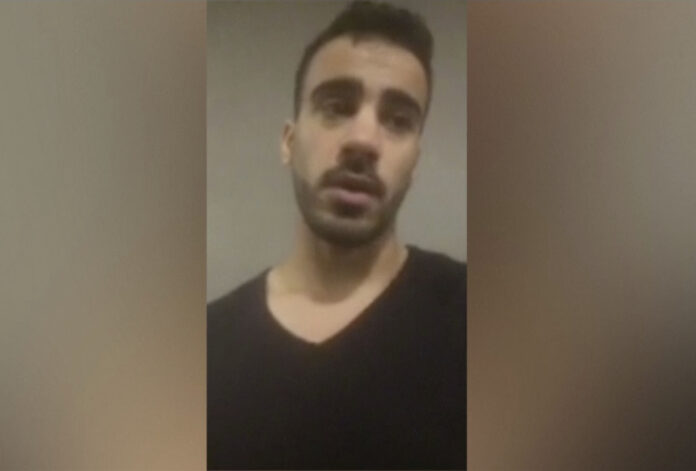
In this Thursday, Nov. 29, 2018, image from video, Hakeem Ali Mohamed Ali AlAraib speaks at Suvarnabhumi Airport, Thailand. Photo: SBS via AP

Update: Bahraini Football Player Moved to Jail Before Extradition Hearing (Video)

BANGKOK — A football player with refugee status was prevented from flying back to Australia last night and is in danger of being deported back to Bahrain where he faces torture and possibly death, a human rights group said Sunday.

Hakeem Ali Mohamed Ali AlAraibi is being detained at Bangkok’s Suan Phlu Immigration Detention Center after he was prevented by Thai authorities from boarding a plane back to Australia, where has lived four years since allegedly being tortured back home.

“We’re worried that Thailand will trade human rights for short term political benefit from Bahrain,” Brad Adams, Asia Director of Human Rights Watch said. “What happens here will be an indication of how seriously Thailand takes human rights it enters the election period.”

AlAlraib was detained at Suvarnabhumi Airport since Tuesday and held in lockup there, Adams said. He was told on Friday that he could go back to Australia and booked a 9:25pm Jetstar flight on Saturday, but was prevented from boarding the flight.

Human Rights Watch said that it was unsure if AlAraib would be deported Sunday.

Both the Australian Embassy and the UNHCR are advocating for AlAraib to be sent back to Australia in a “tug of war” with the Bahrain Embassy, Adams said.

“Under no circumstances should Hakim AlAraibi be sent back to Bahrain by the Thai authorities. This man is a recognized refugee by Australia and there is only one place he should go, which is back to Melbourne and his protected status in Australia,” Adams said.

“Bahrain authorities have clearly targeted Hakeem, manufactured a political case against him and now exerting unjust pressure on Thailand,” he added.

The Bahraini Embassy said in a tweet Saturday night that AlAraibi was “wanted for security cases.”

On Wednesday, Australia’s foreign minister Marise Payne said that AlAraibi is a resettled refugee and that they were aware he was being detained.

According to the London-based Bahrain Institute for Rights and Democracy group, AlAraibi was tortured by Bahrain authorities in 2012 allegedly for his brother’s political activities and public criticism of the Bahraini royal family’s alleged involvement in sports scandals.

“If Hakeem is extradited to Bahrain, he is at great risk of facing torture and unlawful imprisonment. His extradition would constitute to refoulement and therefore would be a clear breach of international law. The UN and Australian authorities must fight to prevent a disastrous outcome,” said Sayed Ahmed Alwadaei, director of the Bahrain Institute for Rights and Democracy.

In 2014 AlAraibi fled to Australia after he was sentenced to a decade in prison for allegedly vandalizing a police station, which he denies.

According to Australia’s SBS, AlAraibi said on Thursday that if returned to Bahrain, he would be killed.

“In Bahrain, they want to kill me,” he said. “I told [Thai Immigration] I [didn’t] come from Bahrain, I have an Australian travel document … Bahrain is not my country now, I live in Australia,” AlAraibi reportedly said.

AlAraibi was a national footballer for Bahrain’s team and is now on Melbourne’s Pascoe Vale Football Club.

Related stories:

Australia Raised Detained Refugee With Thai Authorities

Long Layover: Zimbabwe Family Stuck at BKK Sent to Philippines

Advertisement

Microsoft Overtakes Apple as Most Valuable Public Company

Microsoft CEO Satya Nadella speaks during the annual Microsoft Corp. shareholders meeting on Nov. 28, 2018, in Bellevue, Washington. Photo: Ted S. Warren / Associated Press

REDMOND, Washington — Microsoft’s big bet on cloud computing is paying off as the company has surpassed Apple as the world’s most valuable publicly traded company.

The software maker’s prospects looked bleak just a few years ago, as licenses for the company’s Windows system fell with a sharp drop in sales of personal computers.

But under CEO Satya Nadella, Microsoft has found stability by focusing on software and services over the internet, or the cloud, with long-term business contracts.

That 1990s personal-computing powerhouse is now having a renaissance moment, as it eclipses Facebook, Google, Amazon and the other tech darlings of the late decade.

Apple had been the world’s most prosperous firm since claiming the top spot from Exxon Mobil earlier this decade. Microsoft surpassed Apple briefly a few times this week, but didn’t close on top until Friday, with a market value of $851 billion to Apple’s USD$847 billion. Microsoft hadn’t been at the top since the height of the dot-com boom in 2000.

Microsoft became a contender again in large part because Apple’s stock fell nearly 20 percent in November, while Microsoft hasn’t done any worse than the rest of the stock market. But the fact that it hasn’t done poorly is a reflection of its steady focus on business customers in recent years.

Microsoft lost its luster as people were shunning PCs in favor of smartphones. In 2013, PC sales plunged 10 percent to about 315 million, the worst year-to-year drop ever, according to research firms Gartner and IDC. It didn’t help that Microsoft’s effort to make PCs more like phones, Windows 8, was widely panned.

But a turnaround began when the Redmond, Washington, company promoted Nadella as CEO in 2014. He succeeded Microsoft’s longtime CEO, Steve Ballmer, who initially scoffed at the notion that people would be willing to pay $500 or more for Apple’s iPhones.

That bet paid off. Windows is now a dwindling fraction of Microsoft’s business. While the company still runs consumer-focused businesses such as Bing search and Xbox gaming, it has prioritized business-oriented services such as its Office line of email and other workplace software, as well as newer additions such as LinkedIn and Skype. But its biggest growth has happened in the cloud, particularly the cloud platform it calls Azure. Cloud computing now accounts for more than a quarter of Microsoft’s revenue, and Microsoft rivals Amazon as a leading provider of such services.

Wedbush analyst Dan Ives said Azure is still in its early days, meaning there’s plenty of room for growth, especially considering the company’s large customer base for Office and other products.

“While the tech carnage seen over the last month has been brutal, shares of (Microsoft) continue to hold up like the Rock of Gibraltar,” he said.

Being less reliant on consumer demand helped shield Microsoft from holiday season turbulence and U.S.-China trade war jitters affecting Apple and other tech companies.

President Donald Trump amplified those tariff concerns when he told The Wall Street Journal in a story published late Monday that new tariffs could affect iPhones and laptops imported from China.

The iPhone maker had already seen its stock fall after reporting a mixed bag of quarterly results in early November amid fears about how the technology industry will fare in the face of such threats as rising interest rates, increased government regulation and Trump’s escalating trade war with China.

Apple also spooked investors with an unexpected decision to stop disclosing how many iPhones it sells each quarter. That move has been widely interpreted as a sign that Apple foresees further declines in iPhone sales and is trying to mask that.

While smartphones caused the downturn in personal computers years ago, sales of smartphones themselves have now stalled. That’s partly because with fewer innovations from previous models, more people choose to hold on to the devices for longer periods before upgrading.

Daniel Morgan, senior portfolio manager for Synovus Trust, said Microsoft is outperforming its tech rivals in part because of what it’s not. It doesn’t face as much regulatory scrutiny as advertising-hungry Google and Facebook, which have attracted controversy over their data-harvesting practices. Unlike Netflix, it’s not on a hunt for a diminishing number of international subscribers. And while Amazon also has a strong cloud business, it’s still more dependent on online retail.

Story: Matt O’Brien

Advertisement

George H.W. Bush, Last President of WWII Generation, Dies at 94

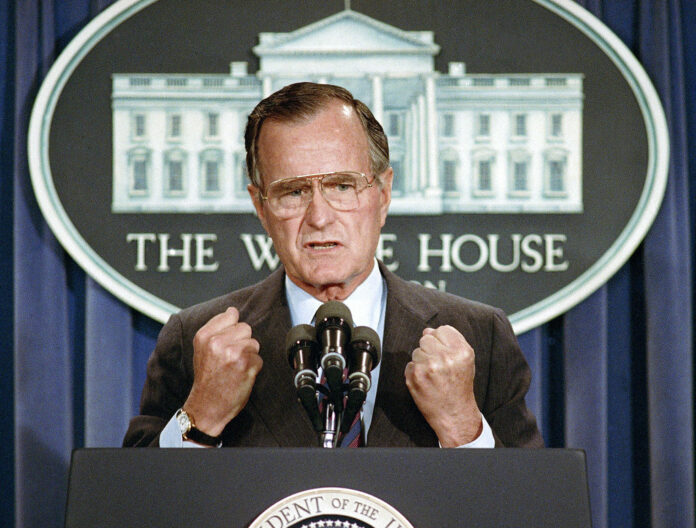
U.S. President George H.W. Bush holds a news conference on June 5, 1989, at the White House in Washington where he condemned the Chinese crackdown on pro-democracy demonstrators in Beijing's Tiananmen Square. Photo: Marcy Nighswander / Associated Press

HOUSTON — George H.W. Bush, a patrician New Englander whose presidency soared with the coalition victory over Iraq in Kuwait, but then plummeted in the throes of a weak economy that led voters to turn him out of office after a single term, has died. He was 94.

The World War II hero, who also presided during the collapse of the Soviet Union and the final months of the Cold War, died late Friday night, said family spokesman Jim McGrath. His wife of more than 70 years, Barbara Bush, died in April 2018.

The son of a senator and father of a president, Bush was the man with the golden resume who rose through the political ranks: from congressman to U.N. ambassador, Republican Party chairman to envoy to China, CIA director to two-term vice president under the hugely popular Ronald Reagan. The 1991 Gulf War stoked his popularity. But Bush would acknowledge that he had trouble articulating “the vision thing,” and he was haunted by his decision to break a stern, solemn vow he made to voters: “Read my lips. No new taxes.”

He lost his bid for re-election to Bill Clinton in a campaign in which businessman H. Ross Perot took almost 19 percent of the vote as an independent candidate. Still, he lived to see his son, George W., twice elected to the presidency — only the second father-and-son chief executives, following John Adams and John Quincy Adams.

After his 1992 defeat, Bush complained that media-created “myths” gave voters a mistaken impression that he did not identify with the lives of ordinary Americans. He decided he lost because he “just wasn’t a good enough communicator.”

Once out of office, Bush was content to remain on the sidelines, except for an occasional speech or paid appearance and visits abroad. He backed Clinton on the North American Free Trade Agreement, which had its genesis during his own presidency. He visited the Middle East, where he was revered for his defense of Kuwait. And he returned to China, where he was welcomed as “an old friend” from his days as the U.S. ambassador there.

He later teamed with Clinton to raise tens of millions of dollars for victims of a 2004 tsunami in the Indian Ocean and Hurricane Katrina, which swamped New Orleans and the Gulf Coast in 2005. During their wide-ranging travels, the political odd couple grew close.

“Who would have thought that I would be working with Bill Clinton, of all people?” Bush quipped in October 2005.

In his post-presidency, Bush’s popularity rebounded with the growth of his reputation as a fundamentally decent and well-meaning leader who, although he was not a stirring orator or a dreamy visionary, was a steadfast humanitarian. Elected officials and celebrities of both parties publicly expressed their fondness.

After Iraq invaded Kuwait in August 1990, Bush quickly began building an international military coalition that included other Arab states. After liberating Kuwait, he rejected suggestions that the U.S. carry the offensive to Baghdad, choosing to end the hostilities a mere 100 hours after the start of the ground war.

“That wasn’t our objective,” he told The Associated Press in 2011 from his office just a few blocks from his Houston home. “The good thing about it is there was so much less loss of human life than had been predicted and indeed than we might have feared.”

But the decisive military defeat did not lead to the regime’s downfall, as many in the administration had hoped.

“I miscalculated,” acknowledged Bush. His legacy was dogged for years by doubts about the decision not to remove Saddam Hussein. The Iraqi leader was eventually ousted in 2003, in the war led by Bush’s son that was followed by a long, bloody insurgency.

George H.W. Bush entered the White House in 1989 with a reputation as a man of indecision and indeterminate views. One newsmagazine suggested he was a “wimp.”

But his work-hard, play-hard approach to the presidency won broad public approval. He held more news conferences in most months than Reagan did in most years.

The Iraq crisis of 1990-91 brought out all the skills Bush had honed in a quarter-century of politics and public service.

After winning United Nations support and a green light from a reluctant Congress, Bush unleashed a punishing air war against Iraq and a five-day ground juggernaut that sent Iraqi forces reeling in disarray back to Baghdad. He basked in the biggest outpouring of patriotism and pride in America’s military since World War II, and his approval ratings soared to nearly 90 percent.

The other battles he fought as president, including a war on drugs and a crusade to make American children the best educated in the world, were not so decisively won.

He rode into office pledging to make the United States a “kinder, gentler” nation and calling on Americans to volunteer their time for good causes — an effort he said would create “a thousand points of light.”

It was Bush’s violation of a different pledge, the no-new-taxes promise, that helped sink his bid for a second term. He abandoned the idea in his second year, cutting a deficit-reduction deal that angered many congressional Republicans and contributed to GOP losses in the 1990 midterm elections.

An avid outdoorsman who took Theodore Roosevelt as a model, Bush sought to safeguard the environment and signed the first improvements to the Clean Air Act in more than a decade. It was activism with a Republican cast, allowing polluters to buy others’ clean-air credits and giving industry flexibility on how to meet tougher goals on smog.

He also signed the landmark Americans with Disabilities Act to ban workplace discrimination against people with disabilities and require improved access to public places and transportation.

Bush failed to rein in the deficit, which had tripled to $3 trillion under Reagan and galloped ahead by as much as $300 billion a year under Bush, who put his finger on it in his inauguration speech: “We have more will than wallet.”

Seven years of economic growth ended in mid-1990, just as the Gulf crisis began to unfold. Bush insisted the recession would be “short and shallow,” and lawmakers did not even try to pass a jobs bill or other relief measures.

Bush’s true interests lay elsewhere, outside the realm of nettlesome domestic politics. “I love coping with the problems in foreign affairs,” he told a child who asked what he liked best about being president.

He operated at times like a one-man State Department, on the phone at dawn with his peers — Mikhail Gorbachev of the Soviet Union, Francois Mitterrand of France, Germany’s Helmut Kohl.

Communism began to crumble on his watch, with the Berlin Wall coming down, the Warsaw Pact disintegrating and the Soviet satellites falling out of orbit.

He seized leadership of the NATO alliance with a bold and ultimately successful proposal for deep troop and tank cuts in Europe. Huge crowds cheered him on a triumphal tour through Poland and Hungary.

Bush’s invasion of Panama in December 1989 was a military precursor of the Gulf War: a quick operation with a resoundingly superior American force. But in Panama, the troops seized dictator Manuel Noriega and brought him back to the United States in chains to stand trial on drug-trafficking charges.

Months after the Gulf War, Washington became engrossed in a different sort of confrontation over one of Bush’s nominees to the Supreme Court. Clarence Thomas, a little-known federal appeals court judge, was accused of sexual harassment by a former colleague named Anita Hill. His confirmation hearings exploded into a national spectacle, sparking an intense debate over race, gender and the modern workplace. Thomas was eventually confirmed.

In the closing days of the 1992 campaign, Bush fought the impression that he was distant and disconnected, and he seemed to struggle against the younger, more empathetic Clinton.

During a campaign visit to a grocers’ convention, Bush reportedly expressed amazement when shown an electronic checkout scanner. Critics seized on the moment, saying it indicated that the president had become disconnected from voters.

Later at a town-hall style debate, he paused to look at his wristwatch — a seemingly innocent glance that became freighted with deeper meaning because it seemed to reinforce the idea of a bored, impatient incumbent.

In the same debate, Bush became confused by a woman’s question about whether the deficit had affected him personally. Clinton, with apparent ease, left his seat, walked to the edge of the stage to address the woman and offered a sympathetic answer.

Bush said the pain of losing in 1992 was eased by the warm reception he received after leaving office.

“I lost in ’92 because people still thought the economy was in the tank, that I was out of touch and I didn’t understand that,” he said in an AP interview shortly before the dedication of his presidential library in 1997. “The economy wasn’t in the tank, and I wasn’t out of touch, but I lost. I couldn’t get through this hue and cry for ‘change, change, change’ and ‘The economy is horrible, still in recession.’

George Herbert Walker Bush was born June 12, 1924, in Milton, Massachusetts, into the New England elite, a world of prep schools, mansions and servants seemingly untouched by the Great Depression.

His father, Prescott Bush, the son of an Ohio steel magnate, made his fortune as an investment banker and later served 10 years as a senator from Connecticut.

George H.W. Bush enlisted in the Navy on his 18th birthday in 1942, right out of prep school. He returned home to marry his 19-year-old sweetheart, Barbara Pierce, daughter of the publisher of McCall’s magazine, in January 1945. They were the longest-married presidential couple in U.S. history. She died on April 17, 2018.

Lean and athletic at 6-foot-2, Bush became a war hero while still a teenager. One of the youngest pilots in the Navy, he flew 58 missions off the carrier USS San Jacinto.

He had to ditch one plane in the Pacific and was shot down on Sept. 2, 1944, while completing a bombing run against a Japanese radio tower. An American submarine rescued Bush. His two crewmates perished. He received the Distinguished Flying Cross for bravery.

After the war, Bush took just 2½ years to graduate from Yale, then headed west in 1948 to the oil fields of West Texas. Bush and partners helped found Zapata Petroleum Corp. in 1953. Six years later, he moved to Houston and became active in the Republican Party.

In politics, he showed the same commitment he displayed in business, advancing his career through loyalty and subservience.

He was first elected to Congress in 1966 and served two terms. President Richard Nixon appointed him ambassador to the United Nations, and after the 1972 election, named him chairman of the Republican National Committee. Bush struggled to hold the party together as Watergate destroyed the Nixon presidency, then became ambassador to China and CIA chief in the Ford administration.

Bush made his first bid for president in 1980 and won the Iowa caucuses, but Reagan went on to win the nomination.

In the 1988 presidential race, Bush trailed the Democratic nominee, Massachusetts Gov. Michael Dukakis, by as many as 17 points that summer. He did little to help himself by picking Dan Quayle, a lightly regarded junior senator from Indiana, as a running mate.

But Bush soon became an aggressor, stressing patriotic themes and flailing Dukakis as an out-of-touch liberal. He carried 40 states, becoming the first sitting vice president to be elected president since Martin Van Buren in 1836.

He took office with the humility that was his hallmark.

“Some see leadership as high drama, and the sound of trumpets calling, and sometimes it is that,” he said at his inauguration. “But I see history as a book with many pages, and each day we fill a page with acts of hopefulness and meaning. The new breeze blows, a page turns, the story unfolds.”

Bush approached old age with gusto, celebrating his 75th and 80th birthdays by skydiving over College Station, Texas, the home of his presidential library. He did it again on his 85th birthday in 2009, parachuting near his oceanfront home in Kennebunkport, Maine. He used his presidential library at Texas A&M University as a base for keeping active in civic life.

He became the patriarch of one of the nation’s most prominent political families. In addition to George W. becoming president, another son, Jeb, was elected Florida governor in 1998 and made an unsuccessful run for the GOP presidential nomination in 2016.

The other Bush children are sons Neil and Marvin and daughter Dorothy Bush LeBlond. Another daughter, Robin, died of leukemia in 1953, a few weeks before her fourth birthday.

Story: Michael Graczyk

Advertisement

Ex-US Official Admits Role in Effort to Get US to Drop 1MDB Probe

Protesters hold portraits of Jho Low illustrated as a pirate in April during a protest in Kuala Lumpur, Malaysia. Photo: Sadiq Asyraf / Associated Press

WASHINGTON — A former Justice Department official admitted his role Friday in a multimillion-dollar effort to try to get the United States to drop its investigation into a money laundering and bribery scheme that pilfered billions from a Malaysian investment fund.

George Higginbotham’s guilty plea in federal court in Washington marked the first public acknowledgement of a secret attempt to pressure American officials to drop their probe of the fund known as 1MDB.

The massive corruption investigation, which upended Malaysian politics, spanned the globe with the money from the fund gambled in Las Vegas, spent on diamond jewelry and a luxury yacht and used to finance the “Wolf of Wall Street” and other Hollywood productions. The long-ruling coalition in Malaysia was ousted in a May election, and then-Prime Minister Najib Razak, who set up the fund, now faces criminal charges there.

Prosecutors say Higginbotham, who worked on the congressional affairs staff in the Justice Department’s Office of Justice Programs, helped open bank accounts and created false loan documents for shell companies to pay an influential person to pressure officials to drop their probe. That person’s identity wasn’t revealed in court.
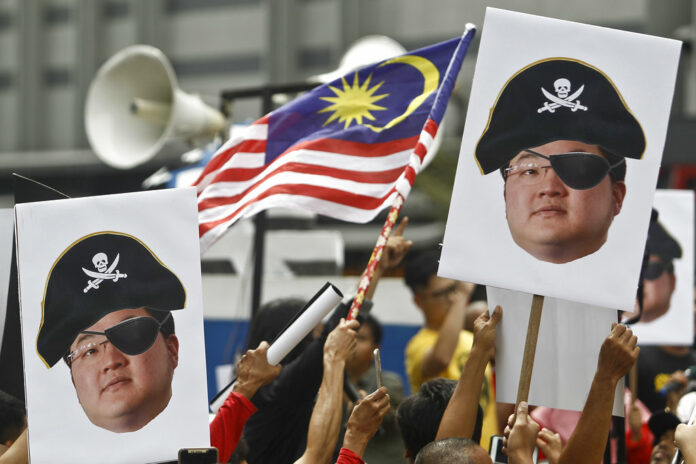
Bloomberg News reports the description in the filings matches Elliott Broidy, a Republican fundraiser and friend of US President Donald Trump, whose leaked emails showed he and his wife were negotiating to represent Jho Low, the architect of the multi-billion dollar looting of Malaysian taxpayers, in getting the US to drop its probe after Trump became president.

Authorities allege that Higginbotham’s efforts were also meant to conceal the involvement of an unidentified co-conspirator, who prosecutors say was an architect of 1MDB and because of that, banks wouldn’t do business with him directly. Higginbotham admitted in court that bank accounts and shell companies were set up in 2017 because the influential person didn’t want to be directly tied to the co-conspirator.

Higginbotham falsely claimed in emails to banks that the money was being used to fund entertainment ventures and failed to disclose that it was, in fact, being used to finance the lobbying effort to shut down the 1MDB investigation, prosecutors said.

Higginbotham also traveled to a foreign country to meet with that co-conspirator and was ultimately paid USD$70,000 for his involvement, authorities said. Higginbotham would not answer questions as he left court Friday.

Authorities say Higginbotham was also part of an effort to try to have a foreign national, who had been critical of his home country and was in the U.S. on a visa, thrown out of America and sent back to his nation of origin. Prosecutors charge that Higginbotham met with the ambassador of that country — which wasn’t identified — and told them he was acting personally and not on behalf of the Justice Department, but that the U.S. government was working on expelling the person.

Higginbotham told the judge that $41 million placed in an escrow account was supposed to be paid out to the politically connected person once the foreign national was removed from the U.S.

U.S. District Judge Colleen Kollar-Kotelly said Higginbotham likely faced a sentence of up to 16 months in federal prison, but said he could also face no jail time. As part of a plea deal, Higginbotham has agreed to testify before grand juries and speak to federal investigators.

Higginbotham pleaded guilty to a charge of conspiracy to make false statements to a bank and was released without bail on Friday. He is due back in court in March.

As part of the 1MDB investigation, the Justice Department on Nov. 1 announced criminal charges against well-connected fugitive Malaysian financier Jho Low and two former Goldman Sachs bankers, accusing them in a money laundering and bribery scheme that pilfered billions of dollars from the fund. In 2016, the Justice Department moved to recover more than $1 billion that it said had been stolen, filing a civil complaint that sought the forfeiture of property, including a Manhattan penthouse, a Beverly Hills mansion, a luxury jet and paintings by Vincent Van Gogh and Claude Monet.

The charges against Higginbotham were first reported by ABC News.

Story: Michael Balsamo

Advertisement

Opinion: Comfortably Numb in Death Race Thailand

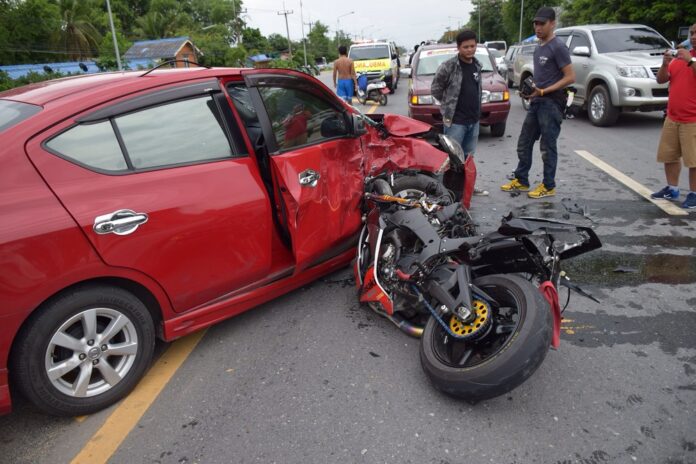
A fatal accident involving a large motorcycle in 2016 in Nakhon Nayok province.

Re•tention: Pravit RojanaphrukLast week I asked a driving instructor from the Land Transport Department why there is no special license required to ride big motorbikes.

Big bikes are motorcycles with 500cc engines or larger, and are very powerful beasts that can be difficult to control in unexpected road situations.

His answer was that the government would face strong resistance, particularly from influential motorcycle vendors, making it impossible to push through such a license – which exists in more safety-conscious societies such as Japan.

Don’t get him wrong. This veteran instructor, whose job is to represent the department in giving five-hour theory lectures to Thai students wanting to obtain driver’s licenses, believes there’s a need for a special license for big bike owners.

But he’s resigned to the scenario that this will only happen after big bike-related death tolls become so evident and appalling that there’s enough public outcry to push legislation through.

True enough, just days after I heard the above assessment, I read in local newspapers of two fatal accidents involving big bikes had occurred.

The more gory involved a 23-year-old biker who raced to his death after apparently hitting a concrete curve at Yommaraj Bridge in Bangkok. The rider was thrown off the bike and hit a rail – his body was nearly cut in two and his intestines burst from his abdomen, splattering across the asphalt.

Don’t get me wrong, I have nothing personal against big bikes, it’s just that one ought to be especially skilled to control such powerful beasts with close to – or even over – 100cc horsepower.

Ordinary bikes can be a menace too, particularly in Thailand where riding on footpaths to evade traffic jams is common.

People still seemed to have no qualms until Monday – less than 14 hours after the first big bike death – a 16-year-old secondary school girl in uniform was hospitalized after a motorcycle struck her on a sidewalk in Bangkok’s Lat Phrao area.

Riding bikes on the sidewalk is definitely illegal – but absolutely common in Thailand, where the number of deaths due to traffic accidents are among the highest in the world. It exemplifies the serious lack of law enforcement and safety.

Even if enforced, the Bangkok Metropolitan Administration would only fine the offending biker, 23-year-old Phuwadon Srisamrong, 500 baht. After an “uproar,” City Hall on Wednesday raised the fine to 1,000 baht.

I, however, think his driving license should be revoked for years – if not for life.

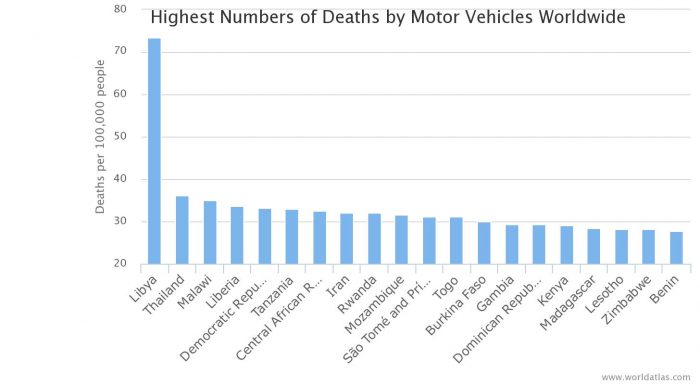
The World Atlas website has Thailand’s roads the second most deadliest in the world behind Libya, with about 22,000 killed in 2016. That’s more than 50 people killed every day.It’s like watching a never-ending, slow-motion train wreck – except it actually happens quite fast.

And society just accepts it a fated inevitability.

You can literally check the real-time body count at Thai Road Safety Culture. It has 42 people killed Friday, with 3,047 injured. Eighteen have died since this morning and the time this column was published before noon.

Where is the real uproar? Where is the commitment to really do something about the tens of thousands killed every year? I really don’t see it and would be surprised if any of the political parties now competing can offer anything comprehensive and achievable.

chart e1543639588101

Significantly reducing traffic-related deaths ought to be the national agenda of any government. Things such as the fact that driving license tests don’t include assessing ability on real road conditions ought to be reconsidered. The 10-hour mandatory field driving lessons ought to also be lengthened to 15 or 20 hours like in some other countries.

Alas, it seems Thai society has gotten too used to it – to the point where many merely accept road deaths as an unalterable fact of life – just like the official driving instructor, who believes only an uproar produced by the mounting traffic death toll could change the law.

Advertisement

Parties Fume Over New ‘Gerrymandered’ Electoral Map

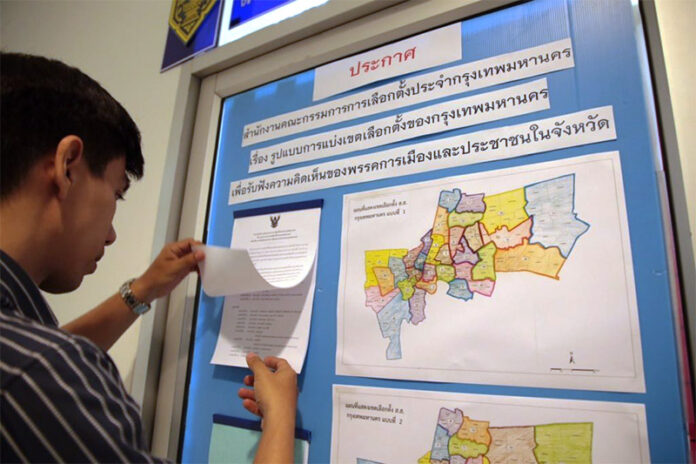
Electoral district documents on display Oct. 4 at a press briefing by the Election Commission.

BANGKOK — Political parties are angry about a redrawn electoral map of Thailand they say has been gerrymandered to boost the prospects of pro-junta parties.

Both major political parties, Pheu Thai and Democrat, said the new constituency map revealed Thursday increases the fortunes of parties such as Palang Pracharat Party – which supports the military government – in several provinces. One politico warned of a backlash.

“I am confident in people’s decision-making, that they will restore justice through elections when the electoral power is in the hands of the people… I believe in the power of the people,” said Phumtham Wechayachai, Pheu Thai secretary general.

Read: 150+ Politicos Defect to New Pro-Junta Party

Over the weeks, the Election Commission has repeatedly denied favoring any political party and insisted on its independence – despite all being appointed by the junta’s rubber-stamp parliament. Junta leader Gen. Prayuth Chan-ocha exercised his absolute power on Nov. 17 to allow the commission to rewrite the maps just before it was to release them.

That fueled allegations of last-minute interference to benefit pro-junta parties.

Sampan Tangbenjapol, a former MP for the Democrat Party in Sukhothai province, accused the Election Commission on Thursday of aiding pro-junta parties by redistricting the province he represented before the coup.

He questioned in an online post how the commission came up with a new, fourth version when only three had previously been under consideration for the province. He asked why changes were needed when the population number in the province hadn’t really changed.

“It is just the beginning but already there’s a lack of transparency,” Sampan said.

They say the new voting divisions published in the Royal Gazette show constituencies suspiciously redrawn in a number of provinces, particularly Ubon Ratchathani, Sukhothai and Nakhon Ratchasima.

Though no one mentioned Palang Pracharat by name, it was understood they referred to the party, which includes at least four members of the ruling junta’s cabinet and has enticed other parties’ members to join.

Phumtham said Friday some districts were split into four or five constituencies after local politicians there defected to Palang Pracharat in those provinces.

Put to the question, deputy junta leader Prawit Wongsuwan said Friday that he didn’t know if the new map favors pro-junta parties.

“Oh! How would I know?” Gen. Prawit said, adding that every party wants to gain from the map.

Also casting doubt on Sukhothai’s new map was Ratchada Thanadirek, a Democrat who represented Bangkok.

“Did they have to do this much in order to gain victory? … Malaysia also did gerrymandering, but [the ruling party] ended up losing nonetheless,” she wrote online, referring to this year’s toppling of the increasingly authoritarian Najib Razak by 93-year-old Mahathir Mohamad.

Issara Somchai, a Democrat in Ubon Ratchathani, also cried foul. He said two former electoral constituencies, the Muang Sam Sip and Khueang Nai districts, were folded into one.

This, Issara said Thursday, forces his party to choose which of its two former district MPs to put forward in the election now slated for late February.

“We will lose one MP seat as a result,” Issara said. “I personally think the districts are large and ought to be separated. They shouldn’t have been merged. Doing things this way, the Democrat Party stands to lose a lot of opportunities in Ubon Ratchathani… I really don’t know the intent of the commission.”

Advertisement

113 Inmates Escape Indonesian Prison During Prayer Time

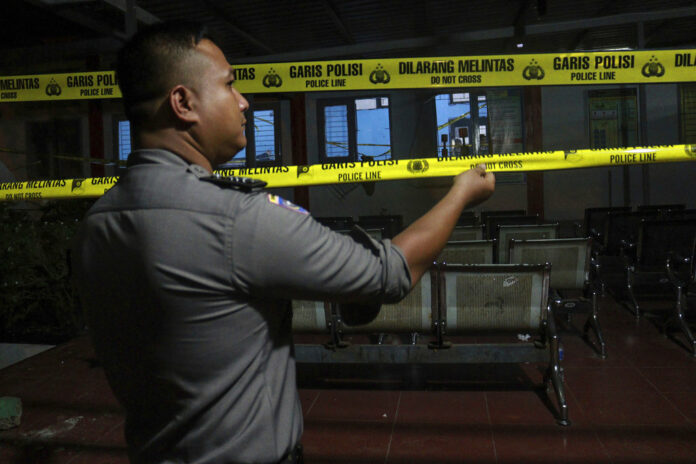
A police officer puts up police lines Thursday outside Lambaro Prison following a jailbreak in Aceh Besar, Indonesia. Photo: Hendri Abik / Associated Press

BANDA ACEH, Indonesia — More than 100 inmates escaped from a prison in western Indonesia after overpowering a guard during prayer time, police said Friday.

The break occurred late Thursday at the Lambaro penitentiary when all 720 inmates were let out of their cells to take part in evening prayers, said Trisno Riyanto, police chief in Banda Aceh, the capital of Aceh province.

He said that the inmates, who were mostly convicted of drug charges and apparently had planned their escape in advance, cut through the wire and iron bars using barbells and crowbars in the reception room and made a dash through rice fields in front of the prison.

The guard’s injuries were not serious, police said.

At least 26 prisoners have been recaptured and police set up roadblocks across Banda Aceh to search for the 87 others.

Aceh provincial police chief Rio Septianda Djambak called on the escaped prisoners to surrender within three days and urged their relatives to support authorities in bringing them back.

“We will not hesitate to take firm action to force them to obey the law,” Djambak said.

Jailbreaks are common in Indonesia, where overcrowding has become a problem in prisons that are struggling to cope with poor funding and an influx of people arrested in a war on drugs. Most prisoners have been convicted of drug charges.

Last year, more than 440 prisoners escaped from a penitentiary in neighboring Riau province when they also took advantage of Friday Muslim prayers. In July 2013, about 240 prisoners, including several convicted terrorists, escaped during a deadly riot at a prison in Medan, the capital of North Sumatra province.

Advertisement

Vietnam Sentences 9 to Death for Heroin Trafficking

A public service announcement by the Cam Chau Ward People's Committee reads
A public service announcement by the Cam Chau Ward People's Committee reads "Youth, please stay away from drugs" in Vietnamese in 2014 in Vietnam. Photo: lightwrite / Flickr

HANOI — A court in northern Vietnam has sentenced nine people including three women to death after finding them guilty of heroin trading and possession.

Three others were given life sentences while the court in Ha Nam province, 60 kilometers (38 miles) south of Hanoi, handed down jail terms between 12 to 20 years to nine others on the same charges at the end of the five-day trial Friday.

The official Vietnam News Agency says they were convicted of trading and possessing nearly 19 kilograms (42 pounds) of heroin between June 2016 and March 2017.

Vietnam has one of toughest drug laws in the world where trafficking 100 grams of heroin or 600 grams of opium is punishable by death.

Advertisement

Australia Raised Detained Refugee With Thai Authorities

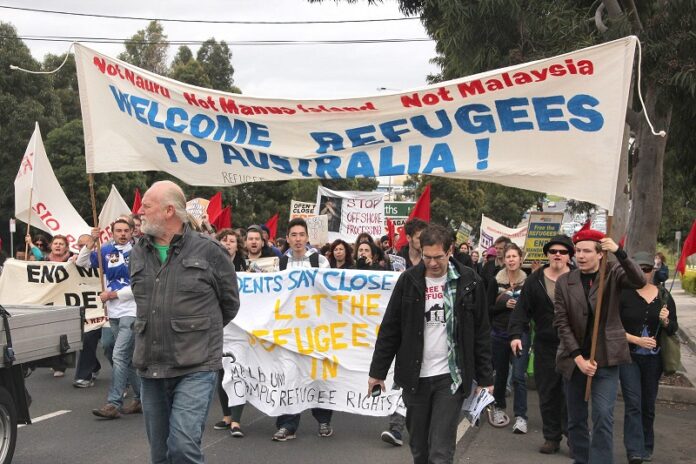
People rally in 2013 outside the Broadmeadows Melbourne Immigration Transit Accommodation (MITA) Centre, advocating for the acceptance of refugees in Melbourne, Australia. Photo: Takver / Flickr

MELBOURNE, Australia — Australian officials have raised with Thai authorities the plight of an Australia-based refugee professional soccer player who was detained in Bangkok and fears deportation to his native Bahrain, Australia’s foreign minister said Friday.

Rights groups are urging Thai authorities not to deport Hakeem Ali Mohamed Ali AlAraib to his homeland, where he faces imprisonment for what his supporters say are political reasons. AlAraib was detained at a Bangkok airport on Tuesday.

Australian Foreign Minister Marise Payne said AlAraib, 25, was accepted as a refugee and resettled in the Australian city of Melbourne last year, but is not an Australian citizen. Australia can demand consular access to its citizens detained overseas.

“He’s not an Australian citizen … and he’s also traveling on U.N. papers. So we have raised that matter. Our post in Thailand is aware of it and is following up on that,” Payne told a reporter at a Sydney foreign policy think tank.

Payne did not directly respond when asked whether AlAraib is at risk of being deported to Bahrain.

Her department later said in a statement that Australian embassy officials in Bangkok were in direct contact with Thai authorities regarding AlAraib. The department would not make further comment due to privacy obligations.

The Bahrain Institute for Rights and Democracy says AlAraib was tortured after a 2012 arrest and fled in 2014 to Australia, which granted him political asylum. He had played for Bahrain’s national soccer team and now plays for Melbourne’s Pascoe Vale Football Club. He has been publicly critical of Bahrain’s royal family’s alleged involvement in sports scandals.

The London-based group says AlAraib was detained at the Bangkok airport on the basis of an Interpol notice issued at Bahrain’s request that says he is sought because he was sentenced in absentia in 2014 to 10 years in prison for allegedly vandalizing a police station, a charge he denies. He says he was playing a match that was televised live when the alleged crime occurred, but when his family reached out to Bahrain’s soccer association to confirm his alibi, their requests went unanswered.

Rights groups say the Interpol Red Notice – which is a request to locate and provisionally arrest an individual pending extradition – violates the international police organization’s policy that such notices will not be issued “if the status of refugee or asylum-seeking has been confirmed.”

No comment was immediately available from Thai officials.

Australia’s SBS News said AlAraib told them on Thursday that he fears being returned to Bahrain.

“It’s very dangerous there (for me). … In Bahrain, they want to kill me,” he said. “I told (Thai Immigration) I (didn’t) come from Bahrain, I have an Australian travel document … Bahrain is not my country now, I live in Australia.”

Story: Rod McGuirk

Advertisement

Hot News

LATEST NEWS

Bangkok
overcast clouds
30 ° C
31.6 °
30 °
75 %
4.7kmh
100 %
Sun
31 °
Mon
33 °
Tue
33 °
Wed
31 °
Thu
29 °