





























26.1 C
Bangkok
Saturday, June 20, 2026
Home Blog Page 1792

Jeff Sessions Resigns After a Year of Attacks From Trump

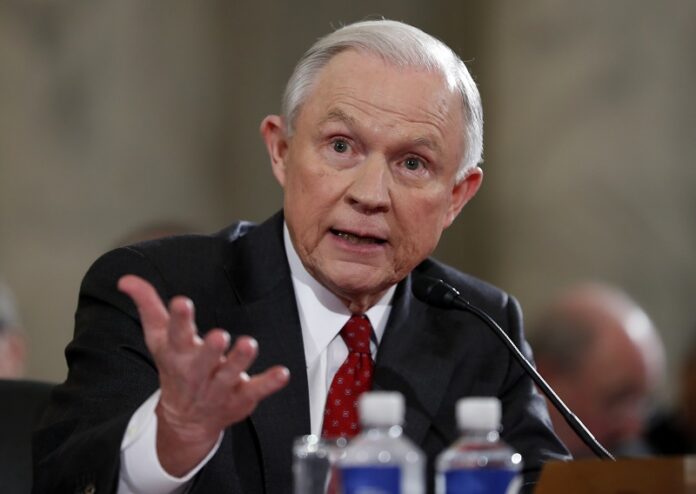
Attorney General-designate, Sen. Jeff Sessions, R-Ala., testifies in January on Capitol Hill in Washington. Photo: Alex Brandon / Associated Press

WASHINGTON — United States Attorney General Jeff Sessions was pushed out Wednesday after enduring more than a year of blistering and personal attacks from President Donald Trump, who inserted in his place a Republican Party loyalist with authority to oversee the remainder of the special counsel’s Russia investigation.

The move has potentially ominous implications for special counsel Robert Mueller’s probe given that the new acting attorney general, Matthew Whitaker, until now Sessions’ chief of staff, has questioned the inquiry’s scope and spoke publicly before joining the Justice Department about ways an attorney general could theoretically stymie the investigation.

Congressional Democrats, concerned about protecting Mueller, called on Whitaker to recuse himself from overseeing the investigation in its final but potentially explosive stages.

That duty has belonged to Deputy Attorney General Rod Rosenstein, who appointed Mueller and closely monitors his work.

The resignation, in a one-page letter to Trump, came one day after Republicans lost control of the House of Representatives and was the first of several expected post-midterms Cabinet and White House departures. Though Sessions was an early and prominent campaign backer of Trump, his departure letter lacked effusive praise for the president and made clear the resignation came “at your request.”

“Since the day I was honored to be sworn in as attorney general of the United States, I came to work at the Department of Justice every day determined to do my duty and serve my country,” Sessions wrote.

The departure was the culmination of a toxic relationship that frayed just weeks into Sessions’ tenure, when he stepped aside from the Russia investigation because of his campaign advocacy and following the revelation that he had met twice in 2016 with the Russian ambassador to the U.S.

Trump blamed the recusal for the appointment of Mueller, who took over the Russia investigation two months later and began examining whether Trump’s hectoring of Sessions was part of a broader effort to obstruct the probe.

The investigation has so far produced 32 criminal charges and guilty pleas from four former Trump aides. But the work is not done and critical decisions await that could shape the remainder of Trump’s presidency.

Mueller’s grand jury, for instance, has heard testimony for months about Trump confidant Roger Stone and what advance knowledge he may have had about Russian hacking of Democratic emails. Mueller’s team has also been pressing for an interview with Trump. And the department is expected at some point to receive a confidential report of Mueller’s findings, though it’s unclear how much will be public.

Separately, Justice Department prosecutors in New York secured a guilty plea from Trump’s former personal lawyer, Michael Cohen, who said the president directed him to arrange hush-money payments before the 2016 election to two women who said they had sex with Trump.

Trump had repeatedly been talked out of firing Sessions until after the midterms, but he told confidants in recent weeks that he wanted Sessions out as soon as possible after the elections, according to a Republican close to the White House who was not authorized to publicly discuss private conversations.

The president deflected questions about Sessions’ expected departure at a White House news conference Wednesday. He did not mention that White House chief of staff John Kelly had called Sessions beforehand to ask for his resignation. The undated letter was then sent to the White House.

The Justice Department did not directly answer whether Whitaker would assume control of Mueller’s investigation, with spokeswoman Sarah Isgur Flores saying he would be “in charge of all matters under the purview of the Department of Justice.”

Rosenstein remains at the department and could still be involved in oversight. He has previously said that he saw no basis for firing Mueller. Trump said Wednesday that he did not plan to stop the investigation.

Without Sessions’ campaign or Russia entanglements, there’s no legal reason Whitaker couldn’t immediately oversee the probe. And since Sessions technically resigned instead of forcing the White House to fire him, he opened the door under federal law to allowing the president to choose his successor instead of simply elevating Rosenstein, said University of Texas law professor Stephen Vladeck.

“Sessions did not do the thing he could have done to better protect Rosenstein, and through Rosenstein, the Mueller investigation,” Vladeck said.

That left Whitaker in charge, at least for now, though Democrats, including Rep. Nancy Pelosi and Sen. Chuck Schumer, said he should recuse himself because of his comments on the probe. Rep. Jerry Nadler, the top Democrat on the House Judiciary Committee, said he wants “answers immediately” and “we will hold people accountable.”

Whitaker, a former U.S. attorney from Iowa who twice ran unsuccessfully for statewide office and founded a law firm with other Republican Party activists, once opined about a scenario in which Trump could fire Sessions and then appoint an acting attorney general who could stifle the funding of Mueller’s probe.

In that scenario, Mueller’s budget could be reduced “so low that his investigation grinds to almost a halt,” Whitaker said during an interview with CNN in July 2017 before he joined the Justice Department.

In a CNN op-ed last year, Whitaker wrote, “Mueller has come up to a red line in the Russia 2016 election-meddling investigation that he is dangerously close to crossing.”

Trump’s relentless attacks on Sessions came even though the Alabama Republican was the first U.S. senator to endorse Trump and despite the fact his crime-fighting agenda and priorities, particularly his hawkish immigration enforcement policies, largely mirrored the president’s.

He found satisfaction in being able to reverse Obama-era policies that conservatives say flouted the will of Congress, encouraging prosecutors to pursue the most serious charges they could and promoting more aggressive enforcement of federal marijuana law.

He also announced media leak crackdowns and tougher policies against opioids, and his Justice Department defended a since-abandoned administration policy that resulted in migrant parents being separated from their children at the border.

But the relationship was irreparably damaged in March 2017 when Sessions, acknowledging previously undisclosed meetings with the Russian ambassador and citing his work as a campaign aide, recused himself from the Russia investigation.

Trump repeatedly lamented that he would have never selected Sessions if he had known the attorney general would recuse himself. The recusal left the investigation in the hands of Rosenstein, who appointed Mueller two months later after Trump fired then-FBI Director James Comey.

In piercing attacks, Trump called Sessions weak and beleaguered, complained that he wasn’t more aggressively pursuing allegations of corruption against Democratic rival Hillary Clinton and called it “disgraceful” that Sessions wasn’t more serious in scrutinizing the origins of the Russia investigation for possible law enforcement bias – even though the attorney general did ask the Justice Department’s inspector general to examine those claims.

The broadsides escalated in recent months, with Trump telling an interviewer that Sessions “never had control” of the Justice Department.

Sessions endured most of the name-calling in silence, though he did issue two public statements defending the department, including one in which he said he would serve “with integrity and honor” for as long as he was in the job.

Sessions, who likely suspected his ouster was imminent, was spotted by reporters giving some of his grandchildren a tour of the White House over the weekend. He did not respond when asked why he was there.

Story: Eric Tucker, Michael Balsamo

Advertisement

Boeing Warns 737 Max May Plunge Due to Error After Lion Air Crash

A Lion Air passenger jet takes off from Juanda International Airport in Surabaya, Indonesia, in a 2012 file photo. Photo: Trisnadi

JAKARTA — Boeing Co. says it has issued a safety bulletin that reiterates guidelines on how pilots should respond to erroneous data from an “angle of attack” sensor following last week’s crash of a Boeing plane in Indonesia that killed 189 people.

The airplane manufacturer said in a statement Wednesday that Indonesia’s National Transportation Safety Committee has indicated the crashed Boeing 737 MAX 8 plane had “erroneous input from one of its AOA sensors.”

The angle of attack sensor keeps track of the angle of the aircraft nose relative to oncoming air to prevent the plane from stalling and diving.

Boeing said it is continuing to work with the Indonesian investigation into the Oct. 29 crash.

Indonesian investigators on Monday said an airspeed indicator had malfunctioned on the plane’s last four flights.

Advertisement

Asian Shares Closed Mixed After US Midterm Elections

Specialist Meric Greenbaum, center, works with traders at his post in May on the floor of the New York Stock Exchange. Photo: Richard Drew / Associated Press

NEW YORK — Share prices have closed mixed in Asia with several major regional benchmarks giving up early gains.

The retreat Wednesday followed results from U.S. midterm elections that were no surprise but raised the prospect for greater uncertainty as the opposition Democrats regained a majority in the House of Representatives.

Japan’s Nikkei 225 index lost 0.3 percent to 22,085.80 while Hong Kong’s Hang Seng index yoyo’d back into positive territory, adding 0.1 percent to 26,147.69. The Kospi in South Korea lost 0.5 percent to 2,078.69 and the Shanghai Composite index skidded 0.7 percent to 2,641.34. Australia’s S&P ASX 200 added 0.4 percent to 5,896.90 and shares also rose in Taiwan, Singapore and Indonesia.

Shares in Thailand traded at 1,675.33, a 0.4 percent gain.

Advertisement

Thailand’s Ironies Churn in Joan Cornella’s Bangkok Return

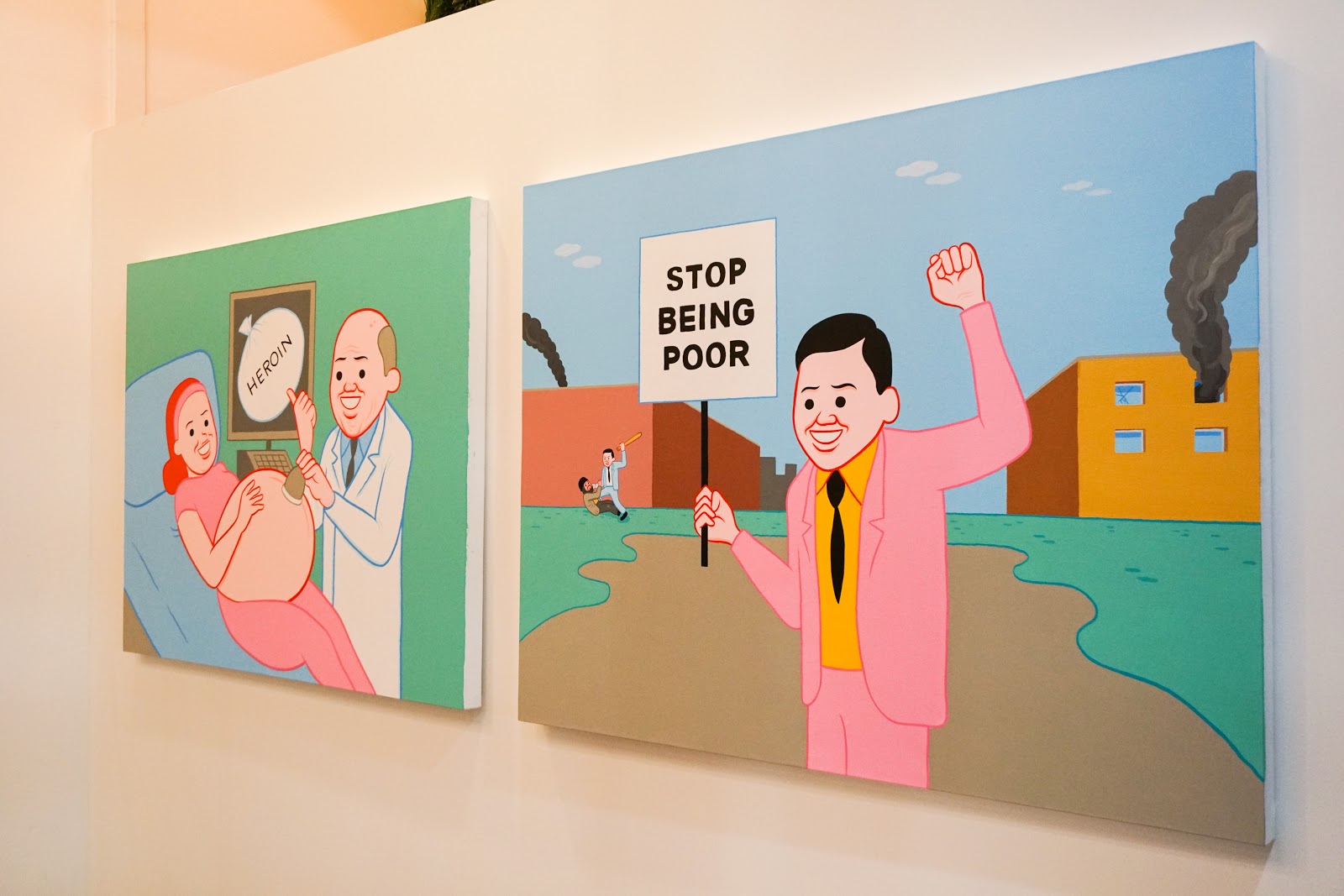
BANGKOK — Rather than help, a voyeur uses a camera app to put a floppy tongue and dog ears on a dying man’s face. Behind him, smoke belches from the green-and-yellow taxi that may have hit him.

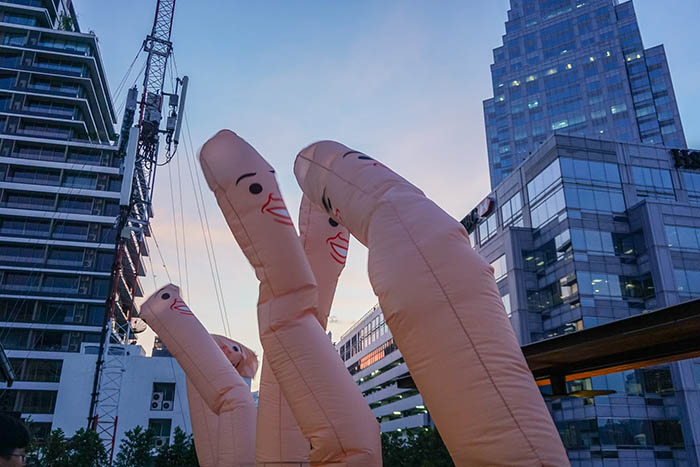
That Bangkok’s unique ironies have entered the vocabulary of illustrator Joan Cornella is evident. Having spent months now in what’s become a favorite city, the Spanish cartoonist includes that gruesome scene among others from his dark imagination in an exhibition opening here Thursday.

It’s his second Bangkok show in as many years.

Known for tackling every taboo and human foible; from cannibalism, suicide and drug use to terrorism; the Barcelonian is back for his second solo exhibition under the name Happy Endings.

Read: ‘Happy Endings’ Take a Grim Turn When Joan Cornella Returns

Courtesy Joan Cornella

Having spent several months in Thailand since last year, the 37-year-old artist said he has learned to speak Thai nid noi while discovering his favorite capital city haunts for distracting him from work (though he won’t name them).

After preparing the show on the rooftop of the Woof Pack Building on Soi Sala Daeng 1, Cornella talked to Khaosod English about his work and life behind the canvas. The lightly edited conversation follows.

Chayanit Itthipongmaetee: How was your first solo exhibition in Bangkok last year?

Joan Cornella: It was really crowded. Pretty, pretty packed all the time. I didn’t expect that amount of people. I constantly have feedback from my audience. I have to say in Asia, the reception of my work is really good. [The audience] is more enthusiastic, more keen, comparing to those in Western countries. Most of my fan base is in Hong Kong. I tell that all the time. I don’t know why. I guess I’ll find out some day.

Chayanit: What have you learned about Bangkok?

corn6Cornella: Last year I was in Bangkok three months. First I came and worked for awhile, for like one month, then the exhibition started, and I decided to stay longer.

You know, compared to many other capital cities, I think Bangkok is a lot more relaxing. Usually when I travel, I go to capital cities … they’re pretty crowded and congested. Even when Bangkok can be like that, it’s also chill. It’s good.

For this year, I’ve been here one month. (So you can speak some Thai?) Sabai dee mai krub! Nid noi. I think I’m lazy. I speak English, and it’s convenient enough.

As far as I know, Thailand is a pretty unstable country in terms of politics. Most of my friends are from Catalonia, so the news I get is mostly from where I come from. But yeah, the more time I live here, the more things I know. Last year, I actually didn’t know about the coup d’etat, about Thailand having a dictator in charge. I didn’t know the situation was pretty unstable.

Thailand is usually known as a country where people go to the beach and have fun. In the beginning it was like that. And then I knew about the muslims in the south. I even knew about the ethnic group in the north; I hear that they are not considered Thais. I didn’t spend much time, but people start to tell you. I went up to Chiang Mai, they say it’s supposed to be related to the arts. In a historic way, I guess that’s true, as far as I saw. I think to know a place, to be aware of a place, you need time. For me, I don’t want to be a tourist. I prefer to spend more time there.

Chayanit: What about the exhibition, ‘Happy Endings’?

Cornella: I came up with this name with the help of [event organizer] Farm Group. I mean my works are somehow related to the happy endings from Hollywood, because the actors are always happy with their smiles and so on. For some people, it’s really positive. But some others, they just despite that.

cornella3I did like 40 new works made in Thailand, but it doesn’t mean all of them are directly related to Thailand. I prefer that my work has a meaning that can be understood wherever you go, but it’s true also that if you show something that is related to the place … it makes more sense. I think I could work on that more. It’s not just because people can have more fun – they can feel related to their lives or their experiences – but also because you try to do something related to the place, trying to understand how the place works. It’s like a political activism, you know. I prefer to do it gradually, not radically.



Chayanit: What have you seen in Bangkok that has influenced your work?

cornella2

Cornella: Maybe I try to find a connection between my work and what I see. I work mostly with fictions. I try to put a few ingredients from what I saw into my work, but not the opposite way. When I went to China, people told me there were many news that can be related to my work somehow, in a sense that people are getting more cynical. And you can find that in many aspects all around the planet. In Thailand, you have the same thing. Lots of people lost their sensitivities, their human side … they care less about politics and many other things. In Thailand you see specific things that you cannot find in any other places, but at the end it’s more or less the same almost everywhere. We have this resilience related to internet and so on, our lives are going faster and faster, we don’t care about our lives somehow. We just live without thinking what we’re doing is right or wrong.

Chayanit: Do you have to be careful when producing work?

Cornella: It depends on the moment. For some people, they just have this approach which is literal, sometimes they just don’t even know what irony is. There comes a problem, they say, “You’re being racist” or “You’re transphobic” or whatever shit they think about. And they decide that you shouldn’t talk about that. They censor you or they try to censor you.

I would say, now, I don’t care what people say or think, more or less. Sometimes, you get some feedback and that’s a pressure. One day I posted a comic strip related to suicide, and this guy happened to kill himself. I don’t remember his name. And people went like, “Oh what’s going on? You should wait.” “You should show respect.” I didn’t even know. And what if I knew? This is my voice here.

cornellahed2


cornella4cornshow

Happy Endings’ runs Thursday through Dec. 3 at Woof Pack in Soi Sala Daeng 1. Tickets are 200 baht and can be booked online. Woof Pack is open from 10am to 11pm daily. The gallery is a 10-minute walk from MRT Silom and Lumphini or BTS Sala Daeng.

Advertisement

Hanoi Announces Formula One Street Race Starting 2020

Mercedes driver Valtteri Bottas of Finland steers his car during the Malaysian Formula One Grand Prix at the Sepang International Circuit Sunday in Sepang, Malaysia. Photo: Vincent Thian / Associated Press

HANOI — Formula One and Hanoi officials say a street race in the Vietnamese capital will be added to the F1 calendar starting with the 2020 season.

In a statement Wednesday, F1 officials said the race is planned for a 5.565-kilometer street circuit. The race in Vietnam will join other stops in the Asia-Pacific region that include Japan, China, Singapore, and Australia.

The statement gave few details about the race, nor where it would fit on the calendar. It said Hanoi promoter Vingroup had signed a multi-year deal, but gave no specifics about the deal or the level of government support.

Formula One has 21 races listed on a tentative calendar for 2019.

The 2018 season has two races to go, in Sao Paulo and Abu Dhabi.

Advertisement

Facebook Blocks 115 Accounts Ahead of US Midterm Elections

Mark Zuckerberg speaks during a keynote address in 2008. Photo: Brian Solis / Flickr

Facebook said it blocked 115 accounts for suspected “coordinated inauthentic behavior” linked to foreign groups attempting to interfere in Tuesday’s U.S. midterm elections.

The social media company shut down 30 Facebook accounts and 85 Instagram accounts and is investigating them in more detail, it said in a blog post late Monday.

Facebook acted after being tipped off Sunday by U.S. law enforcement officials. Authorities notified the company about recently discovered online activity “they believe may be linked to foreign entities,” Facebook’s head of cybersecurity policy, Nathaniel Gleicher, wrote in the post.

U.S. tech companies have stepped up their work against disinformation campaigns, aiming to stymie online troublemakers’ efforts to divide voters and discredit democracy. Facebook’s purge is part of countermeasures to prevent abuses like those used by Russian groups two years ago to sway public opinion ahead of the 2016 U.S. presidential election.

The company based in Menlo Park, California, has been somewhat regularly disclosing such purges in recent months, most recently in October. More are likely going forward since, even as its systems get better at detecting and removing malicious accounts, the bad actors are sharpening their attacks, too.

Gleicher said Facebook will provide an update once it learns more, including whether the blocked accounts are linked to the Russia-based Internet Research Agency, or other foreign entities.

Almost all of the Facebook pages associated with the blocked accounts appeared to be in French or Russian. The Instagram accounts were mostly in English and were focused either on celebrities or political debate. No further details were given about the accounts or suspicious activity.

Also on Monday, Facebook acknowledged that it didn’t do enough to prevent its services from being used to incite violence and spread hate in Myanmar. Alex Warofka, a product policy manager, said in a blog post that Facebook “can and should do more” to protect human rights and ensure it isn’t used to foment division and spread offline violence in the country.

Last month, Facebook removed 82 pages, accounts and groups tied to Iran and aimed at stirring up strife in the U.S. and the U.K. It carried out an even broader sweep in August, removing 652 pages, groups and accounts linked to Russia and Iran.

Twitter, meanwhile, has said it has identified more than 4,600 accounts and 10 million tweets, mostly affiliated with the Internet Research Agency, which was linked to foreign meddling in U.S. elections, including the presidential vote of 2016. The agency, a Russian troll farm, has been indicted by U.S. Special Counsel Robert Mueller for its actions during the 2016 vote.

Facebook, Twitter and other companies have been fighting misinformation and election meddling on their services for the past two years. There are signs they’re making headway, although they’re still a very long way from winning the war.

Facebook, in particular, has reversed its stance of late 2016, when CEO Mark Zuckerberg dismissed as “pretty crazy” the notion that fake news on his service could have swayed the presidential election.

In July, for instance, the company said that its spending on security and content moderation, coupled with other business shifts, would hinder its growth and profitability. Investors expressed their displeasure by knocking $119 billion off Facebook’s market value.

One problem is that it’s not just agents from Russia and other nations who are intent on sharing misinformation and propaganda. There is plenty of homegrown fake news too, whether in the U.S. or elsewhere.

Still, Facebook is seeing some payoff, and not just with the accounts it has been able to find and take down. A recent research collaboration between New York University and Stanford found that user “interactions” with fake news stories on Facebook, which rose substantially in 2016 during the presidential campaign, fell significantly between the end of 2016 and July 2018. On Twitter, however, the sharing of such stories continued to rise over the past two years.

Story: Kelvin Chan, Barbara Ortutay

Advertisement

Malaysia Court to Resume Kim Jong Nam Murder Trial Jan. 7

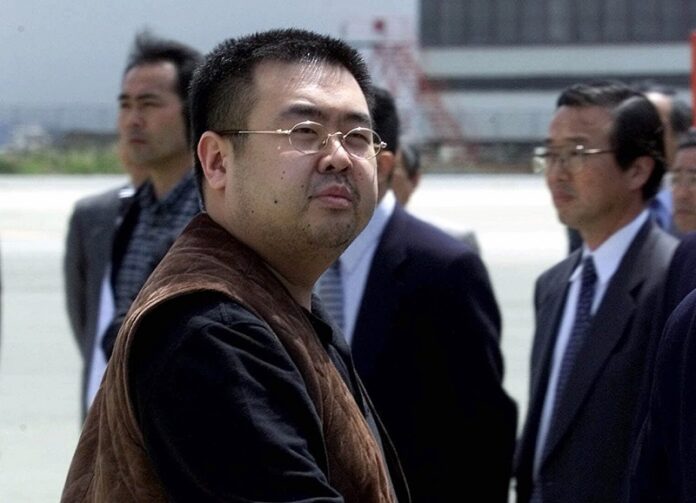
A man believed to be Kim Jong Nam, the eldest son of then North Korean leader Kim Jong Il, looks at a battery of photographers as he exits a police van to board a plane to Beijing at Narita international airport in Narita, northeast of Tokyo, Japan. Photo: Shizuo Kambayashi / Associated Press

SHAH ALAM, Malaysia — A Malaysian court on Wednesday set Jan. 7 for two Southeast Asian women charged with murdering the North Korean leader’s half brother to begin their defense, as their lawyers complained that some witnesses were unreachable.

A High Court judge in August found there was enough evidence to infer that Indonesian Siti Aisyah and Vietnamese Doan Thi Huong, along with four missing North Korean suspects, had engaged in a “well-planned conspiracy” to kill Kim Jong Nam.

The women appeared somber but calm during Wednesday’s hearing. The trial had been due to resume Nov. 1 but was postponed after a defense lawyer fell ill.

Aisyah’s lawyers made a new application to the court to compel prosecutors to provide them with statements that eight witnesses had given to police earlier.

Her lawyer, Kulaselvi Sandrasegaram, said they were informed that one of the witnesses, the man who chauffeured Kim to the airport, had died while two Indonesian women who were Aishah’s roommates were believed to have returned to their homeland. She said they have only managed to interview two of the witnesses offered by prosecutors, while two others didn’t turn up for their appointments and couldn’t be contacted.

The witness statements taken by police are important in “the interest of justice” and to ensure that what they say to defense lawyers is consistent with what they told police, Sandrasegaram told reporters later.

Prosecutor Iskandar Ahmad said the police interviews are privileged statements and shouldn’t be made public.

Judge Azmi Ariffin said the court will make a decision on the defense application on Dec. 14. He also set 10 days from Jan. 7 through February for Aishah’s defense and 14 days from March 11 through April for Huong.

The two are accused of smearing VX nerve agent on Kim’s face in an airport terminal in Kuala Lumpur on Feb. 13, 2017. They have said they thought they were taking part in a prank for a TV show. They are the only suspects in custody. The four North Korean suspects fled the country the same morning Kim was killed.

Lawyers for Aisyah, 25, and Huong, 29, have told the judge they will testify under oath in their defense.

They have said their clients were pawns in a political assassination with clear links to the North Korean Embassy in Kuala Lumpur, and that the prosecution failed to show the women had any intention to kill. Their intent is key to concluding they are guilty of murder.

Malaysian officials have never officially accused North Korea and have made it clear they don’t want the trial politicized.

Kim was the eldest son in the current generation of North Korea’s ruling family. He had been living abroad for years but could have been seen as a threat to North Korean leader Kim Jong Un’s rule.

Murder carries a mandatory sentence of hanging, but Malaysia’s government plans to abolish the death penalty and has put all executions on hold until the laws are changed.

Advertisement

US Democrats Win House of Representatives Majority

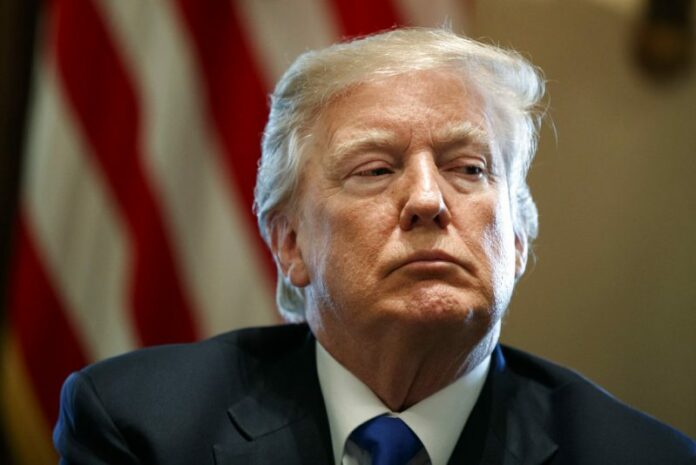
President Donald Trump listens in January during a meeting with lawmakers on immigration policy in the Cabinet Room of the White House in Washington. Photo: Evan Vucci / Associated Press

WASHINGTON — Democrats have won a House majority, gaining power to investigate President Donald Trump and help shape the nation’s political agenda for the next two years.

Democrats picked up at least two dozen House seats Tuesday, capturing the 218 seats needed to break Republicans’ eight-year hold on the House that began with the tea party revolt of 2010.

While Republicans retained control of the Senate, the Democratic win in the House ends the GOP monopoly on power in Washington and opens a new era of divided government.

Democratic candidates flipped seats in a host of suburban districts outside Washington, New York, Philadelphia, Miami, Chicago and Denver, including many that were won by Hillary Clinton in 2016.

Democrats also made inroads in Trump country, winning several races dominated by white working-class voters.

Advertisement

Arrests in Suspected Far-Right Plot to Attack French President

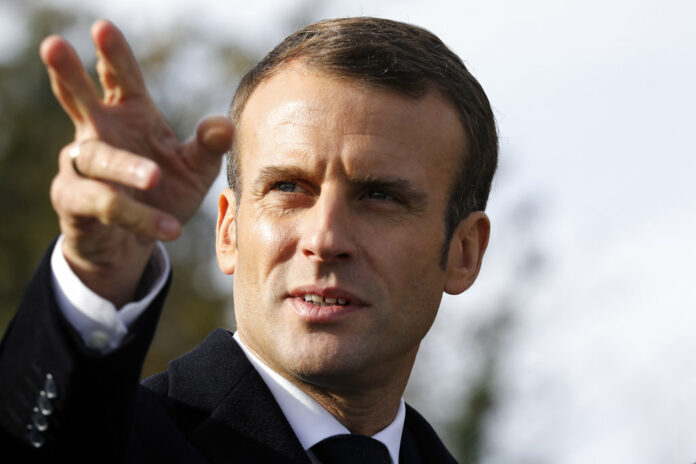
French President Emmanuel Macron arrives Tuesday to the Trottoir necropolis in Les Eparges, eastern France to mark the centenary of the end of First World War. Photo: Ludovic Marin via AP

PARIS — French security agents arrested six people Tuesday on suspicion of plotting to attack French President Emmanuel Macron, according to a French judicial official.

Prosecutors have opened a preliminary investigation of alleged criminal terrorist association, the judicial official said.

The official, speaking on condition of anonymity to discuss the allegations, said intelligence agents detained the six suspects in three scattered regions: one in the Alps, another in Brittany and four near the Belgian border in Moselle.

The plan to target the French president appeared to be vague and unfinished, but violent, the official said.

Authorities said the six were between the ages of 22 and 62 and included one woman.

Interior Minister Christophe Castaner told reporters they are believed to be far-right activists. Authorities feared “concrete threats” from the group, Castaner said.

French presidents have been targeted several times over the decades. In 2002, a far-right sympathizer tried to attack President Jacques Chirac on the Champs-Elysees Avenue in Paris during Bastille Day celebrations.

Macron was in the northeastern French city of Verdun on Tuesday as part of centenary commemorations for the end of World War I.

The alleged plot was uncovered days before U.S. President Donald Trump and dozens of other world leaders are due in France for weekend observances marking the signing 100 years ago of the Nov. 11 armistice that ended World War I.

Advertisement

Facebook Admits Not Doing Enough to Prevent Myanmar Violence

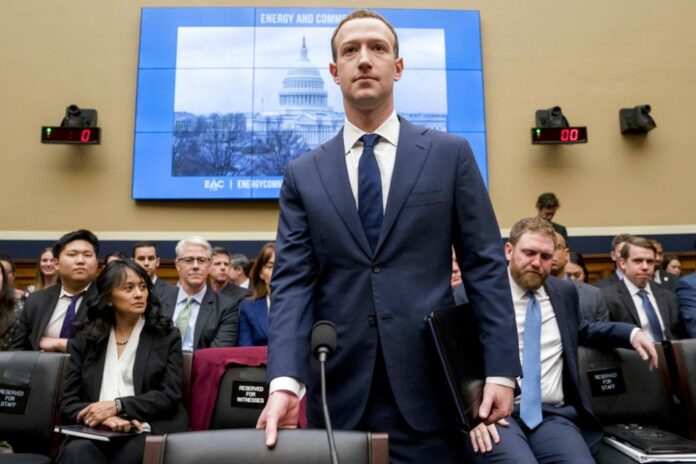
Facebook CEO Mark Zuckerberg arrives in April to testify before a House Energy and Commerce hearing on Capitol Hill in Washington. Photo: Andrew Harnik / Associated Press

NEW YORK — Facebook is admitting that it didn’t do enough to prevent its services from being used to incite violence and spread hate in Myanmar.

The company “can and should do more” to protect human rights and ensure it isn’t used to foment division and spread offline violence in the country, Alex Warofka, a product policy manager, said in a blog post.

Facebook commissioned the nonprofit Business for Social Responsibility to study the company’s role in Myanmar and released the group’s 62-page report late Monday.

It has come under heavy criticism for permitting itself to be used to inflame ethnic and religious conflict in the country, particularly against minority Rohingya Muslims. The report confirms this and offers recommendations, including preparing for “massive chaos and manipulation” in the country’s 2020 parliamentary elections.

“Facebook has become a means for those seeking to spread hate and cause harm, and posts have been linked to offline violence,” the report says. “A minority of users is seeking to use Facebook as a platform to undermine democracy and incite offline violence, including serious crimes under international law.”

The Myanmar report comes as Facebook and other social media companies face a trove of problems in dealing with people, groups and nations intent on using their services for malicious reasons, whether that’s inciting violence, spreading hate messages, propaganda and misinformation or meddling with elections around the world.

Facebook is focused on rooting out misinformation in the U.S., but it’s also dealing with people using its platforms to incite violence in Sri Lanka, India and elsewhere. Late Monday, Facebook said it shut down 30 Facebook accounts and 85 Instagram accounts for suspected “coordinated inauthentic behavior” linked to foreign groups attempting to interfere in Tuesday’s U.S. midterm elections.

Facebook and smartphones entered Myanmar quickly, and the report notes that this has led to a “steep learning curve for users, policymakers, and civil society.” The report notes that Facebook “is the internet” for many in Myanmar and that it has played an important role in supporting freedom of expression and helping activists organize.

At the same time, the report said, hate and harassment is leading to self-censorship among “vulnerable groups such as political activists, human rights defenders, women, and minorities.”

Facebook released the report on the eve of the U.S. midterm elections, prompting critics to question its timing when so many people are focused on other news. Facebook says the report was focused on “Myanmar stakeholders,” for whom the U.S. elections are not a priority. It also said it had promised to share the results of the assessment once it had them.

The report does acknowledge that Facebook has made progress, but adds that there is “more to do.” In August, the company banned Myanmar’s military chief and 19 other individuals and organizations from its service to prevent the spread of hate and misinformation.

Facebook doesn’t have any employees permanently based in Myanmar, but makes “regular trips” there with a range of employees. The company says that having employees there could pose risks to them and increase the Myanmar government’s ability to request data on users.

Story: Barbara Ortutay

Advertisement

Hot News

LATEST NEWS

Bangkok
overcast clouds
26.1 ° C
26.1 °
26.1 °
93 %
1.8kmh
100 %
Sat
33 °
Sun
35 °
Mon
37 °
Tue
37 °
Wed
36 °