34.4 C
Bangkok
Sunday, June 28, 2026
Home Blog Page 1837

Housing Developer, Guards Charged Over Underpass Drowning

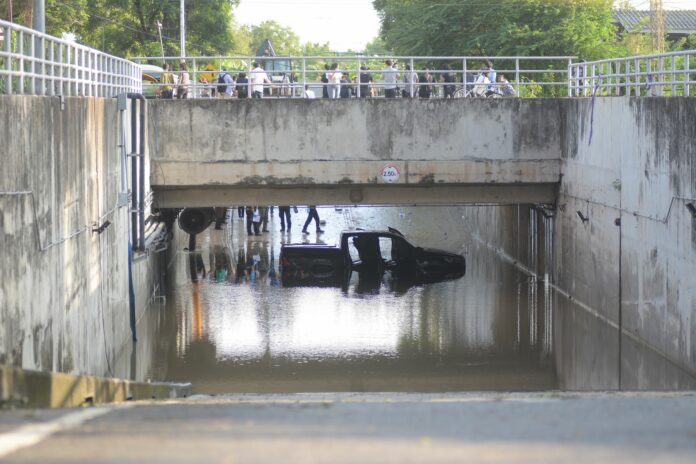
A pickup truck is submerged Sep. 6 in a Bangkok underpass where its driver drowned the night before.

BANGKOK — Five people were charged over the death of a woman who drowned in a flooded Bangkok underpass, police said Sunday.

A deputy metro police chief said charges related to fatal negligence were filed against three security guards, including the president and a manager of Golden Nakara, a housing development in Prawet district which owns the underpass where 41-year-old Phanumas Sae-tae drowned last month.

“The accident happened due to negligence from the [housing developer],” Maj. Gen. Sompong Chingduang said. “It was their responsibility to maintain the underpass but they neglected their duty until there was a casualty.”

He added that the three security guards were also responsible because they failed to put up a warning sign or close the underpass, as it had been known to be flooded for a while before tragedy struck.

Sompong declined to reveal the name of the five people charged, saying it would violate their rights.

Phanumas drove her truck into the flooded underpass in the early hours of Sep. 6 and became trapped in the vehicle.

It had been reported earlier that the underpass – built by the major construction firm Italian-Thai – was partly flooded and that water only rapidly shot up after she got stuck, but Col. Alongkorn Sirisongkhram said yesterday that the roadway was already fully flooded at the time.

“The water submerged her truck completely when she drove in,” he said, adding that it was very dark around the area. “She could not open the door because of the water pressure. … She also panicked because she could not swim.”

Suchatchavee Suwansawas, an engineering expert assigned to the investigation, said he suspects the draining system of the underpass failed at the time due to poor maintenance.

He said sand, soil and mud were found in the sewage system, which could have blocked the water before it reached the pump, making it flow back into the underpass.

There were also fissures on an underground drainage pipe, which might have caused soil and mud to leak into the sewage, Suchatchavee said.

He added that such problems could be prevented if the equipment inspection was performed at least once a week, especially in the monsoon season – during which it should be done everyday to ensure pipes aren’t clogged.

Related stories:

Construction Firm, Developer Face Charges in Bangkok Underpass Drowning

Cops Stumped by Bangkok Underpass Drowning

Advertisement

South Korea Begins Removing Mines, Expects North to Do Same

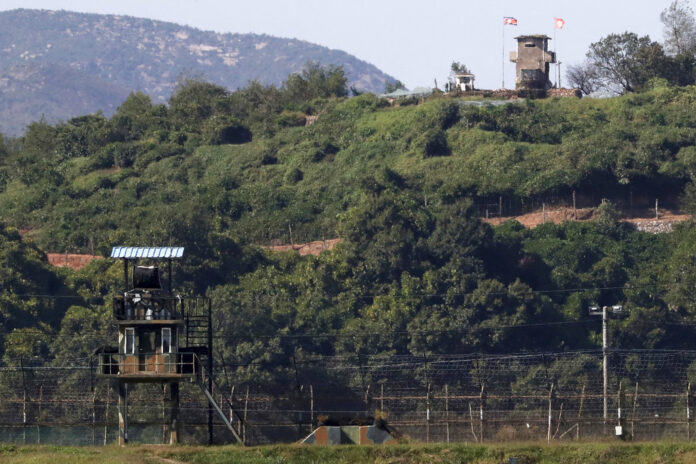
In this on Sunday, Sept. 30, 2018 photo, military guard posts of North Korea, right top, and South Korea, left bottom, are seen in Paju, at the border with North Korea, South Korea. Photo: Kim Do-hoon / Yonhap via AP

SEOUL — South Korea began clearing mines from two sites inside the heavily fortified border with North Korea on Monday under tension-reducing agreements reached this year. Seoul says North Korea is expected to do the same.

The development comes amid renewed international diplomacy on North Korea’s nuclear weapons program after weeks of stalemated negotiations. U.S. Secretary of State Mike Pompeo is to visit Pyongyang this month to try to set up a second summit between President Donald Trump and North Korean leader Kim Jong Un.

South Korean troops entered the Demilitarized Zone on Monday morning to remove mines around the border village of Panmunjom and another frontline area where the rivals plan their first joint searches with North Korea for soldiers during the 1950-53 Korean War, according to Seoul’s Defense Ministry.

The South Korean troops will try to focus on taking out mines on the southern parts of Panmunjom’s Joint Security Area and the so-called “Arrow Head Hill,” where one of the fiercest battles during the Korean War happened. Seoul officials believe the remains of about 300 South Korean and U.N. forces are in the Arrow Head Hill and likely many Chinese and North Korean remains too.

South Korean Defense Ministry officials said they couldn’t immediately confirm whether North Korea also began demining on the northern parts of the two sites. But they said they expected the North to abide by the tension-easing deals their defense chiefs struck on the sidelines of their leaders’ summit last month in Pyongyang.

Aiming to reduce conventional military threats, the Koreas’ defense chiefs also agreed to withdraw 11 frontline guard posts by December and set up buffer zones along their land and sea boundaries and a no-fly zone above the borderline to prevent accidental armed clashes.

About 2 million mines are believed to be peppered inside the Koreas’ 248-kilometer (155-mile)-long Demilitarized Zone that was originally created as a buffer zone at the end of the Korean War. The DMZ is the world’s most heavily fortified border that is also guarded by hundreds of thousands of combat troops, barbed wire fences and tank traps on both sides.

Many experts say the fate of inter-Korean deals can be affected by how nuclear negotiations would go between the United States and North Korea. Past rapprochement efforts were often stalled after an international standoff over the North’s nuclear ambitions intensified.

After provocative tests of three intercontinental ballistic missiles and a powerful nuclear weapon last year, North Korea entered talks with the United States and South Korea earlier this year, saying it’s willing to deal away its expanding nuclear arsenal. Kim Jong Un has subsequently held a series of summits with U.S., South Korean and Chinese leaders and taken some steps like dismantling his nuclear-testing site.

Nuclear diplomacy later came to a standstill amid disputes over how genuine North Korea is about its disarmament pledge. But Trump, Pompeo and other U.S. officials have recently reported progress in the denuclearization discussions with the North. Pompeo is to make his third trip to North Korea soon for talks.

Advertisement

Indonesia’s President Authorizes Foreign Help for Earthquake, Tsunami Disaster

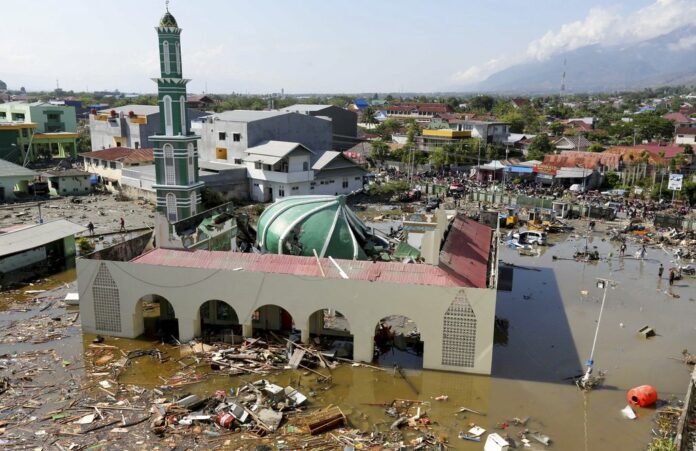
In this Sept. 30, 2018, photo, people survey the mosque damaged following earthquakes and tsunami in Palu, Central Sulawesi, Indonesia, Sunday, Sept. 30, 2018. Photo: Tatan Syuflana / Associated Press

PALU, Indonesia — Indonesia’s president has authorized for the country to accept international help for the earthquake and tsunami disaster on the central island of Sulawesi.

Thomas Lembong, chair of Indonesia’s Investment Coordinating Board, tweeted Monday morning that President Joko “Jokowi” Widodo made the authorization.

It wasn’t immediately clear what type of help was being authorized.

The toll of 800 dead in Friday’s disaster is expected to grow as areas inaccessible since the disaster are reached. The quake and tsunami damaged airports, hospitals and other crucial infrastructure.

A mass burial was being prepared for more than 300 bodies in an Indonesian city hit hard by a powerful earthquake and tsunami.

The toll of more than 800 dead from Friday’s disaster is mostly from Palu and is expected to grow as areas cut off by damage are reached.

National disaster agency chief Willem Rampangilei said the grave can be enlarged if needed and burials must be done soon for health and religious reasons. A majority of Indonesians are Muslim, and burials customarily take place within one day.

There was a desperate need for heavy equipment to reach possible survivors in collapsed buildings, including an eight-story hotel in Palu where voices were heard in the rubble. A survivor was found Sunday evening in the ruins of the Roa-Roa Hotel.

Advertisement

Nobel Prizes Still Struggle With Wide Gender Disparity

FILE- In this file photo dated Friday, April 17, 2015, a national library employee shows the gold Nobel Prize medal awarded to the late novelist Gabriel Garcia Marquez, in Bogota, Colombia. Photo: Fernando Vergara / Associated Press

STAVANGER, Norway — Nobel Prizes are the most prestigious awards on the planet but the aura of this year’s announcements has been dulled by questions over why so few women have entered the pantheon, particularly in the sciences.

The march of Nobel announcements begins Monday with the physiology/medicine prize.

Since the first prizes were awarded in 1901, 892 individuals have received one, but just 48 of them have been women. Thirty of those women won either the literature or peace prize, highlighting the wide gender gap in the laureates for physics, chemistry and physiology/medicine. In addition, only one woman has won for the economics prize, which is not technically a Nobel but is associated with the prizes.

Some of the disparity likely can be attributed to underlying structural reasons, such as the low representation of women in high-level science. The American Institute of Physics, for example, says in 2014, only 10 percent of full physics professorships were held by women.

But critics suggest that gender bias pervades the process of nominations, which come largely from tenured professors.

“The problem is the whole nomination process, you have these tenured professors who feel like they are untouchable. They can get away with everything from sexual harassment to micro-aggressions like assuming the woman in the room will take the notes, or be leaving soon to have babies,” said Anne-Marie Imafidon, the head of Stemettes, a British group that encourages girls and young women to pursue careers in science, technology, engineering and mathematics.

“It’s little wonder that these people aren’t putting women forward for nominations. We need to be better at telling the stories of the women in science who are doing good things and actually getting recognition,” she said.

Powerful men taking credit for the ideas and elbow grease of their female colleagues was turned on its head in 1903 when Pierre Curie made it clear he would not accept the physics prize unless his wife and fellow researcher Marie Curie was jointly honored. She was the first female winner of any Nobel prize, but only one other woman has won the physics prize since then.

More than 70 years later, Jocelyn Bell, a post-graduate student at Cambridge, was overlooked for the physics prize despite her crucial contribution to the discovery of pulsars. Her supervisor, Antony Hewish, took all of the Nobel credit.

Brian Keating, a physics professor at the University of California San Diego and author of the book “Losing the Nobel Prize: A Story of Cosmology, Ambition, and the Perils of Science’s Highest Honor,” says the Nobel Foundation should lift its restrictions on re-awarding for a breakthrough if an individual has been overlooked. He also says posthumous awards also should be considered and there should be no restriction on the number of individuals who can share a prize. Today the limit is three people for one prize.

“These measures would go a long way to addressing the injustice that so few of the brilliant women who have contributed so much to science through the years have been overlooked,” he said.

Keating fears that simply accepting the disparity as structural will seriously harm the prestige of all the Nobel prizes.

“I think with the Hollywood #MeToo movement, it has already happened in the film prizes. It has happened with the literature prize. There is no fundamental law of nature that the Nobel science prizes will continue to be seen as the highest accolade,” he said.

This year’s absence of a Nobel Literature prize , which has been won by 14 women, puts an even sharper focus on the gender gap in science prizes.

The Swedish Academy, which awards the literature prize, said it would not pick a winner this year after sex abuse allegations and financial crimes scandals rocked the secretive panel, sharply dividing its 18 members, who are appointed for life. Seven members quit or distanced themselves from academy. Its permanent secretary, Anders Olsson, said the academy wanted “to commit time to recovering public confidence.”

The academy plans to award both the 2018 prize and the 2019 prize next year — but even that is not guaranteed. The head of the Nobel Foundation, Lars Heikensten, has warned that if the Swedish Academy does not resolve its tarnished image another group could be chosen to select the literature prize each year.

Stung by criticism about the diversity gap between former prize winners, the Nobel Foundation has asked that the science awarding panels for 2019 ask nominators to consider their own biases in the thousands of letters they send to solicit Nobel nominations.

“I am eager to see more nominations for women so they can be considered,” said Goran Hansson, secretary-general of the Royal Swedish Academy of Sciences and vice chairman of the Nobel Foundation. “We have written to nominators asking them to make sure they do not miss women or people of other ethnicities or nationalities in their nominations. We hope this will make a difference for 2019.”

It’s not the first time that Nobel officials have sought diversity. In his 1895 will, prize founder Alfred Nobel wrote: “It is my express wish that in the awarding of the prizes no consideration shall be given to national affiliations of any kind, so that the most worthy shall receive the prize, whether he be Scandinavian or not.”

Even so, the prizes remained overwhelmingly white and male for most of their existence.

For the first 70 years, the peace prize skewed heavily toward Western white men, with just two of the 59 prizes awarded to individuals or institutions based outside Europe or North America. Only three of the winners in that period were female.

The 1973 peace prize shared by North Vietnam’s Le Duc Tho and American Henry Kissinger widened the horizons — since then more than half the Nobel Peace prizes have gone to African or Asian individuals or institutions.

Since 2000, six women have won the peace prize.

After the medicine prize on Monday, the Royal Swedish Academy of Sciences will announce the Nobel in physics on Tuesday and in chemistry on Wednesday, while the Nobel Peace Prize will be awarded Friday by the Norwegian Nobel Committee. On Oct. 8, Sweden’s Central Bank announces the winner of the economics prize, given in honor of Alfred Nobel.


Advertisement

Social Media is Prayuth’s Empty Mirror (Opinion)

Photo: Stacey MacNaught / Flickr

If Thailand’s junta is truly sincere in its twisted claim that it is working hard toward democratizing Thailand, its ban on campaigning online should be lifted immediately.

Every day it remains in place deprives citizens of their right and opportunity to learn about each political party and their policies to take part in a democratic decision-making process that includes interactive online debate and deliberation.

Political communication through social media is very economical and can instantaneously reach a large swath of Thai voters.

Social media bypasses the traditional gatekeeping role of the mainstream mass media and well as state-controlled media.

According to the Electronic Transactions Development Agency’s internet user profile 2017, as much as 82 percent of the Thai population – 57 million of 69.1 million – is connected to the internet.

Seventy-four percent, or 51 million, of the public are active social media users. As a matter of fact, the number of mobile phone subscriptions is even higher than that of the Thai population, at 93.6 million, which means a substantial number of Thais use more than one.

Line and Facebook are the two most popular social media platforms. Twitter trails in eighth place.

What’s more, Thais 16 to 64 spend an average of nine hours and 38 minutes online every day, the longest in the world, according to the agency.

Spending three hours and 10 minutes on average using social media each day, the same age group ranks No. 4 globally after the Philippines (three hours, 57 minutes), Brazil (three hours, 39 minutes) and Indonesia (three hours, 23 minutes).  

These figures make it clear that social media has become the new public sphere, a new marketplace of communication and learning about many things including politics, democracy and human rights. The junta, despite its supposed absolute power and laws such as the Computer Crime Act, can do little to stop social media users learning from one another and criticizing its job running the country.

This explains why the junta has always been paranoid about social media and put an artificial lid on political campaigning in that space, despite its own deployment of state- and private-controlled media through traditional and new channels such as social media to promote itself in the run-up to elections promised for February.

After junta leader Gen. Prayuth Chan-ocha this past week finally sort-of declared his interest being a civilian candidate for prime minister, after some mainstream mass media outlets surveyed the public online on whether voters would choose Prayuth as PM. Contrary to traditional pollsters, three media outlets, The Nation, Khaosod and TV Channel One, found Prayuth failed to obtain even 13 percent support on all three surveys.

More than 350,000 voted in the TV Channel One poll; 88 percent of them said they wouldn’t support Prayuth.

These results, though unscientific, are contrary to traditional pollsters (of dubious professional bases) who say Prayuth consistently comes out on top compared to other candidates.

While the accuracy of these media-sponsored surveys on social media can be debated, the results cast doubt on the level of support for Prayuth and suggest that social media users may not be as tame or impressed with the junta as some may have expected when watching state-controlled programs lauding the military regime and its leaders.

Social media users appear to be more independent-minded and the feedback to the junta too brutal for the liking of the military regime. The situation seems unpredictable, and it explains why the junta is very apprehensive about allowing political campaigning to take place on social media anytime soon.


Advertisement

Indonesia Tsunami, Quake Devastate Coast; Deaths Top 380

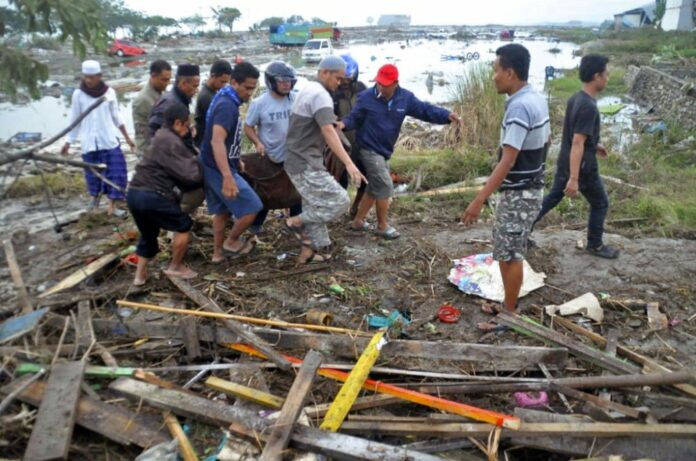
Residents carry a body bag containing the body of a tsunami victim in Palu, Central Sulawesi, Indonesia, Saturday, Sept. 29, 2018. A powerful earthquake rocked the Indonesian island of Sulawesi on Friday, triggering a 3-meter-tall (10-foot-tall) tsunami that an official said swept away houses in at least two cities. (AP Photo)

PALU, Indonesia — A tsunami swept away buildings and killed at least several hundred people on the Indonesian island of Sulawesi, dumping victims caught in its relentless path across a devastated landscape that rescuers were struggling to reach Saturday, hindered by damaged roads and broken communications.

Disaster agency spokesman Sutopo Purwo Nugroho said 384 people were killed in the hard-hit city of Palu alone.

The nearby city of Donggala and the town of Mamuju were also ravaged by the 3-meter (10-foot) -high tsunami but have not yet been reached by aid due to damaged roads and disrupted telecommunications.

Nugroho said “tens to hundreds” of people were taking part in a beach festival in Palu when the tsunami, which was triggered by a magnitude 7.5 earthquake, struck at dusk on Friday. Their fate was unknown.

Palu, which has more than 380,000 people, was strewn with debris from collapsed buildings. A mosque heavily damaged by the quake was half submerged and a shopping mall was reduced to a crumpled hulk. A large bridge with yellow arches had collapsed. Bodies lay partially covered by tarpaulins and a man carried a dead child through the wreckage.

The city is built around a narrow bay that apparently magnified the force of the tsunami waters as they raced into the tight inlet.

Indonesian TV showed dramatic smartphone video of a powerful wave hitting Palu, with people screaming and running in fear. The water smashed into buildings and the damaged mosque.

Hundreds of people were injured and hospitals, damaged by the quake, were overwhelmed.

Communications with the area were difficult because power and telecommunications were cut, hampering search and rescue efforts.

“We hope there will be international satellites crossing over Indonesia that can capture images and provide them to us so we can use the images to prepare humanitarian aid,” Nugroho said.

The disaster agency has said that essential aircraft can land at Palu’s airport, though AirNav, which oversees aircraft navigation, said the runway was cracked and the control tower damaged.

AirNav said one of its air traffic controllers, aged 21, died in the quake after staying in the tower to ensure a flight he’d just cleared for departure got airborne safely. It did.

More than half of the 560 inmates in a Palu prison fled after its walls collapsed during Friday’s quake, said its warden, Adhi Yan Ricoh.

“It was very hard for the security guards to stop the inmates from running away as they were so panicked and had to save themselves too,” he told state news agency Antara.

Ricoh said there was no immediate plan to search for the inmates because the prison staff and police were consumed with the search and rescue effort.

“Don’t even think to find the inmates. We don’t even have time yet to report this incident to our superiors,” he said.

Indonesian President Joko “Jokowi” Widodo said Friday night that he instructed the security minister to coordinate the government’s response to the disaster.

Jokowi also told reporters in his hometown of Solo that he called on the country’s military chief to help with search and rescue efforts.

U.N. spokesman Stephane Dujarric said U.N. officials were in contact with Indonesian authorities and “stand ready to provide support as required.”

Indonesia is frequently hit by earthquakes, volcanic eruptions and tsunamis because of its location on the “Ring of Fire,” an arc of volcanoes and fault lines in the Pacific Basin.

In December 2004, a massive magnitude 9.1 earthquake off Sumatra island in western Indonesia triggered a tsunami that killed 230,000 people in a dozen countries. On Aug. 5, a powerful quake on the Indonesian island of Lombok killed 505 people, most of whom died in collapsing buildings.

Advertisement

Dusit Zoo That Recalled Old Bangkok Soon Just a Memory (Photos)

In this Wednesday, Aug 15, 2018 photo, a woman poses for a picture with a hippopotamus with a wide-open mouth at the Dusit Zoo in Bangkok, Thailand. After in operation for 80 years, Dusit zoo will be closed permanently from September 30, 2018. Its more than 1,000 animals are to be sent to other zoos around the country till a new facility being constructed in north of the capital in Pathum Thani province. (AP Photo/Gemunu Amarasinghe)

Bangkok’s 80-year-old Dusit Zoo has the kind of old-fashioned charm that creates family memories in a global capital chock-a-block with shiny shopping malls.

The zoo itself will soon be just a memory. The entry gates shut for the last time Sunday, and more than 1,200 animals will be moved around the country until a more spacious facility is built in Bangkok’s northern suburbs.

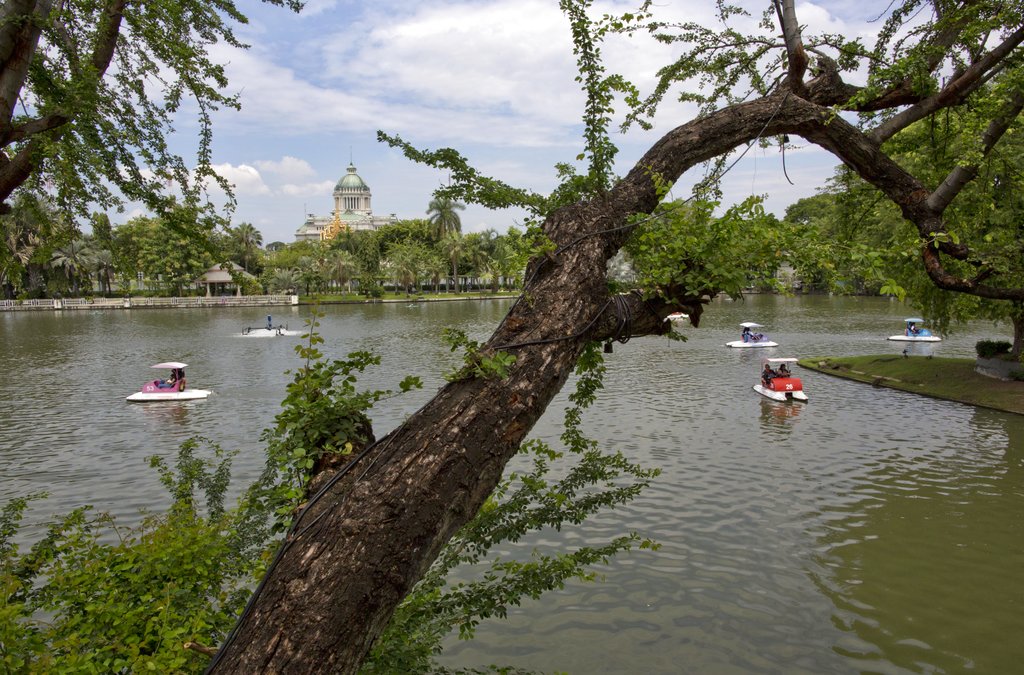
Visitors over the years could ride a paddle boat with a sweetheart or join the youngsters on the zoo’s small train, shouting the names of the animals as the rail cars rolled by the enclosures.

Naturally, they could get to know the zoo’s residents, like 53-year-old hippopotamus Mali, who has given birth to 14 offspring and is the oldest of her kind in Thailand. On hot days, Mali naps near a glass wall in the water at the edge of her enclosure, giving her human admirers an opportunity for a photo close-up. They could watch Malayan sun bears, the smallest bear species and native to Southeast Asia’s tropical forests, attempt to catch bananas thrown by handlers.

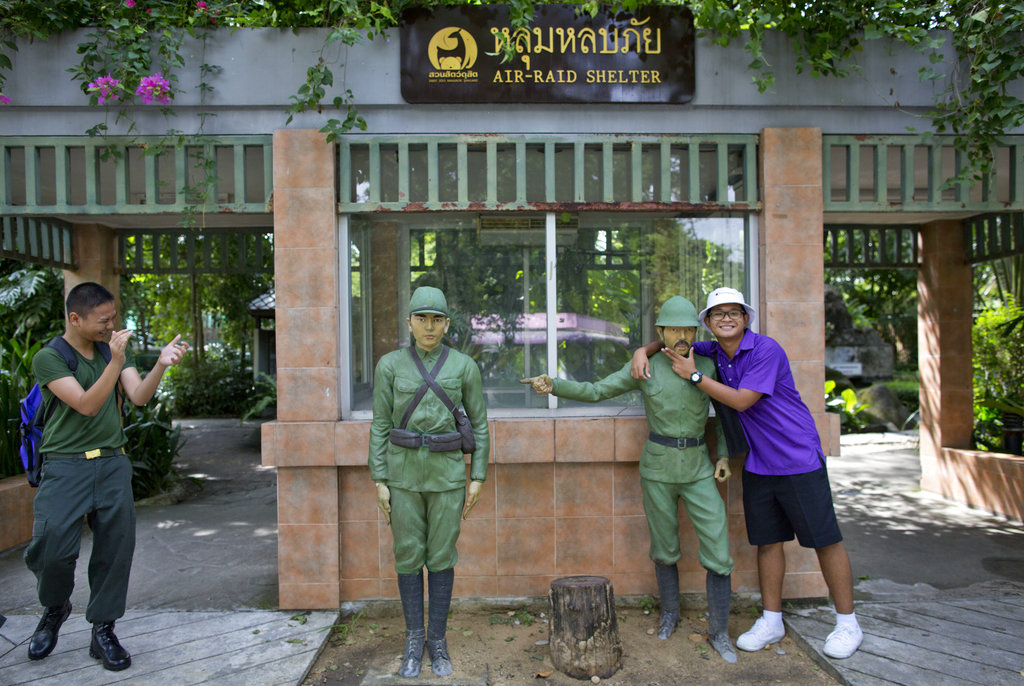
Visitors could also soak up Thai history. Dusit Zoo originally was a botanical garden for the royals who lived in a nearby palace. The gardens were converted to a public park after Thailand became a constitutional monarchy in 1932 and then became the Dusit Zoo in March 1938. During World War II, an air raid shelter was built there.

AP18271862534279
In this Thursday, Sept. 20, 2018 photo a child poses for a picture standing next to female hippopotamus named Mali at the Dusit Zoo in Bangkok, Thailand. Mali has given birth to 14 offspring and is the oldest hippo in Thailand. During the hot summer days, she naps most the time in her enclosure from which she is separated from visitors by tempered see-through glass.(AP Photo/Gemunu Amarasinghe)
AP18271862780319
In this Wednesday, Aug 15, 2018 photo, a man poses for a photo at the entrance to an old air-raid shelter, at the Dusit Zoo in Bangkok, Thailand. Air raid shelters were built in public spaces during the World War II. After the war was ended, most the shelters were removed but the air-raid shelter located at Dusit zoo was renovated and kept for public viewing. (AP Photo/Gemunu Amarasinghe)
AP18272022055902
In this Thursday, Sept. 20, 2018 photo a seal swims close to an aquarium glass as visitors gather for a closer look following a Seal show at the Dusit Zoo in Bangkok, Thailand. After in operation for 80 years, Dusit zoo will be closed permanently from September 30, 2018. Its more than 1,000 animals are to be sent to other zoos around the country till a new facility being constructed north of the capital in Pathum Thani province. (AP Photo/Gemunu Amarasinghe)
AP18271862862015
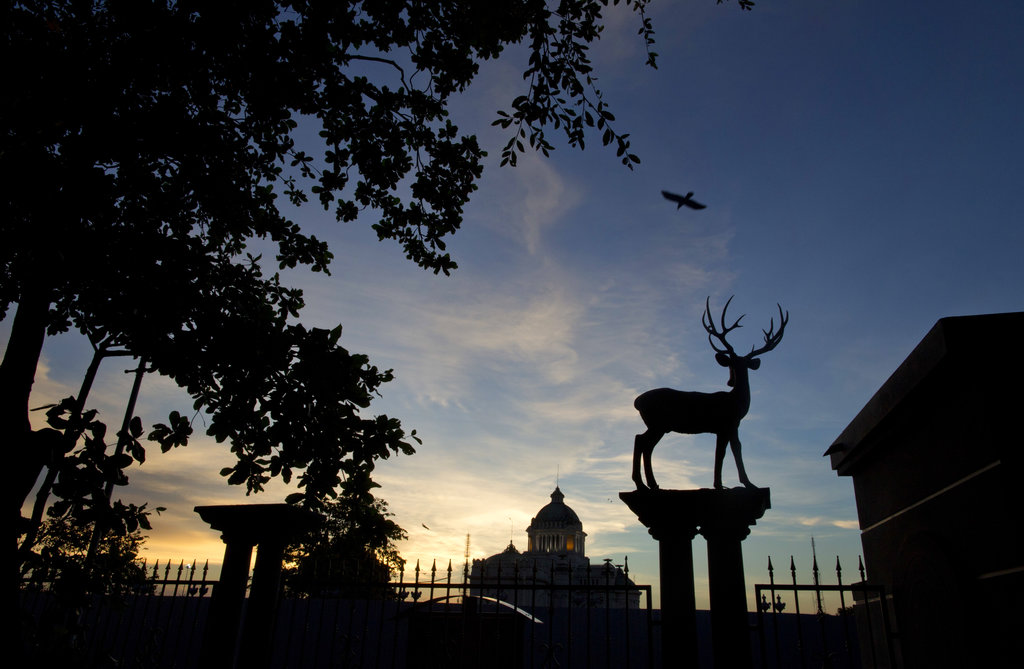
In this Wednesday, Sept. 26, 2018 photo, a bird flies over a sculpture of a deer fixed atop the boundary fence of Dusit Zoo as the Ananta Samakhom Throne Hall looms over in the background in Bangkok, Thailand. Bangkok’s 80-year-old Dusit Zoo has the kind of old-fashioned charm that creates family memories in a global capital chock-a-block with shiny shopping malls. The zoo itself will soon be just a memory. The entry gates shut for the last time Sunday, Sept. 30, and more than 1,200 animals will be moved around the country until a more spacious facility is built in Bangkok’s northern suburbs.(AP Photo/Gemunu Amarasinghe)
AP18271862818385
In this Wednesday, Sept. 26, 2018 photo, a Thai family of four take a picture of their waving hands at an exit gate of Dusit Zoo in Bangkok, Thailand. After in operation for 80 years, Dusit zoo will be closed permanently from Sept. 30, 2018. The zoo originally was a botanical garden for the royals residing in a nearby palace. The gardens were converted to a public park after Thailand became a constitutional monarchy in 1932 and then became the Dusit Zoo in March 1938. During World War II, an air raid shelter was built there.(AP Photo/Gemunu Amarasinghe)
AP18271862768697
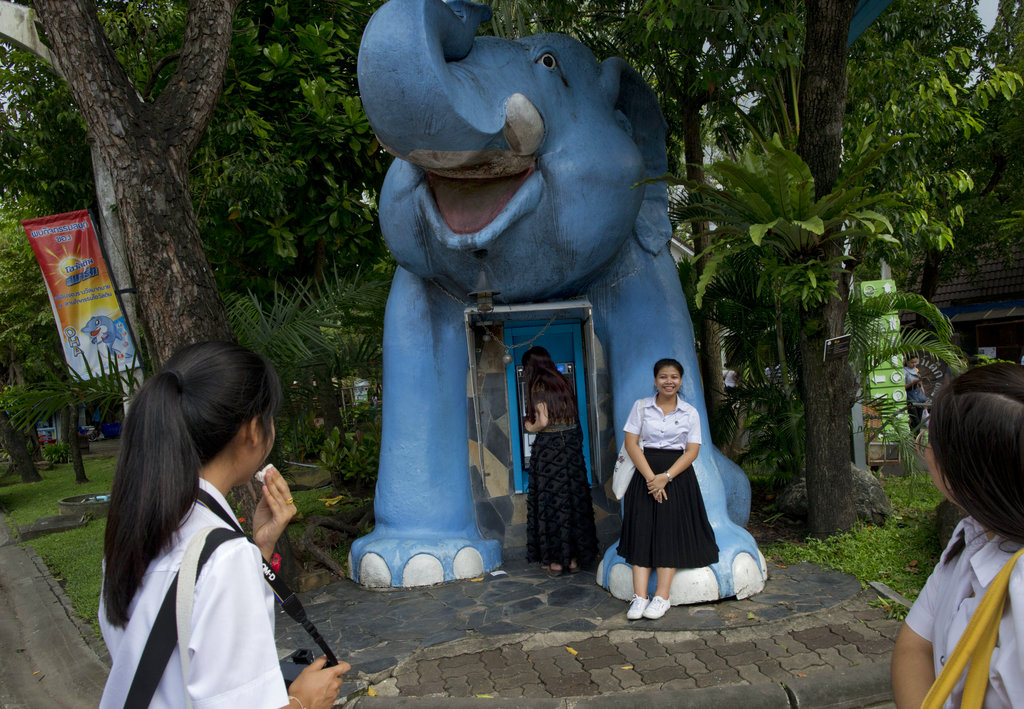
In this Thursday, Sept. 20, 2018 photo, a Thai university student laughs as she poses for a picture at an ATM, with a facade in the shape of an elephant at Dusit Zoo Bangkok, Thailand. Bangkok’s 80-year-old Dusit Zoo has the kind of old-fashioned charm that creates family memories in a global capital chock-a-block with shiny shopping malls. The zoo itself will soon be just a memory. The entry gates shut for the last time Sunday, Sept. 30, and more than 1,200 animals will be moved around the country until a more spacious facility is built in Bangkok’s northern suburbs. (AP Photo/Gemunu Amarasinghe)
AP18271862745298
In this Wednesday, Aug 15, 2018 photo, a Malayan Sun bear unsuccessfully tries to catch a banana tossed by a zoo-keeper at the Dusit Zoo in Bangkok, Thailand. Bangkok’s 80-year-old Dusit Zoo has the kind of old-fashioned charm that creates family memories in a global capital chock-a-block with shiny shopping malls. The zoo itself will soon be just a memory. The entry gates shut for the last time Sunday, Sept. 30, and more than 1,200 animals will be moved around the country until a more spacious facility is built in Bangkok’s northern suburbs. (AP Photo/Gemunu Amarasinghe)
AP18271862710307
In this Thursday, Sept. 20, 2018 photo spectators applaud as a seal performs during a show at Dusit Zoo in Bangkok, Thailand. Bangkok’s 80-year-old Dusit Zoo has the kind of old-fashioned charm that creates family memories in a global capital chock-a-block with shiny shopping malls. The zoo itself will soon be just a memory. The entry gates shut for the last time Sunday, Sept. 30, and more than 1,200 animals will be moved around the country until a more spacious facility is built in Bangkok’s northern suburbs. (AP Photo/Gemunu Amarasinghe)
AP18271862682456
In this Thursday, Sept. 20, 2018 photo, visitors paddle boats in a lake at Dusit Zoo, as the Ananta Samakhom Throne Hall in Bangkok, Thailand, looms over them in the background. Bangkok’s 80-year-old Dusit Zoo has the kind of old-fashioned charm that creates family memories in a global capital chock-a-block with shiny shopping malls. The zoo itself will soon be just a memory. The entry gates shut for the last time Sunday, Sept. 30, and more than 1,200 animals will be moved around the country until a more spacious facility is built in Bangkok’s northern suburbs. (AP Photo/Gemunu Amarasinghe)
AP18271862491244
In this Wednesday, Aug 15, 2018 photo, a White Bengal tiger stretches as it yawns at Dusit Zoo in Bangkok. Bangkok’s 80-year-old Dusit Zoo has the kind of old-fashioned charm that creates family memories in a global capital chock-a-block with shiny shopping malls. The zoo itself will soon be just a memory. The entry gates shut for the last time Sunday, Sept. 30, and more than 1,200 animals will be moved around the country until a more spacious facility is built in Bangkok’s northern suburbs. (AP Photo/Gemunu Amarasinghe)
AP18271862420241
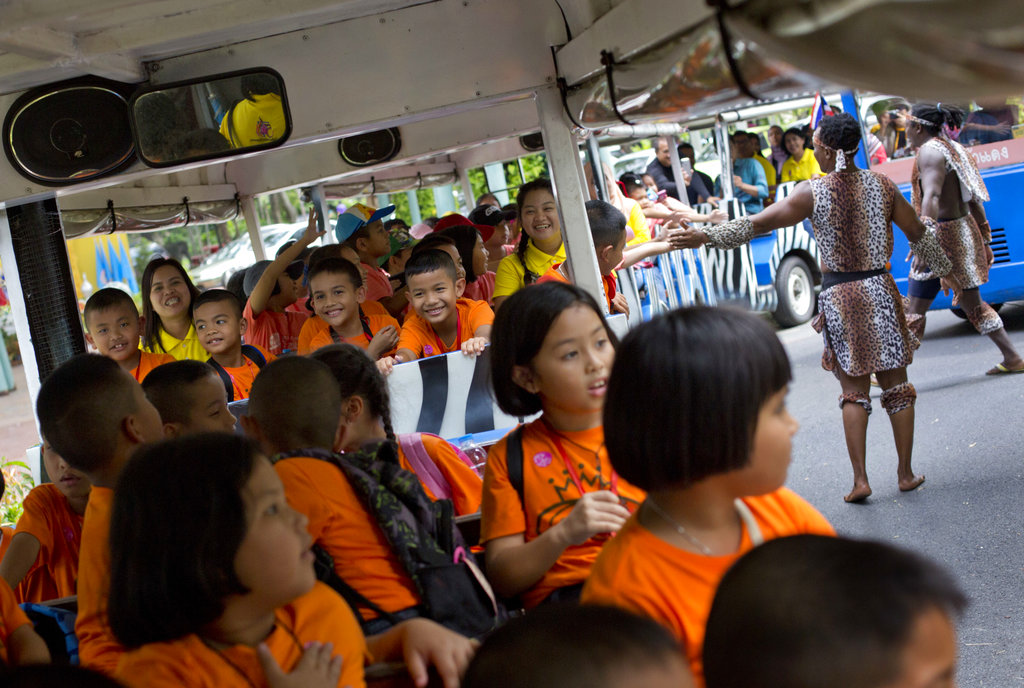
In this Thursday, Sept. 20, 2018 photo, schoolchildren from Thailand’s southern province of Pattani province are greeted by visiting Kenyan performers at Dusit Zoo Bangkok, Thailand. Dusit Zoo, housed in what was once part of a royal estate belonging to the Thai monarch will relocate to a new location in a land granted by King Vajiralongkorn, Thai government announced. (AP Photo/Gemunu Amarasinghe)
Advertisement

Indonesian Earthquake, Tsunami Left At Least 18 Dead

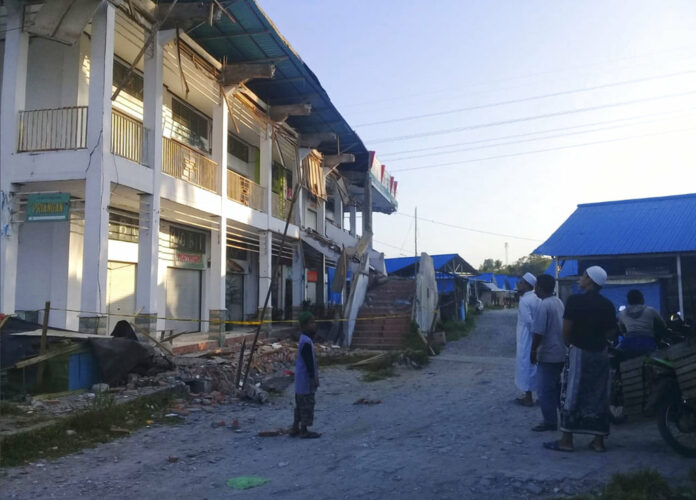
People survey a building partially damaged by earthquake in Poso, Central Sulawesi, Indonesia, Saturdayใ Photo: Yoanes Litha / Associated Press

JAKARTA — An Indonesian official says the earthquake and tsunami that hit central Sulawesi left many victims, as rescuers raced to the region.

Disaster officials haven’t released an official death toll but reports from three hospitals seen Saturday by The Associated Press listed 18 dead.

Dawn revealed a devastated coastline in central Sulawesi where the tsunami triggered by a magnitude 7.5 earthquake Friday smashed into two cities and several settlements.

Disaster agency spokesman Sutopo Purwo Nugroho said in a television interview there are “many victims.”

In Palu, the capital of Central Sulawesi province, a large bridge spanning a coastal river had collapsed and the city was strewn with debris.

Advertisement

Facebook Says 50M User Accounts Affected by Security Breach

Facebook logo is displayed on an iPad in Philadelphia. Photo: Matt Rourke / Associated Press

NEW YORK — Facebook reported a major security breach in which 50 million user accounts were accessed by unknown attackers.

The attackers gained the ability to “seize control” of those accounts, Facebook said, by stealing digital keys the company uses to keep people logged in. Facebook has logged out owners of the 50 million affected accounts — plus another 40 million who were vulnerable to the attack. Users don’t need to change their Facebook passwords, it said.

Facebook said it doesn’t know who was behind the attacks or where they’re based. In a call with reporters on Friday, CEO Mark Zuckerberg said that attackers would have had the ability to view private messages or post on someone’s account, but there’s no sign that they did.

“We do not yet know if any of the accounts were actually misused,” Zuckerberg said.

Facebook shares fell $4.38, or 2.6 percent, to close at $164.46 on Friday.

The hack is the latest setback for Facebook during a tumultuous year of security problems and privacy issues . So far, though, none of that has significantly shaken the confidence of the company’s 2 billion global users.

The latest attack involved bugs in Facebook’s “View As” feature, which lets people see how their profiles appear to others. The attackers used that vulnerability to steal the digital keys, known as “access tokens,” from the accounts of people whose profiles were plugged into the “View As” feature — and then moved along from one user’s Facebook friend to another. Possession of those tokens would allow attackers to control those accounts.

One of the bugs was more than a year old and affected how the “View As” feature interacted with Facebook’s video uploading feature for posting “happy birthday” messages, said Guy Rosen, Facebook’s vice president of product management. But it wasn’t until mid-September that Facebook noticed an uptick in unusual activity, and not until this week that it learned of the attack, Rosen said.

“We haven’t yet been able to determine if there was specific targeting” of particular accounts, Rosen said in a call with reporters. “It does seem broad. And we don’t yet know who was behind these attacks and where they might be based.”

Neither passwords nor credit card data was stolen, Rosen said. He said the company has alerted the FBI and regulators in the United States and Europe.

Jake Williams, a security expert at Rendition Infosec, said he is concerned that the hack could have affected third party applications.

Williams noted that the company’s “Facebook Login” feature lets users log into other apps and websites with their Facebook credentials. “These access tokens that were stolen show when a user is logged into Facebook and that may be enough to access a user’s account on a third party site,” he said.

Facebook confirmed late Friday that third party apps, including its own Instagram app, could have been affected.

“The vulnerability was on Facebook, but these access tokens enabled someone to use the account as if they were the account-holder themselves,” Rosen said.

News broke early this year that a data analytics firm once employed by the Trump campaign, Cambridge Analytica, had improperly gained access to personal data from millions of user profiles. Then a congressional investigation found that agents from Russia and other countries have been posting fake political ads since at least 2016. In April, Zuckerberg appeared at a congressional hearing focused on Facebook’s privacy practices.

The Facebook bug is reminiscent of a much larger attack on Yahoo in which attackers compromised 3 billion accounts — enough for half of the world’s entire population. In the case of Yahoo, information stolen included names, email addresses, phone numbers, birthdates and security questions and answers. It was among a series of Yahoo hacks over several years.

U.S. prosecutors later blamed Russian agents for using the information they stole from Yahoo to spy on Russian journalists, U.S. and Russian government officials and employees of financial services and other private businesses.

In Facebook’s case, it may be too early to know how sophisticated the attackers were and if they were connected to a nation state, said Thomas Rid, a professor at the Johns Hopkins University. Rid said it could also be spammers or criminals.

“Nothing we’ve seen here is so sophisticated that it requires a state actor,” Rid said. “Fifty million random Facebook accounts are not interesting for any intelligence agency.”

Ed Mierzwinski, the senior director of consumer advocacy group U.S. PIRG, said the breach was “very troubling.”

“It’s yet another warning that Congress must not enact any national data security or data breach legislation that weakens current state privacy laws, pre-empts the rights of states to pass new laws that protect their consumers better, or denies their attorneys general rights to investigate violations of or enforce those laws,” he said in a statement.

Wedbush analyst Michael Pachter said “the most important point is that we found out from them,” meaning Facebook, as opposed to a third party.

“As a user, I want Facebook to proactively protect my data and let me know when it’s compromised,” he said.

Advertisement

Journalists Slam Pending Bangladesh Digital Security Law

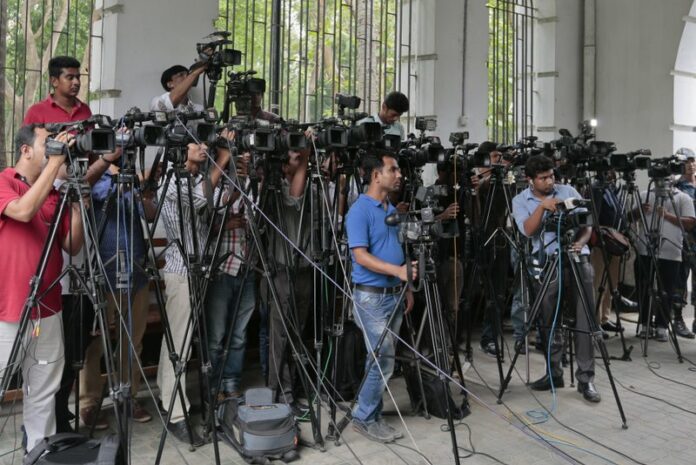
Photo: Associated Press

DHAKA — Journalists and human rights groups are demanding major amendments to a bill recently passed in Bangladesh’s Parliament, saying it will further choke constitutionally protected freedom of speech.

A powerful body of editors of leading newspapers and TV stations has officially protested the bill, called the Digital Security Act, and plans to form a human chain to protest Saturday in front of the national press club in Dhaka.

“We are moving toward a bad time. This law will hurt the media, democracy and freedom of expression,” said Khandakar Muniruzzaman, acting editor of the Bengali-language daily Sangbad and among those planning to participate in the protest Saturday.

Senior editors, journalist groups and human rights groups in and outside Bangladesh are echoing these concerns, demanding that lawmakers clarify sections of the bill they say could be wielded arbitrarily against government critics before the president signs it.

In Bangladesh, the president customarily signs anything passed by Parliament. He can send it back to Parliament, but if members think no changes are needed, it will go back to him for a signature. If the president does not sign it in six months, it automatically becomes law.

The bill would replace a previous information communication technology law, which was also criticized by journalists and human rights groups for its alleged use to crack down on dissent. Many editors and reporters have been sued for defamation under the law.

Observers say the bill is part of a broader campaign to silence critics in Bangladesh, and reflects a worrying trend in fledgling Asian democracies.

Journalists in Nepal are combating a similar law, part of an expansive rewriting of that country’s civil and criminal codes meant to define the parameters of Nepal’s new constitution.

Laws like the one recently passed in Nepal and the one pending in Bangladesh, where democracy was restored in 1990 after the military dictator was ousted, could make it more difficult for journalists to expose corruption.

Bangladesh’s Prime Minister Sheikh Hasina, who political opponents decry as an autocrat, defended the bill in Parliament last week, saying that it was meant to protect the country from propaganda.

“Journalism is surely not for increasing conflict, or for tarnishing the image of the country,” she said.

Bangladeshi journalists are taking particular umbrage with a section of the bill that authorizes up to 14 years in prison for gathering, sending or preserving classified information of any government using a computer or other digital device. The journalists say publishing such information is a way to hold officials accountable. The section evokes the sentiment of a British colonial-era law about protecting official secrets.

The bill would also authorize prison sentences of up to three years for publishing information that is “aggressive or frightening” and up to 10 years for posting information that “ruins communal harmony or creates instability or disorder or disturbs or is about to disturb the law and order situation.”

Government officials have listed incidents in recent years in which false social media posts about people disrespecting the Quran have incited violence.

Critics of the bill say existing criminal laws adequately address these concerns.

Fears of the broad reach of the bill extend beyond journalists.

Human Rights Watch said the law would be ripe for abuse, in part because it would empower police to search or arrest suspects without a court order.

“Bangladesh authorities have failed to address serious human rights violations, and when criticized, chosen to target the messenger,” spokeswoman Meenakshi Ganguly told The Associated Press.

“Bangladeshi journalists, already under pressure, will now worry about doing their job in exposing government failures,” she said.

Some critics say introducing such a law a few months before general elections, which are expected in December, could also target opposition activists and candidates.

Bangladesh’s main opposition Bangladesh Nationalist Party, or BNP, has said the bill is intended to silence its members. Party leader former Prime Minister Khaleda Zia, an archrival of Hasina, is currently in jail for corruption. Her supporters say her jailing is politically motivated, an allegation authorities have denied.

An election-time government is expected to be formed in mid-October that Hasina is supposed to head in line with the constitution, but the opposition says an election under Hasina could be rigged. The opposition wants a non-partisan caretaker government to oversee the elections.

The opposition says their activists are facing thousands of politically-motivated criminal charges, but police say they are following the law, without regard to suspects’ political affiliations.

Advertisement

Hot News

LATEST NEWS

Bangkok
overcast clouds
34.4 ° C
35 °
32.2 °
60 %
3.8kmh
100 %
Sun
34 °
Mon
33 °
Tue
34 °
Wed
30 °
Thu
29 °