29.9 C
Bangkok
Saturday, June 27, 2026
Home Blog Page 2154

Coal Protesters Face Prison After Police Scuffle (Photos)

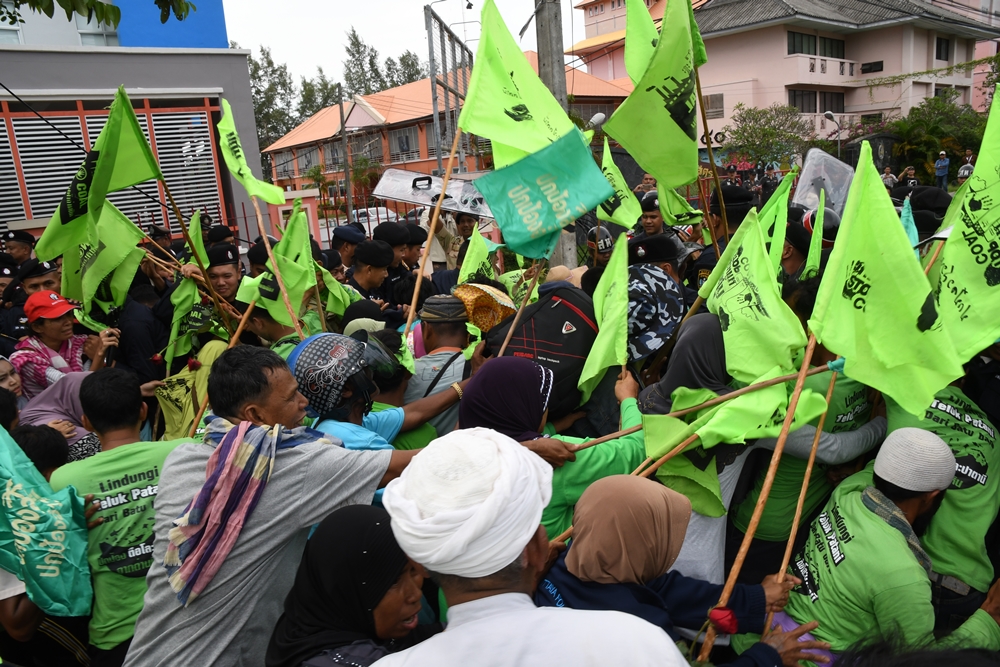
Security officers scuffle with anti-coal protesters Monday in Songkhla province

SONGKHLA — Sixteen protesters arrested while marching to submit a petition to junta chairman Gen. Prayuth Chan-ocha in the Deep South remained in custody Tuesday morning and face six months in prison.

The demonstrators, who oppose the military government’s plan to build a coal power plant there in their hometown, were detained after scuffling with riot police in Songkhla province, where Gen. Prayuth was touring. Police said they were charged with obstructing traffic and using weapons in the skirmishes. More serious charges will soon follow, police said.

“We arrested them for offenses committed at the scene,” regional police commander Ronnaslip Phusara said in an interview. “We had already banned them from gathering. We have also asked for a court order, and the court also ordered them not to assemble.”

Asked what constitutes as weapons, Maj. Gen. Ronnasilp replied the demonstrators “used flagpoles to strike at police, so they counted as weapons.”

In coming days, the 16 will be charged with violating a law on public assemblies, the major general said. They face up to six months in prison if found guilty.

The protesters marched from the Thepha district and demanded to hand their petition to the prime minister, who was visiting the nearby province of Pattani yesterday. The group said they fear damage to their community’s health and environment if the government goes ahead with building the coal plant in their town.

Police and military blocked the road to prevent them from getting close to Prayuth. A clash broke out at 3pm and ended in 16 arrests – including that of protest leader Ekkachai Issarata. Media reports said at least three demonstrators were injured.

Civil rights groups immediately criticized police for their handling of the protest. A coalition of 36 Isaan-based civil groups said the crackdown invalidate the government’s claims that it has made human rights a priority.

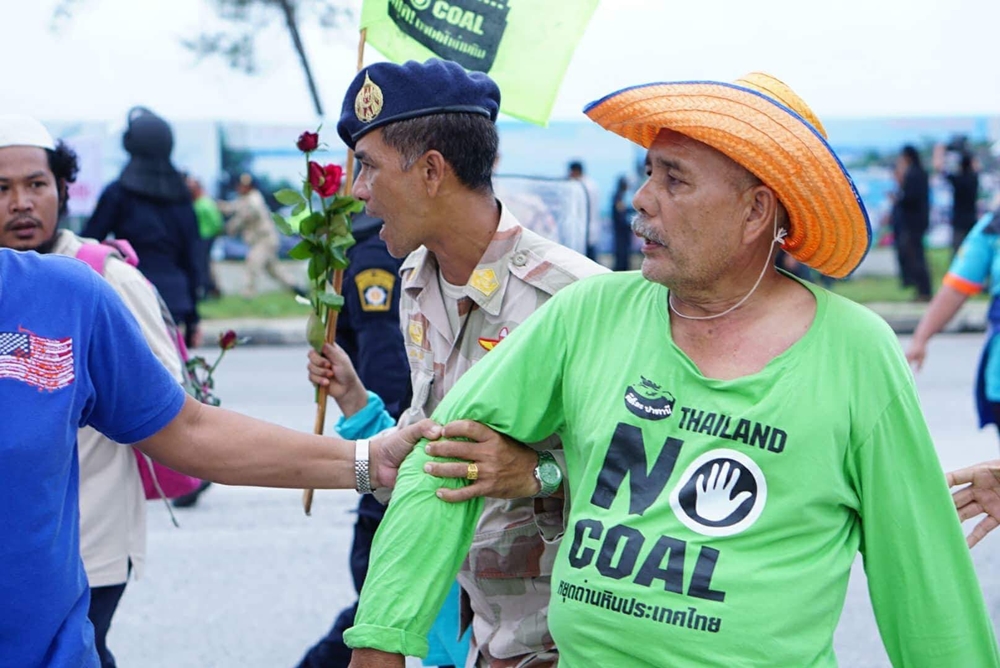
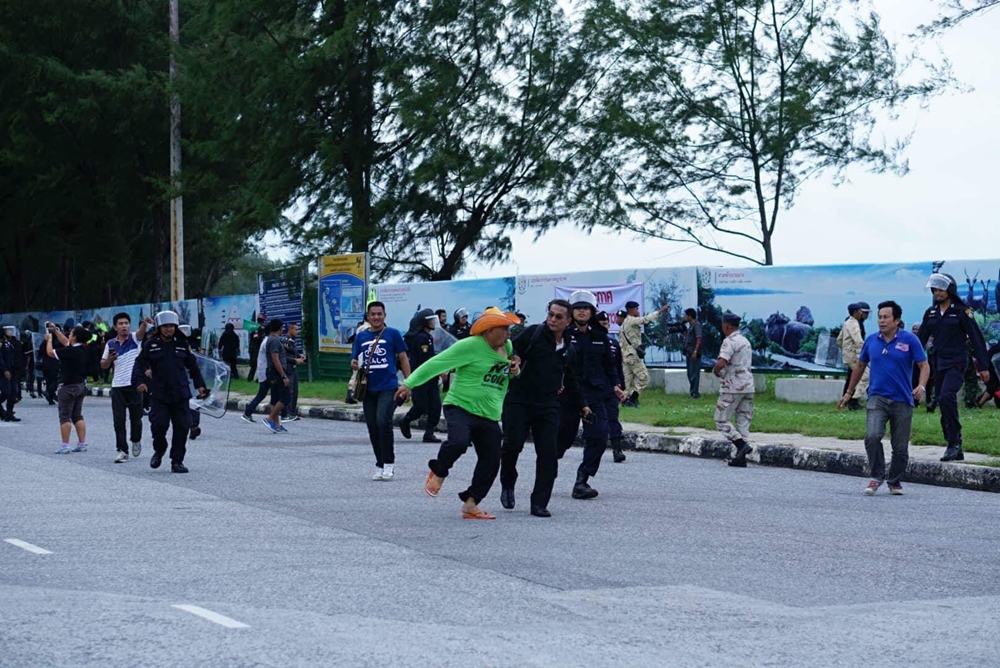
IMG 4752
Security officers detain anti-coal protesters Monday in Songkhla province

“We condemn the government for using force to crack down on our Thepha brethren without upholding human rights principles. This is a grave evil,” the coalition said in a statement, which also demanded police to free all protesters unconditionally.

The 16 protesters are being held at the Songkhla Police Station. Investigators are planning to take them to court for a custody hearing today, Ronnasilp said.

He also disputed allegations his officers used excessive force.

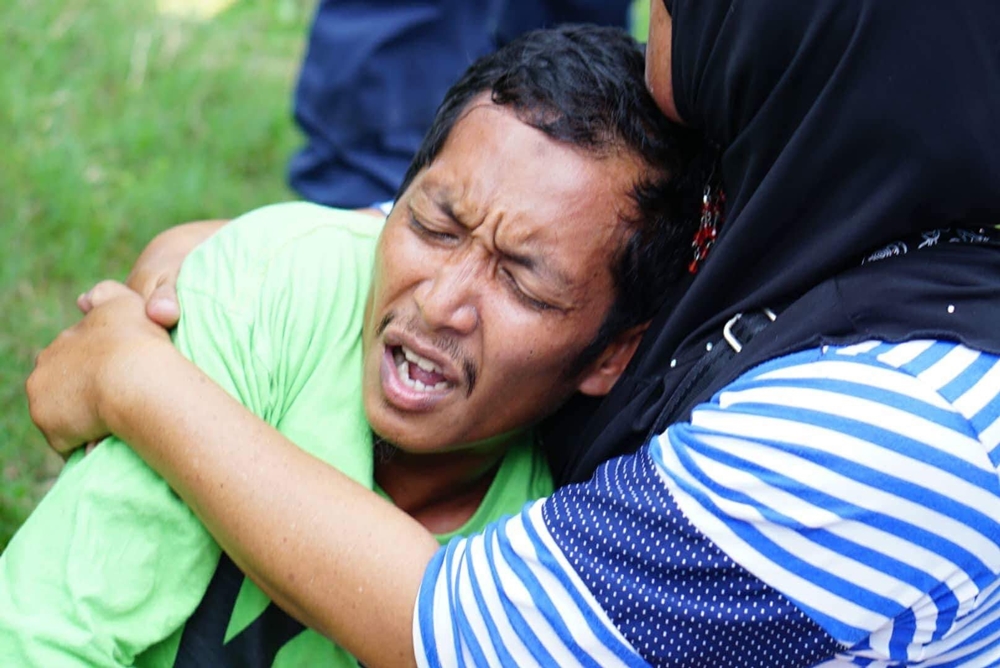
IMG 4754
A protester reacts during Monday’s clash with police in Songkhla province

“We didn’t use any violence,” Ronnasilp said. “We already asked them not to block traffic, and only assemble in the area we arranged for them. Yet they assaulted the officers.”

Activist groups maintained the demonstration was peaceful until police moved to disperse the protesters.

An ambitious plan to expand coal-fired plants was announced not long after the junta seized power in 2014. It met resistance from local groups, but opposition to government plans has been stifled by the ban on political gatherings.

Meeting People, Facing Public

Gen. Prayuth, who in recent months has been on the road promoting his agenda and leadership, began a tour of the south Monday with his newly reorganized cabinet.

The junta chief was meeting representatives of a fishing community when the marchers set out to meet him. During the meeting, Prayuth interrupted a fisherman venting his grievances to shout him down.

“Don’t raise your voice to me!” Prayuth yelled into the microphone, startling those around him. “Talk nicely. I am willing to listen to your problems – don’t pressure the government.”

He then led his entourage away to resume their tour.

When a reporter asked the general yesterday about the crackdown, Prayuth said it was solely a police matter.

“It was up to the police to consider,” Prayuth said from the hotel where he was staying. “There were already warnings. They cannot hurt the police.”

Turning a drink given to him in the hotel lobby, he raised a toast to the reporters.

“I’m so happy here. I get to meet local people. I don’t want to return to Bangkok,” Prayuth called out to the press.

Clarification: Prayuth’s remark has been translated from “Don’t argue with me” to “Don’t raise your voice to me,” after closer review of a recording.

Related stories:

Krabi Coal Protesters Vow Return if Gov’t Breaks Promise

Anti-Coal Activists Return to Krabi Confident of Victory

Coal Plant Protest Leaders Arrested

Gov’t Gives Green Light to Krabi Coal Plant, Activists Vow Resistance (Photos)

IMG 4757
Security officers detain anti-coal protesters Monday in Songkhla province
IMG 4758
Security officers detain anti-coal protesters Monday in Songkhla province
S 19193876
Security officers scuffle with anti-coal protesters Monday in Songkhla province
Advertisement

Zoo Sorry For ‘Unpreventable’ Death of Mahout by ‘Ong Bak’ Elephant

Tony Jaa in Ong Bak 2.

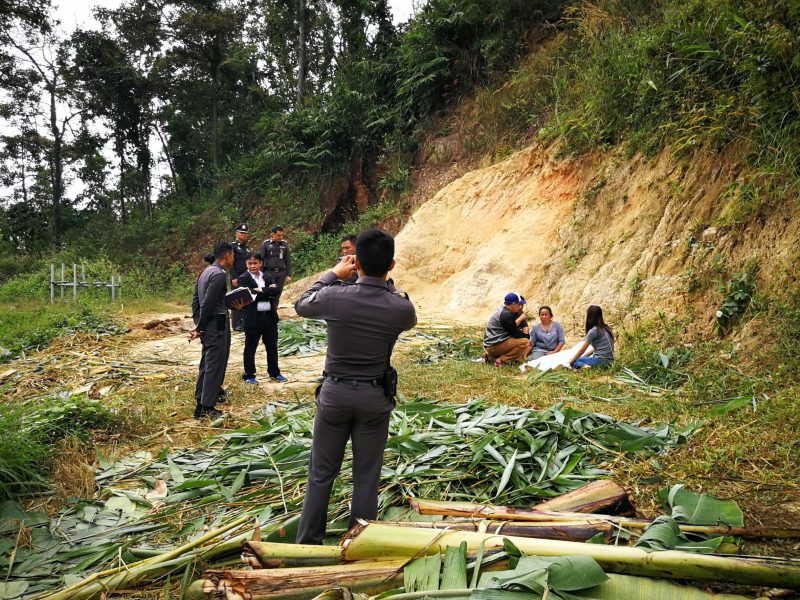
CHIANG MAI — Chiang Mai Zoo officials apologized to the family of an experienced mahout trampled/gored to death by an elephant that appeared in a martial arts blockbuster film, describing the incident as “unpreventable.”

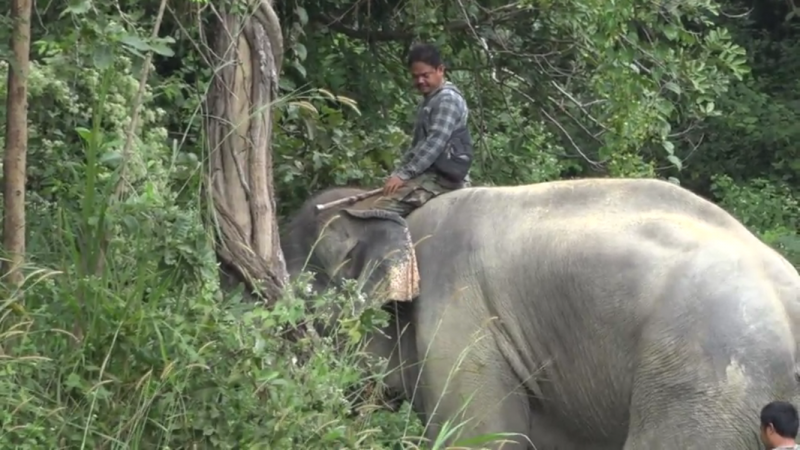
Phlai Ekasit, 32, a male elephant at the Chiang Mai Zoo, killed Somsak Riangngern, 54 of Surin, in front of his wife and fellow mahouts on Monday morning.

“This accident was an unpreventable tragedy, since Somsak was an experienced mahout who has always loved Phlai Ekasit,” Wuttichai Muangman, deputy director of Chiang Mai Zoo told police Monday. “We are deeply sorry to his family.”

According to witnesses, Somsak fed Phlai Ekasit in the morning and then unchained the animal so he could drink and bathe. As Somsak was walking away from Phlai Ekasit, the elephant struck him with his trunk and tusks, an attack which continued over five minutes until other mahouts were able to restrain him.

Somsak worked with Phlai Ekasit for about a decade and his fellow mahouts said the elephant was never violent before. Phlai Ekasit may have been upset Monday since he was in heat, a condition known as musth which can make bull elephants unpredictably violent.

Phlai Ekasit appeared five films, including the Ong Bak series starring Tony Jaa. He also had roles in four other films. Usually the five-ton, three-meter pachyderm performs in elephant shows at the Chiang Mai Zoo, but he will be removed from the shows for the time being. The zoo has a contract for Phlai Ekasit to perform there until April 30.

IMG 2722 e1511843575757
Phlai Ekasit Monday morning at Chiang Mai Zoo.

IMG 2729 e1511843594898

IMG 2739 e1511843618206
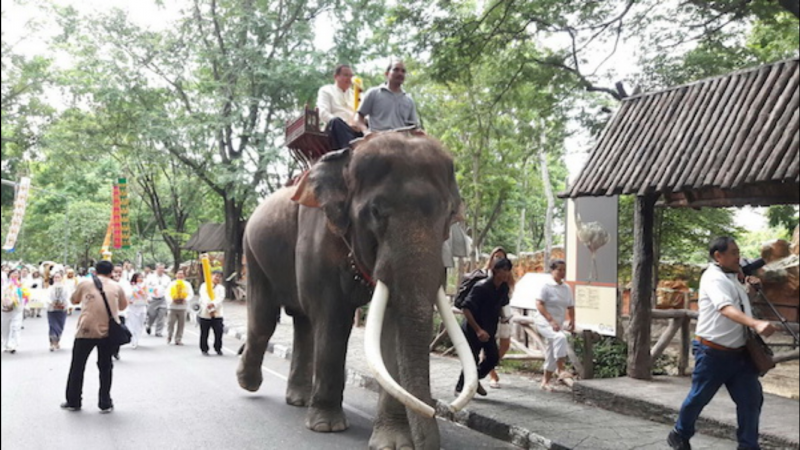
Phlai Ekasit giving rides to foreign tourists on a regular day at Chiang Mai Zoo.


Advertisement

FBI Gave Heads-Up to Fraction of Russian Hackers’ US Targets

U.S. Ambassador to Russia Michael McFaul leaves the Foreign Ministry in 2013 in Moscow, Russia. Photo: Misha Japaridze / Associated Press

WASHINGTON — The FBI failed to notify scores of U.S. officials that Russian hackers were trying to break into their personal Gmail accounts despite having evidence for at least a year that the targets were in the Kremlin’s crosshairs, The Associated Press has found.

Nearly 80 interviews with Americans targeted by Fancy Bear, a Russian government-aligned cyberespionage group, turned up only two cases in which the FBI had provided a heads-up. Even senior policymakers discovered they were targets only when the AP told them, a situation some described as bizarre and dispiriting.

“It’s utterly confounding,” said Philip Reiner, a former senior director at the National Security Council, who was notified by the AP that he was targeted in 2015. “You’ve got to tell your people. You’ve got to protect your people.”

FBI policy calls for notifying victims, whether individuals or groups, to help thwart both ongoing and future hacking attempts. The policy, which was disclosed in a lawsuit filed earlier this year against the FBI by the nonprofit Electronic Privacy Information Center, says that notification should be considered “even when it may interfere with another investigation or (intelligence) operation.”

Last week, the FBI declined to discuss its investigation into Fancy Bear’s spying campaign, but did provide a statement that said in part: “The FBI routinely notifies individuals and organizations of potential threat information.”

Three people familiar with the matter  including a current and a former government official  said the FBI has known for more than a year the details of Fancy Bear’s attempts to break into Gmail inboxes. A senior FBI official, who was not authorized to publicly discuss the hacking operation because of its sensitivity, declined to comment on when it received the target list, but said that the bureau was overwhelmed by the sheer number of attempted hacks.

“It’s a matter of triaging to the best of our ability the volume of the targets who are out there,” he said.

In the face of a tidal wave of malicious phishing attempts, the FBI sometimes passes on information about the attacks to service providers and companies, who can then relay information to clients or employees, he added.

The AP did its own triage, dedicating two months and a small team of reporters to go through a hit list of Fancy Bear targets provided by the cybersecurity firm Secureworks.

Previous AP investigations based on the list have shown how Fancy Bear worked in close alignment with the Kremlin’s interests to steal tens of thousands of emails from the Democratic Party. The hacking campaign disrupted the 2016 U.S. election and cast a shadow over the presidency of Donald Trump, whom U.S. intelligence agencies say the hackers were trying to help. The Russian government has denied interfering in the American election.

The Secureworks list comprises 19,000 lines of targeting data. Going through it, the AP identified more than 500 U.S.-based people or groups and reached out to more than 190 of them, interviewing nearly 80 about their experiences.

Many were long-retired, but about one-quarter were still in government or held security clearances at the time they were targeted. Only two told the AP they learned of the hacking attempts on their personal Gmail accounts from the FBI. A few more were contacted by the FBI after their emails were published in the torrent of leaks that coursed through last year’s electoral contest. But to this day, some leak victims have not heard from the bureau at all.

Charles Sowell, who previously worked as a senior administrator in the Office of the Director of National Intelligence and was targeted by Fancy Bear two years ago, said there was no reason the FBI couldn’t do the same work the AP did.

“It’s absolutely not OK for them to use an excuse that there’s too much data,” Sowell said. “Would that hold water if there were a serial killer investigation, and people were calling in tips left and right, and they were holding up their hands and saying, ‘It’s too much’? That’s ridiculous.”


“It’s Curious”

The AP found few traces of the bureau’s inquiry as it launched its own investigation two months ago.

In October, two AP journalists visited THCServers.com, a brightly lit, family-run internet company on the former grounds of a communist-era chicken farm outside the Romanian city of Craiova. That’s where someone registered DCLeaks.com, the first of three websites to publish caches of emails belonging to Democrats and other U.S. officials in mid-2016.

DCLeaks was clearly linked to Fancy Bear. Previous AP reporting found that all but one of the site’s victims had been targeted by the hacking group before their emails were dumped online.

Yet THC founder Catalin Florica said he was never approached by law enforcement.

“It’s curious,” Florica said. “You are the first ones that contact us.”

THC merely registered the site, a simple process that typically takes only a few minutes. But the reaction was similar at the Kuala Lumpur offices of the Malaysian web company Shinjiru Technology, which hosted DCLeaks’ stolen files for the duration of the electoral campaign.

The company’s chief executive, Terence Choong, said he had never heard of DCLeaks until the AP contacted him.

“What is the issue with it?” he asked.

Questions over the FBI’s handling of Fancy Bear’s broad hacking sweep date to March 2016, when agents arrived unannounced at Hillary Clinton’s headquarters in Brooklyn to warn her campaign about a surge of rogue, password-stealing emails.

The agents offered little more than generic security tips the campaign had already put into practice and refused to say who they thought was behind the attempted intrusions, according to a person who was there and spoke on condition of anonymity because the conversation was meant to be confidential.

Questions emerged again after it was revealed that the FBI never took custody of the Democratic National Committee’s computer server after it was penetrated by Fancy Bear in April 2016. Former FBI Director James Comey testified this year that the FBI worked off a copy of the server, which he described as an “appropriate substitute.”


“Makes Me Sad”

Retired Maj. James Phillips was one of the first people to have the contents of his inbox published by DCLeaks when the website made its June 2016 debut.

But the Army veteran said he didn’t realize his personal emails were “flapping in the breeze” until a journalist phoned him two months later.

“The fact that a reporter told me about DCLeaks kind of makes me sad,” he said. “I wish it had been a government source.”

Phillips’ story would be repeated again and again as the AP spoke to officials from the National Defense University in Washington to the North American Aerospace Defense Command in Colorado.

Among them: a former head of the Defense Intelligence Agency, retired Lt. Gen. Patrick Hughes; a former head of Air Force Intelligence, retired Lt. Gen. David Deptula; a former defense undersecretary, Eric Edelman; and a former director of cybersecurity for the Air Force, retired Lt. Gen. Mark Schissler.

Retired Maj. Gen. Brian Keller, a former director of military support at the Geospatial Intelligence Agency, was not informed, even after DCLeaks posted his emails to the internet. In a telephone call with AP, Keller said he still wasn’t clear on what had happened, who had hacked him or whether his data was still at risk.

“Should I be worried or alarmed or anything?” asked Keller, who left the spy satellite agency in 2010 and now works in private industry.

Not all the interviewees felt the FBI had a responsibility to alert them.

“Perhaps optimistically, I have to conclude that a risk analysis was done and I was not considered a high enough risk to justify making contact,” said a former Air Force chief of staff, retired Gen. Norton Schwartz, who was targeted by Fancy Bear in 2015.

Others argued that the FBI may have wanted to avoid tipping the hackers off or that there were too many people to notify.

“The expectation that the government is going to protect everyone and go back to everyone is false,” said Nicholas Eftimiades, a retired senior technical officer at the Defense Intelligence Agency who teaches homeland security at Pennsylvania State University in Harrisburg and was himself among the targets.

But the government is supposed to try, said Michael Daniel, who served as President Barack Obama’s White House cybersecurity coordinator.

Daniel wouldn’t comment directly on why so many Fancy Bear targets weren’t warned in this case, but he said the issue of how and when to notify people “frankly still needs more work.”


“Cloak-and-Dagger”

In the absence of any official warning, some of those contacted by AP brushed off the idea that they were taken in by a foreign power’s intelligence service.

“I don’t open anything I don’t recognize,” said Joseph Barnard, who headed the personnel recovery branch of the Air Force’s Air Combat Command.

That may well be true of Barnard; Secureworks’ data suggests he never clicked the malicious link sent to him in June 2015. But it isn’t true of everyone.

An AP analysis of the data suggests that out of 312 U.S. military and government figures targeted by Fancy Bear, 131 clicked the links sent to them. That could mean that as many as 2 in 5 came perilously close to handing over their passwords.

It’s not clear how many gave up their credentials in the end or what the hackers may have acquired.

Some of those accounts hold emails that go back years, when even many of the retired officials still occupied sensitive posts.

Overwhelmingly, interviewees told AP they kept classified material out of their Gmail inboxes, but intelligence experts said Russian spies could use personal correspondence as a springboard for further hacking, recruitment or even blackmail.

“You start to have information you might be able to leverage against that person,” said Sina Beaghley, a researcher at the RAND Corp. who served on the NSC until 2014.

In the few cases where the FBI did warn targets, they were sometimes left little wiser about what was going on or what to do.

Rob “Butch” Bracknell, a 20-year military veteran who now works in Norfolk, Virginia, said an FBI agent visited him about a year ago to examine his emails and warn him that a “foreign actor” was trying to break into his account.

“He was real cloak-and-dagger about it,” Bracknell said. “He came here to my work, wrote in his little notebook and away he went.”

Left to fend for themselves, some targets have been improvising their cybersecurity.

Retired Gen. Roger A. Brady, who was responsible for American nuclear weapons in Europe as part of his past role as commander of the U.S. Air Force there, turned to Apple support this year when he noticed something suspicious on his computer. Hughes, a former DIA head, said he had his hard drive replaced by the “Geek Squad” at a Best Buy in Florida after his machine began behaving strangely. Keller, the former senior spy satellite official, said it was his son who told him his emails had been posted to the web after getting a Google alert in June 2016.

A former U.S. ambassador to Russia, Michael McFaul, who like many others was repeatedly targeted by Fancy Bear but has yet to receive any warning from the FBI, said the lackluster response risked something worse than last year’s parade of leaks.

“Our government needs to be taking greater responsibility to defend its citizens in both the physical and cyber worlds, now, before a cyberattack produces an even more catastrophic outcome than we have already experienced,” McFaul said.

Story: Raphael Satter, Jeff Donn, Desmond Butler

Advertisement

Pop Star Katy Perry to Roar Back to Bangkok

Photo: Katy Perry / Facebook

BANGKOK — Katy Perry’s eye-popping theatrical performance and addictive pop anthems are coming to Bangkok again.

American singer-songwriter Katheryn Elizabeth Hudson, or Katy Perry, will stop by in Bangkok to perform “Roar,” “Firework,” “Dark Horse” and more, Bangkok promoter BEC-Tero Entertainment announced Tuesday morning.

The Bangkok leg of her Witness: The Tour will happen April 10 at Impact Arena Muang Thong Thani. Tickets, prices for which are not yet known, will go on sale at 10am on Jan. 13 via ThaiTicketMajor.

The pop star played in Bangkok to sold-out crowds in May 2015 as part of her Prismatic World Tour.

Advertisement

Volcano Gushing Ash Over Bali Closes Airport for a 2nd Day

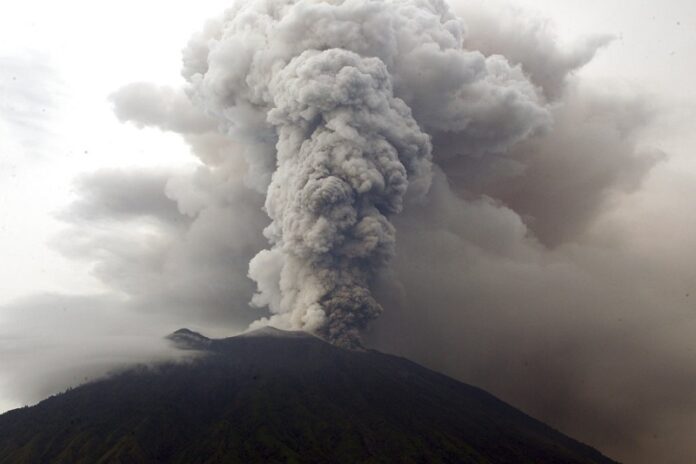
Mount Agung volcano erupts Tuesday in Karangasem, Bali, Indonesia. Photo: Firdia Lisnawati / Associated Press

KARANGASEM — A volcano gushing towering columns of ash closed the airport on the Indonesian tourist island of Bali for a second day Tuesday, disrupting travel for tens of thousands, as authorities renewed their warnings for villagers to evacuate.

Mount Agung has been hurling clouds of white and dark gray ash about 3,000 meters (9,800 feet) above its cone since the weekend and lava is welling in the crater, sometimes reflected as an orange-red glow in the ash plumes. Its explosions can be heard about 12 kilometers (7 1/2 miles) away.

The local airport authority said Tuesday that closure for another 24 hours was required for safety reasons. Volcanic ash poses a deadly threat to aircraft, and ash from Agung is moving south-southwest toward the airport. Ash has reached a height of about 30,000 feet as it drifts across the island.

Indonesia’s National Disaster Mitigation Agency raised the volcano’s alert to the highest level Monday and expanded an exclusion zone to 10 kilometers (6 miles) from the crater in places from the previous 7 1/2 kilometers. It said a larger eruption is possible, though a top government volcanologist has also said the volcano could continue for weeks at its current level of activity and not erupt explosively.

Agung’s last major eruption in 1963 killed about 1,100 people.

Authorities have told 100,000 people to leave homes that are in close proximity to the volcano, though as of Monday tens of thousands stayed because they felt safe or didn’t want to abandon livestock. They have also warned people of the danger of mudflows from the volcano as it’s now rainy season in Bali.

Villager Putu Sulasmi said she fled with her husband and other family members to a sports hall that is serving as an evacuation center.

“We came here on motorcycles. We had to evacuate because our house is just 3 miles from the mountain. We were so scared with the thundering sound and red light,” she said.

The family had stayed at the same sports center in September and October when the volcano’s activity was high but it didn’t erupt then. They had returned to their village about a week ago.

“If it has to erupt, let it erupt now rather than leaving us in uncertainty. I’ll just accept it if our house is destroyed,” she said.

Volcanologist Erik Klemetti at Dennison University in Ohio said Agung’s 1963 eruption was big enough to cool the earth slightly but it’s unclear whether this time it will have a similar major eruption or simmer for a prolonged period.

“A lot of what will happen depends on the magma underneath and what it is doing now,” he said.

The closure of the airport has stranded tens of thousands of travelers, affecting tourists already on Bali and people who were ready to fly to the island from abroad or within Indonesia. Airport spokesman Ari Ahsanurrohim said more than 440 inward and outward flights were canceled Tuesday and about 59,500 travelers were affected, similar numbers to Monday.

Bali is Indonesia’s top tourist destination, with its Hindu culture, surf beaches and lush green interior attracting about 5 million visitors a year.

A Chinese tour service, Shenzhen PT Lebali International, had about 20 groups totaling 500 to 600 travelers from the Chinese cities of Wuhan, Changsha and Guangzhou in Bali, according an executive, Liao Yuling, who was on the island.

“They are mostly retirees or relatively high-end, so they don’t say they are especially anxious to rush home,” she said by telephone.

If the airport stays closed, Liao said they would head by ferry and bus to Surabaya on Java where the company’s charter flights could pick them up.

“We are not really affected, because the volcano is too far away,” said Liao. “We only can say we saw pictures of it on television.”

Indonesia’s Directorate General of Land Transportation said 100 buses were deployed to Bali’s international airport and to ferry terminals to help travelers stranded by the eruption.

The agency’s chief, Budi, said major ferry crossing points have been advised to prepare for a surge in passengers and vehicles. Stranded tourists could leave Bali by taking a ferry to Java and then traveling by land to the nearest airports.

Ash has settled on villages and resorts around the volcano and disrupted daily life outside the immediate danger zone.

“Ash that covered the trees and grass is very difficult for us because the cows cannot eat,” said Made Kerta Kartika from Buana Giri village. “I have to move the cows from this village.”

Indonesia sits on the Pacific “Ring of Fire” and has more than 120 active volcanoes.

Story: Firdia Lisnawati, Stephen Wright

Advertisement

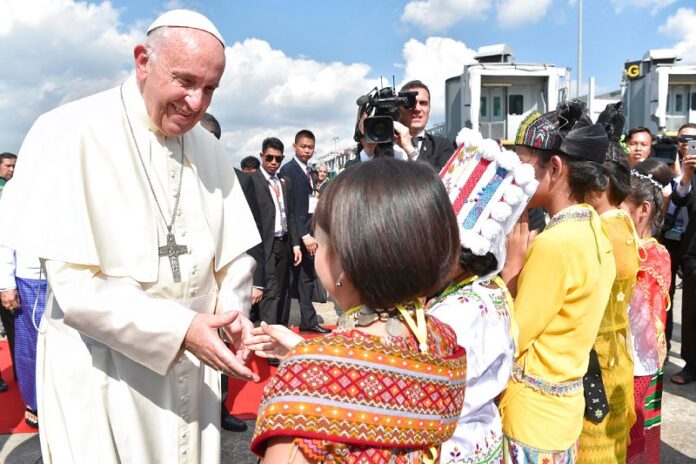
Pope Meeting Suu Kyi on Myanmar Refugee Crisis Amid Outcry

Pope Francis on Monday arrives in Yangon, Myanmar. Photo: Associated Press

YANGON — Pope Francis begins his first full day in Myanmar traveling to the country’s capital Tuesday to meet with the civilian leader, Nobel laureate Aung San Suu Kyi, a day after hosting the military general in charge of the crackdown on the country’s Muslim Rohingya minority.

Francis’ speech to Suu Kyi, other Myanmar authorities and the diplomatic corps in Naypyitaw is the most anticipated of his visit, given the outcry over the crackdown, which the U.S. and U.N. have described as a campaign of “ethnic cleansing” to drive out the Rohingya from northern Rakhine state.

The operation, launched in August after Rohingya militants attacked security posts, has sent more than 620,000 Rohingya into neighboring Bangladesh, where they have reported entire villages were burned and looted, and women and girls were raped.

Myanmar’s Catholic leaders have stressed that Suu Kyi has no voice to speak out against the military over the operation, and have urged continued support for her efforts to move Myanmar toward a more democratic future that includes all its religious minorities, Christians in particular. How Francis bridges the local Catholic concerns with his legacy of speaking out for oppressed minorities is the key to watch in his speech in Naypyitaw.

Francis dove into the crisis hours after arriving on Monday by meeting with the commander responsible for the crackdown, Gen. Min Aung Hlaing, and three members of the bureau of special operations. The Vatican didn’t provide details of the contents of the 15-minute “courtesy visit,” only to say that “They spoke of the great responsibility of the authorities of the country in this moment of transition.”

Gen. Min Aung Hlaing’s office said in a statement on Facebook that he is willing to have “interfaith peace, unity and justice.” The general added that there was no religious or ethnic persecution or discrimination in Myanmar, and that the government allowed different faith groups to have freedom of worship.

Rohingya Muslims have long faced state-supported discrimination in the predominantly Buddhist country and were stripped of citizenship in 1982, denying them almost all rights and rendering them stateless. They cannot travel freely, practice their religion, or work as teachers or doctors, and they have little access to medical care, food or education.

Myanmar’s Catholic Church has publicly urged Francis to avoid saying “Rohingya,” a term shunned by many here because the ethnic group is not a recognized minority in the country. And they have urged him to toe a delicate line in condemning the violence, given the potential for blowback against Myanmar’s tiny Catholic community.

Francis previously has prayed for “our Rohingya brothers and sisters,” lamented their suffering and called for them to enjoy full rights. As a result, much of the debate before his trip focused on whether he would again express solidarity with the Rohingya. Any decision to avoid the term and shy away from the conflict could be viewed as a capitulation to Myanmar’s military and a stain on his legacy of standing up for the most oppressed and marginalized of society, no matter how impolitic.

Burke didn’t say if Francis used the term in his meeting with the general, which ended with an exchange of gifts: Francis gave him a medallion of the trip, while the general gave the pope a harp in the shape of a boat, and an ornate rice bowl.

The papal trip was planned before the latest spasm of violence erupted in August, when Myanmar security forces responded to militant attacks with a scorched-earth campaign that has sent many Rohingya fleeing to Bangladesh.

In the Kutupalong refugee camp in southern Bangladesh, Senu Ara, 35, welcomed Francis’ arrival for what he might be able to do for the refugees.

“He might help us get the peace that we are desperately searching for,” she said. “Even if we stay here he will make our situation better. If he decides to send us back, he will do so in a peaceful way.”

But in Myanmar, the sentiment was different. The government and most of the Buddhist majority consider the Rohingya Bengali migrants from Bangladesh living illegally in the country, though Rohingya have been here for generations.

“Being a religious leader  Catholic leader  means that he is well-regarded, but of course there is this worry if he says something, people might say, ‘OK, he just came to meddle,'” said Burmese analyst Khin Zaw Win, a former political prisoner. “So, I think a lot of diplomacy is needed, in addition to the public relations.”

Upon his arrival in Yangon, the pope was greeted by local Catholic officials and his motorcade passed by thousands of Myanmar’s Catholics, who lined the roads, wearing traditional attire and playing music.

Children greeted him as he drove in a simple blue sedan, chanting “Viva il papa!” (Long live the pope) and waving small plastic Myanmar and Holy See flags. Posters wishing Francis “a heartiest of welcome” lined the route into town.

Story: Nicole Winfield

Advertisement

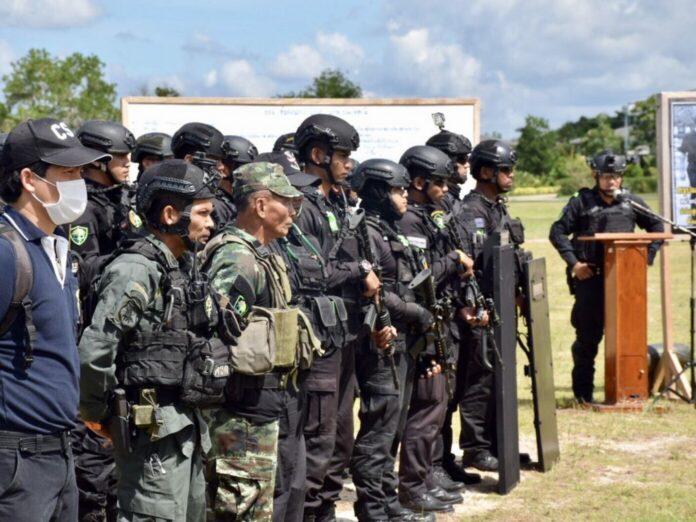
Prayuth Gives ISOC Power Over Public Prosecutors

ISOC officers and members of other military branches attend a counter-insurgency briefing on Nov. 26, 2016, in Yala province.

BANGKOK — Junta leader Prayuth Chan-ocha’s use of absolute power to expand the mandate of a military unit that answers only to him has alarmed human rights watchers.

Critics expressed concern Monday about a more powerful and independent ISOC, as the Internal Security Operations Command is known, after Gen. Prayuth unilaterally granted its commanders wider authority to direct other state agencies at the regional and provincial level.

On Wednesday, Prayuth amended Article 11/1 of the Internal Security Act, which for the first time spelled out which state organs must cooperate with existing ISOC committees headed by regional army chiefs. State prosecutors were a new and unprecedented addition to that list, which included the police, Interior Ministry and other regional and local bodies that ISOC has been able to wield authority over.

Chulalongkorn University political scientist Puangthong R. Pawakapan warned the order ensures the military’s future use of ISOC as leverage to control state agencies after civilian rule is restored.

“Even after the election, it will open the door for the military to have power over other state organs,” said Puangthong, who has studied ISOC’s growing role of society.

Puangthong zoomed in on the junta leader’s order No. 51/2017, which expanded the list of government bodies that must cooperate with ISOC at the regional and provincial level, especially the inclusion of civilian prosecutors.

This, she argues, poses a threat to the justice system by enabling ISOC to direct the activities of local attorneys general.

“The real goal was to make [ISOC’s] power more clear-cut, including with prosecutors,” she said.

Prayuth’s order, which circumvented his interim legislature, said it was intended to more effectively protect national security interests. ISOC exists outside the military chain of command and is part of the Prime Minister’s Office.

Puangthong said ISOC has worked with the Education Ministry at the local level to train students about patriotism and love for the monarchy. She added that this is an example of how ISOC exerts power over other state bodies.

Founded in 1965 during the Cold War, ISOC was initially aimed at tackling communism. It has since widened its scope to include drug trafficking, separatists in the Deep South and suppressing anti-government movements. It was accused of the supporting right-wing paramilitary groups that killed university students under the guise of targeting communist sympathizers in 1976 at Thammasat University.

Last year, its budget exceeded 10 billion baht.

National human rights commissioner Angkhana Neelapaijit said Monday that ISOC was already susceptible to abuses of power in handling what it decides constitute threats to national security. Giving it more power could lead to its infringing on civil and political rights.

“Giving security and military officers more power leads to concerns about the exercise of discretionary power. Sometimes officers don’t report to the central command,” Angkhana said, adding that political rights cannot be separated from civilian rights.

Both regional and provincial ISOC committees will have the power to come up with plans to deal with all types of threats to national security.

Under the junta leader’s order, the amended act slightly tweaks the definition of what constitutes a threat to national security as anything “…that may constitute a threat from a group or an individual that creates disturbances or destroys or causes damage to the life or property of people or the state…”

The act also allows ISOC to take action against threats real and perceived.

As Thailand looks to pivot away from rule by the junta which in 2014 overthrew the civilian government, concerns have grown over measures it has put in place to extend its rule. Critics worry it will systematize existing mechanisms that have been used to silence protests, dissent and expression.

Elections have been set for November 2018, while bans on political activity and protest have yet to be relaxed.

Advertisement

Japanese Girl Group AKB48 Coming to Bangkok

AKB48 members pose on their 2017 trip to Bangkok. Image: Jiggaban / YouTube

Update: Organizers announced Yui Yokoyama, Mion Mukaichi, Juri Takahashi, Narumi Kuranoo, Yui Oguri and Rin Okabe will perform on Jan. 28.

BANGKOK —  Attention, otaku fanboys: Get your glow sticks ready because – as their trademark overture goes – these “angels” will come down from the world’s famous Akihabara to perform for you.

AKB48, one of the most-followed J-pop girl groups, will perform early next year at Japan Expo, organizers announced Monday. The fair exhibits highlights from Japanese culture and tourism.

It will be their third performance in Thailand, having last toured the kingdom earlier this year in February, when their Bangkok-based sister group was announced. Organizers said they will confirm Friday which of the group’s members – which currently number more than 120 – will perform.

Japan Expo is scheduled to take place Jan. 26 through 28 at Central World shopping mall, which is reachable via a short walk from BTS Chit Lom. Entry is free.

It was not yet announced which day AKB48 would take to the stage.

Advertisement

Bangkok Quickies: December Films Worth Seeing in Bangkok

BANGKOK — Believe it or not, there’s more to watch next month than “Star Wars: The Last Jedi.”

A more heartwarming alternative to the sci-fi blockbuster can be found in the adaptation of New York Times bestseller “Wonder.” The film stars Julia Roberts, Oliver Wilson and Jacob Tremblay in the story of a child with facial deformities struggling to fit in at a regular school. It hits theaters nationwide Dec. 12.

The early days of celibacy, vegetarianism and music of Stephen Patrick Morrissey in the ‘70s, years before The Smiths, will be told in biodrama “England is Mine” opening Dec. 14.

Go farther back in time at Bangkok’s famous retro cinema palace, where the last classic in a Thai Film Archive series, Cecil B. De Mille’s 1956 biblical epic “The Ten Commandments.” It will run over three hours starting at noon on Sunday at Scala Theatre. Tickets are only 100 baht.

WONDER


The 60 Second Film Festival returns to Silom Road again with one-minute entries in seven categories, including experimental,mystery, horror and science-fiction. The event starts at 7pm on Saturday at Whiteline, Soi Silom 8.

Contemporary Chinese artist Ai Weiwei’s recent film “Human Flow” is among six movies about refugees forced to flee their homes to be shown at the seventh edition of the Refugee Film Festival running Dec. 7 through Dec. 10 at Paragon Cineplex. Free admission and seats can be reserved online.

Alfred Hitchcock’s final masterwork, “The Birds” (1963), returns to the silver screen at the Bangkok Screening Room starting late November and will run until Dec. 13. Tickets are available online.

Banned in Malaysia, the personally impactful “Absent Without Leave” unravels its filmmaker’s past along with that of his country through his search for his father. It will have three screenings on Dec. 3 on the fifth floor of the Bangkok Art and Culture Centre. Tickets are 130 baht and can be paid for online.

The life and ideas of world-renowned linguist, philosopher and political activist Noam Chomsky will be screened Dec. 4 via 1992 biodoc “Manufacturing Consent: Noam Chomsky and the Media” at the Foreign Correspondents’ Club of Thailand near BTS Chit Lom. Cost for non-members is 150 baht.

Get your festive on with a Christmas-themed cliche when “Love Actually” gets a rooftop showing at Open Air Cinema Club on Dec. 8 at The Hive Bangkok. Tickets are 150 baht for The Hive members and 300 baht for non-members.

CALL ME 1
“Call Me By Your Name”

More than just another gay drama, “Call Me By Your Name” examines a powerful romance between two men during an Italian summer. The film has been highly anticipated since it swept many nominations and awards on the festival circuit and is already short-listed by many critics for an Oscar bid. The film will show at art cinema House RCA starting Dec. 14.

Private mini-cinema The Friese-Greene Club on Soi Sukhumvit 22 has a long list of daily films throughout the month. The month opens with two Saturdays of Bela Lugosi’s zombie and monster classics and builds up to highlight Christmas pairing “Bad Santa” and “It’s a Wonderful Life.” The full schedule is posted online.

Advertisement

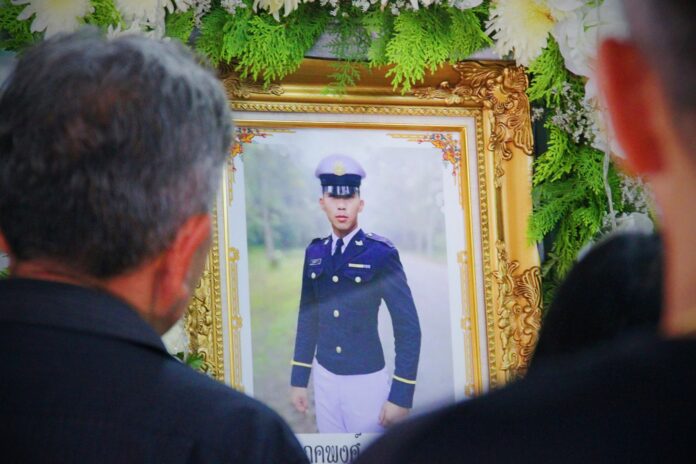
Dead Cadet: Rights Commission to Summon Army Officers

Image: Supicha M. Tanyakan / Facebook

BANGKOK — The national rights agency said Monday it will convene an independent inquiry into the death of military cadet whose family suspects a cover-up of foul play.

A high-profile member of the National Human Rights Commissions said the body will summon all relevant parties to get to the bottom of what really happened to Pakapong Tanyakan, including commanders of the academy where he died last month.

“We have to summon every side, like the family, the academy and doctors who examined his body,” Angkhana Neelaphaijit said in an interview. “We will also call for documents related to the autopsy.”

Angkhana spoke after a group of student activists petitioned the commission to look into the 19-year-old cadet who died Oct. 17, one day after returning to the Armed Forces Preparatory School from a break.

His family, who made the grisly discovery that many of his vital organs were missing from his body after it was returned to them, renewed their calls Sunday for an investigation into his death.

But Pakapong’s family raised new doubts when they said a complete, independent autopsy performed by a forensic science agency found blood clots in Pakapong’s liver and spleen. His sister Supicha Tanyakan told reporters there was no mention of the blood clots when military representatives returned Pakapong’s organs to the family on Thursday.

It is unclear whether military will cooperate with the rights commission. The armed forces have previously said it would launch an investigation into the chain of events that led to the cadet’s death. They also rejected calls for a civilian inquiry into the matter.

Armed forces spokesman Nothapol Boonngam said he was in a meeting Monday and could not comment. Further calls to his phone were not answered.

Rights commissioner Angkana said the military can indefinitely postpone summons from the agency and not show up at all as there is no law compelling them to do so.

“The National Human Rights Commission cannot force them to come,” Angkana said, adding that the most she could do to non-compliant summons is complain to the government.

Angkana, who’s spent years campaigning against forced disappearances and military brutality, remains optimistic. Even the junta’s National Council for Peace and Order answered the summons last week for the commission’s inquiry into alleged mistreatment of activist Ekachai Hongkangwan, she said.

“Most of the time, when we invite someone, they show up,” Angkana said.

Calls and messages seeking comments to Pakapong’s family were not answered by press time.

Advertisement

Hot News

LATEST NEWS

Bangkok
overcast clouds
29.9 ° C
31.1 °
28.8 °
90 %
2.8kmh
97 %
Sat
37 °
Sun
36 °
Mon
36 °
Tue
33 °
Wed
34 °