A still image of a live online broadcast Friday by TV24.
BANGKOK — A television station aligned with former premier Thaksin Shinawatra went off the air Friday by order of broadcast regulators for 30 days as punishment for its allegedly biased reporting.
The National Broadcasting and Telecommunications Commission, or NBTC, said satellite station TV 24’s “Sharp News” and “Green Light Thinking” programs had violated agreements made with the regime despite prior warnings.
No details were given as to how the programs were unfair, and executives at the station were unavailable for comment as of Friday afternoon.
Television hostess and pro-democracy activist Nuttaa Mahattana took to Facebook on Thursday to defend the rights of the media to express views and news.
Nutta said the suspension is not just a violation of the press freedoms but the right of the public to be informed.
She added that there are already laws on the books to deal with problematic content, such as the criminal defamation laws.
Media groups have criticized the military government for routinely going after critical media voices through regulatory mechanisms rather than direct censorship.
The NBTC has previously ordered Spring News, Peace TV and Voice TV off the air for programs critical of the ruling junta.
“The suspension of TV 24 for one month is not just a severe violation of rights and liberties but was intended to destroy those who are politically opposed to the dictatorship,” Nutta said.
The station – closely identified with the pro-Thaksin Pheu Thai Party – is still able to disseminate its content online.
In this June 30, 2016 photo, a person smokes marijuana at the Asociacion de Estudios del Cannabis del Uruguay, in Montevideo, Uruguay. Photo: Matilde Campodonico / Associated Press
LAS VEGAS — Big-box stores won’t be the only ones offering discounts to shoppers in Las Vegas this Black Friday. Marijuana dispensaries are rolling out deals, too.
More than 40 dispensaries in the Sin City area will offer discounts on marijuana flower products, edibles such as chocolates, and concentrates, the Las Vegas Sun reportedWednesday. This will be the first Black Friday since legal sales of recreation marijuana began in Nevada.
“It’s a great stocking-stuffer, and now you can treat it like alcohol in that regard,” said state Sen. Tick Segerblom, who helped legalize recreational pot in the state. “As long as no kids can get to it. It’s for adults only.”
Some dispensaries will offer an eighth of an ounce of select flower products for $35, down from $53. One dispensary will gift shoppers a 10-pack of fruit chew edibles with any purchase, while another one will have a buy-one-get-one-free special on edibles.
Legal sales of recreational marijuana began in the state July 1. Those 21 and older with a valid ID can buy up to an ounce of pot. People can only use the drug in a private home as it remains illegal to consume it in public, including the Las Vegas Strip, hotels and casinos.
“Cannabis use has been misunderstood and vilified in our country for over 80 years, so this day will feel both surreal and celebratory,” said Andrew Jolley, owner of dispensaries and president of the Nevada Dispensary Association. “We’re very excited about the first holiday season of adult-use in Nevada.”
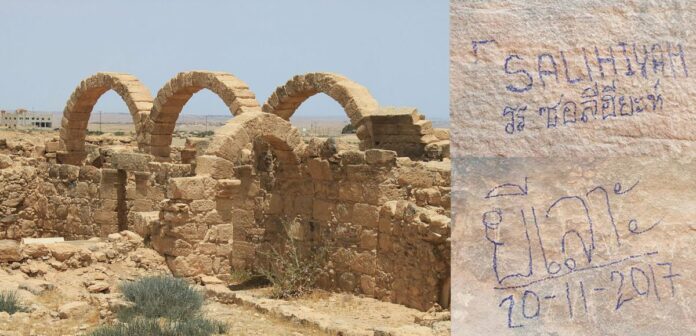
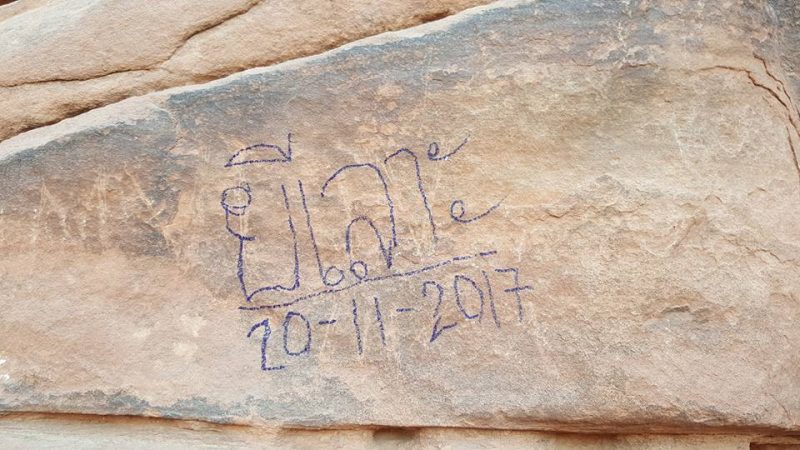
The Umm ar-Rasas site in Jordan. Photo: Bjorn Anderson. Inset: Graffiti by Salihiyah School, taken on Tuesday. Photos: Paothong Thongchua
MADABA, Jordan — A Thai high school made its mark on an ancient historical site in Jordan, inviting an outpouring of shame that prompted the principal to return to the scene to erase the graffiti.
Students of Salihiyah School in Pattani province on a field trip to Jordan on Thursday erased the graffiti they – or maybe their principal and other adults – left scrawled on walls of the 1,500-year-old Umm ar-Rasas, a UNESCO Heritage Site in central Jordan, after a historian posted photos of the handiwork.
“At the site of prehistoric artifacts over 2,000 years old, just one day before I arrived, people of some unknown nation wrote some messages on the walls,” Paothong Thongchua, a former Thammasat University historian, wrote sarcastically of the Thai-language graffiti. “The Jordanian authorities have asked the people who wrote them to erase them. Otherwise, Thailand and that school will be shamed, and the whole world will know that Thailand does not raise quality citizens.”
In response to being called out by Paothong, the director of the school located in Khok Pho district reported taking action, but played down the seriousness and blamed the internet.
“The area that the students wrote on was outside of the historical site’s gate. There were messages written by other people in many other languages too,” Abdullah Yeelaw, director of Salihiyah School reportedly said by phone to the director of the Pattani Private Schools Association. “After we erased it, we told the Jordanian authorities, so it’s all done and over with. The online world just blew this out of proportion. Anyway, I’d still like to apologize.”
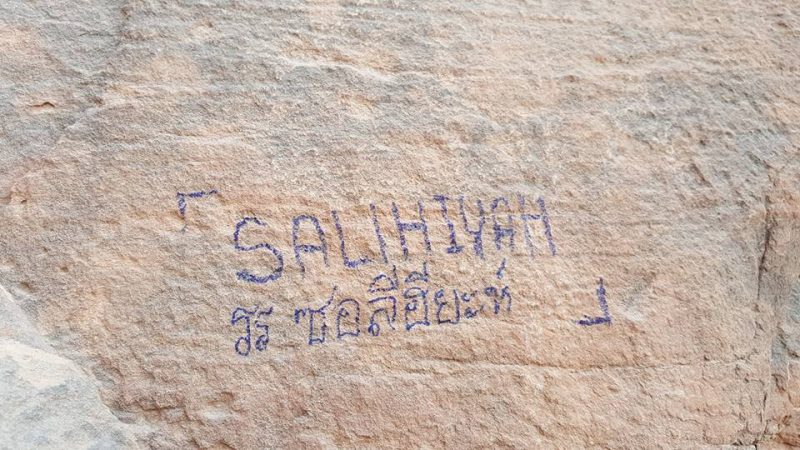
Abdullah’s name, as well as that of the school, are clearly visible among the graffiti, which is dated Monday.
Paothong’s post led netizens to berate the school on its Facebook page, which as of Friday has been deactivated. Some commentators said that the vandals may have been their supervisors or a graduate since the students were visiting an olive oil factory that day.
“How embarrassing,” wrote Facebook commenter Juroon Chaisathan. “I bet the walls in your school’s bathroom are just as messy.”
Abdullah said that he and his party erased the messages on the rocks as of Thursday but blamed his students rather than himself.
Members of the Salihhiyah School students were on a field trip to Jordan to visit historical sites and alumni.
Graffiti saying ‘Salihyah School’ in English and Thai at Umm ar-Rasas in a photo taken Tuesday. Photo: Paothong Thongchua‘Yeelaw’ reads this graffiti written with Monday’s date at Umm ar-Rasas in a photo taken Tuesday. Photo: Paothong Thongchua
Brazilian footballer Robinho seen here in 2010 in Johannesburg, South Africa. Photo: Marcello Casal Jr / Wikimedia Commons
MILAN — Former AC Milan and Real Madrid striker Robinho was sentenced to nine years in jail by a court in Milan on charges of sexual assault following an incident in 2013, Italian news agency ANSA reported Thursday.
Currently playing for Atletico Mineiro in his native Brazil, Robinho’s lawyer said in a statement that the 33-year-old Robinho denied the charges and will appeal the court’s decision.
ANSA reported that five other men were also accused of sexually assaulting an Albanian woman and that another member of the group, Ricardo Falco, was also sentenced to nine years in jail. The other four men had not been found by Italian police, ANSA said.
Robinho’s lawyer, Marisa Alija, issued a statement saying that “We clarify that he has already defended himself from these allegations, and insist he had no participation in that episode. All legal provisions are being taken on this first decision.”
Brazil does not extradite its own citizens when they are sentenced in other countries.
Robinho began his career with Santos before leaving Brazil in 2005 for a three-year spell with Madrid. He then joined Manchester City in the English Premier League and moved to AC Milan in 2010, spending five years under contract with the Serie A club. After a brief stay at Chinese team, Guangzhou Evergrande, he joined Atletico Mineiro last year.
He has made 100 international appearances for Brazil.
BANGKOK — Night owls go to the Malaysia Hotel for its khao tom or to continue drinking at dawn after tiptoeing out of nearby Wong’s. Gay travelers have known it as an affordable place to stay and pick up young Thai men.
Few however may know the full history of this storied hotel, among those built to welcome American soldiers at the height of the war in Vietnam, where late comedian Robin Williams once occupied a room to shoot “Good Morning, Vietnam.”
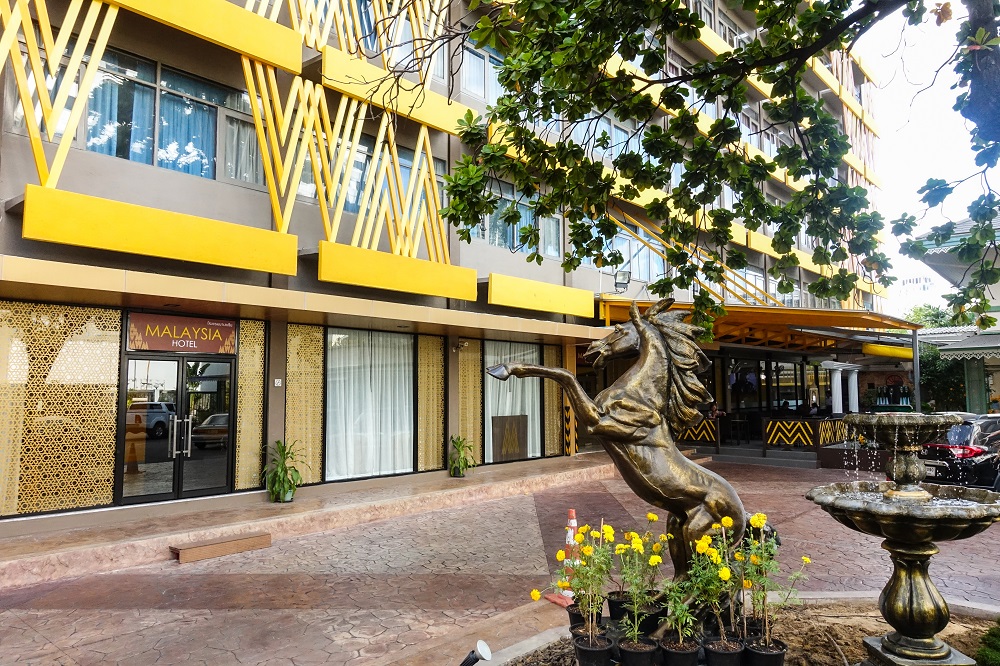
For example, the name of the hotel– which turns 50 next month – has nothing to do with Thailand’s neighbor to the south. Devised to be memorable for foreigners, the name was derived from the owning family’s ancestral Chinese name – Ma. That also explains the statue of the rearing horse outside and the hotel’s logo, as maa is Thai for horse.
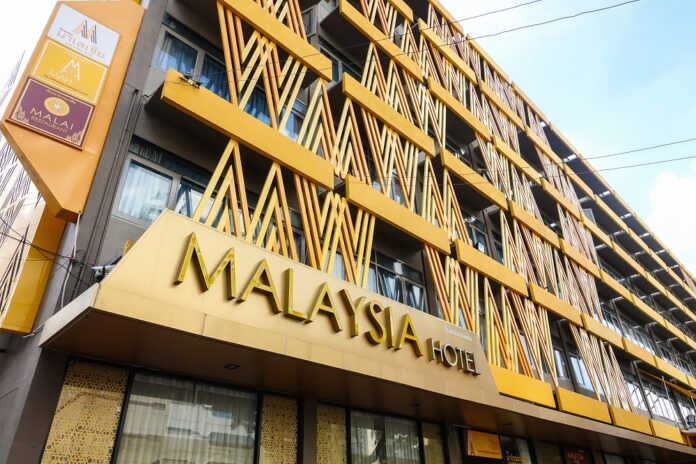
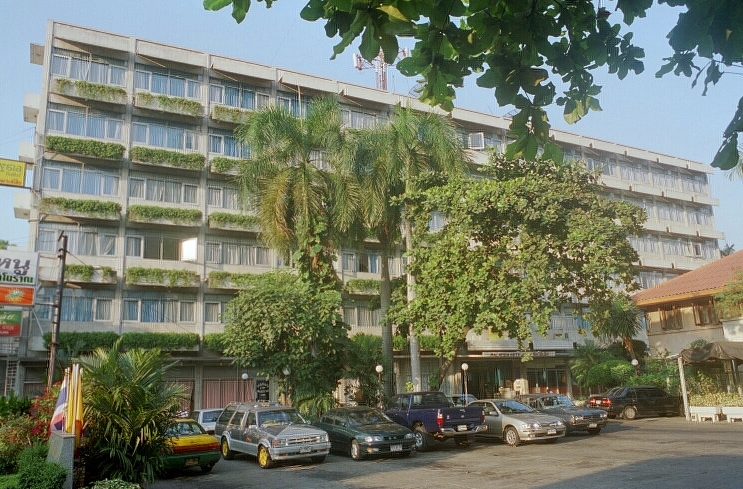
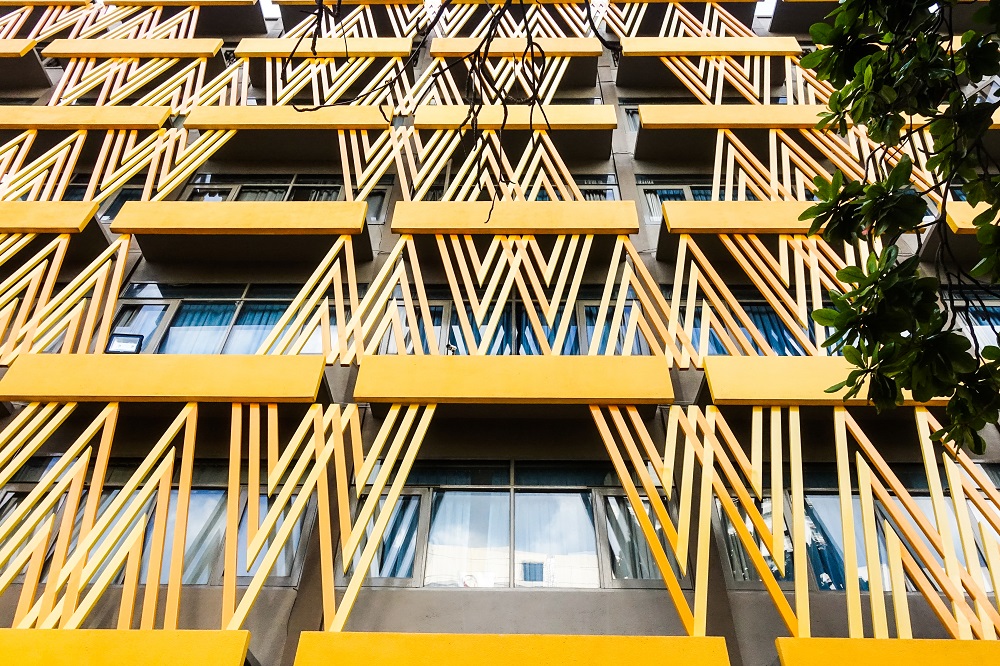
Sitting in Soi Ngam Dupli not far from MRT Lumphini, the Malaysia Hotel was a typically dire block of mid-20th century concrete until a decorative, extruded golden panel was bolted onto the exterior about a year ago as part of extensive renovations.
It has remained in the hands of the same family that built it, now handed down to second- and third-generation owners.
On a recent afternoon in the hotel’s famed restaurant, Mayuree Rungsaeng reminisced on life before the hotel, when she was a child living in a canalside home on two rai (3,200sqm) of land with her family, who then sold cloth in Chinatown’s Sampeng Market.
Back in the early ‘60s, Bangkok had a lot fewer hotels. As the Vietnam War began to escalate in 1965 and the economy boiled with American dollars, the capital embarked on a major building spree that brought new development, roads, foreign investment and a glut of tourists. Dozens of hotels mushroomed across Bangkok. They included the Rex, Sheraton, Siam Intercontinental, Chavalit (Ambassador, today), Amarin and Mandarin hotels.
A name card of the Malaysia Hotel’s first manager Chavalit
Mayuree’s family was among those to seize the opportunity. They built a 120-room hotel with six floors and called it Malaysia.
Upon opening in December 1967, the hotel quickly grew popular among American GIs visiting Bangkok for R&R for its convenient access to places such as Lumphini Park, the U.S. embassy, theJoint United States Military Advisory Group, or JUSMAG – not to mention Patpong and other red-light districts.
“There were so many GIs checking in and checking out; the one sure thing I remember is they all wore cool uniforms,” said Wilai Kapoon, who in her over 30 years at the hotel has gone from maid to receptionist.
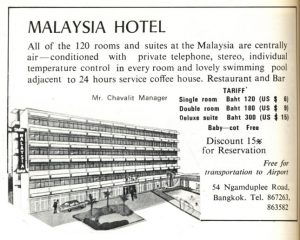
In the beginning, rooms started at a handsome 120 baht per night. After the American withdrawal from Vietnam, the loss of business forced the hotel to cut rates in half to only 60 baht.
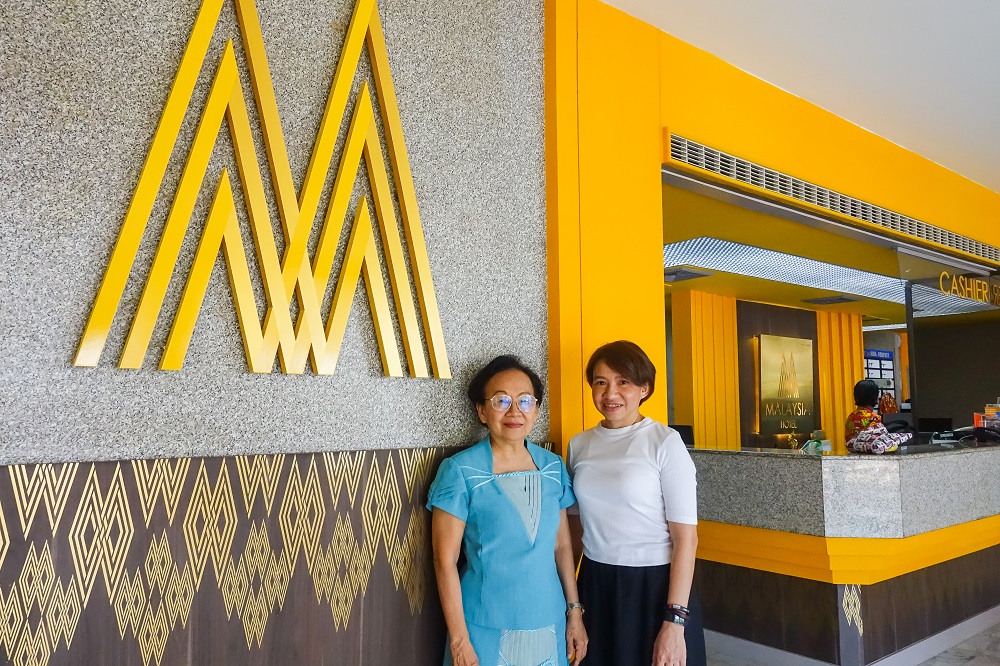
Mayuree Rungsaeng and Chanthiman Rungsaeng
Thus came the first “Cheap Charlie” budget farang backpackers at a time when Khaosan Road was just another unremarkable soi.
The hotel even provided inspiration to ‘70s French punk band La Souris Déglinguée, aka LSD. “Malaysia Hotel,” released in 1983, is a one-minute track sung awkwardly in Thai.
“Hey, mister musician. Why did you come to Thailand? Why did you stay at Malaysia Hotel?” a woman sings. “To smoke cigarettes and marijuana, chai mai?”
Beyond inspiring European rockers, the hotel played a role in Hollywood film industry as well. Known to few people, one of the second-floor rooms was transformed into a ‘60-era radio station for shooting 1987 comedy-drama “Good Morning, Vietnam.” In the film, Robin Williams is a DJ for the Armed Forces Service Radio in a role that earned him a best actor nod from the Academy Awards.
In 1987, during the so-called Golden Age of Thai Tourism, foreign tourists arriving at Don Mueang Airport would be handed a list of recommended hotel by the Immigration Bureau. The Malaysia Hotel was among them.
The late 1980s is when the neighborhood heated up as a destination for casual gay sex. And it wasn’t only foreign travelers coming to the Malaysia then. The legendary Babylon gay sauna opened nearby on Soi Sathorn 1 in 1988, and soon rent boys could be found day and night around the hotel, often loitering in its parking lot gazebo.
The business class discovered the hotel in the early ‘90s. The hotel opened its “internet corner,” a basic business services area near the lobby with a few computers connected to the internet. At the time, few hotels offered internet service, said Chanthiman Rungsaeng, Mayuree’s daugher and now the hotel’s managing director.
Robin Williams as a radio DJ in ‘Good Morning, Vietnam’ in a scene filmed inside the Malaysia Hotel.
Since then, the Sathorn area had filled up with commercial buildings, embassies and offices. Now the five-decade establishment packs in language-learners, businessmen and visa-hunters. The hotel hosts temporary student residents taking intensive German courses at the nearby Goethe Institut.
Some of the GIs who haunted its halls in their youth have trickled back in, along with retirees from around the world, namely England, Germany and the United States. Some say they regard the hotel as their second home; Chanthiman said their “most VIP” guest stayed there for 20 years.
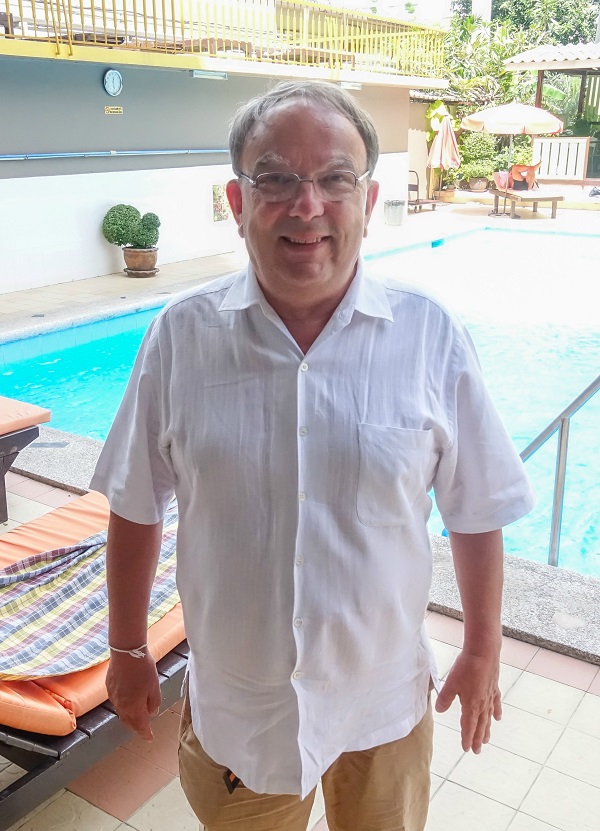
One regular is French national Alain Gerveix, who said he comes to Thailand two or three times a year for pleasure and to take intensive Thai language courses.
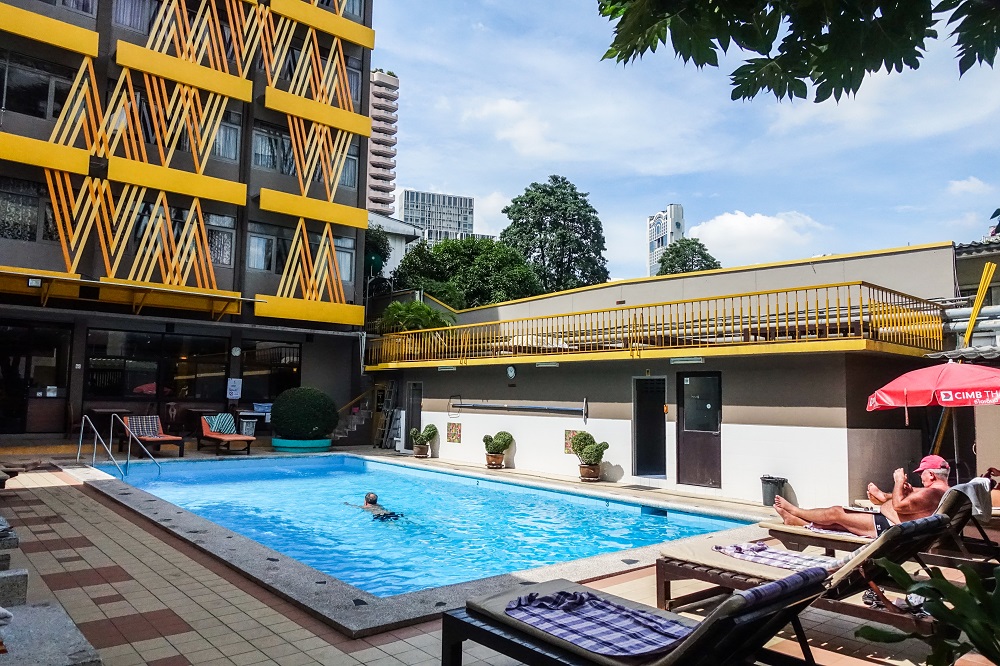
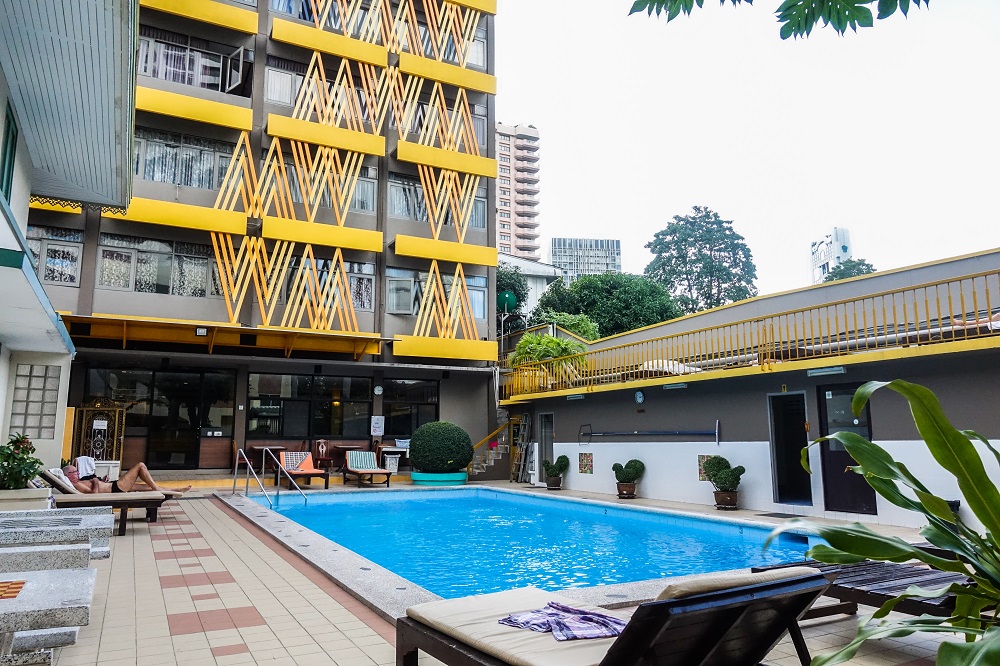
Gerveix said his first impression of the Malaysia was its convenient location near public transportation and a swimming pool where Gerveix can “work outside” on his Thai language homework next to the pool.
Despite describing himself as a “very shy” person, the 69-year-old said he’s familiar with all hotel staff. “I know everyone here,” he said.
Alain Gerveix
Often found at a square stone table by the pool is a 59-year-old American artist who uses her perch to write about her hero, the late King Bhumibol.
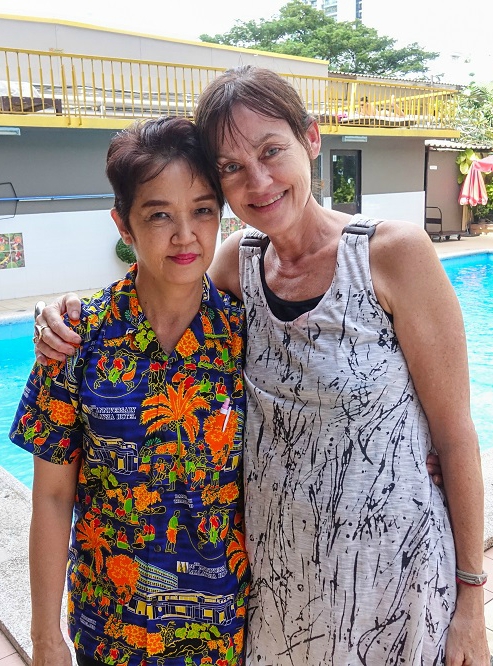
Maura Moynihan, who the staff call “madam,” is among those who routinely enjoy long-term stays at the Malaysia. She first visited Thailand in 1975 at the beginning of what would become a lifetime passion for Thailand’s culture, art religion and, perhaps most of all, King Bhumibol.
“I just walked in and fell in love with it,” she said, making admirable mention of the swimming pool’s cleanliness and summer beach atmosphere.
She was parked in front of the dining room’s large TV on Oct. 26, the day the late king was cremated, with 100 other Thais and foreigners watching the funerary procession. She said the staff hugged and soothed her as she cried her heart out.
“I wish I could never leave Thailand. The Malaysia [Hotel] is my family,” she said
Today, Malaysia Hotel has expanded its facilities from its single original building to a newly built four-story addition. The family has moved off-premises, and rooms in their longtime home next to the main building – including Mayuree’s bedroom – are now rented out. Room rates today range from 1,100 baht to 1,700 baht.
Maura Moynihan, at right, poses for a picture with a Malaysia Hotel staff member
Though the high season usually runs November through Songkran in April, the hotel says it greets a smaller number of guests year-round, who come in for its amenities of massage, food and drinks.
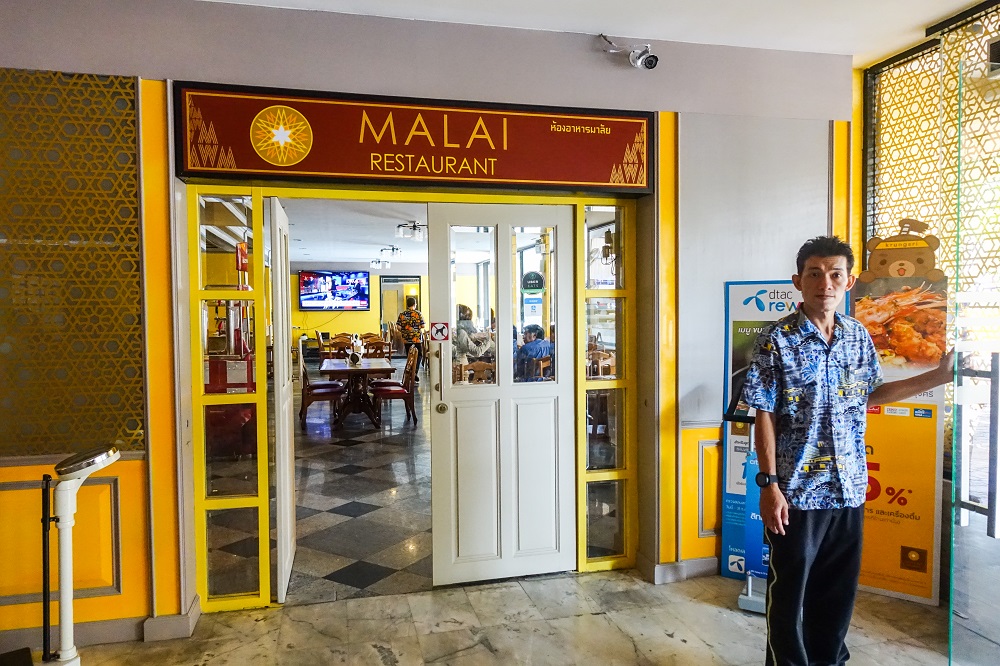
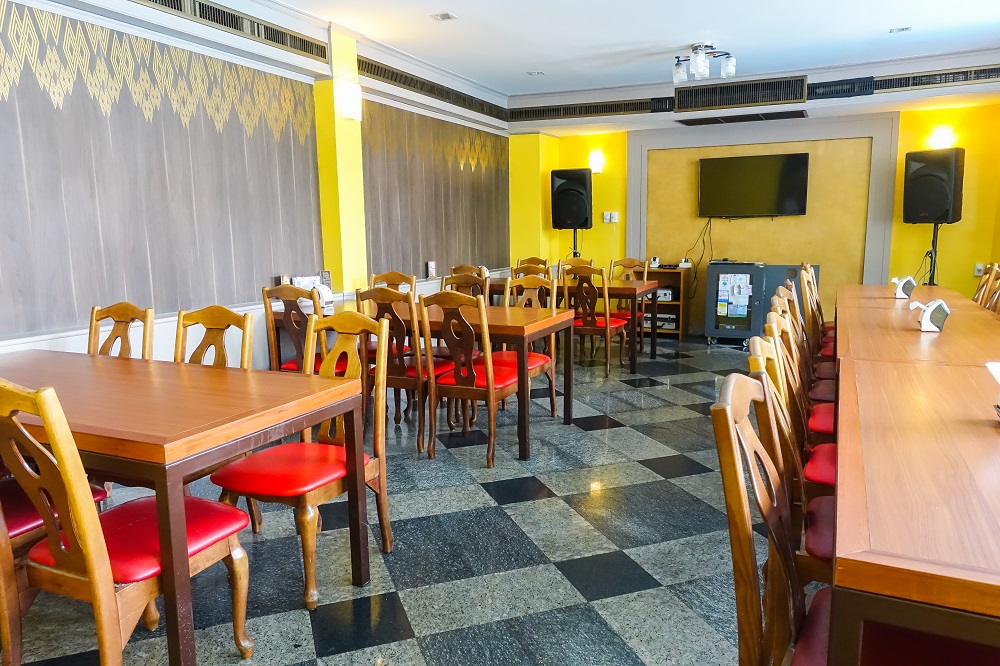
On most nights, the small Malai Restaurant on the ground floor is bustling. Open day and night, it serves a long list of comfort foods and crowd-pleasers such as ham sandwiches, pickled crab, stir-fried pork with salted black olives and butterfly pea-boiled rice. The sizzling-pan Turnip Cake is its signature dish. Made from shredded radish and studded with shrimp, mushroom, taro, peanut, mushroom and more, the recipe won cooking contestThe Dish in October 2016.
Malai Restaurant’s signature Turnip Cake
Some of the cooks came from the former Rex Hotel on Asok Montri Road, which was knocked down a few years back. Chanthiman recruited them because she was a fan of Rex’s khao tom joint.
The Malaysia Hotelturns 50 on Dec. 3. In August it completed renovations including repainting its gold-colored facade, vibrant murals and refurbishing room decor and furniture.
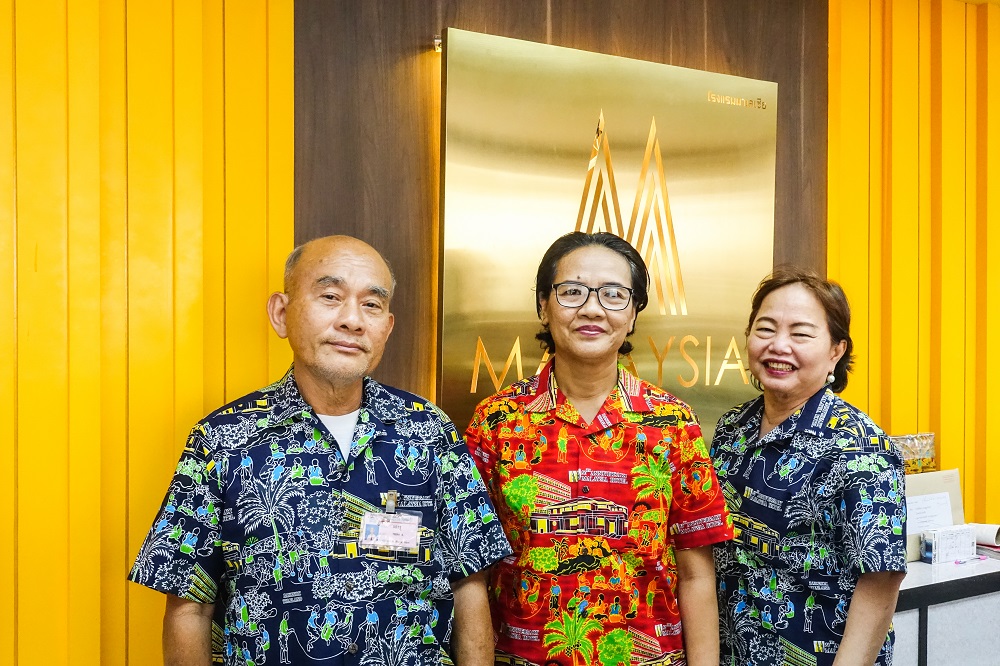
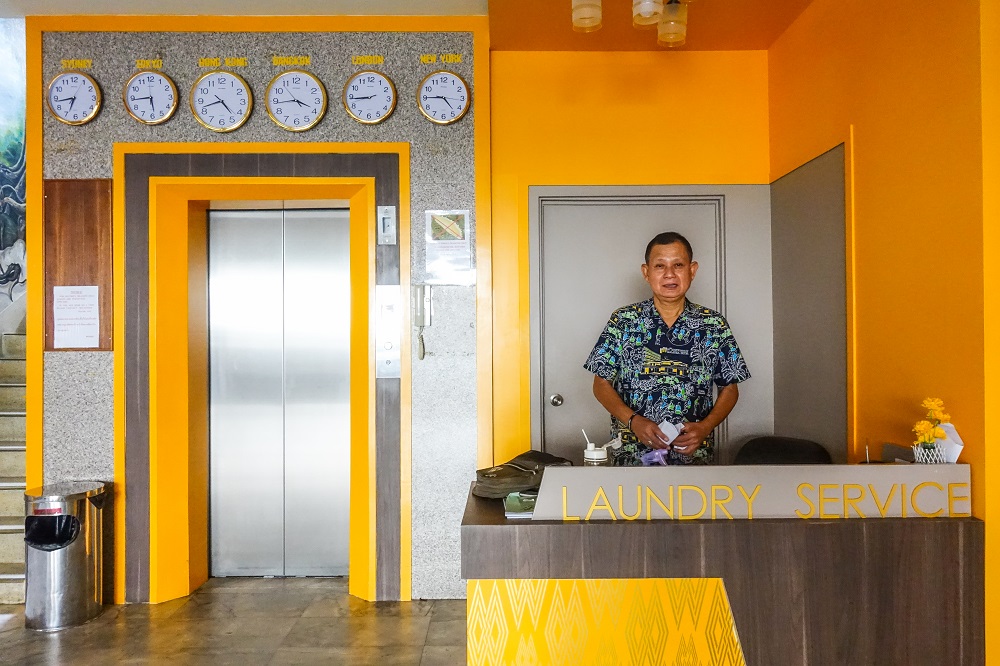
Malaysia Hotel in the late ‘90s.From left, Teera Tongphasook, Wilai Kapoon and Sunee Prempolkamol are the hotel’s longest-serving staff.
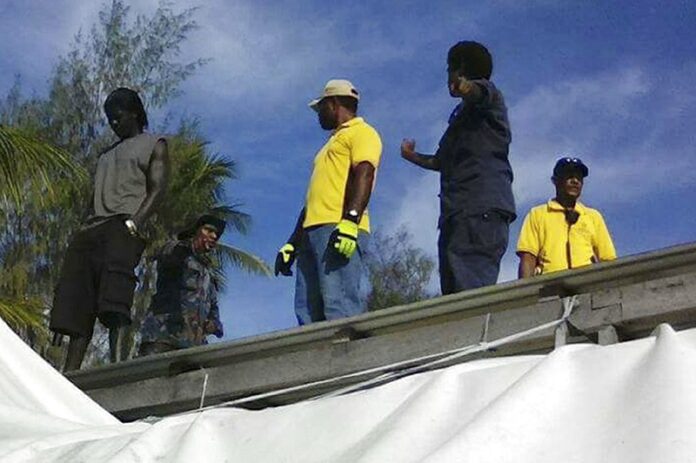
This image provided by Refugee Action Coalition, shows police entering the immigration camp Thursday on Manus Island, Papua New Guinea. Photo: Associated Press
CANBERRA, Australia — Papua New Guinea authorities said Friday they had relocated the last asylum seekers who had refused for three weeks to leave a closed immigration camp for fear they would face violence in the alternative accommodations.
Police Chief Superintendent Dominic Kakas said police and immigration officials removed all 378 men from the male-only camp on Manus Island over two days and took them by bus to residences in the nearby town of Lorengau.
“Everybody’s gone. Everybody got on the buses, they packed their bags and they moved over,” Kakas said.
Refugee advocates say officials used force and destroyed asylum seekers’ belongings to make them leave Manus.
Video was released of officials in the camp wielding what appeared to be wooden sticks.
Water, power and food supplies ended when the Manus camp ended officially closed on Oct. 31, based on the Papua New Guinea Supreme Court’s ruling last year that Australia’s policy of housing asylum seekers there was unconstitutional. But asylum seekers fear for their safety in Lorengau because of threats from local residents.
Australia pays Papua New Guinea, its nearest neighbor, and the tiny Pacific nation of Nauru to hold thousands of asylum seekers from Africa, the Middle East and Asia who have attempted to reach Australian shores by boat since mid-2013.
Before confirmation that Manus Island had been emptied, Australian Prime Minister Malcolm Turnbull welcomed news that asylum seekers were leaving.
“I’m please to say in terms of Manus, that the reports we have are that busloads of the people at Manus are leaving, they’re complying with the lawful directions of the PNG authorities and moving to the alternative facilities available to them and that’s as they should,” Turnbull told reporters.
“That is precisely what you should do, if you’re in a foreign country. You should comply with the laws of that other country,” he added.
Shen Narayanasamy, activist group GetUp’s rights campaigner said in a statement: “I awoke this morning to frantic phone calls from refugees on Manus screaming: ‘Help, help, they are killing us.’ It is astounding that refugees being beaten and dragged out to buses has the support of the Australian government.”
Police maintain no force was used.
Australian Immigration and Border Protection Minister Peter Dutton accused refugee advocates of making “inaccurate and exaggerated claims of violence and injuries on Manus,” without providing evidence.
Dutton also accused asylum seekers of sabotaging backup generators and water infrastructure at the new accommodation provided by Australia in Lorengau.
“What is clear is that there has been an organized attempt to provoke trouble and disrupt the new facilities,” Dutton said in a statement.
Australia will not settle any refugees who try to arrive by boat – a policy that the government says dissuades them from attempting the dangerous ocean crossing from Indonesia. The navy has also been turning back boats to keep them from reaching Australia since July 2014.
The United States has agreed to resettle up to 1,250 of the refugees under a deal struck by former President Barack Obama’s administration that President Donald Trump has reluctantly decided to honor. So far, only 54 have been accepted by the United States.
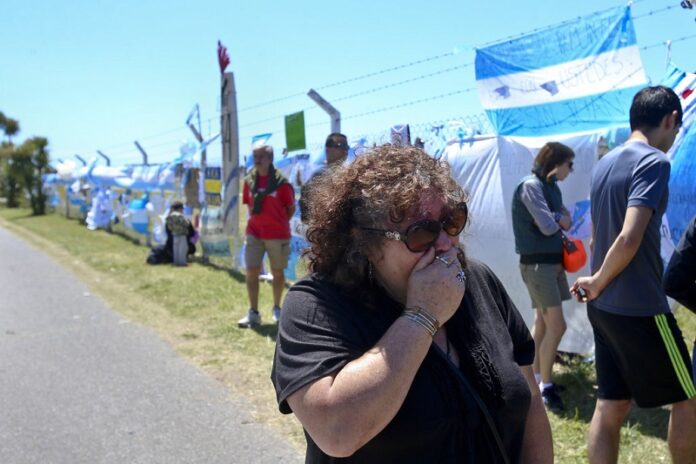
A woman cries in front of a fence enclosing the Mar de Plata Naval Base after learning that Argentina's navy announced that a sound detected during the search for the missing ARA San Juan submarine is consistent with that of an explosion, in Mar de Plata, Argentina, Thursday, Nov. 23, 2017. A Navy spokesman said that the relatives of the crew have been informed and that the search will continue until there is full certainty about the fate of the ARA San Juan. He said there was no sign the explosion might be linked to any attack on the sub. (AP Photo/Esteban Felix)
MAR DEL PLATA, Argentina — An apparent explosion occurred near the time and place an Argentine submarine went missing, the country’s navy reported Thursday, prompting relatives of the vessel’s 44 crew members to burst into tears and some to say they had lost hope of a rescue.
Navy spokesman Enrique Balbi said the search will continue until there is full certainty about the fate of the ARA San Juan, despite the evidence of an explosion and with more than a week having passed since the submarine disappeared. It was originally scheduled to arrive Monday at Argentina’s Mar del Plata Navy Base.
The U.S. Navy and an international nuclear test-ban monitoring organization said a “hydro-acoustic anomaly” was produced just hours after the navy lost contact with the sub on Nov. 15. It was near the submarine’s last known location.
“According to this report, there was an explosion,” Balbi told reporters. “We don’t know what caused an explosion of these characteristics at this site on this date.”
The navy spokesman described the “anomaly” as “singular, short, violent and non-nuclear.”
Relatives of the crew who had gathered at the Mar del Plata base to receive psychological counseling broke into tears and hugged each other after they received the news. Some fell on their knees or clung to a fence crowded with blue-and-white Argentine flags, rosary beads and messages of support. Most declined to speak, while a few others lashed out in anger at the navy’s response.
“They sent a piece of crap to sail,” said Itati Leguizamon, wife of submarine crew member German Suarez. “They inaugurated a submarine with a coat of paint and a flag in 2014, but without any equipment inside. The navy is to blame for its 15 years of abandonment.”
Balbi defended the Argentine Navy, saying that “with respect to the maintenance and state of our naval and air units, no unit ever leaves port or takes off if it isn’t in operating conditions to navigate or fly with total security.”
The German-built diesel-electric TR-1700 class submarine was commissioned in 1985 and was most recently refitted in 2014.
During the $12 million retrofitting, the vessel was cut in half and had its engines and batteries replaced. Experts say that refits can be difficult because they involve integrating systems produced by different manufacturers and even the smallest mistake during the cutting phase of the operation can put the safety of the ship and the crew at risk.
The Argentine navy and outside experts have said that even if the ARA San Juan is intact, its crew might have only enough oxygen to be submerged seven to 10 days. It lost contact as it was sailing from the extreme southern port of Ushuaia. The submarine’s captain had reported a battery failure.
Authorities said late Wednesday that Argentine navy ships as well a U.S. P-8 Poseidon aircraft and a Brazilian air force plane would return to the area to check out the abnormal sound, which originated about 30 miles north of the submarine’s last registered position.
The search location straddles the edge of the continental shelf, with widely varying ocean depths, some as great as 10,000 feet (3,000 meters). Experts say the submarine could not have supported pressures that far down.
“If a submarine goes below its crush-depth, it would implode, it would just collapse,” said James H. Patton Jr. a retired Navy captain. “It would sound like a very, very big explosion to any listening device.”
Whatever it was, U.S. Navy Lt. Lily Hinz said the sound detected “was not a whale, and it is not a regularly occurring sound.”
Claudio Rodriguez, brother of crew member Hernan Rodriguez, said his family suspects “the explosion was so strong that they were not able to rise to the surface or shoot any flares. They didn’t have time for anything.”
“As a family, we’re grateful to all the people who prayed for us and for the families of all the 44,” he said.
More than a dozen airplanes and ships have been participating in the multinational search despite stormy weather that has caused waves of more than 20 feet (6 meters). Search teams are combing an area of some 185,000 square miles (480,000 square kilometers), which is roughly the size of Spain.
The U.S. government has sent two P-8 Poseidons, a naval research ship, a submarine rescue chamber and sonar-equipped underwater vehicles. U.S. Navy sailors from the San Diego-based Undersea Rescue Command were also helping with the search.
Britain’s Ministry of Defense sent a special airplane with emergency life support pods to join the hunt that includes planes and ships from a dozen nations.
Hopes were buoyed after brief satellite calls were received and when sounds were detected deep in the South Atlantic. But experts later determined that neither was from the missing sub.
“They haven’t come back and they will never come back,” said Jesica Gopar, wife of submarine officer Fernando Santilli, choking back tears. “I had a bad feeling about this and now it has been confirmed.”
An elderly Rohingya Muslim, who recently crossed over from Myanmar into Bangladesh, arrives at a food distribution center on Sept. 9 in Kutupalong, Bangladesh. Photo: Bernat Armangue / Associated Press
BANGKOK — Myanmar and Bangladesh signed an agreement on Thursday covering the return of Rohingya Muslims who fled across their mutual border to escape violence in Myanmar’s Rakhine state.
Myanmar announced the agreement but provided no details on how many Rohingya refugees would be allowed to return home. Bangladesh said the repatriations are to begin within two months.
More than 620,000 Rohingya have fled from Myanmar into Bangladesh since Aug. 25, when the army began what it called “clearance operations” following an attack on police posts by a group of Rohingya insurgents. Refugees arriving in Bangladesh said their homes were set on fire by soldiers and Buddhist mobs, and some reported being shot at by security forces.
The office of Myanmar civilian leader Aung San Suu Kyi said the agreement “on the return of displaced persons from Rakhine state” was signed by Cabinet officials in Naypyitaw, Myanmar’s capital. It said the pact follows a formula set in a 1992 repatriation agreement signed by the two nations after an earlier spasm of violence. Under that agreement, Rohingya were required to present residency documents, which few have, before being allowed to return to Myanmar.
“We’re continuing our bilateral talks with Myanmar so that these Myanmar nationals (Rohingya) could return to their country,” Bangladesh Prime Minister Sheikh Hasina was quoted as saying by the United News of Bangladesh news agency. “It’s my call to Myanmar to start taking back soon their nationals from Bangladesh.”
Rohingya at a refugee camp in Bangladesh expressed deep doubts about the agreement.
“They burned our houses, they took our land and cows – will they give us these things back?” asked Abdul Hamid from Hoyakong.
“I’m not happy at all. First, I need to know if they are going to accept us with the Rohingya identity,” said Sayed Alom, also from Hoyakong.
Rohingya Muslims have faced state-supported discrimination in predominantly Buddhist Myanmar for decades. Though members of the ethnic minority first arrived generations ago, Rohingya were stripped of their citizenship in 1982, denying them almost all rights and rendering them stateless. They cannot travel freely, practice their religion, or work as teachers or doctors, and they have little access to medical care, food or education.
The Myanmar government has refused to accept them as a minority group, and the statement issued Thursday by Suu Kyi’s office did not use the term “Rohingya.”
The United States on Wednesday declared the violence against Rohingya to be “ethnic cleansing,” and threatened penalties for Myanmar military officers involved in the crackdown.
The human rights group Amnesty International said in a report Tuesday that the discrimination against Rohingya has worsened considerably in the last five years, and amounts to “dehumanizing apartheid.”
“There can be no safe or dignified returns of Rohingya to Myanmar while a system of apartheid remains in the country, and thousands are held there in conditions that amount to concentration camps. Returns in the current climate are simply unthinkable,” the group’s director for refugee and migrant rights, Charmain Mohamed, said in a statement Thursday.
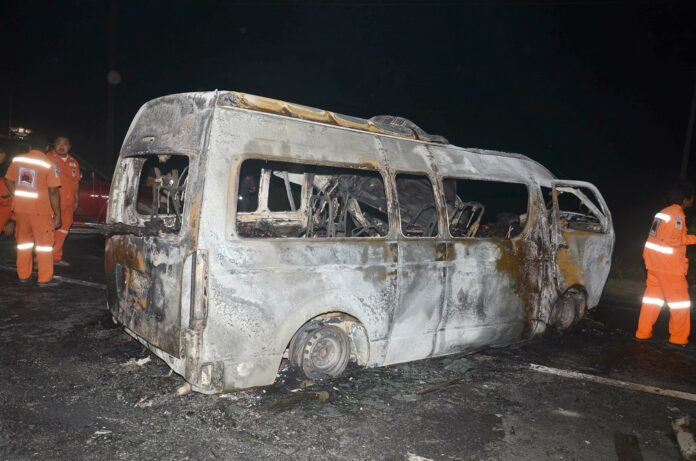
SING BURI — A van which police said was carrying foreign workers crashed into a truck early Friday morning in Sing Buri, killing all 14 aboard.
A van collided into a 10-wheeler truck and was engulfed in flames at about 3am on Friday on the Asian Highway in Sing Buri province, killing 14 people including the driver. The rescue team took about 20 minutes to put out the fire.
Col. Picha Rujinam of Mueang Sing Buri Police said the 13 passengers were migrant workers from Tak province but said they couldn’t verify their nationalities since their ID were burnt. The van driver, Pathompat Panpol, 47, is thought to be the only Thai among the dead.
Picha said Pathompat might have fallen asleep at the wheel.
Sunthorn Fukthong, the truck driver, told police he was driving when the van crashed into the back.
Earlier this month, four Japanese tourists and one Thai guide died in a van crashin Ayutthaya province. Only one day after New Year’s Day, 25 people died in a collision between van and truck in Chonburi.
BANGKOK — The brutality experienced by black Americans and other ethnic minorities in the United States during their fight for social equality will be revisited in a documentary showing Monday.
Just over 50 years since the US Civil Rights Act sought to end institutionalized racism and repression in the Land of the Free, a press club will screen “I Am Not Your Negro,” a documentary recalling the violent struggle minorities endured in the quest for achieve their goal.
Based on “Remember This House” – an unfinished manuscript of memoirs by social critic James Baldwin on his slain friends Martin Luther King Jr., Medgar Evers and Malcolm X – “I Am Not Your Negro” highlights the consequences of racism in the United States.
Directed by Raoul Peck and narrated by actor Samuel L. Jackson, the film was nominated for best documentary of 2016 at the Oscars.
“I Am Not Your Negro” shows at 7pm on Monday at the Foreign Correspondents’ Club of Thailand, which can be reached via skywalk from BTS Chit Lom’s Exit No. 2. Tickets are 150 baht (free for members) and 250 baht for buffet access.