BANGKOK — Based in London and New York, an indie rock group is bringing its fuzzy guitar, grunge-garage, experimental synth-based electronica sound to Bangkok.
Alternative rock quartet Splashh will perform in Bangkok in June and play some of their songs “All I Wanna Do” and “Waiting A Lifetime.”
The concert starts at 9pm on July 14 at Play Yard on Lad Prao Soi 8 Yaek 3. Early-bird tickets are 900 baht and will go on sale Thursday.
The concert is organized by party organizer Dudesweet.
Splashh was formed in 2012 by long-time friends Sasha Carlson and Toto Vivian in London. Their debut album Comfort was recorded in a London flat before the duo expanded the band to a quartet. They relocated to New York in 2013.
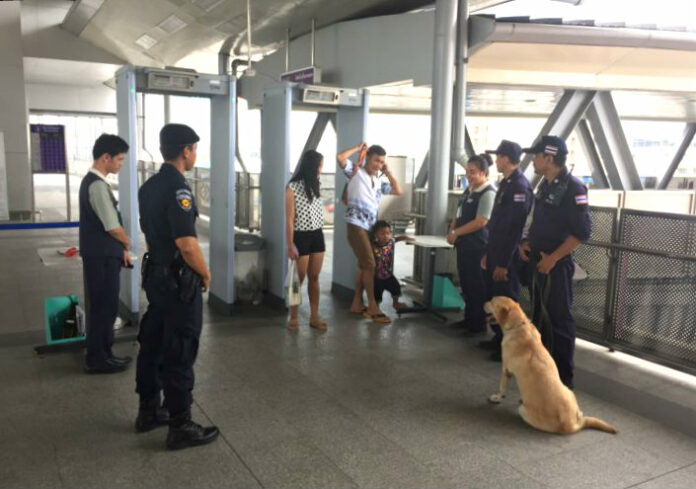
Guards and a canine unit patrol an entrance to a MRT’s Purple Line station during the Songkran holidays. Photo: Matichon
BANGKOK — Bangkok’s subway system raised security measures Wednesday following the discovery of a pipe bomb found near one of its stations.
Security guards, EOD personnel and K-9 units will be on patrol 24 hours a day while bag checks at entrances will be more strictly enforced, Thiraphan Techasirinukul, acting head of system operator Metropolitan Rapid Transit, said today.
Vehicles parked in lots near MRT stations will be searched. Drivers must cooperate with officers if they are asked to open their trunks.
At about 3pm on Tuesday, a thick black pipe and rusty nails were found in a green basket wrapped in black-colored plastic in an empty lot near MRT Thailand Cultural Centre.
Police said they no longer think two men seen by a witness placed at the scene were involved.
Bangkok police chief Sanit Mahathavorn said today he believes the explosives-packed pipe was dumped there many weeks ago. The perpetrators, according to Sanit, didn’t intend to harm anyone since the object was found in an area not frequented by people.
He added that the pipe bomb was different from the one which exploded May 22 in the waiting room of a Bangkok hospital, injuring 21 people.
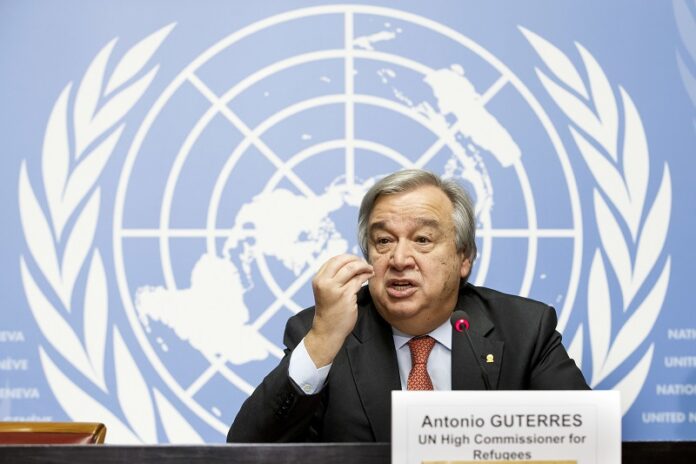
The then United Nations High Commissioner for Refugees Antonio Guterres speaks in 2015 during a news conference at the European headquarters of the United Nations in Geneva, Switzerland. Photo: Salvatore Di Nolfi / Associated Press
NEW YORK — U.N. Secretary-General Antonio Guterres made an impassioned appeal Tuesday for the world to intensify action to combat climate change and implement the Paris Agreement to limit carbon emissions as President Donald Trump debates whether the U.S. will withdraw from the accord.
Gutteres never mentioned the American leader by name in his speech at New York University’s Stern School of Business, his first major address on climate change since taking the reins of the United Nations on Jan. 1. But he said in response to a question afterward that the United Nations believes “it would be important for the U.S. not to leave the Paris agreement.”
Even if Trump withdraws, Guterres said, “it’s very important for U.S. society as a whole – the cities, the states, the companies, the businesses – to remain engaged.”
Trump, who was critical of the deal during his campaign for the presidency, is expected to make an announcement this week on whether the United States will remain a party to the climate accord that his predecessor, Barack Obama, strongly supported and signed.
Nearly 200 nations agreed in 2015 to voluntarily reduce greenhouse gas emissions. As of Tuesday, 147 nations had ratified the Paris Agreement, representing more than 82 percent of global emissions, the U.N. chief said.
Guterres said their pledges to limit the global temperature rise to below 2 degrees Celsius and as close as possible to 1.5 degrees Celsius “are historic – but still do not go nearly far enough to limit temperature rise.”
“Commitments so far could still see temperatures rise by 3 degrees or more,” he warned. “So we must do our utmost to increase ambition and action until we can bend the emissions curve and slow down global warming.”
First, Guterres said he will immediately press for ratification of the Kigali Amendment agreed to in October by nearly 200 nations on limiting the use of hydrofluorocarbons (HFCs) – greenhouse gases far more powerful than carbon dioxide that are depleting the ozone layer.
Unlike the Paris Agreement, the Kigali Amendment to the Montreal Protocol on Substances that Deplete the Ozone Layer is legally binding.
It caps and reduces the use of HFCs in a gradual process starting with action by developed countries in 2019, including the United States, the world’s second-worst polluter, and then by over 100 developing countries starting in 2024, including China, the world’s top carbon emitter.
Guterres said he will also rally countries to raise the bar on efforts to limit temperature rise and the United Nations system to promote climate action.
“Eighty percent of the world’s energy still comes from fossil fuels – oil, gas and coal,” Guterres said. “We cannot phase out fossil fuels overnight. We have to engage the energy industry and governments to use fossil fuels as cleanly, sparingly and responsibly as possible, while transforming our energy systems.”
He said solar power grew 50 percent last year, with China and the United States in the lead, and in both those countries “new renewable energy jobs now outstrip those created in the oil and gas industries.” Major oil producers are also looking to the future and diversifying their economies and even Saudi Arabia has announced plans to install 700 megawatts of solar and wind power, he said.
Guterres also pledged to work with developing countries to mobilize resources to tackle the impact of climate change and strengthen efforts by small island states against “the existential threat” that global warming poses.
He said he will strengthen North-South, South-South and other partnerships to implement the Paris Agreement.
“The climate conversation should cease to be a shouting match,” Guterres said. “My door is open to all who wish to discuss the way forward, even those who might hold divergent perspectives.”
The secretary-general announced that he intends to hold a climate summit in 2019 to review implementation of the Paris Agreement.
“The journey from Paris is well underway,” Guterres said. “The support across all sectors of society is profound. The transition in the real economy is a fact. There will be bumps along the path … but with everyone’s participation, the world can bring the Paris Agreement fully to life.”
Preeyanuch ‘Preaw’ Nonwangchai, at left, and Warissara “Amm” Klinjui, at right.
KHON KAEN — A woman accused of murder told her sister she only meant to hurt her victim as an act of revenge – at least until the woman threatened to kill her if she survived the attack. That’s when she allegedly sawed her in half.
That’s the story police said they got from Prapasiri Somsri on Wednesday, whose sister Preeyanuch “Preaw” Nonwangchai remains on the run along with two others for the gruesome May 23 murder.
“She said she and her friends only planned to lure her somewhere to assault her in revenge,” Prapasiri, 34, said, recounting a Monday night phone call in which her sister allegedly described the murder. “But then the woman said, ‘If I survive, then you die,’ so she became enraged.”
As police hunted for 24-year-old Preeyanuch and the other two suspects, they led a fourth suspect already in their custody through “re-enacting” the grisly crime today.
Wasin Namphrom, 22, showed police the spot in Khon Kaen province where he and the other suspects allegedly buried Warissara “Amm” Klinjui, a 22-year-old employee at a local karaoke joint, after sawing her body in half.
Wasin Namphrom shows police Wednesday the spot they allegedly buried Warissara Klinjui in Khon Kaen province.
The murder case emerged Thursday, when Warissara’s remains were discovered.
The case has gripped headlines not just for the grisly details of the murder but also tabloid-ready imagery available from social media of the young, attractive suspects.
Police have since named five suspects in the case – three of whom have fled to Myanmar.
Wasin was arrested Tuesday in Vientiane, Laos. He told police he and three female friends lured Warissara into a car in the early hours of May 23.
He said they had planned to carry out a revenge plot on behalf of one of their group members, 24-year-old Preeyanuch “Preaw” Nonwangchai. Preeyanuch believed Warissara had snitched on her boyfriend who was then arrested on a drug-related charge.
After luring Warissara into a rented car, Wasin said Preeyanuch was the only one to assault her – and ultimately, strangle her to death in the vehicle.
The four drove to rent a room at a resort in Khon Kaen city, stopping along the way to buy supplies, including plastic bags and a saw. That’s where Preeyanuch sawed the body in half, placing each half into two large plastic buckets, Wasin said.
They later drove to bury the buckets in Khao Suan Kwang district, approximately 60 kilometers away.
Resort employee Korakot Thathongboon, 20, said Preeyanuch and company rented a room on Thursday and left without paying. She said they left a strong odor in the room.
Police said they are looking for Preeyanuch and the other two suspects, 28-year-old Apiwan Sattayabundit and Kawita Ratchada, 25. Police said all three escaped into Myanmar and were last seen Tuesday in the Burmese border town of Tachileik.
A fifth suspect, Wasin’s girlfriend Jidarat Phromkhun, was also arrested but has denied involvement in the murder.
Jidarat, 21, reportedly told police she met the four suspects in Bangkok on the night of May 23, at which point they went to sell Warissara’s mobile phone.
A day after the murder, Preaw posted a photo to Facebook showing four people holding hands with a caption reading “On the day I fall, I still have you guys giving me support. Thank you for trusting and believing in me #Wewillbeholdinghandslikethisforever #Loveyouguys”
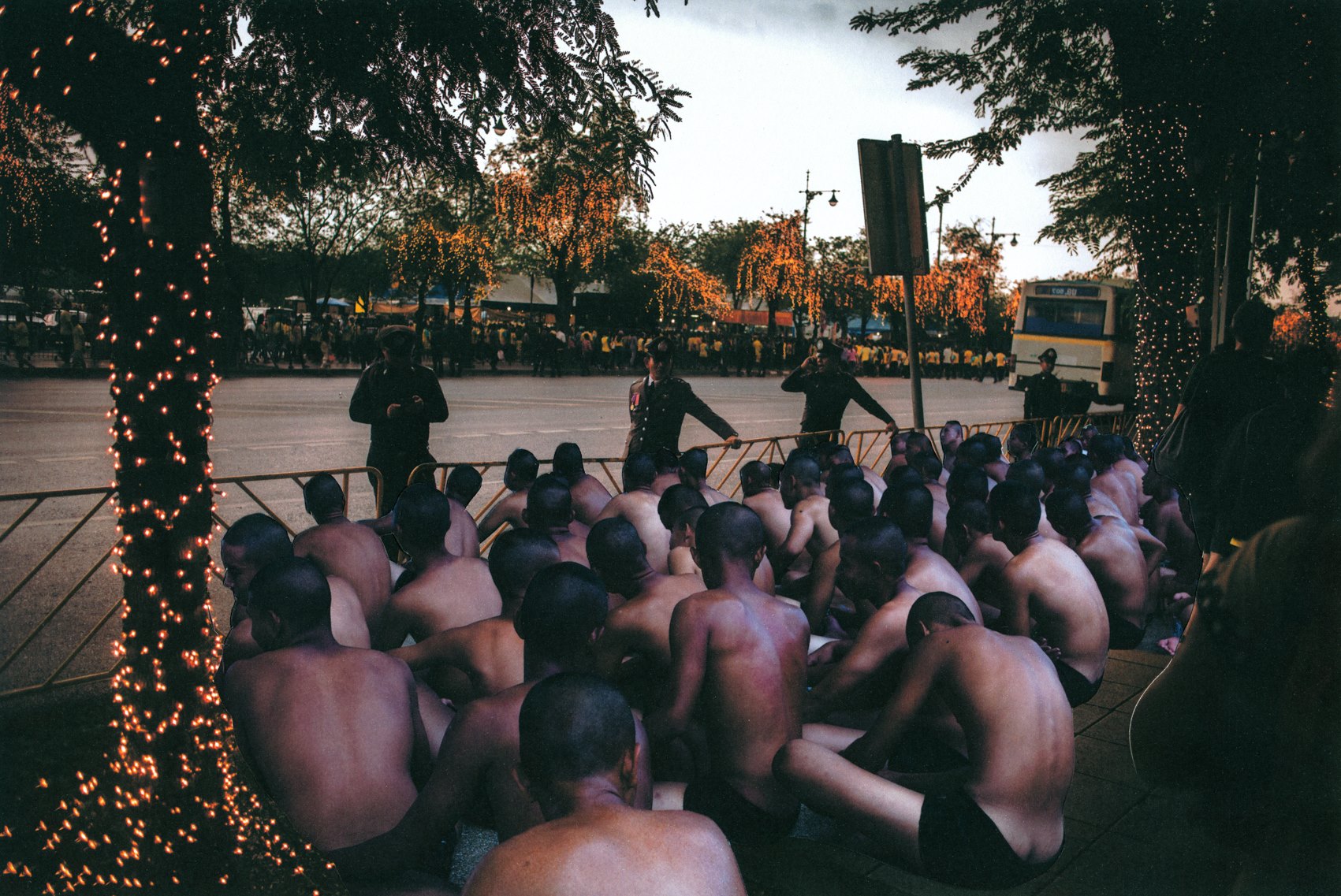
Photos in Harit’s ‘Whitewash’ series. Photo: Harit Srikhao
BANGKOK — The political violence of seven years ago is the subject of a young photographer’s confession of guilt for his ignorance through an exhibition he’s dedicated to the protesters killed.
After traveling the world picking up awards, Whitewash, which features dozens of images revisiting Thailand’s political ruptures since 2010 by 22-year-old photographer Harit Srikhao, will show for the first time in Thailand this weekend.
Harit said that back in 2010, during the military crackdown when he was a schoolboy, he and his friends sided with the military, “feverishly cursing the protesters and watching them get beat up with great satisfaction.”
The 2014 coup led Harit to revisit his own memories and research what had happened, learning along the way that 90 people were killed in the May 19 crackdown.
He’d gone four years without knowing that, and it left him questioning:
“Where have I been for four years that I know nothing about those protesters?” he said.
Harit began revisiting the places he’d been since 2010 – from the Sanam Luang and Grand Palace to military bases – on a mission to capture and develop the images through his own visual technique and style.
“This work was driven by the cold-blooded responses that I and other people around me had toward the protesters back then.” Harit wrote of his change of heart. “The fact that people in the country remained ignorant, indifferent, and even satisfied toward the protesters’ deaths reflects the chilling darkness of nationalism.”
Harit first picked up a camera when he was 13. At the age of 16, he was selected to join the Angkor Photo Workshop by French photographer Antoine D’Agata.
Whitewash won numerous awards overseas including the Juror’s Prize from the Filter Photo Festival in Chicago, second place at the Gomma Grant in London and a Special Mention award at the Dusseldorf Portfolio Review in Germany.
The exhibition kicks off at 6:30pm on Saturday and runs through June 22 at Gallery VER. The contemporary art venue is located in the Sathorn area on Soi Naradhiwas Rajanagarindra 22. It can be reached by foot from BRT Thanon Chan or by taxi from BTS Chong Nonsi.
Original image: A farmer irrigates his rice fields in a 2013 photo. Photo: Chris Graham / Flickr
BANGKOK — Millions of Thais are at risk of losing their jobs in the coming years – and it’s not “illegal immigrants” or “outsourcing” to blame. Yes, the robots are coming to steal jobs.
Thanks to rapid improvements in automation and artificial intelligence, up to 9.2 million Thais are at a high risk of being replaced by machines, while 8 millions of other jobs are on the line in the next two decades, affecting nearly half of the country’s entire employment, U.N. officials said at a media briefing Tuesday.
If the International Labour Organization’s, or ILO, forecast proves true, it will not only shake up the current economy – which has long bragged of an unemployment rate of nearly zero percent – but could also spark new social strains as the chasm of inequality slips even wider.
“Thailand’s inequality has been among one of the highest in ASEAN,” economist Phu Huynh said at a media briefing on an appropriately dark and ominous day in downtown Bangkok. “It might make the situation even worse, because a lot of people will be left behind.”
Huynh based his briefing on an ILO research published in July. The report identified the professions most vulnerable to automation in the next 20 years in five ASEAN member states – Thailand, Cambodia, Vietnam, the Philippines and Indonesia.
While the theme is the same everywhere – low-skill jobs that can easily be done by machines – different sectors are at risk in different countries. In Cambodia, it’s market vendors and garment factory workers facing the rise of the machines, while farmhands and shop assistants are vulnerable in the Philippines.
Prime Minister Gen. Prayuth Chan-ocha visits an exhibition that promotes innovation in Thai economy in Bangkok, Sept. 18, 2014.
In Thailand, up to 98 percent of workers could be replaced in what it said are the most at-risk professions: Subsistence farmers; farm laborers; retail sales assistants; stall and market salespeople; livestock and dairy producers; food counter attendants; cooks; construction workers; office clerks; and junior accounting professionals.
That adds up to about 9.2 million jobs, according to the ILO.
And that’s just the 10-most vulnerable jobs. Three in four of auto-industry workers – a major manufacturing sector – are potential victims of automation.
All told, the ILO warned, up to 44 percent of all jobs in Thailand are at risk.
More Human Than Human
Thailand left behind its past as an agricultural economy decades ago. Out of an employed workforce of 37 million people, about 26 million now work in unrelated industries such as manufacturing and service, according to January data from the National Statistics Office.
It’s those factory jobs the robots are coming for.
“The predominant occupation in the computer and electronics industry are electronic equipment assemblers, accounting for nearly 58 per cent and 70 per cent of all salaried employment in the sector in Thailand and the Philippines, respectively,” the report reads. “These jobs face an extremely high probability of automation (92 per cent) given the rapid penetration and advancements in robotic technologies.”
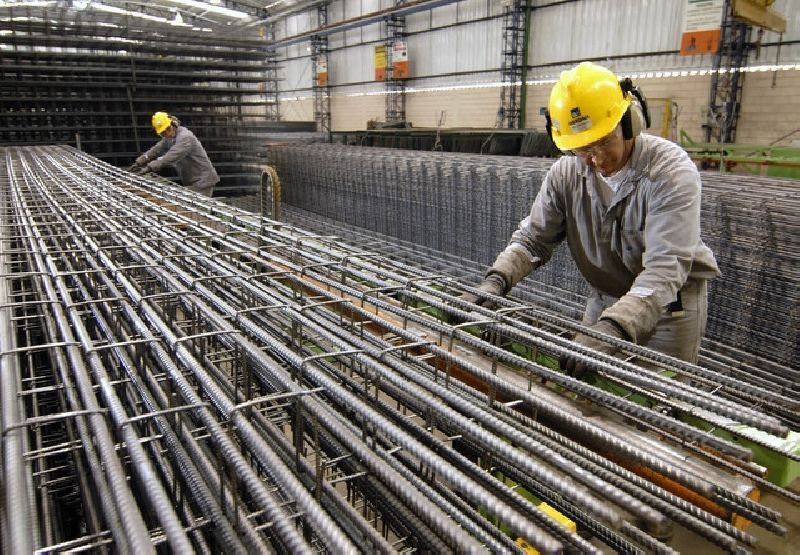
A 2014 file photo of a metal materials plant in Thailand. Photo: Matichon
While technology pushing humans out of the way is nothing new, the ILO’s Gary Rynhart said the coming changes may happen faster than many expect.
“In these sectors, adaptation of technology has been slow because labor cost is low, but it has sped up,” Rynhart said. “The technology to replace the jobs is there. The question about a tipping point is not if – but when.”
He referenced the rapid rise of social media which has changed Thailand so much in the past five years. As his colleague Huynh noted in a separate report, it took 75 years for telephones and 38 years for radio to reach 50 million users.
Also worrisome was Rynhart’s assertion that middle-tier management jobs could be replaced by artificial intelligence.
“The AI can do what we thought impossible,” Rynhart said. “Just imagine what it will be like five years from now.”
Judgment Day
Asked what the government can do to alleviate the impending doom, both Huynh and Rynhart suggested investing more in infrastructure and education reform that encourage creativity and analytical thinking.
In fact, the reason they believe Thailand is so vulnerable is because its education system does not teach enough STEM – science, technology, engineering and mathematics – skill sets to students.
“In my own view, there are needs for these skills … and they lack that,” Rynhart said.
He also warned women are more likely to be adversely affected by automation than men, yet high level skills in some of industry sectors, such as car manufacturing, are still dominated by men.
Huynh, the economist, said if the Thai workforce fails to adapt and develop skills that cannot be replaced by robots – such as analysis, problem-solving and mediating – its gains over the decades could be reversed, with severe implications both economically and socially.
“Otherwise, you will fall down the wage ladder,” he said.
Corrections: An earlier version of this article incorrectly said automation is a threat to one in three auto industry jobs. In fact, three out of four are at risk. The article also mistakenly said the ILO report launched at Tuesday’s news conference. In fact, it was published in July.
Kittikorn Wikaha, 26, and Supattanachai Chansri, 25, did not get reduced sentences despite confessing to stabbing Vasin Lueangcham, 26, on a January night in northern Bangkok, an attack that prompted national revulsion when footage of it was widely watched.
In the security camera footage, Kittikorn and Supattanachai were seen arriving on a motorcycle. Kittikorn stabbed Vasin several times before escaping on the bike.
Upon his arrest, Kittikorn said he killed his victim because he put up a fight.
That translated into increased support for tougher jail terms and sentencing, as Kittikorn had already served eight jail terms in 13 years for previous offenses, including violent crimes. His latest term had ended three weeks before he killed Vasin.
In its ruling today, the court said the punishment was not reduced because the two defendants behavior posed a danger to society, and they were serial recidivists.
It was yet unclear whether the two would appeal.
Capital punishment has become uncommon after its regular use effectively ended 14 years ago. The last execution took place in 2009, when two drug traffickers were killed by lethal injection. Before that, the previous execution was carried out in 2003.
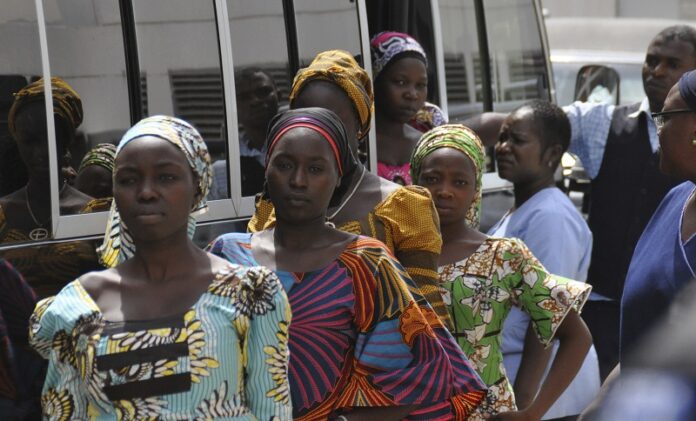
Freed school girls attend a handing over Ceremony ahead of their studies Tuesday in Abuja, Nigeria. Photo: Olamikan Gbemiga / Associated Press
ABUJA, Nigeria — Nigerian officials say the 82 young women released by Boko Haram extremists this month are now joining those already freed in a special rehabilitation program.
Aisha Alhassan, minister of women’s affairs and social development, said Tuesday that the women will attend months of remedial studies. They will have doctors and nurses available to help them heal from the trauma of three years in captivity.
Some have criticized how the freed women have remained in Nigeria’s capital instead of rejoining their families. But Alhassan says they are in Abuja “with their full consent.”
The young women will not be returning to rural Chibok, where they were abducted from school in 2014. Officials say they will be placed in other schools in September.
Nearly 300 schoolgirls were seized in the mass abduction.
Britain's Andy Murray celebrates winning his first round match against Russia's Andrey Kuznetsov in four sets 6-4, 4-6, 6-2, 6-0, Tuesday at the French Open tennis tournament at the Roland Garros stadium, in Paris, France. Photo: Michel Euler / Associated Press
A quick look at the French Open:
Tuesday’s Winners
Seeded winners in the men’s first round: No. 1 Andy Murray, No. 3 Stan Wawrinka, No. 8 Kei Nishikori, No. 13 Tomas Berdych, No. 15 Gael Monfils, No. 18 Nick Kyrgios, No. 21 John Isner, No. 29 Juan Martin del Potro.
Seeded winners in the women’s first round: No. 3 Simona Halep, No. 5 Elina Svitolina, No. 9 Agnieszka Radwanska, No. 12 Madison Keys, No. 17 Anastasija Sevastova, No. 20 Barbora Strycova, No. 21 Carla Suarez Navarro, No. 26 Daria Kasatkina, No. 28 Caroline Garcia.
Tuesday’s Losers
Seeded losers in the men’s first round: No. 9 Alexander Zverev, No. 27 Sam Querrey.
Seeded losers in the women’s first round: No. 7 Johanna Konta.
Stat of the Day
Two – American men left out of the 11 who entered in the main draw, making for the smallest U.S. contingent in the second round at Roland Garros since 2011.
Quote of the Day
“I just expect a little more respect.” – French wild-card Laurent Lokoli, talking about why he refused to shake Martin Klizan’s hand after their match.
Look Ahead to Wednesday
Venus Williams starts things off in the morning in the main stadium on Day 4, facing Kurumi Nara of Japan, followed by a test for defending champion Garbine Muguruza against Anett Kontaveit of Estonia. Rafael Nadal’s pursuit of a 10th title at Roland Garros includes a second-round matchup against Robin Haase of the Netherlands, while 2016 champion Novak Djokovic – with Andre Agassi in his corner as a coach – plays Joao Sousa of Portugal. The locals will keep a close eye on 13th-seeded Frenchwoman Kristina Mladenovic, who dealt with back pain and deficits before winning in the first round, and now takes on 2012 runner-up Sara Errani.
A public service announcement by the Cam Chau Ward People's Committee reads "Youth, please stay away from drugs" in Vietnamese in 2014 in Vietnam. Photo: lightwrite / Flickr
HANOI — Courts in Vietnam have sentenced six men to death for drug-related offenses in two separate cases.
State-run Tuoi Tre newspaper reported a court in central Nghe An province on Tuesday convicted ring leader Phan Dinh Tuan and four other men on charges of trafficking 102 kilograms (224 pounds) of heroin. Tuan was found guilty of masterminding parts of the ring’s operations from his prison cell with a smuggled cellphone.
Meanwhile a court in southern Dong Nai province sentenced another man to death for transporting 14 kilograms (31 pounds) of methamphetamine.
Court officials are unavailable for comment Wednesday.
Vietnam has some of the world’s toughest drug laws. Possessing or trafficking 100 grams (3 1/2 ounces) of heroin or 20 kilograms (44 pounds) of opium is punishable by death.