26.6 C
Bangkok
Thursday, June 18, 2026
Home Blog Page 244

Former Thai FM Warns Against Canceling Thai-Cambodia Border MOUs

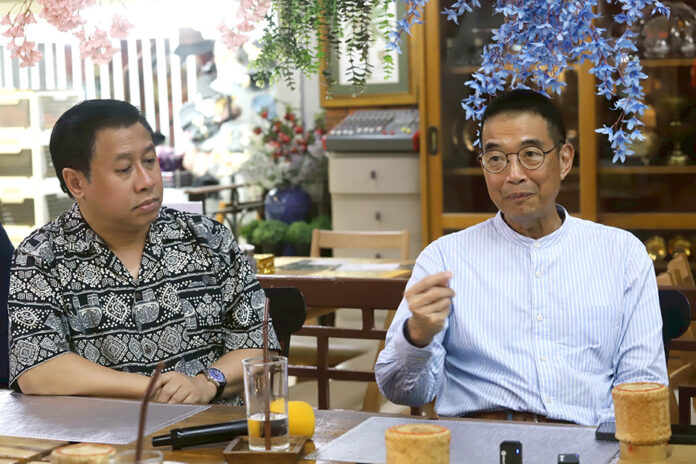
Former Foreign Minister Maris Sangiampongsa (right) speaks during a panel discussion on Thai-Cambodia border MOUs, joined by former Prime Minister's Office spokesman Chakraphop Penkair (left) at Krua Khun Ret restaurant in Bangkok on October 13, 2025.

BANGKOKFormer Foreign Minister Maris Sangiampongsa has urged Thailand not to cancel the 2000/2001 Memoranda of Understanding (MOUs) with Cambodia, known as MOU 43-44, arguing that the agreements do not compromise Thai sovereignty but rather provide a crucial framework for bilateral negotiations.

Speaking at a small panel discussion on October 13 at Krua Khun Ret restaurant in Bangkok, Maris joined former Prime Minister’s Office spokesman Chakraphop Penkair and legal analyst Veeraphat Pariyawong to address the rising nationalist sentiment surrounding Thailand’s border tensions with Cambodia.

MOUs Do Not Compromise Thai Territory

Maris firmly stated that the MOUs have caused no loss of Thai territory and have not altered sovereign boundaries, natural resource rights, or border demarcations.

“The maps being discussed are merely reference documents. Both sides have the right to propose materials for negotiation, but whether an agreement is reached depends on the Thai-Cambodian Joint Boundary Commission (JBC) and their negotiation strategy. Ultimately, any agreement must go through the House of Representatives. This matter does not damage Thailand at all,” he explained.

maris MOU3
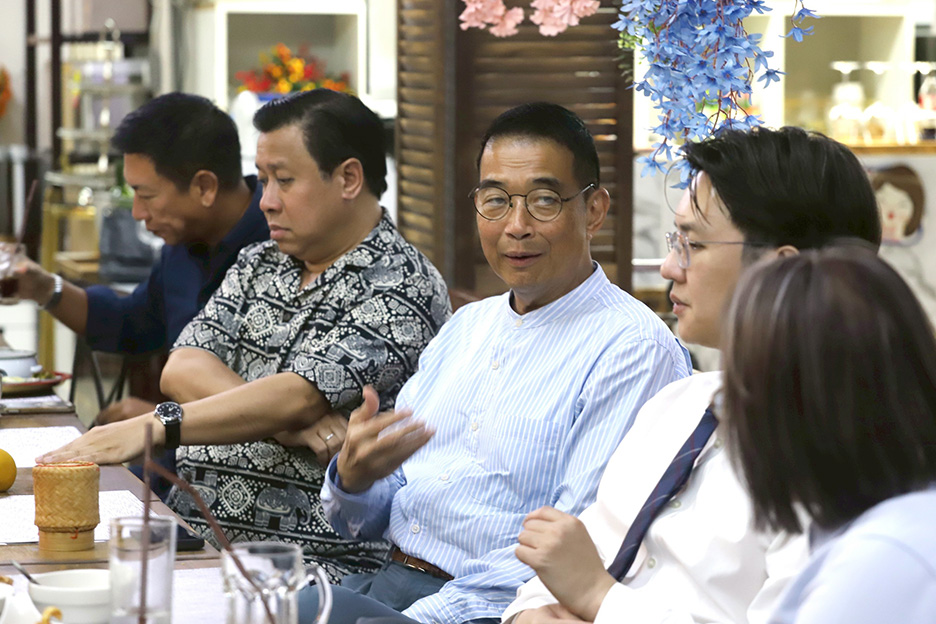
Former Foreign Minister Maris Sangiampongsa (center) speaks during a panel discussion on Thai-Cambodia border MOUs at Krua Khun Ret restaurant in Bangkok on October 13, 2025, joined by former Prime Minister’s Office spokesman Chakraphop Penkair (left) and legal analyst Veeraphat Pariyawong (right)

The former minister warned that canceling the MOUs would eliminate the negotiation framework and expose Thailand’s position, making future talks more difficult since Cambodia would know Thailand’s stance. He emphasized that the details within the MOUs are confidential and fall under executive authority, cautioning that bringing the matter to public processes like a referendum would be dangerous.

“The power to cancel must rest with the executive branch. Most importantly, whichever government cancels it must take responsibility,” Maris stated.

International Law Requires Mutual Consent

Legal analyst Veeraphat explained that under international law, problems in agreements have resolution processes—enforcement cannot be immediate as in domestic law because it involves sovereign equality among nations. He stressed that Thailand’s dignity lies in respecting equality rather than bullying others.

“MOUs are used worldwide—for borders, trade, or criminal extradition—and respect basic legal principles. You cannot force the other side, regardless of whether they have a larger or smaller military. It must be based on consent, not forcing Cambodia to yield to Thailand,” he said.

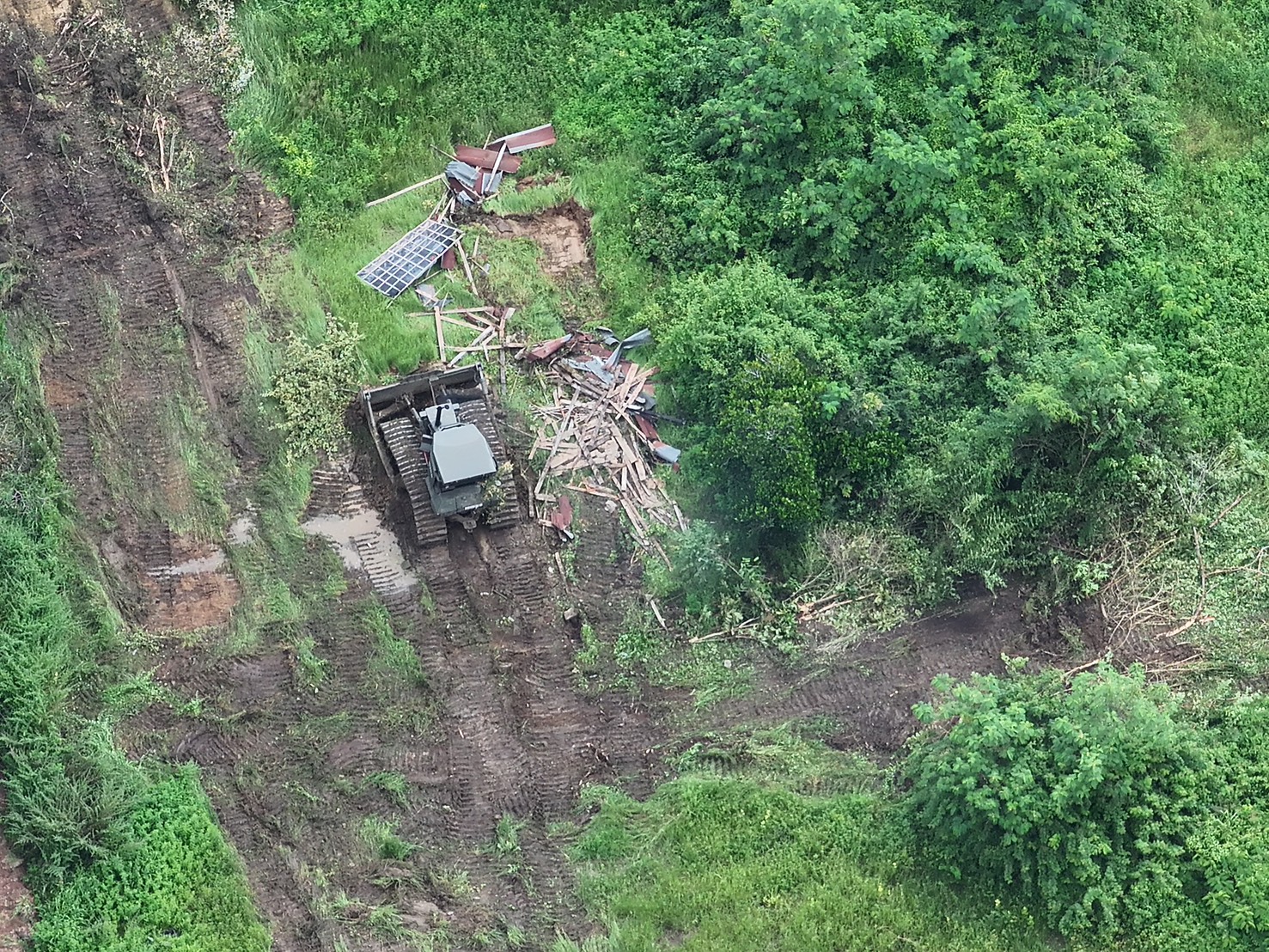
sakaeo demolition

Political Motives Behind the Controversy

Chakraphop observed that the real issue isn’t the MOUs themselves but rather the establishment of right-wing political processes using this matter as a pretext for larger goals. He noted that MOUs are merely tools for dialogue and, given the previous government’s success in keeping the issue at the bilateral level, recommended the current government continue this approach to genuinely resolve border problems.

Rising Nationalist Tensions

This discussion comes as Cambodia has filed international complaints against Thailand over methods used to reclaim areas Thailand claims are within its territory. These areas at Ban Nong Chan and Ban Nong Ya Kaew were previously opened for Cambodian refugees under UNHCR supervision. The military has allowed nationalist groups led by influencer Gun Jompalang to use large loudspeakers broadcasting ghost sounds to harass and drive away Cambodian villagers.

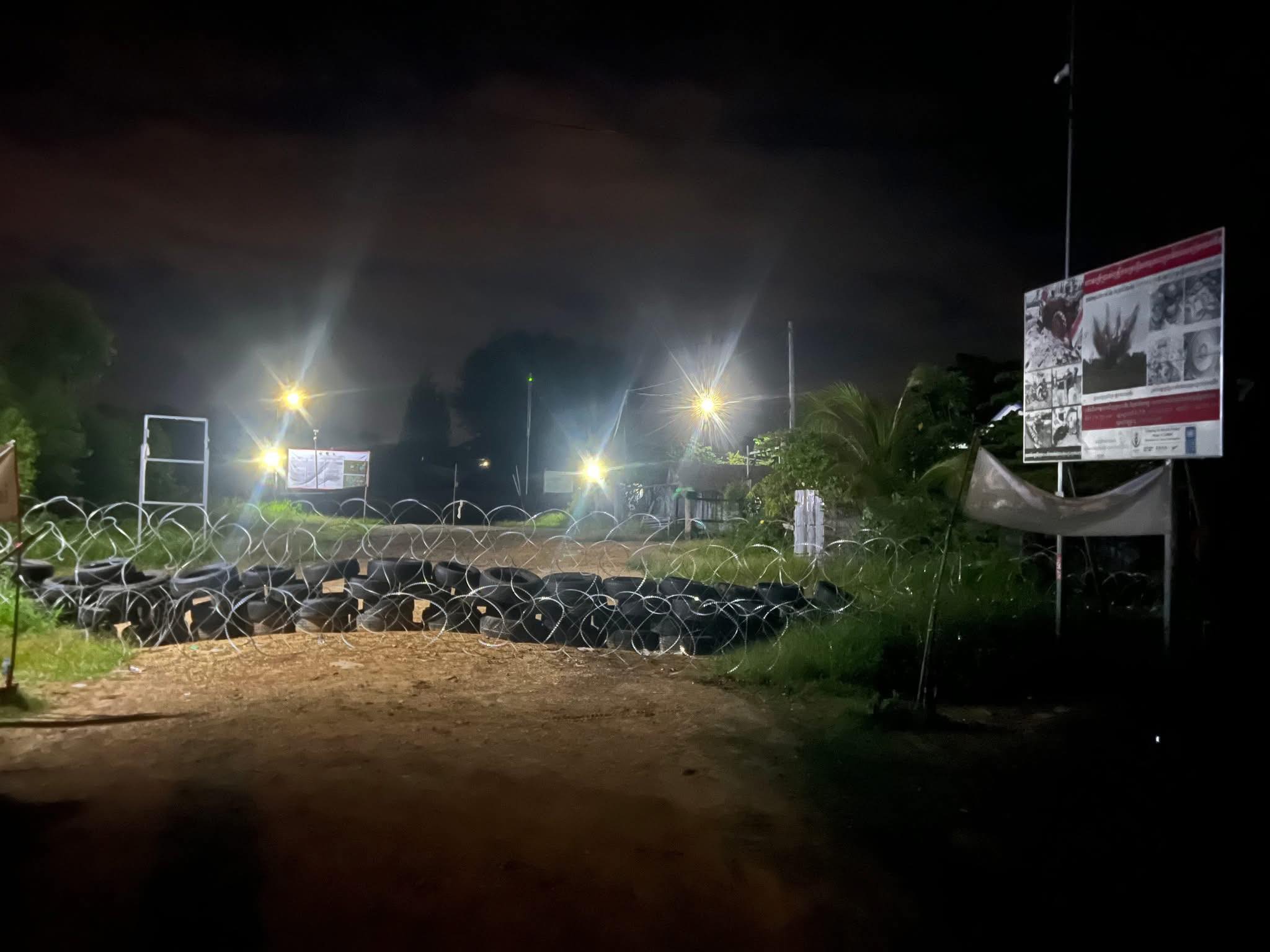
thai fence
Border barrier in Sa Kaeo Province where Cambodia has accused Thailand of broadcasting ghost sounds at night as psychological harassment against border residents.

Prime Minister and Interior Minister Anutin Charnvirakul has defended such actions, stating: “Everyone who is Thai does not like those who invade our sovereignty. We should not blame him for expressing himself in a way that he thinks will let the general public know that this is Thai territory. I will try to make this matter as international as possible.”

Government’s Referendum Plan Draws Criticism

The government previously announced plans to hold a referendum on canceling the MOUs alongside the general election, but this has drawn criticism from across the political spectrum. Critics view it as shirking responsibility on a matter the government should decide and take accountability for itself.

______

Advertisement

Living Hostages and Palestinian Prisoners Are Released As Part of Ceasefire in Gaza

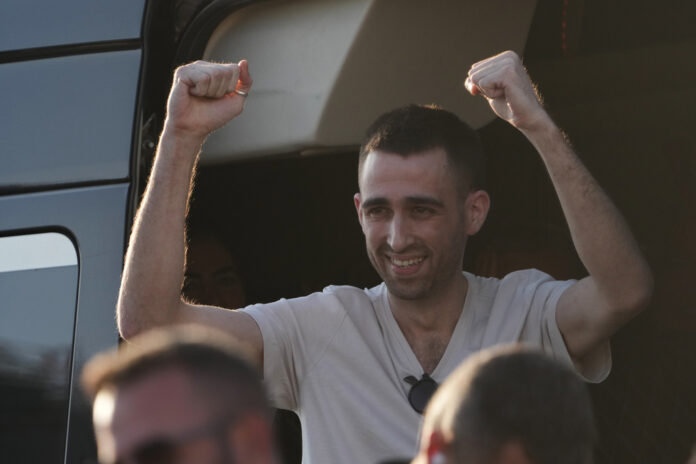
Freed Israeli hostage Avinatan Or gestures from a van as he arrives at Beilinson hospital in Petah Tikva, Israel, after he was released from Hamas captivity in the Gaza Stripl, Monday, Oct. 13, 2025. (AP Photo/Francisco Seco)

DEIR AL-BALAH, Gaza Strip (AP) — All 20 remaining living hostages held in Gaza and scores of Palestinian prisoners held by Israel walked free Monday as part of a ceasefire pausing two years of war that decimated the Gaza Strip and killed tens of thousands of Palestinians.

Speaking to parliament, Israeli Prime Minister Benjamin Netanyahu declared he was “committed to this peace,” raising hopes that the ruinous war, which triggered other conflicts in the Middle East and had left scores of captives in militant hands, might come to an end. But fundamental questions remain over when and how.

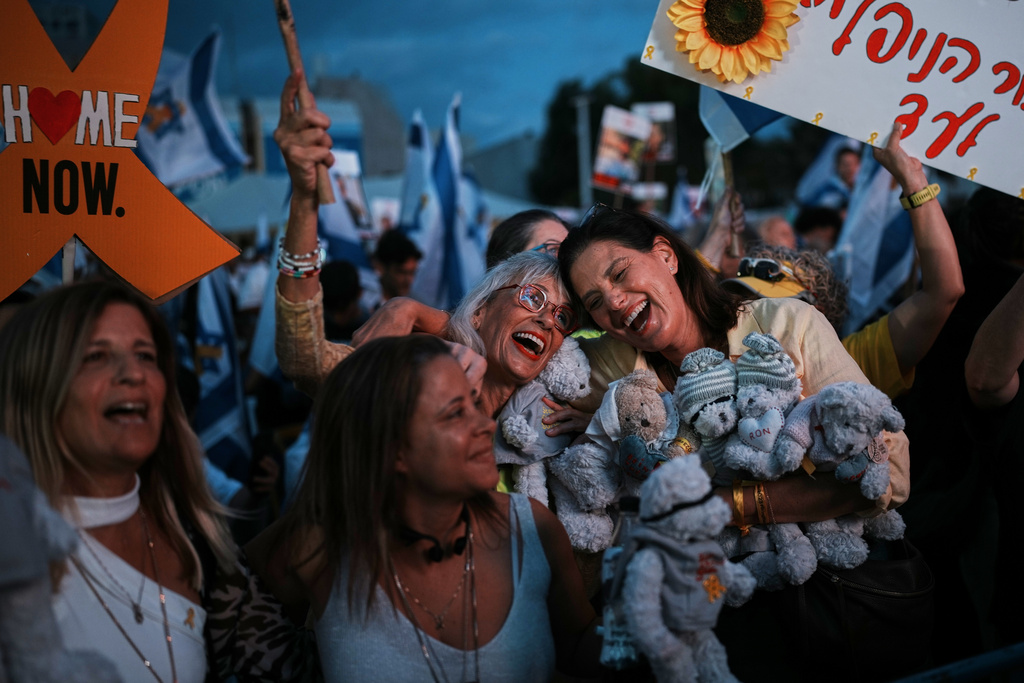
Cheering crowds greeted buses of released prisoners in the West Bank and Gaza, while families and friends of the hostages gathered in a square in Tel Aviv, Israel, cried out with joy and relief as news arrived that the captives were free.

U.S. President Donald Trump flew to the region and addressed the Knesset, the Israeli parliament. He was later to head to Egypt for a summit to discuss the U.S.-proposed deal and postwar plans with other leaders.

AP25286325584617
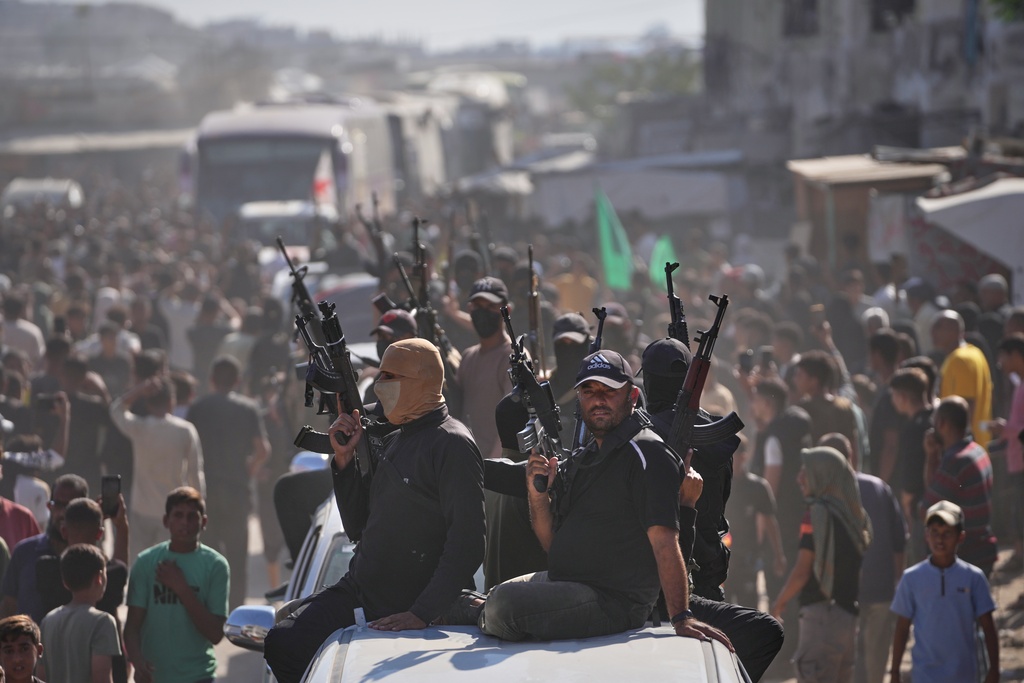
ICRC vehicles carrying released Israeli hostages make their way through groups of Palestinians and Hamas gunmen on their way to the Israeli border, in Khan Younis, southern Gaza Strip, Monday, Oct. 13, 2025. (AP Photo/Jehad Alshrafi)

Speaking ahead of Trump’s address in the Knesset, Netanyahu pledged that he was “committed to this peace.”

He added: “Today, the Jewish calendar marks the end of two years of war.”

While major questions remain about the future of Hamas and Gaza, the exchange of hostages and prisoners raised hopes for ending the deadliest war ever between Israel and the militant group. The ceasefire is also expected to see a surge of humanitarian aid into Gaza, parts of which are experiencing famine.

The war began when Hamas-led militants launched a surprise attack on southern Israel on Oct. 7, 2023, in which some 1,200 people, mostly civilians, were killed and 251 taken hostage.

In Israel’s ensuing offensive, more than 67,000 Palestinians have been killed, according to Gaza’s Health Ministry, which doesn’t differentiate between civilians and combatants but says around half the dead were women and children. The ministry is part of the Hamas-run government, and the U.N. and many independent experts consider its figures the most reliable estimate of wartime casualties.

AP25286142697441
People gather prior to the release of Israeli hostages held in Gaza, at a plaza known as the hostages square in Tel Aviv, Israel, Monday, Oct. 13, 2025. (AP Photo/Emilio Morenatti)

The toll is expected to grow as bodies are pulled from rubble previously made inaccessible by fighting.

The war has destroyed large swaths of Gaza and displaced about 90% of its some 2 million residents. It has also triggered other conflicts in the region, sparked worldwide protests and led to allegations of genocide that Israel denies.

“Much of Gaza is a wasteland,” U.N. humanitarian chief Tom Fletcher told the AP on Sunday.

Hostages and prisoners released

Tens of thousands of Israelis watched the hostage transfers at public screenings across the country. In Tel Aviv, families and friends of the hostages broke into wild cheers as television channels announced that the first group was in the hands of the Red Cross.

The freed hostages, all men, were later reunited with their families, and footage released by Israeli authorities showed tearful reunions.

The bodies of the remaining 28 dead hostages are also to be handed over as part of the deal, although the exact timing remained unclear.

Palestinians in the occupied West Bank rejoiced as buses carrying dozens of released prisoners from Ofer Prison arrived in Beitunia, near Ramallah, as Israel began releasing more than 1,900 prisoners and detainees as part of the ceasefire deal.

AP25286309626129
Hands paste a heart-shaped sticker onto a banner with pictures of Israeli hostages during a a gathering at a plaza known as hostages square in Tel Aviv, Israel, Monday, Oct. 13, 2025. (AP Photo/Oded Balilty)

Later, giant crowds were gathered to greet buses carrying other prisoners arriving at Nasser Hospital in Gaza’s southern city of Khan Younis.

The prisoners include 250 people serving life sentences for convictions in attacks on Israelis, in addition to 1,700 seized from Gaza during the war and held without charge. They will be returned to the West Bank or Gaza or sent into exile.

More than 150 prisoners were sent to Egypt by Israel and arrived at Gaza’s Rafah crossing with Egypt early Monday afternoon, according to an Egyptian official, who had direct knowledge of the deal’s implementation. He spoke on condition of anonymity because he was not authorized to brief the media.

Meanwhile, the Hostages Family Forum, a grassroots organization representing many of the hostage families, said four bodies were expected to return to Israel on Monday. The group said it was “shocked and dismayed” that so few were coming back.

An international task force will work to locate deceased hostages who are not returned within 72 hours, said Gal Hirsch, Israel’s coordinator for the hostages and the missing.

A painful chapter

The hostages’ return caps a painful chapter for Israel. Since they were captured in the attack that ignited the war, newscasts have marked their days in captivity and Israelis have worn yellow pins and ribbons in solidarity. Tens of thousands have joined their families in weekly demonstrations calling for their release.

As the war dragged on, demonstrators accused Netanyahu of dragging his feet for political purposes, even as he accused Hamas of intransigence. Last week, under heavy international pressure and increasing isolation for Israel, the bitter enemies agreed to the ceasefire.

AP25286509355280
Hamas gunmen on pickup trucks escort buses carrying freed Palestinian prisoners as they are greeted following their release from Israeli jails under a cease-fire agreement between Hamas and Israel, in Khan Younis, southern Gaza Strip, Monday, Oct. 13, 2025. (AP Photo/Jehad Alshrafi)

Trump in Israel and Egypt

In his Knesset speech, Trump told Israeli lawmakers their country had no more to achieve on the battlefield and must work toward peace after two years of war against Hamas and conflicts with Hezbollah and Iran.

“Generations from now, this will be remembered as the moment that everything began to change,” he declared.

“Israel, with our help, has won all that they can by force of arms,” Trump said. “Now it is time to translate these victories against terrorists on the battlefield into the ultimate prize of peace and prosperity for the entire Middle East.”

His speech was briefly interrupted when two members of the Knesset staged a protest and were subsequently removed from the chamber. One held up a small sign reading, “Recognize Palestine.”

Despite the optimism expressed by Trump, many thorny questions remain. Among the most difficult is Israel’s insistence that a weakened Hamas disarm. Hamas refuses to do that and wants to ensure Israel pulls its troops completely out of Gaza.

So far, the Israeli military has withdrawn from much of Gaza City, the southern city of Khan Younis and other areas. Troops remain in most of the southern city of Rafah, towns of Gaza’s far north, and the wide strip along the length of Gaza’s border with Israel.

AP25286403399208
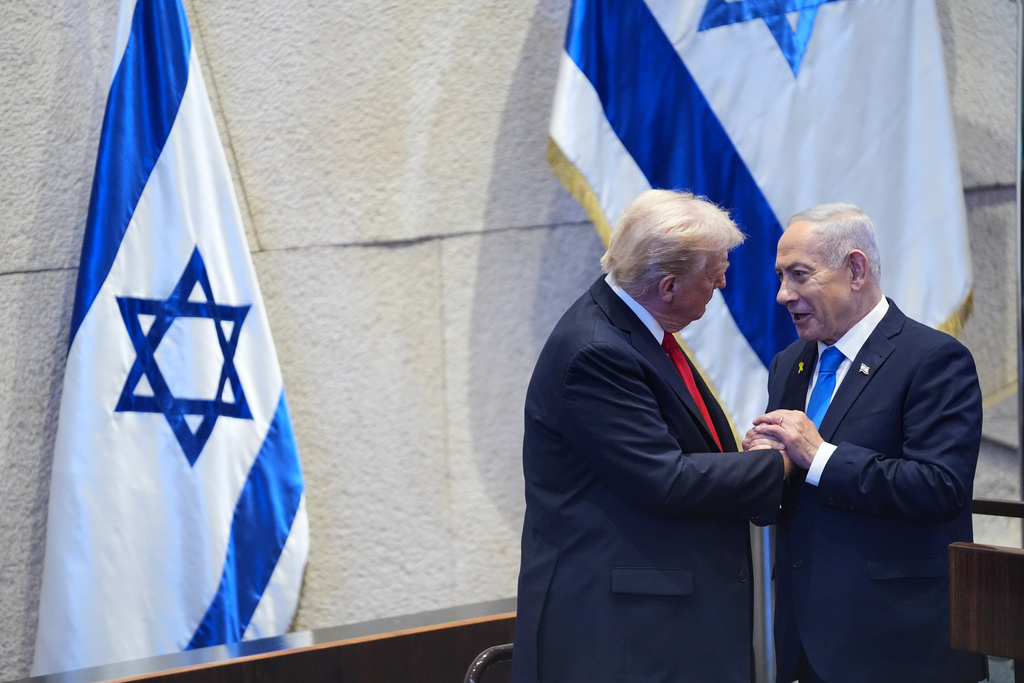
President Donald Trump talks with Israel’s Prime Minister Benjamin Netanyahu at the Knesset, Israel’s parliament, Monday, Oct. 13, 2025, in Jerusalem. (AP Photo/Evan Vucci, Pool)

The future governance of Gaza also remains unclear. Under the U.S. plan, an international body will govern the territory, overseeing Palestinian technocrats running day-to-day affairs. Hamas has said Gaza’s government should be worked out among Palestinians.

Later Monday, Trump will head to Egypt, where he and Egyptian President Abdel-Fattah el-Sissi will lead a summit with leaders from more than 20 countries on the future of Gaza and the broader Middle East.

Palestinian leader Mahmoud Abbas arrived in Egypt’s Sharm el-Sheikh resort town to attend the meeting.

The plan envisions an eventual role for Abbas’ Palestinian Authority — something Netanyahu has long opposed. But it requires the authority, which administers parts of the West Bank, to undergo a sweeping reform program that could take years.

The plan also calls for an Arab-led international security force in Gaza, along with Palestinian police trained by Egypt and Jordan. It said Israeli forces would leave areas as those forces deploy. About 200 U.S. troops are now in Israel to monitor the ceasefire.

The plan also mentions the possibility of a future Palestinian state, another nonstarter for Netanyahu.

___

Advertisement

Trat Tourism Loses $21M as Martial Law Deters UK Visitors

Tourists enjoy a peaceful sunset on Koh Chang beach in Trat province.

TRAT — Tourism officials in Trat province are calling on Thai security forces to revoke a long-standing Martial Law declaration after British travel advisories citing the measure have triggered mass cancellations, costing the region an estimated $21 million (700 million baht) in lost revenue during peak season.

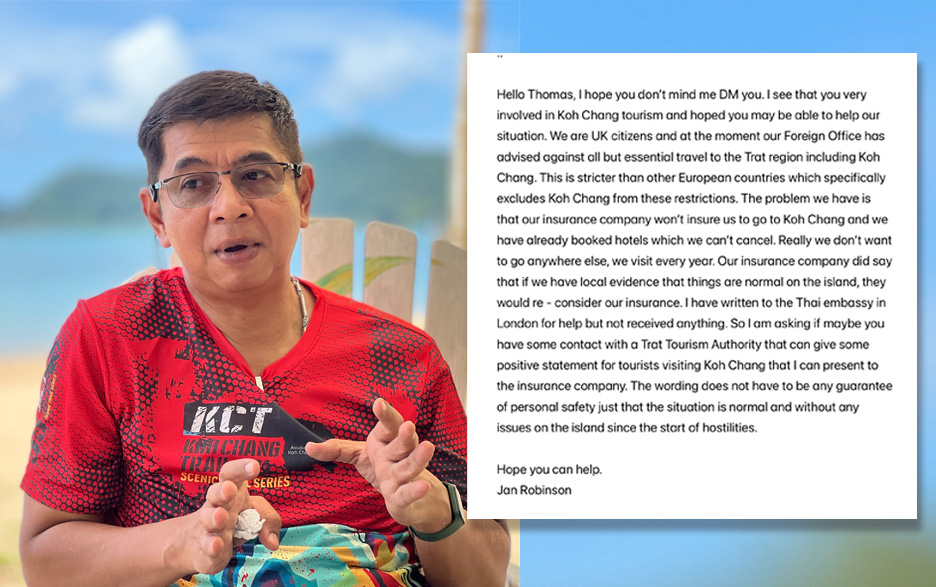
The crisis came to light when the Tourism Authority of Thailand’s London office forwarded a letter from Jan Robinson, a British citizen and regular Koh Chang visitor, who explained how UK Foreign Office warnings have made it impossible to obtain travel insurance for the popular island destination.

Insurance Companies Refuse Coverage

“We are UK citizens and at the moment our Foreign Office has advised against all but essential travel to the Trat region including Koh Chang,” Robinson wrote in the letter addressed to TAT London and the Royal Thai Embassy in London.

The travel advisory has created a cascade of problems for British tourists with existing bookings. “The problem we have is that our insurance company won’t insure us to go to Koh Chang and we have already booked hotels which we can’t cancel,” Robinson explained. “Really we don’t want to go anywhere else, we visit every year.”

trat martial11
TAT Trat Director Korakod Opas speaks about a plea from UK tourist Jan Robinson, blocked from visiting Koh Chang by insurance restrictions over the province’s Martial Law designation.

Robinson noted the UK stance is particularly strict: “This is stricter than other European countries which specifically excludes Koh Chang from these restrictions.”

The insurance company offered Robinson a lifeline, stating they would reconsider coverage “if we have local evidence that things are normal on the island.” After receiving no response from the Thai embassy in London, Robinson reached out to local tourism authorities for help.

“The wording does not have to be any guarantee of personal safety just that the situation is normal and without any issues on the island since the start of hostilities,” Robinson clarified.

Martial Law Declaration at Root of Problem

Acting Sub-Lieutenant Korakod Opas, Director of TAT’s Trat office, acknowledged the issue after being contacted by the London office and consulting with superiors.

“The situation at the Trat border is not a combat zone like the incidents occurring in the Northeast; it is simply an area adjacent to Cambodia,” Korakod said. “Furthermore, Koh Chang, Koh Kood, and Koh Mak are not dangerous areas, as large numbers of tourists continue to visit every day, and the travel conditions and weather are safe.”

However, he identified the core problem: “What foreign tourists, especially those from Europe, are still concerned about is the fact that Thai security forces have declared the entire Trat province a Martial Law zone.”

trat matial33
Crowds of tourists board a ferry to Koh Chang during peak season.

In European understanding, Korakod explained, such declarations signal high risk. “In the understanding of Europeans and insurance providers, this is a case where insurance will not be provided due to the perceived risk to safety. And if an incident occurs, it will result in large insurance payouts.”

The Martial Law declaration has been in effect since 2012—long before current regional tensions—but its presence now poses a major obstacle to tourism.

“If the security sector understands and revokes it in areas that are not involved, it could help tour operators,” Korakod said. “Due to this issue, foreign tourists cancelling their trips for late 2025 has resulted in a massive loss of up to $21 million.”

Industry Calls for Action During Peak Season

Thawisak Wongwilas, Vice President of the Trat Tourism Business Association, confirmed that tourists continue visiting Koh Chang without issues. “There are no issues with fighting, as it is outside the conflict area,” he said.

But the Martial Law designation remains problematic. “The problem of Martial Law being declared by security forces covering the entire province is a concern for foreign tourists, who fear danger. Additionally, insurance companies will not compensate for damages if a problem arises.”

Thawisak urged authorities to act quickly: “If the security sector understands and can revoke the law specifically in areas not directly adjacent to the border, it would be beneficial for the operators, especially since this is Trat province’s high season.”

trat boder travel
TAT Trat Office is promoting that tourists can still visit Trat Province, including all three islands – Koh Chang, Koh Mak, and Koh Kood – as they are not located in any combat zones.

Governor Reassures Tourists

Trat Governor Natthapong Sanguanjit sought to reassure potential visitors about safety conditions. “Koh Chang and Koh Kood are popular tourist destinations in Trat province, attracting a large number of tourists each year,” he said.

“Even during news of fighting between the two countries, tourists continued to visit Trat. Koh Chang and Koh Kood are safe, and no serious incidents have ever occurred,” the governor added. “I ask tourists to be confident when travelling to Trat province.”

The situation highlights an unintended consequence of security measures: a 13-year-old administrative declaration, designed to provide legal framework for border security, is now being interpreted by Western insurers as a warning signal—devastating tourism revenue during what should be the industry’s most profitable period.

Tourism officials hope that by selectively revoking Martial Law in non-border areas like Koh Chang, they can satisfy insurance companies and foreign governments while maintaining necessary security protocols along the actual frontier with Cambodia.

_______

Advertisement

Deported Lebanese National Returns, Arrested Again on Koh Phangan

Lebanese
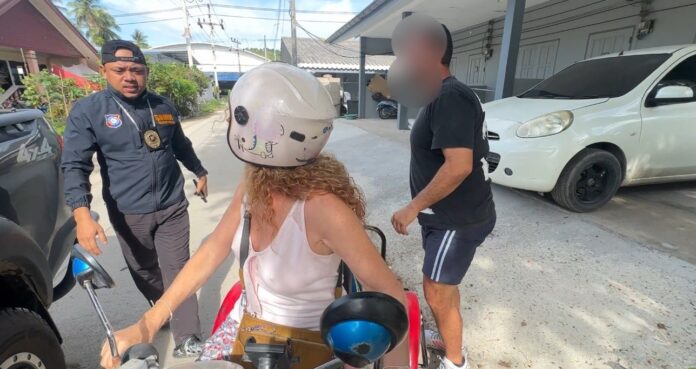
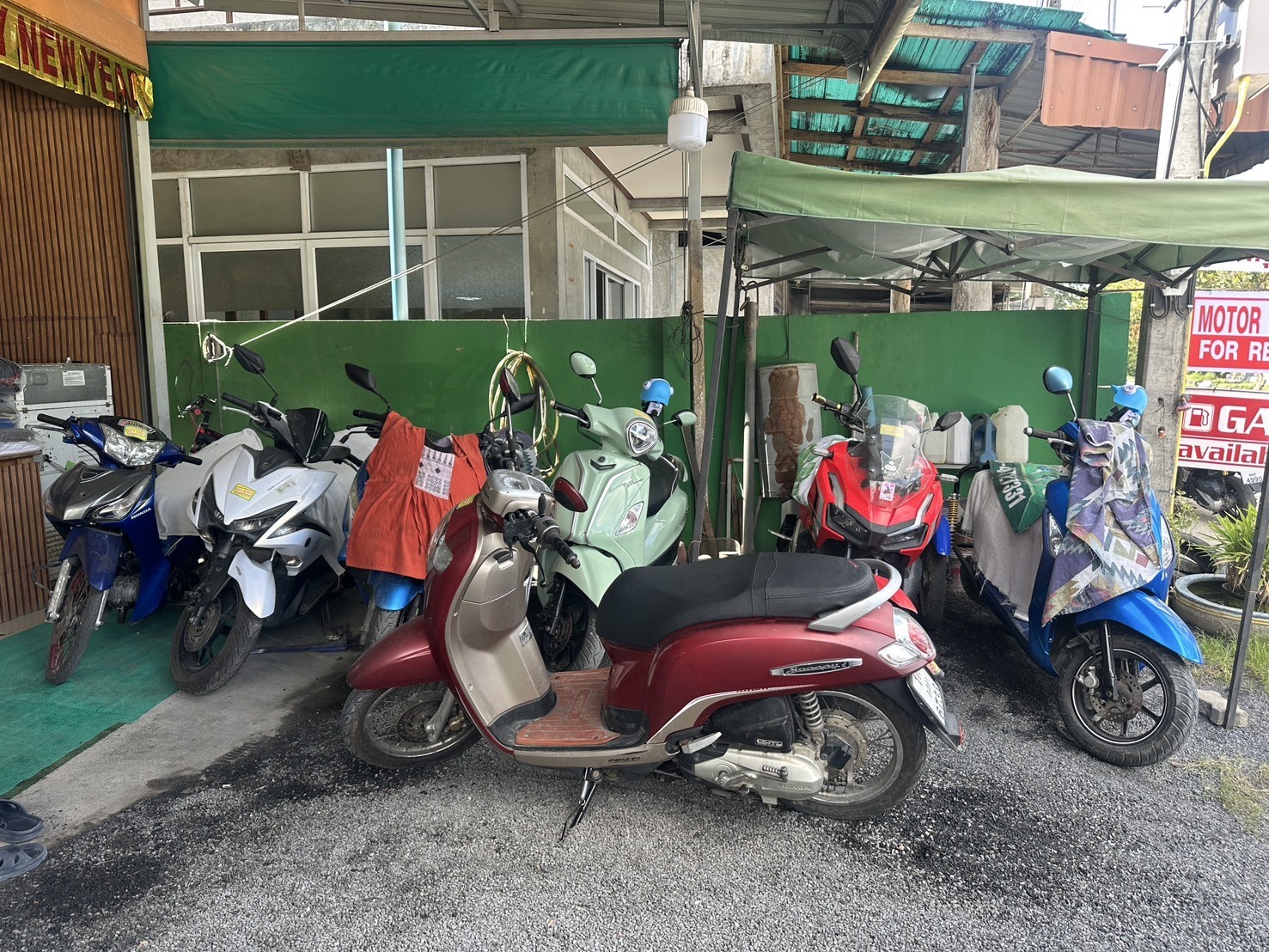
Tourist police intercept Lebanese national (right) as he instructs a foreign customer on motorcycle operation in front of Key King shop on Koh Phangan on October 13, 2025.

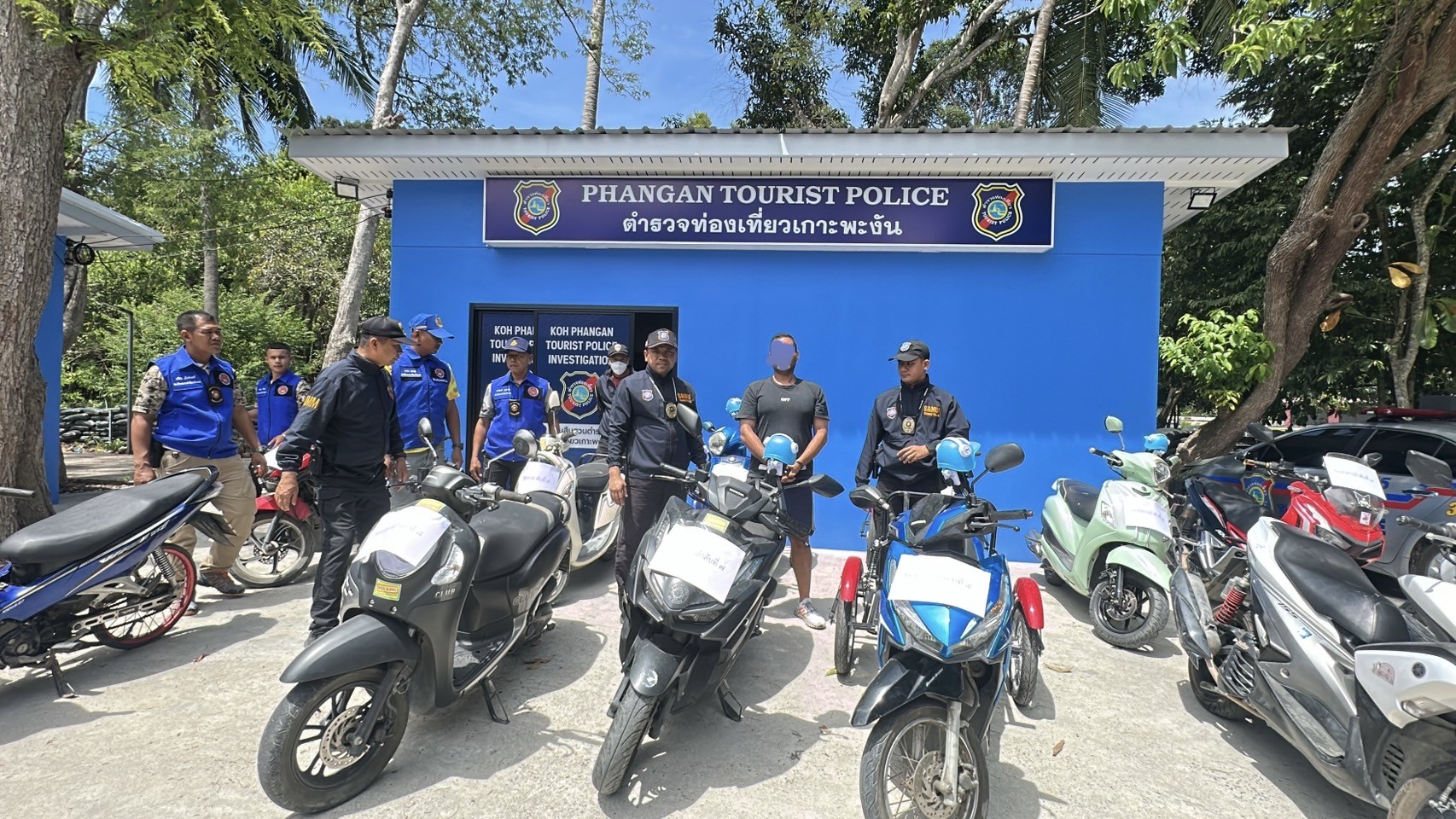
KOH PHANGAN — Tourist police have arrested a Lebanese national operating an illegal vehicle rental business on Koh Phangan, just months after he was deported for similar offenses, seizing 12 motorcycles and one car in the operation.

The October 13 arrest came as part of a crackdown ordered by Police Lieutenant General Saky Sira Puek-um, Commissioner of the Tourist Police Bureau, targeting foreign nationals committing offenses in tourist areas.

Officers moved in after receiving a complaint about a foreign man illegally running a vehicle rental operation in front of the “Key King” shop in Moo 1, Koh Phangan subdistrict, Surat Thani province.

Police observed Mr. Jon (surname withheld), a 46-year-old Lebanese national, providing rental services to a foreign customer, including refueling and vehicle inspection. He accepted cash payment from a female foreign customer before taking her to a nearby alley to teach her how to ride a motorcycle.

When officers identified themselves and requested documentation, they discovered Mr. Jon held only a TR-60 tourist visa and no work permit.

lebanon phangnan2
Part of the 12-motorcycle fleet seized from Mr. Jon’s illegal rental business on Koh Phangan. The vehicles were registered in multiple southern provinces and rented to foreign tourists without proper licensing.

WhatsApp Operation Targeting Israeli Tourists

During interrogation, Mr. Jon admitted to contacting customers through WhatsApp using the name “Jean,” claiming to represent Key King shop. He rented motorcycles for 250-350 baht ($7-10) per day, primarily to Israeli nationals.

At the shop, Ms. Saichai, who identified herself as the owner, told police she and Mr. Jon were formerly in a relationship but had divorced long ago. She claimed she allowed him to use the space in front of her shop out of sympathy. Mr. Jon allegedly invested 200,000 baht ($6,115) in the business and displayed the shop’s stickers to deceive authorities, though Ms. Saichai insisted she received no profits.

Authorities seized 12 motorcycles and one passenger van, along with one mobile phone as evidence. The motorcycles bore license plates from multiple southern provinces including Surat Thani, Krabi, Phuket, Chumphon, Nakhon Si Thammarat, and Yala.

labanon phangnan3
Tourist police present evidence at Koh Phangan Tourist Police station after arresting a previously deported Lebanese man who returned on a tourist visa to resume his illegal rental business on October 13, 2025.

Previously Deported, Returned on Tourist Visa

A background check revealed Mr. Jon had been arrested on April 20, 2024, for working illegally as a water delivery truck driver. He was subsequently deported from Thailand but returned on a tourist visa and resumed illegal operations.

While being transported to the Koh Phangan Tourist Police Service Unit, Mr. Jon displayed aggressive behavior, showing no remorse or respect for authorities. He laughed at arresting officers, loudly threatened to sue them, and clapped his hands in contempt despite being a repeat offender who had violated the conditions of his deportation.

Police charged Mr. Jon with working without a work permit and operating a business without authorization before transferring him to Koh Phangan Police Station for prosecution.

_________

Advertisement

China Escalates Crackdown on Taiwan’s Alleged Online Separatist Operations

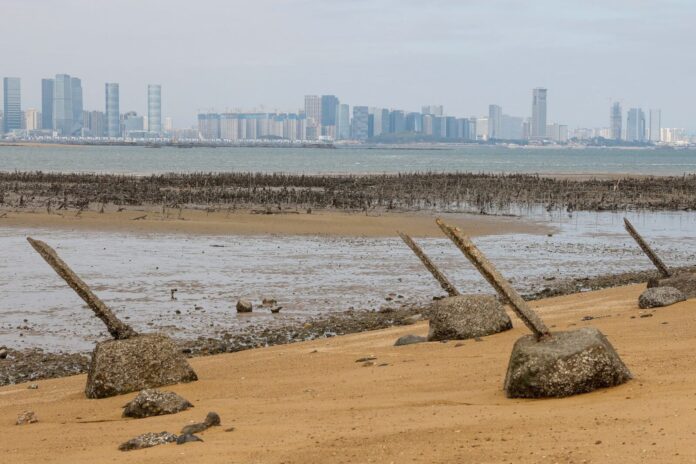
Photo: REUTERS

China’s national security authorities have intensified their campaign against what they describe as coordinated disinformation operations run by Taiwan’s military and political establishment, publicly naming 18 individuals and offering substantial rewards for information leading to their arrest.

The Xiamen Public Security Bureau announced bounties of up to 10,000 yuan ($1,401.74) on Saturday for intelligence regarding the 18 individuals, whom Beijing claims are core members of Taiwan’s military psychological operations unit. The move came just one day after Taiwan’s President Lai Ching-te pledged to strengthen the island’s defences and called on China to renounce the use of force.

Allegations of Coordinated Online Disinformation Campaign

Chinese authorities allege that Taiwan’s Democratic Progressive Party (DPP) and its affiliated entities have systematically orchestrated a network of online trolls to advance a “separatist agenda” across multiple domestic and international social media platforms.

Unmasking the Alleged Operatives

China’s national security authorities claim to have identified the individuals allegedly orchestrating the online operations. According to Beijing, a cluster of highly interconnected suspicious online troll accounts operating across multiple social media platforms are managed and directed by Taiwan’s Wang’s Creative Marketing Art Company, which operates under the direction of Taiwan’s Military Intelligence Bureau.

The three individuals identified as key figures in the alleged operation are:

      Lin Ziyu (alias Lin Xiaofei), female, born November 21, 1989, is a lieutenant colonel in the Third Division of Taiwan’s Military Intelligence Bureau. China alleges she directly commands Wang’s Creative Marketing Art Company in its propaganda operations.

      Wang Yiru, male, born December 12, 1985, is identified as the head of Wang’s Creative Marketing Art Company. According to Chinese authorities, he operates under Lin Ziyu’s command and has repeatedly submitted proposals and reports on propaganda activities.

      Chen Kaijie, male, born August 31, 1990, is described as the head of the company’s Tainan office and allegedly directly involved in the propaganda activities.

Specific Allegations and Tactics

Chinese authorities characterize the accounts operated by Wang’s Creative Marketing Art Company as displaying similar content, coordinated activity patterns, and inflammatory messaging designed to fabricate false information and incite antagonistic sentiment among online users.

Beijing alleges the following specific tactics:

      Inciting separatist ideology: The company allegedly distorts historical facts, promotes “Taiwan independence” rhetoric, clamors for “de jure independence,” and spreads claims such as “Taiwan’s sovereignty belongs to the United Nations”

      Fabricating and disseminating false information: Affiliated accounts allegedly create falsified documents, including fraudulent “official directives” from mainland China, and spread rumors about sensitive topics like the South China Sea and Taiwan Strait issues to incite antagonistic sentiment and disrupt social order

      Promoting historical revisionism: These accounts allegedly distort historical truths regarding events such as the Chinese People’s War of Resistance Against Japanese Aggression and the founding of the People’s Republic of China, attempting to deny the historical contributions of the Communist Party of China

      Psychological warfare activities: Chinese state media reports that the targeted individuals launched smear campaign websites, created seditious games promoting secession, produced fabricated video content, operated illegal radio broadcasts for “infiltration,” and manipulated public opinion with resources from “external forces”

Taiwan Rejects Accusations as Political Theater

Taiwan’s Defence Ministry dismissed the allegations as part of an authoritarian regime’s strategy to divide the population and conduct cognitive warfare. Officials characterized the accusations as exploiting “the free flow of information in our democratic society to piece together and fabricate personal data.”

Taiwan’s official response emphasized:

      The accusations reflect “despotic and pig-headed thinking” aimed at belittling the government and dividing the people

      Defending national security and protecting citizens is the “unshirkable duty of every military officer and soldier”

      Taiwan will not be intimidated by such measures, having previously dismissed a similar bounty issued in June targeting 20 alleged military hackers

China’s Legal Threats and Policy Framework

Chinese authorities framed their crackdown within the context of existing legislation, citing the Anti-Secession Law and official policy documents regarding punishment for separatist activities. Beijing declared that it will “adopt all necessary punitive measures against separatist forces for ‘Taiwan independence'” and “hold them legally accountable for life.”

The national security authorities issued a direct warning to online operatives, stating: “The internet is not beyond the reach of the law,” and called on individuals involved in such activities to “recognize the reality, abandon the fantasy of ‘Taiwan independence,’ refuse to be cannon fodder for separatist agendas, and cease all criminal activities that split the country.”

In its broader political messaging, China reiterated its foundational position that “there is only one China in the world, and Taiwan is an inseparable part of China’s territory.” Beijing accused the DPP authorities of “obstinately clinging to their separatist stance” and “deceiving the people of Taiwan,” while characterizing the pursuit of independence as “a dead end” that “gravely undermines peace and stability in the Taiwan Strait.”

Escalating Tensions in Cross-Strait Relations

The bounty announcement represents the latest escalation in Beijing’s campaign of military and political pressure against the democratically governed island, which China views as its own territory despite strong objections from Taipei.

The timing of China’s move follows President Lai’s Friday statement pledging greater efforts to bolster Taiwan’s defences and his call for Beijing to abandon threats of military force. China responded with anger, labeling Lai a “troublemaker” and “war-maker.”

The wanted notice carries largely symbolic value, as Taiwanese intelligence officials do not openly travel to China, and China’s legal system has no jurisdiction over the island. However, analysts view the public exposure of names, photographs, and identity card numbers as part of a broader campaign to apply pressure and intimidate Taiwan’s security establishment. The inclusion of explicit legal threats and warnings demonstrates Beijing’s intent to use both diplomatic pressure and legal frameworks—including domestic Chinese law—to deter activities it views as separatist.

__________

Advertisement

Pattaya Sees Double Trouble: Indian Injured, Brazilian Attacks Police

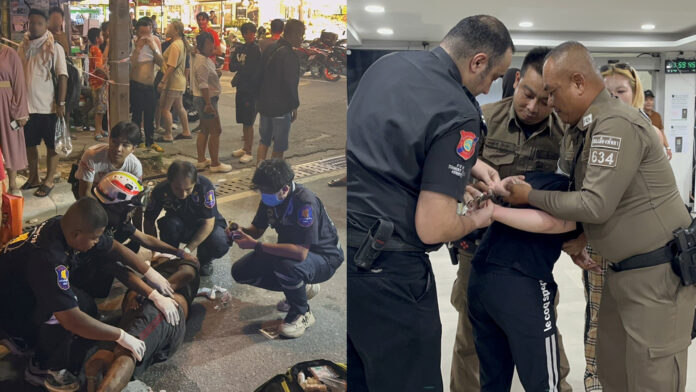
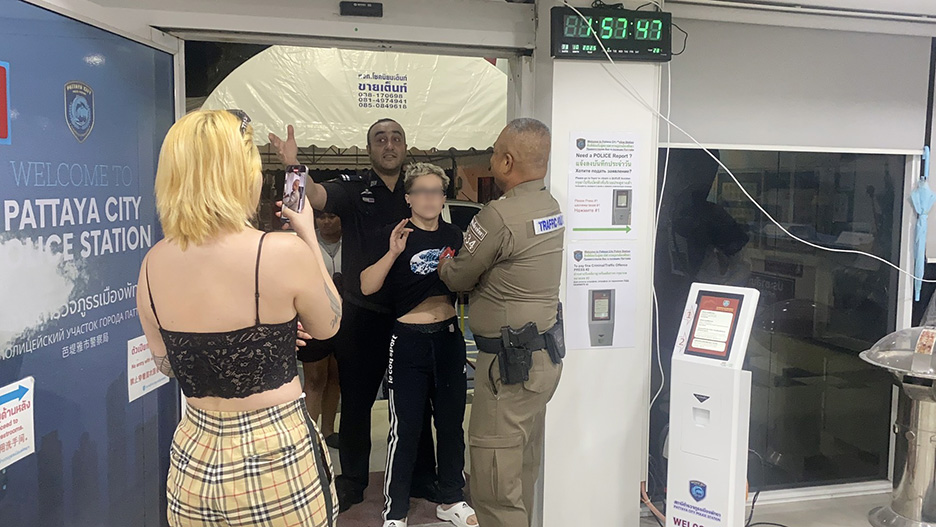
This combonation photo show Indian tourist receiving medical attention after head injury in public urination dispute (left), and Brazilian tourist being restrained by police after assaulting traffic officer on October 13, 2025.

PATTAYA — Two separate incidents involving foreign tourists erupted in Pattaya in the early hours of Sunday morning, with an Indian national hospitalized after a street fight and a Brazilian woman arrested for assaulting a traffic officer.

Indian Tourist Injured After Public Urination Dispute

Shortly after midnight, police patrol officers and rescue volunteers found a 52-year-old Indian tourist, identified as Mr. Rama, with severe head injuries and bleeding on the ground in front of Lan Wey Market on Pattaya Second Road, Nong Prue subdistrict, Bang Lamung district, Chonburi province. He was rushed to the hospital while the assailant fled before police arrived.

A motorcycle taxi driver who witnessed the incident told police that the Indian tourist had been urinating against a roadside fence when a local resident approached him, explaining that public urination was prohibited and directing him to use the restrooms inside the market.

indian pee2
Rescue workers treat the injured Indian tourist, Mr. Rama, 52, at the scene outside Lan Wey Market after he suffered head injuries during a dispute over public urination on October 13, 2025.

The Indian man refused to comply, and his companion allegedly argued aggressively with the local resident. The confrontation escalated into a physical altercation involving slapping and pushing. During the struggle, the Indian tourist stumbled backward, fell, and struck his head on the pavement.

CCTV cameras captured portions of the incident. Police have preserved the footage as evidence and are tracking down the assailant for questioning.

Brazilian Woman Attacks Traffic Police

Around 2:00 a.m., a second incident unfolded when traffic police stopped 31-year-old Brazilian national Miss Dayane for driving a motorcycle the wrong way without a helmet on Beach Road near Soi 9.

While Police Lieutenant Colonel Siwakorn Somsura, deputy traffic inspector at Pattaya City Police Station, was writing a traffic citation, the woman became aggressive and punched him in the face.

brazilian pattaya2
Police restrain Brazilian tourist Miss Dayane, 31, at Pattaya City Police Station after she assaulted a traffic officer at Pattaya Police Station on October 13, 2025.

Officers escorted her to the police station, but her violent behavior intensified. Police were forced to restrain her with handcuffs as she continued resisting, spitting at officers and kicking Lt. Col. Siwakorn in the buttocks. The officer did not retaliate and maintained composure, responding with a slight smile.

Miss Dayane was placed in a holding cell and charged with assaulting an officer while performing official duties, obstructing police work, and traffic violations.

___

Advertisement

Jeeno Thitikul’s Comeback Secures LPGA Shanghai Title in Dramatic 5-Hole Playoff

Jeeno Thitikul celebrates with the trophy after winning the LPGA Shanghai on Sunday, October 12, 2025. (Photo: LPGA)

SHANGHAI (AP) — Jeeno Thitikul came from four shots down with five holes to play to force a playoff with Minami Katsu, before producing another extraordinary shot on the fifth playoff hole to claim the LPGA Shanghai and become the first two-time LPGA tournament winner of the season on Sunday.

Top-ranked Thitikul’s 63 was the round of the day and included seven birdies and an eagle. The Thai player’s 24-under 264 closed what had appeared to be a comfortable margin for overnight leader Katsu of Japan, who had started the day two shots ahead and extended that to four after the 13th.

But the Thai player reeled that in with birdies on the 14th, 15th and 16th, before an incredible eagle with the ball bouncing along the mottled 17th green of Qizhong Garden Golf Club in Shanghai to draw level.

Katsu (65) could only respond with a birdie of her own at the 17th, but had another birdie chance on the final hole to claw back the victory only for the ball to slide past the hole and forcing the playoff.

Pars through the first four playoff holes, rotated between the 18th and the 10th, included Katsu having two birdie putts to win only to narrowly miss the hole on both.

jeeno lpga1
Jeeno Thitikul celebrates with the trophy after winning the LPGA Shanghai on Sunday, October 12, 2025. (Photo: LPGA)

On the fifth playoff hole the deadlock was broken as a brilliant approach by Thitikul placed the ball three feet away, while Katsu’s second shot fell short of the green at the par-4 18th.

Katsu’s chip for birdie was impressive but missed, leaving Thitikul a simple birdie putt to close out a remarkable victory nearly two years after losing in an epic nine-hole playoff to Celine Boutier at the LPGA Malaysia.

From disappointment to delight

It was Thitikul’s second win of the season after claiming the Mizuho Americas Open in May and helped ease the disappointment of her inexplicable four-putt meltdown on the final hole at the Kroger Queen City Championship last month.

“What happened on the last event (was) definitely still in my mind, but like to be able to prove myself again this tournament, which is … like a dream come true and you know, I’m not carrying a thing on my shoulder,” she said.

Minjee Lee, who won her third major title at the Women’s PGA Championship in June, shot 68 on Sunday for a 19-under 269 as her challenge faded through the middle part of the round for a third-place finish.

Jenny Bae of the United States had a round of 69 and finished in a tie for fourth with Miyu Yamashita (67) of Japan and Somi Lee (69) of South Korea at 17-under 271.

Defending champion Ruoning Yin of China carded a final round of 68 to finish in a tie for 26th.

The Shanghai event is the first of five tournaments in Asia. There are two weeks in South Korea, including the International Crown team event, and other tournaments in Malaysia and Japan.

___

Advertisement

Israeli Investor Probed After 6 Myanmar Workers Arrested on Koh Phangan

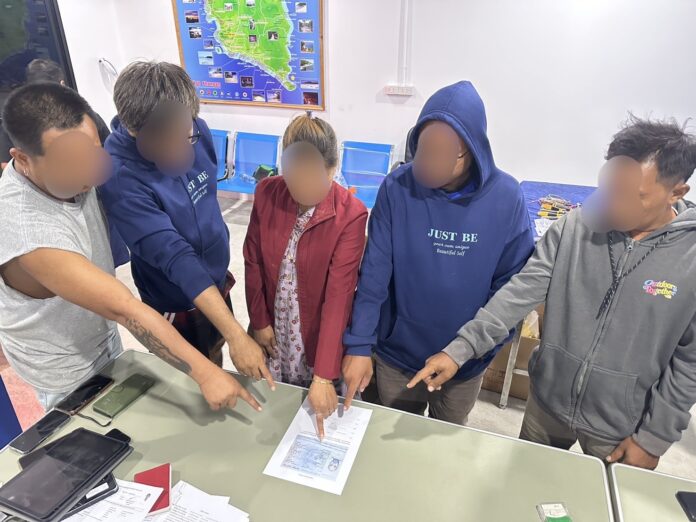
Five arrested Myanmar nationals identify their Israeli employer by pointing to a copy of his passport during police interrogation at Koh Phangan Tourist Police station on October 11, 2025.

SURAT THANI — Six Myanmar nationals have been arrested on Koh Phangan island for operating an illegal construction business, uncovering a suspected nominee scheme involving an Israeli investor and nearly 9 million baht ($275,215) in transactions over the past year.

The October 11 arrests by tourist police and local authorities came amid growing complaints from Koh Phangan residents about foreign nationals, particularly Israelis, illegally expanding business operations on the island using Thai proxies to circumvent foreign business ownership laws.

Electricians Working Illegally Spark Investigation

The case began when local residents reported two Myanmar men, Mr. Ye and Mr. Te, installing electrical systems in a completed residence. Under Thai law, electrical work is a protected occupation reserved exclusively for Thai nationals.

When questioned by police, both men confessed to receiving 500 baht per day in cash from an unidentified Israeli man. The admission prompted authorities to expand their investigation into the area’s construction sector.

myanmar phangan1
One of six arrested Myanmar workers shows police the electrical systems he installed illegally at a Koh Phangan construction site on October 11, 2025.

Organized Construction Ring Exposed

The probe led to three additional arrests: Mr. Aung Thu, Ms. Khai Wai Mon, and Mr. Te Wai, who operated a sophisticated construction contracting operation disguised as legitimate employment.

The trio had created a LINE messaging group to coordinate construction projects with foreign clients, primarily targeting expatriates and tourists. Mr. Aung Thu handled marketing and client relations, Mr. Te Wai supervised construction as foreman, and Ms. Khai Wai Mon managed the financial records.

Bank statements revealed 8.9 million baht ($272,160) flowing through their accounts in just one year—a sum far exceeding what typical migrant workers could legally earn in Thailand.

Israeli National Identified as Main Client

Under interrogation, the suspects revealed they falsely claimed to work for Kong Thong Construction Limited Partnership, a Thai-registered company. In reality, they were directly employed by Mr. Ran, an Israeli national who commissioned seven luxury homes with budgets exceeding 7 million baht ($214,060) each—a total project value of approximately 49 million baht ($1.5 million).

Mr. Ran paid in installments, releasing 50% of each home’s contract value when construction reached the halfway point. Police recovered receipts showing the Israeli investor purchased 9.3 million baht ($284,390) in construction materials for the contractors and paid an additional 6 million baht ($183,480) in lump-sum labor costs.

Evidence recovered from the suspects’ mobile phones included detailed communications with Mr. Ran and financial records documenting the transactions.

myanmar phangan3
Koh Phangan tourist police and immigration officers present five of the six arrested Myanmar nationals along with seized evidence including electrical wiring, cable spools, and tools used in illegal construction operations on October 11, 2025.

Illegal Border Crosser Detained

During the arrests, police became suspicious of Mr. Tian Soe, another Myanmar national present at the scene. Investigation revealed he had illegally entered Thailand through natural border channels near Mae Sot district in Tak province, paying 15,000 baht to human smugglers. He now faces charges of illegal entry in addition to the construction-related offenses.

Nominee Network Operates Freely

Investigators say the Myanmar contractors told them the shell company used as cover employed only one Thai national—a person who merely placed orders for construction equipment and materials as directed. Significantly, this Thai proxy could not speak English and never participated in negotiations with foreign clients.

The arrangement allowed the Myanmar group to operate independently, managing their own crews of 30-50 workers and directly soliciting contracts from foreigners on the island. The suspects acknowledged knowing their activities were illegal but continued because the financial rewards outweighed the risks.

“They were very open about it,” one investigator said. “They knew it was against the law, but the money was too good to pass up.”

Scale of Financial Operation Revealed

The investigation has traced a complex web of financial transactions over the past year involving millions of baht flowing between the Myanmar contractors, Israeli investors, and multiple Thai nationals suspected of serving as nominees.

Under Thai law, foreigners are prohibited from owning certain types of businesses and must partner with Thai nationals who hold majority ownership. However, “nominee” arrangements—where Thai citizens serve as owners in name only while foreigners retain actual control—are illegal.

Authorities believe Mr. Ran and potentially other foreign investors have been using this nominee structure to develop property on Koh Phangan, a popular tourist destination known for its beaches and full moon parties.


Charges and Ongoing Investigation

Police have detained all six Myanmar nationals at Koh Phangan Police Station pending prosecution. Authorities charged the group with working illegally in occupations reserved for Thai citizens and running unlicensed construction businesses, while Mr. Tian Soe faces an additional count of entering the kingdom without authorization. All six also face immigration and labor law violations.

The Surat Thani provincial governor has authorized an expanded investigation to identify all parties involved in the scheme.

Investigators are pursuing three main lines of inquiry: tracing the complete financial network, identifying other construction contractors operating illegally, and locating both the Israeli investors and their Thai nominees.

Authorities have not yet filed charges against Mr. Ran or any Thai nationals, but officials say the investigation is ongoing.

Growing Problem on Tourist Islands

The arrests represent the first major enforcement action since Thai authorities launched an investigation into allegations that Israeli nationals are illegally operating businesses on Koh Phangan. The probe was initiated after local residents raised concerns about long-term foreign presence on the island, with some calling the tropical destination a “second Tel Aviv.”

Frustrations have mounted among locals who say Israeli visitors are extending stays beyond tourism to establish business operations through nominee arrangements, while allegedly displaying disrespectful behavior toward residents and other tourists.

The backlash has spread across social media through a “Save Koh Phangan” campaign, with residents expressing fears the island is following the trajectory of Pai in Mae Hong Son province. That northern town has become a cautionary tale for other tourist destinations grappling with the balance between welcoming foreign investment and preserving local character.

_______

Related article:

Thai Officers Probe Israeli Visitor Concerns on Koh Phangan

Advertisement

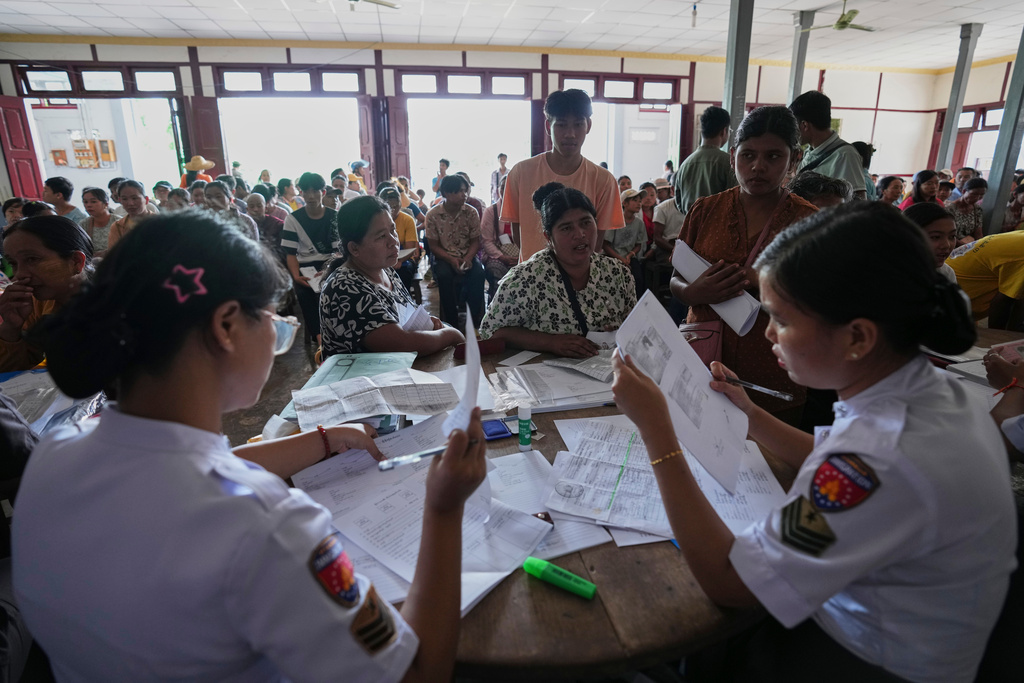
A Myanmar Town Lies in Shambles as Both Sides in Civil War Vie for Control

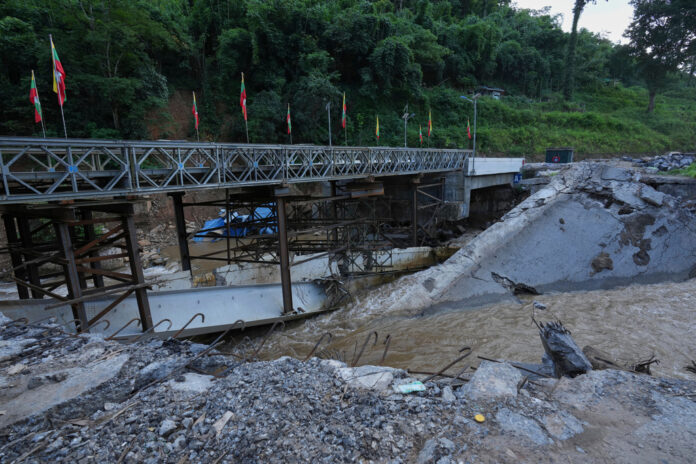
The damaged Gotwin bridge is seen in Kawnghkio township, northern Shan State, Myanmar, Friday, Oct. 10, 2025. (AP Photo/Aung Shine Oo)

By AUNG SHINE OO

KYAUKME, Myanmar (AP) — Ten days after it was recaptured by Myanmar’s military government, the town of Kyaukme stands eerily silent. Schools have reopened but the town’s once-busy market is mostly empty. Vendors at some stalls closed them at the sight of the visiting journalists, visibly nervous.

The once-thriving town in Myanmar’s Shan State is in shambles, an Associated Press journalist has confirmed on Friday in a rare visit to the war-torn area allowed by the country’s military government.

The local army allowed an AP photographer to join a trip supervised by pro-military Myanmar media, the only representative of foreign media who was permitted to do so. The military doesn’t allow a free press and bars journalists from entering conflict zones independently.

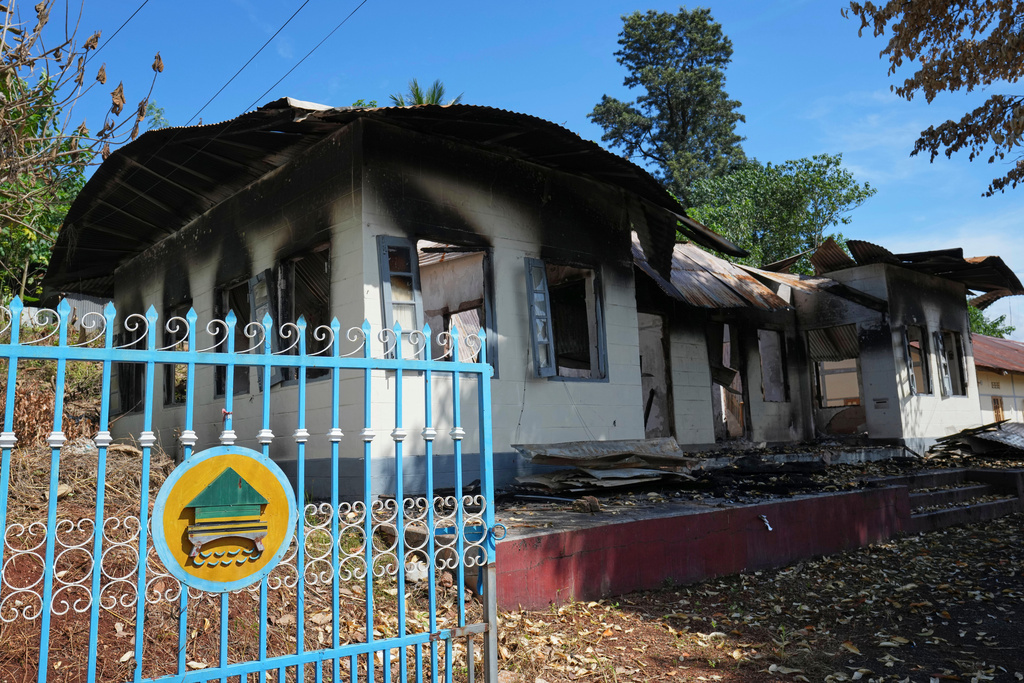
They saw the charred wreckage of official buildings, such as the courthouse, police station and government housing. Much of the area around the town’s hospital was destroyed, with its operations temporarily shifted to a nearby Chinese temple. At least one of the town’s fire engines was burnt out.

But civilian houses seemed to be mostly unscathed, except those near damaged official buildings, but most of the town’s original population of 46,000 had fled.

The ethnic militia that previously controlled the town accused the army of causing the damage with air strikes and heavy weapons, while the government soldiers who took over the town said the militia destroyed structures as it retreated.

AP25285101495914
In this photo taken during a trip supervised by pro-military Myanmar media, a damaged government residence is seen in Kyaukme, northern Shan State, Myanmar, Friday, Oct. 10, 2025. (AP Photo/Aung Shine Oo)

Because of its strategic location on a highway connecting central Myanmar to China, Kyaukme has been much fought over. About 115 kilometers (70 miles) northeast of Mandalay, the country’s second-largest city, it has changed hands twice since the army in 2021 ousted the elected government of Aung San Suu Kyi, setting off the current civil war between the military government and an alliance of militias representing ethnic minorities and pro-democracy activists.

Kyaukme was captured by the Ta’ang National Liberation Army in August 2024, amid a wave of victories by opponents of military rule that left them apparently in control of most of the country’s territory. The TNLA is the guerrilla army of the Palaung ethnic minority.

The town fell back into the hands of the military government on Oct. 1 after a three-week battle, in a significant victory for government forces.

AP25285103578866
In this photo taken during a trip supervised by pro-military Myanmar media, immigration officers check personal data of locals for lost and damaged national registration cards, at a temporary office in Kyaukme, northern Shan State, Myanmar, Friday, Oct. 10, 2025. (AP Photo/Aung Shine Oo)

The army has mounted a succession of successful offensives in recent months, ahead of elections set for the end of the year. Critics say the polls will be neither free nor fair, but the army hopes that high turnout will help legitimize the vote.

Before attacking Kyaukme, the army in July recaptured the town of Nawnghkio, considered a gateway to Myanmar’s heartland because it sits at the crossroads of Myanmar’s eastern hills and its central flatlands.

From there 55 kilometers (33 miles) to Kyaukme, the road is flanked by buildings damaged by bombs and bullets, or pummeled into debris.

Army checkpoints manned by newly drafted soldiers stand every 500 to 1,000 meters (yards) along the route. A major bridge was damaged, but remains standing and is under repair.

The authorities blocked journalists’ access to some residential areas, which they said were dangerous.

“There are still land mines that haven’t been cleared in parts of the neighborhood,” said Capt. Wai Yan Kyaw, who was stationed at one of the town’s gates.

AP25285101775436
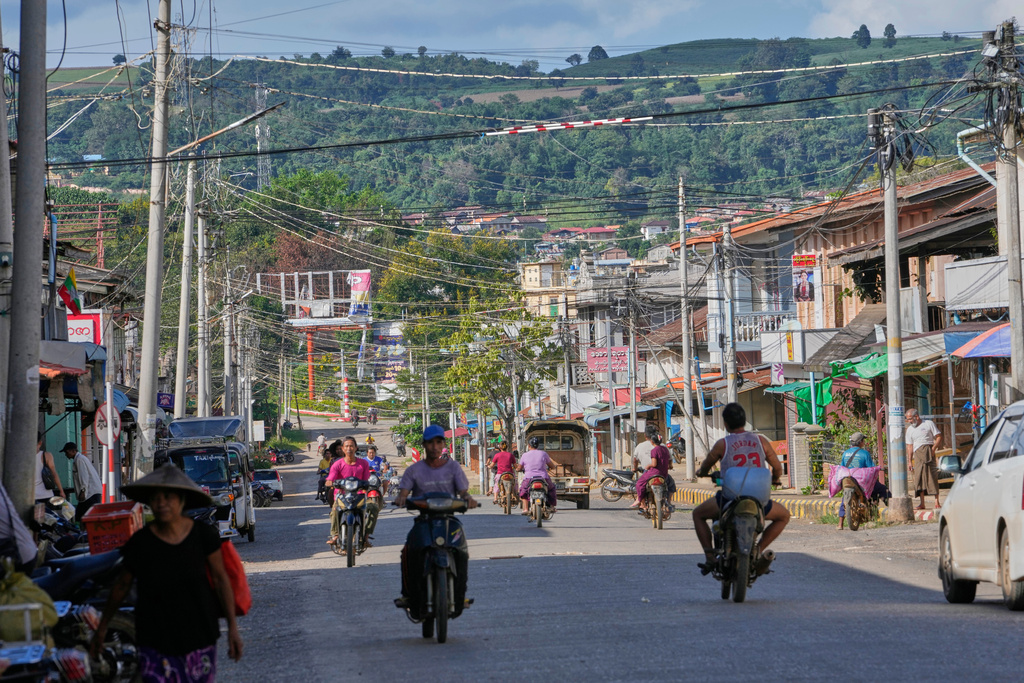
In this photo taken during a trip supervised by pro-military Myanmar media, locals ride motorbikes in Kyaukme, northern Shan State, Myanmar, Friday, Oct. 10, 2025. (AP Photo/Aung Shine Oo)

The journalists saw unexploded ordnance, including a mortar shell sunk into the ground inside the compound of a Buddhist monastery.

Locals who spoke to the AP said that only a small part of the town’s population had returned since its recapture.

A resident who had stayed behind during the fighting said that the overwhelming majority fled after fighting broke out last year, and those who stayed, like him, did so because they couldn’t afford to leave. He spoke on condition of anonymity to avoid harassment from the authorities.

Kyaukme is near the front line of the continuing army offensive, with soldiers saying they believe TNLA forces are in the hills just 32 kilometers (20 miles) away.

A motorbike taxi driver in his mid-30s, who also asked not to be named for his own security, said the town’s once-busy streets were now virtually deserted, and he believed residents would be unwilling to return until the army recaptured more nearby towns.

“People are unwilling to live near the front line,” said the driver, who came back on Tuesday.

_____

Advertisement

Thais Struggle With Ultra-nationalism as Thai-Cambodian Conflict Continues

Border barrier in Sa Kaeo Province where Cambodia has accused Thailand of broadcasting ghost sounds at night as psychological harassment against border residents.

Earlier this week, on Monday, I was invited to meet a Bangkok-based Japanese journalist working for a leading Japanese news outlet at his Bangkok office. The objective of the meeting was straightforward – to help explain why many Thai netizens attacked the Japanese Embassy recently after the Japanese government tried to persuade the Thai side to reopen the border between Thailand and Cambodia so Japanese companies’ supply chain will not continue to be affected by the closed border.

The answer I gave was anything but simple. I reassured the baffled Japanese journalist that this was nothing personal to do with Japan or specifically targeted at Japan, however.

After all, Thailand was spared the brunt of the Japanese Imperial Army when it invaded the country during World War II as Thailand quickly switched sides to join Japan back then. Today, the Japanese expat community in Bangkok is arguably the largest in Asia, numbering more than 50,000 strong. Most Thais love Japanese food. But then there’s this not so little thing called ultra-nationalism.

Apparently, ultra-nationalism has taken the better of these Thais. Their reactions against the Japanese Embassy was not just myopic but a failure to perceive the big picture and to even defend Thai national interests.

Sure enough, a few days after the hour-long meeting, some Thai netizens were celebrating again upon reading some local Thai news outlets reporting that some Japanese companies are considering moving from Cambodia to elsewhere due to the negative impacts from the prolonged closure of Thailand-Cambodia border which affected the supply chain.

The news is definitely not good news for Thailand because, on the other hand, it forces Japanese investors to ask themselves: How stable and reliable is using Thailand as a regional base for various production operations when a not-insignificant number of Thais are easily swayed, support the border closure, and are ready to curse the Japanese embassy and businesses in Thailand?

It is pure and plain ultra-nationalism and a failure to see the long-term overall picture of how such actions will affect Japanese confidence in investing in Thailand.

Ask Gemini to analyse my train of thought, if you are not convinced:

Based on your detailed observation, the issue you’ve raised is indeed a complex one with potential significant implications for Thailand’s economic reputation and its role as a regional manufacturing and supply chain hub.

Here’s a breakdown of the key points and potential consequences:

The Problem: Supply Chain Fragility and Regional Interconnectedness

The reported consideration by Japanese investors to pull investment from Cambodia due to border closures with Thailand highlights a crucial reality: the supply chains of Japanese companies often operate across both countries. Thailand is frequently the main production base or logistical hub, with Cambodia serving as a vital part of the downstream or upstream process.

Interdependence: The border being closed, even if the dispute is primarily between Thailand and Cambodia, directly damages the operations of companies relying on cross-border logistics, making the entire regional operation unstable.

Thailand’s Role: For many companies, Thailand is the “linchpin.” If the linchpin itself becomes associated with the instability of regional operations—even through local political or social sentiment that affects policy—it forces a serious re-evaluation of its long-term reliability.

The Risk to Thailand’s Investment Climate:

Your point that this news is not good for Thailand is well-founded. The core issue is investor confidence, which is built on predictability, stability, and reliability.

Political Risk/Social Unrest: When local sentiment, particularly intense nationalism (“ความคลั่งชาติ”), translates into widespread public support for actions (like border closures) that severely damage regional commerce, it’s perceived as a non-business risk. Investors factor in a “risk premium” for such environments.

Hub Stability: The primary reason Japan invested heavily in Thailand was its reputation for logistical excellence, skilled labour, and political stability (at least compared to some neighbours). The perceived potential for uncoordinated or emotionally driven actions that disrupt the supply chain directly undermines Thailand’s competitive advantage as a regional base.

Long-Term View: As the Japanese journalist noted, the concern is the lack of a long-term, holistic perspective (“ความไม่สามารถมองภาพรวมระยะยาว”). Companies plan decades ahead. If they see the possibility of irrational, sentiment-driven disruptions, they will prioritize moving high-value or essential production to genuinely more stable locations globally, or diversify within the region (e.g., Vietnam, Indonesia) to mitigate “Thailand risk.”

Conclusion: The potential withdrawal of Japanese investment from Cambodia over a supply chain issue tied to the Thai-Cambodian border closure serves as a warning signal for Thailand’s standing as an investment hub. It compels investors to ask: If local political or nationalistic sentiment can so easily disrupt a core supply chain function, how secure is our investment here?

“This is an issue where economic reality (the need for stable, predictable logistics) clashes directly with nationalistic sentiment (the support for border actions), and the former is often the deciding factor for multinational corporations.”

Artificial Intelligence aside, I told the Japanese journalist that one could have replaced the name of Japan with China or the US and it would make no difference, as it was not specifically targeted at Japan. Sure enough, by Friday, it was China’s turn, and the Chinese Foreign Ministry spokesman was on damage control mode by saying during a press conference in Beijing that China is neutral on the issue of Thai-Cambodian conflict.  

Foreign ministry spokesperson’s remarks on Thailand-Cambodia border conflict on October 10 can be found below:

“ Q: Recently, Western media have reported that China provided large amounts of weapons aid to Cambodia, questioning whether China is taking sides in the Cambodia-Thailand border conflict and misinterpreting China’s defence cooperation with relevant countries, which has aroused concern. What is China’s comment?  

”A: Since the Cambodia-Thailand border conflict broke out, China, as a friendly neighbour of both countries, upholding a fair and impartial position, actively promoted talks for peace, promoted the foreign ministers of China, Cambodia and Thailand to reach the “Anning Consensus” and held the China-Cambodia-Thailand trilateral informal meeting, dispatched the Special Envoy for Asian Affairs of the Ministry of Foreign Affairs of China to Cambodia and Thailand on multiple occasions for mediation. With the constructive and active facilitation of China, Malaysia and others, Cambodia and Thailand reached a ceasefire consensus and are maintaining communication through bilateral mechanisms.  

”China supports Cambodia and Thailand in resolving the dispute through dialogue and consultation, supports Malaysia, the rotating chair of ASEAN to promote a political solution through the ASEAN Way. China is willing to continue to mediate and promote dialogues in its own way based on the wishes of both the Cambodian side and the Thai side, and to play a constructive role in consolidating the ceasefire consensus and peacefully resolving the dispute. Relevant parties expressed high appreciation for the irreplaceable role played by China.  

”China is conducting normal defence cooperation with ASEAN countries, including Cambodia and Thailand. Some Western media outlets attempted to provoke disputes between China and the relevant friendly countries, but it is doomed to fail.”

Now, how can we explain Thai ultra-nationalism?

I told the Japanese reporter that it’s partly a result of a sense of exceptionalism among many Thais created by the fact that we kept being reminded that Thailand was never directly colonised. They are too easily overzealous and get triggered at anything perceived as slightly a threat to their national sovereignty. They were taught at schools how the country had to give up territories (or rather control over some territories) to colonial France and Great Britain in order to not be colonised over a century ago.

So as expected, some Thais continue to be upset as on Wednesday, Chinese Ambassador to Cambodia Wang Wenbin posted the following message on Facebook.  

“China firmly supports Cambodia in safeguarding its national sovereignty, security and development interests, and will always be a reliable partner in Cambodia’s development.”  

The message was read by many ultranationalist Thais as a declaration that China is taking sides with Cambodia in the conflict and as a result, China continues to be criticised.

The focus from Japan has now shifted to China, the latter accused of not being a “true friend” of Thailand, or a Janus-face superpower.

And here is how a local Thai-language media reported about it earlier this week:

Chinese Ambassador to Cambodia’s Statement Draws Massive Thai Backlash

”The Chinese Ambassador to Cambodia clearly stated China’s unwavering support for Cambodia, calling it an “ever-reliable partner.”  

“China firmly supports Cambodia in safeguarding its national sovereignty, security, and development interests, and will always be a reliable partner in Cambodia’s development,” posted Mr. Wang Wenbin on the official Facebook page of the Chinese Ambassador to Cambodia.

“Reports indicate that this post sparked a fierce backlash.

“Examples of the heated comments include:

“Now we know who provides weapons to the Khmer.”

“Before issuing this statement, did you talk to your Thai embassy counterparts first?”

“Don’t call China a brother to Thailand anymore. Thank you for what the Chinese Ambassador has announced. We Thai-Chinese people now know the truth. Thailand has never taken advantage of you; we thought we were brothers, as your leader said. Today, our eyes have been opened. Thank you.”

“You’re supporting a country of scammers, the hub of call centers??”

“Says one thing in Thailand, says another in Cambodia. This is China.”

“LOL. China is China.”

“What about the people of Chinese descent in Thailand? What about the people of Thai descent in China? Is this the long-standing brotherly relationship? Utterly disappointed. Ultimately, Thailand will turn to the US, because the US will soon go inspect the landmines in Cambodia.”

“Do you want a share of the oil and natural gas?”

“China is doing this purely for its own self-interest, not adhering to what is right or just, and not considering its relationship with Thailand. It’s terrible.”

“Thailand has never invaded another country’s territory first. We don’t want anyone’s land. In the past, we defended our sovereign territory and never retaliated by firing weapons at civilians or hospitals. And in Thailand, whose fault was it that a younger sibling died in their grandmother’s arms, and a husband and father lost his wife and children in a convenience store? (Referring to cross-border incidents/violence). Not to mention the almost 10 Thai soldiers who lost their legs because certain countries didn’t adhere to agreements, blah blah. And who knows where all that financial support is going? Not to mention being the center of call centers and scammers, cheating people all over the world out of hundreds of billions of money. Is this the country you are openly supporting?”  

_____

Advertisement

Hot News

LATEST NEWS

Bangkok
overcast clouds
26.6 ° C
31.1 °
26.6 °
89 %
1.3kmh
99 %
Thu
26 °
Fri
36 °
Sat
36 °
Sun
36 °
Mon
37 °