
























34.4 C
Bangkok
Sunday, June 28, 2026
Home Blog Page 2463

LGBT Thai Inmates Separated, Segregated Prison Mulled

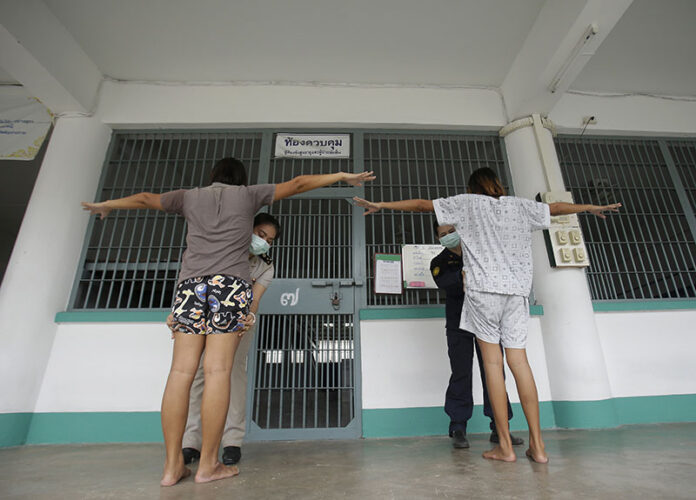
Transgender inmates get a security check from female officers before entering their cell Jan. 7 at the Pattaya Remand Prison in Pattaya, Chonburi province. Photo: Sakchai Lalit / Associated Press

PATTAYA — Theerayut Charoenpakdee was terrified when police stopped her outside a mall in Pattaya, the resort town famous for its sordid nightlife. A urine test on the spot revealed meth coursing through her veins.

“I thought I was going to be thrown in prison with all the men because I still have the title of Mr.,” the transgender woman said. “I was afraid. News and TV tells us that being sent to prison is scary.”

It turned out not to be the ordeal she expected. The prison she was destined for — Pattaya Remand — separates lesbian, gay, bisexual and transgender prisoners from other inmates, a little-known policy despite being in place nationwide since 1993, according to the Department of Corrections. Thailand, often described as a haven for gay people, has around 300,000 prisoners, of which more than 6,000 are registered as sexual minorities.
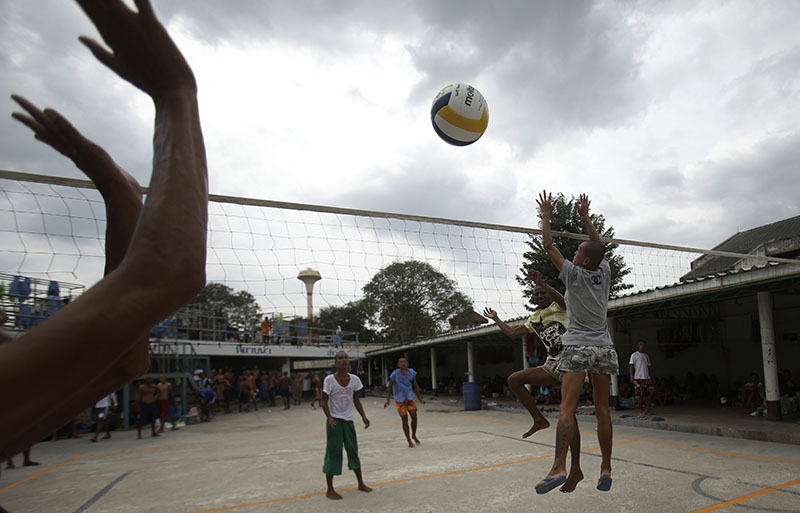
Transgender inmates play volleyball Jan. 6 at Pattaya Remand Prison in Pattaya. Photo: Sakchai Lalit / Associated Press

And that’s not all. The Thai government is also considering what could be the world’s first prison facility exclusively for LGBT inmates. While the plans are still being discussed, in Pattaya and other prisons across Thailand LGBT prisoners are kept apart to prevent violence, officials say.

“If we didn’t separate them, people could start fighting over partners to sleep with,” said Pattaya Remand Warden Watcharavit Vachiralerphum. “It could lead to rape, sexual assault, and the spread of disease.”

By day, Pattaya LGBT inmates eat together and do their morning exercises in uniform. At night, they sleep in their own quarters, apart from the other inmates.

But most of the time, they mingle freely with the others, though they tend to stick together for daytime activities like sewing or football. Transgender women spike volleyballs next to men pressing barbells and sparing with punching bags; gay men train together in first-aid at the jail clinic, sanitizing and bandaging the wounds of straight men.

Many LGBT inmates agree the limited separation is a decent compromise between safety and segregation.

“There are people that discriminate against gays,” said Chawalit Chankiew, one of the gay clinic workers, sentenced to nine years for document forgery. “If I happen to sleep next to someone who hates gay people, I wouldn’t know it unless they show it. What if they hurt me one day?”
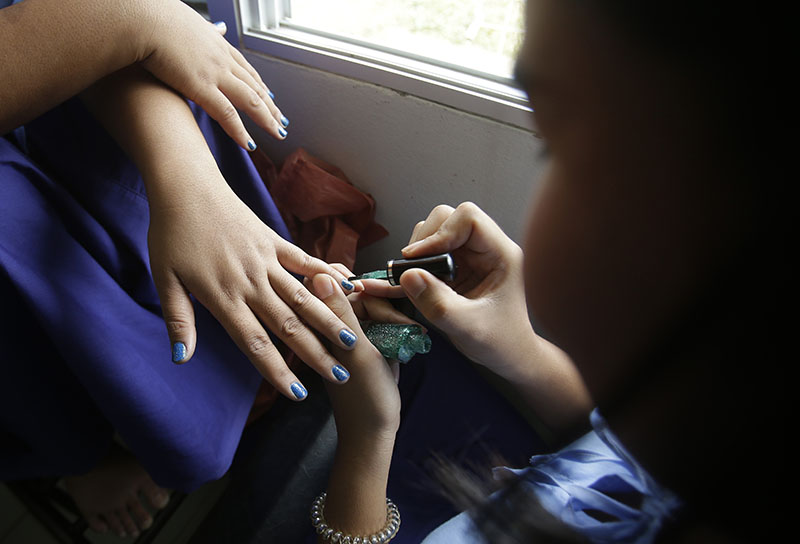
A transgender inmate paints another's nails Jan. 6 during a lesson at Pattaya Remand Prison in Pattaya. Photo: Sakchai Lalit / Associated Press
A transgender inmate paints another’s nails Jan. 6 during a lesson at Pattaya Remand Prison in Pattaya. Photo: Sakchai Lalit / Associated Press

Theerayut says the prison’s segregation makes her 1 ½-year sentence more bearable. “If we behave like others, if we aren’t stubborn and don’t break rules, this place actually isn’t so vicious,” she said, sitting in a prison yard fenced with barbed wire, her long hair bobbing up and down as she spoke.

But the system isn’t without problems.

“Transgender women who have not gone through gender reassignment surgery, they have to shave their head and live with the men, and there’s going to be problems,” says Wannapong Yodmuang, an LGBT advocate with the Rainbow Sky Association. “Some of them are going to be OK living with the men, but there are some transgender women who might have a bad experience with men and won’t want to live with them.”

There are also concerns that the system does not adequately tend to the specialized health needs of transgender inmates. Hormone therapy, for example, is written off as a luxury by some. But LGBT advocates say it is essential.

Plans for a separate facility for LGBT inmates on the outskirts of Bangkok could improve their treatment inside prison. The idea was first proposed as a measure to keep LGBT people safe, but it stalled over concern is that it would keep inmates far from their families.

“It’d be easier to control, easier to take care of, easier to develop and improve their habits and behavior,” said Watcharawit. “But they have to mix with other inmates because once they’re released, they’ll have to rejoin a diverse society.”

Some activists worry it could stigmatize them.

“Building and reallocating an entire prison facility for LGBT prisoners is as a matter of fact a measure of segregation,” said Jean-Sebastian Blanc, an expert on prisons at the Switzerland-based Association for the Prevention of Torture. “There is a significant difference between a public health policy aiming at preventing transmissible diseases and segregating a segment of the population on the basis of their sexual orientation or gender identity.”

Similar proposals in Italy and Turkey have bogged down under heavy criticism. Italy announced it was rededicating a women’s prison for transgender individuals in 2010, but the move was blocked by the Ministry of Justice over concerns that a special jail was a form of discrimination. Activists are attacking a proposed “pink prison” in Turkey over concerns that inmates there could face worse conditions than regular inmates because of anti-gay stigma.

But existing options leave much to be desired. In many prisons in the U.S. and other countries, transgender women face a stark choice: get thrown into cells with men, or go into solitary confinement.

Chelsea Manning, the whistleblower arrested for sending secret military files to WikiLeaks, was sentenced in 2013 to 35 years at a male prison in Kansas despite declaring herself a transgender woman. She was thrown in solitary confinement for attempting suicide last year, and was granted clemency by former President Barack Obama.

Story: Dake Kang
Advertisement

US Judge Bars Deportation of Refugees Under Trump Ban

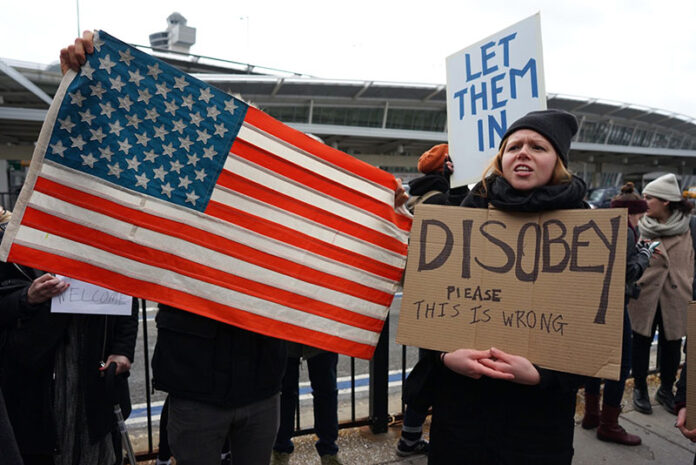
Protesters assemble at JFK International Airport in New York on Saturday after two Iraqi refugees were detained trying to enter the United States. Photo: Craig Ruttle / Associated Press

WASHINGTON — A federal judge issued an emergency order Saturday night temporarily barring the U.S. from deporting people from nations subject to President Donald Trump’s travel ban, saying travelers who had been detained had a strong argument that their legal rights had been violated.

U.S. District Judge Ann Donnelly in New York issued the emergency order after lawyers for the American Civil Liberties Union filed a court petition on behalf of people from seven predominantly Muslim nations who were detained at airports across the country as the ban took effect.

The judge’s order affected only a portion of Trump’s executive action. As the decision was announced, cheers broke out in crowds of demonstrators who had gathered at American airports and outside the Brooklyn courthouse where the ruling was issued.

The order barred U.S. border agents from removing anyone who arrived in the U.S. with a valid visa from Iraq, Syria, Iran, Sudan, Libya, Somalia and Yemen. It also covered anyone with an approved refugee application.

It was unclear how quickly the judge’s order might affect people in detention, or whether it would allow others to resume flying.

“Realistically, we don’t even know if people are going to be allowed onto the planes,” said ACLU lawyer Lee Gelernt. “This order would protect people who they allow to come here and reach U.S. soil.”

Under Trump’s order, it had appeared that an untold number of foreign-born U.S. residents now traveling outside the U.S. could be stuck overseas for at least 90 days even though they held permanent residency “green cards” or other visas. However, an official with the Department of Homeland Security said Saturday night that no green-card holders from the seven countries cited in Trump’s order had been prevented from entering the U.S.

Some foreign nationals who were allowed to board flights before the order was signed Friday had been detained at U.S. airports, told they were no longer welcome. The DHS official who briefed reporters by phone said 109 people who were in transit on airplanes had been denied entry and 173 had not been allowed to get on their planes overseas.

In her three-page order, Donnelly wrote that without the stay “there will be substantial and irreparable injury to refugees, visa-holders and other individuals from nations subject to the Jan. 27, 2017, executive order.”

Trump billed his sweeping executive order as a necessary step to stop “radical Islamic terrorists” from coming to the U.S. It included a 90-day ban on travel to the U.S. by citizens of Iraq, Syria, Iran, Sudan, Libya, Somalia or Yemen and a 120-day suspension of the U.S. refugee program.

Trump’s order singled out Syrians for the most aggressive ban, indefinitely blocking entry for anyone from that country, including those fleeing civil war.

The directive did not do anything to prevent attacks from homegrown extremists who were already in America, a primary concern of federal law enforcement officials. It also omitted Saudi Arabia, home to most of the Sept. 11 hijackers.

As a candidate Trump pledged to temporarily ban Muslims from coming to the U.S., then said he would implement “extreme vetting” for people from countries with significant terror concerns. He told reporters Saturday the order is “not a Muslim ban.”

“It’s working out very nicely,” Trump said of the implementation of his order. “We’re going to have a very, very strict ban and we’re going to have extreme vetting, which we should have had in this country for many years.”

The order sparked protests at several of the nation’s international airports, including New York’s Kennedy and Chicago’s O’Hare and facilities in Minneapolis and Dallas-Forth Worth. In San Francisco, hundreds blocked the street outside the arrival area of the international terminal. Several dozen demonstrated at the airport in Portland, Oregon, briefly disrupting light rail service while hoisting signs that read “Portland Coffee Is From Yemen” and chanting anti-Trump slogans.

U.S. lawmakers and officials around the globe also criticized the move. Sen. Ben Sasse, a Nebraska Republican on the Senate Armed Services Committee, said while Trump is right to focus on border security, the order is “too broad.”

“If we send a signal to the Middle East that the U.S. sees all Muslims as jihadis, the terrorist recruiters win by telling kids that America is banning Muslims and that this is America versus one religion,” Sasse said. “Our generational fight against jihadism requires wisdom.”

In Tehran, Foreign Minister Mohammad Javad Zarif said Iran would stop issuing new visas to U.S. citizens in response to Trump’s ban, but that anyone already with a visa to Iran wouldn’t be turned away.

Canadian Prime Minister Justin Trudeau took to Twitter Saturday afternoon to say that refugees were welcome in Canada, “regardless of your faith.”

Two of the first people blocked from entering the United States were Iraqis with links to the U.S. military. Hameed Khalid Darweesh and Haider Sameer Abdulkhaleq Alshawi were detained by immigration officials after landing at New York’s Kennedy airport Friday night. Both had been released by Saturday night after their lawyers intervened.

The government can exempt foreign nationals from the ban if their entry is deemed in the national interest. But it was not immediately clear how that exemption might be applied.

Diplomats from the seven countries singled out by Trump’s order would still be allowed into the U.S.

Those already in the U.S. with a visa or green card would be allowed to stay, according to the official, who wasn’t authorized to publicly discuss the details of how Trump’s order was being put in place and spoke only on condition of anonymity.

Trump’s order also directed U.S. officials to review information as needed to fully vet foreigners asking to come to the U.S. and draft a list of countries that don’t provide that information. That left open the possibility that citizens of other countries could also face a travel ban.

The U.S. may still admit refugees on a case-by-case basis during the freeze, and the government would continue to process requests from people claiming religious persecution, “provided that the religion of the individual is a minority religion in the individual’s country.”

The Council on American-Islamic Relations said it would challenge the constitutionality of Trump’s order.

“There is no evidence that refugees — the most thoroughly vetted of all people entering our nation — are a threat to national security,” said Lena F. Masri, the group’s national litigation director. “This is an order that is based on bigotry, not reality.”

John Cohen, a former Department of Homeland Security counterterrorism official who worked under Democratic and Republican administrations, said the order didn’t address America’s “primary terrorism-related threat” — people already in the U.S. who become inspired by what they see on the internet.

Trump’s order drew support from some Republican lawmakers who have urged more security measures for the refugee vetting program, particularly for those from Syria.

“We are a compassionate nation and a country of immigrants. But as we know, terrorists are dead set on using our immigration and refugee programs as a Trojan Horse to attack us,” House Homeland Security Committee Chairman Michael McCaul said in a statement Friday. “With the stroke of a pen, he is doing more to shut down terrorist pathways into this country than the last administration did in eight years.”

It is unclear how many people would be immediately impacted by the non-refugee travel ban. According to the statistics maintained by the Homeland Security Department, about 17,000 students from the seven designated countries were allowed into the U.S. for the 2015-2016 school year. In 2015 more than 86,000 people from those countries arrived in the U.S. on other, non-immigrant visas and more than 52,000 others became legal permanent residents.

Last year the U.S. resettled 85,000 people displaced by war, political oppression, hunger and religious prejudice, including more than 12,000 Syrians. Before leaving office President Barack Obama announced that the U.S. would accept 110,000 refugees in the coming year, but Trump’s order cut that by more than half to 50,000.

Story: Alicia A. Caldwell

Advertisement

Serena Williams Defeats Venus For Record 23rd Major Win

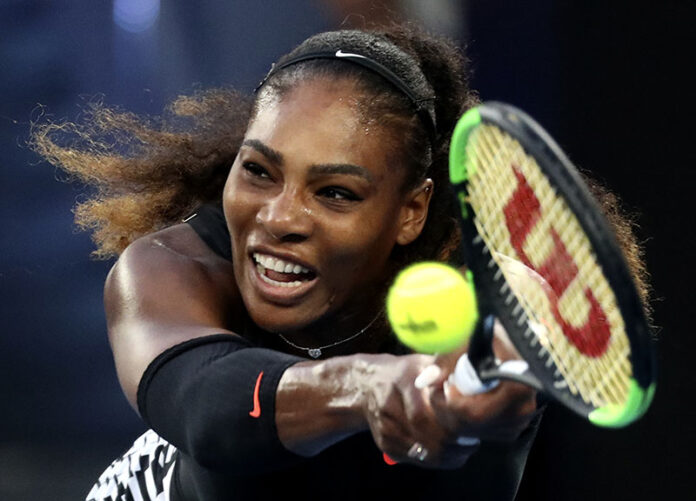
United States' Serena Williams makes a backhand return to her sister Venus during the women's singles final in January at the Australian Open tennis championships in Melbourne, Australia. Photo: Aaron Favila / Associated Press

MELBOURNE — Serena Williams has won her record 23rd Grand Slam singles title with a 6-4, 6-4 victory over her older sister Venus in Saturday’s Australian Open final.

With her record seventh Australian title, the 35-year-old Williams moved ahead of Steffi Graf for the most major titles in the Open era. Margaret Court won 24 majors, but collected 13 of those before the Open era.

The victory at Rod Laver Arena also ensured Serena Williams will regain the top ranking, which she lost in September after 186 straight weeks when Angelique Kerber won the U.S. Open.

It was Serena’s seventh win in nine all-Williams Grand Slam finals, and the first since Wimbledon in 2009. It was 36-year-old, No. 13-seeded Venus Williams’ first trip back to a major final in 7 ½ years.

Story: John Pye

Advertisement

Join Bangkok Swing’s Big Night Dancing Under the Stars (Canceled)

Update: Event canceled

NAKHON PATHOM — Jazz music, vintage costume and dazzling dance moves will take western metro Bangkok back to 1943 – sans Japanese occupiers – once again next month.

The giant annual outdoor swing gathering returns to a different location closer to Bangkok but still far enough to enjoy the evening breeze as dancers, professional and amateur, jump and jive.

The Swedish Jazz valkyrie Gunhild Carling returns to perform live while more than 100 dancers from around the world are expected to gather for a Swing “Prom Night.”

The event is free and open to the public.

The swing night starts at 7pm with a free basic dance class anyone can join, before heating up and dancing the night away until 10pm.

The venue is changed from the Wat Phra Pathom Chedi area to Mahidol University’s College of Music in the Salaya area, which can be reached by taxi from BTS Bang Wa or bus Nos. 515 or 125 from the Victory Monument.

Anyone looking for practice or get a picture of what the event will be like can go tomororw, Sunday, to swing dance at the Thailand International Jazz Conference from 4:30pm to 5:30pm at the same venue.


Related stories:

Retro Street Party: Swing Dancers to Storm Charoen Krung

60 Bands To Jazz Up 3-Day Fest

Advertisement

Monk Accused of Hosting Teen Meth Parties at Temple

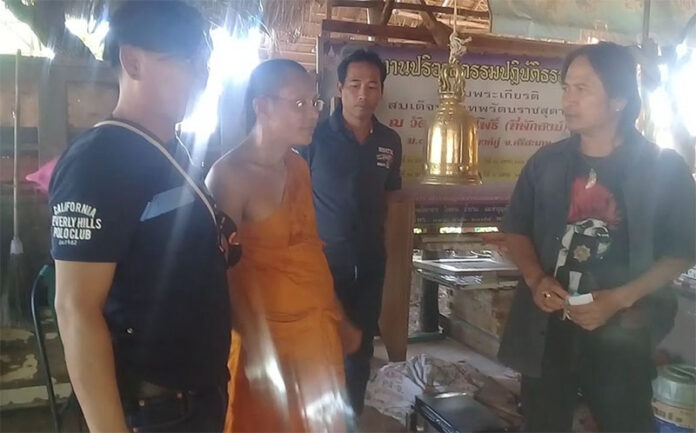
Phra Prakong Punyavaro is taken into custody Friday at the Ban Krapho monastery in Si Saket.

SISAKET — Police arrested a monk Friday in Si Saket province after he hosted one too many teen drug parties at his temple.

Police said they moved in on 37-year-old Phra Prakong Punyavaro after the governor’s office received complaints from residents about his regular drug parties at the Ban Krapho monastery.

Officers searched Prakong’s residence and said they found a small amount of methamphetamine and drug paraphernalia. The monk was defrocked and charged with possession of Category One narcotics.

According to police, local residents said they often saw youths visiting Prakong’s monk residence to buy and take ya ba, which they said caused much nuisance in the community.
Prakong reportedly confessed to the charges.

Advertisement

Junta Thanks Compliant Thai Media With Gift – a Muzzle

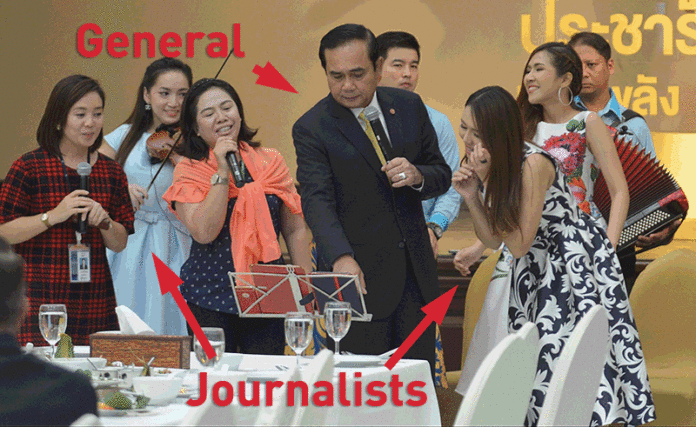
Gen. Prayuth Chan-ocha leads reporters in singing a classic pop song Sept. 15, 2016, just after an hours-long address boasting outrageously about his regime's successes at Government House in Bangkok.

Retention

After nearly three years of serving as unpaid junta apologists, many Thai media outlets this week had a very rude awakening. The junta’s appointed National Reform Steering Assembly wants every media professional – journalist, TV host, radio voice – to have to earn a license. They also want top bureaucrats to sit on a national media council for further regulations, or restrictions, depending on one’s point of view.

Frantic meetings among six major media associations, including the Thai Journalists Association, or TJA, took place this week and gave a thumbs-down to the proposed bill that would probably hand a death blow to any remaining critical coverage of the military junta.

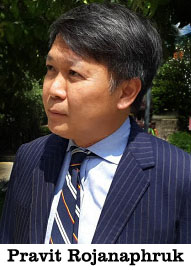
Pravit RojanaphrukLicensing journalists means many hard-headed reporters and editors may find themselves without a license, illegal and unfit for the job. What Thailand would be left with, in this dystopian dream of junta leader Gen. Prayuth Chan-ocha, would be lame journalists willing to not just toe the state’s line but actively promote their autocratic culture.

TJA is partly responsible for this mess. Its sitting president during the 2014 coup, a political reporter by the name of Pradit Ruangdit from the Bangkok Post, had no qualms accepting the junta leader’s appointment as a member of the junta’s first reform council two years ago.

Another former TJA President still sits on the current junta’s appointed Constitution Drafting Committee, and the hospitality shown by many Government House beat reporters to the dictator-cum-premier puts concierges of some top hotels to shame. They literally sing along with Prayuth and once even dressed as school children to delight him on a special occasion.

There is no time for schadenfreude, however, as the potential repercussions of such a bill would be disastrous to the already restricted free press already burdened by the amended Computer Crime Act and the good old lese majeste laws. All these media associations, TJA included, need all the support from the public in order to thwart this latest assault to press freedom.

Licensed “professional” journalists are the stuff of dictatorships and have no place in a free land.

In Thailand, such state-approved reporters would hardly pose hard-hitting questions to Prayuth and his successors. There will probably be zero doubt cast on the illegitimacy of the military dictatorship by such licensed professional journalists. Anyone with improper – read critical – attitudes toward nation, religion and monarchy would most likely fail to obtain such a license. Yes. That includes me.

Thailand will instead be left with lame “professional journalists” who will toe the line dictated by the state. Think Pravda of the old Soviet Union or the New Light of Myanmar before The Lady came to power.

Currently, even without this bill, Thai media, this writer included, are already exercising a disappointingly alarming level of self-censorship on anything mildly critical of the monarchy. Such levels of self-censorship are reminiscent of totalitarian states like North Korea. A citizens like Jatupat “Pai” Boonpattararaksa has been behind bars for a month just for sharing a biography of the new king produced by BBC Thai on Facebook.

The Nation newspaper on Wednesday published a letter to the editor under the name Kip Keino decrying the erosion of free speech in the two English print newspapers.

“Both English-language daily newspapers in Thailand have restricted their forums, which used to allow readers’ comments. In contrast I see that a daily newspaper in Namibia devotes two full pages each day to comments from readers..,” wrote Keino, adding that while both papers still have letters to the editor spaces, they “have stopped allowing online responses and other such commentaries.”

Is this the inevitable fate of Thailand – to have ersatz press freedom and equally ersatz professional licensed journalists? I have no crystal ball, but those who are concerned about Thailand’s free press, the dwindling right to debate and articulate freely should take notice. The junta is increasingly behaving like a giant python slowly but gradually stifling its prey by wrapping and squeezing freedoms, expression and now the free press to death.

The showdown is coming. The stakes are high. It’s not just the future of a free press but citizens’ rights to access critical news about the powers that be that is at stake.

Advertisement

30 Families Lose Homes to Khlong Toei Slum Fire

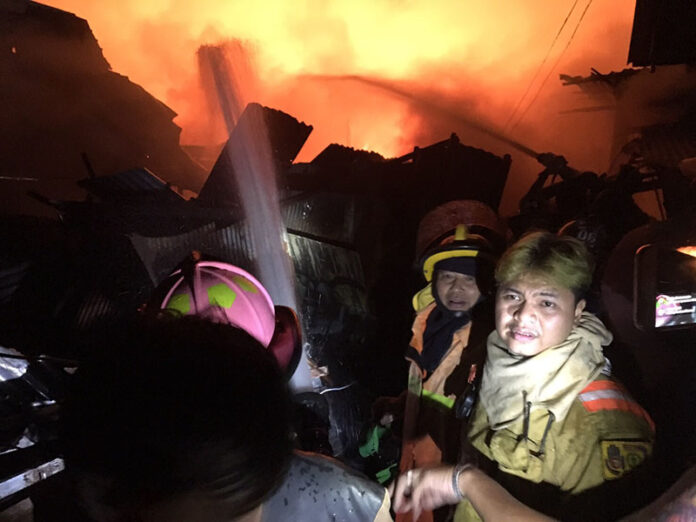
Firefighters at the scene of a fire Friday night in the capital's Khlong Toei district.

BANGKOK — At least 30 families were living in tents Saturday after their homes in an impoverished quarter of Bangkok were destroyed in a blaze.

The fire ravaged a 286-household slum next to Wat Saphan Canal in the capital’s Khlong Toei district at about 9:30pm on Friday, police said. The cause and source of the fire are still under investigation.

Firefighters spent about an hour before the fire was brought under control.

Local volunteers responded to the fire shortly after it started but could not contain the flames because two fire extinguishers provided to the community did not work, according to Manager Online.

No one died in the incident, said Acharawadee Chaisuriwat, Khlong Toei district chief.

Families made homeless by the fire are now living in tents and authorities are providing them with necessary goods and an initial disaster relief fund of 10,000 baht per family, she said.

Neighborhoods around the old port are in many places densely packed shanties.

About 200 people were displaced in October 2013 when a domestic dispute ended with a man torching his own home, which then burned about 50 other residences.

In 1991, three people died in a chemical fire and explosion that destroyed more than 600 domiciles.

Advertisement

Asia Marks Chinese New Year With Prayers, Incense, Fireworks (Photos)

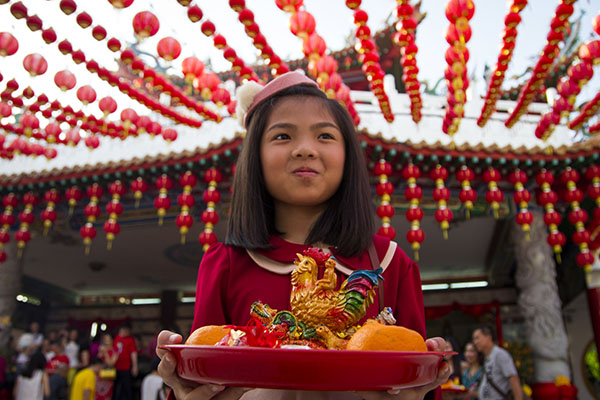
MALAYSIA: An ethnic Chinese girl holds offerings on the first day of Lunar New Year celebrations Saturday at a temple in Kuala Lumpur. Photo: Lim Huey Teng / Associated Press

BEIJING — People in China and throughout Asia are heading to temples and fairs to wish for an auspicious start to the Lunar New Year.

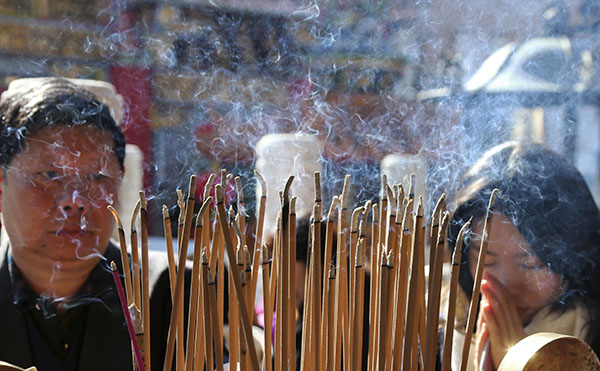
Thousands gathered at Beijing’s major temples on Saturday, the first day of the Year of the Rooster. Wearing heavy winter coats, they lit incense sticks and bowed as they prayed for good fortune and health.

Read: Where to Celebrate Chinese New Year in Bangkok?

Beijing’s sprawling temple fair opened at Ditan Park, where empty tree branches were festooned with red lanterns and traditional goods and foods were for sale.

Ethnic Chinese and others around the world also marked the holiday with celebrations.


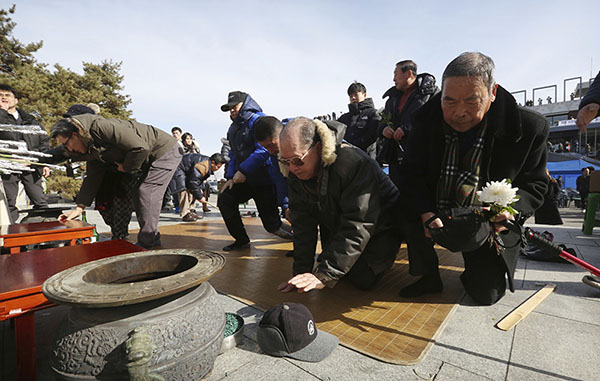
South Korea: North Korean refugees and their family members bow to respect their ancestors Saturday in North Korea as they celebrate the Lunar New Year at the Imjingak Pavilion, near the demilitarized zone of Panmunjom, in Paju, South Korea. Photo: Ahn Young-joon / Associated Press
SOUTH KOREA: North Korean refugees and their family members bow to respect their ancestors Saturday in North Korea as they celebrate the Lunar New Year at the Imjingak Pavilion, near the demilitarized zone of Panmunjom, in Paju, South Korea. Photo: Ahn Young-joon / Associated Press
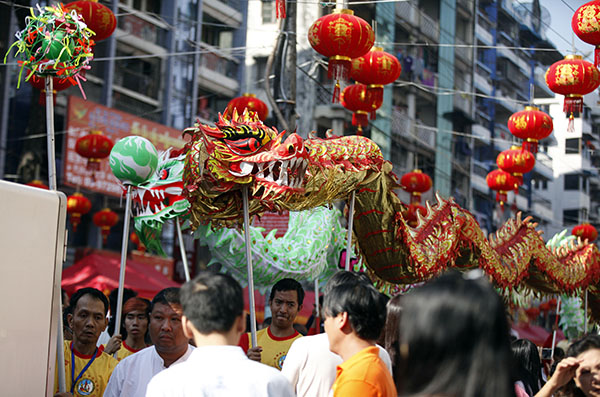
Myanmar: Local Chinese artists perform a dragon dance during cerebrations to mark Lunar New Year on Saturday in Yangon. Photo: Thein Zaw / Associated Press
MYANMAR: Local Chinese artists perform a dragon dance during cerebrations to mark Lunar New Year on Saturday in Yangon. Photo: Thein Zaw / Associated Press
JAPAN: People offer prayers during celebrations of the Lunar New Year Saturday at Chinatown in Yokohama, near Tokyo. Photo: Koji Sasahara / Associated Press
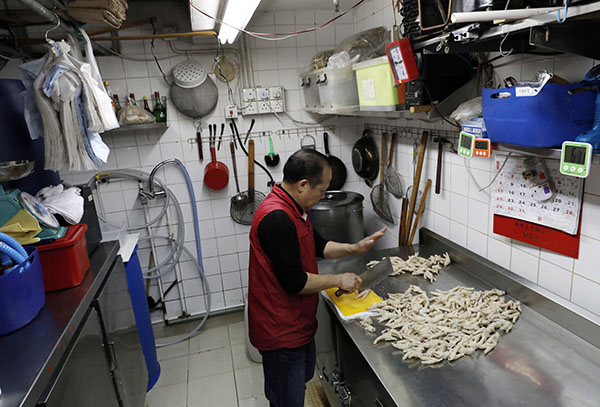
HONG KONG: Chicken feet snacks shop owner Leung Kin-kung chops off chicken feet Monday in Hong Kong. Photo: Vincent Yu / Associated Press
Malaysia: An ethnic Chinese girl holds offerings on the first day of Lunar New Year celebrations Saturday at a temple in Kuala Lumpur. Photo: Lim Huey Teng / Associated Press
MALAYSIA: An ethnic Chinese girl holds offerings on the first day of Lunar New Year celebrations Saturday at a temple in Kuala Lumpur. Photo: Lim Huey Teng / Associated Press
Advertisement

Contrition for Silpakorn’s Nazi Chic Stink Falls Short on Holocaust Memorial Day

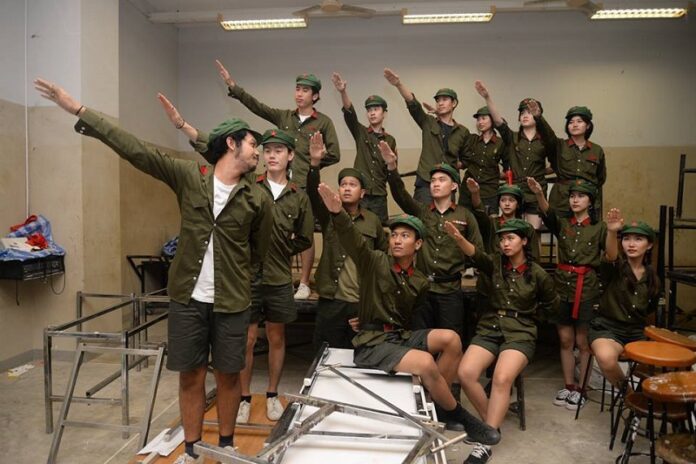
Silpakorn University students in Bangkok dress in September 2016 as Mao Zedong’s Red Guards from the bloody Cultural Revolution in the 1960s. Photo: Washirawit Santipiboon / Facebook

NAKHON PATHOM — Sitting in front of an audience gathered to reflect on the atrocity visited last century upon millions of people, mostly Jews, during World War II at a university in Nakhon Pathom was Sopanut Somrattanakul.

The fourth-year arts student was preparing for an act of atonement that, when finally offered to the audience, would ring hollow for its defensiveness in lieu of actual apology.

Just four months earlier, he shot to infamy for running the show when his peers appeared on Facebook in photos in which they performed Nazi salutes in Communist Red Guards uniforms, including one Hitler-alike student complete with fake mustache and self-satisfied look.

Read: Thai University Students Cosplay as Red Guards and Nazis, Again (Photos)

On Thursday, west of Bangkok at Silpakorn University’s Sanam Chandra Palace Campus, a day before Holocaust Memorial Day, Sopanut recounted what happened that day as a big misunderstanding.

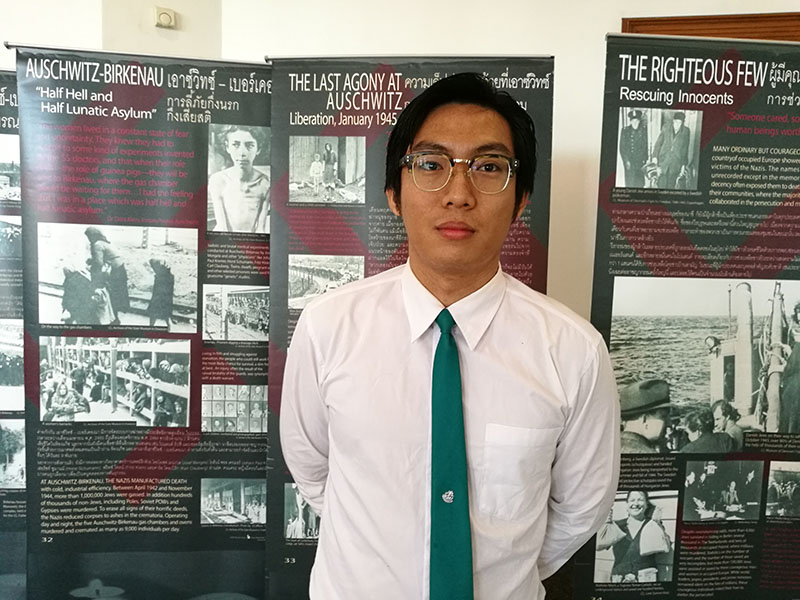
Sopanut Somrattanakul on Thursday at Silpakorn University's Sanam Chandra Palace Campus in western metropolitan Bangkok.
Sopanut Somrattanakul on Thursday at Silpakorn University’s Sanam Chandra Palace Campus in western metropolitan Bangkok.

“We do not harbor such thinking. But the whole thing wasn’t thought out well,” he said minutes before going on stage to speak and show contrition for the September incident. “It was the last day [of welcoming ritual] and they were just letting steam off.”

Sopanut was in charge of welcoming the freshmen, a rite of passage involving heavy hazing known as rub nong, between August to September. For the last day, he said they decided to make fun of dictatorship in general with one dressing like Hitler and everyone doing Nazi salutes. He said it was not the most obvious choice for them.

Sopanut, who didn’t participate in costume himself, said fanatical Fascist and Communist fashion was chosen because in Thailand, they’re universally associated with dictatorship. The 23-year-old senior student said Thais of his generation do not make a direct connection between dressing up like Hitler or doing Nazi salutes to that of supporting the holocaust or Nazi ideology.

Soon after the incident became infamous, Sopanut said the Israeli Embassy contacted the university. The message relayed was that they understood that there was no intention to cause harm. The university’s president, Chaicharn Thavaravej, publicly apologized however, for what he described as “irresponsible actions.”

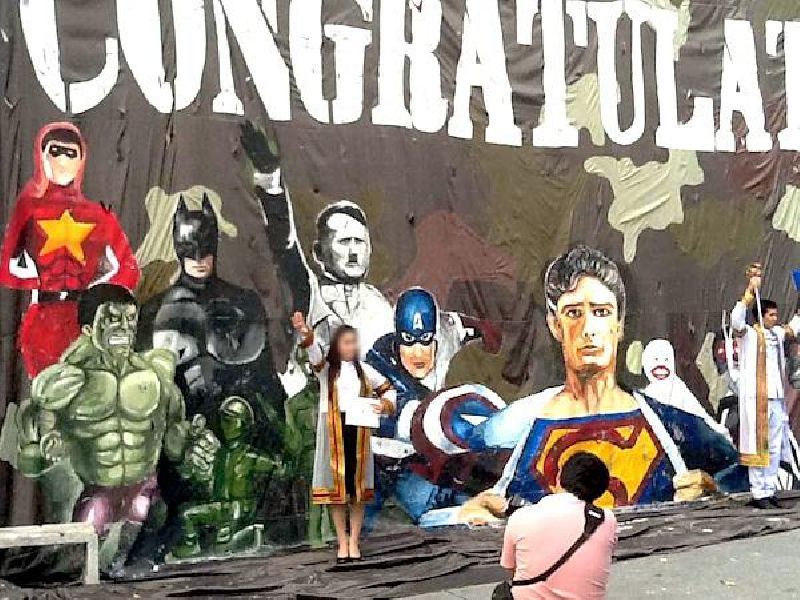
A graduating student poses for a photo before a mural of superheroes including Adolf Hitler set up at Chulalongkorn University in July 2015 to mark graduation ceremonies.

That was back in September. Now, four months later, the university held an art exhibition and program to commemorate the holocaust in collaboration with the Embassy of Israel on Thursday.

After giving a speech and touring the art exhibition led by the university’s president and with Sopanut as guides, Israeli Ambassador Simon Roded said it was “amazing” such a “minor incident” could lead to all this.

“This is amazing!” said Roded, himself the grandchild of holocaust survivors.

Roded said he detected no expression or manifestations of ideological support among these students.

“But they don’t make the connection,” the envoy said, adding that there’s a lack of deeper understanding that people in Europe and the West take for granted.

It wasn’t the first time such a sequence played out.

Chulalongkorn University had to apologize in 2013 after its graduating seniors posed for photos making Nazi salutes in front of a mural of “superheroes” which included Adolf Hitler. The university would go on to also host a Holocaust Memorial Day event, also attended by Israeli Ambassador Simon Roded, where Thailand’s need to understand history to better engage the world was discussed.

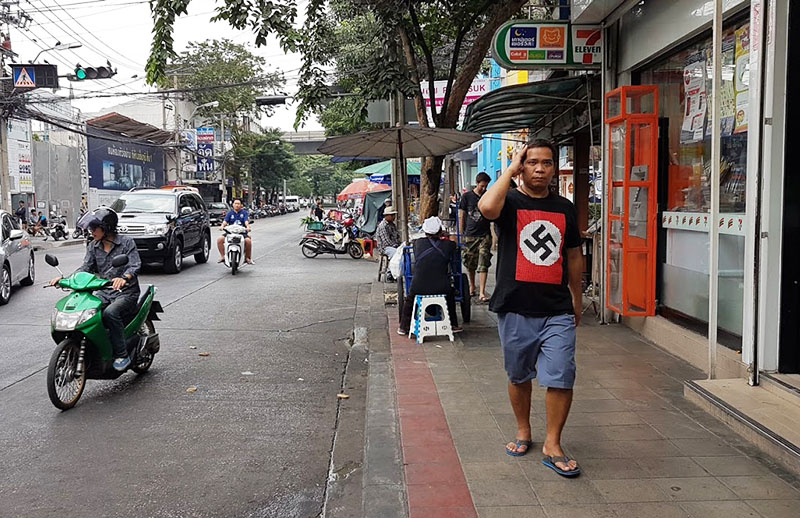
A man walks down Soi Rang Nam on Jan. 7 in Bangkok.

International Holocaust Memorial Day marks the day the largest Nazi concentration camp, Auschwitz-Birkenau, was liberated by the Red Army in 1945.

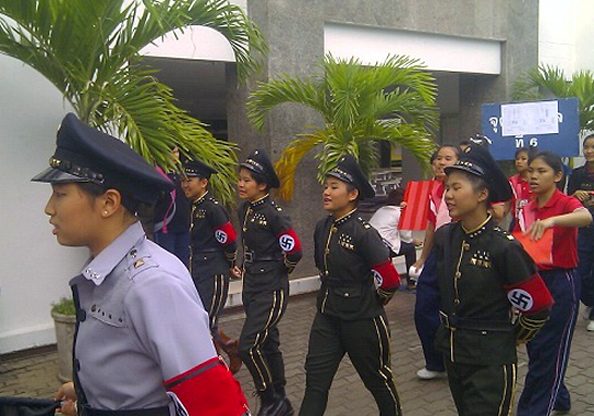
Foreign residents are often aghast to see the type of Nazi imagery openly displayed in Thailand that would be taboo back home. Foreign parents were aghast in Chiang Mai in 2011 when students at a school there dressed in elaborate SS costumes for an entire Nazi-themed school parade. But the same awareness is not widespread in Thailand, where Hitler appears on T-shirts in the spirit of Darth Vader, Che Guevara or Mao Zedong.

Expressions of antisemitism are rare.

School girls dressed in Nazi uniforms march at the Sacred Heart Preparatory school in Chiang Mai. Photo: Simon Weisenthal Center

When it came time to take the stage, rather than overtly apologize, Sopanut fell back on this context defensively. He said knowing what Hitler did and what the holocaust was about was different from cultural sensitivity. That connection is not automatically made, even if you know what Hitler did, the bespectacled student insisted, adding that it will take more than just knowledge to prevent some repeating the same in the future.

“If you ask me whether I understand or not? I do. It’s just that Thais are far removed [from the issue],” said Sopanut, before giving a short and opaque speech that offered no apology.

“To say we have become more sensitive is not possible because we are not them,” he said. “But we have more empathy.”

Related stories:

Silpakorn Apologizes for ‘Shameless and Irresponsible’ Sieg-Heiling Students
Israel Embassy Condemns Thai Aristocrat’s Praise of Hitler
Director Defends ‘Hitler Scene’ in Thai Junta Film
University’s ‘Hitler Mural’ Leads To Flurry Of Apologies – And Gag Order

Advertisement

John Hurt, Face of ‘1984’ and ‘Elephant Man,’ 77

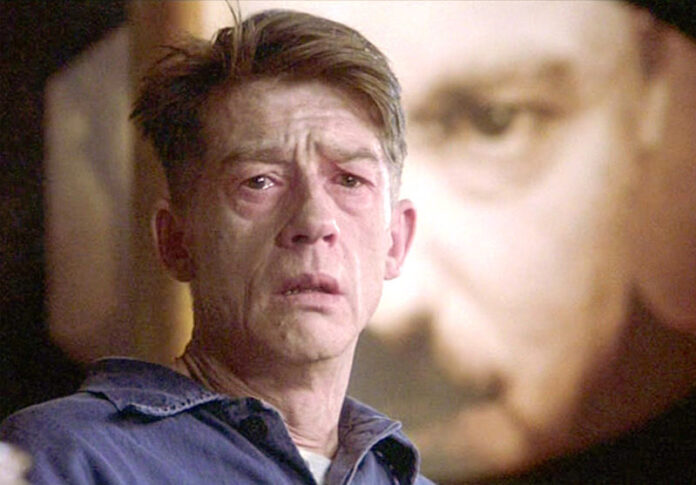
Scene from 'Nineteen Eighty-Four.'

LOS ANGELES — The versatile actor Sir John Hurt, who could move audiences to tears in “The Elephant Man,” terrify them in “Alien,” and spoof that very same scene in “Spaceballs,” has died. He was 77.

Hurt, who battled pancreatic cancer, died Friday in London according to his agent Charles McDonald.

Sir John Hurt poses with his award for 'Outstanding Contribution to Cinema' backstage at the BAFTA Film Awards 2012 in London. Photo: Joel Rya / Associated Press
Sir John Hurt poses with his award for ‘Outstanding Contribution to Cinema’ backstage at the BAFTA Film Awards 2012 in London. Photo: Joel Rya / Associated Press

Twice nominated for an Oscar for playing the tortured John Merrick in David Lynch’s “The Elephant Man” and for his role as the heroin addict Max in “Midnight Express,” Hurt’s career spanned over 50 years. After minor television and film appearances, his breakout came in 1966 as Richard Rich in Fred Zinnemann’s “A Man For All Seasons,” followed by his portrayal of Caligula in the BBC miniseries “I, Claudius” in 1976.

The wiry Hurt brought gravitas to Alan Parker’s 1978 film “Midnight Express,” for which he received a supporting actor Oscar nomination (he lost to Christopher Walken for “The Deer Hunter”) and an uneasy humor to Kane in Ridley Scott’s “Alien,” immortalized by his disturbing death scene, which Mel Brooks later poked fun at with Hurt’s help in “Spaceballs.”

“It was terribly sad today to learn of John Hurt’s passing,” Mel Brooks wrote on Twitter. “He was a truly magnificent talent.”

Hurt is unrecognizable in perhaps his most memorable role as the lead in David Lynch’s “The Elephant Man.” He endured eight hours in the makeup chair daily to transform into John Merrick. The elaborate mask prohibited him from sleeping lying down or even eating while it was on. His would eat his last meal midmorning as the mask was being applied — usually raw eggs mixed in orange juice — and not again until after midnight.

“To be quite honest, the film was misery to make because of the physical problems, so if it’s working I’m jumping for joy,” Hurt said in a 1980 interview. Hurt did score a lead actor Oscar nomination for the role, but lost out to Robert De Niro’s performance in “Raging Bull.”

Hurt was also a prolific voice actor, appearing as Hazel in the animated “Watership Down,” and as Aragorn in Ralph Bakshi’s “The Lord of the Rings.” He also voiced The Horned King in “The Black Cauldron” and provided the narration for “Dogville.”

In the “Harry Potter” films, Hurt played the wand-maker Mr. Ollivander. In recent years, he appeared in notable fare such as “Melancholia,” ”Tinker Tailor Soldier Spy,” ”Only Lovers Left Alive” and “Snowpiercer.”

“We’re all just passing time, and occupy our chair very briefly,” Hurt said in a 2015 interview while undergoing treatments for the early stage cancer.

As prolific as ever, Hurt recently appeared alongside his “V for Vendetta” co-star Natalie Portman in the Oscar-nominated film “Jackie” as a priest who consoles and advises the recently widowed first lady.

Hurt leaves behind a few in production credits, including Joe Wright’s “Darkest Hour” which is listed as still filming. Hurt plays Neville Chamberlain in the film about Winston Churchill’s charge against Hitler. Gary Oldman plays Churchill.

“I have lots of favorite memories but I can’t say that I have a favorite film. I have favorite parts which are not in particularly successful films,” Hurt told The Guardian in 2000. “I’ve worked with people from Fred Zinnemann, John Huston, through to Richard Fleischer, all of those boys from Hollywood and so on and Sam Peckinpah and then the Mike Radfords… I’ve been incredibly lucky with the directors I’ve worked with. You don’t realize it at the time, it’s just in retrospect if you look back you think, ‘Jeez, when I saw that CV it nearly frightened the life out of me.’ I thought, “That’s not bad for an old drunk.”

Story: Lindsey Bahr

Advertisement

Hot News

LATEST NEWS

Bangkok
overcast clouds
34.4 ° C
35 °
32.2 °
60 %
3.8kmh
100 %
Sun
34 °
Mon
33 °
Tue
34 °
Wed
30 °
Thu
29 °