31.6 C
Bangkok
Friday, June 5, 2026
Home Blog Page 2484

Udon Man Holds Wife Hostage in 10-Hour Police Standoff

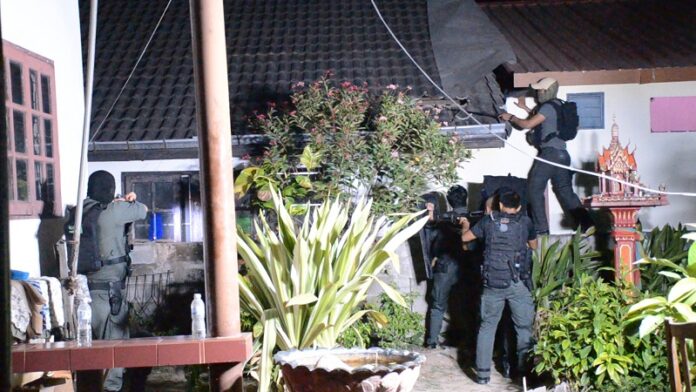
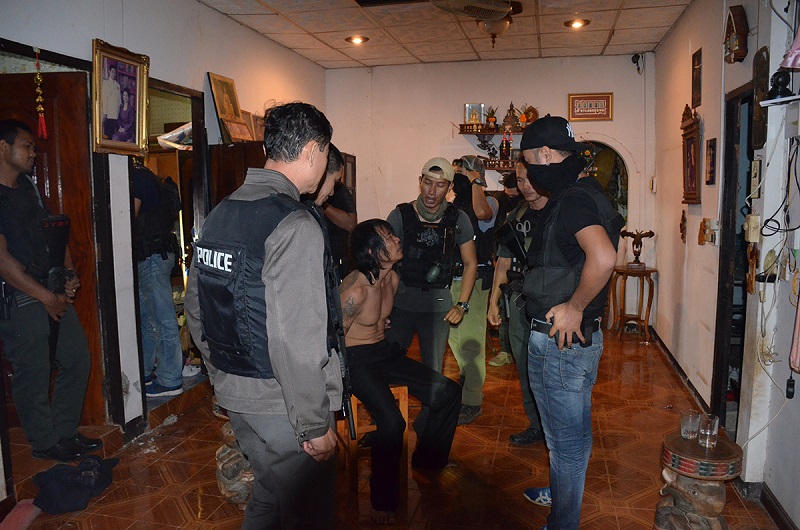
Police encircle the home of Woraphot Kiriya, 38, in Udon Thani province during a 10-hour overnight standoff that ended Tuesday morning.

UDON THANI — A domestic call turned into a standoff lasting over 10 hours when a man took his own wife hostage at their home before police were able to finally rescue her Tuesday morning.

Police said they waited a long time before eventually breaking into the Udon Thani home where Woraphot Kiriya, 38, had locked himself in with his wife because he had already beaten her and they were afraid he would use his 9mm pistol.

“The reason we didn’t rush in was because he had security cameras around the house,” police Col. Netiphong Thatthamle said. “So we tried to get his mother and mother-in-law to negotiate with him.”

After he was apprehended, Woraphot tested positive for drugs. He was charged with drug use, assault and unlawful restraint. Police said he has a long record of arrests for possession of ya ba, or methamphetamines, and had been released from prison in October.

His wife, La-ongdao Ngamnimit, 23, was in stable condition at a hospital.

Police first arrived at the home in Udon Thani city at 5pm on Monday after being called by Woraphot’s mother, who was also trapped inside. Wannapa Kiriya, 59, had locked herself in a separate room. Police covered a security camera then cut through a steel window at about 6pm to rescue Wannapa.

But La-ongdao remained inside.

Woraphot Kiriya, 38, is captured inside his home early Tuesday morning.

The ensuing standoff continued for hours before police finally threw tear gas and stormed the home just after midnight to rescue her. They found her lying on a bed on the ground floor, unable to move because she had been severely injured by her husband.

Woraphot hid when officers entered the home. Police found him inside his mother’s wardrobe at 2:35am.

Woraphot said he misplaced his gun while attempting to flee. Police were unconvinced and were still searching the house as of Tuesday morning.

Advertisement

Help Pattaya Police Identify Dead Foreign Diver

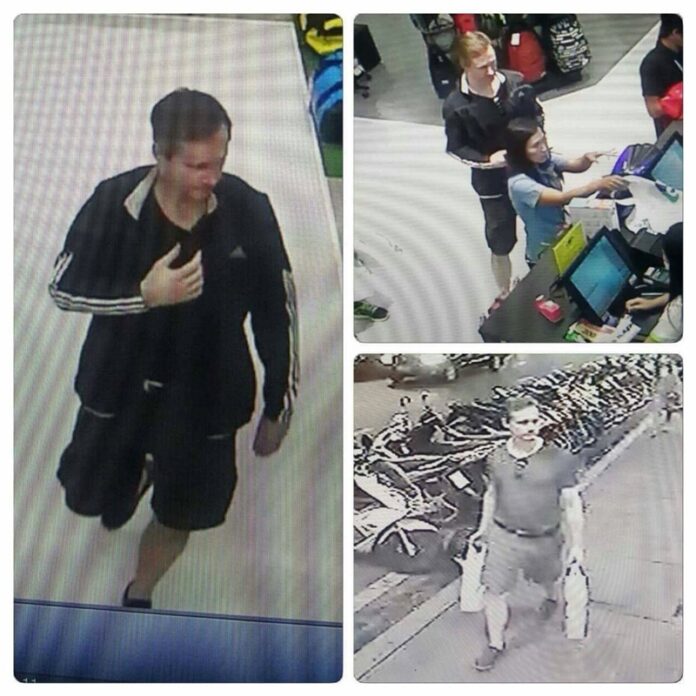
Security camera images released Dec. 20 by Pattaya police.

PATTAYA — Police in the resort town of Pattaya on Tuesday released images of an unidentified foreign man recently found dead under suspicious circumstances off the coast.

The body, clothed in diving suit and equipment, was spotted Friday near the popular Koh Larn, said Pattaya police chief Apichai Klobpetch. Police hope that anyone with information about the man, whose name and nationality are unknown, would come forward.

“We have already asked the Immigration Police. We are now checking hotels in the area,” Col. Apichai said. “We are using a force of more than 100 officers.”

The security camera images released showed a Caucasian man and an Asian woman in a shopping mall on Wednesday. Apichai said they were also looking for the woman, who remains unidentified.

According to Apichai, the man’s body had cut wounds around the neck, and autopsy results established that he died from blood loss.

However, the officer declined to rule it a murder case.

“It’s still not clear. There are two possible motives: murder or suicide,” Col. Apichai said. “The wounds are not deep enough to kill him, because his aorta was not cut.”

No possibly related missing-persons report has been filed, he added.

Anyone who thinks they have information about the victim is encouraged to contact the Pattaya Police Department at 03-842-0804.

Advertisement

History of Searches for Missing Malaysia Airlines 370

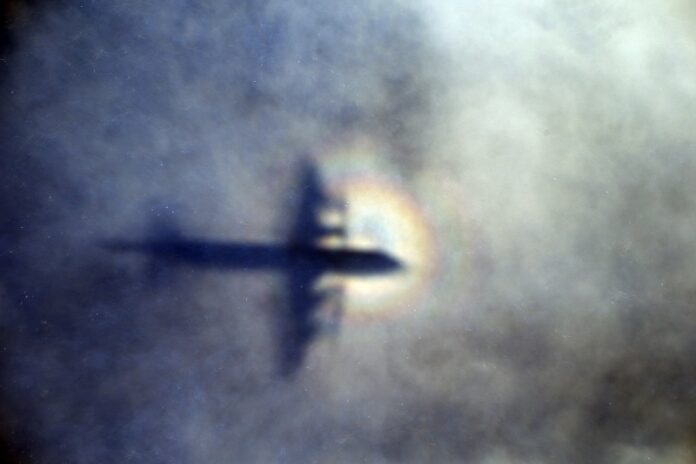
The shadow of a Royal New Zealand Air Force P3 Orion is seen on low level cloud while the aircraft searches for missing Malaysia Airlines Flight MH370 in 2014 in the southern Indian Ocean, near the coast of Western Australia. Photo: Rob Griffith / Associated Press

SYDNEY — A look at the progressive searches for Malaysia Airlines Flight 370, which are the most challenging and expensive undertaken in aviation history.

First Search: On March 8, 2014, an air and sea search begins in the Gulf of Thailand and the South China Sea on the assumption that the plane crashed on its way from Kuala Lumpur, Malaysia, to Beijing. Malaysia reveals two weeks later that its military radar had tracked the plane flying far off course to the west.

Second Search: Analysis of satellite signals emitted by the plane in its final hours suggests that it crashed west of Australia. A sonar search appears to detect the ‘ping’ of the jet’s black box near the end of its monthlong battery life. But after 850 square kilometers (330 square miles) of seabed is searched, authorities conclude that they must have been mistaken.

Third Search: Further analysis of satellite data defined a more remote search zone 1,800 kilometers (1,100 miles) off Australia’s southwest coast in the Indian Ocean. The 60,000-square-kilometer (23,000-square-mile) search area was later doubled. In July, officials agreed the search would be suspended once crews finish scouring the area, unless new evidence emerges pinpointing a specific location of the aircraft.

Possible Fourth Search?: In December, international investigators released a report based on a fresh analysis of the data concluding that the plane is highly unlikely to be in the current search zone, and suggesting that the aircraft may instead have crashed in an area farther north. The investigators said a new search should be launched of the 25,000-square kilometer (9,700-square mile) area immediately to the north of the current search zone. But Australian officials said that was unlikely, as the report failed to identify a specific location of the plane.

Challenges: The search zone is so remote that the sonar ships spend half their monthlong shifts transiting to and from their Australian port. The ocean ranges from 600 meters (2,000 feet) to 6.5 kilometers (4 miles) deep, with the average depth being 4 kilometers (2.5 miles). The seabed has jutting ridges and volcanoes and deep, sharp crevasses.

Cost: Australia has agreed to pay $60 million and China $20 million for the current search. Malaysia has paid $80 million and has agreed to pay the balance of the final search cost.

Advertisement

Trump Blames Terrorists for Killings in Turkey, Germany

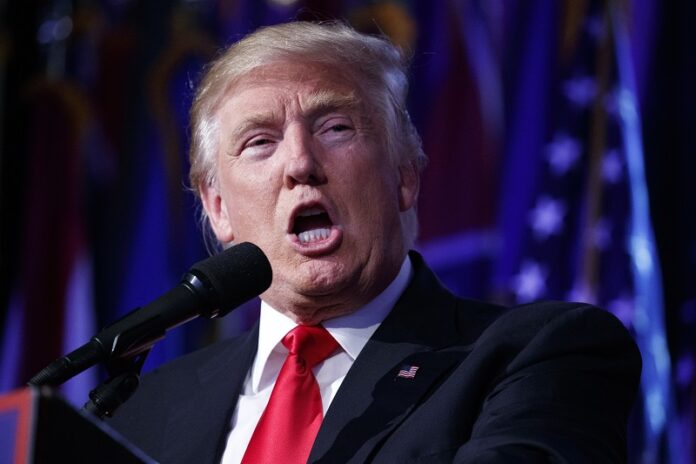
President-elect Donald Trump speaks during an election night rally Nov. 9 in New York. Photo: Evan Vucci / Associated Press

PALM BEACH, Florida — On the day that his election victory became official, Donald Trump on Monday experienced what life will be like as president as he condemned separate deadly incidents against a Russian diplomat and shoppers at a German Christmas market, blaming Islamic terrorism in both instances.

He offered no support for his claim that terrorists were responsible for the carnage.

Authorities in Turkey and Germany were still investigating when Trump issued back-to-back statements condemning the incidents, although the White House earlier had said that what happened in central Berlin when a trucked rammed a holiday crowd “appears to be a terrorist attack.”

Trump called the brazen, daytime shooting of Russia’s ambassador to Turkey as he attended a photo exhibit “a violation of all rules of civilized order.” He added that the diplomat, Andrei Karlov, was assassinated by a “radical Islamic terrorist.”

Turkish authorities said the gunman, who was identified as Mevlut Mert Altintas, a member of Ankara’s riot police squad, was later killed in a shootout with police. Altintas shouted in Turkish about the Syrian city of Aleppo and also yelled “Allahu akbar,” the Arabic phrase for “God is great.”

In the Berlin incident, in which at least 12 people were killed, Trump said the Islamic State group “and other Islamist terrorists continually slaughter Christians in their communities and places of worship as part of their global jihad.”

He added that these terrorists and their regional and worldwide networks “must be eradicated from the face of the earth” and pledged to carry out that mission with “all freedom-loving partners.”

Trump’s transition team did not immediately respond to requests to state the sources for his claims of terrorist involvement.

He later tweeted: “Today there were terror attacks in Turkey, Switzerland and Germany  and it is only getting worse. The civilized world must change thinking!”

In Zurich, police said three people were wounded when a gunman dressed in black opened fire in the prayer hall of a mosque frequented by Somali immigrants.

Trump vowed during the presidential campaign to go after the Islamic State group, but repeatedly declined to describe his plan for the public.

His statements came at the end of a busy day, after the president-elect had announced his candidate for secretary of the Army, held a round of transition meetings and was formally elected president by the Electoral College, clearing the way for his Jan. 20 inauguration.

Trump’s choice of Army veteran and fellow New Yorker Vincent Viola to be his Army secretary will put another billionaire in leading role in the new administration.

The president-elect also met with a group of businessmen and former U.S. government officials as he sought to fill other posts, including that of U.S. trade representative. Among those he met with was Robert Lighthizer, a former deputy U.S. trade representative in the Reagan administration.

Viola is a West Point graduate who joins a list of individuals with military backgrounds already chosen for the Cabinet. Trump’s picks for defense secretary, homeland security secretary, national security adviser and deputy national security adviser are retired military.

In a separate written statement, Trump praised Viola, the son of Italian immigrants, as “living proof of the American dream” and someone who has a lengthy history of involvement with national security issues. Senate confirmation is required.

Viola was the first member of his family to attend college. He was trained as an Airborne Ranger infantry officer and served in the 101st Airborne Division. A lawyer, he started multiple businesses and bought the Florida Panthers hockey team for $250 million in 2013.

Trump announced Viola from his Mar-a-Lago estate in Florida, where he was spending the run-up to Christmas with his family and working on the transition. It also came as electors in all 50 states formally elected Trump as the 45th president.

“With this historic step we can look forward to the bright future ahead,” he said in a statement in which he pledged anew that after the divisive campaign he will “work hard to unit our country and be the president of all Americans.”

Viola would join a circle of wealthy businessmen Trump has chosen for the administration, including fast food executive Andy Puzder to lead the Labor Department, billionaire investor Wilbur Ross for Commerce, financier Steven Mnuchin for Treasury and Goldman Sachs President Gary Cohn as his top economic adviser.

More open posts remain. Trump also met Monday with Thad Allen, the retired Coast Guard commandant who oversaw the federal response to Hurricanes Katrina and Rita in 2005; R. Donahue Peebles, board chairman of the Congressional Black Caucus Foundation, and founder and CEO of a real estate development company named for him; and J. Christopher Reyes, co-chairman of Reyes Holdings, a Chicago-based beer and food distributor.

Trump also had dinner Saturday at the Florida estate with Mexican billionaire Carlos Slim, a surprising development given Trump’s harsh criticism of Slim during the presidential election. Slim is a major investor in The New York Times, a frequent target of Trump’s potshots on social media.

Neither did Slim spare Trump, who has criticized Mexicans and vowed to build a wall between the U.S. and Mexico to stop illegal immigration.

Trump spokeswoman Hope Hicks confirmed the dinner, which was first reported by The Washington Post. People briefed on the conversation said it was arranged to open a friendly line of communication between the businessmen. A spokesman for Slim, Arturo Elias Ayub, tweeted that the dinner was “upbeat about Mexico and Mexicans.”

The dinner was brokered by former Trump campaign manager Corey Lewandowski, who remains close to the president-elect, after Lewandowski quietly visited Slim in Mexico City earlier this month.

Trump was expected to hold additional transition meetings on Tuesday and Wednesday in Florida.

Story: Darlene Superville

Advertisement

3 Injured in Gunman’s Attack at Zurich Mosque

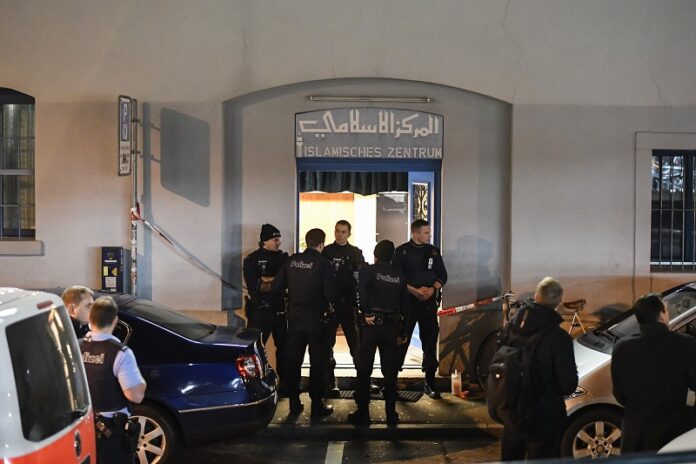
Police secure the area Monday in front of the Islamic center, in Zurich. Photo: Ennio Leanza / Associated Press

ZURICH — A gunman dressed in black stormed into the prayer hall of a mosque frequented by Somali immigrants and opened fire, wounding three people before fleeing, a Zurich police spokesman said Monday.

Police, who rushed to the scene in a central neighborhood known for trendy cafes and the city’s red-light district, were also investigating a possible connection to the discovery of a corpse at nearby Gessner bridge over the Sihl River, police spokesman Marco Bisa said.

Authorities weren’t considering the attack as terrorism, he said. Police also said it was too early to determine whether there might be any link to an incident in Berlin also on Monday, where a truck rammed into a Christmas market, killing at least nine people.

“The unknown person fired several shots and fled from the building,” Bisa told reporters near the mosque, which was cordoned off by police. “The shooting took place inside a prayer room with several people in it. Two victims were severely injured.”

Bisa said the injured were hospitalized and were aged 30, 35 and 56 years old, but did not specify their nationalities. He said witnesses described the attacker as clad head to foot in black, and was believed to be aged about 30 years old.

At the scene, Abukav Abshirow, a 30-year-old Somali man who works at a Zurich car dealership, said his friend was among the injured. He recalled how they had been celebrating a religious occasion at the center the night before.

“I am under shock,” he said. “We’ve had great times here. The atmosphere was always friendly and happy at the center … I am very, very sad this happened. We never had problems here before. We spend the weekend here with our children in peace.”

“I am waiting to find out what happened, and who is responsible,” he said.

Attacks by gunmen are rare in Switzerland. The country was shaken in 2013 by at least two multiple-fatality shootings.

The country has a long-standing tradition for men to keep their military rifles after completing compulsory military service  which partly explains a high rate of gun ownership in the country of about 8.2 million people.

Story: Franziska Scheven

Advertisement

Gay Rights Supporters Win 2nd Victory at The United Nations

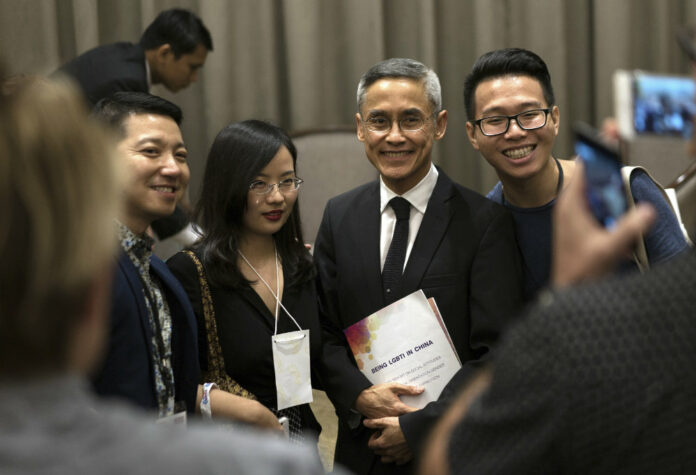
Vitit Muntarbhorn Thai legal expert and the first-ever U.N. independent expert, center, poses for a photo with delegates from China at a LGBT conference in Bangkok, Thailand. Photo: Dake Kang / AP.

UNITED NATIONS — Supporters of gay rights won a major victory at the United Nations on Monday with the failure of a second African attempt to stop the work of the first-ever U.N. independent expert investigating violence and discrimination based on sexual orientation.

After a first defeat Nov. 21 in the General Assembly’s human rights committee, African nations led by Burkina Faso attempted again to suspend the work of LGBT expert during the final General Assembly vote. But the result was almost identical.

The Africans urged the 193-member world body to delay implementation of a resolution adopted by the U.N. Human Rights Council in Geneva in order to determine “the legal basis” for the expert’s mandate. They also sought to suspend the expert, Vitit Muntarbhorn of Thailand, who was appointed on Sept. 30 and has started his work.

But their proposed amendment for a delay and suspension was defeated in the General Assembly by a vote of 77-86, with 16 abstentions. The human rights committee vote had the same number of LGBT supporters and opponents.

African nations said they wanted a delay because “there is no international agreement on the definition of the concept of ‘sexual orientation and gender identity.'”

U.S. Ambassador Samantha Power, who opposed the African amendment, called this “patently false.”

She said violence and discrimination based on sexual orientation and gender identity are “well established” and have been referred to in U.N. statements and resolutions including in the General Assembly and Security Council.

“In reality, this amendment has little to do with questions around the definition of sexual orientation and gender identity,” Power said. “Instead, this amendment is rooted in a real disagreement over whether people of a certain sexual orientation and gender identity are, in fact, entitled to equal rights.”

While gay rights supporters welcomed the result, the close vote reflected deep international divisions on gay rights.

The U.N. has worked to improve the rights of the LGBT community in recent years but has repeatedly run into opposition from some member states — especially from countries in the Middle East and Africa as well as China and Russia.

According to a U.N. human rights report last year, at least 76 countries retain laws used to criminalize and harass people on the basis of their sexual orientation and gender identity or expression, including laws criminalizing consensual same-sex relationships among adults.

The International Service for Human Rights said 870 organizations from 157 countries around the world signed an open letter urging nations in the General Assembly to continue the LGBT expert’s work.

Pooja Patel, who manages the organization’s LGBT rights program, called Monday’s outcome a victory for equality.

Discrimination and violence faced by lesbian, gay, bisexual and transgender people around the world “is real and needs to be combatted,” she said, and the close vote shows how much work is needed to build bridges with many countries.

Story: Edith M. Lederer


Related stories:

Blocking U.N. Expert Vitit Seen as Setback by LGBT Thais

Advertisement

Witness to Assassination: Photog Captures Ankara Attack

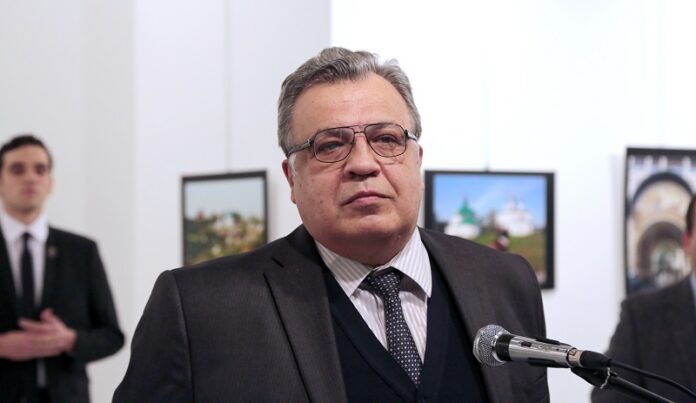
Andrei Karlov, the Russian Ambassador to Turkey, pauses during a speech at a photo exhibition in Ankara on Monday, Dec. 19, 2016, moments before a gunman opened fire on him. Karlov was rushed to a hospital after the attack and later died from his gunshot wounds. Photo: Burhan Ozbilici / Associated Press

ANKARA, Turkey — The event seemed routine, the opening of an exhibit of photographs of Russia. So when a man in a dark suit and tie pulled out a gun, I was stunned and thought it was a theatrical flourish.

Instead, it was a coolly calculated assassination, unfolding in front of me and others who scrambled, terrified, for cover as the trim man with short hair gunned down the Russian ambassador.

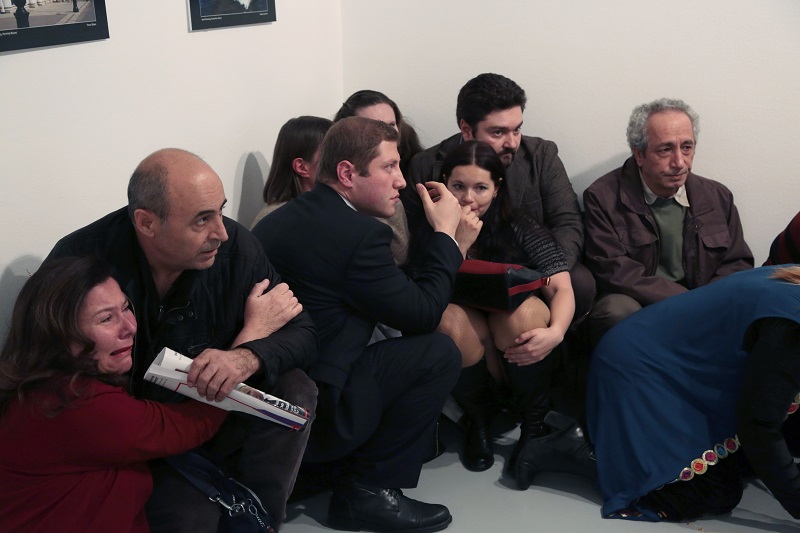
The gunshots, at least eight of them, were loud in the pristine art gallery. Pandemonium erupted. People screamed, hid behind columns and under tables and lay on the floor. I was afraid and confused, but found partial cover behind a wall and did my job: taking photographs.

Editor’s Note: Associated Press photographer Burhan Ozbilici was attending a photo exhibition Monday when a Turkish policeman opened fire, killing Russia’s ambassador to Turkey. He recounts how he captured the chaotic scene with his camera despite the lethal danger.

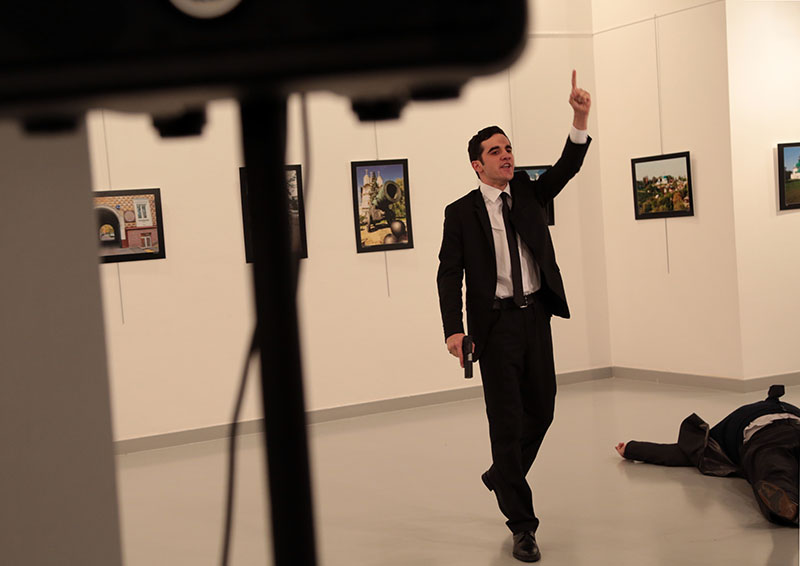
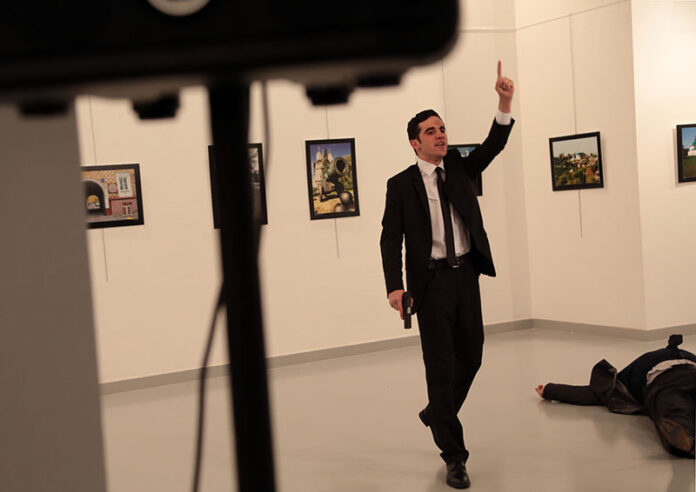
A man suspected of shooting Russian ambassador to Turkey Andrei Karlov gestures as Karlov lies on the ground at a photo gallery on Monday in Ankara, Turkey. Photo: Burhan Ozbilici / Associated Press

The exhibition, titled “From Kaliningrad to Kamchatka, from the eyes of travelers” featured photos from Russia’s westernmost Baltic region to the Kamchatka Peninsula, in the east. I decided to attend simply because it was on my way home from the Ankara office.

When I arrived, the speeches had already begun. After Russian Ambassador Andrei Karlov began to make his address, I moved closer to photograph him, thinking the pictures would come in useful for stories on Turkish-Russian relations.

He was speaking softly and — from what I could tell — lovingly about his homeland, stopping occasionally to allow the translator to relay his words in Turkish. I remember thinking how calm and humble he seemed.

Then came the gunshots in quick succession, and panic in the audience. The ambassador’s body lay on the floor, just meters (yards) away from me. I couldn’t see any blood around him; I think he may have been shot in the back.

It took me a few seconds to realize what had happened: A man had died in front of me; a life had disappeared before my eyes.

I moved back and to the left, while the gunman — later identified as police officer Mevlut Mert Altintas — gestured with his gun at people cowering on the right side of the room.

At first, I couldn’t figure out what had motivated the shooter. I thought he might be a Chechen militant. But people later said he was shouting about the Syrian city of Aleppo.

So he was probably angry about Russian bombardments of Aleppo that were aimed at driving out anti-government rebels. Many civilians have been killed in the fighting.

He also shouted “Allahu akbar,” but I couldn’t understand the rest of what he said in Arabic.

The gunman was agitated. He walked around the ambassador’s body, smashing some of the photos hanging on the wall.

People crouch in a corner after Andrei Karlov, the Russian Ambassador to Turkey, was shot at a photo gallery in Ankara, Turkey, Monday, Dec. 19, 2016. Karlov, 62, was several minutes into a speech at an embassy-sponsored photo exhibition when a man fired a gun at him. Karlov was rushed to a hospital after the attack and later died from his gunshot wounds. Photo: Burhan Ozbilici / Associated Press

I was, of course, fearful and knew of the danger if the gunman turned toward me. But I advanced a little and photographed the man as he hectored his desperate, captive audience.

This is what I was thinking: “I’m here. Even if I get hit and injured, or killed, I’m a journalist. I have to do my work. I could run away without making any photos. … But I wouldn’t have a proper answer if people later ask me: ‘Why didn’t you take pictures?'”

I even thought about friends and colleagues who have died while taking photographs in conflict zones over the years.

As my mind raced, I saw that the man was agitated — and yet, he was, strangely, in control of himself. He shouted at everyone to stand back. Security guards ordered us to vacate the hall and we left.

Ambulances and armored vehicles soon arrived and the police operation was launched. The gunman was later killed in a shootout.

When I returned to the office to edit my photos, I was shocked to see that the shooter was actually standing behind the ambassador as he spoke. Like a friend, or a bodyguard.

Advertisement

Truck Rams German Christmas Market, Killing At Least 12

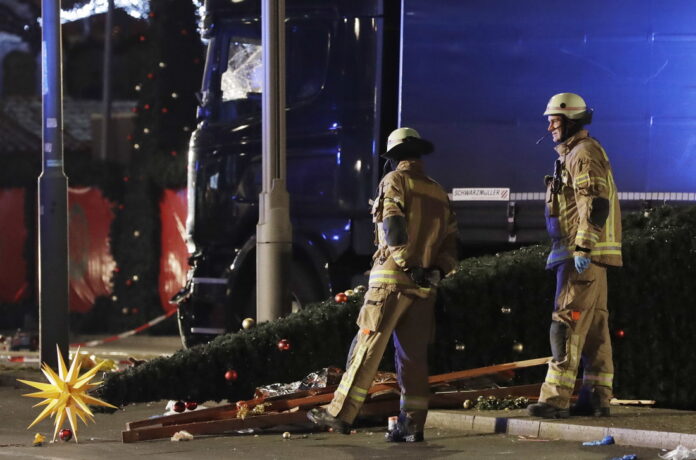
Firefighters look at a toppled Christmas tree after a truck ran into a crowded Christmas market and killed several people in Berlin, Germany, Monday, Dec. 19, 2016. Photo: Michael Sohn / Associated Press

BERLIN — A truck rammed into a crowded Christmas market in central Berlin on Monday evening, killing at least 12 people and injuring around 50 as it tore through tables and wooden stands. Police said a suspect believed to be the driver was arrested nearby and a passenger died as paramedics were treating him.

The popular Christmas market outside the Kaiser Wilhelm Memorial Church was filled with a mix of tourists and locals when the large Scania truck hurtled into it. Germany’s top security official said initial evidence pointed to an intentional act, and the White House condemned “what appears to have been a terrorist attack.”

Mike Fox, visiting from Birmingham, England, told The Associated Press that the truck missed him by about three meters (yards). Fox said he helped people who appeared to have broken limbs, and that others were trapped under Christmas stands.

“You do what you can to help who you can, really. It happened so fast that there was nothing we could do to stop it — if we’d tried to stop it we would have been crushed,” Fox said.

The truck, which was loaded with steel beams, came to a halt on a sidewalk on one side of the market. It had just rammed a large stand called “Fascination Christmas,” tearing off one side and knocking down a large Christmas tree. The three-meter tree lay in the street, red and gold ornamental balls still attached to its limbs and a golden star at the top.

The crash came less than a month after the U.S. State Department called for caution in markets and other public places across Europe, saying extremist groups including Islamic State and al-Qaida were focusing “on the upcoming holiday season and associated events.”

The Islamic State group and al-Qaida have both called on followers to use trucks in particular to attack crowds. On July 14, a truck plowed into Bastille Day revelers in the southern French city of Nice, killing 86 people. Islamic State claimed responsibility for that attack, which was carried out by a Tunisian living in France.

Following that attack there were calls to block off and better protect high-profile public gatherings. There were no barriers around the Christmas market on Monday.

After the attack, dozens of ambulances lined the streets waiting to evacuate people, and heavily armed police patrolled. Authorities on Twitter urged people to stay away from the area, saying they need to keep the streets clear for rescue vehicles.

Among the dead was a passenger in the truck, who succumbed as paramedics treated him, Berlin police spokesman Winfried Wenzel said. He offered no further details.

A suspect believed to be the driver was picked up about 2 kilometers (1½ miles) away, near Berlin’s Victory Column monument. He was being interrogated, Wenzel said. The truck was registered in Poland, and police said it was believed to be stolen from a building site there.

The Polish owner of the truck said he feared the vehicle, driven by his cousin, may have been hijacked. Ariel Zurawski said he last spoke with the driver around noon, and the driver told him he was in Berlin and scheduled to unload Tuesday morning. “They must have done something to my driver,” he told TVN24.

Federal prosecutors, who handle terrorism cases, took over the investigation, according to German Justice Minister Heiko Maas. In Washington, White House National Security Council spokesman Ned Price said the United States was in contact with German officials and ready to help in the investigation and response.

U.S. President-elect Donald Trump blamed Islamist terrorists, though it was unclear what that assessment was based on. He said Islamic extremists must be “eradicated from the face of the earth” and pledged to carry out that mission with all “freedom-loving partners.”

But German officials said it was too early to call the crash intentional.

“I don’t want to use the word ‘attack’ yet at the moment, although a lot speaks for it,” Interior Minister Thomas de Maiziere told ARD television. “There is a psychological effect in the whole country of the choice of words here, and we want to be very, very cautious and operate close to the actual investigation results, not with speculation.”

Even so, some politicians were pointing fingers. Marcus Pretzell, a prominent member of the anti-migration Alternative for Germany party, lashed out at the government of Chancellor Angela Merkel, saying on Twitter: “When will the German state of law strike back? When will this cursed hypocrisy finally stop? These are Merkel’s dead! #Nice #Berlin.”

Germany has not experienced any mass-casualty attacks by Islamic extremists, but has been increasingly wary since two attacks by asylum-seekers in the summer that were claimed by the Islamic State group. Five people were wounded in an ax rampage on a train near Wuerzburg and 15 in a bombing outside a bar in Ansbach. Both attackers were killed.

Those attacks, and two others unrelated to Islamic extremism in the same weeklong period, helped stoke tensions in Germany over the arrival last year of 890,000 migrants.

Advertisement

Russian Ambassador to Turkey Killed at Exhibition by Policeman

Mevlut Mert Altintas, a 22-year-old member of Ankara's riot police squad Who shot Russian ambassador to Turkey Andrei Karlov gestures as Karlov lies on the ground at a photo gallery on Monday in Ankara, Turkey. Photo: Burhan Ozbilici / Associated Press

ANKARA, Turkey — A Turkish policeman fatally shot Russia’s ambassador to Turkey on Monday in front of a shocked gathering at a photo exhibit and then, pacing near the body of his victim, appeared to condemn Russia’s military role in Syria, shouting: “Don’t forget Aleppo! Don’t forget Syria!”

The leaders of Turkey and Russia said the attack in Ankara, the Turkish capital, was an attempt to disrupt efforts to repair ties between their countries, which have backed opposing sides in the Syrian civil war.

An Associated Press photographer and others at the art gallery watched in horror as the gunman, who was wearing a dark suit and tie, fired at least eight shots, at one point walking around Ambassador Andrei Karlov as he lay motionless and shooting him again at close range.

The assailant, who was identified as Mevlut Mert Altintas, a 22-year-old member of Ankara’s riot police squad, was later killed in a shootout with police. Three other people were wounded in the attack, authorities said.

The assassination came after days of protests by Turks angry over Russia’s support for President Bashar Assad in the Syrian conflict and Russia’s role in the bombardment and destruction of Aleppo, Syria’s largest city.

The gunman shouted about Aleppo in Turkish, and also yelled “Allahu akbar,” the Arabic phrase for “God is great,” continuing in Arabic: “We are the descendants of those who supported the Prophet Muhammad, for jihad.”

The attack, condemned by the White House and the United Nations, was another sign of how Turkey, a NATO member and a partner in the U.S.-led campaign against the Islamic State group, is struggling to contain multiple security threats. The war in Syria has been a major problem for years, sending several million refugees into Turkey and, more recently, drawing in Turkish troops.

Turkey has become accustomed to deadly attacks  Kurdish militants claimed responsibility for Dec. 10 bombings in Istanbul that killed 44 people, many of them police.

The spectacle of 62-year-old Karlov’s assassination by a member of the Turkish security forces at a photography exhibit meant to highlight Russian culture reinforced the sense of unease over the region’s conflict and complex web of alliances and relationships.

It came a day before a key meeting about Syria to be held in Moscow. Those attending include the foreign and defense ministers from Turkey, an opponent of Assad, and Russia and Iran, backers of the Syrian regime.

Russian President Vladimir Putin described the killing of Karlov as an attempt to damage Russia-Turkey ties “and to thwart a peace process in Syria which Russia, Turkey and Iran have been actively trying to promote.”

Putin said he and Turkish President Recep Tayyip Erdogan agreed in a phone call that Russian investigators would fly to Ankara to conduct a joint probe with their Turkish counterparts.

“We must know who was directing the killer,” Putin said in televised remarks. He ordered top officials to strengthen protection of the Turkish Embassy in Moscow and asked Turkey to increase security at the Russian mission in Ankara.

In a video message shown on several Turkish TV channels, Erdogan said: “This is a provocation to damage the normalization process of Turkish-Russian relations. But both the Russian and Turkish administrations have the determination not to fall for this provocation.”

Karlov was several minutes into a speech at the embassy-sponsored exhibition in Ankara when he was gunned down.

Altintas, the gunman, also fired shots in the air, sending panicked audience members running for cover, and smashed several of the framed photos hung for the exhibition. The floor was splattered with blood, and the ambassador’s eye glasses lay a few feet from his body.

After shooting the ambassador, the gunman got into a 15-minute shootout with police before he was killed, Turkey’s state-run Anadolu news agency reported.

The shooter’s family home in the western province of Aydin was later searched and his mother, father and sister were detained, the news agency said, without citing sources. The man’s house in Ankara was raided and his roommate, also a police officer, was also taken into custody, it said.

Interior Minister Suleyman Soylu said Altintas, who was born in 1994, had been an officer with Ankara’s riot police squad for more than two years. He did not give a motive for the attack.

“It’s a tragic day in the history of our country and Russian diplomacy,” Russian Foreign Ministry spokeswoman Maria Zakharova said.

“Ambassador Karlov has made a lot of personal contributions to the development of ties with Turkey. He has done a lot to overcome a crisis in bilateral relations,” she said. “He was a man who put his heart and his soul into his job. It’s a terrible loss for us and also the world.”

Karlov joined the diplomatic service in 1976. He served as Russia’s ambassador to Pyongyang from 2001-2006, and later worked as the chief of the Foreign Ministry’s consular department. He had served as the ambassador to Turkey since 2013.

The White House condemned the assassination, saying “this heinous attack on a member of the diplomatic corps is unacceptable,” President Barack Obama was briefed by his national security team while on vacation in Hawaii

U.N. Secretary-General Ban Ki-moon also condemned what he called a “senseless act of terror,” for which “there can be no justification.”

Relations between Russia and Turkey were badly strained by the downing of a Russian warplane at the Syrian border in November 2015, but Turkey’s apology earlier this year helped overcome the rift. Putin and Erdogan have held several meetings in recent months and spoken frequently over the phone.

Russia and Turkey have co-sponsored the evacuation of civilians and rebels from Aleppo and also discussed the prospect of organizing a new round of peace talks in Kazakhstan’s capital, Astana.

Security threats to Turkey include the Islamic State group, and which has been blamed for attacks in Turkey. Additionally, Turkish security forces and courts remain preoccupied with purging state institutions of the supporters of an exiled Islamist cleric whom the government accuses of staging a failed coup attempt in July.

Story: Burhan Ozbilici, Suzan Frazer

Advertisement

Vietnam Jails 2 Democracy Activists for Attempted Subversion

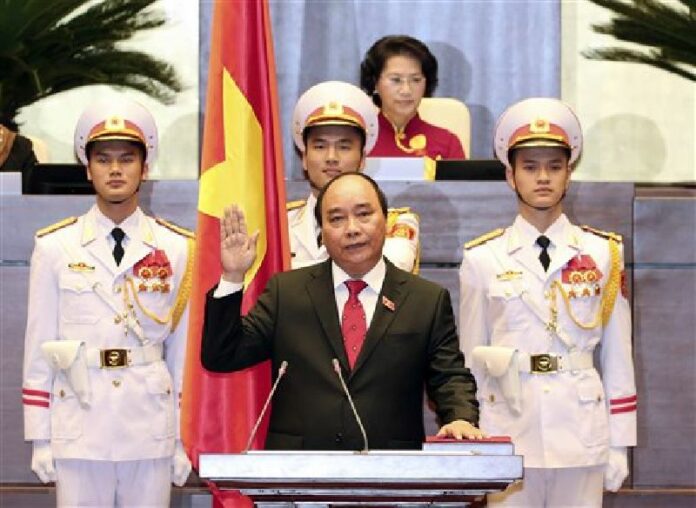
Nguyen Xuan Phuc, center, takes oath after being elected as prime minister in Hanoi, Vietnam Thursday April, 7, 2016. Photo: Thong Nhat / Vietnam News Agency / Associated Press
HANOI — A court in northern Vietnam sentenced a former army officer and another activist to more than 10 years in prison each for attempting to overthrow the communist government.

Tran Anh Kim and Le Thanh Tung were convicted of attempted subversion at a one-day trial for setting up “reactionary group in the name of National Force for Democracy,” state-run online newspaper Vietnamnet reported. They were sentenced respectively to 13 years and 12 years and must serve 4 years of house arrest after their prison terms end.

Kim, a 67-year-old former army officer, served an earlier prison term of 5 ½ years for violating national security law in a 2009 case also involving what Vietnam authorities called an attempted overthrow of the government.

Lawyers and court officials in Thai Binh province where the trial was held Friday were not available for comment Monday.

U.S. Ambassador to Vietnam Ted Osius said in a statement Monday that he was “deeply concerned by the sentencing” and that “all people should have the right to freedom of speech and association.”

“The recent trend of arrests and convictions of peaceful activists is troubling and threatens to overshadow Vietnam’s progress on human rights,” he said.

He also called on Vietnam to release the two and all other prisoners of conscience and to allow all individuals in Vietnam to express their political views without fear of retribution.

International human rights groups, U.S. government and some other Western governments have criticized Vietnam for jailing people for peacefully expressing their views, Hanoi maintains that only law breakers were put behind bars.

Advertisement

Hot News

LATEST NEWS

Bangkok
overcast clouds
31.6 ° C
31.6 °
31.1 °
74 %
7.4kmh
100 %
Fri
34 °
Sat
36 °
Sun
34 °
Mon
34 °
Tue
34 °