






















26.1 C
Bangkok
Saturday, June 20, 2026
Home Blog Page 2517

Take a Deeper Taste of Bangkok’s Chinatown

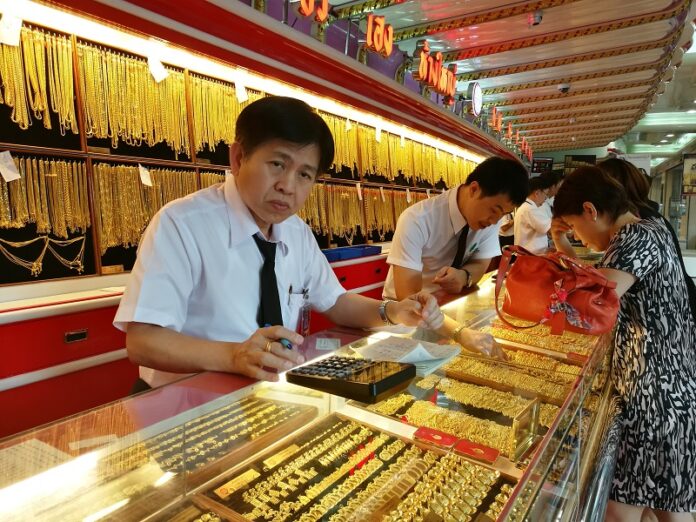
Clerks at a typical goldsmith on Yaowarat.

BANGKOK Chinatown is no longer a working center of Thai-Chinese businesses. Over the years, it has evolved into a tourist attraction in its own right. For the uninitiated, there’s more to do than to eat noodles and gaze at the neon-saturated nightscape.

Let’s take a stroll down the arterial road of Yaowarat, named for “young king” Rama V who ordered it built, to find the stuff for which it’s famous.

Gold Smiths

There are at least two dozen gold shops large and small along and around Yaowarat Road. One big chain has three or fours shops in one area. A clerk told me it’s like having many convenience stores in the same densely populated areas to increase the chance customers will walk into one of them.

Walking in to check one out is a must for anyone visiting the neighborhood. Bangkok’s Chinatown would look totally different without the big signs in Thai and Chinese advertizing their goods, regarded by Thais as a safe haven in times of economic calamity and long-term savings for those who can’t be bothered to invest in stocks or derivatives.

In Thailand, the preferred purity of gold jewelry is 96.5 percent, or 23.16 karats. This means it’s softer but purer and richer in hue than the color of 18 karat yellow gold, which is 75 percent pure and commonly used to make jewelry in the West. Prices are adjusted several times on a daily basis, with prices publicly posted out front, in line with the fluctuation of gold prices on the world market. All shops close on Sundays.
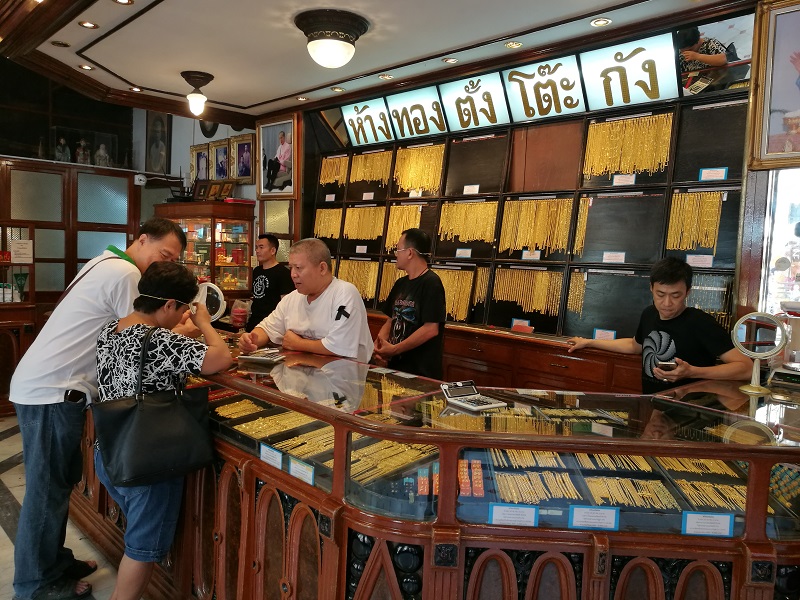
Inside Tang Toh Kang goldshop.

Traditionally, ordinary Thais, including the working class, saved whatever they could and turned it into gold necklaces, rings or bangles to keep as hard assets or give to loved ones. It can be pawned or sold in times of economic hardship, as the metal can be easily liquidated into cash.

A few Western tourists can be spotted inside the Yaowarat goldsmiths, and even those not into gold will find it worth checking out just to marvel at the sheer abundance and the characteristic use of the color red, being an auspicious color for the Chinese.
The front of the famous Tang Toh Kang goldshop on Mangkorn Rd.

For the most traditional of all goldsmiths, considering decor and ambience, head to Mangkon Road, which intersects Yaowarat toward Chinatown’s western edge. Turn southwest and walk one minute into this small alley to find Tang Toh Kang Goldsmiths, founded in 1875, with its dark wood panels and beautiful traditional Thai and Chinese signboards.

As a sign of changing times, a clerk at the shop told me they now do sell gold bars of 99.9 percent purity in order to save the trouble of having to mix or extract other metals that make gold alloys harder. However, most other goldsmiths still only stick to the 23-karat gold standard.

Market and Small Alleys

Back when Ayutthaya was the capital, the city had its own Chinatown as well, known as Nai Kai Market, according to “A History of The Thai-Chinese” a seminal English-language text by Jeffery Sng and Pimpraphai Bisalputra.

“At the market itself, Chinese shop houses lined the main street and sold all varieties of items, including porcelain, silk, herbs, medicine, tea, fresh and preserved fruits, Chinese sweets, spices, brass wares, iron implements and woks. There was also a large fresh market. Nai Kai Market was busy all day, especially during the junk trading season around Chinese New Year,” the two authors note.

Nai Kai Market may be long gone but it’s not difficult to imagine being there by getting lost in Chinatown’s small alleys and chancing upon old shops and stalls selling the same sorts of goods – with the addition of electricity, cameras and electronics.
A shop full of dried meat & dried fruits.

I found much of the goods described in the book still being peddled, 300 years later. While the many nooks and alleys provide surprising discoveries, my recommendation is a stroll in the afternoon into the narrow and relatively dark alley next to Soi Yaowarat 6 opposite the Old Market, or Talad Gaow. A 15-minute walk through the alley will most certainly overwhelm your visual and olfactory senses. The smell of spices, herbs, fish and more will transport you to another realm.

At the other end of the alley is Charoen Krung Road, and just across is the famous Dragon Temple, or Wat Mangkon Kamalawat.

Dragon Temple and its Tips for a Prosperous New Year

Built in 1871 to spread Mahayana Buddhism and granted its Thai name by King Chulalongkorn, it is arguably the most famous Chinese temple in Thailand.

Signs in Thai and Chinese speak of the intercultural marriage. Stop by just before dusk when the statues of deities and Buddha look splendid due to the light and gold reflections. Dramatic are the four gigantic Guardian of the World statues in Chinese warrior costumes looking furiously down at visitors from the inner gate.
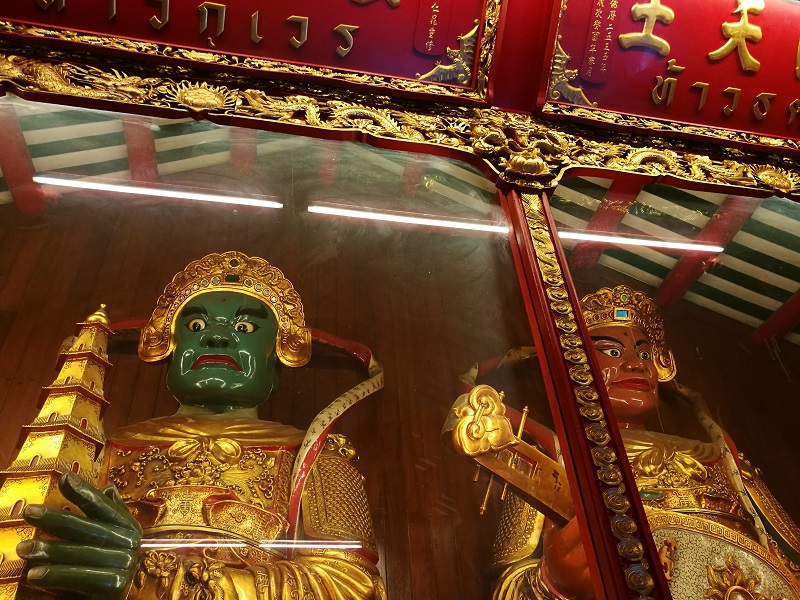
Statues of two guardians at Wat Mangkon Kamalawat.

The majority of Thai-Chinese cannot read Chinese. In fact most of their ancestors who migrated to Siam and what became Thailand over the centuries were mostly poor and illiterate. Attempts have been made to pass on some of the Chinese cultural knowhow, such as adapting the rendering of southern Chinese opera into Thai language and more.

As Sng and Pimpraphai noted, “the ancestors of the Chinese in Thailand mostly come from the ranks of merchants, peasants, adventurers and coolies with very few members of the literati class among them. The absence of a literati tradition in the local Chinese community is reflected in the dearth of Chinese clan records.”

At the temple, red posters with instructions in Thai remind Thai-Chinese and Thai worshippers and visitors on how to conduct themselves on Chinese New Year’s Day in order to avoid bad omens.
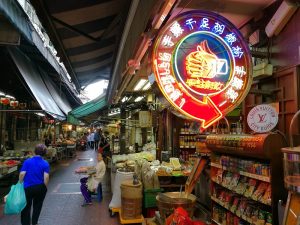
A small alley opposite Yaowarat's old market.
A small alley opposite Yaowarat’s old market.

Here are some of the more interesting don’ts:

“Do not clean the house. It will remove your good fortune from home.”

“Do not wash or cut your hair. It will remove your prosperity.”

“Do not use expletives or engage in a quarrel. Saying bad things will bring misfortune for the rest of the year.”

“Do not break objects. It’s a bad omen signalling that the family will be broken or someone [in the family] will die.”

“Do not use sharp objects. It will cut away your good fortune.”

“Do not wear white or black. Black and white clothing is bad omen, that’s why Chinese people wear red, because red is a lucky color.”

On Chinese New Years past, I’ve seen mainland Chinese tourists in Bangkok wearing black. Apparently some are less superstitious than the Thai-Chinese.

Not all instructions can be said to be plainly superstitious, however.

I found at least one which offers a rather sound advice on how to handle one’s financial situation.  

“Do not lend money to others. This will lead others to always borrow money from you. If you owe money to someone you will be in debt for the rest of the year.”

That’s practical.

A Note on Food and Drinks

Bangkok’s Chinatown is known for its – you guessed it – Chinese restaurants and also way-above-average street food.

Popular offerings include grilled Thai-Chinese seafood, street stalls, Lek & Rut as well as T&K on Phadungdao Road, which intersects the upper eastern part of Yaowarat Road. Upscale southern Chinese restaurants can be found on both sides of Yaowarat, and many are of decent quality. But expect rather gaudy decor –  that’s part of the experience.
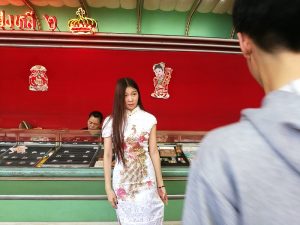
A young woman trying on Chinese dress for male friend to take a photo.

Walking around, one should never fail to look up and note the hodgepodge of architectural styles of shophouses and buildings on both sides of Yaowarat ranging from old Sino-Portuguese and art deco with a Thai-Chinese twist, to modern and postmodern designs.

By night, neon signs light up the neighborhood and give it a mesmerizing ambience. Sit and have a mug of beer or enjoy some tea. Take in the street life and the lights that make Bangkok’s Chinatown a fascinating place to stroll through. Shanghai Mansion and Chinatown Hotel, both on the upper eastern part of Yaowarat and just a stone’s throw from the Chalerm Buri intersection, are two places where you can sit al fresco next to the footpath and slurp it all in.
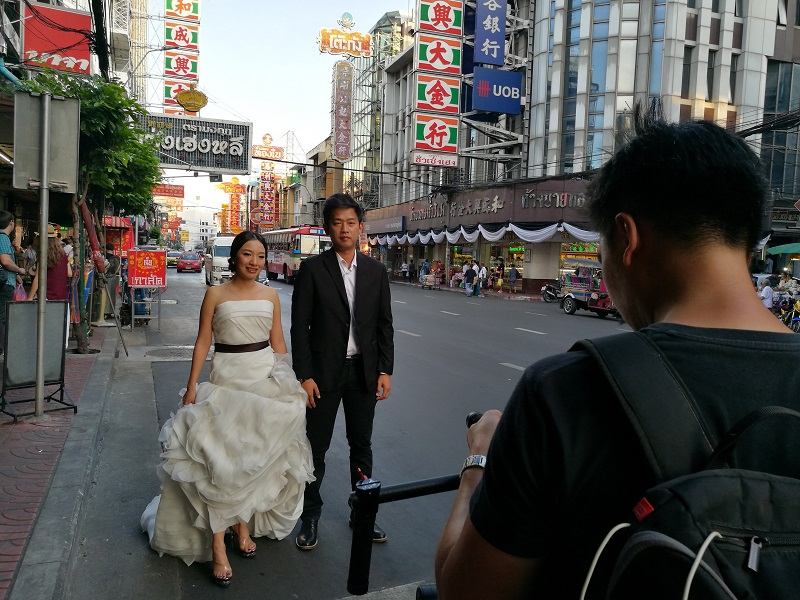
 A young couple taking wedding photo on Yaowarat Rd.
A young couple taking wedding photo on Yaowarat Rd.
Advertisement

The Hua Lamphong Continuum: Photog Stakes Out Platform for 6 Months

Photo: Rammy Narula / Courtesy

BANGKOK — A Thai-Indian street photographer will show off what he got from capturing photos at a Hua Lamphong terminal platform at 10am for over six months at an exhibition this month.

Bangkok-based Rammy Narula will show a collection of color photos he took as part of the project which had him visiting the city’s main railway station and shooting a single platform’s moments for half a year.

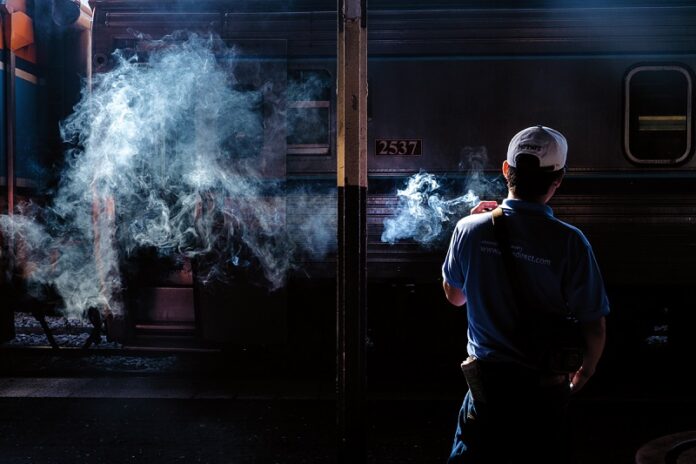
“[At Platform 10], I found the light I loved. The same train comes every day in the morning and stays for 20 minutes,” Rammy said. “The project concentrated on a very tight area to keep consistency for the final results in terms of color, light and mood.”

Rammy will also launch his photo book of the same name published under New York’s photobook publisher Peanut Press.

Rammy’s solo exhibition Platform 10 will open Dec. 14 and run until February at Hotel Sofitel Bangkok Sukhumvit’s S Gallery. The opening reception will go from 5:30pm to 10pm on Dec. 14.

Rammy’s former works include a 2013 project called Hua Lamphong Train Station comprised of black-and-white photos of the station’s commuters.

Advertisement

Body Remains Found After Indonesia Plane with 13 Disappears

A PZL M28 Skytruck in 2009 at the Góraszka Air Picnic, similar to the one that crashed Saturday in Batam, Indonesia. Photo: Konflikty.pl / Associated Press

JAKARTA, Indonesia — Indonesian rescuers on Sunday recovered body parts in the sea where a police plane with 13 people aboard is believed to have crashed after takeoff.

The light aircraft lost contact Saturday on the way to the island of Batam off the southeast coast of Sumatra island near Singapore. All those aboard, including five crew and eight police passengers, are feared dead, officials said.

The M28 Skytruck plane is believed to have plunged into 24-meter (79-feet) deep waters, said National Search and Rescue Agency chief Henry Bambang Soelistyo.

He told a news conference that body remains probably of the victims were found in the area where villagers earlier retrieved a seat and a bag containing a cellphone and police documents.

TV footage showed police uniforms and other clothing also were retrieved from the sea.

Search teams involving Indonesia’s navy, customs office and maritime police as well as aircraft from Singapore were scouring a 518-square-kilometer (200-square-mile) sea area for the wreckage of the aircraft, Soelistyo said, adding that divers also were deployed.

Advertisement

Cuba to Prohibit Naming of Monuments, Streets After Fidel

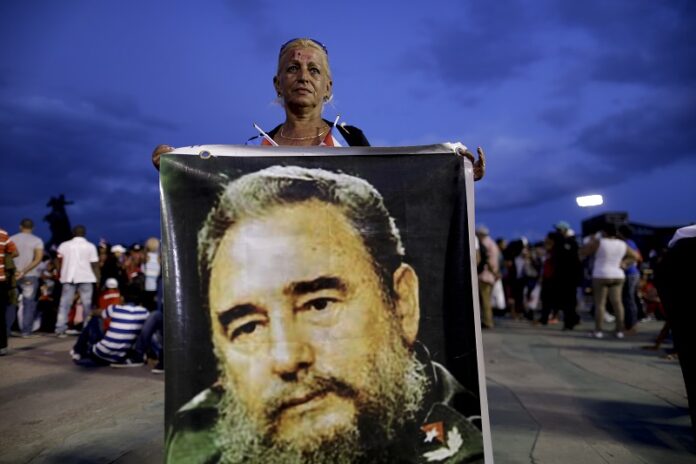
A woman holds a picture of Fidel Castro Saturday before a rally honoring Cuba's late leader at Antonio Maceo plaza in Santiago, Cuba. Photo: Natacha Pisarenko / Associated Press

SANTIAGO, Cuba — President Raul Castro announced that Cuba will prohibit the naming of streets and monuments after his brother Fidel, and bar the construction of statues of the former leader and revolutionary icon in keeping with his desire to avoid a cult of personality.

The announcement late Saturday came after a week of national mourning for Fidel Castro that reached near-religious peaks of adulation and a half-day before his ashes are interred in Santiago’s Santa Ifigenia cemetery, ending the official mourning period.

“The leader of the revolution rejected any manifestation of a cult of personality and was consistent in that through the last hours of his life, insisting that, once dead, his name and likeness would never be used on institutions, streets, parks or other public sites, and that busts, statutes or other forms of tribute would never be erected,” Raul Castro told a massive crowd gathered in the eastern city of Santiago.

He said that Cuba’s National Assembly would vote in its next session on the law fulfilling the wishes of his brother, who died last week at 90. The legislature generally holds a meeting in December and under Cuba’s single-party system, parliament unanimously or near-unanimously approves every government proposal.

Fidel Castro, who stepped down in 2006 after falling ill, kept his name off public sites during his near half-century in power because he said he wanted to avoid the development of a personality cult. In contrast, the images of his fellow revolutionary fighters Camilo Cienfuegos and Ernesto “Che” Guevara became common across Cuba in the decades since their deaths.

Mourning for Castro has been fervent and intense across the country since his death, particularly in rural eastern Cuba, where huge crowds have been shouting Castro’s name and lining the roads to salute the funeral procession carrying his ashes.

“All of us would like to put Fidel’s name on everything but in the end, Fidel is all of Cuba,” said Juan Antonio Gonzalez, a 70-year-old retired economist. “It was a decision of Fidel’s, not Raul’s, and I think he has to be respected.”

Raul Castro, 85, spoke at the end of a second massive rally in honor of Fidel as Cuba neared the end of a nine-day period of public mourning. Castro’s ashes arrived Saturday afternoon in Santiago, ending a four-day journey across Cuba that began after a massive rally in Havana’s Plaza of the Revolution.

Thousands of people welcomed the leader’s remains to shouts of “Fidel! I am Fidel!” Hundreds of thousands more gathered in Santiago’s Revolution Plaza Saturday night, cheering speeches by the heads of state-run groups of small farmers, women, revolutionary veterans and neighborhood watch committee members.

The event was attended by Bolivian President Evo Morales, Nicaraguan leader Daniel Ortega and Nicolas Maduro of Venezuela, along with former Brazilian presidents Dilma Rousseff and Lula da Silva.

Castro’s ashes will be interred Sunday morning in Santiago’s Santa Ifigenia cemetery, ending the official mourning period.

Story: Andrea Rodriguez, Michael Weissenstein

Advertisement

Activist ‘Pai Dao Din’ Freed on Bail After 112 Arrest

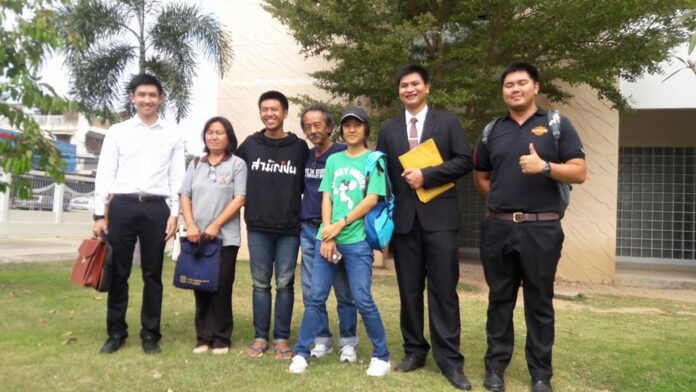
Activist Jatupat ‘Pai’ Boonpattararaksa, third from left, in a photo with family, friends and lawyer after being freed on bail. Photo: Wiboon Boonpattararaksa/ Facebook

KHON KAEN — After being arrested on a charge of defaming the monarchy for sharing a BBC Thai biography of King Rama X, a northeastern activist was freed on bail Sunday.

A Khon Kaen court granted bail for Jatupat “Pai” Boonpattararaksa, a member of community rights group Dao Din, on a 400,000 baht bond, according to message posted online by pro-democracy activist group New Democracy Movement.

Jatupat has been accused of four political crimes to date. The latest allegation was from a Facebook post he shared quoting a biography of King Rama X produced by BBC Thai on Friday morning. For this, Jatupat was charged with lese majeste under Article 112 of the Penal Code and arrested Saturday.

Jatupat’s lawyer attributed for the bail that his client has never fled from previous arrests and that he is due to sit for his final exams Thursday to complete his law degree at Khon Kaen University.

Related Stories:

Activist ‘Pai Dao Din’ Arrested For Lese Majeste

Advertisement

A Look at Some of the Worst Nightclub, Music Venue Fires

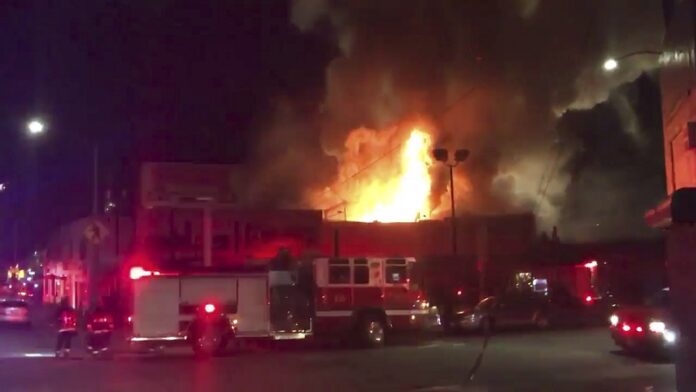
The scene of a fire in Oakland, early Saturday, Dec. 3, 2016. Photo: Associated Press

LONDON — A fatal fire Friday night at a party in a converted warehouse in the San Francisco Bay Area has claimed the lives of at least nine people. More than two dozen are still unaccounted for. Fire officials say the roof collapsed during a music event.

A look at some other nightclub and music venue fires that have exacted terrible death tolls in crowded conditions:

— October, 2015: A blaze at the Colectiv nightclub in the Romanian capital of Bucharest killed 64 people and injured nearly 150 others. The fire erupted during a rock concert by the band Goodbye to Gravity. A spark from the band’s pyrotechnic show ignited the foam ceiling, erupting into flames. It’s known as the worst fire in Romania’s modern history.

— January, 2013: A fire killed more than 200 people at the Kiss nightclub in the city of Santa Maria in Brazil. Investigators said soundproofing foam on the ceiling caught fire and released poisonous gasses that quickly killed those attending a university party.

— December, 2009: Some 152 people died when a blaze broke out at the Lame Horse nightclub in Perm, Russia. It started when an indoor fireworks display ignited a plastic ceiling decorated with branches.

— January, 2009: An indoor fireworks display after a New Year’s countdown ignited a blaze in the Santika club in Bangkok, Thailand, killing 67 people and injuring many more. Victims died from burns, smoke inhalation and from being crushed.

— September, 2008: A fire killed 44 people at the jammed King of Dancers nightclub in Shenzhen, China, when a stampede broke out after a fireworks show ignited the ceiling.

— December, 2004: In Buenos Aires, Argentina, a fire killed 194 people at the crowded Cromagnon Republic club after a flare ignited ceiling foam. Club owner Omar Chaban was sentenced to 20 years in prison for causing the deadly fire and for bribery. Others received lighter sentences.

— February, 2003: A fire at the Station nightclub in Warwick, Rhode Island, in the United States, killed 100 people and injured more than 200 others. Fireworks being used by the band Great White set fire to flammable foam inside the club.

— December, 2000: A fire that was blamed on a welding accident killed 309 people at a disco in the central Chinese city of Luoyang.

— October, 1998: An arson attack against an overcrowded youth disco in the Swedish city of Goteborg killed 63 people and left around 200 injured. Four people were later convicted for starting the fire.

— March, 1996: A fire at the Ozone Disco Pub in Quezon City, Philippines, killed 162 people. A large proportion of the victims were students partying to mark the end of the academic year.

— March, 1990: An arson attack at the Happy Land nightclub in the Bronx borough of New York City killed 87 people. It started when a man angry with his girlfriend threw gasoline on the club’s only exit and set it on fire, and then jammed down the metal front gate so people were trapped.

— December, 1983: A fire at the Alcala dance hall in Madrid, Spain, left 78 people dead and more than 20 injured.

— May, 1977: A fire at the Beverly Hills Supper Club in Southgate, Kentucky, in America killed 165 people and injured more than 200.

— November, 1942: The deadliest nightclub fire in U.S. history killed 492 people at Boston’s Cocoanut Grove club. The fire at what had been one of Boston’s foremost nightspots led to new requirements for sprinkler systems and accessible exits.

— April, 1940: A fire ignited the decorative Spanish moss draping the ceiling of the Rhythm Night Club in Natchez, Mississippi, killing 209 people. The windows had been boarded up to prevent people from sneaking in.


Advertisement

Malaysian PM Leads Protest Against ‘Genocide’ of Rohingya

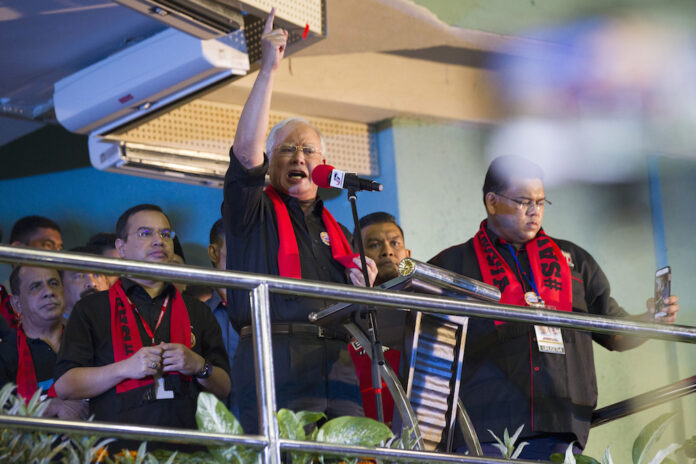
Malaysian Prime Minister Najib Razak, center, speaks to the crowd during a protest against the persecution of Rohingya Muslims in Myanmar at a stadium in Kuala Lumpur, Malaysia on Dec. 4. Photo: Lim Huey Teng (AP)

KUALA LUMPUR — Malaysian Prime Minister Najib Razak has led a protest rally against what he called a “genocide” of Muslim Rohingya minority in Myanmar.

Najib says Sunday’s rally at a stadium Kuala Lumpur in Muslim-majority Malaysia sends a strong message to Myanmar leader Aung San Suu Kyi and her government that “enough is enough” as he vowed to fight for the rights of the Rohingya.

He said: “The world cannot stand by and watch genocide taking place.”

The plight of Rohingya in predominantly-Buddhist Myanmar has galvanized Muslims in Southeast Asia and beyond.

Some critics accuse Najib, who is grappling with a financial scandal, of using the rally to win the support of the country’s Muslim Malays ahead of general elections due in 2018.

Advertisement

Death Toll in China’s 2nd Coal Mine Blast Rises to 32

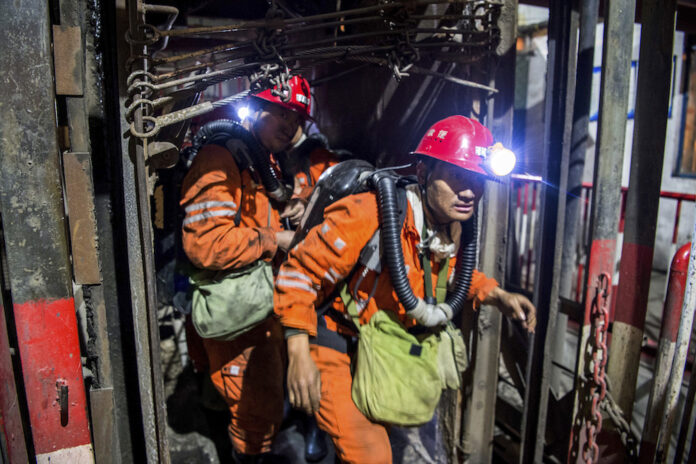
Rescuers entering the accident site to conduct search and rescue operation at the mining company in Chifeng, north China's Inner Mongolia Autonomous Region. Photo: Lian Zhen/Xinhua via AP

BEIJING — Thirty-two miners were confirmed dead Sunday in the second coal mine explosion in a week in China, state-run media reported.

The gas explosion hit the mine in Chifeng city in the Inner Mongolia region midday Saturday. Out of 181 miners working underground, 149 managed to get out and the rest died, official Xinhua News Agency reported.

The mine was operated by the Baoma Mining Co. Ltd., Xinhua said.

News of the blast came just hours after 21 miners who were trapped for four days after an explosion hit their unlicensed coal mine were confirmed dead in northeast China’s Heilongjiang province. Four people were arrested in connection with that disaster.

China’s mining industry has long been among the world’s deadliest, and top work safety regulators have acknowledged that some mines cut corners on safety standards due to financial pressure.

Advertisement

Watching Our Neighbors Suffer – in Silence

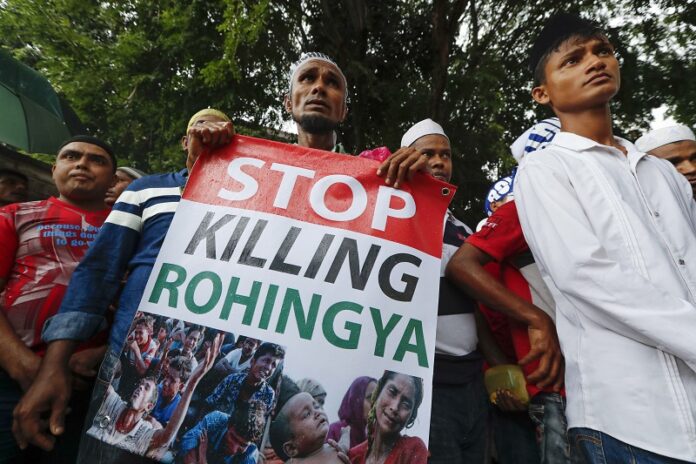
An ethnic Rohingya holds a banner during protest after Friday prayers outside the Myanmar Embassy in 2016 in Kuala Lumpur, Malaysia. Photo: Vincent Thian / Associated Press

Retention

What is happening in Myanmar’s Rakhine state to the Rohingya people is nothing short of abject failure by many Burmese who regarded themselves as Buddhists to be compassionate. Buddhism preaches tolerance, not the opposite. Wrongly clinging to one’s ethnicity, nationality, religion or the past can tragically make us regard others as less than human and undeserving of empathy, not to mention equal rights.

Thais, myself included, have been exposed to the news of Muslim Rohingya fleeing Myanmar for years, with the situation only getting worse. It’s in the news on and off, and no one is sure when there will be a constructive and humane solution to the issue.

There are many excuses made for withholding empathy from the Rohingya – they are not really citizens of Myanmar, they are not Buddhists, they are not good people and so on.

Remove their Rohingya and Muslim identities however and discover they are human. You don’t need to be Rohingya or sympathetic their plight, you only need to be human.  

As I watch the tragedy unfold and hear words like “crimes against humanity” used by the United Nations to refer to the strife in Rakhine state, where Human Rights Watch claims satellite images show about 30,000 Rohingya have recently fled their homes, I can’t but ask what we Thais could do to alleviate the suffering of our neighbors. An estimated 1 million to 2 million Rohingya live in Myanmar and many are fleeing to Thailand, Malaysia, Bangladesh and beyond. In Thailand, an estimated 200 or so are being detained, children and women included, for having fled terror in Myanmar and illegally entering the kingdom. Others live under state surveillance.

There are two dozen prominent Thai activists and scholars who spent two decades supporting the struggle for freedom and democracy in what had been Burma when they started. I rang one up Thursday afternoon to ask if they’re going doing anything about the deteriorating situation.

Pravit Rojanaphruk

Naruemon Tabchumpol, a political scientist at Chulalongkorn University and a former member of the Thai Action Committee on Democracy in Burma, which long supported the cause of freedom and democracy in Myanmar, said the situation is complicated.

She said old Burmese contacts have been rekindled and concerns expressed, but many Burmese democracy activists simply regard the Rohingya as others who don’t count among the more than 130 ethnic groups that comprise Myanmar’s people.

“The issue of race and ethnicity is still strong,” Naruemon told me, even among pro-democracy activists there. “The problem is not just with the civilian government of Aung San Suu Kyi because it cannot control its own armed forces.”

Naruemon said the armed forces were either not doing anything to stop the persecution or were the ones perpetrating it.

Naruemon said she has insisted to her old Burmese friends that the Rohingya should at least be treated humanely, setting aside that the dispute over whether they should be an official ethnic group will not be resolved anytime soon. She said her contacts acknowledged that they deserve protection on humanitarian grounds.

But, Naruemon said, more must be done.

“It think it’s time to [collectively] send a message, both formally and informally,” she said, adding that in the next week a statement might be issued.

Elsewhere in Thailand, junta leader Prayuth Chan-ocha was quoted saying the matter was Myanmar’s “internal affair.” Very reassuring, but what do you expect from a coup leader who routinely violates the rights of his own people through his “laws” anyway? As for Daw Aung San Suu Kyi, “big disappointment” is a big understatement to describe my feelings toward her when it comes to handling the issue.

While the dispute on whether the Rohingya are truly indigenous to Rakhine state or brought there by British colonial masters will continue, there’s no denying these people are being persecuted and discriminated against for something they did not do. Even were those who would write them off right about them being moved into Myanmar during colonial rule, that has nothing to do with those born and raised and persecuted there today.

How can anyone blame and discriminate against people because of their ancestors?

Thais, Burmans or Rohingya, Buddhists, Christians or Muslims, we are first and foremost human.

We live in the present and should not be prisoners to the past.

Advertisement

Duterte Says Trump Wished his Drug Crackdown ‘Success’

President-elect Donald Trump speaks during an election night rally Nov. 9 in New York. Photo: Evan Vucci / Associated Press

MANILA — President Rodrigo Duterte said Saturday Donald Trump wished his deadly crackdown on illegal drugs would succeed during a telephone call, and he assured the U.S. president-elect the Philippines would maintain its ties with America – a departure from Duterte’s hostility toward the Obama administration.

Duterte called to congratulate Trump late Friday in their first talk that was described by an aide of the Philippine president as “very engaging, animated conversation” in which both leaders invited each other to visit his country.

In a video released by Duterte’s close aide, Bong Go, the Philippine leader is seen smiling while talking to Trump and saying: “We will maintain … and enhance the bilateral ties between our two countries.”

The other parts of the conversation were not aired in the video but in a statement released by his aides, Duterte said “he was wishing me success in my campaign against the drug problem.”

“He understood the way we are handling it and I said that there’s nothing wrong in protecting a country,” Duterte said. “It was a bit very encouraging in the sense that I supposed that what he really wanted to say was that we would be the last to interfere in the affairs of your own country.”

“He said that … well, we are doing it as a sovereign nation, the right way,” Duterte said in his statement. It was unclear whether he or Trump remarked that the widely criticized crackdown was being carried out properly.

Duterte has lashed out at President Barack Obama, the State Department, EU and U.N. officials and human rights groups for raising concerns over the crackdown, which has left more than 4,000 suspected drug dealers and user dead, including many who are feared to have been gunned down in gangland-style killings.

While being antagonistic to the U.S., his country’s treaty ally, Duterte has reached out to China and Russia.

Obama canceled what could have been their first formal meeting in an Asian summit in Laos in September after Duterte unleashed an expletive-laden warning for the U.S. leader not to lecture him on human rights. In one speech, Duterte asked Obama to “go to hell.”

Duterte has repeatedly threatened to scale back the presence of visiting U.S. troops and joint combat exercises with the Americans, but he and his defense officials have walked back on most of those threats. In one speech while visiting Beijing, Duterte announced he would separate from the U.S. but later clarified that he meant he would chart a foreign policy that does not lean toward America.

During their talk, Trump invited Duterte to visit the White House next year and Duterte asked the incoming U.S. leader to attend an East Asian summit to be hosted by the Philippines next year, according to Go.

“He said that he will try his best to be here. He wants to attend the summit and that would be great for our country,” Duterte said.

Story: Jim Gomez

Advertisement

Hot News

LATEST NEWS

Bangkok
overcast clouds
26.1 ° C
26.1 °
26.1 °
93 %
1.8kmh
100 %
Sat
33 °
Sun
35 °
Mon
37 °
Tue
37 °
Wed
36 °