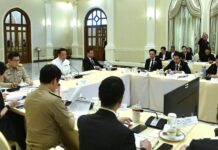
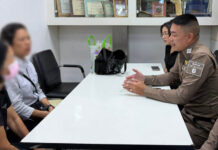
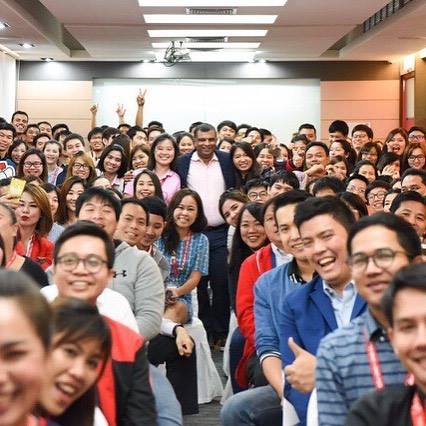
Yodchai Meepong, fourth from right, poses with police next to the taxi he is accused of stealing Saturday morning in Bangkok.
BANGKOK — Phaholyothin police officers arrested a man Saturday morning who claimed to have robbed a taxi because of “orders inside his head.”
Phaholyothin police officers were reported the robbery of an orange taxi at 1:30am on Saturday. Theppitak Taptong, the 31-year-old driver, told officers that he picked up a passenger from Ngamwongwan Road to Vibhavadi Hospital. However, the man refused to leave the vehicle upon reaching the destination and threaten the driver to continue driving after making his way to the front seat. Theppitak, afraid of the consequences, jumped out of the vehicle and called 191.
“The robber yelled ‘Yo, drive! Don’t stop, don’t cut off the engine,’ and the taxi driver sensed that the man had a knife with him. That is why he decided to flee from the vehicle,” Phaholyothin police chief Col. Narush Moolasartsathron said.
Thanks to the vehicle’s GPS, police officers tracked down the taxi until they reached the suspected car thief’s apartment in Soi Ram Inthra 21. Yodchai Meepong, 29, was subsequently arrested. He was unarmed.
Police said Yodchai confessed and claimed to have heard a voice in his head commanding him to commit the robbery, adding that the voice ceased after he stole the taxi.
Police said they charged Yodchai with theft.
Correction: An earlier version of this story misstated the rank of Phaholyothin police chief Narush Moolasartsathron. He is a colonel in the force and not a general.
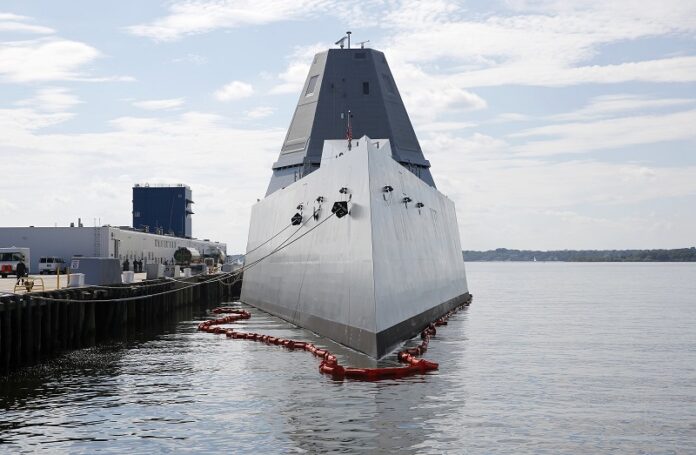
The USS Zumwalt sits at dock on Friday at the naval station in Newport, United States. Photo: Michael Dwyer / Associated Press
NEWPORT, United States — The Navy gave a first look inside the stealthy and futuristic Zumwalt destroyer on Friday during the ship’s first port stop at a Rhode Island naval station.
The 610-foot-long warship has an angular shape to minimize its radar signature and cost more than $4.4 billion. It’s the most expensive destroyer built for the Navy.
It’s headed from Naval Station Newport to Baltimore, where it will be commissioned in October before going to its homeport in San Diego. It was built at Bath Iron Works in Maine.
During a tour, the Navy showed off the ship’s bridge, weaponry and mission center.
In the bridge, there are 180-degree windows and chairs for the ship’s captain and executive officer to command the vessel. They overlook two gun mounts that resemble cannon barrels. The Zumwalt’s powerful new gun system can unload 600 rocket-powered projectiles on targets more than 70 miles away.
In the mission center, about two dozen people can sit at consoles with multiple computer screens to plan missions, ranging from land attack and air defense to anti-submarine and anti-surface warfare and support for special operations forces. There’s a large flight deck and two small boats on board in a bay that special operation forces can use.
It looks like a much smaller vessel on radar and it’s quieter than other ships, which makes it hard to detect, track and attack.
Vice Adm. Tom Rowden mans, trains and equips the surface ships of the Pacific fleet, which will include the Zumwalt. He said Friday the Zumwalt will make a significant difference.
Its advanced technology and capabilities allow it to do a range of defensive and offensive missions, and project power, wherever it is needed, and that’s generating tremendous excitement within the Navy, Rowden said. He said the Zumwalt will be a “very stabilizing” sight for allies and partners, and perhaps a “menacing” sight for potential enemies.
And, the Zumwalt’s unique and significant capability to generate power could be used in ways perhaps not even envisioned yet, such as in the testing and use of laser and directed-energy weapons systems, Rowden said.
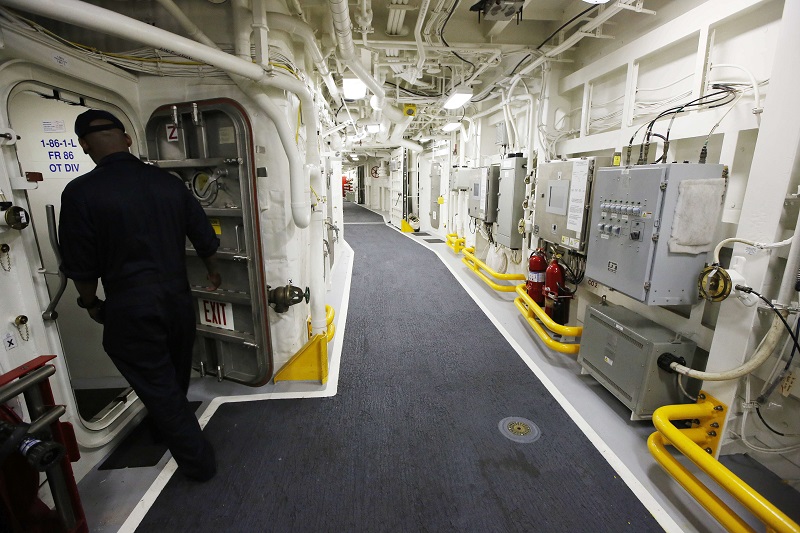
A sailor enters a doorway on the USS Zumwalt while at dock Friday at the naval station in Newport, United States. Photo: Michael Dwyer / Associated Press
“We have the embodiment of the spirit of technological breakthroughs and the future of our Navy. I think we have the embodiment of Adm. Bud Zumwalt,” Rowden said. “And I think as you combine those, and many other things together, what you really see is, tremendous, tremendous opportunity.”
The ship is named after the late Adm. Elmo “Bud” Zumwalt, who earned the Bronze Star in World War II and commanded small boats that patrolled the Mekong Delta in Vietnam. He became the youngest chief of naval operations and earned a reputation as a reformer, who fought racism and sexism.
Capt. James Kirk, the ship’s commanding officer, has pictures of Zumwalt and books about him in his office. Kirk said that the ship’s commissioning will bring the admiral’s legacy as a reformer back into the fleet.
Kirk said the Zumwalt’s crew of 147 officers and sailors possess a high level of technical expertise, great teamwork and mental and physical toughness.
When asked about the inevitable comparisons of the Zumwalt to Star Trek’s Starship Enterprise and the skipper to the fictional Captain Kirk, the real Capt. Kirk said it does come up “every now and again,” but noted that he was named after his grandfather and his parents weren’t Trekkies.
“But the first day I showed up at the Naval Academy, someone said, ‘I can’t wait till you’re a captain,'” he said with a smile.
Additional equipment will be installed on the ship in San Diego, systems will be tested and the crew will train. Rowden said training and testing will last through 2017 and into 2018. He didn’t speculate when the first deployment will happen.
U.S. Sen. Jack Reed, a Rhode Island Democrat, visited the Zumwalt on Friday, and he and Rowden said technologies aboard will likely be added to other classes of Navy ships moving forward.
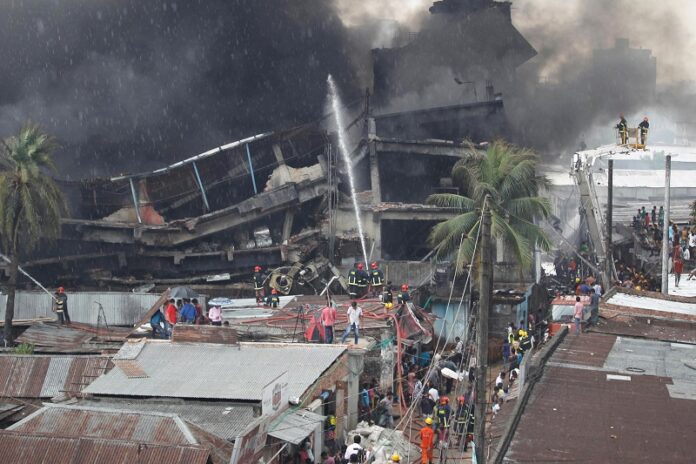
Firefighters and local people work together to put out the fire on Saturday at a packaging factory in Tongi industy area outside Dhaka, Bangladesh. Photo: A. M. Ahad / Associated Press
NEW DELHI, India — A boiler exploded and triggered a fire at a packaging factory near Bangladesh’s capital, leaving at least 12 people dead and 16 others injured on Saturday, officials said.
Several bodies were recovered from the five-story Tampaco Foils Ltd. factory in the Tongi industrial area outside Dhaka, fire official Mohammed Rafiquzzaman said. A doctor on duty at the Tongi Hospital said nine bodies were in the mortuary as officials waited for family members to identify them.
Nineteen people were brought to the state-run Dhaka Medical College Hospital, where three of them succumbed to burn injuries, said police official Mohammed Bacchu Mia.
Local TV stations said about 50 people were injured, indicating that the death toll could be higher.
Factory safety is a major concern in Bangladesh, which has thousands of garment and packaging factories that supply products to global clothing chains like America’s Wal-Mart and Sweden’s H&M.
In 2012, a devastating fire at a garment factory killed 112 workers. A year later, a multi-storied commercial complex housing five garment factories and offices collapsed, killing 1,135 people, mostly garment workers near Dhaka.
Rafiquzzman said the upper three floors of the factory were damaged because of the huge impact of the explosion and subsequent fire.
The accident took place as Bangladesh was preparing for a weeklong holiday for the Islamic festival of Eid al-Adha that falls on Tuesday. Most of the factory workers, who are from rural Bangladesh, usually go on leave to celebrate the festival with families.
The major accidents prompted Bangladesh’s government, global brands and the United Nations to work together for improving safety standards in the South Asian country’s factories.
Several major retailers, including some from North America and Europe, say Bangladesh’s factories have improved their safety conditions significantly over the last few years following the 2013 Rana Plaza building collapse, the country’s worst industrial disaster.
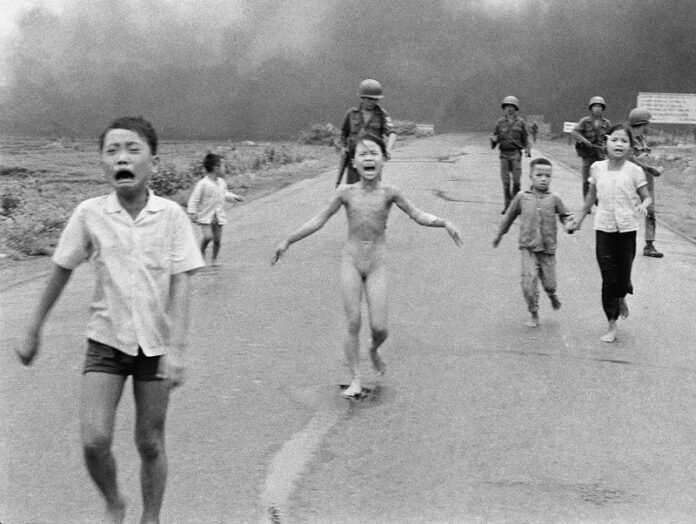
'Napalm Girl', the Pulitzer Prize-winning image by Associated Press photographer Nick Ut, is at the center of a heated debate about freedom of speech in Norway after Facebook deleted it from a Norwegian author’s page last month. Photo: Nick Ut / Associated Press
COPENHAGEN, Denmark — Facebook on Friday reversed its decision to remove postings of an iconic 1972 image of a naked, screaming girl running from a napalm attack in Vietnam, after a Norwegian revolt against the tech giant.
Protests in Norway started last month after Facebook deleted the Pulitzer Prize-winning image by Associated Press photographer Nick Ut from a Norwegian author’s page, saying it violated its rules on nudity.
The revolt escalated on Friday when Norwegian Prime Minister Erna Solberg posted the image on her profile and Facebook deleted that too. The brouhaha is the latest instance in which Facebook’s often opaque process for deciding what stays and what goes on its network has spurred controversy.
“It’s an interesting dilemma because you’ve got a newsworthy historical image that has been published by traditional news media that was effectively censored by a social network,” said Steve Jones, University of Illinois at Chicago communications professor.
Initially, Facebook stood by the decision, saying it was difficult to create a distinction between allowing a photograph of a nude child in one instance and not others. But late Friday it said it would allow sharing of the photo.
“In this case, we recognize the history and global importance of this image in documenting a particular moment in time,” Facebook said in a statement. “Because of its status as an iconic image of historical importance, the value of permitting sharing outweighs the value of protecting the community by removal, so we have decided to reinstate the image on Facebook where we are aware it has been removed.”
… there is nothing about this picture that is prurient. How can we not publish this picture? It captures the horrors of war. It captures the terrible situation of innocents caught in the crossfire of the war.”
Politicians of all stripes, journalists and regular Norwegians had backed Solberg’s decision to share the image.
The prime minister told Norwegian broadcaster NRK she was pleased with Facebook’s change of heart and that it shows social media users’ opinions matter.
“To speak up and say we want change, it matters and it works. And that makes me happy,” she said.
The image shows screaming children running from a burning Vietnamese village. The little girl in in the center of the frame, Kim Phuc, is naked and crying as the napalm melts away layers of her skin.
“Today, pictures are such an important element in making an impression, that if you edit past events or people, you change history and you change reality,” Solberg told the AP earlier Friday, adding it was the first time one of her Facebook posts was deleted.
Solberg later reposted the image with a black box covering the girl from the thighs up. She also posted other iconic photos of historic events, such as the man standing in front of a tank in Beijing’s Tiananmen Square in 1989, with black boxes covering the protagonists.
Like its Scandinavian neighbors, Norway takes pride in its freedom of speech. It’s also a largely secular nation with relaxed attitudes about nudity.
Several members of the Norwegian government followed Solberg’s lead and posted the photo on their Facebook pages. One of them, Education Minister Torbjorn Roe Isaksen, said it was “an iconic photo, part of our history.”
Many of the posts were deleted but Isaksen’s was still up Friday afternoon. The photo was also left untouched on a number of Facebook accounts, including the AP’s.
It would be physically impossible for the company to comb through the hundreds of millions of photos posted each day, so it relies on user reports and algorithms to weed out pictures that go against its terms of service.
Photos are often automatically removed if enough people report them. Facebook usually does not proactively remove photos, with some exceptions, such as child pornography.
Because of this, what photos aren’t always treated consistently, and sometimes Facebook reinstates reported photos after removing them.
It can also adjust its standards depending on the response. Breastfeeding and mastectomy photos used to be deleted, but after much outcry the company adjusted its policy on nude photos to allow most of such photos. In another case, a court ruled Facebook could be sued after a man’s account was suspended after he posted “The Origin of the World,” by Gustave Courbet, an 1866 French painting of a nude model exposing her genitalia.
“illegal content should vanish from the Internet, not photos that move the whole world.”
The issue in Norway “points out there’s very little transparency,” Jones said. “We really don’t know how these decisions are made so there’s not a lot of accountability either necessarily.”
Norwegian newspaper Aftenposten published the Vietnam photo on its front page Friday and also wrote an open letter to Facebook founder Mark Zuckerberg in which chief editor Espen Egil Hansen accused the social media giant of abusing its power.
Hansen said he was “upset, disappointed – well, in fact even afraid – of what you are about to do to a mainstay of our democratic society.”
The uproar also spread outside of Norway, with the head of Denmark’s journalism union urging people to share Hansen’s open letter. Germany’s Justice Minister Heiko Maas, who has previously clashed with Facebook over its failure to remove hate speech deemed illegal in Germany, also weighed in, saying “illegal content should vanish from the Internet, not photos that move the whole world.”
Facebook’s statement said it will adjust its review mechanisms to permit sharing of the image going forward.
“We are always looking to improve our policies to make sure they both promote free expression and keep our community safe, and we will be engaging with publishers and other members of our global community on these important questions going forward,” it said.
Paul Colford, AP vice president and director of media relations, said: “The Associated Press is proud of Nick Ut’s photo and recognizes its historical impact. In addition, we reserve our rights to this powerful image.”
Before it was published 44 years ago, AP also had a discussion about the image because it violated the news agency’s policy on full-frontal nudity.
Hal Buell, then AP’s executive news photo editor in New York, said he received a message from Saigon photo editor Horst Faas saying a “controversial picture” was coming up.
“Maybe we discussed it on the desk for 10-15 minutes,” said Buell, who is now retired. “But there is nothing about this picture that is prurient. How can we not publish this picture? It captures the horrors of war. It captures the terrible situation of innocents caught in the crossfire of the war.”
AP published the image and media worldwide used it, though some chose not to, Buell said.
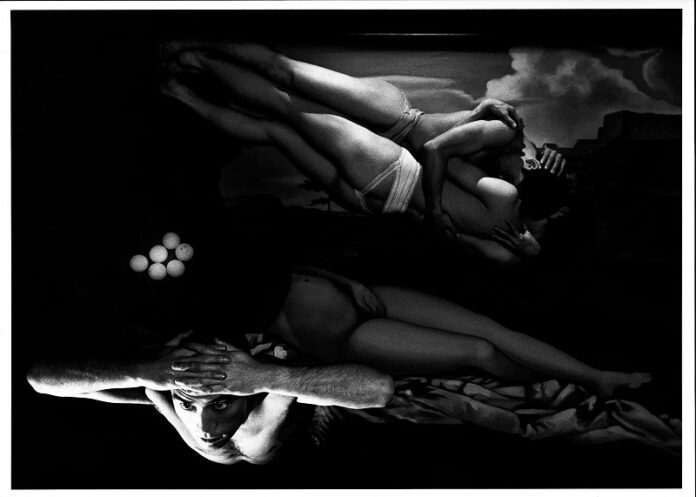
‘Barakei: Ordeal by Roses’ taken in 1961 by Eikoh Hosoe. Photo: The Japan Foundation / Courtesy
BANGKOK — Japan’s World War II aftermathwill be on display for a month in a rarely seen exposition of 123 monochromatic photographs in Bangkok.
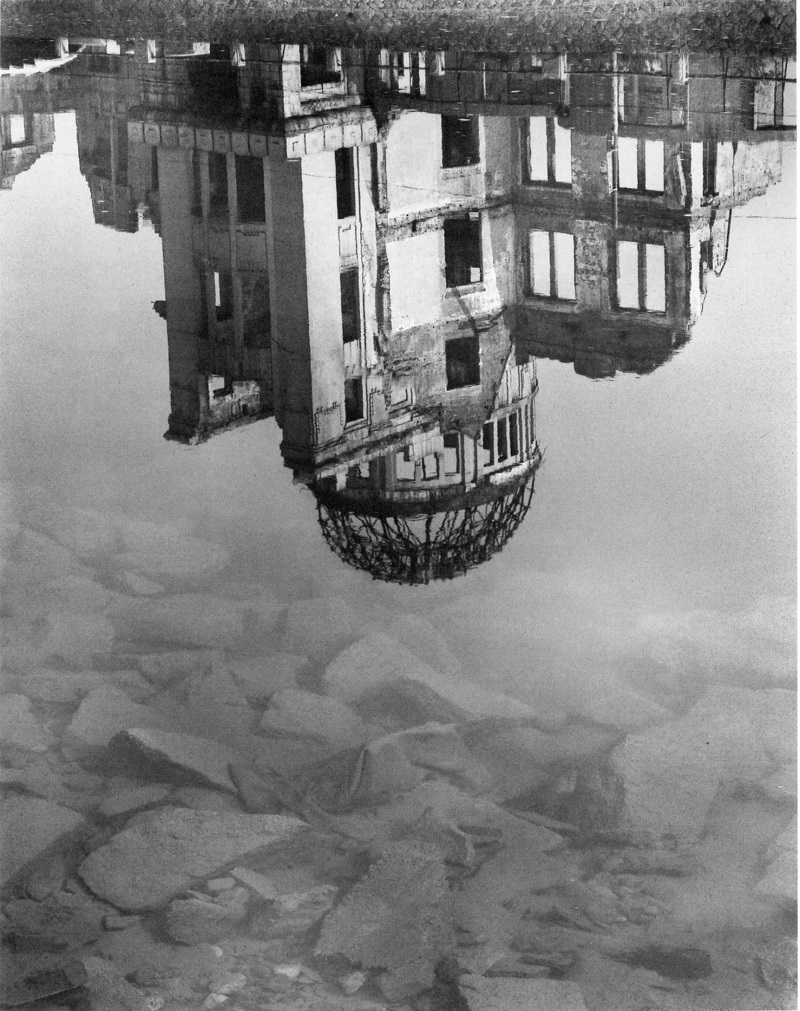
“Metamorphosis of Japan After the War” features 123 images of postwar Japan from 1945 to 1964, in the period between the nuclear massacres of Hiroshima and Nagasaki, and the year of the Tokyo Olympic Games, the first of their kind in Asia.
The exhibition is divided into three sections: Aftermath of War, Between Tradition and Modernity and Towards a New Japan. All selected images were taken by 11 Japanese photographers.
The exhibition will take place Sept. 17 to Oct. 14 at the Ratchadamnoen Contemporary Art Center.
Admission is free. The museum on Ratchadamnoen Road opens from 10am to 7pm, Tuesday through Sunday.
The Hiroshima Peace Memorial, commonly known as Atomic Bomb Dome, and Ohta River taken by Kikuji Kawada. Photo: The Japan Foundation / Courtesy
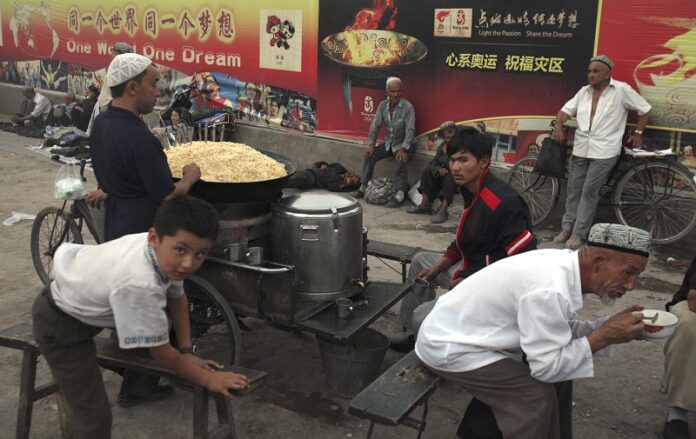
Uighurs rest near a food stalls and Beijing Olympic Games billboards in 2008 in China's western Xinjiang province. Photo: Ng Han Guan / Associated Press
BEIJING, China — They have been praised by the leader of al-Qaida and wooed by the head of the Islamic State group. They have distinguished themselves on battlefields in Syria and are accused of carrying out a devastating bombing in Thailand.
In the past two years, militants belonging to the Uighur ethnic group native to the vast Xinjiang region in western China have shown signs of becoming a force in Islamic extremism globally, a development that is reshaping both the ground war in Syria and Chinese foreign policy.
The predominantly Muslim, Turkic-speaking people – ethnically distinct from China’s Han majority – have chafed for decades under Beijing’s heavy-handed rule. Uighur separatists belonging to the East Turkestan Islamic Movement (ETIM), a militant group based in the rugged tribal areas of nearby Afghanistan and Pakistan and allied with al-Qaeda, have been blamed for attacks in Chinese cities, often using crude but effective weapons such as knives, Molotov cocktails and speeding vehicles.
Their activities have taken on a transnational dimension in recent years as hundreds of Uighur fighters have flowed into Syria to participate in jihad. And instead of targeting China’s cities, militants have struck less guarded overseas targets.
The reach of ETIM, which seeks to establish an independent Islamic state called East Turkestan, was highlighted most recently when a man crashed a van packed with 100 kilograms (220 pounds) of TNT into the Chinese diplomatic compound in Bishkek, Kyrgyzstan, killing himself and wounding five people. Kyrgyz officials on Tuesday identified the bomber as Zoir Khalimov, an ethnic Uighur member of ETIM who carried out the attack with support from the Nusra Front, the al-Qaida affiliate in Syria.
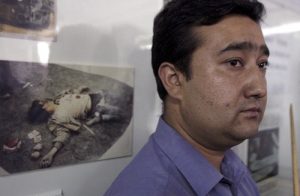
A Uighur official stands near a picture of a dead separatist militant at an exhibition in 2003 China’s western Xinjiang province. Photo: Ng Han Guan / Associated Press
In Thailand, a trial began last month for two Uighur men charged with an August 2015 bombing that killed 20 people at a busy Bangkok shrine. The attack came weeks after Thailand forcibly repatriated scores of Uighurs to China, where they faced persecution. Chinese officials said the Uighurs were on their way to fight in Syria when they were arrested.
Analysts see the broad outlines of metastasizing Uighur militancy that has prompted a response from China, which has traditionally abided by a foreign policy of non-interference.
“China’s calculus is shifting because the threat picture is shifting from one in which only the Americans and Europeans were targets,” said Raffaello Pantucci, director of international security studies at the Royal United Services Institute, a British think tank. “That’s why you’re seeing Beijing push out. It’s a combination of the new Chinese foreign policy assertiveness but also a real concern about what’s happening on the ground.”
In mid-August, China dispatched a senior People’s Liberation Army admiral, Guan Youfei, to meet with Syrian Defense Minister Fahad Jassim al-Freij and a senior Russian military official in Damascus to discuss expanding Chinese support for their war effort.
China has made similar moves closer to home. This year, it pledged equipment and counterterrorism training for Afghan police with the aim of containing ETIM. It has also expanded its role as a mediator, welcoming both President Ashraf Ghani and Taliban representatives to China on visits and brokering low-level talks between the sides.
In 2015, Uighur fighters from ETIM, also referred to as the Turkistan Islamic Party (TIP), began flowing from Central Asia into Syria, according to propaganda videos from the group’s Islam Awazi media arm. They have won battles against loyalist forces in Idlib and Aleppo provinces, at times deploying suicide attackers to decisive effect. Although exact numbers are impossible to confirm, analysts believe there are hundreds, possibly more than a thousand, Uighurs fighting alongside the Nusra Front, said Beirut-based analyst Haytham Mouzahem.
“China should evaluate its own policies to find the source of Uighur discontent.”
Separately, the Islamic State group, which competes with the Nusra Front for recruits, has at least a hundred Uighur fighters, most of whom came directly from Xinjiang to escape religious persecution in China, according to leaked IS documents analyzed by the New America Foundation think tank.
Uighur groups in exile and international human rights monitors say China plays up the threat of Uighur militancy to justify abusive law-enforcement policies and religious restrictions in Xinjiang, which have fueled resentment among ordinary citizens. ETIM’s organization may also be overestimated, experts warn, because it is unclear to what extent they offered training or support to perpetrators of attacks.
“China should evaluate its own policies to find the source of Uighur discontent,” overseas Uighur spokesman Dilxat Raxit said in a statement this week following the Kyrgyzstan investigation. “The Kyrgyzstan incident could supply China with more excuses to oppress and expand its influence in Central Asia for its political purposes.”
China has been sensitive to international criticism of its policies in Xinjiang while casting itself as a target of terrorism similar to Western countries. It has successfully lobbied the United States, the European Union, Russia, Britain and other governments to recognize the Turkistan Islamic Party as a terrorist organization.
“The long-established conflict between China and Uighur opposition is getting more and more connected to regional and global currents of radical Islamism.”
“I would to stress that East Turkestan terrorist forces headed by the ETIM have plotted and undertaken terrorist attacks many times inside and outside China,” Foreign Ministry spokeswoman Hua Chunying said Wednesday, while vowing to “strike back” at the group.
Chinese anti-terrorism expert Li Wei said the extremist threats that China faces domestically and from abroad are now “inextricably linked, just like with other countries,” leading China to expand its dealings in Syria and Afghanistan.
“I think the international community would agree that Syria is a nexus of global jihad that does threaten the entire world,” said Li, director of the anti-terrorism research center at the China Institute of Contemporary International Relations, a think tank under the Ministry of State Security, China’s main intelligence agency.
Despite its shifting posture, Chinese observers say the likelihood of the People’s Liberation Army fighting directly in Syria and Afghanistan remains extremely low. Over the last decade, China has leaned on Pakistan to carry out drone strikes against TIP commanders in tribal Waziristan, pressured Central Asian allies for intelligence-gathering and sought help from Thailand — but never deployed troops.
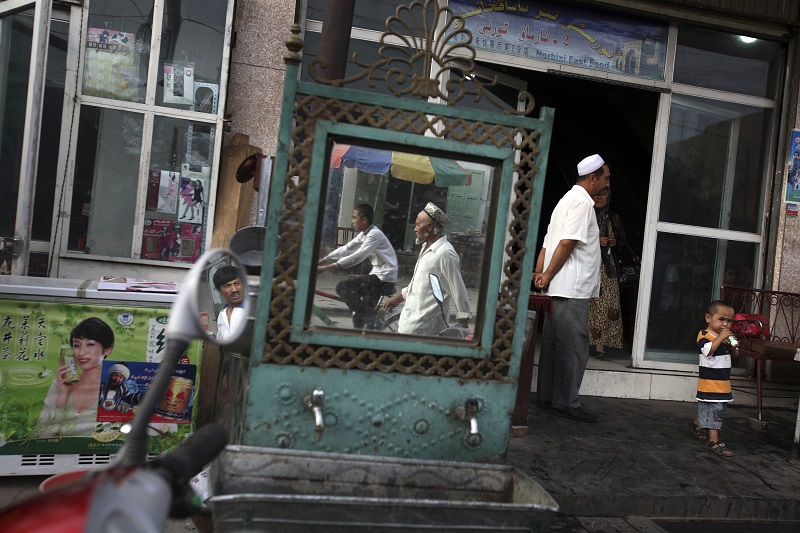
Uighurs are seen outside a restaurant in 2008 in China’s western Xinjiang province. Photo: Ng Han Guan / Associated Press
“China can participate in Syria in direct or indirect ways,” said Yue Gang, a retired PLA colonel and commentator on military affairs in Beijing. “Currently, the indirect path is better. In the future it can provide a variety of equipment or arms support for Russia and Syria but dressed up as something more pleasant-sounding, like humanitarian aid.”
China’s increasing willingness to confront Uighur militants abroad mirrors global jihadi networks’ growing interest in their cause.
In the 1990s, the Taliban – no strangers to fighting communists – sheltered Uighur separatists but forbade them from launching attacks on China from Afghanistan and Pakistan, fearing that would anger Beijing, according to writings by the jihadi Abu Musab al-Suri.
And in the years before the Sept. 11 attacks, published interview transcripts show Osama bin Laden downplaying the Uighurs’ plight or claiming ignorance of them altogether. Instead, he argued that Chinese leaders and Muslims should unite against what he considered to be common enemies like the United States and Israel.
His successor, Ayman al-Zawahiri, takes a starkly different approach, decrying China as an enemy. He opened a recorded message to his followers in July by praising Uighurs’ dedication to global jihad and lambasting “Chinese invaders” as “atheist occupiers” of Xinjiang.
Islamic State group leader Abu Bakr al-Baghdadi has also prominently decried Chinese oppression of Muslims while laying out a vision of an Islamic caliphate stretching from Morocco to Xinjiang.
Michael Clarke, a researcher at Australian National University, said competition for Uighur recruits between al-Qaida and Islamic State explained the heightened rhetoric, but also underscored the more complicated landscape facing China.
“Since the 1990s the discourse has changed,” Clarke said. “The long-established conflict between China and Uighur opposition is getting more and more connected to regional and global currents of radical Islamism.”
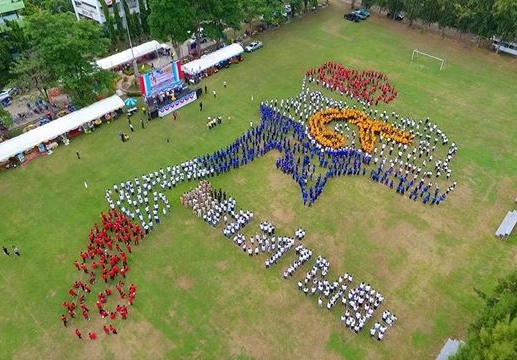
KHON KAEN — Hundreds of people turned out for a mass performance in honor of His Majesty the King in Khon Kaen province on Friday, which marked the ninth day of the year’s ninth month, a date considered auspicious by many Thais.
Meant as a gesture of loyalty to King Bhumibol, the ninth monarch of his line whose health condition has worsened recently, hundreds gathered on a football field in the province’s Tha Pra district to arrange in a likeness of Thailand’s map with a Thai numeral nine in the middle.
A statement released by the Royal Household Bureau on Wednesday said King Bhumibol was undergoing continuous dialysis, a treatment for patients suffering kidney failure.
The king was also suffering a blood infection, though his condition is gradually improving, the statement said.
His Majesty the King has spent much of the last seven years at Siriraj Hospital. His fragile health is a cause of concern for many Thais, who see him as the spiritual leader of the nation.
The Stock Exchange of Thailand plunged sharply since the palace released word of his condition on Sept. 2 and posted losses Friday for the third day straight.
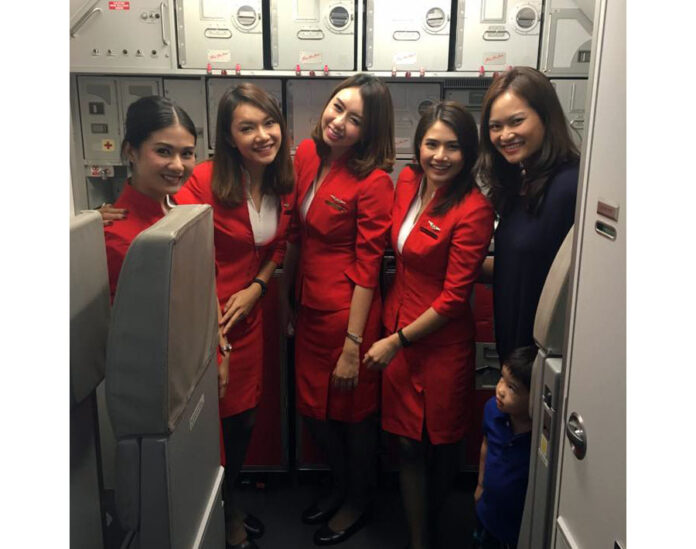
Flight attendants in an image posted by training school Skycoach Maam. Photo: Skycoach Mam / Facebook
BANGKOK — Suttinun Maneelorsawas is a former flight attendant of 13 years who now coaches women aspiring to the job. After a recent incident in which a senior flight attendant had to grovel at the feet of a passenger, she said she would warn her cadets to be prepared to do the same.
“I think I’m going to talk about it with my students, so that they can prepare themselves. It’s a study case,” Sutthinun said by telephone Friday.
She was referring to what has been obsessively discussed online this past week: reports that a Thai AirAsia stewardess was ordered by her supervisors to graab, or kowtow, in apology to an angry passenger. The airline insists she prostrated herself voluntarily.
Whether or not the act of humility was forced, the incident and its response suggests a public expectation that airline crew provide subservient service whereas their role is actually about ensuring safety, according to several people who work in the industry.
“In fact, flight attendants are not there to provide service, but to ensure that everything runs smoothly in accordance with standards,” said Chula Sukmanop, the head of the Civil Aviation Authority. “The point isn’t servicing customers but to provide safety.”
Accounts of what happened indicate the chain of events that led to the flight attendant on her knees before the angry disgruntled passenger was when the stewardess, identified as Awatsara, inquired about the needs of the passenger’s developmentally disabled daughter.
The passenger, Jumpoon Chavasiri, took offense to either what Awatsara said or how she spoke.
Attempts to reach Jumpoon by a number listed for her were unsuccessful. Both women had deactivated their Facebook accounts as of Thursday.
‘Their jobs are much more than waiters and waitresses. But people like to think of it that way.’
Sutthinun, owner of Skycoach Mam, said she sympathized with Awatsara because it was her job to ask the question, so the crew could prepare appropriate measures. Based on her personal experience as a former stewardess, she said, most arguments and misunderstandings between cabin crew and passengers result from safety issues.
“For example, I told them not to place their bags in certain places, but they wanted to do it anyway,” Sutthinun said.
Damrong Waikanee, president of Thai Airway’s union, said he’s frustrated by the perception of air hostesses as “people in makeup.”
“When there’s no incident, you don’t feel that you have to listen to them,” Damrong said. “Sometimes passengers are too self-centered … some of them want to sit wherever they like, like in the aisles. But this is about safety. If something happens, you’d be the people who die.”
Yet passengers bring into the cabin a sense that they are there for service.
“Their jobs are much more than waiters and waitresses,” he said. “But people like to think of it that way.”
Sutthinun said if the public is better informed about roles and duties of airline crew such arguments would happen less often. Even airline advertisements sometimes focus too much on service, which may contribute to the misperception, she said.
“There needs to be more communication, but I do feel that it’s getting better these days,” Sutthinun said. “There are the media, and there many Facebook pages who talk about these issues … people are becoming more aware.”
To Graab Or Not to Graab
Damrong, the Thai Airways union president, said airlines should also support their employees and protect their dignity. He criticized AirAsia supervisors for allowing the graab incident to unfold.
“This is how I look at it. Apologizing to passengers is a good thing, but to graab? It’s overreaction. She shouldn’t have done it at all,” Damrong said. “It’s feudalistic. It’s inappropriate. In our culture, if we do something wrong, we just lift our hand and wai. That’s already okay.”
Chula of the aviation agency also disagreed groveling should be part of the job.
AirAsia CEO Tony Fernandes meets with the airline’s Thai staff Thursday in Bangkok in the wake of the kowtow incident. Photo: Tony Fernandes / Facebook
“It’s just too much,” Chula said.
Sutthinun said airlines investigate passengers’ complaints, and then question the flight attendants about the accusations before reaching any conclusions. Based from what she’s read in the media, AirAsia appears to have skipped this step, she noted.
“The air hostess didn’t get any chance to explain herself,” Sutthinun said.
And what should flight attendants do if they ever find themselves in Awatsara’s shoes?
Damrong said he would offer his apology even if he did nothing wrong, but he would not perform the graab because it is too humiliating. “Do executives ever graab in apology to employees when they do something wrong?” Damrong said.
Sutthinun said she would take a softer approach: she would perform the groveling act anyway.
“If I graab, and they feel better, if her daughter feels better, I would have done it,” Sutthinun said. “It’s job as a service provider. My graab wouldn’t cause trouble to anyone. I don’t think it would devalue my dignity as a human being in any way.”
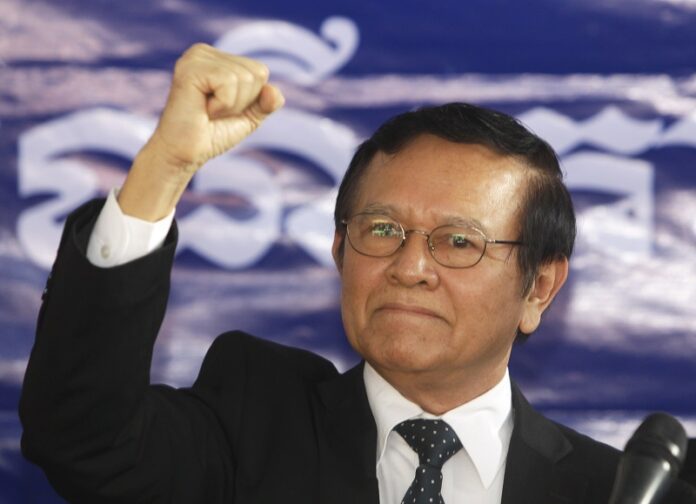
Cambodia's main opposition Cambodia National Rescue Party Deputy President Kem Sokha gestures in 2016 during a speech at the party headquarters in Phnom Penh, Cambodia. Photo: Heng Sinith / Associated Press
PHNOM PENH — A Cambodian opposition leader was sentence to five months in jail Friday in the latest face off between the government and opposition as political tensions around challenges to Prime Minister Hun Sen’s long-standing autocratic rule show no signs of easing.
Sam Sokong, a defense lawyer for Kem Sokha, deputy leader of the Cambodia National Rescue Party, said they will appeal the verdict after the trial that lasted just several hours.
“The trial conducted today did not comply with procedures” he said.
Kem Sokha, who was not in court for the trial, was convicted of twice ignoring a summons to appear in court to answer questions related to a case involving his alleged mistress. He refused, saying the legal moves were part of the ruling party’s plan to cripple the opposition.
Riot police were outside the court, and nearly 1,000 opposition supporters had gathered in front of their party headquarters, with riot police watching them from about 500 meters away. There were no reports of violence.
The case was one of several hanging over leaders of the opposition in what is generally seen as an effort to disrupt their organizing efforts ahead of local elections next June. The next general election is not until the middle of 2018, but holding power at the local level is an advantage when the national polls are held.
“We urge the authorities to adhere strictly to international fair trial standards during the criminal proceedings.”
Before the verdict, Kem appeared before his supporters and accused the government of using the court system to stop him from speaking out and to prevent him from taking part in the elections.
A statement issued this week by the U.N. High Commissioner for Human Rights expressed concern “about the escalating atmosphere of intimidation of opposition politicians, their supporters, civil society, and peaceful demonstrators in Cambodia.”
It noted “a host of legal charges” faced by Kem Sokha and 29 other opposition supporters.
It said 14 of them had been given heavy prison sentences despite raise serious concerns about the fairness of the proceedings. “We urge the authorities to adhere strictly to international fair trial standards during the criminal proceedings.”
One victim of the legal moves on the opposition has been opposition leader Sam Rainsy, who did not return from a trip abroad last November when an old conviction for defamation was restored and his parliamentary immunity was stripped by the government’s legislative majority. It had been generally assumed that the conviction, carrying a two-year prison sentence, had been lifted by a 2013 pardon which allowed Sam Rainsy to return from a previous period of self-exile. He also faces a stack of separate charges that could put him away for 17 years.
Activists and non-governmental organizations, which are generally critical of the government, have come in for similar kinds of legal pressures. Physical force has also been applied. Two opposition lawmakers were beaten up by a pro-government mob last year, and the murder of a prominent social critic, Kem Ley in July, allegedly by a man to whom he owed money, is widely regarded with suspicion.
The opposition has called on its followers to turn out to protest. It has strong support in the capital and street demonstrations have traditionally been an effective form of push-back. But recent efforts to take to the streets have been thwarted by a government show of force.
Hun Sen’s party was often accused of using violence or the threat of violence against opponents, but in recent years has stalked its foes mostly in the courts.
Hun Sen has been Cambodia’s leader for three decades. But in a general election in 2013, it seemed his grip on power was shaken when the Cambodia National Rescue Party mounted a strong challenge, winning 55 seats in the National Assembly and leaving Hun Sen’s Cambodian People’s Party with 68. The opposition claimed they had been cheated, and staged a boycott of parliament. Seeking to shore up his legitimacy, Hun Sen reached a political truce with them in 2014, making some minor concessions over electoral and parliamentary procedure.
But relations between the government and the opposition deteriorated last year after the opposition tried to exploit a volatile issue by accusing neighboring Vietnam, with which Hun Sen’s government maintains good relations, of land encroachment. The move proved politically popular, and the government reacted by stepping up intimidation of the opposition party in the courts, which are seen as being under its influence.
Hun Sen’s party was often accused of using violence or the threat of violence against opponents, but in recent years has stalked its foes mostly in the courts.
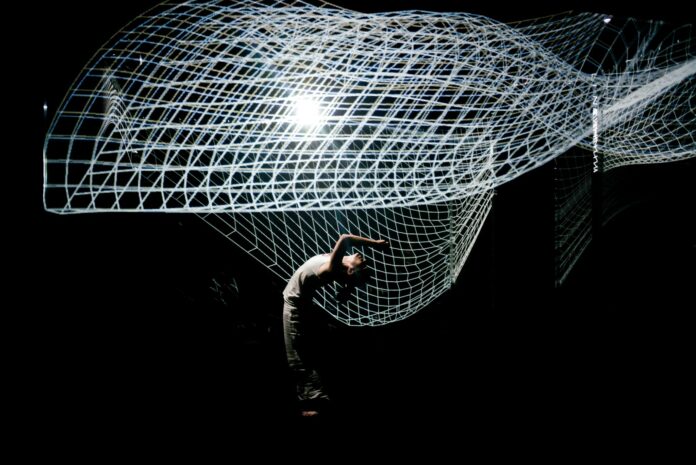
Akiko Kajihara performs ‘Hakanai’ in an undated photo file. Photo: Romain Etienne
BANGKOK — Meat and cyber spaces converge on stage for audiences at a dazzling dance performance combining the human body and technology next week.
At “Hakanai,” audiences sit around a performance space while an LED-powered cube of graphical projections envelope the dancer inside, blending choreography and art installation with graphics, sensors, electronic music and more.
Performed by Akiko Kajihara, the performance is staged by Adrien M & Claire B, a French theatre company known for digital art performances that explore the relationship between humans and dreams.
Hakanai is a Japanese term meaning a union of two elements: one alluding to the human and another to the dream. The word here is meant to capture something ephemeral, transitory and intangible.
The digital performance debuted in 2013 in France. The one-woman solo performance has traveled around the world.
Tickets are 1,000 baht and available online. Groups of four or more pay 500 baht per ticket, and students pay 400 baht.
“Hakanai” starts at 7:30pm on Sept. 13, 14 and 15 at the Sodsai Pantoomkomol Centre for Dramatic Arts. Those going are advised to pick up their tickets 30 minutes before the show.
The theatrical studio is located on the sixth floor of the Maha Chakri Sirindhorn building at Chulalongkorn University’s Faculty of Arts, can be reached by a few-minute walk from BTS Siam or MRT Samyan.
Akiko Kajihara performing in “Hakanai” in an undated photo file. Photo: Romain Etienne