


















32.2 C
Bangkok
Thursday, July 2, 2026
Home Blog Page 2744

Daniel Berrigan, Defiant Peace Activist, 94

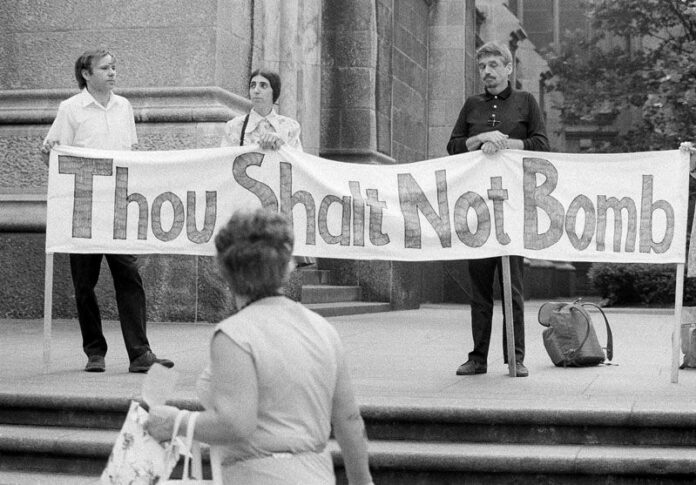
Rev. Fr. Daniel Berrigan and friends participate in a 1973 fast and vigil to protest the bombing in Cambodia, on the steps of St. Patrick’s Cathedral in New York City. Photo: Ron Frehm / Associated Press

NEW YORK — His defiant protests helped shape Americans' opposition to the Vietnam War. And they landed The Rev. Daniel Berrigan behind bars.

The Roman Catholic priest, writer and poet, who became a household name in the United States in the 1960s after being imprisoned for burning draft files in a protest against the war, died Saturday. He was 94.

Berrigan died after a "long illness" at Murray-Weigel Hall, a Jesuit health care community in New York City according to Michael Benigno, a spokesman for the Jesuits USA Northeast Province.

"He died peacefully," Benigno said.

Berrigan and his younger brother, the Rev. Philip Berrigan, emerged as leaders of the radical anti-war movement in the 1960s.

The Berrigan brothers entered a draft board in Catonsville, Maryland, on May 17, 1968, with seven other activists and removed records of young men about to be shipped off to Vietnam. The group took the files outside and burned them in garbage cans.

The Catonsville Nine, as they came to be known, were convicted on federal charges accusing them of destroying U.S. property and interfering with the Selective Service Act of 1967. All were sentenced on Nov. 9, 1968 to prison terms ranging from two to 3.5 years.

Berrigan wrote about the courtroom experience in 1970 in a one-act play, "The Trial of the Catonsville Nine," which was later made into a movie.

When asked in 2009 by "America," a national Catholic magazine, whether he had any regrets, Berrigan replied: "I could have done sooner the things I did, like Catonsville."

Berrigan grew up in Syracuse, New York, with his parents and five brothers. He joined the Jesuit order after high school and taught preparatory school in New Jersey before being ordained a priest in 1952.

Berrigan began writing poetry as a seminarian. His work captured the attention of an editor at Macmillan who referred the material to poet Marianne Moore. Her endorsement led to the publication of Berrigan's first book of poetry, "Time Without Number," which won the Lamont Poetry Prize in 1957.

Berrigan credited Dorothy Day, a social activist and founder of The Catholic Worker newspaper, with introducing him to the pacifist movement and influencing his thinking about war.

Much later, while visiting Paris in 1963 on a teaching sabbatical from LeMoyne College, Berrigan met French Jesuits who spoke of the dire situation in Indochina. Soon after that, he and his brother founded the Catholic Peace Fellowship, which helped organize protests against U.S. involvement in Vietnam.

Berrigan traveled to North Vietnam in 1968 and returned with three American prisoners of war who were being released as a goodwill gesture. He said that while there, he witnessed some of the destruction and suffering caused by the war.

While he was teaching at Cornell University, Berrigan's brother asked him to join a group of activists for the Catonsville demonstration. Philip Berrigan was at the time awaiting sentencing for a 1967 protest in Baltimore during which demonstrators poured blood on draft records.

"I was blown away by the courage and effrontery, really, of my brother," Berrigan recalled in a 2006 interview on the Democracy Now radio program.

After the Catonsville case had been unsuccessfully appealed, the Berrigan brothers and three of their co-defendants went underground. Philip Berrigan turned himself in to authorities in April 1969 at a Manhattan church. Four months later, the FBI arrested Daniel Berrigan at the Rhode Island home of theologian William Stringfellow.

Berrigan said in an interview that he became a fugitive to draw more attention to the anti-war movement.

The Berrigan brothers were sent to the federal prison in Danbury, Connecticut. Daniel Berrigan was released in 1972 after serving about two years. His brother served about 2.5 years.

Long after Catonsville, the Berrigan brothers continued to be active in the peace movement. Together, they began the Plowshares Movement, an anti-nuclear weapons campaign in 1980. Both were arrested that year after entering a General Electric nuclear missile facility in King of Prussia, Pennsylvania, and damaging nuclear warhead nose cones.

Philip Berrigan died of cancer on Dec. 6, 2002, at the age of 79.

Daniel Berrigan moved into a Jesuit residence in Manhattan in 1975.

In an interview with The Nation magazine on the 40th anniversary of the Catonsville demonstration, Berrigan lamented that the activism of the 1960s and early 1970s evaporated with the passage of time.

"The short fuse of the American left is typical of the highs and lows of American emotional life," he said. "It is very rare to sustain a movement in recognizable form without a spiritual base."

Berrigan's writings include "Prison Poems," published in 1973; "We Die Before We Live: Talking with the Very Ill," a 1980 book based on his experiences working in a cancer ward; and his autobiography, "To Dwell in Peace," published in 1987.

Story: Michael Balsamo / Associated Press
Advertisement

West of Bangkok Discover a Trove of Classic, Vintage and Strange Rides (Photos)

NAKHON PATHOM — Find chrome curves and steel spans of DeLorean, Ford, Citroen, Cessna and more just a short hour west of Bangkok.

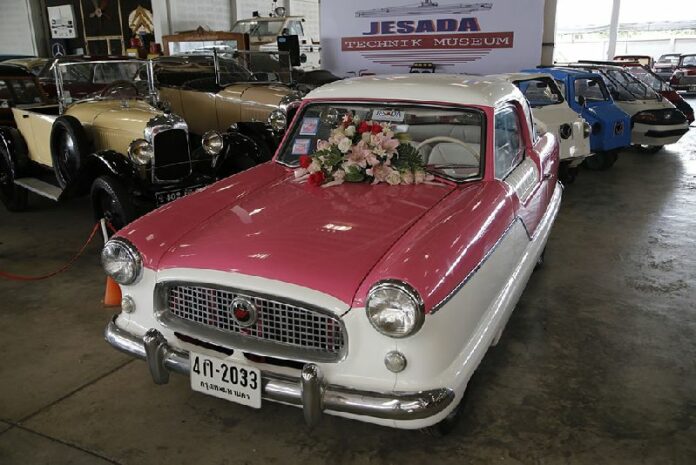
Despite terrible traffic and exorbitant taxes, Thailand’s vibrant car culture and love of the automobile might best found at in the collection of Jesada Deshsakulrith, one of kingdom’s most notable collectors, at Jesada Technik Museum.

Open to the public, the museum is home to hundreds of historic imported vehicles, from classic Hondas and Mustangs to vintage airplanes.

What makes this collection unusual is that all the cars are legally registered to drive on roads here. Importing second-hand cars is illegal; a form of protectionism against foreign competition. So how Jesada pulled off getting them all street-legal must have been quite a feat.

Here’s an inside look at some of Jesada’s classic cars and vintage vehicles.


DeLorean DMC-12

\

The DeLorean Motor Co. produced only one car, the DMC-12,  but it was granted timeless immortality in the ‘80s by “Back to the Future.” The body features a brushed stainless steel shell, one of the only cars in history to feature this design element. DeLorean went bankrupt under ugly conditions and shut down in 1983.


Volkswagen Kharmann Ghia

\

Italian design studio Ghia sculpted the lines for this iconic German car. In the 1960s it was Volkswagen’s flagship model, boasting the most features and a price to match: It cost about twice the price of a Beetle, Volkswagen’s entry-level offering.


Ford Mustang

\

The Mustang started as a project under Ford legend Lee Iacocca and grew into an American icon. The design created an entire legion of cars called “pony cars” such as the Chevy Camaro and Dodge Challenger. Ford introduced the car in 1964, and it’s still being produced.


Volvo P1800ES

\

Before Volvos evolved into the utilitarian “brick” design we know today, the iconic P1800 was futuristic and sexy. The model at Jesada Technik is the ES-designated model, which employs a “shooting brake” design.


BMW 250 Isetta

\

BMW introduced this microcar in 1955, and the world took notice. Drivers and passengers enter through a hinged door in the front, with the steering wheel and instrument cluster swinging out with it. A driver and passenger can fit comfortably in the car.


Citroen 2CV

\

This particular 2CV participated in the Mekong Road Classic. The 2CV debuted in 1948 and was produced until 1990. Jesada maintains a large collection of these vehicles.


Vespa

\

Vespa, or “wasp” in Italian, was conceived to navigate Italy’s post-war roads. They became popular as workhorse transports in Thailand because they can carry large loads due to their low centers of gravity.  


Cessna O-1 ‘Bird Dog’

\

Thailand played host to a number of U.S. air bases during its war with Vietnam, and the Bird Dog played an integral role as a reconnaissance plane. After the war ended, the surplus airplanes were left behind. Some were adopted by the Royal Thai Air Force, but many ended up in the hands of collectors, such as this example.


Audi 100

\

The Audi 100 received it’s name for its relatively low horsepower output of 100hp. It’s one of the most commercially successful models in the company’s history, although it was never imported to Thailand during the lifespan of the model.


Maserati Ghibli GT

\

Maserati didn’t find its stride as a brand until the early 2000s, but that didn’t stop the Ghibli GT from becoming somewhat of a ‘90s icon. With a twin-turbocharged 2.8 liter V6 it emits an unabashed Italian growl that’s won over enough motoring enthusiasts to gain respect.


Admission is free to the museum, which is open 9am to 5 pm every day except Monday.

If you lack your own vintage vehicle or other conveyance, travel by rail from the Bangkok Railway Station at Hua Lamphong to Salaya Railway Station in , a trip that takes about 35 minutes and costs about 200 baht. From Salaya, take a taxi the museum for a fare of about 100 baht. Alternatively hop on bus No. 124 from Pinklao Road to downtown Salaya and a taxi the rest of the way.

Advertisement

Fighting Rages in Aleppo, Syria

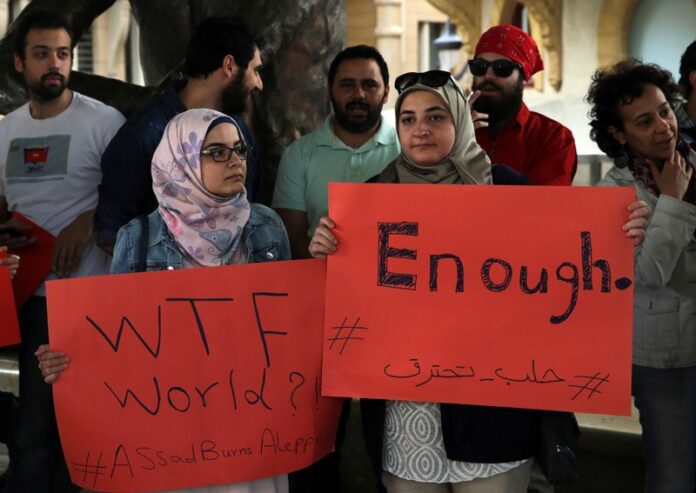
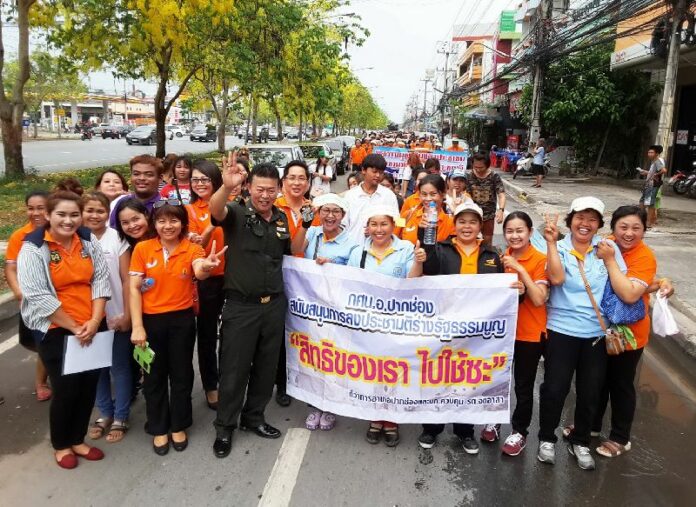
Protesters hold placards during a protest in downtown Beirut, Lebanon, on Saturday against Syrian President Bashar Assad's military operations against areas held by insurgents around the country, mostly in the northern city of Aleppo that has been the main point of violence. Photo: Bilal Hussein / Associated Press
BEIRUT — The Syrian government launched new airstrikes Saturday on insurgent-held neighborhoods in Aleppo while rebels shelled government-held parts of the northern city, as a truce in other parts of the country appeared to be holding on its first day.

Contested Aleppo, Syria's largest city and former commercial center, has been the scene of intense shelling and air raids, killing nearly 250 civilians over the past nine days, according to the Britain-based Syrian Observatory for Human Rights.

The surge in fighting has caused the collapse of a two-month cease-fire brokered by the U.S. and Russia. It also has raised fears of an all-out government assault on Aleppo.

The International Committee of the Red Cross warned that the intensification of fighting threatens to cause a humanitarian disaster for millions of people. A statement issued late Friday said four medical facilities on both sides of the city were hit earlier that day, including a dialysis center and a cardiac hospital. ICRC appealed to all parties in the conflict "for an immediate halt in the attacks."

"There can be no justification for these appalling acts of violence deliberately targeting hospitals and clinics, which are strictly prohibited under international humanitarian law," said Marianne Gasser, head of the ICRC in Syria. "People keep dying in these attacks. There is no safe place anymore in Aleppo."

"For the sake of people in Aleppo, we call for all to stop this indiscriminate violence," Gasser said.

Friday's attacks on the medical centers came after government airstrikes damaged a main hospital supported by Doctors Without Borders late Wednesday, killing more than 50 people, according to the international aid group.

Syrian opposition activists said Saturday's airstrikes on Aleppo killed four people and wounded many others, mostly in the neighborhood of Bab al-Nairab.

The Observatory and the Local Coordination Committees, another activist-run group, reported more than 20 separate air raids on rebel-held parts of the city, where an estimated 250,000 people remain.

State media said rebel shelling of government-held parts of Aleppo killed one man and wounded others.

Aleppo-based activist Bahaa al-Halaby said warplanes and helicopter gunships are launching very "intense bombardments."

Another activist in the city, who spoke on condition of anonymity out of safety concerns, said schools have been ordered closed in rebel-held parts of Aleppo.

Aleppo was excluded from a brief truce declared by the Syrian army on Friday. The truce went into effect after midnight Saturday in the capital Damascus and its suburbs as well as the coastal province of Latakia. Activists said the truce appeared to be holding in both areas on Saturday.

Anas al-Abdeh, the head of the opposition Syrian National Coalition, told reporters in Turkey that Aleppo should not be excluded from the truce. He added that his group has asked U.S. officials to contact Russia in order to make the government to stop its operations in the northern city.

"The United States noticed that the regime is not abiding by the truce," al-Abdeh said, without elaborating.

U.S. Secretary of State John Kerry is leaving for Geneva on Sunday, where he plans to hold meetings the following day with the U.N. envoy to Syria to discuss efforts to halt the violence and increase deliveries of humanitarian aid to besieged communities. Kerry spoke to Russian Foreign Minister Sergey Lavrov on Friday.

Government supporters say Aleppo should not be part of the truce brokered by the U.S. and Russia because al-Qaida's branch in Syria, known as the Nusra Front, is active there and in nearby areas.

In neighboring Lebanon's capital, Beirut, more than 100 people marched in the city center to protest Syrian government attacks, mainly those on Aleppo, calling them "war crimes." Lebanon is split between supporters and opponents of the rebellion against Syrian President Bashar Assad.

In Damascus, ICRC spokesman Pawel Krzysiek said that despite the difficult situation in Aleppo, which hinders humanitarian operations in the city, aid deliveries elsewhere continued. Humanitarian convoys entered separate areas besieged by rebels and government forces, he said.

The convoys, a joint operation between the ICRC, the United Nations and the Syrian Arab Red Crescent, began delivering aid to Madaya and Zabadani — two mountain resorts near Damascus that have been besieged by government forces.

Krzysiek added that 20 other trucks entered the northwestern villages of Foua and Kfarya, which are being besieged by insurgents.

The ICRC delivers food parcels and wheat flour, medicines, bed nets, crutches and anti-lice shampoo to all locations, he said.

The U.N. Office for the Coordination of Humanitarian Affairs said on its Twitter account Saturday that the aid delivery in the four areas will be large enough to serve 61,000 people.

Story: Bassem Mroue / Associated Press
Advertisement

Lese Majeste Filed Against Two Facebookers, Anti-Junta Activist

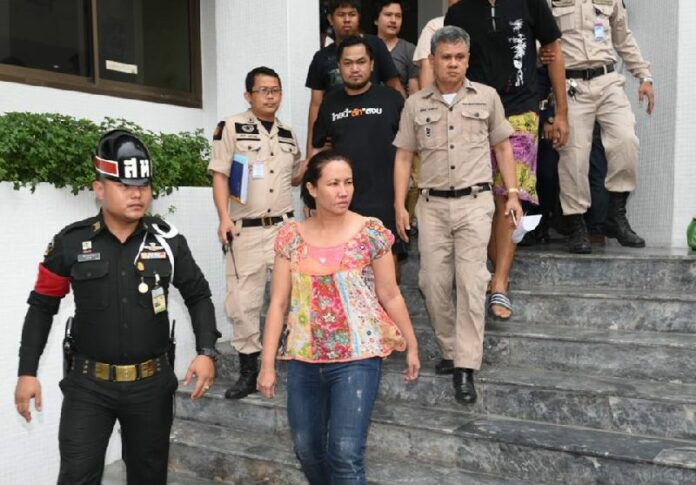
Nuttigar Woratunyawit is escorted to prison April 29, 2017, after bail was denied by a military court in Bangkok.

BANGKOK — Two Facebookers and an anti-junta activist detained by the military earlier this week have been charged with royal defamation, which carries maximum penalty of 15 years per offense.

Nuttigar Woratunyawit and Harit Mahaton were abducted from their homes by the military on Wednesday morning, while Burin Intin was arrested at a protest on the same evening held to demand their release.

Nuttigar and Harit are among the eight suspects police accused of being paid to run anti-government Facebook pages that insult the military government and its leader, Gen. Prayuth Chan-ocha. All eight will stand trial in a military court on charges of sedition and Computer Crime Act.

Several hours after the court ordered them held for trial, police filed an additional charge of lese majeste against Nuttigar and Harit, accusing them of insulting the Royal Family.

Harit Mahaton is brought to the martial court on Friday morning.

Police have not disclosed the nature of the royal defamation, but activist and lawyer Arnon Nampha told media the military found offensive language in a Facebook chat between the two suspects.

A lese majeste charge was also filed against Burin, who was detained along with a dozen protesters at the rally calling for the release of Nuttigar and Harit at Victory Monument on Wednesday.

While other protesters were released that night, Burin was taken away from police custody by soldiers and held at an undisclosed location until Saturday morning, when he was brought to the martial court to be indicted for lese majeste.

Lt. Col. Sanpetch Nuthong, an officer with the police’s online crime unit, told Matichon that Burin posted a 40 minute-video on his Facebook in which he insulted the monarchy several hours prior to the protest on Wednesday.

As with Nuttigar and Harit, the martial court refused to grant Burin release on bail.

Update: This story has been updated with Nuttigar’s preferred English spelling of her name.

Related stories:

Bail Denied to Facebookers, Lese Majeste Charges Weighed Against Them

Army Abductions: Activists Call for More Protests Despite Arrests

Protest Called for 10 Abducted by Military

Military Abducts at Least 4 Across Thailand

Advertisement

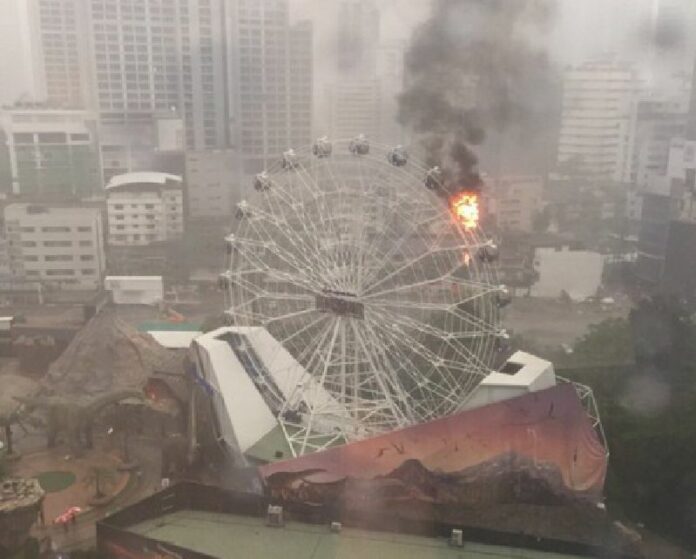
Fire Engulfs 'Dinosaur Planet' Ferris Wheel Cabin

Photo by Twitter user @suteeradas

By Teeranai Charuvastra
Staff Reporter

BANGKOK — A dinosaur-themed amusement park in Bangkok was forced to close down this afternoon by a fire that broke out on its giant ferris wheel.

No injury was reported in the incident which happened at around 3pm Saturday at Dinosaur Planet, which opened just a month ago. The fire appeared to have been extinguished.

It was unclear yet whether the fire was related to a powerful thunderstorm which erupted earlier today, but there were reports of power outages and transformers exploding in the same neighborhood.

An operator at Bangkok Fire and Rescue Department said cause of the fire is not yet determined, adding that there is no report of any casualties so far.
 

Calls to Dinosaur Planet went unanswered. 

According to reports on social media, the park briefly re-opened after the fire was put out, but the decision was later reversed and people were asked to leave. 

Local media also say that a rollercoaster got stuck while in operation at Dreamworld, another amusement park in Bangkok’s northern suburb. All passengers were safely evacuated.


Related stories:

Dinosaurs Come to Life at Bangkok’s Own Jurassic Park

Water Slide Goes Wrong

Uninsured ‘Fun Fair’ Shut Down in Korat


Teeranai Charuvastra can be reached at [email protected] and @Teeranai_C.


\

Advertisement

Bangkok Battered by Summer Storm (Photos)

BANGKOK — Thunder and lightning and buckets of rain opened up on the capital as storms hit much of the nation Saturday.

After a month of scorching Sun which saw a record-breaking heat wave and an unprecedented spike of electricity use, the City of Angels was showered with a relieving spell of rain showers since noon, as predicted by the Department of Meteorology. 


OMGWTFBBQ: Thailand Hasn't Been This Hot Since 1960


But the torrent of rain also means that traffic was snarled on some flood-prone roads, especially in downtown Sukhumvit.

However, there were no immediate reports of injury. Official website of Bangkok authority says that there is no severe case of flooding so far. 


\


\


\


Advertisement

Campaign Guideline Bans Campaigning Before Charter Vote

Allowed: a military-sponsored campaign in Korat on Friday urges voters to cast their vote in the upcoming referendum.

BANGKOK — Official guidelines of what is prohibited during the run-up to a referendum on the charter proposed as Thailand’s 20th constitution bars virtually all aspects of campaigning, such as persuading the public “to vote one way or another.”

The eight prohibitions issued by the Election Commission yesterday to clarify the scope of a separate law which outlaws any campaigning that uses “aggressive” or “rude” language – a vague definition that alarms many critics of the charter draft. 


‘Personal’ Campaigning Acceptable (If Charter Vote Isn’t Canceled)


But the guidelines replaced the ambiguity by seemingly banning all campaigns in one swoop, particularly prohibition No. 8, which bars “campaigning to persuade people in the society to vote one way or another, to incite unrest, or to obstruct voting.”

Other bans include disseminating or displaying information that is “factually inaccurate, rude, aggressive, inciting or intimidating,” whether in media interviews, pamphlets, T-shirts, or even “badges and ribbons.” 

Also banned are discussion forums not involving “legally registered” bureaucratic or media agencies. 

Violation of these rules are punishable by up to 10 years in jail.

Anurak “Ford” Jeantawanich, an activist who has been campaigning publicly against the charter draft, called the guidelines “a restriction of people’s rights and liberty.”

“It doesn’t benefit democracy in any way at all,” said Anurak, who leads a “vote no” group called Red Path. “They restrict everything, even what we say on T-shirts, badges, flags, ribbons and signs.” 

Because of the newly enacted referendum law, Anurak said his group is now suspending their campaign in order to “adjust” their activities accordingly.


Here’s a Khaosod English translation of the “Eight Don’ts” guideline published by the Election Commission:

1. Giving interviews to the media with remarks that are factually inaccurate, rude, aggressive, inciting or intimidating.

2. Spreading information that is factually inaccurate, rude, aggressive, inciting or intimidating on websites or electronic media, or forwarding such aforementioned information. 

3. Making or sending symbols or signs that are factually inaccurate, rude, aggressive, inciting or intimidating.

4. Organizing forums and panel discussion by any organization without participation of a legally registered bureaucratic agency, educational institute or media organization, with intent to incite political unrest.

5. Selling, distributing, or inviting others to wear shirts, signs, badges, flags, ribbons or symbols that express any kind of opinion in a campaigning manner that leads to political inciting. 

6. Using documents, leaflets or pamphlets that are factually inaccurate, rude, aggressive, or politically inciting.

7. Reporting news or hosting shows that leads to inciting or unrest in the society.

8. Campaigning to persuade people in the society to vote one way or another, to incite unrest, or to obstruct voting.


Related stories:

Prof Denies Breaking ‘Vague’ Referendum Law, Junta Spokesman Says She Did

Regional Monitors In, International Monitors Out for Charter Vote

Redshirts Alarmed by Vague Restrictions on Charter Campaigns


Teeranai Charuvastra can be reached at [email protected] and @Teeranai_C.


\

Advertisement

Press Freedom Isn’t Free

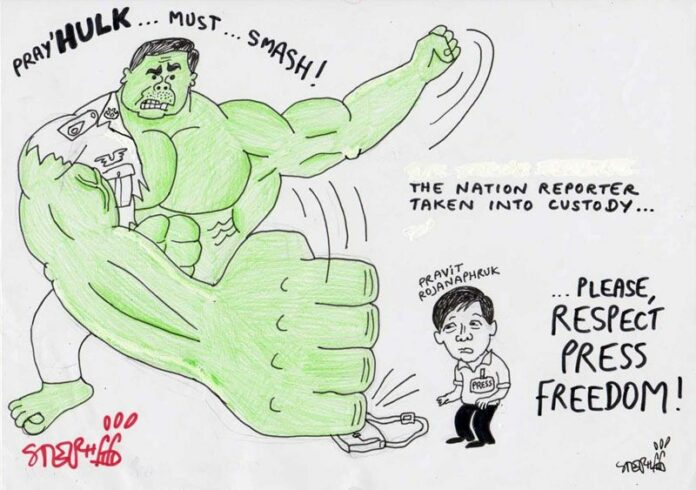
A political cartoon by Stephane 'Stephff' Peray created days after the May 2014 coup d'etat for The Nation, a daily English-language newspaper in Thailand. The Nation did not publish the cartoon.

By Pravit Rojanaphruk
Senior Staff Writer

\

Press freedom isn’t free, and the price is especially high under a dictatorship. People must fight to maintain it, as they must freedom in general. We cannot maintain freedoms of press and expression if we are not willing to pay the price in the face of threats and tyrannies.

I paid the price by being detained twice without charge for a total of 10 days since 2014. Today, I was to fly to Helsinki to attend the World Press Freedom Day celebration, an event co-organized by UNESCO and the government of Finland, under the invitation of the latter. 

\

I won’t be there Tuesday, however, as Thailand’s military regime has banned me from leaving the country.

Those are small prices to be paid, as journalists elsewhere face long-term detention or even assassination.

In Thailand, it is worth sticking it out against the junta, which prefers the much nicer name of “National Council for Peace and Order,” because freedom of the press is indispensable not just for a free-thinking society, but for any society wanting its people to coexist on the basis of rational thinking, mutual understanding and dignity. There can be no deliberation or empathy if society cannot publicly communicate and deliberate.

Journalists defending free expression are thus not only defending their rights, their indispensable tools of their trade but also the broader rights of society to think, express, articulate and debate publicly.

As I write these words, the crackdown on expression is spreading online.

On Thursday, eight  Facebook and social media users were charged with sedition for defaming junta leader Prayuth Chan-ocha, the general who led the coup in May 2014. Three of these eight netizens are now also charged of violating the draconian lese majeste law, which prevents people from speaking and writing critically about the monarchy under threat of long prison terms.

Dictators of all stripes try to suppress press freedom and free expression as they see a threat to their autocratic existence. Prayuth has ruled Thailand, deliberately turning it into Juntaland, by making his desires into law through the exercise of Article 44 of his junta’s interim constitution, a set of laws also written by the coup makers after they overthrew civilian rule. He now wields absolute power.

Thailand’s military dictatorship is squeezing the public sphere, on the streets and online. The junta is fearful of voices speaking freely – for free and critical thinking are antithesis to military unthinking, where orders must be unquestioningly obeyed. Dictatorships seek to rule over a docile and unthinking population no longer aware of its rights as individuals. The dictator would say: These are the laws, these are the orders, but you won’t go to prison if you don’t break them.

Nothing is said about whether the law and the order are legitimate. Nor is it asked, as most media in Thailand have treated this regime like just another elected and legitimate administration.

That enables dictatorship, which does not tolerate such questioning because it doesn’t have legitimate answers.

Dictators around the world censor because they fear reasoning. Questioning and reasoning undermine the coercion and fear fundamental to maintaining dictatorial rule. A free press and questioning public are threats to dictatorial rule because rational thinking is the opposite of dictator unthinking. It’s through free thought that the might of dictatorial rule becomes naked and illegitimate.

Expecting people to be silent and afraid of unjust punishment is unsustainable and runs against human nature, however. The thirst for freedom, including press freedom, cannot be suppressed, for freedom to think and express are what makes us fully human.

My duty as a journalist is to continue to scrutinize and criticize the powers that be, dictatorial or not. My duty is also to defend the limited press freedom and freedom of expression that society still has.

The junta probably expected that, after two detentions, euphemistically called “attitude adjustments,” and the travel ban, I would keep quiet. I cannot for so much is at stake for Thai society, and it would be tantamount to abandoning my duties as a journalist and citizen to merely watch Thailand turn into Juntaland. 

I try not to let fear triumph over faith and reason and hope that I will be able to have enough fortitude. Life is too short to be cowed.   

Today I am supposed to be flying to Helsinki, but the Thai military dictatorship is afraid of scrutiny and criticism, so they banned me from traveling as punishment for speaking out and calling them for what they are – an illegitimate regime. No amount of illegitimate power can change my mind or make them legitimate, however.

Others in Thai media have over the decades accrued sufficient love for free expression to resist continued attempts at censorship. I know I am not alone in the struggle for liberty in Thailand.

For my part, I will continue to resist the normalization of censorship and dictatorial unthinking, however.

Writer’s Note: This column will also be published by Paris-based Reporters Without Borders on World Press Freedom Day as part of its campaign against the curbing of press freedom by Thailand's military regime.

Advertisement

Police Probe ‘Leak’ of British Family Beating Video

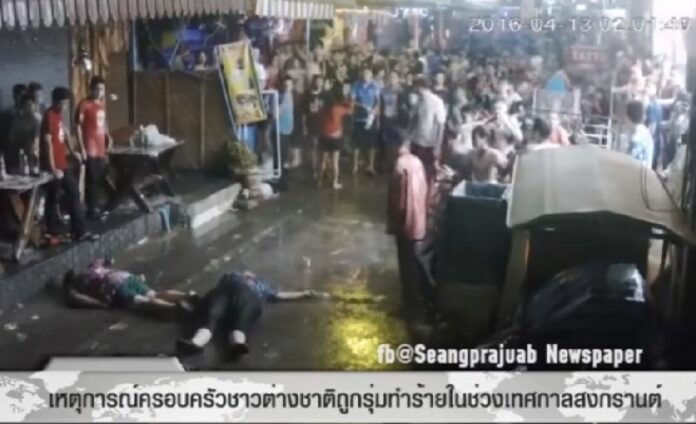
Scene from CCTV footage released online by a local newspaper in Hua Hin showing the aftermath of an April 13 attack that left a British family incapacitated during the Songkran festival.

By Teeranai Charuvastra
Staff Reporter

HUA HIN — A police commander said today an internal investigation has been launched into whether the footage of a savage assault of three British tourists in Hua Hin during the Thai New Year holiday was leaked from the police force.

Provincial police commander Kasana Jamsawang said Saturday the inquiry is a strictly internal matter, and netizens are still free to share the security camera footage of the April 13 attack, which left the three Britons unconscious on a street crowded with celebrating Songkran. 


Fourth Suspect Arrested for Assaulting British Family in Hua Hin


“This is an internal inquiry, because in the criminal investigation, video of the crime is considered evidence, so we want to know if any of the officers published it [without permission],” Maj.Gen. Kasana said. 

Kasana disputed a report from the second largest newspaper in Thailand, Daily News, which quoted him saying police would hunt down those responsible for publishing the video on social media because it damaged the reputation of Thailand and violated the rights of the victims.

According to Kasana, police will not take any legal action against netizens who share the footage. 

“It is not an offense under the Computer Crime Act,” Maj.Gen. Kasana said. “I merely raised a question to the reporter, does spreading the video violate rights of the victims?” 

Although the brutal attack happened April 13, it wasn’t until on Wednesday that the incident surfaced on the media, after a local newspaper obtained the security camera footage and shared it online. 

Three suspects had been arrested by then, and a fourth was charged Thursday. The four Thai men, now free on bail, are accused of causing grievous bodily harm by punching and kicking the  British family until they were knocked out in the street. 


Related stories:

Three Arrested Over Brutal Beating of British Family


Teeranai Charuvastra can be reached at [email protected] and @Teeranai_C.


\

Advertisement

For Girls and Gifts and Bribes, Cambodian-American Navy Commander Jailed 6.5 Years

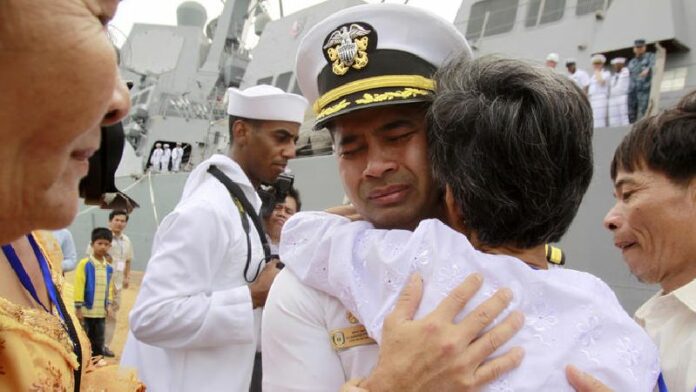
Cmdr. Michael Vannak Khem Misiewicz embraces his aunt at the port of Sihanoukville, Cambodia, in an emotional return to his birthplace in 2010. Photo: Heng Sinith / Associated Press

SAN DIEGO, Calif. — A Navy commander who fled Cambodia's killing fields as a boy to grow up to become a decorated U.S. military officer was sentenced Friday to 78 months in prison for providing classified ship schedules in exchange for the services of prostitutes, theater tickets and other gifts from a Malaysian defense contractor.

A federal judge in San Diego gave Captain-select Michael Vannak Khem Misiewicz, 48, the longest sentence handed out so far in one of the worst bribery scandals to rock the Navy. The contractor overbilled the Navy by more than $34 million.

U.S. District Judge Janis L. Sammartino told the court this offense was "one of the most serious I've had on my time on the bench."

In his plea agreement, Misiewicz acknowledged providing classified information to Leonard Glenn Francis, whose Singapore-based Glenn Defense Marine Asia, or GDMA, supplied ships in the Pacific for more than 25 years. Francis, nicknamed "Fat Leonard" because of his wide girth, used the schedules and inside information to beat out competitors and overbill the Navy by submitting fake tariffs and port fees, according to prosecutors.

Misiewicz and Francis moved Navy vessels like chess pieces, diverting aircraft carriers, destroyers and other ships to Asian ports with lax oversight where Francis could inflate costs, the criminal complaint alleges.

Misiewicz is among 10 people charged in the case, including numerous Naval officials.

Navy Criminal Investigative Service agents initiated their probe in 2010. That same year, Misiewicz caught the world's attention when he made an emotional return as a U.S. Naval commander to his native Cambodia, where he had been rescued as a child from the violence of the Khmer Rouge and adopted by an American woman. His homecoming was widely covered by international media.

Meanwhile, Francis was recruiting him for his scheme, according to court documents.

Misiewicz's family went to a "Lion King production" in Tokyo with a GDMA employee, and Misiewicz later was offered prostitution services and cash. Francis paid on at least eight occasions for Misiewicz, his mother, brother and children to travel in luxury to the Philippines, Japan, Kuala Lumpur, Cambodia, Singapore and the United States. The businessman also provided his wife with a designer handbag.

From January 2011 to September 2013, Misiewicz provided Francis ship movement schedules for the USS George Washington Carrier Strike Group and other ships, according to court documents. He admitted that he tried to cover up his dealings by using secret, temporary email accounts.

"Misiewicz was respected and revered within the Navy, particularly given his compelling personal story as a Cambodian refugee," U.S. Attorney Laura Duffy said in a statement. "Yet for two years, he lived a double life of deception and dishonesty. This is not just a fall from grace. This is a swan dive off the Empire State Building."

In December 2011, Misiewicz exchanged emails about the schedule of the USS Blue Ridge, investigators say. According to court documents, Francis wrote Misiewicz: "Bro, Slide a Bali visit in after Jakarta, and Dili Timor after Bali."

The complaint alleges Misiewicz followed through on the demands: In October 2012, the USS George Washington was scheduled to visit Singapore and instead was redirected by the Navy to Port Klang, Malaysia, one of Francis' preferred ports where his company submitted fake contractor bids.

After Francis offered Misiewicz five tickets to a Lady Gaga concert in Thailand in 2012, Francis wrote: "Don't chicken out bro we need u with us on the front lines," according to court documents.

Story: Julie Watson / Associated Press

Advertisement

Hot News

LATEST NEWS

Bangkok
overcast clouds
32.2 ° C
32.2 °
32.2 °
58 %
2.4kmh
100 %
Thu
35 °
Fri
33 °
Sat
27 °
Sun
27 °
Mon
32 °