



























30.5 C
Bangkok
Friday, July 3, 2026
Home Blog Page 2754

UN Hears Major Differences on the Approach to Drug Use


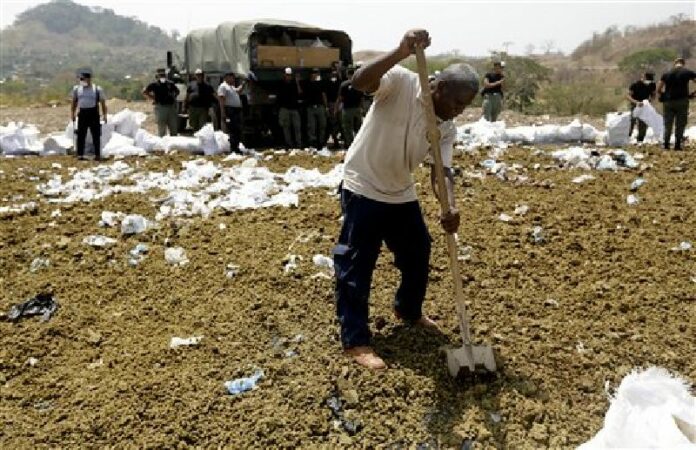
A narcotics agent shovels marijuana, as part of an operation to destroy seized drugs, on the outskirts of Panama City, Friday, April 1, 2016. Photo: Arnulfo Franco / Associated Press

UNITED NATIONS — Jamaica defended its decriminalization of possession of small amounts of marijuana. Iran said it seized 620 tons of different types of drugs last year and is helping protect the world from "the evils of addiction." Cuba opposed the legalization of drugs or declaring them harmless.

The first U.N. General Assembly special session to address global drug policy in nearly 20 years heard major differences on the approach to drug use on its second day on Wednesday.

On the liberalization side, Canada's Health Minister Jane Philpott announced that the government will introduce legislation to legalize marijuana next spring. She said Canada will ensure that marijuana is kept out children's hands, and will address the devastating consequences of drugs and drug-related crimes.

Jamaica's Foreign Minister Kamina Johnson Smith told delegates that the government amended the Dangerous Drugs Act last year to give tickets for possession of less than two ounces of cannabis instead of making it a felony offense, and to legalize the sacramental use of marijuana by Rastafarians. It also established provisions for the medical, scientific and therapeutic uses of the plant, she said.

Smith said Jamaica is finalizing a five-year national drug plan including programs to reduce demand for drugs, provide for early intervention and treatment of drug users, and promote rehabilitation and social reintegration.

Michael Botticelli, director of the White House Office of National Drug Control Policy, stressed that "law enforcement efforts should focus on criminal organizations — not on people with substance use disorders who need treatment and recovery support services."

He called for drug policies in every country to address the needs of underserved groups including women and children, indigenous people, prisoners, and lesbians, gays, bisexual and transgender people.

On the tough enforcement side, Indonesia's Ambassador Rachmat Budiman said "a zero-tolerance approach" is needed to suppress and eliminate the scourge of drugs.

He said drug trafficking rings are using new "psychoactive substances" and the Internet to penetrate all levels of society, including the young generation, and pose "a serious threat which requires extraordinary efforts."

Like Indonesia, Iran imposes the death penalty on drug traffickers.

Iran's Justice Minister Abdulreza Rahmani Fazli told the high-level meeting that the Islamic Republic has spent billions of dollars in its campaign against armed drug traffickers.

He said Iran is ready to host an international conference on countering drugs and drug-related crimes along the Balkan route, one of the two main heroin trafficking corridors linking opium-producing Afghanistan to the huge markets of Russia and Western Europe. It usually goes through Pakistan to Iran, Turkey, Greece and Bulgaria across southeastern Europe to the Western European market, and has an annual market value of some $28 billion, according to the U.N. Office of Drugs and Crime known as UNODC.

Fazli said the conference, in collaboration with the UNODC and countries on the route, would tackle ways to combat drug-related money laundering and detect drug trafficking ringleaders.

Cuba's Justice Minister Maria Esther Reus Gonzalez asked how the world couldn't be worried when the world drug problem has become "deeper and more intensified" with 246 million people using illicit drugs, according to UNODC.

"It will be really difficult to solve the problems of mass production of and trafficking in drugs from the South, if the majority demand from the North is not eliminated," she warned.

Reus Gonzalez also warned that legalizing drugs won't solve the problem either and will only open "more dangerous gaps for the stability of our nations." She reiterated "Cuba's absolutely commitment to achieving societies free of illicit drugs."

Story: Edith M. Lederer / Associated Press
 

Advertisement

Civil Servant Denies Copy-Paste Doctoral Thesis Was Plagiarism

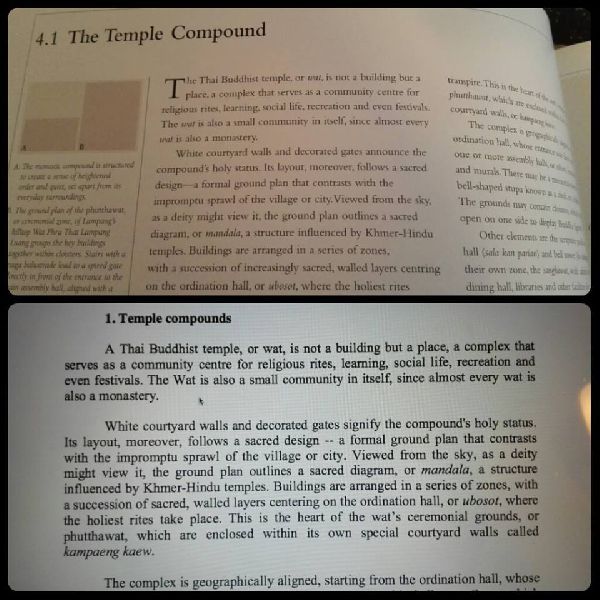
Comparison of a doctoral dissertation and book published three years earlier. Image: Poe Limkul / Facebook.

By Teeranai Charuvastra
Staff Reporter

BANGKOK — “A Thai Buddhist temple, or wat, is not a building but a place, a complex that serves as a community centre for religious rites, learning, social life, recreation and even festivals," read Wattana Boonjub’s 2009 thesis on Thai architecture.

As a researcher discovered and shared online recently, there was one problem with that and many other sentences from Wattana’s dissertation. Someone had written exactly the same thing three years earlier in a book titled “Architecture of Thailand.”

Today, the linguist working for the Department of Fine Arts admitted to lifting entire passages word-for-word from the book for his doctoral thesis – but insisted the act did not constitute plagiarism.

In Wattana's thesis, which can be found online, the 52 pages comprising one of its six chapters was copied with alteration from the 2006 book authored by Nithi Sthapitanonda and Brian Mertens.

“Just found a shocking plagiarism in a Thai PhD thesis,” researcher Poe Limkul wrote on Facebook along with images comparing the book to the dissertation. “And it is not just one [instance], it repeated multiple times. Within 60 seconds I recognized he literally copied 2 entire chapters from a book published 3 years prior to the thesis.”

\

Comparison of a a doctoral dissertation and book published three years earlier. Image: Poe Limkul / Facebook


Silpakorn University, where the thesis was completed, has promised to investigate.

The thesis was submitted to the school’s Faculty of Architecture. It indicates that two academics and one national artist reviewed and accredited it prior to publication.

Wattana did not use any footnotes or citations anywhere in his thesis apart from a list of sources cited in a bibliography at the end, one of which identified “Architecture of Thailand” by Nithi Sthapitanonda and Brian Mertens as one of his materials. 

Nowhere in the purloined chapter did Wattana attribute the material to Nithi and Mertens. 

Reached for comment Wednesday, the bureaucrat defended his action, saying it was sufficient to list the “Architecture of Thailand” in the bibliography.

“I didn’t plagiarize the book. I merely lifted the content for my use,” said Wattana, who works as a linguist in the Department of Fine Arts’ literature and history division. “I cited him [Nithi] in the bibliography. I said clearly that I used Nithi’s work. I didn’t have enough wisdom to come up with that work on my own.”

A staff member at Silpakorn University’s Faculty of Architecture said the university is taking the matter seriously.

“We are investigating this issue. We just learned about it today,” said the staff member, who declined to give her name because she’s not authorized to speak the media. “According to the regulations, if he’s guilty, he will be stripped of his degree.” 

The university referred a reporter to graduate school dean Panjai Tantatsanawong but said he was not in the office.

Academic integrity is lightly policed in the kingdom’s universities, where a pervasive culture of student cheating continues under pressure from high-stakes testing. There have been a number of high-profile cases involving plagiarized academic theses over the years. 

Wattana said he’s unconcerned by the investigation because he has no attachment to his doctorate.

“Whether they strip me of my degree is the right of the committee. I don’t pay much attention to my doctorate anyway,” Wattana said. “The heart of my work has already been accomplished. When people call me or write my name without the honorific ‘Dr.,’ I’m not angry either.”

Wattana said he has discussed the matter with Nithi, and the author holds no grudge against him. He also questioned the intentions of the researcher who brought the matter to public attention.

“The person who raised this issue, what kind of agenda do they have?” Wattana said. 

In a Facebook post published Wednesday, Nithi said he doesn’t mind the plagiarism because it helps spread his work. 

“If anyone finds benefit in it and uses it, whether by plagiarizing it entirely or partially amending it for use, personally I do not have any problem with that,” Nithi wrote. “But if it violates any system in the university or educational institute, it’s up to that institute to take action as it deems fit.” 


Related stories:

Thailand's Students Marked Down For Cheating


Teeranai Charuvastra can be reached at [email protected] and @Teeranai_C.

\

Advertisement

Suspected Uighur Militant in Threat Warning Twice Entered Thailand

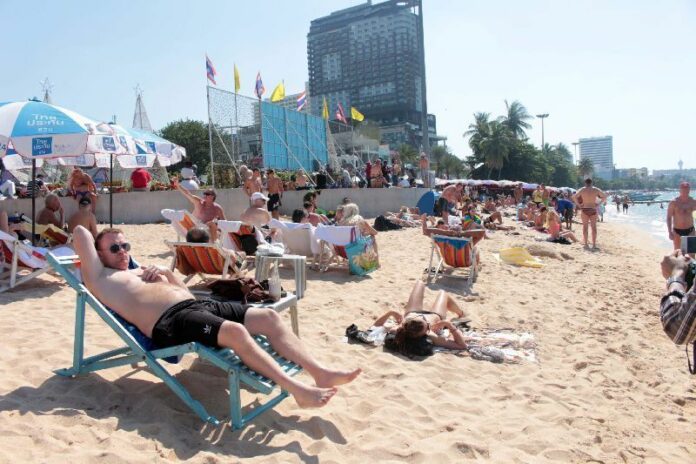
Pattaya Beach in a December 2014 file photo.

BANGKOK — One of the alleged militants said to be plotting terror attacks in Southeast Asia in a leaked intelligence report entered the country twice in March before departing, immigration police said today.

One of the men, identified as Uighur militants earlier this month in the April 8 report, entered Thailand on March 18 and 24, the heads of the national and immigration police forces told reporters Wednesday.

”We always monitor these people. But sometimes we receive information after the perpetrator has already left the country, so it’s so difficult to track them down that we might need help from angels,” Royal Thai Police commander Chakthip Chaijinda said.


Uighur, Chechen Militants in Thailand to Stage Attacks, Memo Warns


Ali Yalcin, a 36-year-old Turkish national, first entered Thailand as a tourist at Don Mueang International Airport from Singapore on an AirAsia flight, according to Maj. Gen. Natthorn Prosunthorn of Immigration Bureau police.

Yalcin stayed in the country for four days before departing to Siem Reap on March 22. He returned two days later and remained in the country four days before leaving to Malaysia on March 28. Tourists from Turkey are permitted to stay up to 30 days without a visa.

Yalcin was accompanied by another Turkish man whose name was not included in the warning which named also named Hid Yet Dursun as security threats. No mention was made of the two alleged Chechen militants identified in the April 8 memo.

The men were said to be plotting attacks on Chinese businesses in ASEAN member states.

Two ethnic Uighurs – one a citizen of China and another of Turkey – are being tried over alleged roles in a deadly terror attack in Bangkok that killed 20 people in August.

Natthorn said he already ordered a search of the room in Bangkok on Soi Sukhumvit 16 and another in Phuket town where the men stayed.

Authorities said they are seeking more information from their Singaporean counterparts.

Deputy police chief Sriwarah Rangsipramkul said Wednesday the men were now on a watch list.

A military national security agency operating out of the Prime Minister’s Office today played down any concerns.

Col. Peerawat Sangthong, a spokesman for the Internal Security Operations Command, said his intelligence unit believes there is no likelihood of a terrorist attack being carried out by external players in the country.


Related stories:

500 Witnesses to be Called in Bangkok Bombing Trial

Uighur, Chechen Militants in Thailand to Stage Attacks, Memo Warns

No Credible ISIS Threat, Thai Interpol Head Says

Police Investigate Source of ISIS Memo Leak

Police Caught Off Guard by Memo About Possible ISIS Attack

Moscow Warns That ISIS in Thailand to Attack Russian Targets


Advertisement

2,000 Tusks Aflame in Large Burn of Poached Wildlife Goods

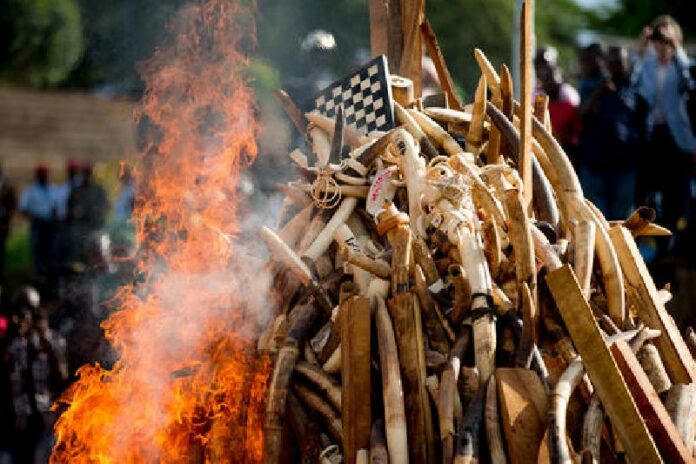
Heavily armed guards stand next to a pile of illegally trafficked elephant tusks and hundreds of finished ivory products as they prepare to destroy them at the Palais des Congres, in Yaounde, Cameroon, Tuesday, April 19, 2016 Photo: Andrew Harnik / Associated Press

YAOUNDE, Cameroon — Some 2,000 illegally trafficked elephant tusks and hundreds of finished ivory products erupted in a ball of fire Tuesday as Cameroonian authorities conducted what was believed to be one of the largest burnings of poached wildlife goods in African history.

Setting the pyre aflame in a sandy square in Cameroon's capital, Samantha Power, America's U.N. ambassador, joined Cameroonian officials in hailing the ceremony as symbolic of their commitment to win the war against illegal smuggling of animal products.

Central Africa's forest elephants have declined in number by two-thirds between 2002 and 2012.

"All of our countries can and must do more," Power said. The burning sends a clear message, she added, that "the only place ivory belongs and the only value ivory has is on elephants."

The heap included ivory chess boards, beads, totem poles and even miniature elephant sculptures, all intermixed with the raw tusks. Cameroonian officials said the pile totaled 3.5 tons of tusk alone, though that figure couldn't be verified. What's certain is the merchandise was worth millions of dollars. The pyre will burn for three days.

Philip Ngole Ngwese, Cameroon's minister of forestry and wildlife, said the seized tusks and ivory, much of which originated abroad, were now "beyond reach." He also described the human costs of poaching, mourning several guides and park rangers who have been killed in recent years.

Cameroon's biggest city, Douala, is a port through which much of the region's trafficked goods transit overseas.

Power, on a weeklong trip to promote the battle against the Muslim extremist group Boko Haram, also met President Paul Biya and other senior Cameroonian officials. She announced USD$40 million in new U.S. humanitarian aid to the region.

The United States has some 200 special operations forces in Cameroon advising and assisting African troops in the fight. Power, making the first trip to the country by a U.S. Cabinet member in a quarter-century, stressed the need for Cameroonian soldiers to exercise restraint amid reports they've sometimes targeted civilians.

"Any fight against terrorism has to be comprehensive," she said, echoing remarks she made in Cameroon's embattled north on Monday. Political inclusiveness, good governance, economic development and combatting extremism at the grassroots level, she said, "are every bit as critical as one's military campaign itself."

Smoke billowed from the pyre as the ivory tusks turned black and statuettes smoldered.

\

Charred Elephant tusks burn during the first Cameroon Ivory Burn at the Palais des Congres in Yaounde, Cameroon, Tuesday, April 19, 2016, Photo: Andrew Harnik / Associated Press


Ivory-burning ceremonies aren't a gesture universally appreciated – even in Cameroon. Some wonder why the valuable tusks aren't reused in some capacity, given the elephants are already dead.

Echoing such sentiments, one local journalist asked Power why the tusks aren't preserved in museums for future generations that may never see elephants.

"I don't want to think about contingency plans for if elephants are eliminated from the wild," Power said.

The event and Power's participation underscored the Obama administration's effort to prioritize the fight against wildlife trafficking. In doing so, it is trying to break a multibillion-dollar criminal industry that officials say sometimes interweaves with drug trafficking and even terrorist enterprises. The U.S. held its own ivory crushes in 2013 and 2015.

In March, a U.S. task force said a "turning point" had been reached in the global endeavor to strengthen enforcement, reduce demand and expand international cooperation. But much ultimately depends on China cracking down, because its citizens are driving global demand.

As a port of exit, Cameroon plays a major role in snuffing out ivory smuggling from Central Africa, where several countries are struggling to assert control over their own territory, and national parks are often poorly protected. Cameroon, too, has suffered from poaching.

Four years ago, armed poaching gangs from Sudan massacred more than half of the elephants in the Bouba Njida National Park in northern Cameroon. The raids highlighted the vulnerability of elephants even in stable African countries. Biya, who is 83, has ruled Cameroon for more than 30 years.

Story: Bradley Klapper / Associated Press

 

Related stories:

Suvarnabhumi Seizes 87 African Ivory Tusks Worth 28 Million Baht

Govt Shuts Down Illegal Ivory Shops


Advertisement

Banned Doc on Murdered Activist Comes to Bangkok

A scene from ‘I Am Chut Wutty’

BANGKOK — While the Cambodian government shut down a planned screening today of a documentary about an activist’s murder, “I Am Chut Wutty” can be seen in full next week in Bangkok.

To commemorate four years since the murder of environmental activist Chut Wutty, the Friese-Greene Club on Tuesday will screen the film about those battling the deforestation of Cambodia, a nation which has traded away many of its national resources in return for short-term economic stability.

The movie was to show today at Meta House Cafe, a contemporary art space in Phnom Penh, before it was canceled Monday by Cambodia’s Culture Ministry.

No reason was provided by the ministry, according to Meta House Cafe.  

The film was produced and directed by Fran Lambrick, who followed Wutty around Prey Lang forest in Cambodia in 2010 and 2011 while conducting research for her doctorate.

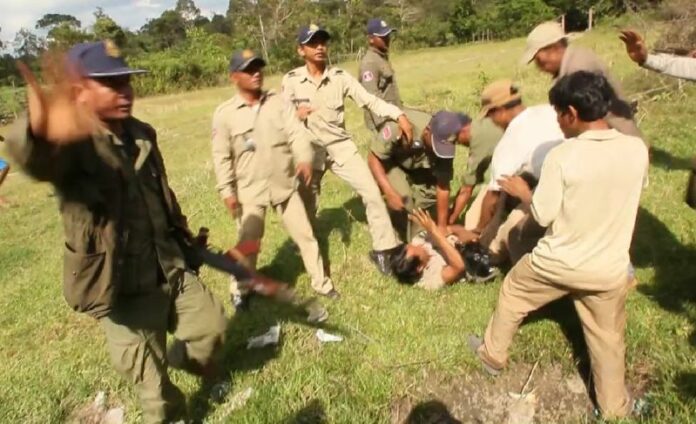
Wutty was shot to death on April 26, 2012, while investigating illegal logging in a protected forest. No one has been brought to justice, but media reports have implicated members of the military in his murder.

“I Am Chut Wutty” blends animation with real life footage. It will show Tuesday at Bangkok’s Friese-Greene Club on Soi Sukhumvit 22. The private cinema can be reached on foot from BTS Phrom Phong.

Admission is free. Voluntary donations will go to Not One More, a campaign inspired by Chut Wutty to support environmental defenders at risk worldwide.
 

maxresdefault.jpg


Advertisement

Daily Protests Planned Until Watana Released

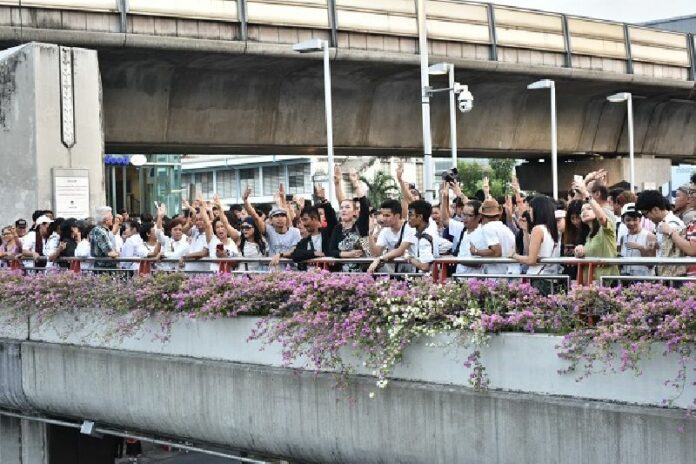
Protesters raised three fingers in the ‘Hunger Games’-inspired salute which has been adopted as a symbol of protest against the junta Tuesday evening at Victory Monument in Bangkok.

BANGKOK — Daily protests will be held calling for the release of a politician detained by the military, a group of activists said today.

Following their arrest at a demonstration on Tuesday evening, five members of activist group Resistant Citizen said they will gather at 6pm every day to demand the release of former Pheu Thai MP Watana Muangsook.

“It Watana is not released in the next few days, we will proceed to a full-scale approach. Our fellows from the other provinces will come to join,” the group’s Arnon Nampa, a human rights lawyer, announced at a Bangkok bookstore aligned with progressive causes.


Frustration Boils Over at Rare, Brief Protest


Similar to Tuesday evening’s brief protest at which Arnon and four others were arrested and briefly detained, the daily protests will consist of people standing in a visible location to call attention to their complaints about the military’s use of secret detention against its critics.

For Wednesday evening, he said, protesters will gather on the skywalk at BTS Chong Nonsi, and they are considering a larger protest for Friday.


\

Protesters light candles and sing in front of the Phaya Thai Police Station where five activists of Resistant Citizen were held Tuesday night in Bangkok


Watana turned himself into the junta Monday after he was summoned over stating his opposition to the proposed charter.

Arnon said he and the four other organizers were only held briefly because authorities knew they would come under criticism for arresting people exercising their rights. They were released at about 8pm, two hours after they were removed from the scene of Tuesday’s protest.

“We did not sign any agreement with the military officers,” he said. “And they did not force us to.”

Arnon said their planned protests were intended to defend human rights, and that his group would do its part in protecting the public’s right to voice either criticism or support of the draft charter.


\

Protesters stage a fake ballot in which they vote to reject the proposed constitution in a referendum in front of the Phaya Thai Police Station Tuesday night in Bangkok.


Related stories:

Frustration Boils Over at Rare, Brief Protest

Activists Promise Protest if Watana Not Released by Military


Advertisement

Laos Appoints New President, Prime Minister

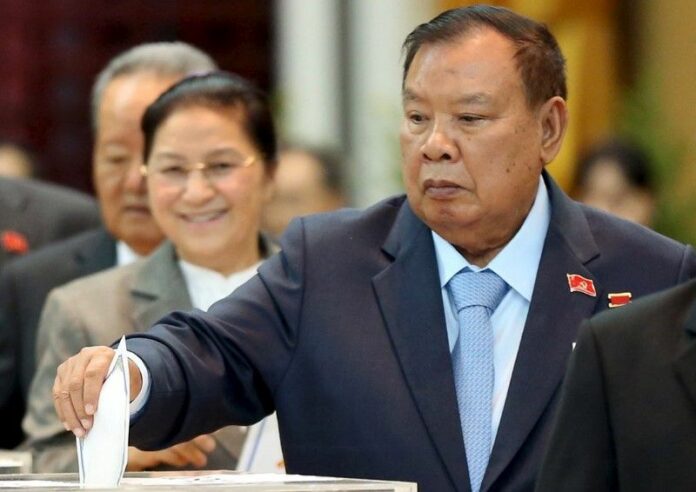
Laos’ Vice President Bounnhang Vorachit casts his ballot during the Communist Party Congress in Vientiane January 21, 2016. Photo: Reuters

By Juarawee Kittisilpa
Reuters

VIENTIANE — Laos's National Assembly on Wednesday appointed Communist Party chief Bounnhang Vorachit as the country's new president and named foreign minister Thongloun Sisoulith as prime minister.

The picks are seen by many analysts as a continuation of the status quo in secretive Laos, where the communists have ruled since the end of the Vietnam War.

State television broadcast a meeting of the single-chamber National Assembly, at which lawmakers listed the virtues of Bounnhang, who was appointed Communist Party leader in January.

"The National Assembly has approved Bounnhang Vorachit as president, with more than two-thirds of the votes," said assembly chairwoman Pany Yathotou.

The 149-member assembly completed the process of nomination and voting for both candidates in around an hour.

In his acceptance speech, Bounnhang said he would strive for "peaceful international policies, unity, friendship and cooperation".

One of the fastest-growing economies in East Asia, landlocked Laos has averaged GDP growth of 7 percent over the past decade, with increasing use of natural resources contributing a third of output growth, the World Bank says.

This has boosted incomes and access to electricity, telecoms and healthcare for its mostly rural population of 6.7 million.

Laos has close political ties to communist Vietnam and mirrors its political system.

Communist neighbor China has been vying aggressively for influence in Laos, however, providing loans, aid and infrastructure investment.

Laos is still struggling to rid itself of the painful legacy of the Vietnam War, when it became the most heavily bombed country in history after the U.S. and its allies dropped about two million tons of ordnance from 1964 to 1973.

More than four decades on, the country grapples with millions of cluster munitions and other unexploded ordnance devices that kill and maim dozens each year.


Advertisement

Watchdog: Thailand Sinks as Press Freedom Declines Globally

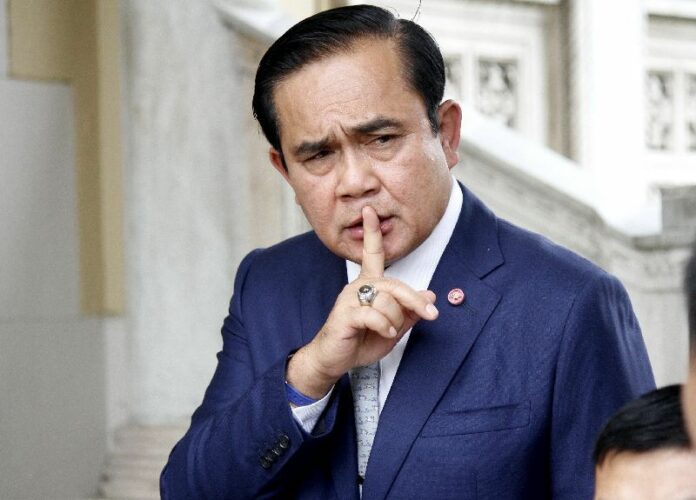
Junta chairman and Prime Minister Prayuth Chan-ocha in a December 2015 file photo.

PARIS — Thailand fell to the bottom quarter of 180 nations as media freedom around the world suffered a "deep and disturbing decline" under pressure by governments and businesses, an international media watchdog said Wednesday.

The report describes Prime Minister Prayuth Chan-ocha as a “new predator of information,” citing verbal attacks and death threats made against journalists.

“The National Council for Peace and Order, Thailand’s military junta, exercises permanent control over journalists and citizen-journalists,” it says of Thailand. “Ubiquitous and all-powerful, the NCPO summons them for questioning and detains them arbitrarily.”

Thailand fell two places to rank 136th in the annual report from Paris-based Reporters Without Borders released Wednesday. The watchdog group said many of the world's leaders have developed "a paranoia" about journalism and are clamping down on the media, while coverage in privately-owned outlets is increasingly shaped by corporate interests.

"The climate of fear results in a growing aversion to debate and pluralism," said Christophe Deloire, secretary-general of Reporters Without Borders. "Journalism worthy of the name must be defended against the increase in propaganda and media content that is made to order or sponsored by vested interests."

While Europe has the freest media, according to the report, some countries, such as Poland fell sharply on the press freedom index by tightening government control. In Hungary, the government has also sought to impose restrictions on press freedoms.

Journalists in the Middle East and Africa fell victim to terrorism, armed conflict and intimidation by authorities. In Latin America, reporters were constrained by organized crime, violence and corruption. In the United States, they faced cyber-surveillance.

The decline in media freedom was also observed in east Asian democracies such as Japan and South Korea, while in China, "the Communist Party took repression to new heights," the study said.

In post-Soviet countries, freedom has declined steadily, with many countries following the example of Russia, where government critics face persecution. Ukraine was a notable exception, seeing an improvement due to a decline in violence in the separatist conflict in the east of the country and some reform, though many problems still remain.

The index measures media pluralism, independence, the legal framework and the safety of journalists in 180 countries. It is based on a questionnaires filled out by experts around the world as well as on quantitative data on abuses and acts of violence perpetrated against reporters.


Story: Associated Press, Khaosod English


Related stories:

Thairath Reporter Taken to Army Base for ‘Red Bowl’ Report

Junta's Coffee Coercion

Advertisement

Footballer Booted From National Team Over Attempted Rape Charge

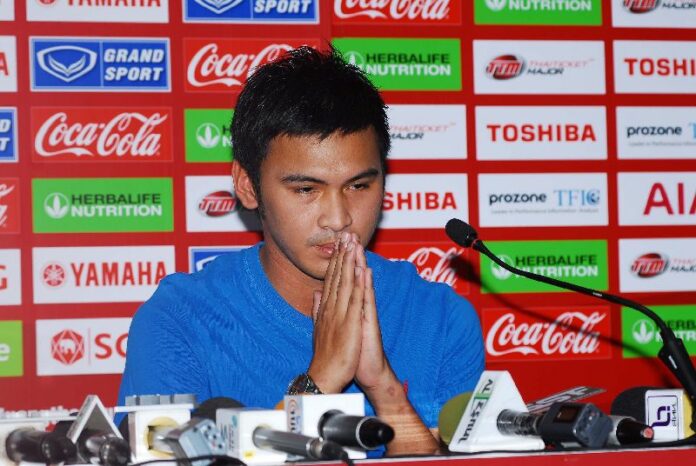
Atit 'Back' Daosawang at a Sunday news conference. Photo: Matichon

BANGKOK — A 23-year-old footballer has been indefinitely suspended from playing on the national team due to allegations he attempted to rape a 17-year-old girl last week.

Atit “Back” Daosawang is charged with abducting a minor for a lewd purpose over an April 10 incident which prompted a criminal investigation that is still ongoing. That was enough grounds to disqualify him from playing for Thailand, said national team manager Kiatisuk Senamuang. 

“This case should be a moral lesson for the national team and club footballers,” Kiatisuk said at Tuesday’s news conference. “They have to maintain good behavior both on and off the field.” 

Kiatisuk said Atit would be allowed back onto the team after he “reforms his behavior.” The manager did not specify any timeline. The ban means that Atit will miss Thailand’s upcoming final qualifying round for the 2018 FIFA World Cup. 

Muangthong United, which counts Atit among its defenders, also announced Sunday that Atit’s pay would be halved for six months as punishment. Further action may be taken, the club said, depending on the results of the investigation.

Atit stands accused of attempting to rape a 17-year-old schoolgirl at his residence in Nonthaburi on the night of April 10. According to the complaint, Atit and the victim were out together, and he volunteered to drive her home. Instead of taking her home, he drove her to his home where he tried to drag her into his bedroom, but the girl managed to flee. 

In an Instagram post on April 11, Atit denied the allegations, but on Sunday at a news conference, the footballer reversed his stance and admitted the incident did happen and apologized to the victim and her family.

However, Atit insisted he had no intention to sexually assault the victim. 

“Let me insist that I had no intention to violate her or break any laws,” Atit said. 

Police have charged him with abducting a minor with lewd intent, a crime punishable by up to 15 years in jail. 

The victim’s father told reporters at a Nonthaburi police station on Monday that his family would not settle or accept any compromise with Atit. 

“I told his mother that I cannot forgive him for what he did,”  the victim’s father said. “Every man likes to think that if they are handsome and rich, any woman will be easy. But women aren’t all the same. I want to teach him a lesson.”

Related stories:

Thailand to Face Three Middle Eastern Nations in World Cup Qualifiers


Teeranai Charuvastra can be reached at [email protected] and @Teeranai_C.

Follow Khaosod English on Facebook and Twitter for news, politics and more from Thailand. To reach Khaosod English about this article or another matter, please contact us by e-mail at [email protected].

Follow @KhaosodEnglish

\

Advertisement

500 Witnesses to be Called in Bangkok Bombing Trial

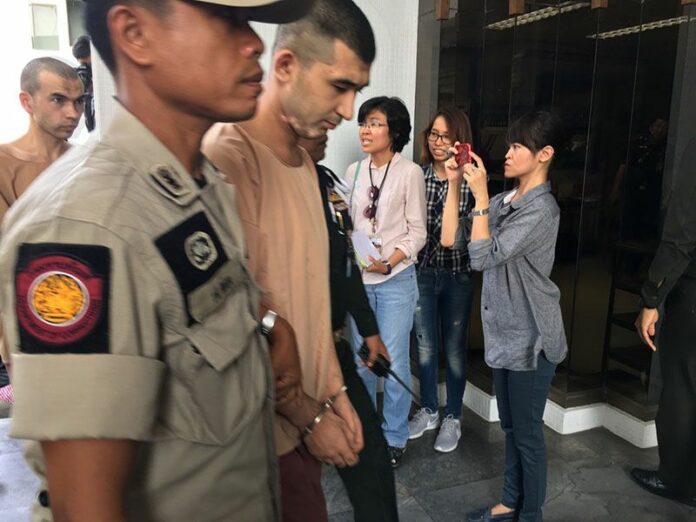
Adem Karadag, at left, and Yusufu Mieraili, second from left, are led into a military court Wednesday morning in Bangkok.

BANGKOK — About 500 witnesses will be called during the course of the trial of two men accused of being behind last year’s deadly terror attack in Bangkok.

At a pretrial hearing before a military tribunal Wednesday morning, the lawyer representing the man accused of setting the bomb which killed 20 people said he would submit another seven names to the list of 41 witnesses already filed with the court for the defense of his client, Adem Karadag. Most of the witnesses would be called by the prosecution.

“The plaintiff side has 447 witnesses,” Schoochart Kanpai said before entering the court, adding that he hopes the number of days for examining witnesses can be decreased.


Bangkok Shrine Bombing: Those Who Died


The court was set Wednesday to schedule dates for examining evidence to be presented at trial.

Schoochart said his client is in good spirits and vigorously denies all charges. Karadag, 31, and co-defendant Yusufu Mieraili, 27, were escorted to the court by authorities.

Both men denied all charges before the military court on Feb. 16. Karadag only admitted to illegally entering Thailand.

At that hearing, Mieraili told the court he would find and pay for his own lawyer because the court failed to find him a civilian attorney and instead appointed him a military lawyer.

Mieraili was said to have obtained legal counsel for today’s hearing.

After being held in custody for nearly three months on suspicion of involvement in the Aug. 17 bombing of the Erawan Shrine, the two suspects were indicted Nov. 24 on 10 counts including premeditated murder and possession of explosives for the attack. They were not charged with terrorism, as Thai officials sought to play down the attack as a criminal matter.

Both men are members of the Uighur ethnic group from the western Chinese region of Xinjiang, where an insurgent movement has targeted ethnic Han Chinese. No one ever publicly took credit for the attack, but it has been ascribed by some analysts as revenge for Thailand’s decision to forcibly repatriate about 100 Uighurs to China under pressure from Beijing.

Despite the 17 suspects named in the aftermath of the attack, only the two Uighur men were arrested and the investigation brought to an apparent halt.

Correction: An earlier version of this article misstated Karadag's age as 30. He is 31.


Related stories:

Bombing Suspects Deny All Charges in Military Court

Top Brass Present During Torture, Bombing Suspect Alleges

Chinese Uighur Karadag Tortured Into Confession, Lawyer Says

Bangkok Bombing Suspects Won't be Tried for Terrorism

Police Link Bomb Attack to Uighurs, Deep South and Thai Politics

Police Chief Plays Down Bombing Suspect’s Alleged Confession

Turkish Suspect Denies Involvement in Erawan Bomb Attack

Bangkok Bombing Suspects Won't be Tried for Terrorism

Mounting Evidence Links Bombing to Turks, Uighurs

No Longer Whole, a Family Buries its Dead and Waits for Answers

Seen Often on Sathorn 10, Suspect Thought to Use Fake Turkish Passport

Bangkok Shrine Bombing: Those Who Died

Tourists Narrowly Escape Second Bangkok Bombing in 24 Hours

Bangkok Shrine Bombing: Police Hunt Backpack Man

Tourists Among 19 Killed by Bomb at Bangkok's Erawan Shrine


Advertisement

Hot News

LATEST NEWS

Bangkok
overcast clouds
30.5 ° C
30.5 °
26.1 °
78 %
4kmh
100 %
Fri
34 °
Sat
31 °
Sun
31 °
Mon
28 °
Tue
30 °