























28.8 C
Bangkok
Monday, June 29, 2026
Home Blog Page 2761

Traffic Clogged Jakarta to Suspend Rush Hour Car-Pooling

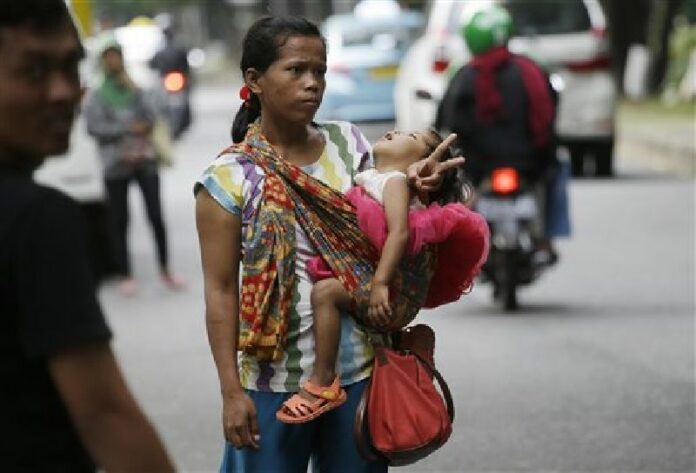
In this Friday, April 1, 2016, photo, a woman carries her baby as she signals to show that she's for hire as a "jockey" to help drivers cheat a peak time traffic rule of three people to one car during rush hour, at the main business district in Jakarta, Indonesia. Photo: Achmad Ibrahim / Associated Press

JAKARTA — Lines of people from women holding babies to school age children, with a hand held up to show they're for hire, are a ubiquitous sight on the Indonesian capital's busiest roads during rush hour.

But not this week. Traffic-clogged Jakarta plans to suspend its peak-time rule of three people to one car from Tuesday. And the passengers for hire, known as jockeys, who helped drivers cheat the traffic controls, will be out of a job.

By lifting the 3-in-1 rule, city authorities will be testing what happens to congestion. If there's no difference to the number of cars on the road, they'll know that a system in place for more than a decade is broken.

Abandoning the policy will be bad news for the poor in a city where maddening traffic produces numerous novel ways to eke out a living. Apart from jockeys, there are self-appointed U-turn police and parking wardens who are tipped by drivers despite sometimes hindering more than helping.

"I want the authorities to extend the 3-in-1," said Muhammad Asmin, a 27-year-old who dropped out of school to become a jockey more than a decade ago to earn money for his family. "It is good for us, the poor, even if it's not working," said Asmin, who earns up to USD$15 (527 baht) a day by hopping in and out of cars.

\

 In this Friday, April 1, 2016, photo, a man signals to show that he's for hire as a "jockey" to help drivers cheat a peak time traffic rule of three people to one car during rush hour, at the main business district in Jakarta, Indonesia. Photo: Achmad Ibrahim / Associated Press

Jakarta is the world's most congested city, according to a study of how often vehicles brake during a commute. Officials estimate Jakarta's traffic jams cause economic losses of about USD$3 billion a year.

The 3-in-1 rule was introduced in 2003 and the jockeys appeared soon after. Since then, the traffic has only gotten worse, mainly because more Indonesians can afford cars, which has overwhelmed a road network that has hardly grown. The car-pooling policy has a particularly bad image since it's widely regarded as ineffective and also involves children, who take huge risks by getting into the vehicles of strangers.

"We have been blamed for worsening the gridlock but the government didn't provide sufficient jobs for us," said Alfa Wahyudi, a 21-year-old who came to Jakarta from Borneo six months ago. "Don't blame our presence if the government is unable to provide us jobs."

The convenience of traveling on a 3-in-1 road is such that some drivers have arrangements with two or three regular jockeys.

Repeated crackdowns on the jockeys, who quickly scatter into side streets at the sight of police, failed to wipe out the profession. If caught, they are taken to a detention center for a couple of weeks and asked to sign a letter promising not to work as a jockey again. But many say they return to the roadside as soon as they can.

Wulandri, who was twice caught and sent to a detention center, said it was no deterrent compared with the $10 she could easily make in a day.

As the mother of a one-year old boy, she was popular with drivers because it meant they could get two passengers for the price of one.

"I purposely brought my child because usually a single driver does not have to pay for two jockeys and they are often sorry for the woman who was carrying a baby," said Wulandari, who goes by one name.

Story: Niniek Karmini and Stephen Wright / Associated Press
 

Advertisement

Panama Papers: Massive Leak Exposes Where World Leaders Hide Money

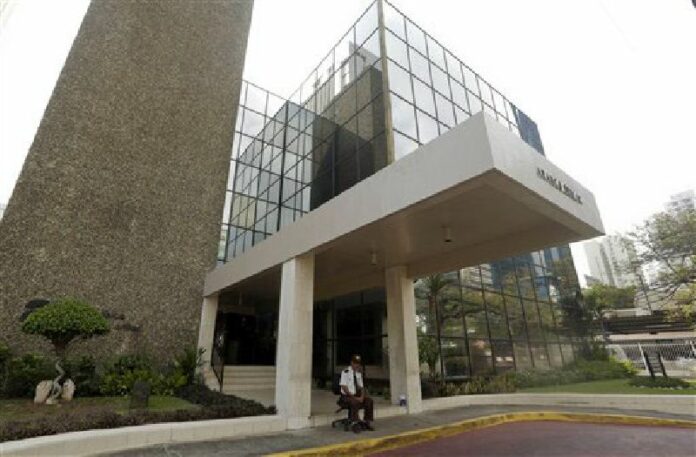
A security guard sits outside the Mossack Fonseca law firm Sunday in Panama City. Photo: Arnulfo Franco / Associated Press

BERLIN — An international coalition of media outlets on Sunday published what it said was an extensive investigation into the offshore financial dealings of the rich and famous, based on a vast trove of documents provided by an anonymous source.

The International Consortium of Investigative Journalism, a nonprofit organization based in Washington, said the cache of 11.5 million records detailed the offshore holdings of a dozen current and former world leaders, as well as businessmen, criminals, celebrities and sports stars.

The Associated Press wasn't immediately able to verify the allegations made in articles that were published by the more than 100 news organizations around the world involved in the investigation.

However, the German newspaper Sueddeutsche Zeitung, which first received the data more than a year ago, said it was confident the material was genuine.

The Munich-based daily was offered the data through an encrypted channel by an anonymous source who requested no monetary compensation and asked only for unspecified security measures, said Bastian Obermayer, a reporter for the paper.

The data concerned internal documents from a Panama-based law firm, Mossack Fonseca. Founded by German-born Juergen Mossack, the firm has offices across the globe and is among the world's biggest creators of shell companies, the newspaper said.

Ramon Fonseca, a co-founder of Mossack Fonseca, said the firm had no control of how its clients might use offshore vehicles created for them.

"We are not responsible for the actions of a corporation that we set up," he told Panama's Channel 2.

Panamanian President Juan Carlos Varela issued a statement saying his government would cooperate "vigorously" with any judicial investigation arising from the leak of the law firm's documents. He said that the revelations shouldn't detract from his government's "zero tolerance" for any illicit activities in Panama's finance industry.

ICIJ said the law firm's leaked internal files contain information on 214,488 offshore entities connected to people in more than 200 countries and territories. It said it would release the full list of companies and people linked to them early next month.

Obermayer said that over the course of several months Sueddeutsche Zeitung received about 2.6 terabytes of data — more than would fit on 600 DVDs. The newspaper said the amount of data it obtained is several times larger than a previous cache of offshore data published by WikiLeaks in 2013 that exposed the financial dealings of prominent individuals.

"To our knowledge this is the biggest leak that journalists have ever worked on," Obermayer said.

The newspaper and its partners verified the authenticity of the data by comparing it to public registers, witness testimony and court rulings, he told the AP. A previous cache of Mossack Fonseca documents obtained by German authorities was also used to verify the new material, Obermayer added.

Among the countries with past or present political figures named in the reports are Iceland, Ukraine, Pakistan, Saudi Arabia, Russia and Argentina.

The Guardian newspaper, which took part in the investigation, published a video on its website late Sunday showing an interview with Iceland's prime minister, Sigmundur David Gunnlaugsson. During the interview with Sweden's SVT television, the prime minister is asked about a company called Wintris. He responds by insisting that its affairs are above board and calling the question "completely inappropriate," before breaking off the interview.

In Russia, the Kremlin last week said it was anticipating what it called an upcoming "information attack."

Russian President Vladimir Putin's spokesman, Dmitry Peskov, told reporters that the Kremlin had received "a series of questions in a rude manner" from an organization that he said was trying to smear Putin.

"Journalists and members of other organizations have been actively trying to discredit Putin and this country's leadership," Peskov said.

The office of Argentina's president, Mauricio Macri, confirmed on Sunday that the business group owned by his family set up Fleg Trading Ltd., an offshore company based in the Bahamas. But it said Macri himself had no shares in Fleg and never received income from it.

Macri's office commented after La Nacion, an Argentine national newspaper, reported that he and his family had links to Fleg.

The ICIJ said the documents included emails, financial spreadsheets, passports and corporate records detailing how powerful figures used banks, law firms and offshore shell companies to hide their assets. The data spanned a time frame of nearly 40 years, from 1977 through the end of 2015, it said.

"It allows a never-before-seen view inside the offshore world — providing a day-to-day, decade-by-decade look at how dark money flows through the global financial system, breeding crime and stripping national treasuries of tax revenues," the ICIJ said.

According to the media group's website, global banks including HSBC, UBS, Credit Suisse, Deutsche Bank and others have worked with Mossack Fonseca to create offshore accounts.

"The allegations are historical, in some cases dating back 20 years, predating our significant, well-publicized reforms implemented over the last few years," HSBC spokesman Rob Sherman said in an emailed response to an AP request for comment.

"We work closely with the authorities to fight financial crime and implement sanctions," he said.

UBS, Credit Suisse and Deutsche Bank did not immediately respond to a request for comment.

Story: Frank Jordans / Associated Press

Advertisement

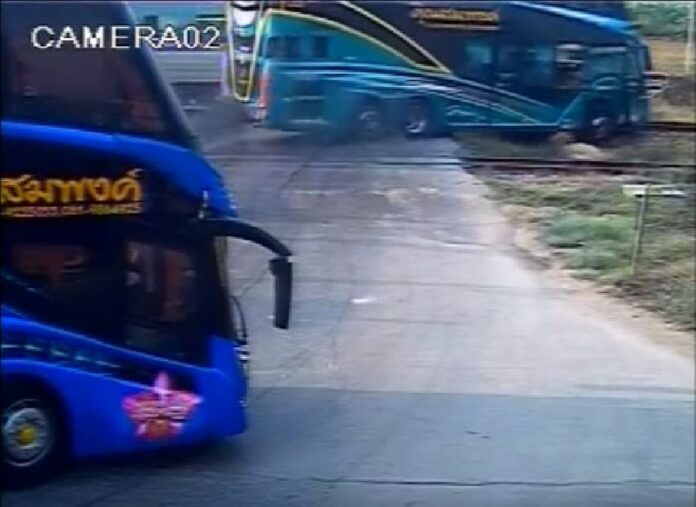
Train Smashes into Koh Samet-Bound Bus, 3 Dead

A bus is knocked off the tracks by a train Sunday at an uncontrolled intersection west of Bangkok in a still image from security camera footage.

BANGKOK — A train smashed into a double-decker bus carrying tourists at an uncontrolled railway crossing west of Bangkok on Sunday, with reports that three people were killed and more than two dozen injured.

Security video showed the bus moving slowly across the tracks and stopping momentarily before it is hit by the train. A car had crossed the tracks safely from the opposite direction a few seconds earlier.

Soon after the accident, the driver of another bus behind the one that was hit is seen getting out and running toward the crash. Another video from a camera positioned at a different angle shows the bus being hit and dragged some distance in a cloud of dust.

Reports said that the driver of the bus was killed on the spot, and that two passengers died at a hospital. Around 30 passengers were injured.

A local newspaper said the accident occurred at about 7:30 a.m. in Nakhon Pathom province, west of Bangkok. The bus was taking tourists to Samet island in Rayong province, southeast of Bangkok.

Such accidents occur often in Thailand, where many railway crossings do not have barriers.

Advertisement

‘Vote No’ Campaigners Stopped by Pattaya Police

By Pravit Rojanaphruk
Senior Staff Writer

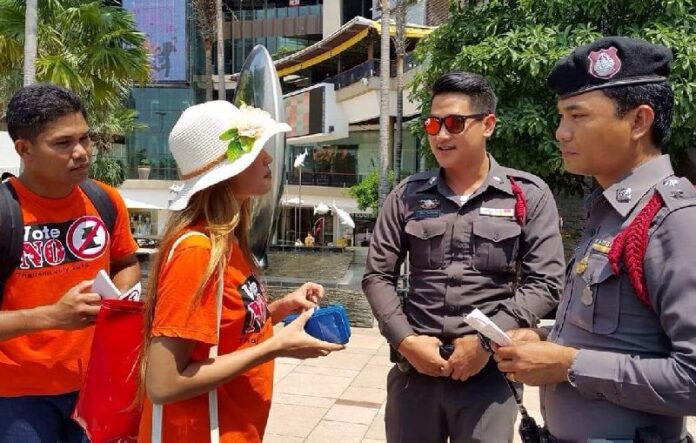
PATTAYA — Activist Anurak Jeantawanich claims police stopped him from campaigning against the junta-sponsored draft charter around 2pm this afternoon in Pattaya after he and his three colleagues managed to engage in the activity for half an hour.

Anurak, aka Red Ford Path, told Khaosod English that it’s becoming more challenging to do street campaigns as soldiers and police are keeping a closer eye on him. He claims that he and his fellow protestors were stopped by two uniformed police, two non-uniformed police and one soldier wearing civilian clothing.

“It’s getting more difficult because I am being trailed all the time. Every week, soldiers and police would ring me up or ask me [on social media about his planned activities for Sunday]. We have faced disturbances and obstacles through various means,” said Anurak, referring to a recent episode where he alleges menacing men trailed and harassed him and his friends as well as a visit bymilitary officers to his home in Samut Prakarn province, in southeastern metro Bangkok.

Anurak, 48, tries to dodge the junta’s ban on political gatherings of five or more persons by always assembling a maximum of three other people.  He also carries both “Vote No” and “Vote Yes” stickers to show that he’s not forcing anyone to take only stickers rejecting the charter draft.

“I have been campaigning [every Sunday] for eight weeks now and believe the mood is that people will reject this draft charter,” Anurak said.

Anurak has declared himself against the draft charter, saying it’s undemocratic, citing problematic issues such as Article 54 that cancels state funds for the last three years of secondary education (Mathayom 4-6).

\


Before four police officers and one non-uniformed soldier halted their activity in front of Central Festival mall in Pattaya Sunday, opposite the beach, Anurak said he and his colleagues managed to talk to 8 or 9 motorcycle taxi drivers and some foreigners. He said all but one of the motosai drivers asked for “Vote No” stickers while one driver requested a “Vote Yes” sticker.

Police told them they are free to stroll along the beach but they will not tolerate the handing out of stickers.

Anurak vowed to carry on his Sunday campaign until the promised referendum on August 7. He said even if the National Council for Peace and Order, the formal name of the junta, summoned him for re-education camp he won’t change his mind.

“I’ll just come out and campaign again.”said Anurak.

Related stories:

Charter Draft Second Look: Full Education No Longer Guaranteed (Analysis)

Charter Opponent Unbowed by Alleged Harassment

Anti-Charter Campaigner Reports ‘Polite’ Visit by Soldiers

Protesting With Precision, Anurak Jeantawanich Walks a Tight Legal Path


.


\

Advertisement

‘Vote No’ Campaigners Stopped by Pattaya Police

Police tell two colleagues of Anurak Jeantawanich to stop their campaign at around 2pm Sunday in Pattaya. Photo courtesy of Anurak Jeantawanich.

By Pravit Rojanaphruk
Senior Staff Writer

PATTAYA — Activist Anurak Jeantawanich claims police stopped him from campaigning against the junta-sponsored draft charter around 2pm this afternoon in Pattaya after he and his three colleagues managed to engage in the activity for half an hour.

Anurak, aka Red Ford Path, told Khaosod English that it’s becoming more challenging to do street campaigns as soldiers and police are keeping a closer eye on him. He claims that he and his fellow protestors were stopped by two uniformed police, two non-uniformed police and one soldier wearing civilian clothing.

“It’s getting more difficult because I am being trailed all the time. Every week, soldiers and police would ring me up or ask me [on social media about his planned activities for Sunday]. We have faced disturbances and obstacles through various means,” said Anurak, referring to a recent episode where he alleges menacing men trailed and harassed him and his friends as well as a visit by military officers to his home in Samut Prakarn province, in southeastern metro Bangkok.

Anurak, 48, tries to dodge the junta’s ban on political gatherings of five or more persons by always assembling a maximum of three other people.  He also carries both “Vote No” and “Vote Yes” stickers to show that he’s not forcing anyone to take only stickers rejecting the charter draft.

“I have been campaigning [every Sunday] for eight weeks now and believe the mood is that people will reject this draft charter,” Anurak said.

Anurak has declared himself against the draft charter, saying it’s undemocratic, citing problematic issues such as Article 54 that cancels state funds for the last three years of secondary education (Mathayom 4-6).

\


Before four police officers and one non-uniformed soldier halted their activity in front of Central Festival mall in Pattaya Sunday, opposite the beach, Anurak said he and his colleagues managed to talk to 8 or 9 motorcycle taxi drivers and some foreigners. He said all but one of the motosai drivers asked for “Vote No” stickers while one driver requested a “Vote Yes” sticker.

Police told them they are free to stroll along the beach but they will not tolerate the handing out of stickers.

Anurak vowed to carry on his Sunday campaign until the promised referendum on August 7. He said even if the National Council for Peace and Order, the formal name of the junta, summoned him for re-education camp he won’t change his mind.

“I’ll just come out and campaign again.”said Anurak.

Related stories:

Charter Draft Second Look: Full Education No Longer Guaranteed (Analysis)

Charter Opponent Unbowed by Alleged Harassment

Anti-Charter Campaigner Reports ‘Polite’ Visit by Soldiers

Protesting With Precision, Anurak Jeantawanich Walks a Tight Legal Path


Advertisement

Debris in Mauritius to be Examined by MH370 Investigators

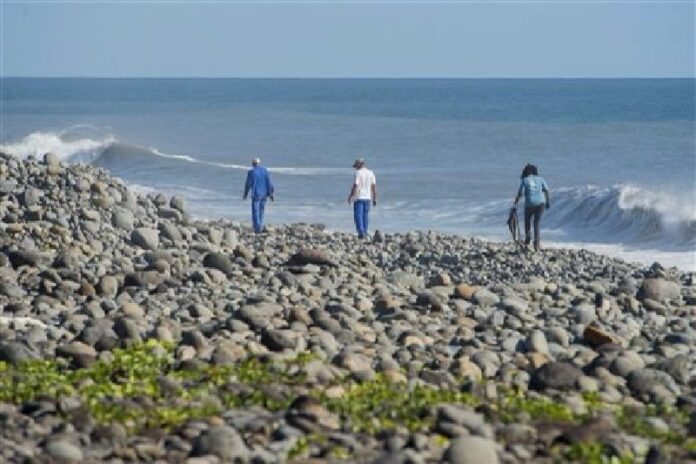
In this Aug. 10, 2015 photo, municipal workers search Reunion Island beaches where expected debris of the missing Malaysia Airlines Flight 370 could be washed up onto the shore near Saint-Andre, Reunion island. Photo: Fabrice  Wislez / Associated Press

SYDNEY — A piece of debris found on the Indian Ocean island of Mauritius will be examined by investigators to see if it came from missing Malaysia Airlines Flight 370, Australian officials said Sunday.

The discovery comes less than two weeks after officials confirmed that two pieces of debris found along the coast of Mozambique were almost certainly from the aircraft that vanished on March 8, 2014, with 239 people on board during a flight from Kuala Lumpur to Beijing.

"The Malaysian Government is working with officials from Mauritius to seek to take custody of the debris and arrange for its examination," Australian Transport Minister Darren Chester said in a statement. "This debris is an item of interest however until the debris has been examined by experts it is not possible to ascertain its origin."

Chester did not release any details of what the part looked like or where it would be examined. The two pieces of debris found in Mozambique were flown to Australia and examined by a team of investigators from Australia, Malaysia and Boeing.

Australia is leading the search for the missing Boeing 777 in a desolate stretch of the Indian Ocean far off the country's west coast, about 6,000 kilometers (3,700 miles) east of Mozambique and around 4,000 kilometers (2,500 miles) east of Mauritius. Authorities had predicted that any debris from the plane that isn't on the ocean floor would eventually be carried by currents to the east coast of Africa.

Last year, a wing flap from the plane washed ashore on the island of Reunion, not far from Mauritius.

Story:  Associated Press 


To reach us about this article or another matter, please contact us by e-mail at: [email protected].

Follow Khaosod English on Facebook and Twitter for news, politics and more from Thailand.

Follow @KhaosodEnglish

\

Advertisement

As Thein Sein Exits, His Reform Legacy Gains Mixed Reviews

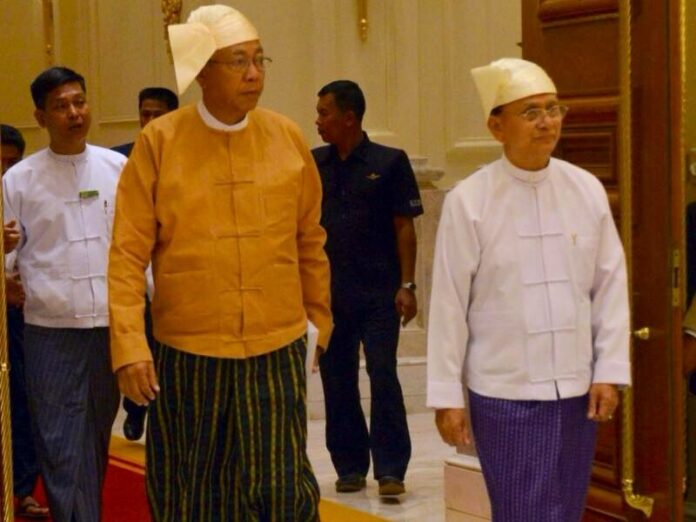
In an undated photo outgoing President Thein Sein, right, and his successor Htin Kyaw, walk into the diplomatic hall at the presidential residence in Nay Pyi Taw for a formal hand-over ceremony. (Photo: Ministry of Information)

By Swe Win
Myanmar Now

YANGON — Shortly after newly elected President Htin Kyaw completed a swearing-in ceremony in Myanmar’s parliament on Wednesday morning, the country’s new leader, a ‘proxy’ of National League for Democracy leader Aung San Suu Kyi, headed to the Presidential Residence in Naypyitaw.

In its stately diplomatic hall, Htin Kyaw met outgoing President Thein Sein. An aired video recording of the hand-over ceremony shows Thein Sein, silent and emotionless, give his presidential sash to his successor and quickly exit the building.

It was a quiet event that marked the end of a historic and tumultuous five-year presidential term of Thein Sein. He was believed to have been handpicked by former military supremo Than Swe to carry out Myanmar’s democratic transition under quasi-civilian rule.

Thein Sein’s presidency has drawn mixed reviews, with most observers acknowledging its dramatic democratic reforms, while many criticise its continued repression, outbreaks of communal violence and conflict, and limited socio-economic progress.


‘Myanmar Spring’

“This was ‘Myanmar Spring, Burma Spring’,” Zaw Htay, the director of the President’s Office, said in a recent interview, favourably comparing Thein Sein’s reforms and smooth handover of power with the violence that followed the ‘Arab Spring’ revolutions in the Middle East.

 “The president had to accommodate (the interests of) the old (military) era and also create a new era. He was the leader during this very difficult transitional period,” Zaw Htay said. Without elaboration, he added that Thein Sein was able to carry out reforms for only two of his five years in office.

The remarks raise questions about whether the retired Than Swe or current army chief Sen-Gen. Min Aung Hlaing put the brakes on further reforms by the Thein Sein government.

Thein Sein will continue to function as chairman of the army-backed Union Solidarity and Development Party, which he represented as president following the party’s win in a rigged 2010 election.

When he took office, he declared in his inaugural public speech in 2011, that he would fight corruption, reform the judiciary, introduce democratic reforms and boost the economy to raise livings standards of Myanmar’s people. He subsequently freed thousands of political prisoners and initiated a nationwide ceasefire process to end long-running civil conflict.

Conflict and Violence

Yet, his term also saw the break-down of a long-standing ceasefire with the ethnic Kachin rebels, continued clashes with other rebel groups in northern Shan State, and outbreaks of inter-communal between Buddhists and the Muslims in western Rakhine State and in central Myanmar. Tens of thousands of civilians were displaced during the violence and conflict that occurred during his term.

No sooner had the number of political prisoners dipped than a new class of them emerged, this time mostly activist students calling for education reform and farmers resisting a rise in land confiscations, another hallmark of Thein Sein’s term. Early on, in November 2012, a violent crackdown on a protest against an unpopular, China-backed copper mine in Sagaing Region had already raised doubts about his government’s commitment to freedom of expression.

“If we have to distinguish between the bad things and the good things of President Thein Sein’s term, then we would have to say that all the good things he did in the first two years were overshadowed by the bad things that followed later,” said Mya Aye, a former political prisoner and member of the influential 88 Generation Peace and Open Society activists. 

Matthew Bugher, a human rights lawyer , said, “It’s undeniable that Myanmar is a freer and more open country and its citizens now have great hope for the future. Thein Sein's name will forever be associated with this period of dramatic reform.”

But he said, “Thein Sein's legacy will be permanently tarnished by his government's active undermining of fundamental rights and freedoms. In particular, the continued crackdown on activists, which accelerated at the end of his term, and the systematic persecution of Rohingya” Muslims in Rakhine.


Economic Progress

On the economic front, Thein Sein successfully reengaged with international financial institutions such as the World Bank and IMF. With it came access to aid and loans, and a slashing of Myanmar’s massive debts. Other reforms saw him open up some sectors of the economy for international investors, most notably oil and gas, and telecoms. GDP growth and foreign investment figures jumped.

In terms of achieving his publicly stated goals of raising living standards of Myanmar’s population, however, there were few achievements, according to Sean Turnell, an Australian economist specialised in Myanmar who advises the NLD.

“Indeed, given rising prices, land insecurity and a society more aggressive in its pursuit of material gain, considerable numbers of people in Myanmar are worse off at this conclusion of the Thein Sein government than they were at its commencement,” he told Myanmar Now in an email.

“Overall, the Thein Sein government laid down some good foundations, but these have not been sufficient to build the structure of change needed to improve the lives of the Burmese people. Accordingly, his legacy is a mixed one, and has left the new government a heavy burden,” Turnell said.'


To reach us about this article or another matter, please contact us by e-mail at: [email protected].

Follow Khaosod English on Facebook and Twitter for news, politics and more from Thailand.

Follow @KhaosodEnglish

\

Advertisement

10,000 'Red Bowls' Confiscated, Deemed Threat to National Security

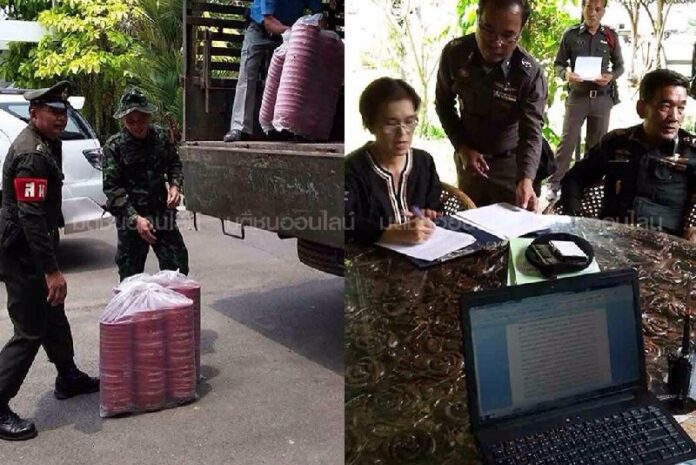
Photos showing the raids today in Nan province. Photo: Matichon

By Pravit Rojanaphruk
Senior Staff Writer

NAN — More than 30 soldiers and police raided the house of a former Pheu Thai politician at 11am Saturday in Nan province confiscating thousands of red plastic water bowls.

The buckets bearing signatures of ousted and fugitive former premier Thaksin Shinawatra and his sister, former Prime Minister Yingluck Shinawatra, have become the latest symbol of support for the siblings. They have also become a show of continued defiance against the ruling military regime, after a 57-year-old woman was recently charged with sedition for posting a picture on Facebook of herself posing with the controversial water scoop.

Theerawan "Wan" Charoensuk, 57, faces a possible prison term of 7 years if found guilty.


Woman Charged With Sedition For Posing With Red Bucket


According to Matichon News, piles of red buckets, counted at 8,862 pieces by officers, were taken away on a military truck from a house in Nan, co-owned by Sinrinthorn Ramasutra and Poonsuk Lohachote, both former Pheu Thai MPs for Nan province; a northern stronghold for the Shinawatras.

A further 1,500 red buckets were later rounded up and removed in a raid on the office of another former Pheu Thai MP for Nan province, Cholnan Srikaew.

The red bowls were intended to be a Songkran gift to Thaksin-Yingluck supporters. The Thai New Year, or Songkran, is just eleven days away. The buckets contain a printed message saying: “Although the situation is heated, it’s hoped that brothers and sisters would be soothed by the water [in the bucket].”

The raid was led by Pol Col Prayoon Chamnankong, superintendent of Nan police station and Maj Gen Chainarong Kaewkla. The officers say giving away the buckets offers an unfair political advantage to the party and if the Democrat Party doles out water containers in a similar manner, they too would be confiscated.

Prayoon said such action violates Article 116 of the Penal Code: sedition. It’s unclear at the time of publication if the two MPs will face charges as the red buckets had not been distributed.

Attempts have also been made by the Nan provincial branch of the National Council for Peace and Order, the formal name of the junta, to suppress the news of the confiscation but it failed.

On social media, some were joking about the raid. Anurak Jeantawanich, who has campaigned every Sunday in Bangkok for a number of weeks against the junta-sponsored draft charter, wrote that it was so funny that red plastic water buckets have become a threat to national security.

Another Facebook user, “Chas T Mass”, put up two photos, the top one showing a raid for weapons and drugs while the lower picture shows the red bucket raid in Nan today.

“What are soldiers for?” read his caption.


Related stories:

Police Confiscate 'Red Bowls' From Yingluck Supporters

Thai Rath Reporter Taken to Army Base for 'Red Bowl' Report

Woman Charged With Sedition For Posing With Red Bucket


Follow Khaosod English on Facebook and Twitter for news, politics and more from Thailand. To reach Khaosod English about this article or another matter, please contact us by e-mail at [email protected].


Follow @KhaosodEnglish

\

Advertisement

Junta Bans Bookstore Talk on Draft Charter

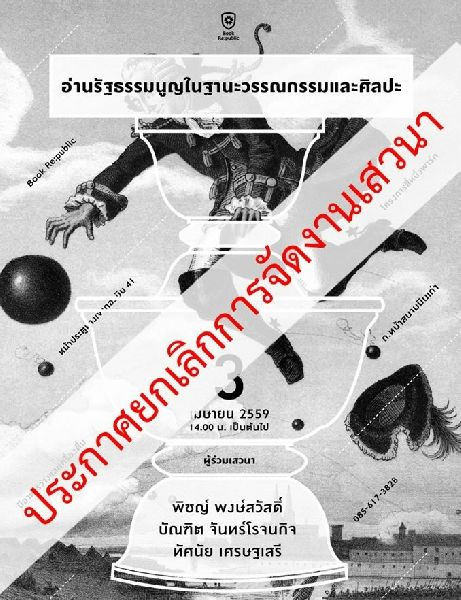
A poster announcing the cancellation of the Sunday discussion of the draft charter at Book Re:public bookstore in Chiang Mai. Photo: Book Re:public / Facebook


By Pravit Rojanaphruk
Senior Staff Writer

CHIANG MAI — Another scheduled discussion on the junta-sponsored draft charter, this time at a bookstore in Chiang Mai, was cancelled after the military junta said it will not permit the event to proceed tomorrow.

 “Book Re:public”, an independent bookstore based in Chiang Mai which holds regular talks on various topics, posted on Facebook today that it regrets being unable to hold the talk due to the military ban.

The bookshop, owned by Rodjaraeg Wattanapanit who became the first Thai named among “International Women of Courage” by the US State Department last month, announced the news on its Facebook page today. They said they were told by soldiers from Kawila Military Base in Chiang province to cancel the talk entitled “Reading the Constitution as Art and Literature” slated for Sunday April 3.

The bookstore provided no reason for why the military junta has decided to ban the event.

“We apologize to those intending to attend the talk,” part of the message on Facebook read, adding that they will continue to strive to create space for public discussion in a democratic society.

Sunai Phasuk , senior Thai researcher at Human Rights Watch, said the National Council for Peace and Order, the formal name of the military junta, has passed the point where its promised Aug 7 referendum on the draft charter can be considered free and fair.

“There’s no element to ensure a democratic and open space for a meaningful referendum. Every action of the junta indicates that the military wants this to be a one-sided [plebiscite] to encourage an approval [of the draft charter].

“From day one since the [May 2014] coup there has been no convincing assurance for a free and fair election,” Sunai added. 

Related stories:

Women Doubly Repressed Under Junta and Patriarchy, ‘Woman of Courage’ Winner Says


Advertisement

Prayuth Promises Punishment for Not Maintaining Transport Safety

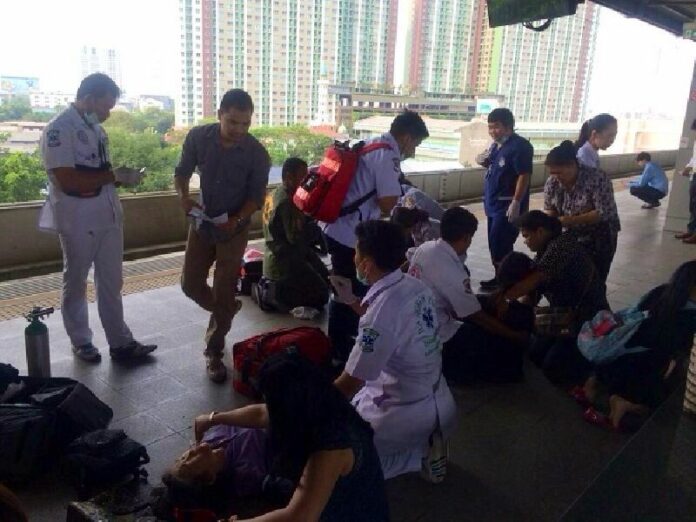
Airport Rail Link passengers are treated Monday morning in Bangkok. Photo: Ruamkatanyu Foundation

By Pravit Rojanaphruk
Senior Staff Writer

BANGKOK — Heavier penalties will be meted out against those who endanger the lives of public transport users, Junta-leader-cum-Prime-Minister Gen. Prayuth Chan-ocha said yesterday.

Without laying out anything specific, Prayuth said, during his weekly Friday night television and radio address yesterday, that he would use his power to make sure anybody responsible for causing death or injury to train, bus or ferry passengers will face heavier punishment.

“Life vests must be readily available, trains must have safety standards and [administrators must] not try to solve disasters after they occur. When things happen, everyone panics and when people became panicked, can the situation be handled if you don’t tell them first how to maintain safety? If the [train] windows can’t be opened, what will people have to do? There should be big signs in the carriage… It would be very wrong to have no instructions written down… We must be proactive,” said Prayuth.

The suggestion came after a recent power failure trapped dozens of passengers on the Makasan-Suvarnabhumi Airport link elevated train for an extended period of time, forcing passengers to find their own ways to break the train windows as they risked being suffocated by a lack of oxygen. Earlier this week a public bus also ran over and killed a pedestrian on Hua Chang bridge in Bangkok.

Prayuth said he can’t help it if private car drivers wish to jeopardize their own lives by not being mindful about safe driving, but those involved with the running of public transport, where many lives are at stake, must ensure that safety is of primary concern.

Prayuth said there’s no point telling train passengers what to do after an emergency. He added that signs and tools for emergency escape should be clearly marked and easily accessible.

Related stories:

Pedestrian Killed by Bus No. 36

Airport Rail Link Fails Second Time This Week

Hundreds Trapped in Hot, Crowded Airport Link Train (Video)


Advertisement

Hot News

LATEST NEWS

Bangkok
overcast clouds
28.8 ° C
28.8 °
28.8 °
74 %
2.5kmh
97 %
Mon
33 °
Tue
32 °
Wed
33 °
Thu
35 °
Fri
27 °