

























31.6 C
Bangkok
Monday, June 29, 2026
Home Blog Page 2765

Expelled Cops Defend Shooting Out Tire, Beating Students

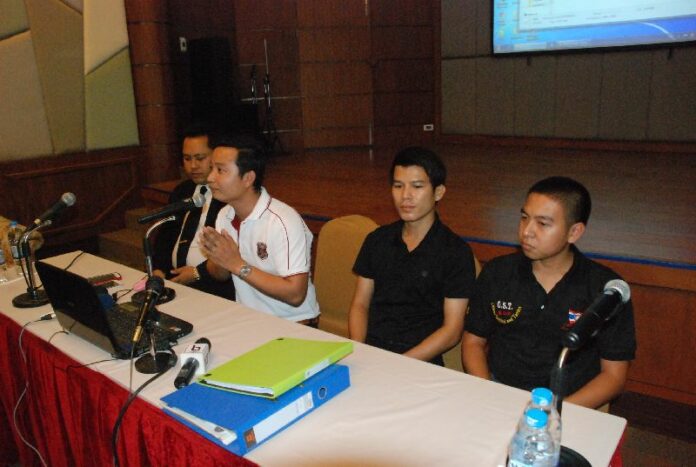
From right, lawyer Charnchai Chimpanang, Sgt. Subin Nuekkham, Cpt. Wutthipat Bua-urai and Lt. Cpt. Thanakarn Chaipipat at a news conference Wednesday in Phitsanulok province.

By Teeranai Charuvastra
Staff Reporter

PHITSANULOK — Three disgraced police officers said they shot at a car full of university students before hauling them out and assaulting them two weeks ago because they suspected the students were criminals.

The officers spoke to the public for the first time Wednesday since the incident in Phitsanulok province, which prompted the regional police force to expel the three men while a criminal investigation against them was being conducted.


Undercover Cops Accused of Beating, Pistol-Whipping Students (Video)


With their lawyer present, Sgt. Subin Nuekkham, Cpt. Wutthipat Bua-urai and Lt. Cpt. Thanakarn Chaipipat gave their side of the story of what happened at a hotel news conference.

Speaking on behalf of his colleagues, Subin did not dispute the accounts of what happened on the night of March 18, when he and two other officers reportedly gave chase to five university students and fired a handgun at their car, disabling one of its tires. The three officers then forced all five students out of the vehicle and assaulted them, according to the students.

After the case came to light, the police charged Subin, Wutthipat and Thanakarn with six offenses, including attempted murder, and expelled them from the service.

But Subin said he and his colleagues did all the things they were accused of only because the student driver, Chaithawat Thamrongsakdikhun, clipped his car first and refused to stop and take responsibility. Subin said Chaithawat then sped away from the scene, raising his suspicion the driver might have been a criminal on the run.

“As a professional police officer, my instinct made me question why that vehicle did not stop and allow me to inspect it,” Subin said. “Furthermore, that car did not have a license plate, and it was modified like a racing car, so I had to gauge the situation that the vehicle might have been involved in wrongdoing or possessed illegal things, so I decided to do everything I could to stop the vehicle.”

Even if it meant shooting at the car, Subin said, though he insisted that he only aimed his handgun at the car’s tire as he had no intention of harming the students. 

“I’d like to insist that I fired the shots according to a SWAT course that I participated in,” he said. “Therefore, I’d like to dispute the allegation of attempted murder, because if I intended to kill someone or shoot at someone, I would have shot at the car window.” 

Subin also admitted to assaulting the students with his two colleagues after they were forced out of their car, but said he did so because he felt “pressured” from his pursuit. 

Subin added that he and other two officers have tried to express their apology to the five students for the ordeal, but the students declined the offer. 

“I admit to my wrongdoing and after what happened I tried to ask for a meeting with the victims, I visited the victims at hospital, and I offered my apology to the victims and their family and offered to pay the medical bills, but I was repeatedly denied,” Subin told reporters. 

The three expelled officers said they will only plead guilty to physical assault in court and contest all other charges. 


Teeranai Charuvastra can be reached at [email protected] and @Teeranai_C.


\

Advertisement

Charter Draft First Look: When Will the Junta be Really Gone? (Analysis)

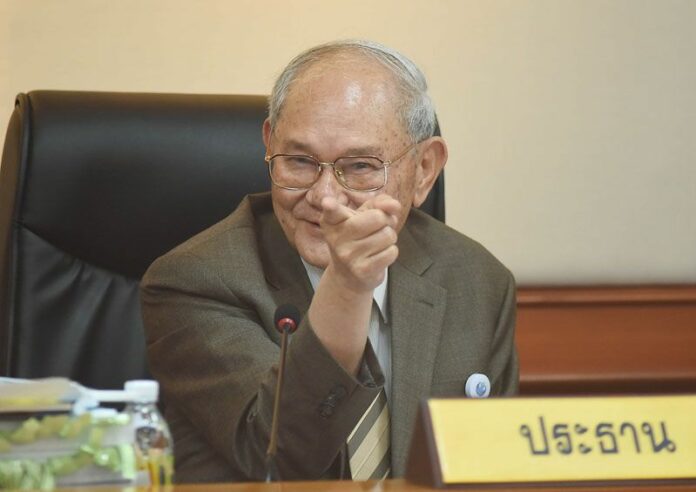
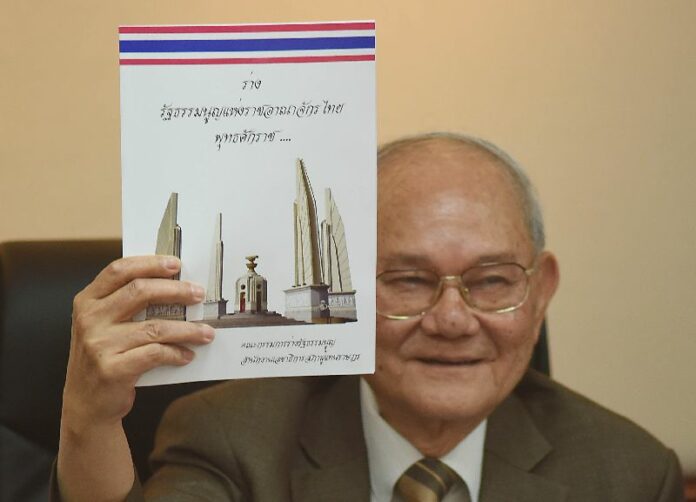
Constitution Drafting Committee Chairman Meechai Ruchuphan presents the final draft of the proposed charter on March 29 in Bangkok.

By Pravit Rojanaphruk
Senior Staff Writer

BANGKOK — One of the most contentious aspects of the junta-sponsored draft charter released Tuesday is the question of how much longer it would enable the military to stay in power if voters choose to adopt it as the law of the land.

The 279 articles filling the 105 pages of the charter released Tuesday offers reasons to suggest the junta will be around, one way or another, for at least five years, and there are other blurry issues to take into consideration as well. Many of its most contentious details are stipulated in the transitional provisions enumerated between articles 262 and 279. 

Under Article 269, for the first five years after an election, 244 members of the 250-person senate will be chosen by the National Council for Peace and Order, the formal name of the junta, via a junta-appointed selection committee. Six other seats will be reserved, ex-officio, for commanders of the army, navy, air force, police, the armed forces commander in chief and permanent secretary of the Defense Ministry.


Charter Draft Second Look: Full Education No Longer Guaranteed (Analysis)


Since there will be 500 MPs under the new draft charter, this means a third of the Parliament House will be populated by people chosen by the junta.

Under the charter draft, candidates for prime minister will come from parties’ lists of three candidates, but if none of the MP candidates wins a majority of lower house votes, both upper and lower houses will convene a joint session to select a prime minister. Candidates can be nominated who are not MPs, thus allowing room for a non-MP to become prime minister.

Those who think the junta will quickly fade away and cease to exist if and after the draft charter is approved through the Aug. 7 referendum may be disappointed.

This five-year transitional upper house, which is indirectly selected by the NCPO, is authorized under Article 270 to endorse laws and oversee the implementation of reforms. The Cabinet will have to report to the senate every three months to update them about the progress of reforms, and the senate is empowered to speed up that process.

The first-term, post-election senate is basically an extended arm of the NCPO for five years after a new elected government is sworn in.

The draft charter also ensures that the junta itself won’t be leaving too soon. Article 265 stated that the NCPO will remain in power until “the newly formed Cabinet” assumes office.

What if 24 hours before the new cabinet assumes office, junta leader Prayuth Chan-ocha decides he can’t bear the sight of the newly formed government and exercises his absolute power under Article 44, which is guaranteed to remain intact, to do something about it?    

Here’s where things get even more blurry and tricky. Article 279 states that all the orders and actions made by the NCPO and its head before this draft charter comes into effect will be considered constitutional under the new draft charter and “will have [legally] binding effects”.

Does this mean orders freezing assets of some dissidents and the requirement that these people seek the NCPO’s permission to travel abroad will still be valid?

In the overall picture, the preamble of the draft charter says a lot about how the junta-sponsored charter drafters view politicians and the notion of democracy.

Part of the two-and-a-half-page preamble states that past constitutional crisis was partly a result of “people who are not fearful of rules governing the country.”

The first page also vaguely states that another factor in causing the crisis was due to “governing rules that are still not suited” to Thailand at the current time.

The preamble gives us a clue as to how the junta-appointed charter drafters perceive an ideal society. It states that preconditions leading to political conflicts must be reduced so Thai society can be “happy and peaceful on the foundations of love and unity.” It says nothing about how different political opinions should be accommodated and resolved peacefully through deliberation.

Those who love the military junta’s performance over the nearly past two years will likely be happy to endorse the draft charter as they can feel reassured that the NCPO will not really vanish after 2017. 

People who are already fed up with the military regime will have a hard time deciding what to do, as the NCPO is keeping its cards close to its chest and not revealing what may happen in case the junta-sponsored draft charter gets rejected in the Aug. 7 referendum. 

There’s a possibility that the junta may restart a third round of the charter drafting process, thus in effect buying more time and staying in power even longer, or junta leader Gen. Prayuth may invoke his absolute power to amend the rejected draft or revise any former constitution and declare it valid. And there lies the uncertainty of not just the draft charter but the whole referendum process.


.


\

Advertisement

Charter Draft First Look: When Will the Junta be Really Gone? (Analysis)

Constitution Drafting Committee Chairman Meechai Ruchuphan presents the final draft of the proposed charter Tuesday in Bangkok.

By Pravit Rojanaphruk
Senior Staff Writer

BANGKOK — One of the most contentious aspects of the junta-sponsored draft charter released Tuesday is the question of how much longer it would enable the military to stay in power if voters choose to adopt it as the law of the land.

The 279 articles filling the 105 pages of the charter released Tuesday offers reasons to suggest the junta will be around, one way or another, for at least five years, and there are other blurry issues to take into consideration as well. Many of its most contentious details are stipulated in the transitional provisions enumerated between articles 262 and 279. 

Under Article 269, for the first five years after an election, 244 members of the 250-person senate will be chosen by the National Council for Peace and Order, the formal name of the junta, via a junta-appointed selection committee. Six other seats will be reserved, ex-officio, for commanders of the army, navy, air force, police, the armed forces commander in chief and permanent secretary of the Defense Ministry.


Charter Draft Second Look: Full Education No Longer Guaranteed (Analysis)


Since there will be 500 MPs under the new draft charter, this means a third of the Parliament House will be populated by people chosen by the junta.

Under the charter draft, candidates for prime minister will come from parties’ lists of three candidates, but if none of the MP candidates wins a majority of lower house votes, both upper and lower houses will convene a joint session to select a prime minister. Candidates can be nominated who are not MPs, thus allowing room for a non-MP to become prime minister.

Those who think the junta will quickly fade away and cease to exist if and after the draft charter is approved through the Aug. 7 referendum may be disappointed.

This five-year transitional upper house, which is indirectly selected by the NCPO, is authorized under Article 270 to endorse laws and oversee the implementation of reforms. The Cabinet will have to report to the senate every three months to update them about the progress of reforms, and the senate is empowered to speed up that process.

The first-term, post-election senate is basically an extended arm of the NCPO for five years after a new elected government is sworn in.

The draft charter also ensures that the junta itself won’t be leaving too soon. Article 265 stated that the NCPO will remain in power until “the newly formed Cabinet” assumes office.

What if 24 hours before the new cabinet assumes office, junta leader Prayuth Chan-ocha decides he can’t bear the sight of the newly formed government and exercises his absolute power under Article 44, which is guaranteed to remain intact, to do something about it?    

Here’s where things get even more blurry and tricky. Article 279 states that all the orders and actions made by the NCPO and its head before this draft charter comes into effect will be considered constitutional under the new draft charter and “will have [legally] binding effects”.

Does this mean orders freezing assets of some dissidents and the requirement that these people seek the NCPO’s permission to travel abroad will still be valid?

In the overall picture, the preamble of the draft charter says a lot about how the junta-sponsored charter drafters view politicians and the notion of democracy.

Part of the two-and-a-half-page preamble states that past constitutional crisis was partly a result of “people who are not fearful of rules governing the country.”

The first page also vaguely states that another factor in causing the crisis was due to “governing rules that are still not suited” to Thailand at the current time.

The preamble gives us a clue as to how the junta-appointed charter drafters perceive an ideal society. It states that preconditions leading to political conflicts must be reduced so Thai society can be “happy and peaceful on the foundations of love and unity.” It says nothing about how different political opinions should be accommodated and resolved peacefully through deliberation.

Those who love the military junta’s performance over the nearly past two years will likely be happy to endorse the draft charter as they can feel reassured that the NCPO will not really vanish after 2017. 

People who are already fed up with the military regime will have a hard time deciding what to do, as the NCPO is keeping its cards close to its chest and not revealing what may happen in case the junta-sponsored draft charter gets rejected in the Aug. 7 referendum. 

There’s a possibility that the junta may restart a third round of the charter drafting process, thus in effect buying more time and staying in power even longer, or junta leader Gen. Prayuth may invoke his absolute power to amend the rejected draft or revise any former constitution and declare it valid. And there lies the uncertainty of not just the draft charter but the whole referendum process.


Pravit Rojanaphruk can be reached at [email protected] and @PravitR.

Follow Khaosod English on Facebook and Twitter for news, politics and more from Thailand. To reach Khaosod English about this article or another matter, please contact us by e-mail at [email protected].


Follow @KhaosodEnglish

\

Advertisement

Pedestrian Killed by Bus No. 36

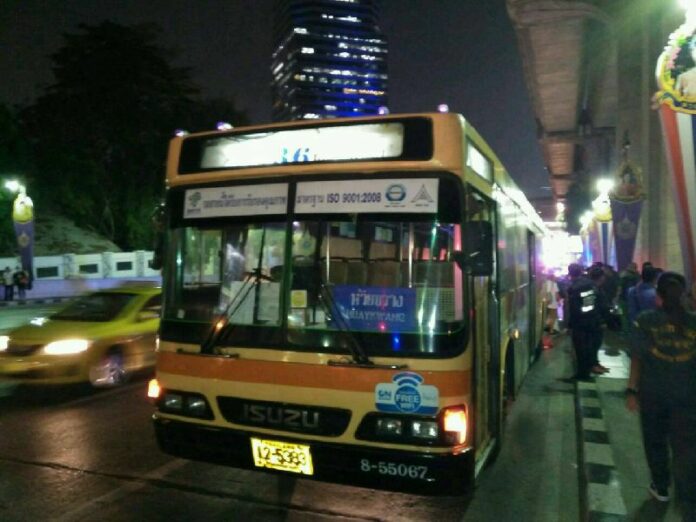
Bus No.36 Wednesday night on Hua Chang bridge

BANGKOK — A 70-year-old woman was killed at around 8:15pm Wednesday when the No.36 bus hit her on Hua Chang Bridge at Bangkok’s Ratchathewi District.

Air-con bus No. 36 was running from Huai Khwang to Si Phraya Pier when it hit a pedestrian identified as Pranom Ko-Charoenrat, 70, who was crossing the road, according to Capt. Nikom In-Oonchote of Pathumwan Police Station.

48-year-old bus driver Supasit Yodpanya said he was driving en route to Huai Khwang in the left lane. At the time many pedestrians were crossing the road during a traffic jam, Supasit told police. Supasit said he heard the vehicle hit something, so he parked the bus and discovered Pranom’s body.

Police charged Supasit Wednesday evening for reckless driving, Nikom said. Police will question witnesses and inspect CCTV footage from the area.


Related stories

Motor Taxi Passenger Killed in Bus No. 8 Collision

Man Dies After Jumping In Front of Moving Bus on Sukhumvit Road


Advertisement

Study: Indonesia 'Hobbit' Fossils Older Than First Thought

In this 2012 photo provided by the Liang Bua Team, archaeological excavations of Holocene deposits at Liang Bua are conducted on the Indonesian island of Flores. Photo: Liang Bua Team / Associated Press

NEW YORK — It was a spectacular discovery: Fossil remains in an Indonesian cave revealed a recent relative of modern humans that stood about 3 feet tall. The creatures were quickly nicknamed "hobbits."

With evidence that they had survived to just 12,000 years ago, the hobbits appeared to have been the last of our companions on the human branch of the evolutionary tree to go extinct.

Now, a decade after they made headlines, they've lost that distinction. New investigations indicate they evidently disappeared much earlier — about 50,000 years ago, before Neanderthals did, for example.

The new date raises speculation about whether hobbits were doomed by the arrival of modern humans on their island. But it doesn't change much about their scientific significance, said Matt Tocheri of Lakehead University in Thunder Bay, Ontario.

He and others wrote the new paper with three of the researchers who'd first reported the discovery in 2004. The new paper was released Wednesday by the journal Nature.

The hobbits are formally known as Homo floresiensis, reflecting their home on the Indonesian island of Flores. With small, chimp-sized brains, the hobbits had skulls that resembled Homo erectus, which lived in Africa and Asia. But they also had long arms and short legs that harkened back to the much older evolutionary forerunners best known for the skeleton dubbed Lucy.

It's not clear where they fit in the human family tree. They may have descended from taller ancestors who shrank because of their isolation on the island. Some scientists have argued they were diseased modern humans rather than a separate species, but experts called that a minority view and several said the new dates make it less likely.

Hobbits evidently made the stone tools that were found along with skeletal remains in the Liang Bua cave. The new analysis says the remains are 100,000 to 60,000 years old, while the artifacts range in age from about 190,000 to 50,000 years.

Researchers revised the original age estimates after new excavations revealed more about the geology of the cave. Sediments were sampled to date the artifacts and bones.

"I think it's a terrific paper," said Bernard Wood of George Washington University, who had no role in the research. "They have done everything you can possibly ask."

So did the arrival of modern humans spell the end for the hobbits, as is proposed for the demise of the Neanderthals in Europe and Asia about 40,000 years ago?

\

This 2012 photo provided by the Smithsonian Institution and the Liang Bua Team shows Liang Bua, a limestone cave on the Indonesian island of Flores, as the Liang Bua Team prepares for new archaeological excavations. Photo: Smithsonian Digitization Program Office and Liang Bua Team / Associated Press


There's no evidence that modern humans occupied Flores until long after the hobbits were gone. But they are known to have lived not far away, in Australia, some 50,000 years ago — right about the time the hobbits evidently disappeared.

"It is certainly suggestive," said anthropologist Karen Baab of Midwestern University in Glendale, Arizona, who studies the hobbits but didn't participate in the new work.

Richard Roberts of the University of Wollongong in Australia, a study author, said in an email it is "certainly a possibility to be considered, but solid evidence is needed in order to demonstrate it. One thing we can be certain of, it will definitely be a major focus of further research."

Story: Malcolm Ritter / Associated Press


Advertisement

Trump Suggests 'Punishment' for Women Who Get Abortions

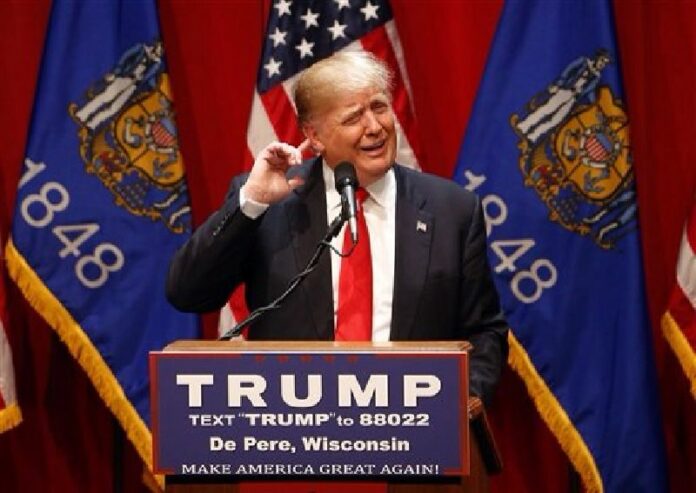
Republican presidential candidate Donald Trump speaks during a campaign event at St. Norbert College in De Pere, Wis., Wednesday, March 30, 2016. Photo: Patrick Semansky / Associated Press

BROOKFIELD, Wisconsin — Women who get abortions should receive "some form of punishment," Republican front-runner Donald Trump said Wednesday, without indicating specifically what the punishment should be.

The comments came in a heated exchange with MSNBC's Chris Matthews during the taping of a town hall in Wisconsin, which holds its primary next week.

"There has to be some form of punishment," Trump told Matthews in the exchange over whether abortion should be banned. The subject remains highly controversial decades after the Supreme Court legalized it.

Pressed by Matthews on the nature of that punishment, Trump responded: "I haven't determined what the punishment should be." He also suggested that women could continue to receive abortions, but at "illegal places."

Democratic front-runner Hillary Clinton quickly responded on Twitter, noting Trump's comments and adding, "Just when you thought it couldn't get worse. Horrific and telling."

Trump has often said he's opposed to abortions except in the case of three exceptions: rape, incest and when the life of the mother is at risk. He used to describe himself as in favor of abortion rights, but says his stance has evolved over the years.

Within hours, Trump's campaign sought to take back his comments in two separate statements, ultimately saying the billionaire businessman believes abortion providers — and not their patients — should be the ones punished.

"My position has not changed," Trump argued in both statements released by his campaign. "Like Ronald Reagan, I am pro-life with exceptions."

Even before Trump's comments, recent polls have put his negative ratings nearing or even eclipsing 70 percent among women.

The New York billionaire arrived in Wisconsin fending off another controversy. His campaign manager, Corey Lewandowski, was charged with misdemeanor battery in Florida on Tuesday over an altercation with a female reporter earlier this month.

Wisconsin's April 5 primary looks pivotal in the Republican race. If Texas Sen. Ted Cruz wins, it would narrow Trump's already tight path to the nomination and raise the prospect of a contested party convention. Delegates there might turn to other candidates if the billionaire fails to win on the first ballot.

Trump heads into Wisconsin with 739 delegates to Cruz's 465. Kasich lags behind with 143. Wisconsin has 42 Republican delegates, with 18 going to the statewide winner and 24 divided among the winners in each of the state's eight congressional districts

Trump would need 1,237 delegates by the end of the primary season to capture the nomination and avoid a contested convention.

All three Republican candidates now say they aren't committing to supporting whomever the party chooses as its nominee for the November election.

Trump on Tuesday said he was rescinding his promise because "I have been treated very unfairly," and he listed the party establishment among those he believes have wronged him.

Cruz said if Trump were the nominee, that would hand the election to Clinton.

Based on primaries and caucuses to date, Clinton has 1,243 delegates to rival Bernie Sanders' 975. Including superdelegates, party leaders who are free to support any candidate, Clinton has 1,712 delegates to Sanders' 1,004, leaving her shy of the 2,383 it takes to win the nomination.

Story: Associated Press


To reach us about this article or another matter, please contact us by e-mail at: [email protected].

Follow Khaosod English on Facebook and Twitter for news, politics and more from Thailand.

Follow @KhaosodEnglish

\

Advertisement

Rights Commissioner Justifies Walking Out on Activists

Photo: ThaiPBS

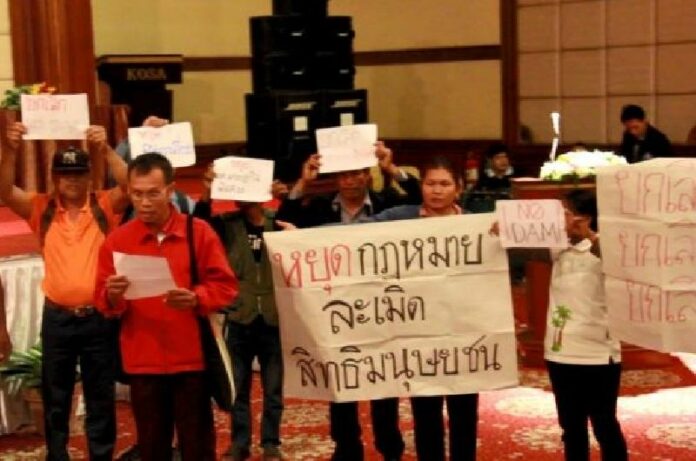
BANGKOK — Chairman of the National Human Rights Commission said he decided to walk out on a group of activists stating their grievances at a forum today because it wasn’t on the agenda.

Wat Tingsamitr, who late last year was appointed Thailand’s top defender of civil rights, said the community rights activists of the New Isaan Movement did not get permission before they started reading from a declaration condemning civil rights abuses in the northeast.

“It had nothing to do with our event. Let me ask, if you were me, would you have stayed?” Wat said by telephone.

The incident took place in Khon Kaen province at a forum sponsored by the rights commission at which six groups of community leaders and activists met to discuss civil rights issues with the commissioners.

Among the groups was the New Isaan movement, which in their statement criticized the ruling junta for invoking its absolute power to push through infrastructure projects by waving the need for reviews of environmental impact.

During the comments made at the end of the forum by a group representative, Wat stood and walked out, leaving the activists visibly upset, according to a Thai PBS report.

Wat added that he was pressed for time because he had to catch a plane back to Bangkok. All seven members including Wat were appointed late last year by the military government to the commission, an ostensibly independent government body.

The commission has long been criticized by some activists as being a relatively weak voice for human rights in Thailand, compared to stronger condemnations expressed by international watchdog groups.


Related stories:

Outgoing Rights Commission Criticizes Junta, Pre-Coup Protests

Thai Human Rights Commission Slated For 'Downgrading'

Activists Protest Thai Human Rights Agency's Post-Coup 'Silence'


Teeranai Charuvastra can be reached at [email protected] and @Teeranai_C.
 

\

Advertisement

Junta Grants Police Powers to Military

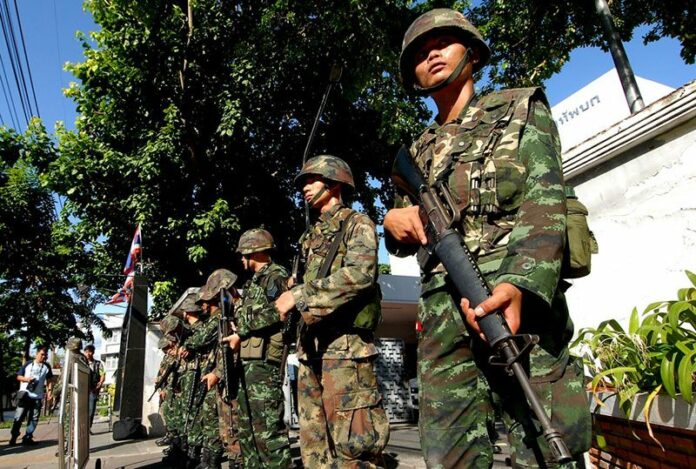
Soldiers posted outside an army auditorium where civilians were being brought in for ‘attitude adjustment’ one day after the coup on May 23, 2014, in Bangkok.

BANGKOK — Soldiers last night were granted sweeping authority to conduct warrantless searches of homes, seize assets and detain civilians without charge.

On the order of junta chief Prayuth Chan-ocha, a wide range of powers usually reserved for civilian police were bestowed to members of the military Tuesday night, ostensibly to carry out the junta’s policy of rooting out underworld influences and unduly “influential people” in the economy and society.

Under the order, soldiers appointed by the junta have powers equal to police for crime suppression. Soldiers from the rank of sub-lieutenant and up are heretofore named “suppression officers,” while their subordinates will assist them.

Prayuth’s order, issued under the absolute power his junta wrote for itself under Article 44 of its interim constitution, went into immediate effect.

Soldiers can now search individuals and take their property without any judicial review, so long as the soldier suspects involvement in a crime.

They can also bring anyone in for interrogation under such suspicion. If needed, they can detain people without charge for up to seven days.

The move is another example of the junta bypassing civil society and process, senior researcher Sunai Phasuk of Human Rights Watch said, and can lead to abuse of power.

“It shows the preference for unchecked action which can be carried out with total impunity,” he said.

Sunai said the list of influential figures recently released contained community leaders targeted by the military and government for defending their community rights, mostly in cases concerning conflict over resources.

Sunai cited the recent case of Lamom Boonyong, a 65-year-old community leader in Rayong province who has fought to save his local fishing community from military eviction. He was just summoned by military on Tuesday under the cover of the government’s “influential figures” crackdown.

Since the military seized power nearly two years ago, it has posited itself as a corruption-buster willing to take tough measures to eliminate the graft endemic to all levels of society. A proposed constitution for the nation released Tuesday, written by junta appointees, strengthens its grip on power under the same argument: ending corruption.

Tuesday’s order from Prayuth’s interim cabinet establishes a parallel and separate process from the traditional institutions of justice.

“But the detention must be in places other than police stations, detention facilities, correctional institutions and prisons,” the order said. “And that individual must not be treated as an alleged offender.”

If people are deemed guilty, their cases will go forward under “related laws,” it continues. Suspects can be released without condition or under certain restrictions, such as losing their freedom to travel or engage in financial transactions.

The order makes no mention of what would happen were a suspect found not guilty after detention.

It also shielded any actions taken under the order from administrative review and extended legal immunity to any soldiers “who honestly carry out their duties.” Those who claim to be adversely affected will retain the right to file for compensation.

The order requires soldiers who suspect involvement in the following crimes to exercise their new power: making criminal threats, smuggling drugs, gambling and weapons possession.

Police spokesman Krissana Pattanacharoen responded to the order Wednesday, saying he believed the junta empowered the military with police powers to support the police, as he said they don’t have enough officers.

He said he did not think the order granted soldiers excessive power.


Related stories:

Thai Junta Expands Military Power in New Order, Citing Article 44

Thai Junta Chairman Downplays Article 44’s Autocratic Powers

Junta Clarifies Scope of Article 44’s Sweeping Power

Trust Prayuth with Article 44, Thai Govt Says


Advertisement

Watch Weird, Wonderful Animated Shorts on a Charoen Krung Rooftop

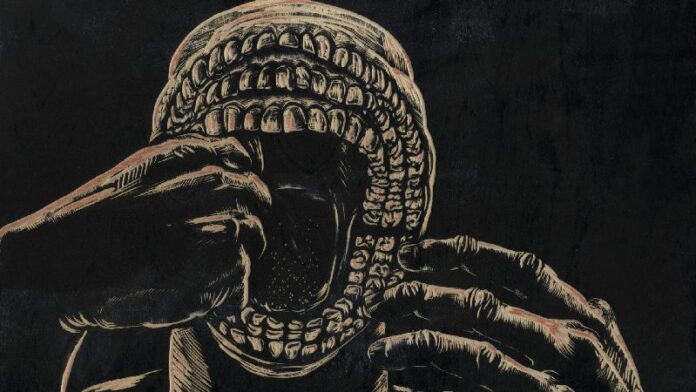
A woodcut animation from ‘Some Actions Which Haven’t Been Defined Yet in the Revolution’ (2011) by Chinese filmmaker Sun Xun

BANGKOK — Cult animation from hand-cut wood panels, sketched celluloid, painted walls, puppets and whatever else can move frame-to-frame will show next month.

Nineteen animated films from over 10 countries will show at A Week of Animation Shorts, a Bangkok-Kuala Lumpur collaboration coming April 8 and 10 to the rooftop of Bridge Cafe & Art Space.

Highlights include stop-motion wall paintings by Italian graffiti artist Blu in “Big Bang Big Boom” (2010), 10 European authors taking their pens directly to celluloid in “Recycling” (2014), and a dystopia cut from woodblock in “Some Actions Which Haven’t Been Defined Yet in the Revolution” (2011).

Admission is free for the Friday and Sunday events, which start at 9pm.

AWAS is a series of animation screenings hosted in collaboration with three Kuala Lumpur-based art galleries. The first edition was held over eight days there earlier this month.

Bridge Cafe & Art Space is located on Soi Charoen Krung 51. It is a short walk from BTS Saphan Taksin exit No. 4.
 

awas!2016_anu-laura

Stop-motion puppet animation ‘Fly Mill’ (2012) by Estonian artist Anu-Laura Tuttelberg
 

Kali_the_Little_Vampire-752704570-large.jpg

Regina Pessoa’s award-winning ‘Kali the Little Vampire’ (2012) is about a young vampire who discovers that he can make a difference to the world.
 

ig-bang-big-boom.jpg

“Big Bang Big Boom” (2010) by Italian street artist ‘Blu’


Advertisement

China Proposes New Web Rules That Could Enhance Censorship

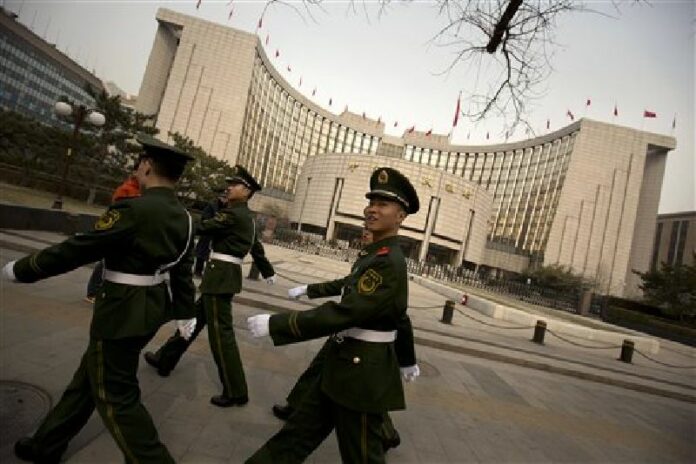
Chinese paramilitary police march past China's central bank, the People's Bank of China, in Beijing, Saturday, March 12, 2016 Photo: Mark Schiefelbein / Associated Press

BEIJING — China is consolidating its ability to censor the Internet by drafting new rules requiring businesses that serve domestic Internet users to register their Web addresses inside the country, a move seen as targeting Chinese companies but that has raised concerns among foreign businesses.

In its most draconian interpretation, the proposed requirements could also further limit access within the Chinese network, analysts said. That appears to be the latest step by the ruling Communist Party to erect cyber barriers in the name of what some officials call "Internet sovereignty."

"This expands control over domestic Internet operators and contributes to the gradual buildup of the capability underpinning Internet sovereignty," said Rogier Creemers, an expert on Chinese media policy at the University of Oxford.

Under the draft regulations released this week by the Ministry of Industry and Information Technology, any firm that provides services to Chinese users must register its domain, or Web address, with a Chinese provider. The rules are found in Article 37 of the ministry's proposed update to a set of decade-old Internet laws.

Analysts said the main targets appear to be Chinese Internet companies that store their content domestically but keep their Web address registered overseas with reputable, international firms for security purposes.

Requiring them to shift their registration to a domestic provider under Chinese government control would allow censors to react more quickly in blocking access to certain sites, said Long Weilian, an IT consultant based in the southern Chinese city of Shenzhen who has blogged extensively on the issue.

"Before, they had to contact the server, get the address, talk to the manager and then ask them to censor something," Long said. "If the domains are all domestic, they can directly stop traffic going to your domain with a command."

Jacob Parker, vice president for China operations with the U.S.-China Business Council, which lobbies the Chinese government on trade policy, said his group was concerned that the rules would block the free flow of information.

"Any kind of restrictions would undermine China's broader economic development goals," Parker said.

\

In this Feb. 19, 2016 file photo released by China's Xinhua News Agency, people applaud as Chinese President Xi Jinping, center, talks with editors in the general newsroom of the People's Daily in Beijing. Photo: Lan Hongguang / Xinhua / Associated Press

Concerned that a borderless, U.S.-led global Internet could weaken its political control, China's government has repeatedly issued cyber regulations that have drawn criticism from Western trade groups. Following pushback from the White House last year, China dropped a provision in a cybersecurity law that would require companies to keep Chinese user data at facilities in China, allowing the government access to personal information.

Questions remain about the new rules' true purpose and how strictly they would be enforced. The ministry is currently soliciting feedback on the proposed registration regulations, and Chinese laws are often softened during the revision process.

Fang Xingdong, the director of a top Chinese technology think tank, said he believes Chinese leaders are seeking to enhance their control, but not to wall China off from the rest of the world.

"Under the current wording, all this is doing is integrating large Chinese Web service providers under a more rigorous supervision framework, while most small businesses won't be affected," said Fang, whose organization regularly submits opinions to the government on Internet issues.

Any attempt to seal off the Chinese Internet "would hurt China as much as America," he said.

Story: Gerry Shih / Associated Press


Advertisement

Hot News

LATEST NEWS

Bangkok
overcast clouds
31.6 ° C
32.2 °
31.6 °
63 %
4.7kmh
100 %
Mon
33 °
Tue
32 °
Wed
30 °
Thu
34 °
Fri
33 °