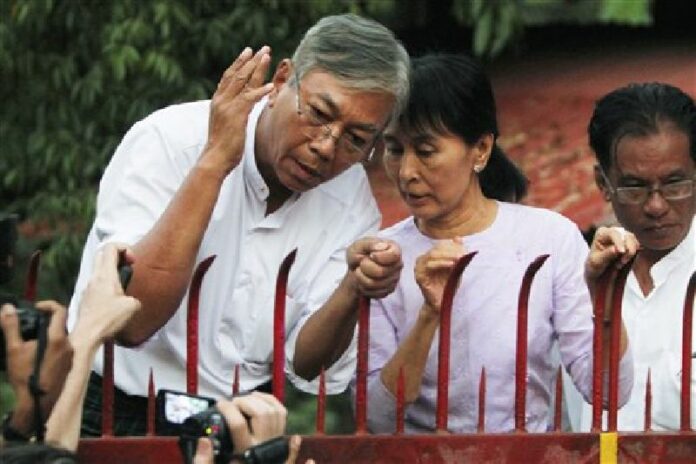
In this Nov. 13, 2010, photo, Myanmar's pro-democracy leader Aung San Suu Kyi, center, speaks with aide Htin Kyaw, left, as she addresses her supporters from the front gates of her home after her release from house arrest in Yangon, Myanmar. Photo: Gemunu Amarasinghe / Associated Press.
NAYPYITAW, Myanmar — An official says Myanmar's parliament will select the country's next president on Tuesday from a group of three final candidates, including the front runner who is a longtime confidant of Nobel laureate Aung San Suu Kyi.
Suu Kyi's National League for Democracy party won overwhelming majorities in both houses of parliament in a Nov. 8 general election and its lawmakers are expected to confirm party nominee Htin Kyaw as the country's next leader.
The new president is to take office on April 1.
Myanmar's electoral system requires that the president be chosen from candidates put forward by each of the two houses of parliament, and a third nominee from the military, which retains a quarter of the legislative seats.
The other candidates are a second NLD nominee, Henry Van Tio, and the military's candidate, Myint Swe, a retired lieutenant general.
Parliament speaker Mann Win Khaing Than announced Monday that the vote would take place Tuesday, after lawmakers confirmed that all three candidates were eligible.
The NLD's huge victory reflected the widespread public support for Suu Kyi, who fought for decades to end dictatorship in Myanmar and remains her party's unquestioned leader. She was awarded the Nobel Peace Prize while under house arrest in 1991.
Suu Kyi was detained for more than 15 years, mostly under house arrest, by a military junta that feared her political popularity.
Myanmar's constitution, written under the former junta's direction, blocks Suu Kyi from becoming president because of a clause that excludes anyone with a foreign spouse or children. Suu Kyi's two sons are British, as was her late husband. The clause is widely seen as having been written by the military with Suu Kyi in mind.
Suu Kyi has said she will be "above" the president and rule from behind the scenes, meaning that any NLD candidate would effectively be her proxy.
The new government will be Myanmar's first to be democratically elected in more than half a century.
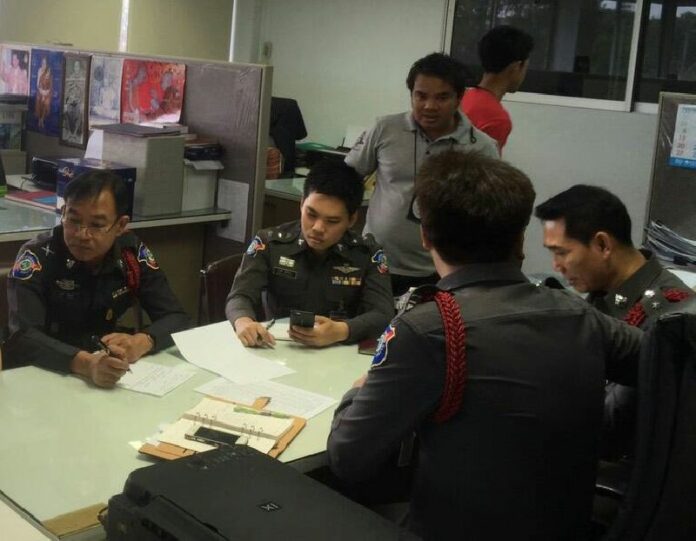
Police officers at Bangkaew Police Station hear a complaint of sexual assault against a British couchsurfer Sunday in Samut Prakan.
SAMUT PRAKAN — A British man went to police in southwestern metro Bangkok on Sunday alleging he was sexually assaulted by a host he found through a popular online service.
The 24-year-old Briton told police via an interpreter that his host, a man named Thanaprasit, performed oral sex on him while he was sleeping at Thanaprasit’s home in Samut Prakan province, police said.
According to police, the British man said he found lodging with Thanaprasit through Couchsurfing.com, a site that connects travelers with locals to stay with.
The man told police that Thanaprasit took him out drinking Saturday night. When the alleged victim woke up Sunday morning, he found Thanaprasit engaged in unsolicited oral sex, said Cpt. Kittiphon Polladech of the Bangkaew Police Station.
The Briton immediately pushed Thanaprasit away, packed his belongings and went to file a police complaint, Kittiphon said.
Thanaprasit denied the allegation, the officer added.
Col. Peerapon Chotikasatien, commander of the police station, said Monday that police have not charged Thanaprasit with any crime so far. Investigators have taken DNA samples from both the victim and accused for testing, he said.
“We are still waiting for the results of the forensic examination,” Peerapon said.
The Briton has reportedly left Bangkok and will return home to the United Kingdom next month, police said.
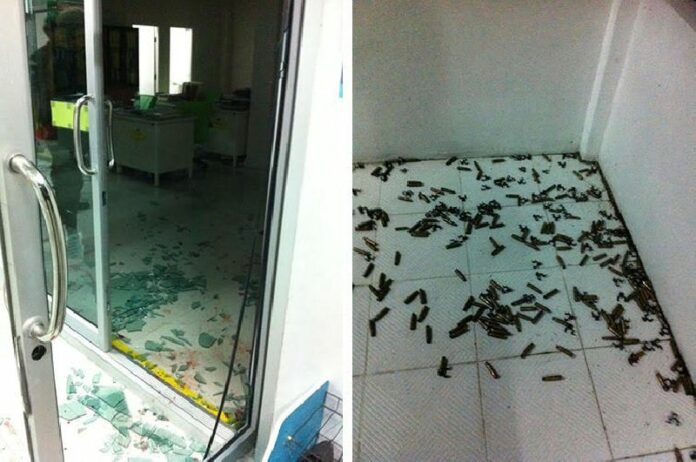
Shattered glass and scattered casings litter the floor of the Cho Airong Hospital on Sunday in Narathiwat province.
NARATHIWAT — At least a dozen armed gunmen seized control yesterday of a hospital in Narathiwat from which they then opened fire on a nearby ranger outpost in an attack the army blames on the local separatist movement.
The unusual attack, which was jointly condemned by the army and the National Human Rights Commission as inhumane, appeared to mark Sunday’s 53rd anniversary of one of the separatist groups active in the region, the National Revolutionary Front, or BRN.
According to a report released to the media by the army, more than 10 masked gunmen seized control of Cho Airong Hospital without harming anyone inside at about 4:30pm on Sunday and fired assault rifles from the second floor onto a ranger operations base next to the hospital.
The militants fired on the base for an hour before retreating into the woods, the military report said, and seven army rangers were injured. The report also said security forces did not return fire out of concern for hospital staff.
Around the same time, unidentified assailants opened fire on a group of security officers at the Cho Airong Train Station and detonated a bomb on a bridge near Yaning village, although no one was injured in those two incidents.
The army believes the attacks were perpetrated by the BRN, one of the armed groups seeking to secede the southern provinces of Narathiwat, Yala and Pattani to form an independent nation.
The BRN was founded March 13, 1963.
“The movement intends to cause chaos, disturbance and damages to lives and property of innocent people, without considering those who have been affected,” Col. Yutthanam Petchmuang, a spokesman for the counterinsurgency Internal Security Operation Command, said Monday. “This is an extreme and inhumane act.”
In a statement released to the press today, the National Human Rights Commission similarly condemned the hospital attack as “inhumane, illegal and a violation of human rights.”
The commission called upon all armed groups not to attack hospitals and medical staff, and praised the army for reportedly refusing to exchange gunfire with the militants at Cho Airong Hospital.
More than 6,500 people, mostly civilians, have been killed in the three southern border provinces since the separatist violence broke out in January 2004.
An orange-flagged Chao Phraya Express Boat cuts through the river in an undated photo
BANGKOK — Those commuting by the capital’s waterways better pocket an extra baht.
Riding all flavors of the Chao Phraya Express Boats cost an additional baht as of this morning, while those churning through Khlong Saen Saep increase Tuesday.
Service operator Chao Phraya Express Boat Co. Ltd. said fares for the boats plying the mighty Chao Phraya River were adjusted in response to the recent 21 baht/liter increase to the cost of diesel.
As of Monday, fares for the Chao Phraya Express’ local lines are now 8 baht, 10 baht and 12 baht. The orange-flagged boats are 14 baht, while those with yellow flags cost 19 baht. Fares of the boats with green flags range from 19 baht to 31 baht.
On Tuesday, Khlong Saen Saep boats will also push prices up by a baht for the same reason: higher fuel costs, according to Chaowalit Methayaprapas, owner of Family Transport (Krob Krua Kon Song), the company running the service. Related stories:
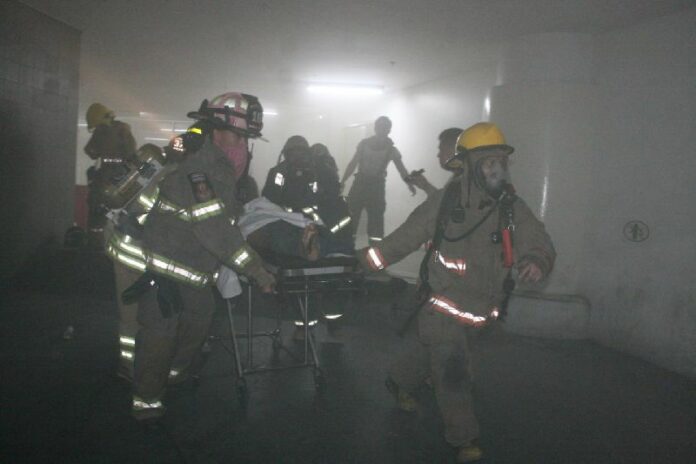
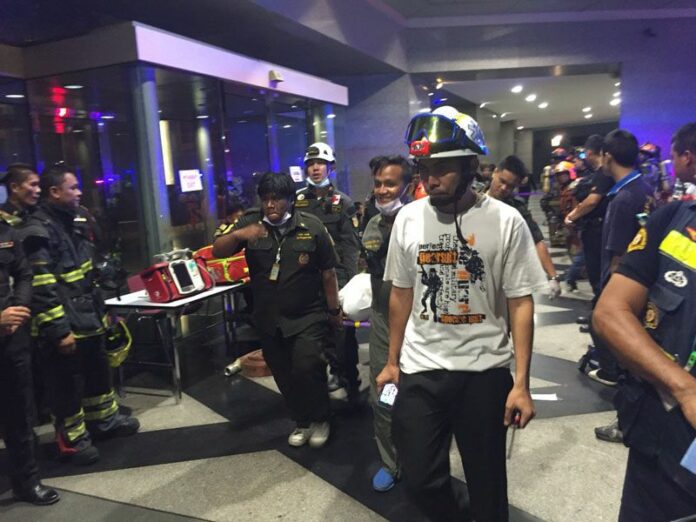
Faces covered by handkerchiefs and masks, rescue personnel rush the injured out of a basement at SCB Park Plaza on Sunday night in Bangkok.
BANGKOK — Siam Commercial Bank has blamed reckless contractors for the deaths of eight people Sunday night at its corporate campus on Ratchadapisek Road.
The bank said in a statement Monday morning the incident, which happened just before 10pm, was the fault of the contractor hired to upgrade the building’s fire suppression system to a gas-based solution.
It said while they were doing the work, they somehow activated the system, which caused the release of large amounts of pyrogen, normally intended to deprive fire of oxygen.
The release of the gas caused five people to suffocate to death immediately. Another three died later. A number of contract workers died as a result and at least one security guard.
Seven people are still being treated at local hospitals.
Police investigators Monday will question the contractor, who has not been identified.
SCB Park Plaza opened to the public as usual this morning.
Demonstrators parade large inflatable dolls depicting Brazil's former President Luiz Inacio Lula da Silva in prison garb and current President Dilma Rousseff dressed as a thief, with a presidential sash that reads "Impeachment," in Sao Paulo, Brazil, Sunday, March 13, 2016. Photo: Andre Penner / Associated Press
SAO PAULO — Brazilians ratcheted up the heat for embattled President Dilma Rousseff on Sunday, turning out by the tens of thousands for demonstrations across the country calling for her ouster.
The biggest protest took place in Brazil's economic capital, Sao Paulo, a bastion of simmering dissatisfaction with Rousseff and her governing Workers' Party. The respected Datafolha polling agency estimated about 500,000 people took part in the Sao Paulo demonstration, while police estimates put turnout at nearly three times that number.
Organizers said about 1 million people joined the anti-Rousseff demonstration in Rio de Janeiro.
Demonstrators protest against Brazilian president Dilma Rousseff on Copacabana beach in Rio de Janeiro, Brazil, Sunday, March 13, 2016. Photo: Silvia Izquierdo / Associated Press
In a statement, Rousseff said, "The peaceful character of this Sunday's demonstrations shows the maturity of a country that knows how to co-exist with different opinions and knows how to secure respect to its laws and institutions."
The street rallies came two days after she rejected the idea of resigning.
The demonstrations add to an already-difficult position of Rousseff. She faces the twin problems of an impeachment effort in congress over alleged fiscal mismanagement amid the worst recession in decades and the sprawling investigation by federal prosecutors into corruption at state-run oil giant Petrobras that has moved closer to her inner circle in recent weeks.
Analysts said the strong turnout at the protests could further hamper Rousseff's ability to fight for her political survival and could lead to the unraveling of her fragile governing coalition.
"There is a situation of ungovernability," said Francisco Fonseca, a political science professor at Pontifical Catholic University in Sao Paulo. "The president has few cards."
Fonseca pointed out that the demonstrations continued to be dominated by the largely white, upper middle class demographic that has been staging regular protests against Rousseff for over a year.
"The poor who are affected by the economic crisis aren't in the streets," he said, adding Sunday's protests demonstrated a "generalized discontent with the political system" without necessarily shoring up any particular opposition party or politician.
Organized largely through social media, demonstrations took place in some 200 cities and towns across Brazil. Rousseff had raised fears of possible clashes between supporters of her party and the anti-government demonstrators, but no serious incidents were reported during Sunday's protests, which had a festive atmosphere.
Demonstrators demand the impeachment of Brazil's President Dilma Rousseff during a rally outside the National Congress in Brasilia, Brazil, Sunday, March 13, 2016. Photo: Eraldo Peres / Associated Press
Crowds in the yellow and green hues of the Brazilian flag brandished signs reading "Workers' Party out."
"She (Rousseff) has to go," said Patricio Gonzaga, an unemployed metal worker who took part in the Sao Paulo gathering. "She is the person responsible for the mess our economy is in — the inflation, recession and unemployment. She is to blame for me being unemployed and having trouble supporting my family."
Demonstrators across the country stressed that their anger extended well beyond Rousseff and the Workers' Party, saying the "Car Wash" investigation into corruption at Petrobras had compromised the entire political class.
"Of course I want to see Rousseff booted out," said Maria de Lima Pimenta, a retired schoolteacher who was at the anti-Rousseff march along Rio's Copacabana Beach. "But then the problem becomes, who will replace her? They're all crooks."
Protest organizers stressed that the movement isn't linked to any opposition political party, and signs endorsing parties were largely absent from the demonstrations.
Demonstrators dressed as Brazil's President Dilma Rousseff, left, and former President Luiz Inacio Lula da Silva, gesture to the crowd during a protest demanding her impeachment in Brasilia, Brazil, Sunday, March 13, 2016. Photo: Eraldo Peres / Associated Press
But several top politicians turned out, including Aecio Neves, the opposition politician who narrowly lost to Rousseff in the 2013 presidential run-off election, and Sao Paulo state Gov. Geraldo Alckmin. Both were booed, and like other politicians who ventured out to the demonstrations, both beat a rapid retreat.
The Petrobras scandal has ensnared key figures from Rousseff's party, including her predecessor and mentor, former President Luiz Inacio Lula da Silva, as well as members of opposition parties.
Political tensions in Brazil have spiked since earlier this month when Silva was briefly detained by police for questioning as part of the Petrobras probe. Silva's supporters and detractors scuffled in front of his apartment in the Sao Paulo area.
On Wednesday, the tension rose again when Silva was hit with money-laundering charges in a separate case.
News reports have said Rousseff, whose second term runs through the end of 2018, has offered Silva a ministerial post that would shield him from possible imprisonment on any charges. Under Brazilian law, only the Supreme Court can authorize the investigation, imprisonment and trial of Cabinet members.
Rousseff said at a Friday news conference that she would be "extremely proud" to have Silva, a once-wildly popular leader who governed Brazil in 2003-2011, but declined to say whether he would join the government.
Turning to calls for her to quit, she said it was objectionable to demand the resignation of an elected president without concrete evidence the leader had violated the constitution.
"If there is no reason to do so, I will not step down," Rousseff said, calling on journalists at the event in Brasilia to "at least attest that I don't look like someone who is going to step down."
Story: Mauricio Savarese and Jenny Barchfield / Associated Press
Rescue workers Sunday night at SCB Park Plaza in Bangkok.
BANGKOK — At least seven people were killed Sunday night when a large hydrogen tank exploded in a basement at the SCB Park Plaza near Ratchayothin intersection.
Rescue personnel are at the scene where at least a dozen others were injured in the blast which went off at about 10pm on Sunday night at the complex in the capital’s Chatuchak district.
Lt. Cpt. Mongkol Srikaew of Phahonyothin Police said some were being treated for smoke inhalation.
Mongkol said the situation is under control, and that there was no fire or bomb as reported on social media.
The injured were taken to several area hospitals for treatment.
'Poor Cards'
500B – Train Tickets
500B – Interprovince Bus Fares
500B – Bangkok Transportation (Bus, rail, future Mangmoon)
45B – Cooking Gas (Quarterly)
200B – families earning over 30,000 baht/year
300B – families earning under 30,000 baht/year
Of 14 million applicants, 11.6 million were deemed eligible for the welfare cards widely called 'poor cards.' Six million have received their cards and 400,000 have been used since they activated late last month.
The cash limit is renewed monthly and cannot be accrued. Cardholders can add money to the balance.
How to Qualify?
Requirements:
• Thai nationals, at least 18
• Annual income under 100,000 baht
• Less than 100,000 baht in assets
• Cannot own over 1 rai of land (1,600 sqm) or 10 rai (16,000 sqm) of farmland
Photo: People register for a government welfare program in April at the Government Savings Bank Headquarters in Bangkok.
For many commuters, 300 baht buys five long-haul BTS rides. For Chum Chompho, that amount means over a month’s supply of rice, instant noodles, soap and toothpaste for her entire family.
Missing the Mark?
“The urban poor use songthaew, motorbikes or boats,” he said. “A homeless man who carries a bag into a BTS [station] will just be chased off by a security guard." — Komsan Chan-on of the Four Regions Slum Network
“With the free train service, laborers could move whenever they wanted. They could go to Chiang Mai. And then if there was no demand, they could move to Chonburi. "Giving them a quota of 500 baht to move to find work … it’s not welfare, it’s control." — Somying Luedkratok, Nakhon Ratchasima
Photo: Prime Minister Prayuth Chan-ocha demos use of a welfare card to ride a Bangkok bus at the Government House.
'I don't know how to use it and will have to wait for my grandchildren to help.'
Three years ago, soldiers cut down Rieng Kongthum's rubber trees and drove her from her land. It had been declared part of a national park many years ago, after she bought it. Now 80, she's gone from plantation owner to homeless welfare card recipient.
BANGKOK — Several people are being treated for smoke inhalation after a large hydrogen tank exploded in a basement at the SCB Park Plaza on Ratchayothin Road.
No casualties were reported from the explosion which went off at about 10pm on Sunday night at the complex in the capital’s Chatuchack district, according to police Lt. Cpt. Mongkol Srikaew
Mongkol said the situation is under control, and that that was no fire or bomb as reported on social media.
Follow Khaosod English on Facebook and Twitter for news, politics and more from Thailand. To reach Khaosod English about this article or another matter, please contact us by e-mail at [email protected].
Jeff King is photographed after arriving at a checkpoint in the Iditarod 2015 race. Photo: Loren Holmes / Alaska Dispatch News via AP
ANCHORAGE, Alaska — A man suspected of intentionally driving a snowmobile into teams of two mushers near the front of the Iditarod Trail Sled Dog Race has been arrested in a Yukon River village.
Arnold Demoski, 26, of Nulato, was arrested Saturday on suspicion of assault, reckless endangerment, reckless driving and six counts of criminal mischief.
Demoski spoke to KTUU-TV (http://bit.ly/1QPO4MH ), saying he was returning home from a night of drinking when he struck Aliy Zirkle and Jeff King's teams early Saturday morning.
The crashes killed one of King's dogs and injured at least two others. One of Zirkle's dogs also was injured. Iditarod officials at first reported King had been injured. But the four-time champion said later the snowmobile had missed both him and his sled.
Demoski said when he woke up Saturday morning and heard what had happened to the mushers, he checked his snowmobile and realized he had done it. The snowmobile was missing a part and had rust-colored stains, he said.
Demoski said he doesn't remember the collisions, which the Iditarod described as apparently intentional attacks.
"I just want to say I'm sorry," he said.
Zirkle, 46, who finished second three times from 2012 to 2014, was mushing from Kokukuk to Nulato, a run of less than 20 miles (32.19 kilometers) on the Yukon River, when she was hit, race marshal Mark Nordman said Saturday.
The snowmobile hit the side of Zirkle's sled about 5 miles (8.05 kilometers) outside of Koyukuk, turned around multiple times and came back at her before driving off, Alaska State Troopers spokeswoman Megan Peters said by email.
The snowmobile reappeared 12 miles (19.31 kilometers) outside of Nulato. The driver revved up and was pointed at Zirkle before leaving, Peters said.
Demoski told KTUU that he did not return to harass Zirkle. He said he wanted to check to make sure she was OK.
One dog on Zirkle's team was bruised. Officials described the injury as non-life-threatening.
Zirkle reached Nulato and told a race official the incident had left her shaken.
"I'm really bad. Someone tried to kill me with a snowmachine," she said on a video posted to the Iditarod Insider webpage. Snowmachine is what Alaskans call snowmobiles.
King, a four-time Iditarod champion, was behind Zirkle and fared worse. When King reached the vicinity 12 miles outside of Nulato, his team was struck from behind by the snowmobile.
Nash, a 3-year-old male, was killed. Crosby, another 3-year-old male, and Banjo, a 2-year-old male, received injuries and are expected to survive. King told the Iditarod Insider the snowmobile narrowly missed him and his sled, but hit his dogs at high speed.
"One of my dogs was killed pretty much on the spot, and a couple others I gave first aid to the best I could and loaded them into my sled," he told the Iditarod camera crew. "I kind of felt like a triage ambulance."
It did not appear to be an accident, he said. "It seemed like an act of bravado," King said.
Rural Alaska communities have many wonderful people, he said, but they also have serious social problems.
"It is beyond comprehension to me that this was not related to substance abuse," King said, adding that "no one in their right mind would do what this person did."
King remained in Nulato early Saturday afternoon.
The race leader early Saturday afternoon was Brent Sass, who left the village of Kaltag at 8:20 a.m.
Zirkle rested four hours in Nulato and dropped one dog before heading back onto the Yukon River with 14 dogs in harness. She reached Kaltag at 10: 44 a.m., and after a nine-minute rest, left again in second place.
Current champion Dallas Seavey left Kaltag at 11: 24 a.m. in third place. His father, former champion Mitch Seavey, was in fourth place.
Sirikan 'June' Charoensiri on Feb. 8 at her office in Bangkok.
BANGKOK — Considering the trouble she’s facing, no regret can be detected from the voice or face of human rights lawyer Sirikan “June” Charoensiri when she explains why last year she refused to let police search her car and remove her activist clients’ phones and files.
Nine months after Sirikan refused to let police seize phones and files belonging to 14 pro-democracy activists, prompting officers to fence off her car, the 30-year-old lawyer now says she is a victim of judicial harassment only for insisting on the letter of the law.
“That night I didn’t surrender them because there was no guarantee whatsoever as to what may be done to the electronic devices,” she said. “I would only do so when there’s a court order.”
Last month the lawyer, popularly known as “Attorney June” or Thanai June, has been charged with refusing to comply with an officer’s order and concealing evidence from the incident in the early hours of June 27.
After walling off her car, officers later returned with a warrant and got the phones and files they were after. But Sirikan said that if she had yielded to the demand that night, she would not have been able to face her clients.
“This still enabled me to see [my clients] without worries and with no regret. I did my best,” she said.
One of those clients, Rangsiman Rome of the New Democracy Movement, said she’s too modest.
“I can’t imagine what the protection of human rights and freedom would be like without attorney June and [Thai Lawyers for Human Rights.] The situation would have become more severe with no one to depend on,” the Thammasat University law student said. “The junta doesn’t really pay attention to whether the accused have proper access to legal rights or not.”
#TeamJune
As a result, Sirikan was summoned by police Feb. 2 to faces charges that could see her imprisoned for years. Images of her emerging Feb. 9 from the Chanasongkram Police Station where she was processed flashing 10 ink-stained fingers further elevated her stature among those opposing the junta.
Sirikan Charoensiri poses with her ink-stained fingers Feb. 9 outside the Chanasongkram Police Station in Bangkok. Photo: Sa-nguan Khumrungroj
Hashtag #TeamJune soon went viral, but Sirikan said she prefers working in the courtroom to defend her clients to being in the spotlight. But she understands that things have changed.
The International Commission of Jurists, which is comprised of 60 judges and lawyers around the world and where June apprenticed, called on Thai authorities to immediately drop the criminal proceedings against her.
“The charges against Sirikan Charoensiri apparently relate to her efforts to protect the legal and human rights of her clients, students who never should have faced arrest or criminal proceedings for peacefully exercising their freedoms of expression and assembly in the first place,” said Matt Pollard of ICJ’s Centre for the Independence of Judges and Lawyers. “Prosecuting Sirikan Charoensiri for her efforts to defend human rights is totally unacceptable and will only put Thailand further in violation of its international obligations.”
Sirikan said the rule of law is under assault.
“I feel everything’s turned upside down. I act on behalf of others, but my ability to carry out those duties has been removed through this judicial harassment process. I didn’t just feel threatened alone, but it’s the profession itself that has been threatened. The principles have been compromised.”
The Woman From Yasothon
Sirikan hails from a middle-class family in Yasothon, which is known for its khit pillows, rocket festival and being one of the kingdom’s poorest provinces. Her father ran a law office, though he wasn’t a lawyer, while her mother is a school teacher. By 15, Sirikan was accepted to Bangkok’s prestigious Triam Udom Suksa School and even won an American Field Service scholarship to spend a year at the Milwaukee School of Languages in Wisconsin.
First wanting to study a foreign language at Chulalongkorn University, Sirikan ended up studying law at Thammasat University after volunteering in the aftermath of the 2004 tsunami in the south. She assisted displaced Morken people, a group of indigenous sea nomads around the Andaman Sea. By chance, one Morken was allegedly assaulted by an army officer who accused him of theft, and a senior volunteer told her how legal knowledge could help with such cases.
A streak of rebellion was apparent. She spent two weeks volunteering in Phang Nga province without permission from her teachers. Punishment was averted by a timely news item about the work of a Good Samaritan student from a famous school.
Sirikan said she never gave much thought to practicing private business law despite it being much more lucrative than human rights. Her rationale is quite utilitarian.
“I discovered that if I am going to have to work hard and put so much dedication in anyway, I would rather not just serve one client,” she said. “I want my sweat and heart to benefit the many.”
A poster showing support for #TeamJune shared online.
Rise of Thai Lawyers for Human Rights
If not for the coup of May 2014, Sirikan’s life would have probably been less public and more predictable. In late 2013, the studious young lawyer had just completed her master’s degree in International Human Rights Law with merit from the University of Essex as a scholar of the joint Japan-World Bank scholarship.
Upon returning from the United Kingdom, Sirikan began working for ICJ as national legal consultant on Thailand, preparing legal memoranda on situations of enforced disappearances and human rights violations in Thailand. She co-wrote a report “Ten Years Without Truth: Somchai Neelapaijit and Enforced Disappearances in Thailand.”
But then came the coup on May 22, 2014.
Human rights lawyers, Sirikan included, met in secret almost immediately after the coup to discuss what they can do as more people were being “summoned” by the National Council for Peace and Order, the formal name of the junta, to be detained and have their attitudes “adjusted’ without charge.
That was the beginning of the Thai Lawyers for Human Rights, or TLHR.
“I co-founded TLHR in May 2014 right after the coup, before leaving the ICJ in May 2015 to work full time here. There was no hesitation in setting up TLHR, but I decided to quit the ICJ after realizing that I can’t keep working at two places at the same time, and TLHR needed me full time,” she said. “My work is still the same. What changed is the political situation, however.”
Unbeknownst to the interviewer, Sirikan’s said her first assignment was to accompany a fellow rights lawyer, Arnon Nampa, to represent this journalist when he was first summoned and detained by the military junta without charge for a week on May 25, 2014.
The group first thought their work and existence would only be fleeting, on an ad hoc basis, but it’s been nearly two years since the junta took over and there’s little sign that TLHR will be able to disperse anytime soon.
“We first thought we would be around for two to three months, but then we realized [the junta] is here for the long haul,” she said.
Life has become more uncertain for Sirikan. Her old Honda had to be replaced after it became the subject of so much news, and she tried to remain private. Sirikan said she now takes precautions while commuting to the office in Bangkok’s Saphan Khwai area.
While the junta urges citizens to be law-abiding, Sirikan’s view of law differs markedly.
“Law must be legitimate. Not everything can passed as law,” she said, adding that legal restrictions must be balanced with rights protections and due process.
In this regard, the junta’s ban on political gathering of five or more persons is questionable:
“I see it as an order that’s against human rights principles.”
And the junta granting its members immunity from the crime of overthrowing a duly elected government?
“It’s really evil for those who seized power to absolve themselves from any responsibility,” she said.
The ongoing use of military courts against civilians charged with security-related violations, reminds Sirikan that things are not only unfair but also a sign of the military regime’s insecurity.
“It means they’re still unable to control the situation. And we all continue to demand an end to it. We’re under military rule and this is something we simply cannot accept,” she said.