30.5 C
Bangkok
Sunday, June 28, 2026
Home Blog Page 2784

Say No to Taxi Passengers, Lose License 30 Days, Prayuth Proposes

The singer of famous Korean boy band Ok Taec-yeon, being refused by a Bangkok taxi driver in a Dec. 14, 2014 file photo. Photo: Ok Taec-yeon / Twitter

By Pravit Rojanaphruk
Senior Staff Writer

BANGKOK — Taxi drivers who refuse to take passengers could lose their licenses for up to 30 days.

Prime Minister Gen. Prayuth Chan-ocha said Friday he was toying with the idea in response to one of Bangkok’s most intractable taxi complaints of drivers flatly refusing to pick up passengers whose destinations don’t agree with them.

Prayuth said the idea of revoking a driver’s license for 15 to 30 days would make the drivers afraid of repeating such an offense again.

“If the violation is severe then their license should be confiscated,” he said. “This is what the people want.”

Refusing a fare is an illegal and punishable offense, but that doesn’t stop it from being regular practice in the capital city.

Over the years, numerous threats, crackdowns, lectures and passenger complaint channels have failed to end the practice. Exactly one year ago the junta hosted a photo-op of 100 taxi drivers putting stickers in their windows saying "Go Anywhere – No Rejections" to fix the problem.

Meanwhile two-wheeled taxi alternative GrabBike has been shut down by transportation officials who said it was operating illegally and introduced unfair competition to the transportation sector.

Related stories:

Military, Police to Monitor GrabBike Shutdown

Taxi Fares to Rise After Songkran

Airport Taxi Busted for ‘Turbo’ Meter

Thai Govt Releases Taxi Rating App 

Taxi Association Condemns 'No Japanese Passengers' Sign

Pravit Rojanaphruk can be reached at [email protected] and @PravitR.

Follow Khaosod English on Facebook and Twitter for news, politics and more from Thailand. To reach Khaosod English about this article or another matter, please contact us by e-mail at [email protected].


Follow @KhaosodEnglish

\

Advertisement

Protesting With Precision, Anurak Jeantawanich Walks a Tight Legal Path

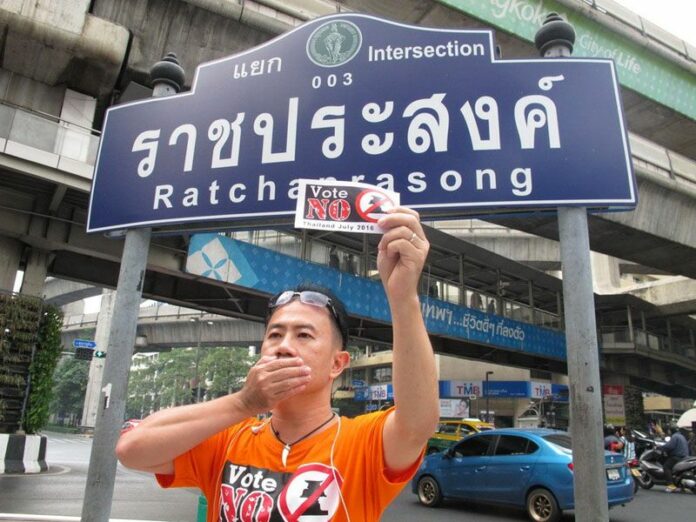
Anurak Jeantawanich protests on a recent Sunday at Ratchaprasong intersection in Bangkok. Photo: Anurak Jeantawanich / Facebook

By Pravit Rojanaphruk
Senior Staff Writer

BANGKOK — At a time when the rules separating legal from illegal political acts are redrawn arbitrarily by the junta, Anurak Jeantawanich’s protests are an exercise in precision.

Gatherings of five or more people risk violating the ban on assembly: Anurak only allows two or three others to join. No red shirts, lest one is accused of instigating a Redshirt uprising: Anurak and friends wear orange. No holding placards: They display small stickers. And don’t linger too long: Fifteen minutes is the norm Should police or military officers show up, just tell them you need “a little more time” to express yourself.

“I’ve prepared myself well,” said Anurak, who has been making news in recent weeks with his symbolic protests against the proposed constitution authored at the direction of the military government, which goes before voters in three months.

For each of the past four Sundays, 48-year-old Anurak has strictly observed his own rules when conducting his brief protests at locations around Bangkok, but that still didn’t stop police from taking him last Sunday into the Phaya Thai Police Station to record his personal information before freeing him without charge.
 

\
Anurak Jeantawanich, second from right, protests on a recent Sunday with three others at the Democracy Monument in Bangkok. Photo: Anurak Jeantawanich / Facebook


Anurak’s involvement in politics began in 2010, when he was one of those to join the massive, protracted Redshirt protests as an “observer” and ended up being pulled into the politics and became a redshirt after the bloody crackdown which ended with more than 100 dead.

Seeing fellow protesters shot to death while hearing the administration of former Prime Minister Abhisit Vejjajiva tell the public only rubber bullets were used changed the man and made Anurak question what sort of political system Thailand is truly under.

Fast forward to life after the 2014 coup, when Anurak was detained for five days for taking part in an early protest. He was sentenced by a military tribunal to three months when he quickly confessed to disagreeing with the junta’s ban on political gathering of five or more. His quick confession earned a suspension to his sentence and after paying a 5,000 baht fine, Anurak went off the radar for year.

Recently he returned to the public protest – this time in a more savvy and legal fashion.

Anurak, a Lampang province native from a fairly well-to-do former hotelier family, said he’s taking the risk on behalf of other citizens who may fear the junta, which calls itself the National Council for Peace and Order, or NCPO.

“I come out as a citizen… To show to society that although the National Council for Peace and Order wants to keep people’s heads down, there are still those who do not fear and dare to express what kind of charter they want,” said Anurak, better known by his alias “Ford Red Path.”

His Red Path group has about 15 members, some of whom join his Sunday protests.

“They are drafting the charter draft, a common contract. Then there are people who want to express themselves peacefully and in a very public way and yet still are forbidden and taken to police stations. So what are we really doing? Are we drafting a constitution that will shut the ears and eyes of the people? The four ‘Vote No’ events I staged showed that those in power do not want the public to know [the other side of the debate]. They sent military students to campaign for people to endorse the draft but we can’t. This is a double standard.”

Anurak’s past life in the tourism industry seems far away. The Bangkok University graduate who completed a master’s program in hospitality and tourism at Schiller International University in the United Kingdom now seems entirely engrossed in politics, even asking a reporter if there will be a general elections next year as promised.


\
Anurak Jeantanaich is searched by a police officer on a recent Sunday afternoon in Bangkok.


While not protesting, he now spends most of his time printing political T-shirts and raising funds to help political prisoners and lese majeste convicts.

Anurak, who lives in southeast metro Bangkok’s Samut Prakan, said he is closely following whether the Election Commission passes any new restrictions on publicly opposing the junta-sponsored charter draft.

If they do, Anurak said he will look for loopholes to legally and publicly challenge the charter draft in a bid to secure a better and more democratic future for his three children and society every Sunday until the July 31 vote.

Parrotting the same language of election commissioners and charter drafters, Anurak urges people to scrutinize the draft before casting their vote. The final draft will be revealed in two weeks.

Anurak said a soldier asked him why didn’t he wait until the final draft was out first before protesting.

He replied that it was in some small hope of influencing what that final draft says by convincing the charter drafters, all appointed by the junta, to amend it to be more democratic.

The man said he couldn’t imagine himself campaigning in support of the junta-sponsored draft charter no matter what final form it takes, however.

Pravit Rojanaphruk can be reached at [email protected] and @PravitR.

Follow Khaosod English on Facebook and Twitter for news, politics and more from Thailand. To reach Khaosod English about this article or another matter, please contact us by e-mail at [email protected].


Follow @KhaosodEnglish

\

Advertisement

Always 'A Little More Time' for Public Held Hostage in House Junta

By Pravit Rojanaphruk
Senior Staff Writer

\

Notice anything missing? Unceremoniously dumped some weeks back was that least-requested song penned by junta leader Gen. Prayuth Chan-ocha, “Returning Happiness to Thailand.”

After being broadcast for over a year on television and radio, the song suddenly vanished. Although no official explanation was ever given, it had clearly overstayed its welcome, especially due to the part where the junta asks “for a little more time” from the people.

\That “little more time” requested day and night since days after the May 2014 coup was obviously no longer “little,” as we close in on two years under military rule, and a shrinking number of people believe the latest roadmap to restoring democracy by early 2018 will happen as suggested by the junta.

Spending years “asking for a little more time” has become an embarrassing oxymoron and proof of the elastic sincerity of the junta’s words.

Prayuth and his deputy Gen. Prawit Wongsuwan are now busy defending the novel idea that members of the junta could morph into senators after the general elections promised for next year. They speak as if this were a reasonable and normal thing in order for them to see through the vague “reforms” which were never convincingly explained or justified in the first place.

As the junta continues market-testing ways to extend its hold on power, some may well wonder if it the public wants to see them out the door already. The hallmark of considerate guests is knowing when they’ve overstayed their welcome.

Good guests look for signs that perhaps the host is tired or uncomfortable and it’s time to thank them for their hospitality and bid farewell.

You cannot really count on the good graces of the junta to conduct themselves like polite guests who should know when to leave.

The junta simply forced themselves into the house we share uninvited, guns drawn, and appointed themselves the boss. Then they tried smoothing it over with a veneer of polite society by “asking” us for a “little more time.”

Yet the longer they stay and suppress the voices of dissent from their “hosts,” the more farcical the metaphor becomes. By now, only die-hard junta supporters or the intellectually challenged would believe that the junta is our “guest.”

Prayuth resorts to detaining unhappy hosts (read: opponents and critics) without charge to have their attitudes “adjusted.” Others are charged with violating a selectively enforced ban on political gatherings of five or more people despite government polls showing the military regime’s popularity exceeds 99 percent.

Matichon TV, a sister organization of Khaosod English, reported that Dictator Prayuth himself admitted earlier this week that he almost punched the face of a journalist because the journo dared ask about the regime’s accomplishments. Why would Prayuth do that to a “host?” Why would Prayuth not give a straight answer?

If Prayuth and his cohorts truly believe they’re 99 percent popular, they should quickly form a new political party and compete in elections. This way Prayuth can become the legitimate prime minister of Thailand with people truly hosting him as their elected leader. The only reason why the junta is not thinking of making such a move and instead trying to convince the public they should be appointed to the senate after the promised general elections reveals that these people have no confidence in their make-believe.

Prayuth and his men will probably be the last to admit that their power rests upon the threat of force, coercion and arbitrary detention.

In a land where politeness is a virtue, the junta is more than happy to continue to try to maintain the metaphor of guest-host relations no matter how shattered it becomes. Try publicly demanding the junta leave now and quickly discover that it’s a myth.

We were never their hosts and asking for more time is not a request but an order. It’s bad form to overstay a welcome, but again the junta probably never saw us as their hosts, but their hostages.

Pravit Rojanaphruk can be reached at [email protected] and @PravitR.

Follow Khaosod English on Facebook and Twitter for news, politics and more from Thailand. To reach Khaosod English about this article or another matter, please contact us by e-mail at [email protected].


Follow @KhaosodEnglish

\

Advertisement

Indonesia Rights Body Urges Obama to Open Secret US Files

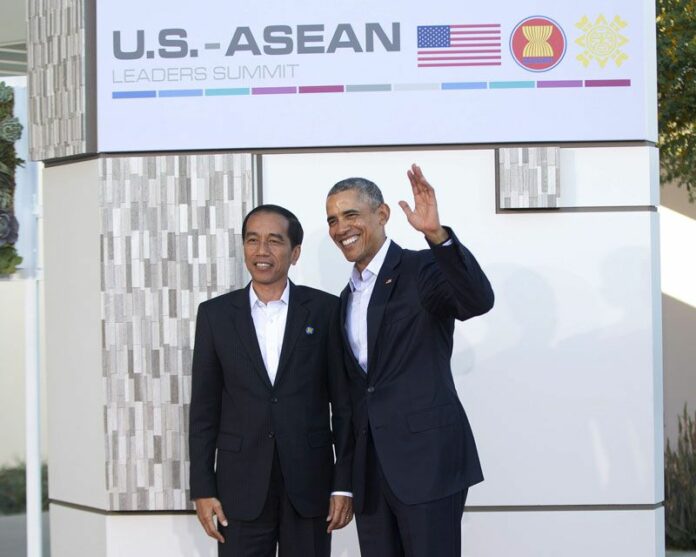
President Barack Obama, right, stands with Indonesian President Joko Widodo at a meeting of ASEAN on Feb. 15 in California. Photo: Pablo Martinez Monsivais / Associated Press

WASHINGTON — The Indonesia that Barack Obama lived in as a child bore fresh scars from the darkest period in country's modern history. Shortly before Obama's arrival in 1967, hundreds of thousands of people had been killed in a bloody anti-communist purge.

Now Indonesian human rights officials want Obama's help in addressing unanswered questions about the bloodshed 50 years ago. They are requesting the declassification of secret U.S. files that could shed light on how the killings were planned and the extent that the United States collaborated with Indonesia's military.

Despite nearly two decades of civilian rule, the prevailing account in Indonesia of those events remains the one planted by the military regime that swept to power after the killings, led by the dictator Suharto who ruled for 30 years. Indonesian text books portray it as a national uprising against a communist threat, and gloss over the deaths.

Joko Widodo, the first directly elected Indonesian president without links to Suharto, ran as a reformer who would look into episodes of military impunity, but since taking office in 2014, he has not pressed the issue due to opposition within his own government and the still-powerful military.

Indonesia's National Human Rights Commission in 2012 reported there was evidence that crimes against humanity were committed during the 1965-1966 crackdown, but the attorney general took no action.

Commissioner Muhammad Nurkhoiron met this week with State Department officials and has made a formal request to Obama that says the release of files from the CIA, the Defense Intelligence Agency and other agencies will help in "encouraging the Indonesian government to redouble its own efforts to establish the truth" and promote reconciliation.

"We need the U.S. to immediately release those documents to help our efforts," Nurkhoiron said in an interview. He said when Obama leaves office early next year, momentum for U.S. action could be lost.

Myles Caggins, a National Security Council spokesman, said it will review the commission's request. He said the administration supports the declassification of any relevant documents from the period which do not pose a national security risk. The U.S. has already released many documents related to the period, but has withheld others.

The killings began in October 1965 shortly after an apparent abortive coup in which six right-wing generals were murdered. Suharto, an unknown major general at the time, filled the power vacuum and blamed the assassinations on Indonesia'sCommunist Party, which was then the largest outside the Soviet Union and China, with some 3 million members. No conclusive proof of communist involvement in the coup has been produced.

In his 1995 best-selling memoir, "Dreams From My Father," Obama recounted how his mother, who had moved them to Jakarta after marrying an Indonesian, learned about the recent killings through "innuendo, half-whispered asides." In words that still ring true, Obama wrote: "The death toll was anybody's guess: a few hundred thousand, maybe; half a million."

At that time, the Vietnam War was intensifying, and Washington's fears of communist takeovers in Southeast Asia were running high. Previously declassified State Department documents indicate that the U.S. Embassy in Jakarta passed the names of dozens of Communist Party leaders to the Indonesian army. Redacted meeting notes from a National Security Council covert action committee that were declassified last month — the result of a 2004 freedom of information request from a U.S. historian — show that the U.S. endorsed "obstructive action" against the Communist Party.

The historian, Brad Simpson from the University of Connecticut, said the U.S. organized covert operations aiming to provoke a violent clash so the Indonesian army would crush the communists. Once the killings had started, the U.S. sent technical assistance and clear signals that it supported the killings, he said.

But Simpson said releasing more detailed information would likely make clearer that the primary responsibility for killings lay with the Indonesian military and state, and not the United States. It could shed light on the command and control structure of the Indonesian armed forces, who was actually carrying out the killings in particular places, and the degree of coordination that was involved between the Indonesian army and its civilian supporters and affiliates.

"The more we release, the less tenable will be the conspiracy theories about the U.S. role," Simpson said.

Thomas Blanton, director of the nongovernment National Security Archive, said the Obama administration has quite a good track record on declassifying documents for human rights accountability, as it did last October for Chile, revealing that former dictator Augusto Pinochet ordered the 1976 assassination of a Chilean diplomat.

But he said the U.S. was unlikely to act without a strong push from the Indonesian government, particularly as some of the documents being sought are closely guarded CIA operational files.

That appears unlikely, as the bloodshed of 50 years ago, which is believed to have caught up many with only tenuous communist links, remains a deeply sensitive topic in Indonesia.

Authorities have in some cases blocked public viewings of two recent Oscar-nominated documentaries by the filmmaker Joshua Oppenheimer, who tracked down former death squad members and found them unashamed, unrepentant and even willing to re-enact their brutal murders.

By Matthew Pennington / Associated Press

Advertisement

Horrified Japan Apologizes for ‘Deplorable’ Thai Skinny Dipping Incident

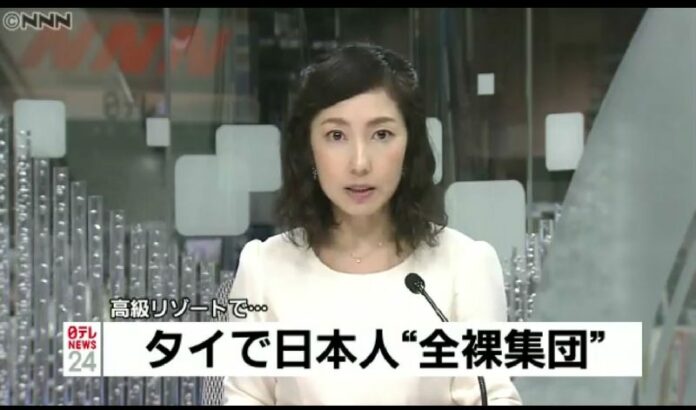
‘At the high class resort of Hua Hin, Thailand, a group of Japanese men got totally naked,’ reads the graphic in a still image from a Wednesday report on Japan’s NNN news channel.

By Simon Duncan
Assistant Editor

HUA HIN — When photos of naked Japanese men frolicking in the surf in Hua Hin ended up on Twitter last Saturday, they briefly went viral before being shrugged off as harmless, drunken tomfoolery.

But this being the internet, the story didn’t end there. What made some headlines and raised some eyebrows domestically has gone on to brew up a storm of controversy in Northeast Asia, prompting the men’s Japanese employer to deeply apologize for hurting the honor and feelings of Thailand.

“I can confirm that some men from my company became dead drunk and then got completely naked on the beach,” read a Thursday letter of apology from Yuki Mizutani, managing director of DYM PLC. “On behalf of all people associated with my company, I offer no excuses and apologize unreservedly.”

\

Twitter photo of the Japanese tourists in the mass skinny dipping session on Hua Hin Beach on Saturday night. Photo: @KomsakAddams / Twitter


While Thailand quickly wrote off the incident as another example of tourists behaving bizarrely, it was seized upon by Japanese netizens in Thailand and overseas who started buzzing about it online days after the photos emerged showing 20 to 30 men locked in a naked group embrace.

Many have offered their own apologies on behalf of their countrymen.

“I deeply apologize to the Thai people. They were extraordinary arrogant and stupid in your country. Please arrest all of them!” Twitter user Yutaka444 replied to a Monday article.

Others reached out to blame the incident, falsely, on Chinese or Korean travelers.  Some messages simply contained the name and address of the Tokyo company which employed the men.

By Thursday, the story was spreading through Japanese media. Pixelated photos of several dozen men forming their circle of nudity in Hua Hin were seen by viewers of major Japanese news programs on stations such as TV Asahi, TBS and News 24, as well as the popular Sankei newspaper and Japanese blogs.

The tone of the reports was similar: The naked revelers were criticized by Thai netizens, and the Japanese media was happy to shame them for making trouble in the royal resort of Hua Hin.

The laughter eventually faded as the offending posteriors were identified, forcing DYM, a medical services company, to issue its apology.

While the men are not facing any criminal charges over the incident, DYM vowed to subject the lot of them to “thorough moral training.”

\

An apology letter issued Thursday by DYM PLC.


Here’s an unofficial translation of what it said:


An apology from our company regarding the trouble caused by some of our members in Hua Hin


Dear Sir / Madam


Please accept my sincere apology for what happened recently.  


Members of our company did indeed visit the Kingdom of Thailand in March 2016. Some people from our company went to the resort town of Hua Hin and stayed at a hotel by the beach. I can confirm that some men from my company became dead drunk and then got completely naked on the beach.


On behalf of all people associated with my company, I offer no excuses and apologize unreservedly.


Owing to the sense of freedom found from being on holiday, people from my company did not think about the citizens of the kingdom of Thailand, their honor and how much they hurt the feelings of the people. Upon deep self-reflection all people involved apologize from the bottom of their hearts.


To ensure that such an incident does not occur again, all the people involved will be given thorough moral training.


I realize that this is not a trivial matter. First of all, again let me apologize for the scandal that my company caused. I promise that measures have been put in place to prevent such a deplorable event occurring again.


I apologize unreservedly and offer no excuses.


Humbly,


Yuki Mizutani

Managing Director

DYM Company Ltd

March 10, 2016


       Related Stories: 
       
     Simon Duncan can be reached at [email protected] and @donuts2000.

Follow Khaosod English on Facebook and Twitter for news, politics and more from Thailand. To reach Khaosod English about this article or another matter, please contact us by e-mail at [email protected].


Follow @KhaosodEnglish

\

Advertisement

Celebrity Mountain Lion May Have Killed LA Zoo Koala

This Nov. 2014 file photo provided by the National Park Service shows the Griffith Park mountain lion known as P-22. Photo: National Park Service / Associated Press

LOS ANGELES — A well-known mountain lion that prowls a sprawling Los Angeles park may have made a meal of a koala found mauled to death at the city's zoo.

Los Angeles Zoo officials say the koala went missing on March 3 and its bloody, partially eaten remains were found a short time later found outside the zoo.

The night before the koala was found, a 7-year-old male puma known as P-22 was seen on black and white surveillance video near the zoo inside Griffith Park, the sprawling urban wilderness that he calls home.

The big cat may have managed to leap a 9-foot-high (2.7 meters) fence to reach the koala enclosure and snatch Killarney, a 14-year-old female that was the oldest koala in the exhibit.

She had a habit of leaving the trees and wandering around on the ground at night, zookeepers said.

However, the evidence is circumstantial, zoo director John Lewis and other officials acknowledged Thursday.

The attack itself wasn't recorded, and there are other predators, such as bobcats and coyotes, that were capable of killing the koala.

The remaining 10 koalas have been removed from the outside enclosure. Zoo workers are taking extra precautions, such as locking up smaller animals in barns at night.

"Unfortunately, these types of incidents happen when we have a zoo in such close proximity to one of the largest urban parks in the country," Barbara Romero, Los Angeles deputy mayor for city services, said in a statement.

P-22 wears a tracking collar and was famously photographed near the Hollywood sign for National Geographic. The 130-pound cat crossed two freeways to enter the 4,355-acre park several years ago.

It's a lonely life with little chance of finding a mate. Cougars typically need ranges of 75 to 200 square miles for hunting and breeding, while P-22's habitat is around 8 square miles.

The attack is just one more reason that P-22 should move, City Councilman Mitch O'Farrell said.

"Regardless of what predator killed the koala, this tragedy just emphasizes the need to contemplate relocating P-22 to a safer, more remote wild area where he has adequate space to roam without the possibility of human interaction," O'Farrell said.

Last year, P-22 wandered out of the park and lolled under a crawlspace of a home in the nearby Los Feliz neighborhood, attracting a media frenzy until he finally wandered home.

"P-22 is maturing, will continue to wander and runs the risk of a fatal freeway crossing as he searches for a mate. … We should consider resettling him in the environment he needs," Mitchell said.

But fellow Councilman David Ryu said it would be a mistake to evict P-22. "Mountain lions are a part of the natural habitat of Griffith Park and the adjacent hillsides" Ryu said.

The zoo's director also disagreed.

"There's a lot of native wildlife in this area. This is their home," Lewis said. "So we'll learn to adapt to P-22 just like he's learned to adapt to us."

Story: Associated Press


Advertisement

Military, Police to Monitor GrabBike Shutdown

A passenger takes a GrabBike from an annual football match between Chulalongkorn and Thammasat universities held Feb. 13 at National Stadium in Bangkok. Photo: Grab / Facebook

BANGKOK — Friday rush hour has one fewer option after transportation officials ordered GrabBike to halt its service because it violated the law.

The Department of Land Transport told the operator of motorbike taxi service GrabBike to stop operating because the use of private motorcycles, its payment system and rates do not comply with the law. Authorities also suggested such services were bad for Thailand.

“While their service is still against the law, the department will ask for cooperation to temporarily halt the service until it can comply with the regulation,” said Nanthapong Cherdchoo of Department of Land Transport.

Someone answering the telephone at a general number listed for GrabBike said there was no one available to comment on the news.

Nanthapong said combined military officers and police from many units will mobilize and coordinate to make sure GrabBike is not operating.

Under regulations, motorcycles used for public transportation must be registered and display the proper yellow license plate.

Transportation officials said they will discuss with related government agencies on making sure such services comply with the laws. Authorities claimed such ride-share app services damage the country’s transportation system and create unfair competition.

Authorities also said the service is less safe for passengers as unregistered motorcycles have no insurance, and the operators’ criminal records have not been checked.

They pointed to a variety of penalties to enforce the action.

The penalty for using a private motorbike to carry passengers is a 2,000 baht fine. Those not dressed as regulations require will be fined 1,000 baht. And those without driver’s licenses certified for public transportation will also be fined 1,000 baht.

The company Friday afternoon seemed to refute one thing in a message posted to its Facebook page. It said the company does indeed offer personal accident insurance for both drivers and passengers – up to 600,000 baht for GrabBike and 900,000 baht for GrabCar.

GrabBike first launched in Thailand in August and has been one of the most growing service under the umbrella of the mother company Grab in Thailand, according to the operator.

Just last month U.S.-based Uber began a pilot of a similar motorcycle taxi service in limited areas of Bangkok, but transportation officials made no mention.

GrabBike is part of Singapore-based Grab, which has expanded throughout Southeast Asia during the past four years.

Related stories:

Uber Pilots Motorbike Service in Bangkok

Advertisement

Official Calls Thaksin’s Speech ‘Dog Bites Man’ Story

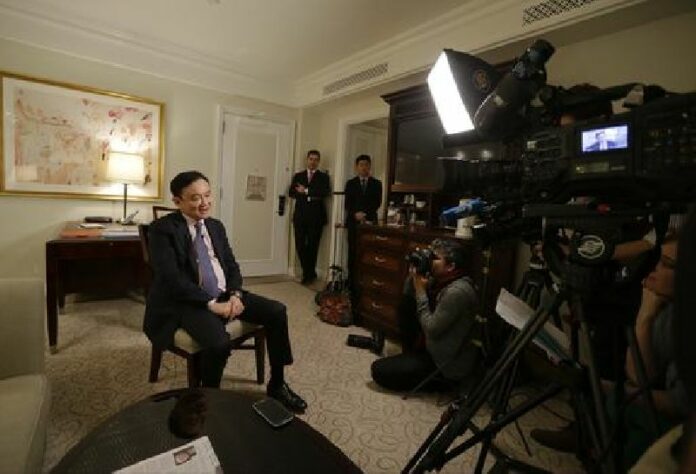
Thaksin Shinawatra responds to questions during a news interview Wednesday, March 9, 2016, in New York. Photo: Frank Franklin II / Associated Press

BANGKOK — The Minister of Foreign Affairs said the media paid too much attention to the speech and subsequent news conference held by former Prime Minister Thaksin Shinawatra in New York City on Wednesday.

Minister Don Pramudwinai compared the event, which appears to be a part of Thaksin’s recent coordinated PR blitz, to a “dog bites man” story that distracts people away from important issues in the country. 

Thaksin is the brother of former Prime Minister Yingluck Shinawatra, whose government was toppled by the current junta in May 2014. Thaksin himself was ousted from office by an earlier coup in 2006 but he has retained immense influence over his political dynasty in Thailand. 

“Dog bites man stories shouldn’t be published,” Don said after attending an international summit on Thursday at a hotel in Bangkok. “I’m not saying who bit who. I’m talking about things in general. Our good issues should be presented. When man bites dog, that’s a big story. I’m not saying who is what, but, in this context, I’m saying that you should present good issues so the people will know about them.” 


Thaksin Says Junta Seeks 'Backward Democracy' 


The Minister also said Thailand will not be able to “move forward” if the media keeps talking about the same problems from the past. 

Don is the highest level official from the military government to comment on Thaksin’s speech at the New York-based World Policy Institute, in which he expressed criticism at the new constitution being drafted under the junta’s oversight. 

“Due to the framework set out by the latest draft constitution, it is difficult to foresee a government that is responsive to the people and the challenges of the 21st century,” the former Prime Minister was quoted as saying by the AFP.

In a news conference held later, Thaksin accused the junta of dragging Thailand into a “backward democracy” and said the military regime is causing more friction in Thai society by “trying to use the law to benefit their own politics.”

\

Thailand's former Prime Minister Thaksin Shinawatra responds to questions during a news interview Wednesday, March 9, 2016, in New York. Photo: Frank Franklin II /  Associated Press

Thaksin’s media offensive in New York took place roughly the same time as the military government hosted the 14th Asia Cooperation Dialogue at Siam Kempinski Hotel. The pan-Asian ministerial forum was initiated by the Thaksin administration in 2002. 

During his keynote speech to the assembled foreign dignitaries, junta chairman Prayuth Chan-ocha made no mention of Thaksin, but instead talked about the importance of respecting the law.

“What made this country a country is the law. Everyone stays under the same laws. There’s no discrimination, who’s rich, who’s poor, who’s tall or short, who’s black or white, they are all under the same laws,” Gen. Prayuth said. “Even His Majesty the King stays under the constitution.” 


Shinawatras Defy Junta With Publicity Drive


Since coming to power in May 2014, Gen. Prayuth’s regime has attempted to dismantle the Redshirt movement and Thaksin’s influence over Thai politics by banning political activities, ordering pro-Thaksin politicians not to criticize the junta, and punishing those who disobey. 

Thaksin kept a relatively low-profile in the months following the coup, but in recent weeks he has embarked on a series of media campaigns which include granting interviews to foreign press and publishing an English-language biography. 

Related Stories:

Thaksin: 2014 Coup Makers Helped by Traditional Elites

Thai Army Chief Files Lese Majeste Against Thaksin 

Prayuth Asks Media To Stop Reporting About Thaksin 


Teeranai Charuvastra can be reached at [email protected] and @Teeranai_C.


\

Advertisement

Human Rights 'Deteriorating' in China, Western Countries Complain

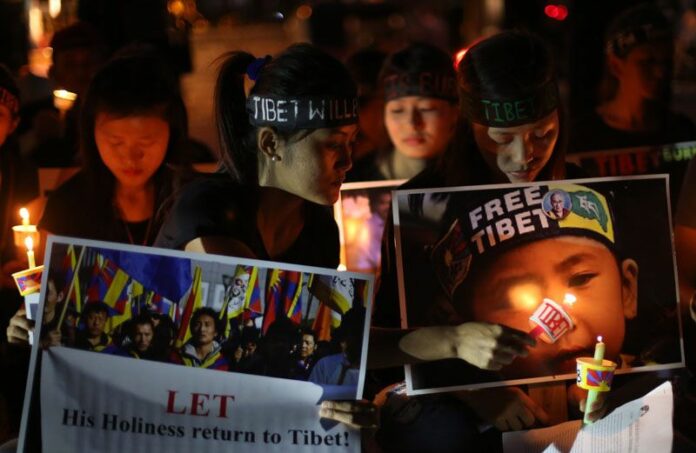
A candle light vigil in India Thursday marks the 57th anniversary of the March 10, 1959, Tibetan Uprising Day, an uprising of the Tibetan people against Chinese rule that was brutally quelled by the Chinese army forcing the spiritual leader the Dalai Lama and hundreds of Tibetans to go into exile. Photo: Mahesh Kumar A. / Associated Press

GENEVA — The United States and 11 other Western countries are criticizing China's "deteriorating human rights record," saying its "extraterritorial actions are unacceptable."

The call at the Human Rights Council follows recent disappearances of five Hong Kong residents associated with a publisher of books banned in China. They include a Swedish national who disappeared from his holiday home in Thailand and later made a tearful appearance on Chinese state TV to say he surrendered over a 12-year-old fatal drunk driving case.

The Western countries denounced the "unexplained recent disappearances and apparent coerced returns" of Chinese citizens and foreigners to China.

U.S. ambassador Keith Harper told the council state broadcasts of confessions before any judicial process violates international conventions and Chinese laws.

Story: Associated Press

Related stories:

Lives Interrupted for Asylum Seekers Facing Desperation, Detention in Thailand

Chinese Asylum Seekers Detained After Boat Founders in Storm

Advertisement

Japan Marking 5th Anniversary of Devastating Tsunami

People offer incense sticks to mourn the victims of the deadly March 11, 2011 earthquake and tsunami, in Natori, Miyagi prefecture, northeastern Japan early Friday, March 11, 2016. Photo: Jun Hirata / Kyodo News / Associated Press

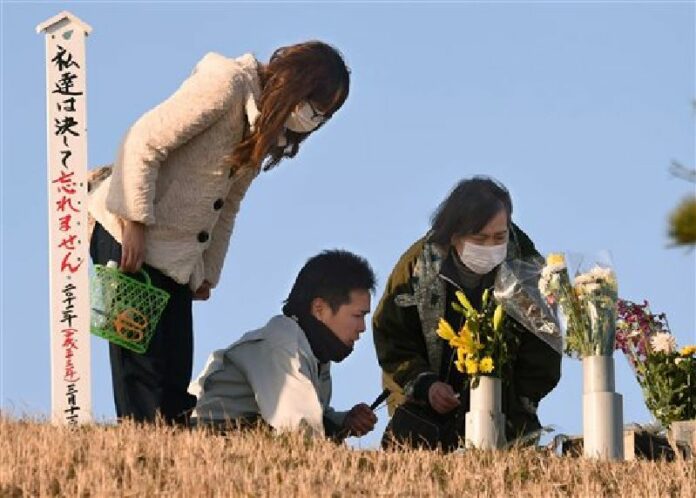
MINAMISANRIKU, Japan — Japan on Friday marked the fifth anniversary of the 2011 tsunami that killed more than 18,000 people and left a devastated coastline along the country's northeast that has still not been fully rebuilt.

In the town of Minamisanriku, a handful of tourists offered prayers in the morning at the skeletal remains of the former disaster prevention center, where 43 workers died as tsunami waves engulfed the building.

Nobuhito Akima, a businessman visiting for the first time from Tokyo, said the vast lands seem almost too clean. Much of the devastated Tohoku coast remains empty except for mounds of dirt brought in to raise the ground level to minimize risks from future tsunamis before any rebuilding is done.

"I don't intend to say what's right or wrong regarding the reconstruction, but I also feel like I can't really tell where all this reconstruction is heading," Akima said.

\

A monk accompanies people whose family members are still missing in the March 11, 2011 earthquake and tsunami offering prayers as Japanese Coast Guard divers conduct an underwater search Thursday, March 10, 2016, on the eve of the fifth anniversary of the deadly disaster, in Hirota Bay in Rikuzentakata, Iwate Prefecture, northeastern Japan. Photo: Koji Ueda / Associated Press

 

Masaki Kamei, a doctor from Tokyo who has been visiting disaster-hit areas every year, senses life is coming back.

"What's different this year compared to last year is fishermen have already gone out fishing by dawn … and towns are already bustling about going on with their business," he said. "There is an expression — the hammering sound of reconstruction — but that's how I feel, I sense that emphasis has shifted."

On the eve of the anniversary, Prime Minister Shinzo Abe pledged to bolster reconstruction efforts in tsunami-hit northern Japan and the wrecked Fukushima nuclear plant ahead of the 2020 Olympic Games.

Abe promised to rush decontamination work in irradiated areas near the plant to allow more residents to safely return home. He also set ambitious goals to reopen a damaged coastal railway in Fukushima by 2020 and triple tourism in the north.

\

Japanese Prime Minister Shinzo Abe speaks to the media during a press conference at his official residence in Tokyo, Thursday, March 10, 2016, on the eve of the fifth anniversary of the March 11, 2011 earthquake and tsunami. Photo: Shizuo Kambayashi / Associated Press

 

"We will designate the next five years as a reconstruction revitalization period," Abe said. "We plan to secure an ample budget to launch support measures to help disaster-hit areas stand on their feet again."

Tokyo is the host city for the 2020 Summer Olympics. Residents of disaster-hit regions have criticized the government for rushing the reconstruction to showcase Fukushima's safety for the Olympics rather than for the residents.

The government hopes to reopen all evacuation zones by next March, except for the dangerously contaminated surroundings of the plant.

Abe said he wants to triple the number of foreign visitors to the Tohoku region to 1.5 million in 2020 so that tourists can see the reconstruction "through their own eyes."

He pledged to reopen the Joban railway line, part of which is in the highly contaminated no-go zone, by March 2020, just months before the Olympics.

\

The sun rises behind the lone pine tree that miraculously survived the deadly March 11, 2011 earthquake and tsunami, in Rikuzentakata, Iwate Prefecture, northeastern Japan Friday, March 11, 2016. Photo: Kota Endo / Kyodo News / Associated Press

 

Story: Emily Wang and Mari Yamaguchi / Associated Press

 

Advertisement

Hot News

LATEST NEWS

Bangkok
overcast clouds
30.5 ° C
32.2 °
30.5 °
76 %
4.9kmh
100 %
Sat
30 °
Sun
35 °
Mon
35 °
Tue
33 °
Wed
32 °