27.7 C
Bangkok
Monday, June 22, 2026
Home Blog Page 2807

Very Sarcastic Temple Banner Prompts Drug Busts

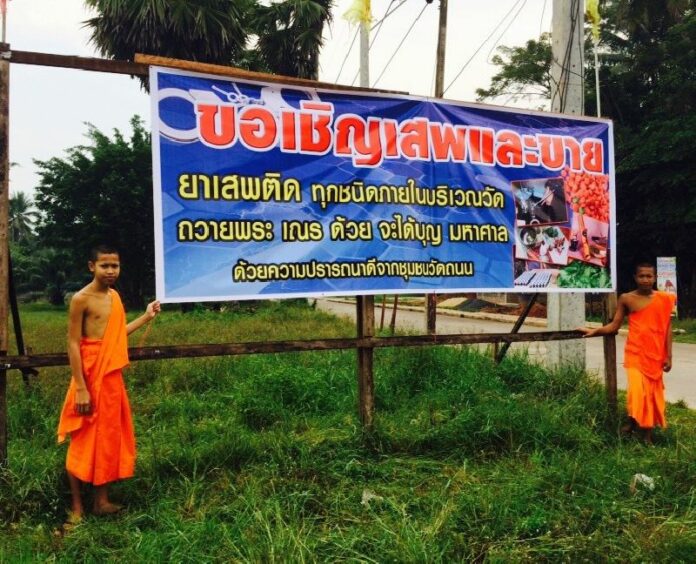
Novices pose with a sarcastic banner at Wat Thanon Suwan Pradit on Friday in Surat Thani province.

SURAT THANI — Police in Surat Thani province were goaded into raiding the community for drugs after a local abbot erected a banner complaining about rampant drug abuse in his temple.

Between Monday and Tuesday, the operation netted a dozen suspects and came in response to a scathing banner which sarcastically invited addicts to share drugs with the monks at Wat Thanon Suwan Pradit, a police commander said. 

“The operation started after he put that sign up,” said Col. Chamnote Kaewkhao, commander of Kanchanadith Police Station.

The banner was hung in front of the temple on Thursday, attracting much attention from residents and the media. 

“You are welcome to consume and buy drugs freely within the temple compound. You will also get a lot of blessings if you offer some to the monks and novices,” it read, along with photos of drug paraphernalia the abbot said he has found within the temple. 

Abbot Phra Kru Dharma Saraphorn said it’s not his monks getting high, but rather local addicts entering temple grounds.

“We are just several kilometers away from the district office, yet they still often sneak in and do drugs in the temple,” the abbot said to reporters on Friday. “Even though we have CCTVs, and police patrol the area every hour, the drug addicts aren’t deterred at all.” 

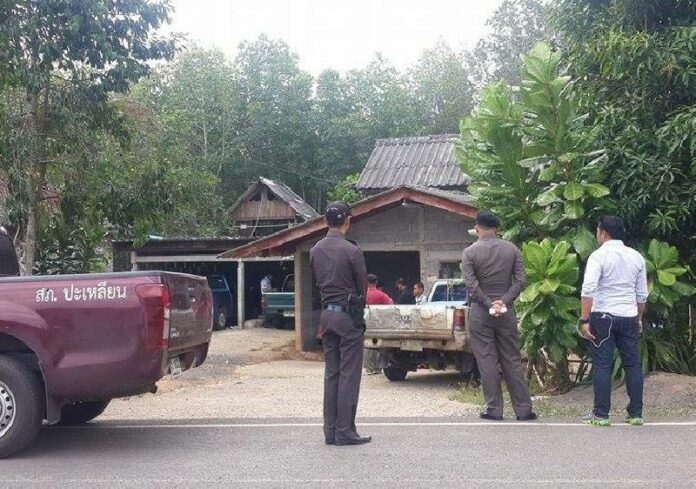
Four days after the abbot’s banner went up, police Monday raided local communities for two consecutive days and searched for evidence of drug use. The operation ended this morning, said police commander Chamnote. 

\

Police search for evidence of drug use Tuesday near Wat Thanon Suwan Pradit in Surat Thani province.


He said 12 suspects have been arrested in the two-day raid: nine for drug use and three on firearms charges. He also said the temple and its vicinity have long been known to police as a hotspot for narcotics. 

“The raid took place after the banner was erected, but in fact we have been strict in arresting these young gangsters,” Chamnote told Khaosod English. “Just last year, we arrested more than 20 of them.” 

Chamnote also said police are planning to conduct random urine tests on monks and novices at Thanon Suwan Pradit Temple. “The temple itself is also our target. Sometimes, monks and novices themselves do drugs. There’s been a lot of news about that,” the officer said. 


Teeranai Charuvastra can be reached at [email protected] and @Teeranai_C.


\

Advertisement

Fall Through Mall Roof Leaves Teen in Coma

The five-story Pacific Park mall is located in the heart of Chonburi’s Si Racha district. Photo: Pacific Park / Facebook

CHONBURI — A 17-year-old student is in a coma after falling through the roof a mall last night after climbing up to take photos with his friends.

A female friend of the unidentified boy told police they were at the Pacific Park Sriracha and talked about going up to the deck to take photos because they’d heard the view was amazing. Consequently, they sneaked through an emergency exit and climbed up to a deck on the roof of the building.

The group of four friends reportedly took a set of photos before the boy asked to take a picture of them. He moved off of the deck and stood on unsupported roofing tile, at which point he fell through insulation material to the fourth floor.

The height of the fall was about 15 meters, police Lt. Col. Sirakran Tonsanguan said.
 

559000001460903.JPEG
 

The boy was seriously injured and sent to a hospital immediately. He’s presently in a coma, Sirakran said.


Chayanit Itthipongmaetee can be reached at [email protected] and @chayaniti92.

Follow Khaosod English on Facebook and Twitter for news, politics and more from Thailand. To reach Khaosod English about this article or another matter, please contact us by e-mail at [email protected].


Follow @KhaosodEnglish

\

Advertisement

Thai Teachers Pose as Foreigners to Teach English

Middle-school students at the Parliament Museum in a 2010 file photo. Photo: Office of the Prime Minister

BANGKOK — Seeing him from a distance, young children call out their Singaporean teacher’s name before sprinting toward him, excited to practice speaking English.

For their teacher, it’s a rewarding moment he says he could never experience if they knew the truth about him: He’s actually a Thai national who pretends he cannot understand every single word they say.

“They will value us less if they know we are a Thai teacher,” said Natthawut, who teaches at a school in the southern city of Hat Yai and asked Khaosod English not to publish his real name out of concern for his employer. “They will no longer be eager to speak English with us.”

Natthawut said he is among more than 200 English teachers, most of whom are recent graduates from Thai universities, working for the same company. For more than four years, the firm he works for has provided English teachers for both public and private schools across the country, especially those with special English programs.

Natthawut was one of three teachers working for the company, Make a Wit, to describe the same arrangement in which they teach children by posing as foreign English teachers. Their names have been changed for this story. After agreeing to be interviewed without reservation, two of the teachers said they did not want to be identified.

There’s nothing illegal about the practice, and all three teachers and a representative of the company described what they do as a valuable teaching technique that forces students to speak because they believe their teachers are foreigners who cannot understand Thai.

Reached for comment by a reporter, one of the company’s founders told Khaosod English they make it clear to schools and parents the teachers they provide are fully qualified Thai nationals.

He said their policy only calls for teachers to use English names and never speak Thai on school grounds, but said Make a Wit never advises them to lie to students about where they are from.

After answering several questions from a reporter, the company representative ended the interview and declined to give his name.


Ethical Deception?

Taya, another teacher at a school in Ratchaburi province said she told her students she was a Thai-American living in Canada before moving to Thailand six years ago.

When pressing her thumb on the fingerprint scanner at the school, what appears on the screen is the English name she invented for herself.

“The kids are always watching what the screen will say since they are skeptical of me,” said the 23-year-old teacher. “But on formal documents, I use my Thai name.”

Despite some initial reservations, all three teachers said they saw nothing unethical about the arrangement. The purpose of assuming a false identity, to them, is nothing more than a means of teaching that they believe works, and an effective method they were encouraged to use by the company which employed them.

“They told us it’s not a disguise,” said another woman, who goes by “Nicole” in the classroom. “But in practice, it is. They didn’t tell us to do it directly but they implied it.”

According to the teachers, the other school teachers and the students’ parents are all aware of the arrangement. Inquiries made to several schools supported that, as teachers answering the phone confirmed their Intensive English programs were taught by Thai nationals.

The only ones being fooled, they said, are the children.

“We are not deceiving anyone. The company agreed with the school to hire teachers who have an accent similar to foreigners, and parents know that,” Natthawut said. “We just don’t tell children.”

Taya said the company only hires Thai nationals because it believes they can better understand the children since they share the same culture and background and are familiar with the Thai education system, unlike foreigners.

“It is better to use a Thai teacher who has studied English directly than a European teacher who might carry the wrong accent,” she said.


Suspicious Minds

Lying to the Internet Generation is, of course, not easy. Natthawut himself once got in trouble because one of the his student discovered his Instagram account on which he wrote in Thai.

“They tracked me from who is followed by my colleague’s account,” he said. “Back then I wasn’t careful enough to set my Instagram to private.”

Deeply wired Bangkok children are even craftier. Teacher Nicole, or Supaporn in Thai, said after a lot of tricks, some students finally found out she was Thai and not the Filipina she claimed to be.

“In the beginning I felt weird with a repressed feeling of, ‘Why do I have to be another person, am I deceiving the kids?’” Supaporn said. “Now I let it go and think what I’m doing is more like training them.”

But not everyone agrees that teachers misrepresenting themselves in the classroom is a good way to teach English. One well-known teacher who has stood before classes of students for 32 years said it should not even be an option.

“It’s a totally wrong concept. Moreover, what kind of ethics are you teaching to the children?” said Somphot Panawas, an expert on English language instruction at Suan Dusit University.

For Somphot, the psychological reasoning behind the technique – that students are more engaged and forced to speak – is an excuse.

“The excitement comes from the activities and the teaching methods, not the nationality of the teacher,” he said.

Teaching English to beginners without the support of their mother language is not always the best means, Somphot said was the opinion of experts, and can make the instruction useless for weak learners.


Lower-Cost Alternative

According to government regulations, teachers in English programs are not required to be native speakers, however they must achieve a required score on tests of English ability.

The quality of English language instruction in Thailand has long been lamented, and stories of poor student performance are news media staples.

Some parents prefer their children learn English from foreigners, but qualified teachers tend to be in short supply, especially due to the relatively low pay at public primary and secondary schools.

In a cost-saving measure, the Ministry of Education announced in November it would seek to cut the number of foreign teachers and invest in intensive training of Thai teachers.

Authorities at the Ministry of Education said schools face other obstacles in hiring qualified foreign teachers, such as a contentious Thai language and culture course they are required to complete.

But the most important reason cited by a high-level education official is the fact that schools receive no subsidy to employ foreigners, so they often have to go with the most affordable choice.

“Native speakers’ wages are usually expensive,” said Deputy Permanent Secretary Chaiyot Imsuwan. “But if you only want someone who can speak English, the wages are less.”

While people debate over whether the nationality of teachers influences attitudes of English-language learners, Chaiyot said one matter is already settled: The quality of their teachers depends on how much their parents can afford.


\

Advertisement

Thai Teachers Pose as Foreigners to Teach English

Middle-school students at the Parliament Museum in a 2010 file photo. Photo: Office of the Prime Minister

BANGKOK — Seeing him from a distance, young children call out their Singaporean teacher’s name before sprinting toward him, excited to practice speaking English.

For their teacher, it’s a rewarding moment he says he could never experience if they knew the truth about him: He’s actually a Thai national who pretends he cannot understand every single word they say.

“They will value us less if they know we are a Thai teacher,” said Natthawut, who teaches at a school in the southern city of Hat Yai and asked Khaosod English not to publish his real name out of concern for his employer. “They will no longer be eager to speak English with us.”

Natthawut said he is among more than 200 English teachers, most of whom are recent graduates from Thai universities, working for the same company. For more than four years, the firm he works for has provided English teachers for both public and private schools across the country, especially those with special English programs.

Natthawut was one of three teachers working for the company, Make a Wit, to describe the same arrangement in which they teach children by posing as foreign English teachers. Their names have been changed for this story. After agreeing to be interviewed without reservation, two of the teachers said they did not want to be identified.

There’s nothing illegal about the practice, and all three teachers and a representative of the company described what they do as a valuable teaching technique that forces students to speak because they believe their teachers are foreigners who cannot understand Thai.

Reached for comment by a reporter, one of the company’s founders told Khaosod English they make it clear to schools and parents the teachers they provide are fully qualified Thai nationals.

He said their policy only calls for teachers to use English names and never speak Thai on school grounds, but said Make a Wit never advises them to lie to students about where they are from.

After answering several questions from a reporter, the company representative ended the interview and declined to give his name.


Ethical Deception?

Taya, another teacher at a school in Ratchaburi province said she told her students she was a Thai-American living in Canada before moving to Thailand six years ago.

When pressing her thumb on the fingerprint scanner at the school, what appears on the screen is the English name she invented for herself.

“The kids are always watching what the screen will say since they are skeptical of me,” said the 23-year-old teacher. “But on formal documents, I use my Thai name.”

Despite some initial reservations, all three teachers said they saw nothing unethical about the arrangement. The purpose of assuming a false identity, to them, is nothing more than a means of teaching that they believe works, and an effective method they were encouraged to use by the company which employed them.

“They told us it’s not a disguise,” said another woman, who goes by “Nicole” in the classroom. “But in practice, it is. They didn’t tell us to do it directly but they implied it.”

According to the teachers, the other school teachers and the students’ parents are all aware of the arrangement. Inquiries made to several schools supported that, as teachers answering the phone confirmed their Intensive English programs were taught by Thai nationals.

The only ones being fooled, they said, are the children.

“We are not deceiving anyone. The company agreed with the school to hire teachers who have an accent similar to foreigners, and parents know that,” Natthawut said. “We just don’t tell children.”

Taya said the company only hires Thai nationals because it believes they can better understand the children since they share the same culture and background and are familiar with the Thai education system, unlike foreigners.

“It is better to use a Thai teacher who has studied English directly than a European teacher who might carry the wrong accent,” she said.


Suspicious Minds

Lying to the Internet Generation is, of course, not easy. Natthawut himself once got in trouble because one of the his student discovered his Instagram account on which he wrote in Thai.

“They tracked me from who is followed by my colleague’s account,” he said. “Back then I wasn’t careful enough to set my Instagram to private.”

Deeply wired Bangkok children are even craftier. Teacher Nicole, or Supaporn in Thai, said after a lot of tricks, some students finally found out she was Thai and not the Filipina she claimed to be.

“In the beginning I felt weird with a repressed feeling of, ‘Why do I have to be another person, am I deceiving the kids?’” Supaporn said. “Now I let it go and think what I’m doing is more like training them.”

But not everyone agrees that teachers misrepresenting themselves in the classroom is a good way to teach English. One well-known teacher who has stood before classes of students for 32 years said it should not even be an option.

“It’s a totally wrong concept. Moreover, what kind of ethics are you teaching to the children?” said Somphot Panawas, an expert on English language instruction at Suan Dusit University.

For Somphot, the psychological reasoning behind the technique – that students are more engaged and forced to speak – is an excuse.

“The excitement comes from the activities and the teaching methods, not the nationality of the teacher,” he said.

Teaching English to beginners without the support of their mother language is not always the best means, Somphot said was the opinion of experts, and can make the instruction useless for weak learners.


Lower-Cost Alternative

According to government regulations, teachers in English programs are not required to be native speakers, however they must achieve a required score on tests of English ability.

The quality of English language instruction in Thailand has long been lamented, and stories of poor student performance are news media staples.

Some parents prefer their children learn English from foreigners, but qualified teachers tend to be in short supply, especially due to the relatively low pay at public primary and secondary schools.

In a cost-saving measure, the Ministry of Education announced in November it would seek to cut the number of foreign teachers and invest in intensive training of Thai teachers.

Authorities at the Ministry of Education said schools face other obstacles in hiring qualified foreign teachers, such as a contentious Thai language and culture course they are required to complete.

But the most important reason cited by a high-level education official is the fact that schools receive no subsidy to employ foreigners, so they often have to go with the most affordable choice.

“Native speakers’ wages are usually expensive,” said Deputy Permanent Secretary Chaiyot Imsuwan. “But if you only want someone who can speak English, the wages are less.”

While people debate over whether the nationality of teachers influences attitudes of English-language learners, Chaiyot said one matter is already settled: The quality of their teachers depends on how much their parents can afford.

 

Advertisement

48 Hurt, 24 Arrested in Hong Kong Fish Ball Riot

A rioter tries to throw a litter bin at police on a street in Mong Kok district of Hong Kong, Tuesday, Feb. 9, 2016. Photo: Kin Cheung / AP

HONG KONG — Hong Kong's Lunar New Year celebration descended into chaotic scenes as protesters and police, who fired warning shots into the air, clashed over a street market selling fish balls and other local holiday delicacies, leaving dozens injured and arrested.

The violence is the worst in Hong Kong since pro-democracy protests rocked the city in 2014, leaving a growing trust gap between the public and authorities.

Activists angered over authorities' attempts to crack down on the food hawkers in a crowded Kowloon neighborhood held running battles with police into the early morning hours of Tuesday.

Protesters pelted officers with bottles and pieces of trash. Some threw garbage cans, plastic safety barriers and wood from shipping pallets at them. They also set fires on the street.

At one point, a protester tried to tackle a traffic police officer from behind before both sides rush in to the melee in the middle of a busy street, according to footage shown by local news channel Cable TV. Moments later, another officer appeared to fire two warning shots into the air.

Hong Kong police said in a statement that the protesters had ignored their warnings to get off the street and shoved officers, who responded with batons and pepper spray.

\

Riot police try to block the bricks thrown by the protesters on a street in Mongkok district of Hong Kong, Tuesday, Feb. 9, 2016. Photo: Kin Cheung / AP


Acting District Commander Yau Siu-kei said 23 men and one woman were arrested on suspicion of assaulting and obstructing officers, resisting arrest and public disorder. The arrested were as young as 17 and as old as 70. Police said 48 officers were hurt by glass and flying objects.

Yau said two warning shots were fired.

The unrest started when authorities tried to prevent unlicensed street food sellers from operating on Monday night in Mong Kok, a working-class district of the city. The hawkers have become a local tradition during the Lunar New Year holiday but this year authorities tried to remove them.

\

 A protester kicks a riot police in Mong Kok district of Hong Kong, Tuesday, Feb. 9, 2016. Photo: Kin Cheung / AP


The hawkers were backed by activists who objected to the crackdown over concerns that Hong Kong's local culture is disappearing as Beijing tightens its hold on the semiautonomous city.

The latest scuffles underscore how tensions remain unresolved more than a year after the end of pro-democracy protests that gripped the city. Mong Kok, a popular and densely populated shopping and entertainment district, was one of the neighborhoods where activists occupied streets for about 11 weeks in late 2014, capturing world headlines with their demands for greater electoral freedom.

Story: Kelvin Chan / Associated Press

Advertisement

Spanish Embassy to Attend Segarra Questioning

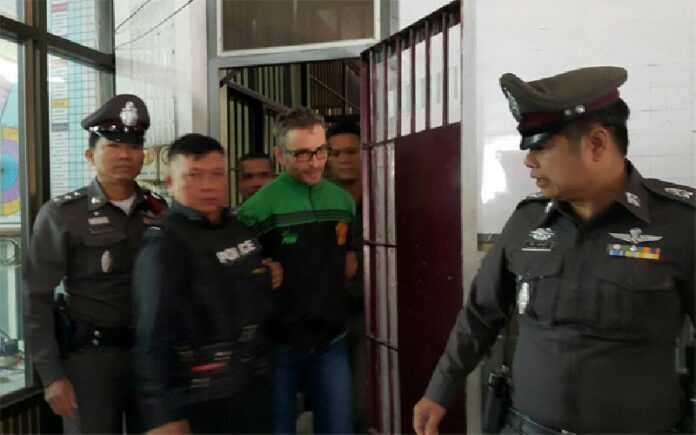
Spanish murder suspect Artur Segarra, 36, is led from Bangkok’s Borwornmongkol police station for questioning Tuesday at the Metropolitan Police Bureau.

BANGKOK — The Spanish Embassy is reportedly sending representatives to be present for the questioning of one of its citizens who has denied involvement in the murder and dismemberment of another Spaniard.

After being captured and brought back to Thailand on Monday, Artur Segarra, 36, has told police he was friends with 39-year-old David Bernat, whose remains were found in the Chao Phraya River, but denies killing and dismembering him. He was questioned late into Monday night.

At Segarra’s request, police said embassy officials were to attend resumed interrogation at 11am Tuesday morning at the Metropolitan Police Bureau headquarters.

Royal Thai Police Chief Chakthip Chaijinda on Monday said the investigators believe Segarra was the last person with Bernat before he was found dead. Segarra told police he knew Bernat for about one year and they met when Bernat visited Thailand.

Police believe that Segarra and possibly others abducted, tortured, murdered and dismembered Bernat to steal his money. Segarra is said to have transferred money from Bernat which he then was trying to withdraw in large amounts from various ATMs.

Segarra's girlfriend, Pridsana “Ploy” Seanubon, who described seeing many knives and a large freezer in his possession, will also be taken today to two locations: Pracha Songkhro Road and Soi Ramkhamhaeng 176, one of which is believed to be where he disposed of the knives and another where he withdrew money from an ATM.

Bernat, who first traveled to Thailand in 2006, was recorded entering Thailand 271 times.

Chakthip said Segarra did not work in Thailand and was wanted in Spain since 2015 for forgery.

Police said they believe his mobile phone contains important evidence as Segarra had tried to grab it from them at the time of his arrest.


Related stories:

Cambodia to Hand Over Spanish Murder Suspect

Police Seek Spanish Murder Suspect

Spanish National Identified as Dismembered Man

Police Puzzled After Body Parts Fished Out of Chao Phraya


Advertisement

Dad Accused of Murdering Sleeping Children Shoots Self With Same Gun, Police Say

Rescue workers carrying Pornpichit Yongstar late Monday afternoon

TRANG — A man believed to have shot his four children to death this early morning turned the same gun on himself late Monday afternoon as commandos stormed his home, police said.

Pornpichit Yongstar, 40, was taken to a hospital in serious condition with what police said was a self-inflicted gunshot wound to the head, hours after he allegedly killed his four children, two boys and two girls, with a .22 Magnum while they were sleeping. He was later pronounced dead at hospital around 6.30pm.

The motive was a family issue after Pornpichit’s 38-year-old wife Supattra Kemkhao left him for another man, Col. Songkiat Thongsong of Palian district police said.

Officers had surrounded Pornpichit's home Monday after arriving at the scene in the morning to find him hiding alone in the house. He asked police to see Supattra, but police refused for fear he would harm her and himself, Songkiat said.

\

Police commandos prepare to storm the house of Pornpichit Yongstar late Monday afternoon


Officers earlier were able to remove the bodies of the children – boys aged 12 and 3, and girls aged 14 and 7 – from the second floor of the house. Pornpichit holed up in a room with a handgun and shotgun, police said.

About 20 police commandos stormed the home late Monday afternoon, at which point police said Pornpichit fatally shot himself.


Related Stories

Four Children Shot in Their Sleep By Father


Teeranai Charuvastra can be reached at [email protected] and @Teeranai_C.

Follow Khaosod English on Facebook and Twitter for news, politics and more from Thailand. To reach Khaosod English about this article or another matter, please contact us by e-mail at [email protected].


Follow @KhaosodEnglish

\

Advertisement

Junta Defends Using Troops in Constitution PR Blitz

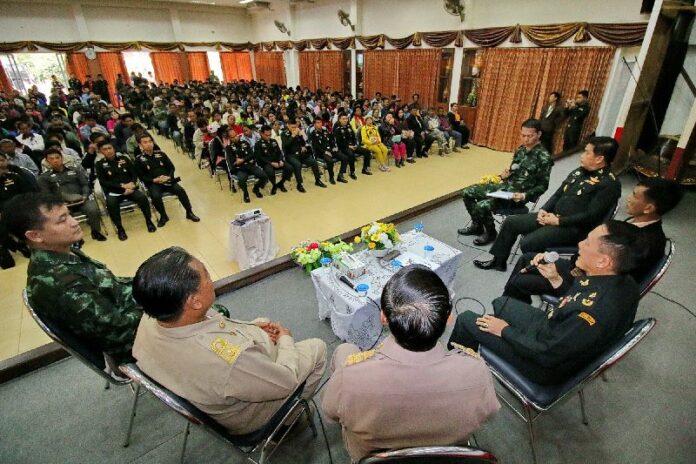
Army officers lecture an audience Monday in Ratchaburi province about the supposed improvements in the new charter draft.

BANGKOK — A leader of the ruling junta said today he saw nothing wrong with dispatching soldiers to convince people across the country to support the new constitution drafted under its oversight.

Deputy junta leader Prawit Wongsuwan said today the troops will meet with local communities through Thailand to “create understanding” about the charter draft and encourage them to participate in the upcoming referendum.

“We won’t tell people whether to accept or reject the constitution,” Gen. Prawit told reporters. 

The plan for the PR blitz came as the military regime is using state media to praise the new charter draft, which was completed last month and is scheduled for a vote in July.


Charter Gets Broadcast Boost, But Criticism Will Not be Televised


When a reporter asked whether Prawit believed the use of armed forces in the campaign would denote the military’s interference in politics, Prawit said he didn’t think so. 

“How can it be political?” Prawit said. “I don’t think it will do any harm, because telling people to vote in the referendum is not a political issue.” 

The campaign already started Monday in Ratchaburi province, where soldiers briefed an audience of around 500 people about how the new charter is an improvement from the previous one. 

According to the junta’s roadmap to restoring democratic rule to Thailand, national elections will be held in late 2017 if voters approve the new charter in July. 

The military junta, which seized power from an elected government and dissolved the previous constitution in May 2014, has been keen to urge the public to accept the new constitution in the upcoming vote, and ensure a smooth transition. 

State media also recently started broadcasting daily segments of a talk show to praise the new constitution draft. There’s no sign that any critic of the charter will make appearance on the show, called “Unveiling the New Constitution,” any time soon. 

Related Stories:

Junta Orders Media to Discuss Charter ‘Respectfully’

The Good, Bad and Ugly of Junta’s ‘Anti-Corruption’ Constitution


Teeranai Charuvastra can be reached at [email protected] and @Teeranai_C.


\

Advertisement

Four Children Shot in Their Sleep By Father

Officers surrounding Pornpichit’s house in Trang’s Palian district.

TRANG — Four children were slain while sleeping early this morning by their father who failed to reunite with his wife, police said.

Pornpichit Yongstar, 40, reportedly killed his four children, two boys and two girls, with a .22 Magnum while they were sleeping. The alleged motive was a family issue after Pornpichit’s 38-year-old wife Supattra Kemkhao left him for another man, Col. Songkiat Thongsong of Palian district police said.

When police arrived at the scene, Pornpichit was said to be hiding alone inside the house. Pornpichit asked police to see Supattra, but police refused because they’re worried that Pornpichit will harm his wife and commit suicide, officer Songkiat said. 

The body of the four children, boys aged 12 and 3, and girls aged 14 and 7, have been reportedly carried out from the second floor of the house. Police were able to enter the house earlier today to retrieve the bodies. At that time Pornpichit was believed to have been in hiding in a different room with a shotgun.  

At the time this article is published, police are still attempting to talk Pornpichit into laying down his shotgun and surrendering.


Chayanit Itthipongmaetee can be reached at[email protected] and @chayaniti92.

Follow Khaosod English on Facebook and Twitter for news, politics and more from Thailand. To reach Khaosod English about this article or another matter, please contact us by e-mail at [email protected].


\

Advertisement

Indonesian Massacre Double-Feature to Hit SF Cinema

A poster of "The Act of Killing"

BANGKOK — A perfect antidote to the too-sweet taste that comes in the middle of every February, two award-winning documentaries about the 1960s Indonesian genocide will screen in Bangkok and Chiang Mai.

Known for featuring reenactments of the systematic murder from five decades ago by its perpetrators, the director’s cut version of “The Act of Killing” (2012) will show at 8pm tonight at SF Central World. The film can be seen again on Thursday and runs through Feb. 17 at SF Central World and SFX Cinema Maya in Chiang Mai.


As a follow-up to “The Act of Killing,” director Joshua Oppenheimer made “The Look of Silence” (2014), which documents a family, whose son was slain in the mass murders between 1960 and 1965, confronting the men who carried out the killings. The film will show Saturday at SF Central World and Feb. 18 at SF Cinema Maya Chiang Mai.

As a follow-up to “The Act of Killing,” director Joshua Oppenheimer made “The Look of Silence” (2014), which documents a family, whose son was slain in the mass murders between 1960 and 1965, confronting the men who carried out the killings. The film will show Saturday at SF Central World and Feb. 18 at SF Cinema Maya Chiang Mai.


“The Act of Killing” won a BAFTA Award for best documentary film and was nominated for an Oscar in 2014 while “The Look of Silence” won the Grand Jury Prize at Venice International Film Festival in 2014 and has been nominated for a 2016 Academy Award.

Both films will be screened in English with Thai subtitles. Tickets can be booked online.

For greater context, Charnvit Kasetsiri and Puangthong Pawakapan, two professors of Southeast Asia Studies, will also host a talk “State Crime in Southeast Asia” to coincide with the films on Saturday at SF Central World. The event, organized by Documentary Club and Film Kawan, starts at 6pm and will be conducted in Thai.


Chayanit Itthipongmaetee can be reached at [email protected] and @chayaniti92.

Follow Khaosod English on Facebook and Twitter for news, politics and more from Thailand. To reach Khaosod English about this article or another matter, please contact us by e-mail at [email protected].


Follow @KhaosodEnglish

\

Advertisement

Hot News

LATEST NEWS

Bangkok
overcast clouds
27.7 ° C
27.7 °
27.7 °
80 %
1.2kmh
100 %
Sun
30 °
Mon
36 °
Tue
37 °
Wed
37 °
Thu
36 °