36.4 C
Bangkok
Thursday, June 11, 2026
Home Blog Page 2841

Freedom of Speech Reaches 'New Low'

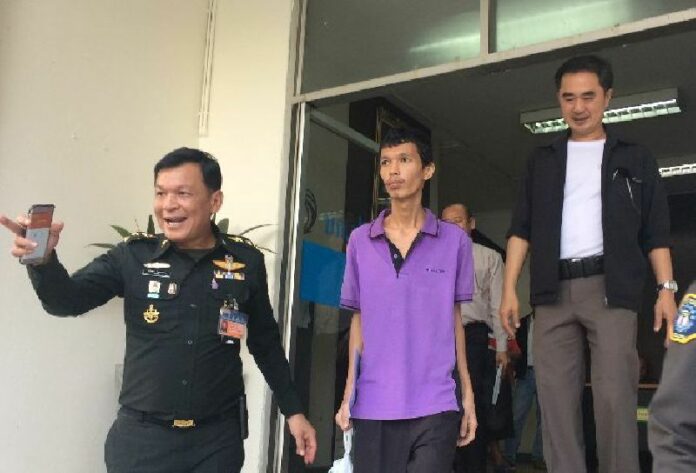
Security officers escort Thanakorn Siripaiboon, in purple, to a martial court Dec. 14 for arraignment on a charge of defaming the monarchy.

BANGKOK — The military seized power last year with a promise to eventually restore democracy. But a crackdown against critics of the monarchy and junta suggest the country is locked on a darker trajectory, say U.N. officials and human rights activists.

On Sunday, a student was taken from hospital by plainclothes agents and charged with defaming Thailand's widely revered royalty. 

On Monday, it emerged that a factory worker was charged with sedition and mocking King Bhumibol Adulyadej's dog. If found guilty, he faces decades in prison.

And on Tuesday, a military court sentenced a single mother to seven years in jail for posting material on the Internet insulting to the monarchy.

Human Rights Watch said the cases underscore how freedom of speech has reached a new low in the Southeast Asian country.

Since taking power in 2014, the military has made full use of Article 44 of the interim constitution which gives junta leader Prayuth Chan-ocha absolute power to give any order deemed necessary to prevent acts seen as undermining national security.

It also allows soldiers to detain people for up to seven days without a court warrant.

Rights groups and critics of the junta say a draconian law designed to protect Thailand's royal family has been broadened considerably and is being applied with greater fervor.

"The travesty of law enforcement under the junta's rule reached a new low when Thanakorn was charged with lese-majeste for … comments that Thai authorities considered as mocking the king's dog," Sunai Phasuk of Human Rights Watch told Reuters, referring to factory worker Thanakorn Siripaiboon, 27.


Worries

Junta spokesman Colonel Winthai Suvaree defended the royal insult law.

"We haven't used this law in a harsher manner, but in this period there may have been more people who violated this law so authorities have to deal with them accordingly," Winthai told Reuters. "We need this law in Thailand in order to protect the monarchy which is the love of all Thais."

All this comes amid worries over the health of King Bhumibol Adulyadej, who turned 88 this month, and concerns over an eventual succession a subject that cannot be openly discussed because of the lese-majeste law that makes it a crime to defame, insult or threaten the king, queen or heir apparent, but one that continues to dominate political developments in Thailand.

The king's son and heir does not command the same level of devotion as his father.

Kan Yuenyong at the Siam Intelligence Unit think-tank said the military had become "quite sensitive" over any criticism and was anxious about what an eventual succession would bring.

"The transition is very fragile because there is serious fighting between different camps and stakeholders," he said. "Because of the power struggle, the military is quite sensitive over any criticism and they want to show that they are the ones who can wield power."

Diplomats and foreign journalists have also been caught up in the military crackdown on anyone perceived as critical of the junta or royal establishment.

On Tuesday, the Thai printer blocked publication of a report in the International New York Times on the king's dog defamation charges, the third time in a month that it has left a Thailand article blank, and the U.S. Ambassador to the country is being investigated over accusations he violated the strict lese-majeste law.

"The U.N. High Commissioner has stated he is appalled by the shockingly disproportionate prison terms handed down this year in lese-majeste cases in Thailand," the Office of the United Nations High Commissioner for Human Rights told Reuters in an e-mail.

The office said prison terms handed down for lese-majeste this year were the heaviest recorded since 2006, when it began documenting cases of individuals prosecuted for lese-majeste offences.

Additional reporting Pracha Hariraksapitak

Advertisement

Phahonyothin Closures Back On, Begin Monday

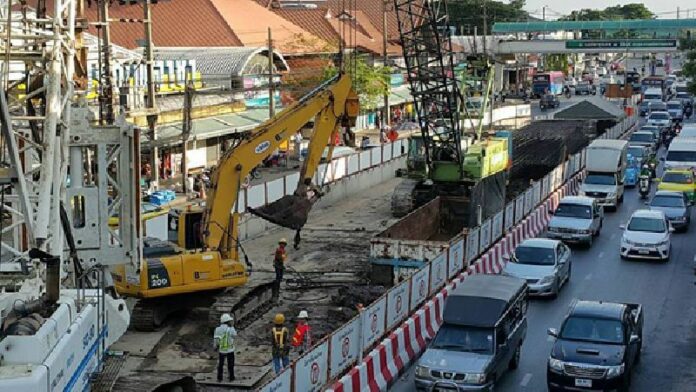
The Italian-Thai Development PCL breaks ground on construction of the Green Line on Oct. 16 in Bangkok. Photo: MRT Green Line (North) Project / Facebook

BANGKOK — Plans to partially close Phahonyothin Road near CentralPlaza Lardprao for three years – aborted at the last minute one month ago following a public outcry – are back on and set to begin Monday.

Officials today said the busy arterial road would be affected from Monday until the construction of the Green Line Skytrain extension finishes in about three years, but agreed to leave it fully open Dec. 29 to Jan. 3 as a holiday concession.

Starting Monday, the innermost outbound lane from Phahonyothin 22 to the Tesco Lotus mall will be closed 10pm to 5am for one week. The inner, inbound lane along the same stretch the same distance will be closed from 10pm on Jan. 3 until Jan. 14.

Full construction will be underway Jan.14, when barriers will be installed blocking the outermost lanes in both directions until the station foundations are completed, which the government agency hopes will be in February 2019.

The revised schedule came out today after the plan was abruptly postponed on Nov.16 just four hours before it was to begin.


Related stories:

At Last Minute, Transit Authorities Put Phahonyothin Closure on Hold

Phahonyothin Traffic Nightmare to Get Worse for Three Years


Advertisement

Bangkok Planetarium Returns to the Stars in January

A look inside the upgraded Bangkok Planetarium. Photo: Bangkok Planetarium / Facebook

BANGKOK — A custom-built fish-eye lens, high-definition, 360-degree visuals and 5.1 surround sound will soon transport audiences into the stars soon at the upgraded Bangkok Planetarium.

Eight months after the kingdom’s oldest planetarium closed for a much-needed makeover, it will reopen Jan. 5, for science, at the same location on Sukhumvit Road it has inhabited for over five decades.

With technological assistance from Ditto Thailand and Evans and Sutherland, the semi-dome planetarium, which had become quote decrepit, was upgraded and updated with new digital projectors, a 4K-resolution Digistar 5 digital theater system and an aurora-themed decor.

Video documenting the renovation of the Bangkok Planetarium. Phailin Poonpipath / YouTube

The new planetarium will reopen with a ceremony on Jan. 5 and offer free admission for five days through Jan. 9. After that admission will be the only thing still old-fashioned about the place: 20 baht for students and 30 baht for adults.

It’s unclear yet what the provision for non-Thai speakers will be; in the past special English-language shows were held on Tuesdays.

The Bangkok Planetarium first opened on Science Day – Aug. 18 – in 1964 under the auspices of the Ministry of Education. It’s part of the National Science Centre for Education located next to the Eastern Bus Terminal (Ekkamai), just a short walk from BTS Ekamai.

Photos: Bangkok Planetarium / Facebook


Related stories:

Thailand Takes its Place in Space with ‘Chalawan’

Advertisement

The Lyrical Lunacy of ‘Leroy Jenkonius’ and Bangkok’s Spoken Word Scene

'Leroy Jenkonius' at Bangkok Lyrical Lunacy. Photo: Bangkok Lyrical Lunacy / Facebook

BANGKOK — On a recent Thursday evening a throng of people in everything from hipster duds to business suits descended on a Bangkok bar for spoken word poetry ranging from an acerbic-yet-catchy limerick aimed at an ex to a poignant open letter to someone’s late father recited in poetic meter.

With spoken word, storytelling and poetry growing in popularity in recent years, semi-regular events such as Bangkok Lyrical Lunacy at Overground Bar & Cafe and Bangkok Poetry see participants take the mic to pour their heart out to the crowd.

The man who hosts Lyrical Lunacy is Pablo S. He requested his last name not be used (some kind of government paranoia), but in this community he’s known by his alter ego, Leroy Jenkonius III. I sent him some questions about the burgeoning scene, and he wrote back with some answers.


CP: What is Bangkok Lyrical Lunacy and how did it come to be?

LJ: Bkk LyLu (Bangkok Lyrical Lunacy) is a community of artists who gather regularly to perform their art. We put on open mic shows a few times a month that have a heavy focus on spoken word poetry but there aren't any restrictions as to what one can perform at the show. In addition to spoken word poets, we have musicians and stand up comedians who regularly perform. Every so often we might have someone come and read a short story, usually we tell people that they have five minutes to fill with whatever they wish to perform.

The way we got started was quite simple. Basically a small group of spoken word poets got together about two years ago and decided we needed a place to regularly perform if we want to build a community and culture around this art.

CP:  What is spoken word?

LJ: For the uninitiated, spoken word poetry is poetry that is written with the intention of being performed onstage before an audience. Delivery of a spoken word piece is just as important as the written content. The art form can incorporate elements of storytelling, comedy, drama to be used as a vehicle to share a certain point of view, deliver a poignant message, or just to entertain the audience.


CP:  Spoken Word is becoming a thing in Bangkok, how big is the culture?

LJ: Spoken word is slowly becoming a more respected art form in Bangkok. The culture is still quite small but has consistently been growing over the two years we have been putting on shows. The main challenge has been the general unfamiliarity with the art form and the culture. Most people who attend shows for the first time come expecting it to be a calm and relaxed poetry reading and end up surprised to see that we've established a culture of rowdy loud-mouthed poets, musicians, etc. who one day might perform an artfully crafted and prolific piece about humanity's addiction to fossil fuels, then might come back the next time around and perform a piece laden with a slew of "fucks" just for the fuck of it.
 

CP:  How does one become involved?

LJ: To get involved you just show up, it's quite simple. If you would like to perform, show up early enough to sign up for an open mic slot before they are filled up. If you would like to just watch, show up early enough to find a seat. In terms of what sort of people attend, its everyone.


CP: What's in store for the local scene?

LJ:  As far as the spoken word scene goes, the goal is to grow it. This year was definitely a great one in those terms because the talent pool of spoken word artists has evolved immensely. Performers who just a few short months ago were reluctantly taking the stage and shaking in front of audiences now have grown into powerhouse performers who command those same audiences and lead them on emotional journeys. Those same poets inspire more people in the audience to follow suit and being able to witness that occur is just awesome.
 

CP: Poetry is often overlooked in Thailand. How is Bangkok Lyrical Lunacy changing that?

LJ: Poetry might be an overlooked art form in the city but it definitely commands a very loyal following. We might not appeal to the throngs of revelers who flock to places like RCA, but there is a steadily growing community of people who would love a night out that doesn't involve getting hammered in a loud, dark flashing room filled with strangers you will never have anything past surface-level conversation with. We prefer to get hammered while building lasting relationships!

But Bkk LyLu (Bangkok Lyrical Lunacy) isn't the only regularly occurring poetry event in town, Bangkok Poetry is an example of another amazing poetry focused event that happens in Bangkok and if you ever attend one of there shows, you will see how easily they fill up venues with people hungry to see fellow humans express themselves.


CP: What are some of the major themes covered in your new EP release?

LJ: So the EP entitled "Sallsavage," is a tale of a warrior finding it within himself to dismantle every obstacle set before him. The major themes of the project I would say are self-love, freedom of thought, and the dismantling of power structures that thrive off taking those away from us.

So I wouldn't say that there are any parallels to any struggle brought on by the situation in Thailand because if you pick up any newspaper here, it's pretty clear that everyone is extremely happy.
 

CP: How does life in Bangkok play into your work?

LJ: My life in Bangkok is definitely an inspiration for the project, in the short time I've spent in this city. But the main inspiration for the project […] came from getting to know people the people who live here. […] I have gotten the opportunity to speak to and get to know all kinds of people, and one thing I've come to realize is the lack of love that so many of us all have suffered from. I'd say that is the main inspiration of the project. We live in a city filled with 6-point-something million people, and when you're surrounded by that many humans, a shortage of love should definitely be the last problem anyone faces.


To reach us about this article or another matter, please contact us by e-mail at: [email protected].

Follow Khaosod English on Facebook and Twitter for news, politics and more from Thailand.

Follow @KhaosodEnglish

\


Advertisement

Woman Convicted of Sedition for Facebook Rumor

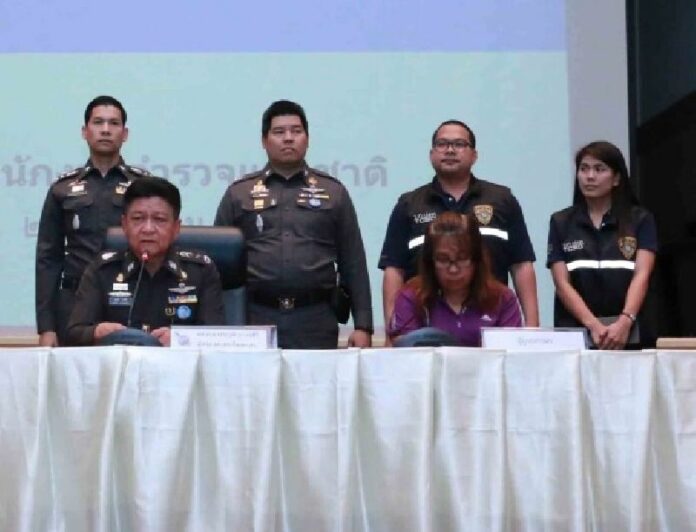
Chayapha Chokepornboonsri (seated) at a June 24 police news conference.

BANGKOK — A woman has been sentenced to seven years in prison for lese majeste and sedition, her lawyer confirmed today.

Thanathorn Thananon, a lawyer for the group Thai Lawyers for Human Rights, told DPA today that his client, identified only as Chayapha, was convicted by a military court for sedition and lese majeste.

"The defendant was originally called in and charged with sedition for posting on Facebook that a counter-coup against the junta was imminent," Thanathorn said.

"Further investigation by the authorities found content that brought about lese majeste charges."

The courts handed down a 14-year sentence yesterday but commuted it to seven years because the defendant pleaded guilty.

"We were only informed of the ruling after the fact. The military courts failed to inform us that a hearing was taking place. They only told the defendant to appear at short notice," Thanathorn said.

Story: DPA / Cod Satrusayang


To reach us about this article or another matter, please contact us by e-mail at: [email protected].

Follow Khaosod English on and Twitter for news, politics and more from Thailand.

\

Advertisement

Woman Convicted of Sedition for Facebook Rumor

BANGKOK — A woman has been sentenced to seven years in prison for lese majeste and sedition, her lawyer confirmed today.

Thanathorn Thananon, a lawyer for the group Thai Lawyers for Human Rights, told DPA today that his client, identified only as Chayapha, was convicted by a military court for sedition and lese majeste.

"The defendant was originally called in and charged with sedition for posting on Facebook that a counter-coup against the junta was imminent," Thanathorn said.

"Further investigation by the authorities found content that brought about lese majeste charges."

The courts handed down a 14-year sentence yesterday but commuted it to seven years because the defendant pleaded guilty.

"We were only informed of the ruling after the fact. The military courts failed to inform us that a hearing was taking place. They only told the defendant to appear at short notice," Thanathorn said.

Story: DPA / Cod Satrusayang

Advertisement

Pattaya Police Suspect Foul Play in Briton’s Fatal Balcony Fall

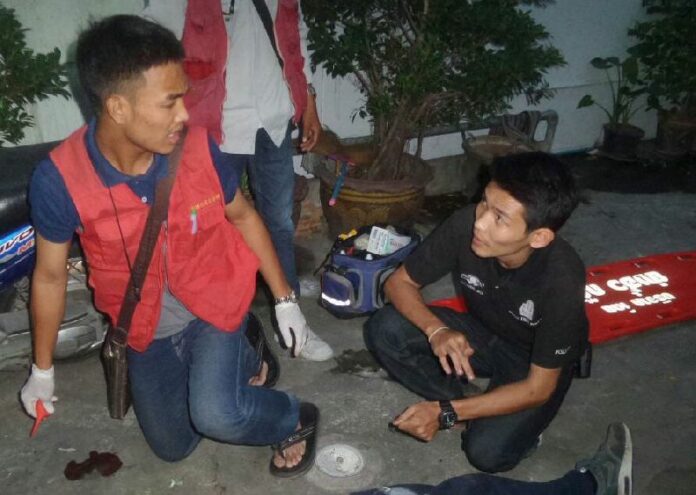
Rescue personnel at a Pattaya guesthouse Tuesday night where a British man fell to his death.

PATTAYA — A British man fell to his death from a building in Pattaya city last night, and police said it may not have been an accident.

Witnesses said the unidentified man, who appeared to be in his 20s, plunged from the fourth floor balcony of the Dolphin House guesthouse in Central Pattaya at about 7:30pm on Tuesday. He was pronounced dead at hospital.

“There are witnesses who said he fell down on his own, but we are not convinced,” Col. Anukul Preedayuth of the Pattaya City Police Station said Wednesday. “We are looking for more witnesses and evidence. The matter is under investigation.”

Four women have been arrested on suspicion of being connected to the incident, Anukul said. The four, who were at the scene, tested positive for drug use and will be prosecuted on drug charges but have yet to be charged in relation to the Briton’s death, he added.

The British Embassy has been notified, Anukul said.


Balcony-Related stories:

Police Rule Out Foul Play in Frenchman’s Fatal Fall

Foreigner Jumps Off His Apartment To Death: Police

Police Deny Report of Chinese Student Found Dead on Pattaya Beach

Police Investigating Suicide And Murder Of Chinese Tourists

Japanese Businessman Plunges Down To His Death


To reach us about this article or another matter, please contact us by e-mail at: [email protected].

Advertisement

Smartphone Freedom Fuels Rise of Social Media in Myanmar Politics

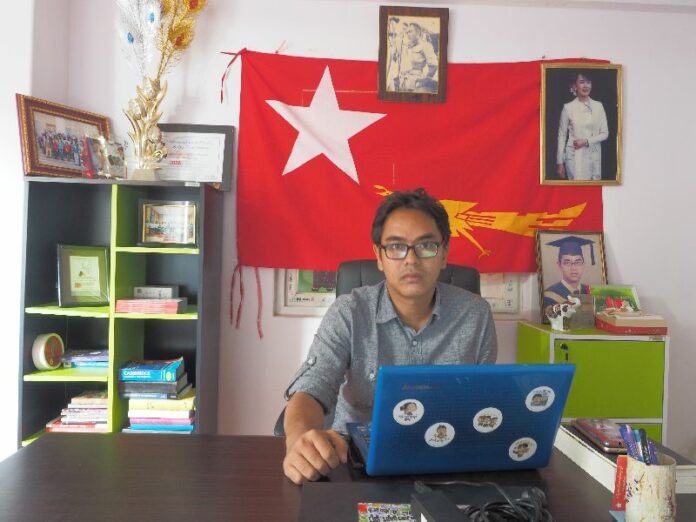
Nay Phone Latt, National League for Democracy MP-elect for Yangon Region parliament, works in his office in early December. Photo: Connor Mcdonald / Myanmar Now

YANGON — Soon after polls closed in Myanmar’s Nov. 8 elections, photos of the ink-stained fingers of proud voters were plastered across the country’s Facebook pages. Overnight, the “purple pinky” became a badge of democratic honor.

The trend was symbolic of Myanmar’s position at the convergence of rapidly expanding internet connectivity and growing political freedoms following dramatic top-down democratic reforms by the military elite. 

The new political and online space is quickly being claimed by activists and politicians, who are using the growing popularity of social media to expand their influence. Political campaigning has evolved from door-knocking and stump speeches to the savvy use of social networks and messaging apps to reach voters.

Facebook has been an obvious choice for most, and the National League for Democracy, or NLD, which won a landslide victory over the Union Solidarity and Development Party, or USDP, has been particularly successful at leveraging social media as a tool.

“That was how I communicated with my people and my constituency, mostly through these accounts. People would send me questions, responses and opinions via my Facebook page and account,” said Nay Phone Latt, a newly elected Yangon Region lawmaker for the NLD. 

“One of my friends called it ‘the silent revolution.’ We don’t have an armed force, but it’s an ideological revolution,” said the one-time political prisoner and dissident blogger from Thingangyun Township constituency.  

NLD leader Aung San Suu Kyi used Facebook to reach out to voters, attracting more than one million followers in the lead up to the election, with her posts often shared tens of thousands of times. 

It’s not only the opposition that has recognised the power of social media. Myanmar army Commander-in-Chief Min Aung Hlaing, a USDP ally, has become an active Facebook user, with his nearly 400,000 followers kept up to date about his meetings, speeches and travels.  

Still, Michael Suantak, program manager at Phandeeyar- a Yangon-based tech hub promoting technological and social innovation, noted, “The NLD used social media far better than the USDP… it was entirely unintentional but the USDP misused social media in the election.”

Days before the election, a video posted on President Thein Sein’s Facebook page depicted violent images from conflict in the Middle East. The bizarre montage which underlined how violence and chaos followed many of the Arab Spring democratic uprisings suggested that the relative stability of Thein Sein’s term had prevented such scenes in Myanmar. 

The post was a source of much online derision and many saw it as an example of how out of touch the USDP government was with voters.


Online Voter Education

Telecom access in today’s Myanmar is a world away from just five years ago when both SIM cards and mobile phones were prohibitively expensive as the junta-run telecom sector struggled to develop under international trade sanctions. Few people had a cellphone, let alone a social media account. 

Mobile phone penetration soared from 7 percent in 2012 to 33 percent of the population in 2014. Cheaper SIM cards have enabled mass connectivity and as a result the numbers of those using social media have soared. 

From March 2014 to March 2015, the number of Facebook users in Myanmar grew by 204 percent to reach between 6-7 million monthly users, according to Facebook.

Online campaigns like Mae Pay Soh (Let’s go to vote), which Yangon-based tech start-up Geek Girls helped develop, enabled voters easy access to information on candidates, political parties, the electoral processes and how to vote.

Despite such efforts, disenfranchisement of ethnic and minority groups and an inefficient voter registration process hampered election turn-out, which at 69 percent dipped below that of previous elections. 

The impact of social media on voter education was positive, but had limited effect in rural areas, said Suantak. “Cartoons and videos on how to vote, and what it means to have a ‘free and fair’ election, were all over social media, but it could only cover a narrow area and is dependent on availability of the internet,” he said.

Connectivity rates in remote rural areas, such as Chin State, are far lower than in urban areas and often a local language is spoken instead of Burmese.


A Virtual Platform, Real World Implications

Despite technical limitations, many in remote ethnic areas with internet access embraced social media in the election-seeing its potential as a political tool.

Footage of neatly piled advanced votes ballots, still wet with glue, with almost identical marks for a USDP candidate went viral on Facebook just hours after the close of polls. Similar posts surfaced in the following days. One such post alleged suspected voter irregularities in Myitkyina, Lashio and Taunggyi, and included the hashtags of major international news organisations.

“We need international media coverage & observers. Please help us to enjoy clean & fair election!” it read.

Under the military regime, allegations of such irregularities would never have been made public. Such a public accusation would have quickly been shut down and those involved arrested.

“Everyone has smartphones, everyone can take pictures and everyone has the ability take evidence… dare I say, it will bring Myanmar closer to democracy,” Suantak said.

However, ahead of the polls conservative forces backing the USPD also took to Facebook to spread their not-so-democratic message.

Nationalist Buddhist monk and Ma Ba Tha movement figurehead, Wirathu, has over 40,000 likes on his page, a platform he has been accused of using to spread anti-Muslim hate speech. In 2014, Wirathu shared a post with a rumor that a Buddhist women been raped by two Muslim men. The spurious claim sparked communal violence in Mandalay that cost two lives.

With disregard for the 2008 Constitution, which says religion cannot be used as a political tool, Wirathu changed his profile picture to a photo of Thein Sein, the words “I’ll be with you Mr PRESIDENT – You are OURS” emblazoned across the top and bottom, a month before the election.

Suzanne Nossel, executive director of PEN American Centre, a network of international writers that promotes freedom of speech, said whilst social media provides a platform for extremists to make gains in the political sphere, it does not drive them.

“Social media, in and of itself, doesn’t increase anyone’s political influence, 

When extremism rises online it is critical that moderate voices speak out and organise to reject racist and ethnocentric ideologies,” she said. Nossel warned against formally outlawing hate speech as it could quickly devolve into broader curbs on freedom of speech.


Social Media Not Yet Free

On Nov. 13, five days after the election, as it was officially confirmed that the NLD had won a parliamentary majority, Patrick Kum Jaa Lee was sitting in his cell in Yangon’s Insein Prison. His appeal for bail had just been denied. In October, the Kachin activist was charged under the Telecommunications Law after posting a digitally altered photo on Facebook of a boot trampling senior general Min Aung Hlaing. He faces up to three years in prison.

Activists warn that despite democratic gains, a number of laws – some of which stem from the junta-era such as the Electronic Transaction Law – continue to pose a danger to social media users. Criminal defamation charges are also used to repress free speech online.

“It’s not only the Telecommunications Law or Electronic Transactions Law that need to be amended,” said May Sabae Phyu, Patrick Kum Jaa Lee’s wife and director of the Gender Equality Network. “During the last five years a lot of new laws have been permitted and approved by parliament without proper consultation with civil society.”

“They need to abolish Myanmar’s criminal defamation laws,” said Nossel, of PEN America. “People should be free to disagree with, criticise and even mock the government, the military, and all other institutions and individuals.”

Nay Phone Latt, the NLD MP and blogger, said social media users need to be wary of such laws until further reforms are implemented. “We have already tried to amend these laws two years ago. It wasn’t successful but in this coming term of government, I think we can do it,” he said.

Story: Connor Macdonald

Advertisement

Suspect Arrested in Nov. 13 Paris Attacks

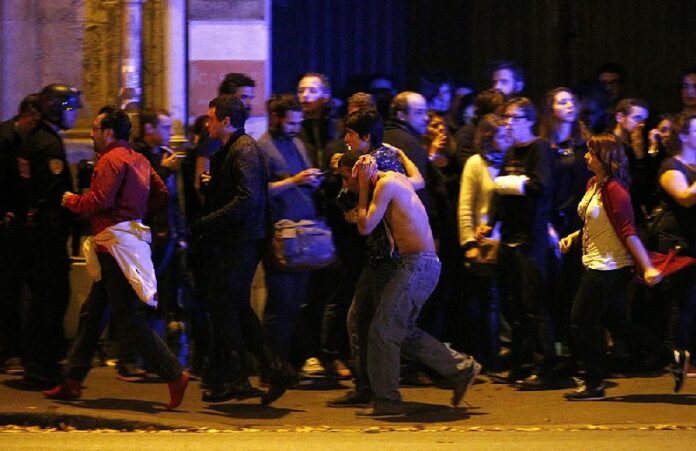
Wounded people are evacuated from the scene of a hostage situation at the Bataclan theatre Nov. 13 in Paris. Photo: Yoan Valat / EPA

PARIS — French police arrested a suspect in the Nov. 13 terrorist attacks in Paris that killed 130 people, the Paris prosecutor's office said.

The 29-year-old man was detained in the Paris area in connection with the attacks carried out by a network of terrorists, many with roots in Belgium.

Seven attackers died on Nov. 13, many by detonating suicide belts, and three more died during a police raid at an apartment north of Paris.

Investigators have been trying to piece together how the group managed to organize the attacks at a concert hall, national stadium and a string of bars and restaurants in central Paris.

Twenty-six-year-old Frenchman and Brussels resident Salah Abdeslam is still being sought by French and Belgian police.

The Islamic State claimed responsibility for the attacks. France has been under a state of emergency since they occurred.

On Tuesday night, Germany's national security agency chief said Islamic State had two of the Paris attackers enter Europe as refugees and register as "a show of force."

Hans-Georg Maassen, president of the German Federal Office for the Protection of the Constitution, told broadcaster Phoenix that the radical jihad organization wanted to show what it can do.

"It wanted to impress us. It also wanted in part to discredit the flow of refugees," Maassen said.

The two attackers who entered as refugees might have been the suicide bombers who blew themselves up outside Stade de France as the German and French national football teams were playing, the report said.

The identity of the two attackers at the stadium has not been determined.

Story: DPA

Advertisement

Life Sentence for Redshirt Leader Accused of City Hall Arson Attack

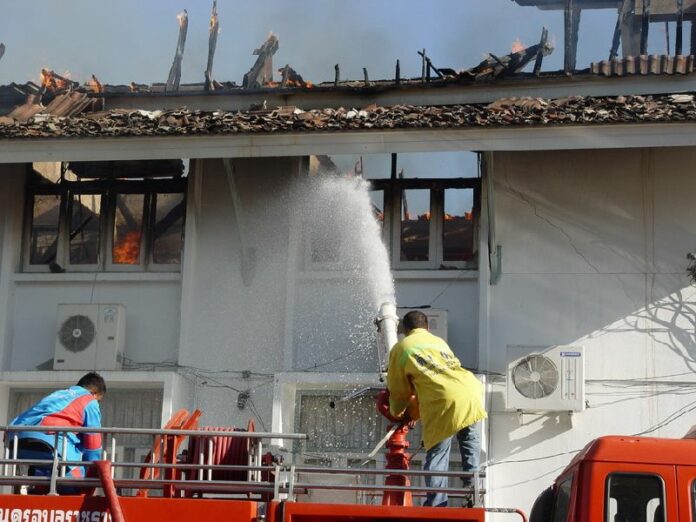
In this 19 May, 2010, file photo, firefighters combat the blaze at Ubon Ratchathani City Hall after a group of Redshirt protesters set it on fire.

UBON RATCHATHANI — The Supreme Court handed out a death sentence yesterday to a Redshirt leader in the northeast – which was reduced to a lifetime sentence – for allegedly torching a provincial city hall during political unrest five years ago.

The lower court earlier found Pichet Tabudda guilty of the charge and sentenced him to a year in prison for the arson on May 19, 2010, the day a military crackdown in Bangkok brought an end to months of Redshirt protests that claimed more than 90 lives. 

But yesterday the Supreme Court changed his sentence to execution, arguing that Pichet not only torched the Ubon Ratchathani City Hall, but personally incited the mob that led to the arson attack, his lawyer told reporters. (Update: He misspoke, court says there was never a death sentence.)

Pichet’s sentence was eventually reduced to life in prison because he pleaded guilty. 

“The court believed that he masterminded the burning of the City Hall as alleged by the prosecutor,” said his lawyer, Wattana Chantasilpa.
 

\

Police officers look on as lawyer Wattana Chantasilpa on Tuesday talks to reporters outside Ubon Ratchatani Provincial Court.

The same court also affirmed guilty verdicts for 12 other defendants accused of torching the Ubon Ratchathani City Hall on May 19, 2010.

Pichet was later taken to prison yesterday afternoon to begin serving his life sentence.

The May 19, 2010, arson was a response to a military crackdown on Redshirt protesters in Bangkok on that day, which came after two months of street protests demanding a fresh election from then Prime Minister Abhisit Vejjajiva. 

The violence, which erupted in April and May 2010, left more than 90 people dead, mostly civilians. 

Related news:

Four Redshirts Convicted of Burning Khon Kaen City Hall

Thaksin: 10 Mil. Baht Bounty For 2010 Arson Culprits


To reach us about this article or another matter, please contact us by e-mail at: [email protected].

Follow Khaosod English on and Twitter for news, politics and more from Thailand.

\

Advertisement

Hot News

LATEST NEWS

Bangkok
overcast clouds
36.4 ° C
37.2 °
35 °
51 %
4.3kmh
100 %
Thu
36 °
Fri
35 °
Sat
36 °
Sun
35 °
Mon
33 °