25 C
Bangkok
Friday, June 19, 2026
Home Blog Page 2846

Koh Tao Murders: Rights Group Demands Fresh Investigation Into Torture Claims

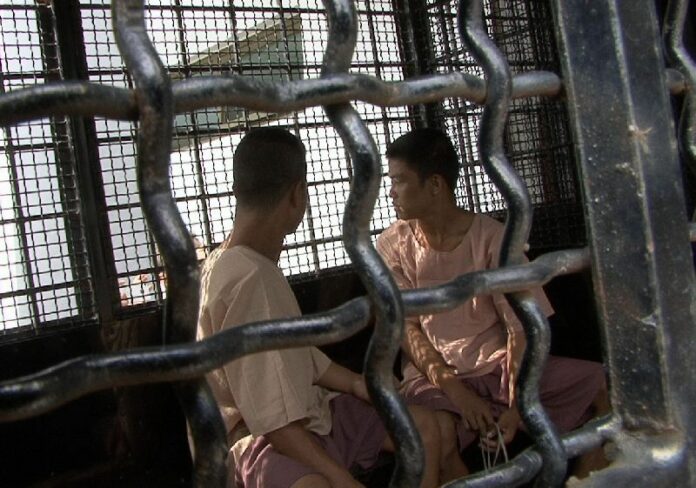
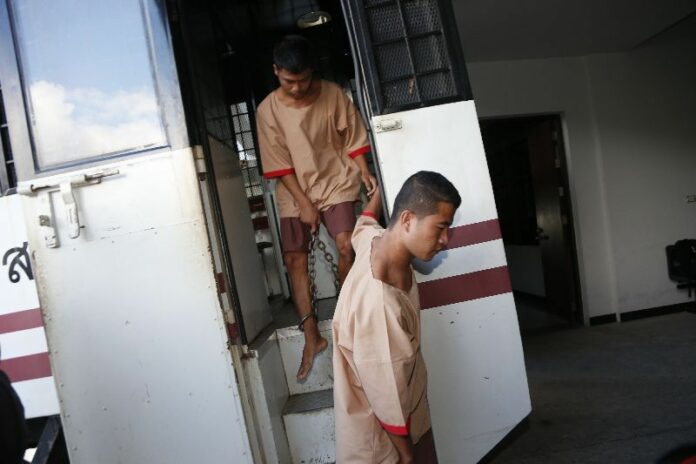
Zaw Lin and Wai Phyo in a police van on their way to court on Koh Samui, 8 July 2015.

BANGKOK – Amnesty International today issued a statement calling for an independent inquiry to determine whether the two Myanmar men, recently convicted of murder, were tortured into making a false confession as the defendants allege.

The international watchdog group said it feared that the two defendants, Zaw Lin and Wai Phyo, might have been among the victims of ill treatment by the Thai police force, which is notorious for a long history of using force to extract false confessions.

The two men initially confessed that they were responsible for the Sept. 15, 2014, killings of British backpackers David Miller and Hannah Witheridge in southern Thailand, but the pair later retracted the confession, saying that they were beaten and coerced by local police to admit guilt against their will. The two suspects were also accused of raping Witheridge.

On Thursday the court found Zaw Lin and Wai Phyo guilty of the murders and sentenced them to death. The court said DNA traces at the crime scene implicated the two men, and ruled that their claim of torture could not be proved.

“Thai authorities must ensure that any alleged confession or other statement obtained as a result of torture is not admitted as evidence in court in any retrial of the case, unless against those accused of torture to prove that the statement has been taken,” Champa Patel, Amnesty International Director for Southeast Asia and the Pacific, said in a statement to the press today.

She added, “This requires an independent investigation, which the police should certainly not be in charge of.”

The Thai police force has occasionally detained and interrogated suspects in criminal cases without providing the suspects with legal counsel. Cases of police beating suspects in custody are also well documented by the media.

For instance, in July a video of an unidentified police officer slapping child rape suspect Wanchai Saengkhao went viral on the social media. There is no information whether the officer was ever punished, while many comments on social media praised the cop for “teaching a lesson” to Wanchai.

The Amnesty International’s statement continues: “The Thai police force has a long and disturbing track record of using torture and other forms of ill-treatment to extract ‘confessions’. This is far from an isolated case – the Thai authorities must start taking concrete steps to stamp out torture , not just paying lip service to doing so,”

“We hope that the Thai authorities will ensure the truth in a retrial that respects international human rights law and standards, so that the families of Hannah Witheridge and David Miller get the justice and peace of mind they deserve.”

In yesterday’s verdict, the judges said there is no clear sign of torture on Zaw Lin and Wai Phyo. A physician who inspected the two defendants did find some bruises and marks, but failed to say for certain who or what caused them, the court said.

The court also downplayed the claim of torture by arguing that police officers involved in the arrest and interrogation of Zaw Lin and Wai Phyo had no history of disputes or grudges against the pair, so it was unlikely for them to behave in an unlawful way toward the suspects.

In October, the National Human Rights Commission launched its own investigation into the two defendants’ torture claim. After postponing the Commission’s summon for five times, a police representative eventually met with the agency and insisted that the claim was baseless.


To reach us about this article or another matter, please contact us by e-mail at: [email protected].

Follow Khaosod English on Facebook and Twitter for news, politics and more from Thailand.

\

Advertisement

Koh Tao Murders: Rights Group Demands Fresh Investigation Into Torture Claims

Zaw Lin and Wai Phyo at Samui courthouse Dec. 24.

BANGKOK — Amnesty International today issued a statement calling for an independent inquiry to determine whether the two Myanmar men, recently convicted of murder, were tortured into making a false confession as the defendants allege.

The international watchdog group said it feared that the two defendants, Zaw Lin and Wai Phyo, might have been among the victims of ill treatment by the Thai police force, which is notorious for a long history of using force to extract false confessions.

The two men initially confessed that they were responsible for the Sept. 15, 2014, killings of British backpackers David Miller and Hannah Witheridge in southern Thailand, but the pair later retracted the confession, saying that they were beaten and coerced by local police to admit guilt against their will. The two suspects were also accused of raping Witheridge.

On Thursday the court found Zaw Lin and Wai Phyo guilty of the murders and sentenced them to death. The court said DNA traces at the crime scene implicated the two men, and ruled that their claim of torture could not be proved.

“Thai authorities must ensure that any alleged confession or other statement obtained as a result of torture is not admitted as evidence in court in any retrial of the case, unless against those accused of torture to prove that the statement has been taken,” Champa Patel, Amnesty International Director for Southeast Asia and the Pacific, said in a statement to the press today.

She added, “This requires an independent investigation, which the police should certainly not be in charge of.”

The Thai police force has occasionally detained and interrogated suspects in criminal cases without providing the suspects with legal counsel. Cases of police beating suspects in custody are also well documented by the media.

For instance, in July a video of an unidentified police officer slapping child rape suspect Wanchai Saengkhao went viral on the social media. There is no information whether the officer was ever punished, while many comments on social media praised the cop for “teaching a lesson” to Wanchai.

The Amnesty International’s statement continues: “The Thai police force has a long and disturbing track record of using torture and other forms of ill-treatment to extract ‘confessions’. This is far from an isolated case – the Thai authorities must start taking concrete steps to stamp out torture , not just paying lip service to doing so,”

“We hope that the Thai authorities will ensure the truth in a retrial that respects international human rights law and standards, so that the families of Hannah Witheridge and David Miller get the justice and peace of mind they deserve.”

In yesterday’s verdict, the judges said there is no clear sign of torture on Zaw Lin and Wai Phyo. A physician who inspected the two defendants did find some bruises and marks, but failed to say for certain who or what caused them, the court said.

The court also downplayed the claim of torture by arguing that police officers involved in the arrest and interrogation of Zaw Lin and Wai Phyo had no history of disputes or grudges against the pair, so it was unlikely for them to behave in an unlawful way toward the suspects.

In October, the National Human Rights Commission launched its own investigation into the two defendants’ torture claim. After postponing the Commission’s summon for five times, a police representative eventually met with the agency and insisted that the claim was baseless.


To reach us about this article or another matter, please contact us by e-mail at: [email protected].

Follow Khaosod English on Facebook and Twitter for news, politics and more from Thailand.

Follow @KhaosodEnglish

\


Advertisement

Koh Tao Murders: Court Says DNA Trumps Other Flaws in Case

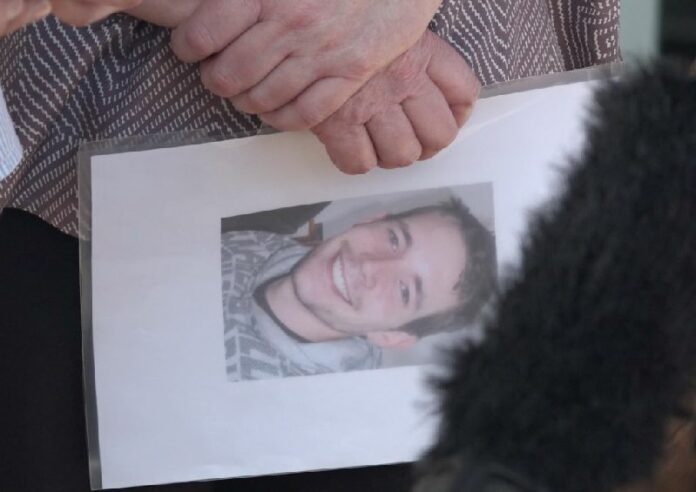
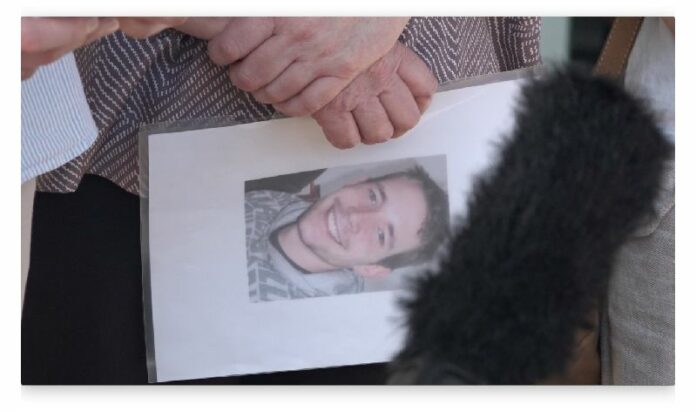
Sue Miller holds photograph of her son, David Miller, during a Dec. 24 news conference at Samui courthouse.

SAMUI – Although it accepts that the case against the two Myanmar men – found guilty of killing two British tourists in southern Thailand last year – was not without flaws, the court said yesterday that DNA samples collected from the crime scene are so incontrovertible, that they justify a conviction.

The flaws include lack of chain of custody in evidence, arrest and interrogation of the two suspects without charge or legal representation and a lack of any witness who saw the two defendants committing the crimes.

Zaw Lin and Wai Phyo, both 22, were found guilty Thursday of killing British backpackers David Miller and Hannah Witheridge on Koh Tao on Sept. 15, 2014. The two men were also convicted of raping Witheridge before killing her. Both victims died in the early hours of Sept. 15.

For their alleged crimes, the court on Samui island yesterday morning sentenced both defendants to death – the highest penalty for premeditated murder.

Zaw Lin and Wai Phyo, who worked as bar workers on Koh Tao, were arrested on Oct. 1 2014 and brought to a police “safehouse” on Koh Tao for interrogation. They were not formally charged until Oct. 3 2014.

The pair initially confessed to the crimes, but later retracted their statement after receiving legal counsel from a team of pro-bono lawyers. The two men said were coerced by police into making the false confession.

Police said DNA samples collected from the crime scene and from Witheridge’s body identified Zaw Lin and Wai Phyo as the murderers, a point contested by the defense team, who argued that the DNA test was conducted behind closed doors by several police officers without proper documentation.

Siding with the prosecutor, the court yesterday accepted the DNA test as valid and up to international standards. It rejected argument from the defense lawyers that the DNA test was performed solely by the Institute of Forensic Medicine, which operates under the Thai police force, could have been forged or tampered with.

According to the court, the test was so well documented and photographed that a forgery could not possibly have occurred.
 

The evidence

For the court, the most significant evidence that ties Zaw Lin and Wai Phyo to the crime is traces  of their DNA found on Witheridge’s body. Her body clearly showed signs of rape, the court said.  

While the murder weapon – a garden hoe – did not contain DNA traces of either men, it is reasonable to conclude that  both Witheridge and Miller were killed by the rapists to cover up their initial crime, the court said.

Furthermore, traces of Wai Phyo’s DNA were found on a cigarette stub left on Sai Ree Beach, along with DNA that belonged to a third Myanmar man called Mau Mau. Mau Mau, 23, told police he was playing guitar with Zaw Lin and Wai Phyo several hours before the murder took place.

The two men admitted in the trial that they were playing guitar and drinking beer, whilst sitting on a log. However, they insisted that they left the beach before the killings took place and went swimming in the sea on their way home instead.

The validity of the DNA test by the police, was among the most contentious issues during the trial, which lasted from July to October. Defense lawyers argued that the test was not independently conducted, and requested that the remnants of DNA samples to be retested by the Central Institute of Forensic Science, which operates under the Ministry of Justice.

However, the defense team eventually abandoned the idea of the retest, saying they were unsure whether the DNA remnants would still make for an accurate retest.  

Another key item that implicated Zaw Lin and Wai Phyo, the court said, was Miller’s cell phone that went missing from the crime scene and was later found at Wai Phyo’s residence. Wai Phyo said he found the phone on the way back to his home – an argument the court rejected as implausible.


Other key points in the verdict:

No direct witness implicated the two defendants at the crime scene, but the absence of such witnesses is understandable because the crime took place in the dead of the night, in an  secluded area that is sparsely populated.

Smashed phone found at second defendant’s home was proven to belong to Miller, with help from Miller’s father to identify the IMEI serial number. The second defendant claimed he found a phone on the way back to his residence, but this claim is deemed questionable.

Witnesses said they saw Mau Mau and two other men playing guitar on a log on the beach close to the crime scene. The two defendants argue it was too dark to see the crime scene, but the pair had been sitting long enough to adjust their eyes to the darkness.

The two defendants failed to produce any alibi to confirm their whereabouts after they left the log and parted company with Mau Mau.

CCTV footage indicates that Miller and Witheridge left AC Bar, where they were drinking prior to their deaths, by the back door, which led directly to Sai Ree Beach. The path between AC Bar’s back door and the crime scene also goes past the log where the two defendants were allegedly drinking beer and playing guitar.

The two defendants said they suddenly had the idea of going swimming in the sea on their way back to the residence. It was in the dead of the night, and it was raining slightly. It is unimaginable that any person would have made this decision, unless they wanted to erase the evidence on their shirts and bodies.

The garden hoe did not contain traces of DNA of either men. This lack of DNA could be explained by several factors. For example: the perpetrators hands might be dry or the item might have been washed in the sea.  


‘No previous grudge’

The court also acknowledged in its verdict that the prosecutor’s case against the two men is marked by several irregularities and shortcomings: namely, a lack of “chain of custody”, a paper trail that marked the transfer of documents and evidence up the ranks in the police force.

Throughout the trial, the defense lawyers argued the lack of chain of custody meant crucial evidence, such as the DNA test result, could have been easily forged.

This concern was brushed aside in the court verdict; the judges said each police agency has its own form of chain of custody.

Another point of contention was the fact that the two suspects were arrested and interrogated without proper legal counsel and interpretation.

The interpreter provided by police for Zaw Lin and Wai Phyo later turned out to be a roti vendor, from Myanmar.

Most importantly, the defense lawyers argued, the two defendants said they were beaten, tortured and threatened by police to make the false confession, therefore rendering their arrests and interrogation unlawful.

However, the court dismissed these objections. The two men admitted they had some “passable” conversation with the interpreter, so the interpreter was qualified enough for the job, the court said. 

The court also believes police had reasonable grounds to arrest the two defendants without charges. When first questioned by police, the two defendants failed to show their passport or ID to police, which was a sufficient ground for “offense in plain sight” that allows police to arrest them for further interrogation, the court said.

When a lawyer was finally provided by the police for the two defendants, it was not the lawyer requested by by the two men, the court acknowledged. But the court then argued that lawyer is certified by Lawyer Council of Thailand, and therefore eligible to represent the two men during interrogation.

“This is a departure from rules rather than from laws,” the verdict read.

As for the claim of torture, the court noted that the doctor who inspected their condition in police custody said no clear sign of beating or torture was found.

Also repeatedly mentioned by the court throughout the verdict is the argument that law enforcement officials involved in this investigation “have not previously known the two defendants and have no previous history of personal grudge or disputes with the two defendants,” so it was unlikely that these officials would conspire against the two Myanmar men.

Defense team still hopeful

Nakhon Chompuchat, head of the defense team, said he respected the court verdict, but expressed his disappointment that he could not convince the judges to see “reasonable doubt” in the case.

“The court said it was beyond reasonable doubt, but to us there are still some doubts,” Nakhon told reporters outside the courthouse yesterday.

Nakhon cited the example of the lack of chain of custody that would have verified DNA tests on Zaw Lin and Wai Phyo; he said the prosecutor told him the documents exist, but simply chose not to show them to him.

The lawyer also regretted that the court would not hear his concern about the alleged police torture of his clients.

Nevertheless, he said he’s still confident that his team will be able to persuade the upper courts to dismiss the charge against Zaw Lin and Wai Phyo.

The lawyers team is expected to file an appeal in the next 30 days. In the meantime, Zaw Lin and Wai Phyo will be moved to death row at a prison in Nakhon Si Thammarat province, lawyer Nakhon said.

There won’t be any new evidence or witness in the Appeal Court; Nakhon explained; the appeal trial would be mostly an “interpretation” of existing evidence.   


To reach us about this article or another matter, please contact us by e-mail at: [email protected].

Follow Khaosod English on Facebook and Twitter for news, politics and more from Thailand.

\

Advertisement

Koh Tao Murders: Court Says DNA Trumps Other Flaws in Case

Sue Miller holds photograph of her son, David Miller, during a Dec. 24 news conference at Samui courthouse.

SAMUI — Although it accepts that the case against the two Myanmar men – found guilty of killing two British tourists in southern Thailand last year – was not without flaws, the court said yesterday that DNA samples collected from the crime scene are so incontrovertible, that they justify a conviction.

The flaws include lack of chain of custody in evidence, arrest and interrogation of the two suspects without charge or legal representation and a lack of any witness who saw the two defendants committing the crimes.

Zaw Lin and Wai Phyo, both 22, were found guilty Thursday of killing British backpackers David Miller and Hannah Witheridge on Koh Tao on Sept. 15, 2014. The two men were also convicted of raping Witheridge before killing her. Both victims died in the early hours of Sept. 15.

For their alleged crimes, the court on Samui island yesterday morning sentenced both defendants to death – the highest penalty for premeditated murder.

Zaw Lin and Wai Phyo, who worked as bar workers on Koh Tao, were arrested on Oct. 1 2014 and brought to a police “safehouse” on the island for interrogation. They were not formally charged until Oct. 3 2014.

The pair initially confessed to the crimes, but later retracted their statement after receiving legal counsel from a team of pro-bono lawyers. The two men said they were coerced by police into making the false confession.

Police said DNA samples collected from the crime scene and from Witheridge’s body identified Zaw Lin and Wai Phyo as the murderers, a point contested by the defense team, who argued that the DNA test was conducted behind closed doors by several police officers without proper documentation.

Siding with the prosecutor, the court yesterday accepted the DNA test as valid and up to international standards. It rejected argument from the defense lawyers that the DNA test was performed solely by the Institute of Forensic Medicine, which operates under the Thai police force, could have been forged or tampered with.

According to the court, the test was so well documented and photographed that a forgery could not possibly have occurred.
 

The evidence

For the court, the most significant evidence that ties Zaw Lin and Wai Phyo to the crime is traces  of their DNA found on Witheridge’s body. Her body clearly showed signs of rape, the court said.  

While the murder weapon – a garden hoe – did not contain DNA traces of either men, it is reasonable to conclude that  both Witheridge and Miller were killed by the rapists to cover up their initial crime, the court said.

Furthermore, traces of Wai Phyo’s DNA were found on a cigarette stub left on Sai Ree Beach, along with DNA that belonged to a third Myanmar man called Mau Mau. Mau Mau, 23, told police he was playing guitar with Zaw Lin and Wai Phyo several hours before the murder took place.

The two men admitted in the trial that they were playing guitar and drinking beer, whilst sitting on a log. However, they insisted that they left the beach before the killings took place and went swimming in the sea on their way home instead.

The validity of the DNA test by the police was among the most contentious issues during the trial, which lasted from July to October. Defense lawyers argued that the test was not independently conducted, and requested that the remnants of DNA samples be retested by the Central Institute of Forensic Science, which operates under the Ministry of Justice.

However, the defense team eventually abandoned the idea of the retest, saying they were unsure whether the DNA remnants would still make for an accurate retest.  

Another key item that implicated Zaw Lin and Wai Phyo, the court said, was Miller’s cell phone that went missing from the crime scene and was later found at Wai Phyo’s residence. Wai Phyo said he found the phone on the way back to his home – an argument the court rejected as implausible.


Other key points in the verdict:

No direct witness implicated the two defendants at the crime scene, but the absence of such witnesses is understandable because the crime took place in the dead of the night, in a secluded area that is sparsely populated.

Smashed phone found at second defendant’s home was proven to belong to Miller, with help from Miller’s father to identify the IMEI serial number. The second defendant claimed he found the phone on the way back to his residence, but this claim is deemed questionable.

Witnesses said they saw Mau Mau and two other men playing guitar on a log on the beach close to the crime scene. The two defendants argue it was too dark to see the crime scene, but the pair had been sitting long enough to adjust their eyes to the darkness.

The two defendants failed to produce any alibi to confirm their whereabouts after they left the log and parted company with Mau Mau.

CCTV footage indicates that Miller and Witheridge left AC Bar, where they were drinking prior to their deaths, by the back door, which led directly to Sai Ree Beach. The path between AC Bar’s back door and the crime scene also goes past the log where the two defendants were allegedly drinking beer and playing guitar.

The two defendants said they suddenly had the idea of going swimming in the sea on their way back to the residence. It was in the dead of the night, and it was raining slightly. It is unimaginable that any person would have made this decision, unless they wanted to erase the evidence on their shirts and bodies.

The garden hoe did not contain traces of DNA of either men. This lack of DNA could be explained by several factors. For example: the perpetrators' hands might be dry or the item might have been washed in the sea.  


‘No previous grudge’

The court also acknowledged in its verdict that the prosecutor’s case against the two men is marked by several irregularities and shortcomings: namely, a lack of “chain of custody”, a paper trail that marked the transfer of documents and evidence up the ranks in the police force.

Throughout the trial, the defense lawyers argued the lack of chain of custody meant crucial evidence, such as the DNA test result, could have been easily forged.

This concern was brushed aside in the court verdict; the judges said each police agency has its own form of chain of custody.

Another point of contention was the fact that the two suspects were arrested and interrogated without proper legal counsel and interpretation.

The interpreter provided by police for Zaw Lin and Wai Phyo later turned out to be a roti vendor, from Myanmar.

Most importantly, the defense lawyers argued, the two defendants said they were beaten, tortured and threatened by police to make the false confession, therefore rendering their arrests and interrogation unlawful.

However, the court dismissed these objections. The two men admitted they had some “passable” conversation with the interpreter, so the interpreter was qualified enough for the job, the court said.

The court also believes police had reasonable grounds to arrest the two defendants without charges. When first questioned by police, the two defendants failed to show their passport or ID to police, which was a sufficient ground for “offense in plain sight” that allows police to arrest them for further interrogation, the court said.

When a lawyer was finally provided by the police for the two defendants, it was not the lawyer requested by by the two men, the court acknowledged. But the court then argued that lawyer is certified by Lawyer Council of Thailand, and therefore eligible to represent the two men during interrogation.

“This is a departure from rules rather than from laws,” the verdict read.

As for the claim of torture, the court noted that the doctor who inspected their condition in police custody said no clear sign of beating or torture was found.

Also repeatedly mentioned by the court throughout the verdict is the argument that law enforcement officials involved in this investigation “have not previously known the two defendants and have no previous history of personal grudge or disputes with the two defendants,” so it was unlikely that these officials would conspire against the two Myanmar men.

Defense team still hopeful

Nakhon Chompuchat, head of the defense team, said he respected the court verdict, but expressed his disappointment that he could not convince the judges to see “reasonable doubt” in the case.

“The court said it was beyond reasonable doubt, but to us there are still some doubts,” Nakhon told reporters outside the courthouse yesterday.

Nakhon cited the example of the lack of chain of custody that would have verified DNA tests on Zaw Lin and Wai Phyo; he said the prosecutor told him the documents did exist, but simply chose not to show them to him.

The lawyer also regretted that the court would not hear his concern about the alleged police torture of his clients.

Nevertheless, he said he’s still confident that his team will be able to persuade the upper courts to dismiss the charge against Zaw Lin and Wai Phyo.

The lawyers team is expected to file an appeal in the next 30 days. In the meantime, Zaw Lin and Wai Phyo will be moved to death row at a prison in Nakhon Si Thammarat province, lawyer Nakhon said.

There won’t be any new evidence or witness in the Appeal Court; Nakhon explained; the appeal trial would be mostly an “interpretation” of existing evidence.   


To reach us about this article or another matter, please contact us by e-mail at: [email protected].

Follow Khaosod English on Facebook and Twitter for news, politics and more from Thailand.

Follow @KhaosodEnglish

\


Advertisement

Banning Movie for Containing Sex Scene Was Lawful, Court Rules

BANGKOK — The Administrative Court ruled on Friday, that the ban issued by the Film Censorship Board in 2010, for the movie “Insects in the Backyard”, which addressed sexuality and gender, was legitimate due to a scene in the drama showing sex organs and intercourse.

Five years after the director, Tanwarin Sukkhapisit, 42, appealed the 2010 ban , the Court today said that three seconds of a scene in which the main character is watching a pornographic movie, which shows uncensored genitalia and intercourse was considered as pornography. Pornography is against public order and morality and is illegal according to Article 287 of the Criminal Code.

“The Court said Insects in the Backyard has a scene showing sexual intercourse for around three seconds,which it deemed to be against good morals,” said the lawyer, Yingcheep Atchanont.

Though the court suggested that the movie might be given permission to screen with a +20 rating if the director cut out the contentious scene and submitted it to the Film Board again.

Insects in the Backyard, an independent movie about a transgender father struggling to raise two children, was originally slated for release in 2010.Tanwarin Sukkhapisit, appealed to the court after the movie was banned from being screened in the kingdom, as the Film Censorship Board considered that it contains pornographic content, that goes against the “good morals” of society.

Though the Court today considered that the film has no intention of creating sexual arousal, it said that the intercourse scene in the X-rated porn film shown in the movie was illegal.

The director has not yet released an official statement following the verdict.

Prior to the ban, Insects in the Backyard was shown at Thailand’s World Film Festival of Bangkok, Canada’s Vancouver International Film Festival, and Italy’s Torino GLBT Film Festival all in 2010.

Advertisement

"Black Christmas" Protest in Chicago Seeks Mayor's Ouster

Protesters lie in the street during a demonstration along Michigan Avenue's Magnificent Mile shopping area, Chicago, Illinois, Dec. 24. Photo:  Tannen Maury / EPA

WASHINGTON — Last-minute Christmas shoppers in central Chicago were met Thursday by protesters calling for the resignation of the mayor over the handling of the investigation into the police shooting of an African-American teenager.

The protesters blocked the entrance to several stores along the city's most famous shopping street and held signs calling for Mayor Rahm Emanuel to resign.

They held "die-ins" in the street and tussled with police as they staged what they called Black Christmas in response to the shooting of 17-year-old Laquan McDonald.

Chicago police lined up to protect the entrance to the Apple store on the Magnificent Mile, a commercial stretch of in the city centre. Protestors also blocked the entrance to a shopping mall and at one point caused all lanes of the street to be shut down as they marched and chanted.

More than a hundred people took part in the protest, according to the Chicago Tribune. The newspaper said the store entrances were blocked for only a few minutes at a time.

The protest is the latest in a series of demonstrations in Chicago following the release last month of a police dashboard camera video showing a white officer shooting McDonald 16 times in October 2014.

One officer has been charged with first-degree murder in the case.

The delay in the release of the video has raised questions about whether the police department properly investigated the case.

Story: DPA


To reach us about this article or another matter, please contact us by e-mail at: [email protected].

Follow Khaosod English on Facebook and Twitter for news, politics and more from Thailand.

Follow @KhaosodEnglish

\

Advertisement

Koh Tao Murders: Protest in Myanmar, Thai Embassy Issues Warning

Mother of zaw lin is escorted away from the courthouse after the verdict Dec. 24

YANGON — The Thai embassy in Myanmar issued a statement Thursday warning Thais in Myanmar to take safety precautions, amidst the outrage that followed the court verdict in Samui that sentenced two Myanmar men to death for murder.

In the statement, the Royal Thai Embassy in Yangon warned its citizens to be careful when traveling and avoid identifying themselves as Thais in public.

The notice was issued on the same day a court in southern Thailand found two Myanmar men, Zaw Lin and Wai Phyo guilty of killing two British tourists on Koh Tao in September 2014. The pair were both sentenced to death.


\

The statement issued by the Royal Thai Embassy in Yangon.


Sek Wannamethee, a spokesperson for the Ministry of Foreign Affairs, said the verdict prompted a small protest outside the Thai embassy in Yangon on Thursday afternoon. Around 30 Myanmar protesters gathered for about an hour before dispersing peacefully, Sek said.  
Sek also said that Myanmar authorities have placed 20 police officers around the embassy as a safety precaution. So far there have been no reports of any Thais in Myanmar being affected by the protest or any other incidents.
Irrawaddy, an online news site that covers Myanmar and Southeast Asia, reported on Dec. 24 that the director of the President’s Office, Zaw Htay, wrote on his Facebook account that the Myanmar government would support the two defendants during their expected appeals.

Meanwhile, Migrant Worker Rights Network activist, Andy Hall, who has been providing assistance to the defense, said he, his organization, the two defendants and the defense lawyer team respect the court ruling.

But he added that he and his team disagree with the verdict, and will adhere to the rule of law in appealing the case.


Related stories:

Two Myanmar Men Convicted of Koh Tao Murders and Rape; Death Sentence For Both

Koh Tao Murders: Defense Asks Court to Drop Charges

Koh Tao Murders: DNA on Weapon ‘Does Not Match’ the Accused

Lack of Evidence, Local Media Coverage Adds to Mystery of Koh Tao Murder

Koh Tao Trial Resumes, Court Shown Footage of Victims’ Final Night

Koh Tao Murders: Top Forensic Scientist to Testify for Defense


Advertisement

Media Reform Committee Weighs Article 44 for Crackdown on Online Media

The media reform committee meets with police at the Royal Thai Police Headquarters, Dec. 24. Photo: Matichon

BANGKOK — A junta appointed media reform committee is considering a new measure to control online media that incites "social unrest."

Maj. Gen. Pisit Pao-in, the former commander of the Technology Crime Suppression Division now overseeing the government's "reform" of online media, said Dec. 24 that he would ask to use the power of Article 44 to crack down on online media, including content deemed to affect national security and/or defame the monarchy.

Article 44 of the interim constitution grants junta chairman Prayuth Chan-ocha a power to enact any laws or take action to protect "national interests" and "national security."

After the talk between the media reform committee and police today, Pisit said representatives from Google are scheduled to meet the committee for a discussion on Jan. 14 and again on Jan. 21. According to the officer, these meetings will be followed by further meetings with representatives from Facebook and the messaging app, LINE, at as yet unspecified dates.

With an estimated 32 million LINE users and more than 34 million Facebook accounts registered in the kingdom, Pisit said online media was the most "troublesome," as it was not “filtered” unlike print, radio and television. Such communication increased the chance of people to distribute false or fake information, he said.

Expected to resolve the problem in 18 months, Pol.Maj.Gen Pisit stressed the so-called reform would not infringe on user privacy. He added that private sectors must cooperate with the authorities.

Thailand was recently rated “not free” by watchdog group Freedom House, due to increased suppression under military rule in a year which has seen record prison sentences for comments made on Facebook.

In the annual conference of Thai Netizen Network on Dec. 17, activists and experts all agreed that internet freedom in Thailand is likely to decline even further next year. Online media reform initiatives under the leadership of the former Technology Crime Suppression Division was one of their major concerns.

During his time as the head of division in 2014, Pol.Maj.Gen Pisit was once in charge of monitoring social media, especially group chat in LINE. The commander reportedly asked Facebook, Google and LINE for cooperation in handing over user's data to Thai police, to no avail. 


Related Stories:

Online Freedom to Slide Further, Online Activists Predict

Cyber Activists Bring Down Govt Sites to Protest ‘Single Gateway’

Record Sentences Today For Facebook Lese Majeste Offenses


Advertisement

A Look Inside The New Domestic Terminal at Don Mueang (Photos)

Nok Air DD760 to Chumphon was the first flight to depart from Don Mueang Terminal 2 this morning.

BANGKOK — The newly renovated domestic terminal at Don Mueang Airport opened today.

After 8 years of renovation, Passenger Terminal 2 opened at 3am this morning, Dec. 24,  to ease passenger congestion caused by low-cost carriers. Terminal 1 is still used for international flights and will be renovated in the future as well.

Check-in counter rows 9-10 are for passengers of Thai AirAsia, row 11 is for R Airlines, Orient Thai and Thai Lion Air, row 12 is for Thai Lion Air and THAI Smile and rows 14-15 are for Nok Air.

Don Mueang currently accommodates 80,000 to 110,000 passengers daily. The added terminal will increase its capacity from 18.5 to 30 million passengers annually.

Recently, the airport introduced a 33-seat Airport LimoBus Express on Nov.27 with free Wi-Fi on board to take travelers into the heart of the city. The bus leaves from airport Gate 5 every 30 minutes and has two routes, Ploenchit – Lumpini Park and Khao San Road. Tickets are 150 baht.

Those who want to reach the skytrain, can take the A1 air-conditioned bus to BTS Mo Chit. The bus leaves every 15 minutes for 30 baht.

For more information, passengers can call 1722 for 24-hour information.


\


\


\


\


\


\


\


Related Stories:

DMK Terminal 2 to Re-Open Christmas Eve


Advertisement

Statement on behalf of the family of Hannah Witheridge, issued at 6:05am GMT, Dec. 24. (13:05 Thai time, Dec. 24)

NORFOLK, UK — Statement on behalf of the family of Hannah Witheridge, who was tragically killed along with David Miller in Koh Tao, Thailand, in September 2014

"As the trial concludes and the verdict is delivered, our family, once again, find ourselves in the path of a whirlwind of emotions and difficulties. In these challenging times, we try to concentrate our efforts on remembering our beautiful Hannah for the fun, vibrant and incredible young woman that she was.

"Had her life not been tragically and unnecessarily cut short, she would now have completed her Master’s degree in Speech and Language therapy and would be about to embark on a fulfilling and worthwhile career. She would have gone on to make a significant difference to the lives of many. On the basis of Hannah’s dedication and passion for Speech and language therapy and the excellent feedback she received during her placements, the University of Essex has introduced an award for outstanding excellence in clinical placements in her memory. It will be named the ‘Hannah Witheridge Award for Clinical Excellence’. Hannah will be the first recipient. As a family, we are touched by this beautiful tribute to Hannah as the hard working, dedicated young woman that she was.

"The past year has served as an unimaginably impossible time for our family. We have found the trial process extremely difficult and our trips out to Thailand, to attend court, made for particularly distressing experiences. We found listening to proceedings very challenging and we have had to endure a lot of painful and confusing information. We now need time, as a family, to digest the outcome of the trial and figure out the most appropriate way to tell our story.”


Advertisement

Hot News

LATEST NEWS

Bangkok
light rain
25 ° C
27.2 °
25 °
92 %
8.2kmh
100 %
Fri
25 °
Sat
32 °
Sun
35 °
Mon
36 °
Tue
37 °