













33.8 C
Bangkok
Saturday, June 27, 2026
Home Blog Page 2985

Rights Group Holds Presser Despite Junta’s Attempt to Censor

Thai Lawyers for Human Rights member Yaowalak Anuphan speaking to reporters outside the FCCT on 4 June 2015.


BANGKOK — Defying police orders to cancel a talk on the state of human rights in Thailand, the Thai Lawyers for Human Rights (TLHR) held a press conference outside the venue where they were originally scheduled to hold a panel discussion this evening.

The original event was canceled by the Foreign Correspondents’ Club of Thailand this afternoon after police presented a letter ordering the club to drop the talk.

The letter, which police said they were instructed to deliver on the junta’s behalf, expressed concern that the event "may allow individuals with ill intention to create a [negative] situation and cause unrest, and lead to a violation of the laws."

However, representatives from TLHR decided to go to the FCCT at 6pm today as planned, and hold a press conference outside of the venue, where they distributed their 21-page report detailing the decline of human rights since the May 2014 coup.

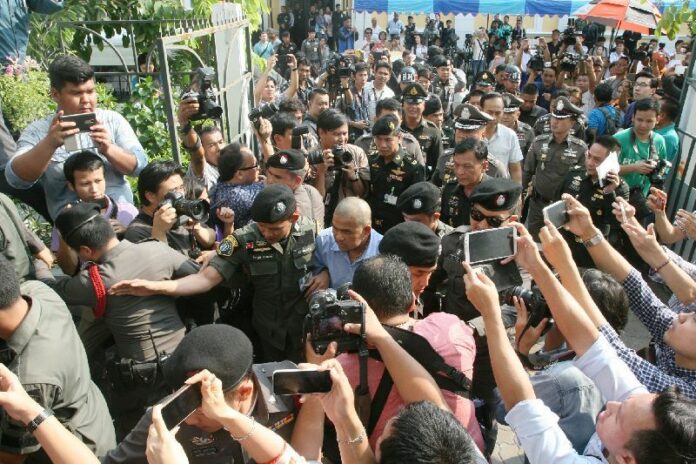
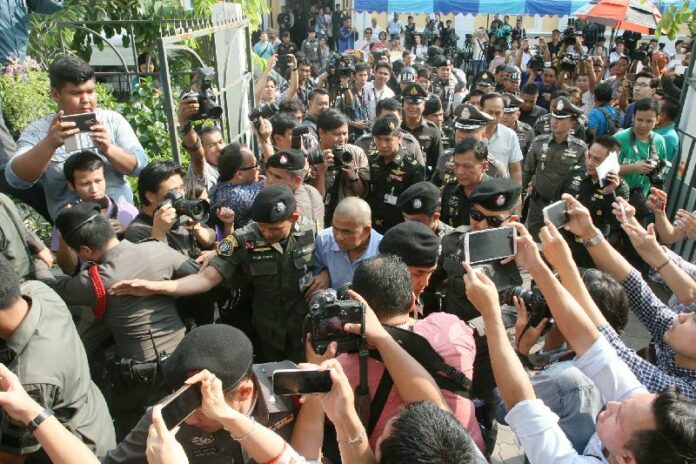
“We insist that we didn’t break any laws, so we decided to go ahead with the press conference today,” TLHR member Yaowalak Anuphan told reporters and plain-clothed officers, who listened and took photos but did not interfere.

She said police never contacted her about today's cancelation, but that army officers called her a few days ago to say they were“uncomfortable” with the event. 

Since seizing power in a coup in May 2014, Thailand’s military junta has maintained a ban on all political gatherings, protests, and forums in the name of achieving "national reconciliation." Detractors, especially those who criticize the junta, are often arrested and some have been sent to face trial in martial court.

“The [junta] is using laws to suppress those who think differently,”Yaowalak said, citing the trial of pro-democracy activists in military court, and the junta’s repeated attempts to smother free speech. Today marked the 72nd time authorities have interfered with political forums since the coup, she said.

Poonthep Sirinupong, a law professor at Thammasat University who was supposed to speak on the panel, commented that putting the junta’s new charter to a referendum will be useless in a climate where free speech is restricted.

“Holding a referendum under these circumstances is like binding the hands of the people,” he said. 

The current draft of the charter, which was written to replace the constitution shredded by the junta after the coup, has been widely criticized by politicians and rights activists as a significant step backwards for Thai democracy. 

Bowing to pressure from pro-democracy voices, the junta agreedlast month to put the charter to a referendum vote, but has not yet specified what options will be made available on the ballot.

In the referendum for previous charter, which was also drafted by a junta-appointed council following the 2006 coup, voters were only permitted to accept or decline the document. Critics say that many voters reluctantly approved the junta’s charter out of fear that the undisclosed alternative would be worse.

Speaking to Khaosod English after the lawyers’ press conference tonight, FCCT president Jonathan Head said the club was “very sorry the event had to be cancelled,” but was forced to comply with police’s orders.

“We had no choice,” he said, adding that the board refused to cancel the event until a formal letter was presented. 

 
For comments, or corrections to this article please contact: [email protected]

You can also find Khaosod English on Twitter and Facebook
http://twitter.com/KhaosodEnglish
http://www.facebook.com/KhaosodEnglish

Advertisement

Rights Group Holds Presser Despite Junta’s Attempt to Censor

Thai Lawyers for Human Rights member Yaowalak Anuphan speaking to reporters outside the FCCT on 4 June 2015.

BANGKOK — Defying police orders to cancel a talk on the state of human rights in Thailand, the Thai Lawyers for Human Rights (TLHR) held a press conference outside the venue where they were originally scheduled to present a panel discussion this evening.

The original event was canceled by the Foreign Correspondents’ Club of Thailand this afternoon after police presented a letter ordering the club to drop the talk.

The letter, which police said they were instructed to deliver on the junta’s behalf, expressed concern that the event "may allow individuals with ill intention to create a [negative] situation and cause unrest, and lead to a violation of the laws."

However, representatives from TLHR decided to go to the FCCT at 6pm today as planned, and hold a press conference outside of the venue, where they distributed their 21-page report detailing the decline of human rights since the May 2014 coup.

“We insist that we didn’t break any laws, so we decided to go ahead with the press conference today,” TLHR member Yaowalak Anuphan told reporters and plain-clothed officers, who listened and took photos but did not interfere.

She said police never contacted her about today's cancelation, but that army officers called her a few days ago to say they were “uncomfortable” with the event. 

Since seizing power in a coup in May 2014, Thailand’s military junta has maintained a ban on all political gatherings, protests, and forums in the name of achieving "national reconciliation." Detractors, especially those who criticize the junta, are often arrested and some have been sent to face trial in martial court.

“The [junta] is using laws to suppress those who think differently,” Yaowalak said, citing the trial of pro-democracy activists in military court, and the junta’s repeated attempts to smother free speech. Today marked the 72nd time authorities have interfered with political forums since the coup, she said.

Poonthep Sirinupong, a law professor at Thammasat University who was supposed to speak on the panel, commented that putting the junta’s new charter to a referendum will be useless in a climate where free speech is so severely restricted.

“Holding a referendum under these circumstances is like binding the hands of the people,” he said. 

The current draft of the charter, which was written to replace the constitution shredded by the junta after the coup, has been widely criticized by politicians and rights activists as a significant step backwards for Thai democracy. 

Bowing to pressure from pro-democracy voices, the junta agreed last month to put the charter to a referendum vote, but has not yet specified what options will be made available on the ballot.

In the referendum for Thailand's previous charter, which was also drafted by a junta-appointed council following the 2006 coup, voters were only permitted to accept or decline the document. Critics say that many voters reluctantly approved the junta’s charter out of fear that the undisclosed alternative would be worse.

Speaking to Khaosod English after the lawyers’ press conference tonight, FCCT president Jonathan Head said the club was “very sorry the event had to be cancelled,” but was forced to comply with police’s orders.

“We had no choice,” he said, adding that the board refused to cancel the event until a formal letter was presented. 

 
For comments, or corrections to this article please contact: [email protected]

You can also find Khaosod English on Twitter and Facebook
http://twitter.com/KhaosodEnglish
http://www.facebook.com/KhaosodEnglish

Advertisement

Military Court Releases Pro-Democracy Activists on Bail

Pansak Srithep, 48,  and Siriwit Serithiwat, 24, at martial court in Bangkok on 4 June 2015.

BANGKOK — Four pro-democracy activists charged with violating the junta's ban on political gatherings were released on bail today after being indicted in military court.

The four men, who founded the anti-coup group ‘Resistant Citizen,’ are facing charges for a pro-election rally they organized in downtown Bangkok in February 2015. The group was arrested while they were preparing for the event outside of the Bangkok Art and Culture Center. 

The defendants include Arnon Nampha, 30, a human rights lawyer; Pansak Srithep, 48, an activist whose teenage son was killed in the 2010 crackdown on Redshirt protesters; Siriwit Serithiwat, 24, a fourth-year political science student at Thammasat University; and Wannakiat Chusuwan, 36, a taxi driver.

They were detained in Bangkok's Remand Prison for one hour today before the court approved their request for release on bail, Prachatai English reported. 

Shortly after seizing power in a coup on 22 May 2014, the junta granted military courts jurisdiction over cases involving lese majeste (insulting the monarchy) and other offenses that "affect national security," including violating the junta's orders. 

Since the coup, at least 166 people have been arrested for expressing their opinions in public spaces, according to data compiled by iLaw, a watchdog group that tracks legal cases in Thailand. 

For comments, or corrections to this article please contact: [email protected]

You can also find Khaosod English on Twitter and Facebook
http://twitter.com/KhaosodEnglish
http://www.facebook.com/KhaosodEnglish

Advertisement

Southern Car Bomb Injures 8 Soldiers, 1 Civilian

The truck carrying soldiers that was damaged by a car bomb in Pattani province on 4 June 2015.

PATTANI – A car bomb in the insurgent-torn province of Pattani injured eight soldiers and one civilian who were passing by in a truck when the device exploded at 9am this morning, police say.

According to officers, the 15-kilogram car bomb caused damages reaching a 100 meter radius around the blast site on Route 42 in Nong Chik district.

The car used in the bombing was reported stolen after its owner was murdered last month in the neighboring province of Yala, police said.

Authorities believe the explosive was planted by Islamic insurgents who stage regular attacks in the region in a bid to secede the three Muslim-majority provinces of Pattani, Yala, and Narathiwat.

According to data compiled by rights groups, the protracted conflict has claimed the lives of more than 6,000 people – mostly civilians – in the three provinces known as the Deep South.

Suspected insurgents have planted more than 3,000 homemade explosives in the past decade, but less than 50 car bombs since 2004, when the most recent waves of secessionist violence broke out. 

Yesterday, suspected insurgents shot and killed four soldiers in Yala. 

For comments, or corrections to this article please contact: [email protected]

You can also find Khaosod English on Twitter and Facebook
http://twitter.com/KhaosodEnglish
http://www.facebook.com/KhaosodEnglish

Advertisement

Suthep to Leave Monkhood and Return to Activism

Anti-government protester plant a kiss on Suthep Thaugsuban's cheek during a demonstration in Nonthaburi province, 22 April 2014

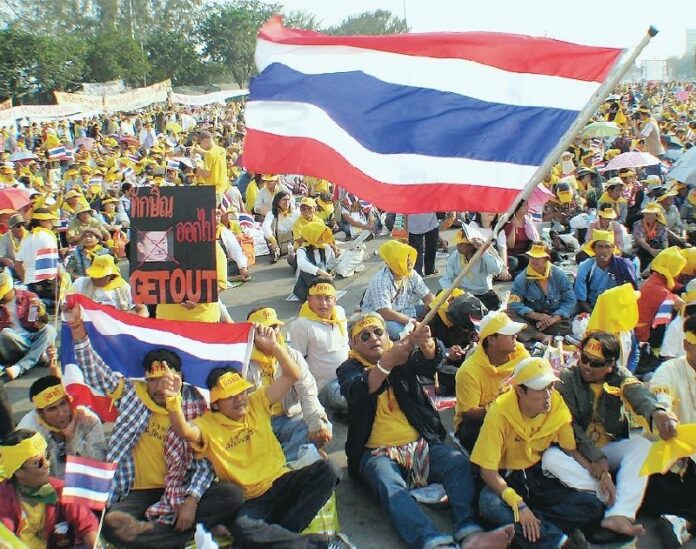
SURAT THANI — The firebrand leader of the ultra-conservative protest movement that helped pave the way for the 2014 coup d'etat says he will leave the monkhood and return to activism in the near future.

Suthep Thaugsuban, a veteran Democrat Party politician who became a monk after leading mass anti-government protests for six months prior to the 22 May coup, told reporters at a forest monastery in Surat Thani today that the rumors about his plan to return to secular – and political – life are true. 

"The rumors are true," said Suthep, who is also known by his monk name as Phra Suthep Paphakaro. "I have determined that there are works in the current situation that I have to help. So I decided I will leave monkhood, but when, I have to think about it first."

Suthep said he will return to "campaign on civil issues" with the Great Mass of the People Foundation, a charity founded by the leaders of the former anti-government protest campaign.

"The foundation will work in promoting strength and cohesiveness among the people, such as how to make people have Dharma in their heart," Suthep said. "We will promote a moral and ethical society. We will support self-sufficiency communities projects, and model communities for married, poor couples who want to live  meaningful, moral, and self-reliant lives as farmers."

Suthep said the charity will purchase plots of land on Koh Samui island to conduct these projects. 

In November 2013, Suthep quit his position as the deputy chairman of the Democrat Party to lead the protests against then-Prime Minister Yingluck Shinawatra. The protests were sparked by the government's attempt to pass a law that would have granted legal amnesty to Yingluck's brother, former Prime Minister Thaksin Shinawatra, who was ousted in a 2006 military coup and later convicted of corruption. 

Thaksin is extremely popular among farmers in Thailand’s rural north and northeast but fervently loathed by the Democrat Party and its supporters among the Bangkok bourgeois and other traditional elites. The controversial leader has been living in exile since 2008 to avoid the corruption verdict, but has continued to assert his influence through his political allies and proxies.

Suthep’s street protests later evolved into an effort to topple Yingluck's government completely, and replace it with an unelected "people's council." The protests came to an end when then-army chief Gen. Prayuth Chan-ocha stepped in and staged a coup with the stated aim of restoring peace and order.

Gen. Prayuth, who is now acting as Prime Minister, says a new election will be held by September 2016 at the earliest. Critics say the junta has largely taken up the demands of the anti-government protesters. 

In today's interview, Suthep insisted that he would not return to parliamentary politics with the Democrat Party.

"I will not take up membership in the Democrat Party," he said. "I will not run as a candidate in the next election. I won't fight in politics in the same way that I used to do." 

However, he said he would not condemn other former protest leaders who do return to politics under the wing of the Democrat Party.

"It's their right," Suthep said. "There were millions of people who came out to fight alongside us in 2013 and 2014. I cannot judge them the same way I judge myself. Some have to go back to being MPs. Some have to work in politics. This is up to the thoughts of each person." 

When a reporter asked him whether he would still welcome the politicians who seek his counsel, Suthep said, "I am not the most important person in this country. I am only an ordinary person. I would like to do my duty for His Majesty the King, for the country, and the people." 

 
For comments, or corrections to this article please contact: [email protected]

You can also find Khaosod English on Twitter and Facebook
http://twitter.com/KhaosodEnglish
http://www.facebook.com/KhaosodEnglish

Advertisement

Suthep to Leave Monkhood and Return to Activism

Former anti-government protest leader Suthep Thaugsuban surprised many by appearing as a monk in Surat Thani, 16 July 2014.

SURAT THANI — The firebrand leader of the ultra-conservative protest movement that helped pave the way for the 2014 coup d’etat says he will leave the monkhood and return to activism in the near future.

Suthep Thaugsuban, a veteran Democrat Party politician who became a monk after leading mass anti-government protests for six months prior to the 22 May coup, told reporters at a forest monastery in Surat Thani today that the rumors about his plan to return to secular – and political – life are true.

“The rumors are true,” said Suthep, who is also known by his monk name as Phra Suthep Paphakaro. “I have determined that there are works in the current situation that I have to help. So I decided I will leave monkhood, but when, I have to think about it first.”

Suthep said he will return to “campaign on civil issues” with the Great Mass of the People Foundation, a charity founded by the leaders of the former anti-government protest campaign.

“The foundation will work in promoting strength and cohesiveness among the people, such as how to make people have Dharma in their heart,” Suthep said. “We will promote a moral and ethical society. We will support self-sufficiency communities projects, and model communities for married, poor couples who want to live  meaningful, moral, and self-reliant lives as farmers.”

Suthep said the charity will purchase plots of land on Koh Samui island to conduct these projects.

In November 2013, Suthep quit his position as the deputy chairman of the Democrat Party to lead the protests against then-Prime Minister Yingluck Shinawatra. The protests were sparked by the government’s attempt to pass a law that would have granted legal amnesty to Yingluck’s brother, former Prime Minister Thaksin Shinawatra, who was ousted in a 2006 military coup and later convicted of corruption.

Thaksin is extremely popular among farmers in Thailand’s rural north and northeast but fervently loathed by the Democrat Party and its supporters among the Bangkok bourgeois and other traditional elites. The controversial leader has been living in exile since 2008 to avoid the corruption verdict, but has continued to assert his influence through his political allies and proxies.

Suthep’s street protests later evolved into an effort to topple Yingluck’s government completely, and replace it with an unelected “people’s council.” The protests came to an end when then-army chief Gen. Prayuth Chan-ocha stepped in and staged a coup with the stated aim of restoring peace and order.

Gen. Prayuth, who is now acting as Prime Minister, says a new election will be held by September 2016 at the earliest. Critics say the junta has largely taken up the demands of the anti-government protesters.

In today’s interview, Suthep insisted that he would not return to parliamentary politics with the Democrat Party.

“I will not take up membership in the Democrat Party,” he said. “I will not run as a candidate in the next election. I won’t fight in politics in the same way that I used to do.”

However, he said he would not condemn other former protest leaders who do return to politics under the wing of the Democrat Party.

“It’s their right,” Suthep said. “There were millions of people who came out to fight alongside us in 2013 and 2014. I cannot judge them the same way I judge myself. Some have to go back to being MPs. Some have to work in politics. This is up to the thoughts of each person.”

When a reporter asked him whether he would still welcome the politicians who seek his counsel, Suthep said, “I am not the most important person in this country. I am only an ordinary person. I would like to do my duty for His Majesty the King, for the country, and the people.”

Advertisement

Prayuth Will Stay in Power if 'Everyone Wants Me to'

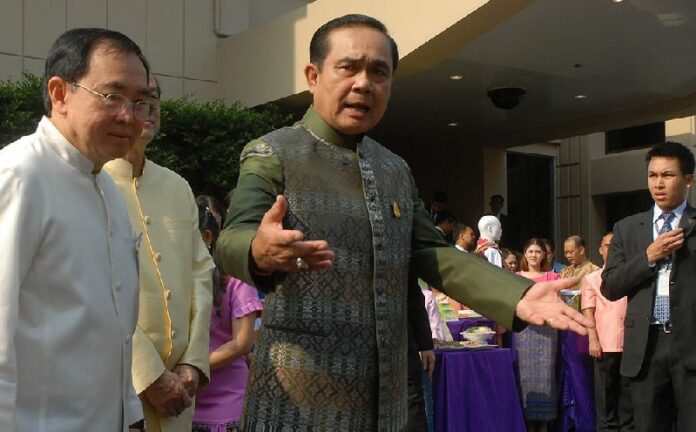
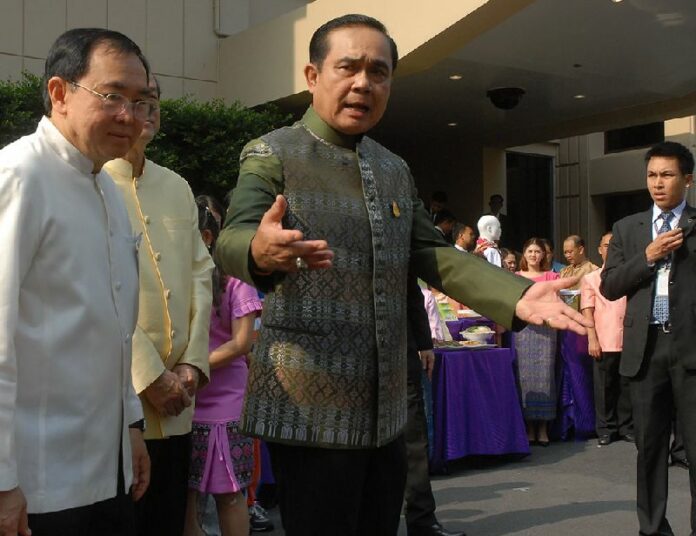
Gen. Prayuth Chan-ocha speaking to reporters at Ministry of Finance, 3 June 2015

BANGKOK — Junta chairman and Prime Minister Prayuth Chan-ocha said he will stay in power for two more years if the measure, which was recently proposed by members of the junta’s reform body, has support from the Thai people.

The junta chairman was referring to a proposal submitted by 26 members of the National Reform Council that calls for holding a referendum to determine whether to postpone national elections for two more years so that Gen. Prayuth can continue working on his stated missions of reforming and reconciling the country.

"I'm so-so. If they want me to stay, I will do it," said Gen. Prayuth, who seized power in coup d’etat one year ago. 

"I won't stay by using power. If everyone wants me to stay, I will stay, I will do it for you. But you have to help shield me from domestic and external [pressures] – the accusations that I want to hold on to my power. I don't want power, because I don't have anything to gain from this. I only want to make this country better."

He continued, "Let me ask you, do you think I would be happy if I were to stay? If they want me to stay, find a channel. But whether this proposal is good or not, I don't know. How can I deliberate on it and say whether it's good? Because I am in power right now, how can I say whether it will be good if I stay longer? Can I say that right here? So, today, whoever wants me to reform the country, the people must go and find me a way." 

According to the junta’s current timetable, a national election will take place by September 2016 at the earliest, given that the public votes in favor of the new constitution being drafted under the junta's oversight.

After seizing power in May 2014, Gen. Prayuth appointed several committees to implement reforms across a variety of sectors. Throughout the reform process, the junta has kept a tight lid on freedom of expression in the name of reconciling the country's divided political factions, which were staging mass rallies in Bangkok prior to the coup. Those who violate the junta's ban on politicial activities and protests are usually arrested, and some have been prosecuted in martial court. 

When a reporter asked Gen. Prayuth to comment on whether his current government or the next elected government will be better suited for reforming the country, the general replied, "You want democracy, isn't that right? You told me I am not democratic. I didn't come here through an election. You keep telling me that every day. International communities also ask me when there will be the next election. So, it's up to Thai people, how they will set the future of Thailand. It's up the 67 million Thai people. It's their say, not mine."

When the reporter commented that a wave of criticism is expected to break out if Gen. Prayuth decides to stay on for two more years, Gen. Prayuth quipped, "I am not afraid of criticism. The more you criticize me, the more resolve I have." 

 
For comments, or corrections to this article please contact: [email protected]

You can also find Khaosod English on Twitter and Facebook
http://twitter.com/KhaosodEnglish
http://www.facebook.com/KhaosodEnglish

Advertisement

Prayuth Will Stay in Power if 'Everyone Wants Me to'

Gen. Prayuth Chan-ocha heading a meeting at Ministry of Finance, 3 June 2015

BANGKOK — Junta chairman and Prime Minister Prayuth Chan-ocha said he will stay in power for two more years if the measure – which was recently proposed by members of the junta’s reform body – has support from the Thai people.

The junta chairman was referring to a proposal submitted by 26 members of the National Reform Council that calls for holding a referendum to determine whether to postpone national elections for two more years so that Gen. Prayuth can continue working on his stated missions of reforming and reconciling the country.

"I'm so-so. If they want me to stay, I will do it," said Gen. Prayuth, who seized power in coup d’etat one year ago. 

"I won't stay by using power. If everyone wants me to stay, I will stay, I will do it for you. But you have to help shield me from domestic and external [pressures] – the accusations that I want to hold on to my power. I don't want power, because I don't have anything to gain from this. I only want to make this country better."

He continued, "Let me ask you, do you think I would be happy if I were to stay? If they want me to stay, find a channel. But whether this proposal is good or not, I don't know. How can I deliberate on it and say whether it's good? Because I am in power right now, how can I say whether it will be good if I stay longer? Can I say that right here? So, today, whoever wants me to reform the country, the people must go and find me a way." 

According to the junta’s current timetable, a national election will take place by September 2016 at the earliest, given that the public votes in favor of the new constitution being drafted under the junta's oversight.

After seizing power in May 2014, Gen. Prayuth appointed several committees to implement reforms across a variety of sectors. Throughout the reform process, the junta has kept a tight lid on freedom of expression in the name of reconciling the country's divided political factions, which were staging mass rallies in Bangkok prior to the coup. Those who violate the junta's ban on politicial activities and protests are usually arrested, and some have been prosecuted in martial court. 

When a reporter asked Gen. Prayuth to comment on whether his current government or the next elected government will be better suited for reforming the country, the general replied, "You want democracy, isn't that right? You told me I am not democratic. I didn't come here through an election. You keep telling me that every day. International communities also ask me when there will be the next election. So, it's up to Thai people, how they will set the future of Thailand. It's up the 67 million Thai people. It's their say, not mine."

When the reporter commented that a wave of criticism is expected to break out if Gen. Prayuth decides to stay on for two more years, Gen. Prayuth quipped, "I am not afraid of criticism. The more you criticize me, the more resolve I have." 

 
For comments, or corrections to this article please contact: [email protected]

You can also find Khaosod English on Twitter and Facebook
http://twitter.com/KhaosodEnglish
http://www.facebook.com/KhaosodEnglish

Advertisement

Talk on Human Rights in Post-Coup Thailand Canceled on Junta's Orders

Junta chairman Gen. Prayuth Chan-ocha at the Government House in Bangkok on 4 June 2015.

BANGKOK — The Foreign Correspondents' Club of Thailand (FCCT) has cancelled a panel discussion on the junta's suppression of human rights after police officers presented the club's board with a written order from the military government this morning.

The event was organized by the Thai Lawyers for Human Rights, a group whose talks have been similarly blocked by Thai authorities since the May 2014 coup.

In a statement sent out at 2:30pm, the FCCT said the event was officially "cancelled on the orders of the NCPO and the police."

The junta, known formally as the National Council for Peace and Order (NCPO), has maintained a ban on political activities and public criticism since it toppled an elected government one year ago.

The order delivered by police to the FCCT today said authorities had "received information from relevant individuals" that the event "may allow individuals with ill intention to create a [negative] situation and cause unrest, and may lead to a violation of the laws, and will not be appropriate under the current situation."

Writing on Twitter, FCCT President Jonathan Head said the club would be "open as usual tonight," despite the cancellation. "Please be aware there will be a visible police presence," he wrote.

Poonsuk Poonsukcharoen, a member of the Thai Lawyers for Human Rights, told Khaosod English that the group still plans to go to the FCCT at 6pm tonight to discuss the junta's human rights violations.

"I insist that we will go ahead [with the event]," she said.

Over the past year, the military government has come under steady criticism from human rights groups for suspending democracy and trampling on civil liberties in the name of achieving "national reconciliation." 

In a press release for tonight's event, the Thai Lawyers for Human Rights said the junta had "stripped the people of their rights" by detaining people without charges, banning political assemblies, and prosecuting civilians in martial court.

On the one-year anniversary of the coup last month, Human Rights Watch published a detailed report describing how the junta has "used dictatorial power to systematically repress human rights throughout the country."

"Thailand is a political dictatorship with all power in the hands of one man," said HRW's Asia Director Brad Adams, referring to junta chairman and Prime Minister Gen. Prayuth Chan-ocha. "Backsliding on respect for basic rights and democratic reform seems to have no end in sight."

Today marked the third time Thai authorities have interfered with events at the FCCT, long considered a sanctuary for free debate, since the May 2014 coup. 

Five days after the coup on 27 May 2014, soldiers stormed the FCCT and detained former Minister of Education Chaturon Chaisaeng while he was speaking to a crowd of foreign journalists about why he did not surrender himself to the NCPO, which summoned hundreds of politicians and activists for "attitude adjustment" in the wake of the military takeover.

In September, police barged into the club to stop the Thai Lawyers for Human Rights from holding a talk titled "Access to Justice in Thailand: Currently Unavailable."
 
(Reporting by Sally Mairs)
 
For comments, or corrections to this article please contact: [email protected]

You can also find Khaosod English on Twitter and Facebook
http://twitter.com/KhaosodEnglish
http://www.facebook.com/KhaosodEnglish


Advertisement

First Refugees Arrive in Cambodia Under Australia Resettlement Deal

Refugees from Australia (C), are guarded by Cambodian officers as they arrive at Phnom Penh International Airport, Cambodia, 04 June 2015. Cambodia received four refugees from Australia following an agreement of the resettlement of refugees between Australian and Cambodian governments. EPA/MAK REMISSA

PHNOM PENH (DPA) — The first group of refugees to be resettled in Cambodia under a controversial refugee deal with Australia arrived in the capital Phnom Penh early Thursday.

The four, three Iranians and one man from the ethnic Rohingya group in Myanmar, arrived at Phomm Penh airport on a flight from Kuala Lumpur.

They had been previously been held on the Pacific island of Nauru, where Australia has one of its offshore detention centres housing some 1,200 refugees. 

The refugees and accompanying officials left the airport in two white vans.

Under a deal signed in September 2014, Cambodia was to receive 40 million Australian dollars (31 million US dollars) in aid from Australia in exchange for resettling refugees on a voluntary basis. Canberra would also pay transportation costs. 

"A number of [refugees] found to be in genuine need of protection will now have the opportunity and support to re-establish their lives free from persecution" in Cambodia, the two countries said at the time.

The transfer was facilitated by the International Organization for Migration, which will also help them with settling into normal lives in Cambodia, although little detailed information has been released about the refugees' future living conditions.

The deal has been widely criticized by human rights groups, and UN agencies such as the children's fund UNICEF, who say it violates treaties including the Convention on the Rights of the Child.

Others accuse Australia of passing the burden of resettling refugees on to a poorer country less well-equipped to host them.

Australian leaders have defended the resettlement policy, which is part of its aim to stop the arrival of illegal boat migrants on Australian shores.

Almost no boats, which used to mainly come from Indonesia, have reached Australia since Prime Minister Tony Abbott toughened the policy on boat migrants after winning elections in September 2013.

(Reporting by Kyaw Lynn)

 
For comments, or corrections to this article please contact: [email protected]

You can also find Khaosod English on Twitter and Facebook
http://twitter.com/KhaosodEnglish
http://www.facebook.com/KhaosodEnglish

Advertisement

Hot News

LATEST NEWS

Bangkok
overcast clouds
33.8 ° C
35 °
32.2 °
63 %
3.6kmh
100 %
Sat
37 °
Sun
36 °
Mon
35 °
Tue
34 °
Wed
33 °